
Crypto World
How to Make the U.S.-China AI Race Less Dangerous


The Trump Administration should push for technical exchanges on how to actually test models for dangerous capabilities and behaviors that neither country wants to see released into the wild. These include AI systems capable of helping amateurs develop bioweapons, or evading human oversight and control. American AI companies have been studying these risks for years, and they have also begun to appear in Chinese technical standards related to safety testing. Exchanging best practices and new insights about how to test for and mitigate these risks could render the systems built in both countries meaningfully safer.
These proposed technical exchanges would not depend on “trust” or even strict “reciprocity” between the two superpowers, nor would they require identical conceptions of AI risk. They would be driven by self-interest. As the most advanced AI models grow even more powerful, both countries have an interest in ensuring that these systems remain controllable, regardless of where they are built or deployed. That will require both countries to improve their model testing, monitoring and safeguards, and share promising findings that could enhance safety without surrendering a competitive edge or undermining national security.

Just a few days after receiving major blows from the US Federal Reserve and the Senate, bitcoin’s price suddenly skyrocketed by a few grand and topped $80,000 for the first time in over ten days.
The altcoins have followed suit, with ETH surging past $2,550, while XRP has rocketed to over $1.35. Naturally, the liquidations are on the rise.
Recall that the primary cryptocurrency slumped to $75,000 on Tuesday evening after the CLARITY Act setback in the US Senate. Although the asset defended that zone, more volatility ensued a day later when the Fed hiked rates for the first time since July 2023.
However, BTC rebounded almost immediately after the initial shock and went past $76,000. It kept fluctuating in the following days, but the bulls appeared to be in control. Today’s decision by the Bank of Japan to increase the rates to a 31-year high was well received by the cryptocurrency, which jumped to just over $78,000.
It remained there for hours before it went on the offensive minutes ago, skyrocketing to over $80,000. This level was last breached on September 7.
Most altcoins have marked substantial 2-3% gains over the past hours as well. Ethereum has seemingly reclaimed the $2,550 level after a 2.3% hourly jump, while XRP is above $1.35 after a 3% increase. SOL and BNB have marked slightly more modest gains.
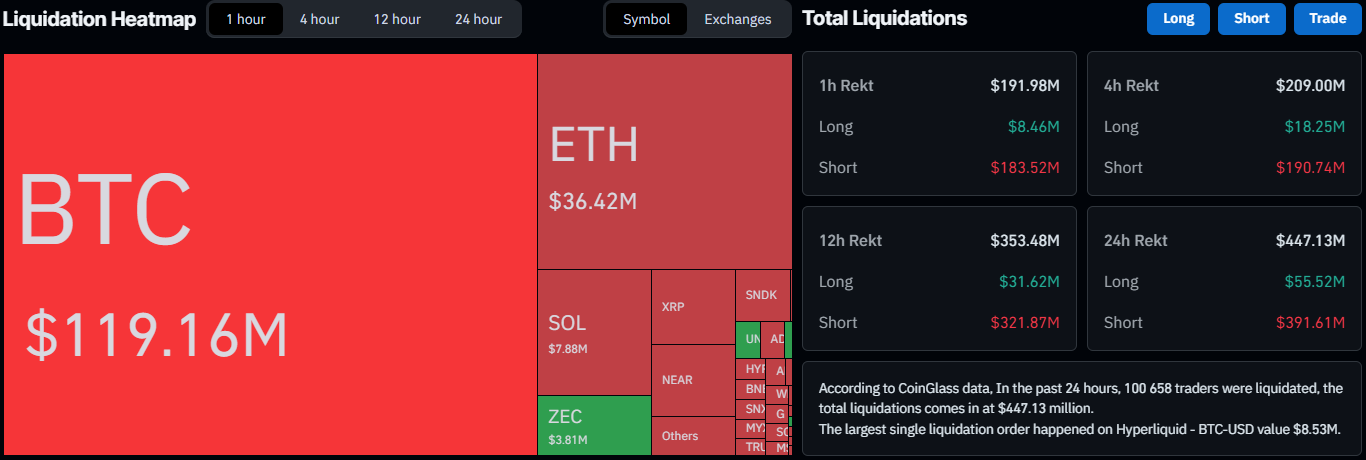
Data from CoinGlass shows that $192 million worth of over-leveraged positions were wrecked in the past hour, with shorts responsible for more than $183 million. BTC holds the lion’s share ($119 million), followed by ETH ($36 million).
On a daily scale, the numbers are even higher, with $450 million wrecked. $390 million was from shorts. In total, more than 100,000 traders have been wiped out within this timeframe.
The post Bitcoin Price Suddenly Rockets Past $80K Leaving $180M in Shorts Liquidated appeared first on CryptoPotato.

Investor’s Business Daily’s IBD 50 index is on track for a third straight down month, and some of its components are sputtering. Various factors help decide when to sell stocks, and five have already triggered sell signals. AngloGold Ashanti (AU) broke out above a 113.30 buy point on Aug. 20. Nearly a month later, the stock is struggling, down 10%…
Copyright ©2026 Investor’s Business Daily, LLC. All rights reserved. 87990cbe856818d5eddac44c7b1cdeb8

Artificial intelligence has come under renewed scrutiny of late, with many plays in the space coming off highs. But AI stock NetApp (NTAP) is now eyeing a potential buy point after getting support at a key level. California-based NetApp offers data storage systems and cloud data services. It operates through two segments, hybrid cloud and public cloud. It derives the…
Copyright ©2026 Investor’s Business Daily, LLC. All rights reserved. 87990cbe856818d5eddac44c7b1cdeb8

Long before they met, Ramakrishnan was a huge fan of Patriot Act, a Netflix series in which Minhaj wielded punchlines and PowerPoint presentations to unpack politics and the perils of unchecked capitalism.
“The first time I met you was way later at one of your first ever performances of Hasan Hates Ronnie / Ronnie Hates Hasan,” she tells Minhaj, referring to his live comedy tour with Ronny Chieng.
“And you were in full costume, right? You were dressed as Princess Leia or something like that?”
“It wasn’t a costume,” says Maitreyi. You can hear the eyeroll in her voice. “It was fashion.”
“Wait wait,” Minhaj says, shrinking.
“But it’s fine. Whatever. Wouldn’t expect you to know, Minhaj.”
“You had a full hood.”
“It was a karate gi meets Obi-Wan Kenobi up top.”
This jabbing rapport reads as a playful generational tete-a-tete between millennial and Gen Z, but it also speaks to the exchange of perspectives that informed their collaboration on Best of the Best. “What you’re seeing in the movie,” says Minhaj, “is Maitreyi and Lena coming together, and really masterminding and creating the tone and the feeling of the film.”


A 50–49 Senate vote that stalled the CLARITY Act has raised the risk that crypto companies will rely on more custodians and permissioned systems, according to GenLayer Labs CEO Albert Castellana.
Summary
- The Senate vote fell 10 votes short of the 60 needed to begin debate.
- Castellana said unclear rules could push companies toward custodians, restricted frontends and administrator keys.
- The GENIUS Act covers stablecoin issuance but leaves questions involving DeFi, wallets and trading.
- Bitwise CIO Matt Hougan called the failed vote “a speed bump, not a roadblock.”
GenLayer Labs CEO and co-founder Albert Castellana told crypto.news that the Senate result was disappointing because the proposal had been moving toward a principle he considers important: regulation should follow control.
Entities that hold customer funds, decide who may transact, or stand between two parties perform a different role from developers who publish software or users who join an open network, according to Castellana.
Without rules that recognize the difference, he said companies may respond by adding custodians, restricting access or placing another intermediary between users and blockchain applications.
“Every one of those decisions can look reasonable on its own. But you do that enough times, and suddenly you’ve rebuilt most of the intermediaries crypto was supposed to get rid of.”
CLARITY Act failure could encourage centralized safeguards
The Senate voted 50–49 against invoking cloture on H.R. 3633, leaving the proposal 10 votes short of the 60 required to open formal debate.
As crypto.news previously reported, the failed motion blocked immediate consideration of a framework that would divide oversight between the Securities and Exchange Commission and the Commodity Futures Trading Commission.
The proposal would have given the CFTC authority over qualifying digital commodities and registered spot-market intermediaries. The SEC would have retained jurisdiction over assets and transactions governed by securities laws.
Other provisions addressed decentralized software developers, stablecoin rewards, government ethics and prediction-market contracts that could conflict with state or tribal gambling rules. A revised classification framework also would have treated XRP as a digital commodity in secondary-market transactions, regardless of Ripple’s holdings.
Castellana said regulatory uncertainty does not necessarily cause companies to stop developing products. Instead, legal concerns influence how they design and offer them.
“You add another custodian. You make the frontend permissioned. You use a centralized provider because it’s easier to explain to lawyers. You block the US. You keep an admin key because somebody wants a clear responsible party,” he said.
For American users, such decisions can determine whether they retain direct access to a protocol or must use a company-controlled interface that can restrict transactions, impose identity checks or exclude US residents.
Control provides a test for deciding who should face regulation
Rather than asking whether an entire project is decentralized, Castellana proposed examining where each system places the power to force an outcome.
“For me the simplest test is: who can actually force an outcome? Can you freeze my money? Move it? Stop my transaction? Change the rules underneath me? Override the result? If you can, then you have control.”
Publishing code does not necessarily give a developer control over the finished protocol, he said. Operating one validator or owning governance tokens also may not provide enough power to determine what happens to funds or transactions.
Different parts of the same product may distribute authority in different ways. Castellana cited a permissionless protocol with a company-controlled frontend as one possible structure, while another network could use independent validators but retain an administrator key capable of changing its rules.
“I would much rather regulate the place where the power actually exists,” he said.
The distinction matters for developers because market-structure legislation has included protections intended to separate passive software development from regulated financial activity. With the Senate motion defeated, federal agencies retain responsibility for interpreting existing securities and commodities laws unless Congress revives the proposal.
Stablecoin rules leave DeFi and wallet questions unresolved
The GENIUS Act has already created clearer requirements for payment-stablecoin issuers, including rules for reserves and redemptions. Castellana said the law resolves an important part of the regulatory question, but its focus remains on the money rather than the applications built around it.
“So I don’t think stablecoin payments are waiting for CLARITY. They aren’t. But we are getting clarity on the money faster than we are getting clarity on the economy that will be built around it.”
Once stablecoins enter decentralized finance, custody products, self-hosted wallets or trading applications, companies must still decide whether a participant acts as an intermediary or merely provides software, according to Castellana.
The SEC’s work on tokenized securities offers one example of regulation proceeding through separate measures. A Sep. 11 report covered the agency’s proposed 60-day rulemaking process for transfer agents, which would permit blockchain-based systems to maintain securities ownership records.
Castellana said the SEC has also opened a path for tokenized stocks to use public, permissionless blockchains, although access to trading venues remains controlled and the exemption is temporary.
“Maybe that’s a reasonable bridge for now,” he said. “The risk is that bridges have a habit of becoming permanent infrastructure.”
For US investors, blockchain settlement alone does not determine whether a token gives its holder legal ownership of a share. The issuance structure, official ownership register, custody terms and applicable securities rules continue to determine voting, dividend and other shareholder rights.
Hougan says the bull market does not depend on Congress
Bitwise Chief Investment Officer Matt Hougan has taken a less cautious view of the vote’s effect on crypto prices.
In January, Hougan warned that a failure to pass the CLARITY Act could stall the 2026 bull market. One day after the Senate vote, however, he described the result in a Sep. 16 client memo as “a speed bump, not a roadblock.”
Hougan based his revised view partly on the difference between Bitcoin’s performance and the bill’s declining prospects. Bitcoin rose from a July 1 low of $57,950 to more than $80,000 on Sep. 4, while Polymarket traders reduced the probability of passage.
The immediate vote still caused losses across major crypto assets. BTC fell 3.7%, ETH lost 5.2%, and XRP declined 7.3%, while liquidations reached $669 million.
Institutional companies also continued developing blockchain products while the bill remained uncertain, Hougan said. He cited Robinhood’s blockchain launch, Morgan Stanley’s Solana ETF and the Depository Trust & Clearing Corporation’s first settlement of tokenized stock trades.
Hougan argued that SEC and CFTC rulemaking could support continued development without a new statute, although he acknowledged that a later administration could reverse agency rules.
AI agents raise another question about control
Castellana applied the same control principle to AI agents that can negotiate agreements or initiate transactions. A company or person that gives an agent authority over funds must remain accountable for that decision, he said.
“I don’t think ‘the AI did it’ can become an excuse,” Castellana said.
Automated agents may eventually enter large numbers of agreements that cannot account for every possible result in advance. Disputes could involve whether work was completed, whether its quality met the agreed standard or whether one party broke the terms.
GenLayer is developing a system in which agents can set terms, acceptable evidence and collateral requirements before entering an agreement, according to Castellana. If a dispute occurs, independent validators evaluate the evidence, while participants retain the ability to challenge the result.
“We need to verify the agreement, the evidence and the process used to reach the outcome,” he said.
The House passed H.R. 3633 by a 294–134 vote in July 2025, but the Senate later prepared different language. Any revived Senate version would still need approval from the House or reconciliation between the two chambers before it could reach the president.
It was expected to be a massively eventful week for the entire cryptocurrency industry, and it was.
But first, let’s see what happened precisely seven days ago. The US CPI data had just come out, confirming that inflation is still persistent. As such, the US Federal Reserve had all the missing pieces to its monetary puzzle, and experts predicted a rate hike on September 16.
BTC went wild after the CPI data was announced, going from $77,000 to $76,000 before it suddenly exploded to $79,800, where it was violently rejected and driven south to its starting point. All of this took place within an hour or so. After this enhanced volatility, the market calmed during the weekend, with BTC trading sideways at around $77,000.
It dipped to $76,400 on Monday before the bulls took control and drove it to $79,600 ahead of the key CLARITY Act vote a day later. BTC had already retreated to $77,000 when it became official that the Senate rejected cloture to advance the bill, and bitcoin plunged to a three-week low of $75,000.
The bulls managed to defend that level, but the next day was anticipated to be just as eventful with the conclusion of the FOMC meeting. The Fed indeed hiked the rates for the first time in over three years, but BTC’s reaction was more modest and somewhat surprising. The asset slipped to $75,000 once again initially, but rocketed to over $76,000 within minutes.
It kept climbing gradually on Thursday and especially on Friday. Although the BOJ also increased the rates by 25 bps to a 31-year high, BTC actually reclaimed $78,000 during the morning trading session. It stood there for a while, but initiated another leg up as US trading hours began and rocketed to a two-week peak of $81,000, where it was stopped, at least for now.
This means that BTC is actually in the green during the week in which all major events went against it. Meanwhile, ZEC continues its massive rally, while NEAR has rocketed by 35%. UNI is up by over 30% as well, followed by HYPE, BCH, and a few others. RAIN has plummeted by 22%.
Market Data

Market Cap: $2.770T | 24H Vol: $96B | BTC Dominance: 58.6%
BTC: $80,600 (+0.9%) | ETH: $2,570 (-3%) | XRP: $1.37 (-4%)
This Week’s Crypto Headlines You Can’t Miss
Strategy Stays on the Sidelines Again, but Strive Buys More Bitcoin. The week began with a familiar announcement: Strategy refused to buy more BTC while it continues to focus on rebuilding its USD stash. At the same time, Strive keeps accumulating more BTC, adding another 469 units.
Bitcoin Could Get More Support Than Gold as ETF Hedging Eases: JPMorgan. Analysts at the Wall Street behemoth said BTC may gain more price support than the precious metal amid easing ETF hedging demand, with BlackRock’s iShares Bitcoin Trust showing high short interest.
From Bear to Bull: Analyst Says Bitcoin UTXO Data Points to a Cycle Shift. Bitcoin’s share of addresses sitting at a loss has dropped sharply, and an on-chain analyst said moves of that size have historically ended bear markets and are not just producing a short bounce.
SEC Opens Door to Onchain Stock Trading With New ‘Innovation Exemption’. The regulator has launched an “Innovation Exemption” to promote secondary trading of tokenized stocks on blockchain platforms, easing regulatory burdens for Tokenized Securities Venues.
Seven Democrats Refuse to Give Up on CLARITY Act After Senate Setback. Despite the latest developments on the matter, several Democrats stated that this is not the end, pledging to continue bipartisan efforts for crypto regulatory clarity.
CoinEx Calls Time After Nearly Nine Years as Crypto Market Pressure Mounts. After nine years in existence, CoinEx has decided to shut down its platform by the end of the year due to declining crypto market conditions and increased regulatory pressures. As such, the exchange joins other major names that fell during the 2026 bear market, such as BitMart and BitMEX.
Charts
This week, we have a chart analysis of Ethereum, Ripple, Cardano, Binance Coin, and Hyperliquid – click here for the complete price analysis.
The post Bitcoin Hits 14-Day High Despite CLARITY Setback, Fed and BOJ Rate Hikes: Weekly Recap appeared first on CryptoPotato.


HYPE has risen 10.5% to $91.20 after Hyperliquid introduced manual USDC and USDT borrowing against HYPE and Bitcoin collateral, with the token setting a new all-time high of $92.56.
Summary
- HYPE price gained 10.5% in 24 hours and reached a record $92.56 on Sep. 18.
- Hyperliquid users can borrow USDC and USDT against supplied HYPE or Bitcoin.
- HYPE carries a 65% loan-to-value ratio, compared with 50% for Bitcoin.
- Payward plans to offer regulated Hyperliquid perpetuals to eligible U.S. clients.
Hyperliquid loans accept HYPE and Bitcoin collateral
Hyperliquid’s official documentation states that manual borrowing went live on Sep. 18, allowing users to borrow USDC and USDT after supplying HYPE or Bitcoin as collateral. The new service runs through HyperCore, the same infrastructure that supports the platform’s portfolio margin system.
“Manual borrowing is supported for Manual/Standard and Unified Account users,” the platform said.
Portfolio margin accounts already handle borrowing automatically, so the separate manual action is unavailable to those users. Manual and unified account holders can instead choose the amount they want to borrow, subject to available liquidity and account-level and global limits.
HYPE collateral has a loan-to-value ratio of 65%, meaning $1,000 worth of HYPE provides up to $650 in borrowing capacity at the applicable oracle price. Bitcoin has a lower LTV of 50%, giving the same collateral value up to $500 in capacity.
When a user supplies both assets, Hyperliquid adds their respective borrowing contributions together. Supplied HYPE and Bitcoin do not earn interest, while supplied USDC and USDT earn interest but do not increase the account’s borrowing capacity.
Borrowed stablecoins accrue interest continuously, with the balance indexed every hour. According to the documentation, rates depend on how much available liquidity borrowers are using. Suppliers receive a lower annual percentage yield than borrowers pay because the interest is divided among a larger pool of supplied assets.
Hyperliquid also retains 10% of the interest paid by borrowers as a reserve for future liquidations. Data cited following the rollout placed total borrowed assets at about $269 million, showing early use of the lending feature.
Liquidation rules depend on collateral value
Hyperliquid uses a health factor to compare a user’s LTV-adjusted collateral with outstanding debt. An account cannot take another loan once its health factor reaches 100% or lower, although crossing that level does not automatically trigger liquidation.
Partial liquidation begins when borrowed value moves above the collateral value after applying the designated liquidation threshold. HYPE has an 82.5% partial liquidation threshold, while Bitcoin has a threshold of 75%.
Falling collateral prices can therefore increase liquidation risk even when the user does not borrow more. Interest charges, collateral withdrawals, and additional borrowing can also move an account closer to the threshold, according to the platform.
In an example provided in its documentation, Hyperliquid used 100 HYPE worth $40 each and a 2,000 USDC loan. The collateral would provide $2,600 in borrowing capacity at a 65% LTV, leaving another 600 USDC available to borrow.
For the same position, the account would reach the 82.5% partial liquidation threshold if the HYPE oracle price fell to about $24.24, excluding further interest. Hyperliquid noted that displayed liquidation prices can change as asset prices, balances, and accumulated interest move.
Multiple forms of collateral make the calculation more complex because the system includes the contribution from every supplied asset. A displayed liquidation price of “N/A” does not necessarily mean a position carries no risk, as the label can appear when another asset covers the debt or when the calculated price sits above the current oracle price.
HYPE price breaks above its previous record
CoinGecko data showed HYPE trading at $91.20 at the time of writing, up 10.5% over 24 hours. The token moved between $81.70 and $92.56 during the period, with the upper end setting its latest all-time high on Sep. 18.
Trading volume reached approximately $1.72 billion over 24 hours, while HYPE’s market capitalization stood near $20.3 billion. The token was also up 57.1% over 30 days, according to the same market snapshot.
The advance pushed HYPE above the $89.57 record set on Sep. 6. In an earlier technical report, crypto.news covered HYPE’s consolidation between roughly $84 and $88 after the previous high, when selling repeatedly appeared above $87.
HYPE later fell toward $78.70 as weaker momentum and legal concerns weighed on the market, before reversing above $90 following the manual borrowing rollout. The move also cleared the former $87–$90 liquidity area identified in the earlier report.
Bitcoin rose alongside HYPE, trading near $80,981 after gaining about 5.6% over the latest session. BTC moved between approximately $76,205 and $80,998 during the period, placing it close to its intraday high when the market data was recorded.
U.S. access remains tied to regulated partners
Hyperliquid’s growing product range has arrived while companies connected to the platform pursue a regulated route into the United States. The Hyperliquid Policy Center has also challenged CME’s lawsuit against the Commodity Futures Trading Commission over the agency’s approval of a Kalshi Bitcoin perpetual contract.
In its Sep. 9 filing, the policy group argued that CME had not shown a competitive injury caused by the CFTC’s decision. The group also said CME’s commercial interests did not fall within the protections of the Commodity Exchange Act provisions cited in the lawsuit.
A separate U.S. proposal involves Payward, the parent company of Kraken. On Sep. 16, Payward announced regulated Hyperliquid markets for eligible American clients through Bitnomial, subject to regulatory approval.
Under the proposed structure, Bitnomial Exchange would deploy and administer selected perpetual futures markets through Hyperliquid’s HIP-3 system. Bitnomial Clearinghouse would handle clearing and settlement, while NinjaTrader Clearing would carry approved customer accounts.
U.S. customers would need to complete onboarding with NinjaTrader Clearing and receive approval for the relevant Bitnomial market. Their associated addresses would also need to appear on the permissioned HIP-3 allowlist, rather than receiving access to every market available through Hyperliquid.
Payward said Hyperliquid would be the first blockchain protocol used for the planned service. The company has not announced a launch date, and CFTC records do not yet establish final approval for the proposed HIP-3 arrangement.

Occidental Petroleum (OXY) has been in a nice uptrend since early July and this latest pullback could represent a good buying opportunity. Investors could buy Occidental Petroleum stock at the current price, or they could use options to potentially buy it at a discount. This is like getting paid to place a limit order. Let’s say I have $5,500 that I…
Copyright ©2026 Investor’s Business Daily, LLC. All rights reserved. 87990cbe856818d5eddac44c7b1cdeb8
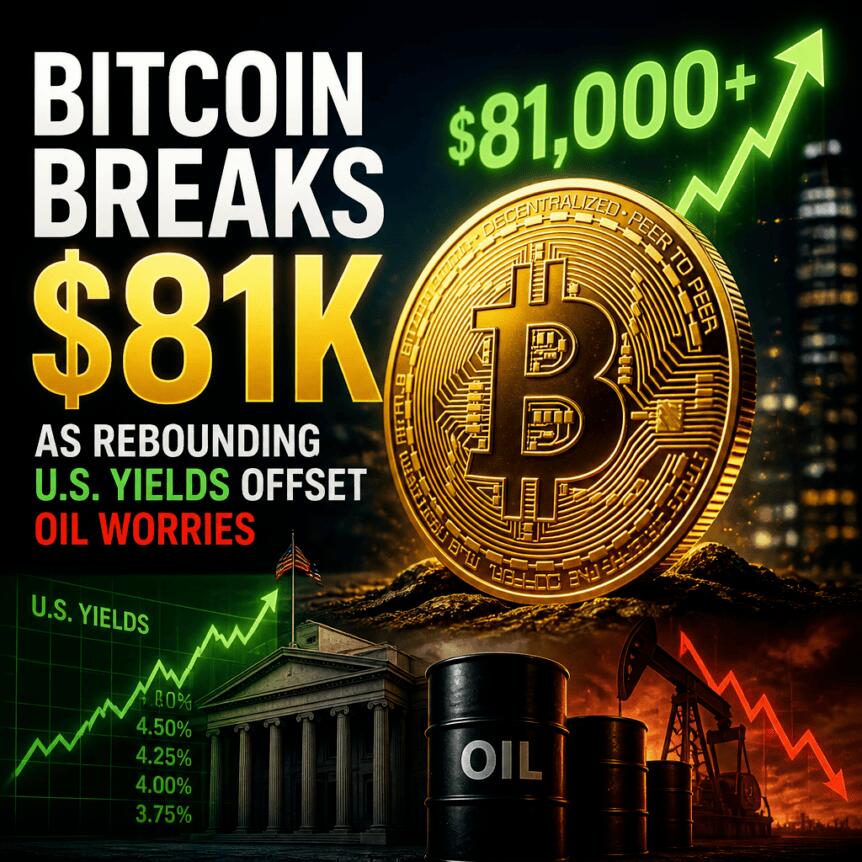
Bitcoin pushed through the $80,000 level during Friday’s Wall Street open, reaching a local high of $81,034 on Bitstamp. The move coincided with renewed stress in global energy markets, where concerns around oil supply fed into higher US bond yields—an interplay that has again spilled over into crypto.
Within hours, short-position liquidations accelerated across crypto derivatives. According to CoinGlass data cited in the report, cumulative cross-crypto short liquidations totaled close to $250 million over a four-hour window, helping fuel Bitcoin’s short-term upside momentum.
Key takeaways
- BTC gained about 6% on Friday as oil-supply worries contributed to US bond yields turning higher.
- Crypto liquidations intensified, with CoinGlass data putting cross-crypto short liquidations near $250 million in roughly four hours.
- Bitcoin’s rebound runs into well-watched resistance zones that previously surfaced around May.
- On-chain cost-basis benchmarks—such as Glassnode’s “True Market Mean”—suggest price has regained a historically important threshold.
Energy jitters and a bond-yield reversal lift BTC
TradingView data (as referenced in the source) showed BTC/USD “filling pockets” of upside liquidity to trade at local highs of $81,034 on Bitstamp. The price action was accompanied by a build-up of short positions above spot that were later liquidated.
CoinGlass’s liquidation heatmap data, also referenced in the original piece, showed cross-crypto short liquidations accumulating near $250 million over four hours. In practice, this kind of rapid unwind can amplify moves: as stops trigger and leveraged shorts are forced out, spot buying tends to intensify in the near term.
The catalyst was tied to crude oil. WTI traded down to lows around $94.8 per barrel before climbing again during Asia hours, moving toward the $98 area at the time of writing.
In a Friday commentary, the International Energy Agency (IEA) warned that countries may have to cut usage if Gulf supplies remain constrained and commercial inventory buffers continue to deplete quickly. The IEA noted that earlier emergency measures—such as the release of 400 million barrels in March following the Strait of Hormuz disruptions—helped ease prices from April peaks, aided by rerouted Middle East exports and increased output outside the region.
“But if Gulf supplies remain constrained in the coming months and commercial inventory buffers continue to deplete rapidly, higher prices and further demand reductions may be required to close the supply-demand gap.”
The IEA’s calculations also referenced a sizable gap between current oil flows through Hormuz and pre-war levels, estimating 7.6 million barrels per day in August—13.1 million below the daily tally before the US-Iran war.
As oil uncertainty returned, US rates followed. The US 30-year yield reached 5.34% on the day, up 90 basis points, according to the figures cited in the source. Earlier reporting by Cointelegraph had linked rising yields across multiple countries to expectations that central banks would maintain or raise interest rates—an environment that can reprice risk assets, including crypto.
Traders watch $82,000 and the risk of “double rejection”
While Bitcoin’s move above $80,000 drew immediate attention, short-term technical traders flagged a key test ahead. Trader and analyst Rekt Capital, commenting on low-time-frame action, described the current phase as a “moment of truth,” according to the X post cited in the source.
A chart shared on X positioned $82,000 as a critical breakout level for BTC/USD. If Bitcoin fails to clear and hold above it, the pattern could resemble a double rejection scenario, the source notes—linked to the prior market structure that ended the mid-May rebound.
For active traders, this framing matters because it highlights a transition point: momentum from liquidations can push price quickly through levels, but follow-through often depends on whether buyers defend breakout levels when volatility cools.
On-chain benchmarks: reclaiming a key cost basis
Beyond derivatives and price charts, the source also pointed to on-chain indicators tied to investor cost. Bitcoin’s latest upside reportedly helped it reclaim its True Market Mean, an aggregate measure of the cost basis of coins acquired on secondary markets. Glassnode, as referenced in the article, placed this benchmark at $76,660.
Glassnode’s interpretation—shared via X in the source—was that trading back above this level places Bitcoin “back into a bullish regime.” In other words, rather than treating the move as purely speculative, the argument is that reclaiming certain cost-basis thresholds can shift the balance between holders in profit and those sitting under historical averages.
The piece also referenced the cost basis for Bitcoin’s corporate treasuries, estimating it at $80,500. That figure sits near the current local trading range, implying that the market is oscillating around an area meaningful to long-term institutional buyers—an additional reason $80,000 to $82,000 could remain a focal zone for price action.
What to watch next as macro pressure and crypto volatility intersect
Bitcoin’s jump has so far been tied to macro spillovers from oil and rates, alongside derivatives positioning that helped accelerate the move. Over the next sessions, the key question is whether BTC can maintain gains through the $82,000 breakout test—or whether the market reverts to prior resistance levels seen around May while crude and bond yields continue to set the tone.

ETH witnessed a notable recovery after briefly plunging near $2,350 this week. The leading altcoin has since climbed over $2,480. At the same time, its transaction fees have fallen sharply, making the network cheaper to use.
The average cost per ETH transfer has dropped to around $0.095 from this year’s peak of $0.72 on April 21, according to Santiment’s findings.
Ethereum Gets Cheaper
The decline comes as mainnet demand softened during the bearish summer. However, network upgrades have also increased Ethereum’s capacity. Fusaka, higher blob throughput, and a 60 million gas limit have helped the network handle more activity. At the same time, Layer 2 solutions are processing large amounts of transactions that previously competed for Ethereum’s mainnet blockspace.
Lower fees could make Ethereum more accessible for users and developers, according to Santiment. Swaps, transfers, DeFi activity, stablecoin movements, and ERC-20 transactions can now be completed at a lower cost.
The analytics platform said that cheap transactions do not necessarily mean demand is recovering. But it is important to note that lower costs remove one of Ethereum’s long-standing barriers. With ETH prices having recovered, cheaper network activity could provide a more favorable environment for Ethereum-based projects.
Meanwhile, Ali Martinez observed that the asset is trading within a defined 4-hour channel despite recent market volatility. ETH has reached the lower boundary of the range, following which the $2,570 level has come into focus. Martinez expects a potential rebound toward the middle and upper end of the channel. A strong 4-hour close above $2,570, supported by higher trading volume, could signal a breakout. He added that the next stops would be $2,700 and then $3,000.
The Long Investor believes Ethereum remains a buy despite an almost 45% rise over the past three months. The investor said buying before ETH moves above $3,000 may put investors ahead of late buyers. They also pointed to the 200-week moving average as a strong long-term reference.
Supply Drain
Less ETH on exchanges is helping the recovery. Recent estimates revealed that only 6.06 million units now sit on exchanges, down from 22.9 million at the June 2020 peak. That is a 73% decline in readily available supply. The drop reflects more ETH moving into staking, ETFs, treasury holdings, and long-term custody.
Validators are also locking ETH to help secure the network. Lower liquid supply may increase the impact of buying activity. Even without a major rise in demand, smaller waves of buying can have a stronger effect when fewer coins are available on exchanges.
The post Ethereum Gets Cheaper: Network Fees Collapse Over 85% as ETH Price Rebounds appeared first on CryptoPotato.

East Belfast man jailed for drugs charges after using encrypted phone network

Kylian Mbappe signs with On after Nike parts ways
Bitcoin Price Suddenly Rockets Past $80K Leaving $180M in Shorts Liquidated

Weekend Open Thread – Corporette.com

Memory prices are slowing because buyers ran out of money

Micron Stock Climbs Above $1,031 as AI Memory Crunch and a $50 Billion Outlook Fuel the Rally

Bayley RETURNS | Sol Ruca qualifes for Money in the Bank Ladder Match: Raw highlights, Sept. 7, 2026

This is the largest USB Bitcoin Mining Setup in the world! |#Shorts | How Much?

Corporate Office Interior Transformation | UNIMONI by Wizz Financial
-
 Fashion7 days ago
Weekend Open Thread – Corporette.com
-

 Tech5 days ago
The Latest Weird Thing to Play Doom Is the Mapped-Out Brain of a Fruit Fly
-
 Crypto World4 days ago
Kraken Lets xStocks Holders Earn Yield Through DeFi
-

 Crypto World2 days ago
US Charges Robinhood Engineers Over Crypto Listing Trades
-

 Entertainment7 days ago
News Specials, Movies, Shows, More
-

 Crypto World6 days ago
Can AI Build a Startup in 72 Hours? Elon Musk's Team Will Livestream the Test
-

 Crypto World4 days ago
Elon Musk Drops a Bombshell: Grok 5 Could Be the AGI Breakthrough
-

 Business5 days ago
Rivals Sam Altman and Elon Musk Rally Behind Dario Amodei’s Call for a Slowdown in AI Development
-

 Crypto World3 days ago
What Is the Status of the U.S.-Iran Peace Talks? Here's What Both Sides Are Saying
-
 NewsBeat4 days ago
‘Sick conspiracy’: Trump says only guardrails AI needs is ‘a strong and smart (High IQ!) president’ in all-caps rant
-
 Crypto World5 days ago
New Tesla Roadster Uses SpaceX Tech. Will It Impact the Stock Price?
-

 Crypto World7 days ago
Robinhood Chain Never Stopped But its Blobs Did Stop Reaching Ethereum For 14 Minutes
-
 Crypto World3 days ago
NVIDIA Analysis: Attempted Rising Wedge Breakout Amid Pressure on the AI Sector
-
 Entertainment7 days ago
New Horror Movie Officially Earns a Rare Stephen King Recommendation
-

 Business6 days ago
Marvell: Most Potent Setup Of The AI Factory Decade
-

 Crypto World4 days ago
Revolut Attackers Warn of Ongoing Daily Customer Data Leaks
-

 Crypto World4 days ago
DOJ Seeks to Seize $61M in Iran Oil Funds From Binance Accounts It Vouched For
-

 Crypto World6 days ago
Bitcoin ETFs lose $462.7M as Ethereum funds gain $196.9M
-
 Crypto World5 days ago
3 Token Unlocks to Watch in the Third Week of September 2026
-
Business4 days ago
SK Hynix ADRs Fall More Than 6% as Memory Rally Breaks on Fears of Slower AI Spending
You must be logged in to post a comment Login