

Crypto World
How to Optimize Company Operational Costs: A Manual on Modern Payment Ecosystems


Recent business landscape shifts have forced companies to rethink financial management. Remote work, global teams, scattered suppliers — all demand fast, cheap, transparent settlements. Traditional banking works, sure, but often feels like shipping packages by postal carriage in the drone era. That’s why businesses increasingly seek alternatives enabling settlements without intermediaries and currency conversions within minutes.
This piece isn’t about financial miracles or tech wonders. Rather, it’s about building smart payment infrastructure, cutting fees, speeding operations while staying legally compliant. We’ll examine real tools (from classic methods to cutting-edge solutions) and identify where hidden costs lurk.
Anatomy of Corporate Payment Expenses
When Airbnb was gaining momentum, the company faced a challenge: paying hosts across 190+ countries. Bank transfers took 3–7% commission plus several days. The solution became a proprietary payment system — a path later echoed by modern crypto solutions for business, though not every company can afford or justify such investment.
Typical cost structure looks like this: payment system fees (1.5-3.5%), currency conversion (another 2-4% on unfavorable rates), interbank charges ($15 to $50 per SWIFT), internal processing costs (accounting salaries, software). Annually, an average company with €10M turnover might spend up to €350K just on transactional expenses.
Stripe published a 2023 study showing businesses underestimate real payment costs by 40-60%. Hidden expenses include chargebacks, fraud, human error during manual entry, cash flow delays. One mistaken $100K payment can paralyze a department for a week.
Classic Banking: Where Money Gets Lost
Picture a Polish IT company paying contractors in the US, India, and Portugal. Through SWIFT, transfers take 3-5 days, passing through 2-3 correspondent banks, each taking $25-40. Exchange rates set by banks with their own markup. Result: from $5,000 sent, the recipient gets $4,820. The rest vanishes in fees.
An alternative — systems like Wise (formerly TransferWise) — use local accounts to simulate international transfers. Instead of physically moving money across borders, the company sends zloty to Wise’s Polish account, while the recipient gets dollars from their US account. Fees drop to 0.4-1%, timing to one day.
Revolut Business went further, offering multi-currency accounts holding 28 currencies simultaneously. For companies with constant multi-currency settlements, this means buying euros or dollars during favorable rates, not when payment’s due.
Yet classic systems have limits. Payments to certain countries (Argentina, Nigeria, partially Turkey) remain complicated due to currency controls. Weekends and holidays paralyze SWIFT. Most importantly, even modern neobanks still operate within fiat system limitations.
Cryptocurrency Rails: When Speed Matters
When Tesla announced accepting Bitcoin, that was more PR than business strategy. But there are spheres where cryptocurrencies solved real pain points. GameStop launched an NFT marketplace in 2022 not for hype, but to monetize digital assets without intermediaries.
Practical applications run deeper than they appear. Companies use stablecoins (USDT, USDC) for rapid international settlements. Transferring $100K in USDC between Berlin and Toronto takes 15 minutes and costs $2-5, regardless of amount. Particularly relevant for e-commerce: stores can accept payments globally without configuring local payment gateways in each country.
Ripple (XRP) was specifically created for banks — JPMorgan, Santander and others test it for interbank settlements. Settlement speed: 3-5 seconds versus 3-5 days with SWIFT, fees: fractions of a cent. Mass adoption hasn’t happened yet due to regulatory uncertainty.
Businesses need to understand: cryptocurrencies aren’t fiat money replacements, but additional tools. Bitcoin or Ethereum volatility makes them unsuitable for daily settlements without instant conversion. Yet for payments to freelancers in countries with limited banking (Venezuela, Zimbabwe), sometimes it’s the only option.
Multi-Chain Solutions and Their Role
Previously, transferring between different blockchains was a quest: exchange Bitcoin for Ethereum through an exchange, withdraw to wallet, wait for confirmations. Modern cross-chain crypto swaps like those offered by LetsExchange have automated this process, allowing direct asset exchanges between different networks without centralized intermediaries.
Thorchain, Cosmos, and Polkadot built infrastructure for blockchain interaction. Practical business benefit: accept payments in one cryptocurrency, make payouts in another, optimizing fees. For instance, receive USDT on Tron network (fee $1), swap to USDC on Polygon (fee $0.01), and withdraw through Ethereum when gas is cheaper.
Uniswap V3 allows companies to independently provide liquidity and earn from exchange commissions. Some fintechs use this as an additional revenue source: account balances work instead of just sitting idle.
Important nuance — regulatory. The European MiCA (Markets in Crypto-Assets) will take full effect from late 2024, establishing clear rules for crypto business. Companies should consult lawyers before implementing crypto products.
Automation and API Integrations
Shopify processes billions annually, and the key to efficiency is complete automation. Each payment automatically reconciles with invoices, splits between seller and platform, reserves for possible returns. Human intervention only occurs when problems arise.
Modern payment gateways provide APIs for integration with ERP systems (SAP, Oracle), CRM (Salesforce), and accounting (QuickBooks, Xero). This eliminates manual data entry — the main error source. When a client pays an invoice, the record automatically enters accounting, updates inventory, triggers shipping processes.
Plaid built an entire business on connecting financial systems. Through their API, apps can check balances, initiate payments, reconcile transactions without logging into each bank separately. For companies with dozens of accounts across different banks, this proves critical.
Artificial intelligence began analyzing payment patterns. Algorithms detect anomalies (unexpected large payments, new recipients), warn about possible fraud, forecast cash flow. Visa and Mastercard use ML models to block fraudulent transactions before completion.
Geographic Peculiarities and Local Methods
What works in the US can fail in Asia. WeChat Pay and Alipay control 94% of China’s online payment market. Western companies entering the Chinese market must integrate these systems, though they fundamentally differ from familiar card payments.
Latin America lives on Pix (Brazil) and Mercado Pago (Argentina, Mexico). Pix — a state instant transfer system launched by Brazil’s Central Bank in 2020. Within three years, 140+ million users registered. Transactions are free, instant, work 24/7. For business, this means zero fees on receiving payments.
Africa built a unique mobile money ecosystem. M-Pesa (Kenya, Tanzania) processes more transactions than Western Union worldwide. People pay utilities, receive salaries, take microloans — all through SMS, without bank accounts. International companies adapt systems to such realities.
Even within Europe, differences are significant. Germans dislike credit cards, preferring SEPA transfers and cash. Netherlands lives on iDEAL (direct bank payments). Scandinavia nearly abandoned cash. Global strategy must account for local specifics.
Security and Compliance: Invisible Costs
Equifax lost data on 147 million clients in 2017 through an unpatched vulnerability. Compensation cost $1.4 billion. Security investments seem like expenses until you become a hack victim.
PCI DSS (Payment Card Industry Data Security Standard) — minimum requirements for companies processing card data. Certification costs $5K to $500K depending on volumes. But the alternative is worse: data breach fines reach $100K plus card acceptance bans.
KYC (Know Your Customer) and AML (Anti-Money Laundering) — not just bureaucracy. For violations, the European Banking Authority fines millions of euros. HSBC paid $1.9 billion in 2012 for AML requirement breaches. Compliance automation through services like Onfido or Jumio saves money long-term.
Two-factor authentication, biometrics, card data tokenization — standards that became cheaper in recent years. Google Authenticator is free but reduces hack risk by 96%. Tokenization replaces real card numbers with one-time codes — if intercepted, they’re worthless.
Practical Steps Toward Optimization
Auditing current systems is the first task. How much does each transaction type cost? What’s average speed? How much time does accounting spend on reconciliation? Buffer reduced payment processing time from 40 hours monthly to 2 hours simply by switching from manual transfers to automated systems.
Provider diversification reduces risks. If the main payment gateway crashes (Visa and Mastercard had outages in 2018 and 2022), backup picks up the load. Plus you can switch between providers depending on fees for specific regions.
Fee negotiations work. Payment systems are willing to lower commissions for stable clients with predictable volume. One European marketplace reduced acquiring from 2.8% to 1.9% simply by showing annual statistics and inviting competing offers.
Team training investments pay off. Finance professionals need to understand the difference between SEPA Instant and SEPA Credit, know when to use cryptocurrencies versus traditional rails. Shopify Academy teaches payment basics for free — such resources are available to everyone.
Future of Payment Systems
Central banks are launching their own digital currencies (CBDC). Bahamian Sand Dollar has operated since 2020, Chinese digital yuan tests in millions of transactions, ECB plans digital euro by 2028. For business, this could mean instant settlements without intermediaries at all — payment goes directly from company account to recipient’s Central Bank account.
Open Banking forces banks to share data through APIs. In the EU, this is already reality thanks to PSD2. Result — apps like Revolut or N26 can show balances from all banks, initiate payments, build analytics. Traditional bank monopoly crumbles.
Quantum computers threaten modern encryption. IBM and Google work on post-quantum cryptography. Companies should monitor developments — in 5-10 years, entire security infrastructure will need updating.
Embedded finance makes financial services part of non-financial products. Uber doesn’t just call taxis but also credits drivers. Shopify issues business loans to sellers based on sales. Tesla allows buying electric cars on credit without banks. The blurring of lines between fintech and regular business will only intensify.
Cutting Costs Without Disruption
Operational payment costs aren’t fixed. Every company can reduce them by 20-40% without radical changes. An audit, choosing the right tools, and constant optimization suffice. The financial world changes rapidly, but basic principles remain: transparency, speed, security, and reasonable cost. The rest is finding balance between innovation and stability.



A code dispute has surfaced between Curve Finance and PancakeSwap over the use of StableSwap technology.
Summary
- Curve Finance says PancakeSwap copied parts of its StableSwap code without permission, calling it a license violation.
- PancakeSwap responded that its team is reaching out to Curve to discuss the matter.
- Both sides signaled they prefer cooperation and possible licensing over a legal dispute.
Curve Finance (CRV) has publicly accused PancakeSwap (CAKE) of copying parts of its code without permission.
The allegation was posted on X on March 6. Curve claimed PancakeSwap used code from its StableSwap implementation without following the license terms.
Dispute over StableSwap code
In the post, Curve directly addressed PancakeSwap and said the exchange copied its code “without asking,” which it described as a violation of the software license.
Curve said the issue is both legal and technical. According to the team, similar situations in the past created problems for projects that reused the code without proper handling.
The post included a screenshot that appeared to highlight parts of the code in question. Curve suggested the file attribution listed PancakeSwap as the author even though the logic originated from Curve’s StableSwap system.
StableSwap is one of Curve’s main innovations. The automated market maker model is designed to allow low-slippage swaps between stablecoins and other tightly pegged assets. It uses a specialized mathematical formula that blends constant-product and constant-sum curves to keep prices stable during trades.
The system is widely used across decentralized finance. Curve’s smart contracts are open source, but the license requires proper attribution and compliance with the terms.
PancakeSwap response and possible resolution
PancakeSwap responded shortly after the post. The exchange said its team would contact Curve directly to discuss the matter. Curve welcomed the response and said it would prefer co-operation over conflict.
“Better to be friends and build together,” Curve wrote in a follow-up message.
The issue appears connected to PancakeSwap’s recent “Infinity StableSwap” upgrade announced earlier in March. The update brings better pricing for stablecoin swaps, with lower slippage and dynamic fees.
Curve cautioned that there may be technical risks if StableSwap code is copied directly or improperly modified. Forks of comparable systems in earlier DeFi projects occasionally encountered vulnerabilities or exploits due to improper code implementation.
As of right now, it appears that both teams are open to discussing a solution. Curve noted that PancakeSwap could still obtain a proper license and collaborate if it wants to use the technology without legal issues.
Global headlines may be dominated by reports of conflict, but crypto is holding steady. According to projections generated by Perplexity, holders of XRP, SOL, and SHIB could still see significant gains this year.
Many say that geopolitical risk may already have been priced into markets after Donald Trump’s previous warnings about possible U.S. military escalation involving Greenland and Iran earlier this year.
With uncertainty still lingering, we examine how realistic Perplexity’s projections are.
XRP ($XRP): Perplexity Projects a Potential 7x Surge by Year-End
In a recent update, Ripple reaffirmed that XRP ($XRP) plays a central role in the XRP Ledger’s (XRPL) growth into a global payments infrastructure designed for enterprise use.
XRP enables near-instant settlement and extremely low transaction fees, positioning the network to capture two rapidly expanding sectors in crypto: stablecoins and tokenized real-world assets.
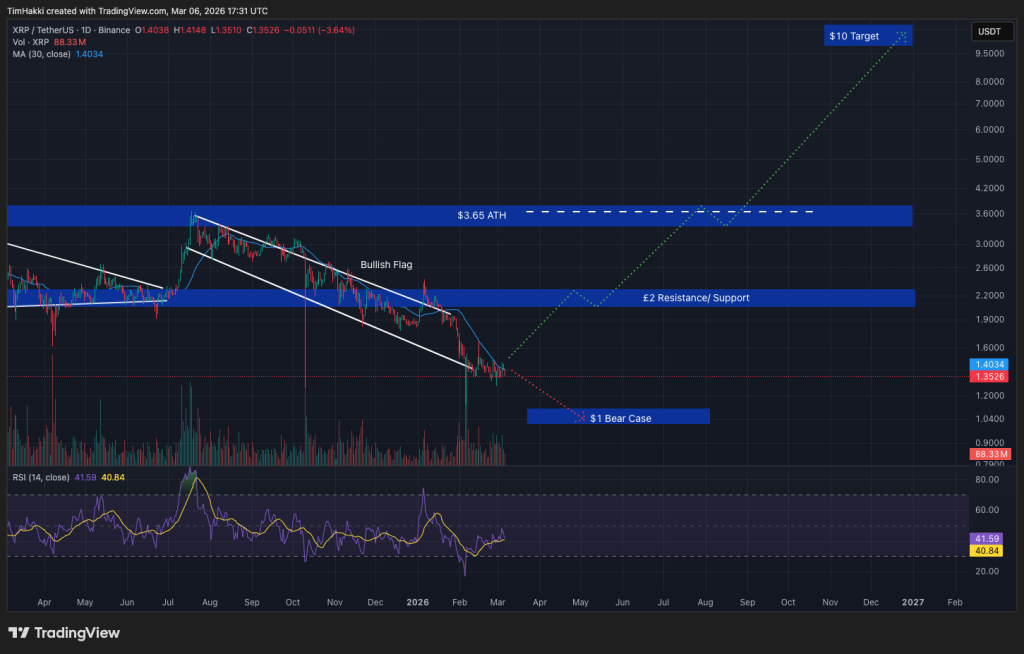
With XRP currently trading close to $1.36, Perplexity AI predicts the asset could potentially climb to around $10 in 2026, representing a little over sevenfold return for current HODLers.
XRP’s relative strength index (RSI) currently sits near 42, while price movement has begun stabilized around its 30-day moving average, suggesting perhaps the extended consolidation period is nearing its end.
Several catalysts could further strengthen XRP’s outlook, including rising institutional demand following the launch of U.S.-listed XRP exchange-traded funds, Ripple’s expanding network of international partnerships, and comprehensive crypto legislation (the CLARITY Act) in the United States.
Solana (SOL): Could Solana Soon Hit $700?
Solana ($SOL) currently secures around $6.7 billion in total value locked and has a market capitalization of $48 billion.
Institutional interest increased after the introduction of Solana-based exchange-traded funds by prominent asset managers such as Bitwise and Grayscale.
However, SOL crashed toward the end of 2025 and spent much of February trading below the $100 mark.
Perplexity sees Solana rising from $84 today to approximately $700 by Christmas. That would give 8x returns and price Solana more than double it’s January 2025 ATH of $293 recorded.
Moreover, major asset managers like Franklin Templeton and BlackRock have begun issuing tokenized assets on Solana.
Shiba Inu (SHIB): Perplexity Forecasts a Potential 2,000% Rally
Originally launched in 2020 as a tongue-in-cheek Dogecoin challenger, Shiba Inu ($SHIB) has since developed into a broader ecosystem with a market capitalization of $3.2 billion.
Currently around $0.000005359, Perplexity’s analysis suggests that a decisive breakout above the $0.000025–$0.00003 resistance range could trigger strong upward momentum. Under that scenario, SHIB could potentially climb toward $0.00008 before the end of the year.
Such a move would represent gains of roughly 15x, or around 1,400%, bringing it a hair’s breadth beneath its October 2021 ATH of $0.00008616.
Beyond its meme coin reputation, the project has introduced practical utility through Shibarium, its Ethereum Layer-2 scaling solution. Shibarium delivers faster transactions, lower fees, enhanced privacy features, and improved developer tools for building decentralized applications.
Maxi Doge: Emerging Meme Coin Aims for Rapid Growth
Perplexity’s projection of a potential 14x surge for Shiba Inu reflects expectations that a new meme coin cycle could accompany the next crypto bull market. However, projects at earlier stages often present even greater growth potential.
One project gaining attention is Maxi Doge ($MAXI), which has already raised $4.7 million through its ongoing presale as early investors accumulate what some believe could become the next Shiba Inu.
Maxi Doge is the loud, louche and degenerate distant cousin to Dogecoin, embracing a comic marketing approach inspired by the chaotic enthusiasm of the 2021 meme coin boom.
MAXI is an ERC-20 asset on Ethereum’s proof-of-stake network, giving it a significantly smaller environmental footprint compared with Dogecoin’s proof-of-work system.
Early participants in the presale can currently stake MAXI for yields reaching up to 67% APY. These rewards gradually decrease as more tokens enter the staking pool.
The token is currently priced at $0.0002807 during the latest presale phase, with automatic price increases scheduled at each new funding milestone. Investors can purchase the token using supported wallets such as MetaMask and Best Wallet.
Stay updated through Maxi Doge’s official X and Telegram pages.
Visit the Official Maxi Doge Website Here
The post Perplexity AI Predicts the Price of XRP, Solana and Shiba Inu by The End of 2026 appeared first on Cryptonews.
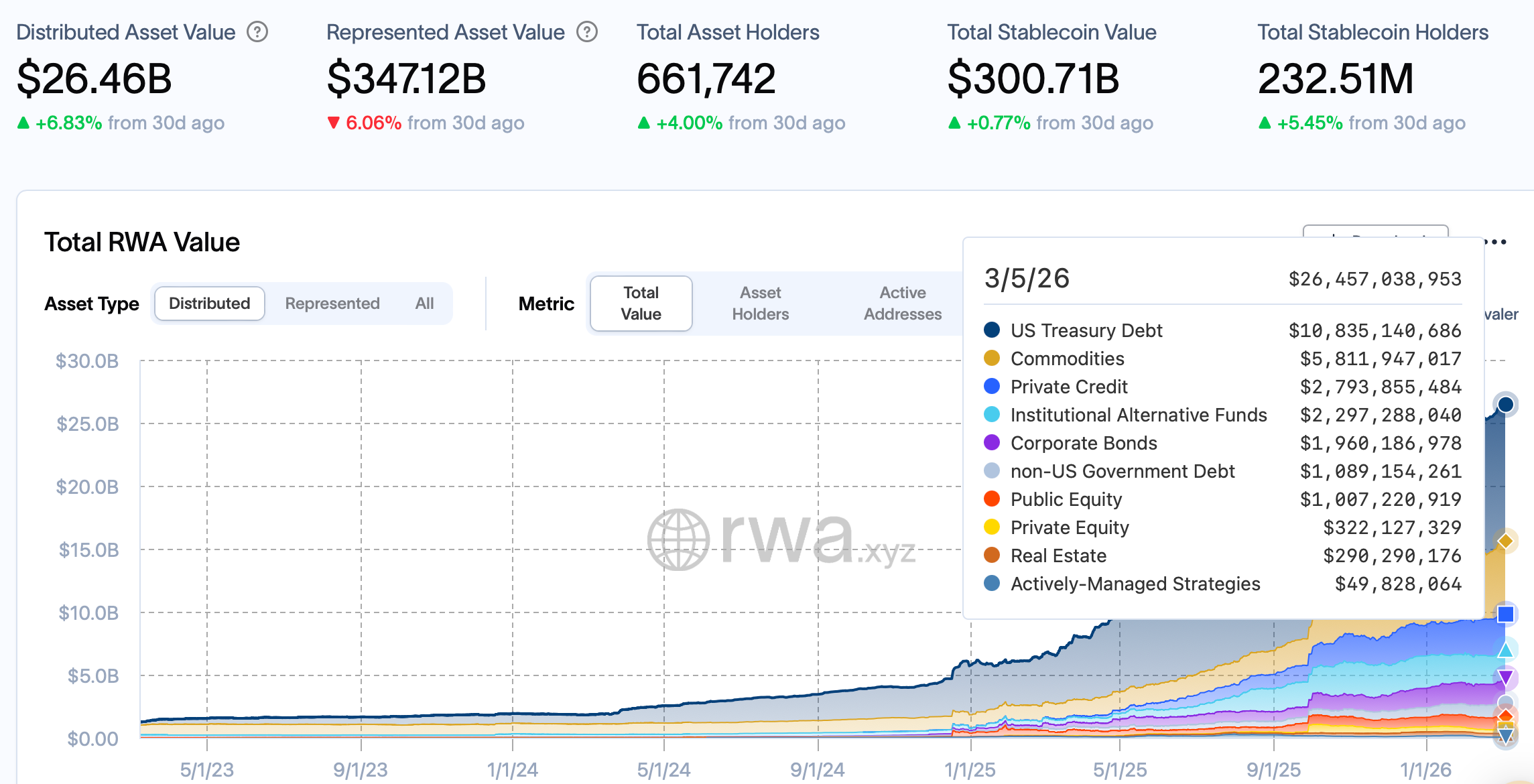
Kraken’s tokenized equities platform xStocks has launched xChange, an onchain trading engine designed to facilitate trading of tokenized stocks across the Ethereum and Solana networks.
According to the company, the system supports trading of more than 70 tokenized equities backed 1:1 by underlying shares held in custody, with prices intended to track the corresponding public market stocks.
The launch adds new trading infrastructure for tokenized equities, part of the broader tokenized real-world asset market that aims to bring traditional financial instruments such as stocks onto blockchain-based trading systems.
Kraken launched xStocks in June, offering tokenized versions of publicly traded companies issued by Backed Assets, though the products are not available to users in the United States, the United Kingdom or other restricted jurisdictions.
Since then, the platform has recorded $3.5 billion in onchain transaction volume and about $25 billion in total trading volume across exchanges, with about $225 million in tokenized assets held across about 80,000 blockchain wallets, according to company data.
The move from Kraken comes days after the exchange said its banking unit, Kraken Financial, had been granted a limited-purpose master account by the Federal Reserve Bank of Kansas City, giving it direct access to the Fedwire payments network used by banks and credit unions.
Related: Kraken introduces fixed-rate crypto loans for its Pro users
Traditional and crypto exchanges build rails for tokenized stocks
Kraken is not alone in exploring infrastructure for tokenized securities, as both crypto exchanges and traditional market operators experiment with ways to bring stocks onto blockchain-based trading systems.
In December, Coinbase announced that it plans to launch Coinbase Tokenize, an institutional platform designed to support the issuance and management of tokenized real-world assets, including equities.
About a month later, the owner of the New York Stock Exchange, Intercontinental Exchange, said it is developing a platform to support trading of tokenized securities, including stocks and exchange-traded funds.
The proposed system would combine the exchange’s existing matching engine with blockchain-based settlement infrastructure and could support round-the-clock trading with near-instant settlement, potentially using stablecoins instead of the current one-day settlement cycle in US equity markets.

The London Stock Exchange Group has also said it is developing blockchain-based infrastructure intended to support the trading and settlement of tokenized securities such as equities and bonds.
Nasdaq, meanwhile, has proposed integrating tokenized versions of stocks and exchange-traded products into its existing trading infrastructure, a change that could increase liquidity for tokenized securities if approved by regulators.
Magazine: The debate over Bitcoin’s four-year cycle is over: Benjamin Cowen


Oil’s violent intraday squeeze is colliding with fragile crypto risk sentiment, setting up a tense weekend for Hyperliquid oil perps and broader macro-linked digital assets.
Summary
- WTI crude spiked 13% intraday, pushing toward the key $90 level per barrel.
- The move comes as rate-cut expectations firm and crypto trades lower across majors.
- Hyperliquid oil perps now sit at the crossroads of an energy shock narrative and a tired crypto risk complex.
WTI crude’s surge to around $89.21 per barrel, a 13% intraday jump is a full-blown squeeze into a psychologically loaded $90 handle, leading to what analysts say could be a $100 or even $200 barrel price as the war with Iran rages on.
Coupled with that, WTI has ripped to fresh highs with daily relative strength index (RSI) pushing above +88, a momentum extreme ZeroHedge notes hasn’t been seen since the Kuwait War, as crude rockets through resistance on Iran‑linked supply fears and panic‑level volatility. That combo – geopolitics, stretched positioning, and technicals at blow‑off levels – is exactly what’s now bleeding into Hyperliquid perps, Polymarket oil markets, and, by extension, the entire crypto macro trade.
The immediate backdrop is a macro tape increasingly conditioned on Federal Reserve cuts later this year, with multiple officials signaling openness to easing if data cooperates and market pricing in a non-trivial probability of a June cut. In that context, oil ripping higher injects an inflationary tail-risk back into the narrative right as investors were starting to price a smoother disinflation glide path.
Oil and the broader crypto market
Crypto is not trading in a vacuum here. Majors like BTC (BTC), ETH (ETH), and BNB (BNB) are flashing red, with BTC around $68,446.80, ETH near $1,981.04, and BNB at $631.50, all down between roughly 3–5% on the day. Even HYPE (HYPE), a proxy for appetite around Hyperliquid’s ecosystem, is off about 2.62% at $29.81. In a classic macro playbook, higher oil plus fading momentum in crypto raises the probability of a broader de-risking if energy stays bid into next week.
Hyperliquid oil-linked futures volume surges
Hyperliquid has already shown what an Iran weekend looks like in the perps tape. During the first wave of strikes last weekend, the exchange saw nearly 17 million dollars in oil derivatives volume and roughly 148 million dollars in gold trading in a single weekend session, pushing total 24‑hour commodity turnover close to 200 million dollars while COMEX and CME were dark. Subsequent reports put open interest in Hyperliquid’s CL USDC oil perpetuals above 50 million dollars and highlighted gold and silver perps turning into a de facto 24/7 macro hedge, with some instruments briefly trading above 5,400 dollars per ounce as traders rushed to price Iran risk before legacy benchmarks reopened.
For Hyperliquid traders running oil perps into the weekend, the setup is binary and unforgiving. On one side, if $90 breaks and holds, you are effectively long an inflation scare that could bleed into rates, equities, and high-beta crypto, with oil longs and defensive tokens outperforming.
On the other, if this move is an overextended squeeze driven by positioning and thin liquidity, mean reversion early next week could crush late longers while offering crypto a brief relief window as real-yield fears ebb. With Fed expectations fragile, upcoming data and any geopolitical headlines around supply will matter more than usual.
Oil’s spike is not just about Fed cuts and positioning; it is about Iran risk bleeding into the tape. A widening U.S.–Israel confrontation with Tehran and shipping disruptions around the Strait of Hormuz have injected a hard geopolitical premium into crude, with analysts warning that up to a third of global seaborne supply and a fifth of LNG flows sit in the crosshairs if transit is impaired. Even before WTI flirted with $90, oil had been grinding higher on fears of supply shocks and potential blockage scenarios, keeping prices elevated despite otherwise comfortable inventories. For Hyperliquid oil perps, that means you are no longer just trading a chart; you are implicitly taking a view on whether Iran risk escalates into a genuine supply event or fades back into background noise as flows normalize.
Polymarket oil market opportunities?
Polymarket’s crude oil markets are already trying to price that regime shift in real time, with contracts on where CL settles by month‑end and whether oil prints specific upside targets effectively encoding crowd probabilities on an Iran‑driven spike. As of March 26, Polymarket traders are pricing $150 barrel oil at 9%, while bettors see a $100 barrel at 71%.
Crypto World
Coinbase Prime Integrates Regulated Futures and Cross-Margin Trading for Institutional Crypto
TLDR:
- Coinbase Prime now offers 20+ CFTC-regulated futures contracts with 24/7 trading through Coinbase Financial Markets.
- Unified cross-margin allows institutions to manage spot and futures exposures within one single capital framework.
- Assets are secured under Coinbase’s NYDFS-regulated custodian, keeping all trading within a fully regulated structure.
- Coinbase’s Deribit acquisition moves the platform closer to one unified exchange for spot, futures, and options.
Coinbase Prime has taken a major step forward in institutional crypto infrastructure. The platform announced integrated regulated futures trading and unified cross-margin functionality across spot and derivatives markets.
Through Coinbase Financial Markets, its CFTC-regulated futures commission merchant, institutions now access over 20 futures contracts.
These include perpetual-style products with round-the-clock trading availability. The launch positions Coinbase Prime as a full-service, regulated prime brokerage built specifically for institutional-grade digital asset operations.
Unified Cross-Margin Reshapes Capital Management for Trading Desks
Traditionally, spot and futures trading required separate collateral pools and independent risk systems. That separation often created inefficiencies for institutional trading desks managing complex multi-market strategies. Coinbase Prime now brings both under one capital framework through unified cross-margin.
With this setup, institutions can evaluate spot and futures exposures together within a single portfolio view. Capital moves more freely across strategies, while risk is monitored holistically across the entire platform.
This is particularly useful for basis trading, where hedged positions can benefit from more efficient margin treatment.
Coinbase Institutional shared the development on X, stating that Prime is now “the most comprehensive operating system for institutional crypto.”
The post noted that institutions can now “trade, finance, and manage assets within a regulated full-service crypto prime brokerage framework.”
Prime’s deterministic risk model also allows trading desks to calculate margin requirements before execution. That transparency reduces reliance on opaque margin engines that have historically complicated pre-trade planning for institutions.
Regulated Infrastructure Brings Futures Directly Into the Prime Workflow
Futures access through Coinbase Financial Markets, a CFTC-regulated FCM, is now embedded directly into the Prime workflow.
Institutions no longer need separate platforms to access derivatives markets. Execution, custody, and risk management now operate within a single environment.
Assets remain secured within Coinbase’s NYDFS-regulated qualified custodian throughout the trading lifecycle. This structure allows institutions to operate within a fully regulated framework while accessing both spot and derivatives markets simultaneously.
Beyond futures, Coinbase Prime also covers financing, lending, and operational infrastructure at institutional scale.
The platform is designed so trading desks no longer need to coordinate across fragmented or self-assembled systems.
Coinbase’s recent acquisition of Deribit, the world’s leading crypto options exchange, further broadens this ecosystem.
The goal is a single platform where institutions can access spot, futures, perpetuals, and options together. That consolidated model reflects Coinbase Institutional’s broader objective of building what it describes as an “Everything Exchange” for professional market participants.
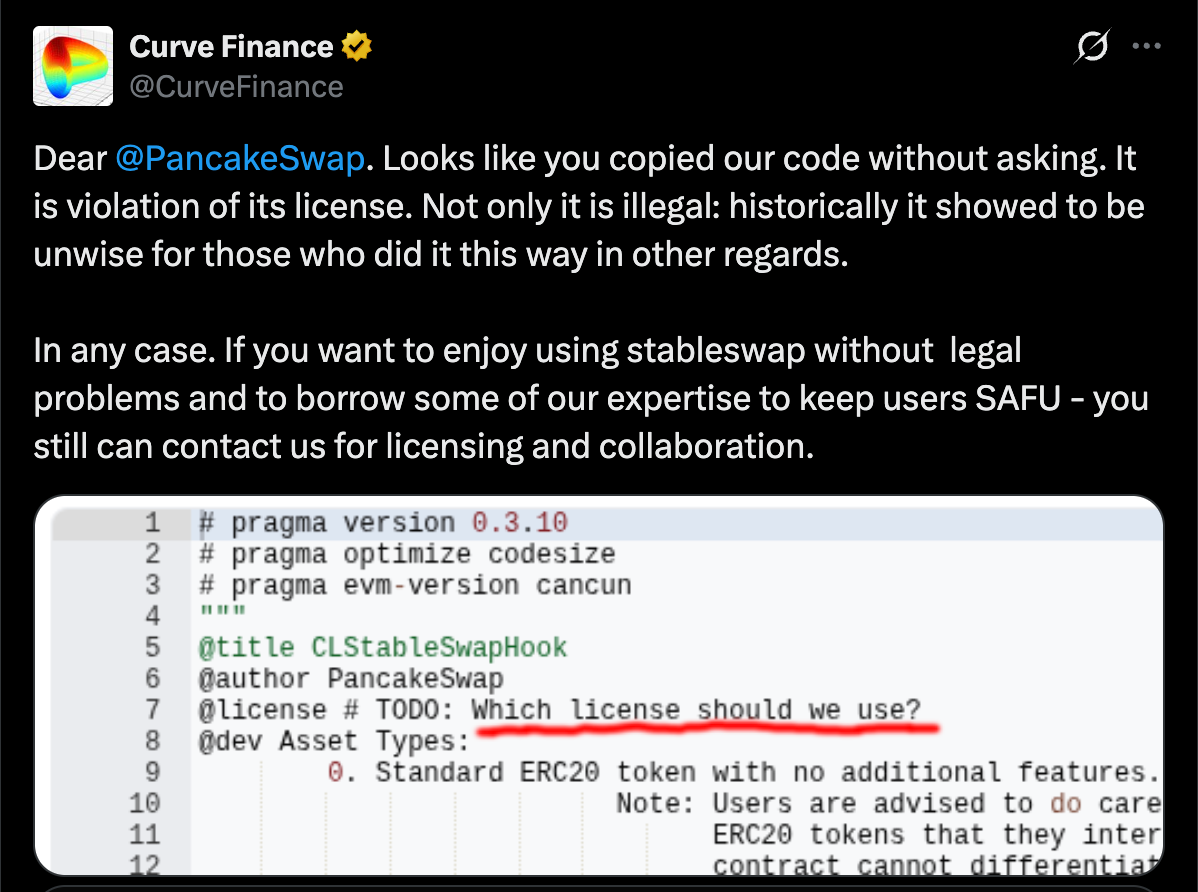
The team behind the Curve Finance decentralized finance (DeFi) platform accused the PancakeSwap decentralized exchange (DEX) of using its code without the proper licensing.
The code is tied to the “StableSwap” feature used for swapping stablecoins and “tightly-pegged” assets on PancakeSwap Infinity, the latest version of the PancakeSwap DEX.
“If you want to enjoy using stableswap without legal problems and to borrow some of our expertise to keep users SAFU, you still can contact us for licensing and collaboration,” the Curve team said on X.

In a separate post, Curve said “deep stableswap expertise” is needed to safely integrate swap features, and cited the 2022 hack of the Saddle Finance DEX and the $116 million hack of DeFi protocol Balancer in 2025 as examples of swap-based code exploits.
The PancakeSwap team said it would reach out to Curve Finance to discuss the issue. “Indeed, better to be friends and build together,” the Curve team responded.
Cointelegraph reached out to both teams but did not receive a response by the time of publication.
The incident highlights the potential cybersecurity and legal issues that arise in decentralized finance as projects and protocols continue to iterate on products and expand features.
Related: Curve founder says DeFi must ditch token emissions for real revenue
PancakeSwap Infinity launches and goes cross-chain
PancakeSwap Infinity launched on the Arbitrum network and BNB Chain in April 2025, following the integration of one-click, cross-chain swaps that allow users to move digital assets between blockchain protocols.
The updated DEX introduced “hooks,” smart contract plug-ins that customize parameters for liquidity pools, including dynamic fee structuring, tailored rebates and onchain limit orders that execute when preset conditions are met.

The upgrade also lowered pool creation fees by up to 99% and was built to accommodate different liquidity strategies, according to PancakeSwap.
In July 2025, PancakeSwap Infinity launched on Base, an Ethereum layer-2 (L2) scaling network, and touted up to 50% cheaper trading fees when Ether (ETH), the native token of the Ethereum layer-1 blockchain network, was traded against ERC-20 tokens.
ERC-20 is the token standard for most assets minted on Ethereum, including the gas and governance tokens of Ethereum L2s, memecoins, and other projects issuing tokens on Ethereum.
Magazine: MakerDAO’s plan to bring back ‘DeFi summer’ — Rune Christensen


Kazakhstan’s central bank has announced a strategic move to invest up to $350 million in cryptocurrency assets, marking a significant shift in its reserve management strategy.
Kazakhstan’s central bank has unveiled plans to invest up to $350 million in cryptocurrency assets. This decision represents a substantial policy shift aimed at diversifying the country’s reserves.
Kazakhstan has emerged as a significant player in the global crypto mining sector, contributing approximately 6-8% of Bitcoin’s global mining due to its low electricity costs. The government is also working on a regulatory framework to legalize and tax crypto mining and trading, further solidifying its position as a crypto-friendly nation, according to Reuters.
The central bank, which oversees Kazakhstan’s monetary policy and manages its currency reserves, is implementing this investment strategy as part of a broader approach to reserve management.
This move is likely to influence neighboring Central Asian countries, encouraging them to consider similar investments or regulatory measures. The shift could potentially transform the regional crypto landscape, making Central Asia a hub for cryptocurrency development and innovation.
The investment decision aligns with global trends where central banks are increasingly exploring crypto assets as part of their reserve diversification strategies.
This article was generated with the assistance of AI workflows.
Bitcoin outflows from exchanges continued during the Hormuz crisis, signaling holders are moving coins into cold storage rather than selling.
Bitcoin (BTC) held near $70,000 on March 6 after a geopolitical shock tied to tensions around the Strait of Hormuz pushed energy prices higher and triggered risk-off behavior across global markets.
Despite the turbulence, blockchain data shows BTC continuing to leave exchanges, suggesting many holders are not preparing to sell.
Energy Shock Rattles Markets
Analyst GugaOnChain linked the latest volatility to disruptions around the Strait of Hormuz, a major energy shipping route, which remains effectively closed amid the U.S.-Israeli war on Iran.
The market watcher noted that Brent crude traded near $85 and West Texas Intermediate around $81 as the situation pushed up fuel costs, including a $0.27 increase in U.S. gasoline prices during the week.
According to the same analysis, the shock drained liquidity across global markets and led to outflows of just under $228 million from Bitcoin exchange-traded funds on March 5. However, exchange flow data showed an unusual divergence. Using a seven-day moving average, Bitcoin’s net exchange flows remained negative, meaning more coins were leaving exchanges than entering them. Daily data showed withdrawals of 500 BTC, while the weekly total reached about 6,500 BTC, leaving trading venues.
According to GugaOnChain, such movements often signal that investors are transferring holdings into cold storage, which reduces the supply immediately available for sale.
“Given the notable on-chain resilience, the directive is to adopt a tactical defensive stance, maximizing cash now and awaiting confirmation of a reversal in institutional flows before raising exposure again,” the analyst advised.
Trading Activity Intensifies on Major Exchanges
While coins are leaving exchanges overall, trading activity inside platforms has accelerated. Data shared by Arab Chain on March 6 showed Bitcoin turnover on Binance reaching about 425,000 BTC over the past 30 days, one of the highest readings since December.
You may also like:
Binance’s Bitcoin reserves currently stand near 660,000 BTC, and compared with the 30-day turnover figure, the liquidity ratio sits around 0.64, meaning about 64% of those reserves have been traded or transferred during the period.
That pattern suggests the same coins are changing hands repeatedly within a short time frame, which reflects increased speculative activity and stronger liquidity circulation within the market.
Bitcoin has fallen from a monthly peak attained earlier in the week, with price data from CoinGecko showing the asset trading just under $71,000 at the time of writing, down about 2% in the last 24 hours but still up close to 5% over seven days.
At the moment, the flagship cryptocurrency is sitting between renewed institutional demand and global macro pressure. Exchange withdrawals imply that many holders are waiting rather than rushing to exit positions, even as traders remain active inside the market.
Binance Free $600 (CryptoPotato Exclusive): Use this link to register a new account and receive $600 exclusive welcome offer on Binance (full details).
LIMITED OFFER for CryptoPotato readers at Bybit: Use this link to register and open a $500 FREE position on any coin!


As part of Outset PR’s Web3 communications talks, the agency founder Mike Ermolaev recently spoke with Jamie Elkaleh, CMO of Bitget Wallet, about how marketing changes when a crypto wallet evolves from a trading tool into a broader financial interface.
Summary
- Crypto marketing is moving towards utility-driven adoption, where product experience and real-world usability play a central role.
- Regional differences increasingly shape communication strategies, as adoption patterns, regulations, and user expectations vary between markets such as Asia and the West.
- As the industry matures, both media narratives and market movements are becoming more influenced by verifiable data, institutional capital, and macroeconomic forces.
While the full conversation explores everything from user acquisition to media strategy and the shifting dynamics of crypto markets, here are several key insights that are worth broader market attention.
Smooth onboarding drives sustainable user acquisition
One of Jamie’s key points is that sustainable wallet growth is no longer driven by incentives. Airdrops and points programs are often used to generate rapid attention. But according to him, these tactics rarely translate into long-term users. Instead, the focus should be on reducing product friction and simplifying onboarding.
“When users can transact without managing seed phrases or holding native gas tokens, adoption becomes more sustainable.”
In a utility-driven market, Jamie says, product design effectively becomes marketing.
Marketing in Asia vs. the West reflects different user expectations
Another point Jamie raised is that crypto marketing strategies vary significantly by region.
In Asia, adoption is closely tied to everyday financial use cases such as remittances, cross-border transfers, and stablecoin payments. As a result, communication tends to focus on speed, accessibility, and practical value.
“In 2025, the region recorded a 69% year-over-year increase in on-chain value. That reflects strong grassroots usage.”
In Western markets, the situation is different. Regulatory clarity and institutional trust shape user expectations much more strongly.
“With frameworks such as MiCA in Europe and new U.S. stablecoin legislation, users prioritize compliance, proof of reserves, and risk transparency.”
Despite these differences, Jamie notes that the core requirement remains the same across regions: products must work reliably in real-world financial contexts.
Data now underlies media credibility
At Bitget Wallet’s scale, Jamie insists that media coverage can’t rely on generic commentary. Journalists increasingly expect verifiable data that helps explain what is actually happening in the market.
“We publish research reports based on on-chain analytics and user behavior trends, which allows reporters to reference measurable insights.”
Per him, stories supported by real usage patterns – whether in transaction volume, adoption, or user growth – travel much further across the media ecosystem. This approach also changes how the team evaluates PR performance.
“We prioritize tier-one mentions, analyst citations, and share of voice within strategic narratives. Secondary indicators include organic brand mentions, backlink authority, inbound media inquiries, and invitations to podcasts or research collaborations.”
The real signal, Jamie adds, appears when external analysts start referencing the company’s data independently.
Crypto markets now move with macro capital
Jamie also confirms that crypto’s relationship with news has fundamentally changed. In earlier cycles, a single headline could move markets within hours. Today, price actions are increasingly shaped by macro capital flows, because
“Crypto has matured into a macro-sensitive asset class.”
As sector valuations reached multi-trillion-dollar levels, individual headlines naturally stopped carrying such influence.
With nearly $44 billion flowing into Bitcoin ETFs in 2025, institutional capital now plays a structural role in the market. In this environment, narratives matter less than fundamentals.
Utility is becoming crypto’s growth model
Reflecting on the conversation, one pattern becomes clear: the crypto industry is gradually shifting away from narrative-driven growth toward functional adoption.
Wallets are used not just for trading but for payments, transfers, and yield farming. Users expect reliability rather than explanations. And as institutional capital becomes a structural force, macro conditions are more important than short-term hype.
In that environment, the logic of marketing changes as well.
“If users don’t need to understand the infrastructure behind the product, the marketing has done its job.”


Buterin proposed AI-assisted wallets where algorithms suggest transaction plans but users must manually confirm large transfers.
Vitalik Buterin has outlined his perspective on how artificial intelligence (AI) could redefine the next generation of Web3 wallets.
He also proposed a model where humans remain directly involved in approving high-value transactions.
AI Will Shape Newer Crypto Wallets
The Ethereum co-founder shared his views on the decentralized social media platform Farcaster, noting that it is “pretty obvious” that the next iteration of wallets will heavily involve AI.
Despite this, Buterin added that he would not trust LLMs with multi-million-dollar transactions or control over large amounts of money. Instead, he gave an approach in which AI systems assist users while leaving the final decision in human hands.
He described an optimal workflow in high-value situations that would involve an AI system proposing a plan, after which a local light client simulates the transaction. The person would then review the intended action and the required outcome before manually confirming it.
However, Buterin warned that this approach must be implemented conservatively with a strong emphasis on security. He suggested that one way to achieve this is by removing decentralized application interfaces from the transaction process. By eliminating dApp user interfaces from the flow entirely, the system could reduce several attack vectors associated with theft and privacy risks.
The 32-year-old has previously discussed how cryptocurrency and AI could evolve together. He envisions blockchains and the technology working hand-in-hand, with crypto providing the trust, privacy, and economic infrastructure that it needs to operate safely and fairly.
You may also like:
Proposed AI-Assisted Wallet Workflows
Other developers and community members responded to Buterin’s comments by describing potential implementations of the idea.
Ethereum developer Andrey Petrov suggested two additional scenarios. In the first, a user initiates a transaction as usual while AI analyzes the payload about to be signed. The technology would then attempt to guess their intended action and explain it in plain language, allowing them to confirm whether the transaction accurately reflects what they meant to do.
In the second case, the user either states their intended action directly or relies on the explanation generated in the first step. The AI then tries to reconstruct the transaction independently, without referencing the original amount, to determine whether it arrives at the same outcome. He explained that any differences between the two would show areas that require further review before the process is finalized.
Another Farcaster user, identified as fkaany, described a framework in which AI plans complex crypto strategies such as multi-hop swaps, yield optimization, and gas minimization.
This would involve a local light client simulating the outcome, which would allow individuals to review a clear summary and manually confirm the transaction, helping reduce risks from blind signing, phishing interfaces, and malicious dApp payloads.
Binance Free $600 (CryptoPotato Exclusive): Use this link to register a new account and receive $600 exclusive welcome offer on Binance (full details).
LIMITED OFFER for CryptoPotato readers at Bybit: Use this link to register and open a $500 FREE position on any coin!

Joao Pedro: Chelsea striker in same ‘category’ as Haaland, Mbappe and Kane – Rosenior

Stranded Americans in the Middle East navigate canceled flights and confusion

(VIDEO) Bianca Censori Trades Bold Style for Modest Attire in Kanye West Malibu Mansion Trial


-

 Politics4 days ago
Alan Cumming Brands Baftas Ceremony A ‘Triggering S**tshow’
-

 Tech6 days ago
Unihertz’s Titan 2 Elite Arrives Just as Physical Keyboards Refuse to Fade Away
-

 NewsBeat6 days ago
Abusive parents will now be treated like sex offenders and placed on a ‘child cruelty register’ | News UK
-
Business8 hours ago
Form 8K Entergy Mississippi LLC For: 6 March
-
 NewsBeat6 days ago
Dubai flights cancelled as Brit told airspace closed ’10 minutes after boarding’
-
Sports7 days ago
The Vikings Need a Duck
-
 NewsBeat6 days ago
The empty pub on busy Cambridge road that has been boarded up for years
-

 NewsBeat5 days ago
‘Significant’ damage to boarded-up Horden house after fire
-

 Tech2 days ago
Bitwarden adds support for passkey login on Windows 11
-

 Entertainment5 days ago
Baby Gear Guide: Strollers, Car Seats
-
 Sports1 day ago
499 runs and 34 sixes later, India beat England to enter T20 World Cup final | Cricket News
-
Politics6 days ago
FIFA hypocrisy after Israel murder over 400 Palestinian footballers
-
 NewsBeat6 days ago
Emirates confirms when flights will resume amid Dubai airport chaos
-

 NewsBeat4 days ago
Is it acceptable to comment on the appearance of strangers in public? Readers discuss
-

 Fashion5 hours ago
Weekend Open Thread: Ann Taylor
-

 Tech6 days ago
Viral ad shows aged Musk, Altman, and Bezos using jobless humans to power AI
-

 Video5 days ago
How to Build Finance Dashboards With AI in Minutes
-

 Fashion5 days ago
On the Scene at the 57th Annual NAACP Image Awards: Teyana Taylor in Black Ashi Studio, Colman Domingo in Yellow Sergio Hudson, Chloe Bailey in Christian Siriano, and More!
-

 Business3 days ago
Guthrie Disappearance Enters Fifth Week as Family Visits Memorial
-
 Crypto World6 days ago
US Judge Lets Binance Unregistered Token Class Action Proceed