

Crypto World
HTX Delists Trump-Linked USD1 After Alleged Wallet Freeze

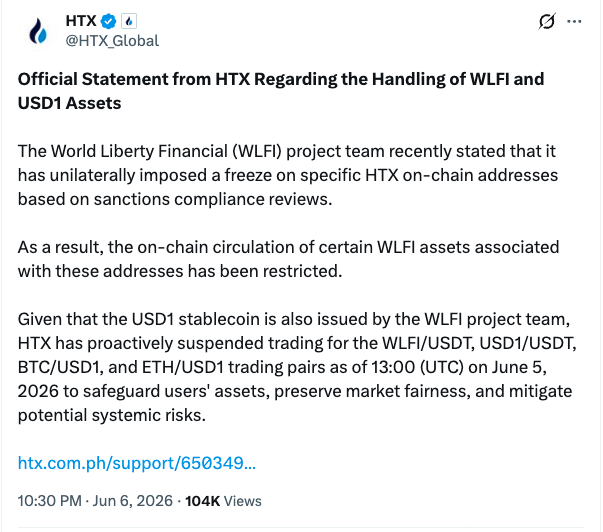
HTX, the crypto exchange linked to crypto entrepreneur Justin Sun, delisted the Trump family’s USD1 stablecoin after claiming World Liberty Financial wrongly froze the exchange’s addresses.
“The World Liberty Financial (WLFI) project team recently stated that it has unilaterally imposed a freeze on specific HTX on-chain addresses based on sanctions compliance reviews,” said HTX on Saturday.
“As a result, the on-chain circulation of certain WLFI assets associated with these addresses has been restricted,” it said, adding it delisted USD1 to safeguard user assets.
Last month, the UK sanctioned HTX, formerly called Huobi Global, on May 26, claiming there were “reasonable grounds to suspect” the exchange had supported Russia’s government through financial services.
However, HTX said the sanctioned entity, Huobi Global S.A., is “distinct from the online HTX exchange” and that such a designation should not impact the platform.
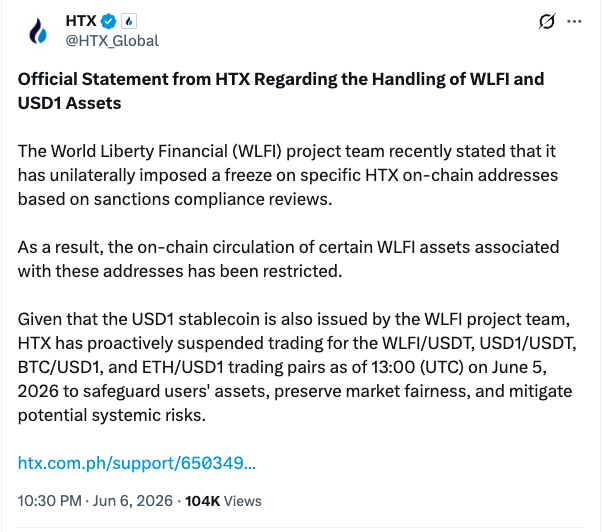
Source: HTX
The delisting took effect on Sunday. Deposit and conversion services for USD1 are no longer supported, and users’ USD1 holdings would be converted to the stablecoin Tether (USDt) at a 1:1 ratio, with exact completion times and details to be announced separately.
It has also suspended WLFI/USDT, USD1/USDT, BTC/USD1 and ETH/USD1 trading pairs.
The exchange said its addresses were frozen “without sufficient prior communication, adequate contractual or legal grounds, transparent disclosure or adherence to due process” and that the move infringed the rights of its users and their assets, and has called WLFI to reverse the freeze.
HTX said it will also take measures to “safeguard users’ legitimate rights and interests, including but not limited to pursuing legal remedies.”
World Liberty, which counts US President Donald Trump and his three sons, Donald Jr., Eric and Barron as advisers, has not publicly addressed whether it froze HTX’s addresses.
It posted on X on Wednesday that “in light of recent sanctions updates, World Liberty Financial maintains risk-based sanctions compliance controls.”
Cointelegraph contacted World Liberty Financial for comment.
Related: Trump claims he can ‘future proof’ crypto regulation with CLARITY Act
Sun, who reportedly owns HTX and serves on the exchange’s global advisory board, sued World Liberty in April, claiming the platform froze his tokens and threatened to burn them “without any proper justification.”
In May, World Liberty sued Sun for defamation, claiming he made false statements about the platform and violated WLFI token sale terms through alleged prohibited transfers, short-selling and straw purchases.
Magazine: Quitting Trump’s top crypto job wasn’t easy: Bo Hines

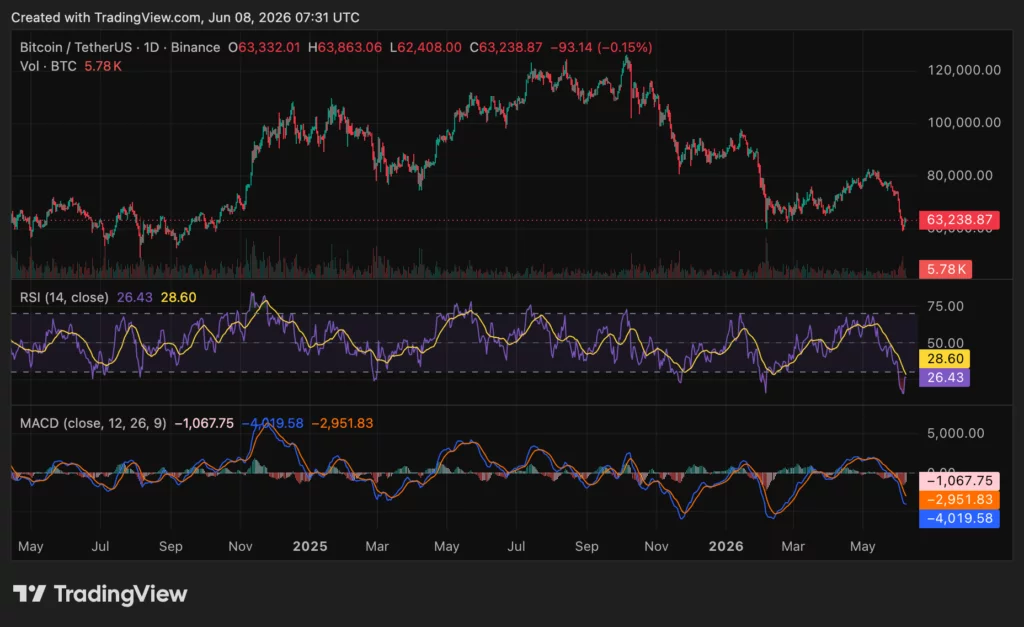
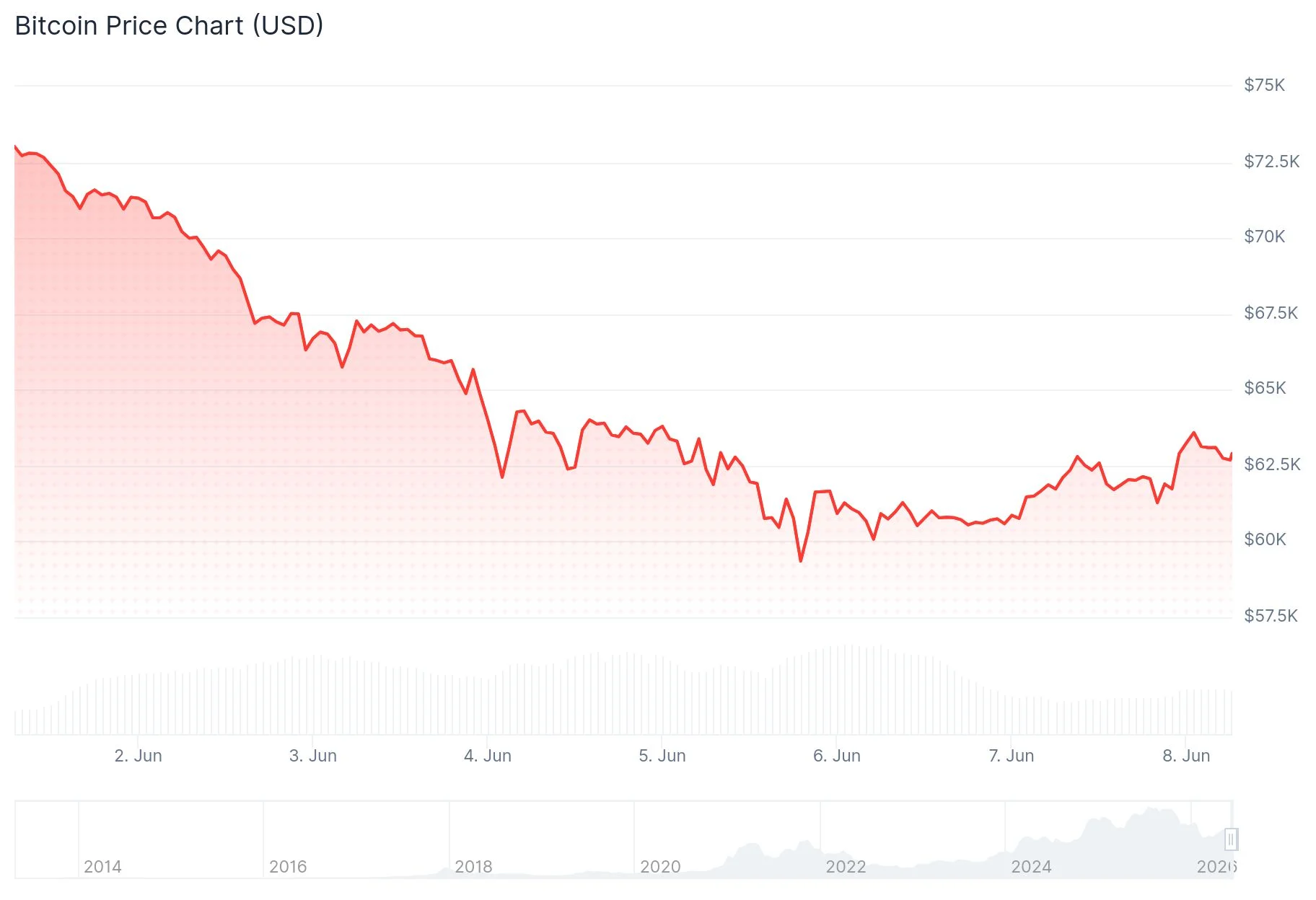
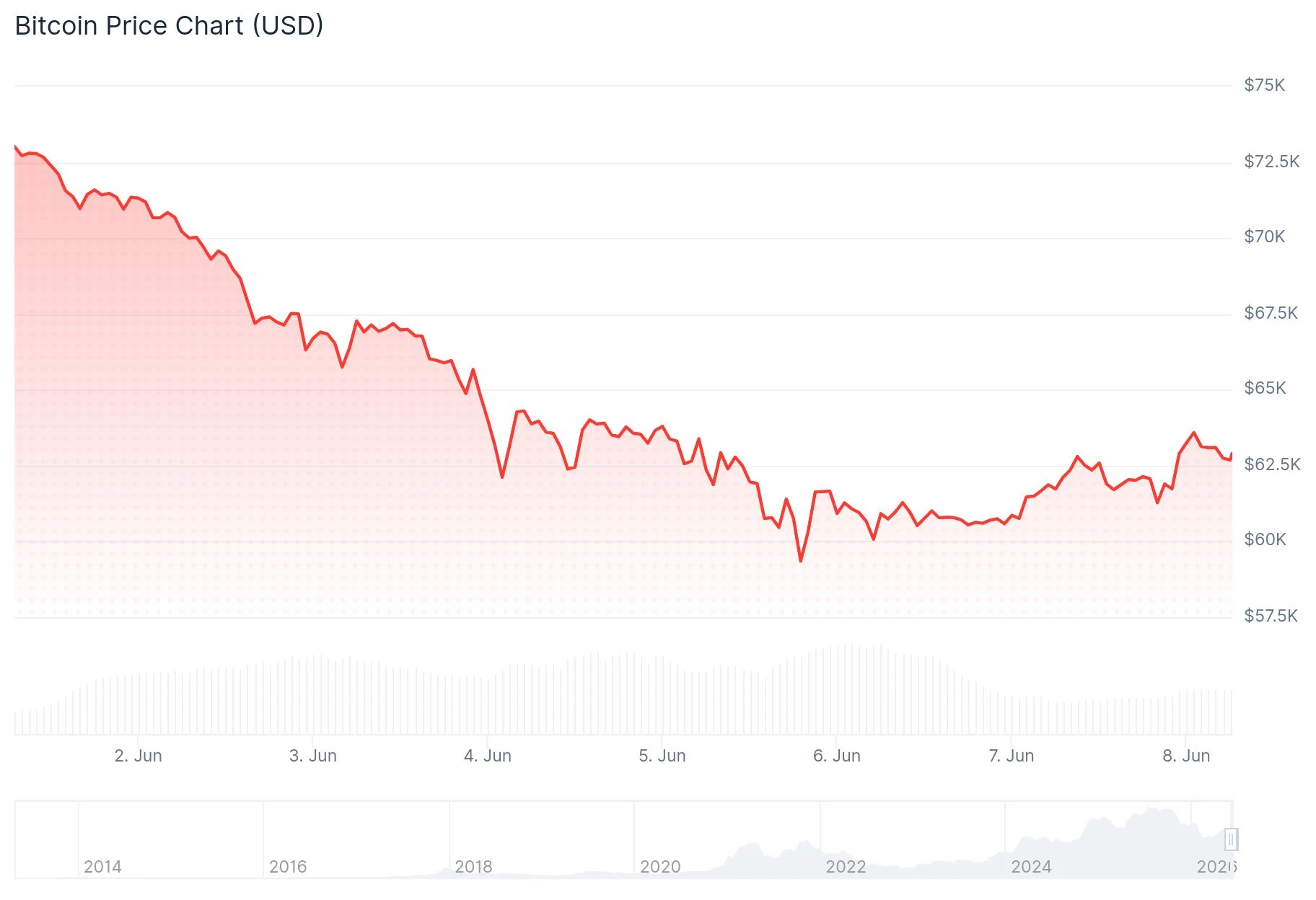
Bitcoin price recovered above $62,000 on Monday after last week’s selloff pushed the asset to about $59,100.
Summary
- Bitcoin reclaimed its 200-week average after sweeping February’s low, but resistance remains near $64,000.
- Oversold RSI supports a relief bounce, while bearish MACD shows sellers still control broader momentum.
- Rising open interest increases liquidation risk as traders watch $55,000 if the recovery loses support.
The rebound briefly carried BTC near $64,200 before sellers returned, leaving the market between long-term support and its first recovery barrier.
At the time of writing, Bitcoin traded near $63,000, up 1.39% over 24 hours. Its daily range stood between $61,206 and $63,739, while the seven-day loss remained 14.06%. Buyers have slowed the decline, but they have not reversed the broader weekly trend. ETF flows and futures positioning also remain important tests for the rebound.
Bitcoin price holds the 200-week moving average
Bitcoin closed the week above its 200-week simple moving average near $62,800 after sweeping the February low, according to crypto analyst Crypto Rover. Traders follow this average because it tracks Bitcoin’s long-term trend.
Holding above it could support another test of $64,000 to $64,200. A daily close below the average would return attention to $60,000 and the recent $59,100 low.
The June decline followed several waves of macro pressure. Higher inflation weakened expectations for easier monetary policy in May. Strong U.S. employment data then added another setback.
The economy created 172,000 jobs in May, compared with forecasts of 85,000, while unemployment stayed at 4.3%. As previously reported by crypto.news, Bitcoin’s break below $60,000 came as total crypto liquidations passed $1.7 billion within 24 hours.
Oversold RSI meets a still-bearish MACD setup
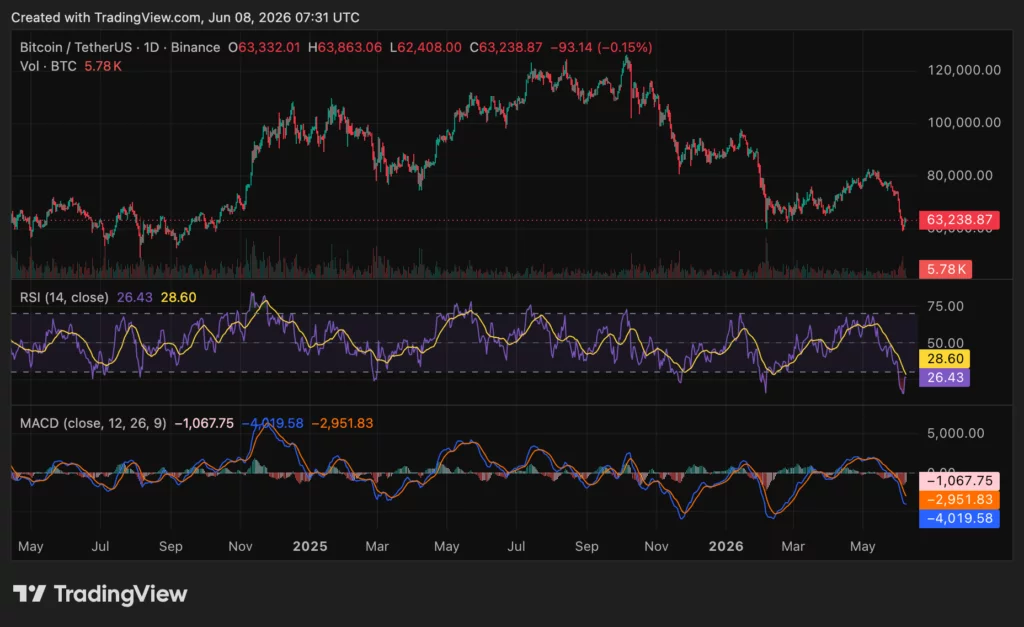
Bitcoin’s 14-day relative strength index stands at 26.43, below the 30 oversold threshold and its RSI moving average of 28.60. The reading shows that selling became stretched, which can support a relief bounce without confirming a lasting bottom. According to analyst Crypto Rover, the Fear and Greed Index has also fallen to 8, placing sentiment in “extreme fear.”
The Wolf of All Streets trader Scott Melker said Bitcoin may be forming a weekly bullish divergence from oversold RSI. “Need this week to close with a clear elbow up on price and RSI,” he wrote. The signal remains unconfirmed because price and momentum must turn higher together.
Bitcoin’s MACD line sits near -4,019.58, below the signal line at -2,951.83, while the histogram remains negative at -1,067.75. Rising selling volume supports the bearish momentum reading and shows that sellers remain active despite the rebound.
Trump-Iran headlines keep Bitcoin traders cautious
Bitcoin’s move toward $64,000 followed comments from U.S. President Donald Trump about a possible agreement with Iran. Trump said the parties were “very close” to a deal and claimed Israeli Prime Minister Benjamin Netanyahu did not control the process, according to Reuters. Traders initially treated the remarks as a possible reduction in geopolitical risk, helping stocks and cryptocurrencies recover from their late-week lows.
Events on June 8 weakened that optimism. Israel struck military targets and a petrochemical site in Iran after Tehran fired missiles toward Israel. Trump maintained that the attacks would not derail talks, but the renewed exchange left the agreement uncertain.
Brent oil rose above $96 per barrel as prices gained more than 3%. Higher energy costs could keep inflation and interest-rate concerns active for Bitcoin. The market may therefore remain sensitive to each new military or diplomatic update.
Bitcoin support levels place $55,000 next in focus
Analyst Ali Martinez listed the 200-week average at $62,800, the 300-week average at $55,000 and the 400-week average near $42,500. These levels form a long-term support ladder rather than fixed targets.
Bitcoin must first defend $62,800 and $60,000 before the lower averages become active tests. The $55,000 area also matches a long-running trendline tracked by Crypto Patel, making it the next broad support zone if the recent low fails.
Calls for $42,500 or $35,000 remain conditional bearish cases rather than immediate forecasts. Bitcoin would need to lose the 200-week average, the $60,000 level, the $59,100 low and the $55,000 region before those levels gain weight. That sequence gives traders several areas to assess before treating a deeper fall as the main path.
Derivatives data adds another risk. Crypto.news reported that open interest rose while Bitcoin’s price fell, showing that traders added leverage during weakness. That setup can produce a short squeeze if BTC clears $64,200, or another long squeeze if the price falls below $60,000. A firm close above $64,200 would strengthen the recovery and support the bullish RSI case.
For now, $62,800 remains the main dividing line. Holding it would keep $64,200 within reach and give buyers time to build a base. Failure to hold the 200-week average would place $60,000, $59,100 and $55,000 back in focus, while the bearish MACD would remain the stronger trend signal.
Disclosure: This article does not represent investment advice. The content and materials featured on this page are for educational purposes only.


PiggyBank has closed a hedge tied to LAB after sharp price swings and deeply negative funding rates made the trade too costly to maintain.
Summary
- PiggyBank closed the LAB short after volatility and negative funding breached its internal risk limits.
- The USDC vault faces a 15% drawdown, while SPYx and JitoSOL show smaller reported declines.
- ZachXBT questioned using depositor funds for LAB after earlier allegations around its token distribution structure.
The DeFi yield protocol said the move will reduce the net asset value of several vaults, including an estimated 15% drawdown for its USDC product.
The disclosure drew fresh questions about how PiggyBank used depositor capital and measured risk. On-chain investigator ZachXBT said the protocol had lost user assets by “gambling on blatant scam coins,” while PiggyBank said it acted before the position crossed its risk limits.
PiggyBank closes LAB short after funding pressure
PiggyBank said it opened the position about one month earlier with $100,000, equal to roughly 2% of its portfolio at that time. The strategy involved buying locked LAB tokens at a discount through an over-the-counter desk and shorting LAB perpetual contracts to offset price risk.
The protocol said LAB then faced “violent manipulation,” thin liquidity and deeply negative funding rates. Those conditions raised the cost of keeping the short open. PiggyBank said maintaining the hedge had become “economically irrational,” so it closed the short to limit further losses.
USDC vault faces the largest NAV drawdown
PiggyBank valued its locked LAB position at about $1.35 million using current prices. However, the protocol removed that holding from its net asset value calculation because the tokens cannot yet be sold. The first unlock is scheduled for August 14.
As a result, PiggyBank expects its USDC vault to show an estimated 15% drawdown. SPYx could record a 12% decline, while JitoSOL could fall 9%. These figures reflect the accounting treatment announced by the protocol and may change when the locked LAB tokens begin unlocking.
ZachXBT questions LAB exposure and risk controls
ZachXBT criticized the trade and questioned why user funds gained exposure to LAB. His response followed earlier claims about the token’s ownership and trading activity. As previously reported by crypto.news, he alleged in May that LAB-linked insiders controlled more than 95% of supply and had hidden key distribution details.
Those claims remain allegations, and the available PiggyBank statement did not address LAB’s token distribution. It focused on the hedge, funding costs and the decision to exclude locked tokens from NAV. PiggyBank also did not announce compensation or explain whether users can withdraw at the revised values.
Detailed PiggyBank report remains pending
PiggyBank said it will publish a detailed report with its next steps. The team has not yet released that report publicly. The coming update may provide trade records, risk thresholds, loss calculations and plans for the August unlock.
Until then, users have limited information on the final recovery value of the LAB position. The locked tokens could regain value before release, but they could also trade lower. PiggyBank’s next report will determine how the protocol records future changes and manages the affected vaults across its three products.
Key Takeaways
- Bitcoin’s price declined to approximately $62,900 following military exchanges between Iran and Israel that shattered a temporary ceasefire
- Asian markets experienced severe losses, with South Korea’s KOSPI plummeting 6.8% and Japan’s Nikkei declining 3%, prompting circuit breakers
- Crude oil surged more than 3% to reach $93.50 per barrel, driving Treasury yields upward and weighing on risk-sensitive investments
- The Nasdaq suffered a 4.2% decline on Friday, marking its steepest single-session loss since April 2025, driven by semiconductor and artificial intelligence sector weakness
- Bitcoin has declined approximately 14% throughout the past week, momentarily dropping beneath the $60,000 threshold
Military strikes between Iran and Israel over the weekend dismantled a ceasefire that had temporarily stabilized energy markets. The resurgence of hostilities created turbulence across international financial systems on Monday.
Bitcoin’s value retreated to approximately $62,900 by 4:00 UTC on Monday. This represents a decline from Sunday’s peak of $63,776, based on CoinDesk market data.
West Texas Intermediate crude oil futures climbed more than 3% to $93.50 in the aftermath of the military action. Escalating oil prices intensify inflation concerns and elevate Treasury yields.
Elevated Treasury yields generally strengthen dollar demand. This dynamic typically creates downward pressure on speculative assets including digital currencies.
U.S. President Donald Trump advocated for de-escalation following the strikes. He informed Axios that he had spoken with Israeli Prime Minister Benjamin Netanyahu, urging him to avoid further military response.
Notwithstanding Trump’s request, Israel conducted strikes against Iranian military installations on Sunday evening. These operations were executed in retaliation to earlier Iranian missile launches.
Asian Stock Markets Experience Sharp Declines
Asian equity indices suffered significant losses on Monday. South Korea’s KOSPI index plunged 6.8%, activating an automatic trading suspension. Japan’s Nikkei index declined more than 3%.
The widespread selloff mirrored heightened risk aversion throughout global financial systems. Market participants shifted capital away from equities and other higher-volatility instruments.
U.S. Equities Already Facing Downward Momentum
U.S. stock index futures showed mixed performance early Monday. S&P 500 futures remained unchanged at 7,397.25 points, while Dow Jones futures decreased 0.4%. Nasdaq 100 futures registered a modest 0.2% gain.
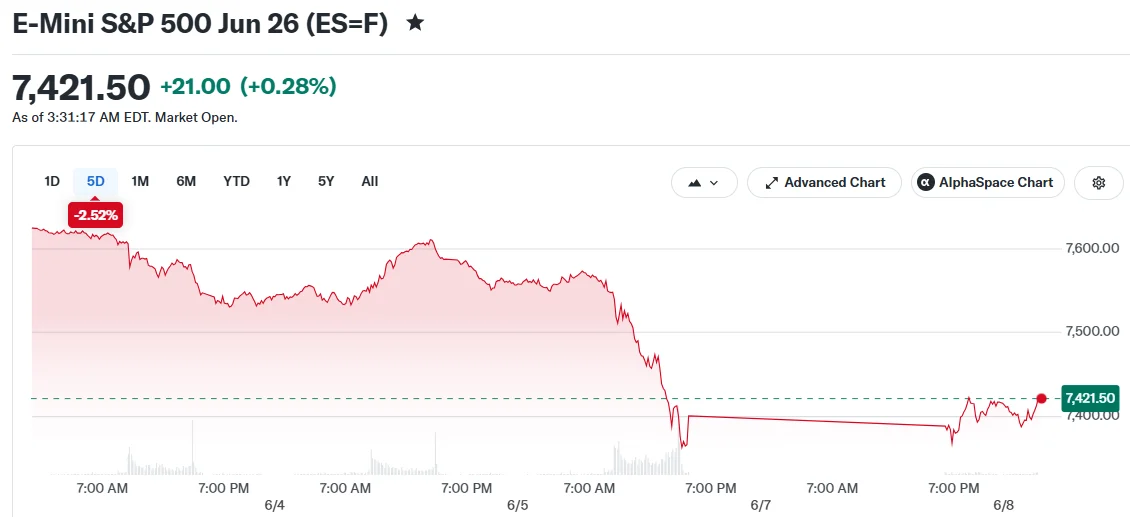
These movements followed substantial declines on Wall Street from Friday’s session. The Nasdaq Composite tumbled 4.2% to close at 25,709.43 points, representing its most severe single-day decline since April 2025.
The S&P 500 retreated 2.6% to settle at 7,383.74 points. The Dow Jones Industrial Average decreased 1.4% to finish at 50,866.78 points.
Semiconductor stocks experienced the most pronounced losses. Nvidia declined more than 6% on Friday as market participants took profits following a recent artificial intelligence-fueled surge.
Friday’s market weakness was additionally influenced by robust U.S. employment figures. Stronger-than-anticipated payroll data heightened speculation that the Federal Reserve might maintain elevated interest rates for an extended period.
Bitcoin Confronts Multiple Challenges
Bitcoin was experiencing downward pressure even prior to the weekend’s geopolitical escalation. Prices contracted nearly 14% during the previous week, temporarily falling below $60,000.
Contributing elements included capital withdrawals from spot Bitcoin exchange-traded funds, investment rotation toward AI equities, and Strategy’s recent Bitcoin liquidation.
Market volatility is anticipated to persist throughout the week. Forthcoming U.S. inflation reports and significant initial public offerings, including SpaceX and Anthropic, may further influence market liquidity conditions.
The weekend’s geopolitical developments have compromised advancement toward a potential U.S.-Iran diplomatic agreement. Tehran has indicated that a Lebanon ceasefire must precede any comprehensive settlement.

Securitize, a leading platform for tokenizing real-world assets, is one step closer to a public listing after the U.S. Securities and Exchange Commission approved a Form S-4 registration statement tied to a Cantor Equity Partners II SPAC merger. The move clears the path for a shareholder vote on June 29, with a potential NYSE listing under the name Securitize Corp, ticker SECZ, should the deal pass.
CEO Carlos Domingo framed the development as a meaningful milestone for both Securitize and the broader push toward institutional adoption of tokenization. “This marks another important milestone for Securitize and for the broader institutional adoption of tokenization,” he said. The company currently reports roughly $4 billion in assets under management and has partnered with prominent asset managers to offer tokenized funds, including Apollo, BlackRock, BNY Mellon, and VanEck. In the first quarter, Securitize posted revenue of $19.5 million, up about 39% from a year earlier.
Beyond its SPAC trajectory, Securitize has already been advancing ties with traditional finance. The New York Stock Exchange signed a memorandum of understanding with Securitize in March as part of a broader initiative to explore blockchain-based stock trading infrastructure for Wall Street.
Securitize is the largest tokenization platform by market share. Source: RWA.xyz
Tokenized real-world assets reach new highs as market matures
Looking at the broader market, the on-chain value of tokenized real-world assets has surged in the past year, signaling growing institutional interest even in a broader crypto bear market. Data from RWA.xyz show total on-chain RWA value rose to a record $32 billion in May, up roughly 220% over the previous 12 months, excluding stablecoins. The composition of this on-chain wealth remains heavily skewed toward government securities and traditional metals and commodities.
According to the same data, tokenized U.S. Treasuries account for about half of on-chain assets, while tokenized commodities represent around 16%. Tokenized stocks remain a smaller slice, at roughly 4.8% or about $1.5 billion. The Ethereum ecosystem and various layer-2 networks continue to dominate the technical backbone of these tokenization efforts, collectively handling more than 60% of activity.
The RWA push has also been reflected in the naming and leadership of the sector. Securitize stands out as the largest tokenization platform by market share, underscoring the central role that established platforms play in driving liquidity and standardization for these assets.
What the SPAC path could mean for investors and the market
If the June 29 vote clears, Securitize would join a growing set of crypto-finance and tokenization platforms that have pursued public-market access through SPAC mergers. The potential NYSE listing would not only validate Securitize’s business model but could also signal a broader appetite among traditional investors for exposure to tokenized RWAs. The company’s existing relationships with major asset managers, combined with tangible revenue growth and a sizeable AUM base, provide a concrete basis for investor interest in a tokenization-focused public company.
For players in the space, the development highlights several trends: the continued convergence of traditional finance and blockchain-based infrastructure; the pursuit of regulated, compliant platforms to manage tokenized assets; and the ongoing effort to quantify and improve liquidity for RWAs across asset classes. Yet the picture remains nuanced. While the on-chain RWA market has expanded rapidly, tokenized stocks remain a relatively small segment, and regulatory clarity surrounding digital assets continues to evolve.
As Securitize moves toward a shareholder vote and potential exchange listing, market watchers will be watching not only the outcome of the SPAC merger but also how the company scales its technology and governance to support a broader set of investors and asset types. The coming months should reveal how Wall Street’s embrace of tokenization translates into practical, tradable markets for real-world assets.
Readers should watch for updates from the June 29 vote, any subsequent disclosures from the merged entity, and evolving regulatory guidance that could shape the pace and scope of on-chain asset tokenization across the broader market.


Michael Saylor’s Strategy has seen JPMorgan turn cautious on digital assets, with the bank warning that the company may need to rebuild its $ reserves as annual dividend obligations reach about $1.7 billion.
Summary
- JPMorgan said Strategy may need to replenish its dollar reserves to ease concerns about future Bitcoin sales tied to dividend obligations.
- The bank expects Strategy’s Bitcoin purchases to reach about $32 billion in 2026 despite recent scrutiny over its sale of 32 BTC.
- JPMorgan has lowered its outlook for digital assets and now sees less than a 50% chance of the CLARITY Act becoming law this year.
According to a Friday report from JPMorgan analysts led by Managing Director Nikolaos Panigirtzoglou, investor concerns increased after Strategy sold 32 Bitcoin between May 26 and May 31, even though the bank described the transaction as symbolic and voluntary.
The analysts said the sale appeared intended to demonstrate flexibility and commitment to preferred stockholders. Even so, they argued that the move raised questions about how Strategy plans to fund future dividend payments without relying on its Bitcoin holdings.
JPMorgan estimated that Strategy’s remaining dollar reserves cover only about 6.3 months of dividend payments. Strategy had established a $1.44 billion reserve in December to support preferred stock dividends and service interest payments on outstanding debt.
In the report, the analysts said restoring confidence may require Strategy to replenish those reserves, reducing concerns that additional Bitcoin sales could be needed to meet future obligations.
Hours after those concerns surfaced, Strategy co-founder and Executive Chairman Michael Saylor hinted at another Bitcoin purchase, posting on X that it was “a good time to add more dots.”
Strategy currently holds 843,706 Bitcoin acquired at an average price of $75,699. JPMorgan estimated the position represents an unrealized loss of roughly $11.5 billion at current market prices.
Bitcoin buying expected to continue
Despite concerns about reserves, JPMorgan said it still expects Strategy to remain an active Bitcoin buyer.
Based on the company’s acquisition pace so far this year, the analysts projected around $32 billion in Bitcoin purchases during 2026, up from approximately $22 billion in both 2024 and 2025. The estimate was revised higher from the bank’s previous forecast of $30 billion issued last month.
Recent debate over Strategy’s funding model has also drawn responses from industry figures. Earlier this month, BTCTOP CEO Jiang Zhuoer said he does not expect Strategy to become a significant net seller of Bitcoin even during a severe market decline.
In comments posted on X, Jiang argued that Strategy’s reputation as a long-term Bitcoin holder carries substantial value and that large-scale sales would damage the company’s public image. He also said a drop in Bitcoin to $30,000 would raise Strategy’s leverage ratio from roughly 5% to around 10%, which he described as manageable.
Jiang further suggested that Strategy could sell older, lower-cost Bitcoin to realize accounting gains and help cover STRC dividend obligations while continuing to acquire Bitcoin through new capital raised from investors.
Those comments contrasted with warnings previously raised by Grayscale, which said weakness in both MSTR shares and STRC preferred stock could make fundraising more difficult and increase pressure on the company’s financing model.
JPMorgan cuts confidence in crypto outlook
Elsewhere in its latest outlook, JPMorgan lowered its expectations for crypto market developments that it previously viewed as supportive for digital assets.
The analysts now assign less than a 50% probability that the U.S. crypto market structure legislation, known as the CLARITY Act, will pass this year. Earlier this week, JPMorgan said the bill faces a narrowing legislative window as midterm elections approach and debates over stablecoin yield provisions continue.
A positive second half for digital assets would depend partly on clarity around Strategy’s dividend funding plans and progress on market structure legislation, according to the bank.
JPMorgan’s latest stance contrasts with its February outlook, when the analysts said they were overweight and positive on digital assets for 2026 because they expected institutional investors to drive stronger inflows into the sector.
The bank also pointed to weaker capital entering crypto markets this year. JPMorgan estimates digital asset inflows at roughly $22 billion year to date, which translates to an annualized pace of about $52 billion, nearly half the level recorded in 2025. The calculation includes crypto fund flows, CME futures positioning, venture capital fundraising and corporate treasury purchases such as Strategy’s Bitcoin acquisitions.
Bitcoin’s production cost also remains an important metric in the bank’s analysis. JPMorgan said its central estimate fell from $90,000 at the start of the year to $77,000 before recovering to about $87,000 as mining conditions changed. Historically, the bank noted, production cost has often acted as a support level for Bitcoin prices.
Even after adopting a more cautious outlook, JPMorgan said the current pessimism across crypto markets could become a bullish contrarian signal if market conditions improve later in the year.
Key Takeaways
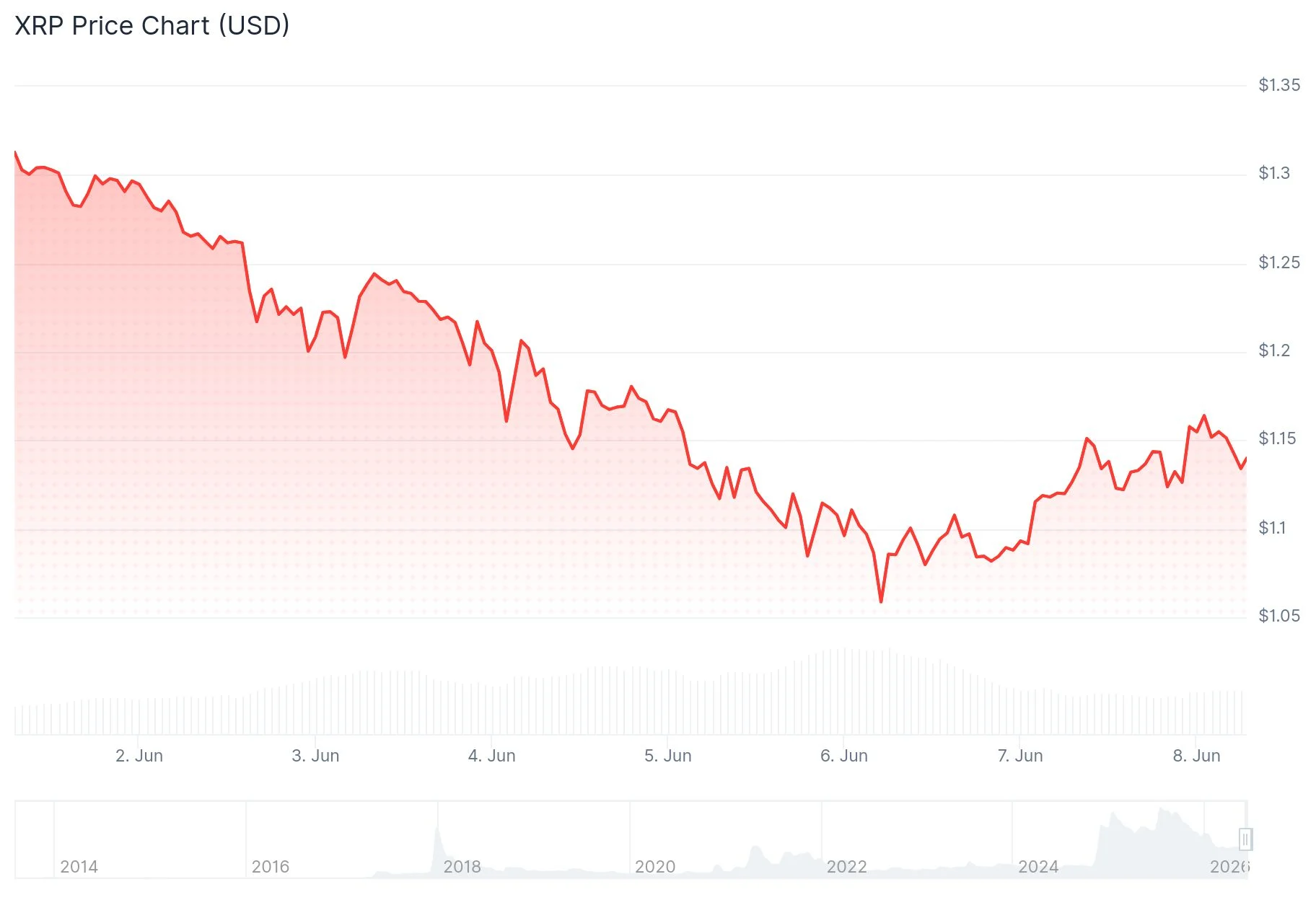
- XRP currently trades at $1.12, registering a 1.82% increase over the past 24 hours alongside a $69.45 billion market capitalization
- The digital asset successfully breached a downward trend line at $1.10 and surpassed the 23.6% Fibonacci retracement threshold
- Critical resistance zones are positioned at $1.1720 and $1.2080 — breaking through $1.2080 may trigger a rally toward $1.2450
- Should bullish momentum falter near $1.1740, downside targets include $1.1250, $1.110, and $1.050
- Technical analyst Ali Charts identifies $0.90 as a potentially robust accumulation zone for long-term investors
XRP has successfully reclaimed territory above the psychologically important $1 level following recent bearish pressure, currently trading at $1.12. The cryptocurrency has recorded a daily increase of 1.82%, accompanied by $2.93 billion in trading volume and maintaining a market capitalization of $69.45 billion.
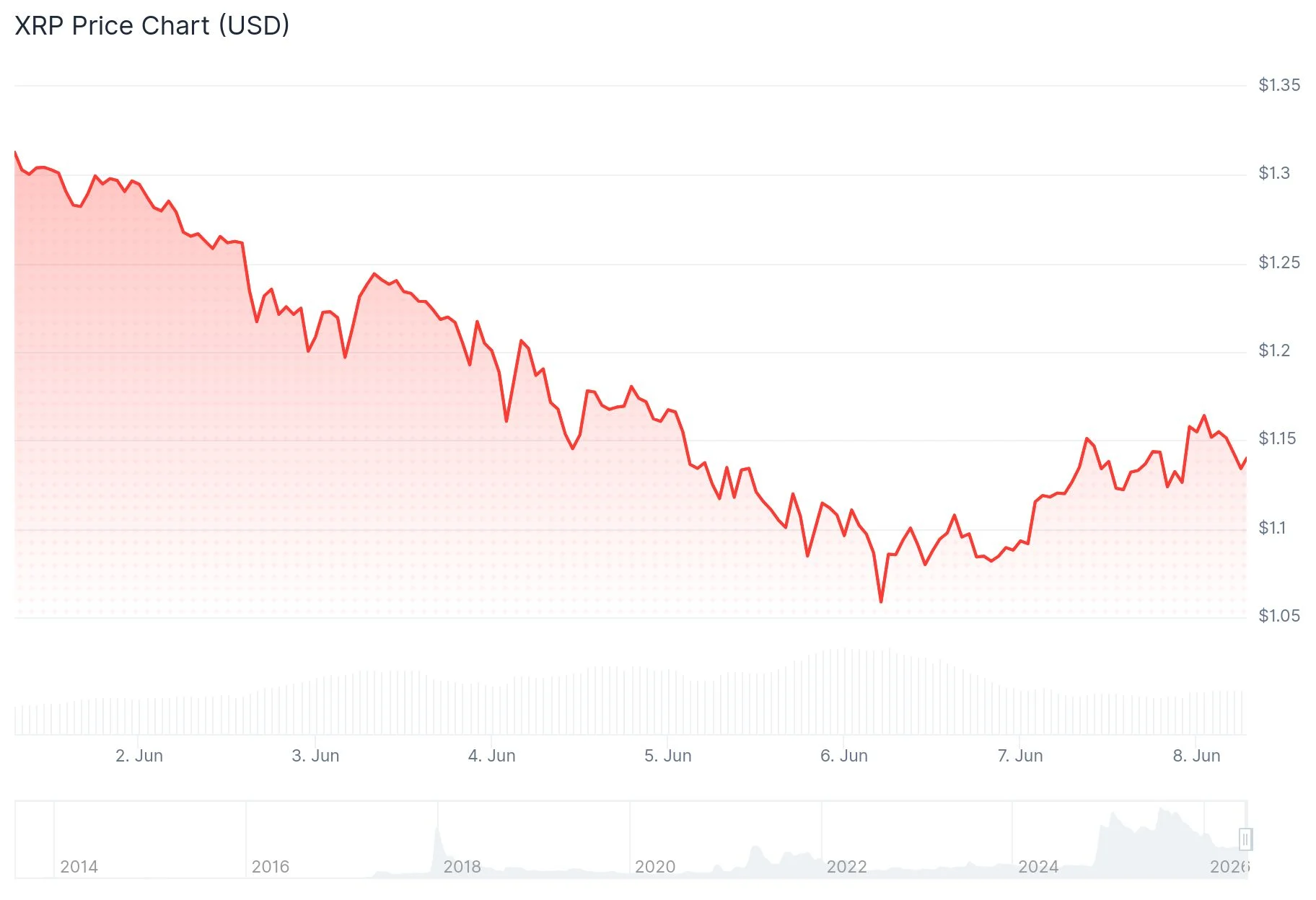
The upward movement initiated after XRP maintained critical support above the $1.050 threshold. Following this consolidation, market participants drove the price beyond $1.10 and subsequently through $1.120, eliminating a descending trend line that had previously functioned as resistance on the 60-minute timeframe.
The token has also moved past the 23.6% Fibonacci retracement level calculated from the decline between the $1.3640 peak and the $1.052 bottom. Current price action shows XRP trading comfortably above its 100-hour Simple Moving Average.
Market analyst Ali Charts shared insights on X, highlighting his close monitoring of the $0.90 price zone for XRP. According to his analysis, should the asset retrace to that level, it could present an attractive entry point for those with longer investment horizons.
Critical Resistance Zones Ahead
The immediate obstacle facing XRP bulls stands at $1.1720. Successfully clearing this barrier would establish a pathway toward $1.2080, a level that corresponds with the 50% Fibonacci retracement point. Beyond this threshold, subsequent targets emerge at $1.2150, $1.220, and ultimately $1.2450.
Potential Bearish Scenarios
If XRP encounters resistance near $1.1740 and cannot sustain upward momentum, a retracement becomes likely. The first line of defense appears at $1.1250, with additional support at $1.110. A breakdown beneath $1.110 could accelerate selling toward $1.080, potentially extending to the $1.050 region.
The Relative Strength Index currently reads 25.40, remaining within oversold conditions, though the recent uptick suggests diminishing selling pressure. The MACD indicator continues below its signal line at -0.0700 compared to -0.0476, indicating persistent short-term bearish momentum.
On June 7, analyst Crypto Patel observed that XRP currently trades approximately 37,000% above its 2017 lows. He disclosed his accumulation strategy targets the $1.00 to $0.60 range, suggesting that if XRP eventually reaches $10–$20 in upcoming market cycles, present price levels may appear as favorable entry points retrospectively.
The MACD histogram value of -0.0224 confirms that bearish forces maintain control, and a bullish shift would require a positive MACD crossover to signal definitively changing momentum dynamics.
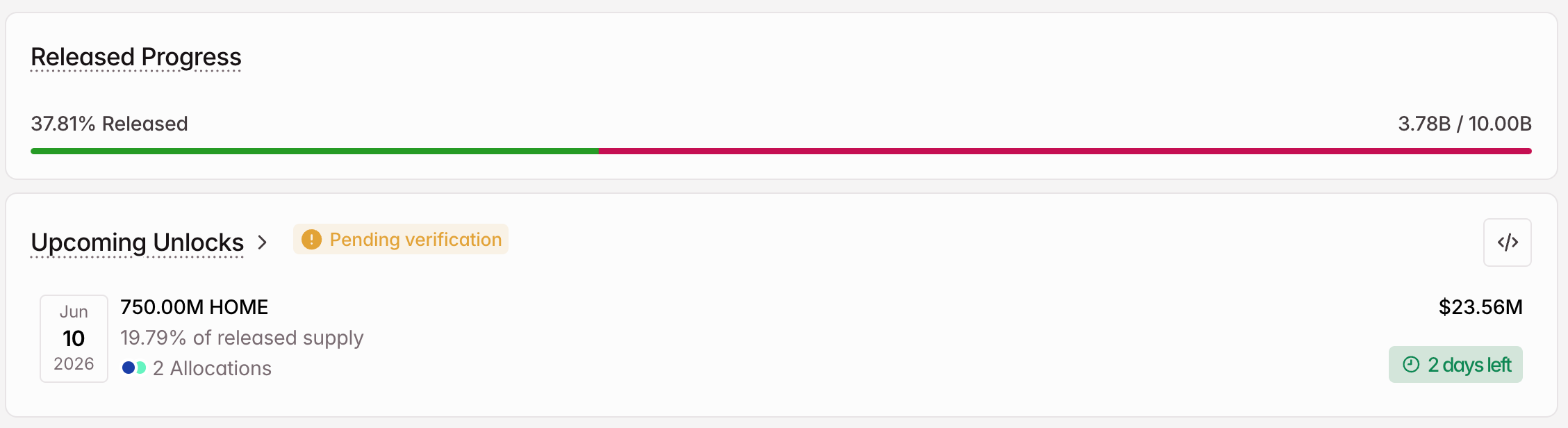
The crypto market will welcome tokens worth more than $634.89 million in the second week of June 2026. Major projects, including HOME (HOME), HumidiFi (WET), and Magic Eden (ME), will release significant new token supplies.
These unlocks could introduce market volatility and influence short-term price movements. So, here’s a breakdown of what to watch.
1. HOME (HOME)
- Unlock Date: June 10
- Number of Tokens to be Unlocked: 750 million HOME
- Released Supply: 3.78 billion HOME
- Total supply: 10 billion HOME
HOME is the native token of DeFi.app, a self-custody “everything app” for swaps, perps, and yield across chains. The platform uses HOME for gas abstraction, governance, and fee buybacks.
On June 10, the network will unlock 750 million HOME, worth about $23.56 million at current prices. The release equals 19.79% of the released supply.

Core Contributors will receive 500 million HOME from the unlock. Early Backers will claim the remaining 250 million HOME.
2. HumidiFi (WET)
- Unlock Date: June 9
- Number of Tokens to be Unlocked: 256.67 million WET
- Released Supply: 230 million WET
- Total supply: 1 billion WET
HumidiFi is a Solana-based decentralized exchange. WET is the network’s native token. The protocol integrates with Jupiter, DFlow, Titan, and OKX Router, serving as a key liquidity layer for the network.
HumidiFi will release about 256.67 million WET, worth roughly $14.66 million, on June 9. The unlock accounts for around 111.59% of the released supply.

The supply spans several stakeholders. HumidiFi will give 106.67 million altcoins to the Foundation. Labs will get 83.33 million tokens. Lastly, the team will allocate 66.67 million tokens towards the ecosystem.
3. Magic Eden (ME)
- Unlock Date: June 10
- Number of Tokens to be Unlocked: 172.03 million ME
- Released Supply: 506.9 million ME
- Total supply: 1 billion ME
Magic Eden is a multi-chain marketplace, and ME is its native utility and governance token. It started as the dominant NFT marketplace and has since expanded.
On June 10, Magic Eden will release 172.03 million ME, worth roughly $10.36 million. The release equals about 33.99% of the released supply.

The bulk of the unlock flows to contributors. They will receive 162.19 million ME. Strategic Participants will gain 2.88 million ME. The team will also allocate the remaining 6.96 million tokens to Community & Ecosystem.
Besides these three, other prominent token unlocks that investors can look out for in the second week of June include Aptos (APT), Babylon (BABY), and Movement (MOVE).
The post 3 Token Unlocks to Watch in the Second Week of June 2026 appeared first on BeInCrypto.
Crypto World
Securitize (SECZ) Eyes NYSE Debut: SEC Clears Path for Tokenization Giant’s Public Listing

Key Takeaways
- Securitize received SEC clearance on its Form S-4 filing, advancing its special purpose acquisition company transaction with Cantor Equity Partners II
- A shareholder vote scheduled for June 29 will determine whether the merged entity trades on the NYSE under ticker symbol “SECZ”
- The platform oversees $4 billion in tokenized assets and generated $19.5 million in Q1 revenue, marking a 39% year-over-year increase
- On-chain tokenized real-world assets reached an all-time high of $32 billion in May, representing 220% growth over the past year
- More than 60% of tokenized assets reside on Ethereum and its layer-2 scaling solutions
A leading platform specializing in real-world asset tokenization has cleared a critical regulatory hurdle with the US Securities and Exchange Commission, bringing it one step closer to debuting on the New York Stock Exchange.
The securities regulator declared effective the Form S-4 registration document submitted by Securitize in conjunction with Cantor Equity Partners II, a blank-check company backed by a Cantor Fitzgerald affiliate.
This regulatory green light paves the way for shareholders to cast their votes on June 29. Should the proposal pass, the newly formed entity will begin trading on the NYSE with the ticker symbol SECZ.
According to Carlos Domingo, who co-founded Securitize and serves as its CEO, this represents “another important milestone for Securitize and for the broader institutional adoption of tokenization.”
Understanding Securitize’s Business Model
Securitize holds the position as the dominant tokenization platform measured by market share. With $4 billion in assets under management, the company provides tokenized investment products in partnership with prominent asset managers such as Apollo, BlackRock, BNY, and VanEck.
During the first quarter, Securitize posted revenue totaling $19.5 million, representing a 39% jump compared to the corresponding period in the prior year.
This past March saw the NYSE enter into a memorandum of understanding with Securitize. This partnership forms part of a broader initiative to develop blockchain infrastructure for securities trading on Wall Street.
Real-World Asset Tokenization Hits All-Time Peak
The announcement of this SPAC combination arrives amid unprecedented growth in tokenized real-world assets.
According to data from RWA.xyz, the total value of on-chain RWA reached $32 billion in May. This calculation excludes stablecoins and reflects a 220% surge compared to twelve months earlier.
US Treasury securities comprise nearly half of all tokenized assets on blockchain networks. Commodities represent approximately 16% of the total.
Equities remain a relatively modest segment, constituting just 4.8% of the market, equivalent to roughly $1.5 billion in total on-chain valuation.
Ethereum alongside its layer-2 scaling networks dominates the tokenization landscape, commanding a collective market share exceeding 60%.
The SEC has additionally designated digital assets as a strategic focus area extending through 2030, a policy shift that could prove advantageous for tokenization platforms such as Securitize in the years ahead.
The upcoming shareholder vote on June 29 represents the next critical juncture for the company. Approval would provide retail and institutional investors with direct exposure to one of the world’s largest tokenization platforms.
Should Securitize complete its public listing, it would represent one of the earliest instances of a prominent tokenization company achieving a listing on a conventional stock exchange.
America’s newest Federal Reserve Chair did not get a quiet start. Kevin Warsh was sworn in on May 22, three weeks ago, as the 17th Fed Chair. The youngest Fed governor ever appointed when he first joined the board in 2006 at age 35, he walked in promising “regime change”: tighter inflation discipline and a rethink of the Fed’s balance sheet.
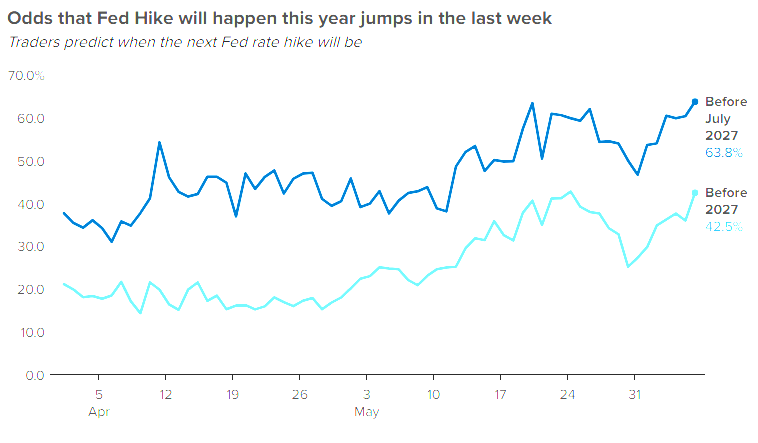
Then the May jobs report landed. The US economy added 172,000 jobs, nearly double expectations, against a forecast of 85,000. Bond markets pushed the odds of a December rate hike to 68%.
Kevin Warsh’s First Real Test
His Senate confirmation, 54-45, the most divisive Fed vote in history, signaled a contested tenure from day one.
Wall Street largely read his appointment as a sign of rate continuity: while Warsh was a hawk during the 2008 financial crisis alongside Ben Bernanke, analysts expected his second stint to run closer to Powell’s playbook.
His “regime change” language, most argued, pointed to internal Fed reform rather than a shift in rate policy.
Recently, Cleveland Fed President Beth Hammack stepped forward to say the central bank may need to act soon to bring inflation back to 2%, warning that “if we wait for definitive evidence that high inflation has become embedded in the economy, it may require larger policy adjustments, at greater cost.”
That lands Warsh in a direct position: hold rates at the June 17-18 FOMC meeting and signal that regime change means structure, not stance, or back a hike and prove his inflation discipline is real.

When Bitcoin ETF outflows hit a record streak amid rate-hike fears, markets have been repricing the Fed outlook for weeks.
The Kevin Warsh Paradox for Bitcoin
Warsh enters the role as the most crypto-familiar Fed chair in history: past ties to Bitcoin and stablecoin ventures, opposition to a central bank digital currency, and support for private-sector stablecoins.
Yet crypto-friendly or not, the rate math dominates. Bitcoin has fallen from $82,000 in mid-May to the low $60,000s, tracking almost exactly with the collapse in rate-cut expectations over the same period.
As BeInCrypto previously reported, when Goldman Sachs and others were still forecasting rate cuts, Bitcoin was pricing in a very different policy path.
Warsh’s crypto fluency means he understands how the rate decision affects digital assets in a way no previous Fed chair has.
Bitcoin price analysis for June 2026 showed that the next directional move is entirely contingent on whether the Fed signals hold or hike at its June 17-18 meeting.
Whether that means tighter rates or just tighter communication, June 17-18 is the date Bitcoin investors are watching.
The post Fed Rate Hike Odds Just Hit 68%, Is Kevin Warsh Now Bitcoin’s Biggest Problem? appeared first on BeInCrypto.
Maelstrom co-founder Arthur Hayes said he sold his Worldcoin (WLD) holdings just days after his venture capital firm described it as one of the cleanest proxies for the AI investment play.
“This chart is going in the wrong direction,” said Hayes on X on Saturday, showing a chart for the SpaceX pre-IPO perpetual futures contract, which had fallen sharply.
“Dumped WLD. I’m out. See y’all at the clerb,” he added.
It was only on Wednesday that Maelstrom researcher Lukas Ruppert described Worldcoin as an “overlooked” bet on “AI mega IPOs,” predicting WLD would hit $5 by August.
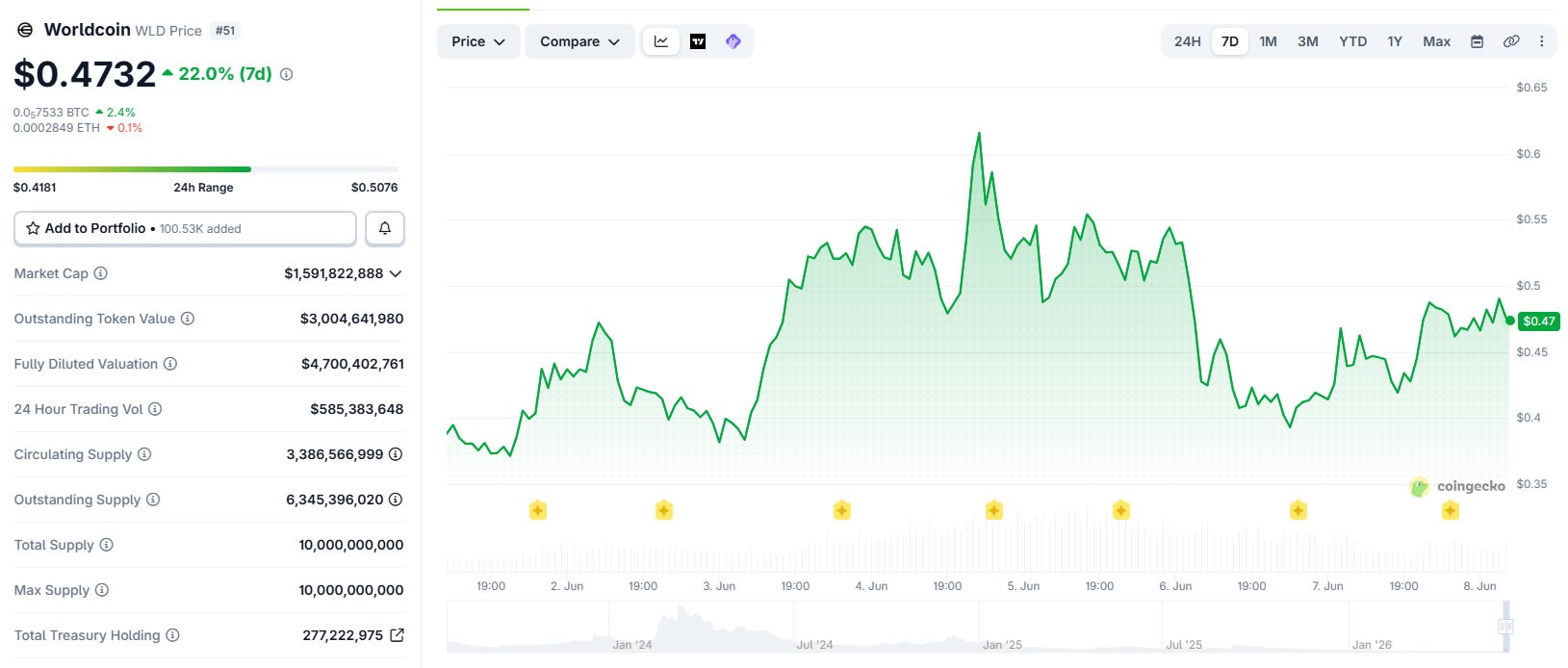
The investor note led to a short rally for WLD, which topped $0.60 on June 5, but has since fallen back to $0.40 on June 7 as Hayes told his 800,000 X followers that he had exited his position.
Hayes previously said on X that he would hold WLD through the SpaceX IPO on Nasdaq, which is expected on June 12, prompting some to criticize the timing of the sale.
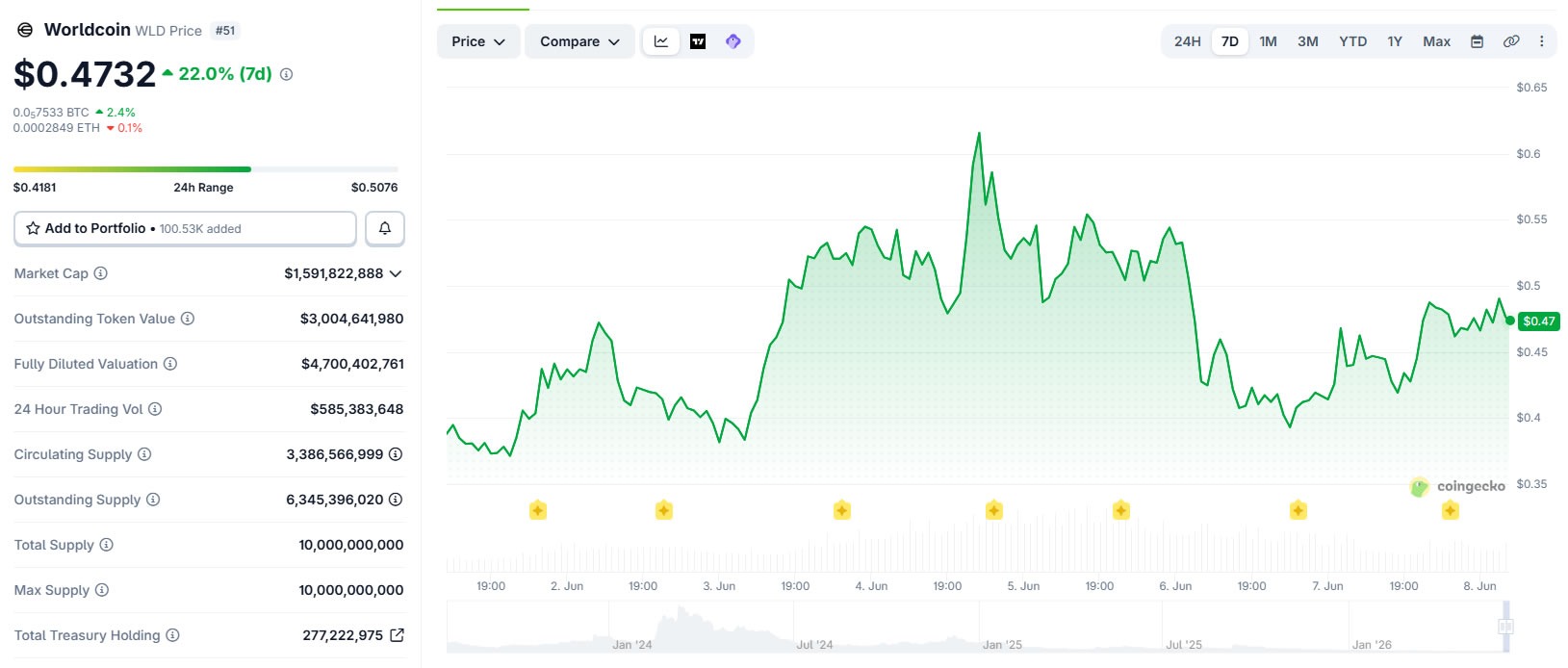
WLD prices have been extremely volatile over the past week. Source: CoinGecko
The ‘Holy Trinity is dead’ — or is it?
WLD adds to the list of crypto assets Hayes has pivoted on despite earlier bullish comments.
In March, Hayes predicted that Hyperliquid (HYPE) would reach $150 by August and on June 1 said it would “outperform any other current top ten crypto in USD terms from now until year-end,” but sold his entire position in the asset three days later, citing higher energy prices due to the Iran war, “inventory restocking,” and imminent “mega AI IPOs.”
Related: Hyperliquid bear turns bullish after losing over $46M shorting HYPE
On May 6, Hayes said Zcash would reach 10% of Bitcoin’s price. On June 5, he offloaded his ZEC stash following the discovery of a critical vulnerability in its privacy protocol, claiming that the “Holy Trinity” of HYPE, ZEC, and NEAR was “dead.”
However, Hayes appears to have reversed his position partially. A wallet linked to Hayes bought back around 33,978 HYPE worth around $2 million on Monday, after it had fallen 26% in the wake of his June 4 sale, according to Arkham Intelligence.
Cointelegraph reached out to Maelstrom for comments but did not receive an immediate response.
Magazine: Korea probes Polymarket users, crypto PACs sweep primaries: Hodler’s Digest

How Is This Possible… | Financial Audit

Tony Awards 2026: John Lithgow, Ragtime, Death of a Salesman win big

Textile stocks to rally? Emkay sees sector at inflection point to regain lost glory, initiates ‘Buy’ call on 3 stocks



-

 Fashion3 days ago
Weekend Open Thread: Evereve – Corporette.com
-

 Business6 days ago
Jade Biosciences, Inc. (JBIO) Discusses Positive Interim Results From JADE101 Phase I Healthy Volunteer Study and Development Plans Transcript
-
 Crypto World3 days ago
Jensen Huang Approves Samsung, SK Hynix, and Micron for NVIDIA (NVDA) HBM4 Memory Supply
-

 Sports5 days ago
French Open 2026 results: Alexander Zverev beats Rafael Jodar and will play Jakub Mensik in semi-finals
-

 Tech6 days ago
CryZENx Releases Fresh Playable Content Deep Inside Jabu-Jabu for His Ocarina of Time Remake
-

 Business5 days ago
Trump Taps Housing Chief Bill Pulte as Acting Intelligence Director After Gabbard Exit
-
 Business1 day ago
The Pain Points Taking a Fragile Tech Rally Down a Notch
-
Crypto World3 days ago
LBank Surpasses 25 Million Users Worldwide as AFA Partnership Continues to Drive Global Growth
-
 NewsBeat5 days ago
Republicans balk at Trump’s attempt to appoint a MAGA enforcer to lead National Intelligence
-

 Tech3 days ago
RCS Messages Between iPhone and Android Get End-to-End Encryption With iOS 26.5
-
 Crypto World6 days ago
Seagate (STX) Stock Surges to Record High on AI Boom and Legal Settlement
-

 Tech3 days ago
Microsoft launches MXC, an OS-level sandbox for AI agents, with OpenAI and Nvidia already on board
-

 Tech3 days ago
Meta steals a tactic from Tesla and builds data centers in tents
-
Crypto World5 days ago
EU AI Data Center Project Faces Delays as Funding Gaps Grow
-

 Entertainment5 days ago
Did The Mandalorian And Grogu Already Ruin The Next Star Wars Movie?
-

 Business5 days ago
Aehr Test Systems Stock Soars 17% Amid Surging AI Demand and Conference Spotlight
-
 Crypto World3 days ago
Merlin (MRLN) Stock Soars 32% on Major USSOCOM Autonomy Milestone
-
 Business6 days ago
Claude AI Down Today Reason: Why Anthropic’s AI is not working today? What’s the latest quota update
-

 Tech3 days ago
Credit card theft campaign abuses Stripe to host stolen payment info
-
 Business1 day ago
Cryptos Could Be Casualties of SpaceX IPO as Bitcoin Hits Lowest Price Since 2024
You must be logged in to post a comment Login