
Crypto World
Huge Day for XRP: CLARITY Act Vote Could Spark the Next Big Move


Although the entire cryptocurrency market rallied on Monday, perhaps to the surprise of a lot of people given the upcoming expectations for a Fed rate hike, XRP was at the forefront, surging from under $1.35 to $1.50 to mark a three-week peak.
It was rejected there, but still remains close to $1.40 ahead of what could be a major day for all crypto assets, including XRP.
XRP Braces for CLARITY Vote
The US Senate is expected to vote shortly after 2 p.m. ET today on cloture for the motion to proceed with the landmark crypto market-structure legislation. It’s worth noting that this is not a final passage vote. Instead, it will show whether the bill has legs to run in the Senate, as it requires 60 votes simply to advance to formal debate. This means that Republicans need support from several Democrats or independents while also avoiding defections within their own party.
The latest developments on the matter were somewhat promising as Senate Republicans released another revised version over the weekend in an attempt to address disagreements surrounding stablecoins, banking competition, and public officials’ crypto interests. However, Senate Democrats sent a counterproposal late last night, even though their Republican counterparts had said their version was “best and final.”
For XRP, the implications are particularly interesting as it already enjoys substantially more regulatory certainty than before or during Ripple’s years-long battle with the SEC. However, the CLARITY Act would establish a durable statutory framework dividing oversight between the SEC and the CFTC and provide clearer rules for digital-asset intermediaries.
$2 Next?
In a previous article, we discussed (with the help of ChatGPT) what could go wrong for XRP in case of a negative vote. In this one, we will reverse course, as most analysts are quite bullish on the asset. One thing they all agree on is that volatility is likely to go wild.
CasiTrades sees the next important upside objective around $1.74-$1.78, followed by an even higher target at $2.00 if momentum continues. EGRAG CRYPTO, who has been among the most bullish XRP commentators, highlighted the importance of the asset maintaining its 100-day EMA around $1.38-$1.40, which is currently being tested again. Holding that level would preserve the broader bullish structure, but losing it could result in a major leg down.
Other analysts, including Mikybull Crypto and Bird, also pointed to improving XRP momentum immediately ahead of the Senate vote. The first test, though, is very close. A sustained breakout above the $1.50 area could open the door toward $1.60, with $1.74-$1.78 coming into focus shortly after. Naturally, $2.00 would return as the obvious next psychological objective.
The post Huge Day for XRP: CLARITY Act Vote Could Spark the Next Big Move appeared first on CryptoPotato.

Crypto World
Standard Chartered predicts Arbitrum’s ARB to rise 70-fold to $10, citing Robinhood Chain revenue
There is a catch. ARB holders currently have no direct claim on that revenue, something Kendrick himself listed among the risks to the call. CoinDesk reported earlier this month that Robinhood Chain pays 10% of its net protocol revenue into the Arbitrum ecosystem, with 8% going to the DAO treasury and 2% to a developer fund. None flows directly to token holders currently.
Read More: Robinhood’s new crypto network is printing cash, and it’s sending Arbitrum’s token soaring
Robinhood Chain’s early growth has also come from a somewhat different crowd than the traditional-financial users behind Kendrick’s longer-term thesis. Memecoin launchpads and trading apps have supplied much of its activity even though the network was built primarily around tokenized stocks and other traditional assets.
Robinhood Chain paid about $360,000 in licensing fees in July, accounting for 35% of Arbitrum DAO income that month. The chain was generating $3.75 million in user fees by Sept. 1 and sending roughly $370,000 to Arbitrum over 24 hours.
Kendrick expects $4 trillion of traditional assets to be tokenized by the end of 2028 and sees Arbitrum capturing a growing share of the infrastructure behind them. He forecasts ARB at 50 cents by year-end, $1.50 in 2027, $3.50 in 2028, $6.50 in 2029 and $10 in 2030.


The pullback is also showing up on Kalshi, where traders are increasingly pushing any breakthrough further into the future. The contract for a crypto market structure bill becoming law before Oct. 1, 2027, fell to 36% Tuesday, down from around 53% Monday morning.
For comparison, traders on Monday had put the chances of passage before July 1, 2027, at 53%. By Tuesday, the longer timeline was looking more plausible: Kalshi traders gave the bill, or another qualifying crypto market structure measure, a 51% chance of becoming law only by Jan. 1, 2028.
The reversal comes after prediction markets surged on Monday on hopes that Republican concessions could finally break the months-long stalemate. That optimism quickly faded as banking groups pressed lawmakers to tighten restrictions around stablecoin interest and rewards, while a bipartisan group of state attorneys general warned the legislation could weaken states’ ability to police crypto-related fraud.
Republicans released what they called their final draft over the weekend after making more than 100 changes requested by Democrats, including concessions on ethics provisions. The Senate is scheduled to vote Tuesday afternoon on whether to invoke cloture on the motion to proceed, which requires 60 votes.


The European Central Bank (ECB) on Tuesday called on e-commerce and mobile commerce merchants in the euro zone to join a digital euro pilot as it prepares a retail central bank digital currency (CBDC) for possible issuance in 2029.
The pilot will test the technology, operational processes and user experience of a beta version of the currency, which will resemble the digital euro, but will not be legal tender.
The ECB’s call for merchants is about more than just technical testing. A digital euro will need enough places to spend it if consumers are to use it, making merchant acceptance a commercial question as much as a policy one.
“Many people think the digital euro’s success will depend on how governments and the public sector explain its usefulness,” Isadora Arredondo, vice president of global policy at Hedera, told CoinDesk via LinkedIn. “But the more difficult part will be making the project work commercially.”
Arredondo said merchants would need incentives to join in sufficient numbers and to ensure consumers do not encounter barriers when paying. One option, she said, could be for payment service providers to lower the fees merchants pay to accept digital-euro payments.

The US House Ways and Means Committee is set to consider a 114-page cryptocurrency tax package on Wednesday, designed to bring more structure to several areas of digital-asset taxation. The bill, H.R. 10357—the Digital Asset Tax Certainty Act—was published alongside the committee’s markup materials on Monday.
While the proposal retains multiple provisions affecting mining and staking, it does not include a key feature that would have delayed taxes on new rewards until the tokens are actually sold for cash. That omission could be a practical sticking point for miners and stakers who argue that taxing rewards as soon as they are received may create liquidity problems.
Key takeaways
- The House Ways and Means Committee will mark up H.R. 10357 (the Digital Asset Tax Certainty Act) on Wednesday, with markup text published Monday.
- The bill removes a proposed rewards-timing option that would have allowed deferring taxation until sale, as described in Rep. Mike Carey’s earlier staking/mining legislation.
- Beyond mining and staking, the package targets multiple tax mechanics, including treatment of network/transaction fee payments (up to $10) and special rules for certain stablecoins.
- The proposal extends wash-sale and constructive-sale style rules to crypto and creates a voluntary disclosure pathway for taxpayers seeking to remedy past digital-asset tax issues.
- The House effort arrives as the Senate weighs the CLARITY Act, which would reshape how federal regulators split oversight of crypto markets.
What the House bill keeps—and what it drops
H.R. 10357 is framed as a broad effort to reduce uncertainty in how the tax code applies to digital assets. According to the committee’s bill text, it would classify income from blockchain validator activities as ordinary income and address whether such income is sourced within or outside the United States.
The package also includes provisions meant to preserve the tax status of certain investment trusts that stake qualifying digital assets. In other words, it attempts to address questions that matter not just to individuals, but also to broader investment structures.
However, the legislation stops short of including a rewards-timing provision that had been part of Rep. Mike Carey’s earlier “Tax Clarity for Mining and Staking Act,” which was introduced in June. In the earlier proposal, taxpayers would have had a choice: treat newly created tokens as income when received, or instead handle them in a manner akin to self-created property—effectively triggering taxation when the tokens are sold.
Without that option, the underlying tax treatment in the House package keeps mining and staking rewards taxable when received or when they come under the recipient’s control, potentially before any cash sale occurs.
How H.R. 10357 handles payments, stablecoins, and ordinary crypto transactions
Beyond staking and mining, the bill targets several areas that have repeatedly complicated day-to-day crypto reporting.
For one, the proposal includes a mechanism to prevent taxpayers from recognizing gains or losses when crypto is used to pay network or transaction fees of up to $10. That change is aimed at reducing the tax friction that can arise from frequent, small fee payments across on-chain activity.
The bill also proposes special tax treatment for qualifying US dollar stablecoins and includes rules allowing certain qualifying digital asset loans to occur without being treated as taxable sales. Additionally, it calls for simplified accounting for widely traded crypto assets, a category that generally reflects the reality that many taxpayers interact with large, liquid assets rather than a narrow set of obscure tokens.
Another major thread in the proposal involves expanding rules commonly associated with wash sales and constructive sales. In practice, those provisions are meant to limit tax outcomes that can be achieved by replacing an asset before taxes are realized—rules that the bill would extend to crypto.
Voluntary disclosure and the push for “certainty”
H.R. 10357 also creates a voluntary disclosure program for taxpayers who want to correct earlier digital-asset tax violations. The existence of such a path suggests the committee is not just writing new rules, but also attempting to manage the compliance landscape for taxpayers who may have already made reporting decisions under prior ambiguity.
The committee’s markup process did not begin with H.R. 10357 alone. Earlier in June, Ways and Means circulated seven crypto tax drafts ahead of a digital asset taxation hearing. Those proposals reportedly covered stablecoins, mining and staking, and measures aimed at reducing the tax-reporting burden created by the structure of crypto transactions.
As the process developed, industry stakeholders pressed for specific changes. Reporting on earlier advocacy noted that the Blockchain Association, Crypto Council for Innovation, and Digital Chamber urged Congress to pass Rep. Carey’s legislation as introduced, arguing that taxing staking and mining rewards before tokens can be sold risks creating liquidity problems. They also opposed an amendment that would have limited the potential deferral to five years.
In this latest House package, that rewards-timing aspect did not survive into the committee’s published markup text. That makes Wednesday’s committee consideration especially significant for miners, stakers, and their tax advisors—because it determines whether liquidity concerns remain central to the bill’s final form or are addressed only indirectly through other provisions.
House tax drafting unfolds alongside Senate market-structure debate
The House crypto tax package is moving forward as lawmakers elsewhere consider a separate but related policy track: the CLARITY Act, which would clarify how the US Securities and Exchange Commission and the Commodity Futures Trading Commission divide oversight of the crypto market.
While H.R. 10357 focuses on taxation mechanics—how and when gains, income, and losses are recognized—the Senate’s regulatory-oversight debate affects a different dimension of the same ecosystem: what kinds of activities, products, and exchanges may fall under which regulator’s authority. For investors and builders, those questions can influence compliance costs, product design, and the willingness of firms to offer services that touch on crypto’s broader market infrastructure.
Taken together, the developments show Congress grappling with both “how to tax” and “how to regulate,” two policy domains that often move at different speeds but ultimately affect similar stakeholders.
As the House committee considers H.R. 10357 on Wednesday, market participants should watch whether the missing rewards-timing provision becomes a focal point for amendments, and whether the bill’s other operational changes—fee de minimis treatment, stablecoin rules, and the expansion of wash/constructive-sale style restrictions—survive intact into any later legislative steps.
Bitcoin is entering a potentially decisive macro catalyst with its short-term structure already under pressure. The asset has drifted back toward the lower boundary of its recent consolidation, while the market awaits tomorrow’s FOMC interest-rate decision, an event that could trigger a sharp expansion in volatility as expectations remain heavily skewed toward a rate increase.
Bitcoin Price Analysis: The Daily Chart
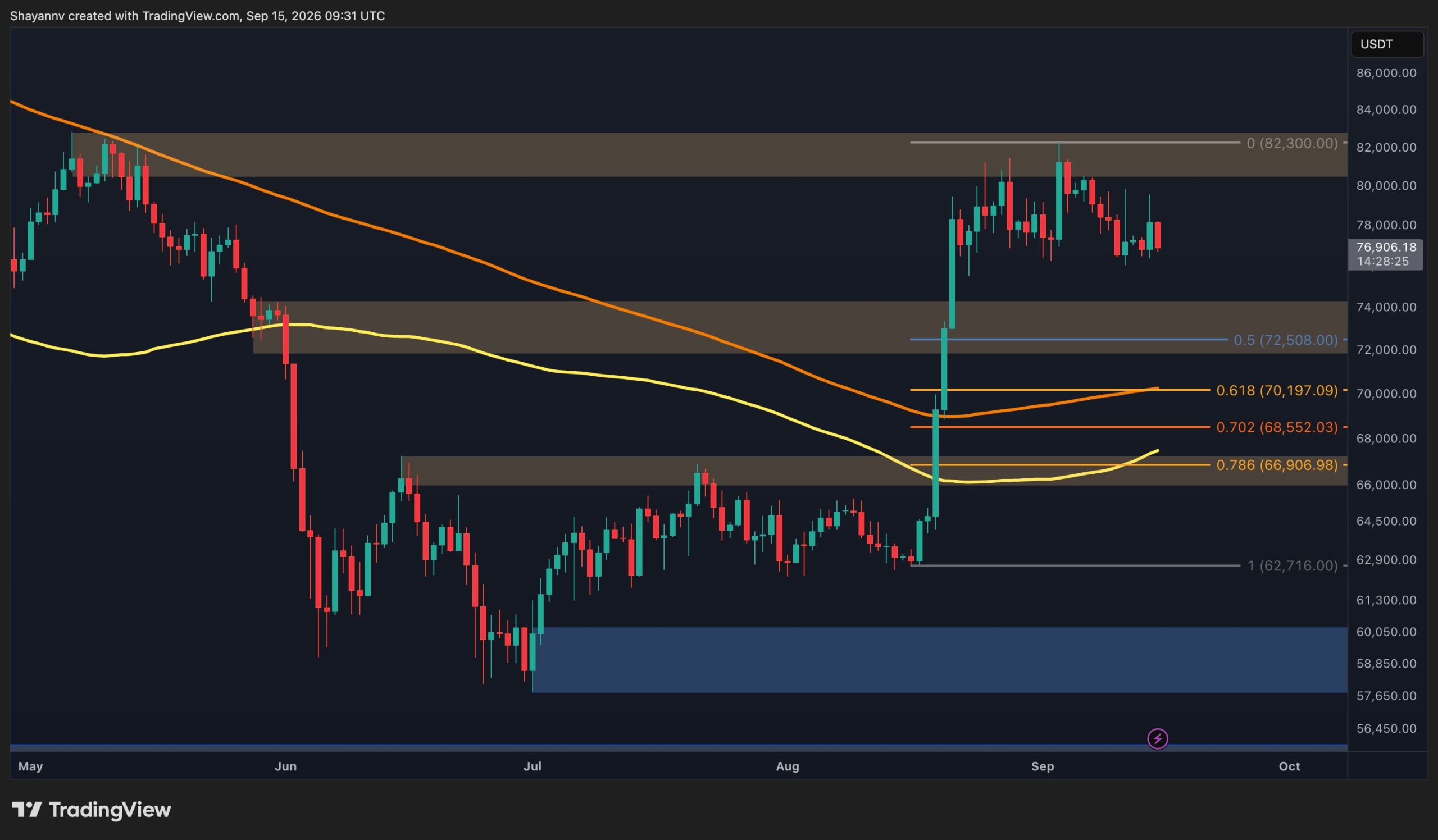
On the daily timeframe, Bitcoin is trading around $77K after repeatedly failing to establish itself above the $80K-$82.3K resistance zone. The rejection from this area has gradually weakened momentum, with the latest sequence showing lower highs and renewed pressure toward the lower end of the post-breakout range.
Despite this weakness, the broader structure has not broken down yet. The explosive August rally remains intact as long as BTC holds above the major support areas underneath. The first significant downside region is the $72K-$74K zone, with the 0.5 Fibonacci retracement positioned near $72.5K. Below it, the 0.618 retracement around $70.2K and the moving average provide another important confluence.
Therefore, a deeper correction toward $72K-$74K would not necessarily invalidate the broader bullish structure. However, continued rejection from $80K-$82.3K combined with a loss of these lower supports would indicate that the post-breakout correction is becoming considerably more significant.
BTC/USDT 4-Hour Chart
The 4-hour timeframe puts the immediate risk into sharper focus. BTC has been moving inside a broad ascending channel since the August breakout, but recent price action has progressively shifted toward its lower boundary.
The latest rejection from around $79K has pushed BTC back to roughly $76.9K, placing the market directly around the ascending support near $76K-$77K. This makes the current area particularly important. A decisive breakdown could confirm that the multi-week consolidation is resolving lower rather than simply continuing within the channel.
In that scenario, the $72K-$74K support zone becomes the primary downside target. Conversely, another successful defense of $76K-$77K could preserve the range and allow BTC to rotate back toward $79K-$80K, followed by the major $80.5K-$82.3K resistance zone.
With the FOMC meeting approaching tomorrow, however, short-term technical signals may become less reliable as traders wait for the interest-rate decision. The proximity of price to channel support means that any volatility generated by the announcement could determine whether the current structure survives or finally breaks.

Sentiment Analysis
Bitcoin’s Futures Average Order Size provides additional context on participation in the derivatives market. The latest readings are predominantly gray and light green around the $77K-$80K region, indicating a mixture of normal orders and smaller whale activity rather than clear dominance from exceptionally large participants.
Notably, the recent price recovery toward $80K has not been accompanied by the kind of concentrated large-order activity that would clearly signal aggressive conviction from major futures traders. This fits with the hesitant price action visible on the technical charts, where BTC has struggled to generate sustained momentum despite remaining relatively close to its recent highs.
With the FOMC decision now approaching, this lack of decisive positioning may also reflect traders reducing conviction ahead of a major macro event. A meaningful increase in larger orders after the announcement, particularly alongside a confirmed move away from the current $76K-$77K support area, could provide a stronger indication of where institutional futures participants expect Bitcoin’s next directional leg to develop.

The post Bitcoin Price Analysis: BTC Tests Key Support Ahead of Crucial FOMC Decision appeared first on CryptoPotato.
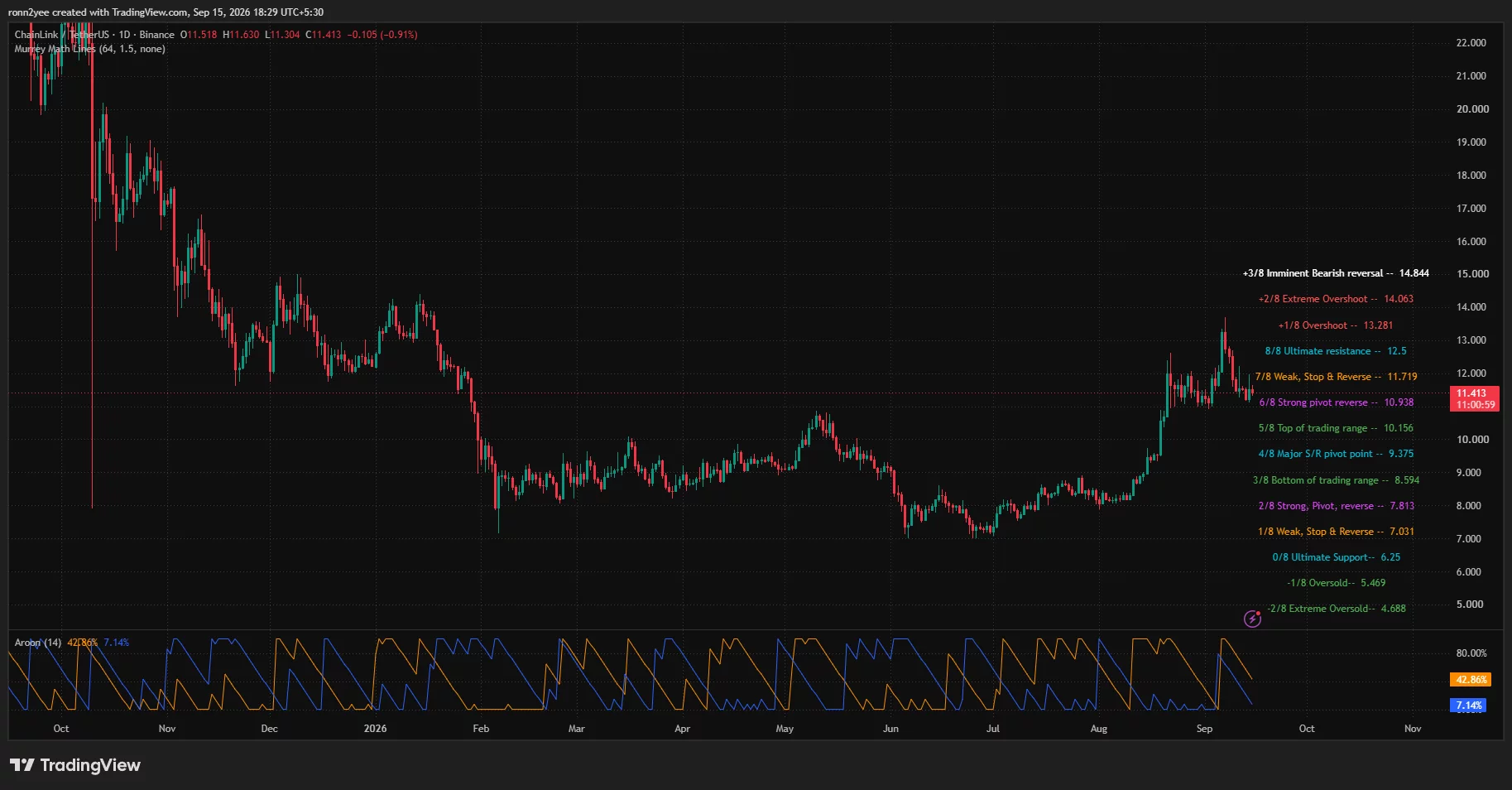
Chainlink price traded near $11.41 after failing to hold its latest rebound, while weak momentum and liquidity below $11.20 raised the risk of another decline.
Summary
- Chainlink price remained below the $11.72 resistance after retreating from its September peak near $13.60.
- Daily Aroon readings showed fading upward momentum, with Aroon Up falling to 7.14%.
- 4-hour Bollinger Bands placed immediate support near $11.20 and resistance around $11.68.
- Liquidation clusters near $11.00 could draw the price lower if the current support range fails.
Chainlink price remains under pressure
Chainlink (LINK) price was trading around $11.41 at the time of writing, down 0.91% on the daily candle after moving between $11.30 and $11.63. The token remained close to the lower end of its intraday range as buyers struggled to extend a brief recovery.
LINK has lost much of the advance that carried it from approximately $8.20 in early August to a September high near $13.60. The rally accelerated after the price broke through $9.40 and later cleared $11.00, but selling increased once the token moved above $13.00.
Price has since formed a sequence of lower highs and lower lows. The latest bounce stalled below $11.70, leaving LINK beneath the $11.72 Murrey Math resistance level on the daily chart.
The broader crypto market also faced pressure as investors assessed inflation, energy prices and the outlook for U.S. interest rates. Expectations that the Federal Reserve could keep borrowing costs restrictive reduced demand for higher-risk assets, including cryptocurrencies that do not offer a fixed yield.
Uncertainty surrounding the Digital Asset Market Clarity Act added another U.S.-specific risk for crypto traders. A delayed or unsuccessful Senate vote could weaken expectations for near-term regulatory clarity, although LINK’s immediate move remained closely tied to its technical setup and wider market direction.
Daily indicators show fading LINK momentum
The daily chart showed LINK holding above the 6/8 Murrey Math level at $10.94, which now serves as the nearest major pivot. Price previously used the area around $11.00 as a breakout level during its August rally, making the zone important for the short-term trend.
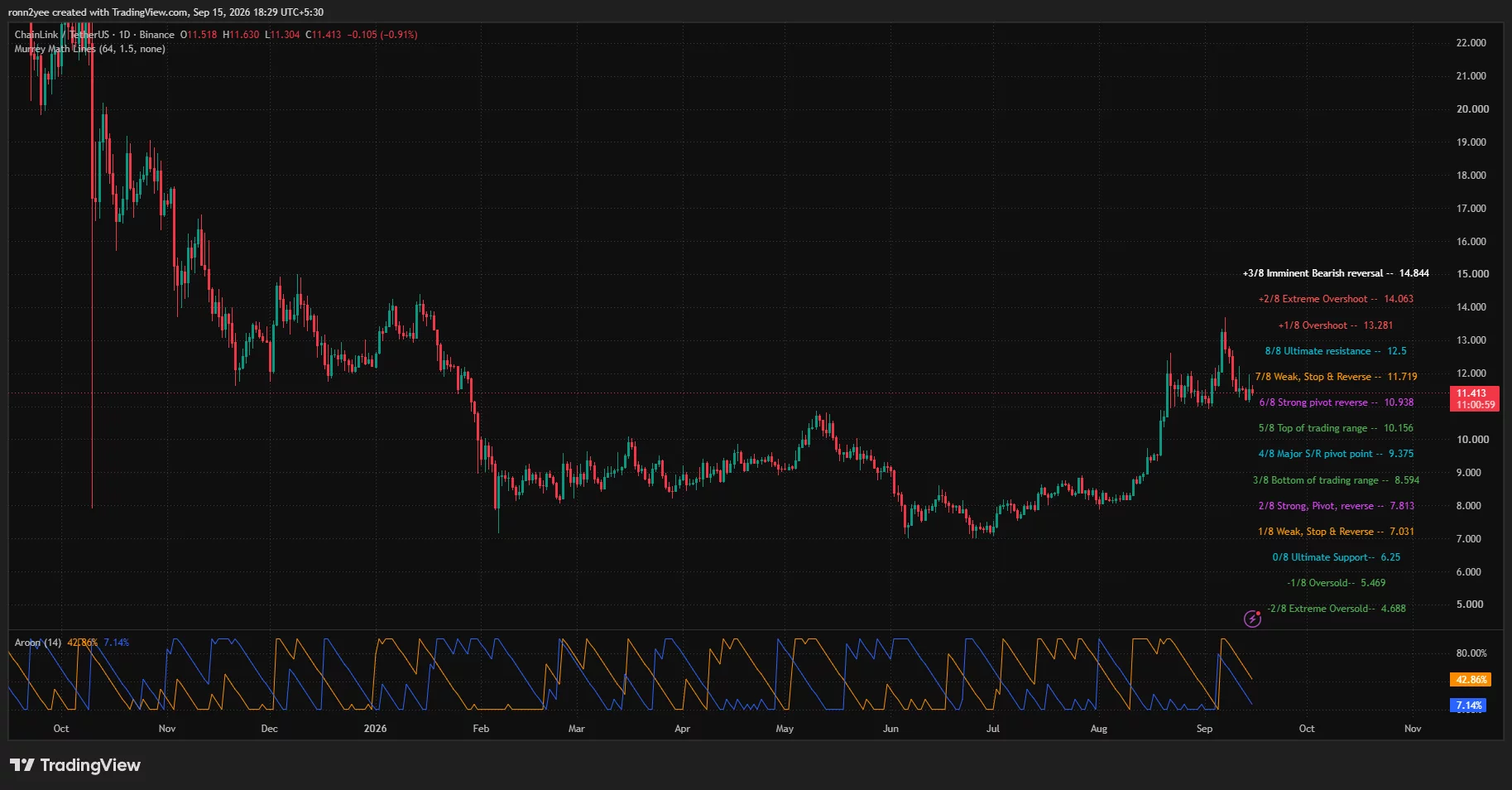
Aroon readings pointed to weakening bullish control. Aroon Up stood at 7.14%, while Aroon Down was at 42.86%. The wide gap suggests that LINK has not recorded a recent high, while downside pressure remains more active.
The readings do not confirm a fresh breakdown on their own, but they support the pattern of declining momentum since the early September peak. Buyers would need to reclaim $11.72 before LINK could attempt another move toward the 8/8 resistance at $12.50.
A break above $12.50 would expose the next Murrey Math targets at $13.28 and $14.06. LINK would still need stronger volume and broader market support to reach those levels, particularly after its rejection from the $13.00–$13.60 region.
If $10.94 fails, the daily chart places the next support at $10.16. A deeper correction could then bring the major $9.38 pivot into focus, although such a move would require a clear loss of the current $11.00 support area.
4-hour chart keeps $11.20 support in focus
LINK was trading slightly below the 4-hour Bollinger Band midpoint at $11.44. The upper band stood near $11.68, while the lower band was around $11.20.
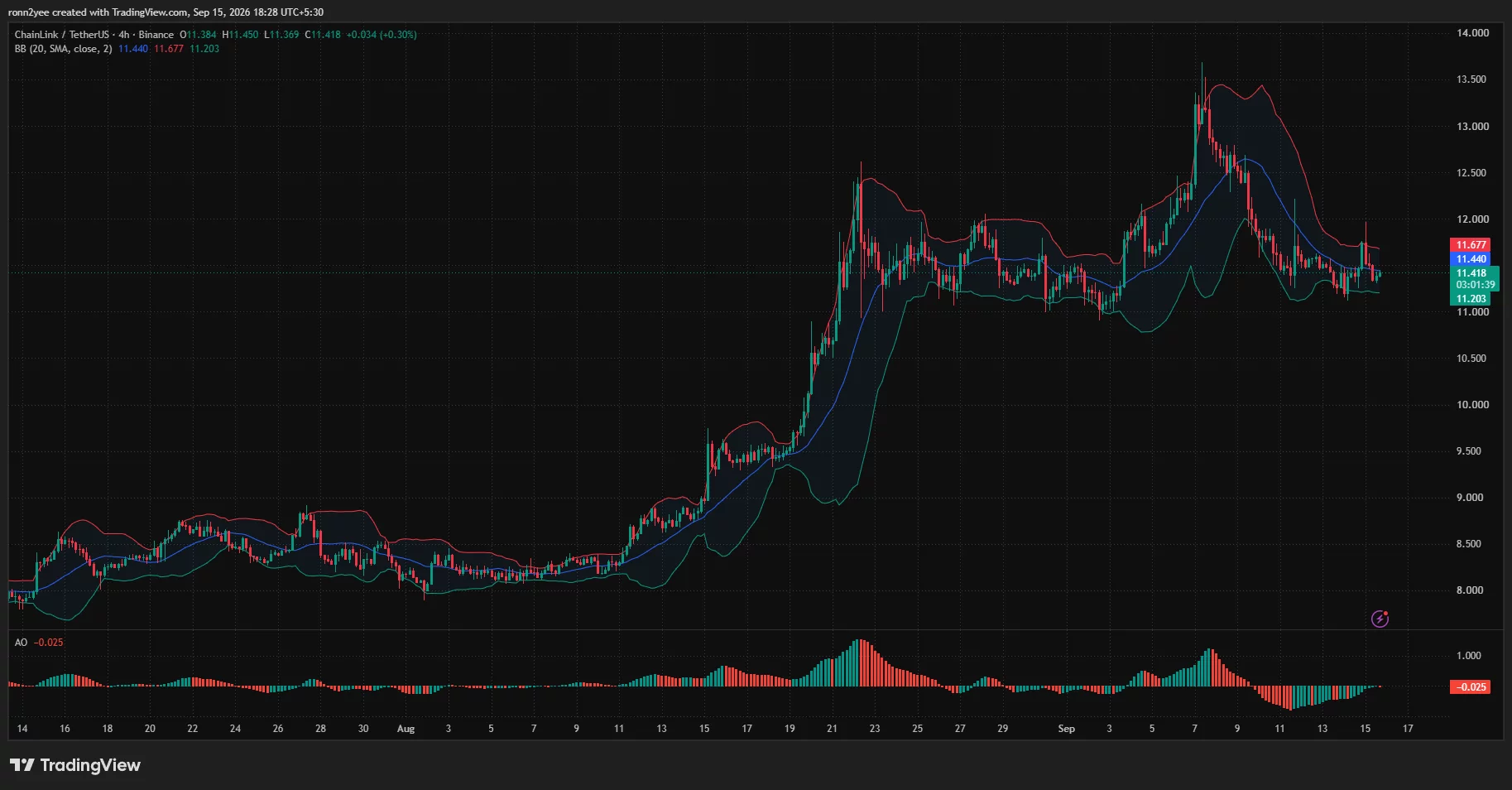
The narrow distance between the bands reflected reduced volatility following the sharp decline from the September high. Price has moved sideways between roughly $11.20 and $11.70, creating a short-term consolidation range.
A close above the Bollinger midpoint would be an early sign that buyers are regaining control. LINK would then need to break $11.68–$11.72 to challenge the psychological $12.00 level.
The Awesome Oscillator remained marginally negative at -0.025. Its red bars had shortened, indicating that bearish momentum was easing, but the indicator had not yet moved decisively above zero to confirm a bullish shift.
Failure to defend the lower Bollinger Band could send LINK toward the daily pivot at $10.94. Conversely, a breakout above the upper band would weaken the short-term bearish structure and increase the chance of a recovery toward $12.00 and $12.50.
Liquidation map points to liquidity near $11
CoinGlass’ one-week liquidation heatmap showed a dense concentration of leveraged positions below the current price, particularly around $11.00–$11.15. The strongest lower cluster appeared close to $11.05, with additional liquidity extending toward $10.90.
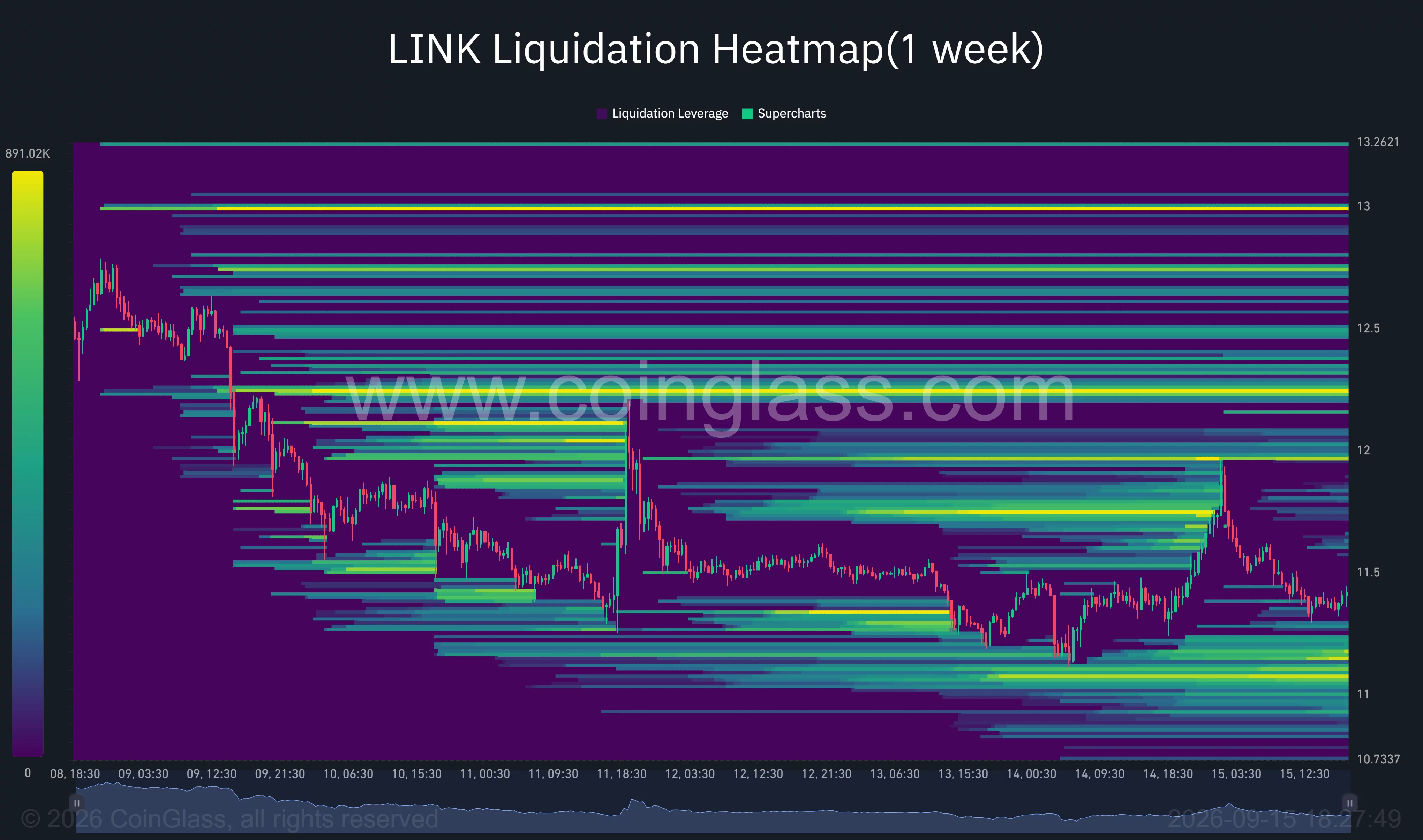
Large liquidation concentrations can attract price as traders target areas where leveraged positions may be forced to close. A drop below $11.20 could therefore accelerate toward $11.00 if long liquidations add mechanical selling pressure.
Upside liquidity was spread across several levels. The nearest visible concentrations sat around $11.70–$12.00, followed by stronger bands near $12.20 and $12.50. A particularly large cluster was visible around $13.00, although LINK would first need to reverse its lower-high structure to approach it.
The uneven distribution leaves LINK exposed to volatility in either direction. Lower liquidity sits closer to the current price, making the $11.00 region the more immediate level, while a break above $11.72 could force short positions to close and support a faster recovery.
For now, $10.94–$11.20 forms the main support zone, while $11.68–$11.72 remains the first resistance range. A decisive close outside those boundaries could determine whether LINK extends its correction toward $10.16 or begins another attempt at $12.50.
Disclosure: This article does not represent investment advice. The content and materials featured on this page are for educational purposes only.

TIME’s 2026 LATINO LEADERS LIST INCLUDES:
Ana Valdez, president and CEO of Latino Donor Collaborative
Cástulo de la Rocha, president and CEO of AltaMed Health Services Corporation
Jose Alvarado, NBA champion
Julián Castro, CEO of the Latino Community Foundation
Luana Lopes Lara, COO and co-founder of Kalshi
Marina Larroudé, co-founder of Larroudé
Mónica Ramírez, founder and president of Justice for Migrant Women
Nelson German, chef and restaurateur
Rachel Zegler, actor and singer
Ronaldo Salgado and Lorenzo Salgado Jr., advocates
Sofia Carson, actor, singer, and advocate
PepsiCo is the premier partner of TIME Latino Leaders.
To recognize this year’s honorees, TIME will host a special cocktail reception celebrating TIME’s fourth annual Latino Leaders list in Miami on October 27th, presented by premier partner PepsiCo. The evening will feature remarks from actor, singer, and advocate Sofia Carson, CEO of the Latino Community Foundation Julián Castro, CEO, Latin America, and Global Chief Strategy & Transformation Officer at PepsiCo Athina Kanioura, and more.


Two software bugs allowed the attacker to create more than 2,000 times Bitcoin’s maximum supply in unbacked syBTC. Symbiosis puts preliminary losses at 9.97 BTC.

Ethereum and the Base ecosystem are moving toward different account abstraction (AA) standards after an effort to align on a shared approach reportedly stalled last week. The split could have practical consequences for wallet developers, potentially requiring support for multiple transaction formats to deliver a consistent user experience across networks.
In an X post on Monday, Derek Chiang—founding member and researcher at Ethlabs and a co-author of Ethereum’s EIP-8141—warned that interoperability standards have taken a back seat to each chain’s primary goals. “Putting the burden on wallets,” Chiang wrote, framing the divergence as a shift in where the compatibility work will land.
Key takeaways
- Ethereum and Base are pursuing different native account abstraction paths after a previously sought shared standard failed to materialize.
- Wallets may need to handle separate transaction formats to maintain a uniform experience across networks.
- Ethereum is progressing account abstraction under EIP-8141 via “Frame Transactions” as part of its Hegotá upgrade plan.
- Base’s native account abstraction implementation via Keystore is aligned with EIP-8130 and is already live on devnet.
- The divergence reflects a broader tension: L1 priorities around security and resistance themes vs. L2 alignment with scalability-oriented standards.
Why the account abstraction split matters
Account abstraction is designed to move transaction logic out of fixed protocol rules and into programmable authorization mechanisms. That enables more flexible transaction policies—for example, defining how users authorize actions and how network fees are handled—without relying solely on traditional externally owned account behavior.
But as AA becomes native to more chains, standardization becomes increasingly important for the application layer. When chains choose different AA schemes, wallet software often becomes the integration point. In that scenario, developers may have to map user actions into multiple formats, or maintain separate signing and fee-handling flows depending on which chain the transaction targets.
Chiang’s framing suggests that while technical progress continues, the interoperability “cost” is shifting away from cross-chain AA agreements and toward wallet infrastructure. For end users, that tradeoff can surface as inconsistent behavior across networks—especially in edge cases involving authorization rules, fee sponsorship patterns, or signature semantics.
Ethereum’s Hegotá direction: EIP-8141 and Frame Transactions
On Ethereum, the roadmap for native account abstraction is closely tied to EIP-8141. According to the proposal’s materials, Ethereum is advancing “Frame Transactions” as a “headliner” item under its Hegotá upgrade, which is planned to introduce native account abstraction and create a path toward post-quantum authentication.
Ethereum Foundation communications also identify protocol Hegotá as an upgrade with multiple items, and EIP-8141 is highlighted as a key feature. The intent, as described in these sources, is to make account abstraction an integrated capability rather than an external add-on—an approach that could influence how wallets, dApps, and security tooling interact with Ethereum accounts going forward.
Timing is still dependent on broader upgrade sequencing. The same coverage notes that Ethereum developers could begin implementing Hegotá in late 2026 following Glamsterdam. Glamsterdam, per Ethereum’s public roadmap as discussed in prior reporting, is expected to improve scalability, harden the network, and make the system easier to use, with a mainnet launch expected in the second half of 2026.
Base’s native AA: EIP-8130 and Keystore on devnet
Base, meanwhile, is taking a separate route to native account abstraction through Keystore. The project’s documentation describes native account abstraction under EIP-8130, and the specification indicates that the implementation is currently live on devnet.
The significance of Base’s approach is twofold. First, it suggests that Base is treating the AA feature as something it will integrate and iterate on quickly in its own ecosystem, rather than waiting for a cross-chain convergence point. Second, if Base’s AA model differs from Ethereum’s, wallet teams will likely have to build a more adaptable abstraction layer to support both ecosystems.
For developers building across networks, the divergence may also affect application assumptions around transaction structure and how authorization and fee-related operations are packaged. Even if user-facing features remain similar, the underlying transaction format can change—forcing more careful integration work for cross-chain dApps and tooling.
L1 vs. L2 priorities: different visions, different standards
Chiang’s argument connects the technical divergence to differing design priorities between layer-1 networks and layer-2 networks. He suggested that L1s are increasingly focused on elements such as censorship resistance, capture-resistance, open-source values, privacy, and security features—factors that could naturally lead to different account abstraction standards than those favored by scalability-focused L2 environments.
In contrast, he implied that L2s may be more aligned with standards such as EIP-8130. That difference helps explain why standardization efforts may stall: each network is optimizing for its own constraints and goals rather than minimizing complexity for shared infrastructure.
Still, Chiang cautioned against treating the separation as an automatic negative. He argued that the outcome doesn’t necessarily end badly because Ethereum and Base are “free to innovate” on account abstraction within the boundaries of their respective visions. Practically, however, the gap creates work for wallets and middleware, which must bridge distinct transaction behaviors for users who expect portability.
What to watch next
Wallet developers and cross-network builders should watch for how EIP-8141-based “Frame Transactions” and Base’s EIP-8130 Keystore model evolve into production-ready interfaces, and whether any new compatibility layer emerges to reduce fragmentation. The next milestone will be less about theoretical AA support and more about how transaction formatting differences are surfaced—or hidden—from users and developers in real tooling.

Bitcoin’s rebound narrative is getting a data point that historically shows up before stronger upside attempts: short-term holders (STHs) appear to be keeping at least part of their paper gains rather than flipping back into losses.
According to onchain analysis from CryptoQuant, Bitcoin wallets holding coins for less than six months have maintained partial profitability for nearly a month, marking the longest consecutive in-profit stretch of 2026. At the same time, the broader Bitcoin investor base has remained in net profit since Aug. 19, suggesting the market’s cost-basis landscape is improving rather than merely bouncing off support.
Key takeaways
- CryptoQuant says STHs have spent roughly 30 straight days in at least partial profit, the longest such run in 2026.
- STH profitability is measured as $168.2 billion in profit versus $102.6 billion in losses, with gains currently outweighing drawdown.
- CryptoQuant frames sustained STH profitability as a prerequisite for a more durable reversal in Bitcoin’s trend.
- STH profitability is being supported particularly by wallets in the one-to-three-month age band, with higher realized cost bases toward the three-to-six-month cohort.
Why short-term holder profitability matters
CryptoQuant’s analysis focuses on the behavior of STHs—wallets that still hold unspent transaction output (UTXO) for less than six months. In practice, these holders are often more responsive to recent price moves: they tend to buy and sell in shorter cycles, making their profit-and-loss state sensitive to market volatility.
The key observation from the data is persistence. CryptoQuant reports that since Aug. 16, the STH cohort has been split between coins in profit ($168.2 billion) and coins below acquisition price ($102.6 billion), but the overall period qualifies as an extended in-profit stretch. Even CryptoQuant emphasizes that the absolute profit-versus-loss ratio is less important than the fact that STHs have maintained at least some profitability continuously for about 30 days.
In an accompanying CryptoQuant blog post, the firm argues this is the first time STHs have held profit territory for a sustained period since the market top. CryptoQuant also points to prior cycles—most notably an earlier January episode that was shorter than a week, and a May period where losses dominated—to frame how unusual the current streak appears.
CryptoQuant’s broader claim is that longer stretches of STH profitability have historically preceded the kind of trend reversal traders look for after bear-market phases. The firm ties the setup to market recoveries across Bitcoin’s prior cycles and cites observations from the end of the 2022 bear market.
Profit persistence across the broader investor base
The short-term picture is reinforced by a wider investor-level profitability condition. Cointelegraph’s earlier market coverage noted that the spent output profit ratio (SOPR)—which tracks net profit or loss for investors spending coins—crossed above breakeven at SOPR level 1 on Aug. 19 and has stayed narrowly above it since.
While SOPR and STH profitability are not identical metrics, they overlap conceptually: both are concerned with whether real-world trading behavior is occurring at profits rather than losses. When both measures tilt positive and remain there, it usually indicates fewer forced exits and less capitulation-like selling embedded in the market’s cost basis.
Cointelegraph also referenced an argument from Checkonchain that STH profitability “starting to look more like those early bull-market recoveries.” That aligns with CryptoQuant’s framing of the current streak as a step toward a more sustained upside attempt, not just a short-lived bounce.
Which STH cohorts are driving the shift
CryptoQuant’s data suggests the improving profitability isn’t uniform across all short-duration holders. The firm says profitability is being driven primarily by entities holding between one and three months. For that subgroup, CryptoQuant reports a realized cost basis of $63,372—an important detail because it represents the average price at which their holdings were accumulated.
Meanwhile, the more “mature” end of the STH base—wallets holding for three to six months—shows a higher realized cost basis. CryptoQuant places this realized price at $73,190, meaning that while gains exist across the STH population, the market still has to clear more expensive acquisition levels for the older slice of short-term demand.
For traders and investors, this matters because the distribution of realized cost bases often influences where selling pressure could reappear. If price pushes through the higher realized band with momentum, it tends to reduce the probability that the newer profit holders will quickly become loss holders again.
In other words, the market’s health here isn’t only about being above a single breakeven line; it’s about whether the improving profitability can extend across aging cohorts inside the short-term bucket—especially those with higher cost bases.
What to watch next
CryptoQuant’s historical signal is clear on what it considers a prerequisite for stronger upside: STHs need to remain in profit long enough that they are more likely to “ride the upside” rather than re-enter sell-the-rally behavior. The next checkpoint for readers is whether this profitability persistence continues beyond the current streak, particularly as price interacts with higher realized cost bases in the three-to-six-month segment.

India vs Afghanistan LIVE Score, 2nd T20I: India Recover After Massive Blunder, Afghanistan 5 Down

10 Best Meal Delivery Services, Tested by an Ex-Restaurant Critic

Groomer EXPOSED On Financial Audit



-

 Fashion4 days ago
Weekend Open Thread – Corporette.com
-

 Business6 days ago
Micron Stock Climbs Above $1,031 as AI Memory Crunch and a $50 Billion Outlook Fuel the Rally
-

 Tech2 days ago
The Latest Weird Thing to Play Doom Is the Mapped-Out Brain of a Fruit Fly
-

 Business6 days ago
AMD Stock Climbs After Management Lifts 2027 Data Center Outlook Toward $70 Billion in AI Sales
-

 Crypto World7 days ago
Robinhood Stock: How To Take Advantage With Reduced Risk
-

 Crypto World7 days ago
Bitcoin price risks $76K drop as $78K support weakens
-

 Crypto World4 days ago
XAG/USD: Silver’s Short-Term Rally Meets Its Moment of Truth
-

 Crypto World5 days ago
2 Chip Stocks Broke Out This Week. Neither Was Nvidia
-

 Crypto World7 days ago
Ethereum price stalls below $2,500 as ADX drops to 11
-

 Business4 days ago
10 Most-Streamed Songs On Spotify In 2026 So Far, Led By Ella Langley’s Dominant Run On The Charts This Year
-

 Tech5 days ago
Battery life is the only iPhone 18 Pro and iPhone Duo upgrade I care about. Apple didn’t disappoint
-

 Crypto World5 days ago
OKX launches 10x OpenAI, Anthropic X-Perps in Europe
-

 Crypto World7 days ago
Intel Stock Jumps 9% on Chip Price Hike Report, US Stake Gains $36 Billion
-

 Crypto World6 days ago
Pi Network ships Protocol 27 on a network with 14 million users and zero DeFi
-

 Crypto World4 days ago
Diesel Tops $6 a Gallon for the First Time as 28 States Set Records
-

 Tech6 days ago
Apple Watch Ultra 4 vs Watch Ultra 3: Should you really spend another $799?
-

 Crypto World7 days ago
CLARITY Act runs out of calendar as crypto regulation stalls
-

 News Videos4 days ago
Facing Financial Fears
-
 Crypto World6 days ago
Bitcoin price risks $70K if $78K neckline breaks
-
 Crypto World6 days ago
Bitcoin price holds near $79K as cycle drawdowns narrow
You must be logged in to post a comment Login