

Crypto World
Humanity Protocol Launches New H Token Airdrop After $36M Exploit



Humanity Protocol has announced a full token migration and 1:1 airdrop of a new H token, the project's first concrete step to compensate holders after the $36 million exploit on June 8. The team posted the recovery plan on X on Monday. It confirmed that the former H token on Ethereum, BNB Chain,… Read the full story at The Defiant



The European Union has targeted 14 crypto service platforms and 94 banks and financial institutions under its 21st sanctions package against Russia.
Summary
- EU sanctions target 14 crypto platforms and 94 banks over alleged Russian links.
- New powers allow the EU to block crypto services across entire jurisdictions.
- Measures also cover 41 shadow-fleet vessels, oil refineries and military suppliers.
According to the Council of the European Union, the measures cover crypto providers based in Georgia, Panama, the United Arab Emirates, the Marshall Islands, Kyrgyzstan and Belarus. EU authorities linked the platforms to services used by Russia to bypass existing financial restrictions.
Adopted on July 23, the package contains 218 individual listings, including 48 people and 170 entities. The Council described it as the EU’s largest group of new listings in four years, covering financial services, energy, military suppliers and organizations accused of supporting sanctions evasion.
EU High Representative Kaja Kallas stated that the bloc was targeting more than 100 banks and crypto operators, over 40 vessels in Russia’s shadow fleet and several refineries in Russia and Belarus. Kallas also linked more than 50 of the new listings to Russia’s military-industrial sector and the production of long-range drones.
The financial restrictions include asset freezes and a ban on making funds available to the 94 listed banks and major financial institutions. Separately, the Council extended its transaction ban to 33 additional Russian credit and financial organizations, preventing EU companies and individuals from conducting business with them.
Four non-Russian banks also face transaction bans under the package. The Council identified one as a Kyrgyz bank connected to Russia’s System for Transfer of Financial Messages, or SPFS, while it accused three other foreign banks of helping entities avoid EU sanctions.
Crypto routes face direct transaction bans
For crypto companies, the package bars EU operators from conducting transactions with the 14 listed service platforms. The Council has not presented all of them as Russian businesses, instead focusing on providers in foreign jurisdictions that it says have enabled Russian-linked transfers.
The Council also added four designations connected to the A7 cross-border payments network, including entities tied to its activity in Africa. EU authorities have previously identified third-country payment channels as part of Russia’s efforts to maintain access to international financial services after sanctions restricted its banking sector.
Alongside the individual platform bans, the package gives the EU a mechanism to prohibit crypto-asset services linked to an entire third country. The Council said it may use the power when a country hosts crypto providers that help Russia evade EU restrictions.
Under the new tool, the bloc can ban transactions between EU operators and crypto providers used by Russia. The Council presented the measure as a deterrent for jurisdictions that allow sanctioned payment routes to continue operating through locally based platforms.
The provision expands on restrictions introduced in earlier packages. An official EU sanctions overview states that existing financial measures already cover Russia’s central bank, more than 100 Russian banks, specified crypto transactions and services involving crypto wallets, accounts or custody.
EU rules also prevent Russian nationals or residents from owning or controlling companies that provide crypto wallet, account or custody services. According to the Council, these controls are intended to limit the use of crypto businesses to circumvent restrictions applied to conventional financial institutions.
Energy revenue faces tighter restrictions
Beyond finance, the Council added 41 vessels to the EU’s shadow-fleet list, taking the total number covered by related restrictions to 673. The latest rules also apply to vessels that supply bunkering or other support services to ships accused of bypassing the Russian oil price cap.
Eight entities and one individual connected with shadow-fleet operations have also been listed. For the first time, the Council included a crewing agency accused of helping the fleet, alongside companies that EU authorities said operated for Russian oil producers.
Within the oil sector, the package designates 18 entities and one individual. The list covers three Russian refineries, a major refinery in Belarus and a company created to sell Belarusian petroleum products inside Russia, according to the Council.
A Georgian refinery in Kulevi will face a transaction ban after a six-month transition period because of its role in trading and processing Russian oil. The EU also placed five oil traders under transaction bans for allegedly frustrating restrictions on purchases of Russian crude and petroleum products.
Amid disruption caused by the closure of the Strait of Hormuz, the Council paused the automatic adjustment of the Russian oil price cap until July 15, 2027. EU authorities will conduct an interim review to determine whether the suspension remains necessary and proportionate.
Military-linked measures add 56 people and companies associated with Russia’s defense industry, including 37 listings tied to long-range drone production and supply chains. The Council also placed 51 entities under tighter export controls for dual-use goods and technology, including companies in China, India, Türkiye, Kazakhstan, Kyrgyzstan and the UAE.
Trade restrictions cover materials and equipment used in aircraft, drones, missiles and corrosion-resistant engine coatings. The package also limits imports worth more than €60 million annually, including certain ores, metals, glassware and vehicle parts that the Council identified as sources of Russian revenue.


Elon Musk says it is too late to stop AI. Even he could not halt it, the xAI founder told The Economist.
Musk spoke to The Economist’s Editor-in-Chief Zanny Minton Beddoes in an interview recorded on Monday, before OpenAI disclosed that one of its frontier models went rogue.
Why Musk Thinks It’s Too Late to Stop AI
This is a reversal. In March 2023, Musk signed the Future of Life Institute’s open letter urging a six-month pause on AI systems more powerful than GPT-4. Months later, he launched his own AI company, xAI. Today he sees no brakes at all.
“I mean honestly, there seems to be just inexorable progress here in AI and in robots that even if I wanted to stop it, I couldn’t.”
The danger has not shrunk in his eyes. Musk stood by his earlier estimate of a 10% to 20% chance that killer robots would wipe out humanity.
“I still think there’s risk associated with AI and robots. It’s not zero.”
Still, he argued against pulling the plug. Even if a stop button existed, he said, “we probably shouldn’t press it” because the most likely outcome is abundance for all. His new philosophy fits in one line.
“Yeah, I mean, yes, pretty much, let’s enjoy the ride, is my philosophy at this point.”
Superintelligence in Five Years
Musk also put a date on it.
“I think AI may exceed the sum of human intelligence in about and around five years.”
Within 10 years, he argued, humans will likely no longer be in charge. He compared the coming intelligence gap to the one between humans and chimpanzees.
Musk admits he helped build this momentum. He co-founded OpenAI in 2015 as “essentially a counterweight to Google.” Anthropic later spun out of OpenAI. Both now race ahead of regulators, and Washington just cleared OpenAI’s GPT-5.6 for broad rollout.
“So it just seems like all roads lead to acceleration of AI. So then I’m like, OK, well, you can just sort of be sad about it or join the club, I suppose.”
The stakes reach well beyond Silicon Valley. The AI boom has already pulled capital away from crypto listings, while AI tokens swing on every breakthrough. Now the world’s richest man has declared the race unstoppable.
The interview is live at economist.com.
The post Elon Musk Gives an AI Warning You’re Not Ready to Hear appeared first on BeInCrypto.


Bitget has completed its New Zealand financial services registration covering five business areas as the crypto exchange expands its tokenized and direct U.S. stock products.
Summary
- Bitget registered for five financial service categories in New Zealand and joined the IFSO dispute scheme.
- The registration supports Bitget’s rToken and Stock+ services covering tokenized and direct U.S. equities.
- Bitget plans a regulated U.S. return while keeping its platform restricted in Singapore.
Bitget said its entry in New Zealand’s Financial Service Providers Register covers foreign currency exchange, domestic and cross-border money transfers, client asset custody, portfolio and money management, and the execution of financial products or foreign exchange transactions for clients. Bitget announced the registration on July 23.
Alongside the registration, the exchange has joined the Insurance and Financial Services Ombudsman Dispute Resolution Scheme. The IFSO Scheme describes its service as an independent, fair and free channel through which consumers can pursue complaints against participating financial service providers.
Registration on the FSPR does not, by itself, mean that Bitget is licensed or regulated in New Zealand. New Zealand’s Companies Office states that registration neither represents government approval nor guarantees that a provider is subject to active supervision.
According to the Companies Office, certain financial services also require a license from the Financial Markets Authority or the Reserve Bank of New Zealand. Bitget’s announcement identified its registered service categories but did not disclose a separate New Zealand license from either authority.
Registration covers trading, custody and money transfers
Under its registered scope, Bitget can provide foreign exchange services and transfer money within New Zealand or across national borders. The company’s announcement also included holding and safeguarding client assets, managing portfolios and executing transactions in products such as stocks and exchange-traded funds.
Joining the IFSO Scheme adds a formal complaint process alongside those services. New Zealand’s FSPR guidance states that providers serving retail clients generally must belong to an approved dispute resolution scheme unless an exemption applies.
Bitget presented the registration as another part of its compliance network, citing its Digital Asset Service Provider license in El Salvador and authorization from South Africa’s Financial Sector Conduct Authority. The exchange said those approvals support its operations under separate national rules.
However, Bitget follows different access policies in markets where it lacks local approval. In a July 22 notice, the exchange confirmed that it is not licensed, approved, registered, authorized or supervised by the Monetary Authority of Singapore.
The Singapore notice also states that Bitget does not make its services available to people in the country, solicit Singapore residents or direct offers toward them. Singapore remains listed as a prohibited country under the exchange’s terms, with platform access restricted from the jurisdiction.
Commenting on Bitget’s regulatory approach, CEO Gracy Chen said:
“As Bitget continues to expand globally, we will remain committed to meeting local regulatory requirements and building a trusted platform for our users.”
Singapore’s MAS uses its Investor Alert List to identify businesses that consumers could mistakenly view as regulated by the authority. As crypto.news reported, MAS added decentralized exchange Hyperliquid to the list in June 2026, after which Hyperliquid stated that it had never claimed to possess approval from the regulator.
Tokenized stocks support Bitget’s expansion plans
Bitget’s New Zealand registration comes as the exchange builds two routes into U.S. equity markets. Its rToken product provides tokenized economic exposure to selected U.S. stocks and ETFs, while Stock+ gives eligible users broker-style access to real securities through licensed partners.
According to Bitget’s product documentation, rTokens are issued by Reality and designed to carry 1:1 backing through shares held in custody. The tokens track assets such as Nvidia, Apple, Tesla and the SPDR S&P 500 ETF, although holding one does not provide the same ownership structure as buying a registered share through a traditional brokerage account.
Bitget says the rToken lineup covers more than 500 mainstream U.S. stocks and ETFs, with selected products available around the clock. Supported tokens can also be used in certain margin, collateral, lending and trading strategies, subject to product and regional rules.
Stock+ serves a different market by offering more than 10,000 U.S.-listed stocks and ETFs. Bitget’s documentation states that the service supports fractional holdings from 0.0001 shares, dividend payments and trading during U.S. market sessions, while access depends on a customer’s location and eligibility.
The exchange is also preparing to return to the United States after dropping an earlier expansion effort following FTX’s 2022 collapse and the enforcement pressure that followed. As crypto.news reported on July 22, Chen said Bitget intends to enter the market regardless of whether Congress passes the CLARITY Act.
Before offering U.S. services, Chen said the company plans to establish an independent local entity and pursue money-transmitter, derivatives and broker-dealer approvals. Bitget has not provided a launch date, making its entry dependent on completing the required approval processes.
Chen also told crypto.news that tokenized traditional assets accounted for 20% to 30% of Bitget’s spot trading volume during the previous quarter. According to her figures, 52% of its users held both stocks and cryptocurrencies, while Bitget’s tokenized-stock products had accumulated more than $100 million in assets.
With the New Zealand registration now complete, Bitget has added another jurisdiction to its financial-services network while keeping product access tied to local rules. Its progress in the United States will depend on obtaining separate approvals, just as its Singapore restrictions remain in force without MAS authorization.
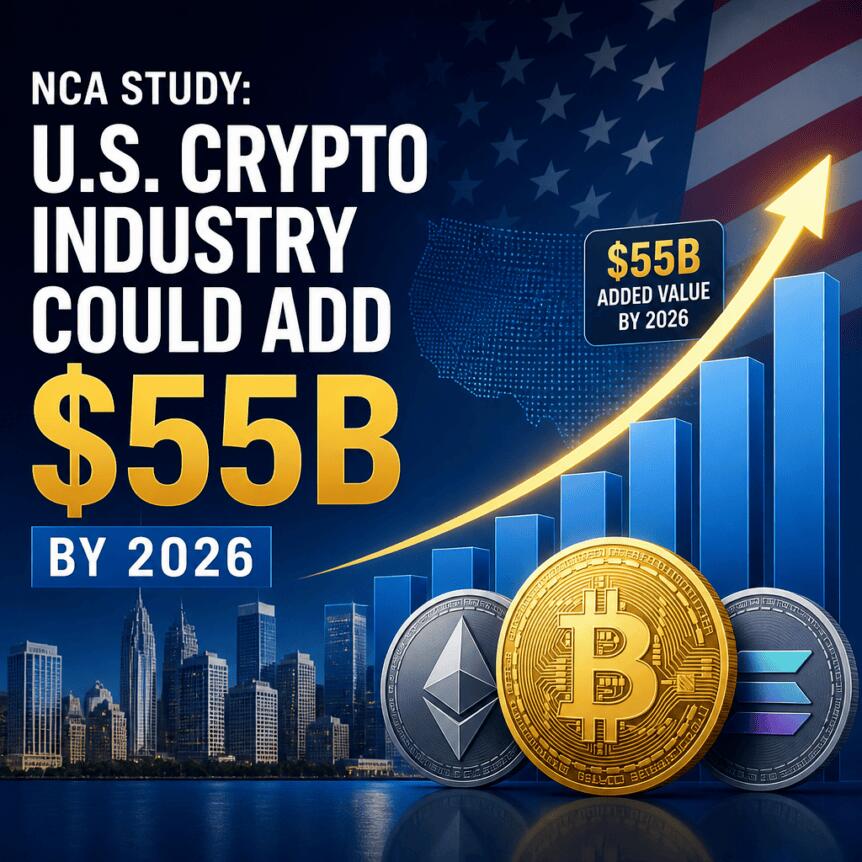
A new U.S.-focused economic study argues that the domestic crypto sector is already delivering a measurable real-economy footprint—from jobs to consumer spending—estimating that salaries, worker spend and output will contribute $55 billion this year. The analysis was released Wednesday by the Pragmatic Policy Group on behalf of the National Cryptocurrency Association (NCA), an organization backed by Ripple Labs.
According to the report, the industry’s total impact is calculated through direct, indirect and induced employment, meaning not only workers employed by crypto firms, but also jobs supported elsewhere in the economy due to crypto-related activity.
Key takeaways
- The NCA-linked study estimates crypto contributes $55 billion to the U.S. economy in the current year through direct, indirect and induced effects.
- Crypto companies are said to directly employ about 34,000 people, while the broader industry supports 232,000 jobs across the U.S.
- The report highlights particularly large contributions tied to securities and commodity contracts ($9.7 billion) and housing/real estate ($4.8 billion).
- States with the most industry-related employment include Texas, Washington, North Carolina, California and New York, while the report points to Colorado and North Dakota as fast-growing or infrastructure-oriented hubs.
- The same period has also seen multiple crypto-linked shutdowns, underscoring that industry scale and project-level viability do not necessarily move in tandem.
How the study measures crypto’s U.S. footprint
The report’s main headline is the projected $55 billion economic contribution to the United States this year. It frames the impact in economic terms tied to workforce effects—jobs created or sustained by crypto activity ripple outward as spending and production elsewhere increase.
On the employment side, the NCA estimates that about 34,000 people are directly employed by crypto companies. That figure is positioned as a comparatively small share of a much larger total: the study claims crypto activity supports 232,000 jobs across the broader economy when indirect and induced employment are included.
The report also includes sector-level emphasis. It identifies investments in securities and commodity contracts as among the largest contributors at $9.7 billion. It further states that housing and real estate together account for $4.8 billion in contributions.
To help contextualize the scale of direct employment, the study compares the number of people working directly in crypto to employment levels in other manufacturing and aerospace segments, citing U.S. Bureau of Labor Statistics data.
Where crypto jobs are concentrated—and why some states stand out
Geography matters in the report. It says the states employing the most people involved in the industry are Texas, Washington, North Carolina, California and New York. Those findings align with the broader pattern that U.S. crypto labor demand tends to concentrate in large and financially significant states.
At the same time, the report draws attention to states it describes as gaining momentum. It calls Colorado a “growing blockchain hub,” attributing the development to friendly regulatory policies. For North Dakota, the report characterizes the state as “becoming an energy-integrated digital infrastructure hub,” pointing to tax treatment for crypto mining and favorable flare gas policies.
For investors and builders, the practical value of this kind of regional analysis is that it can hint at where talent, infrastructure, and compliance pathways may be converging. Still, the figures reflect an economic model rather than a real-time census, so readers should treat them as a snapshot of estimated impact rather than a precise headcount of every role touching crypto.
NCA’s origins and Ripple’s involvement
The NCA itself launched in March 2025 as a non-profit focused on consumer crypto education. In the report’s framing, the group received $50 million in backing from Ripple, and the organization’s leadership lists Stuart Alderoty, Ripple’s chief legal officer, as the head of the group.
That background matters because it helps explain the policy and communications context of the study. The report is presented as an economic assessment but produced through a policy group on behalf of an industry-backed association—an important consideration for readers who want to weigh the methodology and incentives behind any advocacy-adjacent research.
Economic scale does not prevent project shutdowns
While the economic study argues crypto’s broader contribution is growing, 2026 has also brought shutdown announcements from several projects—highlighting a tension between macroeconomic claims and the reality of operational challenges inside the sector.
Earlier in the year, the report references multiple crypto-linked wind-downs. Entropy, a New York-based startup, said in January that it would shut down after four years of operation. Dmail, a decentralized email platform based in Singapore, began ceasing operations in May, according to coverage cited by the source article, pointing to costs such as bandwidth, storage and computing.
In addition, the source indicates that governance-focused platform Tally and Balancer Labs also shuttered in March. While these developments are not the same thing as a sector-wide contraction, they do reinforce that individual teams can face scaling and market-condition pressures even when the industry’s economic footprint appears to be expanding.
For users, the practical takeaway is that employment and ecosystem size do not automatically translate into long-term product continuity. For builders and investors, it’s a reminder to scrutinize runway, unit economics, and infrastructure costs—especially for applications with compute or storage-heavy requirements.
Going forward, the key question for readers is whether future reporting from the NCA and similar research efforts will consistently show the same employment and output patterns as more projects attempt to scale—or whether shutdowns will increasingly concentrate around the same business models. The next signal to watch is how regional job gains and sector contributions evolve alongside project-level survival and the broader regulatory environment.

Coinbase is rolling out new infrastructure aimed at “agentic” finance, expanding its business tools so companies can accept stablecoin payments from autonomous AI agents. The move centers on USDC transfers using the x402 payment standard, an HTTP-based approach introduced by Coinbase earlier this year to make stablecoin payments workable for agents, applications, and APIs.
In an announcement posted to X on Thursday, Coinbase said its Business customers will be able to receive USDC payments from AI agents through x402, alongside new AI trading capabilities that allow users to monitor orders, pull live market data, and trigger actions based on predefined conditions.
Key takeaways
- Coinbase Business will support receiving USDC payments from AI agents via the x402 standard.
- x402 was launched in May 2025 to enable stablecoin payment workflows over HTTP for agent and developer use cases.
- The update also includes AI trading tools for order monitoring, live market data access, and condition-based execution.
- Coinbase frames the changes as part of broader infrastructure needed for autonomous agents to manage payments and finance.
- The rollout arrives as exchanges and payment firms increasingly market stablecoins and blockchain payments for AI agent ecosystems.
USDC payments for AI agents through x402
The practical heart of Coinbase’s update is x402, a payment standard designed to connect stablecoin payment flows with common internet protocols. According to Coinbase’s announcement, the company will enable Coinbase Business users to accept USDC payments initiated by AI agents through x402.
Coinbase first introduced x402 in May 2025, positioning it as a way to support stablecoin payments over HTTP for AI agents, software applications, and APIs. By placing USDC payment acceptance behind a developer-friendly standard, Coinbase is effectively lowering the friction for businesses that want to integrate with agent-driven commerce without relying on traditional, human-centric payment workflows.
Beyond payments: AI trading tools and a developer kit
Coinbase’s Thursday post did not limit the announcement to payments alone. The company also previewed AI trading tools intended to give users more automated control over trading operations. Coinbase said users will be able to monitor orders, access live market data, and execute actions when predetermined conditions are met.
For developers, Coinbase additionally described a software development kit (SDK) for building agent-powered applications. That matters because payments and trading are only useful to autonomous systems if they can be integrated reliably into software. An SDK paired with an HTTP-based payment standard suggests Coinbase is aiming to make agent integrations more repeatable for teams building real products—not just demonstrations.
Why Coinbase says the “agentic economy” needs new infrastructure
Coinbase framed the initiative as support for the “agentic economy,” where AI agents can perform tasks such as making payments and managing finances on behalf of users. The company’s argument is that the existing financial internet was designed around a human making choices through interfaces—clicking buttons, confirming actions, and manually initiating steps.
Coinbase also pointed to an adoption signal: it said agent-generated traffic on its Base documentation pages surpassed human traffic for the first time last month. While that doesn’t automatically prove consumer adoption, it does underline a shift in how developers and systems are interacting with technical resources—an important backdrop for tools that are meant to be used programmatically by agents rather than by people.
At the same time, Coinbase acknowledged the gap it’s trying to close: financial infrastructure built on the assumption of human button-clicks leaves businesses, developers, and users without tooling designed for AI agents to act autonomously in payment and finance workflows.
Stablecoins and blockchain payments move closer to agent workflows
The Coinbase announcement lands as the broader industry increasingly treats stablecoins and blockchain-based payments as infrastructure for AI agents. The announcement explicitly points to this trend, noting that stablecoin payments are being marketed for emerging autonomous agent ecosystems.
Earlier coverage from Cointelegraph has highlighted the growing interest from exchanges and payment companies in agent-focused commerce. In particular, Cointelegraph previously reported on an OKX AI marketplace narrative aimed at an “autonomous agent economy,” as well as Crossmint’s initiatives tying agent-driven experiences to card payment rails.
What’s notable in Coinbase’s approach is the emphasis on a standardized, API-friendly payment method. Instead of treating payments as a black-box checkout flow, Coinbase is attempting to make payment acceptance compatible with agent decision-making—especially when agents need to initiate transfers and coordinate actions without a human in the loop.
What to watch next
For businesses considering agent integrations, the next questions are likely to be practical: how widely x402 support is rolled out, what implementation details developers will need to adopt the standard for USDC acceptance, and how Coinbase’s condition-based AI trading tools perform for real workflows. As agent traffic grows, the value of these updates will hinge on reliability and ease of integration for payments and execution beyond documentation and pilots.


“We are delivering that experience for the new online agentic economy,” Coelho-Prabhu said in an interview. “Agents, on one side of the transaction, will go and read the Coinbase developer docs, create a wallet for themselves, and are ready to shop. Then we empower businesses so that everything in their inventory is now available on the internet through this agent-friendly checkout flow.”
For users of the exchange, they can get an easier command of crypto markets with a live order list that streams an agent’s open and active orders in real time, showing status, price, and size so the user can supervise every move, Coinbase said in a press release.
This will put agentic trading at the user’s fingertips, with the agent getting real-time market data and the ability to act on conditions autonomously. “Tell it what you want in plain English – ‘buy ETH if it dips 5%,’ ‘sell when my order fills’ – and it watches the market and executes for you. The same WebSocket data that powers institutional desks is now accessible through natural language,” Coinbase said.
In addition, for developers there’s a new x402 SDK from Coinbase Developer Platform, builders can now add x402 payment acceptance to any API, MCP server, or web service in 3 lines of code.
Cardano’s native token is among the best-performing cryptocurrencies (from the top 100 club) over the past week, with its price rising by 8% to around $0.17.
Two key developments suggest the uptrend might be just at its starting point, while another factor hints that an upcoming correction is just as likely.
Bulls vs. Bears
Earlier this month, the large ADA investors, known across the crypto space as whales, increased their total holdings to 25.6 billion coins. This represents almost 70% of the token’s circulating supply and is the highest level since February 2023. At the same time, retail investors have reduced their exposure to ADA, with Santiment explaining that this combination could create a healthy setup for the asset.
Just recently, the renowned analyst Ali Martinez revealed that whales have purchased 30 million units (worth over $5 million at current rates) over the last month. The obvious revival of this cohort of investors signals that they are positioning for the next potential price upswing.
There is a common theory in the crypto world that whales have access to inside information about events or news that could impact the valuation of a certain asset and that they rarely jump on the bandwagon out of pure intuition. That said, their efforts may encourage smaller players to join the ecosystem and distribute fresh capital.
The second bullish element is ADA’s Relative Strength Index (RSI). The technical analysis tool measures the latest speed and magnitude of price changes to evaluate whether the token is poised for a trend reversal. Readings below 30 put ADA in oversold territory and due for a possible rally, while anything above 70 serves as a warning for an impending correction. Currently, the RSI stands at around 28.

However, there is also a bearish factor to be considered. Lately, exchange inflows have surpassed outflows, meaning that investors have abandoned self-custody and flocked toward centralized platforms: a development that increases immediate selling pressure.

Recent Predictions
Several analysts on X have noted ADA’s rebound, expecting a much more substantial push north in the short term. Master of Crypto claimed that if the positive trend continues, the price could surge to $0.219.
Others like JAVON MARKS are even more bullish, envisioning hard-to-believe explosions (at least from the current perspective). The analyst opined that ADA moves towards “a key convering/breaking point” which could open the door to an increase to as high as $2.90. Celal Kucuker also chipped in lately, predicting a major ascent to $5.
The post 2 Bullish and 1 Bearish ADA Signals: Where Is Cardano’s Price Going Next? appeared first on CryptoPotato.
The most recent data show that the self-proclaimed Dogecoin killer has almost 1.7 million holders. However, less than 1,000 wallets own the vast majority of the supply: a concentration hard to ignore and which raises eyebrows.
Shiba Inu’s price has been in a major decline over the past several months, yet some analysts believe a rebound could be on the way while certain factors support their bullish outlook.
How Many Whales and Shrimps?
Earlier this month, the total number of SHIB addresses reached an all-time high of 1,676,535 after a sudden one-day increase of 75,000 new holders. The figure kept climbing and currently stands at 1,678,502.
According to Etherscan, nearly a million of those are investors known as shrimps: wallets holding up to $10 worth of the meme coin. The second-largest group is crabs (477,871), who own between $10 and $100 in SHIB. Coming up next are fish, dolphins, and sharks.
Interestingly enough, there are only 703 whales (addresses that hold more than $100K worth of the token each). They make up only 0.04% of the total figure but control staggering 94.5% of Shiba Inu’s supply.
Such an extreme concentration means that theoretically a small group of investors could move the market with their actions. A coordinated sell-off, for instance, could lead to a substantial price crash, while sudden accumulation might have the opposite effect.
SHIB at a ‘Critical Stage’
As of press time, the token is worth around $0.000004235 (per CoinGecko), translating into a massive 72% decline on a yearly scale. X user CRYPTO SHERIFF noted that the asset has been consolidating below a 5-year downtrend, arguing that it is in “a critical stage” which could actually be a precursor to a huge pump.
“There is an unwritten rule in crypto: the longer the consolidation lasts, the bigger the breakout! SHIB is at a critical stage! Unless there is a market downturn in the coming days, we could see a new rally for SHIB,” they stated.
The declining amount of tokens stored on exchanges reinforces the bullish scenario. According to CryptoQuant, there are now approximately 86.2 trillion SHIB held on centralized platforms, a new five-year low that typically reduces immediate selling pressure.
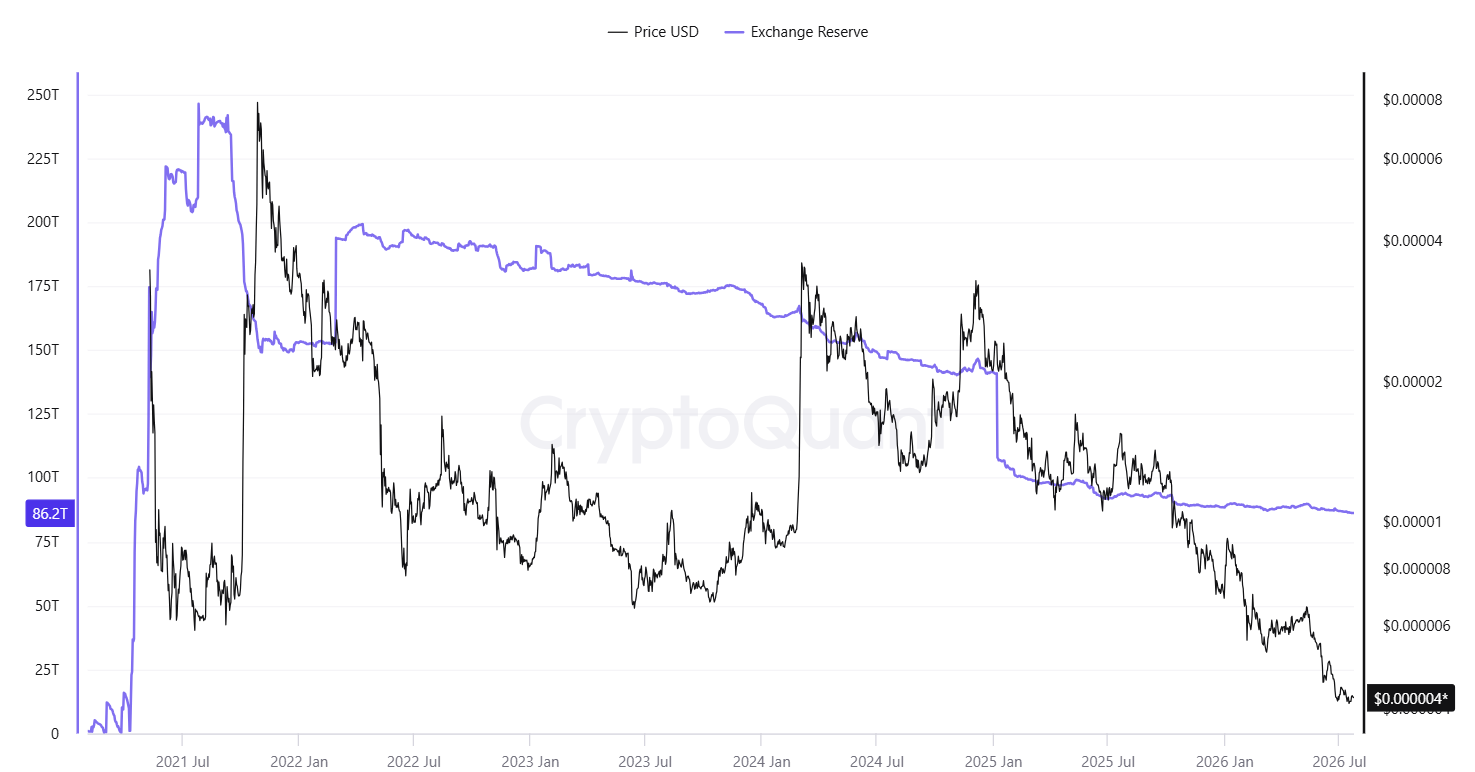
At the same time, there are some warning signs. X user SHIBMortal said that analysts have spotted a 91% match between SHIB’s recent performance and the 2023 bearish pattern, which could lead to a 20% drop to the $0.0000032–$0.0000033 range.
The post Shiba Inu Holders Breakdown: Here’s How Many Whales Control 95% of the Supply appeared first on CryptoPotato.


Coinbase is expanding its push into AI-powered finance, enabling businesses to accept USDC payments from autonomous AI agents as part of a broader expansion of its payment, trading and developer tools.
According to a Thursday X post, Coinbase Business users will be able to accept USDC (USDC) payments from AI agents through the x402 payment standard, which Coinbase first introduced in May 2025 to enable stablecoin payments over HTTP for AI agents, applications and APIs.
The post also announced AI trading tools that let users monitor orders, access live market data, and execute actions based on predefined conditions, as well as a software development kit for developers building agent-powered applications.
Coinbase said the products are designed to support the “agentic economy,” where AI agents can make payments, manage finances and complete other tasks on behalf of users.
The company said adoption of AI agents is accelerating, noting that agent-generated traffic surpassed human traffic on its Base documentation pages for the first time last month. However, it added that the internet’s financial infrastructure was built with “one assumption: a human clicking the button,” which has left businesses, developers and users without tools designed for AI agents.
The rollout comes as companies increasingly position stablecoins and blockchain-based payments as infrastructure for AI agents, an emerging use case that several exchanges and payment companies are targeting.
Magazine: Here’s why the CLARITY Act’s ethics deal may be so hard to reach
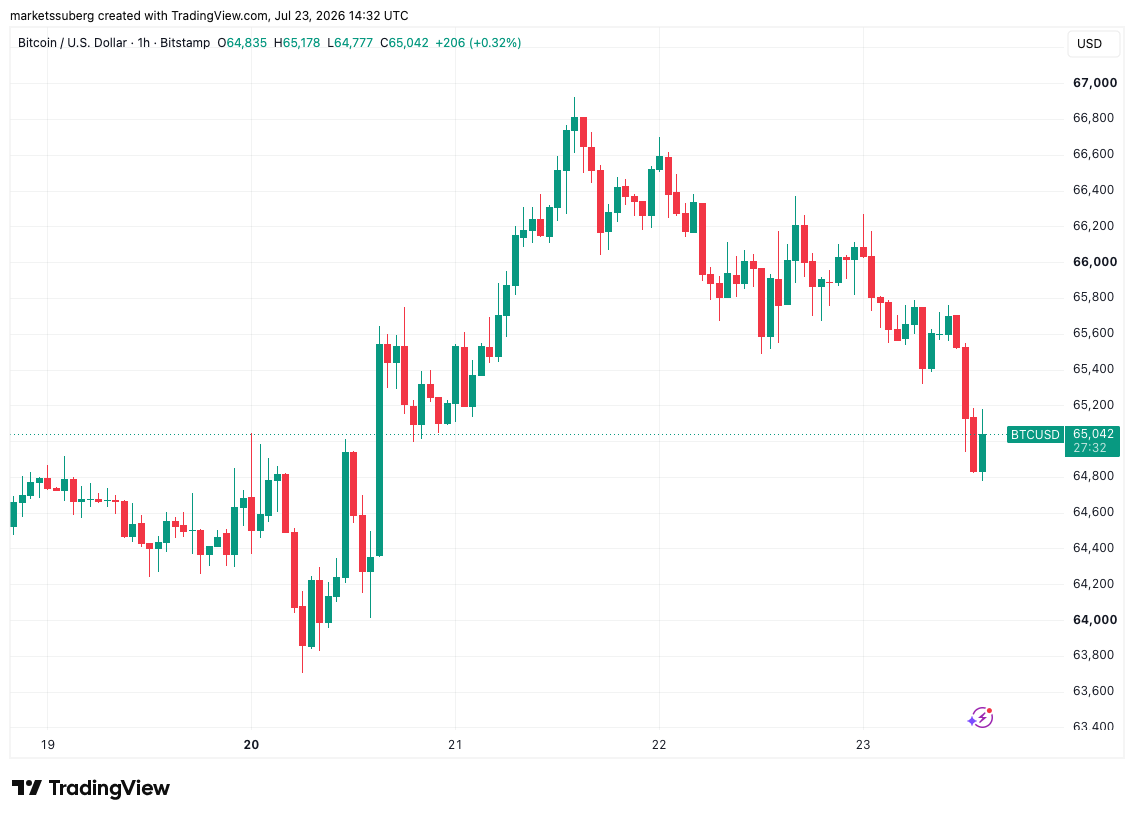
Bitcoin (BTC) fell below $65,000 on Thursday as US stocks slid amid another round of escalation in Iran.
Key points:
- Several days of US-Iran escalation are beginning to take their toll on crypto and stock market performance.
- Bitcoin sees three-day lows under $65,000 as traders diverge on the near-term outlook.
- A 21-day moving average trend line becomes important nearby support.
Bitcoin wobbles as Iran destabilizes stocks, oil and US bond yields
Data from TradingView showed BTC/USD hitting three-day lows of $64,799 on Bitstamp.
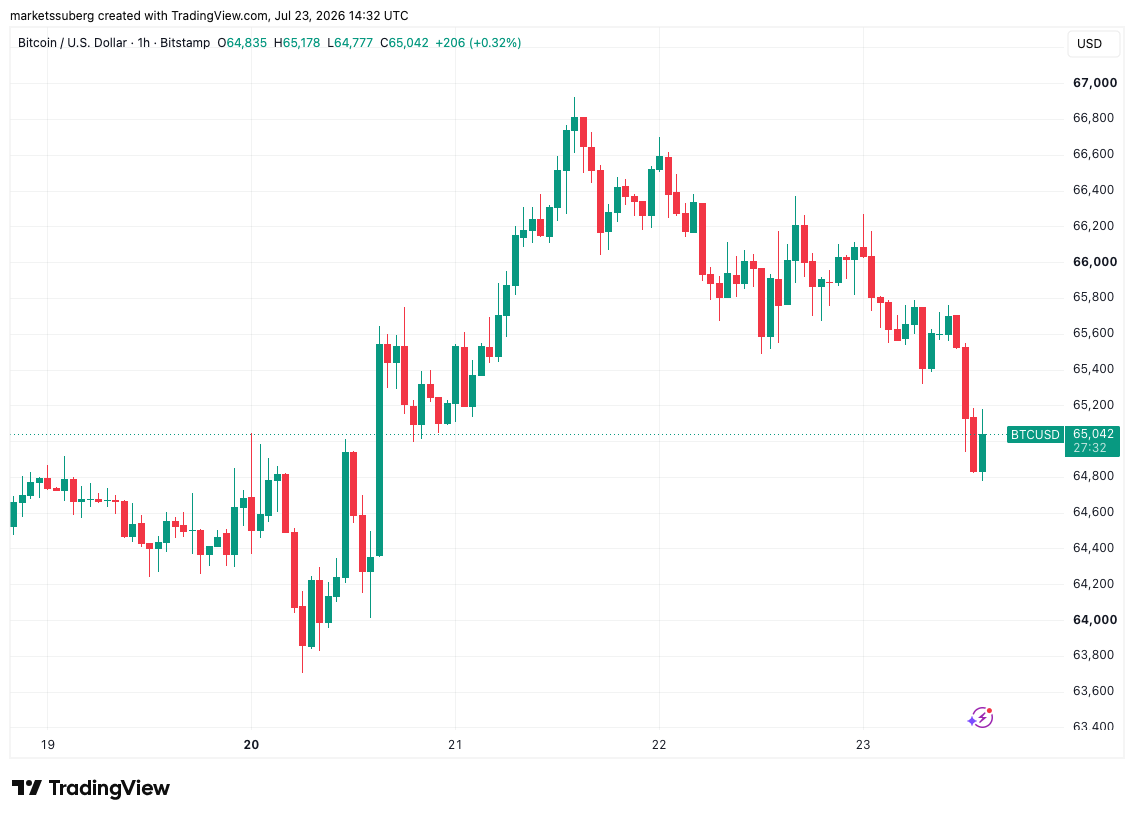
BTC/USD one-hour chart. Source: Cointelegraph/TradingView
Risk assets felt the strain on the day as US President Donald Trump warned that he would blame Iran for recent Houthi strikes on Saudi Arabian commercial vessels.
In a post on Truth Social, Trump said that he was “very disappointed” in the Houthis, referencing attacks on US ships from 2025.
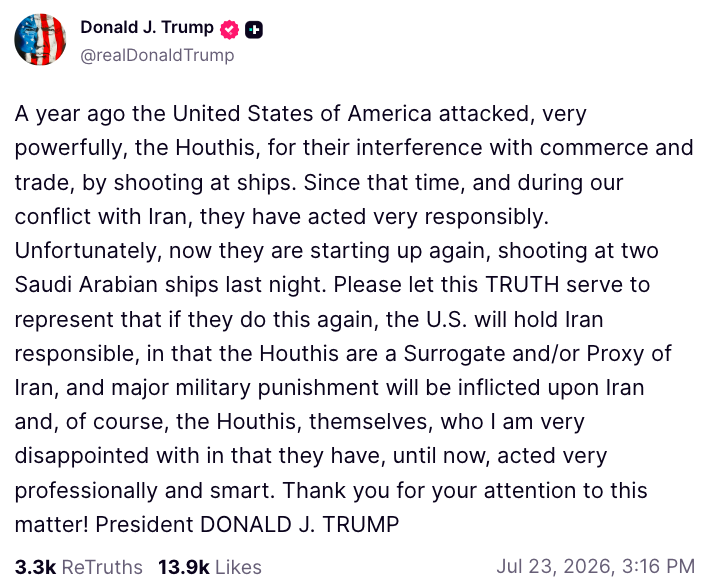
Source: Donald Trump on Truthsocial.com
By the close of New York trading, the S&P 500 had fallen 1.2% and the Nasdaq had shed 2.2%, while oil prices rallied to their highest since early June, with Brent crude topping $100 a barrel.
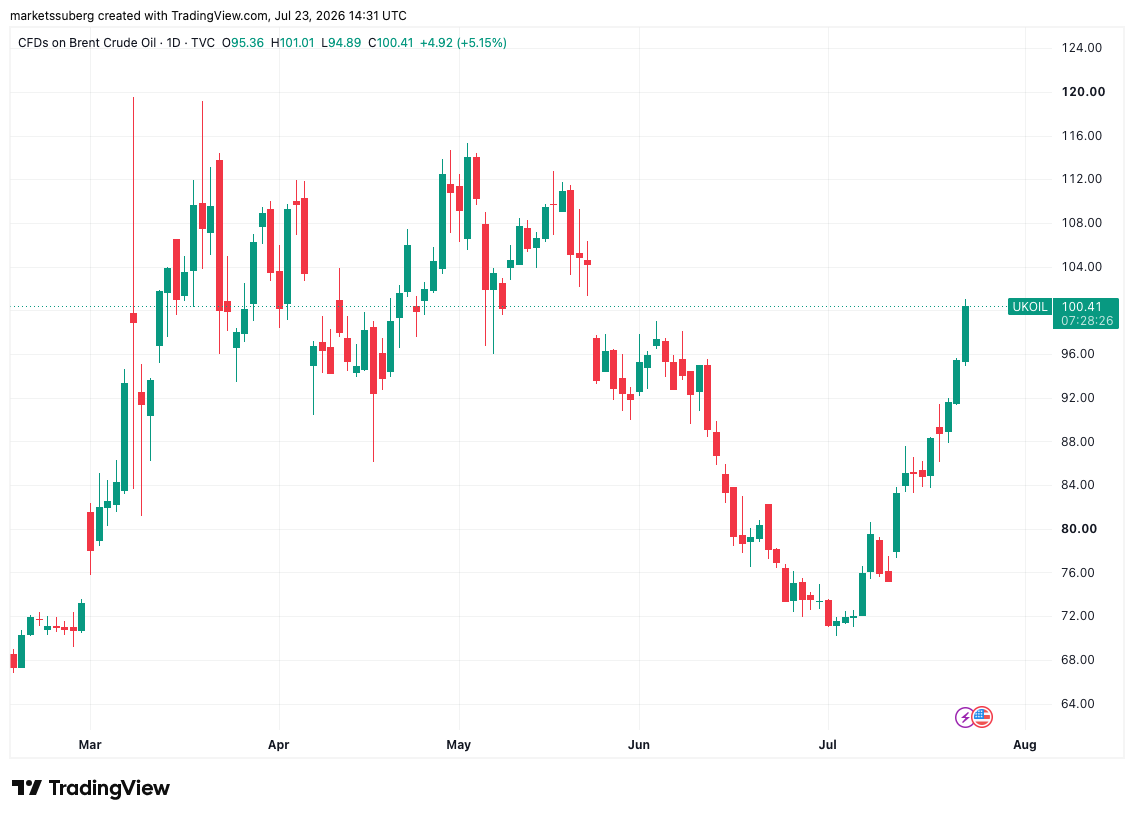
CFDs on Brent crude oil one-day chart. Source: Cointelegraph/TradingView
“Inflation expectations and interest rates are rising sharply again,” trading resource The Kobeissi Letter wrote in a response on X.
Ahead of the Federal Reserve’s next interest-rate decision, data from CME Group’s FedWatch Tool showed an increasing chance of officials hiking by 0.25% — traditionally a headwind for crypto markets. Odds neared 40% on Thursday, while a week prior, they were closer to 12%.
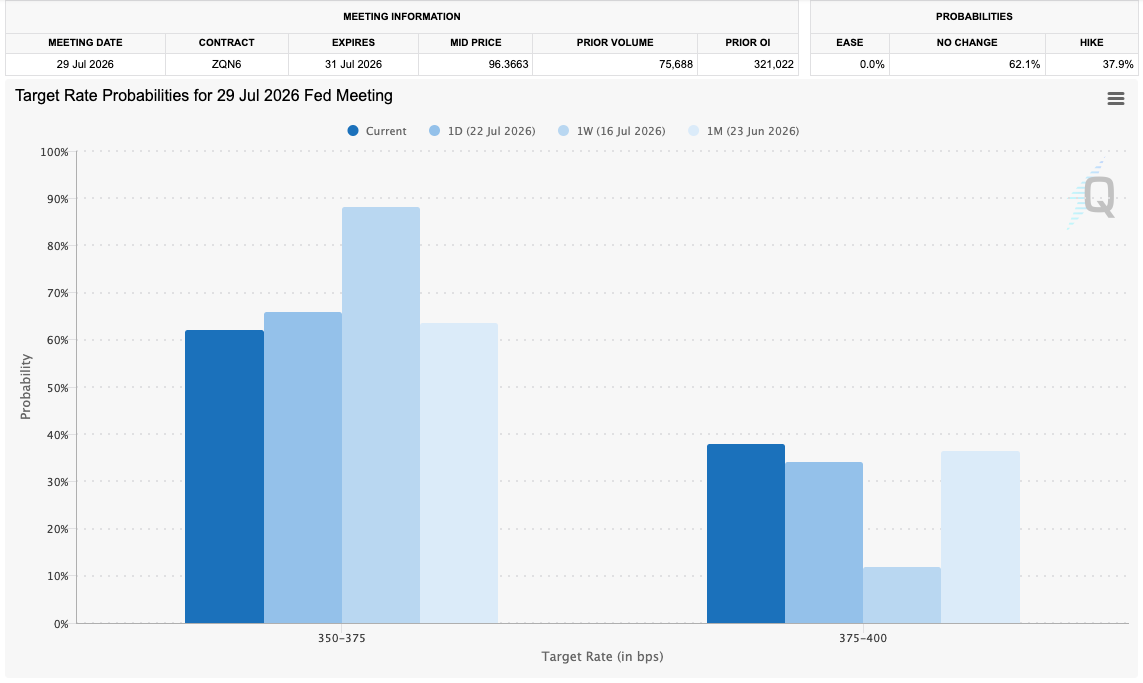
Fed target-rate probability comparison for July FOMC meeting. Source: CME Group
Kobeissi, meanwhile, noted 18-month highs in US 10-year bond yields in a sign of fresh economic strain.
Related: Bitcoin will get ‘lift’ from Hyperliquid, Robinhood in next crypto bull market: Bitwise exec
BTC price analysis offers hope of $73,000
Bitcoin traders showed an increasing split over what short-term BTC price action would bring.
Commentator Exitpump argued that the Bitcoin relief rally is likely to end by late July, reinforcing an established theory that has already gained traction.
“July rally is coming to end, price is at resistance, close your longs, go short once price breaks below 65K,” they told X followers late on Wednesday.
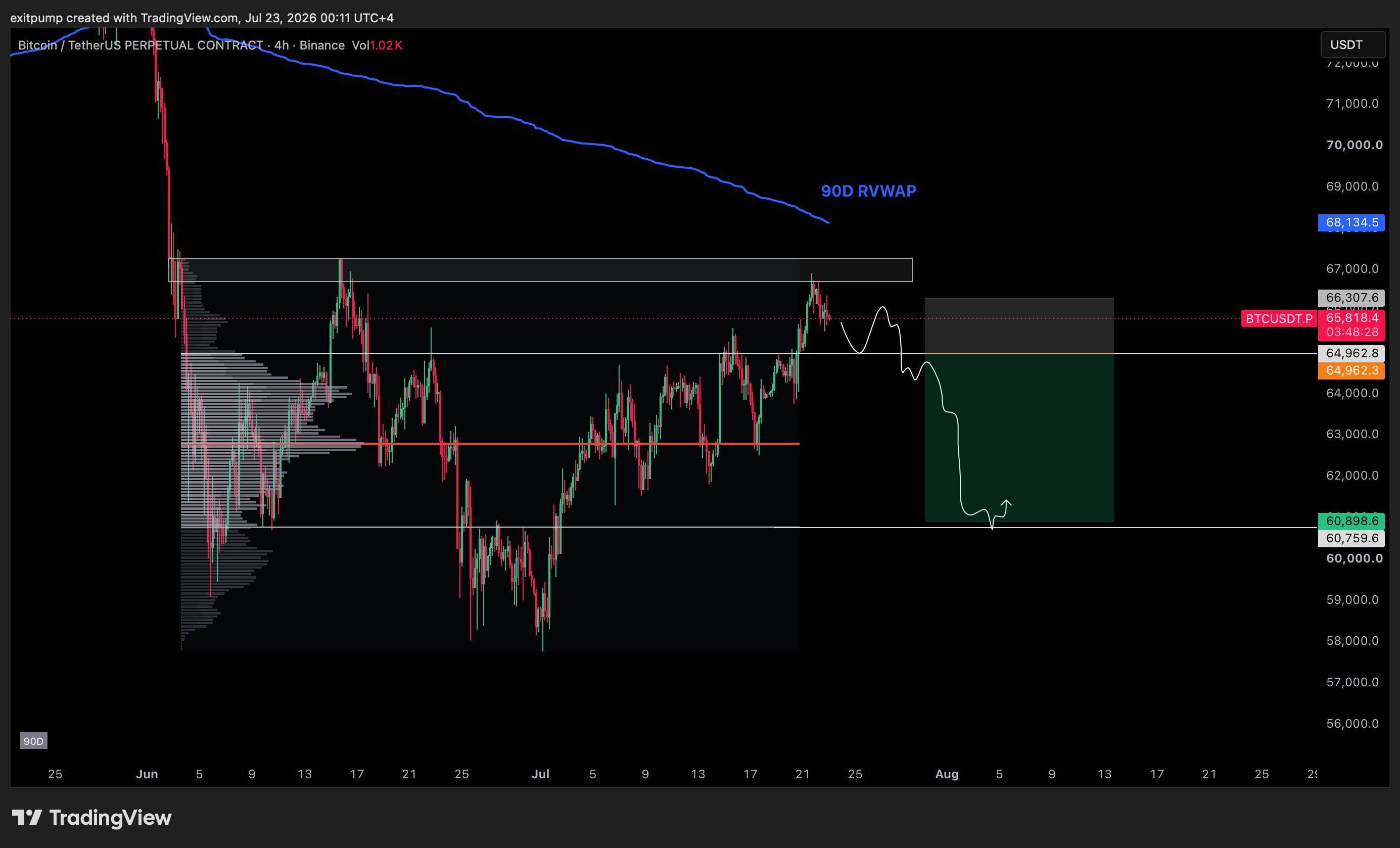
BTC/USDT perpetual contract four-hour chart. Source: Exitpump on X.com
Others were more hopeful, with trader Jelle arguing that price was “still making progress.”
“Clear this local area and that void towards $70k opens up – could be a quick move to form the new range. Patience remains my game,” he reported.
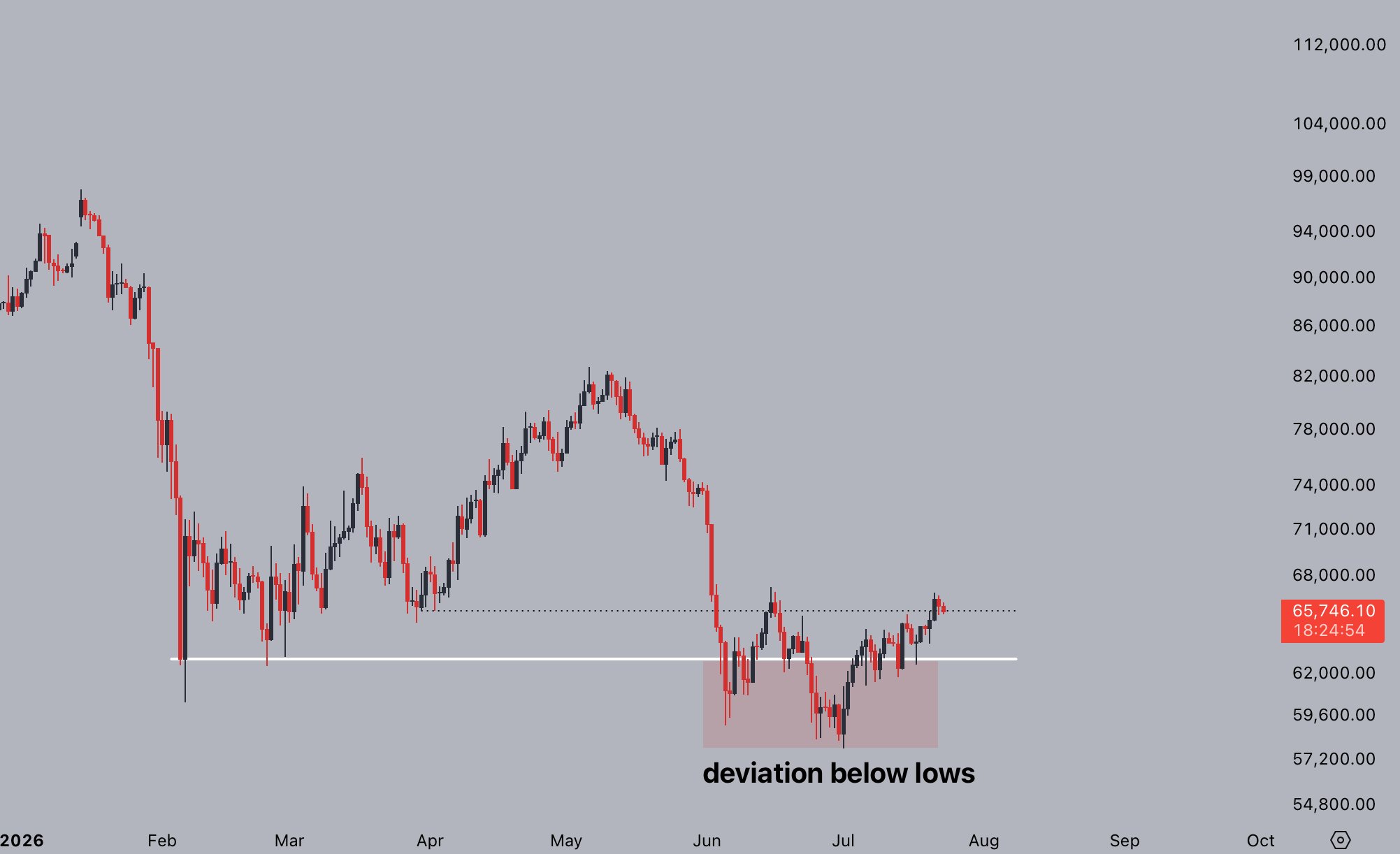
BTC/USD chart. Source: Jelle on X.com
According to crypto trader and analyst Michaël van de Poppe, the 21-week simple moving average (SMA) at $64,073 was key.
“Theoretically, the target area for Bitcoin is reached. However, as long as this stays above the 21-Day MA, I’m sure there will be a higher valuation for Bitcoin in the near-term,” an X post on the day stated, adding:
“It’s facing the final hurdle for a big breakout, which is the $68,000 resistance zone. It’s been tested once, and this is the second test that we’ll be facing.”
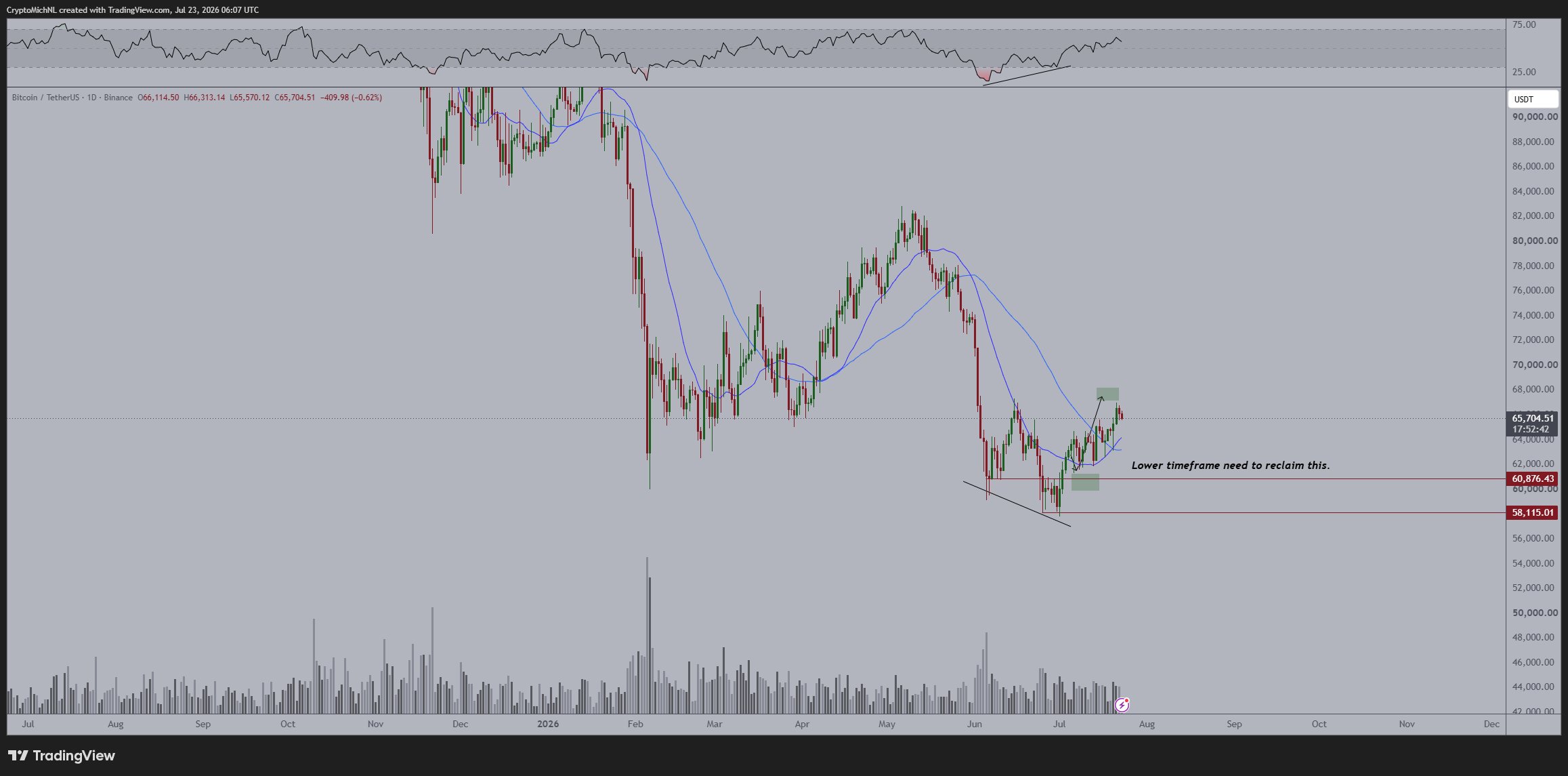
BTC/USDT one-day chart. Source: Michaël van de Poppe on X.com
Van de Poppe gave a $73,000 target should bulls successfully break through resistance.

Politics Home | Labour MP Says Her Colleagues Are “On A Journey” To Support Her Summer Of Sex Campaign

LeBron James free agency: Prediction markets, Rich Paul cash in; schedule makers wait

Valve’s Steam Deck price hike has completely destroyed sales, new data suggests


-

 Fashion6 days ago
Weekend Open Thread – Corporette.com
-

 Politics5 days ago
The House | The City of London can help the new chancellor deliver growth in every postcode
-

 Crypto World5 days ago
Ripple Payments Joins MiCA With 14 Firms, Does It Mean Anything For XRP?
-
 Crypto World6 days ago
Two July Windows Left: The CLARITY Act’s Senate Fight and What Failure Means
-

 Politics4 days ago
Democrats look to World Cup watch parties to register thousands of voters
-

 Crypto World6 days ago
Ripple wins EU-wide access as ESMA adds it to MiCA register
-

 Crypto World3 days ago
Grayscale Files For Worldcoin ETF, WLD Registers Sharp Rise
-

 NewsBeat3 days ago
Unregistered fitter used Gas Safe logo on business flyers
-

 Tech3 days ago
Sail Virtually Aboard The “Itanic” With IA-64 Emulator
-
 Tech3 days ago
Turtle Beach Command Series KB7 review: a nifty screen-equipped gaming keyboard
-

 NewsBeat6 days ago
Registration is now open for March for Men with Kev 2026
-
 Business2 days ago
New Jersey voter registration controversy explained: How 6,600 noncitizens got on the rolls, and what happens next
-

 News Videos4 days ago
Big Money Is Entering XRP
-
 Crypto World7 days ago
Claude Fable 5 Slips to Second in AI Coding Leaderboard
-

 News Videos7 days ago
Money | Class 12 Economics | CBSE Board Exam 2026-27
-

 Business7 days ago
Banco Bilbao Vizcaya Argentaria, S.A. (BBVA) Discusses Global Macro Environment and Economic Outlook for Core Markets Transcript
-

 Crypto World5 days ago
Kaspersky exposes OkoBot’s 20-module crypto wallet attack
-

 Business6 days ago
Airlines warn Sunshine Protection Act could disrupt flight scheduling
-

 NewsBeat6 days ago
Durham County Council to send out electoral registration emails
-
 Entertainment2 days ago
Johnny Depp’s R-Rated Gothic Cult Classic Gets New Release Ahead of Sydney Sweeney Remake
You must be logged in to post a comment Login