
Crypto World
HYPE Hits $45 as Oil Contracts Boost Hyperliquid Volume


TLDR
- HYPE climbed above $45 for the first time in five months after gaining more than 20% in one week.
- Oil perpetual contracts ranked among the most traded assets on Hyperliquid during the price rally.
- Crude Oil generated over $840 million in 24-hour volume and became the third most traded market.
- Brent Crude Oil recorded more than $360 million in daily volume and ranked fifth on the exchange.
- HIP-3 daily trading volume reached about $5.4 billion in late March, led by commodity contracts.
HYPE advanced to nearly $45 early Tuesday, marking its highest level in five months. The token gained over 20% during the past week as trading volumes expanded. Oil-linked perpetual contracts drove much of the activity on Hyperliquid.
The token later eased to about $43.4 at press time. However, it held most of its weekly gains as traders stayed active. The recovery followed renewed focus on commodity markets listed on the exchange.
HYPE Price Rally Aligns with Commodity Trading Surge
HYPE climbed sharply as traders increased activity across builder-deployed markets on Hyperliquid. The token reached nearly $45 before trimming gains later in the session. It still traded firmly above late January levels.
The weekly advance exceeded 20%, reflecting stronger participation on the platform. Oil contracts ranked among the most traded assets during the rally. This trading momentum coincided with higher open interest across new perpetual listings.
Hyperliquid operates a permissionless listing structure under its HIP-3 framework. Outside developers can launch perpetual markets directly on the exchange. The protocol describes HIP-3 as a move toward decentralized perp listings.
This structure expanded the range of available markets beyond digital assets. Commodity and equity-linked contracts gained traction in recent weeks. As a result, overall trading activity shifted toward these instruments.
Market data showed builder-deployed markets topping $1.2 billion in open interest during March. Oil and equity futures contributed heavily to that figure. These contracts became central to daily trading flows on the platform.
Crude Oil emerged as one of the busiest contracts on Hyperliquid. The contract generated over $840 million in 24-hour volume. It ranked as the third most traded market on the exchange.
Brent Crude Oil also attracted strong participation from traders. The contract recorded more than $360 million in 24-hour volume. It ranked fifth among all listed markets.
Oil Frenzy Under HIP-3 Lifts HYPE Visibility
Trading activity accelerated during volatility tied to the US-Iran conflict. Traders used perpetual markets to react before traditional exchanges reopened. This dynamic increased volume across oil-linked contracts.
A March report from The Wall Street Journal detailed rapid volume growth. Cumulative oil futures volume jumped from $339 million to $7.3 billion within days. Traders favored nonstop markets during heightened geopolitical tension.
This surge extended beyond oil alone and covered other commodities. HIP-3 daily volume reached about $5.4 billion in late March. Silver, WTI, Brent, and gold contracts led that activity.


Key Highlights
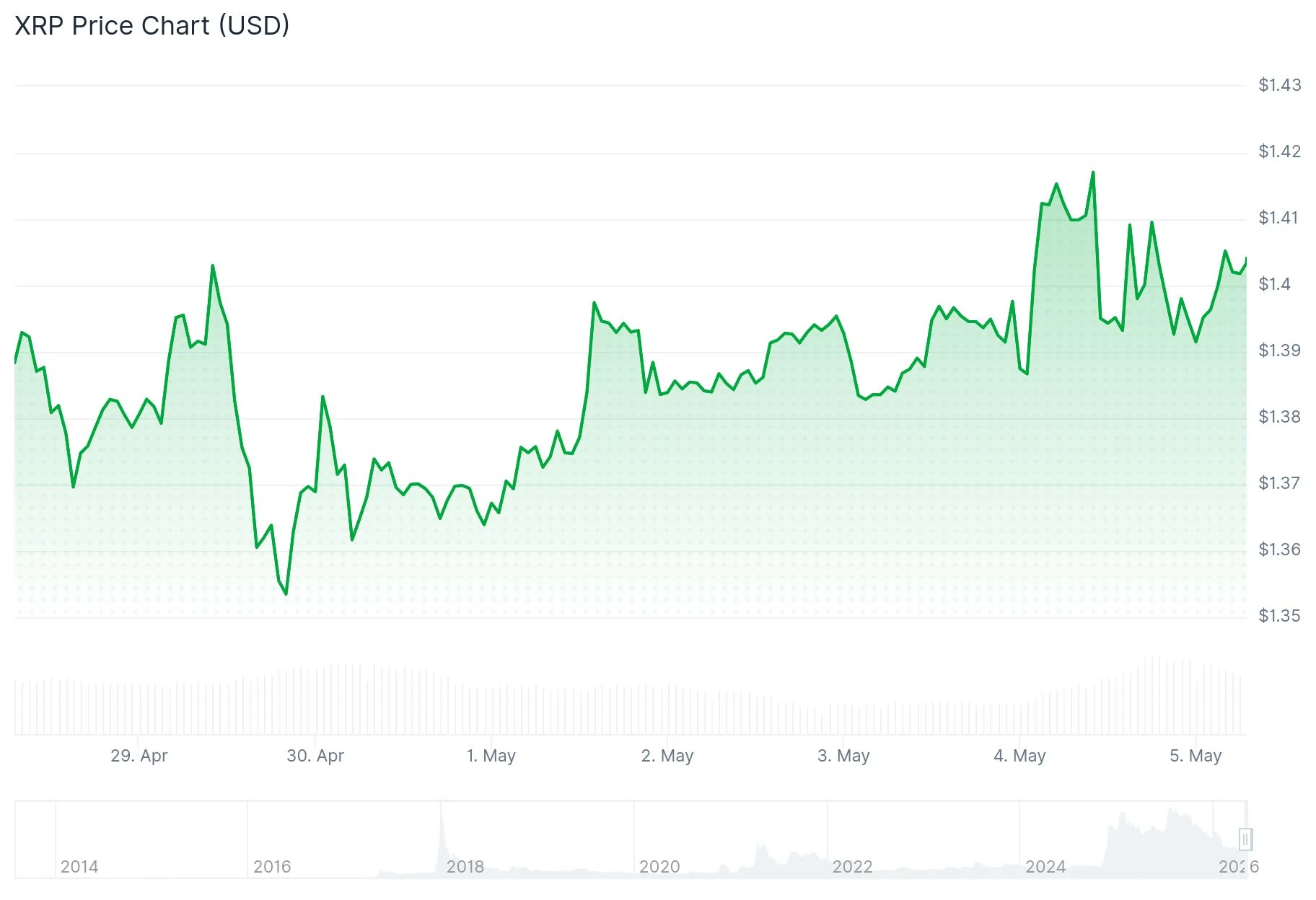
- XRP currently hovers between $1.39 and $1.41, posting a 1.70% gain over the past day with $2.15 billion in trading activity
- Binance’s 30-day liquidity measurement for XRP has plummeted to 0.038, marking the weakest reading in five years
- Derivative market metrics reveal a 48.27% jump in volume alongside a remarkable 311.69% spike in options activity
- Technical analysts suggest a monthly settlement above $1.50 may trigger bullish momentum toward the $2.20 zone
- Polymarket data indicates the CLARITY Act carries a 64% probability of enactment before 2026
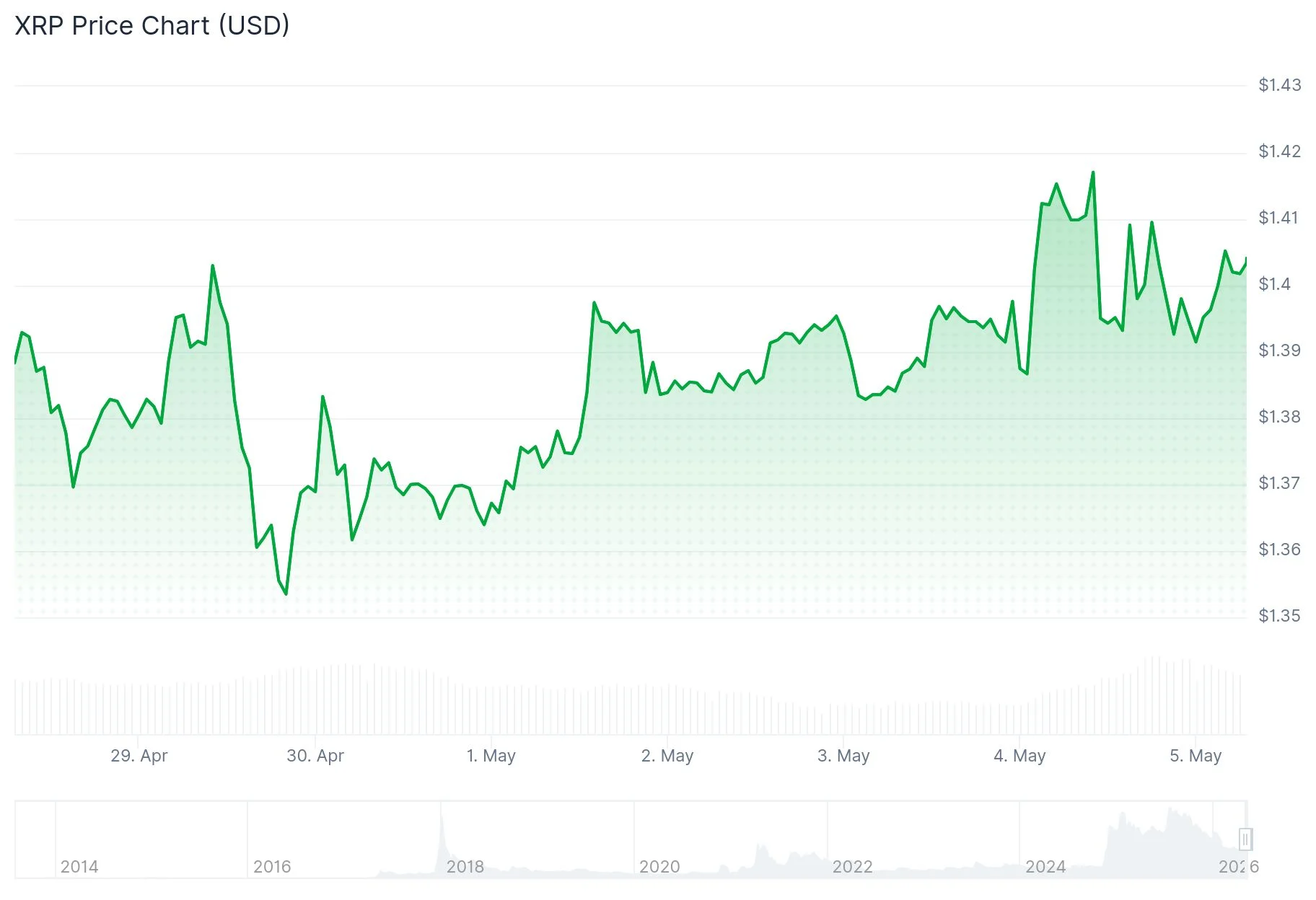
XRP continues to consolidate around the $1.40 mark following a modest 1.70% uptick over the last 24-hour period. Daily trading volumes registered approximately $2.15 billion, while the aggregate cryptocurrency market capitalization stands at $2.64 trillion.
Bitcoin momentarily surpassed the $80,000 threshold before retracing to approximately $79,700. Ethereum maintained its position above the $2,300 level. These movements helped establish a constructive sentiment throughout digital asset markets.
XRP bounced from its support foundation near $1.35 and has established a series of ascending lows. The primary resistance barrier lies within the $1.42–$1.45 corridor, an area where selling pressure has consistently emerged.
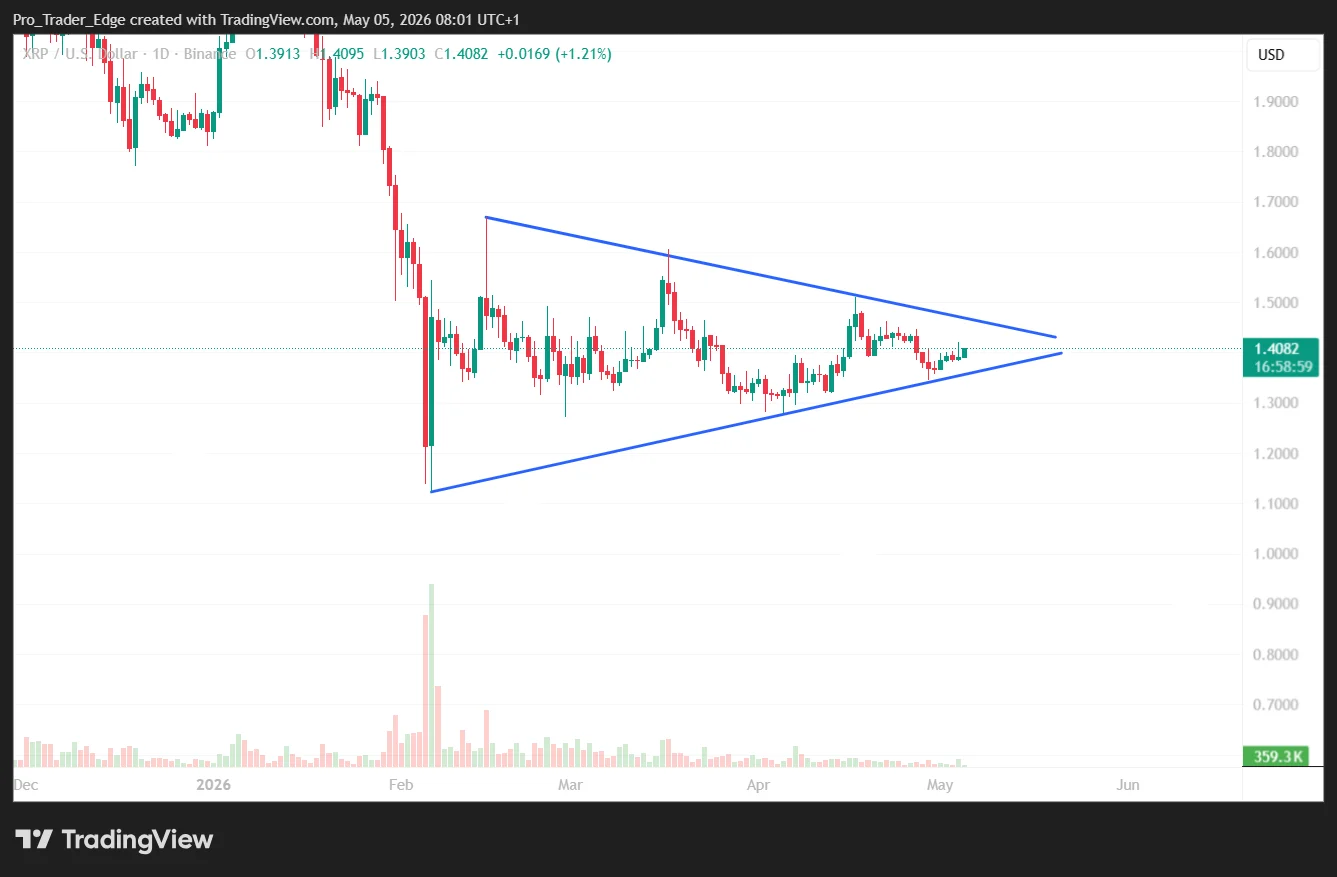
A decisive push beyond $1.45 would bring the $1.50 threshold within striking distance. Chart analysts suggest that securing a monthly closing price above $1.50 would validate an escape from an extended diamond consolidation formation, projecting a technical objective at $2.20.
Market Depth Reaches Historic Lows
The 30-day liquidity measurement for XRP on Binance has contracted to 0.038. This represents the most compressed level observed since 2020, based on information referenced by Arab Chain.
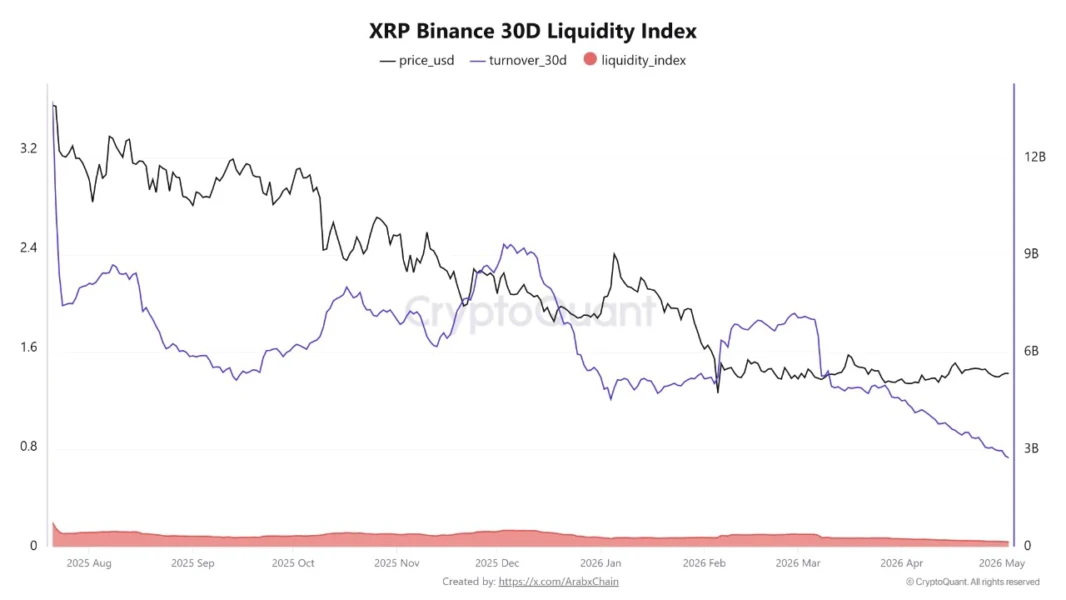
Reduced liquidity indicates a sparse order book environment. With fewer market participants actively posting buy and sell orders, substantial transactions can generate price swings that are both faster and more pronounced than typical conditions would produce.
The noteworthy aspect is XRP’s price stability despite this liquidity erosion. The token has maintained its range while order book depth has quietly contracted. Arab Chain characterizes this as a dual-edged scenario: the subsequent significant capital flow in either direction could catalyze price movement exceeding normal volatility parameters.
Legal commentator Bill Morgan emphasized that macroeconomic market conditions remain influential. He suggested XRP’s regulatory standing might persist independent of legislative developments, though broader market fragility could still exert downward pressure on valuation.
Legislative Probability and Compliance Developments
Decentralized prediction marketplace Polymarket currently assigns approximately 64% likelihood to the CLARITY Act’s passage by 2026. This proposed legislation addresses digital asset categorization and has attracted considerable interest from both policymakers and market participants.
The Senate Banking Committee may conduct deliberations on the measure as soon as mid-May. Recent weeks saw legislators introduce revised language addressing stablecoin yield provisions following extended negotiation periods.
XRP historically exhibits sensitivity to legal and regulatory announcements due to its prolonged engagement with the Securities and Exchange Commission. Enhanced clarity regarding token classification frameworks could influence institutional participation strategies.
Evernorth, a Ripple-supported XRP treasury entity, has named Robert Kaiden — Chief Financial Officer of the OpenAI Foundation — to its governing board. The organization maintains holdings of hundreds of millions of XRP tokens and pursues a $1 billion capital raise preceding an anticipated Nasdaq public offering.
XRP’s options open interest currently registers at $52.89 million, reflecting a 2.81% increase, while aggregate derivatives open interest achieved $2.59 billion.
America’s largest banking groups said they remain dissatisfied with the CLARITY Act’s newly proposed language on stablecoin yield, arguing that it fails to protect bank deposits.
In a statement Monday, the bankers acknowledged that US Senators Thom Tillis and Angela Alsobrooks are “seeking to achieve the correct policy goal” in prohibiting stablecoin yield but noted that the CLARITY Act’s “proposed language” currently “falls short of that goal.”
“It is imperative that Congress get this right,” the American Bankers Association said in a joint statement with the Bank Policy Institute, Consumer Bankers Association, Financial Services Forum and Independent Community Bankers of America.
The dispute between bankers and the crypto industry over stablecoin yield has stalled the bipartisan bill, which passed the House of Representatives in July by a 294-134 vote. There are concerns that the CLARITY Act may not pass before the US midterm elections in November 2026, which could further hinder its progress.
Banking groups have previously cited studies suggesting that widespread stablecoin adoption could lead to trillions in outflows from the US banking system, particularly from community banks, which may not have enough balance-sheet flexibility to absorb these outflows without resorting to higher-cost wholesale borrowing.
In the Monday statement, the bankers also cited an article by Stanford-trained economist Andrew Nigrinis to argue that stablecoin yields driving bank deposit outflows “could reduce all consumer, small-business, and farm loans by one-fifth or more, making it essential for the prohibition to be clear and transparent.”
However, White House economists reported in April that banning stablecoin yield may increase bank lending by only $2.1 billion, a marginal net increase of about 0.02%.
Bankers want “loophole” closed
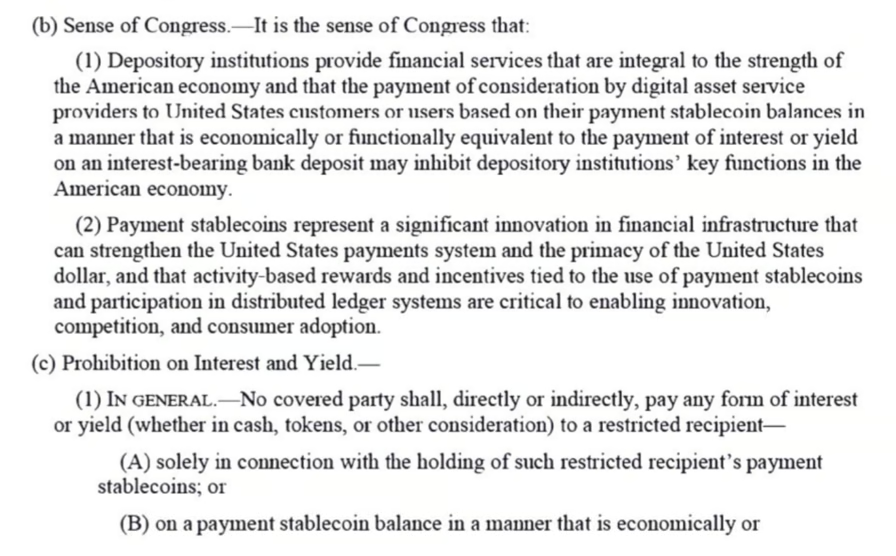
The bankers contested the language of Section 404, arguing that it allows crypto platforms to pay users bank-like interest or yield outside traditional rules.
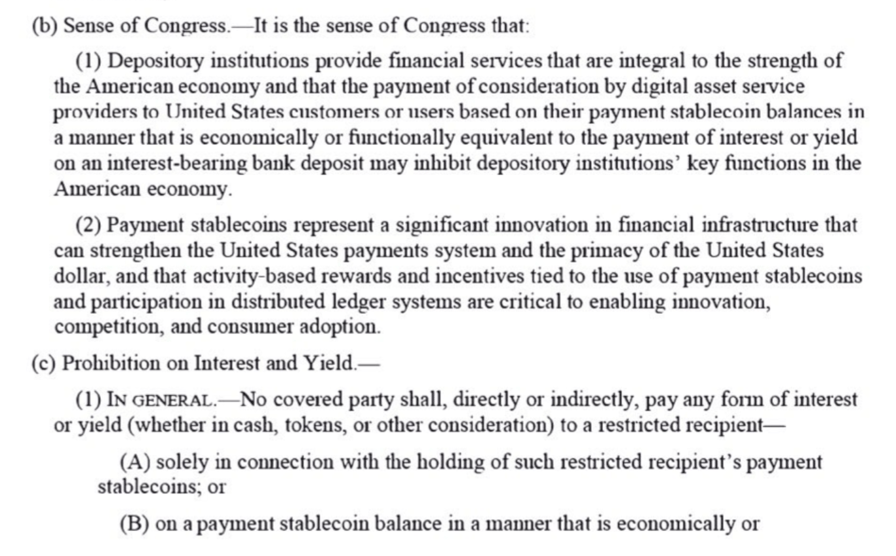
Extract of the “SEC 404. Prohibiting interest and yield on payment stablecoins” document. Source: Alex Thorn
“This is a significant loophole that must be addressed,” the bankers said, adding that they will be sharing “detailed suggestions for strengthening the proposed language with lawmakers in the coming days.”
Related: Lummis says CLARITY Act offers ‘strongest’ developer protections
However, Tillis said the current text of the CLARITY Act strikes a compromise by prohibiting stablecoin rewards on idle balances while allowing crypto platforms to “offer other forms of customer rewards.”
“Most importantly, it helps put us on a bipartisan path to pass the CLARITY Act, providing the regulatory certainty needed to foster innovation. Some in the banking industry may not want either of these things to happen, and we respectfully agree to disagree.”
The current text of the CLARITY Act was made public on Friday, with Coinbase and other members of the crypto industry pushing for a Senate markup next week.

Key Takeaways
- Circle’s stock soared almost 20% while Coinbase climbed 6% during Monday’s widespread crypto market rally
- Bitcoin climbed back above the $80,000 threshold for the first time since January’s final days
- Momentum behind the Digital Asset Market Clarity Act sparked renewed confidence among investors
- Two senators reached a breakthrough agreement on stablecoin yield provisions, clearing a major legislative hurdle
- Prediction markets now show 64% probability for the Clarity Act becoming law
Shares of Circle, the company behind the USDC stablecoin, spearheaded a widespread surge across crypto-related equities on Monday. The stock jumped 19.89% to settle at $119.53, pushing its 2025 returns above the 50% threshold.
Coinbase finished the trading day higher by 6.14% at $202.99. Digital asset custody provider BitGo climbed 10.26%. Robinhood shares increased nearly 4%, while SOL Strategies experienced a surge exceeding 17%.
Bitcoin pushed through the $80,000 threshold during Monday trading, hovering around $80,020 at 9:20 p.m. ET. This marked its most robust performance since January’s conclusion. Meanwhile, the CoinDesk 20 Index advanced 1.2%.
The cryptocurrency sector’s strength emerged as traditional U.S. stock markets headed in the reverse direction. The Dow Jones declined 1.13% and the S&P 500 dropped 0.41%, pressured by escalating geopolitical tensions across the Middle East.
The primary catalyst propelling the crypto equity rally was legislative advancement of the Digital Asset Market Clarity Act on Capitol Hill. This legislation seeks to establish comprehensive regulatory guidelines for digital asset markets across the United States.
Senators Reach Stablecoin Yield Agreement
Last Friday, Maryland Senator Angela Alsobrooks and North Carolina Senator Thom Tillis reached consensus on compromise text addressing stablecoin yield mechanisms. This provision had represented one of the bill’s most contentious elements.
The revised text prohibits “covered parties” from distributing any interest or yield forms to American customers purely for stablecoin holdings. It additionally restricts payments that functionally replicate interest earned on traditional bank deposits.
Nevertheless, the agreement preserves the ability to offer incentives connected to actual usage and transactional engagement. This differentiation represents the core of the ongoing policy debate.
Banking industry associations voiced opposition on Monday. They characterized the compromise as inadequate for achieving its stated objectives and urged Congress to eliminate perceived regulatory gaps.
Senator Tillis countered by describing the updated version as a “substantially improved, consensus-based product.” He emphasized that it prevents stablecoin reward structures from mirroring traditional banking deposit interest.
Industry Expert Perspectives
Markus Thielen, who founded 10x Research, stated the compromise eliminates among the last remaining barriers to legislative approval. He anticipates lawmakers will proceed toward official markup sessions potentially within days.
Polymarket, a blockchain-based forecasting platform, currently assigns 64% likelihood to the Clarity Act securing passage before year-end, representing an increase from prior estimates.
Thielen noted that equity investors are beginning to factor in prospective beneficiaries. He highlighted Circle as particularly positioned to gain if stablecoins receive formal classification as payment instruments rather than interest-generating products.
Circle plans to announce quarterly earnings next week. Following its previous February earnings disclosure, the company’s stock price roughly doubled throughout subsequent weeks.
Strategy, holding the largest corporate bitcoin reserves, and Bitmine, maintaining an Ethereum-focused treasury, each registered gains ranging from 3% to 4% during Monday’s session.
Ethereum scaling solution Polygon has launched private stablecoin payments in an effort to attract more businesses and institutions to the chain.
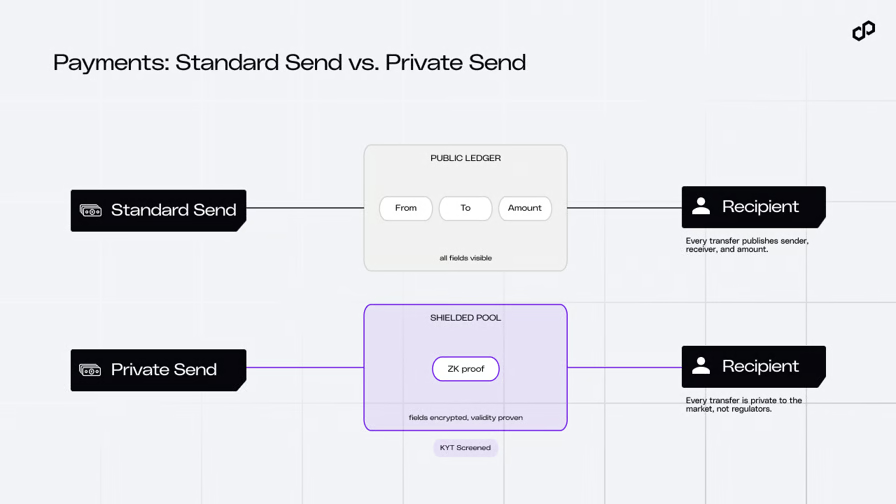
In a statement on Sunday, Polygon introduced its new wallet feature that enables users to privately route transactions through a shielded pool, with verification handled by zero-knowledge proofs. The move is part of an integration with privacy protocol Hinkal.
“For onchain payments to go mainstream, businesses need privacy. Not ‘hide from regulators’ privacy. Operational privacy,” noted Polygon community lead Smokey on X.
Privacy was one of the biggest crypto themes in 2025, with many crypto assets tied to privacy projects surging last year despite a broader market downturn. Polygon highlighted the importance of privacy, arguing that many institutions are unlikely to move significant volume onchain without it.
“Confidentiality has been the single biggest gap between onchain rails and what institutional finance actually needs to move serious stablecoin volume,” Polygon said.
“Banks, treasuries and payments teams already live with confidentiality on traditional rails. They won’t move operational flows onto a ledger that broadcasts every counterparty and every amount to every observer on the network.”
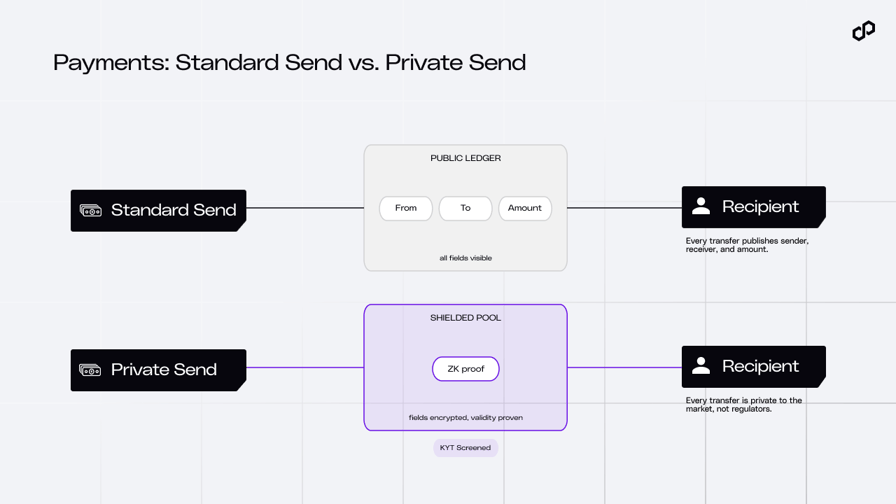
Payment process for private transactions vs normal transactions. Source: Polygon
Polygon’s new feature is that it enables users to hide transactions from the public while maintaining compliance and auditability. Polygon said that “privacy means opacity to the market, not opacity to regulators.”
This happens in two key ways. First, every private transaction on Polygon “passes through KYT (Know Your Transaction) screening before execution.” Meanwhile, Hinkal’s documentation indicates that users can generate audit files to hand over to tax officials or regulators.
The move from Polygon comes just weeks after layer-1 blockchain Aptos made its own privacy play by launching the Confidential APT coin on April 24.
The coin is pegged to the value of the Aptos (APT) token and uses zero-knowledge proofs to conceal and verify transfer information.
Related: DeFi can freeze stolen funds, but not everyone agrees it should
The total market capitalization of stablecoins on Polygon hit an all-time high of $3.6 billion on April 10, according to data from DefiLlama, making it the eighth-largest stablecoin chain.
Passage of the stablecoin-friendly GENIUS Act in July last year sparked an uptick in interest and trading volume for the asset class. On Sunday, Western Union became the latest traditional finance firm to launch a stablecoin through its USD-pegged USDPT on Solana.
Magazine: AI-driven hacks could kill DeFi — unless projects act now
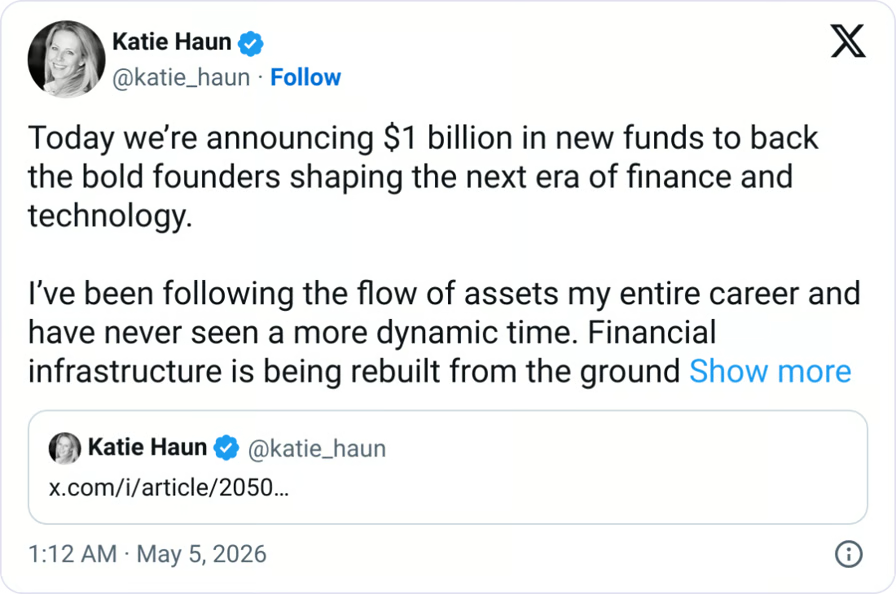
Haun Ventures has raised $1 billion to back early- and late-stage crypto startups, while expanding into artificial intelligence for the first time.
The funds will focus on three areas: crypto financial infrastructure, tokenization and AI agents. The firm’s founder, Katie Haun, called these areas the “new economy.”
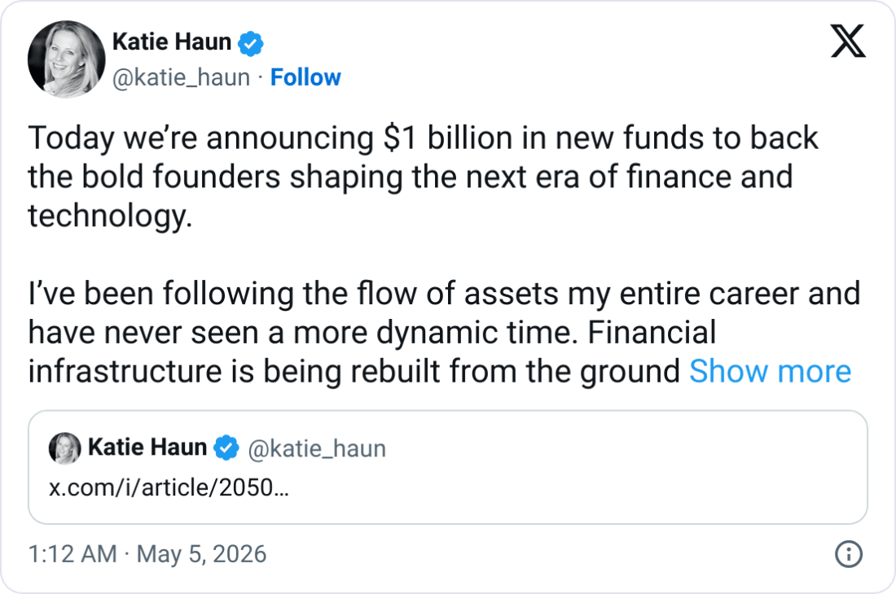
“I’ve been following the flow of assets my entire career, and this is the most dynamic period in technology and finance I’ve ever witnessed,” said Haun, a former US government prosecutor turned crypto executive, in a blog post on Monday.
“The foundations of capital, commerce and trust are undergoing meaningful structural changes,” she added. “The founders who can see across all of it, and build accordingly, will be defining entrepreneurs of this era.”
It’s a significant shift for Haun Ventures, as it is the first time the crypto-focused firm has looked to invest in AI startups, joining a rush of venture firms that are moving into the growing industry.
Crunchbase reported in April that AI firms received a record $242 billion in venture funding in the first quarter of 2026, capturing 80% of the total global venture funding over the quarter, which hit an all-time record of $300 billion.
Haun’s vision for AI agents
Haun said that AI agents, software that autonomously performs tasks, will “increasingly begin to conduct economic activity on our behalf,” and new products and services would need to be “developed for a world in which computers are the customers.”
AI agents currently make a small number of payments, around $1.6 million worth over a 30-day period as of early March, according to Andreessen Horowitz partner Noah Levine, a number that the Boston Consulting Group expects to rise to $2.4 trillion a year by 2029.
Source: Katie Haun
“Every supporting layer will need to be rearchitected for this world: fraud prevention, credit, insurance, identity, privacy, provenance, reputation, and verification all require native versions designed for how agents transact, and cryptographic tools will be important here,” she added.
Related: DTCC eyes October tokenized securities launch with 50 DeFi and TradFi giants
Meanwhile, Haun said that “the core plumbing of global finance” was being shifted to accommodate an always-on digital world, and noted tokenization as a technology that allowed traditional assets such as gold and oil to be “borderless, always on, and programmable.”
She told Bloomberg on Monday that her company wants to focus on the cross-section of AI agents and crypto infrastructure, wanting to invest in “AI that is in our lane.”
Magazine: AI-driven hacks could kill DeFi — unless projects act now


Bitcoin continues to rally in a move that defies the typical inflation playbook, raises the question of whether the cryptocurrency has quietly crossed over from risk asset to inflation hedge.
The leading cryptocurrency by market value has risen 19% in just over a month, topping $80,000 on Monday for the first time since January. The rally comes as oil hovers above $100 and Bloomberg’s commodity futures index has jumped to a decade high, pointing to inflation in the pipeline. Meanwhile, U.S. consumer inflation expectations are surging.
In the standard playbook, this combination is considered bearish for bitcoin. Rising inflation means the Federal Reserve is likely to keep interest rates higher for longer, while higher rates mean attractive returns on supposedly safe assets such as U.S.
Treasury notes and less incentive to invest in yield-less assets like bitcoin. This logic has worked several times before, most notably in 2022, when the Fed hiked rates aggressively to tame inflation, which partially catalyzed that year’s bitcoin crash.
This time is different
But this time, bitcoin is not following that script. Some analysts are acknowledging the disconnect plainly, raising questions about the durability of the rally. Others say something more fundamental is happening.
“Macro signals remain divided, with commodities pricing supply-side stress while risk assets continue to trade higher. This divergence highlights a growing disconnect across asset classes and raises questions about the durability of the current risk-on environment,” analysts at prominent and long-running exchange Bitfinex said in a report shared with CoinDesk.
Inflation hedge
A different interpretation is gaining traction, suggesting a shift in how BTC is used: from a risk asset to an inflation hedge. And this interpretation is not just circumstantial but backed by renewed inflows into the spot ETFs.
Since March, the 11 U.S.-listed spot bitcoin exchange-traded funds have raised $4.45 billion in investor capital, nearly reversing the massive outflows during the autumn that weighed on the spot price at the time. Most of these inflows are seemingly bullish directional bets rather than the once-popular non-directional arbitrage play, which has not fallen out of investor favor.
“The more interesting shift is happening on the institutional side. Continued inflows into bitcoin ETFs point to a broader change in how hedging is approached. Gold is no longer the default — digital assets are increasingly being considered alongside it, not after it,” Ryan Lee, chief analyst at Bitget Research, said in an email.
Paul Howard, senior director at crypto liquidity provider Wincent, also sees bitcoin as an inflation hedge and has a price target for it. “As both an inflation hedge and a highly liquid store of value, bitcoin possesses several characteristics that could support a 3.5 times increase in price over the next three years,” he said in an email.
The view that BTC is an inflation hedge is no longer confined to crypto circles.
Last week, Paul Tudor Jones, one of the most respected macro traders alive, the man who correctly called and traded the 1987 stock market crash, came out with the most direct endorsement of the bitcoin inflation hedge thesis heard from a Wall Street heavyweight.
“Bitcoin is, unequivocally, the best inflation hedge there is,” Jones said in an interview on the Invest Like the Best podcast. “More than gold.”
His reasoning is structural. Unlike gold, whose supply increases by a couple of per cent each year, bitcoin has a finite supply that can be mined. In a world where central banks have demonstrated a clear willingness to boost the money supply, own the thing they cannot print more of.
Don’t forget stocks
Here is the honest caveat that the bullish inflation hedge narrative needs to reckon with.
Right now, U.S. equities are on a tear, and that is offering positive cues to bitcoin and the broader risk complex, as we noted Monday. In this environment, it is therefore genuinely difficult to draw a definitive conclusion that BTC has evolved into an inflation hedge and that the hedging bid, rather than the risk-on bid, is driving BTC higher.
“After a solid April, BTC has begun May on firm footing, breaking above $80k for the first time since January 31. The move appears aligned with equities, reinforcing a broader trend as BTC’s correlation with US stocks climbing back toward 2023 levels, signaling a renewed linkage with risk assets broadly,” Singapore-based digital assets trading firm QCP Capital said in a market note.
The real test of the inflation hedge narrative comes if and when equities turn lower. If bitcoin holds or rises during an equity sell-off, the narrative gets confirmed. But if it falls alongside equities, the risk asset label will stick.
That test has not arrived yet. Until then, the inflation thesis remains compelling.


GSR has secured a strategic investment from SC Ventures, the fintech investment arm of Standard Chartered, according to a Tuesday announcement.
Summary
- SC Ventures became GSR’s first external strategic shareholder since crypto liquidity firm launched in 2013.
- GSR and SC Ventures plan to expand tokenization, liquidity and institutional digital asset infrastructure.
- GSR recently launched its Crypto Core3 ETF, covering Bitcoin, Ethereum, Solana and staking exposure.
The deal makes SC Ventures the first external strategic shareholder in GSR since the crypto capital markets firm was founded in 2013.
The companies said the partnership will focus on digital asset market infrastructure, tokenization and institutional access. GSR provides market making, over-the-counter trading, advisory, asset management and liquidity services to crypto firms and financial institutions.
GSR and Standard Chartered target tokenization
The deal builds on a wider push to connect traditional finance with crypto markets. GSR said the partnership would support its role across advisory, liquidity and asset management, while SC Ventures brings banking and fintech investment experience.
“Institutional digital asset markets are maturing rapidly,” noted GSR CEO Xin Song.
He added that firms best placed to lead will combine capital markets experience with trusted banking infrastructure, with tokenization as a starting point.
The investment follows GSR’s recent move into Libeara, a tokenization platform backed by SC Ventures. That earlier investment gave GSR clients another path to tokenize assets and linked both firms before the latest shareholder deal.
SC Ventures deepens crypto infrastructure bets
SC Ventures CEO Alex Manson said, “The next phase of the digital asset evolution will be defined by the strength of infrastructure.” He said the investment supports SC Ventures’ focus on institutional ecosystems with deeper liquidity and more resilient market activity.
The move also fits Standard Chartered’s wider digital asset strategy. crypto.news reported in March that SC Ventures led Keyrock’s Series C round, valuing the crypto market maker at $1.1 billion. The report said Keyrock planned to scale trading, options, asset management and acquisition activity.
SC Ventures has become one of the more active bank-backed players in digital assets. Its related activity includes backing crypto firms, preparing a $250 million digital asset fund and advancing a crypto prime brokerage through SC Ventures.
GSR expands beyond market making
GSR has also moved into token lifecycle services. The firm expanded that business after acquiring Autonomous and Architech earlier this year. The company now positions itself as a provider that can support token projects from planning to post-launch market making.
The firm has also entered crypto ETF issuance. crypto.news reported that GSR launched the GSR Crypto Core3 ETF, ticker BESO, on Nasdaq. The fund targets Bitcoin, Ethereum and Solana, uses weekly rebalancing, charges a 1% fee and adds staking rewards where allowed.

Aave, the decentralized finance protocol, has filed an emergency motion in a New York court to vacate a restraining notice that would block Arbitrum DAO from transferring 30,766 Ether to the victims of the Kelp DAO exploit. Gerstein Harrow LLP served the notice on Arbitrum DAO last Friday, claiming its clients hold default judgments against North Korea worth about $877 million and that the Kelp hacker group had possession of the stolen tokens, giving a legal claim over the Ether. Aave contends that theft does not confer ownership and argues that North Korea is only suspected to be involved, calling the notice “logically and legally incoherent.”
Meanwhile, Arbitrum DAO has been voting on whether to release the Ether to support DeFi United, an industry-wide coordination effort aiming to restore rsETH holders and backing after the roughly $292 million Kelp DAO hack on April 18. The voting window closes on May 7, with the outcome shaping how the DeFi ecosystem responds to the incident.
Key takeaways
- Aave filed an emergency motion to vacate a restraining notice intended to stop Arbitrum DAO from moving 30,766 ETH to Kelp exploit victims, arguing the claim rests on disputed ownership and questionable attribution to North Korea.
- The restraining order stems from Gerstein Harrow’s assertion that its clients hold default judgments against North Korea amounting to roughly $877 million tied to the incident.
- Arbitrum DAO’s vote to unfreeze the Ether is part of a broader effort, DeFi United, to make rsETH whole and restore the token’s backing after the April hack.
- Aave warns that delays could inflict “irreparable harm” on users and the broader DeFi ecosystem, potentially destabilizing collateral arrangements tied to immobilized assets.
- Gerstein Harrow has pursued similar recoveries in the past, including funds linked to the 2023 Heco Bridge hack and the 2025 Bybit exploit, setting a legal backdrop that readers should watch for in upcoming court actions.
Aave challenges restraining orders as it seeks to protect users
In its emergency motion, Aave argues that the court should vacate the restraining notice because the alleged ownership transfer does not follow the legal logic of property rights. The motion contends that a thief cannot lawfully convert stolen assets into property that can be restrained or redirected by a third party, especially when the rightful ownership remains with the protocol’s users who were harmed during the exploit on April 18, 2026.
Another core contention is that North Korea is only suspected of involvement, and the claim that the thief’s acts automatically confer legitimate ownership is inconsistent with established principles of property and criminal law. Aave’s lawyers describe the claim as “defies logic, common sense and the law,” noting that the immobilized Ether belongs to Arbitrum DAO’s user base, not to any state actor or the alleged hacker group.
The emergency motion also raises concerns that allowing the restraining notice to stand could deter future recovery efforts for North Korea–related hacks by inviting additional legal challenges to recover funds. Aave warns that delays in unfreezing assets could hamper the protocol’s ability to restore value for users who relied on rsETH and other DeFi positions that may incorporate those assets as collateral. If the assets remain frozen, the firm argues, the broader DeFi ecosystem could face cascading collateral and liquidity issues that cannot be cured by damages alone.
“The immobilized assets do not belong to North Korea or any affiliated entities. Instead, the immobilized assets belong to the users of the Aave protocol who were victimized when a third-party thief effectively stole their assets during a cyber exploit April 18, 2026.”
The move comes as Aave seeks to ensure that a court decision—whichever way it rulings—does not set a precedent that could complicate future asset-recovery efforts across DeFi. If the court does not immediately vacate the notice, Aave has asked for a bond—reportedly $300 million—to sustain the restraining order until a ruling is reached.
Arbitrum DAO’s vote and the DeFi United effort
The Arbitrum DAO vote to unfreeze the 30,766 ETH is tied to a coordinated industry response named DeFi United, aimed at protecting rsETH holders and stabilizing the backing that supported rsETH after the incident. The initiative seeks to marshal community resources and align recovery efforts to restore trust and liquidity within the Arbitrum ecosystem and broader DeFi networks. The outcome of the vote, expected by May 7, could determine how quickly a significant tranche of Ether could be redirected to affected users and how much leverage the DeFi community has in guiding asset recovery during a legal dispute.
The debate underscores the tension between legal seizures or restraints tied to high-profile cyber incidents and the operational realities of DeFi protocols, which rely on the trust and accessibility of user funds. Proponents of unfreezing the Ether argue that rapid action is necessary to prevent further value erosion and to fulfill promises made to rsETH holders who may have relied on the asset’s corroborated backing. Critics worry about potential misuse or setting a precedent that could tempt external actors to cause disruption in the service of complex legal battles.
Legal backdrop and what it means for DeFi recovery efforts
Gerstein Harrow has built a portfolio of cases where they claim an interest in funds allegedly stolen in North Korea–linked incidents and subsequently frozen by crypto firms. The framework of these cases includes earlier disputes over assets linked to the 2023 Heco Bridge hack and the 2025 Bybit exploit. The firm’s approach—asserting ownership rights on behalf of plaintiffs tied to state-backed or state-actor–assisted hacks—has drawn responses from affected protocols that argue such claims risk overreach and misalign with the actual ownership landscape of DeFi assets.
Aave’s legal response emphasizes that the chain of ownership, especially in a decentralized setting, does not automatically transfer to third parties based on circumstantial attribution. The case hinges on whether a restraining notice can be sustained when the underlying premise is contested, and whether a court should permit continued immobilization of assets intended to restore value to users who were harmed by a criminal act. The outcome could influence how DeFi protocols navigate similar recoveries in the future, particularly when the alleged perpetrators are subject to jurisdictional complexities or international sanctions considerations.
As the hearing date remains unannounced, observers are watching not only the immediate fate of the Arbitrum Ether in question but also how courts will handle asset-freeze requests in cross-border, high-stakes cybercrime scenarios. The proceedings could shape how quickly DeFi projects can mobilize recovered assets to support token holders and maintain collateral integrity across ecosystems.
Context and precedent worth watching
Beyond the current dispute, the legal strategies employed by Gerstein Harrow reflect a broader pattern of claims aimed at recovering stolen crypto, especially in cases where wrongdoing is attributed to state actors or state-backed entities. The linkage to North Korea’s alleged involvement has been a recurring theme in related coverage and legal filings, underscoring the challenge of attributing cyber theft in a global, decentralized market.
For investors and builders, the key takeaway is that the legal status of recovered assets—whether they can be restrained, redirected, or used to compensate victims—depends on nuanced interpretations of ownership, theft, and the jurisdiction in which disputes are heard. The Aave motion and the Arbitrum DAO vote illustrate how the industry is trying to balance rapid value restoration for users with complex, sometimes speculative, legal claims. The coming weeks will reveal whether the court grants temporary relief, vacates the notice, or imposes further conditions on asset handling during ongoing litigation.
As a reminder of the ongoing legal landscape, the case references publicly available materials, including the underlying court filings and related analyses. For instance, the CourtListener filing referenced by the parties provides detailed context on the restraining notice and the arguments presented by both sides. Meanwhile, industry observers note that the debate over NK attribution remains central to how aggressively courts will weigh similar requests in the future.
Readers should monitor the next scheduled developments: a judge’s ruling on the emergency motion and the May 7 conclusion of the Arbitrum DAO vote, both of which could recalibrate expectations for asset recovery programs across DeFi and impact how protocols approach recoveries in future incidents.
Source notes: The Kelp DAO incident and the 30,766 ETH figure are tied to the ongoing recovery effort. Aave’s position is documented in its emergency filing, which argues against the restraining notice on grounds of ownership and identity attribution. Related coverage includes references to DeFi United’s rsETH restoration plan and prior cases pursued by Gerstein Harrow, such as the Heco Bridge and Bybit exploits.


Ripple is now sharing its internal threat intelligence on North Korean hackers with the crypto industry, the company said Monday, in a move that reframes how the sector is responding to a shift in DPRK attack methodology.
The Drift hack was not a hack in the way most people think of one.
Nobody found a bug or exploited a smart contract. North Korean operatives spent months befriending Drift’s contributors, slipped malware onto their machines, and walked off with the keys. By the time the $285 million moved, every system that was supposed to catch a hack had nothing to flag.
That is the version of events Ripple and Crypto ISAC, the crypto industry’s threat-sharing group, laid out Monday alongside news that Ripple is now sharing its internal data on North Korean threat actors with the rest of the sector.
The 2022-24 wave of more DeFi hacks was centred on exploiting code, with attackers finding smart contract vulnerabilities and draining protocols in minutes.
But as security gets tighter, the modus operandi shifts from technology to people. Rogue operatives apply for jobs at crypto firms, pass background checks, show up on Zoom calls and build trust for months. Then they deploy attacks that no traditional security tool was built to catch, because the attacker is already inside.
Ripple is now feeding Crypto ISAC the kind of profile data that makes that pattern legible across companies. LinkedIn profiles, email addresses, locations, contact numbers — or the connective tissue that lets a security team recognise the candidate they just interviewed as the same operative who failed background checks at three other firms last week.
“The strongest security posture in crypto is a shared one,” Ripple posted on X. “A threat actor who fails a background check at one company will apply to three more that same week. Without shared intelligence, every company starts from zero.”
Lazarus Group’s reach across the crypto sector is now visible enough that it has begun reshaping legal proceedings as well as security ones.
On Monday, an attorney representing victims of North Korean terrorism served restraining notices on Arbitrum DAO, arguing that the 30,765 ETH frozen after April’s Kelp bridge exploit is North Korean property under U.S. enforcement law.
Lending company Aave has since disputed that filing in support of Arbitrum, arguing that a “thief does not gain lawful ownership of stolen property simply by taking it.”
The Kelp breach had drained $292 million in ether (ETH) and was also publicly attributed to Lazarus Group operatives, putting April’s Drift and Kelp losses together at more than half a billion dollars tied to a single state actor in the span of a single month.
Whether industry-level intelligence sharing actually slows the campaigns is the open question. The same operatives may already be in the next round of interviews somewhere.
K Wave Media has redirected up to $485 million from its Bitcoin treasury strategy into artificial intelligence infrastructure.
Summary
- K Wave redirected $485M from Bitcoin treasury plans into data centers and GPU compute operations.
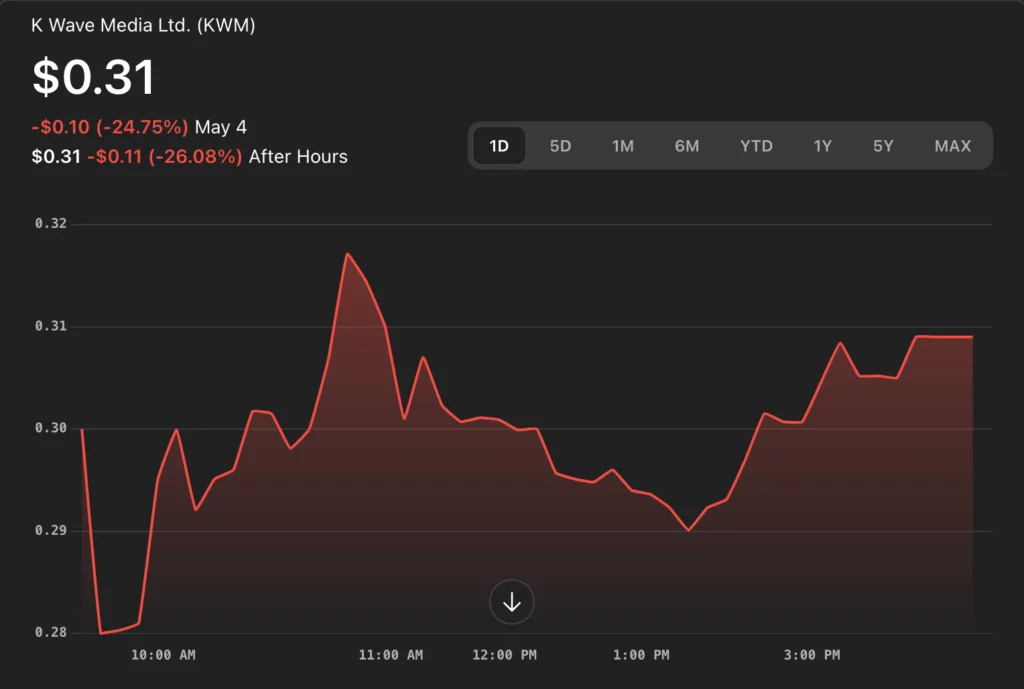
- KWM shares fell about 25% Monday after the company announced its Bitcoin-to-AI infrastructure strategy shift.
- The restructuring includes Play Co.’s planned sale and about $48M in debt and liabilities reduction.
The Nasdaq-listed media and entertainment company disclosed the change in a May 4 Form 6-K filing with the U.S. Securities and Exchange Commission.
The capital will now support data center investments, GPU compute and rental operations, and possible acquisitions in AI infrastructure.
The funds come from an amended securities purchase agreement with Anson Funds, which had earlier backed the company’s Bitcoin treasury plan.
Bitcoin treasury plan loses priority
The amended deal changes a prior $500 million equity purchase facility. That facility had been designed to support K Wave Media’s Bitcoin treasury strategy, which the company announced in 2025 as part of a wider capital markets shift.
K Wave Media had earlier linked its plans to Korean cultural intellectual property, digital assets and tokenized securities. The latest filing moves the company’s main funding plan away from Bitcoin and toward AI infrastructure, while keeping the focus on a new corporate structure.
Meanwhile, KWM shares fell after the announcement. Latest available market data showed the stock at $0.3071, down 24.75% from the previous close. The stock opened at $0.309, traded between $0.28 and $0.587, and recorded volume of more than 10.2 million shares.
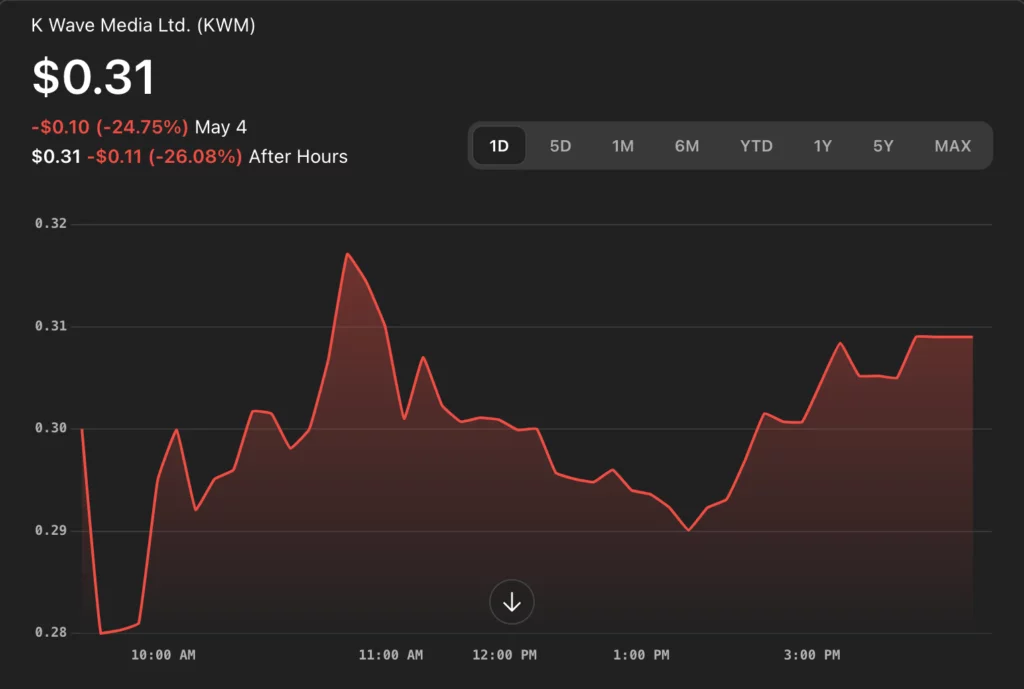
The drop came as investors weighed the company’s move from a Bitcoin treasury plan to an AI infrastructure strategy.
Restructuring targets debt reduction
K Wave Media said its board approved the planned sale of Play Co., Ltd., its largest wholly owned subsidiary, back to the unit’s previous owner. The company expects the sale to remove about $48 million in debt and related contingent liabilities.
The company also said it may rebrand as “Talivar Technologies,” subject to shareholder approval. The vote is expected at its annual meeting in early July 2026. Chief executive Ted Kim said, “This marks a defining inflection point for KWM.”
Crypto treasury trend faces new test
The reversal comes after several public firms adopted crypto treasury plans in 2025. crypto.news reported in October that Asian companies including Top Win, Quantum Solutions and K Wave Media were raising capital to expand Bitcoin positions.
The move also fits a wider shift among crypto-linked firms toward AI infrastructure. crypto.news reported that Bitcoin miner Hut 8 secured $150 million from Coatue in 2024 to build an AI infrastructure platform. K Wave Media is now trying a similar direction through data centers, GPU operations and AI-related acquisitions.

Taylor Townsend vs Victoria Jimenez Kasintseva preview, head-to-head, odds, prediction & betting tips

Stop Ignoring This When Making Financial Decisions (Reupload)

I visited the beautiful ‘forgotten’ city near Cambridge locals say is ‘now cool’

Manchester United reach agreement with Casemiro over contract clause amid transfer speculation

US brings back mandatory military draft registration

Steven Gerrard disagrees with Gary Neville over ‘shock’ Chelsea and Arsenal claim | Football
Stop Ignoring This When Making Financial Decisions (Reupload)

How much content creators & YouTubers earns in India? #youtube #instagram #money

Yahoo Finance Live: Stocks drop as US-Iran hostilities ramp up again May 4, 2026
-

 Business6 days ago
Most Commercial Energy Audits Miss the Real Losses
-

 Fashion6 days ago
Kylie Jenner’s KHY Enters a New Era with ‘Born in LA’
-

 NewsBeat2 days ago
Channel 5 – All Creatures Great and Small series 7 new post
-
 Tech4 days ago
Trump’s 25% EU auto tariff breaches Turnberry Agreement that also covers semiconductors and digital trade
-
 Sports4 days ago
Paul Scholes issues Marcus Rashford reality check as agreement emerges over Man United star
-

 Crypto World7 days ago
CFTC’s AI will review U.S. crypto registration applications, chairman tells CoinDesk
-

 Business6 days ago
Barclay Brothers Avoid Bankruptcy: HSBC Drops High Court Petitions After IVA Deal
-
 Business5 days ago
Tesla Officially Registers Elon Musk’s Stock: What Investors Need to Know
-
Crypto World7 days ago
Robinhood Phishing Scam Exploits Gmail Dot Feature to Bypass Security
-

 Tech7 days ago
Get Ready for More Brain-Scanning Consumer Gadgets
-

 Business4 days ago
Two Powerball Tickets Split $143 Million Jackpot in Indiana and Kansas
-

 Tech6 days ago
Texas Instruments made a new flagship graphing calculator: the TI-84 Evo
-
 Crypto World4 days ago
CoreWeave (CRWV) Stock Climbs 8% Despite $45M Insider Share Dump
-
Business2 days ago
Winning Numbers Drawn as Jackpot Resets to $20 Million
-
Crypto World5 days ago
Securitize and Computershare Enable Tokenized Equity Issuance for Over 25,000 U.S.-Listed Stocks
-

 Crypto World5 days ago
Gibraltar Proposes Tokenized Funds Regulation to Bolster Compliance
-

 Fashion2 days ago
Mary J. Blige Vegas Residency Looks: Crystal-Embellished Fjolla Haxhismajli, Todd Fisher, and More!
-

 Tech5 days ago
Official SAP npm packages compromised to steal credentials
-
 Crypto World7 days ago
Bitcoin (BTC) Price Action: Analysts Project $85K Rally Despite Current Consolidation Near $77K
-
 Tech7 days ago
Acer Swift 16 AI (2026) Review: Where Do Your Hands Go?
You must be logged in to post a comment Login