

Crypto World
Hyperliquid's HYPE Token Rallies 7% as Trade.xyz Launches First Pre-IPO Perpetual Market for SpaceX



HYPE token gained 7% over 24 hours following the launch of a synthetic SpaceX pre-IPO perpetual contract on Hyperliquid, valuing the private aerospace company at $1.78 trillion.



Technology giant Sony’s online banking unit said it received conditional approval to establish a U.S. national trust bank subsidiary to support the issuance and management of dollar-denominated stablecoins.
The planned unit, Connectia Trust, National Association, will be based in New York and capitalized with $40 million, according to a Sony Financial Group announcement. Sony Bank will own 100% of the subsidiary.
The move comes as stablecoin usage is surging. Transaction volume hit a $1.79 trillion record last month, 63% more than in May and more than double the year-earlier level, according to Visa’s onchain dashboard.
With dollar-pegged tokens accounting for more than 99% of the total $311 billon market capitalization, according to DeFiLlama data, it may be a difficult market to crack.
Not only do market leaders USDT and USDC alone account for about $250 billion of the total, competition is increasing. A wave of potential rivals has also won conditional approval from the Office of the Comptroller of the Currency (OCC) for federal trust-bank structures tied to stablecoin businesses, including Stripe-owned Bridge, Paxos and Circle Internet.

Robinhood Chain has already minted another paper millionaire. One wallet turned an $86 buy into $2 million from CASHCAT, and the number keeps changing.
The first viral hit on Robinhood’s Arbitrum based chain was not a tokenized stock. It was CASHCAT, a memecoin inspired by Robinhood’s old cat with cash logo. Onchain data shows the top five wallets have earned almost $3.7 million combined, proving memes still ignore the script.
LATEST: — CoinMarketCap (@CoinMarketCap) July 9, 2026
 A trader turned $85 into over $2M by buying CashCat on Robinhood Chain within 30 minutes of launch, per Bubblemaps, a gain of roughly 27,000x. pic.twitter.com/0u29N0cB1d
One trader flipped an $838 buy into about $1.05 million across realized and unrealized gains. Another watched an $86 entry explode to nearly $2 million. Those eye watering profits came from thousands of traders happily buying the other side. Someone always catches the bouquet, while someone else catches the bill.
That is why CASHCAT has grabbed attention so quickly. The token is real, and the wallet gains are visible onchain. The tougher question is timing. New buyers could still be early, or they could be funding the next round of screenshots from traders already heading for the exit.
Bitcoin dominance remains elevated while daily crypto trading volume sits near $80 billion. That combination often pulls speculative money into tiny tokens chasing impossible returns. Whether CASHCAT becomes another legend or another expensive lesson depends on who runs out of buyers first.
Don’t Miss Out on Our $1,000 USDT Airdrop on ByBit
Can CASHCAT Sustain the Rally or Is the Exit Already Crowded?
CASHCAT’s market cap has cooled to roughly $88 million, while liquidity remains tiny beside it. That mismatch is where things get spicy. A few determined sellers can move the price far more than holders would like. Small pools rarely forgive big exits.
The token has dropped about 40% from its all time high near a $145 million valuation. Even so, trading activity remains intense as fresh buyers keep showing up. There is little chart history, so classic technical analysis offers about as much guidance as a weather forecast from last week.

Instead, liquidity matters more than trendlines. Thin liquidity limits how much buying the market can absorb before volatility takes over. It also works the other way. One whale heading for the door can turn a gentle dip into a trapdoor.
The bullish case still exists if Robinhood Chain excitement returns and new money keeps flowing into memes. Otherwise, early winners may continue locking in gains while momentum fades. The bearish outcome is simple. One large wallet sells, everyone refreshes the chart, and gravity suddenly remembers its job.
Discover: The Best Token Presales
Maxi Doge Targets Early Mover Upside as Robinhood Chain Tests Thin Liquidity
CASHCAT illustrates what life-changing crypto gains look like when they work, and what the exit structure looks like when they don’t. A $105 million market cap against $6.6 million in liquidity means the window for outsized returns has likely narrowed significantly for new entrants.
Capital rotating out of late-stage memes has been finding its way into earlier-stage presales where the entry price hasn’t already been repriced by 1,250x.
Maxi Doge ($MAXI) is currently in presale at $0.0002828 per token, with $4.8 million raised to date on Ethereum. The project positions itself around a “1000x leverage trading mentality,” a 240-lb canine juggernaut aesthetic built for holders who want community-driven trading competitions.
It also has its own leaderboard rewards, a Maxi Fund treasury for liquidity and partnerships, and dynamic staking APY. The gym-bro meme culture is deliberate and viral-optimized.
For traders who want early-stage exposure before a potential exchange repricing, research Maxi Doge here.
Discover: The Best Crypto to Diversify Your Portfolio
The post CASHCAT Turns $86 to $2 Million: Best Life-Changing Crypto to Buy? appeared first on Cryptonews.
Members of the UK’s ruling Labour party are considering a total ban on digital asset donations in response to Nigel Farage’s resignation from Parliament and the potential influence crypto billionaires had on his policies.
The Guardian reported Thursday that Labour MPs are looking to overhaul existing rules on donations to political parties and candidates. Specifically, lawmakers have proposed that a moratorium on crypto donations enacted in March be made permanent after it was revealed that the Reform leader personally accepted millions of British pounds in what he called “gifts” from industry figures.
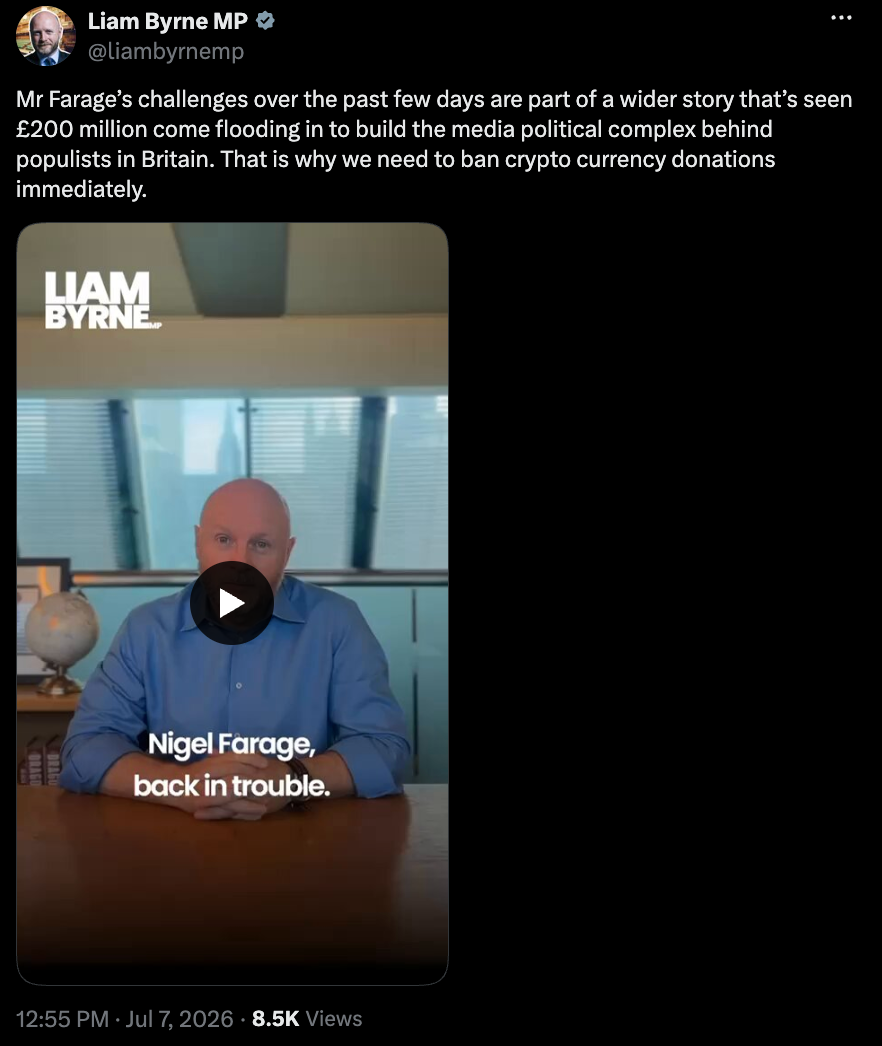
“Amendments to the representation of the people bill which my colleagues and I have tabled are vital safeguards against the wider threat that’s seen [$268 million] come flooding in to build a whole media political complex behind populists in Britain,” said Liam Byrne, MP for Birmingham Hodge Hill and Solihull North and the Labour chair of the business select committee calling for a permanent crypto donation ban. “We simply cannot afford to let our crumbling defenses be undermined any further.”
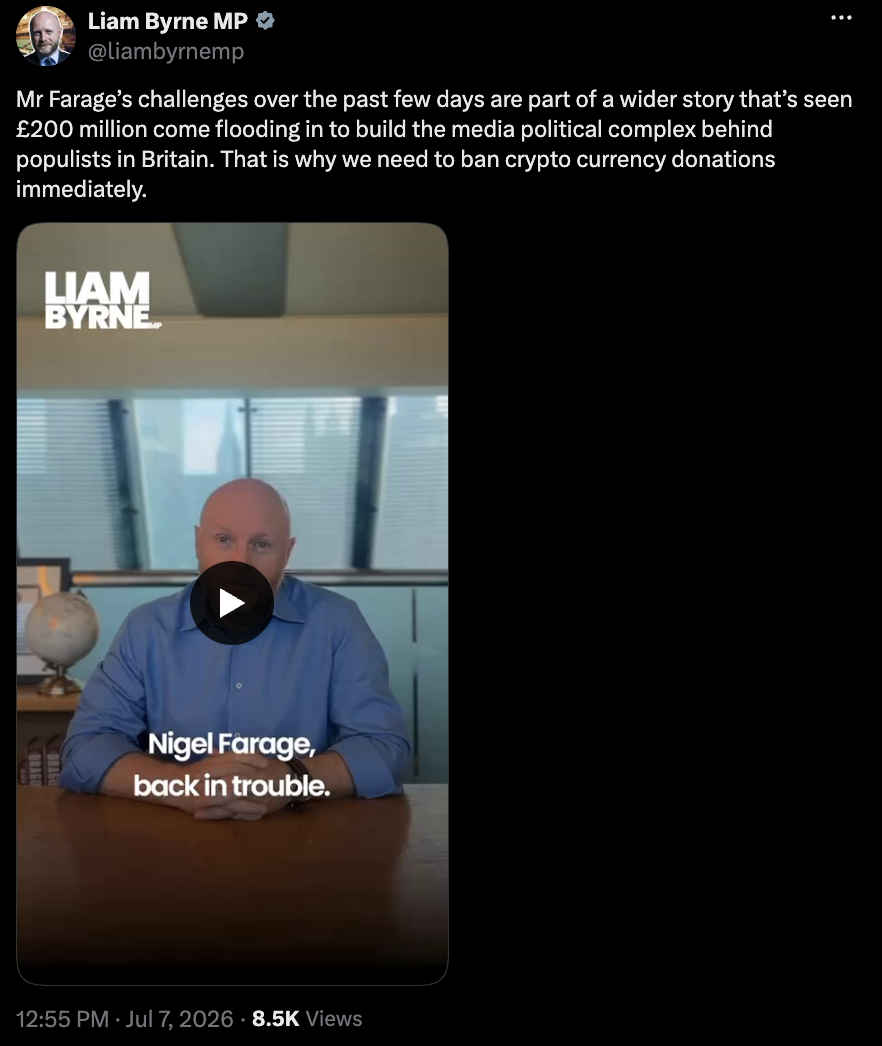
Source: Liam Byrne
UK lawmakers will reportedly consider amendments to the crypto donation measures next week. Farage announced on Tuesday that he would resign as MP for Clacton in response to reports of the contributions, which included a $6.7 million “gift” from crypto billionaire Christopher Harborne and staff, security, transport and accommodation by George Cottrell, a convicted fraudster involved in a crypto casino.
Farage confirmed in his resignation speech that the UK’s parliamentary standards commissioner was investigating the donations, but said that he did “nothing wrong.”
Related: Bank of England governor denies Farage lobbying swayed CBDC policy: Report
The Reform UK leader’s resignation has automatically triggered a by-election in the area, where he said “the people of Clacton should be the judges of my actions.” However, the major political parties, including Labour, Conservatives, Liberal Democrats and Greens will reportedly not field candidates for the by-election, with UK Prime Minister Keir Starmer calling Farage’s resignation a “desperate stunt.”
Former Manchester mayor on track to be next UK PM
Andy Burnham, a UK Labour lawmaker who recently won a by-election to become an MP representing Makerfield, is expected to be the country’s next prime minister following Starmer’s resignation. On Thursday, the week-long window opened for Labour MPs to nominate candidates for the party’s next leader, who would also become prime minister.
As mayor of Greater Manchester, Burnham advocated for the city to be a “Web3 powerhouse” and supported using digital technology as an economic development tool. If he receives enough support from Labour MPs to win a leadership bid, he could address the crypto donation ban and the Financial Conduct Authority’s oversight of the industry.
Magazine: Crypto industry looks to stablecoins and DeFi revisions in MiCA 2.0


This summary was created based on CoinDesk Research’s latest report; Digital Assets: Quarterly Review and Outlook, Featuring CoinDesk 5 and CoinDesk 20.
– Joshua de Vos, Research Lead, CoinDesk
Ask an Expert
Q: Is Asia advancing via tokenization and stablecoins rather than spot bitcoin ETFs?
Institutional adoption in Asia is shifting from exploratory pilots to targeted deployment, with tokenization of real-world asset and regulatory stablecoin acting as key entry points for bank and asset managers. Jurisdictions like Hong Kong have introduced comprehensive legislation such as the Stablecoins Ordinance. Requiring full reserve backing, redemption rights and risk controls to make tokenization activity compatible with existing prudential frameworks. Against that backdrop, pure bitcoin ETF plays a smaller strategic role than in North America and Europe.
Q: Are bitcoin ETFs adding income features like other non-traditional ETFs?
The growth of deep, liquid options markets on regulated bitcoin ETFs gives structured product issuers a reliable exchange-traded tool for income and hedging strategies. This is why covered call, buffered and other derivatives-based approaches are being used to generate income from bitcoin ETFs, which do not pay cash distributions or dividends.
Q: How much more capital could flow into bitcoin ETPs from institutions?
The more capital an asset can reasonably attract, the bigger its pool of potential buyers who follow fixed rules like pension plans, retirement accounts and institutional allocators. Right now, retirement systems are the largest pool of this kind of money that still has not meaningfully slowed into bitcoin ETFs. Just a 1% allocation from the $22 trillion US 401(k) and Defined Contribution system would generate $90-$130 billion of inflows, roughly matching the size of the current bitcoin ETF market size.
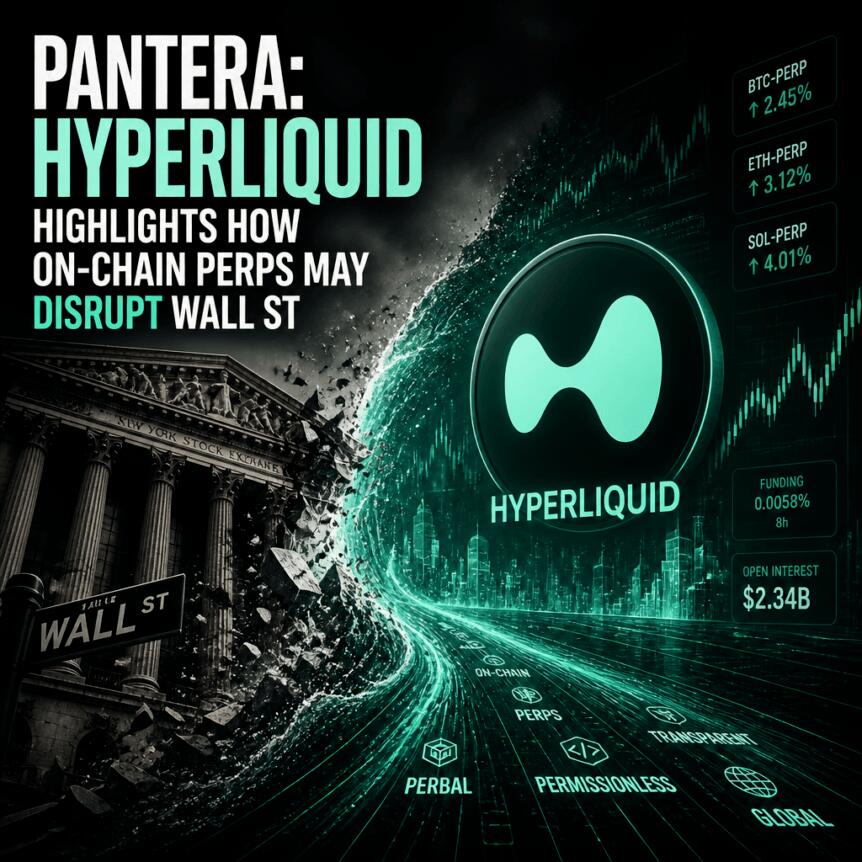
Perpetual futures—derivatives that typically trade without fixed expiry dates—are increasingly being positioned as a next-generation instrument for markets that never sleep. In a Wednesday post on X, blockchain-focused asset manager Pantera Capital argued that decentralized venues built around onchain infrastructure could make 24/7 perpetual trading materially more competitive with traditional finance by improving continuity of trading and simplifying contract mechanics.
Pantera, which is an investor in the Hyperliquid ecosystem, highlighted Hyperliquid as a leading example of that shift. The firm also pointed to growing interest from established market operators, including NYSE parent Intercontinental Exchange (ICE), and cited data suggesting onchain perpetuals have taken a meaningful share of total perpetual volumes over the last year-plus.
Key takeaways
- Pantera says perpetual futures offer structural advantages—such as 24/7 trading and continuous price discovery—over many traditional derivative formats.
- Hyperliquid is presented as the clearest onchain case study, extending perpetuals from crypto to equities, commodities, and stock indices.
- Pantera claims decentralized exchange (DEX) perpetual volumes have risen to 14% of centralized exchange (CEX) perpetual volumes, up from less than 1% in early 2023.
- Pantera estimates Hyperliquid represents about 40% of onchain perpetual trading volume and generated $13.5 million in weekly fees over the past seven days, according to DefiLlama data.
- Traditional finance firms are moving toward onchain 24/7 markets, with ICE leadership urging regulators to avoid a “level playing field” disadvantage for onchain perps.
Why perpetuals are attracting attention beyond crypto
Perpetual futures have long been a staple in crypto markets, but Pantera’s argument is that their core mechanics translate well to broader financial products. According to the asset manager, onchain perpetual venues benefit from several “structural advantages” relative to conventional derivatives: trading can run continuously, positions don’t face the same kind of scheduled contract expiries, position management can be simpler, and prices can reflect ongoing demand through uninterrupted markets.
The point matters for investors and market participants because it reframes the debate away from whether derivatives can be moved to blockchain and toward how the product’s operational characteristics change trading behavior. If market hours and contract roll cycles are reduced, liquidity dynamics and execution practices may shift—particularly for strategies that rely on staying continuously exposed rather than rebalancing around expiry windows.
Hyperliquid’s expansion and the push toward “housing all of finance”
Pantera specifically singled out Hyperliquid as evidence that perpetuals can spread quickly when the venue’s design supports both trading continuity and a growing menu of assets. The firm said Hyperliquid has gone beyond cryptocurrencies and expanded perpetual futures into equities, commodities, and stock indices as part of founder Jeff Yan’s vision of “housing all of finance.”
That expansion is significant because it introduces a compatibility question that often holds back experimental derivatives: whether an onchain trading venue can support complex, non-crypto underlyings while maintaining the user experience traders expect. By framing Hyperliquid’s asset diversification as a key driver, Pantera is effectively arguing that the perpetual model—paired with always-on trading—can serve as a general-purpose derivatives interface.
Onchain perps gain share, but central venues are watching closely
Pantera’s post also emphasized measurable traction in onchain perpetuals. The firm said DEX perpetual volumes rose to 14% of CEX perpetual volume, up from less than 1% in early 2023, when Hyperliquid first launched. It further claimed Hyperliquid accounts for roughly 40% of onchain perpetual trading volume.
To ground the growth narrative in revenue generation, Pantera cited fees performance: Hyperliquid, it said, generated $13.5 million in weekly fees in the past seven days, using DefiLlama data. While trading volume and fee totals are not the same metric, the combination is useful for readers because it suggests demand is not purely speculative—there is sustained activity sufficient to support protocol revenue.
Still, the numbers also highlight a transition phase. Even at 14% of CEX perpetual volume, the majority of perpetual activity remains centralized. Pantera’s figures therefore portray an emerging competitive set of venues rather than a complete replacement of traditional exchanges.
Traditional finance steps toward 24/7, and ICE calls for regulatory parity
Pantera’s thesis about perpetual futures has drawn parallels with moves already happening in traditional finance. The asset manager pointed to attention from ICE, where CEO Jeffrey Sprecher urged regulators to create a “level playing field” for launching 24/7 onchain perpetual futures contracts.
The underlying tension is straightforward: onchain derivatives aim to bring trading closer to continuous market mechanics, but regulatory frameworks and supervisory expectations may still treat onchain offerings differently than traditional venues. Pantera’s mention of ICE leadership implies that the competitive stakes are large enough that major incumbents are advocating for consistent rules rather than waiting for markets to converge naturally.
Momentum appears across multiple related announcements involving 24/7 trading ambitions. Cointelegraph previously reported that OKX announced plans to launch perpetual futures linked to ICE’s Brent crude and West Texas Intermediate benchmarks, citing a partnership with the exchange operator. Earlier coverage also noted the NYSE’s collaboration with tokenization platform Securitize to develop blockchain-based stock trading infrastructure with 24/7 trading and settlement for Wall Street, as well as ICE’s plans for a tokenized securities venue aimed at 24/7 trading and instant settlement, with stablecoin-based funding and onchain settlement.
Taken together, these developments show that the “always-on” market concept is no longer confined to crypto infrastructure. Instead, it is becoming a reference point for how TradFi platforms consider liquidity access, settlement speed, and funding workflows.
For readers, the next thing to watch is whether regulatory clarity accelerates the move from pilots to scaled onchain perpetual launches across more traditional asset classes. Pantera’s data suggests onchain perps are already carving out measurable share, but the pace of expansion beyond current players will likely depend on how the “level playing field” debate resolves and whether incumbents can align product rollouts with regulator expectations.

Key Takeaways
- PayPal USD arrives on Polygon natively via Paxos for streamlined business transactions.
- The Open Money Stack from Polygon now supports PYUSD alongside wallets and fiat conversion.
- Companies gain access to integrated settlement and cash-out capabilities in one platform.
- Polygon reports handling $2.6 trillion in stablecoin transaction volume.
- Paxos delivers regulated, dollar-backed PYUSD to Polygon’s payment ecosystem.
PayPal’s stablecoin has officially launched on Polygon via a Paxos partnership, marking a significant expansion in its payment capabilities. This development provides companies with native access to PYUSD through Polygon’s comprehensive payment framework. The integration combines regulated dollar-backed settlement with digital wallets, fiat on-ramps, and built-in compliance infrastructure.
Native PYUSD Integration with Polygon’s Payment Infrastructure
Paxos has introduced native PYUSD issuance on Polygon, eliminating the need for bridged token versions. Consequently, companies can now leverage the stablecoin across Polygon’s entire payment ecosystem. This framework enables deposits, transfers, settlements, and fiat conversions within a unified architecture.
The Open Money Stack from Polygon integrates digital wallets, fiat gateway services, regulatory compliance features, and stablecoin settlement capabilities. This unified approach allows companies to minimize the need for multiple payment provider integrations. The infrastructure accommodates various payment methods including card transactions, bank transfers, exchange operations, and stablecoin flows.
This integration specifically addresses the needs of organizations requiring accelerated cross-border transactions and simplified operational workflows. Payroll service providers, digital marketplaces, and money transfer services can leverage PYUSD for global payment processing. These companies can transfer value and convert to fiat without developing proprietary banking infrastructure.
Stablecoin Transaction Volume Highlights Polygon’s Payment Focus
According to Polygon, its blockchain has facilitated over $2.6 trillion in stablecoin transaction volume. This substantial figure demonstrates the network’s established foundation in payment-oriented stablecoin operations. It also illustrates why integrating PYUSD aligns with Polygon’s comprehensive settlement approach.
Major companies including Revolut and Stripe currently utilize Polygon for payment operations. Businesses already operating on Polygon can incorporate PYUSD without overhauling their existing technology stack. This compatibility reduces technical overhead and accelerates implementation timelines.
According to Polygon Labs, the Open Money Stack enables organizations to accept payments and facilitate cross-border fund movement. It also provides currency conversion to local denominations through a single integration point. This architecture creates a more direct connection between conventional financial systems and blockchain-based settlement.
Regulated Stablecoin Settlement Through Paxos
PYUSD is minted by Paxos and maintained through dollar-denominated reserve assets. Paxos states that the stablecoin functions under a national trust charter with OCC oversight. This regulatory framework positions PYUSD among the supervised dollar-backed stablecoins operating in the U.S. market.
The Polygon deployment provides PYUSD with access to another significant blockchain network for payment and settlement operations. This expansion reflects the broader trend of stablecoin integration by payment companies and financial technology providers. Earlier this year in June, Mastercard incorporated PYUSD into its settlement infrastructure across multiple blockchain platforms.
PayPal and MoonPay also unveiled PYUSDx this year for customized stablecoin applications. This platform enables developers to create stablecoins supported by PYUSD reserves without constructing payment infrastructure independently. Collectively, these initiatives demonstrate PYUSD’s strategic expansion into mainstream payment systems.

Bitcoin (BTC) saw intraday highs after Thursday’s Wall Street open as US stocks rebounded on fresh Iran peace hopes.
Key points:
- Bitcoin joins a risk-asset rebound as US President Donald Trump said that Iran “wants to make a deal” after the ceasefire breakdown.
- Crypto short liquidations near $100 million over 24 hours.
- Traders see important BTC price levels coming as soon as the daily close.
Crypto, stocks rise as Trump teases new Iran “deal”
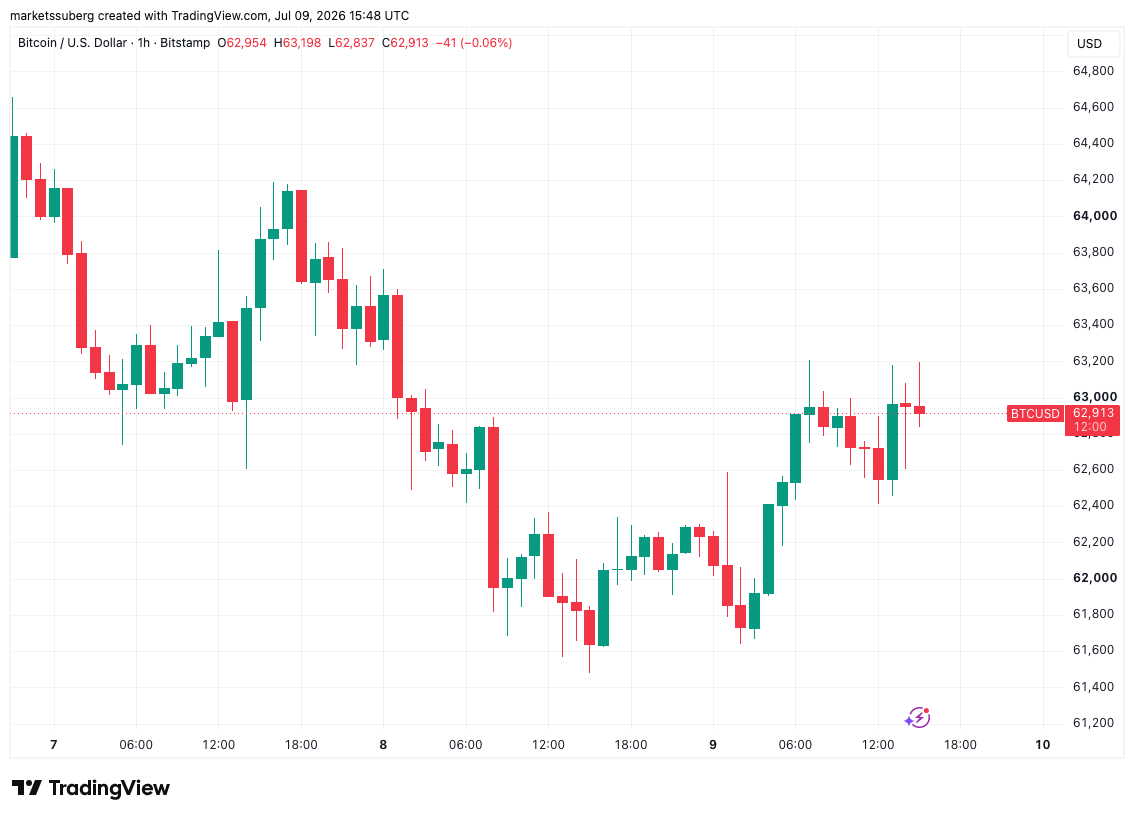
Data from TradingView showed BTC/USD rising back above $63,000, up by nearly 1.5% on the day.
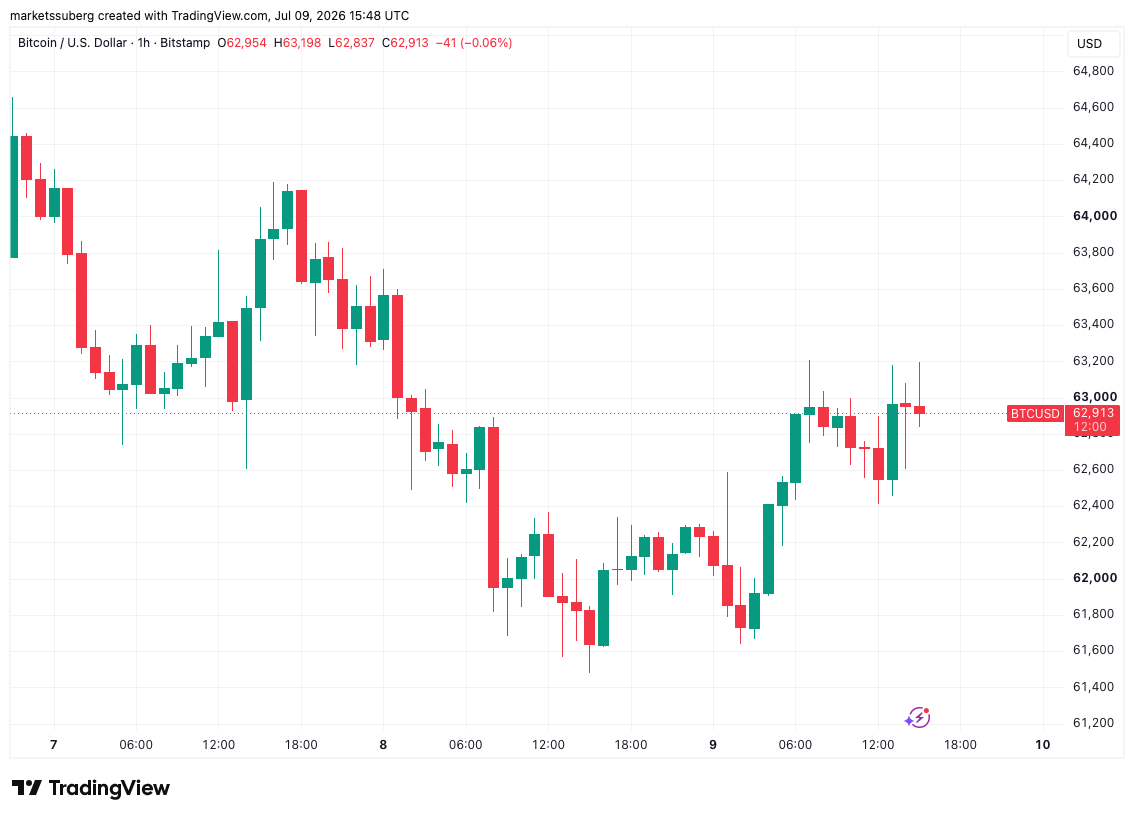
BTC/USD one-hour chart. Source: Cointelegraph/TradingView
US stocks were in the green across the board, helping to erase Wednesday’s downside as US President Donald Trump said that the Iran peace deal was “over.”
“They called a little while ago; they want to make a deal so badly,” Trump subsequently said in comments quoted by trading resource The Kobeissi Letter and others.
Crypto markets joined the sense of relief, helping push 24-hour short liquidations to nearly $100 million, per data from CoinGlass.
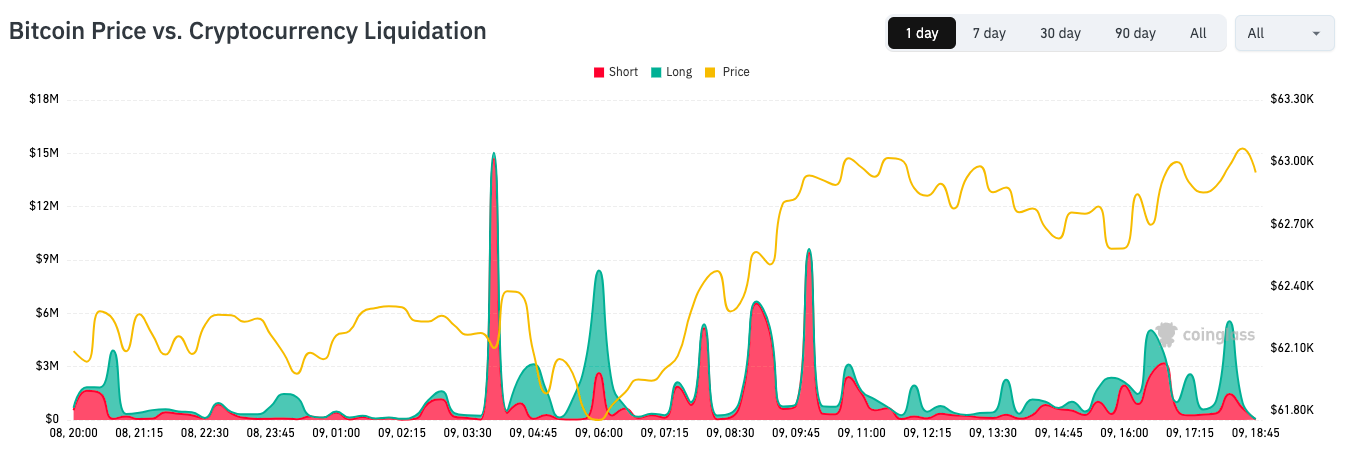
BTC/USD vs. crypto liquidations (screenshot). Source: CoinGlass
Commenting on the latest BTC price setup, trader Killa described their view as “not bearish at all.”
“In my view, we still have a few more months of choppy PA,” an X post stated, eyeing $68,000 for a potential short entry.
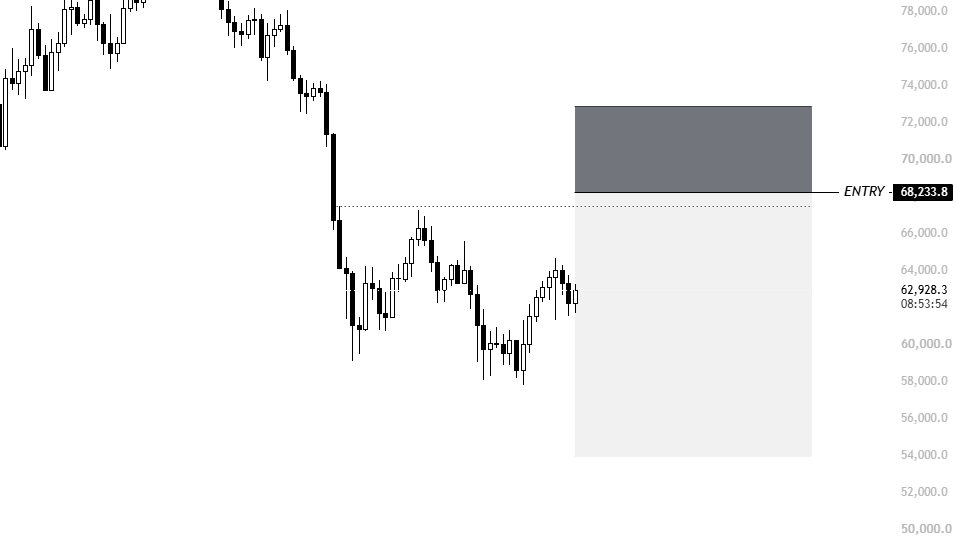
Source: Killa/X
Fellow trader Jelle saw ongoing strength from bulls, with a support reclaim still possible.
“Looks like bulls aren’t giving up on the reclaim just yet,” he told X followers.
“Get back above, and we likely push for 65-70k again. Reject, and sub-60k is back on the menu for $BTC.”
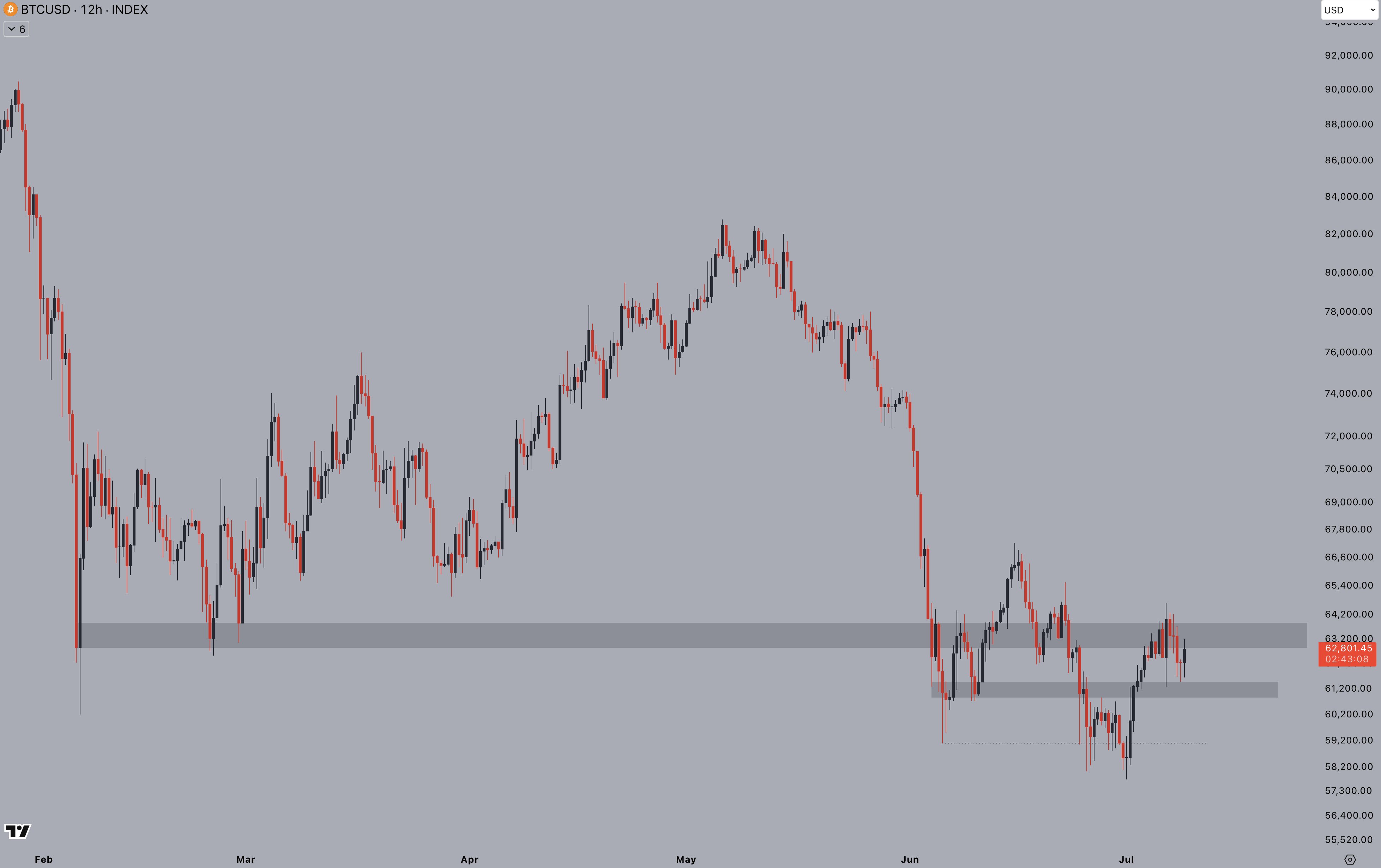
BTC/USD 12-hour chart. Source: Jelle/X
Bitcoin price needs a $64,700 daily close
Continuing, trader Daan Crypto Trades emphasized $64,700 for the daily close.
Related: Bitcoin ETFs end ‘most overwhelming’ $2.7B sell-off amid new $85M net outflow
“$BTC is ranging $61.3K-$64.7K range and spent this morning climbing back up after yesterday’s risk-off flush,” his latest X analysis read.
“A daily close above $64.7K flips the story and would make for a larger relief rally across the board. A close under $61.3K opens the road to the lows again and kills the momentum.”
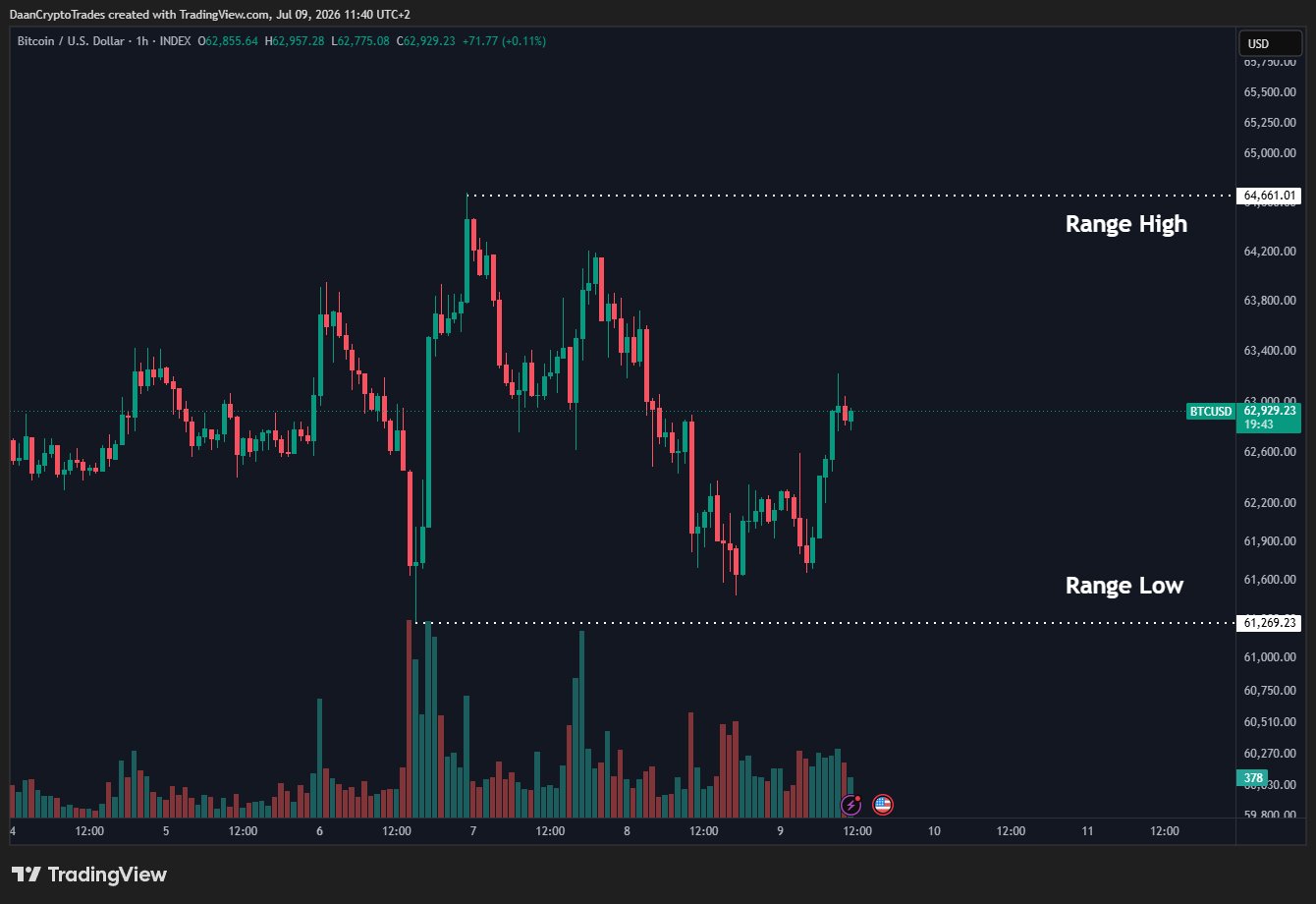
BTC/USD one-hour chart. Source: Daan Crypto Trades/X
As Cointelegraph reported, opinions on the bear-market bottom being in continue to diverge.
This week, analysis described a “textbook” bottom formation now underway, while BTC price-cycle comparisons continued to demand a deeper macro floor.
Crypto World
Cipher, TeraWulf among AI infrastructure stocks trading below contract value, Compass Point argues


Using that approach, the firm said Applied Digital (APLD), TeraWulf (WULF) and Cipher Mining (CIFR) appear to offer the largest disconnect between their contracted business and current valuations. In each case, Compass Point argues the market is assigning little, if any, value to additional AI capacity that has yet to be leased, despite the potential for those projects to generate significant rental income once completed.
Core Scientific (CORZ) and Riot Platforms (RIOT) stand out for different reasons. Compass Point said Core Scientific’s existing contracts are already largely reflected in its valuation, meaning further upside will likely depend on signing new customers. Riot, meanwhile, is valued more on future potential than current lease income, with investors placing a premium on its Corsicana campus and broader AI development pipeline despite its relatively limited contracted capacity today.
The report argues the next two years will be a turning point for the sector as companies shift from announcing AI infrastructure deals to delivering them. As projects are completed, tenants move in and rent payments begin, investors will have a clearer picture of the recurring cash flow these facilities can generate. Companies that execute successfully could be rewarded with valuations more in line with other income-producing infrastructure assets.
Ripple announced several deals and key partnerships over the past few days, further boosting the buzz surrounding the company.
However, the positive news has failed to trigger a major resurgence for XRP, yet certain analysts believe a big breakout could be on the horizon.
The Recent Developments
On July 4, the USA celebrated its 250th Independence Day, a historic milestone filled with nationwide special events. Ripple joined the festivities by partnering with a nonprofit that helps unemployed veterans find high-quality jobs after service. The ultimate goal is to secure jobs for 200,000 affected people by 2030, with Ripple matching donations up to $10,000.
Two days later, the company disclosed breaking news from the other side of the globe. It received full authorization as a Crypto Asset Service Provider (CASP) from Luxembourg’s Commission de Surveillance du Secteur Financier (CSSF), allowing the firm to offer its regulated payments platform throughout the European Economic Area (EEA).
Shortly after, Ripple shook hands with the Kansas Jayhawks, also known as KU (the athletic teams representing the University of Kansas). Per the partnership’s conditions, XRP’s logo will appear on all of their uniforms. Speaking on the matter was Ripple’s CEO, Brad Garlinghouse, who said:
“Rare moment where my professional and personal worlds collide: XRP is now the first crypto on the jersey of a major college athletics program, at my alma mater.”
Just recently, the X account BSCN revealed that the US supply chain firm Made in USA has selected the XRP Ledger to power its verification and product certification system. According to the entity, blockchain will provide immutable records that help verify the origin and authenticity of local products.
The ETF Front
Spot XRP ETFs saw significant capital inflows over the past few months, highlighting growing institutional appetite for the asset. The first company to issue such a fund (with 100% exposure to the token) is Canary Capital, followed by Bitwise, Franklin Templeton, 21Shares, and Grayscale. Since day 1, these investment vehicles have generated a cumulative total net inflow of almost $1.5 billion.
Spot XRP ETFs have had only four red days since April, with July 8 being one of them. This stands in sharp contrast to spot BTC ETFs, which have been bleeding heavily over the past few months.
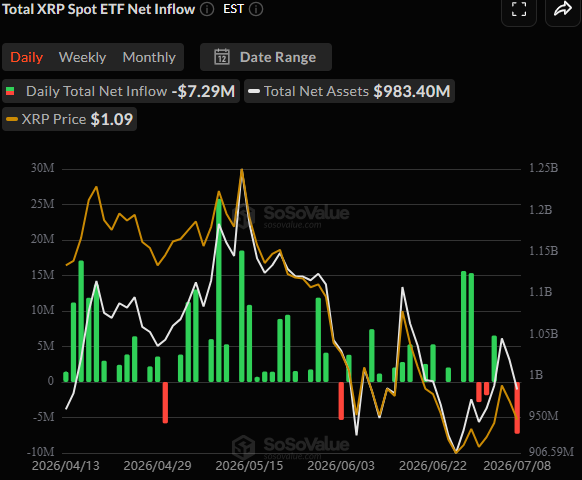
XRP Price Outlook
As of press time, Ripple’s cross-border token trades at around $1.09, a minor 1.3% increase on a weekly scale. According to X user MikybullCrypto, the current price level represents a “lifetime opportunity entry,” as the analyst set a target of $5 and potentially even higher.
For their part, Crypto Coral spotted that XRP is compressing inside a triangle, with the valuation currently reacting from a key support zone. “Structures this large often lead to significant moves once resistance gives way,” they added.
The post Ripple (XRP) News Today: July 9 appeared first on CryptoPotato.
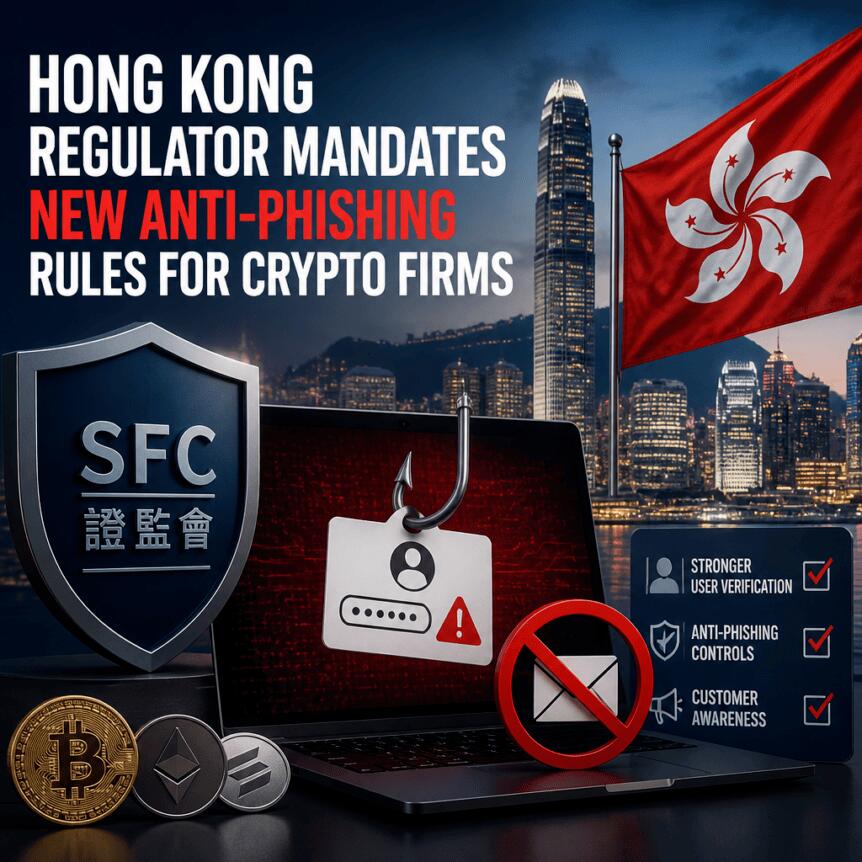
The Hong Kong Securities and Futures Commission (SFC) has issued new rules aimed at reducing account takeovers on virtual asset trading platforms (VATPs) and online brokers. The regulator says platforms in the city must upgrade authentication controls to make logins more resilient to phishing and other social engineering tactics.
The SFC requires stronger phishing-resistant authentication methods and device binding, and it bans one-time passwords delivered via SMS, email, or app-based logins. Companies covered by the rules have 12 months to implement the changes, which the SFC frames as a key part of raising local cybersecurity standards as phishing activity intensifies globally.
Key takeaways
- The SFC’s new requirements apply to virtual asset trading platforms (VATPs) and online brokers operating in Hong Kong.
- One-time passwords through SMS, email, or app-based logins are prohibited for these platforms.
- Phishing-resistant authentication and device binding are required, with options such as passkeys and hardware security keys.
- Covered firms must complete implementation within 12 months from issuance.
- The SFC linked the update to rising phishing and social engineering losses in the broader crypto industry.
What the SFC is requiring for crypto login security
In a statement released Thursday, the Hong Kong regulator outlined specific expectations for authentication on VATPs and online brokers. The SFC’s document sets out requirements for phishing-resistant methods and device binding, aiming to prevent attackers from hijacking accounts through fraudulent login prompts or compromised credentials.
According to the SFC, the new standards disallow one-time passwords delivered by SMS, email, or via app-based logins. Instead, the commission points to stronger alternatives designed to reduce the effectiveness of phishing scams—for example, passkeys, registered devices with cryptographic verification, and hardware security keys.
The formal requirements are available through the SFC’s publication gateway: SFC requirements document.
Why Hong Kong is tightening rules now
The SFC’s move arrives at a moment when phishing and social engineering incidents continue to disrupt crypto users worldwide. The SFC said that in the first quarter of 2026, phishing-related tactics accounted for a significant portion of reported industry losses.
As reported by Cointelegraph earlier, industry losses totaled $482 million in the period, with $306 million attributed to phishing attacks and social engineering scams. The SFC also referenced a separate local data point: counterfeiting and fraud incidents represented 57% of security incidents reported to the Hong Kong Cyber Security Accident Coordination Center in 2025.
In remarks carried in the SFC materials, Dr. Ye Zhiheng, executive director of the Intermediaries Department of the China Securities Regulatory Commission, said that protecting customers from increasingly complex counterfeiting and fraud attacks requires comprehensive measures spanning prevention, detection, response, and education.
Real-world phishing losses underscore the risk
The SFC’s tightening reflects a pattern already visible in recent crypto incidents: attackers often use phishing to trick users into signing approvals or connecting wallets to fraudulent pages. These actions can grant attackers control over funds or enable unauthorized transfers.
Cointelegraph reported on Wednesday that a crypto investor lost nearly $1 million after signing a malicious phishing token approval transaction on Ethereum. Earlier coverage also described another case in which a wallet holder reportedly lost $1.65 million after connecting to a fake exchange and signing a malicious contract that gave attackers unlimited access to funds. Researcher Ryan Coleman made the assessment in a post shared on X: RyanColeXBT.
Additional examples cited in earlier reporting highlight the variety of phishing delivery methods. Cointelegraph noted that on May 25, on-chain analyst “b-block” warned scammers used Google to deploy malicious phishing ads impersonating decentralized exchange Uniswap, reportedly stealing more than $400,000 from victims. That earlier report is here: Cointelegraph on fake Uniswap ads.
Broader industry leaders have also called attention to wallet security weaknesses that phishing exploits. Cointelegraph previously connected such risks to discussions from Binance co-founder Changpeng Zhao after major investor losses, including a $50 million address poisoning incident in December 2025. Earlier coverage on that topic is here: Zhao’s remarks and related loss.
Device binding and passkeys: what changes for users and platforms
Although phishing attacks often start with a message that looks legitimate, the SFC’s approach targets the authentication layer that attackers rely on. By requiring phishing-resistant authentication and device binding, the rules are designed to reduce the chances that credentials or approvals obtained through a scam lead directly to account compromise.
For platforms, the practical implication is that they cannot treat multi-factor authentication as a checkbox. The SFC’s explicit ban on SMS/email one-time passwords is especially important because these methods can still be vulnerable to social engineering and interception—scenarios where attackers focus on tricking users into providing the second factor or luring them into fraudulent flows.
Instead, the SFC highlights methods that tie authentication to trusted hardware or cryptographic verification. Passkeys, cryptographic device registration, and hardware security keys all share a common theme: the login mechanism should be harder for attackers to replicate via fraudulent prompts, and stronger controls should ensure that only authorized devices can complete authentication.
For Hong Kong users, the change may eventually translate into a more consistent login experience with fewer fallback authentication options. For investors and traders, stronger login security is not just a compliance issue; it can be a direct determinant of whether account takeover attempts succeed—particularly when platforms integrate authentication with deposit, withdrawal, and trading permissions.
Still, one key uncertainty remains: how quickly different VATPs and online brokers will choose among the SFC’s allowed phishing-resistant alternatives, and how smooth the migration will be for end users. With a 12-month deadline, platform execution and user onboarding processes will likely be crucial in determining how effectively the new rules reduce real-world phishing losses.
With the SFC setting a clear timeline and banning weaker authentication methods, attention should now turn to how quickly Hong Kong platforms roll out passkeys or device-bound cryptographic authentication—and whether regulators will later expand requirements as phishing tactics evolve.

Kenny Omega wins AEW World Championship by defeating MJF on Dynamite

why this ancient relationship hits the evolutionary sweetspot

Sebi cancels registration of 12 research analysts over unpaid renewal fees


-

 Fashion6 days ago
Weekend Open Thread: High Hopes
-
 NewsBeat5 days ago
Taylor Swift and Travis Kelce wedding staffer hilariously struggles to keep her cool while checking in megastars
-

 Crypto World6 days ago
Standard Chartered Secures MiCA License as ESMA Adds 37 New Crypto Firms
-

 Fashion3 days ago
Open Thread: What Great Books Have You Read Recently?
-

 Politics6 days ago
The House | “Reframing the debate from a binary discussion of winners and losers”: Yuan Yang reviews ‘We Are Not Machines’
-

 Fashion6 hours ago
Loro Piana Fall 2026 Enters Houston’s Art Scene
-

 News Videos3 days ago
Whats Hidden Inside This Cash Register? #treasure #reselling #money
-
 Tech2 days ago
Anthropic’s new “J-lens” reveals a silent workspace inside Claude that mirrors a leading theory of consciousness
-
Crypto World6 days ago
ESMA Expands Crypto Register by 37 Firms Following MiCA Transition Period
-

 Business3 days ago
AXT Shares Jump Nearly 14% as Semiconductor Materials Maker Rebounds on AI-Linked Indium Phosphide Demand
-

 Sports2 days ago
Joshua Pacio ‘more complete’ ahead of ONE rematch vs Malachiev
-
Crypto World3 days ago
SK hynix (000660.KS) Stock Dips as $28B Nasdaq ADR Offering Drives AI Memory Expansion
-

 Crypto World4 days ago
South Africa proposes crypto tax guidance under existing rules
-

 News Videos3 days ago
Best Time to Enter Small Caps Right Now? Another Bull Run? | Financially Free
-

 Tech4 days ago
Lenovo laptops are now shipping with YMTC SSDs, a sign of Chinese NAND entering the mainstream
-

 Business7 days ago
What a 10 Percent Drop Means for Buyers, Sellers and Renters
-
Sports2 days ago
We have punished the disrespect
-

 Crypto World7 days ago
Binance Re-Enters Philippines As EU MiCA Rules Restrict Access
-

 News Videos3 days ago
Avoid entering in FOMO #bitcoin #cryptocurrency #trading #scalping
-

 Crypto World6 days ago
Alibaba bans Claude Code over alleged backdoor security concerns
You must be logged in to post a comment Login