
Crypto World
Iggy Azalea Hit With Lawsuit Over Memecoin

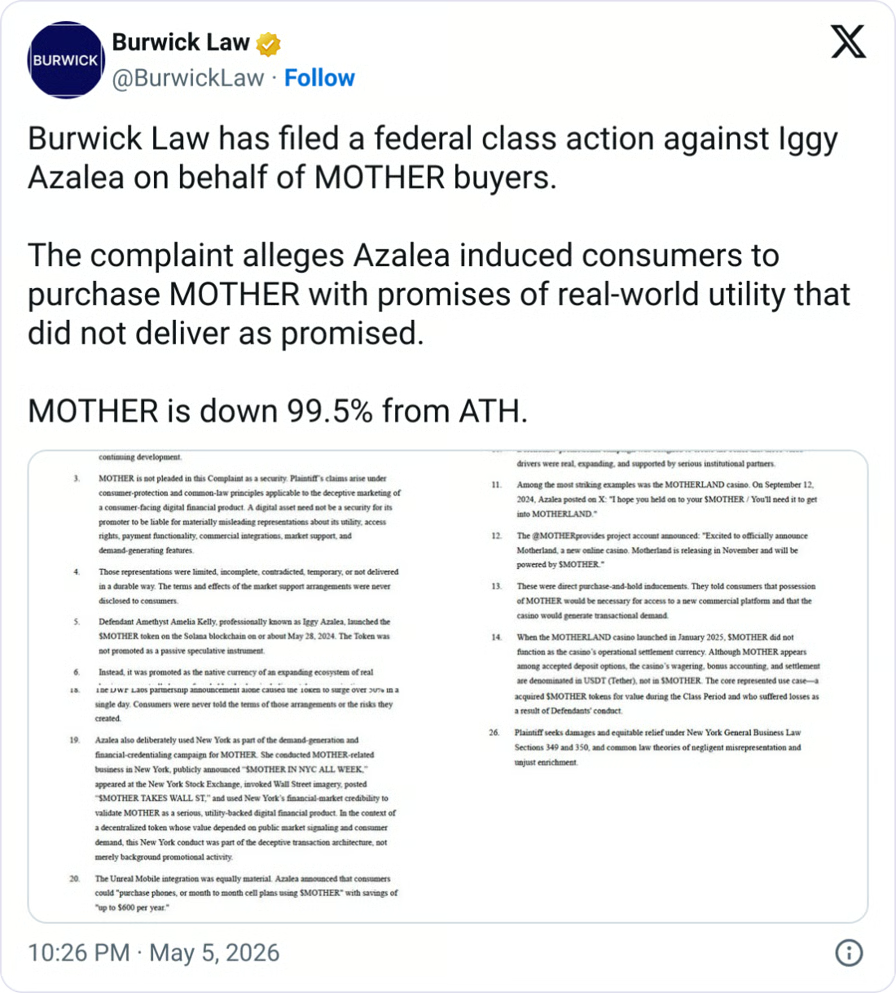
Rapper Iggy Azalea is facing a class-action lawsuit in the US, accusing her of misleading investors about the real-world utility and future development of her Solana-based memecoin Mother Iggy (MOTHER).
The complaint filed by plaintiff Kenneth Kolbrak in a Manhattan federal court on Monday claimed Azalea, whose real name is Amethyst Amelia Kelly, made representations about the token having real-world utility, commercial integrations and continuing development that never materialized.
“Those representations were limited, incomplete, contradicted, temporary, or not delivered in a durable way,” the complaint said. “The terms and effects of the market support arrangements were never disclosed to consumers.”
Azalea’s MOTHER was one of the buzzier tokens launched amid a frenzy of celebrity-tied memecoins in 2024. The token was launched in May 2024 and reached a peak market value of over $136 million by mid-June. Its market capitalization is now sitting at $1.3 million, according to CoinGecko.
Unlike other celebrities who launched memecoins, Azalea has remained involved with the token, interacting with supporters on social media and promoting it on X.
Kolbrak, the lead plaintiff, claimed he lost “several hundred dollars” investing in MOTHER, which the lawsuit said he would not have done, or would have paid less for, if not for Azalea’s promotions.
According to the complaint, Azalea promoted the token as “the native currency of an expanding ecosystem of real businesses controlled or co-founded by Azalea, including a telecommunications company, an online casino, a luxury gifting marketplace, a merchandise store, and entertainment integrations.”
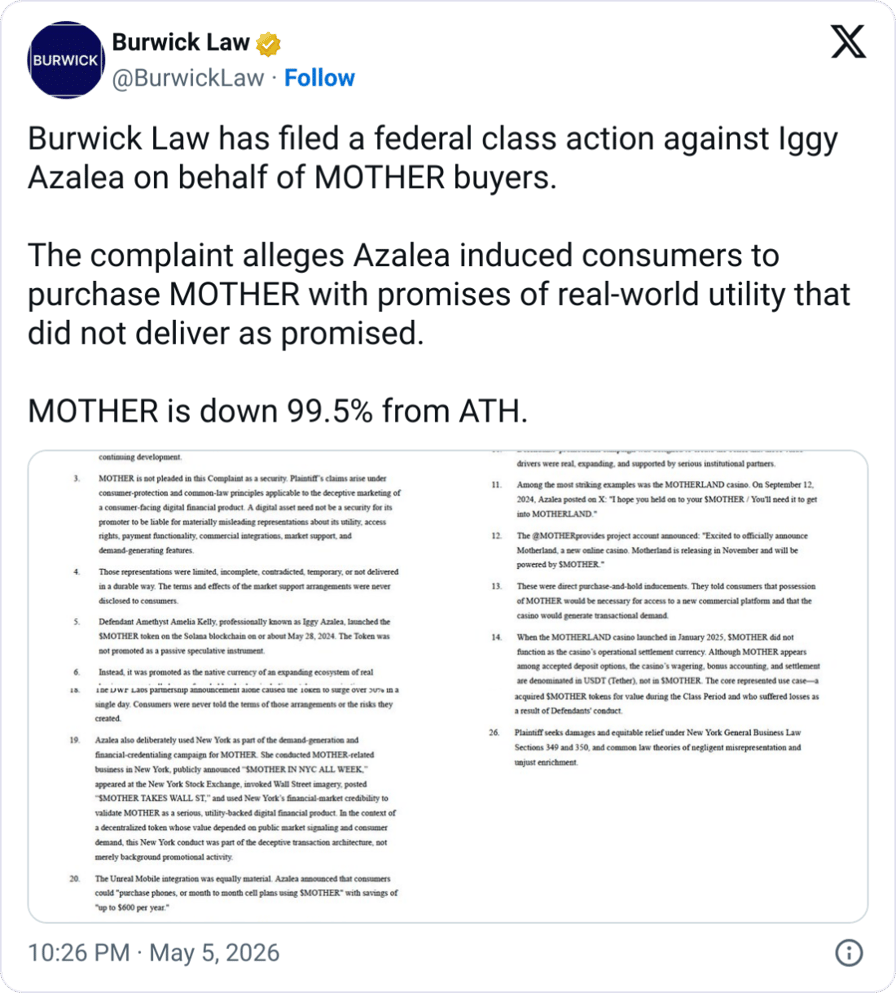
Source: Burwick Law
The lawsuit claimed that Azalea promoted the online casino MOTHERLAND, which was marketed as being “powered by $MOTHER,” but when it launched in January 2025, the platform used Tether (USDt) for its “wagering, bonus accounting, and settlement.”
The complaint also claimed that Azalea said MOTHER could be used to buy phones and mobile plans through the provider Unreal Mobile, however, “no durable, publicly observable MOTHER payment integration exists on the Unreal Mobile platform” as of the filing of the lawsuit.
It further accuses Azalea of not telling tokenholders about the terms or risks involved when crypto market makers Wintermute and DWF Labs were brought on to manage MOTHER’s trading.
Related: World Liberty sues Justin Sun for defamation in WLFI dispute
The lawsuit seeks damages for MOTHER buyers who lost money, along with attorney fees and costs.
The class is represented by Max Burwick of Burwick Law, who has helped launch multiple class-action lawsuits against crypto projects.
Information on Azalea’s lawyers was not available at the time of writing. Azalea and her management could not be reached for comment.
Magazine: Meet lawyer Max Burwick — ‘The ambulance chaser of crypto’



Stockcoin.ai has raised a seed round led by Amber Group to build an AI-native trading OS that pipes on-chain signals into stock and crypto futures flows while adding Hong Kong IPO and US pre‑IPO access from a single interface.
Summary
- AI-native trading platform Stockcoin.ai has closed a seed round led by Amber Group, with backing from angel investors across crypto and traditional finance.
- The startup plans to bridge on-chain data with global stock and crypto futures markets, and will add Hong Kong IPO subscription and US pre-IPO access.
- The raise underscores Amber Group’s continued push into AI-driven trading tools, following similar bets on platforms like OlaXBT.
Stockcoin.ai, an AI-driven platform for stock and cryptocurrency futures trading, has completed its seed financing round led by digital asset heavyweight Amber Group, the company announced on X. According to the disclosure, a group of unnamed angel investors from both the crypto and traditional finance sectors also joined the round, though terms and valuation were not made public.
Positioning itself as an “AI native” trading operating system, Stockcoin.ai says it focuses on fusing on-chain signals with listed equity and futures markets, giving traders a single interface to deploy algorithmic strategies across crypto and stocks. Amber Group, which offers trading, market‑making, lending, and asset management for institutional and retail clients, framed the investment as part of its broader push into data‑driven trading infrastructure.
In its announcement, Stockcoin.ai added that it will “subsequently launch Hong Kong IPO subscription and US Pre‑IPO features,” opening the door for users to access primary and late‑stage equity deals through the same platform. That would mirror how brokers such as Interactive Brokers and other Hong Kong platforms let clients subscribe to IPOs directly from trading accounts, but with AI tools layered on top to screen deals and size orders.
Amber Group has been active in backing AI‑driven trading startups, having previously led a $3.38 million seed round for AI crypto trading venue OlaXBT, which also emphasized algorithmic execution and data‑driven strategies. According to Amber Group, the firm manages more than $5 billion in client assets and has raised hundreds of millions in venture funding to expand its product suite.
If Stockcoin.ai follows through on its Hong Kong IPO and US pre‑IPO roadmap, it will be entering an increasingly competitive segment where exchanges and brokers are racing to list private and pre‑IPO assets for a broader retail audience. A recent Yahoo Finance report noted that major crypto venues have begun listing pre‑IPO instruments, bringing exposure to tens of millions of users.
For readers tracking related capital‑markets infrastructure, crypto.news has previously covered how tokenized Treasury products and AI‑driven quant platforms are blurring the line between TradFi and on‑chain markets in stories such as this analysis, a feature, and a recent report.


The cousin of Cambodia’s Prime Minister (PM) Hun Manet has revealed that he once owned a significant stake in a payment firm linked to alleged $4 billion crypto laundering enterprise Huione Group.
According to local media, a lawyer acting on behalf of Hun To released a statement today confirming that he previously held a 30% stake in Huione Pay.
The firm, which acts as Huione Group’s banking arm, was sanctioned last year by the US and UK along with another alleged South Asian crypto scam conglomerate Prince Group.
Huione Pay’s banking license was also revoked last year due to noncompliance with regulators.
Hun claimed that he had held no managerial authority within Huione Pay and that he didn’t “contribute the required capital in cash” corresponding with his 30% stake.
Additionally, he says he’s never received any profits, dividends, or assets from Huione Pay.
The businessman stressed, “I have never received any invitation for any meeting, general assembly of shareholders. I have never been appointed nor have authorised any proxy or nominee to act on my behalf as a shareholder in the company.”
Hun To is a member of Cambodia’s political class
Hun’s political family connections extend beyond Cambodia’s current PM; he’s also the nephew of the country’s former PM Hun Sen.
Reuters reported in 2024 that Hun was one of three directors working for Huione Pay. Its coverage also detailed the payments firm receiving over $150,000 from the North Korean hacking group Lazarus.
It noted that it had no evidence that Hun was aware of the transactions, and a Huione Pay spokesperson told Reuters that his role in the firm doesn’t include oversight of its day-to-day operations.
Read more: Cambodia has deported 48K foreigners since scam center crackdown began
Hun has also been linked to a heroin trafficking and money laundering group targeting Australia. He denies any involvement.
He launched defamation proceedings against The Australian over an article it published in 2022 alleging his involvement in human trafficking, cyberbullying, and drug trafficking rings.
Hun won the proceedings, and The Australian deleted the article, claiming it “did not intend to make any such allegations against Hun and accepts his denials of such conduct.”
Cambodia’s current PM has overseen a dramatic crackdown on crypto scam centres over the past three years.
Read more: China executes four more in pig butchering scam crackdown
In that time, Cambodia claimed to have deported 48,000 workers, many of which have been trafficked against their will, back to their country of origin.
Last month, the country reportedly deported 600 Thai nationals linked to crypto scam centres. The government also claimed that over 240,000 people alleged to have been involved in the scam operations “voluntarily departed” the country.
Got a tip? Send us an email securely via Protos Leaks. For more informed news and investigations, follow us on X, Bluesky, and Google News, or subscribe to our YouTube channel.

Blockchain analytics platform Bubblemaps said 90 newly funded wallets bought 90% of Mystery (MYSTERY) memecoin supply at launch, raising concerns about coordinated sniping.
The wallets were all funded by wallet “0x544E,” which previously withdrew and distributed 20 Ether from crypto exchange Binance. After buying up 90% of the supply at launch, the wallet cluster sold about $100,000 worth of tokens and still holds 40% of the supply, said Bubblemaps in a Tuesday X post. The analytics company described the pattern as a “textbook scam.”
Sniping refers to using bots or automated trading tools to buy newly launched tokens immediately after trading opens, often before ordinary traders can react. The findings highlight how automated buying and coordinated wallet clusters can dominate thinly traded memecoin launches, leaving later buyers exposed to sharp losses if early holders sell.
A fair launch is meant to give all participants an equal chance to buy a token when trading opens, without insiders or coordinated wallet clusters gaining early control of supply. The concentration flagged by Bubblemaps would undermine that principle if the wallets were acting together.

Source: Bubblemaps
Mystery token down 75% from peak
The Mystery token rose to a peak of $7.5 million market capitalization on April 28, before falling around 75% to a $1.9 million market capitalization at the time of writing, Dexscreener data shows.
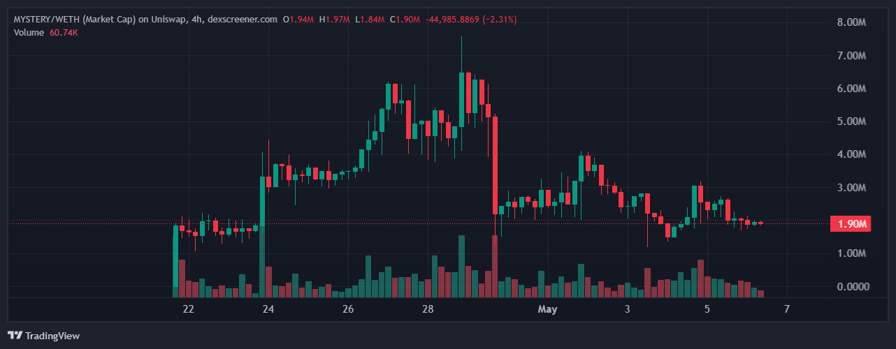
Mystery/WETH, all-time chart. Source: Dexscreener
The memecoin project brands itself as a free-spirited frog from Matt Furie’s “The Night Riders” and claims to have acquired the official HEDZ NFT and related IP rights from Furie, according to a Monday X post.
Cointelegraph was unable to contact Mystery for comment.
Related: Kaiko flags possible front-running before Robinhood token listings
Sniping activity has been a long-standing value-extraction issue in the memecoin space.
In February 2025, a cryptocurrency sniper made nearly $28 million on the Broccoli (BROCCOLI) memecoin, shortly after Binance co-founder and former CEO, Zhangpeng Zhao, revealed that his Belgian Malinois was named “Broccoli,” sparking a wave of community-driven memecoin listings on launchpad Pump.fun.
In November 2025, Bubblemaps claimed that a cluster of about 160 wallets accumulated 30% of decentralized lending protocol Edel Finance’s (EDEL) token supply at launch, worth over $11 million. James Sherborne, the co-founder of Edel Finance, denied the allegations, claiming the team planned to acquire 60% of the token supply.
Magazine: Bitcoiners eye ‘sell in May,’ SBF’s bid for new trial shut down: Hodler’s Digest, April 26 – May 2
Decentralized Finance (DeFi) has rapidly evolved into one of the most dynamic sectors of the digital economy. It promises open access, composability, and yield opportunities far beyond those offered by traditional financial systems. Yet beneath the surface of high Annual Percentage Yields (APYs) and constant innovation lies a more complex reality—one shaped by liquidity flows, incentive design, and systemic fragility.
Understanding this reality is critical. Many of the assumptions that retail participants rely on—about yield, sustainability, and risk—are often incomplete or misleading.
The Illusion of Yield: Recycled Liquidity in DeFi
A significant portion of DeFi yield is not generated by productive economic activity but rather by incentive loops and liquidity recycling.
Protocols frequently attract users by distributing governance tokens or emissions as rewards. These rewards create the appearance of yield, but in many cases:
- Capital is rotated between protocols chasing incentives
- Yield is subsidized rather than earned
- Returns depend heavily on continued inflows of new liquidity
This creates a system where value is often circular rather than additive. Liquidity providers may feel they are earning returns, but in reality, they are participating in a redistribution mechanism that relies on constant participation.
Without sustainable revenue sources—such as real trading fees or external cash flows—these systems risk eventual contraction once incentives decline.
APY Is a Misleading Metric
APY is one of the most widely used metrics in DeFi, yet it is also one of the most misunderstood.
High APYs often:
- Assume constant compounding under ideal conditions
- Ignore token price volatility
- Fail to account for impermanent loss or dilution
For example, a 200% APY denominated in a volatile token may result in net losses if the token’s price declines significantly. Similarly, liquidity providers may earn fees but lose value due to price divergence between paired assets.
A more accurate understanding of returns requires focusing on:
- Real yield (fees generated from actual usage)
- Token emissions vs. organic demand
- Net returns after risks and costs
In essence, APY reflects potential, not guaranteed or even probable outcomes.
Liquidity as the True Signal
In DeFi, liquidity is more important than narrative.
While narratives (e.g., “AI + DeFi,” “Real World Assets,” “GameFi”) can attract attention, they are often lagging indicators. Liquidity, by contrast, is a leading signal—it shows where capital is actively committing.
Key observations include:
- Liquidity can enter and exit protocols rapidly
- Capital efficiency drives where funds concentrate
- Early liquidity movements often precede major trends
For participants seeking an edge, tracking liquidity flows—across chains, protocols, and pools—offers more actionable insight than following hype cycles.
Failure to follow liquidity often results in entering positions too late, when upside is limited, and risk is elevated.
The Next Collapse Will Be Different
DeFi has already experienced multiple cycles of boom and bust, from liquidity mining bubbles to high-profile protocol failures. However, the next systemic downturn is unlikely to mirror previous ones.
Emerging risks include:
- Complex composability: Interconnected protocols can amplify cascading failures
- Hidden leverage: Layered borrowing and rehypothecation increase systemic exposure
- Liquidity fragmentation: Capital spread across chains reduces shock absorption capacity
- Smart contract risk: Undiscovered vulnerabilities remain a persistent threat
Unlike earlier collapses driven primarily by unsustainable emissions, future crises may stem from structural complexity and interdependence.
This makes risk harder to identify—and faster to propagate.
Conclusion
DeFi remains a powerful innovation with the potential to reshape financial systems. However, its current structure demands a more critical and informed approach.
Participants must move beyond surface-level metrics and narratives to understand:
- Where yield truly comes from
- How liquidity behaves under stress
- What risks are embedded within complex systems
In a landscape defined by rapid change, the most valuable skill is not chasing the highest yield—but accurately interpreting the signals beneath it.
REQUEST AN ARTICLE


- Cardano price was up 5% as bulls broke above $0.27 amid Bitcoin’s surge.
- Bullish RSI at 66 and rising open interest signal breakout potential.
- Support could be at $0.25 and $0.23, while $0.30 and 200 EMA near $0.40 are next resistance levels.
Cardano (ADA) traded to above $0.27 as bulls across the cryptocurrency market extended gains toward the key resistance zones.
ADA’s spike aligned with this broader market strength, which has seen renewed investor optimism push Bitcoin’s price past $81,000.
The overall lift already has several altcoins posting double-digit gains, while a few like Toncoin and Zcash have exploded by more than 30% in the past 24 hours.
Cardano price surges to $0.27 as bullish sentiment builds
Data on CoinMarketCap shows Cardano’s price has surged 5% in the past 24 hours and 8% this past week, with ADA decisively extending gains above the pivotal $0.25 level.
This momentum aligns with fresh capital flowing into altcoins, amplifying buying pressure.
Notably, derivatives data further bolsters the bullish narrative.
Open interest in ADA futures has risen to $546 million, signaling heightened trader conviction.
Meanwhile, funding rates for perpetual contracts hovered at positive 0.0074%, and 24-hour spot trading volume was at $129 million.
A lot of this is down to risk appetite returning across markets.
On Wednesday, analysts at QCP highlighted the outlook as largely boosted by geopolitical developments.
“Trump’s pause on “Project Freedom” is read as a de-escalation signal, sending oil lower, equities higher, and the dollar softer. $BTC has reclaimed $80k alongside the S&P 500’s best month since 2020, trading once again as a high-beta expression of dollar weakness and risk appetite,” they noted.
These factors point to mounting bullish sentiment, and Cardano could capitalize on this and the market’s broader recovery to eye higher levels.
Cardano price forecast
From a technical perspective, Cardano’s short-term outlook is bullish.
The token is looking for a breakout from a descending triangle pattern, while the price has jumped above the 50-day exponential moving average (EMA) at $0.25.
The picture signals the potential for an extended rally.

Short-term targets cluster around $0.30, marked by a key horizontal resistance line from March highs.
Beyond that, the 200-day EMA near $0.40 looms as the next major hurdle, potentially unlocking a push toward $0.50 if momentum holds.
The Relative Strength Index (RSI) on the daily chart stands at 66, firmly in bullish territory but yet to enter overbought levels.
This suggests room for additional gains before any pullback.
If bears take control, key support levels include $0.25 (now acting as dynamic support via the 50-day EMA) and $0.23.
A drop below this mark could temper enthusiasm and bring $0.20 into play.
Crypto World
Uber and Disney are seeing the same remarkable dynamic in this economy. Both stocks are surging

Higher gasoline prices and mounting geopolitical tensions are doing little to slow the American consumer — at least judging by the latest results and commentary from Uber Technologies and The Walt Disney Company.
The two companies pointed to a remarkably resilient spending backdrop, with consumers continuing to shell out for rides, food delivery, vacations and theme park trips even as oil prices climb and broader concerns about the economy linger.
Shares of Uber surged nearly 10% in premarket trading, while Disney shares popped 5%.
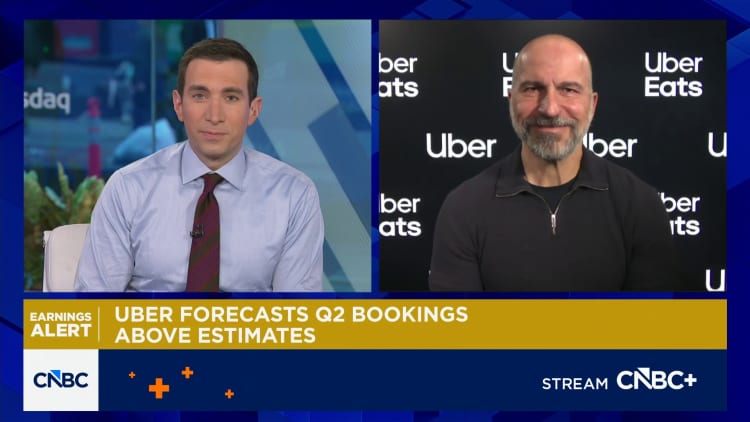
“We watched consumer patterns really closely. Are people taking shorter trips? Are people trading down in terms of the size of their grocery basket, so to speak? With the kinds of restaurants that they’re eating at, are consumers tipping as much as they were? All of those indicators continue to be really strong,” Uber CEO Dara Khosrowshahi said on CNBC’s “Squawk Box” Wednesday. “The consumers are spending, they’re spending locally, and we don’t see any signs of that weakening at this point.”
At Uber, delivery remained the company’s fastest-growing business in the latest quarter, with revenue jumping 34% to $5.07 billion from $3.78 billion a year earlier. Revenue in the ride-hailing division rose 5% to $6.8 billion as commuting activity and local spending stayed strong.
Khosrowshahi said Uber is seeing consumers continue to leave their homes more frequently, helped in part by a return-to-office trend that has boosted commuting demand. The company now has more than 10 million earners on its platform globally, including drivers and delivery workers.
The same resilience showed up at Disney, where the entertainment giant topped Wall Street expectations on the strength of its streaming and parks businesses.
Disney’s experiences division, which includes theme parks and cruises, posted nearly $9.5 billion in quarterly revenue, up 7% from a year earlier. Global attendance rose 2%, even as domestic park visitation slipped 1%.
“Current demand at our domestic parks and resorts is healthy,” Disney said in its earnings materials. “While we acknowledge the potential impact of heightened global macro uncertainty on consumers, we are encouraged by current demand and expect year-over-year attendance at our domestic parks in Q3 to show improvement compared to Q2 results.”
The results from Uber and Disney defied expectations for a slowdown in consumer spending as gasoline prices surge and investors worry that rising energy costs could eventually squeeze household budgets.
The national average price for regular gasoline has climbed to $4.54 a gallon, up 52% since the war began, according to AAA data. Diesel prices have similarly surged to $5.67 a gallon, a roughly 51% increase since late February.
But so far, companies tied to travel, entertainment and local commerce are seeing little evidence of a pullback.
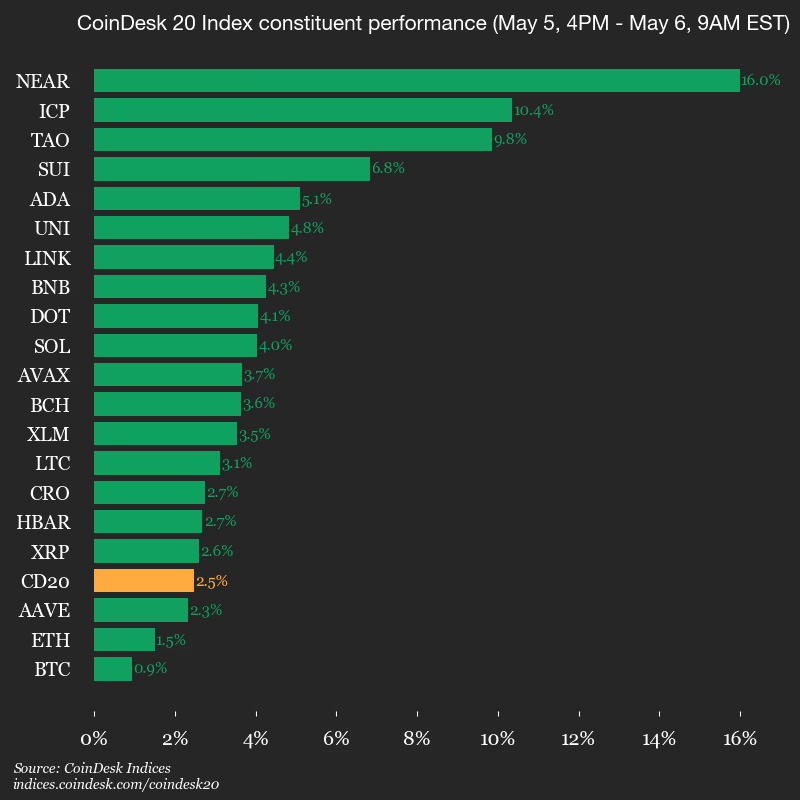
CoinDesk Indices presents its daily market update, highlighting the performance of leaders and laggards in the CoinDesk 20 Index.
The CoinDesk 20 is currently trading at 2210.86, up 2.5% (+53.36) since 4 p.m. ET on Tuesday.
All 20 assets are trading higher.

Leaders: NEAR (+16.0%) and ICP (+10.4%).
Laggards: BTC (+0.9%) and ETH (+1.5%).
The CoinDesk 20 is a broad-based index traded on multiple platforms in several regions globally.

A California federal court is weighing a civil claim that challenges Coinbase Global’s handling of frozen digital assets tied to a $55 million DAI phishing theft in August 2024. The Puerto Rico–based plaintiff requests recognition of ownership over the frozen funds and demands their return, arguing the assets are identifiable and traceable property. The complaint also names an unknown John Doe as a defendant, alleged to have carried out the theft.
The suit, filed in the U.S. District Court for the Northern District of California in San Francisco, raises questions about the duties of cryptocurrency exchanges when funds linked to a crime are traced to exchanges after an exploit. The plaintiff contends Coinbase has acknowledged holding the traced funds and has indicated that a court order adjudicating ownership is required before the assets can be released.
Key takeaways
- The Puerto Rico–based plaintiff seeks court-ordered ownership recognition and return of DAI funds frozen in a Coinbase retail account, tying the assets to the August 2024 DeFi phishing incident.
- The complaint asserts that Coinbase holds identifiable, traceable property and has previously demanded the return of the assets, while indicating that a court ruling is needed to release them.
- The 2024 incident was carried out via a phishing attack that leveraged a compromised DeFi Saver login and a scam-as-a-service tool called Inferno Drainer, enabling asset theft without protocol-level exploits.
- Forensic tracing linked the laundering path to a Ukrainian national, Okelsiy Oleksandrovych Gorelikhin, with Coinbase receiving notifications in late 2024 of funds deposited into a Coinbase address and later implementing measures to prevent dissipation.
- The case illustrates ongoing tensions in asset-recovery workflows: exchanges may freeze stolen funds but often face friction in releasing them absent judicial decrees, a dynamic with regulatory and policy implications for AML/KYC frameworks and cross-border enforcement.
Legal contours of asset recovery on exchanges
According to court filings, the plaintiff argues that the funds in question are “traceable property” linked to the plaintiff’s stolen assets and located within a Coinbase account. The complaint contends Coinbase previously acknowledged the existence of the traced funds and stated that ownership determinations require court intervention before any release. This framing places exchanges at a pivotal point in the chain of custody: they must align operational controls with judicial processes when faced with a theft that can be traced across public ledgers and on-chain flows.
The legal question at the heart of the suit concerns the scope of an exchange’s fiduciary responsibility when it receives stolen assets that are demonstrably linked to a crime. If successful, the claim would set a precedent on whether custodians can or must return or transfer such assets before litigation concludes, or must defer to a court order to resolve ownership disputes. The presence of an unnamed John Doe defendant suggests the plaintiffs anticipate additional actors might be implicated in the theft or its laundering trail.
Forensic timeline: tracing the path from theft to a frozen Coinbase account
The August 2024 breach involved a sophisticated phishing operation that duped the victim into authorizing access to a DeFi Saver account, subsequently enabling the attacker to siphon a substantial amount of DAI. A notable feature of this case is the involvement of a “scam-as-a-service” toolset known as Inferno Drainer, which provided a malware-based framework for facilitating asset theft without exploiting protocol-level vulnerabilities. The broader phenomenon of scam-as-a-service tools surged in 2024, with security researchers noting a marked increase in such capabilities across the ecosystem.
Following the breach, multiple blockchain-analytic entities tracked the stolen funds as they moved through the on-chain ecosystem and into various laundering channels. Zero Shadow and Five Stones, two forensic firms, traced the funds and identified a laundering connection to a Ukrainian national, Okelsiy Oleksandrovych Gorelikhin. The timeline includes two key regulatory- and law-enforcement–adjacent events: on November 30, 2024, Zero Shadow notified Coinbase that funds tied to the theft had been deposited into a Coinbase address, prompting requests for due diligence and asset freezing; and on December 2, 2024, Coinbase confirmed that the address belonged to a Coinbase retail user and said it had implemented friction measures intended to prevent dissipation of the assets pending investigation.
The complaint frames the assets held in the Coinbase account as “identifiable property traceable to Plaintiff’s stolen assets,” and notes that Coinbase had previously requested the return of those assets. This sequence underscores how forensic findings and exchange actions feed into civil litigation over recovery rights, and how such proceedings can influence ongoing enforcement actions tied to cyber-enabled thefts.
Regulatory and policy implications for exchanges and policymakers
What unfolds in this case has broader significance for the crypto industry’s regulatory and compliance landscape. First, it highlights the tension between custodial risk management and judicial control over the disposition of recovered funds. Exchanges frequently face balancing acts between freezing suspected stolen funds to prevent dissipation and awaiting court orders to release assets to rightful claimants. This dynamic intersects with AML/KYC frameworks, as well as with cross-border enforcement considerations when actors and funds cross jurisdictional boundaries.
From a policy perspective, the case invites scrutiny of how existing regulatory regimes—whether adjudicated in the United States or overseas—address the custody and disposition of stolen crypto assets. It also touches on the practical implications for stablecoins and their on- and off-ramps, especially as regulators and financial institutions consider how to integrate such assets into compliant banking and settlement ecosystems. While the immediate dispute centers on a U.S. court’s interpretation of ownership and recovery, the outcome could inform parallel disputes elsewhere and influence how exchanges design procedures for asset freeze, disclosure, and release under varying legal regimes.
As the industry navigates these questions, observers will watch for how courts weigh the evidentiary standard of traceability, the adequacy of on-chain linkage, and the sufficiency of interagency cooperation in recovery efforts. In regulations already evolving around anti-money-laundering and know-your-customer obligations, cases like this may help anchor operational expectations for exchanges and forensic firms, while clarifying the thresholds for blocking access to, or reclaiming, stolen assets. The broader policy context remains fluid, with ongoing discussions in multiple jurisdictions about harmonizing standards for asset recovery, cross-border cooperation, and the role of mixers and obfuscation services in illicit activity.
Closing perspective
As civil litigation over crypto-asset recovery unfolds, the case will test the practical boundaries between exchange custody, judicial authority, and forensic tracing. The outcome could shape institutional expectations for asset freezes, owner identification, and the conditions under which exchanges may release funds to claimants, with wide-ranging implications for compliance programs and cross-border enforcement.


The odds on a seven-leg parlay and the odds on a fresh memecoin trade are roughly the same, BONK core contributor Nom told audience at the ongoing Consensus Miami on Tuesday.
Most memecoin teams lack the staying power to push their projects through real regulatory steps, Nom said, citing exchange listings, ETF filings and public-company structures as the markers that separate tokens that last from those that rinse retail.
Crypto has built systems “really, really good at incentivizing inorganic traffic,” he added, pointing to points programs and airdrop farms that pull in mercenary capital and then watch network activity collapse the following week.
BONK has worked through several of those rails. Nasdaq-listed Bonk Holdings (BNKK), which rebranded from beverage company Safety Shot in October 2025, holds roughly 2.7% of BONK’s circulating supply and is targeting $115 million in token holdings by the end of 2026.
Tuttle Capital has filed a 2x leveraged BONK ETF with the SEC, and TenX Protocols, listed on the TSX Venture Exchange, made a public treasury allocation in January.
The token launched Christmas Day 2022, days after the FTX collapse, with Solana trading below $10 and most builders questioning whether the chain would survive. BONK went out as an airdrop to NFT holders, developers and active wallets with no presale, no venture funding and no whitepaper.
The pitch was distribution rather than a token, Nom said, built to give Solana developers something to rally around in a dead market.
The surrounding stack now includes LetsBonk.fun, the Solana memecoin launchpad that flipped rival Pump.fun on monthly volume earlier this year, plus BonkBot, a Telegram trading interface, and around a million wallets, per figures cited on the panel.
Pressed on where the next breakout community comes from, Nom said it would form around something most people currently dismiss, naming the TON network and Telegram-built projects as candidates worth watching.
Whether BNKK hits its $115 million treasury target by year-end and whether Tuttle’s leveraged ETF clears the SEC are the two cleanest signals for whether Nom’s TradFi-bridge thesis actually plays out.
The fireside was moderated by Lionel Williams, vice president of business development at Light Node Ventures.

Key Highlights
- BMW shares gained more than 6% following first-quarter performance that exceeded analyst projections for margins and cash generation
- Pre-tax earnings of €2.3B surpassed the €2.2B analyst estimate, even with a 25% year-over-year decline
- Automotive EBIT margin reached 5%, exceeding the projected 4.7%
- Automotive free cash flow surged to €777M, nearly doubling from the prior year as capital expenditures declined significantly
- The company reaffirmed its full-year automotive EBIT margin guidance of 4–6%
BMW delivered first-quarter 2026 pre-tax earnings of €2.3 billion, surpassing the analyst consensus estimate of €2.2 billion. Shares reacted positively, gaining over 6% during Wednesday’s trading session to reach approximately €82.
Consolidated revenue declined 8.1% to €31 billion, while EBIT tumbled 36% compared to the same period last year, settling at €2 billion. Despite these challenging headline figures, market participants focused on more encouraging underlying metrics.
The automotive division emerged as the performance driver. Its EBIT margin reached 5.0%, exceeding analyst expectations of 4.7% and remaining well within BMW’s annual guidance range of 4–6%.
Bayerische Motoren Werke AG, BMW.DE
The motorcycle division also delivered strong results, achieving an 11.4% margin.
Cash generation proved to be another positive catalyst. Automotive free cash flow climbed to €777 million—nearly twice the previous year’s level—supported by significantly reduced capital expenditure, which fell from €2.83 billion to €1.73 billion as electric vehicle platform investments began to plateau.
BMW projects full-year automotive free cash flow will surpass €4.5 billion.
The financial services segment represented the weakest area of the report. Pre-tax profit in this division declined 41% to €381 million, impacted by provisions related to a motor finance compensation program in the UK. Most analysts viewed this charge as non-recurring.
Delivery Volumes Face Headwinds
Worldwide deliveries decreased 3.5% to approximately 566,000 vehicles during the first quarter. China continues to present the most significant challenges—sales in that market fell 12.5% throughout 2025, and BMW anticipates volumes will remain essentially flat in 2026.
Battery electric vehicle deliveries contracted 20% during the quarter, reflecting changing consumer preferences and subsidy modifications across major markets.
US deliveries of BMW and MINI brands declined 4.3% to 90,492 units. The 25% US import tariffs on European vehicles present ongoing challenges, though BMW’s Spartanburg manufacturing facility in South Carolina offers partial mitigation.
Its Chinese-manufactured Mini vehicles continue to face EU anti-subsidy tariffs, adding costs in the low hundreds of millions of euros.
Stock Valuation and Expert Perspectives
At present price levels, BMW trades at approximately 6.4 times trailing twelve-month earnings. The stock’s 52-week trading range spans from €70.94 to €97.92, positioning it considerably below its recent peak.
An anticipated dividend of €4.40 per share is scheduled, with the ex-dividend date set for May 14—translating to approximately a 5.7% yield at current valuation.
Morgan Stanley confirmed its overweight recommendation, highlighting enhanced cash generation capabilities and favorable margin trajectory.
JP Morgan maintains an overweight stance with a €100 price objective. RBC Capital Markets holds a neutral rating with an €84 target, citing concerns around raw material pricing and foreign exchange volatility.
Bernstein reaffirmed its buy recommendation on May 4. The consensus analyst price target stands at €91.59, with 10 buy ratings and four sell recommendations among covering analysts.
BMW confirmed its annual guidance, projecting group pre-tax profit will decline an additional 5–9.9% from the €10.2 billion recorded in 2025.
Mercedes-Benz is scheduled to release its Q1 2026 results soon, providing a benchmark for evaluating how German luxury automakers are navigating comparable tariff pressures and China market challenges.


2026 local elections North East results timings

Former USTR sees no impending tariff relief

Stockcoin.ai raises seed round from Amber Group to fuse AI, stocks, and crypto

Manchester United reach agreement with Casemiro over contract clause amid transfer speculation

US brings back mandatory military draft registration

Steven Gerrard disagrees with Gary Neville over ‘shock’ Chelsea and Arsenal claim | Football
![UAE Just Broke OPEC! [Everything Changes For Oil & Bitcoin]](https://wordupnews.com/wp-content/uploads/2026/05/1778075782_maxresdefault-80x80.jpg)


-
 Business7 days ago
Tesla Officially Registers Elon Musk’s Stock: What Investors Need to Know
-

 NewsBeat3 days ago
Channel 5 – All Creatures Great and Small series 7 new post
-

 Entertainment7 days ago
Insider Claims Reason Behind Key & Peele Split
-
 Tech5 days ago
Trump’s 25% EU auto tariff breaches Turnberry Agreement that also covers semiconductors and digital trade
-
 Sports5 days ago
Paul Scholes issues Marcus Rashford reality check as agreement emerges over Man United star
-

 Entertainment5 days ago
Met Gala 2026 Rumored Guest List Is Turning Heads
-

 Entertainment6 days ago
Celebrities Who Are Attending the 2026 Met Gala Event
-

 Business5 days ago
Strait of Hormuz Blockade Persists Amid US-Iran Standoff, Sending Oil Prices Soaring
-
Business7 days ago
Strait of Hormuz Remains Heavily Restricted on April 29 Amid Iran Conflict
-
Entertainment5 days ago
New on Prime Video in May 2026 — Full List of Movies and Shows
-

 Sports5 days ago
Cavaliers vs. Raptors Game 6 live score, updates, highlights from 2026 NBA playoffs first-round series
-
 Sports5 days ago
David Benavidez responds to team Canelo saying the fight will never happen
-

 Crypto World7 days ago
Meta (META) starts stablecoin payout to creators in Circle’s USDC on Polygon, Solana via Stripe
-

 Tech7 days ago
Texas Instruments made a new flagship graphing calculator: the TI-84 Evo
-
 Sports5 days ago
IPL 2026: ‘Love you darling’- Hardik Pandya’s reaction to MS Dhoni steals the show |Watch | Cricket News
-

 Sports7 days ago
Saudi Arabia set to withdraw LIV Golf funding after 2026 season, per reports
-

 Tech6 days ago
Mark Zuckerberg Says Meta Is Working On AI Agents For Personal And Business Use
-

 Entertainment5 days ago
Kylie Jenner Hit With Second Lawsuit From Ex-Housekeeper
-

 Sports5 days ago
Plane crash in Wimberley, Texas kills 5 pickleball players at tournament
-

 Sports7 days ago
Arsenal, Atletico Madrid share draw after penalty drama in Champions League semi-final
You must be logged in to post a comment Login