
Crypto World
Important Pi Network News and PI Price Update: September 1


The controversial cryptocurrency project has stood aside from the spotlight lately as the community awaits a major protocol update scheduled for mid-September.
Meanwhile, social media buzz claimed that Elon Musk publicly endorsed PI, yet the token’s price failed to capitalize on the speculation and hardly participated in the broader crypto rebound seen over the past two weeks.
All Eyes on This Date
Pi Network began the long process of protocol upgrades at the start of 2026 when the Core Team unveiled version 19.6. Among the next ones was v20.2, which laid the foundations for smart contract capabilities.
Some of the following updates became harder to deploy, resulting in delays. Version 25, for instance, was supposed to be introduced by July 22, yet it came later than expected. The implementation of protocol v26 also surpassed its initial deadline.
The next one, which is actually scheduled to be the last, is v27, and it should be deployed by September 15. It will add more flexible and secure smart-contract authentication, giving accounts and apps better ways to authorize transactions. Version 27 will continue the progress by introducing newer protocol features and expanding the network’s smart contract capabilities.
Musk’s Interaction?
Just a few days ago, the world’s wealthiest person dropped an X post where he insisted that the universe “is integer in units of Planck cubes.” The assumption triggered multiple comments from users and experts who used mathematical terms in their theories. One of them, named Pierre Ferragu, claimed that π “doesn’t exist but the idea of π does.” Musk did not stay silent about that assumption, saying:
“Pi can be (and has been) used in integer form for calculating interplanetary trajectories. The relevant maximum number of digits of pi is how many are needed to describe the volume of the Universe in Planck cubes (voxels).”
At first glance, this appeared like a brainstorm about the universe and its complex nature, but it seems the debate intrigued Pioneers. The popular X account BSCN claimed that Musk’s interaction sparked a discussion in the Pi Network ecosystem.
“What started as a casual reply to a user’s comment has sparked a huge frenzy within the Pi Network ecosystem. Yesterday, billionaire CEO Elon Musk replied to a user, highlighting Pi’s physically meaningful representation. However, the reply has been seen as some form of endorsement for Pioneers,” it explained.
Speculation and Nothing More?
It is important to note that there was no further interaction from Musk and no clarification that he was referring to Pi Network’s native token. In fact, the coin has barely seen any volatility over the past few days and continues to trade below $0.10.
It is up approximately 7% over the past two weeks, but that is rather disappointing given the overall market boom during this period, where Bitcoin (BTC) soared by 22%, and Ethereum (ETH) spiked by 30%.
Still, some analysts believe PI may experience a more substantial short-term surge. X user Crypto With Gopal argued that the price is squeezing around the $0.09 zone as volatility contracts, opining that a breakout above could set the stage for a pump toward $0.15.
The post Important Pi Network News and PI Price Update: September 1 appeared first on CryptoPotato.

Ripple Labs became the largest private company holding in C1 Fund’s portfolio during the second quarter of 2026, accounting for 17.5% of the NYSE-listed fund’s net assets as of June 30.
Summary
- C1 Fund made Ripple its largest holding, representing 17.5% of net assets on June 30.
- Payward, Kraken’s parent company, ranked second with an allocation equal to 16.9% of net assets.
- Portfolio investments totaled $33.07 million across eleven private digital asset companies on June 30, 2026.
- Ripple’s partial issuer buyback generated an approximately 150% return for C1 Fund within four months.
- C1 Fund repurchased 249,300 shares for $824,440 through July under its existing authorized buyback program.
C1 Fund reported that Ripple narrowly overtook Payward, the parent company of cryptocurrency exchange Kraken. Payward represented 16.9% of net assets at the end of the period.
The fund recorded total net assets of $42.63 million, equal to a net asset value of $6.49 per share. Based on those percentages, Ripple’s position was worth approximately $7.46 million, while Payward’s position was worth about $7.20 million.
Ripple equity leads C1 Fund’s private portfolio
C1 Fund held $33.07 million in private company investments at fair value on June 30. These investments represented 77.5% of its net assets. Another $9.96 million, or 23.3%, was invested in short-term U.S. Treasury securities.
The portfolio covered 11 private or recently public digital asset businesses. Apart from Ripple and Kraken, its holdings included Alchemy, BitGo, Blockchain.com, Chainalysis, ConsenSys, Figment, Fireblocks, Polymarket and Uphold.
C1 Fund added Polymarket parent Blockratize during the second quarter. It also increased several positions that it initially acquired in 2025. The fund selects companies from its C1 30 list, subject to availability and pricing in private secondary markets.
Ripple’s weighting reflects the fund’s remaining equity position after an earlier partial sale. It should not be interpreted as direct ownership of XRP. Ripple shares represent ownership in the private company, while XRP holders receive no claim on Ripple’s revenue, assets or dividends.
As crypto.news previously explained, Ripple equity and XRP remain legally separate assets. Their values may respond to some of the same corporate developments, but they represent different rights and risk profiles.
Ripple buyback delivered C1 Fund’s first private exit
C1 Fund sold 1,407 Ripple Series A preferred shares back to the company for $422,100 during a Ripple-sponsored transaction announced in April. The fund said the sale generated an approximately 150% return in less than four months.
The return applied only to the shares involved in that transaction. It was not a 150% increase across C1 Fund’s entire Ripple holding or a verified measure of Ripple’s broader private-market valuation.
C1 Fund retained substantial Ripple exposure after the sale. Its remaining position becoming the largest holding shows that the partial exit reduced, rather than eliminated, its investment in the company.
Private company shares do not trade continuously on public exchanges. C1 Fund therefore values these positions using fair-value procedures. Prices may incorporate secondary transactions, issuer buybacks and other valuation inputs unavailable in a liquid public market.
Other publicly accessible funds have also reported small Ripple equity positions. A Kinetics mutual fund disclosed 1,875 Class A Ripple shares valued at $246,319, as crypto.news reported from its quarterly SEC portfolio filing. That position represented roughly 0.1% of the fund’s net assets.
C1 Fund shares remain below reported NAV
C1 Fund finished the quarter with 6,568,348 shares outstanding and a NAV of $6.49 per share. CFND traded around $2.85 at the end of August, placing its market price more than 50% below the reported quarter-end NAV.
A closed-end fund’s stock price can trade above or below the value of its underlying portfolio. The discount does not necessarily indicate that investors assign the same reduction to Ripple or any individual holding. It can also reflect fees, limited liquidity, valuation uncertainty and the difficulty of exiting private investments.
C1 Fund has been buying its own shares in an attempt to take advantage of that gap. Through July 31, it repurchased and retired 249,300 shares for an aggregate $824,440.
Its board authorized up to $3 million in repurchases in January. The program remains subject to market conditions and SEC requirements, and authorization does not require the fund to spend the full amount.
IPO activity could create new liquidity routes
Kraken and Blockchain.com have submitted confidential registration statements for potential U.S. public offerings. A confidential filing begins the SEC review process but does not guarantee that either company will proceed with an IPO.
Kraken co-CEO Arjun Sethi confirmed that Kraken had entered the confidential IPO process in April. Blockchain.com later disclosed a similar step, although neither company has announced final pricing or a listing date.
An eventual listing could give C1 Fund a clearer market price for those positions and potentially create a path to sell shares after any lockup period. BitGo, another portfolio company, completed its IPO in January 2026.
Ripple has not publicly filed for an IPO or announced a listing timetable. Its position will therefore continue to rely on private-market valuation inputs unless another issuer-led transaction or liquidity event occurs.
C1 Fund said it would file its full Form N-PORT for the June 30 period with the SEC. That filing will provide more detailed portfolio information, including security types, values and valuation classifications. Future quarterly reports will show whether Ripple remains ahead of Kraken or whether later transactions change the portfolio rankings.
Strategy is buying Bitcoin (BTC) again, but according to President and CEO Phong Le, the decision has little to do with where Bitcoin’s price sits.
Le said the math behind Strategy’s renewed purchases comes down to cost of capital, not market timing.
Why Bitcoin Buying Comes Down to Capital Costs
Strategy’s resumed Bitcoin purchases followed a 10-week pause spent shoring up its balance sheet. Le compared the underlying calculation to financing a data center buildout.
Land and energy costs have climbed, he said, even as the cost of raising capital stayed low.
“We don’t really make decisions on Bitcoin specific to Bitcoin price.”
Phong Le, President and CEO, Strategy
He said the trade only works when selling shares or debt costs less than Bitcoin’s expected return. Strategy ranked fourth among public companies for equity capital raised this year, behind only SpaceX, Google, and Intel, Le said.
Why Strategy Still Sells, Occasionally
Le rejected the idea that Strategy only accumulates Bitcoin, calling it a “two way strategy” instead. Earlier this year, the company sold about 7,000 BTC, under 1% of holdings, to fund dividends and buybacks.
He said debt holders and ratings agencies expect a company willing to sell assets when needed. A firm that never sells, he argued, is not a “fully operating” company.
Betting on a Sustained Bull Market
Le’s comments suggest he expects Bitcoin’s rally to continue well beyond current levels. He said Strategy would keep buying at $80,000, $90,000, or $100,000, and even at a $130,000 all-time high, arguing today’s purchases would look justified if Bitcoin later climbs to $260,000.
“I don’t foresee us holding Bitcoin as we enter into what I consider a heavy bull market.”
Phong Le, President and CEO, Strategy
That conviction also sits behind Strategy’s fight against an MSCI index removal proposal. MSCI is an index provider whose benchmarks guide passive fund flows.
The proposal would exclude companies with large Bitcoin treasuries, and Le has called it discriminatory.
He argues Bitcoin functions as an operating asset on Strategy’s balance sheet, not a passive holding. That distinction could decide whether Strategy stays in MSCI’s indexes when a ruling arrives October 16.
The post Strategy's CEO Says Bitcoin Buys Come Down to Capital Costs, Not Price appeared first on BeInCrypto.
Ethereum’s latest monthly candle closed above a key resistance level around $2,470 on August 31, prompting analyst Matthew Hyland to declare on X that the downtrend that started in August 2025 is over.
He framed the close as the first confirmation that a new bull market has started, comparing the current chart structure to the setups that preceded ETH’s 2016 and 2020 rallies.
ETH’s Monthly Chart Flips Bullish
Hyland’s chart runs from ETH’s 2025 peak, hit in August of that year, through a steady run of lower highs and lower lows that bottomed out near $1,500 to $1,600 in June and July of this year.
“ETH confirms a Monthly Higher_High and ends its downtrend that started in August of 2025,” Hyland posted. “The Bears have been slayed. WELCOME TO THE #CRYPTO BULL MARKET!!”
Other traders have been circling the same zone, including DonAlt, who wrote that ETH has “No real resistance till $4k,” pointing to support around $2,100 and warning that a break below $2,000 could send price toward $1,000.
Fellow market watcher Daan Crypto Trades pointed out that ETH has spent the last 11 days pinned between its weekly 200-period moving average and a horizontal support level.
Another analyst, Quantum Ascend, noted that ETH’s monthly candle closed near its 50-month simple moving average with the RSI still deeply oversold, a setup that last showed up in spring 2025, right before the token rallied 3.5x in five months, and he says he’s “expecting a new all-time high” based on the move.
At the time of writing, the second-largest crypto asset was trading above $2,400, up roughly 31% over the past month and 30% in two weeks, while remaining about 50% below its record price of over $4,900 from August last year.
Network Activity Adds Another Piece
ETH’s price recovery is happening alongside increased network activity. As CryptoPotato reported, Ethereum is approaching 1 million active addresses, despite substantial activity taking place across Layer 2 networks.
That gives the price move some additional context, although active addresses alone cannot establish whether ETH has entered a new long-term cycle. Tron, for example, has more than 4 million active addresses, largely linked to payments and stablecoin transfers.
For now, the cleanest test of Hyland’s thesis is whether ETH can hold the $2,470 breakout area. A sustained move above it would leave the $4,000 region as the next major target cited by traders, while a failure below $2,000 would considerably weaken the bullish structure.
More on Ethereum can be found in our market video below:
The post Analyst Declares Bull Market After ETH Breaks Key Monthly Resistance appeared first on CryptoPotato.
Wall Street logged its third consecutive losing session Tuesday. Fresh U.S. strikes on Iran sent oil surging, and CNBC’s Jim Cramer says three forces now keep the market, including Bitcoin, volatile.
The Dow fell 419 points and the Nasdaq dropped 1%. Both slides reflect geopolitical shocks, bond market stress, and a hawkish new Fed chair. The 10-year Treasury yield climbed to 4.79%.
Three Forces Rattling Wall Street
The first of the three factors is Iran. Renewed U.S. strikes near the Strait of Hormuz pushed Brent crude up 4.6% to $95.70 a barrel Tuesday evening. U.S. crude closed above $90 for the first time in over a month.
Cramer says the pattern keeps repeating as Iran’s latest Hormuz threat resurfaces whenever ceasefire hopes fade.
The second factor is the Federal Reserve. Federal Reserve Chair Kevin Warsh has signaled he would raise rates even at the cost of a recession.
Cramer compares him to former Fed Chair Paul Volcker, another inflation hawk. Traders now put the odds of a September rate hike at 66%, up from about 40% a week earlier.
The third is the president himself. Cramer estimates a provocative post on Iran shaves about a quarter point off major indexes. An actual strike can cut markets by half a percent and add two percentage points to oil. He calls it a volatility premium with no fixed expiration.
Cramer’s team also trimmed data center exposure ahead of the November election, wary of political risk to AI names. They kept core holdings in Nvidia and Apple.
Bitcoin Also Feeling the Pressure
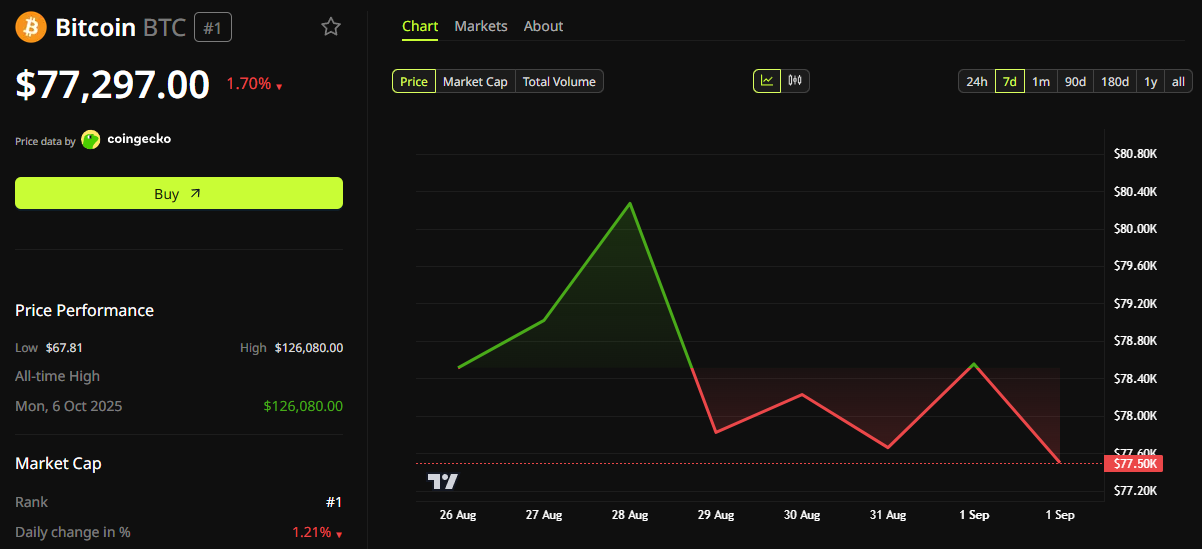
The pressure has spilled into digital assets too. Bitcoin’s brief slide below $77,000 tracked Tuesday’s broader risk-off move.

Investors trimmed exposure across both stocks and crypto. Ether slid alongside bitcoin as traders cut risk broadly across the sector. Cramer’s investing club raised cash to more than 15%, the highest level in its 25-year history.
He is betting the whipsaw continues until Iran’s conflict eases or the Fed’s path becomes clearer. The next test arrives Friday, when the August jobs report could reshape rate-hike expectations further.
The post These 3 Factors Are Whipsawing Wall Street and Bitcoin appeared first on BeInCrypto.
A Fairshake-linked political committee is spending on media support for incumbent U.S. Representative Jake Auchincloss ahead of Tuesday’s Massachusetts primary, according to Federal Election Commission (FEC) records. The activity comes as crypto-focused political spending groups continue to expand their influence beyond narrowly defined policy debates.
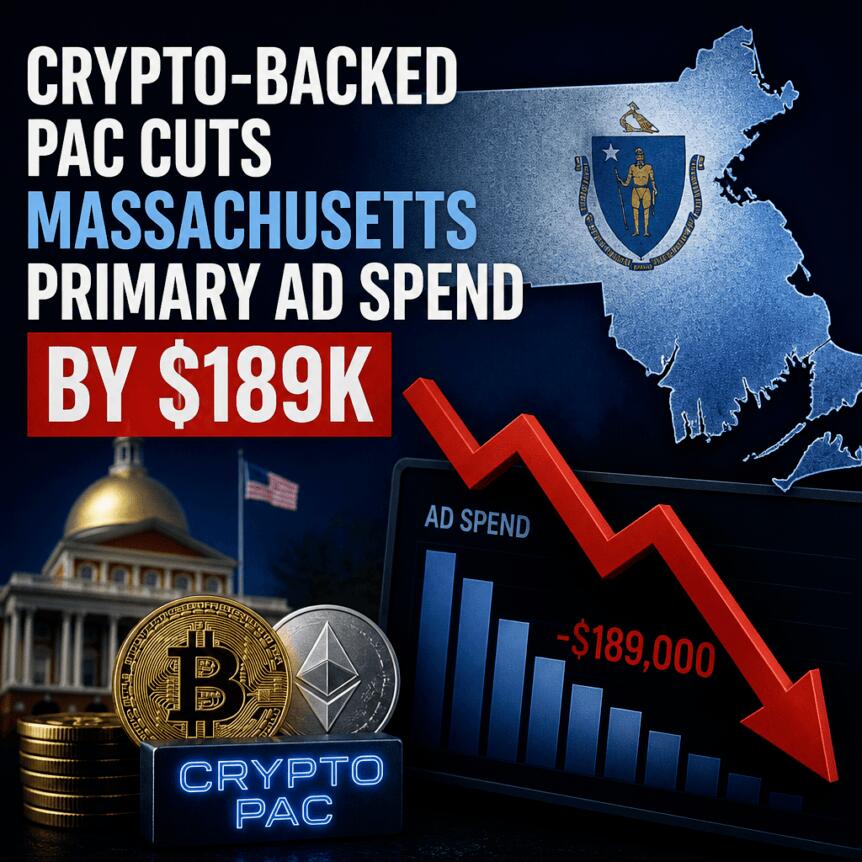
FEC filings show Protect Progress PAC—a Fairshake affiliate—spent just over $189,000 on media to back Auchincloss’s reelection campaign in Massachusetts’ 4th congressional district. Democratic challenger Jason Poulos, in a letter made public on Aug. 16, accused the incumbent of being influenced by the crypto industry and criticized the PAC’s efforts as potentially improper election interference.
Key takeaways
- FEC records indicate Protect Progress PAC spent just over $189,000 on media in support of Jake Auchincloss ahead of Tuesday’s Massachusetts primary.
- PAC spending is not tied to policy position votes in the reporting; Poulos argues the media activity is meant to influence voter perceptions during the primary.
- Poulos alleges Auchincloss accepted $77,500 from “crypto-industry sources” since 2020 and links that to crypto legislation votes.
- Fairshake’s broader election push continues into 2026, with the group citing large cash reserves and multiple prior race efforts earlier in the cycle.
Protect Progress PAC spending in Massachusetts
The FEC data, as of Tuesday, points to Protect Progress PAC’s media spend targeting Auchincloss in the Massachusetts 4th district primary. While the filings confirm the existence and scale of the spending, the underlying communications content is disputed politically, with the campaign message becoming part of Poulos’s attack on the incumbent.
According to Poulos, some of the PAC’s resources were used to produce what he described as “AI-generated slop mailers” supporting Auchincloss ahead of the Massachusetts primary, which took place Tuesday.
Poulos presses Auchincloss to renounce the PAC’s efforts
In the Aug. 16 letter, Poulos urged the incumbent to “publicly renounce” Protect Progress PAC’s involvement, framing the PAC’s activity as a way to influence both the primary and the eventual general election.
Poulos also raised campaign-finance and legislative-history allegations. He claimed Auchincloss accepted $77,500 directly from “crypto-industry sources” since 2020. He further pointed to Auchincloss’s voting record on the Digital Asset Market Clarity Act in July 2025—described in the article as a market-structure bill that has not yet been signed into law and is pending consideration in the Senate.
The core of Poulos’s argument appears to be that Auchincloss’s legislative behavior aligns with donors and industry pressure, and that the PAC’s media campaign—especially if it relies on AI-generated materials—underscores the influence he believes is operating behind the scenes.
Fairshake and affiliates keep targeting 2026 elections
This Massachusetts spending is part of a broader pattern of political activity from Fairshake and its affiliates. The reporting notes that Fairshake’s election efforts have included significant ad and media spending in the 2024 cycle—over $130 million—and that its affiliated PACs are continuing to pursue race-by-race influence during the 2026 midterm election period.
Earlier in August, Fairshake reported spending roughly $3.6 million on House and Senate races across Alaska, Florida, and Wyoming, as described in coverage linked within the article. The same reporting states that Fairshake had $122 million in cash on hand ahead of the 2026 midterms.
In an August statement quoted in the article, a Fairshake spokesperson, Geoff Vetter, said the organization would not slow down heading into November—connecting the group’s persistence to its cash reserves and the number of prior race wins.
What this means for voters and upcoming primaries
Massachusetts’ primary timing makes it one of the final major state nomination contests before the general election, with the general election still ahead and only a little over two months remaining, as cited in the article. The reporting also notes that New Hampshire, Rhode Island, and Delaware are slated to hold their primaries in September, placing additional pressure on political committees seeking momentum during the late-stage primary window.
For market participants and crypto policy watchers, the significance is less about any single congressional district and more about how crypto-aligned political organizations are operationalizing influence—using media spending to shape voter perceptions while also tying their efforts to the legislative outcomes they want to encourage or defend.
As more FEC disclosures and campaign messaging circulate, readers should watch how the Massachusetts primary debate evolves—particularly whether opponents escalate scrutiny of AI-generated campaign materials and donor ties, and whether PAC spending patterns continue to mirror earlier 2026 efforts in other states with upcoming primaries.

Binance is moving deeper into traditional finance, launching options trading on more than 1,000 US stocks and exchange-traded funds for eligible users outside the United States. The exchange says the product will be provided through its Abu Dhabi-regulated broker-dealer, Nest Trading, with orders routed to US-registered Alpaca Securities for execution, clearing, settlement, and custody.
The offering builds on Binance’s existing equities lineup, which includes more than 7,000 US stocks and ETFs. Binance also emphasized that these are physically settled options—meaning users who exercise receive or deliver the underlying shares—rather than equity-linked perpetual futures.
Key takeaways
- Binance will offer options on 1,000+ US stocks and ETFs to eligible non-US users via Nest Trading.
- Execution, clearing, settlement, and custody will be handled through orders routed to Alpaca Securities.
- The options are physically settled, distinguishing them from perpetual futures structures.
- Binance points to rapidly growing TradFi-related activity, citing a sharp rise in TradFi perpetual futures volume in August.
- Broader exchange competition is accelerating tokenized equities access across major venues, including Coinbase, Kraken, and Robinhood.
How Binance’s options rollout is structured
Rather than positioning options as a native onchain product, Binance is integrating it into a conventional market plumbing setup. According to Binance, the options will be offered through Nest Trading, its Abu Dhabi-regulated broker-dealer. When users place trades, Binance routes those orders to Alpaca Securities, which is registered in the United States and will manage execution and post-trade operations.
This matters for readers trying to understand what is actually being delivered on the Binance platform. The exchange is not describing a new settlement model or new clearing network; instead, it is extending access to standard equity options while keeping the core regulatory and operational workflow within established TradFi channels.
Physically settled options, not perpetuals
Binance explicitly contrasts the new product with its equity-linked perpetual futures. Unlike perpetual contracts, physically settled options are tied to the underlying asset delivery. If a user exercises, they receive or deliver the corresponding shares.
For traders, that distinction affects both risk management and what happens at expiration. Perpetual futures generally avoid physical delivery mechanics, while physically settled options introduce share-based outcomes if users exercise. In practice, this may better align with strategies that require actual stock exposure or stock-based collateral considerations rather than purely derivatives exposure.
Why the timing: Binance cites surging TradFi trading activity
Binance attributes the rollout to accelerating engagement in traditional financial products on its platform. The exchange specifically cited TradFi perpetual futures volume reaching about $433 billion in August—roughly 15 times January’s total.
This is an important framing because it suggests Binance is responding to measurable demand rather than launching options as a speculative add-on. Still, readers should note that this figure relates to TradFi perpetual futures volume, not necessarily options volume. The company’s argument is that overall interest in TradFi instruments on the platform has surged, creating an environment where options products can find an audience.
Tokenized equities keep expanding across exchanges
Binance’s move sits within a broader push by exchanges and brokerages toward tokenized and onchain-wrapped equity exposure. As crypto venues expand their catalog of TradFi-adjacent products, the onchain stock market has grown quickly over the past year, according to RWA.xyz.
RWA.xyz data shows tokenized stocks have around $2.6 billion in distributed value, up from roughly $346 million a year earlier. It also reports that monthly transfer volume rose 93% over the past 30 days to $25.1 billion, while the number of holders increased 157% to nearly 2.5 million. These figures reflect both increased throughput and broader participation—two conditions that often make additional derivative products more feasible for platforms.
Last week, Coinbase brought its B20 tokenized equities to Base, offering eligible non-US users 24/7 access to onchain versions of well-known US-listed companies including Apple, Nvidia, Meta, and Alphabet. Coinbase also stated that the assets can be used in DeFi contexts such as trading and collateralized borrowing.
Separately, Kraken expanded equities access in August by opening more than 7,000 US-listed stocks for eligible European customers, placing them alongside its tokenized xStocks offerings. In July, Robinhood launched “Robinhood Chain” and introduced a new generation of Stock Tokens available to eligible users across more than 120 countries, highlighting how large brokerages are extending beyond traditional order-book access toward token-based settlement rails.
Taken together, these developments suggest a competitive landscape where venues are layering new TradFi instruments over blockchain-adjacent infrastructure. Binance’s options launch appears to be a continuation of that pattern—moving from spot-style equity access toward derivatives that can serve more complex hedging and exposure strategies.
What to watch next
As Binance rolls out physically settled options for non-US eligible users, traders and investors should pay attention to how order routing and settlement behave in practice on the platform—especially around exercise, delivery workflows, and any product-specific eligibility constraints. Longer term, the key question is whether demand for derivatives on these platforms scales at the same pace as tokenized equity adoption and TradFi perpetual futures activity.
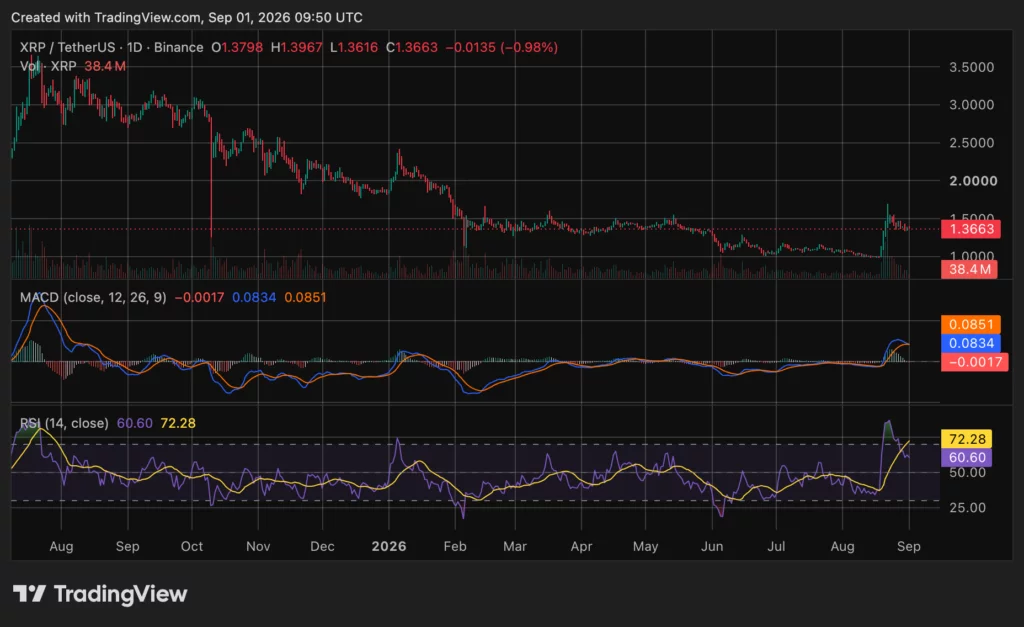
XRP traded near $1.37 on Sept. 1 after retreating from its August peak near $1.70, leaving traders divided over whether its recent breakout remains intact.
Summary
- XRP traded near $1.37 after losing 8.2% weekly while remaining up 25.9% monthly overall.
- Bitwise XRP ETF held 365.35 million tokens worth $507.23 million as of August 30, official data showed.
- Analyst Ali Martinez placed XRP’s next target at $1.70 after calling resistance cleared this week.
- Daily RSI remained positive near 60.6, while MACD showed weakening short-term bullish momentum currently overall.
- XRP must hold support near $1.30–$1.35 and reclaim $1.50–$1.60 to strengthen its rebound case further.
The token fell approximately 0.6% over 24 hours and 8.2% during the preceding seven days, according to crypto.news data. XRP remained up 25.9% over 30 days following its recovery from the $1 area.
Analyst Ali Martinez said XRP had “cleared resistance” and described the breakout as confirmed. He placed the next target at $1.70, although price had already moved back below the breakout area by the time of reporting.
XRP price tests support after its August rally
XRP’s daily chart shows a strong recovery from its August low followed by a pullback from the $1.70 region. The price is now consolidating around $1.36 to $1.38, near an area that previously acted as resistance.
The immediate support range sits between $1.30 and $1.35. Holding this area would preserve the sequence of higher lows established during the August rebound. A daily close below it would weaken the short-term structure and expose lower support near $1.27.
The first major resistance range is between $1.50 and $1.60. XRP would need to reclaim that zone and hold above it before another test of $1.70 becomes more credible.
XRP remains in a broader downtrend when measured from its previous highs above $3. The recent recovery improved its short-term structure, but it has not yet confirmed a full reversal of that longer decline.
The Relative Strength Index stood near 60.6 on the daily chart. A reading above 50 indicates that positive momentum remains, although the indicator has fallen from its recent overbought level.
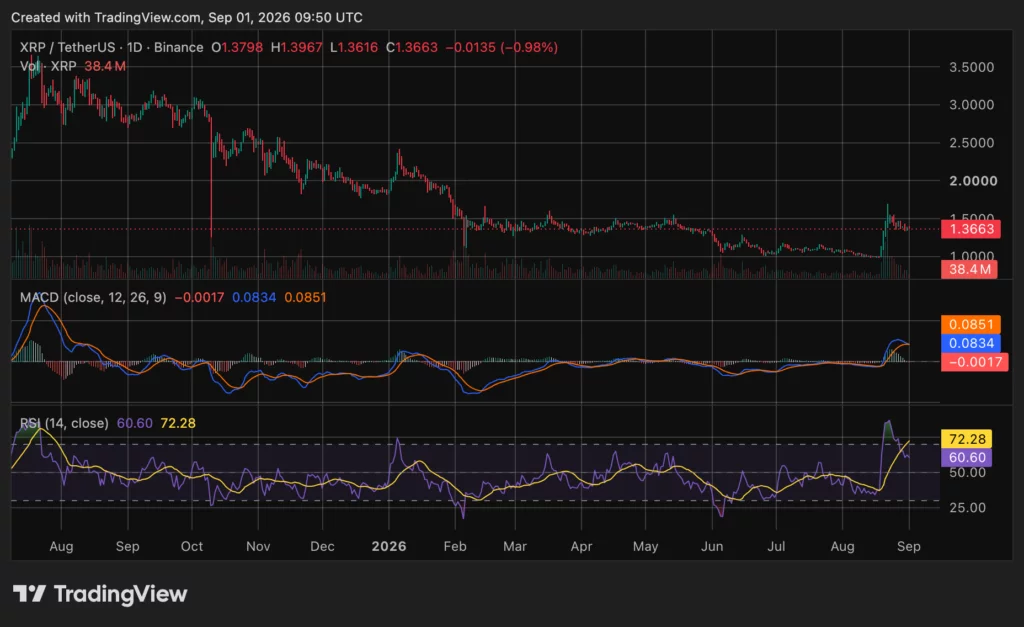
The RSI also remained below its moving average near 72.3, showing that momentum cooled as XRP retreated from the August peak. The indicator is no longer overheated, but it has not produced a fresh acceleration signal.
Bitwise XRP ETF crosses $507 million
The Bitwise XRP ETF held approximately 365.35 million XRP worth $507.23 million as of Aug. 30, according to the fund’s official data.
The NYSE Arca-listed product had 32.71 million shares outstanding and charged an expense ratio of 0.34%. Coinbase Custody Trust held the fund’s XRP, while Bank of New York Mellon served as trust custodian and administrator.
The latest total represented a sharp increase from June 30, when the fund held 286.84 million XRP and reported $299.15 million in net assets. Its holdings therefore increased by approximately 78.5 million XRP between quarter-end and Aug. 30.
A rising asset total does not come entirely from new investor cash. Assets under management can increase through share creations, which require additional XRP, and through gains in the token’s market price.
Bitwise’s second-quarter filing showed that investors added approximately 181.53 million XRP worth $269.85 million through share creations during the first half of 2026. Redemptions removed about 25.61 million XRP.
The trust’s net assets rose from $241.37 million at the end of December to $299.15 million on June 30 despite a $176.61 million decrease from operations. The filing attributed most of that reduction to XRP falling from $1.82 to $1.04 during the period.
XRP breakout targets remain unconfirmed
Martinez’s $1.70 target is a technical forecast rather than an assured price level. XRP must first remain above support and recover the resistance lost during its latest pullback.
The Moving Average Convergence Divergence indicator also points to weaker momentum. The MACD line stood near 0.0834, slightly below its signal line around 0.0851, while the histogram was marginally negative.
This configuration suggests that the bullish momentum behind the August recovery is fading. It does not yet establish a strong bearish trend because both MACD lines remain above zero.
Other analysts have offered wider forecasts. Diana identified potential targets at $1.88 and $7.07 using Elliott Wave analysis, while XRP Update proposed levels extending from $2.50 to $13.
Those projections rely on patterns and assumptions that have not been confirmed by subsequent price action. They should not be presented as expected outcomes.
The bearish scenario also remains active. Crypto Lens said XRP could fall toward $1.17 before beginning another recovery. ChartNerd identified the 20-week exponential moving average near $1.27 as a possible support floor after XRP failed to reclaim its 50-week average.
ETF demand has not prevented XRP volatility
Institutional demand through U.S. exchange-traded products has continued despite XRP’s price swings. As crypto.news previously reported, XRP ETF trading volume reached an all-time high during the August rally.
Seven U.S. spot XRP funds had recorded approximately $1.57 billion in cumulative net inflows by Aug. 24. The latest external estimates placed that total above $1.6 billion by the end of the month.
ETF creations can require issuers or authorized participants to obtain more XRP. However, fund demand does not guarantee price gains because selling from other market participants can offset those purchases.
XRP previously recorded its strongest weekly rally since the SEC settlement before entering the current correction. The sharp rise and subsequent pullback show that institutional inflows have not removed short-term volatility.
The next confirmation will come from price rather than analyst targets. Holding $1.30 to $1.35 would keep the recovery structure intact. Reclaiming $1.50 to $1.60 would strengthen the case for another $1.70 test, while losing support would shift attention toward $1.27 and $1.17.
Disclosure: This article does not represent investment advice. The content and materials featured on this page are for educational purposes only.
July and August have been quite successful for the self-proclaimed Dogecoin killer, with its price closing both months in the green.
Nonetheless, certain important elements suggest that September may not be as beneficial and could deliver a move south.
The Worrying Signals
The first concerning element on the list is Shiba Inu’s burn rate, which has declined by 6% on a monthly scale. Data shows that less than 600 million tokens have been sent to a null address throughout August, an amount whose USD equivalent is negligible.
The burning mechanism aims to reduce the overall supply of the meme coin and potentially make it more valuable, but little to no activity on that front poses a serious obstacle to that mission.
Next is Shibarium’s stalled activity. The layer-2 scaling solution was exploited last year, and since then, the number of processed daily transactions has dropped to mere hundreds or even thousands (at most).

The feature has been labeled numerous times as important for the overall advancement of Shiba Inu’s ecosystem and something that can positively impact its price.
Last but not least, we shall mention the seasonal element. September has been a predominantly poor month for SHIB, with its price finishing the period in the red three out of five times. In 2022, July and August were green (just like this year), yet the following month stopped the uptrend. We have yet to see whether history will repeat itself.

The Bright Side
Not all aspects suggest that the meme coin could experience a downtrend in the coming weeks.
According to CryptoQuant, the amount of SHIB held on exchanges has declined over the past month, signaling that investors continue to abandon centralized platforms in favor of self-custody. This, in turn, reduces immediate selling pressure and could set the stage for a potential additional price ascent.

The post 3 Reasons Why Shiba Inu (SHIB) May Plunge This Month appeared first on CryptoPotato.


RedStone has announced plans to give holders of Centrifuge’s tokenized NYLIM U.S. high-yield bond fund same-block exits through offchain auctions lasting about 300 milliseconds.
Summary
- RedStone Settle will provide same-block exits for HYB, whose standard redemption period is T+3.
- KYC-approved liquidity providers will bid on the discount required to purchase fund units immediately.
- Atomic transactions and bonded solver deposits are designed to limit failed settlement and front-running.
- RedStone said prefunded vaults will supply backstop liquidity when direct participation is insufficient.
RedStone said in a Sept. 1 announcement shared with crypto.news that its Settle service is being integrated with the NYLIM Anemoy U.S. High Yield Corporate Bond Segregated Portfolio, known by the ticker HYB.
Issued through Centrifuge, HYB is the first tokenized fund sub-advised by New York Life Investment Management. NYLIM manages $838 billion in assets, according to the latest figure provided by RedStone, up from the roughly $807 billion reported when the fund was introduced in June.
The integration is designed to let HYB holders, lending protocols, and liquidators sell fund units within one blockchain transaction. A liquidity provider supplies the immediate capital, takes possession of the units, and later completes the fund’s regular redemption process.
Although RedStone describes the service as T+0 settlement, HYB’s underlying redemption period remains T+3. Settle instead transfers the waiting period to an approved liquidity provider willing to hold the units in return for a discount.
RedStone Settle uses a 300-millisecond auction
When RedStone identifies a position eligible for liquidation, the system runs an offchain auction lasting approximately 300 milliseconds, RedStone co-founder and COO Marcin Kazmierczak told crypto.news.
KYC-verified and whitelisted liquidity providers, called solvers, bid according to the discount they require from the HYB reference price. The bid closest to a 0% discount wins, meaning the seller receives the price nearest to the fund unit’s calculated value.
Once the auction ends, RedStone combines its latest price update and the liquidation instruction in one atomic onchain transaction. Kazmierczak said the structure prevents front-running because the price submission and execution happen together rather than through separate transactions.
Atomic execution also means every part of the transaction must succeed, or the entire operation reverts. According to Kazmierczak, the winning solver has a bonded deposit that can be slashed if it fails to supply the promised capital.
The solver then redeems the acquired HYB units through the issuer’s standard T+3 process and keeps the auction discount as compensation for providing immediate liquidity and accepting the redemption delay.
No large onchain liquidity pool is required under RedStone’s model. The company said Centrifuge and NYLIM also do not need to supply capital for early exits or change the fund’s existing redemption operations.
“Tokenization solved issuance. It did not solve settlement — and settlement is what defines whether an asset scales onchain with broader utility,” Kazmierczak said.
According to the executive, lending market curators need confidence that liquidators can dispose of collateral when a loan becomes undercollateralized. A known exit price and settlement time could allow curators to calculate lending limits without relying on an uncertain redemption queue, he added.
HYB auctions start from administrator-derived NAV
Because high-yield corporate bonds do not trade continuously like cryptocurrencies, the HYB auction will not begin with a price taken from a round-the-clock spot market.
Kazmierczak said RedStone’s fundamental price feed will determine the starting value using net asset value data derived from the fund administrator. Solvers then compete by submitting the percentage discount they require to acquire and redeem the units.
The pricing method places the fund administrator’s NAV at the center of the auction, while solver bids account for the cost and risk of waiting through the redemption period. RedStone said the structure can also process voluntary redemptions and deleveraging transactions, rather than operating only when a loan enters liquidation.
In a stressed market, however, the auction still requires enough capital from eligible solvers. Asked what would happen if too few providers participated or no suitable bid appeared, Kazmierczak said prefunded vaults would also join auctions and were intended to keep backstop liquidity available onchain.
Continuous and defensible pricing has remained a separate obstacle for tokenized assets used in lending. An August report on Stellar’s DeFi gap found that its RWA market had exceeded $3 billion, while pools on Blend that could accept RWAs held only slightly more than $2 million.
RedStone said in that report that tokenized corporate debt requires pricing systems to account for credit quality, maturity, settlement terms, and security structure. Fund administrator data is especially important when the underlying portfolio lacks continuous public trading.
NYLIM’s HYB fund moves from issuance to collateral
Centrifuge and NYLIM introduced the HYB fund in June, giving eligible investors onchain access to NYLIM’s U.S. high-yield corporate bond strategy.
Under the original structure, subscriptions and redemptions settle in USDC, while NYLIM retains responsibility for the portfolio, investment process, and risk management. Centrifuge supplies the tokenization and fund infrastructure rather than managing the underlying bonds.
RedStone said HYB units will be made available as collateral in markets built on Morpho, a decentralized lending protocol with isolated pools. Each Morpho market can set separate collateral assets, loan-to-value limits, and liquidation parameters, keeping the conditions attached to HYB apart from unrelated lending pools.
The integration could allow an eligible holder to borrow against HYB rather than sell the position, subject to the rules and liquidity of the relevant Morpho market. RedStone said curators could use the auction’s settlement terms when deciding how much credit to extend against each unit.
In May, Morpho’s lending infrastructure expanded to Tempo, where Gauntlet and Sentora introduced curated markets, and RedStone supplied price feeds for stablecoins and tokenized real-world assets. The HYB integration applies the three services—pricing, market curation and lending—to a tokenized U.S. corporate bond portfolio.
Access will remain permissioned because HYB transfers require approved participants. Kazmierczak said other tokenized funds could use Settle if they support KYC or business-verification whitelists, connect to a reliable NAV feed, and maintain clear redemption terms that let solvers price the waiting period.
Tokenized credit gains another high-yield product
HYB is entering a tokenized credit market that now includes high-yield strategies from several established U.S. investment managers.
In August, Securitize launched a separate fund managed with Neuberger Berman that invests mainly in high-yield bonds. RedStone said it supplies pricing infrastructure for that strategy as well.
RWA.xyz data cited in RedStone’s announcement placed tokenized real-world assets above $38 billion in August, compared with about $5.4 billion in early 2025. The same data put tokenized U.S. government debt at $16.2 billion and tokenized credit at $7.3 billion.
RedStone said more than 1.7 million addresses held tokenized real-world assets during August, following a 56% monthly increase. Wallet or blockchain addresses, however, do not necessarily correspond to the same number of individual investors.
Citi has projected that tokenized assets could reach $5.5 trillion by 2030, while Standard Chartered has estimated a $2 trillion market by 2028. Both figures remain institutional projections rather than measured commitments or completed token issuances.


Predict.fun has launched a self-service developer dashboard that lets builders create applications, generate API keys, monitor usage and manage rate limits from one interface.
Summary
- Developers can create Predict.fun applications and generate API keys without opening a manual support request.
- The dashboard displays API usage and lets developers request higher usage-based rate-limit tiers.
- Existing API keys can be imported into the portal for centralized management.
- New applications receive trade burst limits for order creation and cancellation by default.
Predict.fun developer dashboard centralizes API access
Predict.fun said in a post on X that the new portal gives developers direct control over several tasks previously handled through separate support channels. Users can create applications, issue keys, and view their current usage limits through the dashboard.
Existing keys can also be imported, allowing developers with active integrations to manage them alongside newly created credentials. Predict.fun did not disclose whether imported keys retain their current permissions or require any changes during the transfer.
Before the dashboard launch, Predict.fun’s public developer documentation directed users to join its Discord server and open a support ticket to request an API key. The documentation describes the platform’s REST API as a beta product and asks developers to report problems through the same Discord channel.
Moving key generation into a self-service portal removes that manual step for new applications. Predict.fun did not specify whether Discord-based requests will remain available or whether all future key management will move to the dashboard.
The portal also gives developers access to their usage and rate-limit information. When an application requires more capacity, its owner can manually request a higher usage-based tier through the interface, according to the announcement.
Predict.fun did not publish the request criteria, review period, or call allowances attached to each tier. The company also did not say whether access to higher limits carries a fee or depends on an application’s trading activity.
Trade burst limits apply to order activity
Alongside the dashboard, Predict.fun has introduced “trade burst” limits covering calls used to create and cancel orders. The control restricts how many of those requests an application can send each second.
Every new application will have the restriction enabled by default. Existing applications will receive the burst limit the next time their owners request an adjustment to their rate limits, rather than having it added immediately across all active integrations.
The company did not disclose the number of order calls allowed per second or whether the ceiling differs between usage tiers. It also did not provide separate limits for creating and canceling orders.
Predict.fun’s API documentation shows that developers can submit new orders, remove individual orders, and cancel groups of orders through dedicated endpoints. Applications can also retrieve market data, order books, market statistics, account activity, and user positions.
For live data, the platform provides WebSocket connections covering subscriptions, response formats, and heartbeats. Its developer tools also include OAuth endpoints through which an integrated application can finalize a connection, place or cancel orders, and retrieve a connected user’s positions.
The order-related restrictions apply to the rate at which applications send requests, not to the number of markets developers can display or the total positions held by users. Predict.fun did not announce changes to its market-data, account, or WebSocket limits.
No security incident or service disruption was cited as the reason for introducing the controls. The company described them as part of the updated usage-management system available through its developer portal.
Dashboard follows Predict.fun’s BNB Chain expansion
The developer release follows several additions to Predict.fun’s distribution and infrastructure during 2026. Built on BNB Chain, the platform lets users trade tokenized positions tied to outcomes in categories including crypto, sports, politics, and economic events.
Predict.fun completed its acquisition of Probable in March. Probable had been incubated by PancakeSwap and YZi Labs before its technology was folded into Predict.fun’s product stack.
The companies said the transaction would combine their work on market design, order execution, and collateral use. Binance founder Changpeng Zhao welcomed the deal at the time, describing it as a combination of two projects operating in BNB Chain’s prediction-market sector.
In April, YZi Labs disclosed a follow-on Predict.fun investment that included Susquehanna Crypto, the digital-asset arm of Susquehanna International Group. Figures shared with the announcement showed that Predict.fun had processed more than 4 million orders and over $1.8 billion in cumulative trading volume since launching in December 2025.
YZi Labs said Predict.fun had graduated from the second season of its EASY Residency program. The investor described the protocol as combining self-custody, gasless transactions, and yield earned on collateral while prediction positions remain open.
Developer access could allow third-party interfaces and trading services to connect to the same underlying markets, although Predict.fun has not named any new applications built through the dashboard. The platform’s API already supports market discovery, order-book data, trade execution, account activity and position tracking.
Predict.fun’s existing distribution includes Binance Wallet, which added in-app market access in April. Under that integration, Predict.fun operates the events, pricing, and resolution rules while eligible Binance Wallet users reach the markets through the Binance app.
The integration supports market and limit orders, with transactions executed through Predict.fun’s smart contracts. Binance Wallet said it sponsors trading and settlement gas fees and allows users to trade with balances held in their spot and funding accounts.
US prediction markets face separate access rules
Predict.fun did not state whether applications created through the dashboard may serve users in the United States. Its announcement focused on developer access, key management and technical request limits rather than regional availability or regulatory permissions.
For US developers, an API key does not itself establish permission to offer event contracts to American customers. Platforms serving that market can face federal commodities requirements as well as state rules governing sports betting and gambling products.
Binance.US said in July that it planned to seek a Commodity Futures Trading Commission-designated contract market license as part of its effort to offer federally regulated prediction markets. If approved, the license would allow the exchange to list event contracts under CFTC oversight.
The reported CFTC license plan would place Binance.US in a segment that already includes federally regulated operators such as Kalshi and Polymarket US. Coinbase has also provided event-contract access through a partnership with Kalshi.
State authorities continue to dispute whether federal commodities oversight prevents them from enforcing local gambling rules against some sports-related contracts. Predict.fun’s dashboard announcement did not address that conflict, identify supported US jurisdictions, or announce a US-regulated entity.
The company also did not provide a timetable for taking the REST API out of beta. Its public documentation continues to list endpoints for categories, markets, orders, accounts, positions, search, and OAuth, along with TypeScript and Python authentication guides.

Germany says Russia behind Leipzig airport drone attack

Element Zero awarded $26m federal govt grant to scale up green iron project

Ripple overtakes Kraken as C1 Fund’s largest holding





-

 Fashion4 days ago
Weekend Open Thread: Maeve – Corporette.com
-

 Crypto World5 days ago
Bitcoin’s 22% rally now needs real demand to outlast Treasury liquidity boost
-

 Crypto World7 days ago
Warsh Jackson Hole keynote puts financial innovation first
-

 Business5 days ago
Apple Confirms September 9 Keynote and Reveals Its Full Pre-Order Schedule
-

 Crypto World6 days ago
Elon Musk Grok Bot Promise: We Will Make You Whole if AI Loses Your Money
-

 Business5 days ago
Salesforce Stock Soars 19% as Blowout Earnings and Agentforce AI Growth Silence Software Skeptics
-

 Crypto World7 days ago
Did Trump Just Move SpaceX Stock With One Truth Social Post?
-

 Business4 days ago
Onto Innovation Stock: AI’s Next Bottleneck Is Yield (NYSE:ONTO)
-
 NewsBeat6 days ago
Lindsay Clancy jury braces for closing arguments as judge tells court: ‘You’ve heard all the evidence’ – Live updates
-

 Business7 days ago
Walmart takes aim at younger shoppers with new fashion brand
-

 Crypto World6 days ago
NVIDIA revenue hits $96.2B as AI demand doubles
-

 Crypto World4 days ago
Bitcoin price tests $82K resistance as Brandt stays long
-

 Business4 days ago
iPhone 18 Pro Pre-Orders Could Shift to Saturday as Apple Reportedly Avoids September 11 Anniversary
-
 Crypto World6 days ago
Nvidia Q2 Earnings Reveal $96.2 Billion Beat, So Why Is NVDA Falling?
-
 Tech3 days ago
Hugging Face built a $4.5 billion empire on free AI models. Now Nvidia is buying it for $12.9 billion
-
 Tech6 days ago
Claude Cowork gets its own browser that doesn’t touch your tabs, bookmarks, or saved passwords
-

 Crypto World5 days ago
Truflation calls for Fed rate cut after PCE forecast
-

 Tech4 days ago
PaperCut releases second emergency patch for exploited flaws
-

 Sports7 days ago
SV 07 Elversberg 2026/27 season preview: Transfers, pre-season, predicted lineup & predictions
-

 Tech6 days ago
Apple’s iPhone 18 Pro event is on September 9
You must be logged in to post a comment Login