
Crypto World
Important Ripple News and XRP Price Update: September 3


Over the past few days, developments in Ripple’s ecosystem centered on asset management, custody, and tokenization.
Meanwhile, XRP has failed to extend the rally that briefly carried it to around $1.70 in August, leaving traders focused on resistance levels and key support lines.
Bitwise XRP ETF Tops $500 Million
Bitwise’s spot XRP ETF has surpassed $500 million in assets under management only nine months after it was first launched. As CryptoPotato reported, the fund held about $507 million after Monday’s close, while US spot XRP ETFs had managed to attract a record $1.66 billion in cumulative net inflows by the end of last week.
Bitwise’s product leads this particular category with more than $600 million in cumulative inflows. It’s currently ahead of Canary Capital’s XRPC and Franklin Templeton’s XRPZ.
The milestone suggests that there’s continued demand for regulated exposure to XRP despite the token’s pullback from its August high.
Ripple, SettleMint Target Banks with New Institutional Stack
Ripple Labs and SettleMint have launched a partnership. It seeks to integrate Ripple Custody with SettleMint’s Digital Asset Lifecycle Platform.
The offering is aimed at allowing regulated financial institutions to custody, issue, and manage tokenized assets through a single system.
The service is already live in Asia, with expansion already planned. It targets banks, market infrastructure operators, and sovereign entities, while RLUSD and XRP are among the assets that support Ripple’s institutional solutions.
The partnership also provides the company with more exposure to tokenization – a market BCG estimates could reach $88 trillion in the next 10 years.
Evernorth Moves Closer to Nasdaq Listing
The popular XRP-focused treasury company Evernorth cleared yet another important regulatory hurdle after the US Securities and Exchange Commission declared its registration statement effective. Shareholders of merger partner Armada Acquisition Corp. II are scheduled to vote on the transaction on September 30th.
If approved, the combined company is expected to trade on Nasdaq under the ticker XRPN. Evernorth has so far disclosed more than $1 billion in gross proceeds from its investors, including Ripple, SBI Holdings, Pantera Capital, Kraken, and Arrington Capital.
The strategy is centered on holding and actively managing XRP as a corporate treasury asset.
XRP Price Update: Bulls Need to Reclaim $1.40 – $1.50
Last but not least, let’s take a closer look at XRP’s price action throughout the past few days. It is trading at around $1.35 at the time of this writing, with a market capitalization nearing $85 billion. It has slipped by about 2% in the past few days, dropping by 6% on the weekly chart.
That said, analysts remain divided. Some of them foresee $1.70 as the next major target if the current breakout holds. On the other hand, some highlight the resistance that is currently being faced at around $.140 to $1.43 followed by $1.5, warning that failing to break above these levels could signal weakness and a drop to below $1.3.
The post Important Ripple News and XRP Price Update: September 3 appeared first on CryptoPotato.

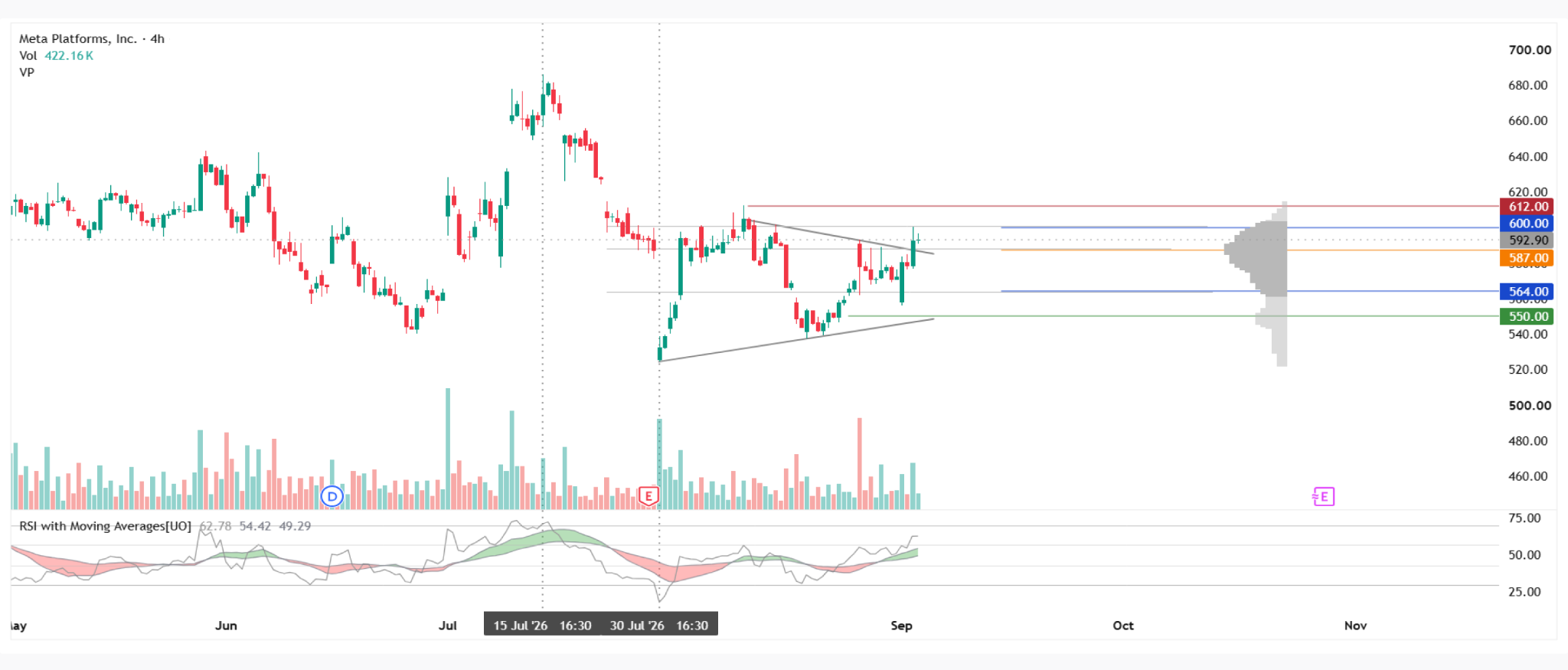
Meta announced on 26 August that it had reached an agreement with a bipartisan group comprising 52 state and territorial attorneys general, together with the Attorney General of the District of Columbia. Under the terms of the agreement, the company is expected to pay approximately $18 billion over ten years and introduce tighter protections for underage users of Facebook and Instagram. These measures include a two-hour daily usage cap and an overnight restriction blocking access to the apps between midnight and 6:00 am.
Of the total amount, around $5.3 billion would only become payable if TikTok and YouTube adopt comparable measures and make equivalent payments. Meta also anticipates recording roughly $10 billion in legal expenses during Q3 2026 as a result of the agreement.
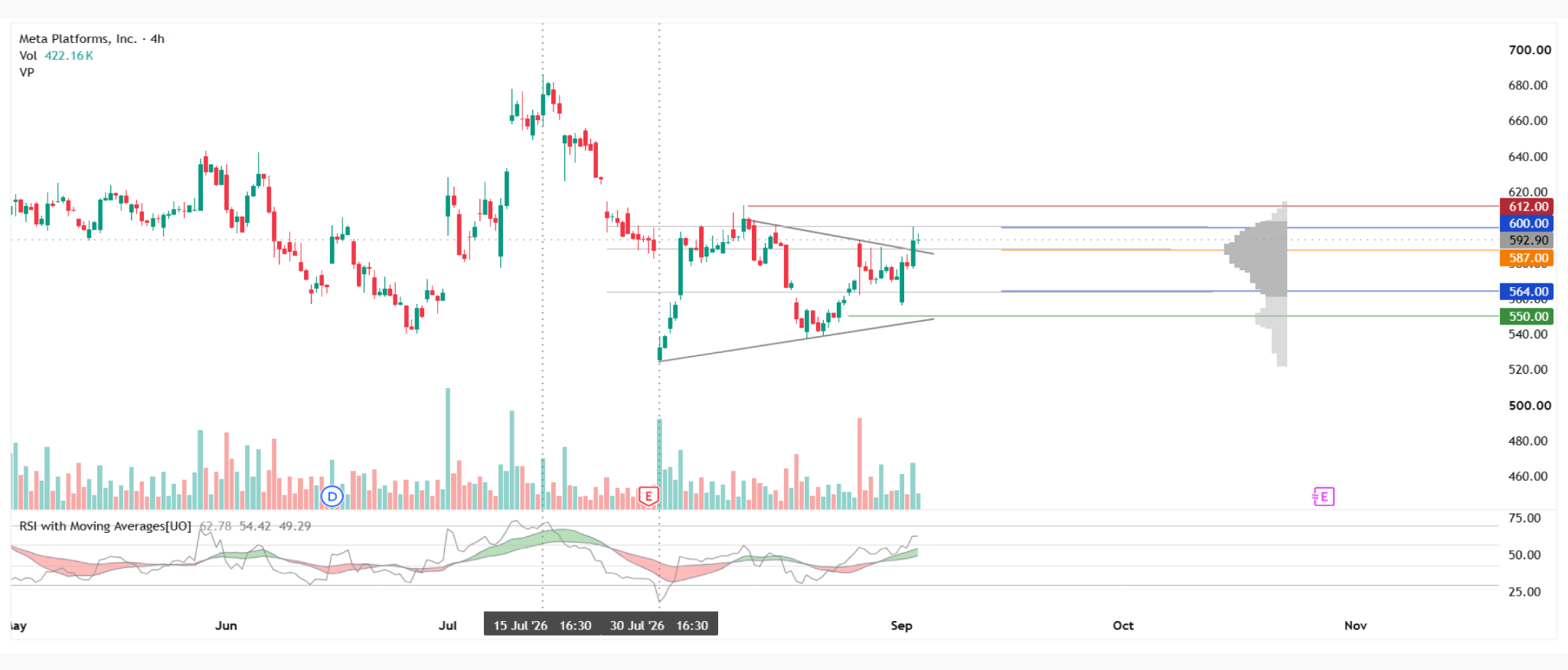
On the four-hour META chart, the medium-term structure remains broadly range-bound, with price continuing to fluctuate between the 690 and 540 areas. During the decline from 15 to 30 July, a converging triangle-like formation developed close to the lower portion of the broader range. Its boundaries gradually contracted as the amplitude of price movements narrowed.
However, the volume profile accompanying the formation is not particularly characteristic of this type of consolidation. This unusual volume behaviour raises some doubt over the reliability of the pattern and whether the subsequent move should be interpreted as a fully confirmed technical breakout.
Following the move above the upper boundary, Meta remains inside the current market profile and is now trading in the relatively narrow zone between the Point of Control (POC) at $587.00 and the profile’s upper boundary at $600.00. Price is effectively attempting to hold above the former pattern.
The next red resistance area sits near $612.00, only a short distance above the profile ceiling. Conversely, a return into the previous structure would become more concerning if price establishes itself below the profile’s lower boundary at $564.00. In that scenario, attention could shift towards the green support around $550.00, which is also positioned relatively close to the profile.
The RSI + MAs indicator currently reads 62, 54 and 49. The oscillator has moved above the neutral area, while the moving averages remain around the neutral zone. As a result, the technical picture has improved, but there is not yet enough confirmation to treat the breakout as firmly established.
Key Takeaways
Meta has managed to remain above the converging structure, but the unusual volume behaviour during the pattern’s development weakens the conviction behind the move. The RSI + MAs readings are also not sufficiently aligned to confirm a decisive change in momentum.
The outlook therefore remains dependent on whether price can sustain itself above the current structure and move through the $600.00–$612.00 area. A failure to hold the breakout zone, particularly a move below $564.00, would increase the risk of a return towards $550.00.
The legal settlement also adds a separate layer of uncertainty, as part of the financial commitment remains conditional on whether Meta’s competitors adopt comparable measures. This leaves both the technical breakout and the broader fundamental backdrop subject to further confirmation.
This article represents the opinion of the Companies operating under the FXOpen brand only. It is not to be construed as an offer, solicitation, or recommendation with respect to products and services provided by the Companies operating under the FXOpen brand, nor is it to be considered financial advice.


Cointelegraph is committed to providing independent, high-quality journalism across the crypto, blockchain, AI, and fintech industries.
All news, reviews, and analyses are produced with full journalistic independence and integrity. For more details on our standards and processes, please read our Editorial Policy.


Australia’s financial regulator issued a final warning on Sept. 2 to crypto businesses relying on temporary enforcement relief.
Summary
- September 30 is ASIC’s deadline for qualifying crypto firms to apply for required financial licences.
- Unlicensed firms operating outside ASIC’s relief conditions may face civil and criminal penalties from October.
- Potential fines can reach 10% of annual turnover for businesses breaching Australian financial services law.
- ASIC recorded more than 45 digital asset licence applications after updating its guidance in 2025.
- Australia’s new Digital Assets Framework begins April 9, 2027, following an eighteen month implementation period.
Qualifying firms have until Sept. 30 to apply for the licences required under existing financial services law.
The Australian Securities and Investments Commission said firms operating without authorization from Oct. 1 could face civil and criminal penalties. Potential fines may reach 10% of annual turnover.
ASIC has recorded more than 45 digital asset-related licence applications since it updated its guidance in October 2025. The figure rose from approximately 30 applications reported when the regulator extended its original June deadline.
The regulator’s warning applies to businesses providing digital asset products or services that qualify as financial products under existing law. It does not mean that every crypto asset or activity automatically requires the same licence.
ASIC’s crypto deadline covers several licence routes
Businesses that require an Australian Financial Services licence must submit a new application or request a variation to an existing licence by Sept. 30. The appropriate route depends on the products and services each company provides.
Firms that need an Australian Market Licence or a Clearing and Settlement facility licence face different conditions. They must notify ASIC in writing that they intend to apply and complete a pre-application meeting before the deadline.
ASIC’s updated Information Sheet 225 provides examples showing how financial product rules can apply to digital assets, custody services, wrapped tokens, staking arrangements and stablecoins. Companies must assess the rights attached to each product rather than relying only on its technical description.
Bitcoin and some other digital assets may not qualify as financial products by themselves. However, related services, investment arrangements or derivatives can still fall within the licensing regime.
The legal distinction has already received attention from Australian courts. In related coverage, crypto.news reported that the High Court ruled 7–0 that Block Earner’s fixed-yield product required a financial services licence.
ASIC’s temporary relief ends on Oct. 1
ASIC introduced its sector-wide no-action position after consulting the industry in December 2024. The relief gave eligible businesses time to review the updated guidance and prepare licence applications.
The regulator initially set June 30, 2026, as the deadline. It later extended the period by three months and expanded the arrangements to cover some authorized representatives and intermediary structures. As crypto.news reported, the extension moved the licensing deadline to Sept. 30.
The no-action position is not a licence, legal exemption or confirmation that a company’s activities comply with the law. It only describes circumstances in which ASIC does not intend to pursue enforcement during the transition.
Companies lose that protection if they fail to meet its conditions. From Oct. 1, ASIC may investigate businesses that appear to provide regulated financial services without authorization.
The warning about fines of up to 10% of annual turnover describes the possible maximum penalty. It does not mean that every unlicensed firm will automatically receive a fine at that level. Courts determine penalties after considering the applicable law and circumstances of each case.
Australia’s 2027 crypto framework is a separate regime
The Sept. 30 deadline concerns duties that already exist under Australian financial services law. It is separate from the Corporations Amendment (Digital Assets Framework) Act 2026.
Parliament passed that legislation on April 1. It received Royal Assent on April 8 and will take effect on April 9, 2027, according to ASIC’s implementation roadmap.
The law establishes dedicated rules for digital asset platforms and tokenized custody platforms. ASIC will license and supervise companies covered by the new categories.
Existing authorizations will remain relevant after the framework begins. Some businesses may therefore need to obtain licences under the current rules and later vary those licences to cover activities regulated by the 2027 framework.
ASIC plans to consult on standards and publish further regulatory guidance during the implementation period. The regulator will also continue meeting with companies and industry groups as the new licensing system takes shape.
Previous crypto.news coverage examined ASIC’s developing approach to stablecoins and wrapped tokens, including how particular products may fall within existing financial regulation.
Crypto firms must decide whether to apply or stop services
Businesses relying on the relief must determine before Sept. 30 whether their activities require an AFS, market or clearing and settlement licence. Firms uncertain about their position may need legal advice based on their products, custody arrangements and customer agreements.
Submitting an application does not guarantee approval. Applicants must satisfy ASIC’s requirements concerning competence, financial resources, compliance systems, risk management and dispute resolution.
Companies that cannot meet the relief conditions may need to stop providing affected services from Oct. 1. Operating while an application is being prepared will not necessarily protect a firm if it missed the applicable deadline.
ASIC’s latest figures show that more than 45 businesses have entered the licensing process. The regulator has not identified those applicants or disclosed how many applications involve exchanges, custodians, tokenization providers or other services.
Enforcement activity may become clearer after the temporary relief expires. ASIC has not announced a specific investigation or prosecution connected to the deadline, but it has stated that noncompliant firms could face both civil and criminal action.


A law firm and a tokenization platform say their proposed structure would give investors legal ownership of cat bonds onchain and could lower the minimum investment.
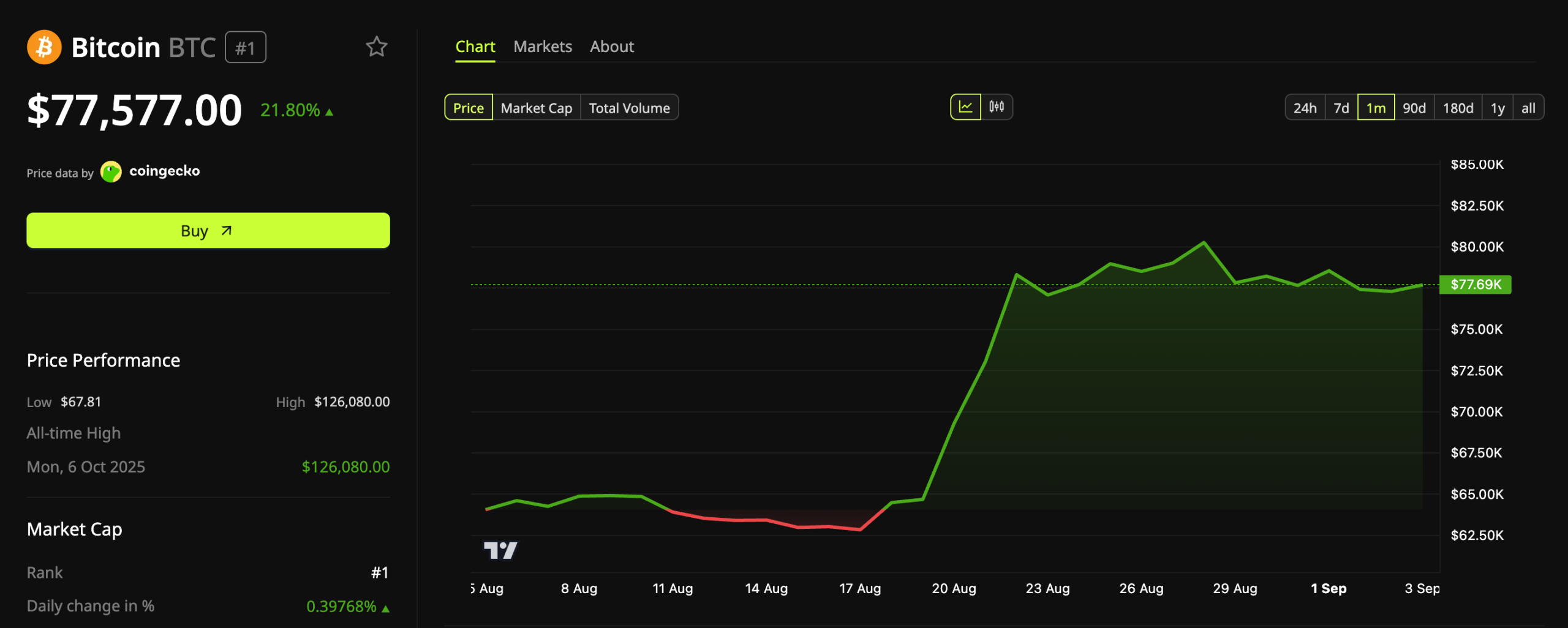
Bitcoin (BTC) price has slipped more than 1% this month, trading at $77,577 as geopolitical tensions and rate expectations weigh on risk assets.
The decline has left traders watching several potential downside levels. One analyst points to $71,000, while seasonal trends suggest a similar target. On-chain data, however, places Bitcoin’s structural support much lower.

Follow us on X to get the latest news as it happens
Head And Shoulders Break Puts $71K In Play
Analysts CryptoGoos and Wealthmanager both identified the formation on four-hour charts. Price has lost the ascending neckline and is testing it from below.
Wealthmanager put $71,000 in play, should that retest get rejected. The same analyst set out the condition that would cancel the setup.
The pattern, therefore, hinges on a single level. Bitcoin reclaiming and holding above the neckline removes the bearish case.
Green Bitcoin August Records Point Lower
Seasonal data also points to further weakness. Bitcoin gained 24.95% last month, marking its strongest August performance since 2017.
Historically, strong August gains have often been followed by September declines. CoinGlass’s monthly return data show four previous instances in which Bitcoin posted a green August and then closed September lower.

Those declines measured 1.76% in 2013, 7.44% in 2017, 7.51% in 2020, and 7.03% in 2021. The median is 7.24%.
Applied to September’s opening price of $78,516 on Binance, that projects $72,831. However, only four instances exist across 13 years. The last three Septembers all closed green. None of them followed a green August.
Glassnode Places The Floor Far Below
Structural support sits well beneath both projections. Glassnode identifies an accumulation floor between $62,000 and $65,000, built during summer consolidation.
The firm also identified a band of long liquidation fuel between $60,000 and $63,000. Meanwhile, heavy long-term holder supply sits between $83,000 and $86,000, capping advances above the current price.
“Until the overhead ceiling is absorbed, the structural floor between $62K and $65K defines the primary downside reference,” the firm said.
The three levels sit far apart. What happens at the neckline may decide which one comes into view first.
Subscribe to our YouTube channel to watch leaders and journalists provide expert insights
The post Where Does Bitcoin Go From Here? This Chart Pattern Says $71,000 appeared first on BeInCrypto.


Ledger has been hit with a proposed class action seeking at least $500 million over allegations that poor security and disclosure failures tied to a December 2023 incident exposed customers to cryptocurrency theft and other financial losses.
Summary
- Ledger faces a proposed class action seeking at least $500 million over alleged security and disclosure failures tied to a December 2023 incident.
- Plaintiff Douglas Kim alleges scammers used compromised customer information to impersonate Ledger representatives before stealing nearly $1.95 million in crypto.
- The complaint cites Ledger’s 2020 breach affecting more than 270,000 customers as part of an alleged pattern of inadequate data safeguards.
- The lawsuit brings seven causes of action and seeks actual, compensatory, statutory, treble and punitive damages.
The complaint, filed by Douglas Kim in the U.S. District Court for the Southern District of New York on Aug. 27, accuses the hardware wallet maker of failing to adequately protect customer personally identifiable information and cryptocurrency security data. Kim brought the case individually and on behalf of a proposed nationwide class.
Kim alleges that Ledger failed to properly notify customers after the December 2023 security incident and did not fully disclose its scope. The lawsuit claims hackers later used customer contact information to impersonate Ledger representatives and gain access to customers’ cryptocurrency wallets and private keys.
The complaint brings seven causes of action, including claims under New York General Business Law Sections 349 and 350, negligence, negligent misrepresentation, promissory estoppel and breach of the implied covenant of good faith and fair dealing.
Ledger lawsuit centers on December 2023 security incident
The December 2023 incident involved Ledger Connect Kit, a software library used to connect hardware wallets with websites and decentralized applications.
The complaint says attackers gained access to the NPMJS account of a former Ledger employee through a phishing attack. Ledger had failed to properly revoke the former employee’s access after their employment ended, according to the filing.
Ledger acknowledged the access control failure at the time, stating that the former employee’s NPMJS access had not been properly revoked.
Once inside the account, the attackers uploaded a malicious version of Ledger Connect Kit that could redirect transactions to addresses they controlled by inducing users to approve malicious transactions. Ledger publicly acknowledged that the malicious software could trick users into signing transactions that drained their wallets.
crypto.news previously reported that a former Ledger employee was phished before an attacker used the compromised access to publish malicious code. Ledger CEO Pascal Gauthier said at the time that the incident was isolated to third party applications and that Ledger hardware wallets remained unaffected.
Estimates at the time put losses from the Connect Kit exploit between roughly $480,000 and $600,000. Ledger later said it would reimburse affected users and announced plans to phase out blind signing for Ethereum virtual machine decentralized applications.
The new lawsuit goes beyond losses reported immediately after the Connect Kit compromise. Kim alleges that hackers accessed and used Ledger customer PII, including names, email addresses and phone numbers, and that Ledger failed to provide customers with sufficient warning about the incident.
Plaintiff says scammers stole nearly $1.95 million in crypto
Kim, who first bought a Ledger hardware wallet around 2017 and purchased a Nano X in New York City in 2021, says he later became the victim of a Ledger impersonation scheme.
On Feb. 18, 2025, Kim received a call from someone claiming to represent Coincover, which the caller presented as a department within Ledger, according to the complaint. The caller allegedly told Kim that someone in the Netherlands had attempted to register for Ledger Recover using his information and that his cryptoassets could be at risk.
A second person then contacted Kim while posing as another Ledger representative and asked him to check his email as proof that the caller was legitimate.
Kim received what appeared to be an email from Ledger, the filing says. The complaint alleges, on information and belief, that the attackers used customer contact information originating from the December 2023 incident to identify him as a Ledger customer and trigger the email. Kim reserved the right to amend that allegation after obtaining Ledger’s breach forensics and incident response records through discovery.
The purported representative directed Kim to a website designed to resemble Ledger’s services and instructed him to enter his confidential passphrase to reset the device, according to the lawsuit. Kim complied and was given what he believed was a replacement passphrase.
Two days later, Kim checked his holdings and discovered that cryptoassets valued at $1,948,074 had been stolen, the complaint alleges. He has not recovered any of those assets.
Ledger customers have continued to face impersonation attempts. In February 2026, scammers sent fake Ledger letters directing recipients to phishing websites designed to collect wallet recovery phrases.
Similar physical mail attacks were reported in April 2025, when scammers reportedly used data leaked in 2020 to send Ledger branded letters containing QR codes that directed customers to websites seeking their recovery phrases.
Complaint points to Ledger’s 2020 data breach
Kim’s lawsuit uses Ledger’s earlier security history to support its allegations of inadequate safeguards.
A 2020 breach affected more than 270,000 Ledger customers, according to the complaint, exposing information that included names, physical addresses and phone numbers. The data later became available on black market channels online. Litigation over that breach was separately brought in the Northern District of California.
The new complaint alleges Ledger failed to sufficiently improve its security practices following that incident and accuses the company of downplaying both the earlier breach and the December 2023 incident.
Kim argues that Ledger’s security representations were particularly important because the company requires customers to provide information when buying its products. The complaint lists names, email addresses, delivery addresses, phone numbers, payment details, product information and order amounts among the customer data collected by Ledger.
Ledger has advertised security measures including encryption, employee training, role based authentication, two factor authentication, continuous system monitoring and independent security testing, according to statements reproduced in the complaint.
The lawsuit alleges those representations were deceptive because Ledger failed to implement adequate measures to protect customer information and did not sufficiently address foreseeable risks after earlier cybersecurity incidents.
Security questions around Ledger resurfaced in August when the company said an Ethereum signing flaw was fixed before another security company publicly disclosed the issue. Ledger CTO Charles Guillemet said users running updated firmware and applications were protected, while no independently verified thefts linked to that specific vulnerability had been reported at the time.
Days later, Ledger rejected claims it was hacked after OneKey’s security team reproduced a transaction substitution flaw using an outdated version of Ledger’s Ethereum application. Ledger said protections had already been added in a newer application version.
Class action seeks at least $500 million
Kim proposes a nationwide class covering U.S. individuals whose PII, cryptoassets, cryptocurrencies or crypto credentials were compromised as a result of the alleged data breach and who suffered financial losses, unauthorized transactions or identity theft mitigation costs. The complaint says the proposed class could number in the thousands.
A separate New York subclass would cover qualifying customers whose transactions with Ledger, including product or service purchases or the creation of Ledger accounts, occurred in New York.
The complaint estimates Kim’s damages at approximately $2 million and claims collective class damages could reach at least $500 million, potentially running into billions of dollars depending on the number of customers affected and the size of individual losses. Those figures are estimates advanced by the plaintiff and have not been established by the court.
Kim’s filing seeks declarations that Ledger violated New York’s SHIELD Act and General Business Law Sections 349 and 350, along with findings of negligence and negligent misrepresentation. The requested relief includes actual, compensatory, statutory, treble and punitive damages, as well as attorneys’ fees and costs.
The plaintiff has demanded a jury trial.




Researchers affiliated with the Bank for International Settlements tested the XRP Ledger as a verification layer for official statistics, according to a working paper published on Sept. 2.
Summary
- BIS researchers tested XRP Ledger Devnet for verifying integrity and origin of official statistical datasets.
- Prototype recorded cryptographic dataset fingerprints rather than publishing the underlying statistics onchain for public verification.
- Controlled tests produced median publication latency of three to five seconds in researchers’ measurements conducted.
- Verification took one to two seconds by comparing files against XRP Ledger records during testing.
- Authors said the experimental system was not intended for production and remains unmaintained prototype software.
The prototype connected the XRP Ledger with Statistical Data and Metadata eXchange, or SDMX, an international standard used by organizations including the BIS to exchange statistical information.
Instead of placing complete statistical datasets onchain, the system calculated cryptographic fingerprints representing the data. It then recorded those fingerprints on the XRP Ledger’s Devnet, allowing a recipient to check whether a downloaded file matched the version originally published.
The experiment does not represent a production deployment, partnership with Ripple or endorsement of XRP as an investment. The paper also states that its conclusions belong to the authors and may not reflect the institutional position of the BIS.
XRP Ledger prototype verifies whether data changed
Official statistics are commonly distributed through websites, databases and automated data feeds. A recipient must trust that the downloaded file is authentic and that its contents have not changed since the publisher released it.
The researchers designed their prototype to provide an independent verification record. Before publication, the software converted an SDMX file into a standardized format and calculated a SHA3-512 cryptographic hash.
A hash functions like a unique digital fingerprint. Changing even a small part of the source file produces a different result. A recipient can therefore repeat the calculation and compare the result with the fingerprint recorded onchain.
The prototype supported checking an entire file or selected statistical series within it. When multiple series were included, the system combined their hashes into a Merkle root. This allowed several data components to share one onchain record while remaining independently verifiable.
The root was anchored through an XRP Ledger transaction. A reference to that transaction was then embedded in the SDMX file, giving recipients the information required to locate the onchain record and complete the comparison.
The design means the XRP Ledger did not establish whether the statistics themselves were accurate. It only provided evidence that the verified data matched the version connected to the original record.
BIS researchers reported verification within seconds
The paper reported median publication latency of approximately three to five seconds under controlled testing conditions. Verification took approximately one to two seconds.
Publication latency covered the process of creating and confirming the blockchain record. Verification involved recalculating the fingerprint and checking it against information stored in the relevant XRP Ledger transaction.
Those results should not be treated as guaranteed performance under production conditions. The researchers conducted the measurements through an experimental system operating on XRPL Devnet rather than the public main network used for real transactions.
Devnet supplies test XRP through a faucet and allows developers to experiment without using assets carrying market value. Its activity, reliability requirements and operating environment differ from those of the XRP Ledger mainnet.
The researchers selected XRPL partly because of its relatively fast transaction confirmation and low transaction costs. However, the experiment did not compare XRPL performance directly against Ethereum, Solana, permissioned databases or conventional digital timestamping services.
The code was released in a public BIS repository. Its documentation describes the software as an experimental proof of concept that is neither intended for production nor actively maintained.
Identity checks strengthen the statistical record
Confirming that data has not changed solves only part of the verification problem. A malicious actor could create a valid hash for a fraudulent file and publish it from an unrelated blockchain address.
The prototype addressed that risk with a publisher identity system. It used a W3C Verifiable Credential signed by an identity key associated with the publisher’s XRP Ledger address.
A recipient could use that credential to check that the party publishing the file controlled the recognized address. The verification process therefore assessed both data integrity and publisher identity.
The SDMX message carried the transaction reference, ordered Merkle leaves and credential required for the check. A verifier could reproduce the root from the received file and compare it through one ledger lookup.
The researchers said the architecture could eventually support zero-knowledge proofs. Such technology could let an organization prove selected facts about restricted data without disclosing the full dataset.
They also identified potential use by artificial intelligence agents. Automated systems increasingly retrieve statistics without a person manually confirming each source. A machine-readable verification record could allow software to reject altered or incorrectly attributed files.
These remain proposed extensions. The published repository provides experimental code rather than a production service for central banks, national statistics agencies or AI companies.
XRP Ledger use case does not require XRP adoption
The prototype used XRP Ledger infrastructure because every onchain record requires a transaction. However, it did not use XRP for payments, liquidity, settlement or cross-border transfers.
Only a small transaction fee would be required to anchor each record on mainnet. The amount would depend on network conditions and the publication method selected by an institution.
That distinction matters because use of the XRP Ledger does not necessarily create material demand for its native asset. A data publisher could anchor many statistical series through a single Merkle root, reducing the number of transactions required.
The experiment nevertheless extends the types of applications tested on XRPL beyond payments and tokenized financial assets. The network is also developing institutional features covering permissioned trading, lending and asset issuance.
In related coverage, XRP Ledger’s institutional infrastructure has expanded through permissioned markets and native lending proposals. Those financial applications are separate from the BIS researchers’ statistical verification system.
The network’s activity has also become more concentrated. XRP Ledger order-book volume rose 79% while daily traders declined during the second quarter, according to research published by Evernorth.
Neither development establishes that the statistical prototype will enter production. They provide broader context for the different financial and nonfinancial applications being tested across the XRP Ledger ecosystem.
Production adoption would require further testing
The prototype would need additional security, governance and operational work before an official statistics provider could rely on it. Institutions would need policies governing publisher keys, compromised credentials, transaction failures and corrections to previously issued datasets.
The permanence of blockchain records creates another challenge. Official statistics are frequently revised after agencies receive new information or correct errors. A production system must distinguish legitimate revisions from unauthorized alterations without suggesting that the earliest version remains current.
Publishers would also need to decide whether to depend on a public blockchain, run additional infrastructure or combine blockchain records with existing digital signature systems. Privacy rules may restrict which metadata can appear in public transactions.
The authors said their approach is not limited to SDMX. It could be adapted for other structured formats, including XBRL, which companies and regulators use for financial reporting.
No implementation deadline was provided. The repository states that the software is unmaintained, and the BIS has not announced plans to deploy it across its official statistical publications.
The verified result is therefore narrower than claims that the BIS adopted the XRP Ledger. BIS-affiliated researchers demonstrated that an experimental system could use XRPL Devnet to authenticate statistical files within seconds under controlled conditions.

The US Securities and Exchange Commission (SEC) is weighing how to regulate the next wave of “novel” exchange-traded products, and major crypto investors are pushing back on a one-size-fits-all approach. In public comments posted in late August, venture capital firm a16z, digital asset investment manager Grayscale, and the Crypto Council for Innovation (CCI) urged the regulator to preserve existing classifications and review products based on their specific risk profiles rather than sweeping new products into a separate regulatory bucket.
The submissions were filed around the close of the SEC’s 60-day public comment window following the agency’s June 30 request for feedback on whether current rules adequately cover novel ETFs and whether the approval and registration process should be changed. The commenters broadly agreed that the SEC should avoid blanket restrictions that could inadvertently force additional Investment Company Act requirements on funds that hold assets the SEC would otherwise treat differently.
Key takeaways
- Crypto firms want product-by-product risk review rather than categorical limits on “novel” ETF structures.
- a16z, Grayscale, and CCI oppose sweeping changes to investment-company classifications that could automatically pull some non-securities holdings into the Investment Company Act framework.
- All three supported more predictable review paths, including coordination between fund-registration and exchange-listing processes.
- The commenters diverged on ETF terminology—a16z ties the label to the Investment Company Act wrapper, while Grayscale focuses on the product’s economic characteristics.
- CCI asked for clearer disclosures rather than radical changes to the approval approach.
Why the SEC’s “novel ETF” review matters
The SEC opened its consultation on June 30, asking whether existing ETF-related regulations remain sufficient for novel products and whether the agency should alter how such funds are registered and listed. That matters to crypto market participants because ETF/ETP frameworks can strongly influence capital access, liquidity, and the compliance burden for issuers.
In their comments dated Aug. 31, the industry’s message was consistent: regulatory efficiency should improve without lowering investor protections—or creating new, automatically triggered requirements that could slow down launches. The SEC’s solicitation did not simply concern how to treat a single issuer or product; it sought general guidance on whether the agency should rewrite the conceptual boundaries for what qualifies as an ETF, and how quickly it should review new structures.
“Avoid categorical restrictions” — a shared warning to the SEC
Across the three letters, the central push was to prevent a blanket restriction on “novel” exchange-traded funds. a16z argued that crypto-based ETPs now operate within more mature market infrastructure, including exchange listing standards and established disclosure requirements. In its view, that maturity makes it inappropriate to lump these products together with funds that may hold private assets or use other genuinely experimental strategies.
Grayscale’s stance similarly emphasized continuity: it said digital asset products with established compliance and disclosure practices should not be forced into new portfolio restrictions or new disclosure regimes solely because they are described as “novel.” CCI, meanwhile, said the SEC should aim for regulatory efficiency across both ETF and non-ETF exchange-traded products, while still preserving the investor protections already embedded in the current approach.
All three commenters also opposed changing investment-company classifications in a way that could automatically sweep products holding non-securities into the Investment Company Act framework. That point is not just technical. The Investment Company Act framework can materially affect fund operations, documentation, and the pace of approval—so the commenters’ argument is that the SEC should ensure any additional burdens are tied to specific risk characteristics, not labels.
Different paths to clarity: classification, procedures, and terms
Although the letters align on resisting categorical regulatory shifts, they do not fully agree on how clarity should be implemented. One prominent difference concerns what should qualify to be called an “ETF.”
a16z proposed that the term “ETF” should be reserved for funds operating under the Investment Company Act of 1940. Grayscale, by contrast, argued that “ETF” should describe the economic characteristics of a product, regardless of the particular legal wrapper used to structure it.
Beyond terminology, the commenters offered procedural suggestions. a16z asked the SEC to coordinate fund-registration and exchange-listing reviews and to adopt more predictable timelines, reflecting a concern that the current process may create avoidable uncertainty when products move through multiple regulatory stages.
Grayscale and CCI supported optional confidential pre-filing processes. In practical terms, the idea is that issuers could reduce friction by engaging with the regulator earlier—before public filings—while still benefiting from the normal review lifecycle.
CCI’s recommendation focused on disclosure rather than a framework overhaul. It urged the SEC to create clearer “registration-status” disclosures, arguing that investors should better understand the regulatory posture of a given product without forcing a drastic change to the approval framework itself.
Where the SEC could draw lines next
The SEC is seeking feedback on whether existing rules are adequate and whether the process should change. Based on the comments, the industry appears to be offering the regulator a roadmap that starts with segmentation: treat products according to underlying risk parameters instead of a blanket category for “novel” offerings.
However, the disagreement on ETF terminology hints at a broader uncertainty the SEC will still need to address: whether the regulator wants to anchor categories to legal form or to how investors experience the product economically. Even if the SEC adopts a risk-based review standard, the way it labels products could influence how exchanges and issuers design and market future offerings, as well as how investors interpret regulatory equivalence.
For investors and market watchers, the next signal to watch is how the SEC responds to these competing recommendations as it moves from public comment to any proposed policy refinements. Until then, issuers will likely continue calibrating their filing strategies to emphasize established disclosure/compliance records, while attempting to reduce review uncertainty through procedural pathways such as pre-filing engagement.
With the SEC weighing whether its “novel ETF” framework should change at all—and if so, how—readers should monitor whether the agency clarifies that investor protections and review rigor will be preserved without automatically expanding Investment Company Act coverage, and whether any final guidance addresses the practical question of timelines and transparency for product registration status.


In 2026, the crypto mining industry is witnessing new ways to participate. Against the backdrop of a maturing global cryptocurrency market, more and more digital asset holders are rethinking a key question: how to generate continuous income from cryptocurrencies without frequent trading or asset sales.
Recently, the cloud mining platform FTmining has attracted attention in the crypto mining sector. Cryptocurrency holders report that participating in cloud mining through this platform is generating a stable and sustainable cash flow.
The shift from “holding and waiting” to “participating in mining”
For a long time, cryptocurrency investors have primarily adopted a “buy and hold” strategy, with returns highly dependent on market fluctuations. While this approach can yield substantial returns in bull markets, it often fails to generate real cash income during periods of volatility or consolidation.
In this context, FTmining cloud mining, as a non-trading mining participation model, is gradually being accepted by more crypto asset holders. By renting computing power to participate in blockchain network mining, users can obtain continuous returns without selling their digital assets.
What is a cryptocurrency mining platform?
Before learning about FTmining, many users will first ask a basic question: What is a cryptocurrency mining platform?
Simply put, a mining platform is a service system that allows users to participate in blockchain network computation, verify transactions, and earn block rewards. Traditional mining usually requires purchasing mining rigs, deploying facilities, and bearing maintenance and electricity costs, while cloud mining platforms lower the barrier to entry for ordinary users through centralized management.
What is FTmining?
FTmining is a comprehensive cryptocurrency service center that integrates tools for managing digital assets, investing, and mining on a single platform. One of its core businesses is its cloud mining service, allowing users to start earning cryptocurrency in about a day without assembling hardware or performing subsequent maintenance. The operator handles installation, maintenance, and energy arrangements, making it easy for beginners to get started. These mining rigs are located near major wind farms worldwide, benefiting from reliable energy supplies, which helps reduce operating costs, minimize footprint, and ensure stable operation.
Platform Security and Service Guarantee
To protect user assets and account security, FTmining has introduced multiple protection mechanisms in its platform architecture:
Two-Factor Authentication (2FA): Enabling this feature ensures that only the account holder can access and operate the account, effectively preventing unauthorized logins.
24/7 Multilingual Customer Support: FTmining provides 24/7 multilingual customer support and has a priority channel for account-related issues, ensuring users can receive timely assistance at any time.
Real-Time Security Monitoring System: The platform monitors account activity in real-time around the clock. Upon detecting abnormal or suspicious behavior, security mechanisms are immediately triggered, further enhancing asset protection capabilities.
How to start mining with FTmining?
Getting started with FTmining is easy in just a few simple steps:
Step 1: Register an Account:
Visit the official FTmining website: https://ftmining.com
Enter your email address and password to create an account.
New users receive a $15 sign-up bonus and enjoy a daily $0.75 login bonus.
Promotional offers are available, including a free trial. These offers are very useful if you want to test the waters on a small scale before going all in.
Step 2: Support for Diverse Cryptocurrencies
Choose supported cryptocurrencies. Users can deposit various crypto assets, including:
Major cryptocurrencies such as BTC, USDT, ETH, LTC, USDC, XRP, and BCH.
Step 3: Choose a Contract
For cloud mining, FTmining offers a range of contracts to meet different budgets and goals. Whether you need a short-term trial or a multi-year plan, there’s always a solution for you.
For example:
Entry-level contract: $100 — 2-day cycle — Total profit approximately $108
Stable contract: $800 — 5-day cycle — Total profit approximately $852.8
Professional contract: $5000 — 20-day cycle — Total profit approximately $6520
Advanced contract: $25000 — 28-day cycle — Total profit approximately $38300
For more contract details, please visit the official website.
After completing the above steps, your FTmining contract will run in the background. You can monitor the results in the control panel, and you can withdraw to your personal wallet or purchase more contracts to increase your computing power.
User perspective: Mining revenue is becoming an important supplement
Several cryptocurrency holders have stated that FTmining cloud mining is changing their perception of how they use digital assets.
Smith, an investor from New York, stated:
“By properly allocating computing power contracts, my passive income is steadily increasing every month, without the need for high-frequency trading. This highly automated mining participation method is ideal for long-term cryptocurrency holders.”
Kyle Jennings, an investor from Canada, also pointed out:
“I don’t want to sell my Bitcoin, but I want it to generate real returns. FTmining has enabled me to achieve this goal, and now my assets are generating returns every day.”
Industry Perspective
Industry observers point out that the attention FTmining’s cloud mining model has garnered reflects the rising demand from investors for “stable returns” and “automated asset management.” With continuous improvements in compliance, security, and automation technologies, FTmining’s cloud mining model provides cryptocurrency holders with a new asset management approach, making “passive income” a realistic and achievable goal.
Conclusion
In the volatile environment of the cryptocurrency market, cloud mining provides investors with an easy, barrier-free way to earn daily returns. Whether you are a novice investor or an experienced digital asset holder, you can steadily increase your wealth through cloud mining, making your investments more efficient.
Official Website: https://ftmining.com
App Download: https://ftmining.com/xml/index.html#/app
Customer Service Email: [email protected]

Heathrow expansion ‘a risk we cannot afford to take’, says mayor

Meta Analysis: Breakout Holds, but Unusual Volume Leaves the Move in Question

How Jen Aniston’s Relationship With BF Jim Curtis Has Evolved





-

 Fashion6 days ago
Weekend Open Thread: Maeve – Corporette.com
-

 Crypto World6 days ago
Bitcoin’s 22% rally now needs real demand to outlast Treasury liquidity boost
-

 Business6 days ago
Apple Confirms September 9 Keynote and Reveals Its Full Pre-Order Schedule
-

 Business6 days ago
Salesforce Stock Soars 19% as Blowout Earnings and Agentforce AI Growth Silence Software Skeptics
-

 Business5 days ago
Onto Innovation Stock: AI’s Next Bottleneck Is Yield (NYSE:ONTO)
-

 Crypto World9 hours ago
CLARITY Act could advance within weeks, Atkins says
-

 Crypto World5 days ago
Bitcoin price tests $82K resistance as Brandt stays long
-
 Tech4 days ago
Hugging Face built a $4.5 billion empire on free AI models. Now Nvidia is buying it for $12.9 billion
-

 Business6 days ago
iPhone 18 Pro Pre-Orders Could Shift to Saturday as Apple Reportedly Avoids September 11 Anniversary
-

 Crypto World6 days ago
Truflation calls for Fed rate cut after PCE forecast
-

 News Videos4 days ago
Charlie Munger on Robinhood: No one should believe that Robinhood’s trades are free
-

 Tech5 days ago
PaperCut releases second emergency patch for exploited flaws
-
 Business7 days ago
AI Assistant Startup Instinct Rockets to $2.5 Billion Valuation in Weeks Amid Investor Feeding Frenzy
-

 Tech6 days ago
The fix for the AI agent that hijacked a company’s DNS: it can propose the change, but it can’t approve it
-
 Entertainment6 days ago
‘Adults’ Creators Break Down Season 2’s Most Shocking Moments and Tease a Potential Season 3
-

 Tech4 days ago
Tamagotchi Ring Takes the 30-Year Digital Pet and Places it on Your Finger
-

 Tech4 days ago
As the influencer economy drives retail sales, Seattle startup raises $22M to play matchmaker
-

 Crypto World1 day ago
Elon Musk Says Grok 4.7 Lands in 10 Days and Will Beat Every Model
-
 NewsBeat4 days ago
Trump posts AI video of ‘Lake America’ being protected by an army of bequiffed ‘Donald Ducks’
-
 Crypto World1 day ago
Bitcoin slips below $77.5K as macro pressure offsets ETF inflows
You must be logged in to post a comment Login