
Crypto World
In quiet crypto markets, yield is the trade

Welcome to our institutional newsletter, Crypto Long & Short. This week:
- Maxime Seiler notes that weak crypto prices mask adoption, making yield strategies the main trade.
- Kavita Maharaj‑Alexander writes on crypto’s next phase being driven by proving compliance in practice, elevating the infrastructure providers that enable it.
- Top headlines institutions should pay attention to by Francisco Rodrigues.
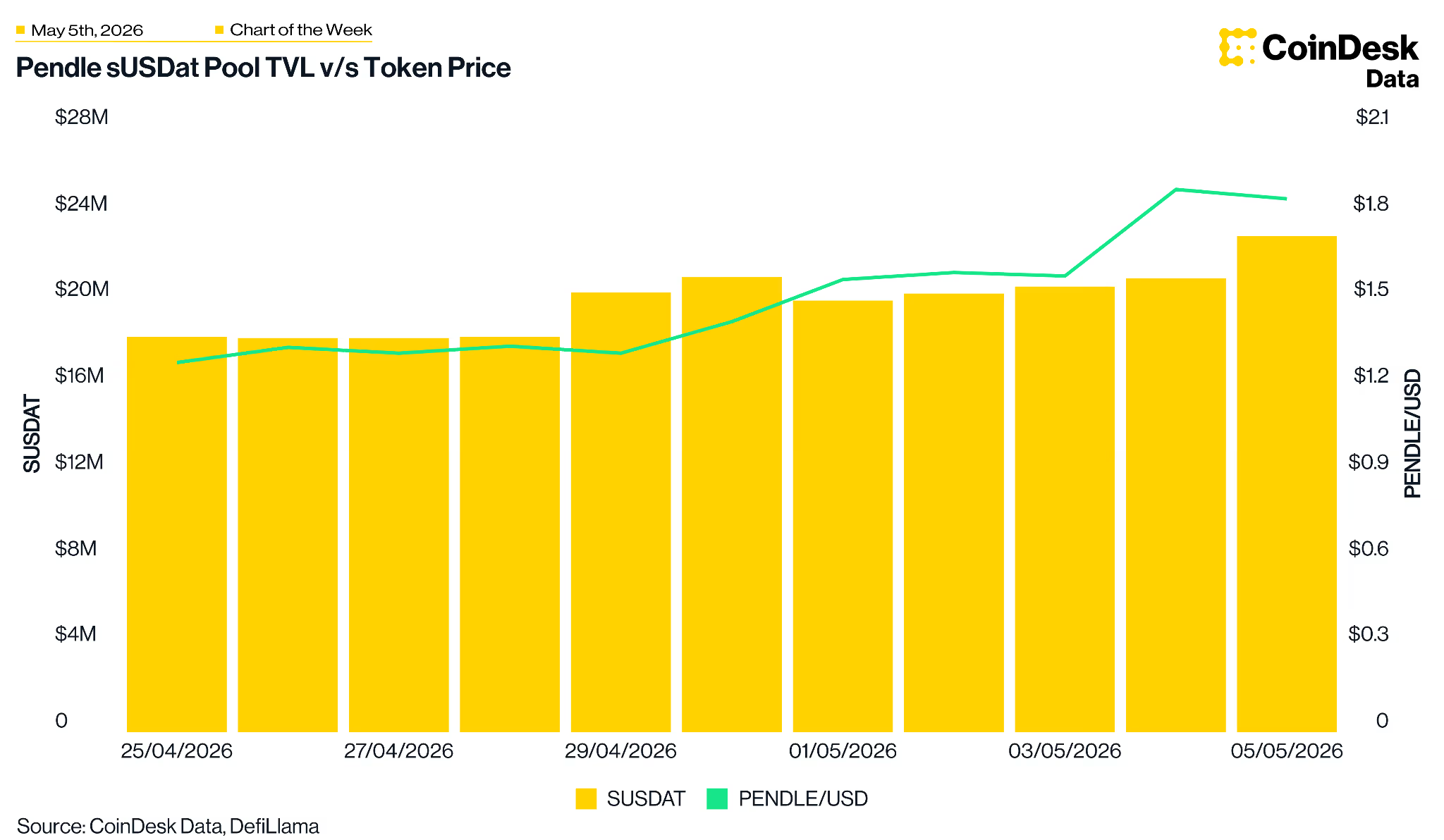
- PENDLE rallies on demand for on-chain STRC yield exposure in Chart of the Week.
Expert Insights
In quiet crypto markets, yield is the trade
By Maxime Seiler, co-founder and chief executive, STS Digital, Ltd.
For much of the last six months, crypto markets have felt unusually quiet. Not dead, but tired. While bitcoin has held up better than most, much of the altcoin market has remained in what can only be described as a bear market. Liquidity has been thinner, follow-through has been weaker and the risk appetite that typically fuels broad-based crypto rallies has been missing.
That is the surface-level story. Underneath it, however, the picture looks very different.
Institutional adoption of digital assets continues to move at record pace. Across mainstream financial services, the build-out is no longer theoretical. Banks, asset managers, payment companies, custodians and infrastructure providers are developing products and capabilities to support tokenization, stablecoins, digital asset custody, trading, settlement and portfolio access. In previous cycles, institutional involvement was often discussed as something that might happen one day. Today, it is happening, but much of it is not yet reflected in token prices.
That disconnect is important. The market has been pricing short-term disappointment, while infrastructure is being built for long-term adoption.
Part of the recent weakness is understandable. The U.S. government created significant expectations around digital assets, but the pace of follow-through has slowed. Markets do not like uncertainty, and crypto markets in particular are quick to discount momentum when policy clarity fails to arrive as fast as expected. At the same time, a meaningful amount of global technical and investment talent has shifted toward artificial intelligence. AI has become the dominant narrative in technology, pulling attention, capital and brainpower away from crypto in the short term.
But these two worlds are unlikely to remain separate forever.
One of the most interesting open questions is how AI agents will eventually transact. If autonomous software agents are going to pay each other, pay merchants, access services, settle invoices, move value across borders or interact with financial applications, they will need payment rails that are programmable, global and available 24/7. Stablecoins and permissionless financial infrastructure are often discussed as potential candidates. DeFi may end up playing a role not because it is ideological, but because it is practical. Machines do not need bank branches. They need APIs, instant settlement and reliable liquidity.
That future may still be a year or more away from meaningful scale. For crypto asset holders, the more immediate question is simpler: what do you do while waiting?
This is where quiet markets can be useful. Bear markets are uncomfortable, but they often create some of the best conditions for disciplined yield generation. When spot prices move sideways and speculative momentum fades, investors are forced to focus less on direction and more on income, carry and risk management. In that environment, options become one of the most useful instruments available.
Options allow investors to monetize volatility, express views with defined parameters and generate yield on existing dollar or crypto holdings. For holders who are not looking to sell long-term positions, structured options strategies can be used to generate income while markets consolidate. For dollar holders, they may offer a more systematic approach to earn enhanced yield while waiting for better entry points. For crypto holders, they can turn otherwise idle assets into productive collateral.
This is exactly the type of environment where volatility selling and structured yield enhancement strategies may perform well in certain conditions, provided they are implemented with proper risk controls. The goal is not to chase yield blindly. The goal is to harvest quiet markets in a disciplined way.
At STS Digital, we have seen growing client demand for these types of strategies. Investors are not necessarily trying to call the exact bottom of the altcoin market. They are looking for ways to stay engaged, earn income and position themselves for the next phase of adoption without relying purely on spot price appreciation.
Crypto has always rewarded patience, but patience does not have to mean inactivity. The next wave of adoption may already be forming beneath the surface. For now, until it shows up in price, yield is the trade.
Disclaimer: For information purpose only. Not financial advice. Client acceptance subject to conditions.
Principled Perspectives
The quiet infrastructure powering digital asset maturity
By Kavita Maharaj‑Alexander, deputy general counsel, Ascentium
As digital assets move into more structured environments, the industry’s next phase is being shaped less by new rules and more by the operational realities of meeting them. The shift reflects a broader truth: regulatory frameworks matter, but the ability to evidence compliance matters more. Whether an entity is licensed, exempt or unregulated, expectations around governance, financial crime controls, risk management and demonstrable controls are rising. This has elevated a category of service providers that rarely attract attention but increasingly facilitate the operationalisation of digital asset projects: the regulatory infrastructure providers supporting governance, compliance and operational continuity.
These providers deliver the practical functions that sit between policy and practice, including registered office services, financial crime compliance, independent directorships, administration and governance support. They do not hold client assets or operate trading platforms. Instead, they support the operational spine that enables entities to demonstrate substance, oversight and continuity. As more jurisdictions move from drafting frameworks to supervising their implementation, this infrastructure has become essential to the responsible operation of digital asset businesses.
The distinction between formation, regulatory authorisation and operational readiness is now central. Regulatory authorization, whether registration or licensing, establishes status but does not on its own demonstrate operational capability. Whether an entity is structured as an LLC or a foundation company, or authorised as a VASP, these forms provide legal personality or regulatory status, not governance in the operational sense. Policies and procedures demonstrate awareness, not implementation. Regulators and institutional counterparties increasingly expect evidence of functioning controls, documented oversight, and the practical execution of obligations. This is where regulatory infrastructure providers play their most important role.
The Cayman Islands offers a clear illustration of how this infrastructure functions in practice. The jurisdiction has moved from initial registration to licensing under its Virtual Asset Service Providers Act. This is accompanied by supervisory evaluation of controls, with thematic reviews focused on demonstrable AML/CFT controls, governance and risk‑based internal controls. Recent legislative updates, including the 2026 amendments streamlining tokenised fund structures, further reflect a shift toward practical implementation and operational clarity.
For globally distributed teams, local regulatory infrastructure providers — from AML officers to independent directors and administrators — often provide the practical means to meet these expectations. The same applies to foundation companies, which are increasingly used by DAOs and crypto projects seeking legal personality and operational continuity. Even when these structures fall outside formal regulation, institutional participants still expect governance discipline, conflict management and reliable oversight. Cayman’s digital asset ecosystem is supported by a mature network of governance, fiduciary, compliance and administrative providers who translate regulatory requirements into day‑to‑day practice, enabling entities to demonstrate functioning controls and maintain governance continuity.
The industry has long called for regulatory clarity, and while meaningful progress has been made, clarity alone does not create the conditions for appropriate compliance or operational efficiency. Operational capability does. The firms that succeed in the next phase of digital asset maturation will be those that place early emphasis on appropriate governance, financial crime controls and risk management; and the jurisdictions that thrive will be those with the infrastructure to support consistent, demonstrable implementation.
Digital assets are entering a period where the quality of execution will matter more than the ambition of policy. In that environment, regulatory infrastructure providers are becoming the quiet enablers of which firms, and which jurisdictions, are prepared for the realities of a more institutional market.
Headlines of the Week
Traditional finance and crypto are continuing to converge through tokenization and stablecoin adoption, even as regulators on both sides of the border move to tighten the rules.
- Wall Street giant DTCC plans tokenized securities platform with July pilot, October launch: The Depository Trust & Clearing Corporation, custodian of over $114 trillion in securities, will begin limited tokenized trades in July ahead of an October launch, with input from BlackRock, Goldman Sachs, JPMorgan, Anchorage and Circle.
- Crypto industry backs CLARITY Act yield compromise, pushes Senate Banking for markup: Senators Tillis and Alsobrooks released text barring stablecoin yield equivalent to a bank deposit while carving out rewards tied to “bona fide activities,” prompting Coinbase, Circle and the Blockchain Association to call for a markup.
- Tether posts $1.04 billion Q1 profit, reaches $8.23 billion reserve buffer: The USDT issuer reported $192 billion in assets against $183.5 billion in liabilities, with reserves now including about $20 billion in physical gold and $7 billion in bitcoin.
- Canada proposes ban on crypto ATMs as fraud cases mount: Ottawa’s Spring Economic Update calls for eliminating crypto ATMs nationwide, with officials citing FINTRAC findings that label the machines a “primary method” for scams and laundering.
- The $292 million crypto hack exposed DeFi’s weak spots. Here’s what must change, insiders say: Industry figures told CoinDesk the Kelp DAO exploit is a “speed bump, not a roadblock” for institutional DeFi, but argued zero-trust architectures, timelocks, stricter multi-sig controls and tighter bridge safeguards must become baseline before TradFi giants can scale onchain.
Chart of the Week
PENDLE rallies on demand for on-chain STRC yield exposure
PENDLE is up 44% over the past 11 days, coinciding with the launch of the Saturn sUSDat pool. sUSDat is the staked version of USDat — a tokenized claim on STRC’s dividend stream and price exposure. The pool has scaled to $22 million since launch, making Pendle one of the few venues to express the Strategy Stretch (STRC) trade on-chain

Listen. Read. Watch. Engage.
Looking for more? Receive the latest crypto news from coindesk.com and market updates from coindesk.com/institutions.



Liquidity provision in digital assets is no longer measured only by quoted spreads on exchanges. Institutional clients need firms that can price size, support bilateral execution, manage settlement across venues, and stay active when traditional markets are closed.
Wintermute has built its business around that demand. The firm is nominated for Best Liquidity Provider at the BeInCrypto Institutional 100 Awards 2026.
Average Daily Volume
$15B+ across CeFi and DeFi
Trading Pairs
3,000+ asset pairs supported
Connectivity
60+ centralized and decentralized venues
OTC Desk
Institutional digital asset execution across crypto and tokenized assets
Regulatory Standing
UK FCA registered
Asset Coverage
Native crypto, stablecoins, tokenized gold, oil exposure, tokenized money market funds
Execution Access
Chat, API, CeFi venues, DeFi protocols
Wintermute Liquidity Provider Snapshot
The nomination reflects Wintermute’s role as a global algorithmic trading firm and OTC desk serving institutional digital asset markets. Its business spans centralized exchanges, decentralized protocols, bilateral OTC execution, and tokenized real-world assets.
For the Best Liquidity Provider category, size alone is not enough. The award assesses whether a firm can support institutional execution across market conditions, asset classes, and settlement environments. Wintermute’s nomination is anchored in that broader role.
The OTC Desk Behind Institutional Flow
Wintermute’s OTC desk sits at the center of its nomination.
For institutional clients, liquidity is often judged away from the visible order book. Asset managers, allocators, tokenization issuers, and trading firms need block execution, same-day settlement, weekend coverage, and access to long-tail pairs without creating unnecessary market impact.
Wintermute supports more than 3,000 asset pairs across 60+ centralized and decentralized venues. The firm transacts more than $15 billion in average daily volume across CeFi and DeFi, with access through chat, API, exchange venues, and DeFi protocols.
That breadth matters because institutional flow is becoming more complex. A client may need a stablecoin settlement leg for a cross-border transaction, a rebalance involving a tokenized money market fund, or weekend exposure to a tokenized commodity while traditional markets are shut.
Wintermute’s OTC desk is designed for that environment. It gives clients access to institutional-sized execution across native crypto assets, stablecoins, and tokenized real-world assets from a single liquidity provider.
A Market-Neutral Liquidity Model
In an interview with BeInCrypto, David Micley, Managing Director of Americas at Wintermute, described the firm’s approach as market neutral.
“Wintermute is a market-neutral liquidity provider. Regardless of whether the market goes up or down, we want to make sure we are in a position to generate positive P&L, assume worst-case scenarios, and not just survive but thrive through all economic environments,” Micley said.
That model is important in a category built around resilience. Liquidity providers must remain active through volatility, exchange stress, geopolitical shocks, and changing regulations.
Institutions rely on desks that can continue quoting and settling when market conditions are not clean.
Pricing the Tokenized Market
Wintermute’s nomination also reflects its role in tokenized assets.
The firm is already active in tokenized gold, stablecoins, tokenized money market fund flows, and weekend commodity exposure. Micley noted that tokenized commodities are solving a real market problem by allowing exposure outside legacy trading hours.
Weekend oil exposure is one example. When geopolitical events move during closed market hours, tokenized markets can give participants a way to hedge or adjust exposure before traditional venues reopen.
Tokenized gold is another important area. Wintermute has highlighted growing activity in digital gold products, with tokenized gold volumes across supported segments surpassing the combined volume of several major gold ETFs.
For institutional liquidity providers, this shows how tokenized commodities are becoming a live execution market rather than a future concept.
Why the Nomination Stands
Wintermute’s nomination for Best Liquidity Provider rests on three factors.
The firm has a regulatory posture that institutions can underwrite, including UK FCA registration. Second, its $15 billion+ average daily volume and 3,000+ supported pairs show the scale of its institutional execution footprint.
Also, its expansion into tokenized commodities, stablecoin settlement, and RWA liquidity places it in the part of the market where institutional crypto is moving next.
The BeInCrypto Institutional 100 Awards recognize firms building the systems that could define the next phase of digital finance. Wintermute’s nomination reflects its role in providing the liquidity layer behind a 24/7 market spanning crypto-native assets and tokenized real-world assets.
The post BeInCrypto 100 Institutional Awards Nomination: Wintermute for Best Liquidity Provider appeared first on BeInCrypto.


MIAMI BEACH, Fla. — Nasdaq President Tal Cohen said the U.S. Securities and Exchange Commission’s (SEC) changing approach to crypto regulation is giving market operators more room to experiment with blockchain-based infrastructure and tokenized assets.
Speaking at Consensus in Miami on Wednesday, Cohen said the industry now feels it can “build” again after years of regulatory uncertainty.
“The gray zone four years ago was a no-fly zone,” Cohen said. “The gray zone now is we can build. We can gain some scale. We can experiment without maybe any brush back.”
Cohen described a broader shift inside financial markets toward “always on” trading systems that operate nearly around the clock and move money, securities and collateral faster than traditional infrastructure.
Nasdaq, which provides trading technology to more than 130 markets globally, is investing in blockchain infrastructure, tokenization and artificial intelligence as part of that transition, Cohen said.
“We’re embracing two trends,” he said. “Always on market infrastructure” and “convergence” between traditional financial rails and digital asset systems.
Cohen said interoperability between those systems remains one of the largest hurdles for the industry. Firms do not want to operate separate infrastructures for traditional securities and tokenized assets, he said.
“Whether you’re in the existing world or you’re in the digital world, let me tell you, I’m bringing it all together for you so you get the benefits of both,” Cohen said.
He also pointed to a more collaborative stance from regulators.
“The SEC is much more constructive,” Cohen said. “It’s not even open mindedness. It’s a proactivity.”
Cohen said tokenization could eventually make assets easier to move, finance and trade while giving issuers better insight into shareholders.
“What it really does is take an asset and put it in motion,” he said.
Nasdaq is also testing AI systems designed to simulate trading activity in a digital replica of its matching engine. Cohen said the technology could help the exchange test market stress scenarios and improve software reliability as markets move toward extended trading hours.
Crypto World
Bitcoin-real estate strategy could outperform REITs, says Grant Cardone. Adds more BTC to treasury.
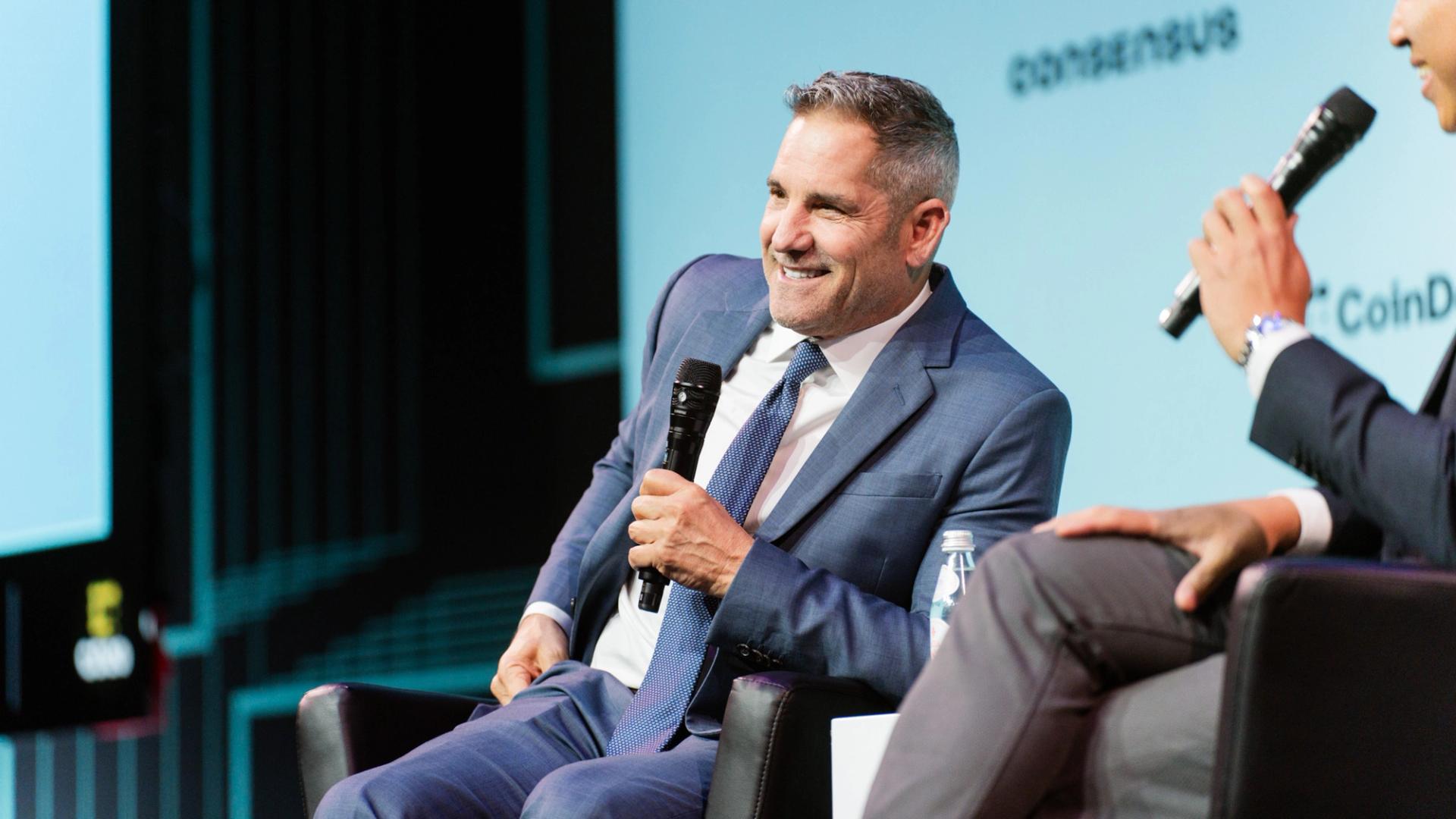
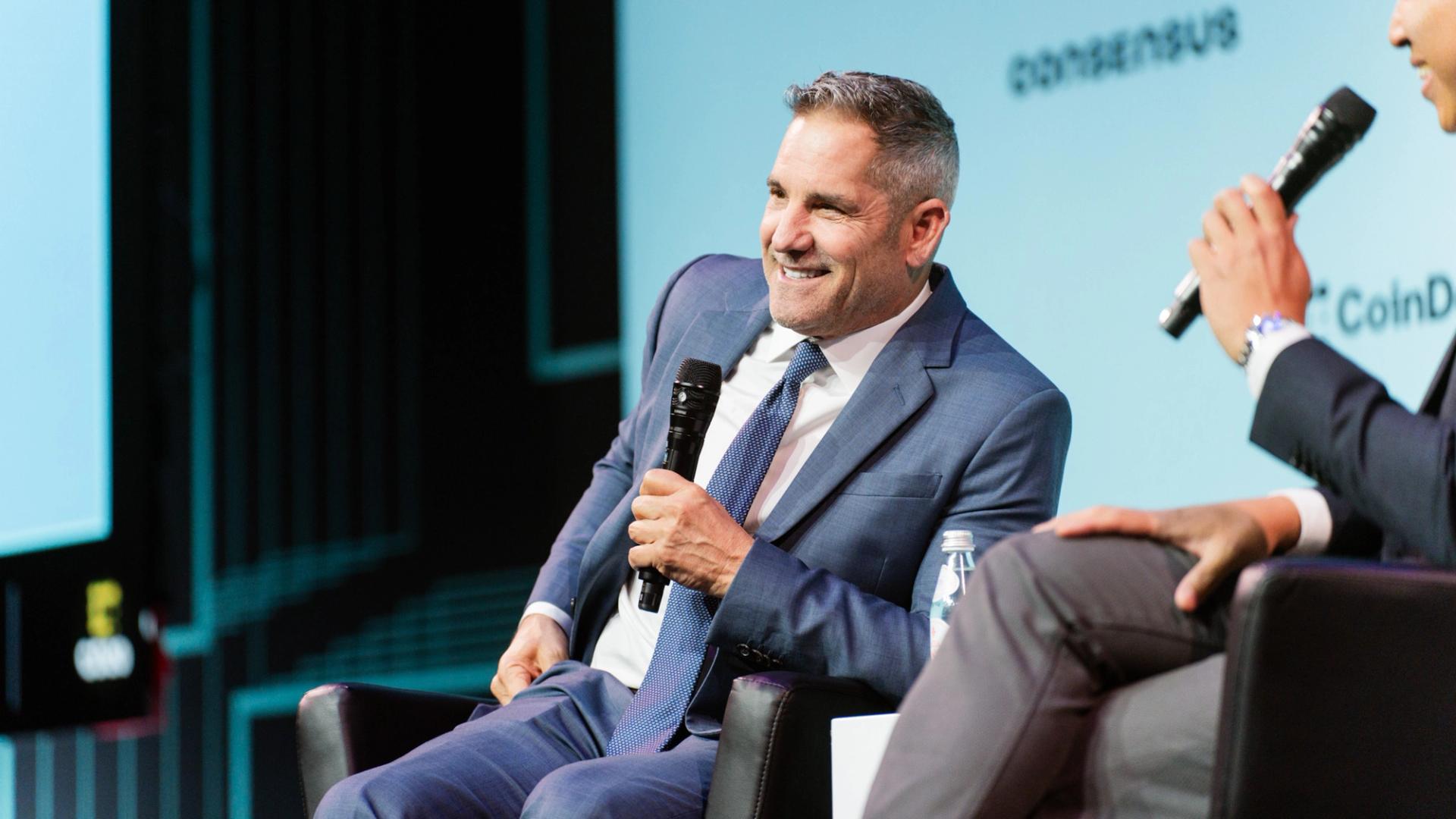
Grant Cardone, a multibillionaire real estate investor, said Wednesday he added another $100 million in bitcoin as part of a strategy combining the asset with income-producing real estate, during a Fireside chat at Consensus Miami 2026.
“We just simply added another $100 million of bitcoin,” Cardone said, describing a recent property deal where BTC was paired with a $235 million asset, a hybrid strategy he believes will outperform real estate investment trusts (REITs).
Cardone said traditional real estate investment trusts are structurally limited. “These companies can never, ever hold bitcoin on their balance sheet,” he said. “We believe by combining real estate and bitcoin […] I’ll end up with somewhere between a 22 and a 32% return.”
The property investor said the latest allocation builds on an earlier bitcoin purchase made in 2025, when Cardone Capital added 1,000 BTC to its balance sheet, a position valued at just over $100 million at the time, bringing the firm’s total bitcoin exposure to roughly $200 million.
The real estate mogul said the structure combines two asset types within a single investment vehicle. “I have two assets that we just fused together in an LLC,” Cardone said.
He explained the approach also consists of introducing new investors to bitcoin. “Eighty percent of the people that invested in that fund own zero bitcoin,” he said, adding that the strategy does not involve putting real estate directly on blockchain rails.
“I’m not putting real estate on the blockchain,” Cardone said. “All I’m doing is buying a bunch of bitcoin and stuffing it into the discount gap.”
However, in February, In an X post, the investor said that Cardone Capital had plans to tokenize its holdings to give investors “collateral and liquidity in the secondary markets.” At the time, he also said the firm aimed to become a market leader in tokenizing assets at scale.
At Consensus, Cardone explained his hybrid strategy combines stable cash flow with bitcoin exposure. “If bitcoin goes to zero, I’m not getting rid of the real estate.” He said the combined model is intended to compete with existing real estate structures. “I’m going to rip [their] face off,” referring to competing investments without bitcoin exposure.


Fairshake has spent $28 million in 2026 primaries as a new poll shows most Americans distrust crypto and AI, raising questions about the political value of industry-backed super PAC money.
Summary
- Fairshake and pro-AI PAC Leading the Future have together spent over $100 million in 2026 midterm races, according to federal filings and published reporting.
- A Public First poll for Politico in April found 45% of Americans say investing in crypto is too risky, and 44% say AI is developing too fast.
- Only 3% of survey respondents recognise Fairshake by name, but analysts warn backlash could be swift once voters connect the spending to the industries behind it.
Fairshake, the pro-crypto super PAC backed by Coinbase, Andreessen Horowitz, and Ripple, has spent $28 million across competitive 2026 primaries. Combined with pro-AI group Leading the Future, which launched in August 2025 and has raised more than $75 million, the two industry-aligned groups have together deployed over $100 million in the current midterm cycle.
The spending arrives against a difficult backdrop. A Public First poll conducted for Politico in April, surveying 2,035 US adults, found 45% of Americans say investing in cryptocurrency is not worth the risk, 44% say AI is developing too fast, and nearly two-thirds want Congress to impose strict regulations or broad AI oversight.
“I do think if they see somebody is backed by crypto, that’s always going to be a problem,” former Ohio Representative Jim Renacci was quoted as saying.
Despite those distrust numbers, public awareness of both groups remains remarkably low. Only 3% of respondents recognised Fairshake, and just 9% had heard of Leading the Future.
Political observers told Politico that backlash could be swift once voters make the connection between the spending and the industries behind it.
The stakes for crypto legislation are direct. As crypto.news reported, if Democrats take either chamber in November, the CLARITY Act’s passage odds are described as close to zero, with Senator Elizabeth Warren likely to take over the Senate Banking Committee chair.
Fairshake’s current $193 million war chest is explicitly aimed at preventing that scenario. In 2024, a Fairshake-affiliated PAC spent over $40 million helping unseat Ohio Senator Sherrod Brown, a longtime crypto critic who is now running again.
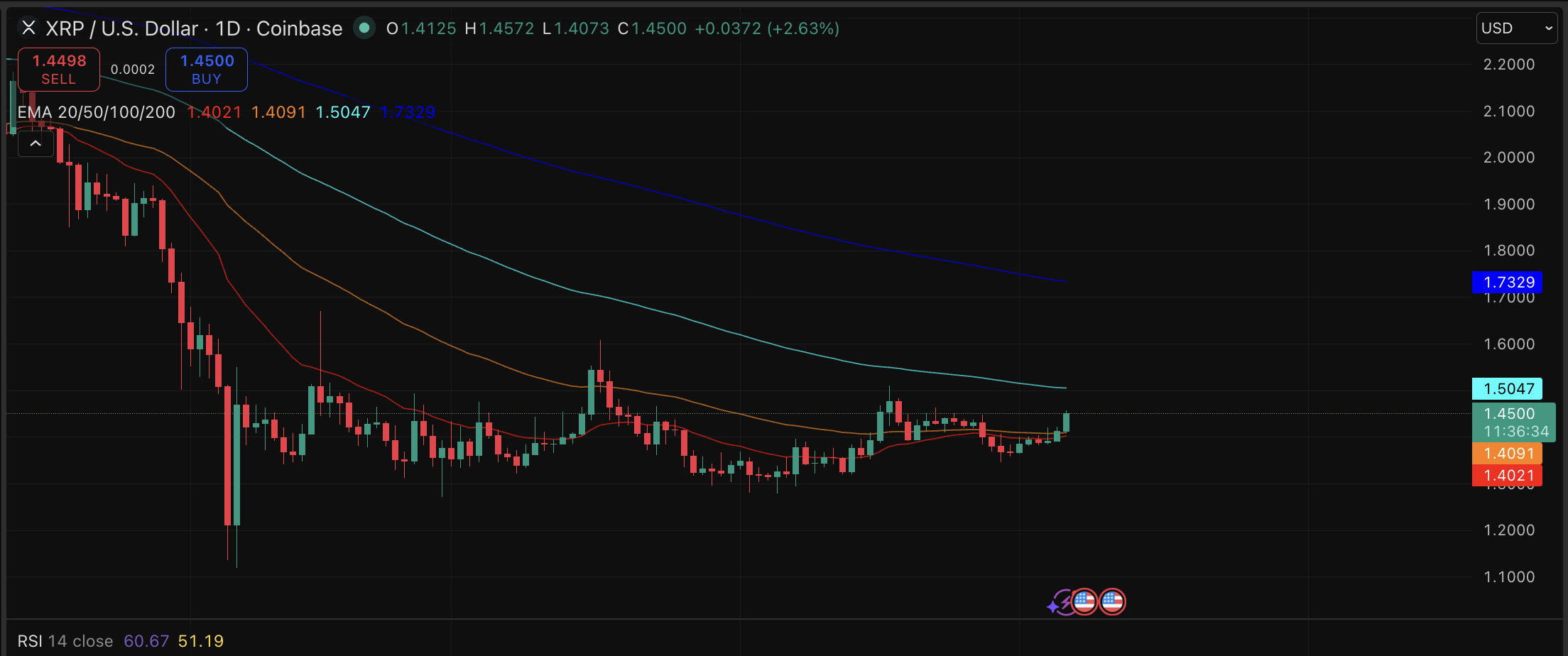
XRP price is coiling, and its prediction is getting more bullish than ever. The token has reclaimed $1.45 with a weekly gain of 4%, and the chart pattern appeared to like what happened when it surged 66% in under two weeks. A bull flag is forming.
The coin’s recent price action mirrors the bull flag structure during 2025, which was followed by controlled consolidation and another leg up. XRP climbed from $1.40 to $1.45 in days, as higher highs and higher lows remain intact above $1.40.
There is also a potential golden cross between the 20-day and 50-day moving averages, adding a second layer of bull confirmation.
Discover: The best crypto to diversify your portfolio with
XRP Price Prediction: $1.73 Target
XRP is holding a bullish structure that has surprised traders who expected a sharper pullback this cycle. The 20 and 50-day moving average break is confirmed, and repeated tests of the $1.45 resistance zone suggest selling pressure is gradually thinning.
Longer-term analyst targets are considerably more aggressive. Raoul Pal has cited a weekly bull flag structure with a breakout target of $5.50, representing a 138% move from recent consolidation levels. EGRAG CRYPTO on TradingView pegged a 67–70% probability of a breakout from the weekly flag, with an extended target of $18.
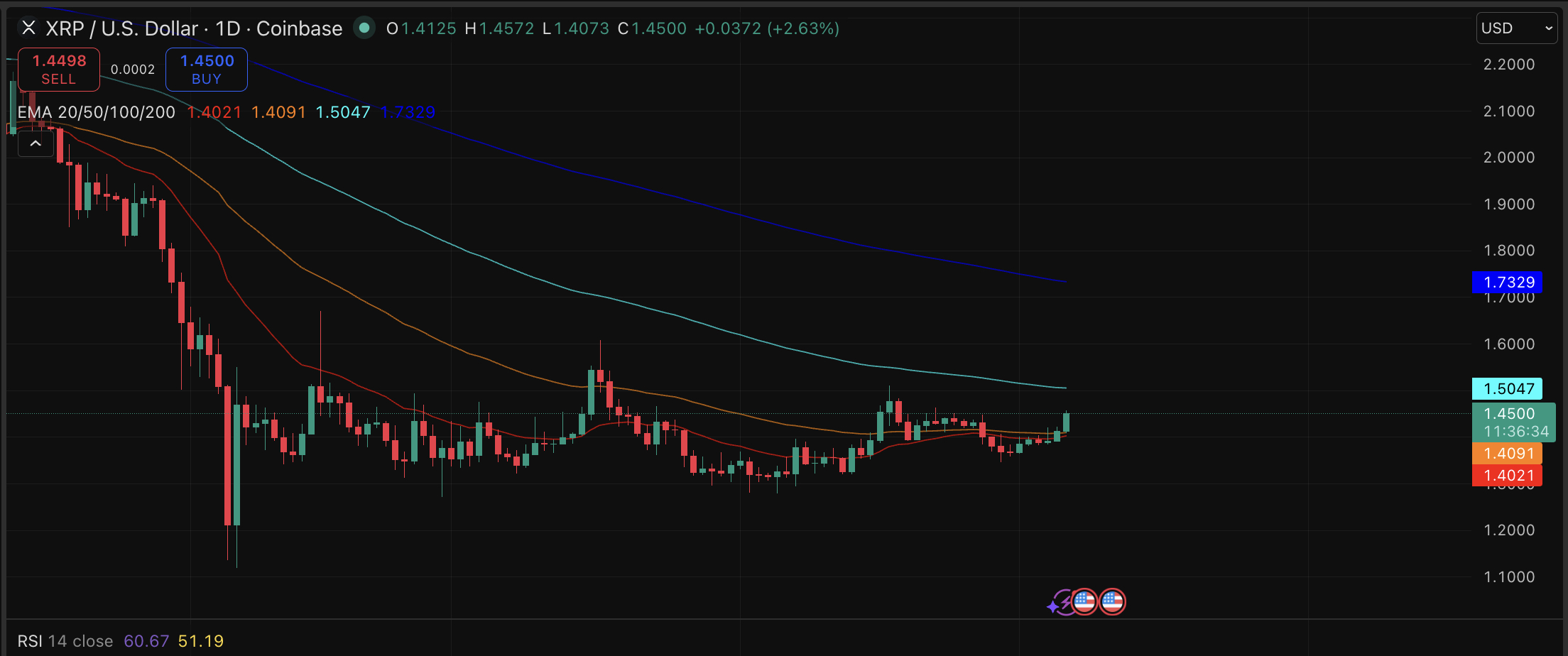
For XRP to run, it needs to hold its consolidation level above $1.42. As volume returns, and price advances toward $1.47–$1.50, a clean break above $1.50 opens a run toward the 200-day moving average at $1.73.
The 200-day moving average at $1.73 remains the line that separates a technical bounce from a genuine trend reversal.
Discover: The best pre-launch token sales
LiquidChain Targets Early-Mover Upside as XRP Coils
XRP’s setup illustrates the central tension of this market moment: technically promising, structurally constrained, with the biggest gains gated behind levels that have historically required sustained institutional volume to clear.
Those watching XRP above $1.45 are long a token with genuine momentum, but also one still trading beneath its 200-day MA and facing Bitcoin dominance of 60%. That’s a real ceiling, even if the bull flag eventually wins.
POV: You start a conversation about the LiquidChain L3. — LiquidChain (@getliquidchain) May 6, 2026
 ⟁https://t.co/vqvBcdSQYC pic.twitter.com/E6fYgZuw2j
Early-stage infrastructure plays offer a different risk profile entirely. LiquidChain is a Layer 3 infrastructure project building what it describes as a unified cross-chain liquidity layer, fusing Bitcoin, Ethereum, and Solana liquidity into a single execution environment.
The architecture is built around four pillars: a Unified Liquidity Layer, Single-Step Execution, Verifiable Settlement, and a Deploy-Once Architecture that lets developers access all three ecosystems without redeployment.
The presale for its native token is currently priced at $0.01456, with more than $700K raised to date, and an extra 1500% APY bonus for presale buyers.
The post XRP Price Prediction: Bull Flag Forming as Bull Run Style Rally Coils appeared first on Cryptonews.

TLDR:
- Colombia generates 75% of its electricity from renewables, giving it a strong edge in clean Bitcoin mining.
- President Petro proposed Barranquilla, Santa Marta, and Riohacha as prime Caribbean Bitcoin mining locations.
- The Wayúu community, Colombia’s largest Indigenous group, could become co-owners of the mining project.
- Petro’s term ends in August, leaving the next administration to decide the future of the mining proposal.
Colombia’s President Gustavo Petro eyes Bitcoin mining as a transformative opportunity for the country’s Caribbean coast.
He has identified cities like Barranquilla, Santa Marta, and Riohacha as prime locations for large-scale mining operations. The plan centers on converting the country’s surplus renewable energy into a steady revenue stream.
Petro has also proposed that the Wayúu community, Colombia’s largest Indigenous group, become co-owners of the project. With his term ending in August, time remains short to move the plan forward.
Petro Sees Renewable Energy as the Backbone of His Mining Vision
Colombia generates around 75% of its electricity from renewable sources, according to a World Bank report from April 2024.
That output is more than twice the global average, putting the country in a strong position. Petro wants to use that surplus power to draw foreign investment into the Caribbean region. Bitcoin mining, in his view, offers a practical way to turn unused electricity into consistent income.
La Guajira, a wind-rich province on the Caribbean coast, sits at the center of this proposal. State-owned energy company Ecopetrol is currently building the Windpeshi wind project there.
The facility is expected to begin operations by 2028, adding significant clean energy capacity to the grid. That additional supply could make the region more competitive for large mining investors.
Petro shared his vision on X after Luxor Technology’s Alessandro Cecere posted about Paraguay’s mining growth. Cecere noted that Paraguay now holds 4.3% of the global Bitcoin hashrate.
The country reached that position by tapping hydroelectric power from the Itaipu Dam. Responding to that data, Petro said the Caribbean coast holds similar potential, calling it “an immense boost to the development of the Caribbean.”
Petro also addressed environmental concerns directly in his X post. He warned that “if virtual currencies are based on fossil energy, global warming explodes and climate collapse ensues.”
His Caribbean coast proposal deliberately relies on clean energy to avoid those outcomes. The approach ties economic growth to environmental responsibility in a single strategy.
Political Clock and Global Competition Shape the Road Ahead
Petro’s presidential term ends in August, leaving him a narrow window to advance the initiative. Constitutional limits bar him from seeking re-election in the May 31 vote.
The next president will decide whether the Bitcoin mining proposal continues or stalls. So far, no leading candidate has offered a clear stance on the matter.
Prediction market Kalshi places Senator Iván Cepeda Castro and conservative lawyer Abelardo de la Espriella as the frontrunners in the upcoming election.
Neither has made notable public statements on Bitcoin or digital assets. Without clear support from the incoming administration, the plan faces an uncertain future. Investors and industry observers are monitoring the political landscape closely.
Meanwhile, global competition for Bitcoin mining activity continues to grow. The United States has put forward the “Mined in America Act” to expand domestic operations.
Russia now counts mining among its export revenue sources. Ethiopia is actively pursuing foreign capital to build out its own mining infrastructure.
Hashlabs managing partner Jaran Mellerud has noted that the industry “can have a sizable economic impact on emerging countries looking to convert otherwise unused electricity into cash flow.”
As American miners pivot toward AI and high-performance computing, opportunities are opening up for other nations.
Countries with lower electricity costs are also better placed to capture a larger share of global hashrate. Colombia’s renewable energy advantage could position it well in that expanding global race.

Crypto World
AI agents becoming more relevant than humans by 2035 has Big Tech ‘terrified’, says Hoskinson


AI agents will become more relevant than humans on the internet within the next decade, a shift already already forcing Google, Facebook and Amazon to react, said Charles Hoskinson.
In his keynote at Consensus Miami 2026 on Wednesday, Hoskinson also said that “by 2035, the majority of searches, commerce and activity on the internet will be AI agents instead of people.”
He said the change threatens existing business models. “Amazon, Google, Facebook, they’re terrified of the agentic revolution,” Hoskinson said, adding that companies are investing heavily because “all of their business models are going to be disrupted.”
AI Agents do not click ads or have brand preferences, Hoskinson explained, saying this “threatens the advertising-driven models of platforms like Google, Amazon and Facebook.”
“Why do you think Google is interested in x402?” he asked his audience of the Coinbase-backed protocol that enables AI agents and applications to make direct, programmatic payments over the internet using stablecoins and crypto rails.
Hoskinson noted this shift will change how crypto is used, adding that artificial intelligence (AI) will increasingly handle tasks such as due diligence, transaction execution and interaction with decentralized finance.
Hoskinson AI agent forecast echoes that of Coinbase CEO Brian Armstrong, who said “very soon there are going to be more AI agents than humans making transactions” and Binance Founder Changpeng Zhao, who predicted they “will make one million times more payments than humans.”
On the flipside, Hoskinson said AI agents are the “single best thing to ever happen to cryptocurrencies” because it simplifies user experience.
The Cardano founder warned crypto users against relying on intermediaries rather than maintaining direct control of their assets, which is the principle, he said, crypto was built on.
“You have to own your data. You have to own your identity. You have to own your money,” he said, adding that users are “outsourcing that to custodial wallets,” “permissioned networks,” and “third parties that they come to regret trusting when they get their account shut down.”
He also pointed to fragmentation across blockchain ecosystems as a barrier to progress, saying it has slowed down development. “There’s been 11 million tokens issued over the years. We have enough of them,” Hoskinson said. “What I want is cooperation. What I want is the mission to be achieved.”
User experience remains a key issue limiting user adoption, said Hoskinson, who described the current crypto onboarding processes as complex and prone to error. “That is the user experience in 2026,” he said. “Is this like a product you want to use?”
He said technologies such as account abstraction and chain abstraction could simplify how users interact with crypto systems, while maintaining control over assets and identity.
Hoskinson highlighted changing attitudes among financial institutions, noting that JPMorgan has moved from restricting crypto-related activity to developing blockchain-based products. “Back when we started JPMorgan was turning people’s bank accounts off and now they have a blockchain product,” he said.
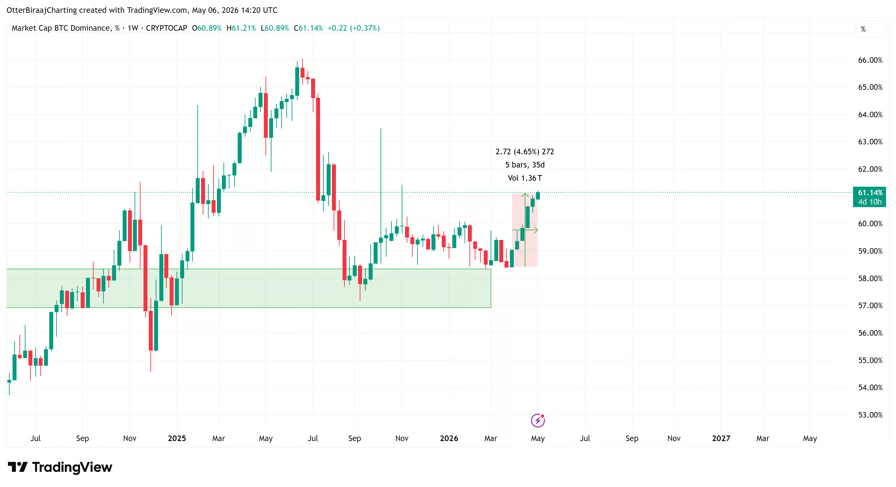
Bitcoin dominance climbed to 61% on Wednesday, its highest level since November 2025. The metric has risen from 58.44% at the start of April, proving that the bullish trend continues to favor BTC over the wider crypto market.
In the last two months, altcoin volumes on Binance also increased by 49%, while 12.6% of altcoins on Binance reclaimed their 200-day simple moving average (SMA).
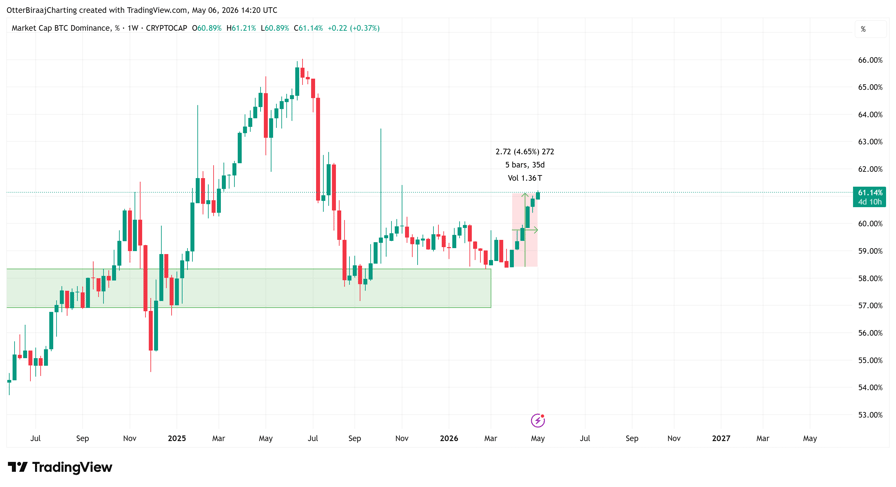
Bitcoin dominance, one-week chart. Source: Cointelegraph/TradingView
Altcoins show early signs of recovery
Crypto analyst Darkfost said Bitcoin has gained 36% since its Feb. 6 lows at $60,000, helping push its dominance to 61.3%.
While altcoins spent much of that period under pressure, TOTAL3, which tracks the crypto market cap excluding Bitcoin and Ether, rose by 17% to a two-month high of $765 billion. The recovery pace of altcoins lagged behind BTC, but several indicators have started to improve.
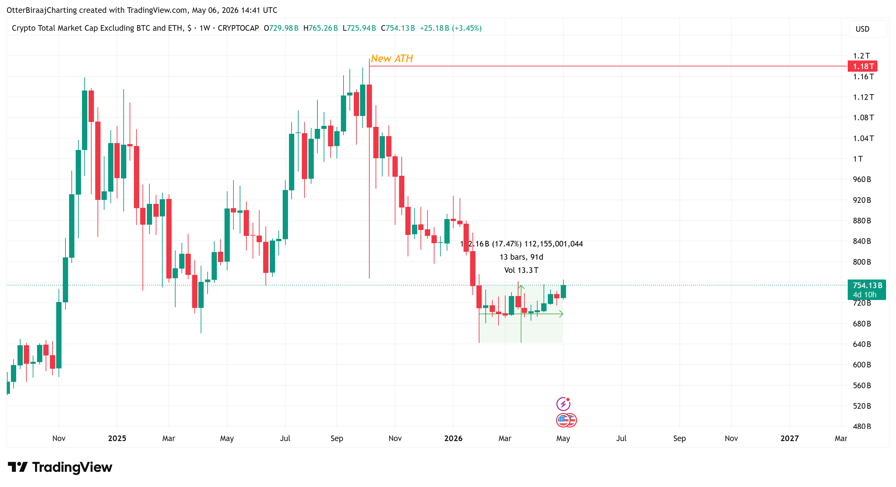
TOTAL3, one-week chart. Source: Cointelegraph/TradingView
Data from CryptoQuant showed that trading activity in the altcoin market was slowly increasing. Their volume share on Binance climbed to 49% on Wednesday, up from 31% in March, when measured against the combined BTC and ETH futures trading volumes. The rise points to growing participation outside of Bitcoin and Ether after several months of capital concentration in the two largest crypto assets.
Darkfost added that the shift still looks moderate and sits far from the aggressive rotation phases seen during the previous altcoin rally in 2024.
.png?prefix=media%2Fcontent)
Altcoin dominance by volume. Source: CryptoQuant
Related: Zcash price may hit $800 as $2.7B hedge fund reveals ‘significant position’ in ZEC
Exchange volume trends point to a rotation
Market analyst CW8900 pointed to the rising activity on centralized exchanges (CEX) as another sign of improving participation beyond Bitcoin. According to the analyst, altcoin trading volume, excluding the five largest cryptocurrencies, has increased steadily over the past few weeks.
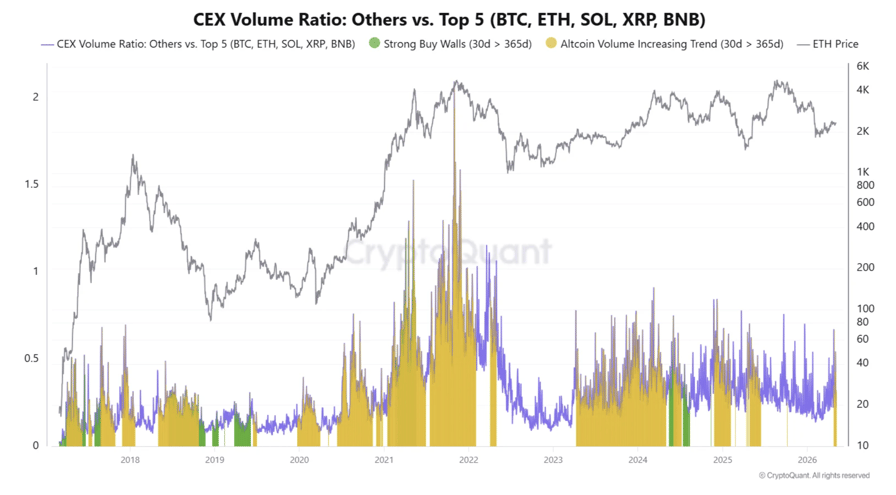
CEX volume ratio vs Top 5 crypto. Source: CryptoQuant
The 90-day AltSeason Index also climbed to 28.6, its fastest recovery in months. The index tracks whether a majority of altcoins outperform Bitcoin over a set period. Readings above 75 are associated with stronger altcoin cycles. However, CW8900 added,
“The indicator also shows that there was no real AltSeason in this cycle. The period when the AltSeason Index reached its highest point was early 2024, and even that value was relatively low compared to previous AltSeasons.”
CryptoQuant data also showed improvements across the altcoin market after months of heavy underperformance against Bitcoin. The average altcoin now trades 23.47% below its 200-day simple moving average, rising from 44.4% earlier in the cycle. Similar readings previously appeared near the end of late-stage bear markets in 2022.
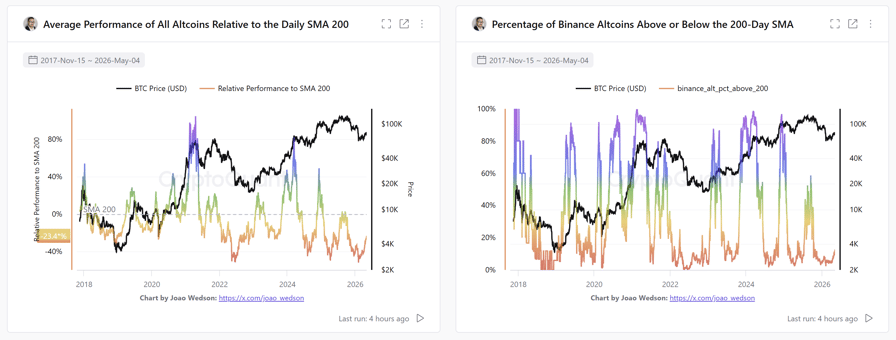
Altcoin performance, on average, relative to the 200-day SMA. Source: CryptoQuant
Related: Crypto Fear and Greed Index turns neutral for first time since January: Is $100K BTC next?
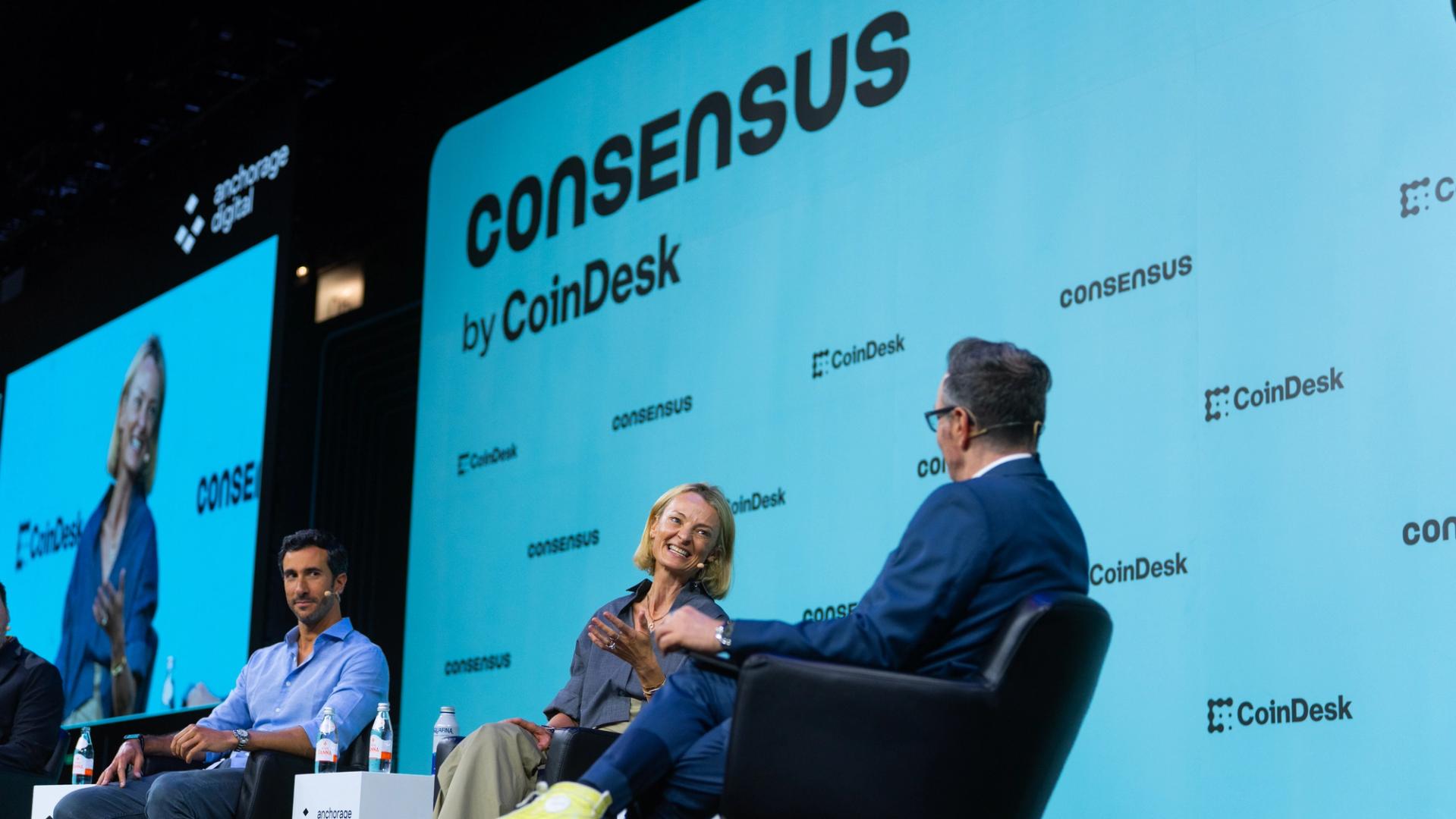
What was once viewed as a speculative fringe movement is rapidly becoming part of the world’s financial plumbing, according to executives from Binance, Revolut and Circle (CRCL) speaking at Consensus Miami on Wednesday.
“We were in the Prohibition era,” said Rachel Conlan, chief marketing officer at Binance. “Now we are in the infrastructure phase.”
Conlan said crypto is evolving beyond trading into functional everyday use cases and is “on route to becoming the fabric of everyday society.”
That shift is increasingly visible in consumer finance. Mazen ElJundi, global business head of investments at Revolut, said crypto’s narrative has moved from speculation toward “real-life utility and scaling.”
Revolut, which operates in more than 40 countries and serves over 75 million customers, now integrates crypto into a broader suite of banking services including remittances and stablecoin usage. “Crypto is about banking without borders,” he said.
At Circle, SVP of marketing Tim Queenan said institutions are increasingly exploring how to move core financial infrastructure onchain. “The infrastructure should be boring,” he said. “What you build on top of it is what’s interesting.” Queenan pointed to stablecoins becoming so embedded in payments that many users no longer even think of themselves as crypto users.
The panelists said institutional momentum, from exchange traded fund (ETF) approvals to major asset managers putting money onchain, is reinforcing retail adoption globally.
But challenges remain. Conlan said the industry still needs to reduce friction and make onboarding easier.
Read more: Crypto ETFs go mainstream as traditional finance locks in


NYSE parent ICE and Securitize warned at Consensus Miami 2026 that offshore synthetic tokenized stocks are misleading retail investors and creating serious risks for the broader market.
Summary
- Executives from ICE, OKX, and Securitize said at Consensus Miami that synthetic tokenized stocks often do not represent underlying equity and use company names without issuer approval.
- Securitize CEO Carlos Domingo said some stocks have five different tokenized versions on the market, none of which represent actual equity.
- NYSE, owned by ICE, is building a regulated tokenized equity platform starting with pre-funded tokens trading against stablecoins.
NYSE executives and partners raised the alarm at Consensus Miami 2026 on Wednesday over a wave of offshore synthetic tokenized stocks they said are creating market risks and misleading retail investors.
Michael Blaugrund of ICE, the NYSE’s parent company, and Securitize CEO Carlos Domingo both warned that products operating outside regulated frameworks are exploiting the tokenization trend at retail investors’ expense.
“For some stocks there’s like five different tokenized versions,” Domingo said at the panel. “None of them actually represent equity on Coinbase,” using the exchange as a concrete example of how public company names are being used without issuer approval by offshore token products that offer only synthetic price exposure.
Blaugrund said NYSE’s own approach takes the opposite path. The exchange’s first tokenized equity product will start with pre-funded tokens trading against stablecoins.
That model is “not the sexiest way” to build a market, Blaugrund acknowledged, but gives issuers, investors, and regulators a structure they can evaluate before more complex features like leverage or self-custody are introduced.
The warning lands as the tokenized equity market grows rapidly alongside legitimate players. As crypto.news reported, Coinbase CEO Brian Armstrong has pointed to tokenized stocks as a way to expand international access, enable fractional ownership, and allow real-time settlement. But a parallel offshore market of synthetic wrappers, which confer no voting rights, dividends, or ownership, is undercutting trust in the category.
For NYSE, the Consensus panel was a public signal that regulated tokenized equities and unregulated synthetic tokens are not the same product.

BeInCrypto 100 Institutional Awards Nomination: Wintermute for Best Liquidity Provider

IPL 2026: Heinrich Klaasen goes top of Orange Cap list after match-winning knock vs PBKS | Cricket News

Today’s NYT Connections: Sports Edition Hints, Answers for May 7 #591

Manchester United reach agreement with Casemiro over contract clause amid transfer speculation

US brings back mandatory military draft registration

Steven Gerrard disagrees with Gary Neville over ‘shock’ Chelsea and Arsenal claim | Football


-

 NewsBeat3 days ago
Channel 5 – All Creatures Great and Small series 7 new post
-

 Entertainment7 days ago
Insider Claims Reason Behind Key & Peele Split
-
 Tech5 days ago
Trump’s 25% EU auto tariff breaches Turnberry Agreement that also covers semiconductors and digital trade
-
 Sports5 days ago
Paul Scholes issues Marcus Rashford reality check as agreement emerges over Man United star
-

 Entertainment5 days ago
Met Gala 2026 Rumored Guest List Is Turning Heads
-

 Business6 days ago
Strait of Hormuz Blockade Persists Amid US-Iran Standoff, Sending Oil Prices Soaring
-

 Entertainment7 days ago
Celebrities Who Are Attending the 2026 Met Gala Event
-
Entertainment5 days ago
New on Prime Video in May 2026 — Full List of Movies and Shows
-

 Sports5 days ago
Cavaliers vs. Raptors Game 6 live score, updates, highlights from 2026 NBA playoffs first-round series
-
 Sports5 days ago
David Benavidez responds to team Canelo saying the fight will never happen
-
Business7 days ago
Strait of Hormuz Remains Heavily Restricted on April 29 Amid Iran Conflict
-

 Entertainment5 days ago
Kylie Jenner Hit With Second Lawsuit From Ex-Housekeeper
-
 Sports5 days ago
IPL 2026: ‘Love you darling’- Hardik Pandya’s reaction to MS Dhoni steals the show |Watch | Cricket News
-

 Entertainment5 days ago
Young and the Restless Next Week: Cane Arrested & Matt’s Deadly New Scheme!
-

 Sports7 days ago
Saudi Arabia set to withdraw LIV Golf funding after 2026 season, per reports
-

 Tech7 days ago
Mark Zuckerberg Says Meta Is Working On AI Agents For Personal And Business Use
-

 Tech6 days ago
Meta ends Sama contract after Kenyan workers report seeing intimate footage from Ray-Ban smart glasses users
-

 Sports5 days ago
Plane crash in Wimberley, Texas kills 5 pickleball players at tournament
-

 Sports7 days ago
Stalemate in Madrid as resilient Arsenal Blunt Atletico Madrid in semi-final clash – Sports
-

 Sports5 days ago
LeBron James adds to his legacy as Lakers eliminate dysfunctional Rockets
You must be logged in to post a comment Login