
Crypto World
Inside prediction markets’ new police



In eighteen months, the prediction market industry has assembled the surveillance apparatus that took stock exchanges decades: named detection engines, encrypted prohibited-person lists, league partnerships, forensic academics, and employment disclosure for high-risk traders. Here is the architecture, who is building it, and the cost nobody in the sector wants to price.
Summary
- Kalshi now runs a proprietary detection engine called Poirot alongside Solidus Labs for trade surveillance, IC360 for sports integrity screening, and the Wharton Forensic Analytics Lab for statistical detection methods.
- The screening moved from post-trade investigation to preemptive blocking: athletes, coaches, referees, and league personnel are screened against lists built with IC360 and the NHL, while candidates are blocked from trading their own races.
- Polymarket built differently, pairing multi-layered surveillance across its offshore and US platforms with a March partnership involving Palantir and TWG AI for sports market monitoring.
- The vendors are consolidating into a de facto standard, with IC360 and Eventus combining insider-risk lists and real-time trade surveillance into a package explicitly marketed as the sector’s emerging benchmark.
- The unpriced cost is participation: every identity check, employment disclosure, and prohibited-person list makes the regulated venues safer and pushes marginal volume toward platforms that ask for none of it.
Financial markets build their police forces after the scandal, not before it, and the construction usually takes a generation. The New York Stock Exchange operated for over a century before anything resembling modern trade surveillance existed; the systems that now watch equity markets for spoofing and insider activity accumulated in layers across decades of enforcement actions, statutes, and technology. The American prediction market industry has compressed that build into roughly eighteen months, and it has done so in public, under a congressional investigation, while growing volumes at a pace that makes each month’s controls obsolete by the next. The result is a surveillance stack with proper names: an in-house detection engine at Kalshi called Poirot, an encrypted prohibited-persons list called ProhiBet, an AI monitoring platform called HALO, a forensic academic partnership, a league relationship, a whistleblower button on market pages, and, as of last month, a requirement that traders in high-risk markets disclose their employer.
This piece maps that architecture, identifies who is actually building it, and examines the trade it embodies, because a category whose entire value proposition is open participation has spent a year and a half constructing the machinery of exclusion.
The stack, named
Kalshi has been the most public about its systems, and the components are worth listing individually because their origins tell you what the industry thinks it is defending against.
At the center sits Poirot, the platform’s proprietary monitoring engine, which runs continuous pattern recognition across every trade looking for anomalous timing, win-rate irregularities, and coordinated activity, following a detect, investigate, enforce sequence the company describes as modeled on the surveillance operations of major financial exchanges. Around it are three external layers. Solidus Labs supplies its HALO platform, an AI-driven trade surveillance system built originally for crypto venues to detect wash trading, spoofing, and layering, which is a revealing choice: the manipulation patterns the industry expects are the ones native to thin electronic order books, not to sportsbooks. IC360, the Las Vegas integrity firm that works with every major professional league, the NCAA, state gaming regulators, and the sportsbook industry, supplies the sports-specific layer, including its ProhiBet service, an encrypted list of individuals barred from participating. And the Wharton Forensic Analytics Lab contributes statistical methods for detecting insider trading and financial fraud, an academic partnership that reads as much like reputational armor as like a technical input, though the methods are real.
The most consequential change was procedural, not technological. For most of the sector’s history, prohibitions on insider participation existed in the rulebooks and were enforced after the fact, through investigation of completed trades. In March the platform shifted to preemptive blocking: after months of assembling screening lists across collegiate and professional leagues with IC360, and in partnership with the NHL directly, known athletes, officials, and league employees are now blocked from trading in associated markets before an order reaches the book. Political screening moved the same direction, extending an existing prohibition on elected officials to cover candidates trading their own campaigns. Identity verification underpins all of it, with names, addresses, and government identification collected before trading, and a whistleblower tool now sits on market pages so participants can flag suspicious activity directly. In June, reporting indicated the platform would begin requiring traders in markets flagged as high-risk to disclose their employer.
Read that list against the product’s marketing, which is about accessibility and putting your knowledge to work, and the tension is immediate. A market that asks for your government identification, your employer, and your absence from an encrypted list of prohibited persons is not a frictionless information venue. It is an exchange, in the full institutional sense, and that is precisely the point of the build.
Polymarket’s different architecture
The other major venue arrived at similar conclusions through a different route, shaped by a structural fact: it operates two platforms with different characters, an offshore blockchain-based book and a regulated US exchange.
Its public position describes multi-layered surveillance across both, combining the transparency of on-chain settlement with third-party monitoring, and its rule updates in March clarified prohibited categories of trading across the pair. The more significant move came earlier that month, when the US entity partnered with Palantir and TWG AI for integrity monitoring in sports markets, with the stated ambition of building tools that leagues and teams could use for their own competitive-integrity purposes. The choice of Palantir is not incidental. A company whose reputation rests on large-scale pattern analysis for government and defense clients signals a particular theory of the problem: that detecting coordinated abuse across a fragmented, pseudonymous participant base is a data-integration challenge, not a rules-enforcement one.
The asymmetry between the two venues is the part worth holding onto. Kalshi’s surveillance operates on a fully identified participant base inside a single regulated perimeter, which makes screening lists workable, because you can check a name against a list only if you have the name. Polymarket’s offshore book has historically been the less transparent half of its business regarding how suspicious activity is monitored, and on-chain transparency, while real, identifies wallets and not people. The industry’s screening model, built on identity, maps cleanly onto one architecture and awkwardly onto the other, and how that gap resolves as the US operation scales is one of the genuine open questions in the sector.
The vendors are writing the standard
Beneath both platforms, a supplier layer is consolidating fast enough to set the rules by default, which is how most financial-market standards actually form.
The clearest signal came in December, when IC360 and Eventus announced a combined offering pairing Eventus’s Validus platform, a multi-asset post-trade surveillance system already used by exchanges, designated contract markets, broker-dealers, and digital asset venues, with IC360’s event-integrity and insider-risk capabilities. The framing in the announcement was explicit about ambition: helping prediction market venues build trust with participants and regulators and set the standards that will support responsible growth. Vendors rarely state the standard-setting objective that plainly, and when two suppliers combine to offer a full-lifecycle package to an entire young sector, the package tends to become the baseline that regulators later reference and competitors later match.
That dynamic has a consequence the industry has not discussed publicly. If integrity infrastructure becomes a purchasable package from a small number of specialist suppliers, then compliance quality converges, which is good for the sector’s credibility and bad for any venue hoping to compete on trustworthiness. It also creates a dependency: a handful of firms will hold the screening lists, the detection models, and the case-management systems for an industry that regulators are actively deciding whether to permit. Concentration in the surveillance layer is not obviously safer than concentration anywhere else, and it has attracted none of the scrutiny that venue concentration receives.
What forced the build
None of this happened because the platforms woke up cautious. The pressure is documented and specific.
Congressional attention arrived in force: the House Oversight Committee opened an examination of insider trading risks in prediction markets in May, and its chairman requested documents from Kalshi’s chief executive covering the platform’s identity verification processes and its capacity to detect insider trading. Enforcement cases had already made the abstract concrete, with the platform disclosing actions in multiple matters including a fined video editor connected to a major creator and actions against political candidates who traded events in which they were directly involved. Investigative journalism amplified both, and a bipartisan bill in Congress would ban sports event contracts on federally regulated exchanges outright, which gives every venue an existential reason to show that its sports markets are policed.
The regulator supplied the frame. The Commodity Futures Trading Commission’s advisory earlier this year reminded designated contract markets that they are the frontline regulators of their own venues under the core principles, that event contracts sit fully under the Commodity Exchange Act, and that sports and similar real-world contracts face a higher bar to show they are not gambling in substance. Read alongside the build, the sequence is legible: the agency told exchanges the obligation was theirs, Congress threatened the most profitable product line, and the platforms responded by constructing visible, nameable, quotable infrastructure. The surveillance stack is a compliance program and a political argument at the same time, and its audience includes committee staff as much as traders.
The trade nobody wants to price
Which brings the piece to the part the announcements do not address, because it cuts against the industry’s founding pitch.
Prediction markets derive their forecasting value from broad, diverse participation. The calibration research this publication has examined finds prices well estimated precisely because many participants with different information bet real money, and thin markets with few participants produce prices carrying much less information. Every element of the integrity build reduces participation at the margin. Identity verification excludes anyone unwilling to hand over government identification. Employment disclosure excludes anyone whose employer’s name is itself sensitive. Prohibited-person lists exclude, by design, the participants with the most direct knowledge of the events being priced, which is both obviously correct as policy and a genuine subtraction from the information the market aggregates. A market on a game that bars everyone connected to the game has removed its best-informed potential traders in exchange for integrity, and that is a real trade rather than a free lunch.
The second-order effect is the sharper one. Barriers on regulated venues do not eliminate demand; they redistribute it. Volume that will not verify identity or disclose an employer migrates toward platforms that ask for neither, which in this sector means offshore books and decentralized venues operating outside the Commission’s direct reach. The integrity build therefore makes the regulated market cleaner and the unregulated market larger, which is precisely the pattern that decades of derivatives regulation have produced elsewhere, and it means the sector’s compliance success and its liquidity migration are the same event viewed from different angles.
Neither observation argues against the build. Markets on real-world events, priced by participants who may be able to influence those events, need policing more than most, and the case for preemptive screening of athletes and candidates is close to unanswerable. The argument is for pricing the cost honestly rather than presenting surveillance purely as an upgrade. The industry is buying legitimacy with liquidity, deliberately, and the exchange rate between the two is the number that will determine what this sector looks like in five years.
The precedent: how the older markets got policed
The compression is easier to appreciate against the timeline it is compressing, and the equity market’s version is instructive precisely because it took so long.
American stock exchanges operated for roughly a century and a half before anything resembling modern surveillance existed. Insider trading was not clearly illegal in the United States until case law developed through the middle of the twentieth century, systematic exchange-level market monitoring arrived later still, and the automated pattern-detection systems that now scan for spoofing, layering, and unusual pre-announcement activity are products of the last few decades, built in layers after specific scandals produced specific rules. Each layer arrived because something went wrong first: the 1929 crash produced the securities acts, later episodes produced the enforcement infrastructure, the flash crash produced consolidated audit trails. The pattern in financial regulation is almost invariably that the policing follows the harm.
Prediction markets have inverted that sequence, and the inversion is worth crediting instead of assuming cynicism. The surveillance being built now is largely preemptive: screening lists assembled before an athlete places a trade, candidate blocking before a race resolves, detection engines running against every order, not reconstructing a scandal afterward. Some of that reflects genuine intent, and some reflects that the technology exists off the shelf in a way it did not for earlier markets, which is the real reason eighteen months can substitute for eighty years. A modern venue can buy institutional-grade post-trade surveillance from a vendor and integrate a prohibited-persons list through an API. The 1930s could not.
But the borrowed timeline carries a borrowed weakness. Equity market surveillance evolved alongside the case law, the enforcement precedents, and the definitions of what actually constitutes abuse in that market, and each system was built to catch behaviors regulators had already defined. Prediction markets are installing detection infrastructure ahead of the doctrine: nobody has authoritatively defined what insider trading means in a market on a football game, whether a coach’s spouse is an insider, whether a campaign staffer trading a rival’s race is abuse, or how foreknowledge differs from expertise when the subject is a real-world event and not a company’s earnings. The tools are institutional-grade. The rules they enforce are, in places, the platforms’ own interpretations, written fast, under pressure, and awaiting a regulator or a court to confirm or discard them. That gap between capability and doctrine is the most interesting thing about the entire build, and it will be filled the ordinary way, one contested case at a time.
What to watch
Whether the standard becomes mandatory. If the Commission’s rulemaking or a future advisory references specific surveillance capabilities, the vendor package effectively becomes a licensing requirement, and the cost of entry for new venues rises accordingly. Watch the comment filings for exactly this.
The employment-disclosure rollout. How broadly high-risk markets are defined, and what share of volume sits inside them, determines whether the requirement is a narrow safeguard or a material participation barrier. Any published data on abandonment rates would be the most informative number the sector could release.
Polymarket’s identity gap. How the offshore book’s monitoring evolves as the US entity scales is the sector’s most consequential unresolved architecture question, and the Palantir partnership is the first serious attempt at an answer.
Migration evidence. Comparative volume growth between fully identified regulated venues and less restrictive alternatives is the cleanest available measure of whether the integrity build is costing the regulated market its liquidity, and it will show up first in the sports categories where screening bites hardest.
Disclaimer: This article is for information and educational purposes only and does not constitute financial, investment, or legal advice. It describes compliance systems and regulatory proceedings based on company statements and reporting available at the time of writing, and these arrangements change frequently. Nothing here is a recommendation regarding any platform or contract. Always do your own research. Information is accurate as of July 27, 2026.
Frequently Asked Questions
What surveillance systems do prediction markets actually use?
Kalshi runs a proprietary detection engine called Poirot for continuous pattern recognition, alongside Solidus Labs’ HALO platform for AI-driven trade surveillance, IC360 for sports integrity screening including its ProhiBet prohibited-persons list, and a partnership with the Wharton Forensic Analytics Lab for statistical detection methods. Polymarket uses multi-layered surveillance across its platforms and partnered with Palantir and TWG AI for sports market monitoring.
What changed in March 2026?
Screening moved from post-trade investigation to preemptive blocking. After months of building lists with IC360 and in partnership with the NHL, athletes, officials, and league employees became blocked from trading in associated markets before orders reach the book, and political screening extended from elected officials to candidates trading their own campaigns. Both platforms also expanded prohibitions covering spoofing, wash trading, and front-running.
Why did the platforms build this now?
Regulatory and congressional pressure. The House Oversight Committee opened an examination of insider trading risk in May and requested documents on identity verification and detection capability, enforcement cases had become public, and a bipartisan bill would ban sports contracts on regulated exchanges. The CFTC separately reminded exchanges that they are the frontline regulators of their own markets under the core principles.
What is ProhiBet?
An encrypted list of individuals prohibited from participating in prediction markets or sports betting, operated by IC360 and used across regulated sports betting. It allows a venue to block a prohibited person without the venue itself holding the underlying list in readable form, which is how screening operates across the regulated gambling industry.
Are the surveillance vendors becoming a standard?
Effectively, yes. IC360 and Eventus combined their offerings in December, pairing real-time trade surveillance used by exchanges and designated contract markets with insider-risk and event-integrity capability, and described the goal as setting standards for the sector. When a small number of suppliers provide full-lifecycle integrity packages to a young industry, that package tends to become the baseline regulators reference.
Does more surveillance make prediction markets better?
It makes them more defensible and less open, and both effects are real. Screening the participants most able to influence outcomes is sound policy and removes the best-informed potential traders from those markets. Identity verification and employment disclosure improve accountability while excluding participants unwilling to provide them, which reduces the diverse participation that gives these markets their forecasting value.
Where does volume go when barriers rise?
Toward venues with fewer barriers, which in this sector means offshore and decentralized platforms outside direct US oversight. This is the standard pattern in derivatives regulation: tightening the regulated perimeter improves conditions inside it and enlarges the market outside it. The regulated venues’ compliance success and any liquidity migration are the same development seen from different sides.
What should participants take from this?
That the regulated venues now operate genuine exchange-grade surveillance, which is a meaningful protection, and that the identity, disclosure, and screening requirements attached to it are permanent features, not temporary responses. Anyone weighing a regulated venue against an offshore alternative is trading privacy and access against monitoring and recourse, and that is the actual choice on offer. This is educational analysis, not investment advice.



South Korea’s Financial Services Commission (FSC) reportedly plans to draft a consolidated Digital Asset Basic Act with the ruling Democratic Party, giving lawmakers a government-backed proposal covering stablecoins and the broader cryptocurrency market after months of delays.
According to an Edaily report published Wednesday, the FSC told the National Assembly ahead of a policy briefing that it intends to introduce a consolidated bill. The proposal would reportedly cover stablecoin issuance and circulation, digital asset business rules, exchange entry requirements, disclosures, internal controls and system-resilience standards.
A consolidated government-ruling party proposal could provide a central framework for negotiations. At the moment, 10 separate digital asset and stablecoin bills are already pending in Parliament, while disagreements have prevented South Korea from settling key elements of its second-stage crypto legislation.
The FSC has not finalized when or how the consolidated bill will be introduced. Key disputes remain over whether won-denominated stablecoin issuers should be majority bank-owned and whether ownership limits should apply to major crypto exchanges.
Opposition crypto tax repeal bill heads for review
Separately, the National Assembly’s Finance and Economic Planning Committee was scheduled to table an opposition bill on Wednesday that would abolish South Korea’s crypto income tax before its Jan. 1, 2027 implementation.
The Income Tax Act amendment was introduced on March 19 by People Power Party lawmaker Song Eon-seok. It aims to delete the provision taxing income from transferring or lending digital assets. Once tabled, it is expected to be referred to the committee’s tax subcommittee for detailed consideration, Edaily reported.
A separate repeal petition backed by more than 50,000 people is also expected to go before a petitions subcommittee. However, neither subcommittee has been fully constituted, and no review dates have been set.
Related: South Korea draft bill puts stablecoins, RWAs under finance laws: Report
From Jan. 1, 2027, income from transferring or lending crypto exceeding 2.5 million won (about $1,700) annually is set to face a 20% tax plus a 2% local income tax.
The government and ruling Democratic Party support implementing the tax, while the opposition argues that taxing crypto while most ordinary stock investors remain exempt is unfair. On May 7, the Finance Ministry said the tax would proceed after repeated delays.
Magazine: Inside the ‘fake police raid’ that forced a $1M Bitcoin transfer


Argentina’s banking-backed groups have moved closer to launching peso stablecoins for businesses, introducing digital peso projects designed for programmable payments while the country’s banking sector remains barred from offering crypto services directly.
Summary
- Two Argentine banking backed financial groups are developing peso stablecoins for institutional payments through separate crypto subsidiaries.
- The projects focus on programmable treasury payments, collateral management, and onchain settlement while banks remain barred from offering crypto services directly.
- BIND Group is building its stablecoin through BEN, while Petersen Group’s DIPE project has already published a whitepaper.
- The initiatives come as Argentina weighs easing banking restrictions on crypto services and stablecoin adoption continues to grow across Latin America.
According to a report by Iproup, two financial holding groups with banking operations are developing Argentine peso-backed stablecoins through separate virtual asset subsidiaries, positioning the products for institutional users rather than retail customers.
The projects are being advanced outside the banking entities themselves because the Argentine Central Bank has prohibited private banks from providing crypto-related services since May 2022.
BIND Group, which manages more than $2 billion in assets and owns BIND Banco Industrial, is developing a peso-backed stablecoin through its virtual asset service provider BEN, the report said. Earlier this year, BEN also entered a partnership with Circle to give institutional clients access to USDC for treasury management and payment applications under Argentina’s regulatory framework.
A second initiative is being prepared by Petersen Group through one of its subsidiaries with technical support from crypto infrastructure provider Lirium, according to Iproup. The stablecoin, known as DIPE, already has a published whitepaper, suggesting the project has progressed beyond the early planning stage.
Although neither offering has been launched publicly, both target corporate treasury operations instead of consumer payments. According to the report, the digital pesos are intended to support programmable payment conditions, collateral management, and treasury settlement using blockchain infrastructure.
Peso stablecoins target enterprise payments
Unlike U.S. dollar-backed stablecoins such as USDT and USDC, which have become popular in Argentina as a hedge against peso depreciation, the new projects focus on digitizing the local currency for business use.
Institutional customers could use the tokens to automate transactions triggered by on-chain events, manage collateral-backed lending arrangements, and streamline treasury operations, Iproup reported. Because the stablecoins are being developed through licensed virtual asset subsidiaries rather than banks themselves, the initiatives currently remain outside the scope of the central bank’s restrictions on financial institutions.
The report added that banking-backed ownership could eventually help expand adoption if regulators later allow banks to provide digital asset services directly. Argentine authorities are reportedly evaluating whether to ease the current restrictions, although no formal policy change has been announced.
Regulatory scrutiny has already emerged for peso-linked stablecoins. In March, Argentina’s national securities regulator questioned the argt peso stablecoin, stating that it constituted a security being offered without complying with applicable regulations.
Banking-backed stablecoins build on earlier digital peso efforts
The latest projects are not Argentina’s first attempt to tokenize the national currency.
In December 2022, lawmakers in the province of San Luis approved legislation establishing the legal framework for CityCoin, officially known as Activo Digital San Luis de Ahorro. The provincial stablecoin was designed to be backed by the government’s liquid financial assets while supporting blockchain-based public services, administrative efficiency, and financial innovation.
The framework also authorized blockchain education initiatives and additional public-sector applications, although operational details for the stablecoin were left to future implementation.
Unlike the San Luis initiative, which was introduced through provincial legislation for residents, the new peso-backed tokens are being developed by private financial groups and focus on enterprise financial infrastructure rather than public-sector digitalization.
Stablecoin competition continues to expand across Latin America
The Argentine projects also arrive as stablecoin adoption gains traction across Latin America’s banking sector.
Earlier this month, Tether reportedly invested $20 million in Argentine digital bank Ualá as part of the lender’s $197 million funding round, according to Bloomberg. The investment followed Tether’s recent backing of Brazilian exchange Mercado Bitcoin and Argentine crypto platform Belo, extending the company’s strategy of supporting digital payment infrastructure throughout the region.
Elsewhere, the Bank of the Philippine Islands (BPI) recently launched a pilot program using stablecoins as the settlement layer for cross-border remittances. Under the project, international payments are settled through stablecoin rails before being converted into Philippine pesos for deposit into customers’ bank accounts, allowing blockchain-based settlement while keeping funds within the regulated banking system.
Stablecoin usage keeps growing despite supply pullback
The institutional focus of Argentina’s proposed peso stablecoins also comes as blockchain-based dollar payments continue expanding globally.
CoinDesk Data reported that the global stablecoin market fell 2.39% during June to about $312 billion, recording the first monthly contraction in five months. Even so, Visa’s Allium-powered dashboard showed adjusted stablecoin transaction volume climbed to a record $1.79 trillion during the same month.
The June figures indicate that stablecoin usage remained active despite lower circulating supply. Visa’s adjusted dataset includes filtered economic activity such as exchange transfers, decentralized finance transactions, lending, and on- and off-ramp activity rather than only merchant payments.
Ionic Digital Inc. (NASDAQ: IOND) climbed more than 25% from its $50 opening price to nearly $63 in its Nasdaq debut Tuesday, July 28. The move gave the Bitcoin miner an implied valuation of roughly $2.75 billion.
Ionic went public through a direct listing rather than a traditional initial public offering (IPO). Existing shareholders sold their shares directly, and the company raised no new capital.
From Celsius Bankruptcy to Nasdaq
Ionic Digital emerged in January 2024 from Celsius Network’s bankruptcy. It took over most of Celsius Mining’s bitcoin (BTC) mining equipment, plus about $195 million in cash and 540 BTC.
Hut 8 (NASDAQ: HUT) initially managed those mining sites under a four-year deal signed in February 2024. Ionic ended the arrangement less than a year later and took direct control, though Hut 8 kept a minority stake. Hut 8’s own stock has surged this year on similar AI hosting deals.
Betting on AI Infrastructure
Ionic now leases its 234-megawatt Cedarvale facility in West Texas to AI cloud provider Nscale. The 10-year deal is worth about $2 billion in contracted revenue. A February amendment could push that total to $2.6 billion.
Ionic hasn’t stopped mining Bitcoin. It still runs four sites in Midland, Texas, and produced just under 25 BTC in May, on top of a 2,861 BTC treasury. Output should shrink as more capacity shifts to AI clients.
The debut adds Ionic to a wider group of miners pivoting to AI hosting to smooth out Bitcoin’s price swings. Hut 8, TeraWulf, and IREN have already taken similar paths into longer-term hyperscaler contracts.
Ionic’s listing gives Celsius creditors a tradable stock instead of a private claim. It also ties Ionic’s future more to AI wins than to bitcoin’s price.
The post Bitcoin Miner Ionic Climbs 25% On Nasdaq Debut, Joining Hut 8’s AI Shift appeared first on BeInCrypto.


Every leveraged crypto venue has a mechanism that can close your profitable position without asking, and it fires precisely when you are most right. It is the last step in a risk waterfall, it selects victims by a published formula, and it works differently on every architecture.
Summary
- Auto-deleveraging is a backstop that force-closes profitable positions when a liquidation cannot be settled in the market and the venue’s buffers are exhausted, ensuring the exchange’s books balance.
- It exists because perpetual futures are zero-sum instruments backed by finite collateral: every long has a corresponding short, and when a losing side runs out of money the accounting must still close somewhere.
- It is the final step in a chain, margin call, liquidation into the market, backstop absorption by an insurance fund or protocol vault, and only then deleveraging of the winning side.
- Selection is not random: venues rank candidates by some combination of unrealized profit, effective leverage, and position size, so the most profitable and most leveraged positions are closed first.
- Architecture determines how likely you are to encounter it, since venues with deep, well-capitalized backstops absorb losses that thinner venues push directly onto winners.
Here is how it operates and what actually reduces your exposure to it.There is a category of financial risk that traders learn about only at the moment it costs them money, and in crypto derivatives the leading example is auto-deleveraging. The mechanism is simple to state and hard to accept: on a venue where you hold a large, profitable, leveraged position, the exchange may close part or all of that position without your consent, at a price you did not choose, because someone on the other side blew up so badly that the venue cannot cover the shortfall any other way. You did nothing wrong. Your analysis was correct. Your position is being reduced precisely because it was working. Every major perpetual futures venue, centralized and decentralized alike, has some version of this mechanism, and it is disclosed in their documentation, which almost nobody reads until afterward. This guide explains why the mechanism must exist, where it sits in the sequence of defenses, how venues decide whose positions to cut, how the architectures differ, and what a trader can actually do to reduce exposure to it. For the venue layer, crypto.news has explained the venues where ADL lives.
Why the math has to close
Start with the structural fact that makes the mechanism unavoidable, because auto-deleveraging is not a policy choice that a more generous venue could simply skip.
Perpetual futures markets are zero-sum. Every long position has a matching short position, and the profit on one side is funded by the loss on the other. Positions are backed by collateral, and collateral is finite. In ordinary conditions this balances: a losing trader’s collateral covers the winning trader’s gain, the venue takes fees, and nobody thinks about the plumbing.
The problem arises when a losing position moves further against its holder than their collateral covers. The venue tries to close it, but if the market gaps, or the asset is thinly traded, or everyone is liquidating simultaneously, the position may only close at a price far worse than the point at which the collateral ran out. The difference between what the collateral covered and what the market actually delivered is a shortfall, and that shortfall is real money that must come from somewhere. It cannot be conjured. There are exactly three sources: a fund the venue maintains for the purpose, the venue’s own capital, or the profits of the traders on the winning side.
Auto-deleveraging is the third option, exercised when the first two are exhausted. Framed that way it is less outrageous than it feels: the alternative to reducing winning positions is a venue that becomes insolvent and cannot pay anyone, which is worse for the same winners. The mechanism is unpopular and defensible at once, and both facts should be held together.
The waterfall
Venues describe their defenses as a sequence, and auto-deleveraging is deliberately the last step, which is why encountering it means several earlier things already failed.
Maintenance margin. Your position must keep collateral above a threshold. This is calculated against a reference or mark price computed by the venue, typically blending external market data, and not the last trade on the venue itself, which prevents a manipulated tick from triggering mass liquidations.
Liquidation into the market. Breach the threshold and the venue closes your position by sending it to the order book, ideally near the bankruptcy price, the point at which the collateral is exactly consumed. Most liquidations end here, and the loss is contained to the trader who took it.
The backstop. If the market will not absorb the position at an acceptable price, the venue’s buffer takes it: an insurance fund accumulated from prior liquidations that closed better than expected, or, on several decentralized venues, a protocol vault whose depositors have collectively agreed to be the counterparty of last resort in exchange for a share of fees and liquidation proceeds. This layer exists to make the next step unnecessary, and most of the time it succeeds. In severe events, well-capitalized vaults have profited handsomely from absorbing distressed positions at discounts and unwinding them into the recovery.
Auto-deleveraging. When the buffer is exhausted or the shortfall exceeds it, the venue reduces positions on the profitable side to close the gap. Positions are closed at the bankruptcy price of the liquidated counterparty, not at the market price, which is why the outcome feels arbitrary to the person on the receiving end. The venue’s books balance, the market continues, and someone who was winning has a smaller position than they did five minutes ago.
How you get selected
Selection is formulaic and disclosed, which means it is also, to a degree, manageable.Venues maintain a ranking of positions on each side, and while the exact formula varies, the ingredients are consistent: unrealized profit, effective leverage, and position size. The most profitable and most leveraged positions rank highest and are deleveraged first, on the reasoning that they have the most cushion to absorb the reduction and that high leverage is itself a contribution to systemic fragility. Many venues display a trader’s current rank in the queue as an indicator, often as a simple visual scale, and that indicator is one of the most useful and least examined pieces of information on any derivatives interface.
Two practical implications follow, and they are the closest thing to actionable advice this mechanism permits. First, leverage is the variable you control that most directly affects your ranking, so the same directional exposure taken with lower leverage and more collateral sits lower in the queue. Second, the indicator is live, meaning a trader in a violently trending market can see their exposure rising and choose to realize some profit instead of being reduced involuntarily at a price they did not select.
Three architectures, three profiles
The likelihood of encountering auto-deleveraging depends less on your trading than on the venue’s design, which is the aspect most explanations skip entirely.
Insurance fund venues. The traditional model, used by most centralized exchanges: a fund accumulates from liquidations that close better than the bankruptcy price and pays out shortfalls when they close worse. Its adequacy is a published number, and its health is the single best predictor of whether a venue will need to deleverage during a stress event. A fund that has been drained by a recent cascade is a venue where the next cascade reaches winners faster.
Vault-backed venues. Several decentralized venues route the backstop through a protocol vault funded by depositors, where the liquidation engine hands distressed positions to the vault instead of to an anonymous fund. The economics are more transparent, since the vault’s positions and balance are publicly visible, and the risk is more explicitly allocated, since depositors know they are the buffer. The practical effect for traders is similar: a large, healthy vault absorbs more before deleveraging becomes necessary. The practical effect for depositors is that they hold the tail risk the mechanism would otherwise distribute to winners, which is the trade they were compensated for. Crypto.news has also examined a vault-backed architecture in its Hyperliquid governance audit.
Pooled-liquidity venues. Where a pool is already the counterparty to every trade, the shortfall lands on the pool by construction, and the response is typically to adjust the pool’s exposure or its pricing instead of deleveraging individual traders. The risk does not disappear; it moves earlier in the chain and lands on depositors continuously and not on winners suddenly.
The general rule that falls out: the deeper and better capitalized the buffer between liquidation and winners, the further you sit from involuntary closure, and that buffer’s size is public information on every venue worth using.
The events that taught the lesson
Auto-deleveraging is abstract until a market makes it concrete, and recent history has supplied several demonstrations worth knowing.
The most instructive was a market-wide deleveraging cascade in October 2025, triggered by a macro announcement, which produced roughly nineteen billion dollars of liquidations across the industry in twenty-four hours, the largest single-day event of its kind on record. That episode did two things at once. It pushed several venues to the edge of their buffers and generated widespread discussion of deleveraging mechanics, and it also showed the other side of the trade: on at least one major venue the protocol vault absorbing distressed positions gained tens of millions of dollars in a matter of hours, buying at forced-sale prices and unwinding into the recovery. Backstop capital is not charity. It is compensated, sometimes handsomely, for being present when nobody else is.
A second pattern, visible across multiple incidents on decentralized venues, is that the events which strain backstops most are not broad market crashes but targeted manipulations of thin markets. A trader takes an outsized position in an illiquid asset, moves the underlying price deliberately, and engineers a liquidation the venue’s engine cannot clear at anything near the expected price. The resulting shortfall lands on the vault or the fund. Several such episodes have now occurred, each producing losses in the millions and each following the same template, which is why the strongest single piece of practical advice about deleveraging exposure is also the least exciting: the risk concentrates in thin markets, so trading deep ones sharply reduces it.
The third lesson comes from what the venues did afterward. Position limits on small-cap markets, tighter margin requirements on volatile assets, larger buffers relative to open interest, and clearer public documentation of the waterfall all followed these incidents. That is the ordinary way market infrastructure improves, one failure at a time, and it means a venue’s current risk parameters encode the history of what has already gone wrong there. Reading them is reading the incident log in compressed form.
What you can actually do
The honest list is short, which is itself worth knowing.
Use less leverage. It is the only variable that simultaneously widens your distance from liquidation and lowers your ranking in the deleveraging queue. Every other suggestion is secondary to this one.
Watch the indicator. If your venue displays a deleveraging rank, treat a rising rank during a volatile move as information, not decoration.
Check the buffer. Insurance fund size or vault capitalization relative to open interest is published, and it tells you how much distress the venue can absorb before the mechanism reaches you.
Prefer liquid markets. Deleveraging cascades begin where liquidations cannot clear, and that is overwhelmingly in thin markets. A profitable position in a deeply traded pair is far less likely to be reduced than the same position in an obscure one.
Take profit deliberately in extreme moves. If a market is moving violently in your favor and the venue’s buffers are visibly under strain, realizing a portion at a price you choose is strictly better than having a portion realized at a price you do not.
And the reframe worth carrying: auto-deleveraging is not a bug in leveraged derivatives, it is the visible edge of the fact that these markets are zero-sum systems with finite collateral. Any venue that promised it could never happen would be promising either infinite capital or an insolvency it had not yet disclosed.
A closing note on how to read a venue’s disclosure, since the mechanism is where documentation quality separates serious platforms from careless ones. Four things should be findable in any competent venue’s own materials, and their absence is itself a finding. First, the sequence: what happens between a margin breach and a deleveraged winner, named step by step. Second, the buffer: the current size of the insurance fund or protocol vault, published and updated, ideally alongside open interest so the ratio is computable. Third, the selection formula: which factors determine ranking and in what order, stated precisely enough that a trader can estimate their own position. Fourth, the price: what a deleveraged position settles at, which on most venues is the bankruptcy price of the counterparty and not the market price, a distinction that materially changes the outcome.
A venue that publishes all four is telling you it expects the mechanism to fire eventually and wants you to understand it beforehand, which is the correct posture. A venue that publishes none of them is not safer; it is simply less legible, and the same arithmetic applies whether it is documented or not. The uncomfortable truth this guide keeps returning to is that auto-deleveraging is not an optional feature that a better-designed exchange could eliminate. It is the visible consequence of building leveraged markets on finite collateral, and every venue that offers leverage has it in some form, named or unnamed, disclosed or discovered.
One last framing that helps at the moment it matters. Traders who encounter deleveraging for the first time typically describe it as theft, and the reaction is understandable but analytically wrong in a specific way worth correcting. Your counterparty in a perpetual market was never the exchange; it was the aggregate of traders on the other side, and their collateral is the only thing that was ever going to pay you. When that collateral is gone and the market cannot supply a replacement at any reachable price, the profit you were expecting does not exist to be paid. Deleveraging does not take your money and give it to someone else. It recognizes that a portion of the gain you were marking was never funded, and it stops the position before the venue records an obligation it cannot meet.
That framing also points at the only durable protection, which is not a venue choice or a setting but a habit: treat unrealized profit on a leveraged position in a stressed market as provisional until you have realized it. The number on the screen is an estimate of what the other side can pay. In ordinary conditions it is accurate. In the conditions where deleveraging fires, it is a forecast, and the venue is about to tell you it was optimistic.
One comparison rounds out the picture, because traditional derivatives markets face the same arithmetic and solved it differently. Regulated futures exchanges sit behind a clearinghouse that interposes itself between every buyer and seller, backed by a default waterfall: the defaulting member’s margin, then their contribution to a guaranty fund, then the clearinghouse’s own capital, then the mutualized contributions of surviving members. Only after all of that is exhausted do losses reach participants, and even then the mechanism is typically an assessment on clearing members instead of a haircut on individual winning positions. The result is a system where retail participants almost never experience anything resembling deleveraging, because several institutional layers absorb the shortfall first.
Crypto venues compressed that structure. There is no clearing member tier, no mutualized guaranty fund contributed by well-capitalized institutions, and in most cases no external capital standing behind the venue. The insurance fund or protocol vault performs the entire job that a clearinghouse waterfall performs with multiple layers and regulatory capital requirements. That compression is why leverage is available instantly to anyone with a wallet, and it is also why the loss-allocation mechanism reaches ordinary traders in conditions where a traditional market would never expose them. Neither design is simply better: one buys accessibility with tail risk, the other buys insulation with cost, gatekeeping, and slower innovation. Knowing which one you are trading in is the point. Crypto.news has also covered equity perps and the same machinery,the collateral that runs out, and mechanism design under adversaries.
Frequently asked questions
What is auto-deleveraging?
A backstop mechanism on leveraged derivatives venues that force-closes profitable traders’ positions when a liquidation cannot be settled in the market and the venue’s buffers are insufficient to cover the shortfall. It exists so the exchange’s books balance and the platform remains solvent, and it is the final step in the venue’s risk chain.
Why would an exchange close a winning position?
Because perpetual futures are zero-sum with finite collateral. When a losing position moves beyond what its collateral covers and cannot be closed at an acceptable price, a shortfall exists that must be funded from somewhere. After the insurance fund or protocol vault is exhausted, the only remaining source is the profits of traders on the winning side.
How does the venue decide whose position to close?
By a published ranking, typically combining unrealized profit, effective leverage, and position size, with the most profitable and most leveraged positions closed first. Many venues display a trader’s current rank in the queue as a live indicator, which is one of the more useful and least noticed elements of a derivatives interface.
At what price are deleveraged positions closed?
Generally at the bankruptcy price of the liquidated counterparty rather than the prevailing market price, which is why the result feels arbitrary. You lose the exposure and the further gains it would have produced, though you retain profits already realized in your account balance.
Does auto-deleveraging happen on decentralized exchanges?
Yes. The problem is structural to leveraged derivatives, not specific to centralized platforms, and decentralized venues implement ADL or equivalent backstops. The details differ: several route shortfalls first through a protocol vault whose depositors are compensated for absorbing distressed positions, which pushes the mechanism further away from ordinary traders.
How likely am I to experience it?
Rare under normal conditions and concentrated in extreme events, thin markets, and venues with depleted buffers. Major deleveraging episodes cluster around market-wide liquidation cascades, and the same event can pass without incident on a well-capitalized venue while reaching winners on a thinner one.
Can I avoid it entirely?
Not while holding leveraged positions on a venue that uses it, which is effectively all of them. You can reduce exposure substantially by using lower leverage, trading liquid markets, monitoring your queue indicator, checking the venue’s buffer capitalization, and realizing profit deliberately during violent favorable moves rather than waiting.
What does it tell me about a venue?
Its buffer size relative to open interest is a direct measure of how much stress it can absorb before pushing losses onto winners, and its documentation on the subject is a measure of its candor. A venue that explains its waterfall clearly, publishes its fund or vault status, and shows traders their ranking is disclosing risk properly; one that does not is a venue whose risk you cannot assess. This is educational information, not investment advice.
Disclaimer: This article is for information and educational purposes only and does not constitute financial or investment advice. Leveraged derivatives carry substantial risk of loss, mechanisms described vary by venue and change, and specific implementations should be verified in each platform’s own documentation. Always do your own research. Information is accurate as of July 28, 2026.

1inch has unveiled Aqua, a new protocol designed to bring liquidity from multiple decentralized finance venues under one coordinated system. Announced this Tuesday, Aqua targets a recurring DeFi limitation: liquidity is often fragmented by protocol, which can make routing less efficient and leave some pools underutilized.
According to the 1inch announcement, Aqua works by letting liquidity providers authorize one or more strategies tied to a single wallet inventory. Rather than depositing assets permanently into any specific liquidity pool, the protocol keeps funds in the wallet until trades are settled, using atomic settlement to prevent overextension.
Key takeaways
- Aqua aims to unify liquidity across many DeFi markets without locking assets into a single pool.
- Liquidity providers can authorize multiple strategies while assets remain in their wallet until settlement.
- Trades are constrained by available wallet balance; if a swap would exceed funds, it reverts atomically.
- 1inch plans to deploy Aqua across multiple chains, including Ethereum and several L2 and alternative networks.
- Pending governance approval, Aqua incentive funding is set to include USDC and 1INCH tokens.
How Aqua coordinates liquidity without pool deposits
At the core of Aqua is an integrated toolkit that includes a generalized onchain registry, wallet-backed automated market making (AMM) strategies, atomic settlement, and position management that’s oriented around how liquidity is allocated to specific trades.
The approach is meant to widen access to liquidity because it’s not necessarily bound to one protocol’s pool structure. That said, Aqua also does not allow unlimited parallel usage of the same capital. 1inch describes a model where the funds a provider makes available can participate in only one operation at a time, even if the provider is advertising liquidity across several venues.
For example, the announcement illustrates a scenario where a liquidity provider with $10,000 can advertise $10,000 on three different protocols, potentially totaling $30,000 of advertised positions. However, at any moment, only $10,000 worth of simultaneous trades can actually execute from that inventory. The design effectively resembles coordinated “overbooking” of advertised capacity, but with strict balance checks at execution time.
Atomic settlement and balance limits
1inch provided additional detail through a spokesperson speaking to Cointelegraph. The spokesperson noted that Aqua can be used by resolvers holding a 1inch-issued access credential, while not all protocols may be supported under the system.
On execution mechanics, the spokesperson emphasized that Aqua positions are quoted against a market maker’s live wallet balance. After a fill, any remaining position quotes against the remaining balance. If a swap request would exceed what’s actually available, the system should revert atomically, preventing partial execution or mismatched accounting.
This “quote-to-balance” behavior is important for users and integrators because it helps reduce the risk of liquidity promises that can’t be honored at settlement—an issue that can arise in some routing and aggregation designs when inventory is handled off-contract or without tight execution constraints.
Deployment footprint and onchain registration
In its rollout plan, 1inch says Aqua has been deployed across 13 blockchains, listing networks that include Ethereum, Arbitrum, Base, Robinhood Chain, and BNB Chain. By spreading deployment across multiple ecosystems, Aqua is positioned as an infrastructure layer rather than a single-venue product.
The protocol’s generalized onchain registry and wallet-backed strategy system are intended to make liquidity coordination more uniform across chains, while the atomic settlement model seeks to keep execution rules consistent even as liquidity sources vary by venue and chain.
For liquidity providers and traders, the practical question is whether this architecture translates into better capital utilization and improved routing reliability. The “advertise more than you can simultaneously use” model only helps if demand patterns align—1inch’s design explicitly assumes that not all operations will require the same capital concurrently.
Incentives pending governance vote
Separately, 1inch said that—subject to approval by tokenholders through a pending governance vote—Aqua will receive incentives to support adoption.
Under the proposal described in the announcement, the protocol would allocate 500,000 USDC for Aqua incentives, alongside 10 million 1inch (1INCH) tokens. At the time of 1inch’s announcement, it stated that the token component was worth roughly $830,000.
1inch frames the incentive program as a way to accelerate liquidity growth and swap activity across the pairs supported by Aqua. If approved, these incentives would align with Aqua’s thesis: coordinating inventory across venues should make it easier for participants to route and execute swaps using the aggregated wallet-backed liquidity.
Investors and builders will likely watch whether the incentives increase actual swap throughput and whether liquidity providers continue to participate given the single-operation-at-a-time constraint.
Background amid company leadership turmoil
Today’s rollout comes after earlier reporting involving 1inch’s internal governance and management. Earlier in the month, Cointelegraph noted that Anton Bukov, a co-founder of 1inch, said he was “fired” from the company in November 2025 after “pushing for change” in its management and operations, as described in coverage linked by Cointelegraph.
While that dispute does not directly inform Aqua’s technical design, it adds context for readers tracking how 1inch’s roadmap is executed and how governance dynamics may influence future protocol decisions.
With Aqua now deployed on 13 chains and incentives awaiting community approval, the next key signal will be whether wallet-backed coordination delivers measurable improvements in routing efficiency and swap volume—especially under real trading demand where simultaneous calls may compete for the same underlying inventory.


The agreement covers tokenized securities, blockchain-based market infrastructure and the potential use of USDT as a settlement layer.


Nexo said on July 28 that its products remain available across the European Economic Area through an operating structure involving two regulated German partners.
Summary
- Nexo routes EEA custody through Tangany and brokerage through DLT Finance under licensed European infrastructure.
- MiCA’s transition ended July 1, requiring covered crypto services to use authorised European providers thereafter.
- Earn rewards and crypto-backed loans remain outside the partners’ MiCA and MiFID authorisations, Nexo says.
Tangany provides digital-asset custody, while DLT Finance supplies brokerage infrastructure for crypto-assets and financial instruments.
The announcement does not identify a MiCA crypto-asset service provider authorisation held by Nexo itself. Instead, Nexo attributes the regulated custody and brokerage functions to Tangany and DLT Finance. The platform said the arrangement completed a testing phase without disrupting customer access.
Nexo’s MiCA setup separates custody from brokerage
Tangany holds EEA client crypto-assets through its Munich-based custody infrastructure. The company received its MiCA licence in September 2025, covering custody, transfers and staking services. Tangany said the approval allows it to passport those services across the European Union.
DLT Finance is the operating brand of DLT Securities GmbH. Under Nexo’s arrangement, it provides brokerage and execution infrastructure. Public licence data list DLT Securities as a German MiCA-authorised provider for services including exchanging crypto-assets, executing orders and placing crypto-assets. The firm also operates as an investment firm under MiFID II.
This division means the companies performing covered custody and trading functions hold the relevant permissions. Nexo continues to control the client-facing wealth platform and user experience.
MiCA entered application before the July deadline
Nexo’s release says compliance was achieved ahead of MiCAR’s “entry into force.” The more precise reference is the end of the transitional period. MiCA entered the EU statute book in 2023, its stablecoin provisions began applying on June 30, 2024, and the remaining rules applied from December 30, 2024.
Existing providers in qualifying national regimes could continue operating temporarily. That final EU-wide transition ended on July 1, 2026. ESMA said firms providing covered crypto services after that date must hold MiCA authorisation or stop those activities.
Notably, MiCA’s transition deadline forced unlicensed platforms to wind down or transfer customers. Nexo’s partner-led model allowed its covered services to remain available rather than undergo a broad EEA suspension.
Lending and rewards sit outside partner licences
Nexo’s EEA website states that custody, trading and futures are provided through Tangany and DLT Finance under their MiCA and MiFID authorisations. However, Earn rewards and crypto-backed loans are separate products offered under different terms and outside the scope of those partner permissions.
That distinction matters because MiCA does not provide a complete regulatory framework for crypto lending. European lawmakers are already examining whether future rules should cover lending, staking, decentralised finance and other activities not fully addressed by the current regime.
Nexo said all of its existing services remain available in the EEA, but that statement is a company representation. Customers still need to review the legal entity and terms governing each product because protections can differ between custody, trading, rewards and credit services.
Partner models may become more common in Europe
Nexo’s structure shows how platforms can retain their brands and interfaces while outsourcing regulated functions to authorised European infrastructure firms. Kraken previously entered Germany through a partnership with DLT Finance, using a similar local-infrastructure approach.
Such arrangements may become more common as MiCA raises compliance, capital and staffing costs. As crypto.news reported, those costs could encourage further partnerships, acquisitions and consolidation across Europe’s digital-asset sector.
No additional launch date or product migration was announced. The immediate next step is continued operation under the new structure, with Tangany and DLT Finance responsible for their authorised functions.
ESMA has advised customers to verify the exact provider and permitted services in its MiCA register. Authorisation applies to named legal entities rather than an entire international brand or every product displayed inside one application.


Jim Cramer told CNBC viewers Wall Street is fleeing this year’s hottest AI stocks. He says investors are moving into names like Coca-Cola and Walmart, a shift he compares to 2000’s dot-com unwind.
The Mad Money host points to swings in memory chip stocks. He also cites Alphabet’s stumble after it raised AI spending guidance.
AI Infrastructure Stocks Face a Reckoning
Alphabet’s stock fell nearly 7% after the company lifted its 2026 capital spending guidance. The new range is $195 billion to $205 billion, up from $180 billion to $190 billion. That increase pushed quarterly free cash flow negative, a rare result for the company.
Memory chipmakers have swung even harder. SK Hynix and its US peers, Micron, Western Digital, and SanDisk, surged through much of 2026. AI data center demand created severe shortages and gave these companies pricing power.
However, those gains have reversed sharply as the rally has matured. Cramer has lived through several boom-bust cycles in this group. He expects stocks to fall before the underlying business slows.
The pullback has hit Asian markets hardest. South Korea’s KOSPI sank more than 10% this week. SK Hynix and Samsung Electronics dropped alongside their US peers. AI supply chain problems are driving the broader bear market.
Cramer Calls It a Broadening, Not a Breakdown
However, Cramer describes the shift more as simple profit-taking. Institutions are selling AI infrastructure winners and buying companies with growth drivers away from the data center.
“You can call it a broadening. Or you can call it fleeing.”
Jim Cramer
The pattern showed up directly in the tape. Coca-Cola, PepsiCo, and Walmart all rallied. The Dow Jones Industrial Average climbed while the Nasdaq Composite lagged behind. Hedge fund manager Steve Eisman has separately flagged this divergence. He warns the market now trades as a single AI bet.
Cramer stopped short of predicting a crash. He remains bullish on Nvidia and Intel and argues durable demand, not temporary chip shortages, supports both stocks. Cramer says he raised the dot-com comparison to flag a resemblance, not to forecast one.
The timing is sensitive. Seagate beat earnings estimates after Tuesday’s close. The Federal Reserve announces its rate decision today. Both events will test the data center trade. Investors will soon see whether it steadies, or whether money keeps flowing toward the stocks Cramer calls boring on purpose.
The post Cramer Sees Echoes of Dot-Com Bust as Wall Street Flees AI Stocks for Safety appeared first on BeInCrypto.
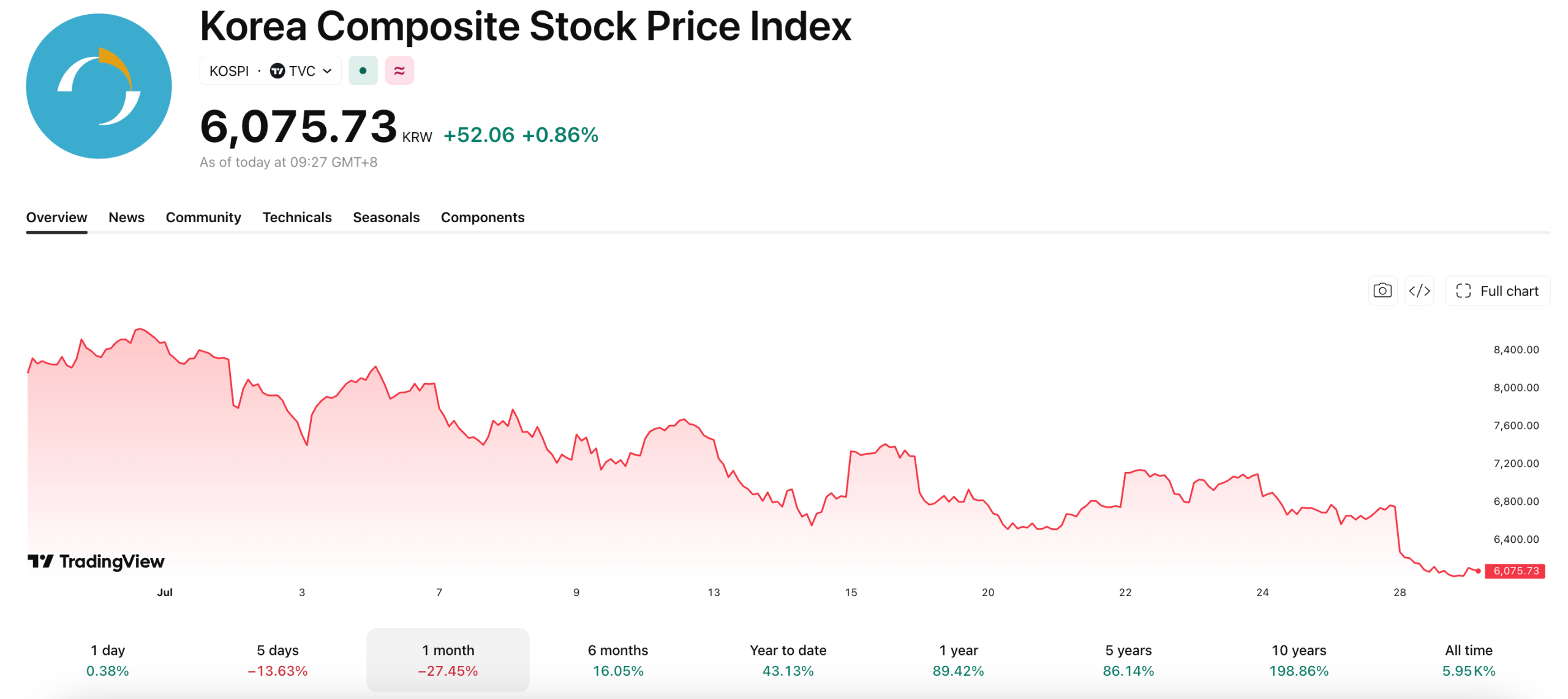
South Korea’s Kospi index and the Nasdaq 100 are moving in near lockstep. Their 60-day correlation climbed to about 0.50, the highest level since 2021, according to data from Rayliant Global Advisors.
The tightening link traces back to artificial intelligence (AI) spending. It now ties Samsung Electronics and SK Hynix to the same hyperscaler capital expenditure driving U.S. tech earnings.
Chipmakers Anchor the Kospi
Samsung and SK Hynix together account for more than half of the Kospi index. These important companies in South Korea thus also sway the index, linking AI infrastructure directly to the way in which the market moves.

Data-center demand made up roughly 40% of global DRAM (dynamic random-access memory) demand last year. That figure now exceeds half, and many expects it to keep rising.
That volatility played out again this week. SK Hynix’s recent selloff knocked the stock down 13% as AI capital expenditure doubts spread through the chip sector.
A Two-Way Signal With Rising Risk
Samsung and SK Hynix trade hours before Wall Street opens. That gives them an early-proxy role for how investors may react to AI news.
“The fortunes of U.S. tech stocks and Korean tech stocks are increasingly being driven by a common underlying factor, which is sentiment toward the AI hardware trade.”
— Wool, head of research at Rayliant Global Advisors
The dynamic cuts both ways. On July 13, Kospi’s chip-driven crash sent the index down more than 8% as SK Hynix plunged 15%. The Nasdaq 100 followed with a 1.88% drop. Micron fell 4%, SanDisk fell 12%, and Intel fell 6%.
Some have warned that a slowdown in hyperscaler capex would hit Korea harder than most markets. Half the Kospi now rests on one cyclical theme. Korean memory stocks also carry more volatility than U.S. peers, and leveraged ETF flows amplify the swings.
Samsung typically releases earnings guidance two weeks ahead of major U.S. semiconductor results. That timing could offer the next read on how closely the two markets trade together.
China’s Changxin Technology Group (CXMT), a rising domestic memory chipmaker, surged 466% on its Shanghai listing. That surge made it China’s most valuable listed company.
The post KOSPI-Nasdaq Correlation Hits 5-Year High as AI Bet Worryingly Binds Markets appeared first on BeInCrypto.
SK Hynix released its second-quarter financial results today, reporting a surge in profit and revenue. However, the numbers still missed analyst estimates.
The firm posted revenue of 79.3 trillion won, below LSEG SmartEstimates of 84 trillion won. Operating profit reached 60.54 trillion won, short of the 64 trillion won expected.
AI Demand Powers A Record Quarter For SK Hynix
According to the company’s release, the quarter marked its best performance on record. SK Hynix reported revenue grew 257% year over year.
Operating profit rose 557%, lifting the operating margin to 76%. Net income came in at 93.92 trillion won, up 1,242% year on year.
The growth extended a record set just 3 months earlier. Revenue came in 51% above the first quarter, with operating profit up 61%. SK Hynix also passed 100 trillion won in cumulative first-half revenue for the first time.
Follow us on X to get the latest news as it happens
The chipmaker attributed the performance to sustained demand from expanding investments in Artificial Intelligence (AI) infrastructure. High-performance AI server products led price increases during the quarter.
“Both DRAM and NAND flash memory prices experienced significant quarter-over-quarter increases. SK hynix achieved top-tier profitability by expanding sales centered on high-value-added products, including HBM, DRAM for AI servers, and eSSD,” the firm said.
The results also strengthened the balance sheet. Cash and equivalents reached 88 trillion won, expanding the net cash position to 69.4 trillion won. Furthermore, SK Hynix said it is expanding multi-year contract discussions to secure supply stability.

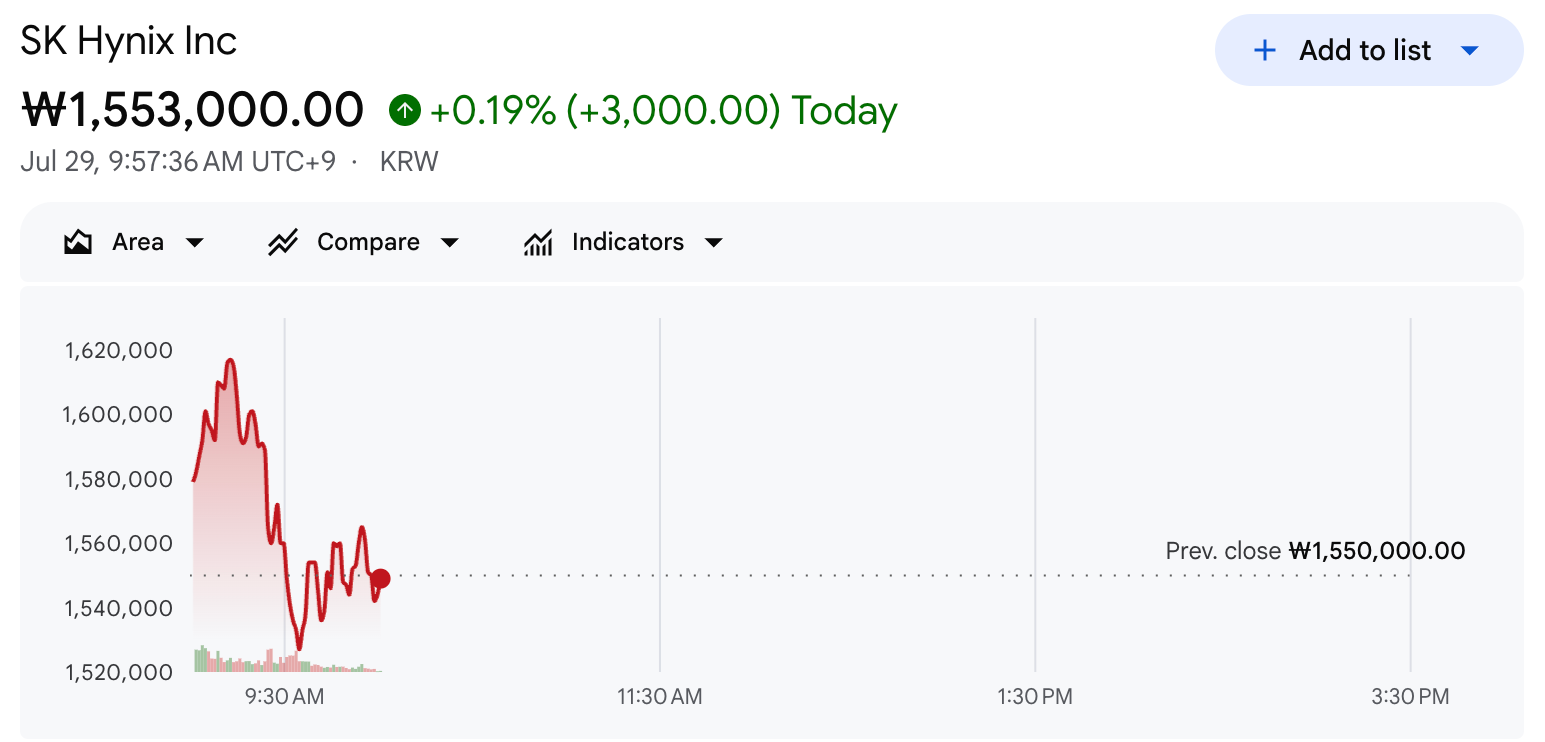
Nonetheless, the strong quarter did not translate into an immediate rally. SK Hynix shares dropped more than 3% after the market opened as investors weighed the estimate miss. The stock later pared losses and traded up 0.19% at press time.
The choppy session fits a broader pattern. Despite remaining in the green year to date, the stock has fallen more than 40% over the past month on persistent volatility.
Subscribe to our YouTube channel to watch leaders and journalists provide expert insights
The post SK Hynix’s Record Profit Still Trails What Analysts Wanted to See appeared first on BeInCrypto.
Australia Q2 CPI undershoots forecasts, easing RBA hike bets

South Korea Plans Crypto Law as Tax Repeal Reaches Committee

Tiger and Phil vanished from this major season. But at Lytham, history lingers


-

 Fashion4 days ago
Weekend Open Thread: Brooks Brothers
-
 Sports2 days ago
Commonwealth Games boxing: Jadumani Singh seals dominant 5-0 win over Pakistan’s Sumama Rehman to enter quarter-finals | Commonwealth Games News
-

 Tech2 days ago
Intel is reversing course and bringing hyper-threading back to its server chips
-

 Crypto World6 days ago
Ethics, other provisions in crypto Clarity Act to be further discussed
-

 Politics2 days ago
Luke Littler dismantles Gerwyn Price to retain title in Blackpool
-

 Sports5 days ago
2026 3M Open leaderboard: Scottie Scheffler finds putter in Round 1, sits three back
-

 Politics19 hours ago
The Part of the Electric Transition Nobody Wants to Discuss
-

 Fashion5 days ago
16 Dresses for the High Summer Event
-
 Entertainment5 days ago
A New Post-Apocalyptic Gundam Anime Series Blasts Into SDCC
-

 News Videos5 days ago
The Peugeot Family: How 200 Years of an “Old Money” Dynasty Died in A Boardroom
-

 News Videos2 days ago
BITCOIN JUST ENTERED THIS CRITICAL ZONE…
-

 Politics3 days ago
Spain sweeps the board at 2026 World Cup with individual awards
-

 Crypto World3 days ago
Ripple bought a bank in pieces. The $4 billion audit
-

 Crypto World3 days ago
XRP Ledger adds $2.6B as RWA inflows rank second
-

 Crypto World6 days ago
Uniswap (UNI) pushes deeper into tokenized RWAs with permissioned trading pools
-

 Tech4 days ago
Anthropic launches Claude Opus 5, a cheaper AI model for coding, agents and enterprise workflows
-
 Entertainment9 hours ago
‘Stargate’ Creator’s New Sci-Fi Series Returns for Season 3 Tomorrow
-
Crypto World6 days ago
SEC Agrees to Overhaul Recordkeeping After Settling Coinbase Lawsuit Over Gensler’s Lost Texts
-

 Business5 days ago
Alliance Entertainment Holding Corporation (AENT) Discusses Evolution Into Omnichannel Distribution and Fulfillment Platform for Media and Collectibles Transcript
-

 News Videos8 hours ago
Claude: Build Financial Dashboards in Minutes (2026)
You must be logged in to post a comment Login