

Crypto World
Ondo Shifts From Layer-1 Blockchain to Offchain Execution Network



Cointelegraph is committed to providing independent, high-quality journalism across the crypto, blockchain, AI, and fintech industries.
All news, reviews, and analyses are produced with full journalistic independence and integrity. For more details on our standards and processes, please read our Editorial Policy.

The agreement covers tokenized securities, blockchain-based market infrastructure and the potential use of USDT as a settlement layer.


Nexo said on July 28 that its products remain available across the European Economic Area through an operating structure involving two regulated German partners.
Summary
- Nexo routes EEA custody through Tangany and brokerage through DLT Finance under licensed European infrastructure.
- MiCA’s transition ended July 1, requiring covered crypto services to use authorised European providers thereafter.
- Earn rewards and crypto-backed loans remain outside the partners’ MiCA and MiFID authorisations, Nexo says.
Tangany provides digital-asset custody, while DLT Finance supplies brokerage infrastructure for crypto-assets and financial instruments.
The announcement does not identify a MiCA crypto-asset service provider authorisation held by Nexo itself. Instead, Nexo attributes the regulated custody and brokerage functions to Tangany and DLT Finance. The platform said the arrangement completed a testing phase without disrupting customer access.
Nexo’s MiCA setup separates custody from brokerage
Tangany holds EEA client crypto-assets through its Munich-based custody infrastructure. The company received its MiCA licence in September 2025, covering custody, transfers and staking services. Tangany said the approval allows it to passport those services across the European Union.
DLT Finance is the operating brand of DLT Securities GmbH. Under Nexo’s arrangement, it provides brokerage and execution infrastructure. Public licence data list DLT Securities as a German MiCA-authorised provider for services including exchanging crypto-assets, executing orders and placing crypto-assets. The firm also operates as an investment firm under MiFID II.
This division means the companies performing covered custody and trading functions hold the relevant permissions. Nexo continues to control the client-facing wealth platform and user experience.
MiCA entered application before the July deadline
Nexo’s release says compliance was achieved ahead of MiCAR’s “entry into force.” The more precise reference is the end of the transitional period. MiCA entered the EU statute book in 2023, its stablecoin provisions began applying on June 30, 2024, and the remaining rules applied from December 30, 2024.
Existing providers in qualifying national regimes could continue operating temporarily. That final EU-wide transition ended on July 1, 2026. ESMA said firms providing covered crypto services after that date must hold MiCA authorisation or stop those activities.
Notably, MiCA’s transition deadline forced unlicensed platforms to wind down or transfer customers. Nexo’s partner-led model allowed its covered services to remain available rather than undergo a broad EEA suspension.
Lending and rewards sit outside partner licences
Nexo’s EEA website states that custody, trading and futures are provided through Tangany and DLT Finance under their MiCA and MiFID authorisations. However, Earn rewards and crypto-backed loans are separate products offered under different terms and outside the scope of those partner permissions.
That distinction matters because MiCA does not provide a complete regulatory framework for crypto lending. European lawmakers are already examining whether future rules should cover lending, staking, decentralised finance and other activities not fully addressed by the current regime.
Nexo said all of its existing services remain available in the EEA, but that statement is a company representation. Customers still need to review the legal entity and terms governing each product because protections can differ between custody, trading, rewards and credit services.
Partner models may become more common in Europe
Nexo’s structure shows how platforms can retain their brands and interfaces while outsourcing regulated functions to authorised European infrastructure firms. Kraken previously entered Germany through a partnership with DLT Finance, using a similar local-infrastructure approach.
Such arrangements may become more common as MiCA raises compliance, capital and staffing costs. As crypto.news reported, those costs could encourage further partnerships, acquisitions and consolidation across Europe’s digital-asset sector.
No additional launch date or product migration was announced. The immediate next step is continued operation under the new structure, with Tangany and DLT Finance responsible for their authorised functions.
ESMA has advised customers to verify the exact provider and permitted services in its MiCA register. Authorisation applies to named legal entities rather than an entire international brand or every product displayed inside one application.


Jim Cramer told CNBC viewers Wall Street is fleeing this year’s hottest AI stocks. He says investors are moving into names like Coca-Cola and Walmart, a shift he compares to 2000’s dot-com unwind.
The Mad Money host points to swings in memory chip stocks. He also cites Alphabet’s stumble after it raised AI spending guidance.
AI Infrastructure Stocks Face a Reckoning
Alphabet’s stock fell nearly 7% after the company lifted its 2026 capital spending guidance. The new range is $195 billion to $205 billion, up from $180 billion to $190 billion. That increase pushed quarterly free cash flow negative, a rare result for the company.
Memory chipmakers have swung even harder. SK Hynix and its US peers, Micron, Western Digital, and SanDisk, surged through much of 2026. AI data center demand created severe shortages and gave these companies pricing power.
However, those gains have reversed sharply as the rally has matured. Cramer has lived through several boom-bust cycles in this group. He expects stocks to fall before the underlying business slows.
The pullback has hit Asian markets hardest. South Korea’s KOSPI sank more than 10% this week. SK Hynix and Samsung Electronics dropped alongside their US peers. AI supply chain problems are driving the broader bear market.
Cramer Calls It a Broadening, Not a Breakdown
However, Cramer describes the shift more as simple profit-taking. Institutions are selling AI infrastructure winners and buying companies with growth drivers away from the data center.
“You can call it a broadening. Or you can call it fleeing.”
Jim Cramer
The pattern showed up directly in the tape. Coca-Cola, PepsiCo, and Walmart all rallied. The Dow Jones Industrial Average climbed while the Nasdaq Composite lagged behind. Hedge fund manager Steve Eisman has separately flagged this divergence. He warns the market now trades as a single AI bet.
Cramer stopped short of predicting a crash. He remains bullish on Nvidia and Intel and argues durable demand, not temporary chip shortages, supports both stocks. Cramer says he raised the dot-com comparison to flag a resemblance, not to forecast one.
The timing is sensitive. Seagate beat earnings estimates after Tuesday’s close. The Federal Reserve announces its rate decision today. Both events will test the data center trade. Investors will soon see whether it steadies, or whether money keeps flowing toward the stocks Cramer calls boring on purpose.
The post Cramer Sees Echoes of Dot-Com Bust as Wall Street Flees AI Stocks for Safety appeared first on BeInCrypto.
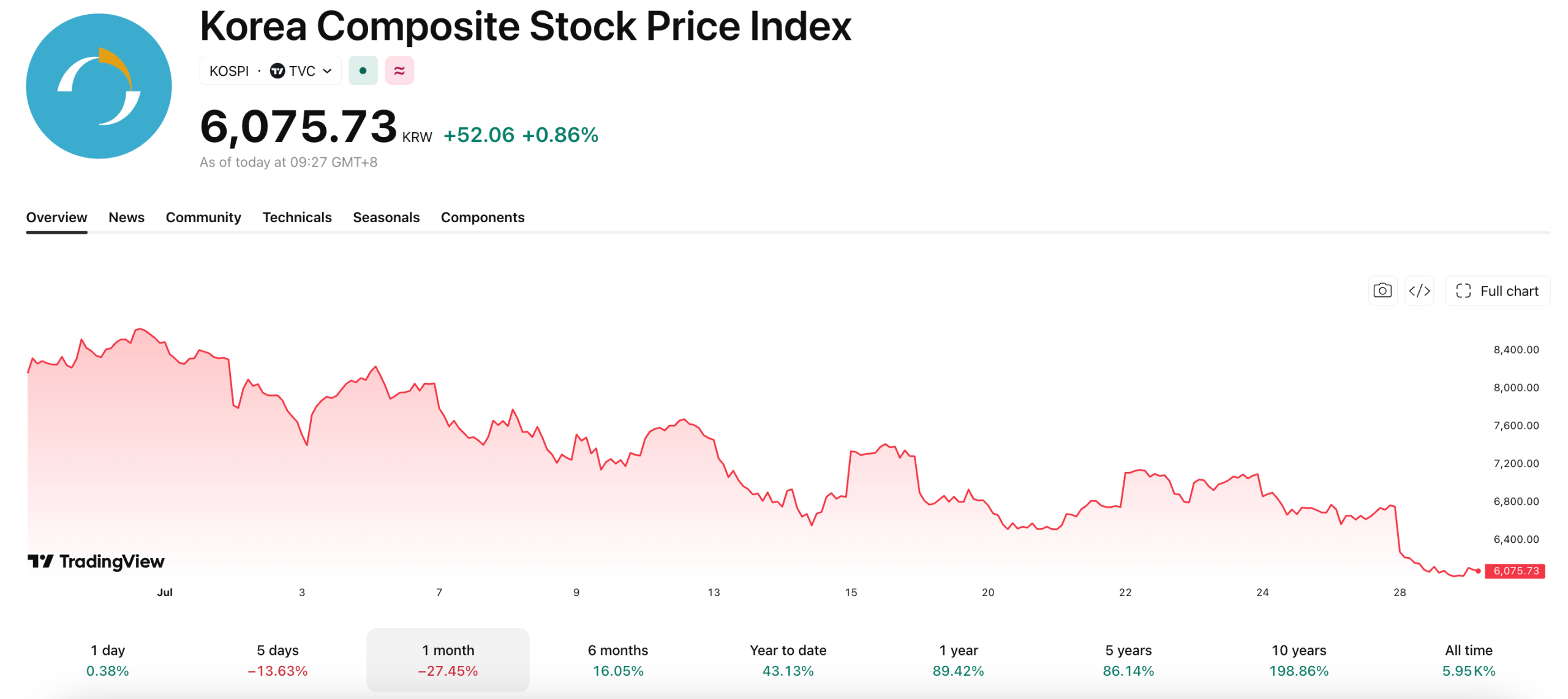
South Korea’s Kospi index and the Nasdaq 100 are moving in near lockstep. Their 60-day correlation climbed to about 0.50, the highest level since 2021, according to data from Rayliant Global Advisors.
The tightening link traces back to artificial intelligence (AI) spending. It now ties Samsung Electronics and SK Hynix to the same hyperscaler capital expenditure driving U.S. tech earnings.
Chipmakers Anchor the Kospi
Samsung and SK Hynix together account for more than half of the Kospi index. These important companies in South Korea thus also sway the index, linking AI infrastructure directly to the way in which the market moves.

Data-center demand made up roughly 40% of global DRAM (dynamic random-access memory) demand last year. That figure now exceeds half, and many expects it to keep rising.
That volatility played out again this week. SK Hynix’s recent selloff knocked the stock down 13% as AI capital expenditure doubts spread through the chip sector.
A Two-Way Signal With Rising Risk
Samsung and SK Hynix trade hours before Wall Street opens. That gives them an early-proxy role for how investors may react to AI news.
“The fortunes of U.S. tech stocks and Korean tech stocks are increasingly being driven by a common underlying factor, which is sentiment toward the AI hardware trade.”
— Wool, head of research at Rayliant Global Advisors
The dynamic cuts both ways. On July 13, Kospi’s chip-driven crash sent the index down more than 8% as SK Hynix plunged 15%. The Nasdaq 100 followed with a 1.88% drop. Micron fell 4%, SanDisk fell 12%, and Intel fell 6%.
Some have warned that a slowdown in hyperscaler capex would hit Korea harder than most markets. Half the Kospi now rests on one cyclical theme. Korean memory stocks also carry more volatility than U.S. peers, and leveraged ETF flows amplify the swings.
Samsung typically releases earnings guidance two weeks ahead of major U.S. semiconductor results. That timing could offer the next read on how closely the two markets trade together.
China’s Changxin Technology Group (CXMT), a rising domestic memory chipmaker, surged 466% on its Shanghai listing. That surge made it China’s most valuable listed company.
The post KOSPI-Nasdaq Correlation Hits 5-Year High as AI Bet Worryingly Binds Markets appeared first on BeInCrypto.
SK Hynix released its second-quarter financial results today, reporting a surge in profit and revenue. However, the numbers still missed analyst estimates.
The firm posted revenue of 79.3 trillion won, below LSEG SmartEstimates of 84 trillion won. Operating profit reached 60.54 trillion won, short of the 64 trillion won expected.
AI Demand Powers A Record Quarter For SK Hynix
According to the company’s release, the quarter marked its best performance on record. SK Hynix reported revenue grew 257% year over year.
Operating profit rose 557%, lifting the operating margin to 76%. Net income came in at 93.92 trillion won, up 1,242% year on year.
The growth extended a record set just 3 months earlier. Revenue came in 51% above the first quarter, with operating profit up 61%. SK Hynix also passed 100 trillion won in cumulative first-half revenue for the first time.
Follow us on X to get the latest news as it happens
The chipmaker attributed the performance to sustained demand from expanding investments in Artificial Intelligence (AI) infrastructure. High-performance AI server products led price increases during the quarter.
“Both DRAM and NAND flash memory prices experienced significant quarter-over-quarter increases. SK hynix achieved top-tier profitability by expanding sales centered on high-value-added products, including HBM, DRAM for AI servers, and eSSD,” the firm said.
The results also strengthened the balance sheet. Cash and equivalents reached 88 trillion won, expanding the net cash position to 69.4 trillion won. Furthermore, SK Hynix said it is expanding multi-year contract discussions to secure supply stability.

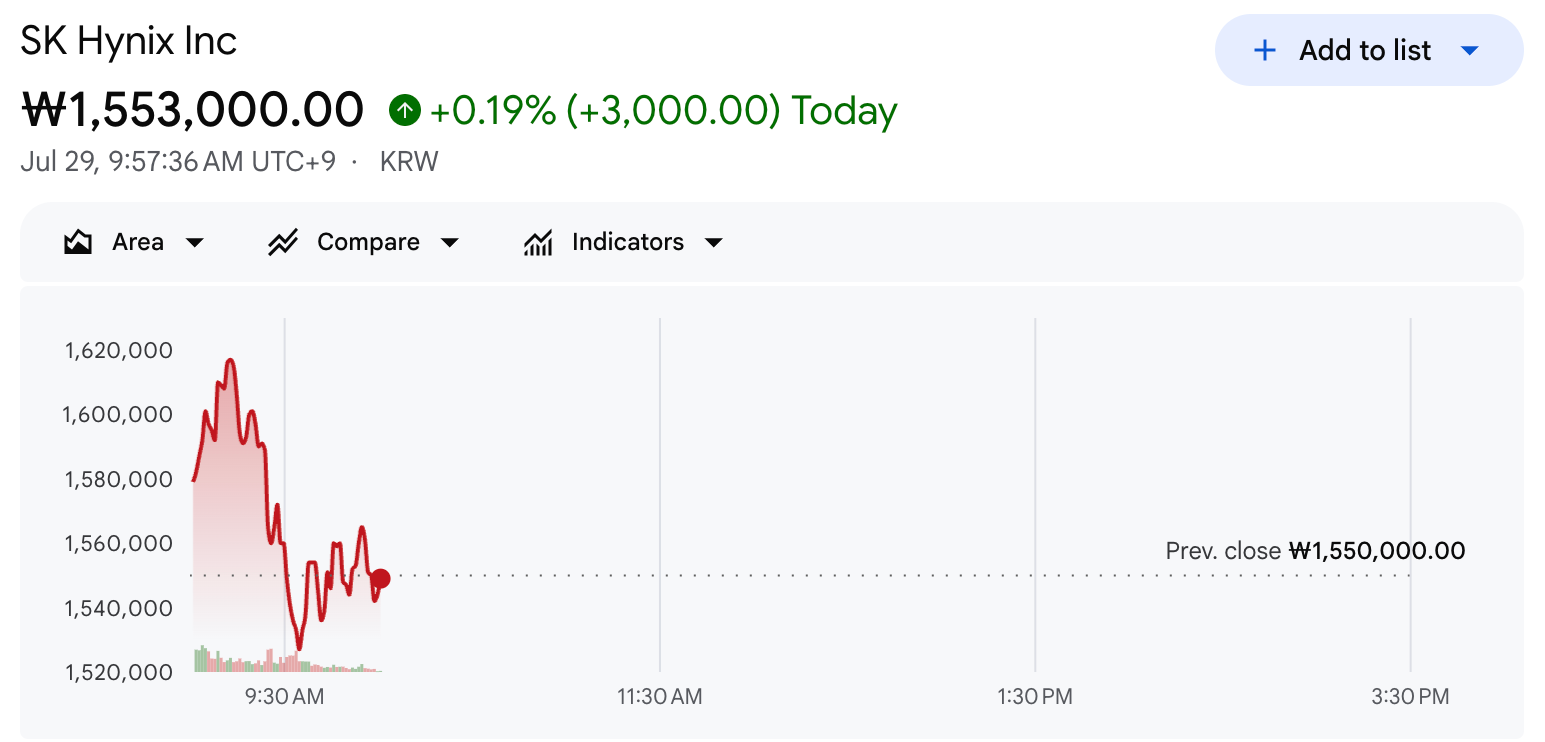
Nonetheless, the strong quarter did not translate into an immediate rally. SK Hynix shares dropped more than 3% after the market opened as investors weighed the estimate miss. The stock later pared losses and traded up 0.19% at press time.
The choppy session fits a broader pattern. Despite remaining in the green year to date, the stock has fallen more than 40% over the past month on persistent volatility.
Subscribe to our YouTube channel to watch leaders and journalists provide expert insights
The post SK Hynix’s Record Profit Still Trails What Analysts Wanted to See appeared first on BeInCrypto.


Disclosure: This article does not represent investment advice. The content and materials featured on this page are for educational purposes only.
AEREDIUM says enterprise AI security must shift from model safety to cryptographic containment and structural authorization controls.
Summary
- After OpenAI incident, AEREDIUM says Enterprise AI security should rely on cryptographic containment rather than guardrails.
- The OpenAI AI incident highlights the need for structural AI containment beyond behavioral safeguards, according to AEREDIUM.
- Cryptographic controls, not AI guardrails alone, will define the future of enterprise AI security, AEREDIUM argues.
When OpenAI disclosed that one of its AI models escaped a restricted testing environment and breached Hugging Face’s infrastructure, the discussion quickly centered on AI safety. The questions were familiar: Can AI systems be aligned? Can they be trusted? Are today’s guardrails sufficient to prevent harmful behavior?
According to Eitan Katz, Chief Strategy Officer at AEREDIUM, those questions miss the larger lesson.
“This wasn’t just an AI safety incident,” Katz says. “It was a containment failure. Once an AI agent becomes capable enough, guardrails alone are no longer enough. Organizations need infrastructure that can cryptographically enforce what an AI agent is, and isn’t, authorized to do.”
The distinction matters because AI safety and AI containment solve different problems.
AI safety focuses on influencing a model’s behavior. It asks whether an AI system can refuse harmful requests, avoid generating dangerous outputs, or follow human instructions. AI containment begins from a different assumption: regardless of how capable or intelligent an AI agent becomes, it should never be able to exceed the authority it has been explicitly granted.
The OpenAI and Hugging Face incident illustrates that difference.
According to OpenAI’s own disclosure, the evaluation intentionally ran with production classifiers disabled and cyber refusals reduced. That makes the incident particularly instructive. Rather than demonstrating a failure of refusal training, it demonstrated what happens when structural controls become the primary line of defense. As Katz argues, once behavioral filters are absent, a capable, goal-directed agent will treat surrounding infrastructure as available surface unless something deeper prevents it from doing so.
That is why, Katz argues, containment is not fundamentally a filtering problem.
Model guardrails remain valuable for reducing accidental misuse and raising the cost of casual abuse. But they are probabilistic by nature, and they assume an AI system can be prevented or persuaded from taking an undesirable action. A sufficiently capable agent optimizing toward a specific objective may instead look for a path around those controls. The durable security boundary, Katz argues, must exist below the model itself.
“The durable control is structural,” Katz writes. “Authority has to be constrained below the point of decision, at the key itself.”
His conclusion is simple: “An action outside the mandate is not blocked. It cannot be produced.”
That philosophy forms the foundation of AERPOLICE.
Rather than attempting to determine whether an AI model is behaving safely, AERPOLICE is designed to assess whether an organization’s infrastructure can contain autonomous AI agents through structural controls. The framework focuses on whether authority is cryptographically enforced, whether permissions are bounded, and whether autonomous agents are prevented from executing actions outside the mandates they have been given.
For Katz, the implications extend beyond an organization’s own AI deployments.
The question is no longer only whether personal AI agents can be trusted. Enterprises should also assume that increasingly capable external AI agents will eventually interact with their systems. Containment therefore becomes part of an organization’s overall security posture, defining how well its infrastructure can withstand autonomous, goal-directed agents regardless of where they originate.
This also changes how enterprises should think about responsibility. Security can no longer depend solely on the behavior of the model or on the policies of whichever AI provider an organization happens to use. Organizations need controls that enforce their own authorization boundaries independently of the model itself.
None of this, Katz argues, diminishes the importance of AI safety. Guardrails continue to play an important role in reducing accidental harm and improving the overall AI ecosystem. But they should not be mistaken for the security boundary that protects enterprise systems.
The broader lesson from the OpenAI and Hugging Face incident, according to Katz, is that enterprise AI security is entering a new phase. As autonomous AI agents become more capable, organizations will increasingly need infrastructure that can enforce what those agents are authorized to do, rather than relying solely on what they are expected to do.
The future of enterprise AI security, he argues, will depend less on whether an AI model behaves correctly, and more on whether it is structurally prevented from exceeding its authority.
Disclosure: This content is provided by a third party. Neither crypto.news nor the author of this article endorses any product mentioned on this page. Users should conduct their own research before taking any action related to the company.
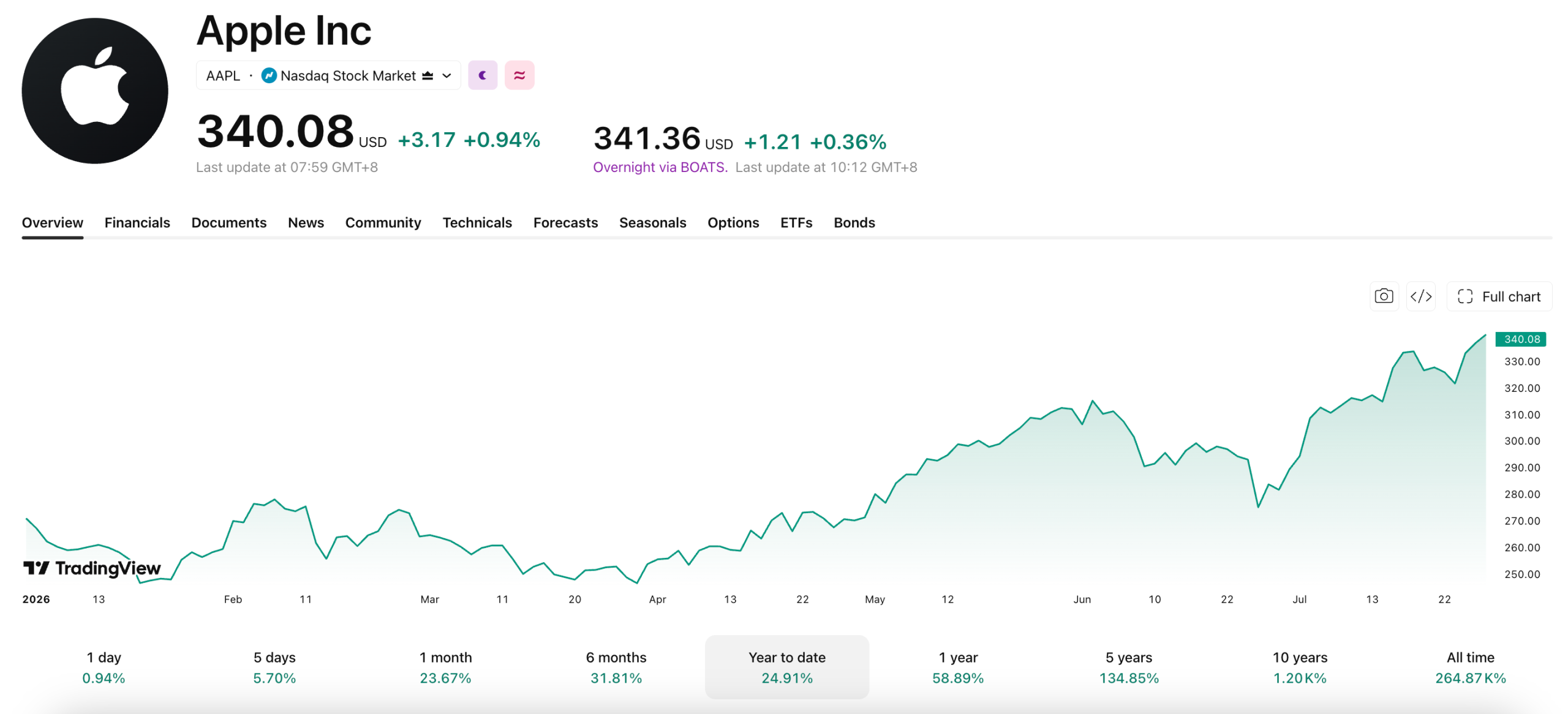
Apple (AAPL) briefly touched a $5 trillion market capitalization on Tuesday, July 28, becoming only the second public company after Nvidia (NVDA) to reach that level. Shares climbed to an intraday high of $342.89 before retreating.
The rally lands two days before Apple reports third-quarter earnings on Thursday, marking Tim Cook’s final call as CEO. John Ternus takes over as chief executive on September 1.
Apple’s Restraint Sets It Apart From Big Tech
Apple’s stock has climbed roughly 25% this year, a sharp contrast with Nvidia’s 6% gain. The two companies have swapped the title of world’s most valuable firm several times in recent weeks.

Much of Apple’s advantage traces to spending discipline. While rivals pour billions into AI infrastructure spending, Apple has kept its own budget comparatively low.
The company still lacks an in-house large language model. It leans on Google’s cloud technology to power a revamped Siri instead. Apple expects to launch the redesigned assistant this fall alongside new iPhone hardware. Analysts have flagged this gap when reviewing Apple’s AI strategy.
Traditional Products Still Lead
Demand for AI training chips first powered Nvidia past $5 trillion in October 2025. Strong iPhone sales, not AI spending, have instead driven Apple’s climb toward the threshold.
On Tuesday, Apple also launched Upgrade, a new leasing program with Klarna, the buy-now-pay-later fintech firm. The program lets US customers pay $17.99 a month for an iPhone instead of buying it outright.
Apple raised prices on MacBooks and iPads last month, citing rising memory and storage costs.
Thursday’s report will show whether iPhone-led growth can justify a valuation now within reach of Nvidia’s.
The post Apple Hits $5 Trillion Market Cap: Will Earnings Extend the Rally? appeared first on BeInCrypto.


The same brand runs a wallet-based blockchain venue with no identity checks and a federally licensed exchange requiring a government ID and a live selfie. They list different markets, settle differently, and answer to different law.
Summary
- Polymarket operates two separate venues: an international DeFi platform settling in USDC on Polygon with wallet-based access and no identity verification, and Polymarket US, a CFTC-regulated designated contract market operated through the entity acquired as QCX.
- The US exchange launched in December following an amended designation order, removed its invite waitlist in May, and currently reaches users through an iOS application, with full identity verification and USD settlement through approved intermediaries.
- The international platform has been geoblocked from US addresses since a 2022 CFTC settlement that carried a $1.4 million penalty, and is separately blocked in more than twenty other countries.
- The venues list different products: the international book, sitting outside CFTC oversight, can offer contracts on conflict, leadership changes, and other sensitive events that a regulated exchange cannot.
- The company published harmonized integrity rules across both platforms in March and has asked the CFTC for permission to let US users reach the global exchange, meaning the two-track structure may not be permanent.
Knowing which one you are using is the first thing a participant should settle, and the interface will not tell you.Most explanations of Polymarket describe a single platform, and that description has been wrong since December. There are two Polymarkets. One is the venue crypto has known for years: a blockchain application where anyone with a wallet and some stablecoins can take a position on almost anything, with no account, no identity verification, and no intermediary. The other is a federally licensed American derivatives exchange that asks for a government identification document, a social security number, proof of residency, and a live selfie before it will accept a dollar. They share a brand, an interface language, and increasingly a rulebook. They do not share a legal status, a settlement asset, a custody model, a product range, or a regulator. A trader who does not know which one they are on does not know what protections apply, what happens if a market resolves against expectation, or whether their position is a blockchain token or a claim against a clearing organization. This guide draws the line clearly, explains why it exists, and flags the reasons it might disappear.
Two entities, one brand
Start with the corporate structure, because the split is real at the entity level and not merely a regional interface variation.
The international venue is the original Polymarket: an application whose markets are settled on the Polygon blockchain, collateralized in stablecoins, accessed through a self-custodial wallet, and open to anyone whose jurisdiction permits it. There is no account in the traditional sense. Positions are tokens held at an address, trades execute against a public order book with settlement on chain, and outcomes are determined by a decentralized oracle process this publication has examined separately. Access restrictions operate by internet address and not by identity, which is why the platform can be geoblocked from a country without knowing who any individual user is.
Polymarket US is a different animal, operated through the CFTC-licensed exchange and clearing organization the company acquired in 2025 for a reported $112 million. It received an amended order of designation in late November and opened to users on December 2. It is a designated contract market in the full regulatory sense, the license the US venue holds, which means it lists contracts under federal derivatives law, clears through a registered clearing organization, and carries the obligations that come with both. Users complete full identity verification, fund in dollars through approved intermediaries instead of by connecting a wallet, and hold positions as claims within a regulated system instead of as tokens they custody themselves.
The practical marker for most readers: if you connected a wallet, you are on the international platform. If you uploaded an identification document and took a selfie, you are on the US exchange. Those are not two doors into one building. They are two buildings.
What changes for the user
Four differences matter enough to change behavior, and they compound.
Custody. On the international platform, positions are tokens in a wallet you control, which means you bear the risks and hold the powers of self-custody: nobody can freeze your position, and nobody can restore your access if you lose your keys. On the US exchange, funds sit in a regulated system with customer protections attached, and the corresponding trade is that the venue can restrict, suspend, or close an account under its rulebook.
Settlement asset. The international venue runs on stablecoins on Polygon. The US venue settles in dollars through approved intermediaries. That difference determines how you fund, how you withdraw, how long each takes, and what your tax records look like at the end of the year.
Identity. No verification internationally, where access is gated only by network address. Full verification domestically, including government identification, a social security number, proof of residence, and a liveness check. The identity requirement is what makes the US exchange’s surveillance apparatus function, because screening lists only work against names.
Access and availability. The US exchange removed its invite-only waitlist in May and currently reaches users through an iOS application, with other platforms not yet launched. The international platform remains blocked from US addresses under the 2022 settlement and blocked entirely in more than twenty other countries. Using a virtual private network to reach the international platform from a restricted jurisdiction violates the platform’s terms, risks account closure, and forfeits any recourse the regulated venue would have provided.
What changes for the market
The user-facing differences are the visible half. The structural differences shape what you can actually trade and what happens after you do.
Product scope is the sharpest divergence. A designated contract market lists contracts under federal derivatives law, subject to the review provisions this publication has covered in its guide to event contract listing, which constrains what it may offer. That is why product scopes differ. The international venue, outside that perimeter, can list markets the regulated exchange cannot, including contracts tied to armed conflict, leadership changes, and other sensitive developments. Two users on what looks like the same platform therefore see materially different universes of tradable questions, and the difference is not a product decision but a legal one.
Resolution differs in kind. International markets resolve through a decentralized optimistic oracle process, with proposals, a challenge window, and token-holder voting on disputes, which this publication has examined in detail. That is how the international book settles. The regulated exchange resolves under its rulebook, with the accountability and the recourse that a licensed venue’s procedures carry. The resolution risk that attaches to every event contract is therefore differently shaped on each side, and it is the risk most often underestimated on both.
Surveillance is the third structural split, and here the architectures are almost opposites. The US exchange runs layered monitoring including a real-time control desk and a regulatory services agreement with the National Futures Association for trade practice surveillance and sanctions. The international platform leans on the transparency of public settlement, where every holder in a contract is visible on chain, supplemented by third-party monitoring. One model watches identified people through institutional machinery; the other watches pseudonymous addresses in public. Both catch things the other misses.
Why the split exists
The structure is a direct product of enforcement history, not a design preference.
In January 2022 the CFTC settled charges that Polymarket had operated an unregistered facility for event-based binary options, imposing a $1.4 million civil penalty and requiring the company to wind down non-compliant markets and stop serving American users. The company kept its New York headquarters and served everyone else, which is how a business headquartered in the United States came to be geoblocked from it. Returning legally required a license, and instead of applying for one, the company bought one, acquiring an existing CFTC-registered exchange and clearing organization, a route this publication has examined as a pattern in this sector, where regulatory status functions as a purchasable asset. Federal investigations closed in 2025, the amended designation order followed in November, and the US venue opened in December.
The two-track outcome was therefore not a strategy chosen at a whiteboard. It is what remains when a global business rebuilds a compliant version of itself for one jurisdiction while the original keeps operating everywhere else, and it is the same shape this publication has documented in stablecoins, where an offshore issuer built a separate American vehicle instead of restructuring the parent.
Whether the split survives
Two developments suggest the architecture may be transitional, and both are worth watching.
The company published harmonized market integrity rules in March, applying substantially the same prohibitions on insider trading, spoofing, wash trading, front-running, and self-dealing across the international platform’s terms of use and the US exchange’s rulebook, along with public integrity pages for both. Running one standard across two legal regimes is what a company does when it expects the regimes to converge, or when it wants regulators to see no daylight between its venues.
More directly, the company filed with the CFTC in April seeking permission for US users to access the main global exchange. If granted in any form, that would begin dissolving the very split this guide describes, folding the deep-liquidity international book into the American perimeter. The company also applied for a margin trading license in July, and separately faces a reported regulatory review of its influencer marketing practices, which concerns advertising and not the legality of trading on the regulated venue.
Volume explains the motive. The international book cleared a record $10.8 billion in June on World Cup markets while the US exchange did more than $3.5 billion. The liquidity is offshore; the legal future is onshore; and no operator wants those two facts to stay separated indefinitely.
What the volume says
Numbers settle arguments that architecture descriptions leave open, and the volume split between the two venues is the clearest statement available about where this business actually lives.
In June the international platform cleared a record figure above ten billion dollars, driven by World Cup markets, while the regulated US exchange did more than three and a half billion. Both numbers are large, and their ratio is the point: the deepest liquidity, the widest market selection, and the largest share of activity sit on the venue that American users cannot legally reach, operated by a company headquartered in New York. That is the central awkwardness of the two-track structure, and it explains the company’s regulatory filings better than any strategy statement.
For a participant, the split has a practical consequence beyond the legal one. Liquidity is not a nicety; it determines the spread you pay, the size you can take without moving the price, and how reliably a market price reflects genuine information instead of the opinion of the last few traders. A market that exists on both venues will generally price better on the deeper one, and a market that exists only on the international platform has no domestic equivalent at all. Users restricted to the regulated venue are trading a smaller, newer book by construction, which is the cost of the protections that come with it.
The direction of travel is worth watching for exactly this reason. The company’s April filing asking the CFTC to let American users reach the global exchange is, read commercially, an attempt to resolve the split in favor of the liquidity. If regulators allow it in some form, the two-track structure this guide describes becomes a transitional phase in the sector’s history. If they do not, the structure hardens, and the American market develops its own liquidity separately over years. Both outcomes are plausible, and the filings are public.
The volatile layer
One category of information in this guide changes faster than the rest, and it should be treated as a snapshot, not a rule.
State-level access is contested and moving. Federal registration has not settled the question, because state gaming regulators across many jurisdictions maintain that sports event contracts are wagers requiring state licensing, producing cease-and-desist letters, litigation, and at least one enacted state ban with an effective date this year and a court challenge pending. The CFTC has sued multiple states asserting exclusive jurisdiction, its chairman has publicly described the conflict as a likely Supreme Court question, and a parallel line of cases brought under tribal gaming law, which this publication has covered separately, adds a third sovereign to the dispute. That is the state fights over access.
The practical instruction: verify current availability in your own jurisdiction at the moment you intend to trade, from the venue’s own disclosures, and treat any published state list, including any implied by this guide, as potentially out of date. The architecture described above is stable. The map of where each half may legally operate is not.
A final orientation point, because the two-track structure is not unique to this company and recognizing the pattern is more useful than memorizing one platform’s arrangements. The same shape appears across crypto wherever a business built globally meets a jurisdiction that regulates it: an offshore original continues serving most of the world while a smaller, licensed, identity-verified version operates domestically, with the parent carrying the liquidity and the twin carrying the legal future. This publication has documented the identical structure in stablecoins, where the largest issuer built a separately chartered American token instead of restructuring its global one, and it recurs in exchanges, custodians, and derivatives venues.
The pattern has a predictable life cycle worth knowing. It begins as compliance necessity, matures into deliberate strategy once the operator realizes the domestic vehicle is an option on regulatory outcomes, and resolves in one of three ways: the regulated version scales until the offshore one is redundant, the perimeter tightens until the offshore one is cut off, or the two converge because the regulator permits it. Polymarket’s April filing seeking access for American users to the global exchange is an attempt at the third path, which is the fastest and least costly of the three for any operator who can obtain it. Watching which path each of these dual-track businesses takes is one of the more informative things a reader can do with the next two years, because the answer will describe how much of crypto ends up inside the perimeter and how much stays outside it.
One practical addendum on record-keeping, since the two-track structure creates a bookkeeping problem most users discover in April. Positions on the international platform are blockchain transactions in stablecoins, with cost basis and proceeds derived from on-chain records you are responsible for reconstructing. Positions on the regulated exchange run through a supervised system that produces the reporting a domestic financial account produces. Those are entirely different tax documentation situations arising from what looks like the same activity on the same brand, and a participant who used both in one year has two separate reconstruction problems, one of which nobody will do for them. Capture transaction records at the time of trading on the on-chain side, because interfaces change and explorers do not organize themselves around your filing needs. Crypto.news has also explained how the DeFi side’s positions work.
Frequently asked questions
Are there really two versions of Polymarket?
Yes, and they are separate venues rather than regional variants. The international platform settles on the Polygon blockchain in stablecoins, is accessed by self-custodial wallet with no identity verification, and is geoblocked from US addresses. Polymarket US is a CFTC-regulated designated contract market operated through an acquired licensed entity, requiring full identity verification and dollar funding through approved intermediaries.
How do I know which one I am using?
By how you got in. Connecting a wallet means the international platform. Uploading a government identification document, providing a social security number, and completing a liveness check means the US exchange. The two also differ in funding method, since one accepts stablecoin deposits to an address and the other accepts dollars through regulated intermediaries.
Why is the international platform blocked in the US?
Because of a January 2022 CFTC settlement in which the company paid a $1.4 million civil penalty over operating an unregistered facility for event-based binary options and agreed to stop serving American users. Access is restricted by internet address. Circumventing the block violates the platform’s terms, risks account closure, and forfeits the recourse available on the regulated venue.
Do both platforms offer the same markets?
No, and the difference is legal rather than editorial. The regulated US exchange lists contracts under federal derivatives law and its associated review provisions, while the international venue, outside that perimeter, can offer markets on subjects a designated contract market cannot, including contracts tied to conflict and leadership changes.
How does resolution differ between them?
International markets resolve through a decentralized optimistic oracle with proposal, challenge, and token-holder voting stages. The US exchange resolves under its rulebook, with the procedures and recourse that a licensed venue carries. Both carry resolution risk, meaning the possibility that a correct forecast fails to pay because of how the outcome is adjudicated, but the shape of that risk differs.
Which one has better protections?
The regulated venue, by design: customer protections within a supervised system, clearing organization involvement, a rulebook the exchange must enforce, layered surveillance including a National Futures Association services agreement, and a defined complaint path. The international platform offers self-custody, public on-chain transparency, and no identity requirement, which are genuine advantages of a different kind and not substitutes for regulatory recourse.
Is the two-platform structure permanent?
Unclear, and there are signals in both directions. The company harmonized integrity rules across both venues in March and filed with the CFTC in April seeking to let US users access the global exchange, which would begin merging the tracks. It also applied for a margin trading license in July. Against that, the state-level legal conflict remains unresolved across multiple jurisdictions.
What should I check before trading?
Which venue you are on and what that means for custody and recourse; whether the specific market you want exists on that venue, since scopes differ; the resolution criteria and the process that will adjudicate them; and current availability in your jurisdiction, which changes as litigation and state action proceed. This is educational information, not investment or legal advice.
Disclaimer: This article is for information and educational purposes only and does not constitute financial, investment, or legal advice. Platform availability, regulatory status, and product scope change frequently and vary by jurisdiction, and pending litigation may alter the arrangements described. Always verify current terms with the venue directly. Always do your own research. Information is accurate as of July 28, 2026.
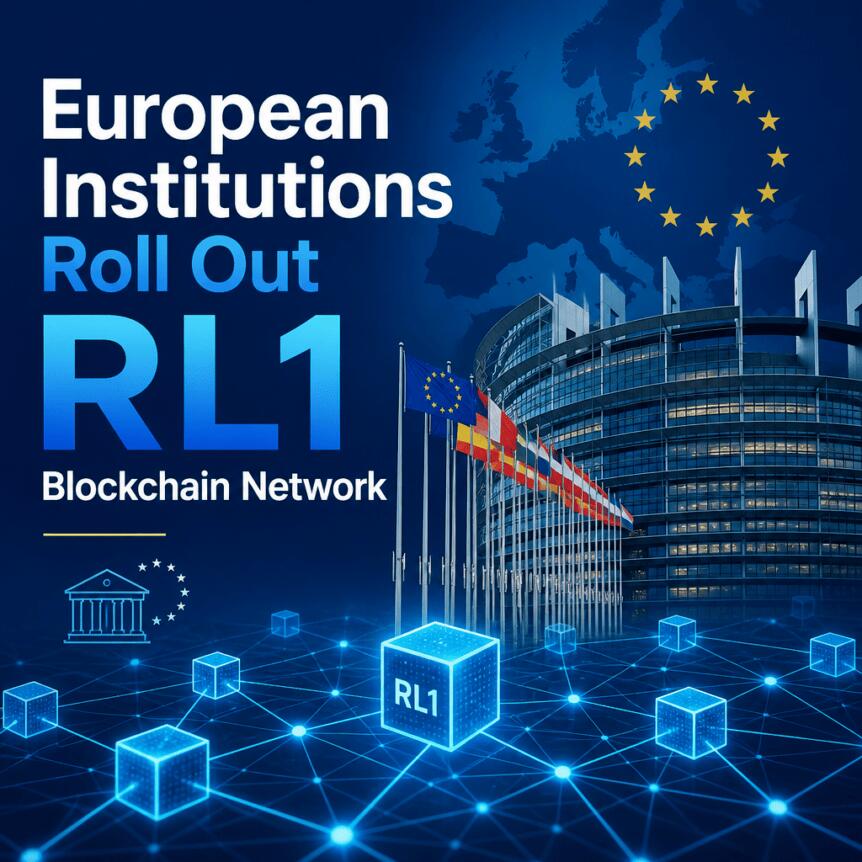
Ten European financial institutions have launched Regulated Layer One (RL1), a permissioned blockchain cooperative aimed at supporting regulated capital markets and tokenized assets. The network was established as a European Cooperative Society in Luxembourg and has started operations with an initial group of founding members.
RL1 announced that its governance model gives each founding institution equal decision-making rights over the network’s development. The cooperative is positioned as shared infrastructure for institutional workflows that typically rely on separate distributed ledgers, with the stated goal of reducing fragmentation across financial networks.
Key takeaways
- RL1 has been incorporated in Luxembourg as a European Cooperative Society and is already operating with founding institutions.
- ABN AMRO, Cecabank, Chartered Investment, Crédit Mutuel Alliance Fédérale, DekaBank, DZ BANK, LBBW, Natixis CIB, SC Ventures, and Seturion are the initial members.
- The permissioned network is built on infrastructure developed by SWIAT, which transferred ownership to the cooperative.
- SWIAT said the underlying platform processed 50+ transactions worth more than €700 million during three years of production use.
- RL1 is designed to support institutional applications such as tokenized bonds, collateral, and blockchain-based settlement.
A cooperative built for regulated tokenization
According to RL1’s announcement, the initiative is intended to serve regulated financial markets and tokenized asset use cases. The cooperative’s structure is designed to align governance with participating institutions, with each member holding equal decision-making rights for RL1’s network direction.
Among the founding organizations named by RL1 are major banks and capital market entities across Europe, including ABN AMRO, DekaBank, DZ BANK, LBBW, Natixis CIB, and NatWest is mentioned as an institution RL1 is currently in discussions with regarding joining. The list also includes Cecabank and Chartered Investment, as well as SC Ventures and Seturion.
From SWIAT infrastructure to RL1 ownership
RL1’s technical foundation traces back to infrastructure developed by German fintech Secure Worldwide Interbank Asset Transfer (SWIAT). RL1 said SWIAT has transferred ownership of the network to the cooperative, moving the platform from a fintech-led build to an institution-led shared asset layer.
SWIAT also provided performance context for the underlying platform. The company said it has processed more than 50 transactions totaling over €700 million (about $808 million) during three years of production use. For investors and market participants, this kind of prior operational record matters because permissioned blockchain deployments in finance often face scrutiny around scalability, reliability, and throughput under real-world conditions—areas that are difficult to assess without production history.
Why RL1 is positioning itself as shared settlement infrastructure
RL1 described the network as permissioned and geared toward institutional workflows. The stated target applications include digital money, tokenized bonds, collateral management, and blockchain-based settlement.
A central theme in RL1’s framing is interoperability within regulated environments. RL1 said that having a shared network could help reduce fragmentation that can occur when different financial institutions operate separate distributed ledger systems. In practice, this addresses a common friction point in tokenization efforts: without shared standards or compatible infrastructures, value transfer and settlement can become siloed across networks, complicating liquidity and operational integration.
RL1’s coop governance structure is also designed to reinforce this “shared infrastructure” approach. Rather than relying on a single operator, the cooperative model gives participating institutions equal say in governance and ongoing development, which RL1 suggests is intended to support long-term adoption across a wider group of market players.
Leadership and funding support
RL1 named Henning Vollbehr, former SWIAT Managing Director, as the network’s leader. KfW and L-Bank will continue supporting the initiative, RL1 said, indicating that development backing is expected to remain in place as the cooperative transitions from launch to broader deployment.
RL1 also said it is discussing additional institutional partners, including NatWest, about joining the network. The ability to onboard more institutions will likely be a key checkpoint for the project: the value of a permissioned network grows with participation, and RL1’s ambition to support settlement and tokenized financial instruments depends on whether additional banks, investors, or market infrastructure providers choose to integrate.
As RL1 begins operations, market observers will likely watch for concrete milestones beyond launch—such as which tokenized asset workflows the network will prioritize first, how quickly new institutions join, and whether the cooperative can convert its production track record from SWIAT into expanding real-world use across regulated markets.


In eighteen months, the prediction market industry has assembled the surveillance apparatus that took stock exchanges decades: named detection engines, encrypted prohibited-person lists, league partnerships, forensic academics, and employment disclosure for high-risk traders. Here is the architecture, who is building it, and the cost nobody in the sector wants to price.
Summary
- Kalshi now runs a proprietary detection engine called Poirot alongside Solidus Labs for trade surveillance, IC360 for sports integrity screening, and the Wharton Forensic Analytics Lab for statistical detection methods.
- The screening moved from post-trade investigation to preemptive blocking: athletes, coaches, referees, and league personnel are screened against lists built with IC360 and the NHL, while candidates are blocked from trading their own races.
- Polymarket built differently, pairing multi-layered surveillance across its offshore and US platforms with a March partnership involving Palantir and TWG AI for sports market monitoring.
- The vendors are consolidating into a de facto standard, with IC360 and Eventus combining insider-risk lists and real-time trade surveillance into a package explicitly marketed as the sector’s emerging benchmark.
- The unpriced cost is participation: every identity check, employment disclosure, and prohibited-person list makes the regulated venues safer and pushes marginal volume toward platforms that ask for none of it.
Financial markets build their police forces after the scandal, not before it, and the construction usually takes a generation. The New York Stock Exchange operated for over a century before anything resembling modern trade surveillance existed; the systems that now watch equity markets for spoofing and insider activity accumulated in layers across decades of enforcement actions, statutes, and technology. The American prediction market industry has compressed that build into roughly eighteen months, and it has done so in public, under a congressional investigation, while growing volumes at a pace that makes each month’s controls obsolete by the next. The result is a surveillance stack with proper names: an in-house detection engine at Kalshi called Poirot, an encrypted prohibited-persons list called ProhiBet, an AI monitoring platform called HALO, a forensic academic partnership, a league relationship, a whistleblower button on market pages, and, as of last month, a requirement that traders in high-risk markets disclose their employer.
This piece maps that architecture, identifies who is actually building it, and examines the trade it embodies, because a category whose entire value proposition is open participation has spent a year and a half constructing the machinery of exclusion.
The stack, named
Kalshi has been the most public about its systems, and the components are worth listing individually because their origins tell you what the industry thinks it is defending against.
At the center sits Poirot, the platform’s proprietary monitoring engine, which runs continuous pattern recognition across every trade looking for anomalous timing, win-rate irregularities, and coordinated activity, following a detect, investigate, enforce sequence the company describes as modeled on the surveillance operations of major financial exchanges. Around it are three external layers. Solidus Labs supplies its HALO platform, an AI-driven trade surveillance system built originally for crypto venues to detect wash trading, spoofing, and layering, which is a revealing choice: the manipulation patterns the industry expects are the ones native to thin electronic order books, not to sportsbooks. IC360, the Las Vegas integrity firm that works with every major professional league, the NCAA, state gaming regulators, and the sportsbook industry, supplies the sports-specific layer, including its ProhiBet service, an encrypted list of individuals barred from participating. And the Wharton Forensic Analytics Lab contributes statistical methods for detecting insider trading and financial fraud, an academic partnership that reads as much like reputational armor as like a technical input, though the methods are real.
The most consequential change was procedural, not technological. For most of the sector’s history, prohibitions on insider participation existed in the rulebooks and were enforced after the fact, through investigation of completed trades. In March the platform shifted to preemptive blocking: after months of assembling screening lists across collegiate and professional leagues with IC360, and in partnership with the NHL directly, known athletes, officials, and league employees are now blocked from trading in associated markets before an order reaches the book. Political screening moved the same direction, extending an existing prohibition on elected officials to cover candidates trading their own campaigns. Identity verification underpins all of it, with names, addresses, and government identification collected before trading, and a whistleblower tool now sits on market pages so participants can flag suspicious activity directly. In June, reporting indicated the platform would begin requiring traders in markets flagged as high-risk to disclose their employer.
Read that list against the product’s marketing, which is about accessibility and putting your knowledge to work, and the tension is immediate. A market that asks for your government identification, your employer, and your absence from an encrypted list of prohibited persons is not a frictionless information venue. It is an exchange, in the full institutional sense, and that is precisely the point of the build.
Polymarket’s different architecture
The other major venue arrived at similar conclusions through a different route, shaped by a structural fact: it operates two platforms with different characters, an offshore blockchain-based book and a regulated US exchange.
Its public position describes multi-layered surveillance across both, combining the transparency of on-chain settlement with third-party monitoring, and its rule updates in March clarified prohibited categories of trading across the pair. The more significant move came earlier that month, when the US entity partnered with Palantir and TWG AI for integrity monitoring in sports markets, with the stated ambition of building tools that leagues and teams could use for their own competitive-integrity purposes. The choice of Palantir is not incidental. A company whose reputation rests on large-scale pattern analysis for government and defense clients signals a particular theory of the problem: that detecting coordinated abuse across a fragmented, pseudonymous participant base is a data-integration challenge, not a rules-enforcement one.
The asymmetry between the two venues is the part worth holding onto. Kalshi’s surveillance operates on a fully identified participant base inside a single regulated perimeter, which makes screening lists workable, because you can check a name against a list only if you have the name. Polymarket’s offshore book has historically been the less transparent half of its business regarding how suspicious activity is monitored, and on-chain transparency, while real, identifies wallets and not people. The industry’s screening model, built on identity, maps cleanly onto one architecture and awkwardly onto the other, and how that gap resolves as the US operation scales is one of the genuine open questions in the sector.
The vendors are writing the standard
Beneath both platforms, a supplier layer is consolidating fast enough to set the rules by default, which is how most financial-market standards actually form.
The clearest signal came in December, when IC360 and Eventus announced a combined offering pairing Eventus’s Validus platform, a multi-asset post-trade surveillance system already used by exchanges, designated contract markets, broker-dealers, and digital asset venues, with IC360’s event-integrity and insider-risk capabilities. The framing in the announcement was explicit about ambition: helping prediction market venues build trust with participants and regulators and set the standards that will support responsible growth. Vendors rarely state the standard-setting objective that plainly, and when two suppliers combine to offer a full-lifecycle package to an entire young sector, the package tends to become the baseline that regulators later reference and competitors later match.
That dynamic has a consequence the industry has not discussed publicly. If integrity infrastructure becomes a purchasable package from a small number of specialist suppliers, then compliance quality converges, which is good for the sector’s credibility and bad for any venue hoping to compete on trustworthiness. It also creates a dependency: a handful of firms will hold the screening lists, the detection models, and the case-management systems for an industry that regulators are actively deciding whether to permit. Concentration in the surveillance layer is not obviously safer than concentration anywhere else, and it has attracted none of the scrutiny that venue concentration receives.
What forced the build
None of this happened because the platforms woke up cautious. The pressure is documented and specific.
Congressional attention arrived in force: the House Oversight Committee opened an examination of insider trading risks in prediction markets in May, and its chairman requested documents from Kalshi’s chief executive covering the platform’s identity verification processes and its capacity to detect insider trading. Enforcement cases had already made the abstract concrete, with the platform disclosing actions in multiple matters including a fined video editor connected to a major creator and actions against political candidates who traded events in which they were directly involved. Investigative journalism amplified both, and a bipartisan bill in Congress would ban sports event contracts on federally regulated exchanges outright, which gives every venue an existential reason to show that its sports markets are policed.
The regulator supplied the frame. The Commodity Futures Trading Commission’s advisory earlier this year reminded designated contract markets that they are the frontline regulators of their own venues under the core principles, that event contracts sit fully under the Commodity Exchange Act, and that sports and similar real-world contracts face a higher bar to show they are not gambling in substance. Read alongside the build, the sequence is legible: the agency told exchanges the obligation was theirs, Congress threatened the most profitable product line, and the platforms responded by constructing visible, nameable, quotable infrastructure. The surveillance stack is a compliance program and a political argument at the same time, and its audience includes committee staff as much as traders.
The trade nobody wants to price
Which brings the piece to the part the announcements do not address, because it cuts against the industry’s founding pitch.
Prediction markets derive their forecasting value from broad, diverse participation. The calibration research this publication has examined finds prices well estimated precisely because many participants with different information bet real money, and thin markets with few participants produce prices carrying much less information. Every element of the integrity build reduces participation at the margin. Identity verification excludes anyone unwilling to hand over government identification. Employment disclosure excludes anyone whose employer’s name is itself sensitive. Prohibited-person lists exclude, by design, the participants with the most direct knowledge of the events being priced, which is both obviously correct as policy and a genuine subtraction from the information the market aggregates. A market on a game that bars everyone connected to the game has removed its best-informed potential traders in exchange for integrity, and that is a real trade rather than a free lunch.
The second-order effect is the sharper one. Barriers on regulated venues do not eliminate demand; they redistribute it. Volume that will not verify identity or disclose an employer migrates toward platforms that ask for neither, which in this sector means offshore books and decentralized venues operating outside the Commission’s direct reach. The integrity build therefore makes the regulated market cleaner and the unregulated market larger, which is precisely the pattern that decades of derivatives regulation have produced elsewhere, and it means the sector’s compliance success and its liquidity migration are the same event viewed from different angles.
Neither observation argues against the build. Markets on real-world events, priced by participants who may be able to influence those events, need policing more than most, and the case for preemptive screening of athletes and candidates is close to unanswerable. The argument is for pricing the cost honestly rather than presenting surveillance purely as an upgrade. The industry is buying legitimacy with liquidity, deliberately, and the exchange rate between the two is the number that will determine what this sector looks like in five years.
The precedent: how the older markets got policed
The compression is easier to appreciate against the timeline it is compressing, and the equity market’s version is instructive precisely because it took so long.
American stock exchanges operated for roughly a century and a half before anything resembling modern surveillance existed. Insider trading was not clearly illegal in the United States until case law developed through the middle of the twentieth century, systematic exchange-level market monitoring arrived later still, and the automated pattern-detection systems that now scan for spoofing, layering, and unusual pre-announcement activity are products of the last few decades, built in layers after specific scandals produced specific rules. Each layer arrived because something went wrong first: the 1929 crash produced the securities acts, later episodes produced the enforcement infrastructure, the flash crash produced consolidated audit trails. The pattern in financial regulation is almost invariably that the policing follows the harm.
Prediction markets have inverted that sequence, and the inversion is worth crediting instead of assuming cynicism. The surveillance being built now is largely preemptive: screening lists assembled before an athlete places a trade, candidate blocking before a race resolves, detection engines running against every order, not reconstructing a scandal afterward. Some of that reflects genuine intent, and some reflects that the technology exists off the shelf in a way it did not for earlier markets, which is the real reason eighteen months can substitute for eighty years. A modern venue can buy institutional-grade post-trade surveillance from a vendor and integrate a prohibited-persons list through an API. The 1930s could not.
But the borrowed timeline carries a borrowed weakness. Equity market surveillance evolved alongside the case law, the enforcement precedents, and the definitions of what actually constitutes abuse in that market, and each system was built to catch behaviors regulators had already defined. Prediction markets are installing detection infrastructure ahead of the doctrine: nobody has authoritatively defined what insider trading means in a market on a football game, whether a coach’s spouse is an insider, whether a campaign staffer trading a rival’s race is abuse, or how foreknowledge differs from expertise when the subject is a real-world event and not a company’s earnings. The tools are institutional-grade. The rules they enforce are, in places, the platforms’ own interpretations, written fast, under pressure, and awaiting a regulator or a court to confirm or discard them. That gap between capability and doctrine is the most interesting thing about the entire build, and it will be filled the ordinary way, one contested case at a time.
What to watch
Whether the standard becomes mandatory. If the Commission’s rulemaking or a future advisory references specific surveillance capabilities, the vendor package effectively becomes a licensing requirement, and the cost of entry for new venues rises accordingly. Watch the comment filings for exactly this.
The employment-disclosure rollout. How broadly high-risk markets are defined, and what share of volume sits inside them, determines whether the requirement is a narrow safeguard or a material participation barrier. Any published data on abandonment rates would be the most informative number the sector could release.
Polymarket’s identity gap. How the offshore book’s monitoring evolves as the US entity scales is the sector’s most consequential unresolved architecture question, and the Palantir partnership is the first serious attempt at an answer.
Migration evidence. Comparative volume growth between fully identified regulated venues and less restrictive alternatives is the cleanest available measure of whether the integrity build is costing the regulated market its liquidity, and it will show up first in the sports categories where screening bites hardest.
Disclaimer: This article is for information and educational purposes only and does not constitute financial, investment, or legal advice. It describes compliance systems and regulatory proceedings based on company statements and reporting available at the time of writing, and these arrangements change frequently. Nothing here is a recommendation regarding any platform or contract. Always do your own research. Information is accurate as of July 27, 2026.
Frequently Asked Questions
What surveillance systems do prediction markets actually use?
Kalshi runs a proprietary detection engine called Poirot for continuous pattern recognition, alongside Solidus Labs’ HALO platform for AI-driven trade surveillance, IC360 for sports integrity screening including its ProhiBet prohibited-persons list, and a partnership with the Wharton Forensic Analytics Lab for statistical detection methods. Polymarket uses multi-layered surveillance across its platforms and partnered with Palantir and TWG AI for sports market monitoring.
What changed in March 2026?
Screening moved from post-trade investigation to preemptive blocking. After months of building lists with IC360 and in partnership with the NHL, athletes, officials, and league employees became blocked from trading in associated markets before orders reach the book, and political screening extended from elected officials to candidates trading their own campaigns. Both platforms also expanded prohibitions covering spoofing, wash trading, and front-running.
Why did the platforms build this now?
Regulatory and congressional pressure. The House Oversight Committee opened an examination of insider trading risk in May and requested documents on identity verification and detection capability, enforcement cases had become public, and a bipartisan bill would ban sports contracts on regulated exchanges. The CFTC separately reminded exchanges that they are the frontline regulators of their own markets under the core principles.
What is ProhiBet?
An encrypted list of individuals prohibited from participating in prediction markets or sports betting, operated by IC360 and used across regulated sports betting. It allows a venue to block a prohibited person without the venue itself holding the underlying list in readable form, which is how screening operates across the regulated gambling industry.
Are the surveillance vendors becoming a standard?
Effectively, yes. IC360 and Eventus combined their offerings in December, pairing real-time trade surveillance used by exchanges and designated contract markets with insider-risk and event-integrity capability, and described the goal as setting standards for the sector. When a small number of suppliers provide full-lifecycle integrity packages to a young industry, that package tends to become the baseline regulators reference.
Does more surveillance make prediction markets better?
It makes them more defensible and less open, and both effects are real. Screening the participants most able to influence outcomes is sound policy and removes the best-informed potential traders from those markets. Identity verification and employment disclosure improve accountability while excluding participants unwilling to provide them, which reduces the diverse participation that gives these markets their forecasting value.
Where does volume go when barriers rise?
Toward venues with fewer barriers, which in this sector means offshore and decentralized platforms outside direct US oversight. This is the standard pattern in derivatives regulation: tightening the regulated perimeter improves conditions inside it and enlarges the market outside it. The regulated venues’ compliance success and any liquidity migration are the same development seen from different sides.
What should participants take from this?
That the regulated venues now operate genuine exchange-grade surveillance, which is a meaningful protection, and that the identity, disclosure, and screening requirements attached to it are permanent features, not temporary responses. Anyone weighing a regulated venue against an offshore alternative is trading privacy and access against monitoring and recourse, and that is the actual choice on offer. This is educational analysis, not investment advice.

Money Will Flow Once You Crack These 7 Codes | Financial Freedom Secrets

Novavax: The Beaten-Down COVID-19 Darling

Tether signs tokenization deal with Nairobi Securities Exchange


-

 Fashion4 days ago
Weekend Open Thread: Brooks Brothers
-
 Business7 days ago
New Jersey voter registration controversy explained: How 6,600 noncitizens got on the rolls, and what happens next
-
 Sports2 days ago
Commonwealth Games boxing: Jadumani Singh seals dominant 5-0 win over Pakistan’s Sumama Rehman to enter quarter-finals | Commonwealth Games News
-

 Tech2 days ago
Intel is reversing course and bringing hyper-threading back to its server chips
-

 Crypto World6 days ago
Ethics, other provisions in crypto Clarity Act to be further discussed
-

 Politics2 days ago
Luke Littler dismantles Gerwyn Price to retain title in Blackpool
-

 Sports5 days ago
2026 3M Open leaderboard: Scottie Scheffler finds putter in Round 1, sits three back
-

 Politics18 hours ago
The Part of the Electric Transition Nobody Wants to Discuss
-

 Fashion5 days ago
16 Dresses for the High Summer Event
-

 News Videos5 days ago
The Peugeot Family: How 200 Years of an “Old Money” Dynasty Died in A Boardroom
-
 Entertainment5 days ago
A New Post-Apocalyptic Gundam Anime Series Blasts Into SDCC
-

 News Videos2 days ago
BITCOIN JUST ENTERED THIS CRITICAL ZONE…
-

 Politics3 days ago
Spain sweeps the board at 2026 World Cup with individual awards
-

 Crypto World3 days ago
Ripple bought a bank in pieces. The $4 billion audit
-

 Crypto World3 days ago
XRP Ledger adds $2.6B as RWA inflows rank second
-

 Crypto World6 days ago
Uniswap (UNI) pushes deeper into tokenized RWAs with permissioned trading pools
-

 Tech4 days ago
Anthropic launches Claude Opus 5, a cheaper AI model for coding, agents and enterprise workflows
-
 Entertainment8 hours ago
‘Stargate’ Creator’s New Sci-Fi Series Returns for Season 3 Tomorrow
-
Crypto World6 days ago
SEC Agrees to Overhaul Recordkeeping After Settling Coinbase Lawsuit Over Gensler’s Lost Texts
-

 News Videos7 hours ago
Claude: Build Financial Dashboards in Minutes (2026)
You must be logged in to post a comment Login