
Crypto World
Iran denies reports of crypto tolls in Strait of Hormuz



Summary
- Iranian state-linked media reject claims Tehran is already collecting Strait of Hormuz tolls in Bitcoin or stablecoins.
- Maritime security firms warn of parallel scam emails demanding crypto “clearance” fees from stranded vessels.
- The controversy comes after Western media detailed Iranian plans to charge about $1 per barrel for oil transit, potentially worth tens of billions of dollars a year.
Iranian media have dismissed reports that Tehran is currently collecting transit tolls for the Strait of Hormuz in cryptocurrency, underscoring the confusion surrounding a wartime payment regime that has rattled global shipping and crypto markets.
Tehran moves to quash ‘crypto toll’ claims
State-linked outlet Fars News said on Apr. 23 that “reports about Iran collecting tolls for the Strait of Hormuz in cryptocurrency are inaccurate,” countering weeks of speculation that the Islamic Revolutionary Guard Corps (IRGC) had already begun accepting Bitcoin or stablecoins from oil tankers during a fragile US-brokered ceasefire.
The denial follows detailed reporting from the Financial Times that Iran planned to demand that shipping companies pay transit fees in cryptocurrency for oil tankers passing through the narrow waterway, at an indicative rate of about $1 per barrel of crude.
Scam messages and market fallout
Even as Tehran rejects the idea that crypto tolls are already live, a Greek maritime risk firm, MARISKS, warned that unknown actors have been sending fraudulent messages to shipowners stuck west of the Strait, “posing as Iranian authorities” and demanding payment in Bitcoin or Tether in exchange for “clearance” and safe passage.
“These specific messages are a scam,” MARISKS said, stressing the emails “did not originate from Iranian authorities” and may have contributed to at least one vessel coming under fire while attempting to leave the area.
The Strait of Hormuz previously carried about one-fifth of global oil and liquefied natural gas flows, and proposals for a crypto-based toll system have drawn intense scrutiny from regulators and blockchain analysts.
Bloomberg reported that an IRGC-linked intermediary has discussed opening negotiations at roughly $1 per barrel, implying potential revenue of up to $2 million for a fully loaded supertanker and between $70 billion and $80 billion a year if traffic returns near pre-war levels.
Chainalysis noted that Iran has historically relied on dollar-pegged stablecoins such as USDT on Tron, arguing that any implemented Hormuz tolls would deepen Tehran’s pivot toward censorship-resistant rails while posing new compliance risks for virtual asset service providers.
Industry observers say the Fars News denial leaves a narrow distinction: Iran appears keen to formalize tolls and experiment with yuan and crypto settlement, but claims it has not yet begun collecting those fees directly in digital assets, even as scammers and intermediaries race to fill the vacuum.

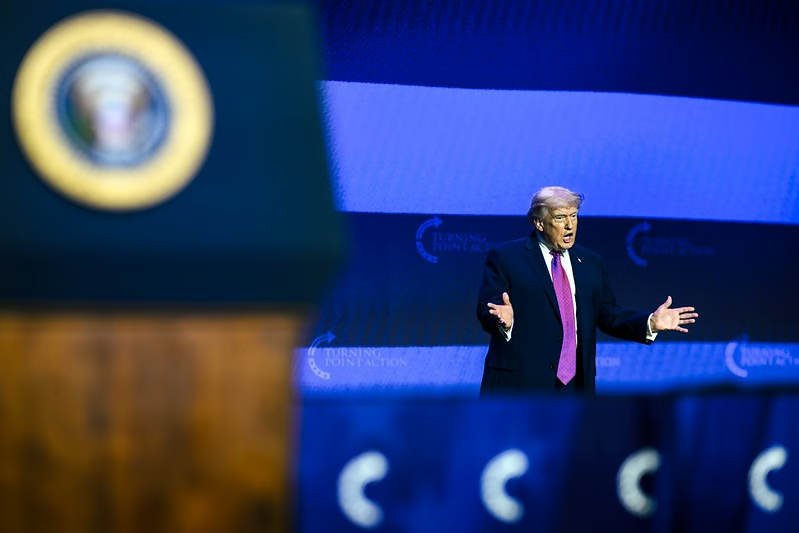
The White House has reportedly confirmed that US President Donald Trump will attend the exclusive event for top TRUMP memecoin holders at his Florida residence on Saturday, after questions were raised earlier this month over whether he would attend.
Reuters reported on Friday that the White House confirmed Trump would deliver a keynote address at the gala luncheon organized by the company behind his Official Trump (TRUMP) memecoin.
The gala is set to take place at Mar-a-Lago. It will be open to the top 297 holders of the TRUMP token, and the top 29 holders will also qualify for a private reception with the president.
When the event was announced in March, a White House official told Politico that it was not locked into Trump’s schedule and that it was taking place the same day Trump said he would attend the White House Correspondents’ Association Dinner in Washington, DC, the first time he would do so as president.
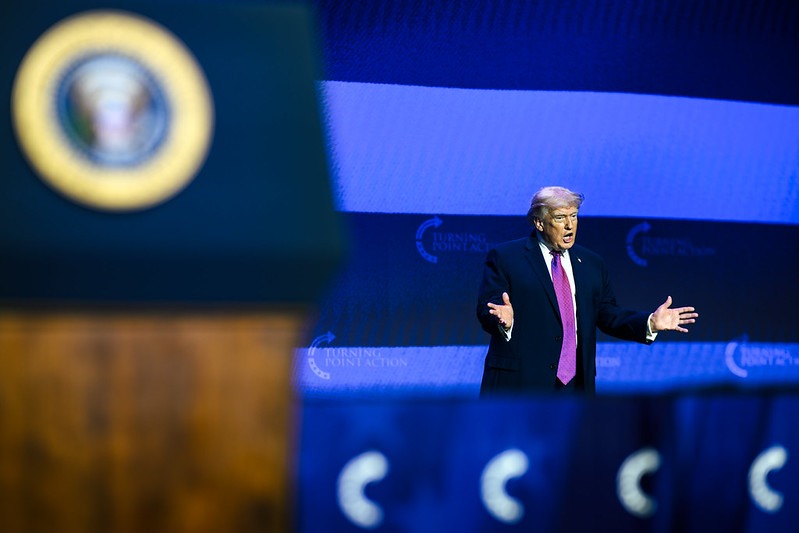
Donald Trump, pictured at a Turning Point USA event on April 17, is confirmed to be addressing an event for holders of his memecoin on April 25. Source: The White House
The event’s terms also state that Trump may not be able to attend the event, and it “may be canceled for any reason.”
Trump’s potential attendance at the event has been a sticking point for some lawmakers, who have criticized the event as a conflict of interest for the president.
Earlier this month, Democratic Senators Elizabeth Warren, Richard Blumenthal and Adam Schiff reportedly sent a letter to Bill Zanker, the individual behind the TRUMP memecoin, questioning whether Trump intends to “dangle access” to himself at the upcoming event.
Related: Trump-linked American Bitcoin energizes 11,298 new ASICs
“[O]rganizers are promoting a conference by dangling access to President Trump to potential attendees (and in doing so, are encouraging purchases of his meme coin that will generate transaction fees for the President and his family) on a day he may not actually be able to attend,” the letter said.
It is the second event for holders of the TRUMP token. The first took place at a Trump golf club in May 2025 and drew criticism from those who said Trump was using his position as president for personal financial gain.
Magazine: Quitting Trump’s top crypto job wasn’t easy: Bo Hines

The White House has confirmed that U.S. President Donald Trump will deliver a keynote address at a private gala for the top holders of the TRUMP memecoin, slated to take place at Mar-a-Lago this weekend. The event has already drawn scrutiny over the intersection of politics, finance and social media hype surrounding meme coins tied to political figures.
According to Reuters, the White House affirmed on Friday that Trump would speak at the gala luncheon organized by the company behind the Official TRUMP memecoin. The affair is designed to be exclusive, with access limited to the top 297 TRUMP token holders, and the top 29 holders qualifying for a private reception with the president. The organizers list attendance terms that acknowledge the possibility that Trump’s schedule could prevent participation, or that the event could be canceled for any reason.
Key takeaways
- The White House has confirmed Trump will keynote a gala for TRUMP memecoin holders at Mar-a-Lago, with the event planned for April 25.
- Access is restricted to the top 297 TRUMP token holders, and the top 29 are eligible for a private reception with the president.
- Lawmakers are raising concerns about conflicts of interest and access diplomacy tied to the event; a formal inquiry has been issued to the event’s organizer.
- Past criticism surrounding a previous TRUMP memecoin event in 2025 underscores ongoing questions about the use of presidential platforms for personal financial gain.
White House confirms keynote at Mar-a-Lago gala
In a development that blends political life with crypto-tinged fundraising, Reuters reported that the White House has given the green light for Trump to address attendees at the TRUMP memecoin gala. The appearance would mark a high-profile moment for the meme-based project, which markets itself around the former president’s name and brand. The venue is Mar-a-Lago, a setting that has already become a focal point for the event’s exclusivity and spectacle.
The organizers’ terms note that participation is not guaranteed if Trump cannot attend or if circumstances necessitate cancellation. The stated plan to host a closed, invitation-only luncheon aligns with how crypto-promotional events have historically attempted to leverage star power to drive attention and potential liquidity for token holders.
Media coverage of the development has focused not only on the logistical details but also on the broader implications for governance and accountability when political figures lend themselves to crypto campaigns. The event’s framing—as a fundraiser, a social meet-up for the crypto community, and a potential venue for policy or influence peddling—has drawn varying responses from observers across the political spectrum.
Lawmakers raise conflict-of-interest concerns
The invitation to such a high-profile engagement has quickly become a political talking point. Earlier this month, Democratic Senators Elizabeth Warren, Richard Blumenthal and Adam Schiff reportedly sent a letter to Bill Zanker, the entrepreneur behind the TRUMP memecoin initiative, questioning whether the event would amount to “dangles of access” to the president. The lawmakers argued that tying access to a personal crypto project could incentivize attendees to purchase the token to gain proximity to power, potentially generating transaction-related benefits for Trump and his family.
As described in the letter, organizers were urged to clarify the intent behind offering faces of power in exchange for financial participation and to address potential conflicts with ethical standards governing the president’s official duties. The questions underscore ongoing tensions around the use of presidential branding for commercial ventures, particularly where digital assets could be involved in fundraising or promotional activities.
Past controversy shadows the current event
This event would be the second time TRUMP token holders have gathered under the president’s orbit. The first such gathering occurred in May 2025 at a Trump golf club and drew sharp criticism from critics who argued that a sitting president’s involvement in a personal financial venture could blur lines between public duties and private enterprise. Critics argued the optics suggested the administration was enabling personal financial gain through the presidency—a concern that has echoed through debates about crypto marketing and political power.
Observers note that the current event’s terms explicitly acknowledge uncertainty around attendance, a feature that some critics have highlighted as a necessary check against overreach. Still, the persistence of such events signals a broader trend in which political figures’ associations with crypto tokens become part of the public discourse surrounding policy, regulation, and the evolving role of digital assets in society.
What to watch next
The immediate question is whether Trump will attend or cancel, given the formal caveats in the event’s terms and the fluctuating nature of schedules for sitting presidents. The President’s schedule and public appearances often shift due to broader political considerations, making the outcome uncertain even as the event date approaches. Additionally, lawmakers’ inquiries could influence how such memecoin-linked events are perceived by regulatory bodies and the public.
In broader market terms, the episode illustrates how political branding and crypto marketing continue to intersect in ways that attract both attention and scrutiny. For investors and observers, the key takeaway is not the hype around a single token event but the signal it sends about governance, transparency, and the evolving boundaries of political influence in digital asset cultures. The outcome could shape how future memecoin campaigns navigate ethics, disclosures, and accountability when tied to public figures.
As coverage develops, readers should monitor official statements from the White House, updates from Reuters and Politico on scheduling, and any formal responses from lawmakers or the campaign organizers. The next steps will likely illuminate how such high-profile political-crypto intersections are managed going forward and what safeguards—if any—emerge to balance access, publicity, and governance in this rapidly evolving space.

Liquidity mining has long been framed as a cornerstone innovation in decentralized finance—an elegant mechanism to bootstrap liquidity, decentralize ownership, and align incentives between users and protocols. But beneath the narrative, a more familiar pattern emerges: liquidity mining often functions as a form of paid customer acquisition, with tokens replacing traditional cash incentives.
This framing does not diminish its importance. Instead, it clarifies both its strengths and its limitations
Reinterpreting Liquidity Mining
At its core, liquidity mining distributes tokens to users who provide capital or perform activities for a protocol. Whether through supplying liquidity, staking assets, or executing trades, participants are rewarded for behaviors that enhance the protocol’s functionality and attractiveness.
From a business perspective, this resembles a classic growth strategy:
- Incentivize user participation
- Increase platform activity
- Build initial network effects
The only difference is the currency. Instead of spending fiat on ads or promotions, protocols issue native tokens—effectively subsidizing early adoption with future upside.
Paid User Acquisition, Repackaged
Traditional startups allocate significant budgets to acquire users through marketing campaigns, referral bonuses, and discounts. Liquidity mining mirrors this approach, but with a structural twist:
- Tokens as incentives: Users are compensated directly in protocol-native assets
- Lower upfront cost: Instead of depleting cash reserves, protocols dilute token supply
- Speculative appeal: Rewards are not just payments—they are perceived investments
This creates a powerful feedback loop. As long as token prices remain stable or increase, participation appears profitable, attracting more users and reinforcing growth.
However, the mechanism is not fundamentally different from paid acquisition—it is simply more capital-efficient in the short term.
Temporary Engagement Spikes
Liquidity mining programs are highly effective at generating rapid traction. When rewards are attractive, capital flows in quickly, often producing dramatic increases in:
- Total Value Locked (TVL)
- Trading volume
- User activity
These spikes can create the appearance of strong product-market fit. Yet, much of this activity is incentive-driven rather than organic.
Participants, particularly sophisticated users, optimize for yield. They allocate capital where rewards are highest and withdraw it just as quickly when incentives decline. This behavior introduces a critical dynamic: engagement is often rented rather than earned.
The Retention Problem
The most significant challenge emerges when rewards taper off.
Without continuous incentives, many users disengage, leading to:
- Declining liquidity
- Reduced trading activity
- Increased volatility in protocol metrics
This reveals a fundamental issue: liquidity mining does not inherently create loyalty. It attracts capital, but it does not guarantee that capital will stay.
In traditional terms, this is equivalent to acquiring users who churn as soon as discounts disappear.
Token Emissions as a Cost
While liquidity mining avoids immediate cash expenditure, it is not free. Token emissions represent a form of cost—one that is often less visible but equally impactful.
Key considerations include:
- Dilution: Increased token supply can suppress long-term value
- Sell pressure: Recipients frequently sell rewards, affecting price stability
- Sustainability: Continuous emissions may be required to maintain engagement
In effect, protocols are paying for growth, just as traditional companies do—only the cost is denominated in equity-like instruments rather than cash.
When Liquidity Mining Works
Despite its limitations, liquidity mining can be highly effective under the right conditions. It performs best when:
- The underlying product delivers genuine utility
- Incentives are used to accelerate, not replace, organic adoption
- Token design aligns long-term participation with protocol success
In these cases, liquidity mining acts as a catalyst—helping a protocol reach critical mass before transitioning to more sustainable growth drivers.
Toward Sustainable Incentive Design
The next evolution of liquidity mining lies in improving retention and reducing reliance on continuous emissions. Emerging approaches include:
- Time-weighted rewards that favor long-term participation
- Revenue-sharing mechanisms that tie rewards to real protocol income
- Dynamic incentive systems that adjust based on user behavior and market conditions
These models aim to shift the focus from short-term attraction to long-term alignment.
Finale
Liquidity mining is not a flawed concept—it is a misinterpreted one. At its essence, it is a sophisticated form of customer acquisition, optimized for decentralized systems and powered by token economics.
The challenge is not whether to use it, but how to use it responsibly. Protocols that recognize liquidity mining as a cost of growth—and design accordingly—are far more likely to convert temporary participation into lasting ecosystems.
Because in the end, incentives can bring users in. Only real value makes them stay.
REQUEST AN ARTICLE
Rising oil prices amid risks to shipping through the Strait of Hormuz have strengthened global inflation expectations. According to the Pentagon, clearing the strait could take at least six months, sustaining uncertainty in commodity markets and weighing on risk assets overall — a category that typically includes cryptocurrencies.
At the same time, institutional demand for Bitcoin remains resilient. As of 20 April, spot ETFs recorded five consecutive days of inflows, with daily volumes around $238 million, while Strategy (formerly MicroStrategy) executed its largest purchase since late 2024, acquiring 34,164 BTC worth $2.54 billion. However, analysts at CryptoQuant note that the current price momentum is being driven primarily by the perpetual futures market, while spot demand is declining. A similar pattern was observed in January ahead of the correction from $98,000, suggesting that the market remains vulnerable.
Technical picture
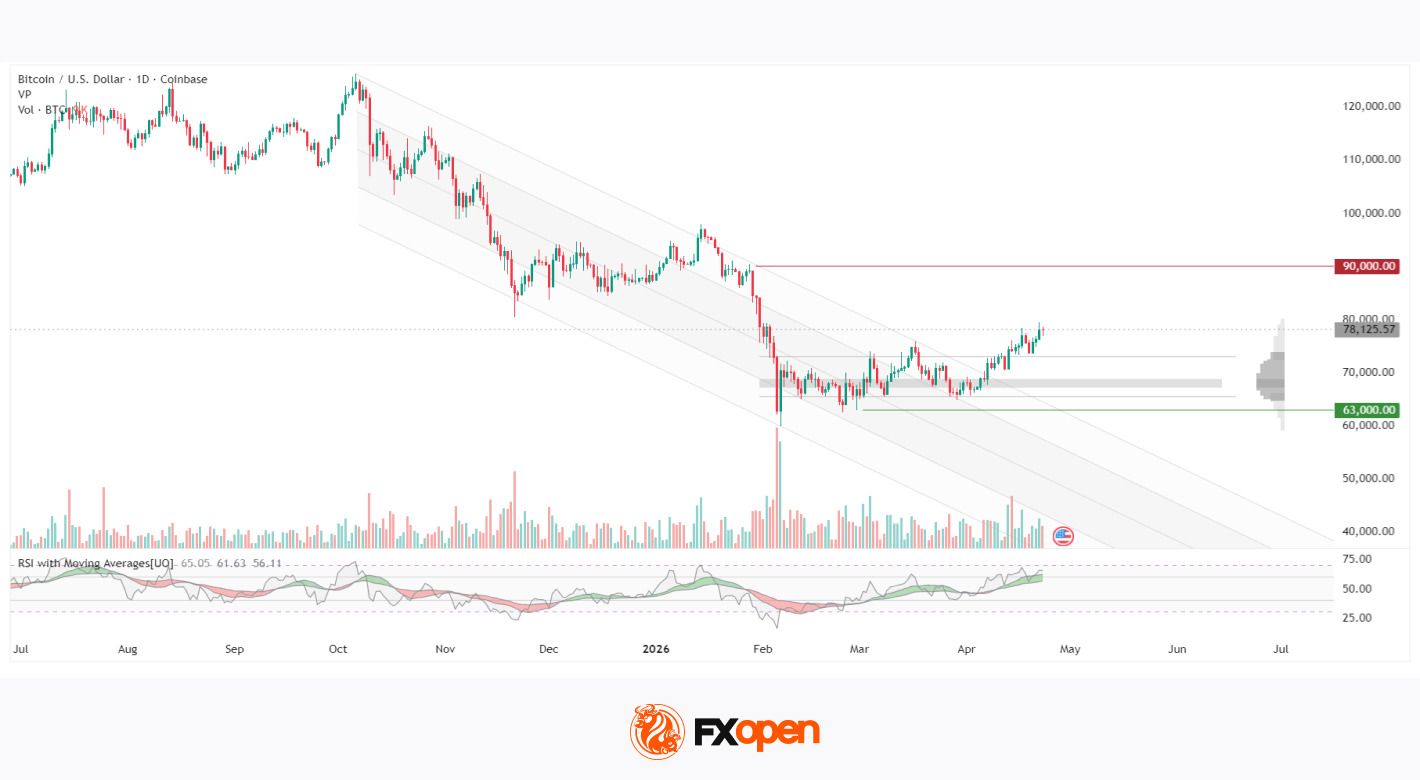
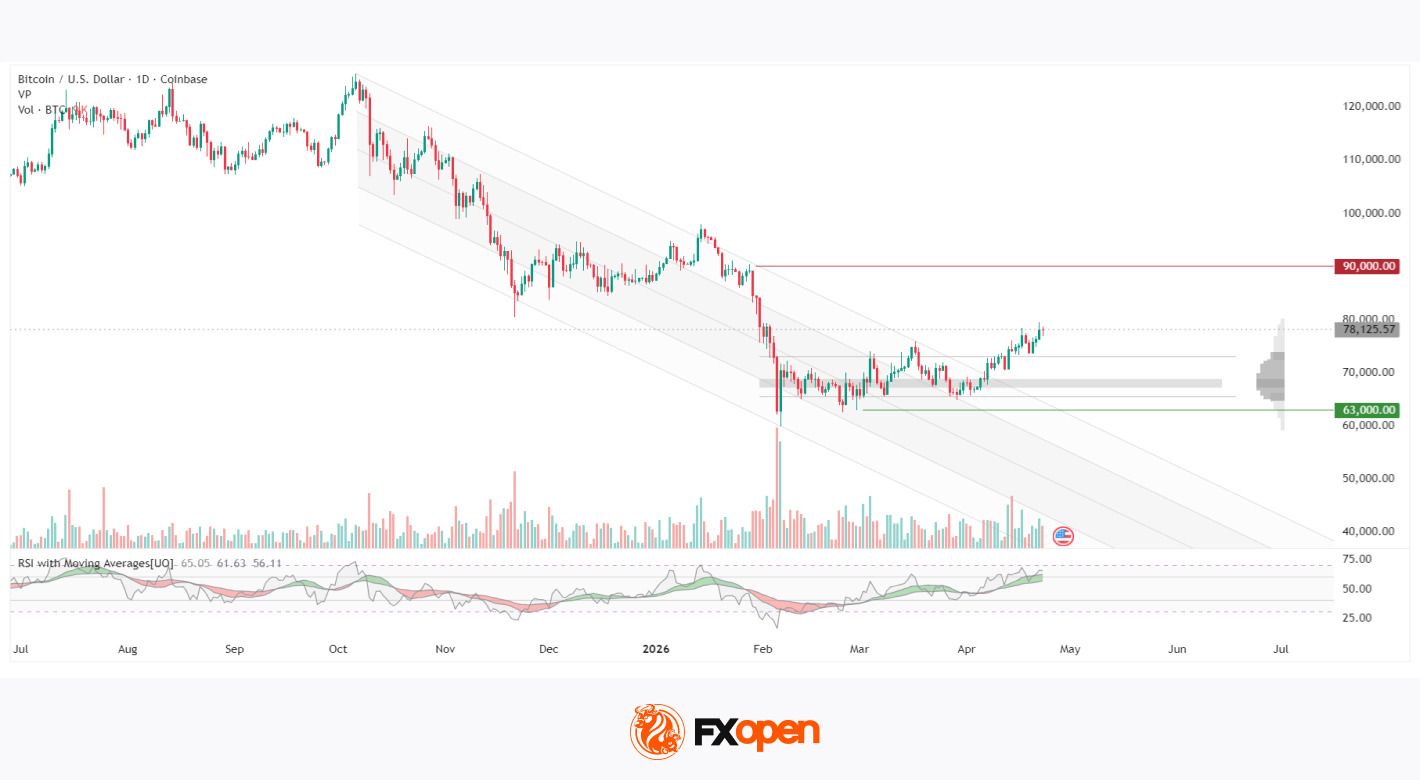
Since October 2025, Bitcoin has been trading within a descending parallel channel, with the lower boundary tested in February 2026 when the price fell to around $60,000 amid exceptionally high trading volumes typical of a selling climax. Following this low, the market shifted into recovery mode, and in the first half of April 2026, the price broke above the upper boundary of the channel and managed to hold above it.
At the same time, the price moved beyond the upper edge of the horizontal volume zone between $65,000 and $73,000, where most trading activity had been concentrated in previous months. This zone now lies below current levels. The nearest resistance is seen at $90,000, while support stands at $63,000. The RSI with moving averages shows readings of 64 / 61 / 56 — the oscillator remains above both moving averages, which are trending upwards, indicating ongoing buying pressure. Vertical volume in recent sessions remains moderate, with no clear signs of acceleration.
Summary
The horizontal volume zone has shifted below the current price, signalling a structural tilt in favour of buyers. The RSI remains above its moving averages, confirming bullish pressure, though recent trading volumes do not yet indicate a strong acceleration in momentum. Resistance at $90,000 and support at $63,000 define the key range within which the next phase of market structure is likely to develop.
FXOpen offers the world’s most popular cryptocurrency CFDs*, including Bitcoin and Ethereum. Floating spreads, 1:2 leverage — at your service (additional fees may apply). Open your trading account now or learn more about crypto CFD trading with FXOpen.
*Important: At FXOpen UK, Cryptocurrency trading via CFDs is only available to our Professional clients. They are not available for trading by Retail clients. To find out more information about how this may affect you, please get in touch with our team.
This article represents the opinion of the Companies operating under the FXOpen brand only. It is not to be construed as an offer, solicitation, or recommendation with respect to products and services provided by the Companies operating under the FXOpen brand, nor is it to be considered financial advice.


Japanese bitcoin treasury firm Metaplanet is back in the market with another round of balance-sheet leverage, issuing 8 billion yen, worth roughly $50 million, in zero-interest ordinary bonds to finance future bitcoin purchases.
In a Friday filing, the company said the latest issuance was fully taken up by EVO Fund, a Cayman Islands-based investor that has repeatedly anchored Metaplanet’s previous offerings. It also marks the firm’s 20th bond issuance, underscoring its long favored strategy of tapping debt markets to fund bitcoin accumulation.
Metaplanet, now Japan’s largest corporate bitcoin holder, has maintained a steady buying spree since April 2024, adding 5,075 BTC in the first quarter alone. As of writing, it held 40,177 BTC, which makes it the third-largest listed bitcoin treasury globally, according to BitcoinTreasuries.
The aggressive accumulation continues even as the firm faces deep paper losses. Metaplanet reported a $619 million net loss for fiscal 2025, largely driven by unrealized markdowns on its bitcoin stack.
The broader backdrop, however, has been volatile rather than outright bearish. Bitcoin, which briefly surged to an all-time high near $126,000 in October 2025, has since pulled back amid geopolitical shocks in the Middle East. It is currently trading around $77,800, still up roughly 10% over the past month as risk sentiment stabilizes.
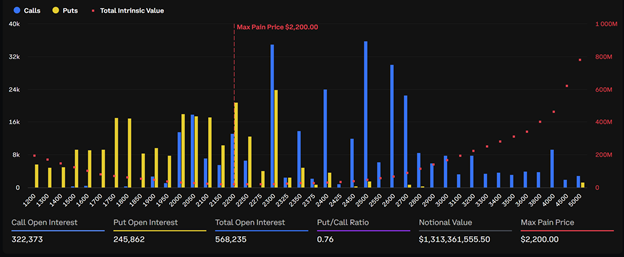
Bitcoin (BTC) and Ethereum (ETH) will see a combined $9.87 billion in options contracts expire today at 08:00 UTC on Deribit, marking April’s largest monthly settlement.
The expiry covers 109,000 BTC contracts with a notional value of $8.55 billion and 563,000 ETH contracts worth $1.32 billion. Both assets traded well above their respective max pain levels heading into settlement, with the Web3 conference in Hong Kong this week adding a bullish backdrop as attendees reflected broad optimism across crypto markets.
BTC and ETH Settle Above Max Pain
Bitcoin’s max pain sat at $72,000, yet spot price hovered near $77,900 at the time of expiry. The put-to-call ratio of 0.93 pointed to a roughly balanced split between bearish and bullish positioning.
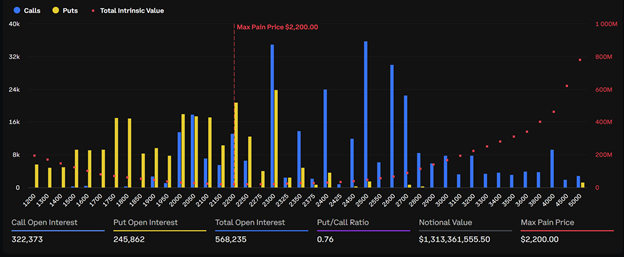
Ethereum showed a stronger call bias. ETH traded around $2,315 against a $2,200 max pain, with a put-to-call ratio of 0.72.
The skew toward calls suggests traders had been betting on further upside. Altcoin prices have also been recovering alongside the broader rally.
According to Deribit, call open interest led on both assets, reinforcing the bullish tilt across the derivatives market.
BTC call open interest totaled 52,607 contracts versus 52,844 puts, while ETH calls dominated at 322,373 against 245,862 puts.
Implied Volatility Drops Despite Price Rally
Analysts at Greeks.live noted that Bitcoin’s implied volatility for major maturities continued to fall this month, with most terms dropping 1% to 2% to below 40%. Ethereum’s IV declined even more sharply, sitting around 60%.
“The market continued to rebound this week, with Bitcoin breaking strongly above $78,000… Despite the price rally, Skew metrics have pulled back, indicating that the market is not driven by FOMO,” they wrote.
The declining volatility and retreating skew suggest the current rally reflects steady capital inflows rather than speculative momentum.
Bitcoin’s second-quarter performance has already outpaced the first quarter in both price and sentiment.
What Comes Next for Options Markets
This monthly settlement clears roughly 25% of total open interest on Deribit. Looking ahead, 12% of remaining positions mature at the end of May and another 24% at the end of June, according to Greeks.live. That June expiry will be the next major quarterly event.
Greeks.live noted that Bitcoin performed significantly better in the second quarter than the first, both in price and overall market sentiment.
If macroeconomic pressures ease by mid-year, the current price floor around $78,000 could solidify as confirmed support.
However, the concentration of June-dated contracts suggests that the next quarterly expiry will carry even greater weight for market direction.
Traders will likely watch whether the declining IV trend holds or reverses as those larger maturities approach.
In the meantime, the options data paints a picture of measured optimism rather than euphoria, with steady institutional flows continuing to support prices without triggering excessive leverage in either direction.
The post Nearly $10 Billion April Options Expiry Puts Bitcoin and Ethereum Direction in Focus appeared first on BeInCrypto.

TLDR:
- US consumer sentiment fell to 47.6, marking its lowest level amid rising cost pressures
- The S&P 500 remains near highs, showing a sharp disconnect from household expectations
- Retail outlook weakens as discount chains report softer demand and cautious guidance
- Strong premium travel demand contrasts with declining confidence among lower-income groups
A widening gap between financial markets and household outlook is drawing attention across the United States. Equity benchmarks remain elevated, yet US consumer sentiment has dropped sharply, raising concerns about how long this divergence can persist without affecting broader economic stability.
Record Gap Between Markets and Households
Recent commentary shared by Global Markets Investor described an unusual disconnect between Wall Street performance and everyday financial expectations. The post noted that US consumer sentiment fell to 47.6 in April, marking a record low reading.
At the same time, the S&P 500 continues to trade near peak levels. This contrast places US consumer sentiment at levels seen during past recessions, while equities reflect continued optimism. The gap between the two indicators now stands at its widest point on record.
The update pointed to rising living costs as a key factor weighing on US consumer sentiment. Higher gas prices and persistent inflation continue to pressure lower-income households. These pressures have intensified following disruptions linked to the Strait of Hormuz closure.
Meanwhile, asset price growth has supported wealthier households. This trend has helped sustain equity valuations despite weakening US consumer sentiment. As a result, financial conditions vary sharply across income groups.
The same post indicated that more than a quarter of households expect their finances to worsen. This marks the highest level since May 2024. Such expectations further reflect declining US consumer sentiment across the country.
Diverging Spending Patterns and Economic Signals
Retail data shows early signs of strain among cost-conscious consumers. Discount chains have reported cautious outlooks, aligning with the drop in US consumer sentiment. Walmart issued measured guidance, while Dollar General noted softer expectations.
At the same time, spending patterns remain uneven. Premium travel and cruise bookings continue to perform well. This divergence suggests that higher-income consumers remain less affected by declining US consumer sentiment.
The contrast between retail segments reflects a broader economic divide. While some households maintain discretionary spending, others are scaling back. These shifts are closely tied to ongoing weakness in US consumer sentiment.
The US economy depends heavily on consumer activity. As US consumer sentiment weakens, questions arise about future demand. Market participants are watching whether reduced confidence will translate into lower spending levels.
Equity markets continue to price in a stable outcome. However, declining US consumer sentiment presents a different narrative. If household confidence continues to fall, corporate earnings could face pressure in the coming months.
This divergence leaves uncertainty about which trend will adjust. Either markets may reprice risk, or consumer conditions may stabilize. Until then, US consumer sentiment remains a key measure shaping expectations across sectors.



The President Trump administration has announced plans to fight what it called “industrial-scale campaigns” aimed at copying artificial intelligence technology from American companies.
Summary
- The White House said foreign entities used proxy accounts to target major American AI companies.
- US officials said unauthorized distillation could help foreign firms build cheaper AI models.
- The plan includes information sharing with US AI companies and stronger private-sector defenses.
The White House Office of Science and Technology Policy said foreign entities are targeting major US AI firms through unauthorized model distillation.
Michael J. Kratsios, assistant to the president for the White House science office, said the government has “information” that foreign entities, mainly based in China, are trying to extract capabilities from US AI models. The statement said these groups use proxy accounts and jailbreaking methods to avoid detection.
Kratsios said, “Models developed from surreptitious, unauthorized distillation campaigns like this do not replicate the full performance of the original.” He added that such models can still allow foreign actors to release products that appear close to US systems on some benchmarks at a much lower cost.
US says proxy accounts helped hide activity
The White House said some foreign companies used “tens of thousands of proxy accounts” to mask their activity while probing American AI models. It also said the groups used jailbreaking techniques to expose private or protected model information.
According to the science office, these campaigns aim to extract useful features from American models without permission. The statement said, “These coordinated campaigns systematically extract capabilities from American AI models, exploiting American expertise and innovation.”
The White House also said models built through these methods may lack security controls. It warned that copied systems could move away from being “neutral and truth-seeking” if safety protections are removed or weakened.
Moreover, the statement follows claims made by Anthropic in late February. The Claude developer accused three Chinese AI firms, DeepSeek, Moonshot, and MiniMax, of carrying out distillation attacks against its models.
Anthropic said the firms created more than 16 million exchanges with its AI models through about 24,000 “fraudulent accounts.” The company said the activity targeted capabilities such as coding, agentic reasoning, data analysis, grading tasks, and computer vision.
The case has added focus to how frontier AI companies protect model access. AI firms charge users through token-based pricing, and lower-cost competitors can gain market attention by offering similar performance on selected tasks.
US plans closer work with private AI firms
The White House science office said the administration will work with US companies to share information about large attacks. It also plans to help the private sector coordinate stronger defenses against foreign actors.
The administration said it will explore measures to “hold foreign actors accountable.” It did not provide a detailed list of possible penalties or enforcement steps in the statement.
The move comes as AI competition between the United States and China continues to grow. US officials have framed advanced AI systems as a core technology for national security, business productivity, and future economic power.
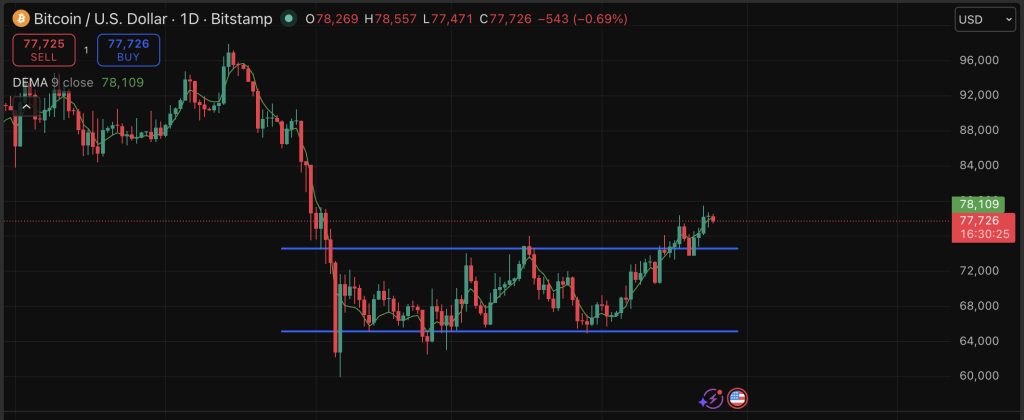
Bitcoin is trading near $78,000, doing well, but pinned just under the $79,000 resistance. Few analysts give a $50,000 price prediction, but our Bitcoin data shows an $80,000 breakout. A few so-called expert traders issued a sharp bearish warning this week, projecting a 36% crash from current levels toward $50,000 if Bitcoin’s range-bound structure resolves to the downside.
In an analysis shared on X, a trader mapped three historical consolidation periods in which Bitcoin traded sideways for 64 to 114 days before a violent breakout, two of which ended in 27% and 33% crashes, respectively.
This split-market setup is producing unusually binary sentiment. Bitcoin has now been breaking the two-and-a-half-month range, with the bottom in sight, or being left behind.
Discover: The best pre-launch token sales
Bitcoin Price Prediction: Rocketing to $80K, Or Is $50K the Real Target?
Bitcoin’s current price is running a mini-rally, with support clustered at $72,000-$73,000 and deeper Fibonacci support at $70,000-$68,000, which is well above the projected $50,000. Resistance sits at $79,000, a zone that has rejected the price twice in the last 10 days.
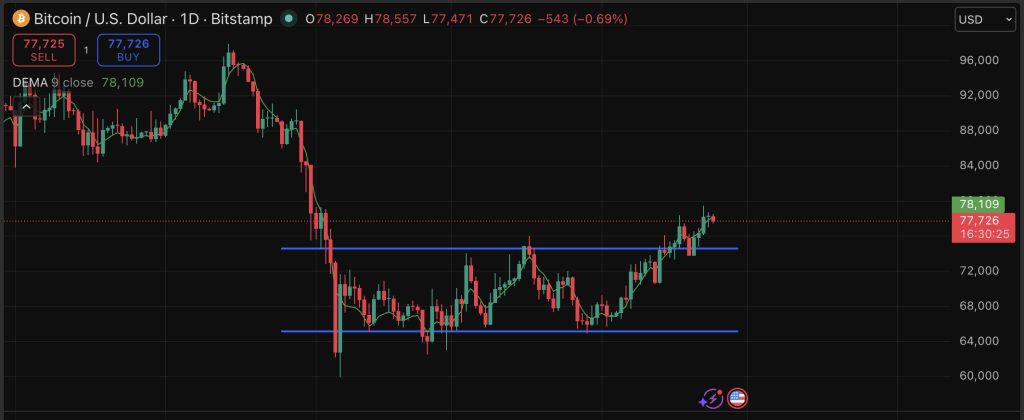
Our prediction model believes that $72,000 is the pivotal “line to hold,” as a foundation for a $80,000-$90,000 run. However, a clean break below risks a cascade of panic selling toward sub-$50,000.
Another analyst has an even more brutal prediction, placing the bear-case floor at $30,000-$40,000 following the failed $79K breakout.
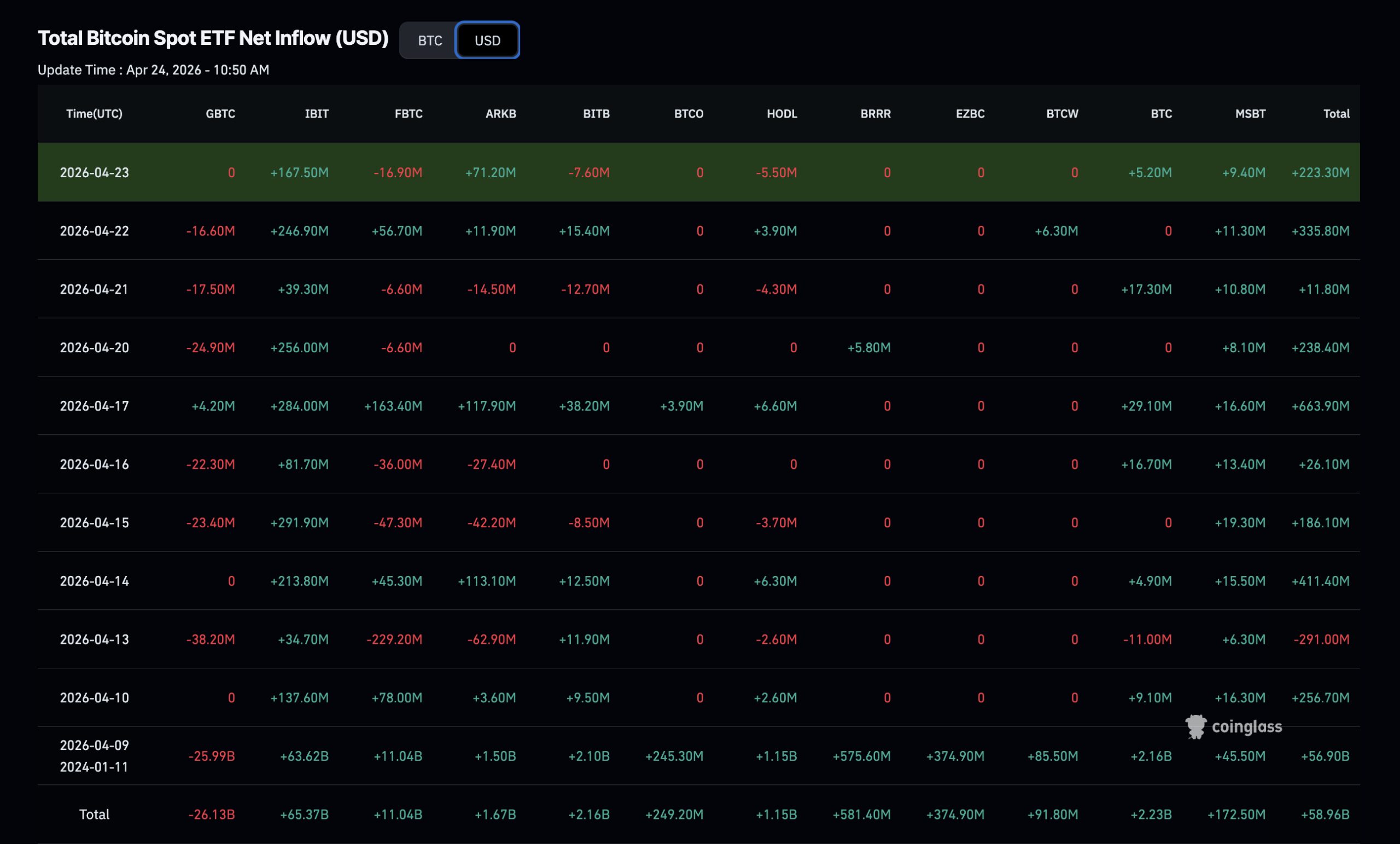
ETF inflows are the one to watch, especially with massive inflows coming in for more than 2 weeks now. See our BlackRock and Strategy accumulation analysis for context on institutional positioning at these levels.
Discover: The best crypto to diversify your portfolio with
Bitcoin Hyper Targets Early-Mover Upside as BTC Tests Critical Support
Traders sitting in BTC face asymmetric risk, a 36% downside to $50,000 versus less than 5% upside to $80,000, with macro headwinds still unresolved. That math is pushing some capital into earlier-stage Bitcoin ecosystem plays where the upside calculus looks different.
Bitcoin Hyper ($HYPER) is positioning as a direct infrastructure bet on Bitcoin’s scalability problem, the same slow transactions and high fees that have limited BTC’s programmability for years. The project will be the first Bitcoin Layer 2 with Solana Virtual Machine (SVM) integration, promising sub-Solana latency and low-cost smart contract execution while inheriting Bitcoin’s security model.
The presale has raised $32,5 million at a current price of $0.0136, with 30% APY staking available to early participants. As covered in recent reporting on the presale milestone, momentum has been building alongside Bitcoin’s price volatility.
Research Bitcoin Hyper before the next price adjustment.
The post Bitcoin Price Prediction: $50K Warns Analyst, Data Points $80K appeared first on Cryptonews.


Kelp DAO’s $292 million exploit has raised new questions about risk across liquid restaking and DeFi lending markets.
Summary
- Kelp DAO’s $292M exploit raised concerns over hidden risks across liquid restaking and lending markets.
- Aave, SparkLend, Fluid, and Lido took risk-control steps after rsETH markets came under pressure.
- The incident renewed debate over whether yield stacking hides risk across connected DeFi protocols.
The attack reportedly affected the protocol’s rsETH bridge and involved 116,500 rsETH, equal to about 18% of circulating supply.
The incident did not remain limited to Kelp DAO. Aave saw large withdrawals, while SparkLend and Fluid paused rsETH markets. Lido also paused earnETH, which had exposure to rsETH, even though its core stETH product was not affected.
A post by a DeFi-focused account, known as @whatexchange on X, compared the event to the 2008 financial crisis. The account wrote, “Stacking asset layers does not remove risk. It compresses and hides it.”
Layered yield products face scrutiny
The post argued that rsETH moved through several layers before the exploit. Users first staked ETH through Lido and received stETH. That stETH could then move into Kelp DAO and EigenLayer, where rsETH was minted.
The rsETH token was then used as collateral on lending platforms such as Aave, SparkLend, and Fluid. It was also bridged through LayerZero to other chains, creating wrapped versions that depended on the same underlying asset.
The analysis compared this structure to mortgage products before the 2008 crisis. It said both systems repackaged one base asset through several financial layers, while each layer relied on the previous one working as expected.
Market response shows hidden exposure
After the Kelp DAO exploit, several DeFi platforms moved to reduce risk. Aave froze rsETH markets for several hours, while SparkLend and Fluid paused similar markets. Ethena also paused LayerZero OFT bridges as a precaution, despite having no direct rsETH exposure.
According to the post, over $6.2 billion exited Aave within less than 36 hours. The account said the main issue was not only the exploit size but the difficulty of mapping indirect exposure across protocols.
The post stated, “No participant, including protocols themselves, can fully map their exposure network.” It added that when users cannot verify exposure in real time, they often react by withdrawing funds.
DeFi risk debate shifts to system design
The post also focused on bridge security. It claimed Kelp used a 1-of-1 verifier setup, meaning one node verified cross-chain messages before funds moved. The post argued that this design created a single point of failure inside a product marketed as decentralized.
The analysis also questioned yield stacking. It said each layer adds new risks, including validator slashing, restaking risks, bridge bugs, contract failures, and lending liquidations.
The post said users should not judge DeFi products only by APY. It argued that higher returns often reflect hidden risk across several connected systems, not simple passive income.
The Kelp DAO exploit has now become part of a wider debate on DeFi security, leverage, and transparency. The incident showed how one failure can affect users across several platforms, including users who did not directly interact with Kelp DAO.

My Biggest Crashout Yet | Financial Audit

EastEnders fans ‘actually cried’ as they heap praise on powerful episode | Soaps

Probal Sen flags muted quarter for Reliance as O2C weakness weighs

Manchester United reach agreement with Casemiro over contract clause amid transfer speculation

US brings back mandatory military draft registration

Steven Gerrard disagrees with Gary Neville over ‘shock’ Chelsea and Arsenal claim | Football


-

 Sports7 days ago
NWFL Suspends Two Players Over Post-Match Clash in Ado-Ekiti
-

 Fashion7 days ago
Weekend Open Thread: Theodora Dress
-

 Politics6 days ago
Palestine barred from entering Canada for FIFA Congress
-
Entertainment4 days ago
NBA Analyst Charles Barkley Chimes in on Ice Spice McDonald’s Fiasco
-

 Tech5 days ago
Auto Enthusiast Scores Running Tesla Model 3 for Two Grand and Turns It Into Bare-Bones Go-Kart
-

 Business5 days ago
Powerball Result April 18, 2026: No Jackpot Winner in Powerball Draw: $75 Million Rolls Over
-

 Politics5 days ago
Zack Polanski demands ‘council homes not luxury flats for foreign investors’
-

 Crypto World6 days ago
Russia Pushes Bill to Criminalize Unregistered Crypto Services
-

 Politics3 days ago
Gary Stevenson delivers timely reminder to register to vote as deadline TODAY
-

 Business2 days ago
Rolls-Royce Voted UK’s Most Iconic Trade Mark as IPO Register Hits 150
-

 Politics2 days ago
Disabled people challenge government SEND proposals over segregation concerns
-

 Politics2 days ago
Making troops accountable for war crimes threatens US alliance, ex-SAS colonel warns
-

 Crypto World6 days ago
Russia Introduces Bill To Criminalize Unregistered Crypto Services
-

 Politics2 days ago
Starmer handler McSweeney to be dragged from shadows by Foreign Affairs Committee
-
Politics2 days ago
Wings Over Scotland | How To Get Away With Crimes
-

 Politics2 days ago
Zack Polanski responds to home secretary’s taser threat
-
Crypto World5 days ago
Kelp DAO rsETH Bridge Hack Drains $292M as DeFi Losses Top $600M in Two Weeks
-

 Politics2 days ago
‘Iran is still a nuclear threat’
-

 Crypto World2 days ago
New York sues Coinbase, Gemini over prediction market offerings
-
 Sports7 days ago
Kevin Kisner apologizes for Masters criticism: ‘I crossed the line’
You must be logged in to post a comment Login