

Crypto World
Iran focus at Trump-Xi summit may delay progress on tariffs, rare earths

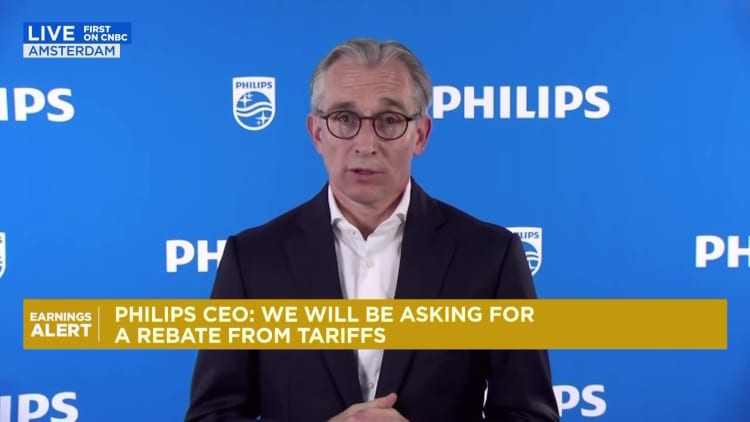
Pictured here is the last time a sitting U.S. president made a state visit to China. President Donald Trump traveled to Beijing in November 2017 during his first term to meet with Chinese President Xi Jinping.
Pool | Getty Images
BEIJING — The Iran war is likely to take center stage in the summit between U.S. President Donald Trump and China’s Xi Jinping, leaving less scope to resolve issues like tariffs and rare earth supplies.
U.S. Treasury Secretary Scott Bessent has already said that Iran will be a topic in the meetings, which are due to take place May 14 and 15. And earlier this week, China hosted Iran’s foreign minister for the first time since the war began in late February — raising hopes for a peace deal, sending oil prices lower and fueling stock-market gains.
The U.S. government declined China’s invitation to organize industry-specific meetings between senior Chinese leaders and U.S. CEOs, thinking it could make American businesses appear too close to Beijing, according to a U.S. executive with direct knowledge of the arrangements. As of Tuesday, the White House had yet to formally invite executives to join Trump on the trip, and a proposed list of two dozen leaders could be halved, the person added.
Boeing and Citigroup CEOs are among those set to accompany Trump, two separate sources said. The U.S. aircraft giant is expected to seal its first large order from China in nearly a decade around the summit.
Xi has hosted a dozen national leaders this year, from the U.K. to South Korea — who often bring large business delegations. Still, corporations may not object to the decreased focus if it resolves a large geopolitical overhang for them.
An end to the Iran war would be a “great relief to global business,” said Hai Zhao, a director of international political studies at the Chinese Academy of Social Sciences, a state-affiliated think tank. It would “be remembered as very much the success” for the Trump-Xi summit.
However, the U.S. and Iran have traded fire in the Strait of Hormuz again, each blaming the other for initiating the attack. Just a few days earlier, a Chinese-owned oil tanker was also struck, according to Chinese media outlet Caixin. CNBC was unable to independently confirm the report.

If a smaller group of executives joins Trump’s visit to China, it would contrast with the president’s trip to Saudi Arabia last May, when more than 30 U.S. executives accompanied him. When Trump visited China during his first term in 2017, the last sitting U.S. president to do so, nearly 30 CEOs accompanied him – signing 37 major deals worth more than $250 billion.
But the expected images of Trump and Xi together may still send a signal within China that it’s more acceptable again to engage with U.S. businesses, said Michael Hart, president of the Beijing-based American Chamber of Commerce of China.
“Since U.S. military actions earlier this year, Chinese officials have been more hesitant to engage with the American business community,” he said.
China welcomes U.S. business expansion and hopes the companies can keep advancing bilateral economic relations, the foreign ministry told CNBC. China’s commerce ministry didn’t respond to a request for comment.
Meanwhile, the urgency of some business-related issues is declining. Both countries are backpedaling on recent confrontation around U.S. sanctions and tech, while eyeing cooperation on the growing security threat of AI, according to reports.
And some progress may still be made. Trump is expected to notch deals on Chinese purchases of U.S. soybeans and Boeing airplanes, according to Scott Kennedy, senior advisor and trustee chair in Chinese business and economics at the U.S.-based Center for Strategic and International Studies.
He also anticipates Trump will discuss U.S. plans to establish trade and investment organizations – called “boards” – to handle specific bilateral issues.
“The meeting most likely will solidify the advantages China has gained over the past year,” Kennedy said.
Beijing’s focus will likely be on tariffs, Taiwan’s status and U.S. restrictions on Chinese access to advanced technology, Kennedy said. China was the first major country to retaliate against tariffs announced by the Trump administration in April 2025.
Meanwhile, changes to China’s increasingly tight rare earths export controls would be felt worldwide, and they affect all countries, not just the U.S.
— CNBC’s Matthew Chin contributed to this report.


BNY has partnered with Abu Dhabi-based Finstreet and ADI Foundation to develop institutional digital asset custody services for clients in the United Arab Emirates.
The initial focus is on Bitcoin and Ether custody for Finstreet’s existing clients, with plans to later extend to ADI Foundation’s blockchain infrastructure, the world’s largest custodian said in a Thursday announcement. The companies said they intend to expand the product scope to include stablecoins, tokenized real-world assets and other regulated digital instruments, though no timeline was given.
“BNY is uniquely positioned to connect traditional and digital financial ecosystems,” Hani Kablawi, executive vice chair at BNY, said. BNY claimed it is the first US global systemically important bank to offer digital asset custody.
The three firms will offer digital asset custody services from the Abu Dhabi Global Market (ADGM), an international financial center and free zone on Al Maryah Island. The initiative remains subject to definitive agreements and regulatory approvals, according to BNY.
Related: UAE free zone launches blockchain-based business IDs for registered firms
UAE stablecoin infrastructure expands
Finstreet is a subsidiary of Sirius International Holding, which is backed by UAE conglomerate IHC. IHC recently joined other institutions in launching DDSC, a dirham-backed stablecoin regulated by the UAE central bank. The stablecoin operates on ADI Chain, an institutional layer-2 blockchain developed by ADI Foundation.
PUSD, a Shariah-compliant stablecoin backed by reserves denominated in Saudi riyals and UAE dirhams, is also expected to launch on ADI Chain.
In 2025, ADI Chain signed memoranda of understanding with BlackRock, Mastercard and Franklin Templeton tied to tokenized asset settlement and digital financial infrastructure.
The UAE has continued developing its digital asset regulatory framework and tokenization infrastructure in recent years, licensing firms including Animoca Brands, BitGo and Binance while introducing rules covering tokenized stocks, ETFs and crypto derivatives.
Cointelegraph reached out to BNY for a comment, but had not received a response by publication.
Related: UAE investors buy AI dip, keep crypto exposure despite conflict
UAE stablecoins launch regulated conversion rail
The BNY collaboration comes as Abu Dhabi firms push deeper into regulated digital asset infrastructure.
In a Thursday announcement, AE Coin and USD Universal said they are building a regulated conversion rail that allows near-instant exchange between the UAE dirham-pegged AE Coin and the US dollar-backed USDU stablecoin, targeting institutional payments and treasury management.
The system runs on Al Maryah Community Bank’s infrastructure and will initially be accessible through Aquanow and Changer.ae, two regulated digital asset service providers in the UAE.
Magazine: Guide to the top and emerging global crypto hubs: Mid-2026

TrustedVolumes, an independent market maker and resolver used by 1inch Fusion, confirmed it was exploited and said about $6.7 million in stolen funds are being held across three Ethereum addresses.
In a Thursday X post, the market maker said the stolen funds were split across three wallets, with two addresses each holding about $3 million and a third holding about $700,000. TrustedVolumes said it was open to “constructive communication” over a bug bounty and a “mutually acceptable resolution.”
The confirmation came after Web3 security company Blockaid said its exploit detection system had identified an ongoing Ethereum exploit targeting TrustedVolumes. Blockaid said the attack involved a TrustedVolumes-controlled custom swap infrastructure. Blockaid initially estimated that about $5.87 million had been extracted, including Wrapped Ether, USDT, Wrapped Bitcoin and USDC.
Blockchain security company CertiK said the attacker registered as an allowed order signer through a public function, then used that authorization to execute orders that transferred funds from the targets.
The incident highlights the risks around third-party infrastructure used in decentralized exchange execution, where resolvers and market makers can operate their own contracts even when the core protocol and ordinary users are not directly affected. TrustedVolumes operates independently as a liquidity provider for multiple protocols, including 1inch, which said its own systems, infrastructure and user funds were not affected.
Cointelegraph reached out to TrustedVolumes for additional comment but had not received a response by publication.

Source: TrustedVolumes
1inch says none of its protocols were breached
In an X post, 1inch said reports linking it directly to the TrustedVolumes exploit were “misleading,” adding that “neither 1inch nor any of the 1inch protocols are involved.” The platform said there was “no impact on 1inch systems, infrastructure or user funds.”
1inch co-founder Sergej Kunz also said TrustedVolumes operates independently and is not exclusive to 1inch. “While it is true that 1inch uses TrustedVolumes as a resolver, we are one of many,” Kunz said.
Kunz said the framing of the exploit as a 1inch-related incident was “confusing and harmful,” adding that 1inch is monitoring the situation with security partners and will assist where appropriate.
Related: Andre Cronje says DeFi is ‘no longer DeFi’ as builders debate circuit breakers
Security researcher Vladimir Sobolev, known as Officer’s Notes on X, also told Cointelegraph there was “no risk for 1inch users,” adding that the exploit was related only to TrustedVolumes.
Sobolev said the exploit points to broader weaknesses in crypto security practices, where vulnerabilities can quickly produce immediate losses.
“We lack security in general. Blockchains just tend to have an immediate payoff,” Sobolev told Cointelegraph. “We need to pay more attention to kill switches, monitoring, circuit breakers, etc.”
Both Blockaid and Sobolev noted that the attack was carried out by the same operator responsible for the March 2025 1inch Fusion V1 resolver exploit. However, Blockaid said the latest attack involved a different vulnerability.
In March 2025, 1inch said a vulnerability affected resolvers using an outdated Fusion v1 implementation in their own contracts, while end-user funds remained safe. SlowMist later traced about $5 million in stolen assets, including USDC and Wrapped Ether.
1inch and the affected resolver negotiated with the attacker, who returned most of the stolen funds under a bug bounty agreement, according to 1inch and Decurity’s postmortem.
Magazine: North Korea denies crypto hacks, Upbit’s bank tests Ripple: Asia Express

TLDR
- Shopify Inc stock rose 3.55% on May 7 and outperformed the Software and IT Services sector, which gained 2.16%.
- The company exceeded analyst expectations for revenue and earnings per share in the first quarter of 2026.
- Gross Merchandise Volume remained above $100 billion for the second consecutive quarter.
- The stock initially declined after Shopify issued softer second-quarter revenue guidance.
- Market sentiment improved as investors reassessed the company’s overall financial strength and long-term strategy.
Shopify Inc (SHOP) stock rose 3.55% on May 7, outpacing the Software & IT Services sector, which gained 2.16%. The rally followed renewed focus on the company’s first-quarter 2026 earnings and strategic updates. Trading activity also highlighted strong turnover in Microsoft Corp, Palantir Technologies Inc, and Meta Platforms Inc.
Shopify Inc Stock Rebounds After Earnings Reassessment
Shopify released its Q1 2026 results on May 5 and exceeded analyst estimates for revenue and earnings per share. The company reported Gross Merchandise Volume above $100 billion for the second consecutive quarter. It also maintained healthy free cash flow margins and reported growth in Merchant Solutions revenue.
However, the stock declined on May 5 and May 6 after management issued softer second-quarter revenue guidance. Executives projected slower growth compared with the first quarter, which prompted short-term selling pressure. Despite that reaction, the May 7 rebound indicated that traders reassessed the guidance in context with overall performance.
Shopify highlighted higher AI-driven order volumes during the quarter, reflecting expanded product capabilities. The company also continued to grow its fintech offerings and international operations. Management emphasized disciplined cost control and sustained margin performance during its earnings call.
Sector Performance and Market Activity Support Gains
The broader Software & IT Services sector advanced 2.16% during the same session. Microsoft Corp climbed 2.76%, while Palantir Technologies Inc gained 4.58%. Meta Platforms Inc added 1.66%, placing them among the top three stocks by turnover in the sector.
Analysts responded to the earnings report by adjusting certain price targets while maintaining favorable ratings. Several firms reiterated “Buy” or “Outperform” recommendations following the results. Consensus estimates still point to implied upside from current trading levels.
Institutional activity also drew attention during the week. Cathie Wood’s ARK ETFs purchased Shopify shares on May 5 and May 6. The company also has an authorized share buyback program, which signals management’s confidence in its capital position.
Shopify confirmed that Merchant Solutions revenue expanded year over year in Q1 2026. The company also reiterated its focus on scaling AI tools across merchant services. It reported that GMV exceeded $100 billion again, closing the quarter with steady operational metrics.

Crypto World
Ripple’s XRPL Linked to Interbank System in Major Pilot With JPMorgan, Mastercard, Ondo

Blockchain settlement rails are increasingly becoming intertwined with the global financial system. A group of firms recently achieved a feat that could introduce 24/7 settlements for traditional financial markets.
According to a tweet, the tokenization platform Ondo Finance, card services provider Mastercard, and JP Morgan’s blockchain platform, Kinexys, are involved in achieving the latest milestone. The companies successfully completed a pilot transaction that connected Ripple’s XRP Ledger (XRPL) with interbank settlement rails.
XRPL Linked to Interbank Settlement Rails
The pilot linked XRPL to global banking infrastructure, enabling institutions to execute cross-border transactions in a single, integrated flow. The assets used for the project were tokenized U.S. Treasury bills. The feat marked the first time tokenized Treasuries were settled across borders in near real time, outside traditional banking hours.
The process entailed Ondo processing Ripple’s redemption of the Ondo Short-Term U.S. Government Treasuries (OUSG) first. Mastercard routed instructions to Kinexys through its multi-token network, while JP Morgan delivered USD to Ripple’s Singapore bank account.
Completed in under five seconds, rather than the usual one to three business days, the pilot transaction highlighted a hybrid model in which XRPL handled the asset token movement while traditional banking rails facilitated fiat settlement.
“Tokenized assets are no longer separate from the global financial system. For the first time, a public blockchain and global banking infrastructure settled a cross-border transaction of a tokenized fund together in real time. Together, we’re laying the groundwork for 24/7 global markets that never close,” Ondo Finance stated.
The Rise of Tokenization on Wall Street
With Treasuries moving like crypto on settlement rails that do not have closing hours, the $30 trillion U.S. Treasury market could be opened to a new wave of investors. Multiple financial institutions, including Wall Street’s biggest firms, are already scrambling to get on this bandwagon.
Besides Treasuries, these institutions are also attempting to tokenize bonds and deposits. A few days ago, the Depository Trust & Clearing Corporation (DTCC) announced plans to launch a new tokenization service for bonds and Treasuries in October.
Meanwhile, the tokenized stocks sector has witnessed massive growth over the past year. In fact, the market cap of the tokenized real-world assets (RWAs) sector as a whole more than tripled from $5.42 billion to $19.32 billion in the last 15 months ending March 2026. The sector grew so well that it outperformed stablecoins.
The post Ripple’s XRPL Linked to Interbank System in Major Pilot With JPMorgan, Mastercard, Ondo appeared first on CryptoPotato.
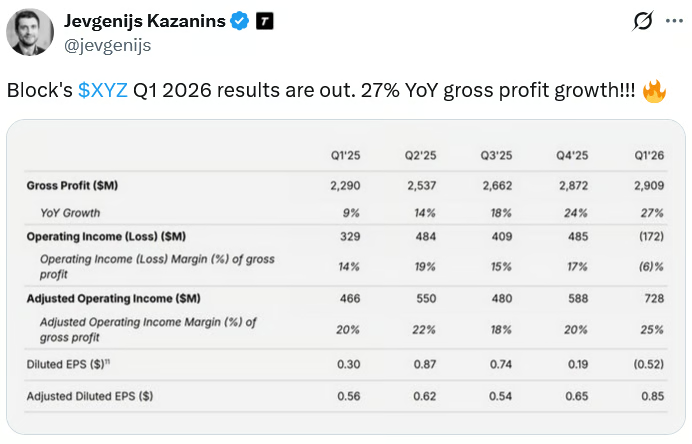
Jack Dorsey’s payments firm Block rose 7.9% in after-hours trading as its Q1 earnings surpassed analyst estimates, despite posting its first loss in three years.
Block’s Q1 earnings came in at 85 cents per share, beating the Zacks consensus estimate of 68 cents per share. Investors responded positively, driving Block shares to $75.70 after hours, Google Finance data shows.
“This quarterly report represents an earnings surprise of +25.68%,” said Zacks Equity Research on Thursday. “Over the last four quarters, the company has surpassed consensus EPS estimates two times.”
Expanding Bitcoin’s use into the payments space has been a key area of focus for Dorsey, who previously argued that widespread payment adoption is needed to fulfill Satoshi Nakamoto’s original vision of Bitcoin as a peer-to-peer electronic cash system. In late April, Block noted that over 800,000 US-based merchants have enabled Bitcoin transactions for everyday purchases.
Block reports first quarterly loss in three years
The earnings beat came despite Block reporting its first quarterly loss since 2023, driven by a 23.8% drop in the price of Bitcoin over the three-month period.
Q1 net loss was $309 million, which included a $172.8 million bitcoin remeasurement loss on the 8,883 Bitcoin it held as of March 31.
Bitcoin revenue from Cash App and other Block products fell to $1.8 billion from $2.33 billion a year ago.
Block attributed the fall to “Bitcoin trading dynamics” and a “strategic decision to reduce the fee” charged on certain Bitcoin transactions on Cash App.
Block’s gross profit rises 27% in Q1
Block’s Q1 gross profit — net sales minus cost of goods sold — reached $2.9 billion, up 27% from a year earlier.
Bitcoin payments in Cash App contributed $63 million to Block’s gross profit, while Square had no meaningful impact on Block’s Bitcoin business.
Avory & Co. founder and chief investment officer Sean Emory said “Block had a strong quarter,” having “beat and raised” its guidance.
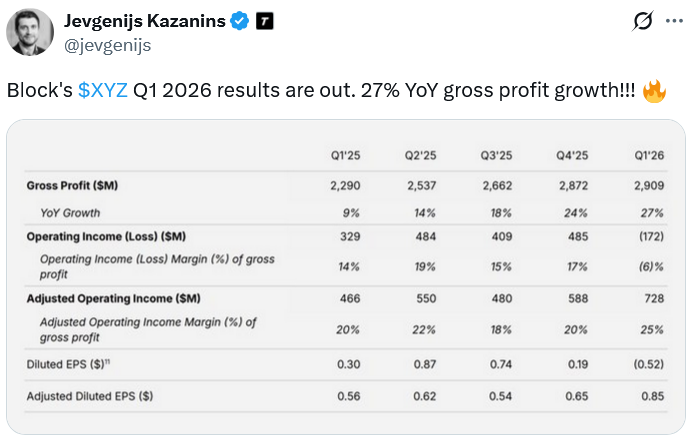
Source: Jevgenijs Kazanins
The quarter also included a restructuring overhaul in late February, when Dorsey announced about 4,000 staff cuts, representing roughly 40% of the company’s workforce, as part of a plan to rely more on AI in search of greater operational efficiency. Block’s operational expenses rose 57.2% year-on-year to $3.08 billion in Q1.
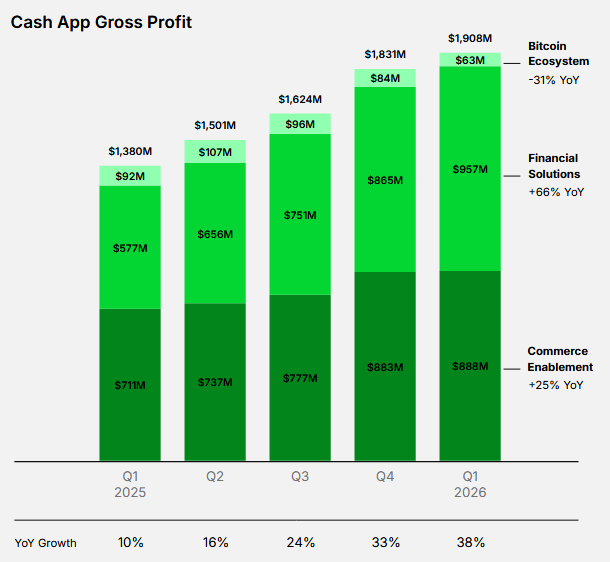
Cash App’s quarter-over-quarter change in gross profit. Source: Block
Block expands Bitcoin offerings
In late April, Block launched a proof-of-reserves for its corporate Bitcoin treasury and for users to confirm Bitcoin balances on Cash App and Square as part of a push to increase transparency with its customer base.
Related: Bitcoin exchange reserves fall to two-year low after $8B exodus
In the same announcement, Block unveiled a Bitkey hardware wallet with a touchscreen to verify transactions and a new feature on Cash App allowing certain users to automatically convert payments into Bitcoin.
It also started offering 5% Bitcoin cash back rewards for Square merchants and raised customer withdrawal limits fivefold to $10,000 per day and $25,000 per week, extending Dorsey’s push to broaden Bitcoin’s role in everyday payments.
Magazine: Guide to the top and emerging global crypto hubs — Mid-2026

Coinbase Global Inc. entered 2026 with a sobering first-quarter performance, delivering a net loss and revenue figures that underscored the headwinds facing the crypto industry. The exchange posted a $394.1 million net loss for Q1, marking a second consecutive quarterly loss after a $667 million shortfall in Q4 2025, and a meaningful drift away from profitability despite revenue coming in below expectations.
The company reported revenue of $1.41 billion for the quarter, trailing consensus estimates of around $1.5 billion. Earnings per share stood at a loss of $1.49, compared with analysts’ expectations for a positive 36-cent print. The quarterly results arrive as macro conditions remained challenging for crypto trading and related services, weighing on Coinbase’s topline and margins alike.
On the call accompanying the release, Coinbase CFO Alesia Haas stressed the broader market backdrop, noting that “macro conditions were genuinely tough” and that the total crypto market capitalization and overall trading volume declined by more than 20% quarter over quarter. The numbers reflect a wider crypto winter in early 2026, even as the company has sought to diversify beyond pure spot trading into other asset classes and services.
Following the report, Coinbase’s stock traded lower in regular hours and slid further in after-hours trading, dipping under $184. The retreat comes as investors weigh not only quarterly performance but the company’s longer-term plan to navigate a market where trading activity has cooled and competition for revenue sources has intensified.
Coinbase’s quarterly challenges come as peers in the crypto ecosystem also grapple with slower revenue and tighter spreads, forcing many to reconfigure operations and human resources. The stock has fallen more than 14% this year, prompting a series of strategic adjustments designed to conserve cash and explore new growth avenues.
Looking ahead, Coinbase is pursuing a broader strategy to diversify beyond a single focus on spot crypto. Chief executive officer Brian Armstrong told investors that the world economy is moving on-chain, and Coinbase was built to capitalize on that transition. He framed the current period as an interim phase in which some asset classes outperformed while spot crypto assets lagged, with the expectation that diversification would eventually yield a more balanced trajectory over time.
That pivot toward a multi-asset platform aligns with a broader industry conversation about tokenized finance and adjacent revenue streams. In recent quarters, Coinbase has signaled interest in markets that extend beyond traditional spot trading, including prediction markets and other services that could complement trading activity. The company has also taken steps to constrain costs as part of a broader effort to return to a more sustainable earnings trajectory.
The market backdrop outside Coinbase has been mixed. Rival Robinhood Markets also reported softer-than-expected first-quarter results, with crypto revenue and trading volumes shrinking versus a year earlier. Industry analysts have suggested that the decline in crypto stocks presents a potential entry point for investors seeking exposure to the tokenization narrative, a view that Bernstein conveyed in March. The research firm argued that the downturn in crypto equities could be an opportunity to gain exposure to a broader shift toward tokenized finance — including stablecoins and prediction markets — that could gain traction in the coming years.
From a regulatory and adoption standpoint, Coinbase’s push to broaden product lines could help mitigate volatility tied to crypto price swings by generating revenue from non-trading services. The company also faces ongoing scrutiny around exchange operations, user protection, and the regulatory clarity required to support a more expansive suite of financial products tied to digital assets. Investors will be watching closely how new business lines perform and whether they can scale in a market where trading activity remains uneven and capital costs have risen.
In a quarterly filing that accompanied the earnings, Coinbase reaffirmed the numbers and provided the formal context for these results. The company’s Q1 2026 10-Q lays out the period’s performance and offers a window into the balance sheet, cash burn, and the company’s ongoing cost-control initiatives. For those seeking to review the official documentation, the filing is available here: Coinbase Q1 2026 10-Q.
As Coinbase navigates these headwinds, investors will be looking for concrete signs that the company can translate its strategic ambitions into tangible revenue streams. The first-quarter miss highlights the gap between the pace of strategic diversification and the immediate earnings trajectory that investors have grown accustomed to in a year of crypto market volatility. The company’s leadership will need to demonstrate that the contemplated shift toward a multi-asset platform can begin to offset declines in core trading activity, particularly if market conditions remain challenging in the near term.
Analysts’ take on the quarter remained mixed, with some noting the difficulty of beating revenue expectations in a slowing market. The Q1 2026 results also come after a period during which Coinbase announced cost-reduction measures, including workforce reductions, to align its cost structure with a slower revenue environment. The company disclosed that it laid off approximately 14% of its workforce, roughly 700 employees, as part of an ongoing effort to protect margin during a period of slower top-line growth.
For now, the path forward hinges not only on market conditions but on execution across new product lines and services. Armstrong’s message to investors — that the on-chain economy will continue to expand and that Coinbase was built to participate in that expansion — remains the north star for the company. The question for investors is whether the diversified approach will translate into a sustainable uplift in revenue and profitability as the broader crypto cycle evolves.
Looking ahead, readers should monitor Coinbase’s progress on cost discipline, the performance of new business initiatives, and how the company hedges against ongoing volatility in crypto markets. As the sector recalibrates, Coinbase’s ability to monetize non-trading activities and scale new products could determine whether the stock can weather the current downturn and participate in a future upswing as tokenization and on-chain finance gain broader traction.
Key takeaways
- Q1 2026 results show a $394.1 million net loss for Coinbase, extending a loss streak from Q4 2025, with revenue of $1.41 billion versus roughly $1.50 billion expected.
- Analysts anticipated earnings per share of 36 cents, but Coinbase reported a loss of $1.49 per share, contributing to a subdued reaction in after-hours trading and a stock price below $184.
- Macro headwinds were cited as a major factor, with total crypto market capitalization and trading volume down more than 20% quarter over quarter.
- Cost-cutting and strategic diversification are central to Coinbase’s plan, including layoffs of about 700 employees (roughly 14% of the workforce) and pivoting toward multi-asset offerings and services beyond spot trading.
- Industry context suggests mixed signals: peers like Robinhood also reported softer results, while analysts at Bernstein argued the downturn may create opportunities to tap into tokenization themes and a broader on-chain economy.
Q1 results and the market backdrop
Coinbase’s first-quarter performance arrived amid a crypto market backdrop that has yet to regain its footing. The company’s CFO underscored the macro challenges during the earnings call, reiterating that a meaningful portion of the revenue softness stemmed from a broad decline in crypto activity. The revenue miss was not just a function of weaker trading volumes but also a softer contribution from non-trading lines, illustrating the difficulty of maintaining profit margins when core activity contracts.
Despite the disappointing quarter, Coinbase’s leadership emphasized a strategic shift toward a broader asset-classes approach. Armstrong framed the current period as a phase where the ecosystem is evolving, with spot crypto assets lagging while other assets may contribute more meaningfully to the platform’s revenue mix over time. This multi-asset strategy, if executed effectively, could reduce sensitivity to price swings in the underlying crypto market and create a more resilient business model.
Moving beyond spot: diversification as a growth lever
The push to diversify aligns Coinbase with a broader industry thesis that tokenized finance and on-chain services will become a core driver of value creation. In the near term, the company is testing and expanding into new product areas that could complement trading activity and broaden the addressable market. Such a transition is not guaranteed to bear fruit quickly, but it represents an important strategic hedge against persistent volatility in spot markets.
At the same time, cost discipline remains a practical necessity. The decision to trim the workforce is a blunt acknowledgment that growth in an uncertain macro environment requires tighter expense management. Investors will want to see if these reductions translate into improved unit economics and whether the company can fund its expansion into new lines without compromising risk controls or user experience.
What to watch next
As Coinbase charts its path through 2026, investors should monitor several key developments: the performance of non-trading revenue streams, the pace and impact of ongoing cost initiatives, regulatory developments that could unlock or constrain on-chain products, and the degree to which the broader market recovers and supports trading volumes. The company’s quarterly progress on its multi-asset strategy will be particularly telling, as this plan represents both an opportunity to stabilize revenue and a test of management’s ability to execute beyond the traditional exchange model.
In case readers want to review the formal quarterly documentation, Coinbase’s Q1 2026 filing is accessible here: Q1 2026 10-Q.
Further context on the quarter’s expectations and peer performance can be found in market coverage surrounding Robinhood’s comparable results and Bernstein’s commentary on crypto equities and tokenization themes. These perspectives underscore a sector-wide pivot toward new revenue engines even as traditional trading volumes remain volatile.
Overall, Coinbase’s Q1 2026 results crystallize a transitional moment for the company and the crypto ecosystem: a time of deliberate restructuring and strategic experimentation, set against a backdrop of ongoing market headwinds and regulatory evolution. How quickly the new growth pillars can scale will shape the trajectory of Coinbase’s earnings power in the quarters ahead.
What remains uncertain is how smoothly the new initiatives will integrate with the existing platform and whether investors will see a clear path to profitability as macro conditions evolve. For now, the market will watch closely for signals that the diversification strategy is gaining traction and that cost controls are translating into measurable improvements in margins.
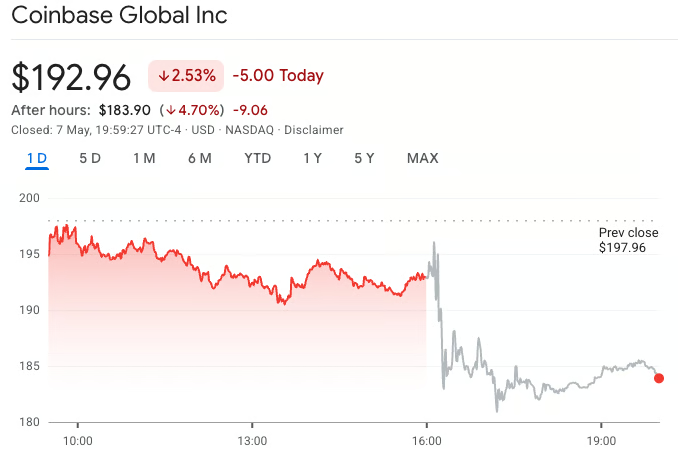
Coinbase shares slid Thursday after the US crypto exchange reported a steep first-quarter loss while revenue missed Wall Street expectations.
Coinbase reported a net loss of $394.1 million in Q1, its second consecutive quarterly loss after reporting a $667 million loss in Q4 2025. It swung from a $65.6 million profit a year earlier.
“Macro conditions were genuinely tough,” Coinbase chief financial officer Alesia Haas told investors on an earnings call. “Total crypto market cap and total crypto trading volume were both down more than 20% quarter-over-quarter.”
Coinbase’s earnings come as other crypto companies have also struggled to turn a profit in the first months of 2026 as a crypto market slump pushed some traders to other investments.
Meanwhile, Coinbase’s Q1 revenue was $1.41 billion, missing analyst estimates of $1.5 billion. Transaction revenue slumped 40%, while subscription and services revenue — representing its business outside trading — fell 13.5% from a year earlier.
Its earnings per share were a $1.49 loss, compared to analysts’ expectations of 36 cents per share, which saw Coinbase dropping by 4.7% after hours on Thursday to under $184.
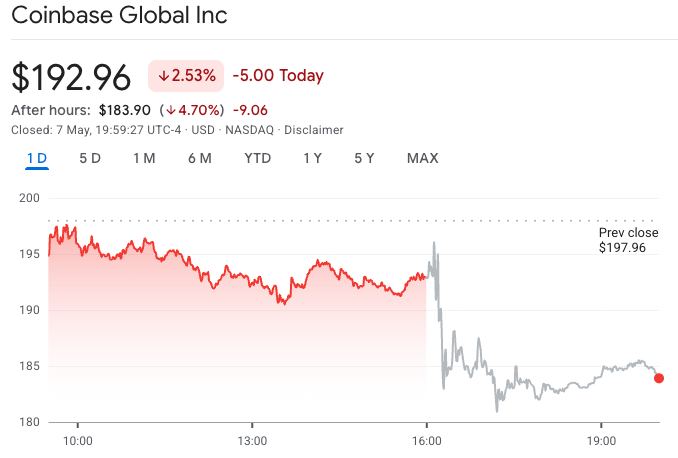
Coinbase shares fell in regular and after-hours trading on Thursday amid the company’s first-quarter earnings. Source: Google Finance
Coinbase’s stock has fallen more than 14.5% this year, prompting the exchange to pursue new business lines such as prediction markets and cost-cutting measures, including laying off 14% of its workforce, or about 700 employees, on Monday.
Despite the company’s earnings, CEO Brian Armstrong struck an optimistic tone on the earnings call, telling investors that “the world economy is moving on-chain, and Coinbase was built to capitalize on this transition.”
He added that over the past year, Coinbase has aimed to transition from “a primarily spot-focused crypto platform into a place where you can now trade any asset class.”
“We’re in kind of this interim period where spot crypto assets were down a bit, other asset classes were up. As we diversify, these things will get balanced out, where we’ll just be in a more upward channel over time,” Armstrong added.
Related: Block Inc rises 8% as Q1 gives ‘earnings surprise’ despite Bitcoin dip
Coinbase rival Robinhood Markets also missed estimates for the first quarter last month as its crypto revenue and trading volumes nearly halved from a year earlier.
Bernstein said in March that the decline in crypto stocks presented a more attractive entry point for investors seeking exposure to the current hot theme of tokenization and maintained a bullish rating on Coinbase and Robinhood.
It argued that the companies offered investors exposure to a broader shift toward tokenized finance, including stablecoins and prediction markets, which it expected to gain traction in the coming years.
Magazine: Guide to the top and emerging global crypto hubs — Mid-2026


American Bitcoin posted an $81.8 million net loss in Q1 2026, even as the Trump-backed miner set a new quarterly production record of 817 BTC and cut its mining cost by 23%.
Summary
- American Bitcoin reported an $81.8 million net loss in Q1, up from a $59.5 million loss in Q4 2025.
- Bitcoin fell 22% during the quarter, triggering a $117.2 million non-cash impairment charge on the company’s holdings.
- The company mined a record 817 BTC and reduced its cost per coin to $36,200, a 23% improvement from $46,900 in Q4 2025.
American Bitcoin reported a net loss of $81.8 million in Q1 2026, driven by a 22% bitcoin price decline that triggered a $117.2 million non-cash impairment on its digital asset holdings. Revenue from mining fell to $62.1 million from $78.3 million in the prior quarter.
Despite the headline loss, CEO Mike Ho pushed back. “Strip out the non-cash mark-to-market adjustment on our Bitcoin required by FASB,” he said, “and the underlying business was profitable and we did not sell a single coin.”
Gross mining margins held above 50% and the cost per coin fell to $36,200, a 23% improvement from $46,900 in Q4 2025.
Record production, widening paper losses
American Bitcoin mined 817 BTC in Q1, its highest quarterly output to date, and purchased an additional 803 BTC for its treasury. Total holdings reached 7,021 BTC as of March 31. Co-founder Eric Trump told Consensus Miami on Wednesday:
“In just over eight months as a public company, we have become the 16th largest bitcoin holder globally and scaled to more than 28 exahash of capacity.”
The company completed the deployment of 11,298 new Bitmain miners in early March, bringing its total fleet to 89,242 machines and 28.1 EH/s of capacity. Operating expenses for the quarter totalled $150.7 million.
ABTC shares fell roughly 7% in pre-market trading after the results missed analyst estimates by 17%. As crypto.news reported, ABTC debuted on Nasdaq through a reverse merger in September 2025, briefly pushing Eric Trump’s paper stake into billionaire territory before a sustained selloff.
Core Scientific (CORZ) reported a $347.2 million first-quarter net loss as its Bitcoin self-mining revenue fell sharply and high-density colocation became its largest revenue source.
In its earnings report published Wednesday, the company reported a net loss of $1.06 per diluted share for the quarter. A year earlier, Core Scientific reported diluted earnings of $1.24 per share.
Core Scientific said the loss included $266.5 million in non-cash impairment charges and a $30.8 million non-cash loss from changes in the fair value of warrants and contingent value rights.
Revenue rose to $115.2 million from $79.5 million a year earlier, but fell short of analyst expectations. Zacks Equity Research said analysts expected $120.2 million in revenue, with Core Scientific’s results coming in about 4.1% below expectations.
The results show Core Scientific’s transition from a Bitcoin miner into an AI infrastructure company, with high-density colocation now generating most of its revenue. The shift gives the company a larger business, but it also highlights how its legacy mining operations have weakened.
Bitcoin mining revenue falls
Core Scientific’s digital asset self-mining revenue fell to $30.1 million from $67.2 million a year earlier, with the company mining 279 Bitcoin (BTC) during the quarter, down 45% from the same period in 2025. According to its 10-Q filing, Core Scientific sold 2,385 Bitcoin during the quarter for $208.3 million to fund planned capital expenditures and other cash needs.
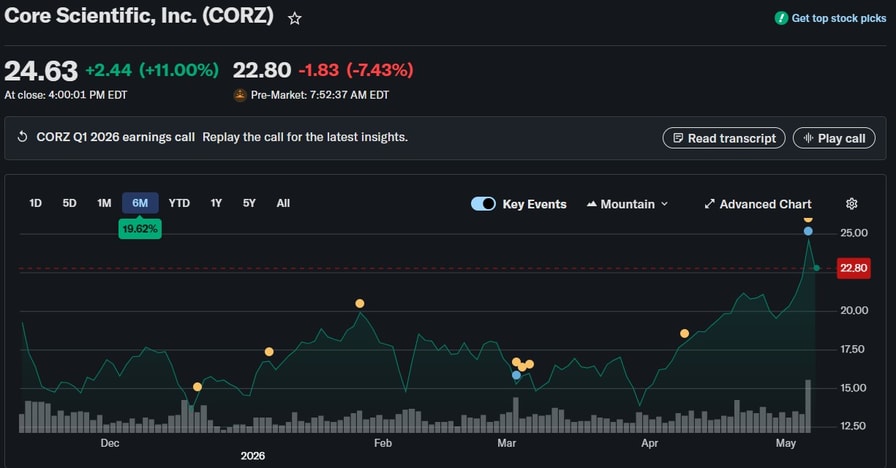
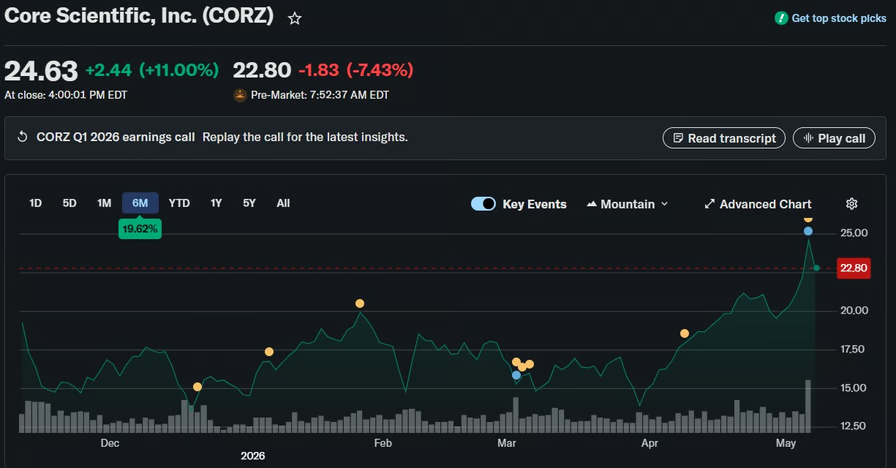
Core Scientific’s six-month price chart. Source: Yahoo Finance
Despite the weaker mining results, Core Scientific’s shares have gained over the past six months. Yahoo Finance data shows CORZ closed at $24.63 on Wednesday, up about 19.6% over six months, before falling 7.43% to $22.80 in pre-market trading at the time of writing.
In a separate announcement, Core Scientific said it plans to scale its Muskogee, Oklahoma, campus to about 1.5 gigawatts of gross power, or about 1.0 gigawatt of leasable power, partly through the planned acquisition of Polaris DS. The company has also started construction on a second, unleased 82.5-megawatt building at the campus.
Related: Trump-linked American Bitcoin reports $82M Q1 loss, revenue miss
Core Scientific expands AI-linked colocation business
Core Scientific’s first-quarter growth came from high-density colocation rather than Bitcoin production, with the company’s mining revenue and Bitcoin output falling while its AI-linked hosting business generated most of its revenue.
The company said its colocation revenue rose to $77.5 million in the first quarter from $8.6 million a year earlier, driven by additional billable customer power capacity delivered during the quarter.
The company said it was billing for 243 megawatts of capacity as of March 31, representing about $350 million in average annualized colocation revenue.
The revenue shift follows a series of hosting agreements with CoreWeave. In June 2024, Core Scientific said it signed 12-year contracts to deliver about 200 megawatts of infrastructure to host CoreWeave’s high-performance computing operations.
The companies later expanded the relationship. In an SEC filing in February 2025, the companies said CoreWeave’s total contracted high-performance computing infrastructure with Core Scientific had increased to about 590 megawatts across six sites.
Magazine: Guide to the top and emerging global crypto hubs: Mid-2026


Blockstream CEO Adam Back told Consensus Miami 2026 that bitcoin is winning a security war against DeFi, and that pension funds and sovereign entities are the next buyers.
Summary
- Adam Back argued at Consensus Miami that Bitcoin’s simpler architecture is pulling institutional capital away from DeFi platforms hit by repeated smart contract exploits.
- He outlined Bitcoin adoption in three waves: retail ownership, spot ETF access, and now institutional allocation through managed portfolios and sovereign entities.
- Back estimated roughly 200 bitcoin treasury companies exist globally and said BlackRock model portfolio allocations have not yet fully taken effect.
Blockstream CEO Adam Back argued at Consensus Miami 2026 that Bitcoin’s comparatively simple network architecture is separating it from more experimental blockchain ecosystems that have suffered repeated smart contract failures.
Back described the dynamic as Bitcoin winning “the DeFi security war,” as institutional investors grow more sophisticated in understanding where security risk actually sits. “Bitcoin infrastructure is much more simple, robust, security first,” he said.
Back said institutions are no longer trying to reshape Bitcoin into traditional finance infrastructure. Instead, he argued, they are adapting themselves to Bitcoin’s incentive structure and conservative security model.
That dynamic, he said, opens the door for Bitcoin-native tokenization and DeFi systems that prioritize safety over rapid experimentation, using layer-2 solutions such as Blockstream’s Liquid Network.
The three waves of bitcoin adoption
Back outlined Bitcoin adoption as occurring in three sequential waves: direct retail ownership, spot ETF access through brokerages and advisers, and now institutional allocation through managed portfolios, pension funds, and sovereign entities.
“The model portfolios that BlackRock and others are putting out,” he said, “those allocations haven’t taken effect yet,” suggesting the largest wave of institutional capital has not yet arrived.
Back also estimated roughly 200 bitcoin treasury companies now exist globally, including BSTR, the firm he leads as CEO.
He described BSTR as a more actively managed approach to bitcoin exposure, intended to generate returns through both holdings and fund management strategies rather than passive accumulation. The comments came as bitcoin traded above $81,000 at the time of the Consensus session.

Mulberry Court residents enjoy tulips at Burnby Hall gardens
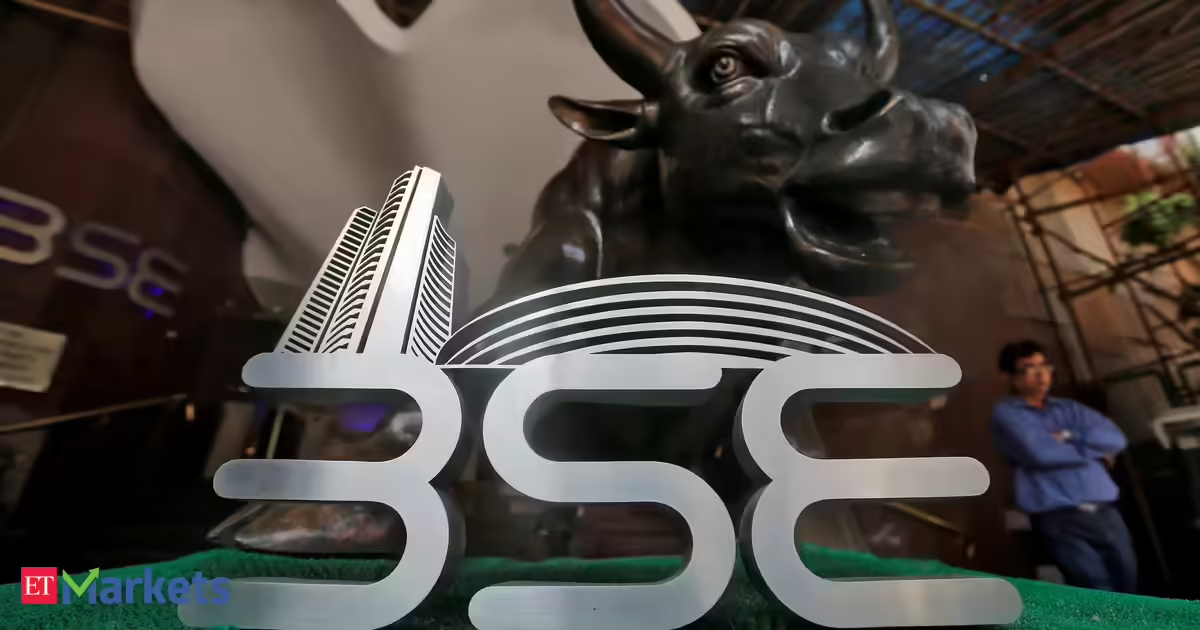
BSE shares fall 3% despite Q4 profit surge. Should you buy, sell or hold India’s oldest stock exchange?
BNY to Launch Institutional Bitcoin, Ethereum Custody for Investors in UAE

Manchester United reach agreement with Casemiro over contract clause amid transfer speculation

US brings back mandatory military draft registration

Steven Gerrard disagrees with Gary Neville over ‘shock’ Chelsea and Arsenal claim | Football
![BITCOIN: CRAZY!!!! THIS IS CRAZY!!!! [trades]](https://wordupnews.com/wp-content/uploads/2026/05/1778214197_maxresdefault-80x80.jpg)


-

 NewsBeat4 days ago
Channel 5 – All Creatures Great and Small series 7 new post
-

 Crypto World20 hours ago
Upbit adds B3 Korean won pair as Base token gains Korea access
-
 Tech6 days ago
Trump’s 25% EU auto tariff breaches Turnberry Agreement that also covers semiconductors and digital trade
-
 NewsBeat21 hours ago
NCP car park operator enters administration putting 340 UK sites at risk of closure
-
 Sports6 days ago
Paul Scholes issues Marcus Rashford reality check as agreement emerges over Man United star
-

 Entertainment6 days ago
Met Gala 2026 Rumored Guest List Is Turning Heads
-

 Business7 days ago
Strait of Hormuz Blockade Persists Amid US-Iran Standoff, Sending Oil Prices Soaring
-

 Entertainment6 days ago
Kylie Jenner Hit With Second Lawsuit From Ex-Housekeeper
-
Entertainment6 days ago
New on Prime Video in May 2026 — Full List of Movies and Shows
-

 Tech7 days ago
Meta ends Sama contract after Kenyan workers report seeing intimate footage from Ray-Ban smart glasses users
-

 Sports6 days ago
Cavaliers vs. Raptors Game 6 live score, updates, highlights from 2026 NBA playoffs first-round series
-
 Sports6 days ago
David Benavidez responds to team Canelo saying the fight will never happen
-
Entertainment5 days ago
New Netflix Movies in May 2026 — My Top 3 Picks to Stream
-

 Entertainment5 days ago
Melissa Joan Hart and More Stars Attend 2026 Kentucky Derby
-
 Sports6 days ago
IPL 2026: ‘Love you darling’- Hardik Pandya’s reaction to MS Dhoni steals the show |Watch | Cricket News
-

 Entertainment6 days ago
Young and the Restless Next Week: Cane Arrested & Matt’s Deadly New Scheme!
-

 Business5 days ago
Luka Doncic Injury Update: Doncic’s Hamstring Recovery Slows Lakers’ Hopes Against Thunder: Can He Run Yet?
-

 Sports7 days ago
Bayern won’t hand bottom side Heidenheim ‘gifts’ despite PSG game
-

 Sports7 days ago
What Preity Zinta Said After Punjab Kings’ First Defeat Of IPL 2026
-
 Crypto World5 days ago
Pi Network Mandates Protocol 23 Upgrade for All Mainnet Nodes Before May 15 Deadline
You must be logged in to post a comment Login