
Crypto World
Is Solana Price Doomed After Falling Below $100?

Solana has staged a sharp intraday recovery after recent losses pressured the price earlier this week. SOL bounced strongly as the broader crypto market added nearly $200 billion in value.
Aggressive dip buying prevented deeper losses, helping Solana stabilize and post a 12% daily gain despite lingering market uncertainty.
Solana LTHs Are Not So Bullish Yet
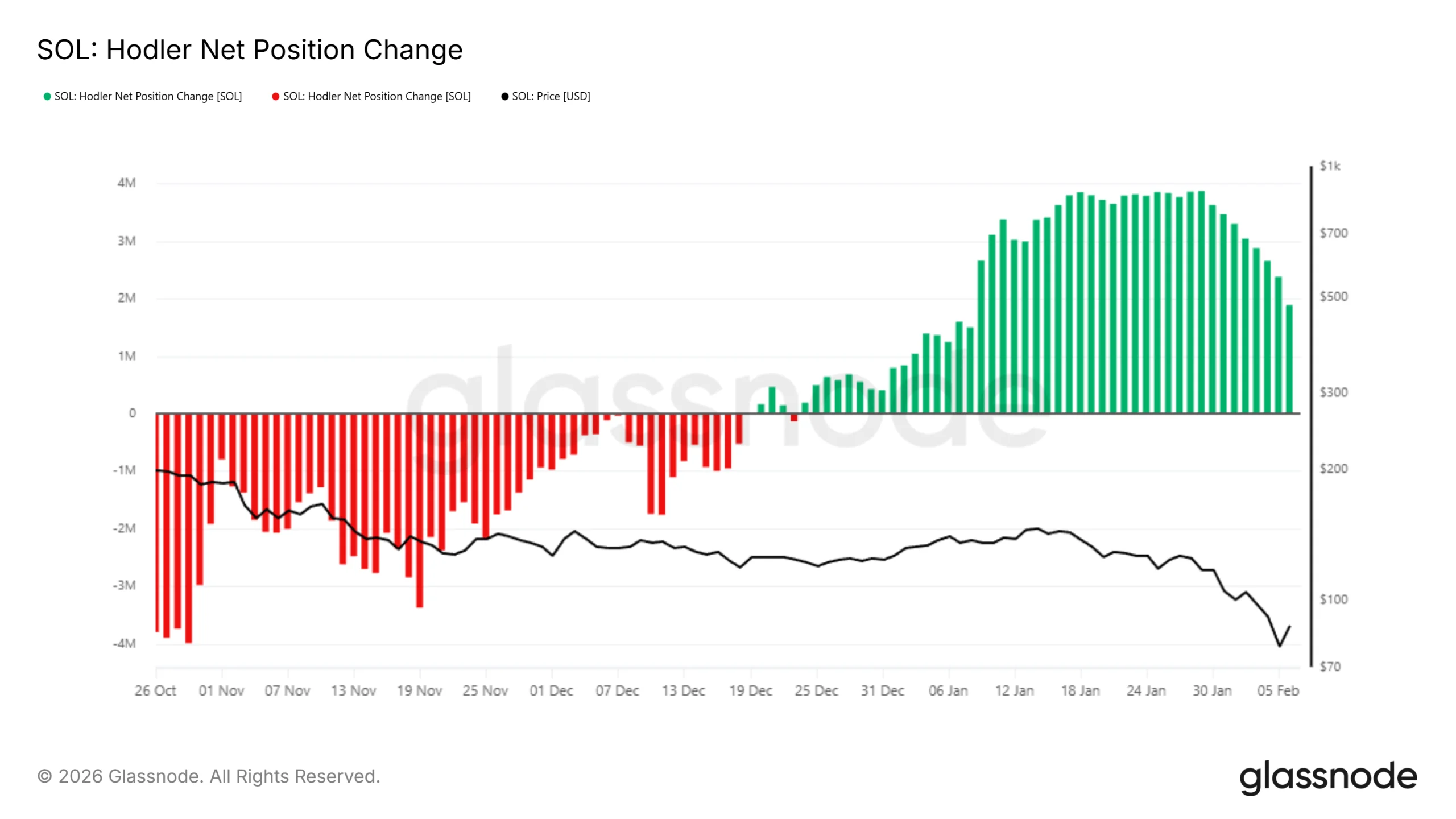
On-chain data shows long-term holder buying momentum is slowing. The HODLer Net Position Change has declined, indicating reduced accumulation from investors who typically support prices during downturns. This shift followed SOL’s sharp pullback over the past week, which appears to have dampened long-term conviction.
Sponsored
Sponsored
A sustained recovery depends on whether long-term holders resume accumulation. If buying momentum remains weak, Solana may struggle to build durable upside. Reduced support from this cohort limits demand absorption, increasing the risk that short-term rallies fade without broader participation from long-term investors.
Want more token insights like this? Sign up for Editor Harsh Notariya’s Daily Crypto Newsletter here.
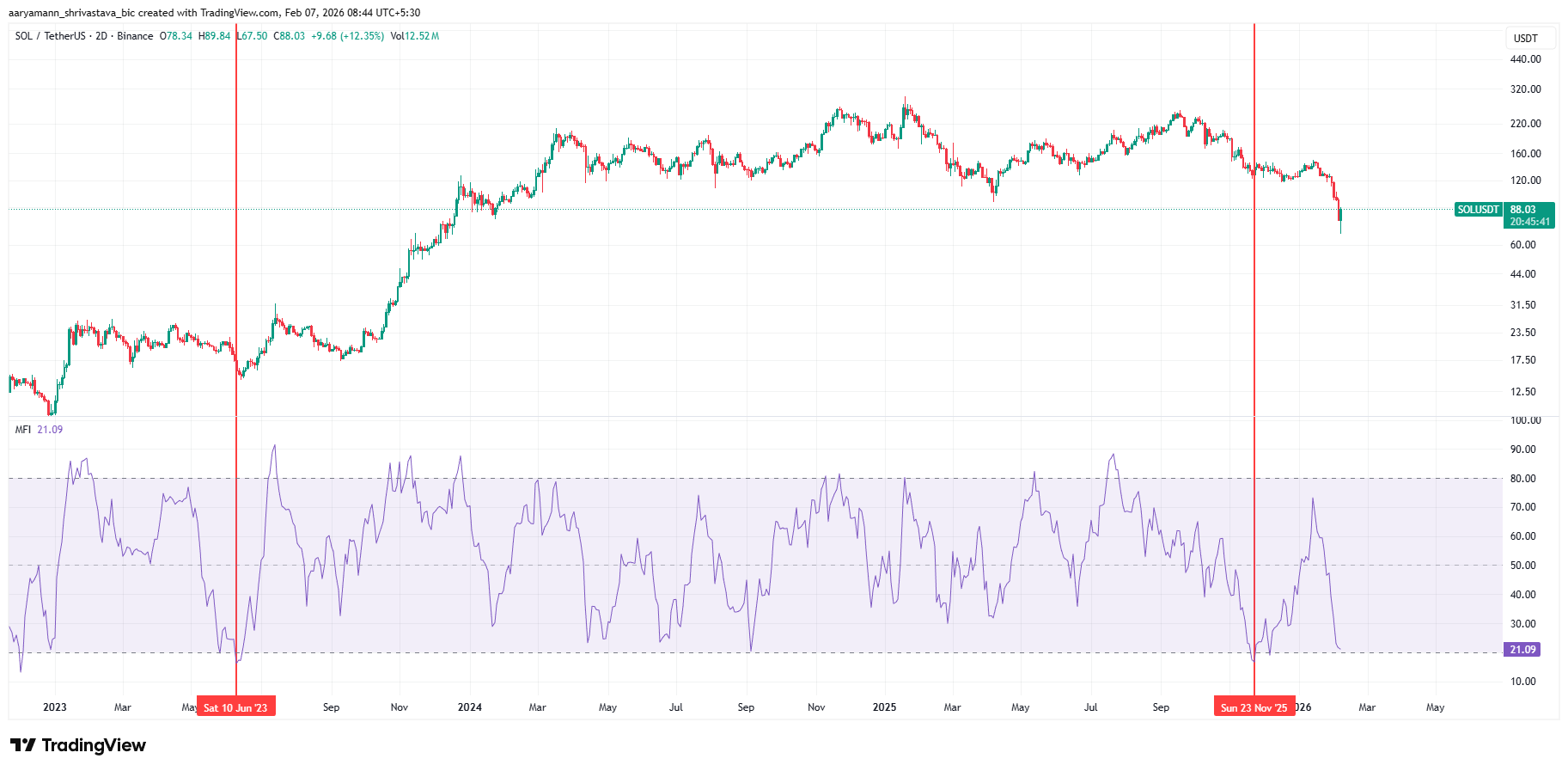
Momentum indicators suggest selling pressure may be nearing exhaustion. The Money Flow Index is approaching the oversold threshold below 20.0. A move into this zone typically signals selling saturation, often preceding periods of stabilization or short-term rebounds in price.
Historically, Solana has entered oversold territory only three times in the past two and a half years. Each instance coincided with notable price stabilization or reversal. If the indicator slips further, it may help SOL pause its decline and attract renewed dip-buying interest from traders.
SOL Price Recovery Still Likely
Solana price is trading near $88 at the time of writing after climbing 12% in the past 24 hours. Earlier in the session, SOL dropped roughly 13% to an intraday low. Strong dip buying prevented a close near $67, highlighting active demand at lower levels.
Support from the broader market could allow SOL to push above $90 in the near term. A recovery rally would require reclaiming $100 as support. Securing that level would confirm improving momentum and open the path toward a move near $110 as confidence returns.
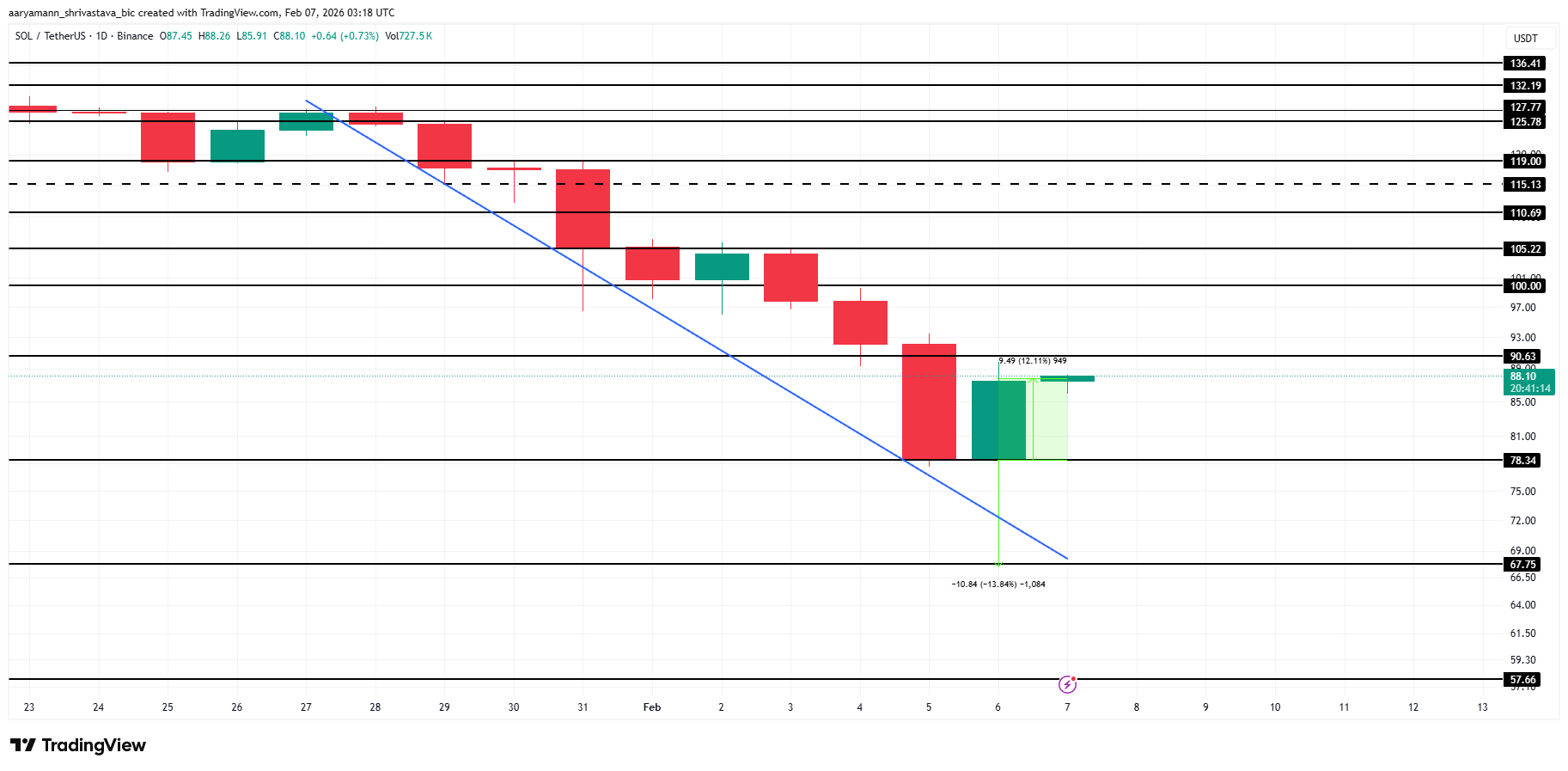
Downside risk persists if long-term holder selling continues. Failure to reclaim $100 could cap upside and leave SOL range-bound near $90. Under weaker conditions, the price may retreat toward $78. Such a move would invalidate the bullish thesis and extend Solana’s corrective phase.

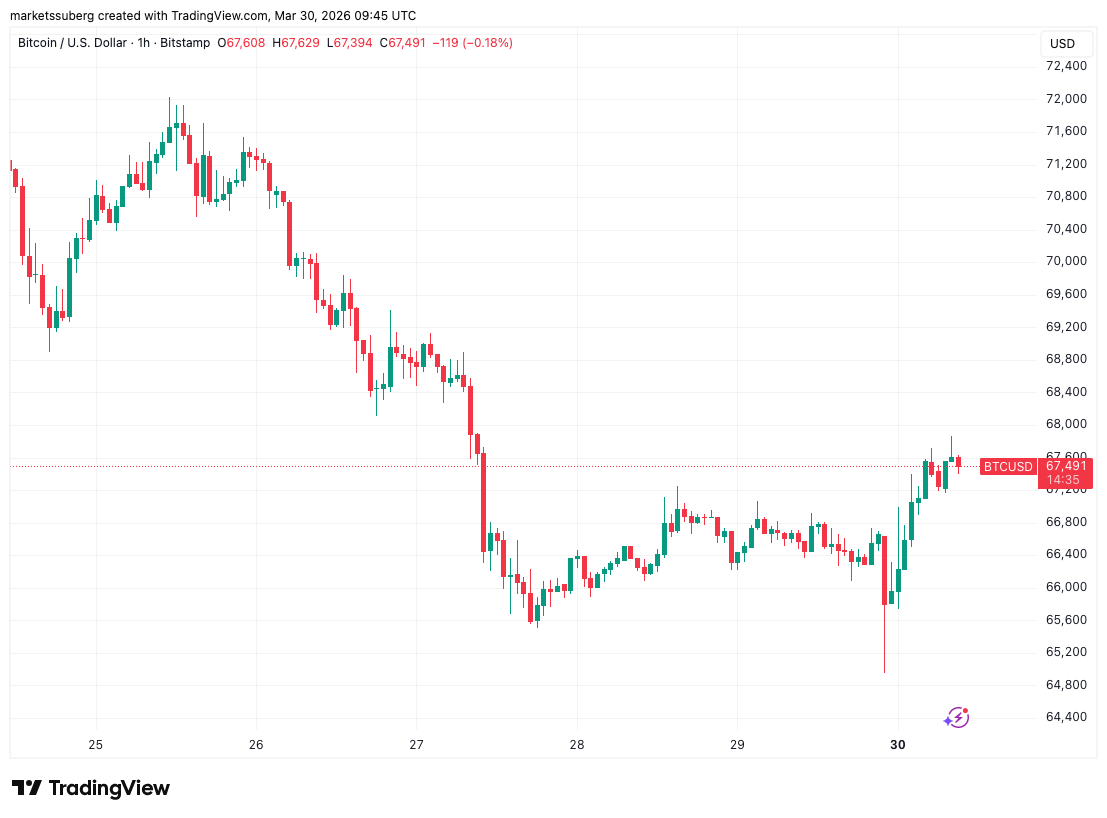
Bitcoin (BTC) heads into the March monthly close as it risks its sixth straight month of losses.
-
BTC price action touches $65,000 to start the week as traders expect a copycat bear flag breakdown.
-
Iran headlines dominate the macro mood amid rumors of a US ground invasion.
-
March could go either way for Bitcoin as it sits on the edge of its first six-month losing streak since 2018.
-
Whales have begun to reduce their BTC exposure, adding to mid-term price headwinds.
-
Modest demand in the current trading range lacks “magnitude” to support a trend reversal.
BTC price action revisits $65,000
Bitcoin faced last-minute selling into Sunday’s weekly close, dropping to $65,000 before a modest rebound.
Data from TradingView shows $67,500 forming a focus for Monday, with traders still firmly risk-off on the short-term outlook.

In its latest post to Telegram channel subscribers, analytics resource Technical Crypto Analyst wrote:
“BTC is showing a clear shift in structure on the 4H, with price forming lower highs and losing the 68–69k support, which now acts as resistance; this confirms short-term bearish momentum, and unless price quickly reclaims 69–70k, the path of least resistance remains downward toward the 65k demand zone.”

Last week, Cointelegraph reported on $70,000 rapidly becoming new resistance, with a key long-term trend line at $68,300 unable to function as support.
“BTC’s local uptrend is over – as expected – and price is starting to move lower again,” trader Jelle continued on Monday.
“Testing the previous lows as resistance as we speak; bears are back in the drivers’ seat.”

Others also focused on the continuing breakdown of Bitcoin’s second bear flag of 2026 — something that has already sparked sub-$50,000 BTC price targets.
“Repeating the exact same bear flag breakdown like we saw in January,” trader Roman summarized.
Iran war rattles stocks with inflation in focus
Macro markets remain highly sensitive to developments in the US-Iran war, and these keep coming as April arrives.
US President Donald Trump reported a “big day” militarily to start the week amid reports of plans for a ground invasion of Iran.
BREAKING: President Trump is weighing a military operation to extract nearly 1,000 pounds of uranium from Iran, per WSJ.
Details include:
1. This is considered a “complex and risky” mission that would likely put American forces inside the country for days or longer
2. Trump…
— The Kobeissi Letter (@KobeissiLetter) March 30, 2026
Asia stock markets opened sharply down on Monday as the impact of the oil-supply crisis made its presence felt.
“The ongoing tensions means that tanker traffic through the Strait of Hormuz remains limited, which continues placing strains on global energy markets along with uncertainty over access to fertilizer products for farming,” trading resource Mosaic Asset Company commented in the latest edition of its regular newsletter, “The Market Mosaic.”
“That’s weighing on the S&P 500, which has now closed out five consecutive weeks with a loss.”

Mosaic noted that the S&P’s red streak was now the longest since the 2022 Russia-Ukraine war.
“The growing risk of lasting damage on the global economy from high energy prices is pressuring the stocks market,” it continued.
“But perhaps the most consequential spillover impact is on the outlook for inflation, and implications for interest rates on both the short- and long-end of the yield curve.”

As Cointelegraph reported, crypto markets joined stocks in a comedown in late March as the odds of the Federal Reserve cutting interest rates in 2026 faded. At the same time, bets of a recession coming this year increased to their highest since last September.
Fed Chair Jerome Powell is due to take to the stage on Monday, potentially offering more insight into officials’ positions on the economy. Powell will participate in a moderated discussion at the Harvard University Principles of Economics Class.
“The outlook for rate cuts by the Federal Reserve is in jeopardy, while long-term rates are jumping higher as well due to uncertainty around inflation,” Mosaic added.
“The 30-year Treasury yield is close to breaking higher from an ominous pattern that could mean sharply higher rates ahead.”
March risks becoming sixth red BTC price month
Bitcoin bulls have little to boast about as March comes to a close, with BTC/USD about to seal its sixth consecutive month of losses.
Data from CoinGlass shows the result on a knife-edge ahead of the monthly close, with a “green” finish still possible.

If Bitcoin ends March lower than its starting price, it would mark the first six straight “red” months since the 2018 bear market.
“Very slow month so far all things considered. Bitcoin pretty much flat on the month just like last year,” trader Daan Crypto Trades commented about the CoinGlass data.
Daan Crypto Trades noted that over Bitcoin’s history, April has always been comparatively strong.
“Historically speaking, April is bitcoin’s 3rd best month in average returns,” he added.
Trader XO observed that in February 2019, following Bitcoin’s first six-month losing streak, monthly gains totaled 11%.
“If April sees an early sweep into the $55–60K range, it could create a compelling setup for mean-reversion longs imo… (much depends on the overall macro landscape),” they told X followers.
“That said, the higher timeframe structure remains in control until a clear contextual ‘structural’ shift is confirmed.”
Bitcoin whales flip defensive
Bitcoin whales have sparked concerns about future downward pressure on BTC price action.
After an “aggressive” accumulation period at the start of 2026, whales have started reconsidering their exposure, per data from onchain analytics platform CryptoQuant.
“A clear divergence has formed: on-chain buying has ceased while large-scale inflows to exchanges are rising,” contributor Sunny Mom wrote in a “QuickTake” blog post.
“Although the price continues to oscillate around $67K, the data suggests the market is entering another phase of hand-overs (re-distribution).”

CryptoQuant noted increasing whale presence among exchange inflows, with their wallets accounting for more of the largest inbound transactions.
“Furthermore, the stablecoin ratio remains at a low level, reflecting a slowdown in sidelined capital flowing into the market,” Sunny Mom added, referring to stablecoin trends.
“Without fresh liquidity, any attempt by whales to realize gains from their previous on-chain accumulation must rely on existing liquidity, making the price highly sensitive to selling pressure.”

Newer holders sit on “massive supply overhang”
Offering a hint of optimism this week, onchain analytics platform Glassnode sees promise in overall demand tendencies at current prices.
Related: Bitcoin value ‘off the chart’ as BTC price metric hits record lows in 2026
Between $60,000 and $70,000, it notes, new BTC buyers have their aggregate cost basis.
“BTC sits at the lower bound of the new buyers’ cost basis range ($60k–$70k),” it wrote in an X post on Monday.
“Supply accumulation in this range is notable, but the cluster is thinner than historical analogs that preceded a strong recovery.”

For a sustained rebound to begin, demand simply needs to ramp up — something not yet underway as traders stay nervous about geopolitical and macroeconomic shocks.
“The accumulation setup is constructive in form, not yet in magnitude,” Glassnode added.
Previously, Cointelegraph analyzed the various aggregate cost bases of Bitcoin investor cohorts, including that of short-term holders (STHs), the majority of whom are now underwater on their BTC holdings.
Last week, CryptoQuant calculated STH share of the overall supply at 5.7 million BTC, with 92% sitting on losses.
“That’s a massive supply overhang,” it warned.

This article is produced in accordance with Cointelegraph’s Editorial Policy and is intended for informational purposes only. It does not constitute investment advice or recommendations. All investments and trades carry risk; readers are encouraged to conduct independent research before making any decisions. Cointelegraph makes no guarantees regarding the accuracy or completeness of the information presented, including forward-looking statements, and will not be liable for any loss or damage arising from reliance on this content.
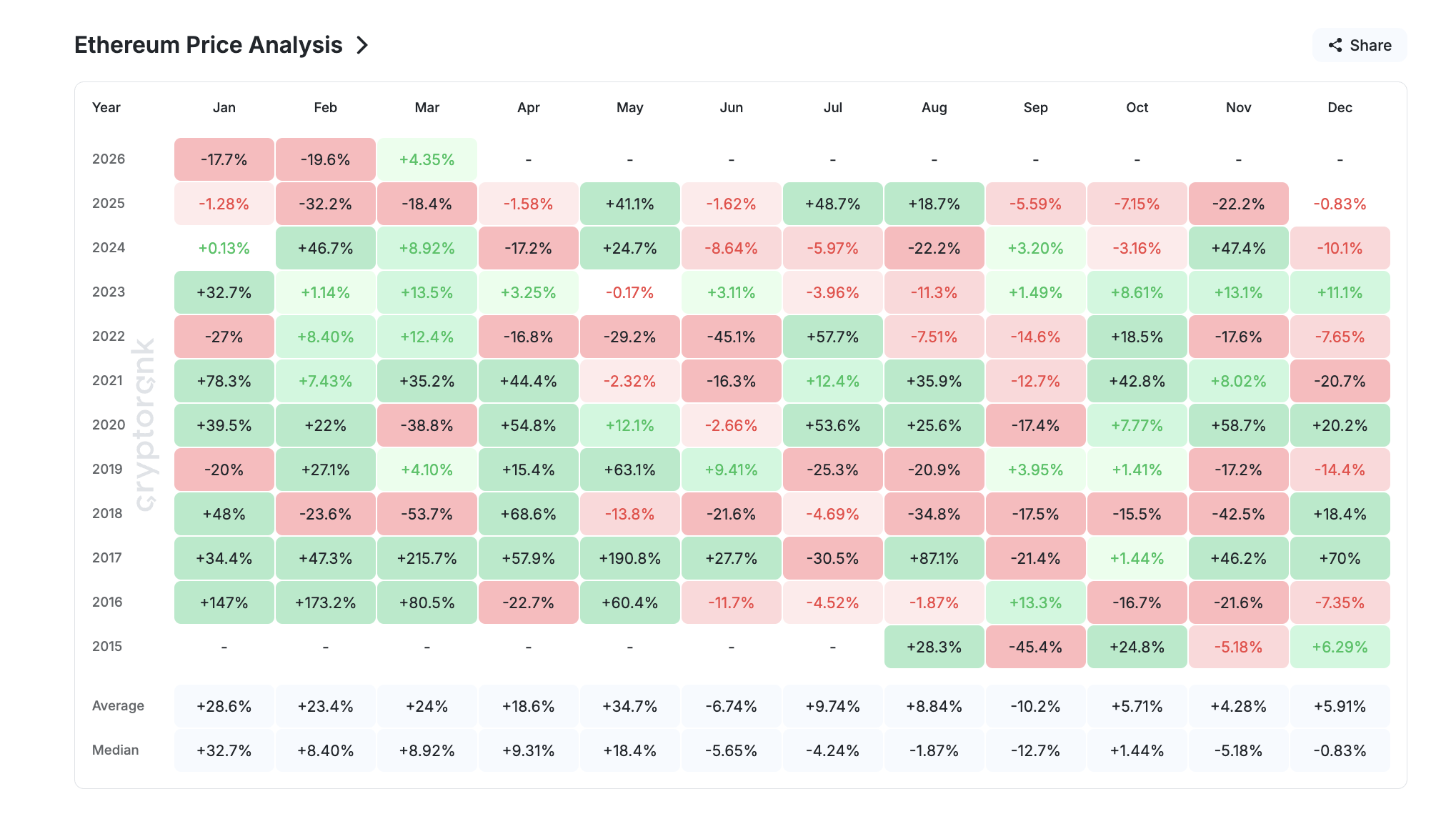
Ethereum (ETH) price is trading above $2,000 as March prepares to close with its first green monthly candle since August 2025, potentially snapping a six-month losing streak.
However, how March closes could set the tone for April and even the rest of 2026. Historically, April has been a solid month for ETH with average gains of 18% and a median of roughly 9%. Yet the 3-day chart, on-chain conviction, and whale behavior all suggest the path into April carries more risk than seasonality would imply.
A Six-Month Red Streak May End, but the 3-Day Chart Warns
Ethereum price has not posted a positive monthly close since August 2025. March is on track to break that streak, though gains remain modest. Historically, April ranks among the stronger months for ETH, with average returns of 18% and median returns above 9%.
Want more token insights like this? Sign up for Editor Harsh Notariya’s Daily Crypto Newsletter here.
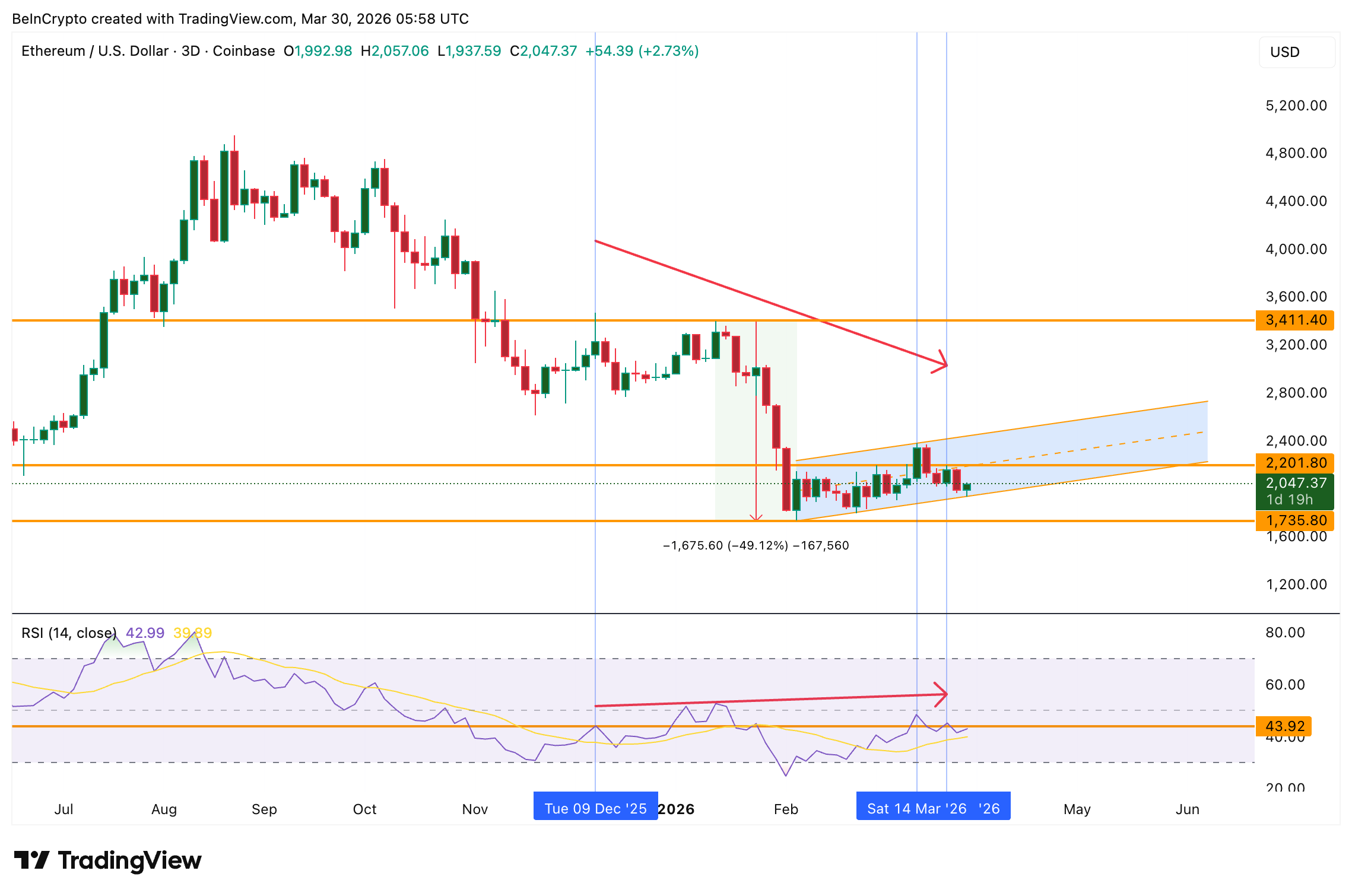
However, the 3-day chart introduces a structural concern. Since hitting a low of roughly $1,730 on Feb. 6, ETH has been rising inside an ascending channel. That channel formed after a near 50% decline from the $3,410 peak on Jan. 13. Ascending channels that develop after steep corrections often act as continuation patterns, resolving lower rather than higher unless the upper trendline breaks convincingly.
The Relative Strength Index (RSI), a momentum oscillator, has formed a hidden bearish divergence on the 3-day timeframe. Between Dec. 9 and March 23, the price made a lower high while the RSI made a higher high. Hidden bearish divergence signals that the dominant downtrend for ETH is likely to resume despite the apparent recovery. This strengthens the ascending channel theory that the chart already highlights.
A similar divergence appeared between Dec. 9 and March 14. After that signal was confirmed, ETH corrected sharply. The current divergence was confirmed on March 23, and prices have already pulled back from the $2,200 area toward $2,000. The lower trendline of the ascending channel is now acting as support. If it breaks on the 3-day chart, the bearish thesis carries into April with added force.
The technical setup alone does not confirm whether the channel will hold or break. On-chain conviction data provides that answer.
Hodler Conviction Collapsed, and Whales Just Started Selling
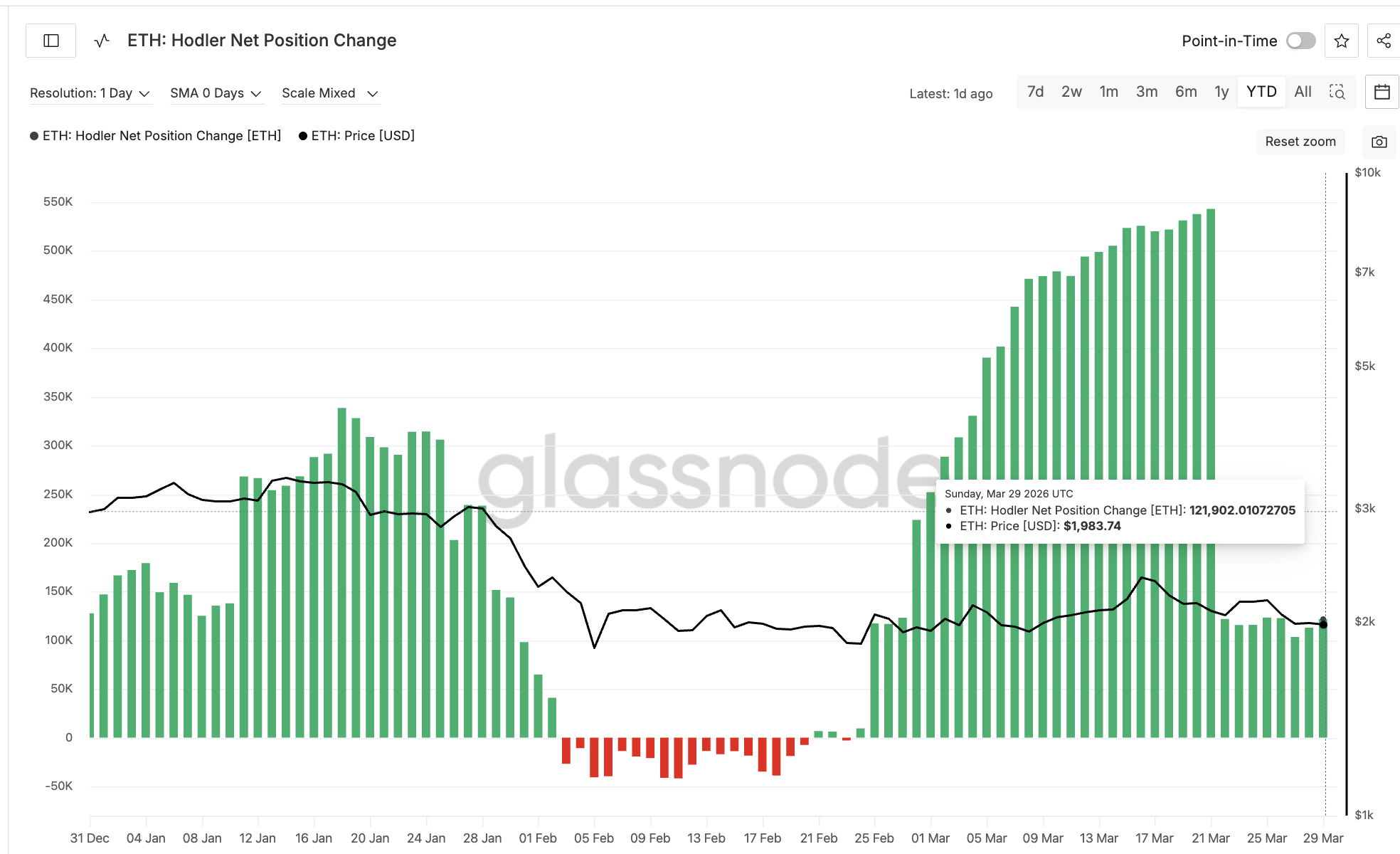
The Ethereum hodler net position change, a Glassnode metric that tracks the 30-day rolling accumulation by wallets holding ETH for more than 155 days, peaked at 543,169 ETH on March 21, its highest year-to-date level. By late March, that figure had collapsed to just 121,902 ETH, a near 78% decline.
That decline matters because a similar pattern played out earlier this year. Between mid-January and early February, hodler net position change weakened steadily before flipping negative on Feb. 3. During that transition, ETH price dropped from $3,383 to $1,824, a correction of roughly 46%. The current pace of decline mirrors that earlier deterioration.
While March is still closing in green, the conviction that supported the rally is evaporating in the final week. If hodler accumulation turns negative in early April, the February playbook suggests a significant move lower.
Ethereum whale behavior adds nuance. Two of the largest cohorts, wallets holding between 1 million and 10 million ETH and those holding between 100,000 and 1 million ETH, increased their share of supply since March 25. The larger group went from 8.07% to 8.22% of supply. The smaller group rose from 13.19% to 13.53%.
However, both cohorts reversed course heading into the final days of March. The larger whales began trimming on March 27, and the smaller cohort followed on March 29. The drops are minor so far, but the directional shift is significant. When hodler conviction weakens and whale accumulation stalls simultaneously, the demand side of the market thins at the worst possible time.
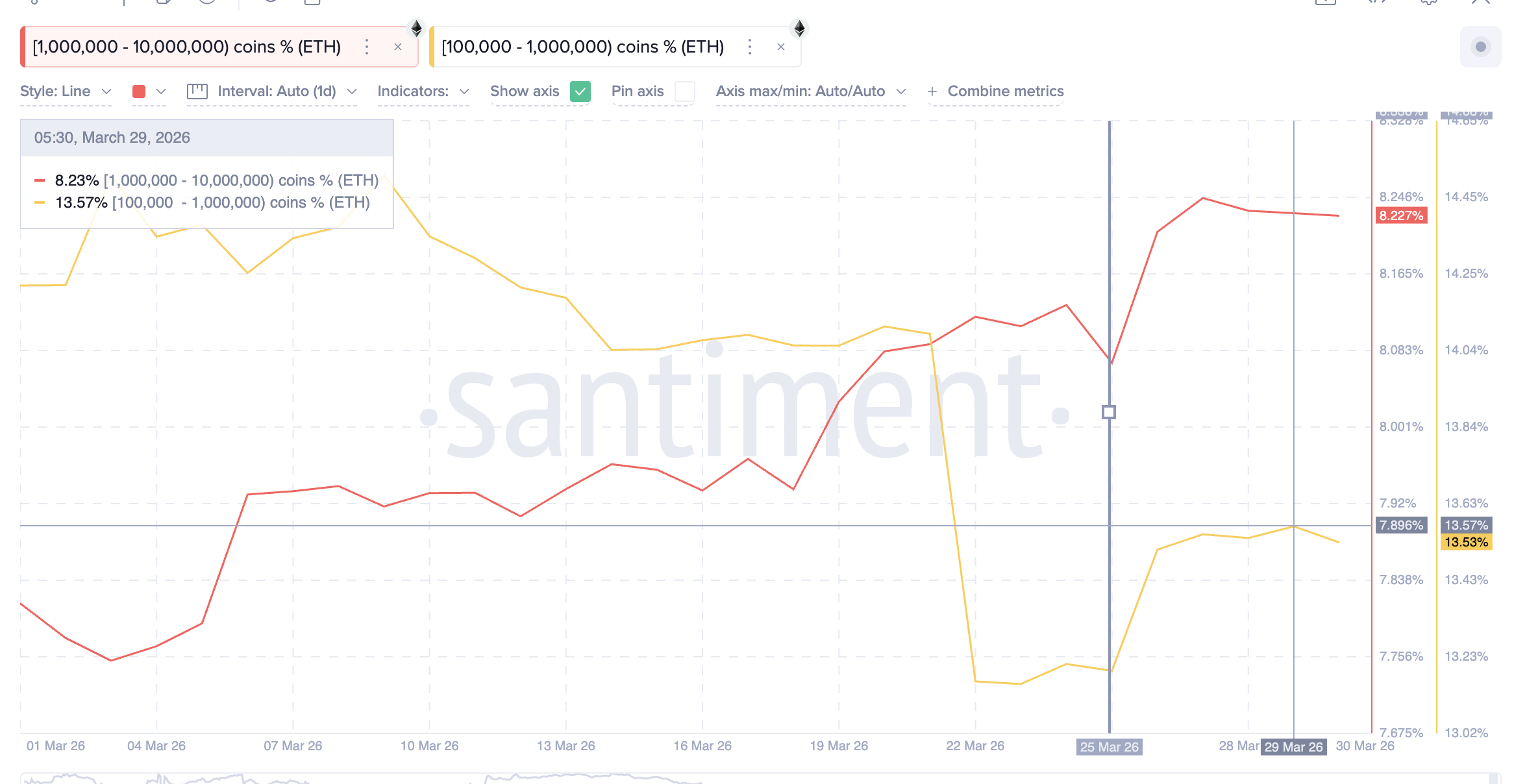
The combination of fading conviction and reversing whale flows weakens the foundation heading into April. The price chart now determines whether these signals translate into a deeper decline.
Ethereum Price Needs $2,200 to Avoid a 30% Drop
For the Ethereum price prediction heading into April, the 3-day chart provides clear levels. To regain bullish momentum, ETH needs a 3-day close above $2,200, which would clear the immediate resistance zone. A stronger confirmation comes at $2,390, where a close would push price above the upper trendline of the ascending channel, converting the pattern from bearish continuation to genuine reversal.
That breakout scenario looks difficult given the weakening hodler conviction and whale distribution. The more probable path, based on the alignment of the hidden bearish divergence, collapsing hodler accumulation, and stalling whale buying, points lower.
On the downside, $2,000 (the 1,999 zone on the chart) is the immediate psychological and technical support. A 3-day close below $2,000 would confirm the channel breakdown and expose the $1,750 to $1,730 zone, which marks the February low.
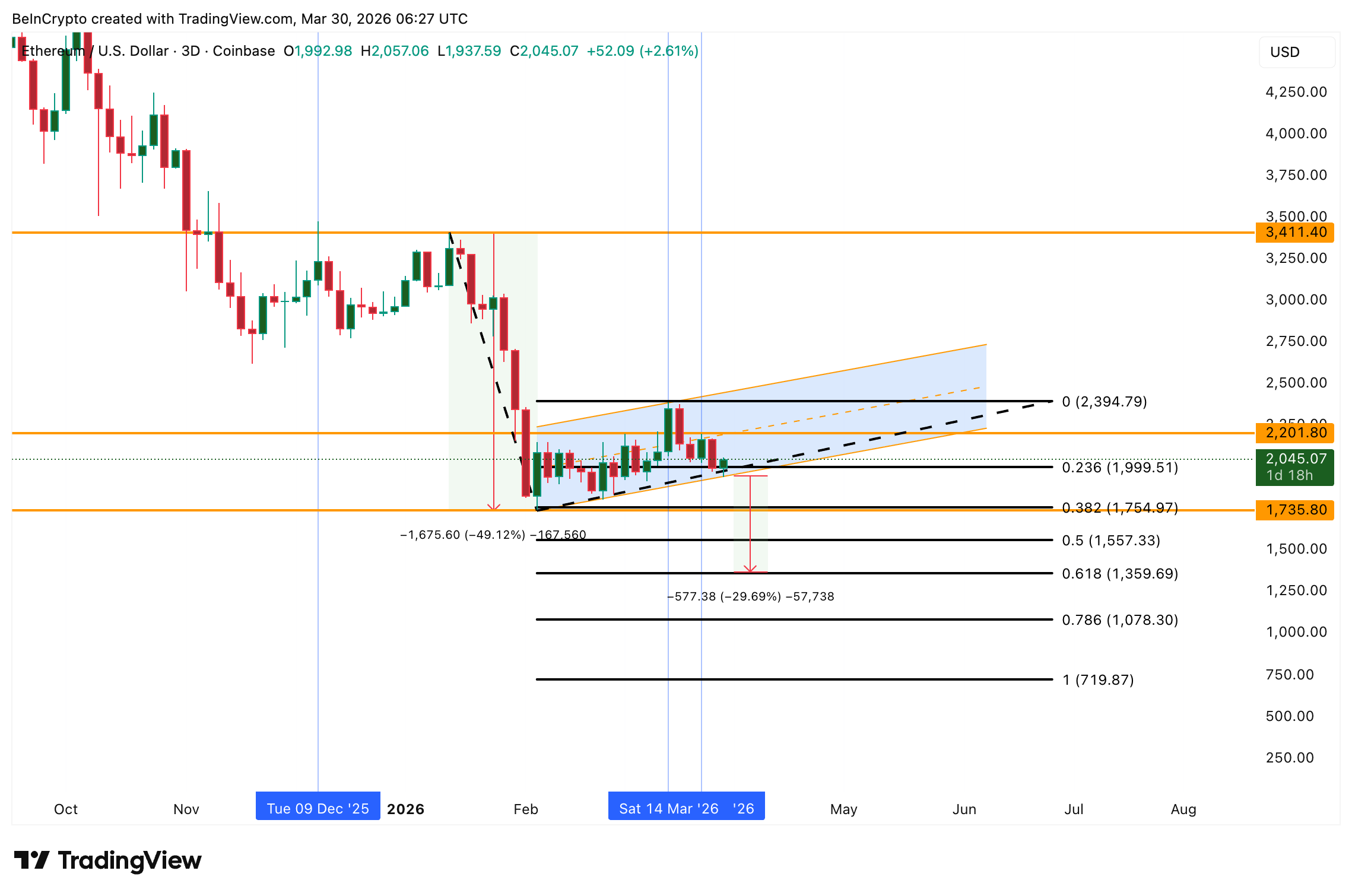
If April follows the pattern set in February, where hodler net position change went negative and prices dropped 46%, the 0.618 Fibonacci retracement near $1,350 becomes a realistic target. That would represent a decline of roughly 30% from current levels.
A 3-day close above $2,200 keeps April constructive and aligns ETH with its historically strong seasonal pattern, while a breakdown below $2,000 risks repeating February’s 46% slide with $1,350 as the measured target.
The post Ethereum Price Prediction: What To Expect From ETH in April 2026 appeared first on BeInCrypto.

Disclosure: This article does not represent investment advice. The content and materials featured on this page are for educational purposes only.
Bitcoin, USDC, and XRP remain key pillars as investors balance store of value, stability, and payments.
Summary
- Bitcoin, USDC, and XRP lead the crypto ecosystem, driving innovation, stability, and cross-border payments.
- ConfluxCapital enables users to earn daily returns through AI-driven quantitative crypto strategies without complex setups.
- The platform offers a $20 signup bonus, automated trading, and flexible withdrawals to simplify crypto investing.
In the booming wave of digital assets, Bitcoin, USDC, and XRP are arguably the three most influential cryptocurrencies. Bitcoin, as decentralized digital gold, continues to lead industry trends; USDC, as a stablecoin, ensures value stability and facilitates asset management and trading; and XRP, with its high-speed, low-cost cross-border payment network, is highly favored by financial institutions.
These three cryptocurrencies together form the core foundation of the modern blockchain ecosystem, continuously driving innovation and development in the global digital economy.
Now, with Confluxcapital, a leading intelligent quantitative strategy mining platform, anyone can easily participate in Bitcoin, USDC, and XRP quantitative strategies, earning stable daily returns without complex equipment or technical barriers.
Whether they are an experienced investor or a beginner, Confluxcapital provides an efficient and compliant strategy environment, allowing anyone to truly create value with digital assets.

What is a quantitative strategy?
ConfluxCapital’s Cryptocurrency AI Quantitative Strategy refers to an investment strategy that uses artificial intelligence and quantitative trading algorithms to automate cryptocurrency trading. In short, it allows programs and AI to replace humans in identifying buying and selling opportunities, automatically trading in the cryptocurrency market to generate stable returns.
ConfluxCapital advantages:
- Receive an instant $20 bonus upon registration. Automated operation: After purchasing a strategy package, earnings are automatically credited to an account the next day, with no need to monitor the market.
- Flexible withdrawals: Withdrawals to a crypto wallet are available once the account balance reaches $100, or reinvest for even more returns.
- Top-tier security: Dual security protection with McAfee® and Cloudflare® ensures assets are safe.
- Globally trusted: Recognized by over 3 million users in 195+ countries and regions.
- Multi-currency support: Supports settlement in major digital assets such as XRP, DOGE, SOL, BTC, ETH, LTC, USDC, USDT, BNB, and BCH.
- Zero extra fees: No hidden fees, transparent and worry-free.
How to start earning daily with Confluxcapital
Step 1: Register an Account
Step 2: Choose a Plan
Confluxcapital offers a variety of earning strategies to meet specific financial goals. Whether someone is looking for short-term gains or long-term returns, there’s one for them.
Step 3: Start Earning
Enjoy earnings without any management. Daily earnings will be automatically deposited into an account, which can then be withdrawn to a cryptocurrency wallet address.
Strategy Name
unit price
Days
Total Revenue
Starter Strategy
$100
2 days
$100+$6
Basic Strategy
$600
5 days
$600+$45
Advanced Strategies
$5,000
15 days
$5,000+$1,215
Elite Strategy
$25,000
25 days
$25,000+$11,250
Quantum Strategy
$90,000
20 days
$90,000+$36,000
Infinite Strategy
$200,000
25 days
$200,000+$110,000
Once the strategy is executed, the resulting profits will be automatically credited to the user’s account the following day. Accumulated funds in the account can be flexibly used to add to existing strategy configurations or withdrawn to a personal encrypted wallet according to platform rules.
About Conflux Capital
Founded in London, UK in 2023, Conflux Capital holds a valid operating license issued by the local government. The platform focuses on quantitative trading, combining intelligent algorithms and arbitrage strategies to provide standardized value-added solutions for crypto asset holders. The team is dedicated to improving strategy execution efficiency and fund transparency, offering multi-currency strategy options to users with different risk appetites.
Conclusion
While XRP still has room for short-term growth, its potential risks are increasingly apparent. Faced with signs of whales exiting the market, more and more savvy investors are choosing to enter the market in a timely manner to diversify their assets and obtain more stable passive cash flow. Confluxcapital’s convenient multi-currency quantitative strategy service perfectly meets this need, enabling investors to fully utilize their existing crypto assets (including XRP, BTC, USDC, etc.) and create a long-term, stable source of income in volatile markets.
No hardware or technical expertise is required to enjoy a one-stop quantitative strategy service, allowing anyone seeking a second or higher income to enjoy a stable and efficient asset appreciation experience.
For more information, visit the official website and download the application.
Email:[email protected]
Disclosure: This content is provided by a third party. Neither crypto.news nor the author of this article endorses any product mentioned on this page. Users should conduct their own research before taking any action related to the company.
Crypto World
XRP Holds Steady Between $1.30 and $1.50 as Whales and Mid-Sized Investors Keep Accumulating
TLDR:
- XRP has been trading between $1.30 and $1.50 for months, showing resilience amid altcoin weakness.
- Binance outflow transactions surged since late February, with some days recording nearly 6,000 withdrawals.
- Most outflow activity is driven by transactions of 1,000 to 100,000 XRP, pointing to mid-sized investors.
- Whales have maintained an accumulation zone between $1.20 and $3.00 for over a year without selling to retail.
XRP has been trading within a defined range for several months, oscillating between $1.30 and $1.50. On-chain data from Binance shows a growing accumulation trend, with outflow transactions rising notably since late February.
Binance Outflow Data Points to an Active Accumulation Phase
Despite challenging conditions across the broader crypto market, XRP has shown a degree of resilience. The asset continues to hold within its established trading range while other altcoins have faced heavier losses.
This steady price action has drawn attention from market analysts tracking on-chain behavior. The pattern suggests that some investors are using the consolidation period to build positions.
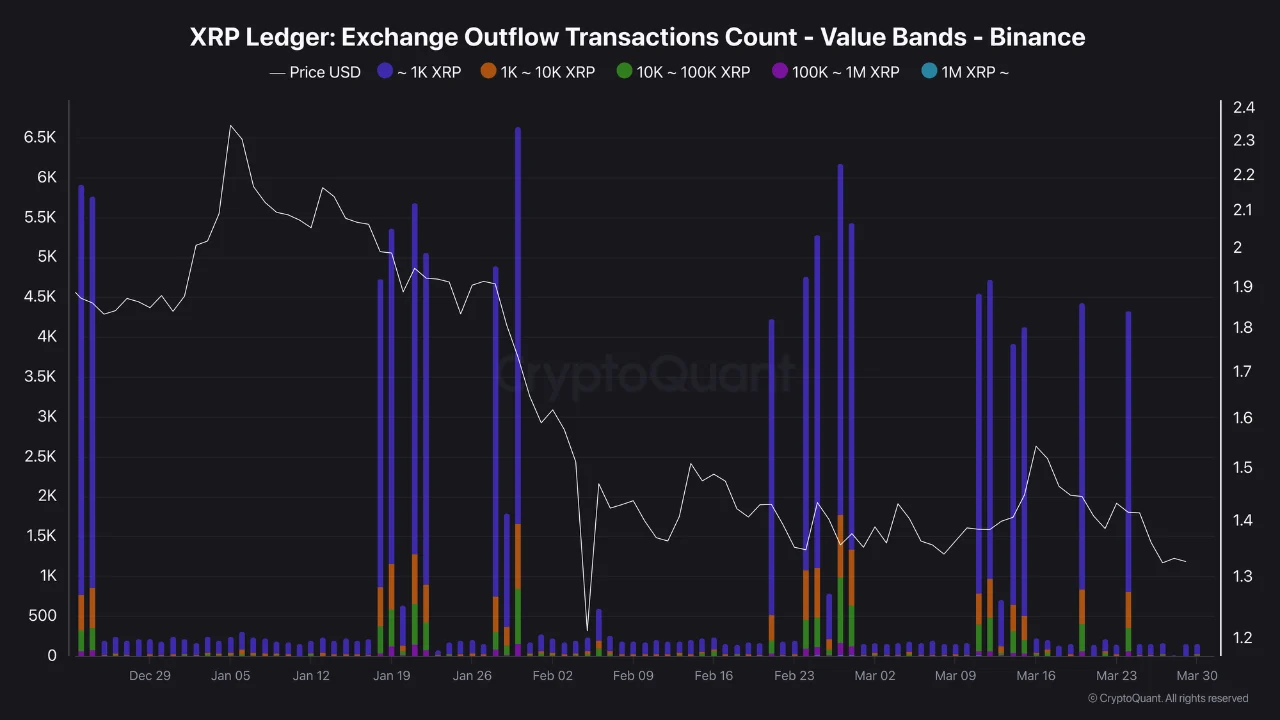
Data from Binance shows a clear resurgence in outflow transactions starting from late February. Several days during this period recorded more than 4,000 outflow transactions on the exchange.
Source: Cryptoquant
Some peaks reached close to 6,000 transactions within a single day. This level of activity is notable for an asset still trading over 60% below its all-time high.
Most of the activity is driven by transactions ranging between 1,000 and 100,000 tokens. This range typically corresponds to mid-sized investors rather than large institutional whales.
The pattern differs from the usual whale-dominated movements seen in early bull market cycles. As a result, the accumulation appears to be spread across a broader segment of the market.
An increase in outflow transactions generally means investors are moving tokens off exchanges. This behavior is often interpreted as a preference to hold assets in private wallets.
It suggests reduced selling intent and a longer-term holding mindset. Analysts often view this trend as a positive on-chain signal during a consolidation phase.
Whale Accumulation Adds to the Bullish Narrative for the Asset
Beyond retail and mid-sized investor activity, whale behavior has also drawn considerable attention. According to crypto analyst CW, whales have been accumulating consistently for over a year.
The analyst noted that whales typically build positions at the bottom before an uptrend begins. This observation adds another layer to the existing accumulation narrative.
CW further noted that the current whale accumulation zone sits between $1.20 and $3.00. Before this phase, strong accumulation was recorded in the $0.30 to $1.30 range as well.
These whales have not yet offloaded their holdings to retail investors. Based on available data, they appear to be continuing to buy.
The broader picture suggests that the asset is in an active accumulation phase across multiple investor segments. Both mid-sized holders and larger market participants appear aligned in their current behavior.
However, the key question remains whether this accumulation will be enough to trigger a breakout. A move above the $1.50 resistance level could confirm a shift in momentum.
At press time, XRP is trading at $1.35, still within its months-long range. Market participants continue to monitor on-chain data closely for further signals of a directional move.

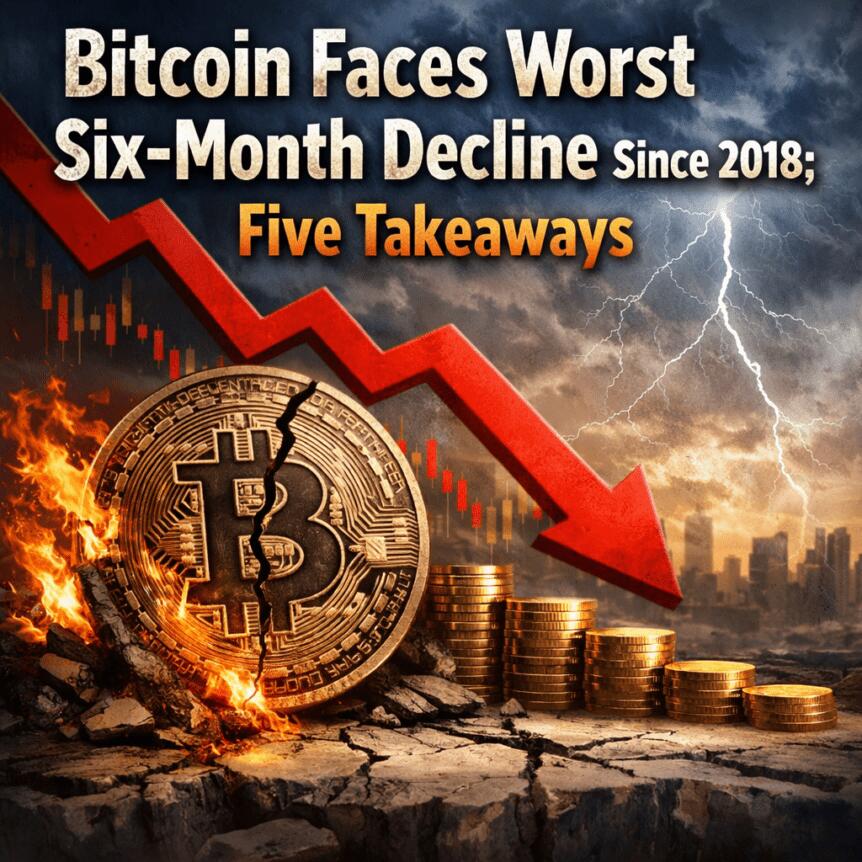
Bitcoin is approaching the March monthly close with a potential sixth straight month in the red, hovering in the mid-$60,000s as macro headlines keep risk-off sentiment front and center. The latest price action saw BTC test the $65,000 area early in the week, with traders eyeing $67,500 to $68,000 as near-term resistance and noting a lack of sustained demand to spark a durable rebound. The backdrop combines geopolitical frictions around Iran with inflation and growth concerns, while equities tilt lower and expectations for aggressive Fed easing retreat.
-
BTC sits near critical levels: a move back above the $68,000–$69,000 zone is needed to shift the short-term bias away from a bearish channel.
-
Macro headlines remain a headwind, as tensions around Iran and energy markets feed inflation and risk-off sentiment in stocks and crypto alike.
-
March risks becoming a sixth red month for Bitcoin; April historically offers stronger average returns, though the path depends on macro liquidity and on-chain demand.
-
On-chain behavior shows whales reducing exposure while large exchange inflows rise, signalling potential near-term selling pressure in the absence of fresh buying demand.
-
New buyers are concentrated around a cost-basis between $60,000 and $70,000, a band that could indicate a fragile cushion for a meaningful rebound unless demand strengthens.
BTC price action tightens around critical levels
Bitcoin’s price action has resumed a cautious stance, with a late-week dip into the mid-$60,000s followed by a modest rebound. Data from Cointelegraph and price-tracking services show BTC hovering around $65,000, with traders highlighting resistance near the $68,000–$69,000 zone. A breach above that range would be a notable shift, while failure to reclaim higher ground keeps the market in a downbeat configuration.
Analysts underscored a pattern of lower highs and a break below prior support, signaling renewed short-term bearish momentum unless BTC can reclaim the $69,000–$70,000 area. In a Telegram update circulated to subscribers, a popular observer noted that the formation of a bear-flag structure on shorter timeframes points toward a continued path of least resistance to the downside unless price quickly reclaims the higher band around $69,000–$70,000.
Market chatter through the week framed this as a continuation of a broader bearish setup that has been developing since mid-March, with traders wary of a potential retest of the mid-$60,000s. Previous cycles have shown that the price must break above the immediate resistance to alter the near-term tilt; otherwise, the scenario remains skewed toward further downside toward a demand zone near $65,000.
Macro headwinds: geopolitics, energy, and monetary policy
Macro markets remain highly sensitive to geopolitical developments in the Middle East, where ongoing tensions are affecting energy prices and risk assets. Reports drawing attention to the potential for further escalation have kept oil markets elevated and injected volatility into equities and crypto alike. As the energy complex tightens and inflation dynamics stay in focus, traders are closely watching how policy signals will adapt to a higher-for-longer inflation regime.
Market commentary has connected these geopolitical and energy factors to broader risk sentiment, noting that tensions surrounding the Strait of Hormuz and related supply constraints can propagate into inflation expectations and the pricing of longer-dated rates. In parallel, a softening in equities has coincided with fading bets on rate cuts this year, a dynamic that has historically correlated with renewed caution in Bitcoin and other risk assets.
Observers point to the Fed’s policy outlook as a crucial hinge for crypto markets. With expectations for significant near-term rate relief waning, long-dated yields have moved higher on inflation concerns, complicating the prospect of any quick crypto rebound. Analysts at market-monitoring firms have highlighted that the combined effect of energy-price pressures and a cautious stance on monetary easing could keep upside momentum contained for Bitcoin in the near term.
April on the horizon? Historical context and potential mean reversion
March is shaping up to be a difficult month for Bitcoin, with data-tracking firms signaling a possible continuation of a six-month losing streak. CoinGlass data shows BTC on the cusp of closing March in the red, maintaining a structure that would echo the strongest downtrends Bitcoin has faced in recent cycles.
Some traders point to historical patterns where April has been more forgiving or even positive for Bitcoin. A number of market observers have highlighted that, in past cycles, April has yielded meaningful upside after a prolonged downturn, though much depends on macro conditions and liquidity flows. One analyst noted that early April strength could set up mean-reversion longs, particularly if broader macro conditions stabilize and Bitcoin retrieves risk-appetite from other assets.
The discussion around April’s potential gains is tempered by the reality that the long-term trend remains under the control of larger-timeframe structure. Another trader emphasized that while a fast bounce is possible, the overarching trend has not yet reversed without a clean break above the defined resistance level and a shift in on-chain demand dynamics.
Whales, liquidity, and the new-buyer base
On-chain dynamics reveal an evolving balance between accumulation and distribution. After an aggressive early-2026 phase of buying, Bitcoin whales have started to pare back some exposure, with analysts noting a divergence between on-chain accumulation and actual supply inflows to exchanges. In a quick-take assessment, CryptoQuant highlighted rising exchange inflows alongside a drop in on-chain buying, suggesting the market could face renewed selling pressure without fresh inflows of demand from buyers at scale.
That narrative is reinforced by stablecoin activity: the stablecoin ratio has remained subdued, indicating a relative dearth of sidelined capital waiting to re-enter the market. As a result, any renewed selling pressure from whales could find limited immediate liquidity, making price moves more sensitive to the available bid depth and to new buyers stepping in at meaningful volume.
Glassnode’s data adds nuance to the debate about demand and supply. The firm pointed out that a notable portion of new Bitcoin buying is concentrated in a cost-basis band between $60,000 and $70,000. While this indicates that new buyers are entering the market, the overall cluster is thinner than past cycles that followed strong recoveries. In other words, a sustained rebound would likely require a clearer uptick in demand rather than a mere reallocation of existing liquidity.
Beyond the headline numbers, the broader takeaway is that a meaningful recovery requires a shift in both macro conditions and on-chain demand. Short-term holders remain underwater for much of their holdings, reinforcing the sense that fresh buyers and renewed risk appetite will be essential to re-accelerate BTC higher.
This article is prepared with reference to market data and commentary from CoinGlass, CryptoQuant, Glassnode, and Mosaic Market, among others, to frame the ongoing crypto-price dynamics against a backdrop of macro and liquidity trends.
This article is produced in accordance with editorial policy and is intended for informational purposes only. It does not constitute investment advice or recommendations. All investments and trades carry risk; readers are encouraged to conduct independent research before making any decisions.
What to watch next: a clear shift above the $68,000–$69,000 zone could retarget the immediate resistance and potentially alter the near-term outlook, while continued macro fragility could keep Bitcoin tethered to the current range. market participants will also monitor on-chain signals for renewed demand and any changes in whale behavior as the market moves into April.
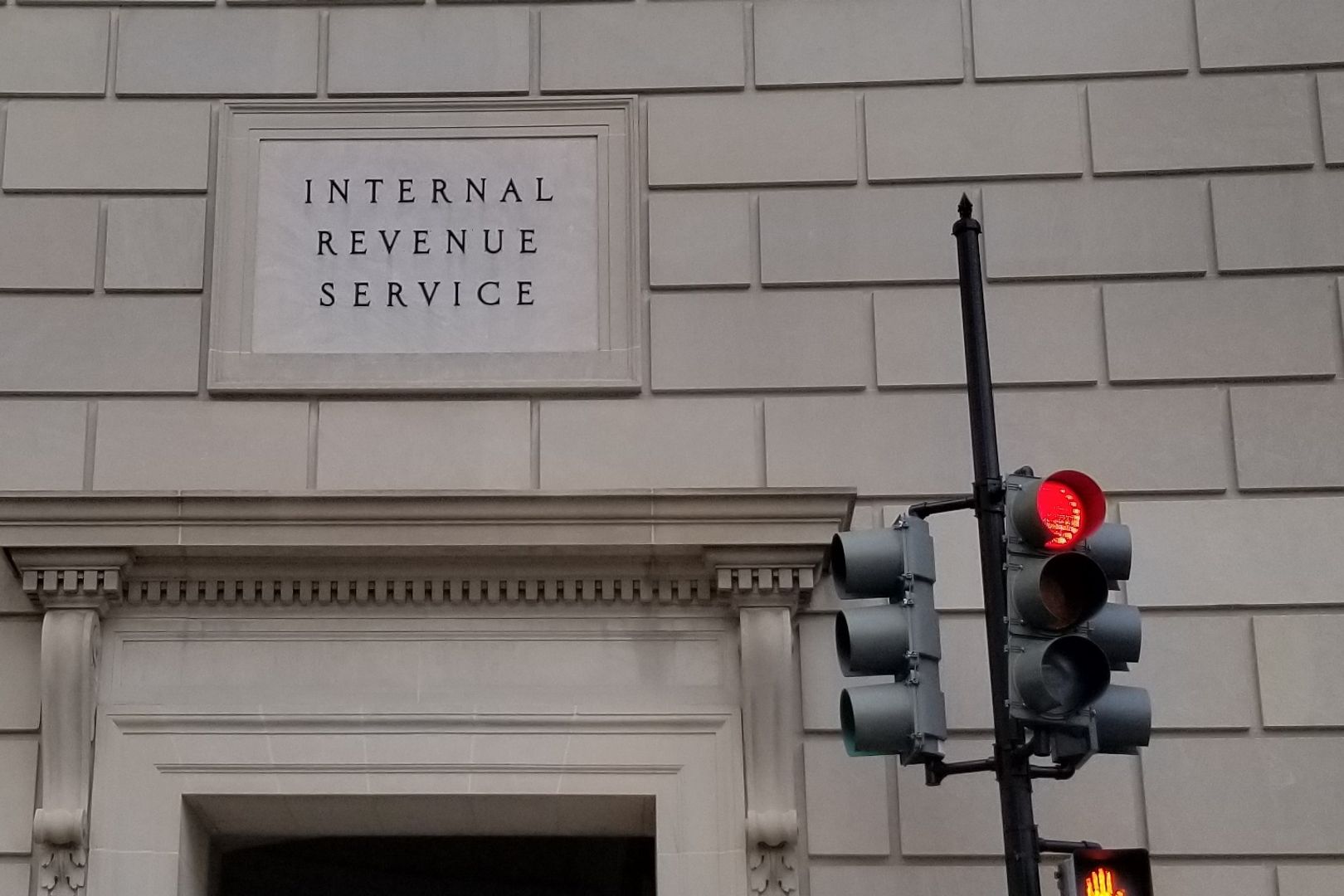
More than half of cryptocurrency investors don’t understand the fundamental concept of taxability when it comes to their digital asset holdings, according to a survey by the U.S.-listed crypto exchange Coinbase (COIN) and Cointracker, a crypto tax and portfolio tracking platform.
The 2026 Crypto Tax Readiness Report found that only 49% correctly understand that crypto is taxable anytime it is sold, while almost a quarter mistakenly believe simple transfers trigger tax events.
Despite the majority of users having good intentions when it comes to crypto tax compliance, the multi-platform reality of crypto ownership exacerbates the so-called cost basis problem, deducting the original purchase price of an asset to report capital gains.
The survey found users averaged 2.5 platforms/wallets with 83% using self-custodial wallets, and only 35% reporting that they’d adjusted their cost basis in the past. The survey, conducted in late 2025, surveyed 3,000 U.S. crypto users.
The confusion around cost basis in the new 1099-DA forms is made worse thanks to a degree of overreporting built into the new regime, Coinbase says. This is because everyday activities like stablecoin payments and Ethereum gas fees trigger taxable events, while generating little meaningful tax revenue.
Coinbase said it expects to issue over four million 1099-DAs Forms to customers with under $600 of proceeds – added to the fact that over 60 percent of its customers have incomplete cost basis data due to the way digital assets move across wallets and platforms.
“Today, that means every stablecoin payment, every small DeFi [decentralized finance] transaction, every gas fee is technically a taxable event,” Coinbase said. “The compliance burden this imposes on ordinary Americans isn’t just inconvenient – it’s a direct threat to the adoption and innovation the GENIUS Act was designed to unlock.”
Despite the wrinkles, the move to standardized reporting of crypto taxes will help adoption in the long run, said Matt Price, director of investigations at blockchain analytics firm Elliptic. Price, a former IRS special agent focused on criminal investigations, sees this as a shift toward targeted enforcement rather than the broad, manual investigations of the past.
Also a former head of investigations at Binance, Price understands the complexity of doing crypto taxes, having been paid partly in crypto by Binance and having to account for a volatile asset in the form of a payment.
“How do you even report it?” Price said in an interview. “I didn’t even have a 1099 to report that, so I had to essentially do all of my own accounting to file accurate taxes to account for that information.”
As such, the arrival of 1099-DA forms means welcome standardization that simply brings crypto in line with what other financial products have had for years and mirrors the approach of the 1099-B for brokerages.
“There’s certainly nuance and it’s a fair point that the basis is harder to calculate given the high frequency of trading,” Price said. “But there are some parallels to that in traditional investments as well; I don’t know how many retail traders are running algo trades on Schwab, for example, but that is also a very similar type of trade. If they can figure it out, I think the industry can probably figure it out.”


- XRP rises to $1.36 on institutional optimism and CEO remarks.
- Technical relief bounce supported by oversold conditions and volume surge.
- Key levels to watch are the support at $1.33 and the resistance at $1.40.
XRP has seen a notable lift in the past 24 hours, climbing to $1.36 and outperforming much of the broader market.
The rally appears to be driven by a combination of technical relief and renewed confidence from institutional investors.
Over the past 24 hours, trading volume surged nearly 50%, signalling that buyers are stepping in after the recent oversold conditions.
Ripple CEO commentary sparks optimism
A major factor behind this price movement is the recent commentary from Ripple’s CEO, Brad Garlinghouse.
In a March 27 Fox interview, Garlinghouse highlighted a growing demand for digital assets and stablecoins from traditional financial institutions.
He emphasised that the crypto landscape is maturing, with more banks and investment firms considering digital assets as part of their portfolios.
Garlinghouse also underscored progress on regulatory fronts, particularly regarding the anticipated CLARITY Act.
The CEO indicated that the act could provide clearer guidelines for crypto operations, fostering confidence among institutional participants.
The combination of regulatory clarity and increased interest from financial firms has sent a strong signal to traders.
Market participants appear to be reacting positively, interpreting the remarks as validation that XRP is positioned for broader adoption in the traditional finance sector.
Reports of large institutional XRP holdings, such as Goldman Sachs’ exposure through XRP ETFs, have further reinforced the bullish narrative.
Technical relief supports the bounce
Alongside these fundamental drivers, XRP’s technical indicators also support the recent surge.
The 14-day Relative Strength Index (RSI) had dipped to around 44, indicating that the asset is approaching oversold territory, which has created conditions for the bounce as selling pressure eases and buyers re-enter the market.

Moreover, XRP’s price gained modest tailwinds from a slight recovery across the broader crypto market.
While the overall market movement was subdued, it contributed to the momentum that carried XRP higher.
The short-term XRP price forecast
For traders watching the immediate market, $1.33 remains a critical support level.
Remaining above this support will be crucial for any attempt to test higher levels.
In case of a continued bullish trend and XRP breaks above $1.40, analysts believe the altcoin could see additional buying pressure and extend the current relief rally.
Other notable resistance levels that traders should watch include $1.45, which has acted as a ceiling over the past week.
Sustaining momentum beyond this level could open the door to a more meaningful uptrend.
However, failure to hold $1.33 could result in a pullback toward $1.30, where buyers may re-enter.
Notably, regulatory developments, particularly progress on the CLARITY Act, will be the key catalyst in the coming weeks.
Positive news could encourage further institutional participation, while delays might keep XRP trading within the $1.30–$1.40 range.

Key Takeaways
- ARTL shares skyrocketed 618% following the company’s announcement about developing ART27.13 as a complementary treatment for GLP-1 obesity medications.
- Shares plummeted over 23% Monday when Artelo disclosed a $31.4 million fundraising initiative involving share and warrant issuance.
- The company plans to issue roughly 3.18 million shares priced at $3.45 each, generating approximately $11 million in gross revenue.
- Warrant agreements for up to 6.37 million additional shares could yield another $20.4 million if fully exercised by investors.
- The financing arrangement was structured at-the-market under Nasdaq compliance guidelines and was scheduled to finalize on March 30.
Shares of Artelo Biosciences experienced a significant downturn exceeding 23% during early trading Monday following the biotechnology firm’s announcement of a financing plan targeting up to $31.4 million through combined share and warrant issuance.
Artelo Biosciences, Inc., ARTL
This sharp decline occurred after an impressive 230.41% rally the preceding Friday, which followed by two days the company’s revelation that it was investigating ART27.13, its experimental compound, as a complementary therapeutic option for GLP-1-based obesity medications.
The strategic decision to pursue capital raising immediately following such substantial share price appreciation seems to have triggered investor apprehension regarding potential ownership dilution.
Artelo revealed it executed binding agreements for the sale of roughly 3.18 million common shares at a combined offering price of $3.45 per unit. This transaction is projected to yield gross revenues of approximately $11 million prior to deducting placement fees and related costs.
Additionally, the biotechnology company intends to issue warrants providing purchasers with rights to acquire up to 6.37 million supplementary shares. Should these warrants be fully exercised through cash payment, Artelo could secure an additional $20.4 million in funding.
The company explicitly cautioned investors that warrant exercise remains uncertain. “No assurance can be given that any of the warrants will be exercised, or that the Company will receive cash proceeds from the exercise of the warrants,” Artelo stated in its official announcement.
H.C. Wainwright & Co. serves as the sole placement agent facilitating this financing transaction.
The private offering is being executed pursuant to Section 4(a)(2) of the Securities Act alongside Regulation D requirements. The offered securities remain unregistered under federal and state securities regulations. Artelo has committed to submitting a resale registration statement encompassing the newly issued securities.
Capital generated from this financing will be allocated toward operational expenses, settlement of specific bridge financing obligations, and broader corporate initiatives.
ART27.13’s Role in the GLP-1 Treatment Landscape
The initial dramatic price increase stemmed from Artelo’s Wednesday disclosure regarding its exploration of ART27.13 — an investigational therapeutic targeting the endocannabinoid system — as a possible adjunct therapy to GLP-1 medications.
GLP-1 therapeutics, which regulate glucose metabolism and appetite control, represent the cornerstone of the rapidly expanding obesity pharmaceutical market. This sector is currently led by Eli Lilly (LLY) and Novo Nordisk (NVO).
According to Artelo, previous clinical observations in oncology patients indicated that ART27.13 might help maintain lean muscle tissue in individuals receiving GLP-1 treatments. The company has subsequently submitted a provisional patent application addressing this therapeutic indication.
“With new non-clinical research commencing and the recent filing of a patent application covering the use of CB2 agonists with GLP-1 drugs, we are aiming to build a scientific and strategic foundation with ART27.13 in an area of potentially significant commercial relevance,” stated Andrew Yates, Artelo’s chief scientific officer.

TLDR:
- February 2026 funding rates landed in the bottom 3–15% of all historical monthly readings across major tokens.
- Every bottom-15% funding rate streak on record has recovered, with a median timeline of two to five weeks.
- SOL on Hyperliquid posted -18.33% annualized in February, the lowest reading ever recorded across all tracked pairs.
- Boros allows traders to long ETH funding rate markets and lock in fixed rates ahead of an expected mean reversion.
Funding rates across major crypto perpetual markets are raising a critical question: has the market finally bottomed?
After Bitcoin shed over 50% from its October 2025 all-time highs, perpetual funding rates collapsed to historic lows in February 2026.
Most major tokens recorded readings in the bottom 5% of all-time monthly data. Now, with crypto prices rallying despite US-Iran war escalations, traders are watching funding rates closely for early reversal signals.
February 2026 Funding Rates Dropped to Levels Never Seen Before
Funding rates in February 2026 were not just low — they were structurally outside the normal range of market history.
BTC on Binance recorded an annualized rate of -0.68%, placing it in the bottom 4.5% of all 66 months on record. That reading alone sat 12 percentage points below BTC’s historical mean of 11.8%.
ETH told an even sharper story. Binance recorded ETH at -4.03% annualized, landing in the bottom 3% of all historical monthly readings.
Hyperliquid and Lighter posted similarly depressed figures, with ETH sitting in the bottom 15% and bottom 20% respectively across those platforms.
XRP and SOL absorbed the worst damage of the month. XRP on Hyperliquid posted -12.77%, the single worst month in that market’s entire recorded history.
SOL on Hyperliquid came in at -18.33%, the lowest absolute reading among all tracked pairs across every platform.
The deviation from historical medians reinforces just how extreme the period was. SOL on Hyperliquid deviated 29.2 percentage points from its median.
BTC on Binance, the least extreme major, still deviated 7.0 percentage points. For most tokens, February was not simply a bad month — it was an anomaly by every measurable standard.
Historical Patterns Suggest These Lows Have Always Preceded a Recovery
The most telling data point in this analysis is also the simplest: every bottom-15% funding rate streak in the historical record has recovered.
That pattern holds across multiple assets, exchanges, and market cycles, including the FTX collapse of November 2022.
The median recovery time back to the bottom 55% of funding rates runs roughly two to five weeks after the streak ends.
BTC provides the clearest evidence. Its longest Binance bottom-15% streak lasted 11 weeks, beginning in March 2025.
Most other BTC streaks recovered within one to five weeks. An extended eight-week streak on Hyperliquid in mid-2023 resolved fully within five weeks of ending.
ETH’s most severe historical episode in late August 2022 averaged -18.6% over five weeks. That took 12 weeks to recover to the bottom 55%, the longest recovery on record for ETH.
More recent episodes, however, including early 2025 streaks, resolved in one to five weeks, suggesting the recovery window is compressing as the market matures.
SOL’s November 2022 streak, driven by the FTX collapse, averaged an extraordinary -468.9% annualized. Despite that severity, Binance SOL recovered to the bottom 20% within seven weeks.
Each of these cases points toward the same conclusion: deeply negative funding rates have historically acted as a contrarian signal for a coming recovery, not a permanent new baseline.
Funding Rate Markets on Boros Allow Traders to Position for the Rebound
If funding rates are indeed at a cyclical bottom, the question becomes how traders can express that view efficiently.
Boros, a funding rate derivatives platform, offers two structured approaches for traders looking to capitalize on a mean reversion in funding rates.
The first strategy targets traders who believe ETH prices will recover over the next three months. By longing ETH on any of the three platforms with June maturities — OKX, Binance, or Hyperliquid — and simultaneously longing the ETH funding rate market on Boros with the same notional amount, traders lock in a fixed funding rate. This protects against funding spikes while maintaining full upside exposure to ETH price recovery.
The second strategy is for traders focused purely on funding rate normalization, regardless of price direction. Longing ETH funding rate markets on Boros directly captures any upward move in implied or underlying APR.
The recommended approach is selecting the maturity with the lowest current implied APR to maximize the distance of a potential recovery move.
Implied APR across June ETH maturities currently sits between 2% and 5% annualized, reflecting cautious market expectations for a gradual recovery.
If underlying APR breaks its downtrend and flips positive, traders long on Boros benefit both from rising implied APR and from positive settlement payouts once underlying APR exceeds their entry point.
The Data Points to an Asymmetric Opportunity, But Margin Management Is Critical
Taken together, the February 2026 funding rate data builds a case for an asymmetric setup. Rates have reached historic lows across virtually every major token and exchange.
Historical recovery patterns are consistent. And crypto prices have already begun recovering despite ongoing geopolitical pressure, a divergence that traders are noting carefully.
Extended periods of negative funding have historically reflected consolidating or ranging markets. As Boros observed, those periods of extended low funding have always eventually ended. The question is not whether rates recover, but when — and whether traders are positioned to benefit when they do.
For those looking to long mean reversion, timing the exact bottom is not necessary. The historical data suggests the recovery window after a streak breaks is two to five weeks, giving traders a defined timeframe to manage positions. The risk is sustaining negative funding payouts during the remaining period of the streak before it turns.
Adequate margin is therefore the most important operational variable for this trade. A trader who enters too early with insufficient runway may be forced out before the recovery materializes.
The setup, however, remains compelling: deeply negative historical funding rates, a consistent track record of recovery, and structured tools through Boros that allow both fixed-rate locking and directional funding rate speculation.
TLDR:
-
- Gnosis is a founding contributor to the Ethereum Economic Zone alongside Jordi Baylina and the Ethereum Foundation.
- EEZ rollups allow smart contracts to call Ethereum mainnet contracts atomically within a single transaction.
- Protocols on EEZ rollups access Ethereum’s native liquidity directly without wrapping, bridging, or extra delays.
- Gnosis plans to define the role of GNO token and its validator set in any future EEZ implementation with its DAO.
- Gnosis is a founding contributor to the Ethereum Economic Zone alongside Jordi Baylina and the Ethereum Foundation.
Ethereum Economic Zone is the framework Gnosis is co-building to address Layer 2 fragmentation on Ethereum. Gnosis, active as a Layer 1 blockchain for seven years, is a founding contributor to this initiative.
Jordi Baylina, founder of ZisK and creator of Circom, also joins as a founding contributor. The Ethereum Foundation is also co-funding the entire development effort.
The framework centers on synchronous composability, enabling rollups to interact with Ethereum mainnet without bridges.
A Framework Built Around Composability
Ethereum scaling delivered on its core promise in recent years. Transactions became cheaper and network throughput increased steadily. However, the process fractured the ecosystem into disconnected chains rather than one unified economy.
Each rollup operates with its own liquidity, bridges, and tooling. Builders must redeploy the same products across multiple chains to reach all users. Users also face expensive bridging costs and assets scattered across chains they barely track.
Gnosis noted on X that Ethereum had scaled into fragmented islands rather than a unified economy. The Ethereum Economic Zone is designed to resolve that at the infrastructure layer. The framework allows rollup smart contracts to call Ethereum mainnet contracts within one transaction.
Calls between different rollups within the same execution are also supported. This is what developers call synchronous composability. It removes the need for bridges, wrapping, or waiting on finality.
Protocols on EEZ rollups access Ethereum’s existing liquidity directly without bridging or wrapping. A protocol can use a Uniswap mainnet pool atomically, with the same L1 guarantees. These rollups also inherit Ethereum’s full validator security with no new trust assumptions added.
What the Ethereum Economic Zone Means for Gnosis Chain
Gnosis acknowledged that its neutral blockspace thesis did not develop as expected. Blockspace became largely commoditized across the industry over time. Running a standalone Layer 1 requires constant rebuilding of DeFi infrastructure and liquidity bootstrapping.
Synchronous interoperability changes the competitive dynamic for chains like Gnosis. Projects inside a composable Ethereum domain no longer need to replicate an entire ecosystem. They can rely on shared liquidity and canonical infrastructure instead.
That shift frees up capital and engineering bandwidth for differentiation. Gnosis plans to invest more in user experiences and products like Gnosis Pay and the Gnosis App. Real-world financial integrations also become more practical under a unified model.
The Ethereum Economic Zone also connects to Gnosis’s mission of giving every person financial access. A stablecoin can now compose with a lending protocol on another chain without a bridge. A consumer app can also access the best rates across the ecosystem without workarounds.
Gnosis noted that the GNO token and validator set may have a role in a future EEZ implementation. Those details will be worked out with the Gnosis DAO community over the coming months. Technical architecture, developer tooling, and integration guides are also planned for release soon.

Birthright citizenship case hits close to home for immigrant mother
GSK’s bepirovirsen accepted for regulatory review in China for hepatitis B

Bitcoin Price Pressure Brings Back 2018 Bear Market


-
 NewsBeat5 days ago
Manchester United reach agreement with Casemiro over contract clause amid transfer speculation
-

 News Videos4 days ago
Parliament publishes latest register of MPs’ financial interests
-

 Sports7 days ago
Gary Kirsten Accuses Pakistan Cricket Board Of ‘Interference’, Mohsin Naqvi Responds
-

 NewsBeat3 days ago
The Story hosts event on Durham’s historic registers
-

 Business4 days ago
Instagram, YouTube Found Responsible for Teen’s Mental Health Struggle in Historic Ruling
-

 News Videos7 days ago
Ch 9 Financial Management Part 1 | Detailed One Shot | Class 12 Business Studies Boards 2026
-
 NewsBeat5 days ago
Tesco is selling new Cadbury Dairy Milk bar and people can’t wait to try it
-
 Entertainment7 days ago
Cynthia Bailey Dishes on ‘RHOA’ Season 17, Discusses Kandi
-

 Tech7 days ago
Samsung will soon let you control smart home devices from your car’s dashboard
-
 Entertainment2 days ago
Lana Del Rey Celebrates Her Husband’s 51st Birthday In New Post
-

 Fashion6 days ago
Does It Matter What You Wear When You’re Laid Off and Looking?
-
 NewsBeat7 days ago
Colombian military plane with 110 soldiers onboard crashes following takeoff
-

 Business6 days ago
More women enter wealth management, but few in advisory roles: study
-

 Fashion7 days ago
Fringe Bags for the Season
-

 NewsBeat6 days ago
Entrepreneurs Forum survey reveals optimism in North East
-

 Politics7 days ago
How Media Platforms Balance Performance and Accessibility in Image Delivery
-
 NewsBeat6 days ago
NASA Artemis II Astronauts enter 14-Day quarantine as moon rocket reaches launchpad
-

 Business6 days ago
Late-paying firms face multimillion-pound fines under new crackdown
-

 Crypto World6 days ago
BTC gives up $70,000 level as markets mull higher interest rates
-

 Sports5 days ago
Fantasy Baseball Week 1 Preview: Top sleeper hitters for both five- and 12-day period led by Munetaka Murakami
You must be logged in to post a comment Login