

Crypto World
Artelo Biosciences (ARTL) Stock Plunges 23% After $31M Offering Following 600% Surge


Key Takeaways
- ARTL shares skyrocketed 618% following the company’s announcement about developing ART27.13 as a complementary treatment for GLP-1 obesity medications.
- Shares plummeted over 23% Monday when Artelo disclosed a $31.4 million fundraising initiative involving share and warrant issuance.
- The company plans to issue roughly 3.18 million shares priced at $3.45 each, generating approximately $11 million in gross revenue.
- Warrant agreements for up to 6.37 million additional shares could yield another $20.4 million if fully exercised by investors.
- The financing arrangement was structured at-the-market under Nasdaq compliance guidelines and was scheduled to finalize on March 30.
Shares of Artelo Biosciences experienced a significant downturn exceeding 23% during early trading Monday following the biotechnology firm’s announcement of a financing plan targeting up to $31.4 million through combined share and warrant issuance.
Artelo Biosciences, Inc., ARTL
This sharp decline occurred after an impressive 230.41% rally the preceding Friday, which followed by two days the company’s revelation that it was investigating ART27.13, its experimental compound, as a complementary therapeutic option for GLP-1-based obesity medications.
The strategic decision to pursue capital raising immediately following such substantial share price appreciation seems to have triggered investor apprehension regarding potential ownership dilution.
Artelo revealed it executed binding agreements for the sale of roughly 3.18 million common shares at a combined offering price of $3.45 per unit. This transaction is projected to yield gross revenues of approximately $11 million prior to deducting placement fees and related costs.
Additionally, the biotechnology company intends to issue warrants providing purchasers with rights to acquire up to 6.37 million supplementary shares. Should these warrants be fully exercised through cash payment, Artelo could secure an additional $20.4 million in funding.
The company explicitly cautioned investors that warrant exercise remains uncertain. “No assurance can be given that any of the warrants will be exercised, or that the Company will receive cash proceeds from the exercise of the warrants,” Artelo stated in its official announcement.
H.C. Wainwright & Co. serves as the sole placement agent facilitating this financing transaction.
The private offering is being executed pursuant to Section 4(a)(2) of the Securities Act alongside Regulation D requirements. The offered securities remain unregistered under federal and state securities regulations. Artelo has committed to submitting a resale registration statement encompassing the newly issued securities.
Capital generated from this financing will be allocated toward operational expenses, settlement of specific bridge financing obligations, and broader corporate initiatives.
ART27.13’s Role in the GLP-1 Treatment Landscape
The initial dramatic price increase stemmed from Artelo’s Wednesday disclosure regarding its exploration of ART27.13 — an investigational therapeutic targeting the endocannabinoid system — as a possible adjunct therapy to GLP-1 medications.
GLP-1 therapeutics, which regulate glucose metabolism and appetite control, represent the cornerstone of the rapidly expanding obesity pharmaceutical market. This sector is currently led by Eli Lilly (LLY) and Novo Nordisk (NVO).
According to Artelo, previous clinical observations in oncology patients indicated that ART27.13 might help maintain lean muscle tissue in individuals receiving GLP-1 treatments. The company has subsequently submitted a provisional patent application addressing this therapeutic indication.
“With new non-clinical research commencing and the recent filing of a patent application covering the use of CB2 agonists with GLP-1 drugs, we are aiming to build a scientific and strategic foundation with ART27.13 in an area of potentially significant commercial relevance,” stated Andrew Yates, Artelo’s chief scientific officer.


Routing Work: The Forgotten Economic Primitive
For decades, the internet has run on a quiet assumption: data moves because infrastructure exists, and infrastructure exists because someone pays for it indirectly.
But beneath that simplicity is a blind spot in modern crypto economics. Blockchain systems reward three things exceptionally well:
- Capital (liquidity provision, staking, yield strategies)
- Computation (mining, validation, proof generation)
- Security (consensus participation, validator uptime)
What remains largely invisible is the fourth pillar—the actual movement of information across networks.
That gap defines one of the most underexplored design spaces in decentralized systems: routing work as a native economic activity.
The Invisible Labor Behind Every Digital Interaction
Every transaction, swap, message, or contract call depends on something unglamorous but essential: routing.
Routing is not just “passing data along.” It involves:
- Selecting efficient network paths
- Relaying packets between nodes
- Maintaining connectivity under congestion
- Handling redundancy, failures, and re-transmissions
In traditional internet infrastructure, this is handled by ISPs and backbone providers who are paid indirectly through subscriptions, peering agreements, or centralized billing models.
In most blockchain networks, however, routing is treated as background noise—a cost absorbed by validators or relayers without a direct, protocol-native incentive structure.
That design choice quietly leaves a major layer of economic value unpriced.
The Economic Gap in Current Blockchain Systems
Blockchain economies are remarkably precise about some incentives and surprisingly vague about others.
Well-defined incentive layers:
- Validators earn rewards for producing blocks
- Miners/validators are compensated for securing consensus
- Liquidity providers earn fees for capital efficiency
Underdeveloped layer:
- Nodes that transport data between participants
- Systems that ensure messages reach their destination efficiently
- Infrastructure that maintains network liveness beyond consensus
The result is a structural imbalance: security and computation are rewarded, but connectivity itself is not independently priced.
This leads to inefficiencies that scale with network growth:
- Congestion concentrates on a small number of relays
- Centralization pressure increases around high-bandwidth nodes
- Routing becomes a hidden subsidy rather than an explicit market
Routing as an Economic Primitive
The idea of treating routing as a first-class economic activity reframes how decentralized systems can be built.
Instead of viewing nodes as passive conduits, routing becomes:
A measurable service with supply, demand, and compensation.
In this model, every data packet carries value not only in its content but in its movement through the network.
Routing work becomes:
- Verifiable (nodes can prove participation in message delivery)
- Metered (data forwarding is trackable and attributable)
- Compensated (fees or rewards distributed based on contribution)
This transforms routing from an infrastructure overhead into a source of economic participation.
Saito and the Routing-Centric Model
Protocols such as Saito explore this idea directly by embedding routing into their economic design.
Instead of separating:
- consensus
- computation
- data propagation
Saito attempts to unify them under a single incentive mechanism where:
- Nodes are rewarded for processing AND routing transactions
- Spam resistance is achieved through the economic cost of propagation
- Network bandwidth becomes a priced commodity rather than a free utility
In this architecture, routing is not a passive service—it is the activity that makes the system function at all layers.
This shifts the focus from “who validates blocks” to “who ensures the network actually carries information efficiently.”
Why Routing Has Been Historically Ignored
Routing has remained under-incentivized for structural reasons:
- It is difficult to measure precisely
Unlike block production, routing is continuous, distributed, and probabilistic. - It was assumed to be cheap
Early internet design treated bandwidth as abundant and coordination as the main constraint. - Consensus systems overshadowed transport systems
Blockchain design prioritized agreement over movement. - Economic abstraction layers hid infrastructure reality
Tokens reward outcomes, not the pathways that enable those outcomes.
As networks scale, these assumptions weaken.
The Scaling Problem Nobody Talks About
As decentralized systems grow, routing becomes a bottleneck before consensus does.
Symptoms include:
- Latency divergence between regions
- Reliance on high-connectivity “super nodes.”
- Rising costs of maintaining full node participation
- Fragmentation of peer-to-peer connectivity
Without explicit incentives, routing becomes centralized by default—not by design, but by physics and economics.
Reframing Network Value
A more complete crypto economy would recognize four primitive layers:
- Capital → liquidity and economic energy
- Computation → execution of logic
- Security → consensus and correctness
- Routing → transport of information
The fourth layer is structurally essential, yet economically undefined in most systems.
By making routing compensable, networks begin to resemble functioning markets rather than passive infrastructures.
Implications for Future Protocol Design
If routing becomes a priced service, several shifts emerge:
- More decentralized network topology
Incentives spread across many smaller nodes instead of central relays - Better spam resistance
Attacks become economically expensive at the transport layer - Improved latency optimization
Nodes compete to provide faster and more reliable delivery - New classes of infrastructure businesses
Routing providers become analogous to liquidity providers in DeFi
It also introduces a deeper conceptual shift: information flow becomes economically visible.
Closing Perspective
Crypto has spent years refining how value is created, secured, and computed.
The next missing layer is not more computation or better consensus—it is the recognition that movement itself is work.
Routing is not a background process. It is the circulatory system of decentralized networks.
Once that labor is acknowledged economically, entirely new protocol designs become possible—systems where connectivity is not assumed, but continuously earned.
The internet has already moved on to routing. The question is whether its future economies will finally pay for it.
REQUEST AN ARTICLE
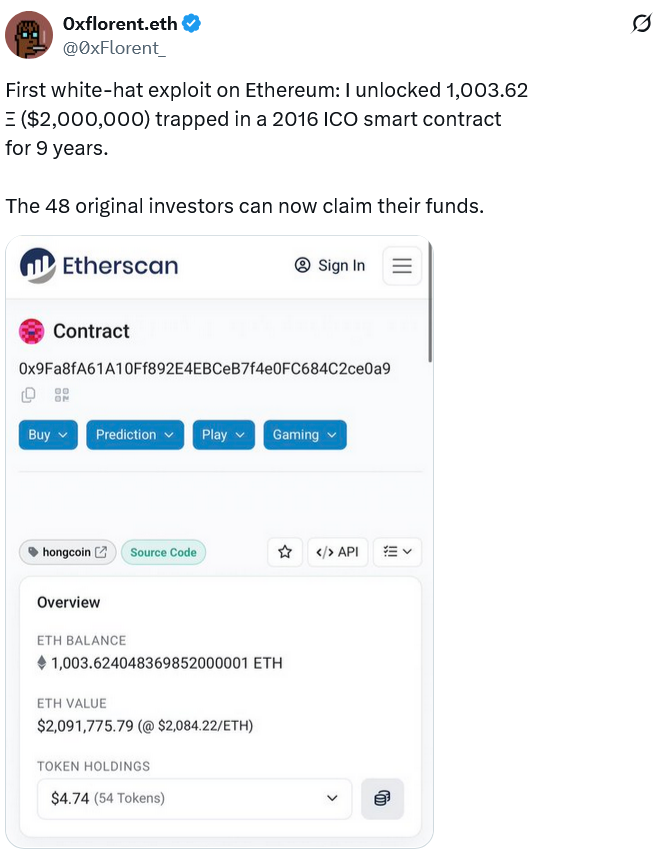
A pseudonymous white hat hacker has helped recover $2 million worth of Ether locked in a faulty initial coin offering (ICO) smart contract for almost a decade.
In a post to X on Sunday, the white hat, known as “0xflorent,” said they helped recover about 1,003 Ether (ETH) from 48 investors who participated in the Hong Coin (HONG) ICO, a decentralized venture capital fund that never launched due to it failing to reach its funding goal.
“The contract held all the investors’ ETH and was supposed to auto-refund them,” 0xflorent said. However, “a bug in the refund function quietly broke that, and the funds got stuck.”
Data from Ethereum block explorer Etherscan shows that one HONG investor has already been refunded 96 ETH, now worth about $192,500, while 0.5 ETH was returned to another.
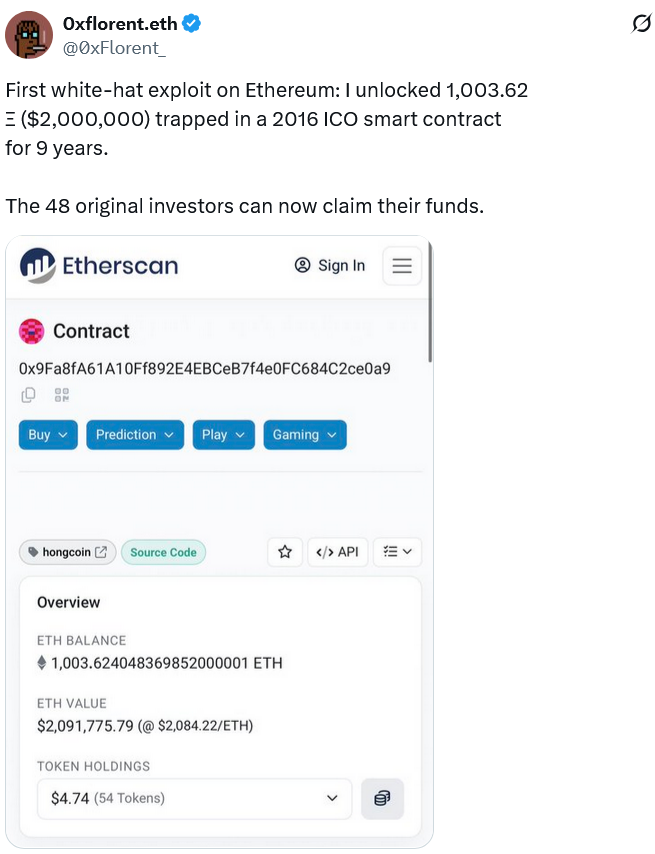
Source: 0xflorent.eth
Hong Coin was first pitched in 2016, and a YouTube video at the time depicted the token as a community-run venture capital fund where members of the project’s decentralized autonomous organization would help decide which projects receive backing.
The ICO started on Aug. 29, 2016, and ended about two months later on Oct. 28.
Investors who sent ETH to the HONG smart contract were supposed to receive 250 million HONG tokens distributed across five stages, but it didn’t reach its funding goal, and investors were supposed to be refunded.
0xflorent said they cooperated with the HONG creators, showing them how to extract the locked funds by taking advantage of a flawed admin function that reset token holders’ balances and triggered the refund mechanism.
Related: Ethereum bull David Hoffman explains why he sold his ETH
“The way out was an admin function with an integer overflow vulnerability,” they explained. “Calling it with a specific input resets a holder’s balance and unblocks the refund check.”
On May 24, 0xflorent said they retrieved a combined 19.33 ETH worth about $40,600 from a failed ICO project in January 2018 and a Liquality Wallet user who had some funds trapped in a cross-chain transfer protocol.
Magazine: Big Questions: Do we really only need 2–5 cryptocurrencies?
A pseudonymous white hat hacker known as 0xflorent has recovered about 1,003 ETH, roughly $2 million at the time of recovery, that had been locked in a faulty initial coin offering contract for nearly a decade. The funds belonged to investors in the Hong Coin (HONG) ICO, a decentralized venture capital concept that never launched after failing to meet its funding goal.
In a post to X on Sunday, the white hat described how they assisted in unlocking funds from the HONG contract, which held ETH for 48 investors. Hong Coin, launched as a community-driven venture fund, never reached its target and did not issue the promised tokens.
The contract was designed to auto-refund investors if the fundraiser fell short. A bug in the refund function quietly broke that mechanism, leaving the funds stuck in the contract until they could be recovered.
Ethereum data shows partial refunds to some participants. One investor has been refunded 96 ETH (about $192,500 at the time) and another 0.5 ETH has been returned, according to data visible on Etherscan.
The Hong Coin ICO ran from Aug. 29, 2016, to Oct. 28, 2016. Investors who sent ETH were to receive 250 million HONG tokens across five stages, but the project did not meet its funding goal, triggering the planned refund process.
0xflorent said they cooperated with the HONG creators, showing them how to extract the locked funds by exploiting a flawed admin function that resets token balances and triggers the refund check. “The way out was an admin function with an integer overflow vulnerability,” they explained, adding that calling it with a specific input resets a holder’s balance and unblocks the refund.
In a separate update on May 24, 2024, 0xflorent noted a prior recovery: they retrieved a combined 19.33 ETH from a failed ICO project in January 2018 and from a Liquality Wallet user whose funds were trapped in a cross-chain transfer protocol.
A 2016-era promotional video for Hong Coin framed the project as a community-run venture capital fund where members of the project’s decentralized autonomous organization would help decide which projects receive backing. The ICO’s design and governance promise are emblematic of a broader era when countless tokenized fundraising efforts faced similar shortfalls and legal uncertainties.
The Hong Coin story underscores how legacy vulnerabilities in early ICO contracts can persist for years, and how targeted, technical intervention—even by white-hat actors—can salvage assets that might otherwise remain inaccessible. It also highlights the ongoing tension between innovation in on-chain fundraising and the need for robust security and governance controls from the outset.
Key takeaways
- Recovery of approximately 1,003 ETH from 48 investors in a 2016 ICO that failed to meet its funding goal, now partially realized through on-chain intervention.
- The refund mechanism was compromised by an admin function with an integer overflow vulnerability, which allowed a reset of balances and the triggering of refunds.
- Partial refunds have already appeared on-chain, with at least 96 ETH and 0.5 ETH returned to individual participants, indicating ongoing on-chain recoveries.
- 0xflorent has a history of on-chain recoveries beyond Hong Coin, including a 19.33 ETH recovery in early 2018 and further work with a Liquality Wallet user on a cross-chain transfer issue.
Hong Coin saga and the refund flaw
Hong Coin’s ICO structure was straightforward on paper: ETH contributions would convert into 250 million HONG tokens distributed across five phases, with refunds to investors if the fundraising target was not met. The project dated back to 2016, a period when a flood of ICOs experimented with decentralized governance and venture-style capital allocation. While many projects faded, the technical legacies of a few—such as flawed refund logic—left open questions about how these systems can be safely unwound when things go wrong.
0xflorent’s account describes a delicate collaboration with the project’s creators to extract funds tied up in a faulty refund path. The critical vulnerability lay in an admin function designed to administer token balances, which, when invoked with a crafted input, could reset a holder’s balance and thereby unlock the refund mechanism that had otherwise been stuck in a dead end.
The episode is a reminder that even in a space marked by rapid iteration and ambitious ideas, robust contract design and clear failure-handling are essential. The Hong Coin case also illustrates how a carefully coordinated, technically informed approach can salvage user funds long after the fact, although it does not absolve the responsibility of launching secure and well-audited contracts in the first place.
Evidence on chain and what the data reveals
On-chain data provides a window into what has been recovered and what remains uncertain. Etherscan shows at least one investor receiving 96 ETH and another receiving 0.5 ETH as part of the refunds tied to the Hong Coin contract. The total amount recovered so far—approximately 1,003 ETH across 48 participants—represents a meaningful recovery for a case that originated in the 2016 ICO boom.
Beyond Hong Coin, 0xflorent has referenced other recoveries, including a 19.33 ETH move in early 2018, described as coming from a combination of a failed ICO project and a Liquality Wallet user’s stuck funds in a cross-chain transfer. These instances collectively illustrate how persistent on-chain investigations can yield tangible returns years after funds are deployed into questionable or poorly scripted smart contracts.
Hong Coin’s original YouTube portrayal framed it as a community-governed venture fund, with the decentralized autonomous organization envisioned as a steering body for project selections. While the ICO itself did not launch, the narrative around the project helps contextualize why such funds attracted interest and how governance concepts from the DAO era translated into tokenized fundraising experiments.
The path from promise to recovery in Hong Coin is a useful case study for builders and investors alike: even when a project fails to launch, the governance and refund architecture it leaves behind can be shaped to protect participants—if the contract’s design allows for safe unwinding and active asset recovery by capable hands.
Watchers of the crypto space should monitor whether more dormant ICOs with refund mechanisms encounter similar vulnerabilities and how auditors and white-hat researchers respond as asset recoveries continue to unfold, potentially reshaping expectations around legacy ICO contracts and their enduring legacies.
Crypto World
China’s factory activity beats forecasts in May, private survey shows, despite softer official data

Workers make US flags ahead of the 2026 World Cup football tournament, at a factory in Qingdao, in China’s Shandong province on May 28, 2026.
– | Afp | Getty Images
BEIJING — China’s factory activity improved in May, a private survey showed Monday, beating expectations even as official data pointed to weaker momentum.
The seasonally-adjusted RatingDog China General Manufacturing Purchasing Managers’ Index came in at 51.8, a touch above the 51.6 expected in a Reuters poll. The 50 mark separates expansion from contraction.
China’s official manufacturing PMI for May fell to 50 from 50.3 in April, in-line with expectations and the lowest since a 49 print in February, according to data released Sunday.
Overall, the official PMI “suggest subdued manufacturing sector growth, increased services activity, and continued decline in the construction industry,” Goldman Sachs analysts said in a report Sunday.
While China’s retail sales growth hit a 40-month low in April, official figures showed overall domestic tourism and spending picked up during an extended May 1 holiday. Chinese hotel group H World said the 10 most popular destinations by occupancy rate were in smaller cities. Rates tend to be lower in those regions than major cities.
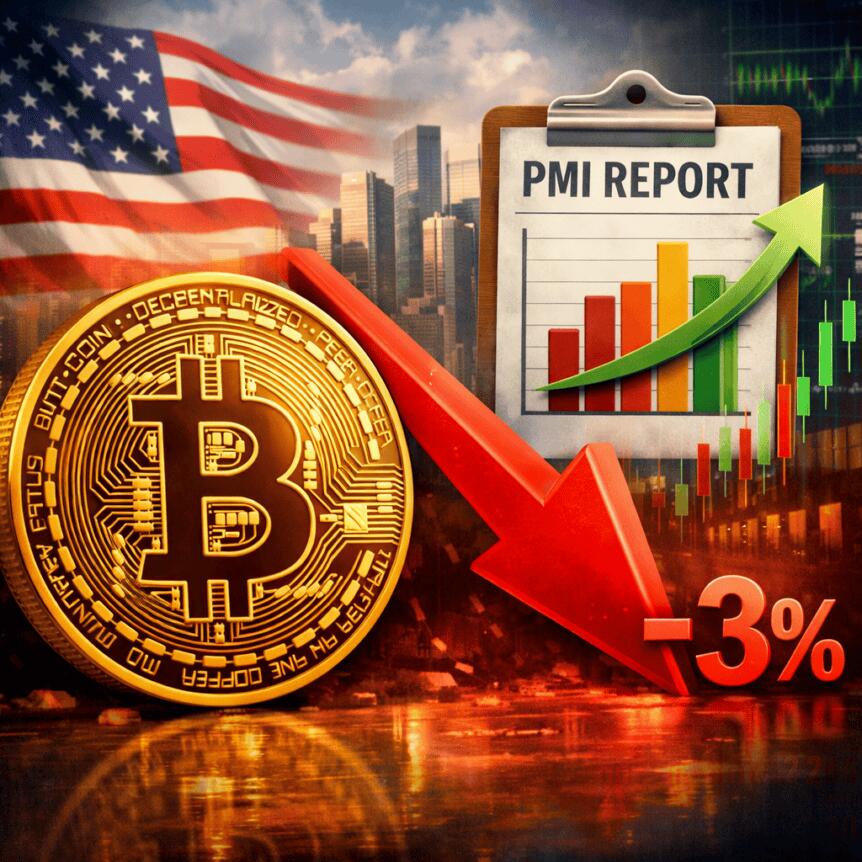
Bitcoin traded around the $73,500 mark on Sunday as traders eyed a May that could close in the red, with price action giving little impetus from global headlines. The market appears to be waiting for a clearer set of macro cues, particularly US labor-market data and the May ISM Manufacturing PMI, which traders say could set the tone for risk assets in the coming week.
TradingView data points to a quiet weekend for BTC/USD, with prices largely hovering near the lower end of the current range and still flirting with levels that have defined the year’s early drama. After a May that has already seen about a 3% monthly retreat, traders and analysts are watching whether BTC can regain momentum as the calendar turns.
US equities finished the week at fresh highs, yet Bitcoin did not draw strength from the easing geopolitical tensions that had helped markets at times this year. The conversation on social channels and research notes centered on whether the next wave of data—especially the labor market and manufacturing activity—will spark a repricing of risk assets, including bitcoin.
Key takeaways
- Bitcoin sits near the $73,000–$74,000 zone as May approaches its close, with a month-to-date decline around 3% per CoinGlass data.
- The upcoming US ISM Manufacturing PMI and monthly employment data are the focal point for crypto and broader risk markets, potentially driving volatility once released.
- A weekly close above $73,000 would be a meaningful signal for traders watching a possible trend continuation or a double-bottom breakout, according to market commentary.
- Analysts continue to describe a wide macro range for Bitcoin, with discussions of a broad $60k–$80k corridor likely to persist in the near term.
- Term structure around CME futures has shifted, with markets moving toward 24/7 trading and away from closing-level targets tied to CME gaps.
Macro catalysts on the radar as May nears its end
Beyond the price tag, traders are laser-focused on the macro calendar. The May ISM Manufacturing PMI, a gauge of the economic pulse for the manufacturing sector, has historically provided volatility cues for bitcoin and other risk assets when released alongside the monthly employment report. Analysts say that if the data reveals resilience in growth and risk appetite, BTC could reprice higher; if not, another leg down could unfold as investors reassess macro risk.
On social media, commentary has underscored the potential volatility attached to these releases. For example, a market note from the Kobeissi Letter framed the coming week as a test of the labor market’s strength, implying that employment data could be the dominant driver of sentiment for both equities and crypto. In a broader view, traders have cautioned that any misstep in growth indicators could rekindle volatility in a market already oscillating between macro optimism and caution.
Meanwhile, some analysts maintain that the price action in May is less about immediate catalysts and more about how Bitcoin responds to sustained shifts in risk sentiment. Andre Dragosch, European head of research at Bitwise, suggested that continued repricing would require evidence of stronger growth and risk appetite, with a move higher potentially signaling a more durable shift rather than a brief relief rally.
Technical framing: watching the $73k line and potential patterns
From a technical standpoint, the market has repeatedly tested the $73,000 region as a key inflection point for the monthly close. The latest commentary from traders such as Rekt Capital notes that a weekly close above $73,000 would push Bitcoin closer to validating a potential double-bottom breakout pattern observed on the weekly chart since late February. The notion of a “W” shaped bottom has formed over several weeks, suggesting that bulls are hoping for a sustained reacceleration rather than a quick snap back.
Technical watchers also flag the interplay of moving averages near current price levels. The weekly 200-period moving average and the accompanying EMA have been converging toward price, a configuration that some analysts interpret as supportive if the macro backdrop improves. In this context, traders have been fond of outlining a broad range in which BTC could oscillate for an extended period—roughly between $60,000 and $80,000—before a decisive breakout or breakdown occurs.
Another structural note from the market community is the diminishing influence of CME futures gaps on near-term price targets. As Cointelegraph has observed, BTC’s price action in recent periods has moved away from CME gap-driven targets, with futures markets now operating around the clock and reducing the likelihood of gap-induced reversals shaping daily moves. This shift underpins a more continuous trading environment and underscores the importance of ongoing macro cues over discrete futures-based triggers.
What this means for traders and investors
For traders, the looming data releases represent both a risk and an opportunity. A surprise stronger-than-expected PMI or nonfarm payrolls would likely lift risk assets broadly, including BTC, as investors reassess growth and inflation dynamics. Conversely, softer data that dampens expectations for a rapid risk-on move could keep Bitcoin tethered to a lower end of its range, testing patience among bulls who are hoping for a more durable breakout later in the year.
In this context, the $73,000 bar remains an anchor for the month’s price action. A successful weekly close above that level would not only enhance the case for a bullish continuation, but also feed into a narrative of a potential trend extension from a double-bottom pattern. If the market holds below that level, traders will likely look for further confirmation signals from macro data before committing meaningfully in either direction.
For longer-term participants, the current dynamic reinforces the value of a patient, data-driven approach. The macro regime remains sensitive to policy signals, growth surprises, and geopolitical developments that influence risk sentiment. While the immediate catalysts are upcoming PMI and employment data, the broader takeaway is that Bitcoin’s trajectory continues to ride on how investors gauge the health of the economy and the pace of liquidity in the system.
On balance, the week ahead promises a clearer read on whether Bitcoin can sustain a move beyond the current consolidation zone or if volatility will linger as markets digest incoming data and reassess risk tolerance. Market participants should remain attentive to the PMI release, job numbers, and any shifts in central-bank commentary, all of which could tilt the balance between risk-off caution and renewed appetite for crypto exposure.
As the market eyes the finishing bell on May, what remains uncertain is not the level of price, but the durability of any move that breaks above it. With the macro backdrop still evolving, investors would be wise to monitor both the headline data and the undercurrents of market psychology that often drive crypto markets when traditional assets begin flashing mixed signals.

Greg Abel, CEO of Berkshire Hathaway, speaks during the Berkshire Hathaway Annual Shareholders Meeting in Omaha, NE on May 2, 2026.
CNBC
Berkshire Hathaway agreed Sunday to acquire homebuilder Taylor Morrison Home in a $6.8 billion deal, deepening the conglomerate’s bet on the U.S. housing market after a prolonged downturn.
The Omaha, Nebraska-based company will pay $72.50 per share in cash for Taylor Morrison, according to a statement. The offer represents a 24% premium to the homebuilder’s closing price on May 29 and values the company at about $8.5 billion, including debt.
The acquisition marks one of the first major strategic deals under Warren Buffett’s successor Greg Abel, who took over as CEO at the start of 2026. The acquisition, expected to close in the second half of 2026, is relatively modest by Berkshire standards as it’s sitting on a cash hoard nearing $400 billion.

“Berkshire is acquiring a best-in-class national homebuilder, led by an exceptional team and backed by a trusted reputation for customer experience,” Abel said in the statement. “Over time, we expect to unify our site-built homebuilding operations into a combined platform enabling us to deliver the dream of homeownership to more Americans.”
The deal suggests Berkshire is positioning for a recovery in U.S. housing demand despite elevated mortgage rates and affordability pressures that have weighed on the sector in recent years.
“They are betting the housing cycle will turn and that there is pent-up demand,” Bill Stone, Glenview Trust CIO and a Berkshire shareholder, told CNBC.
The acquisition expands Berkshire’s already sizable footprint in housing. The conglomerate owns manufactured-home giant Clayton Homes, a slew of building product companies as well as Berkshire Hathaway HomeServices, one of the largest residential real estate brokerage franchise networks in the U.S.
Berkshire’s last major deal came in October, when it reached a $9.7 billion cash deal to purchase of OxyChem, the chemical business of Occidental Petroleum.

TLDR:
- Ethereum (ETH) holds support despite growing short interest clustered above current price levels
- Whale activity remains dominant as retail traders stay cautious amid mixed market sentiment
- Large liquidity pools above the spot price increase the possibility of a short squeeze event
- Whale vs Retail Delta turns higher again, signaling renewed accumulation by larger holders
Ethereum (ETH) price remains range bound as growing short exposure and increasing activity from large holders create tough market conditions for traders.
Ethereum (ETH) Faces Rising Short Squeeze Potential
Ethereum (ETH) has spent recent months trading near the lower end of its broader range, struggling to establish sustained upside momentum.
On the surface, the price structure appears weak, reinforcing a cautious outlook among traders expecting further downside pressure. However, liquidation data is revealing a different narrative beneath current market conditions.
Recent positioning metrics show a substantial concentration of short-side liquidity sitting above the current Ethereum (ETH) price. As those positions accumulate, they effectively build future buying pressure if prices begin moving higher.
A widely circulated market update on X pointed to this imbalance between price action and positioning. According to the analysis, Ethereum (ETH) continues absorbing selling pressure despite persistent bearish bets.
Market participants often view liquidity as a magnet. In Ethereum’s case, one of the largest liquidity pools remains above the spot price.
The longer the asset maintains support without breaking lower, the greater the pressure becomes on traders positioned for a decline.
Sentiment remains noticeably more bearish than price performance. Many traders continue positioning for a breakdown, yet Ethereum (ETH) has avoided a decisive collapse. This divergence has become a key talking point among analysts evaluating near-term market structure.
Whale Activity Diverges From Retail Market Behavior
While liquidation data points toward potential volatility, whale activity is presenting another important development for Ethereum (ETH).
Recent Whale vs Retail Delta metrics show large holders maintaining stronger participation levels than smaller traders across much of the market cycle.
Notably, whale dominance remained positive even during periods when Ethereum (ETH) experienced sharp declines from previous highs.
Instead of reducing exposure, larger market participants appeared to increase activity during weakness. This trend contrasts with retail behavior, which often becomes more defensive during uncertain market conditions.
Several of the strongest positive delta readings occurred during periods of market stress rather than during rallies.
Such activity suggests that large investors continued engaging while broader sentiment weakened. More recently, after a brief period of increased retail influence, the metric shifted sharply back in favor of whales.
The analysis noted that larger holders appear increasingly active despite Ethereum (ETH) remaining well below prior cycle peaks. Although price has yet to produce a decisive breakout, positioning data indicate building exposure.
TLDR:
- Argentina’s crypto fraud crackdown led to 24 arrests across 90 raids targeting scam networks
- Authorities seized over $8M USDT tied to fake investment platforms and WhatsApp fraud schemes
- Criminal rings used fake apps, WhatsApp hijacking, and malware to steal investor funds
- Funds were converted into USDT via P2P markets and traced to overseas crypto wallets
Argentina’s crypto fraud crackdown authorities dismantled multiple investment scam networks and seized more than $8 million in USDT.
The operation, one of the country’s largest crypto-related enforcement actions, exposed sophisticated fraud schemes that allegedly generated billions of pesos in investor losses.
Argentina Crypto Fraud Crackdown Nets 24 Arrests and $8M USDT
Argentine authorities launched Operation “Fake Coins” on May 31, executing 90 coordinated raids across the country. The nationwide action resulted in the arrest of 24 suspects linked to alleged cryptocurrency and investment fraud activities.
According to prosecutors, the networks targeted victims through fake investment opportunities promoted on WhatsApp and WhatsApp Business.
The schemes reportedly promised attractive returns while directing users toward fraudulent platforms disguised as legitimate financial services.
The investigation uncovered nearly ARS 3 billion in alleged losses connected to more than 100 complaints. Authorities also seized almost ARS 60 million in cash and confiscated 80 electronic devices, including computers and mobile phones used during the operation.
The officials recovered more than 8 million USDT, surpassing the amount confiscated during the widely publicized RainbowEx case in 2024.
Prosecutors said private virtual asset service providers cooperated with investigators to freeze digital assets associated with the operation. However, authorities did not disclose the names of all entities involved in the asset recovery process.
Investigators Uncover Three Distinct Fraud Operations
The investigation revealed that the criminal activity operated through three separate groups, each employing different methods to obtain funds from victims.
The first network allegedly used a fake trading application distributed through the Google Play Store. Unregistered advisers reportedly guided investors through multiple deposits while presenting the platform as a legitimate investment service.
A second group focused on WhatsApp account compromises and impersonation tactics. Investigators said stolen funds were converted into USDT through Binance’s peer-to-peer marketplace before being transferred to overseas accounts, including destinations linked to Venezuela.
Authorities identified more than 100 activation codes associated with WhatsApp accounts used during the scheme. Investigators believe these accounts played a central role in contacting victims and maintaining fraudulent communications.
The largest crypto seizure came from a third organization based in San Isidro. Prosecutors alleged that the group developed piracy applications embedded with infostealer malware designed to steal passwords and banking credentials.
Blockchain analysis enabled authorities to trace transactions connected to the stolen funds, leading investigators to significant cryptocurrency holdings.
The suspects now face allegations that include aggravated fraud, money laundering, illicit association, and intellectual property violations.
As judicial proceedings move forward, authorities will determine how the seized USDT is handled and whether recovered assets can be directed toward compensating affected victims.
Crypto World
Coinbase makes a major play for India’s booming $3 billion crypto market with local currency launch
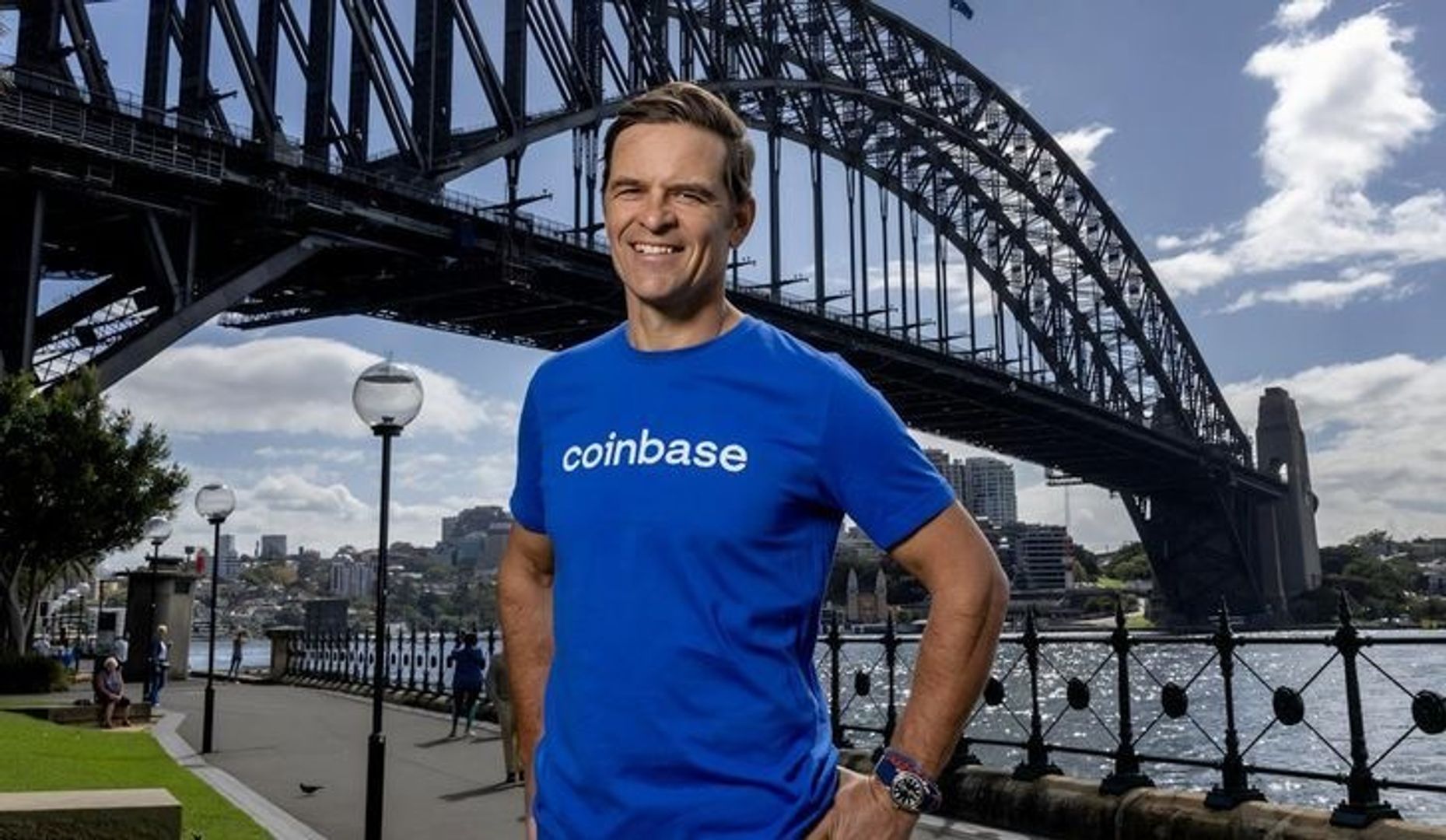
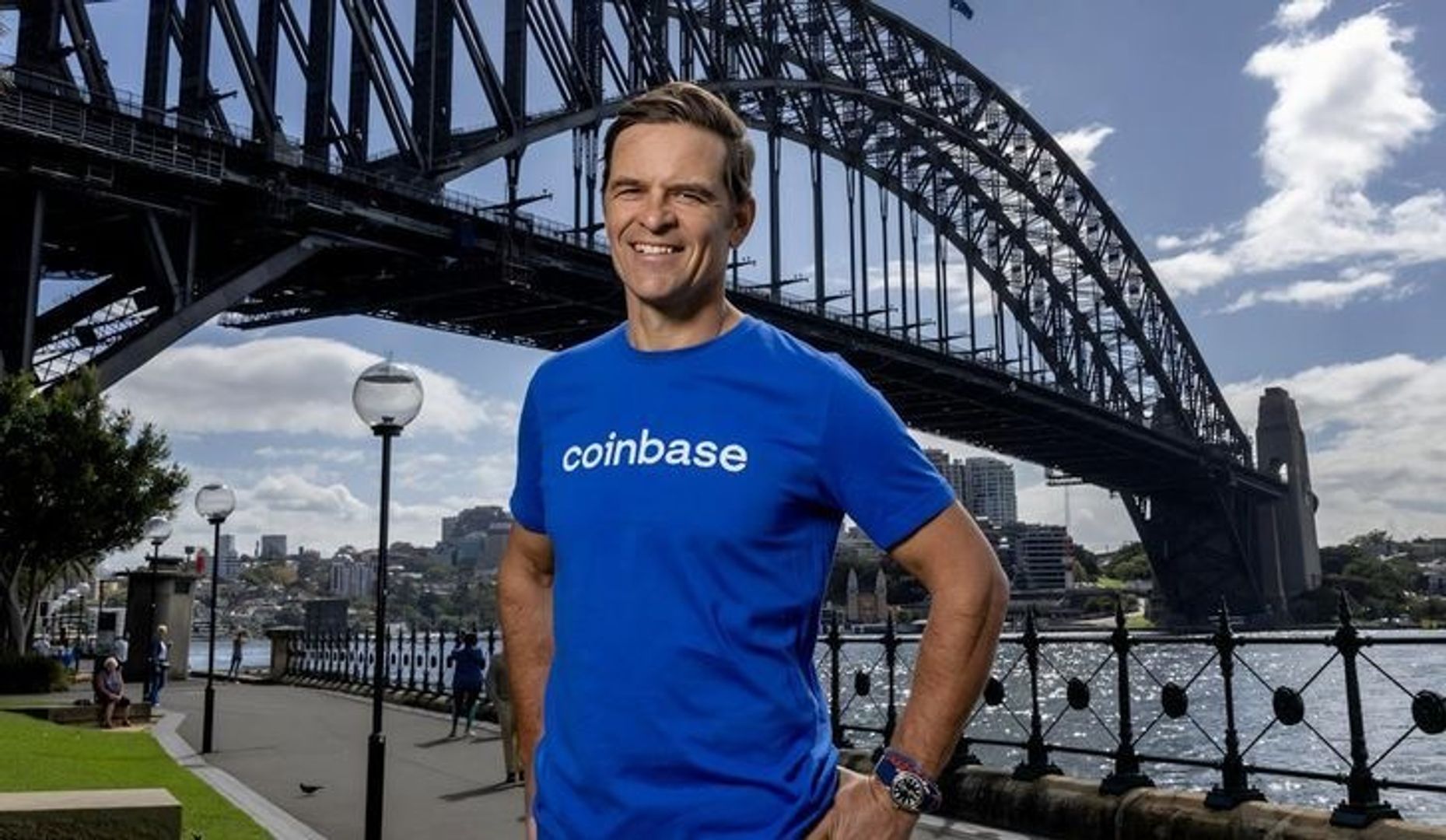
Nasdaq-listed Coinbase exchange announced Monday a major market move: the launch of direct rails for Indian rupees (INR).
Starting June 1, 2026, the exchange’s Indian customers can deposit and withdraw rupees directly from their bank accounts via the Immediate Payment Service (IMPS), a move designed to eliminate the need for intermediaries and simplify the often-clunky process of entering the crypto market in the region.
For a long time, Indians have had to rely on Peer-to-Peer (P2P) markets or third-party intermediaries to fund their crypto accounts. This method can be slow and, at times, risky, often leaving vulnerable users to payment scams or the sudden freezing of their bank accounts by law enforcement due to suspicious fund trails from unknown counterparties. Coinbase is bypassing that by integrating directly with the Immediate Payment Service (IMPS).
Coinbase’s latest move means its customers can transfer funds from their local bank accounts directly to the Coinbase platform and back again.
“India has long been one of the most important markets in crypto, in terms of developer talent, trading activity, and the broader adoption of blockchain technology,” said John O’Loghlen, Coinbase’s Head of APAC, in the announcement shared with CoinDesk.
The country has been ranked among the top countries driving crypto adoption in the APAC market in 2025, and ranked first in the Global Crypto Adoption Index, according to Chainalysis data. In fact, according to the consulting firm Imarc, the Indian cryptocurrency market reached $3.04 billion in 2025 and is projected to reach $14.21 billion by 2034, growing at a CAGR of 18.66% during 2026-2034 time period.
‘Here for the long-term’
The launch isn’t just for beginners, however. While retail traders can access spot markets for major assets, the platform is also introducing perpetual futures contracts.
For the “pro” crowd, the “Coinbase Advanced” suite will offer institutional-grade tools, including TradingView integration and sophisticated APIs. Notably, by building local INR order books, Coinbase ensures users aren’t trading against global prices but have dedicated liquidity right at home.
The goal is to provide the same platform trusted by global institutions to India’s massive retail base, Coinbase said.
Regulation has always been the elephant in the room for crypto in India.
Coinbase first opened its platform to Indians in 2022 but ran into a roadblock within days when the UPI operator, National Payments Corporation of India (NPCI), dismissed Coinbase’s then launch of UPI support, saying it was unaware of any such arrangement involving a crypto exchange.
Coinbase is tackling regulatory challenges head-on this time by registering with the Financial Intelligence Unit (FIU-IND), the central national agency responsible for analyzing and disseminating information on suspicious financial transactions.
The FIU registration is a clear signal that the exchange is seeking a long-term presence in the world’s fastest-growing major economy and most populous country.
The latest offering builds on years of quiet groundwork. Coinbase is already an investor in local exchange CoinDCX and has funneled over $1 million into Indian developers through its “Base” Layer 2 network.
“With the launch of direct INR rails, we’re making Coinbase fully accessible to Indian retail traders, with the same platform trusted by institutions and traders around the world. We’re registered with FIU-IND and here for the long-term,” O’Loghlen said.
Crypto World
XRP Inflows to Binance Fall to Lowest Level Since Early 2026 as Holding Sentiment Grows
TLDR:
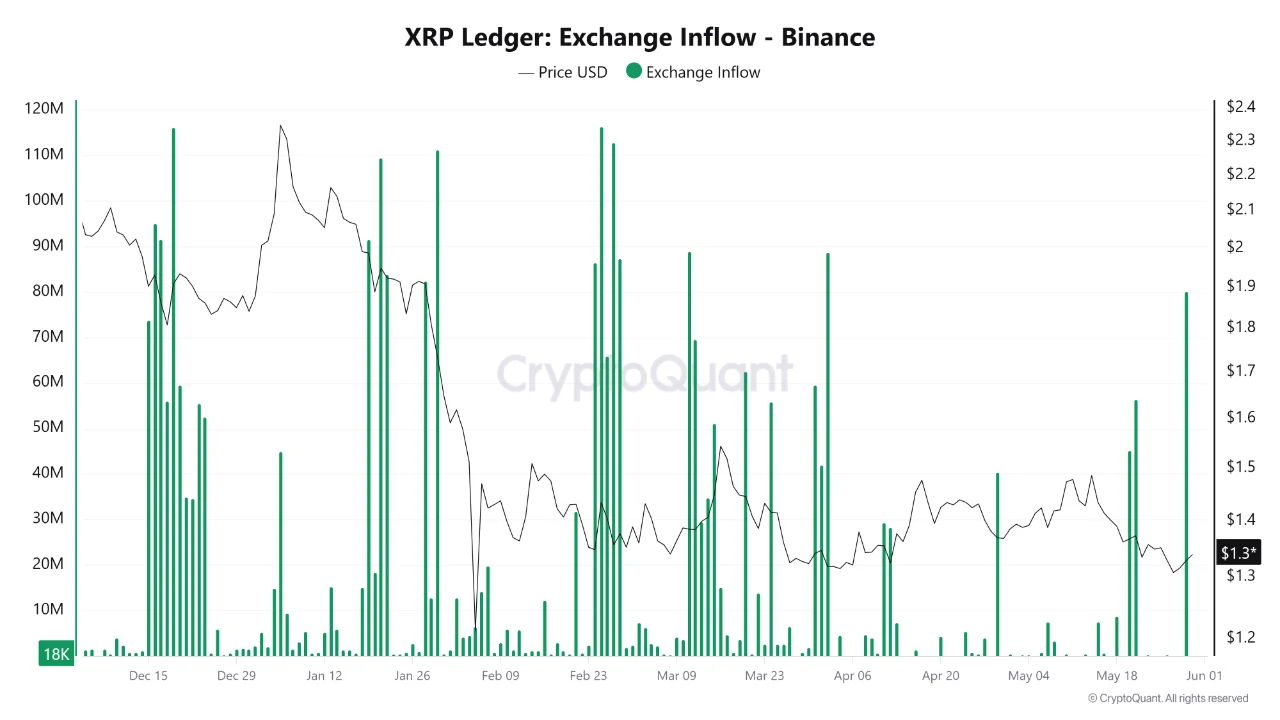
- XRP inflows to Binance dropped to just 215 million XRP in May, the lowest recorded since early 2026.
- The steady decline in inflows since Q2 began reflects reduced short-term selling intent among XRP holders.
- Historically low exchange inflows may point to tightening short-term supply, supporting steadier price action.
- Analyst Ali Charts watches $1.34 channel support, with upside targets set at $1.37 and $1.40 for XRP.
XRP inflows to Binance dropped sharply in May, reaching their lowest level since the start of 2026. Data shows only 215 million XRP moved to the exchange during the month.
That figure carries an estimated value of roughly $292 million. The decline came alongside continued uncertainty across the broader cryptocurrency market. Analysts are now watching what this shift could mean for near-term price behavior.
Declining Exchange Inflows Point to Reduced Selling Activity
Exchange inflows are a widely used metric for gauging investor behavior. Higher inflows generally suggest that holders intend to sell or trade their assets. A drop in inflows, on the other hand, often points to reduced selling intent.
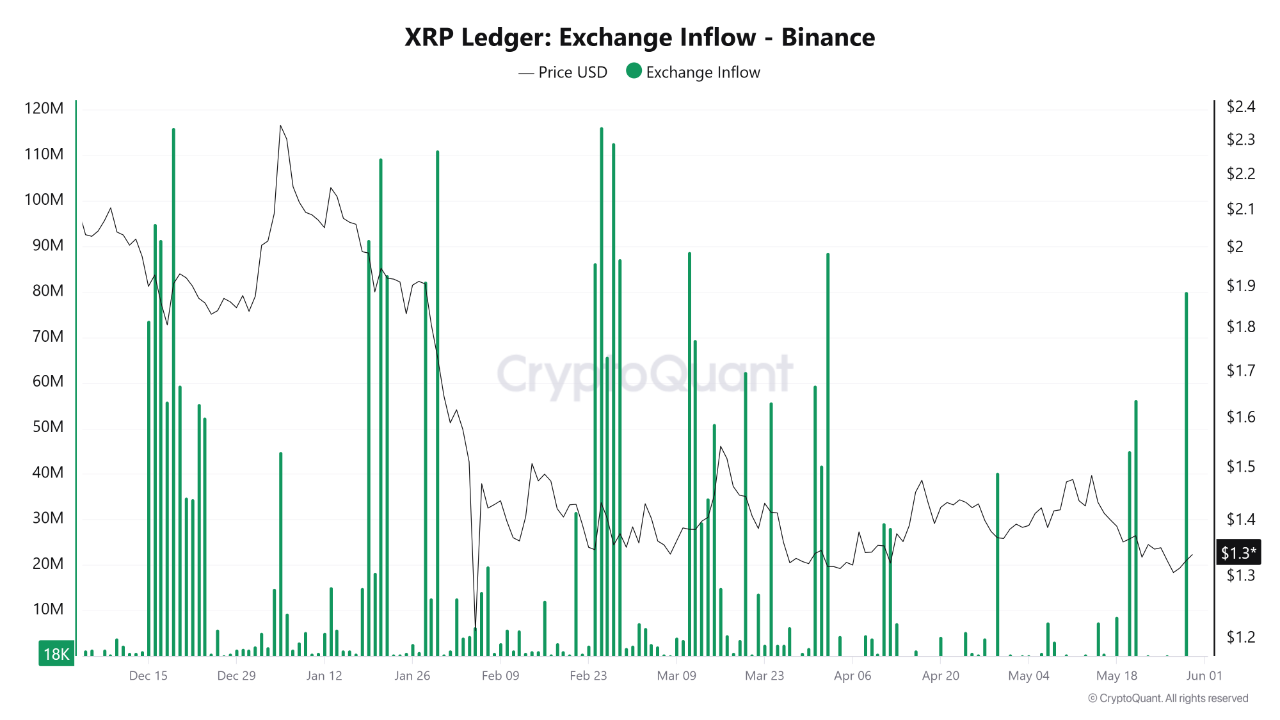
Source: Cryptoquant
In May, XRP inflows to Binance, the world’s largest crypto exchange, fell considerably. This marked a continuation of a gradual downtrend that started at the beginning of the second quarter. The decline coincided with relative price stability and lower volatility compared to earlier months.
The pattern suggests that fewer holders moved their XRP to centralized platforms last month. That behavior typically reflects a preference for holding assets off-exchange for longer periods. It also points to less rapid, short-term speculation in the market.
While falling inflows are not a guaranteed bullish indicator, they can reflect tightening short-term supply. When fewer coins reach exchanges, immediate sell-side pressure tends to ease. That condition may support steadier price action over time.
Technical Levels Draw Attention as Channel Support Holds
Beyond on-chain data, technical analysts are also monitoring XRP’s price structure. Crypto analyst Ali Charts noted on X that XRP remains inside a well-defined rising channel on the one-hour chart. The analyst identified the lower boundary near $1.34 as a key area to watch.
According to Ali Charts, that level aligns with current price action and could serve as a buying zone if buyers respond.
The repeated defense of channel support suggests bulls are maintaining higher lows. That pattern is commonly seen as a sign of trend continuation.
If XRP holds the $1.34 level, the next resistance sits near $1.37. A break above that level could then open a path toward $1.40, which matches the upper end of the ascending channel. A close below $1.34, however, would weaken the current setup and raise the risk of a deeper pullback.
Together, the on-chain and technical data present a cautious but watchful picture for XRP in June. Inflows remain historically low, and the price channel is still intact.
Market participants are now monitoring whether these conditions will hold or shift in the weeks ahead.

Bearish move or buying opportunity? Geojit’s Anand James on Nifty levels and top stocks to watch

Canelo finally reveals why he never agreed to fight David Benavidez

AMD’s Radeon RX 9070 GRE Graphics Card Is Now Available To Purchase


-

 NewsBeat5 days ago
Israel says it has killed new Hamas military leader in Gaza City airstrikes
-

 Tech5 days ago
NASA taps Blue Origin to deliver lunar rovers for Moon Base initiative
-

 Politics7 days ago
Bridgerton Season 5: Cast, Release Date And Everything We Know So Far
-

 News Videos5 days ago
XRP *JUST* SUCCEEDED!!!! CLARITY ACT EXPOSED!!! (SHE EXPOSED IT)
-

 Sports6 days ago
2026 NBA Finals schedule, odds: Knicks await Thunder or Spurs after winning East
-
Crypto World5 days ago
Micron Crosses $1 Trillion Market Cap as AI Demand Reshapes Memory Sector
-

 Business5 days ago
Selena Gomez Reportedly Upset Over Benny Blanco’s Comments on Her ‘Terrible’ Diet
-

 News Videos3 days ago
This is BROKEN! INSANE 5x MONEY CAR WASH WEEK! The NEW GTA Online UPDATE Today! (GTA5 New Update)
-

 Business7 days ago
BTS Sells Out Four Las Vegas Shows at Allegiant Stadium for ARIRANG World Tour
-
 NewsBeat6 days ago
Hottest May day ever as London hits 34.8C in 2C leap from previous records
-
 Tech6 days ago
China assigns ID codes to 28,000+ humanoid robots
-

 Business6 days ago
Nikkei 225 Surges Past 65,000 for First Time as Iran Peace Hopes Fuel Record Rally
-

 Tech7 days ago
Microsoft’s quiet Claude Code retreat and the real cost of enterprise AI
-

 Tech3 days ago
Waymo dominates autonomous vehicle registrations as Tesla trails behind
-

 NewsBeat7 days ago
Crowds find riverside shade in York as temperatures soar
-
Tech5 days ago
The Samsung pay deal is the moment Korean unions changed register
-

 Tech7 days ago
Westone Audio and Etymotic Acquired by Fidelity Collective in Major IEM Market Move
-
 Entertainment6 days ago
‘Breaking Bad’ Star’s Easy-to-Binge 6-Part Crime Series Spin-Off Is Finally Heading to Free Streaming
-

 Tech5 days ago
Millions of AI agents imperiled by critical vulnerability in open source package
-
Crypto World5 days ago
SpaceX’s $2 Trillion IPO: Why Tech Giants Nvidia (NVDA), Apple (AAPL), and Microsoft (MSFT) May Face Pressure
You must be logged in to post a comment Login