
Crypto World
Is Tesla (TSLA) Stock a Buy as Optimus Robot Production Nears?


TLDR
- Tesla stock was flat at $421.80 on Wednesday as investors awaited developments on the Optimus humanoid robot with production planned for 2026.
- An X poll showed Optimus winning as investors’ most anticipated Tesla product for the year, beating Cybercab and semi-truck options.
- Tesla is converting its Fremont Model S and Model X production space into an Optimus factory targeting one million units annually.
- The company will discontinue the Model S and Model X to make room for Optimus production lines at the California facility.
- Tesla stock trades at 259 times earnings with a $1.4 trillion market cap as the company transitions from electric vehicles to AI robotics.
Tesla stock held steady at $421.80 on Wednesday morning. The lack of movement came as investors digested recent developments around the company’s humanoid robot project.
S&P 500 and Dow futures traded higher by 0.3% and 0.2% respectively. No analyst rating changes or price target adjustments hit the stock during the session.
The most interesting development came from social media. A poll on X asked investors which Tesla product excited them most for the year ahead.
Optimus won by a landslide. The humanoid robot beat out the Cybercab, semi-truck, and stationary storage in voting. Over 16,000 votes were tallied by early Wednesday.
The poll reflects growing anticipation around Tesla’s robotics push. CEO Elon Musk has repeatedly called Optimus the company’s future.
A Factory Transformation Underway
Musk outlined specific plans during Tesla’s January 28 earnings call. The company will convert Model S and Model X production space at its Fremont, California factory.
That space will become an Optimus manufacturing facility. The long-term target is one million robot units per year from that location alone.
Production should begin in 2026. Musk said Tesla plans to unveil the third generation robot in “a few months.”
The decision to retire legacy vehicle models shows serious commitment. Model S and Model X currently represent a small portion of Tesla’s sales. But discontinuing them marks a clear pivot point for the company.
Tesla is moving resources from traditional electric vehicles to AI-powered products. This includes both Optimus and the Robotaxi ride-hailing service.
The Numbers Tell a Stretched Story
Tesla’s market cap sits at $1.4 trillion. The stock trades at $430 per share based on recent pricing.
The company finished its 2025 fiscal year with non-GAAP earnings of $1.66 per share. That puts the stock at 259 times earnings.
Analysts project earnings of $2.12 per share for 2026. They forecast $3.00 per share by 2027. Even using those future estimates, Tesla trades above 100 times earnings two years out.
Tesla stock has gained 10% over the past 12 months. But it dropped about 2% following the January earnings report.
The earnings call generated one downgrade from Battleroad Research analyst Ben Rose. He cited higher capital spending on AI projects as a concern.
Tesla plans to spend $20 billion on new plants and equipment in 2026. That’s up from less than $9 billion in 2025.
The average analyst price target rose by about $4 after earnings. That increase represents less than 1% movement.
Experts believe the humanoid robotics market could reach $5 trillion by 2050. Musk wants Tesla positioned as an early mover in that space.
Other companies are already training humanoid robots for factory work. Some industry watchers speculate Optimus could perform real-world applications later in 2026.
Tesla’s vehicle business has declined as the company shifts focus. Musk appears comfortable with this transition.
The stock reflects a loyal shareholder base willing to wait for long-term potential. Whether current prices leave room for near-term gains remains unclear.
Tesla plans to unveil the third generation Optimus robot in the coming months.




Stanford’s 2026 AI Index shows the performance gap between US and Chinese AI models has compressed to just 2.7%, down from a double-digit lead as recently as 2023, as Anthropic’s Claude Opus 4.6 holds a 39-point Elo lead over ByteDance’s best-performing model on the benchmarks Stanford tracks.
Summary
- The 423-page report, released April 14, finds that the US and Chinese models have traded first place multiple times since early 2025, with DeepSeek-R1 briefly matching the top US model in February 2025 before being surpassed.
- The US leads China in private AI investment ($285.9 billion vs $12.4 billion) and notable model production (50 vs 30 in 2025), while China leads in AI publication volume, patent output, and industrial robot installations.
- The number of AI researchers entering the US has dropped 89% over seven years and 80% in the past year alone, a trend the report attributes in part to H-1B restrictions under the Trump administration.
Stanford’s 2026 AI Index, released April 14, documents the near-disappearance of the US performance advantage in artificial intelligence, with the top American model leading the best Chinese model by just 2.7% on the Arena Leaderboard benchmarks Stanford tracks as of March 2026.
The 423-page report from Stanford’s Institute for Human-Centered AI puts the specific figures starkly: in 2023, performance gaps between leading US and Chinese models ranged from 17.5 to 31.6 percentage points on major benchmarks including MMLU, MATH, and HumanEval. By the end of 2024, those gaps had collapsed to 0.3, 1.6, and 3.7 percentage points respectively. The current 2.7% Elo lead between Anthropic’s Claude Opus 4.6 and ByteDance’s Dola-Seed-2.0 Preview is narrow enough to flip on the next major release from either side.
The US advantage remains substantial in investment, infrastructure, and model production. American companies poured $285.9 billion into AI in 2025, 23.1 times China’s $12.4 billion private investment. The US produced 50 notable AI models in 2025 against China’s 30. The US hosts 5,427 data centers, more than ten times any other country.
High-impact patents, where quality of innovation matters more than volume, also favor the US. China leads globally in total patent output, filing 69.7% of all AI patents worldwide. But Stanford’s analysis distinguishes between patent volume and patent impact, and American researchers still produce more commercially influential intellectual property.
Where China Has Surged
China now produces 23.2% of all global AI publications and receives 20.6% of all global AI research citations, compared to 12.6% for the US. Chinese organizations installed 295,000 industrial robots in 2024, versus 34,200 in the United States, with China accounting for 51.1% of global industrial robot installations. The report notes that Chinese government guidance funds, estimated at $912 billion deployed across industries since 2000, mean that private investment figures substantially understate China’s total AI resource commitment.
South Korea has emerged as the world leader in innovation density, filing more AI patents per capita than any other country, introducing a third significant competitor into a rivalry previously framed as bilateral.
The Talent Warning
The report’s most alarming finding for US policymakers may be the talent data. The number of AI researchers entering the United States has dropped 89% over the past seven years, with an 80% decline in the past year alone. New H-1B visa restrictions that include a $100,000 employer fee per hire are cited as a contributing factor.
The Stanford data landed directly in the context of the ongoing US-China AI race that has driven the most significant infrastructure and semiconductor investments in the country’s history, including the NVIDIA Ising quantum AI models launched this week and the Terafab chip project. For AI tokens and the broader crypto-AI intersection, the convergence of the two countries’ capabilities matters: it removes the assumption that US systems have a durable lead and raises the competitive stakes on each new model release.


CFTC AI news came directly from Capitol Hill Thursday as Chairman Mike Selig told the House Agriculture Committee that artificial intelligence tools, specifically Microsoft’s Copilot, are filling surveillance and investigation gaps at an agency that has lost roughly 25% of its workforce since 2025, even as Congress prepares to hand it primary oversight of the US crypto market.
Summary
- Tools such as AI are going to be very helpful in surveilling and bringing the investigations, and we’re incorporating that into various workflows,” Selig told lawmakers, citing Copilot as one productivity tool across the agency.
- The CFTC currently operates with only Selig as its single sitting commissioner out of five required by law, with four seats vacant including both minority-party positions.
- Selig confirmed “numerous investigations ongoing” in prediction markets, where platforms like Polymarket and Kalshi have drawn scrutiny for well-timed trades tied to US military actions and government announcements.
CFTC AI news emerged from Thursday’s House Agriculture Committee oversight hearing as Chairman Mike Selig defended his agency’s shrinking headcount by pointing to productivity gains from AI tools, even as lawmakers pressed him on whether the CFTC has the resources to oversee both a rapidly growing crypto market and a prediction market sector that has ballooned into the billions of dollars in annual volume.
The agency has lost approximately 25% of its staff since 2025 under President Trump’s federal workforce reduction drive. Enforcement division staffing, at roughly 108 positions after a recent budget request for three new hires, is still 23% below the 140 enforcement employees on record in 2025. The CFTC currently operates with Selig as the sole sitting commissioner, with four of five legally required positions unfilled including both minority-party seats.
“Tools such as AI are going to be very helpful in surveilling and bringing the investigations, and we’re incorporating that into various workflows,” Selig told lawmakers. He specifically cited Microsoft’s Copilot as one productivity tool woven into agency workflows. When asked directly about the staff declines, Selig replied: “We are running more efficiently and effectively.”
The CFTC is simultaneously pursuing two expansions that would dramatically increase its regulatory footprint. First, the CLARITY Act, which is moving toward a Senate Banking Committee markup in late April, would designate the CFTC as the primary regulator of non-securities crypto trading, giving it oversight of Bitcoin, Ethereum, and every digital commodity that doesn’t meet the SEC’s securities definition. Second, the CFTC is asserting exclusive federal jurisdiction over prediction markets, a claim currently being contested in courts by multiple states.
Committee Chairman Glenn “GT” Thompson noted the contradiction. “We’re putting a lot on your plate with digital assets, and we’re obviously going down this path with prediction markets,” he told Selig, then asked him to request more staff if operational needs required it. Selig said “Absolutely” and reiterated that enforcement remains a “top priority.”
Prediction Market Investigations and Insider Trading
The prediction market scrutiny has been intense. Multiple members questioned Selig about trades on Polymarket, Kalshi, and other platforms in which small numbers of anonymous accounts appear to have made significant profits on bets tied to US military actions and government announcements, suggesting potential access to non-public information. Reports have identified roughly six Polymarket accounts that earned $1.2 million on correct bets about US Iran strikes placed hours before the February 28 action became public.
Selig said the agency has “numerous investigations ongoing” in prediction markets but declined to quantify or describe them, saying doing so could compromise active work. He described the regulated platforms as the “first line of defense” before the CFTC acts.
Ranking Member Angie Craig of Minnesota said flatly that the CFTC “cannot adequately oversee digital commodity trading and prediction markets” with current resources. She and Thompson announced plans to write to the White House urging bipartisan commissioner nominations. The single-commissioner structure has broader implications for the CLARITY Act rulemaking process: Selig indicated he would not wait for a full commission. “We cannot for the sake of the American people slow down our rulemaking,” he said, signaling he would advance major regulations alone if necessary, a position that could invite legal challenges to any rules adopted without bipartisan deliberation.
As the CFTC’s crypto role expands, Selig’s claim that AI can offset a quarter of the workforce will face a direct test once the CLARITY Act passes and the full weight of digital asset oversight lands on an agency that, by its own data, has 23% fewer enforcement officers than it needs.
Crypto World
Ton Price Prediction: TON Targets $1.51 While Pepeto 300x Heats Up After CoinMarketCap Listing
The ton price prediction for April 2026 covers TON technical levels, Rakuten Wallet’s launch of TON spot trading on April 15, and how the Pepeto presale compares for traders watching the meme coin and exchange token space.
Toncoin (TON) gained 12% over the past seven days after Rakuten Wallet opened spot trading for the token on April 15 and the Catchain 2.0 upgrade cut block times to 400 milliseconds, per Blockonomi. Trading volume jumped 148% in 24 hours while the top 100 whale wallets added 189,730 TON during the same stretch. The ton price prediction at a $1.51 breakout looks solid, but the tools that help retail traders catch the next wave before the crowd still do not exist for most buyers.
Pepeto was built to close that gap with a live exchange that spots early entries before the wider market picks up on them. More than $8,940,333 raised and a verified CoinMarketCap page put Pepeto days from its Binance listing. The window to lock in presale price is shutting fast.
Ton Price Prediction: TON Holds $1.41 With a $1.51 Breakout in Sight
TON trades at $1.41 today, sitting roughly 83% below its $8.25 all time high, and the $1.51 resistance level will shape where it heads next this month. Blockchain News projects the ton price prediction for late April between $1.35 and $1.51, with an average target near $1.42.
Changelly reported that TON is building inside a range between $1.35 and $1.51 with RSI near 51 in neutral ground, and a clean break above $1.51 could push the next leg toward $1.60 on rising volume.
Tokens built to catch the move before it starts
Pepeto: If you missed last cycle’s best entries, this is the one staring you in the face right now
When whale wallets add nearly 190,000 TON in a single week and a major Japanese exchange opens the trading pair, capital is clearly lining up. Most retail wallets only notice the flow once the move already happened. Pepeto just landed on CoinMarketCap, and the Binance listing is days away. The exchange closes that timing gap with tools that flag early entries before the broader market catches on.
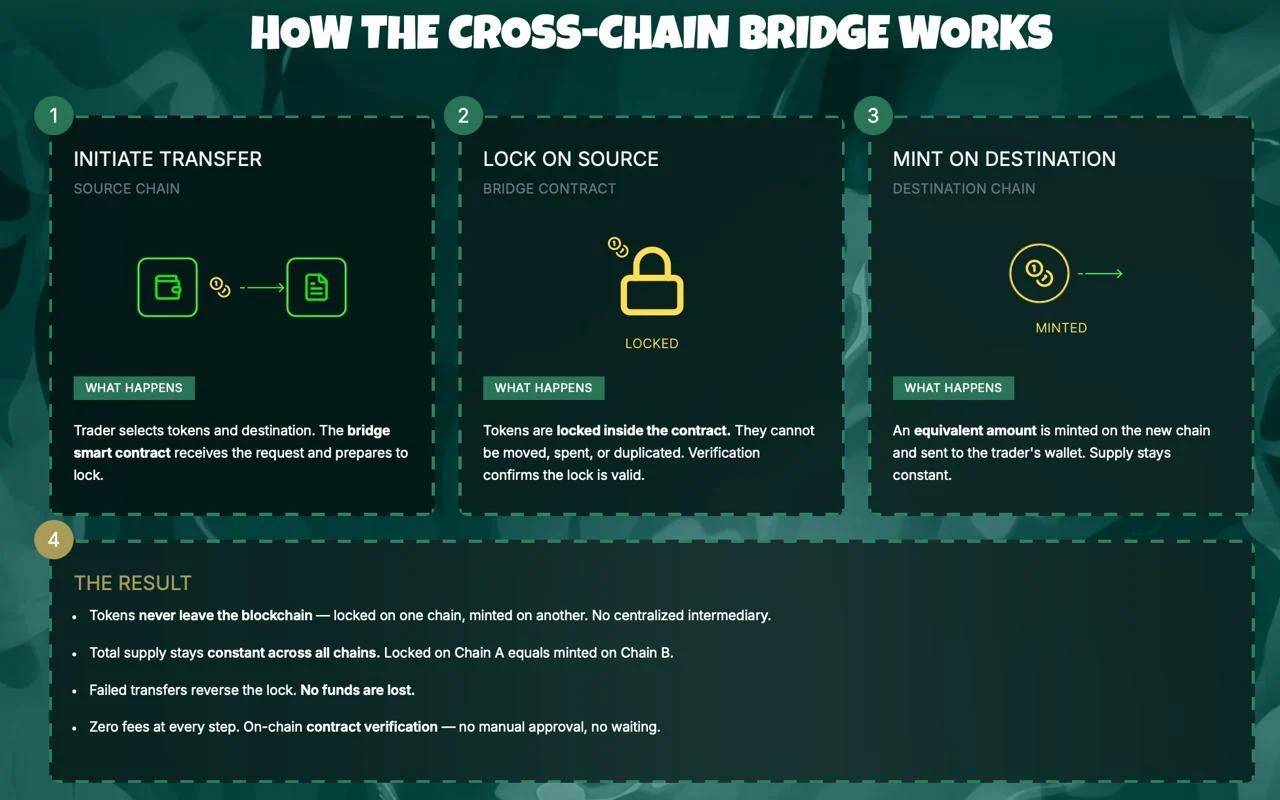
The cross chain bridge pushes meme tokens between networks in seconds, and the scanning engine spots new projects at their cheapest price point.
Behind this entry sits a finished SolidProof audit protecting the contract, the same founder who built the original Pepe to an $11 billion market cap with zero products, and a team member who previously worked inside Binance running the listing rollout.
At $0.0000001863 per token, more than $8,940,333 has flowed into the presale across 420 trillion tokens, with staking running at 185% APY. Once Binance trading goes live, the analyst target sits between 300x and 1000x from this floor. Last cycle rewarded the earliest wallets with life changing gains, and Pepeto carries the same setup now, a confirmed listing closing in while presale buyers hold the lowest entry that vanishes the moment public trading opens.
Ton Price Prediction: TON Targets $1.51 in April and $5.03 by Year End From $1.42
Toncoin (TON) Price at $1.42 as Rakuten Wallet Opens Spot Trading
Toncoin (TON) trades at $1.42 according to CoinMarketCap, ranked number 33 with a $3.45 billion cap per CoinMarketCap. Blockchain News targets a $1.42 average for April with a peak near $1.51. Changelly’s bull case hits $5.03 by mid autumn 2026, roughly 256% from current levels.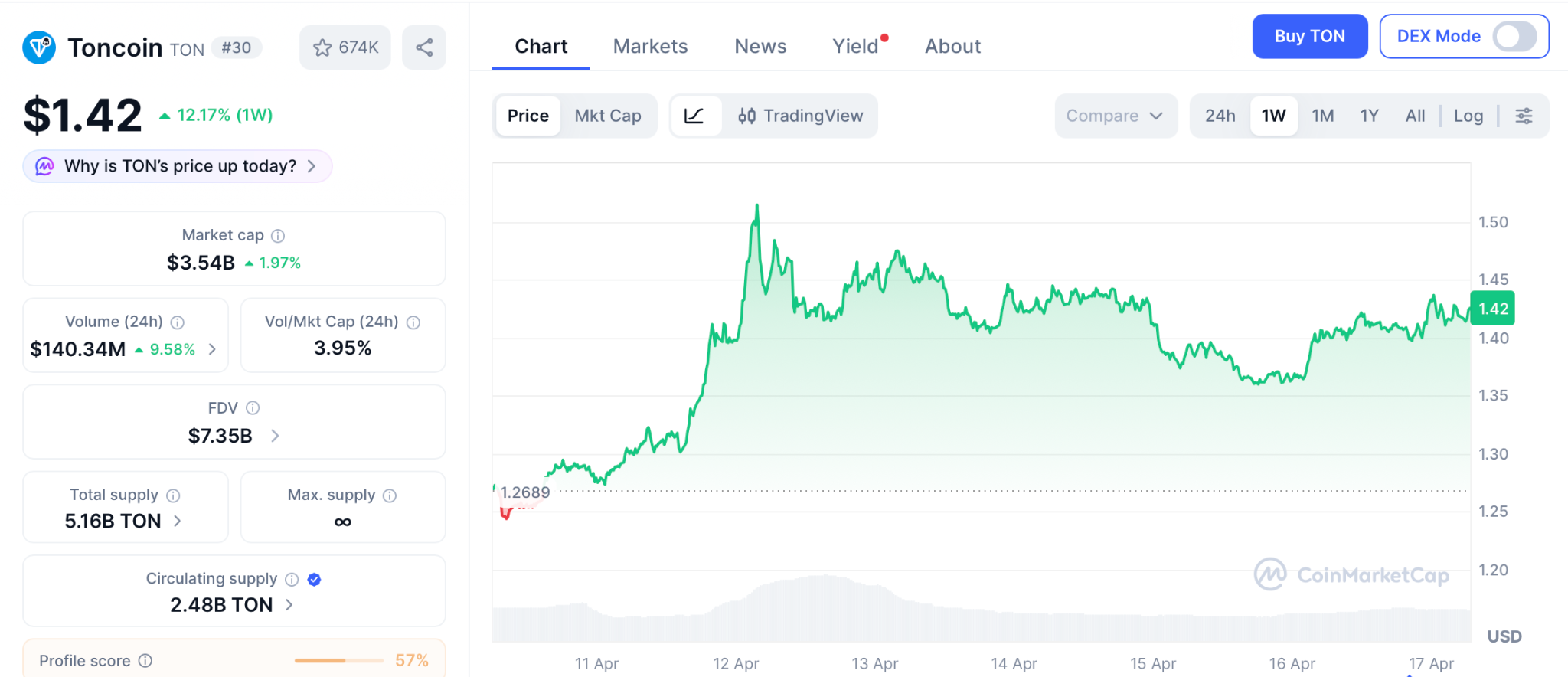
The network just processed Catchain 2.0 and volume jumped 148% in a day, but even the bullish TON forecast delivers gains that take months. A presale backed by a confirmed Binance listing hands you the ground floor now, with weeks to listing day instead of months of waiting.
Conclusion
The ton price prediction targets 256% at best over months while the network absorbs Catchain 2.0 and capital keeps flowing in, but last cycle the wallets that hit the biggest returns entered the strongest setups while fear was still running. That missed window is what Pepeto was built for, with a working exchange, a finished SolidProof audit, a Pepe cofounder driving the build, and the Binance listing locked in.
Getting in at presale price while TON keeps you waiting months for smaller gains is where real crypto wealth gets built. Click below to enter the Pepeto presale before the Binance listing hits.
Click To Visit Pepeto Website To Enter The Presale

FAQs
What does the ton price prediction look like for April 2026?
Toncoin (TON) targets a range of $1.35 to $1.51 for April with a breakout level at $1.51 after Catchain 2.0 cut block times to 400ms. Pepeto at presale price with a confirmed Binance listing offers returns that TON cannot match from $1.41.
How does Toncoin’s Rakuten Wallet listing change the outlook for TON holders watching Pepeto?
Rakuten Wallet added TON spot trading on April 15, boosting volume 148% in a single day. Pepeto at $0.0000001863 with $8,940,333 raised and a Binance listing days away gives traders a presale floor that turns into 300x to 1000x when volume opens.
Disclaimer: This is a Press Release provided by a third party who is responsible for the content. Please conduct your own research before taking any action based on the content.



Summary
- Polish Prime Minister Donald Tusk has accused crypto exchange Zondacrypto of using “Russian funds linked to organized crime” and “Russian security services” to finance opposition politicians and block a MiCA‑style crypto bill.
- Tusk told parliament that some lawmakers fighting his government’s crypto‑asset legislation were “serving the interests” of Zondacrypto, which he said sponsored a CPAC event in Poland where former U.S. Homeland Security Secretary Kristi Noem endorsed nationalist Karol Nawrocki’s presidential bid.
- President Nawrocki, elected in June 2025 with backing from former U.S. President Donald Trump, has twice vetoed MiCA‑aligned regulation, leaving Polish exchanges in legal limbo and deepening a national‑security‑tinged standoff over how to police digital assets.
Speaking in the Sejm on Friday ahead of a vote on overturning his rival’s veto, Tusk claimed that “Russian money was behind the Zondacrypto cryptocurrency platform,” which he alleged has “supported political and social initiatives” aligned with right‑wing groups in Poland. He told lawmakers that the firm’s backing was tied “not only to Russian capital” but also to “groups connected to the so‑called bratva, a term for Russian mafia organizations, as well as Russian security services.”
Tusk links Zondacrypto to Russian ‘Bratva’ and intelligence
According to Tusk, internal security agency findings show that Zondacrypto “sponsors political and social gatherings in Poland and champions very particular political factions,” including politicians from the former ruling Law and Justice party and the far‑right Confederation. He highlighted the exchange’s role as a “significant sponsor” of a Conservative Political Action Conference event in Rzeszów in March 2025, where Kristi Noem publicly backed Karol Nawrocki’s presidential campaign.
Tusk framed the latest vote as a security test, telling parliament there is “no doubt that this market is extremely vulnerable to manipulation by foreign services, intelligence organizations, and criminal enterprises.” In a post on X, he cast the regulatory fight as a straight choice between “Russian money and services versus the security of the state and citizens.”
The political clash comes after President Nawrocki twice blocked government efforts to align Poland with the EU’s Markets in Crypto‑Assets framework. In February, he vetoed a second crypto‑asset bill he described as “practically identical” to legislation he had already rejected in December 2025, arguing that the government’s model was “flawed” and would hurt consumers and smaller firms.
That stance has left Warsaw as a MiCA outlier. Without enabling legislation, Polish exchanges and wallet providers have no domestic route to start the licensing process required under EU rules, putting them at a disadvantage to peers in countries that are already issuing MiCA authorizations. A previous attempt to overturn an earlier veto also failed in December 2025, when parliament upheld Nawrocki’s decision despite Tusk warning that unregulated platforms were “particularly vulnerable to manipulation by foreign intelligence services, organized crime, and mafias.”
For now, Zondacrypto has not publicly commented in detail on the latest accusations, while the president’s office insists it does not oppose crypto regulation per se but rejects the government’s approach. As other EU members move ahead with MiCA licensing and enforcement, Poland’s fight over whether its crypto market is a vector for Russian “Bratva” money or a sector strangled by political point‑scoring is turning into a wider test of how national security, party financing and digital‑asset rules intersect in Europe.
Related crypto.news coverage on regulation and security risks in digital assets includes an explainer on why the U.S. is pushing tokenization‑friendly accounting, an analysis of how Trump‑era regulatory pullbacks reshaped the SEC’s crypto unit, and a report on MiCA‑aligned stablecoin rules emerging in other jurisdictions.

TLDR:
- Over 257K LINK tokens moved from Binance hot wallets to external addresses within a 15-hour window
- Transfers were distributed across wallets like 0x21a, 0x28C, and 0xDFd, showing multi-address activity
- Wallet 0x3C1 recorded the largest single transfer, moving 64,699 LINK worth about $618K in one transaction
- Repeated LINK outflows suggest ongoing exchange-to-wallet movement tracked across on-chain monitoring systems
Large Bitcoin exchange activity on Binance shows notable LINK withdrawals moving from hot wallets to multiple private addresses reported recently.
Data shared by Nazoku indicates over 257,000 LINK tokens moved within fifteen hours across several identified wallet addresses on Binance.
Binance records over 257K LINK withdrawals
On-chain tracking systems recorded heavy LINK movement from Binance hot wallets to externally controlled addresses during recent hours.
Transfers involved multiple destination wallets including 0x21a, 0x28C, and 0xDFd as reported by monitoring dashboards across network systems.
Total recorded withdrawals exceeded 257,000 LINK tokens, valued at approximately 2.45 million dollars at time reporting market data feeds.
Activity was tracked across multiple blockchain analytics platforms observing continuous movement from exchange wallets to private storage systems reporting.
One highlighted transaction involved wallet 0x3C1 transferring 64,699 LINK in a single movement from Binance account as recorded data.
Such transfers were followed closely by market observers tracking exchange reserves and liquidity changes across trading platforms daily updates.
Blockchain monitoring platforms also captured repeated withdrawal patterns showing consistent movement of LINK tokens from exchange hot wallets.
Several analytics services confirmed that transfers were distributed across multiple addresses without a single dominant flow source.
Data collected across monitoring tools showed continued outflow activity over a fifteen-hour observation window involving several wallet clusters.
These movements were recorded through real-time dashboards tracking exchange wallet behavior across multiple blockchain networks.
Large wallet accumulation observed across identified addresses
Wallet accumulation activity involved several newly identified addresses receiving LINK from centralized exchange withdrawals during the observation period.
Top receiving wallets included address 0x21a, 0x28C, and 0xDFd, showing repeated inflows within short intervals on-chain movement logs.
Wallet 0x3C1 recorded the largest single transaction, moving 64,699 LINK tokens from Binance infrastructure wallets, according to analysis data.
This transaction stood among the highest value transfers during the observed reporting cycle across tracking systems data checks.
Blockchain monitoring platforms noted repeated transfer patterns suggesting ongoing distribution from exchange custody systems across reported datasets logs.
Multiple wallets showed consistent inflows, indicating structured movement rather than isolated transfers within exchange-linked accounts.
Data shows continued movement of LINK tokens leaving Binance hot wallets over a fifteen-hour window, as recent network tracking.
Monitoring services continue tracking LINK movements from Binance wallets to assess ongoing exchange supply changes in real-time systems.
Further wallet transfers are expected to be analyzed as blockchain data updates become available through feeds, continuing surveillance logs.
Data aggregation platforms maintain records of LINK flows across exchanges, providing transparency for market participants’ network monitoring reports.


Payward, the parent company of Kraken, agreed to acquire Bitnomial, the first US crypto derivatives platform to hold all three CFTC licenses simultaneously, for up to $550 million in cash and stock, in a deal that values Payward at $20 billion and is expected to close in the first half of 2026.
Summary
- Bitnomial is the first crypto-native US firm to hold all three CFTC licenses required for a full-stack derivatives business — a designated contract market, a derivatives clearing organization, and a futures commission merchant — giving Payward the infrastructure to run an exchange, clear trades, and offer brokerage services inside one regulated framework.
- The deal follows Deutsche Börse’s $200 million investment for a 1.5% stake in Payward and builds on Payward’s $1.5 billion NinjaTrader acquisition in 2025, completing regulated derivatives coverage across the US, UK, and EU.
- Payward Co-CEO Arjun Sethi said the company is “adding the infrastructure layer that makes the next generation of US derivatives possible,” framing the acquisition as foundational infrastructure rather than a traditional company purchase.
The deal covers 100% of Bitnomial’s equity. The Chicago-based firm spent over a decade securing three separate CFTC approvals — a designated contract market, a derivatives clearing organization, and a futures commission merchant registration — the combination that allows a single entity to run an exchange, clear trades, and offer brokerage services under one CFTC-regulated roof. No other crypto-native US firm holds all three simultaneously.
Payward will integrate Bitnomial’s infrastructure across Kraken, NinjaTrader, and Payward Services, its business-to-business platform. Banks, fintechs, and brokerages will access regulated US crypto derivatives through a single API covering futures, options, and leveraged products inside a CFTC-regulated framework.
Co-CEO Arjun Sethi described the acquisition as foundational rather than transactional. “We are not acquiring a company,” he said. “We are adding the infrastructure layer that makes the next generation of US derivatives possible.” Building a CFTC-regulated clearinghouse independently requires years of regulatory engagement and capital commitment. Bitnomial collapses that timeline to the length of a deal close.
Payward generated $2.2 billion in revenue in 2025, up 33%, with its platforms processing roughly $2 trillion in transactions and holding over $48 billion in customer assets at year-end.
How This Fits Payward’s Broader Strategy
The Bitnomial deal completes Payward’s global derivatives build. The company acquired a UK crypto futures platform in 2019, launched EU regulated derivatives in 2025, and purchased NinjaTrader for $1.5 billion the same year, giving it retail futures access and a first CFTC registration. Bitnomial adds exchange, clearing, and brokerage licenses on top, creating a vertically integrated US derivatives business.
The announcement follows Deutsche Börse’s $200 million investment for a 1.5% stake, a transaction that valued Payward at approximately $13.3 billion. The $20 billion valuation embedded in the Bitnomial deal reflects the strategic premium the market is placing on regulated crypto derivatives infrastructure heading into an environment where the CLARITY Act would formally establish CFTC authority over non-securities digital asset trading.
The IPO Context
Payward’s IPO filing remains active. Co-CEO Sethi confirmed on April 14 that a public offering is “still on the table” despite pausing formal preparations in March due to difficult market conditions. A full-stack CFTC-licensed derivatives business strengthens both the institutional narrative and the revenue diversification story that supports a premium IPO valuation ahead of any eventual listing.


The bank says it plans to add other stablecoins across multiple blockchains to the service.
Singapore Gulf Bank (SGB) announced on Friday that it has launched a stablecoin mint and redeem service, allowing its corporate and high-net-worth clients to convert directly between fiat and stablecoins from within their SGB accounts.
The in-bank stablecoin settlement service, which SGB first announced in February, at launch supports USDC on Solana for transactions above $100,000.
The launch follows SGB’s recent admission to the Circle Alliance Program, Circle’s global network of USDC-focused partners.
Per SGB’s announcement, the bank plans to add support for other stablecoins, including USDT, USDe and USDG, across multiple chains in the future.
To mark the launch, SGB is waiving gas and bank fees for minting and redeeming on the Solana blockchain for a limited period, with volume-based rewards to follow. Stablecoin minting and redemption are integrated into SGB Net, the bank’s proprietary clearing network, allowing funds to move between on-chain and off-chain environments within a regulated framework.
CEO Shawn Chan framed the launch as a response to real client pain points: cross-border capital movement has become a key constraint on growth, and embedding stablecoins into banking removes that friction:
“By integrating stablecoin mint and redeem directly into the banking environment, we enable real-time movement between fiat and digital assets, improving cash flow, payments, and treasury management. We are building the bank for a borderless world, where businesses and individuals operate across jurisdictions”
As Business Times reported, SGB is a fully licensed digital wholesale bank based in Bahrain, founded by Singapore-based private investment firm Whampoa Group and backed by Bahrain’s sovereign wealth fund, Mumtalakat.
The launch arrives as stablecoins cement their role in institutional finance. As The Defiant reported, stablecoins stopped being “crypto products” in 2025 and started acting like infrastructure, with enterprise adoption accelerating across payments, treasury, and settlement.
Last fall, Coinbase and Citigroup teamed up to help Citi’s institutional clients use stablecoins to move money faster without abandoning traditional banking systems, pairing Coinbase’s digital asset infrastructure with Citi’s payments network spanning 94 markets.
Earlier this month, Circle launched Circle Payments Network (CPN) Managed Payments, a stablecoin settlement solution designed to let TradFi firms use stablecoin rails for fiat transactions, abstracting complexity for the firms.
This article was written with the assistance of AI workflows. All our stories are curated, edited and fact-checked by a human.


X’s new cashtags trading pilot for stocks and crypto reached an estimated $1 billion in volume within days of its Tuesday launch.
X generated approximately $1 billion in global trading volume following the launch of its cashtags feature on Tuesday, according to Head of Product Nikita Bier. The feature enables users to trade stocks and cryptocurrency directly on the platform, converting social engagement into financial execution at scale. The milestone was reached within days of the pilot going live.
The rapid adoption underscores X’s ability to leverage its massive user base for financial trading activity. The cashtags pilot represents a significant expansion of X’s presence in the retail and institutional trading landscape, combining social networking infrastructure with direct market access for crypto and equities.
Sources: WatcherGuru | BSCNews
This article was generated automatically by The Defiant’s AI news system from publicly available sources.
HBAR price prediction improved Friday as Hedera gained 1.4% and Stellar’s XLM added 1.5% to top the CoinDesk 20 performance update, placing the index at 2,125.52, up 0.3% from Thursday’s close, with just 9 of 20 assets trading higher as Bitcoin approached the $76,000 resistance level that has capped every major rally attempt in 2026.
Summary
- Laggards included Near Protocol at -2.3% and Polkadot at -1.6%, reflecting the selective nature of Friday’s session as capital rotated toward payment-layer and enterprise-backed tokens rather than broad altcoin names.
- HBAR’s 24-hour trading volume surged 57.6% to over $103 million, a signal of directional positioning ahead of the April 22 Iran ceasefire deadline that has driven selective rotation toward utility networks with institutional governance backing.
- Stellar’s Protocol 26 “Yardstick” testnet launched April 16, with a mainnet governance vote scheduled for May 6, while LOBSTR Wallet added XRP Ledger support for 1.5 million users the same day, deepening cross-chain utility between two payment-focused ecosystems.
HBAR price prediction improved Friday as both tokens outperformed the CoinDesk 20’s 0.3% gain by a wide margin, with Hedera rising 1.4% and Stellar 1.5% against an index that saw 11 of 20 assets move flat or lower. Bitcoin’s push toward $76,000 drove selective altcoin rotation, and both HBAR and XLM carry the profile that tends to lead early in such moves — payment-layer infrastructure with institutional governance and regulatory credibility.
Near Protocol fell 2.3% as the session’s worst performer, and Polkadot dropped 1.6%. General-purpose Layer-1 networks with slower development cadences underperformed, while tokens with specific near-term catalysts and enterprise backing attracted the session’s marginal buying.
Hedera’s volume surge to $103 million — up 57.6% on the day — signals targeted positioning rather than passive drift alongside BTC. Several catalysts have built in the ecosystem since March. McLaren Racing joined the Hedera Governing Council in March 2026 as a full voting member, committing to digital collectibles programs across the F1 and IndyCar seasons and giving the network access to a global sports audience.
The Canary Capital HBAR ETF, trading on Nasdaq under the ticker HBR since October 28, 2025, accumulated $93.21 million in cumulative ETF inflows by early 2026, making HBAR the third cryptocurrency to achieve US spot ETF status. Hedera’s governing council includes Google, IBM, Boeing, NVIDIA, and ServiceNow. The network has processed over $10 billion in real-world asset settlements including tokenized bonds and cross-border payments, giving it a fundamental utility base that most mid-cap altcoins lack.
Analyst JAVON MARKS noted this week that a falling wedge breakout pattern forming across altcoin charts is “starting to look familiar to past cycles,” writing: “This looks like the beginning stages of a 2026 alt-season.” Payment-layer and enterprise-governance tokens with institutional backing tend to lead early rotation before broader index participation catches up.
What Drove XLM Higher
Stellar’s move comes off three back-to-back catalysts in five days. Protocol 26 “Yardstick” launched on testnet April 16, introducing benchmarking tools and improved host functions designed to enhance network performance and developer capabilities, with a mainnet governance vote scheduled for May 6. LOBSTR Wallet, serving over 1.5 million users, added XRP Ledger support the same day, enabling Stellar users to manage XRP, RLUSD, and XLM in a single interface.
On April 13, Stellar integrated the EURAU stablecoin, a MiCAR-compliant euro-denominated instrument that extends the network’s reach into European institutional settlement, a market where Hedera has also been expanding through Archax’s tokenized UK gilt integrations.
What to Watch Before April 22
Both tokens remain directionally tied to Bitcoin and the macro calendar. The April 22 Iran ceasefire expiry is the nearest binary. A credible extension maintains the risk-on environment that is driving altcoin rotation; a breakdown would likely push HBAR and XLM toward their 2026 trading lows. NEAR Protocol’s 2.3% decline Thursday may reflect early positioning for a more cautious outcome. Any BTC daily close above $76,000 would be the clearest short-term bullish signal for broader altcoin follow-through.
Crypto World
XRP Price Prediction: Is $8.00 Still Possible After the Standard Chartered Slash? AlphaPepe Offers a High-Speed 150x Alternative

Standard Chartered’s Geoffrey Kendrick slashed the bank’s 2026 XRP target by 65%, from $8 to $2.80, the deepest cut across every asset in the bank’s crypto coverage. The revision did not eliminate $8. It reclassified it. What was the base case became the upside scenario, contingent on the CLARITY Act passing completely before year end rather than simply advancing through committee. XRP trades at $1.38 with $119.6 million in weekly institutional inflows and open interest approaching $1 billion at deeply negative funding rates. The XRP price prediction to $8 is alive but the conditions around it just doubled. While the market recalculates those odds, AlphaPepe is offering 150x math from Stage 13 at $0.01494 with over $870,000 raised, 7,700 wallets inside, and a Q2 listing timeline that requires zero legislative votes.
Is $8 XRP Still Possible After the Revision?
Kendrick’s logic is transparent. The CLARITY Act stall risk was the single variable that moved $8 from probable to conditional. The original $8 target assumed the bill would pass completely through Congress before December 2026. The revised $2.80 target assumes only constructive committee progress in late April without full Senate passage. Both targets sit on the same institutional framework. The difference is legislative probability.
The $2.80 base case requires a macro recovery and the Senate Banking Committee to advance the markup, which carries nearly 70% odds on Polymarket. The $8 upside case requires the full bill to become law, ETF inflows to scale from $1.44 billion toward Kendrick’s projected $4 to $8 billion range, and Ripple’s RLUSD infrastructure to reach institutional settlement adoption.
From $1.38, the $2.80 target is a 103% return. The $8 target is a 480% return. Both are credible under their respective conditions. Neither is fast. The $2.80 path stretches through Q4 2026. The $8 path may extend into 2027 if the CLARITY Act faces procedural delays. The XRP price prediction remains one of the strongest large-cap altcoin theses in the market. It is also one of the most legislation-dependent.
AlphaPepe Offers 150x on a Timeline the Senate Cannot Delay
The 150x target is direct. AlphaPepe at $0.01494 reaching $2.241 delivers 150x. That level sits within the mid-range of independent analyst projections between $1.50 and $3.50. The difference between waiting for the CLARITY Act and entering AlphaPepe is the difference between a return that depends on five Senate hurdles and one that depends on a Q2 DEX launch already on the calendar.
AlphaSwap is the product that makes the comparison asymmetric. A cross-chain AI DEX already live, flagging contract exploits before execution, mapping whale wallet movements, and collecting trading fees now. The engineer behind the code shipped 500 million transactions across Shibarium mainnet before this protocol was written. A flawless 10/10 BlockSAFU audit backs the contract. Supply capped at 1 billion. Instant delivery. Zero vesting. Stakers earn 85% APR while the listing window approaches. Tier 1 CEX debut follows.
Over $870,000 raised from 7,700 wallets with 100 new addresses arriving daily. Stage 13 at $0.01494 with the price climbing every few days and rising again when stages fill. A $1,500 entry secures 100,401 tokens. At $1.50 that becomes $150,601. At $3.50 it crosses $351,403. Buyers at $1,000 or above can use code ALPHA30 for a 30% bonus. The XRP price prediction needs a Senate vote for $8. AlphaPepe needs a launch date for 150x.
$8 Is Possible. 150x Is Faster.
The Standard Chartered slash did not kill $8 XRP. It moved the goalposts. The path is longer and more conditional than it was in January. The AlphaPepe presale at $0.01494 with a live AI DEX and $870,000 raised is not subject to those same goalposts. Stage 13 is filling and the next price level approaches.
Click To Visit AlphaPepe Official Website To Enter The Presale
FAQs
Is $8 XRP still possible after the Standard Chartered cut?
Yes. Kendrick reclassified $8 as the upside scenario requiring full CLARITY Act passage and ETF inflows reaching $4 to $8 billion. The base case is now $2.80.
What does 150x mean for AlphaPepe?
At $0.01494, a 150x places the token at $2.241. Analyst projections of $1.50 to $3.50 put that within the mid-range forecast ahead of the Q2 DEX launch.
Is the AlphaPepe presale still open?
Stage 13 at $0.01494 with over $870,000 raised and 7,700 holders. Instant delivery, no vesting, Q2 launch approaching.
Disclaimer: This is a Press Release provided by a third party who is responsible for the content. Please conduct your own research before taking any action based on the content.

Review: Waiting for Godot, Octagon Theatre, Bolton

Koninklijke KPN N.V. (KKPNY) Shareholder/Analyst Call – Slideshow

US Leads China by 2.7%


-
 NewsBeat5 days ago
Pep Guardiola and Gary Neville agree over Arsenal title problem that benefits Man City
-

 Crypto World4 days ago
The SEC Conditionalises DeFi Platforms to Be Avoided for Broker Registration
-

 Politics5 days ago
World Cup exit makes Italy enter crisis mode
-

 Crypto World4 days ago
SEC Signals Exemption for Crypto Interfaces From Broker Registration
-

 News Videos3 days ago
Secure crypto trading starts with an FIU-registered
-

 Sports15 hours ago
NWFL Suspends Two Players Over Post-Match Clash in Ado-Ekiti
-

 Crypto World4 days ago
SEC Proposes Certain Crypto Interfaces Don’t Need to Register as Brokers
-

 Business6 days ago
Ireland Fuel Protests Enter Day 5 as Blockades Spark Shortages and Government Prepares Support Package
-

 NewsBeat4 days ago
Trump and Pope Leo: Behind their disagreement over Iran war
-
 NewsBeat6 days ago
JD Vance announces ‘no agreement’ with Iran over nuclear weapons fear
-
Sports6 days ago
Dexter Lawrence, Stefon Diggs, Trading for De’Von Achane
-

 Crypto World5 days ago
Trump whales load up ahead of Mar-a-Lago luncheon.
-

 Business7 days ago
Former Liverpool CEO eviscerates FIFA for World Cup ticket pricing
-
Crypto World5 days ago
Sei Network Enters Quiet Reset Phase as On-Chain Metrics Signal a Slowdown in 2026
-
Business7 days ago
Coreweave CSO Venturo sells $5.5m in class a common stock
-
Sports7 days ago
1st-Round WR Enters Vikings Mock Draft Orbit
-
Business5 days ago
Kering slides after Morgan Stanley downgrade, Gucci woes loom
-
 Business1 day ago
Creo Medical agree sale of its manufacturing operation
-

 Sports5 days ago
NWFL opens Pathway for new Clubs ahead of 2026 Season
-
 Entertainment4 days ago
Karol G’s ‘Ultra Raunchy’ Coachella Set Gave ‘Satanic Vibes’
You must be logged in to post a comment Login