
Crypto World
Is your business losing money between payment and conversion?


Disclosure: This content is provided by a third party. Neither crypto.news nor the author of this article endorses any product mentioned on this page. Users should conduct their own research before taking any action related to the company.
Accepting cryptocurrency is only one part of handling a digital asset payment. What happens to the funds after they arrive can determine how much value a business ultimately keeps.
A payment may arrive in Bitcoin at the correct amount and confirm successfully on-chain, but its value can continue moving while the business waits to convert it. For companies processing payments regularly, repeated exposure between receipt and conversion can add up.
Trybit has built automatic conversion directly into its crypto payment infrastructure to shorten that window. Businesses can set preferred conversion rules for each currency, allowing incoming payments to be exchanged into a chosen stablecoin when the transaction confirms.
The platform combines that function with bulk payouts through API, scheduled auto-withdrawals, static wallets, White Label deployments and custom terms for businesses processing crypto and stablecoin transactions.

Trybit at a glance
• Supports Bitcoin, Ethereum, USDT and other cryptocurrencies and stablecoins
• Automatically converts eligible incoming payments into a selected stablecoin
• Uses the exchange rate available when the transaction confirms on-chain
• Provides bulk payouts through API
• Supports scheduled auto-withdrawals and static wallets
• Offers White Label deployments and scalable custom terms
• Has operated for more than five years
• Recorded 99.9% payment gateway uptime over the past 12 months
Trybit targets the time between receiving and converting crypto
A successful crypto transaction does not lock in the value of the asset after it reaches the merchant.
Take a $1,000 Bitcoin payment as an example.
The customer sends $1,000 worth of BTC, the transaction confirms and the invoice is marked as paid. If the business leaves that Bitcoin untouched for several days and BTC falls 15% during that period, the balance would be worth $850 when it is eventually converted.
The payment itself worked correctly. The difference came from the price changing after the funds arrived.
Trybit’s market insights indicate that daily volatility of 2% to 5% remains a standard occurrence for major digital assets such as Bitcoin and Ethereum. Lower-liquidity tokens can experience considerably larger price swings.
For businesses processing a high volume of lower-value transactions, the effect may be spread across many individual payments instead of appearing as one large loss.
A 2% or 3% difference on one transaction may look relatively small. Repeated across thousands of monthly payments, the same type of movement can reduce the value eventually converted by the business.
The payment gap in numbers
Customer sends: $1,000 in BTC
↓
Payment confirms: $1,000
↓
BTC falls 15% before conversion
↓
Value at conversion: $850
Trybit describes delayed conversion as an operational issue because the resulting difference may not appear as a separate line item on a company’s income statement. Instead, the loss can simply be attributed to market conditions.
Automatic conversion is designed to address the period in which that exposure occurs.
Automatic conversion begins after the payment confirms
Trybit lets businesses decide in advance how incoming cryptocurrencies should be handled.
A merchant can set preferred conversion rules for each currency. Once a qualifying payment is confirmed on-chain, it is swapped into the selected stablecoin using the exchange rate available at that point.
The process removes the need to leave incoming crypto in a conversion queue until someone manually handles the balance.
How Trybit automatic conversion works
1. A customer sends a crypto payment
The business can accept Bitcoin, Ethereum, USDT and other supported cryptocurrencies and stablecoins.
2. The transaction confirms on-chain
Trybit processes the incoming payment through its payment gateway.
3. The configured conversion takes place
Where the business has established a conversion rule, the incoming payment is exchanged into its chosen stablecoin.
4. The converted value remains in the selected asset
The business does not have to wait until a later manual conversion to move the payment out of the original cryptocurrency.
Trybit says the exchange takes place at the rate in effect when the transaction confirms, cutting the period of volatility exposure down to network confirmation time.
The resulting balance can therefore remain closer to the value the customer paid instead of continuing to move with the original cryptocurrency while waiting for a later conversion.
Businesses can accept crypto without keeping the original asset
Payment choice and the asset ultimately held by a business do not have to be the same.
A company can accept Bitcoin from a customer while configuring Trybit to convert that payment into its selected stablecoin following confirmation.
The same automated process means a business does not need to repeatedly make conversion decisions as payments arrive.
Without automatic conversion
Crypto payment arrives → Asset remains exposed to market movements → Business converts later
With Trybit automatic conversion
Crypto payment arrives → Transaction confirms → Configured conversion takes place
The distinction becomes particularly relevant when businesses process payments continuously. Trybit positions its infrastructure for high-volume enterprise payments instead of casual crypto acceptance.
Interest in stablecoins for business payments has been increasing at the same time.
A June 2025 EY-Parthenon survey of 350 corporate and financial-institution executives found that 13% of companies were already using stablecoins for payments and settlements.
Among respondents that were not yet using stablecoins, 54% planned to adopt them within the following six to 12 months.
For businesses accepting volatile cryptocurrencies, Trybit’s setup provides a way to use a stablecoin after the payment arrives without requiring the customer to make that conversion before paying.
Trybit covers more than the conversion stage
Automatic conversion is one part of Trybit’s payment infrastructure.
Businesses handling outgoing transactions can use bulk payouts through an API, allowing multiple payments to be processed through the platform.
Scheduled auto-withdrawals provide another automation option for managing funds, while static wallets are available within the payment system.
For companies that want to deploy the payment infrastructure within their own offering, Trybit provides White Label deployments.
The company lists scalable custom terms alongside those services for businesses with different payment requirements.
Trybit payment tools
Crypto and stablecoin processing: Accept supported assets including Bitcoin, Ethereum and USDT
Automatic conversion: Convert incoming payments into a selected stablecoin based on predefined rules
Bulk payouts: Process outgoing payments through API
Scheduled auto-withdrawals: Automate withdrawals through the platform
Static wallets: Use static wallet functionality within the payment infrastructure
White Label: Deploy Trybit’s payment infrastructure as a White Label service
Custom terms: Access scalable terms based on business requirements
Each function addresses a different part of processing and managing digital asset payments, while automatic conversion remains the feature designed specifically to reduce the time incoming volatile assets remain exposed to price changes.
Trybit has operated for more than five years
Trybit says it has been operating for more than five years and recorded 99.9% payment gateway uptime over the past 12 months.
Its gateway supports payments in popular cryptocurrencies and stablecoins, including Bitcoin, Ethereum and USDT.
The company positions the service around businesses operating globally, with its payment infrastructure designed to support crypto acceptance alongside conversion, withdrawals and payouts.
Trybit’s CEO said the value lost between payment and conversion represents money a business ultimately does not receive on its balance.
“Volatility exposure is not about theory. It’s real money a business won’t see on its balance if conversion isn’t handled at the moment of payment.”
The CEO said Trybit removes the conversion decision from the business after a payment arrives, allowing the received value to become a stable amount at the point of receipt instead of waiting until the company later decides to convert it.
Businesses interested in the service can create a Trybit account, learn more through the Trybit crypto processing page or join the company’s Telegram channel.
Trybit Team
Contact: trybit.com/support
Disclosure: This content is provided by a third party. Neither crypto.news nor the author of this article endorses any product mentioned on this page. Users should conduct their own research before taking any action related to the company.

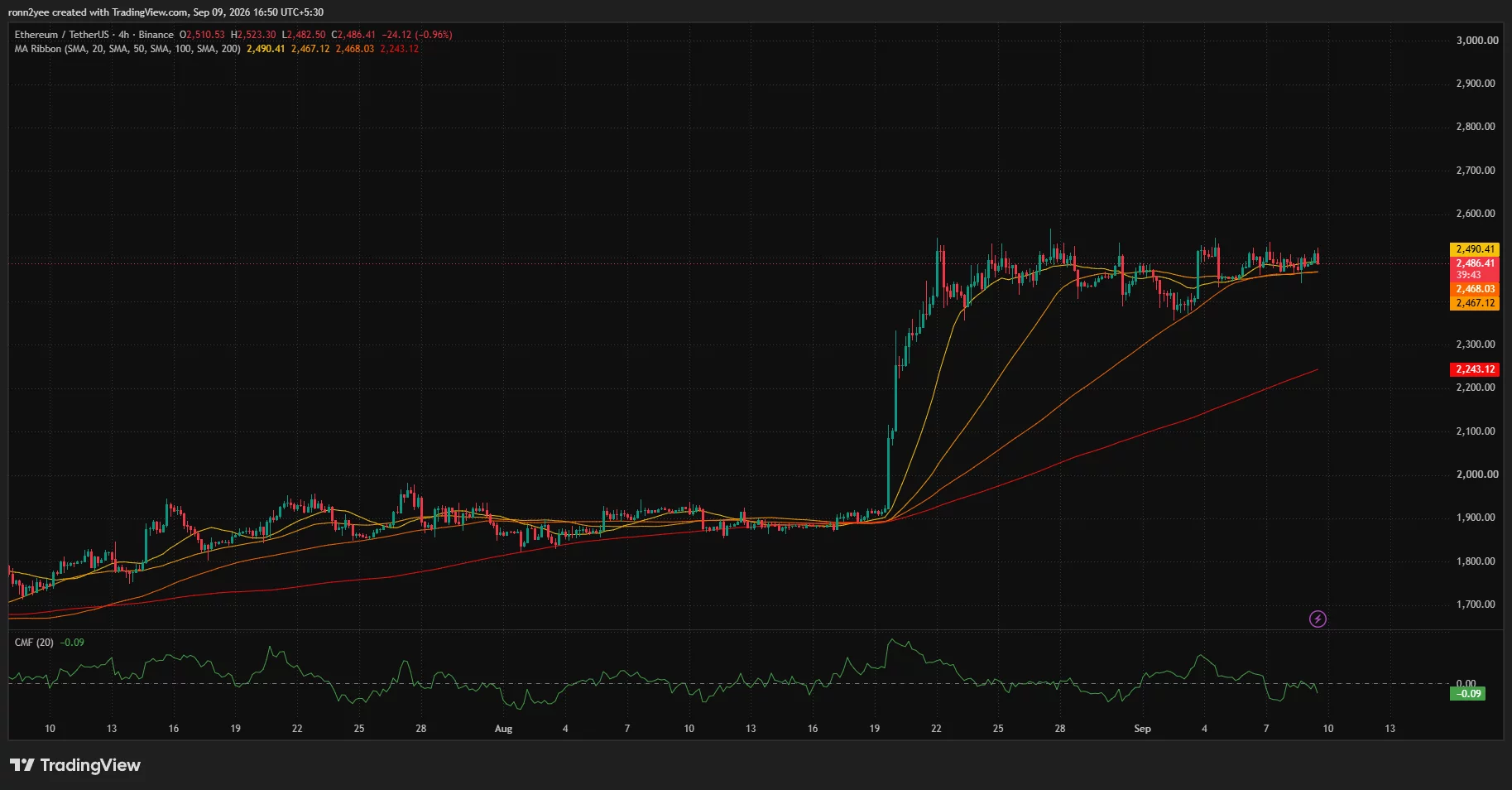
Ethereum price hovered around $2,500 on Sep. 9 as buyers defended short-term support, but weakening momentum and negative capital flows kept a breakout above $2,535 out of reach.
Summary
- Ethereum price traded within a narrow intraday range between $2,482.50 and $2,523.30.
- The 4-hour price slipped below the 20-period moving average at $2,490, while CMF fell to -0.09.
- A daily close above $2,525–$2,535 could open a move toward $2,550 and $2,600.
- The liquidation heatmap shows major liquidity concentrations near $2,430, $2,550, and $2,600.
- Losing the $2,478 pivot would raise the risk of a retreat toward $2,435–$2,445.
Ethereum (ETH) price traded near $2,486 at the time of writing on Sep. 9 after briefly rising above $2,520 earlier in the session. Price remained almost unchanged on the daily chart as buyers and sellers competed around the psychological $2,500 level.
The narrow move followed several days of consolidation after ETH recovered from its early-September low near $2,430. Buyers have repeatedly stepped in around $2,478–$2,485, but each attempt to extend the recovery has met selling pressure between $2,525 and $2,535.
Spot Ethereum exchange-traded fund outflows have reduced one source of institutional demand during the consolidation. Broader risk appetite has also remained weak ahead of the Federal Reserve’s Sep. 15–16 policy meeting, while higher energy prices linked to the U.S.-Iran conflict have added to inflation concerns.
Regulatory uncertainty ahead of the expected U.S. Senate procedural vote on the Clarity Act on Sep. 15 has given institutional investors another reason to limit exposure. Ethereum has consequently struggled to separate from the wider risk-off tone across the crypto market.
Ethereum price momentum weakens below $2,500
The 4-hour chart shows ETH trading at $2,486 after a rejection from an intraday high of $2,523. Price moved below the 20-period simple moving average at $2,490, placing buyers under immediate pressure.
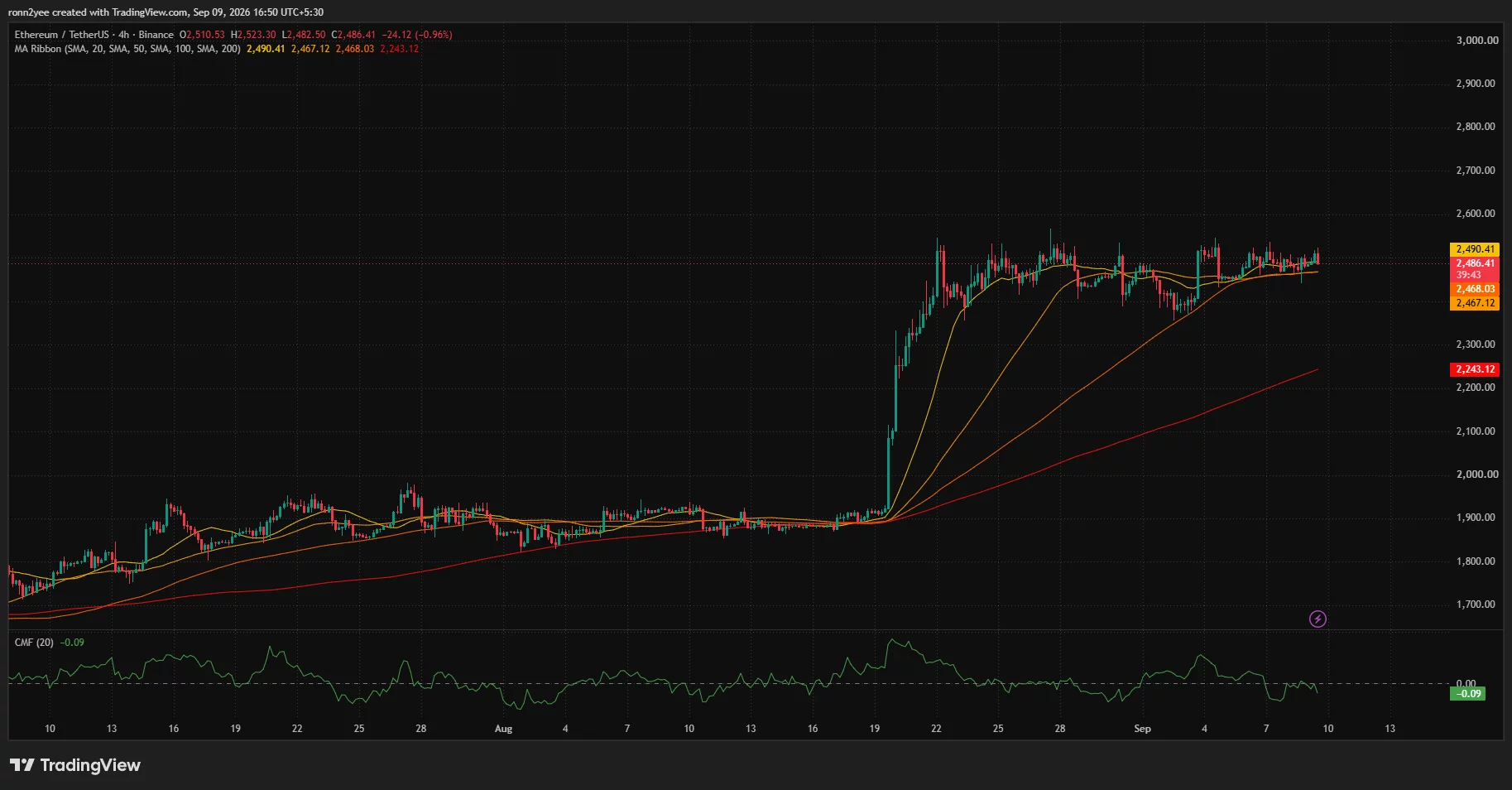
Ethereum remained above the 50-period and 100-period moving averages, located at $2,467 and $2,468, respectively. The close grouping of those averages creates an initial support zone between $2,465 and $2,470.
A break below the cluster would expose the recent range floor around $2,435–$2,445. Deeper selling could place the broader $2,350–$2,360 support zone back in focus, where the weekly liquidation heatmap shows the largest pool of downside liquidity.
The 200-period moving average remains much lower at $2,243, showing that ETH’s medium-term structure has not broken despite its inability to clear nearby resistance.
Still, the Chaikin Money Flow reading of -0.09 points to net capital leaving the asset on the 4-hour timeframe. Continued negative CMF would make it harder for buyers to sustain a breakout, even if ETH briefly returns above $2,500.
Daily momentum also warrants caution. The Awesome Oscillator remains positive at 239.44, but its contracting bars show that bullish momentum has cooled since the sharp August advance. ETH is therefore consolidating below resistance rather than accelerating into a new upward leg.
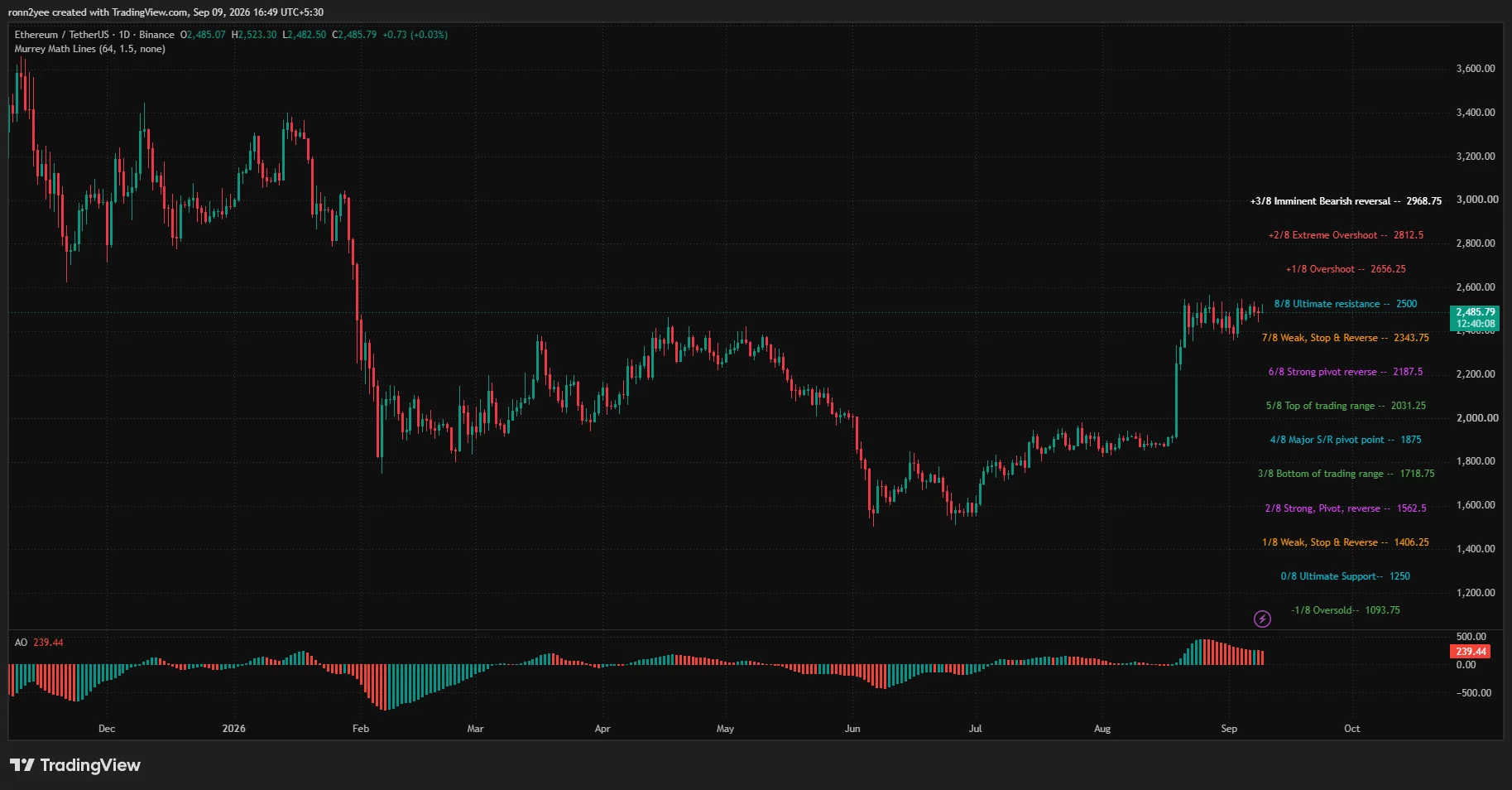
The daily chart places $2,500 at the Murrey Math 8/8 resistance level. A confirmed close above it would improve the immediate outlook, although buyers would still need to overcome repeated supply around $2,525–$2,535.
Market analyst Jules identified $2,478–$2,485 as the key short-term pivot and said repeated rebounds from the area showed active demand. However, the analyst warned that ETH remained in compression until it closed above the resistance band.
“Both sides have clean levels. The longer this squeeze lasts, the more the eventual break will matter.”
According to Jules, a strong close through $2,525–$2,535 could clear the way toward $2,580–$2,600. Losing the pivot would instead weaken the setup and bring $2,435–$2,445 back into play.
Analyst Ted Pillows also identified $2,550 as a major resistance level. Pillows said a strong weekly close above the barrier could support an advance toward $3,000, although the current charts do not yet confirm such a breakout.
Liquidation clusters could shape the next ETH move
CoinGlass’s one-week liquidation heatmap shows leverage building on both sides of Ethereum’s current price.
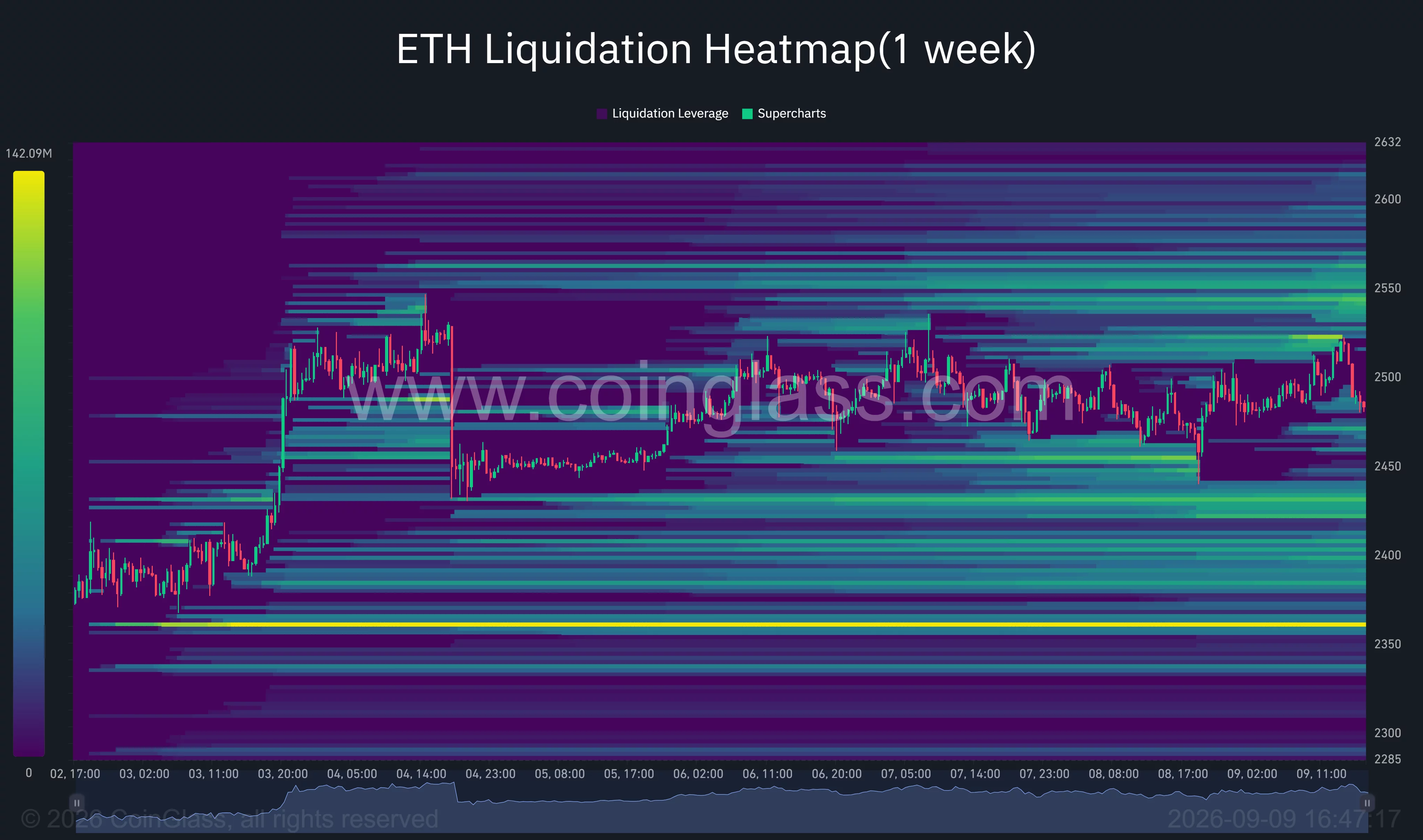
The closest large overhead clusters appear between $2,520 and $2,550. A move into the region could force short positions to close and provide additional momentum, but the same zone has repeatedly attracted spot selling.
More liquidation liquidity is visible between $2,580 and $2,610. Buyers would first need a sustained break above $2,535 and $2,550 before the upper cluster becomes a realistic target.
Downside liquidity is concentrated around $2,430, followed by a much larger band near $2,355–$2,365. A loss of $2,478 could pull price toward the first cluster, while a break below $2,430 would increase the probability of a deeper liquidity sweep.
Ethereum’s next directional move therefore depends on whether buyers can reclaim $2,500 and convert $2,525–$2,535 into support. Failure to do so would leave ETH exposed to another test of $2,478, followed by $2,445 and $2,430. A daily close above $2,535 would strengthen the bullish case and place $2,550, $2,600, and eventually $3,000 on the upside map.
Disclosure: This article does not represent investment advice. The content and materials featured on this page are for educational purposes only.
Hyperliquid price remained close to its record high on Sep. 9 as buyers absorbed an estimated $820 million token unlock, although weakening daily momentum and heavy liquidity near $87–$90 could slow the next advance.
Summary
- Hyperliquid price gained about 4.9% from its Sep. 3 opening price to trade near $85.84.
- The token reached an all-time high of $89.57 on Sep. 6 before entering consolidation.
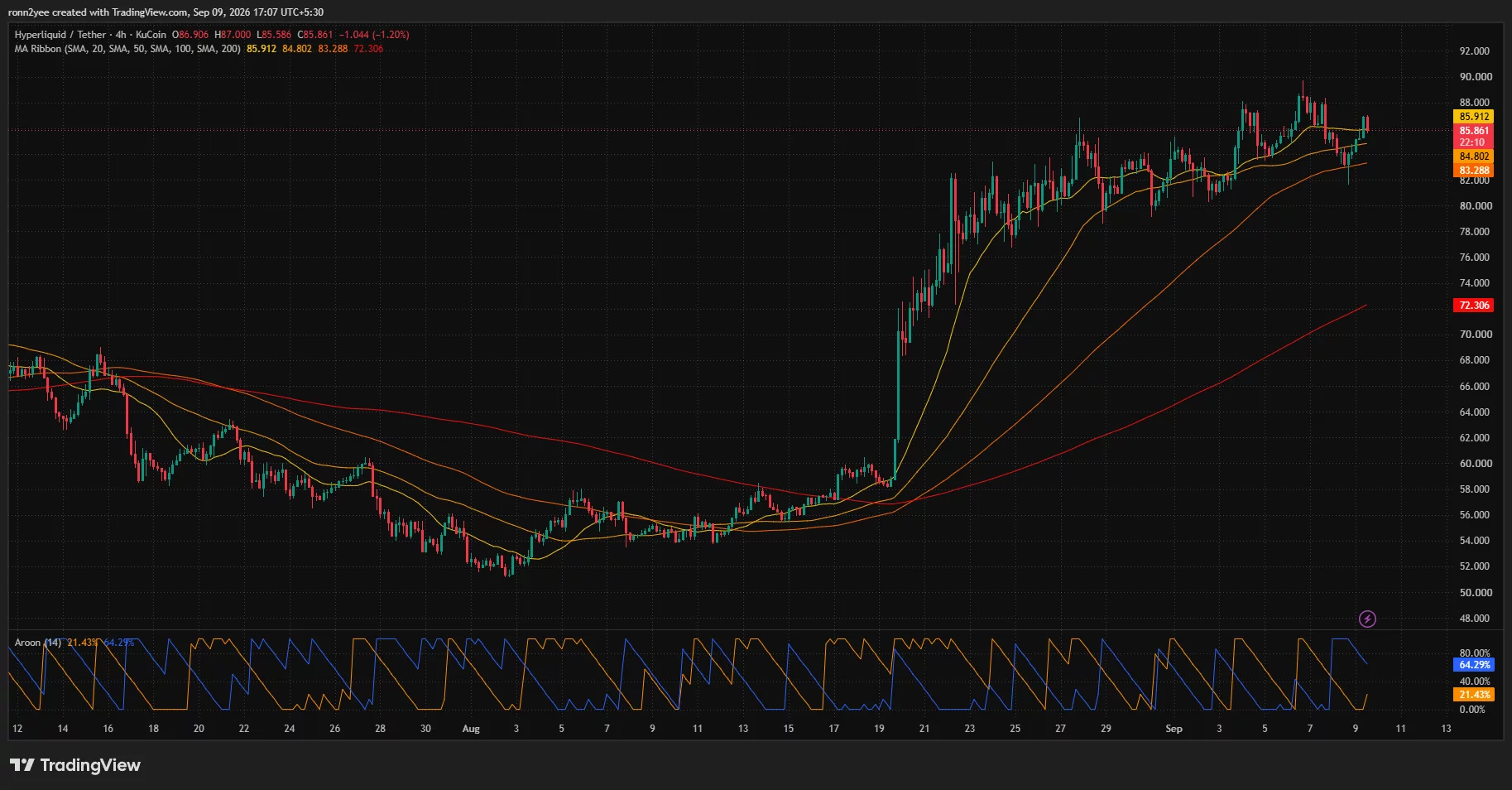
- 4-hour moving averages place immediate support between $83.29 and $85.91.
- Liquidation clusters near $87 and $83.50 could shape HYPE’s next short-term move.
Hyperliquid price consolidates below $90
Hyperliquid (HYPE) price traded at $85.84 at the time of writing on Sep. 9, holding most of its gains after a volatile six-day period. HYPE opened near $81.82 on Sep. 3, placing its net gain at approximately 4.9%.
The token initially climbed to $87.99 before market-wide selling interrupted the advance. HYPE then recovered and reached an all-time high of $89.57 on Sep. 6, showing greater relative strength than several large-cap cryptocurrencies during the broader correction.
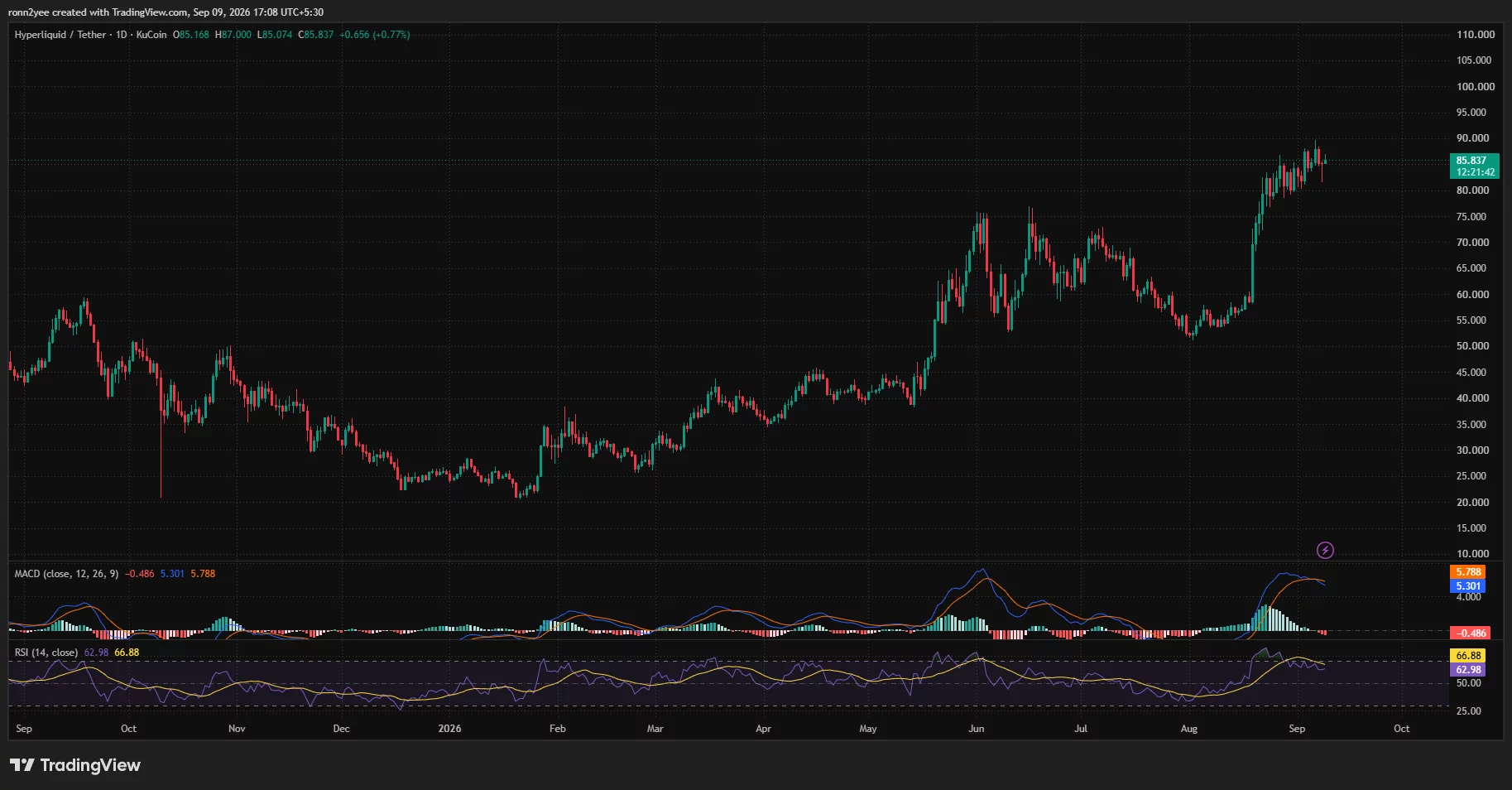
Price action has since narrowed between roughly $84 and $88 as traders test demand below the record high. The daily chart shows that buyers have repeatedly stepped in around $84.70–$85, while attempts to hold above $87 have attracted selling.
HYPE’s daily Relative Strength Index stood at 62.98, down from its RSI moving average of 66.88. The indicator remains above the neutral 50 level but shows that bullish momentum has cooled since the record-setting move.
The daily moving average convergence divergence indicator has also weakened. Its MACD line fell to 5.301, below the 5.788 signal line, while the histogram slipped to -0.486. The bearish crossover points to slower short-term momentum rather than a confirmed reversal, as the token remains near its high.
Token unlock meets sustained protocol demand
HYPE’s resilience followed the Sep. 6 unlock of about 9.92 million tokens allocated to core contributors. The tokens were worth approximately $820 million at the prices recorded around the event.
Large unlocks can raise selling pressure by expanding the amount of supply available to holders. However, only a small portion of the newly unlocked HYPE was reportedly claimed or moved toward venues associated with selling, limiting the immediate impact on the market.
Demand from Hyperliquid’s fee-funded assistance fund also helped offset supply concerns. The mechanism uses most of the protocol revenue assigned to the fund to purchase HYPE from the market, linking token demand to activity on the trading platform.
Hyperliquid open interest reached $14.3 billion during the period, indicating that traders maintained substantial derivatives exposure despite the broader market decline. High open interest can support trading-fee generation, though it also raises the risk of sharper moves if leveraged positions unwind together.
Broader markets faced pressure as tensions between the United States and Iran pushed oil toward $100 per barrel. Strong U.S. employment data and a rise in the 10-year Treasury yield to 4.784% also reduced demand for risk assets.
The resulting crypto sell-off liquidated about $188 million in long positions on Sep. 4. HYPE briefly fell toward $83.68 during the event but recovered faster than much of the market.
HYPE price faces resistance from $87 to $90
The four-hour chart places HYPE close to its 20-period simple moving average at $85.91. A sustained move above that level could give buyers another opportunity to challenge $87 and the record-high region.
Lower support comes from the 50-period SMA at $84.80 and the 100-period SMA at $83.29. The alignment of the 20-, 50-, 100-, and 200-period averages remains bullish, with each shorter average positioned above the longer one.
The four-hour Aroon Up reading of 64.29% also exceeded Aroon Down at 21.43%. The gap suggests that recent highs still carry more weight than recent lows, although neither reading shows complete control.
CoinGlass’ 24-hour liquidation heatmap shows a nearby concentration of leveraged positions around $86.80–$87.20. A move through that area could force short liquidations and help HYPE retest $88–$90.
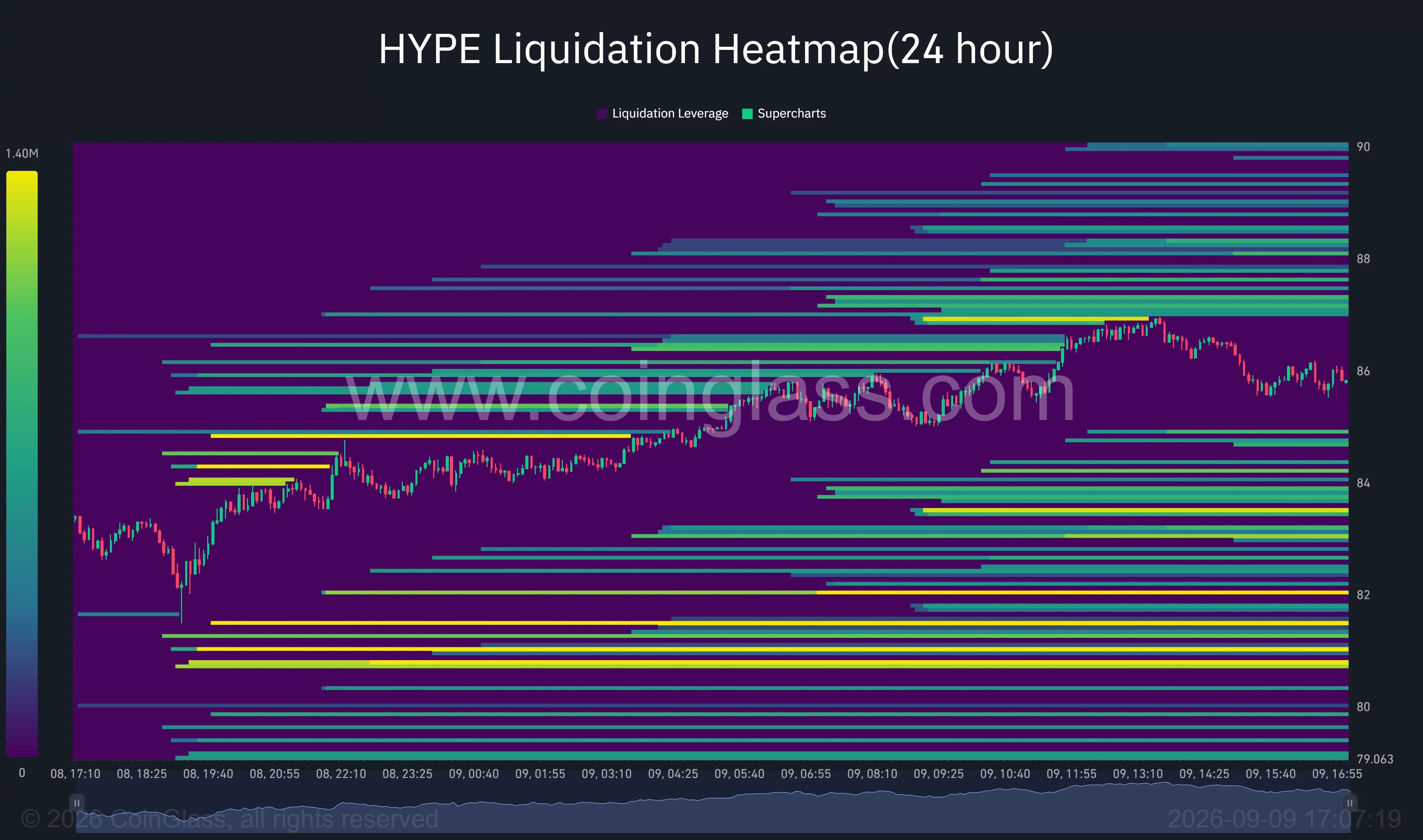
Liquidity below the market is concentrated near $84, $83.50, and $82. Larger bands appear around $80.70–$81.50, making that region a potential downside target if the nearer moving-average support fails.
A daily close above $89.57 would place HYPE in price discovery and bring the psychological $100 level into view. Failure to defend $83.29 would weaken the short-term structure and expose $82, followed by the four-hour 200-period SMA near $72.31.
Analysts remain cautious near the supply zone
Crypto analyst CryptoPatel said in a Sep. 8 post that HYPE was trading inside a daily supply and resistance zone between $84 and $90. The analyst viewed $90 as the invalidation level for a corrective setup and identified $76, $68, and $60 as possible downside levels if sellers take control.
Team LAMBO Charts separately placed the main resistance area between $90 and $95. The analyst said sellers had previously entered around that region and wanted to see stronger volume before treating another test as a confirmed breakout.
Both views identify $90 as the level that separates continued consolidation from a possible bullish expansion. Their longer-term support projections sit well below the immediate levels shown by the four-hour moving averages, reflecting the difference between a short-term pullback and a wider structural correction.
For U.S. traders, Treasury yields, oil prices, and expectations for Federal Reserve policy remain external risks. HYPE has resisted the latest market decline, but another increase in yields or inflation concerns could trigger renewed deleveraging across speculative crypto positions.
The immediate setup, therefore, depends on whether buyers can reclaim $87 and close above $89.57. Until then, HYPE remains in a bullish broader trend but faces fading momentum and concentrated resistance below $90.
Disclosure: This article does not represent investment advice. The content and materials featured on this page are for educational purposes only.

For many crypto believers, retirement planning isn’t about giving up Bitcoin—it’s about deciding whether staking a meaningful portion of future spending power on a volatile asset is actually prudent. A growing debate is emerging at the intersection of personal finance and crypto’s place in mainstream portfolios, with retirement researchers and market participants increasingly focused on the same question: how much (if any) should belong in a long-term retirement allocation?
While some retirement industry professionals argue there is a “sweet spot” near minimal exposure—or even none at all—others say Bitcoin can be integrated more thoughtfully, including as a potential replacement for part of equity risk. The practical challenge is not only whether crypto can deliver returns, but whether investors can survive large drawdowns at the exact moment they need stability most.
Key takeaways
- Public sentiment remains cautious: a National Institute on Retirement Security survey found 77% of Americans view cryptocurrency in workplace retirement plans as risky.
- Industry views diverge sharply, ranging from MIT finance professor Jonathan Parker’s “yes, zero” stance to portfolio designers who suggest small Bitcoin allocations for risk-tolerant investors.
- Financial planners often frame crypto as a small, controllable risk sleeve—commonly capped around 5%—rather than a core retirement holding.
- Retirement timelines change the math: volatility that can be absorbed during earning years may become difficult for those near retirement.
- Institutions appear to be gaining exposure through regulated vehicles and crypto-adjacent public equities, even when direct participation is limited.
Americans see retirement crypto as risky—so why is exposure growing?
Despite crypto’s increasing visibility in finance, trust is not universal. According to a survey by the National Institute on Retirement Security, 77% of Americans consider cryptocurrency in workplace retirement plans risky. That skepticism exists even as regulators, asset managers, and major institutions have gradually expanded access to crypto-related products over recent years.
BlackRock has argued that a modest Bitcoin allocation—on the order of 1% to 2%—can be reasonable in a diversified portfolio for investors who can tolerate volatility, while Fidelity has suggested higher ranges (2% to 5%) may improve outcomes. The underlying premise in both cases is similar: the position is not meant to dominate retirement planning, but to introduce upside potential while constraining downside.
For investors, the key issue is that these proposals depend on behavior as much as math. A small allocation may be manageable in theory, but retirement is when emotions and cash-flow needs often become least forgiving.
“Yes, zero” versus a capped allocation approach
MIT finance professor Jonathan Parker, whose work spans portfolio choice and retirement finance, is notably blunt about where crypto fits. In the reporting, Parker argues the answer is “Yes, zero,” emphasizing that crypto is not an instrument that naturally serves the role many retirement portfolios are designed to fulfill.
The position contrasts with guidance from some financial planners who treat Bitcoin as an adjustable component within an otherwise conventional asset mix. Ryan Firth, founder of Mercer Street Personal Financial Services and a planner specializing in digital assets, describes Bitcoin not as a stand-alone retirement bet, but as something that could potentially replace a portion of stock exposure rather than simply adding another layer of risk.
Firth tells the magazine that Bitcoin may offer “higher return potential than stocks but with more volatility.” His rule of thumb is that crypto should not exceed 5% of an investor’s investable assets, with a conservative framing: invest only what you could realistically afford to lose.
That advice highlights the difference between “conviction” and “concentration.” Even if someone believes Bitcoin is important to the future of money, retirement planning still requires controlling how much of their lifestyle depends on a single, hard-to-predict market outcome.
Institutions look beyond Bitcoin as a core retirement asset
One reason this debate is moving from academic to practical is that institutional investors are increasingly finding ways to gain exposure. Public filings show pension funds and other large investors holding regulated spot Bitcoin exchange-traded funds (ETFs). Others seek exposure through publicly traded companies tied closely to the crypto ecosystem.
CalPERS, described as the largest public pension fund in the United States, has disclosed an investment in Strategy—identified in the reporting as a major corporate Bitcoin treasury holder—within an index-oriented public equity portfolio. CalSTRS, the largest educator-only pension fund, tells the magazine it has not made direct cryptocurrency investments, but it has invested in firms “some might consider crypto companies,” including Coinbase, a publicly traded company that operates a cryptocurrency exchange platform.
As presented in the article, the nuance is significant: institutional interest may not always be about making Bitcoin a central retirement asset. Instead, some investors may be positioning their portfolios to participate in crypto industry growth or to capture returns through regulated structures and publicly traded equities.
Why timing and withdrawals matter more than long-run belief
Bitcoin’s risk profile is not only about whether prices rise over time, but about whether investors can remain invested through severe drawdowns. The reporting draws a clear line between long investment horizons and the vulnerability created when retirement withdrawals begin.
Bill Bengen—credited for research behind the widely cited 4% retirement withdrawal rule—argues that capital preservation should be the primary priority for retirement portfolios. In the piece, Bengen recommends limiting volatile assets like Bitcoin to no more than 5% in order to “help prevent a disaster.”
Firth also emphasizes that the real question is not simply if Bitcoin recovers, but whether investors have the capacity to tolerate waiting. His concern, as quoted, centers on whether people will stay disciplined when prices inevitably fall, and what happens if the asset’s long-term outcome diverges from expectations.
That “behavioral resilience” point is often overlooked in purely theoretical allocation debates. Retirement planning introduces a new constraint: spending needs can force investors to sell at the worst possible moment, turning a temporary drawdown into permanent damage to future purchasing power.
What if the investment thesis is wrong?
Even among committed holders, a common stress test is unavoidable: what happens if the core thesis fails. The reporting highlights the concern that retirement savings could become too dependent on one idea being correct—whether that means Bitcoin declining under future risks or another technology displacing it.
Parker’s broader critique aligns with that stress test. He suggests investors in retirement should not treat crypto as cash-like peer-to-peer currency, and should not treat it like a substitute for holding cash either. In the article, Parker argues that currencies are for transacting rather than investing, and that investors should prefer assets tied to economic activity that pay interest, coupons, or dividends.
Importantly, Parker’s alternative is not a demand that investors avoid crypto-related exposure altogether. He proposes that those who want exposure to crypto industry success or failure should consider owning equity or debt of companies generating revenue from the sector, rather than holding Bitcoin directly.
Belief and bet don’t have to be the same thing
The underlying message across the different perspectives is that belief in crypto’s long-term role does not automatically translate into a justified retirement allocation. As Firth frames it, crypto does not have to be “all-or-nothing.” Investors may still support the broader thesis for technology or market structure without letting one volatile asset determine whether they can fund decades of spending.
What to watch next is how retirement-focused guidance continues to evolve as more regulated crypto vehicles become familiar to institutions and as lawmakers and regulators weigh in on how (and where) digital asset exposure can fit within retirement accounts—especially during the moments when withdrawals turn portfolio volatility into real-life risk.


Coinbase has expanded its Morpho-powered lending product to eligible Brazilian customers, offering market-based returns on USDC without a fixed lock-up period.
Summary
- Brazilian users can allocate USDC to Morpho through the Lending tab in the Coinbase app.
- Deposits enter an audited vault curated by Steakhouse Financial, with rates set by lending demand.
- Coinbase said users can withdraw their USDC and accrued rewards at any time.
- The product has attracted nearly $500 million in deposits since its initial US launch.
Coinbase brings USDC lending to Brazilian users
Coinbase said in a Sep. 9 announcement that its DeFi Earn product would become available to eligible customers in Brazil over the coming days.
Users can access the service through the Lending tab in the Coinbase app, where they choose how much USDC to allocate. Coinbase then transfers the stablecoins onchain to Morpho, a decentralized lending protocol that connects lenders with borrowers.
Deposited USDC enters a vault curated by Steakhouse Financial. According to Coinbase, the vault has undergone an audit, while Steakhouse manages how funds are allocated among available lending markets.
Borrowers supply crypto assets as collateral and pay interest to access the USDC provided by lenders. The interest they pay generates the returns distributed to depositors, creating a two-sided lending market without Coinbase setting a fixed rate.
Unlike a term deposit, the product does not require users to commit their funds for a set period. Coinbase said customers may withdraw their USDC and accrued rewards at any time, although access to funds in an onchain lending market can depend on available liquidity.
Returns will change with supply and demand on Morpho rather than remaining at a guaranteed level. When demand for USDC loans rises relative to the available supply, the lending rate may increase; additional deposits or lower borrowing activity can reduce it.
Coinbase One members may receive an added rate increase where the benefit is available. The company did not state the rate Brazilian customers would receive at launch or whether the boost would apply to every eligible Coinbase One account in the country.
Morpho routes deposits through an audited vault
The Brazil rollout extends a lending model that Coinbase first introduced in other markets in Sep. 2025. As crypto.news previously reported, the original product routed USDC into Morpho vaults on Base, Coinbase’s Ethereum layer-2 network.
Under the setup described at the time, Coinbase created a smart contract wallet for a participating user and directed the deposited USDC into vaults curated by Steakhouse. Customers gained access through the exchange’s app, while the lending transactions took place through Morpho’s onchain infrastructure.
Rates reached as high as 10.8% annual percentage yield when the service launched, but the figure was variable and did not represent a fixed return. Coinbase now says the product has accumulated nearly $500 million in total supply and has recently offered rates of up to 7.4% APY.
The current return may therefore differ from both figures as borrowers enter or leave Morpho markets. Coinbase’s regular USDC Rewards program remains separate from the onchain lending product, meaning the two services use different methods to produce payments for customers.
Coinbase also expanded its in-app lending menu in June by adding an Ethena-powered USDC vault. Morpho supplies the lending infrastructure for that product, while Steakhouse also oversees its vault allocations.
The June product uses a different collateral profile from Coinbase’s Prime USDC vault. Its high-yield option includes markets linked to Ethena assets, while the Prime vault has focused on collateral such as cbBTC, cbETH and wrapped staked Ether.
Different collateral structures can expose lenders to different liquidity and smart contract conditions. Coinbase has not said that the Brazilian launch includes the Ethena-linked option, and its Sep. 9 announcement describes access to its existing Morpho-powered DeFi Earn service.
Coinbase separates lending from standard USDC rewards
Coinbase presents the Brazil expansion as another use for USDC balances alongside staking and its regular stablecoin rewards program. Regional Managing Director for the Americas Fabio Plein said the product was part of the exchange’s effort to “make users’ assets work harder for them.”
Plein also linked the launch to Coinbase’s Everything Exchange strategy, under which the company has been adding financial products to a single platform. His statement identified staking and USDC Rewards as other services customers can use to earn from supported holdings.
The lending option carries mechanics that differ from simply holding USDC in an exchange account. Deposits move into an onchain vault, and the available return comes from borrowers rather than a rate set in advance by Coinbase.
Access through the main app removes the need for customers to connect a separate wallet to Morpho or manually select lending markets. Onchain execution, however, means the funds still interact with smart contracts and lending pools even though Coinbase handles the user-facing process.
For US customers, Coinbase introduced the same general model with access in most states but excluded New York when the product first launched in 2025. The Brazil rollout does not change US eligibility or the terms available to American users, though it expands the geographic reach of a product first tested in the US market.
Brazil adds crypto oversight as stablecoin use grows
Coinbase is adding the product as Brazilian authorities place more controls on crypto businesses. In June, the country’s central bank added independent audit requirements to the authorization and license-renewal process for virtual asset service providers.
Required reviews cover anti-money laundering measures, customer asset segregation, internal risk controls and employee compliance programs. Auditors must also be registered with Brazil’s securities regulator, the Comissão de Valores Mobiliários.
Brazil established its first virtual asset framework in 2022 before assigning primary oversight of crypto service providers to the central bank in 2023. Existing firms were later given until October 2026 to meet a framework covering licensing, custody, governance and stablecoin supervision.
A Chainalysis estimate cited in the June report put Brazil’s crypto transaction volume at about $318 billion across 2024 and 2025. Stablecoins account for much of that activity, with central bank Governor Gabriel Galípolo saying dollar-linked tokens represented about 90% of the country’s reported crypto flows.
Recent commercial activity has also extended beyond trading. An August report on Brazilian stablecoin payments found that providers were developing services for financial institutions, cross-border commerce platforms and digital asset companies as regulators increased scrutiny of international transfers.
Brazil’s central bank has restricted the use of virtual assets within supervised electronic foreign-exchange channels under Resolution BCB No. 561. The rule does not prohibit private crypto trading or stablecoin transfers through exchanges and wallets, but regulated eFX providers must use foreign-exchange transactions or non-resident real accounts when settling with overseas counterparties.

U.S. Bank says it has successfully completed a live cross-border payments pilot using its proprietary USBDC stablecoin issued on the public Stellar network. The test involved transfers between U.S. Bank entities in North America and Europe, while also exercising key stablecoin controls such as minting, redemption, freezing, and clawback.
The bank described the pilot as a validation of its internally developed Digital Asset Platform, which is designed to connect tokenized assets and stablecoin operations with existing banking risk, compliance, and operational systems. U.S. Bank said Wednesday that it is now evaluating additional use cases, including cross-border treasury operations, liquidity management, and moving collateral onchain.
Key takeaways
- U.S. Bank completed a live cross-border payment test with USBDC on Stellar, transferring value between entities in North America and Europe.
- The pilot included not just transfers, but also operational stablecoin capabilities like minting, redemption, freezing, and clawback.
- U.S. Bank framed the exercise as proof of its Digital Asset Platform’s ability to integrate stablecoin workflows with traditional bank controls.
- The bank is exploring next-step applications such as onchain collateral movement and cross-border treasury and liquidity management.
USBDC pilot targets real payment and stablecoin controls
According to U.S. Bank, USBDC was issued and transferred on the public Stellar blockchain during the pilot. Unlike smaller demonstrations that focus primarily on technical connectivity, this test centered on a banking-grade flow: moving funds between separate U.S. Bank entities across regions, with the stablecoin acting as the settlement mechanism.
Importantly, U.S. Bank said the trial also validated the stablecoin’s administrative and risk features—specifically minting and redemption, as well as the ability to freeze and claw back funds. For banks, those controls are not optional “nice-to-haves”; they are central to compliance and operational governance when tokenized value is used outside of internal ledgers.
U.S. Bank linked the results to its Digital Asset Platform, a system the bank has been building to bridge tokenized assets and traditional banking infrastructure. The bank’s emphasis on integration with risk, compliance, and day-to-day operations suggests the institution is trying to move beyond proof-of-concept toward something that can fit within existing regulatory and internal control frameworks.
Digital Asset Platform becomes a bridge between banking and token rails
U.S. Bank said the transaction helped confirm that its Digital Asset Platform can connect the stablecoin lifecycle to established banking workflows. In practical terms, that means the institution is working to ensure that token issuance and transfer activity can be managed with the same operational disciplines used for conventional banking systems.
The bank is also exploring broader applications for the platform. U.S. Bank specifically pointed to cross-border treasury operations and liquidity management, along with moving collateral onchain—areas where the operational overhead of settlement and the speed of fund movement can materially affect how financial institutions manage capital and risk.
The bank’s framing matters for investors and market participants because it highlights a recurring theme in institutional stablecoin adoption: the technology itself is only part of the story. The ability to integrate with compliance, governance, and operational monitoring often determines whether a pilot can progress into a repeatable product.
U.S. Bank expands on earlier Stellar work
This cross-border pilot builds on U.S. Bank’s earlier digital asset efforts. The bank said it launched a dedicated Digital Assets and Money Movement organization in October 2025 focused on stablecoin issuance, crypto custody, asset tokenization, and digital money movement. That internal structure indicates the project has been treated as a longer-term initiative rather than a short-lived experimental desk.
U.S. Bank also previously indicated that it has been testing custom stablecoin issuance on Stellar since at least November 2025. In that earlier phase, the bank said it was working alongside PwC and the Stellar Development Foundation. Taken together, the timeline suggests the institution has moved from stablecoin issuance testing on a blockchain to a broader operational exercise that includes cross-border transfers and full stablecoin administrative functions.
Readers watching the institutional stablecoin space should note what appears to be the bank’s progression: first establishing the issuance capability and ecosystem partnerships, then refining operational mechanics, and finally running a live cross-border settlement scenario designed to stress the operational and governance layer.
Broader banking stablecoin momentum continues
U.S. Bank’s announcement lands as the wider banking sector continues to accelerate stablecoin projects, even as parts of the industry have pushed back on how stablecoins should be allowed to behave in markets.
Earlier coverage from Cointelegraph noted that American banks have raised objections to proposals that would let stablecoin issuers and crypto platforms offer yield or rewards. Even so, major lenders and financial institutions are still moving ahead with their own token plans, often positioning them around payments, settlement, and institutional workflows rather than consumer yield incentives.
Cointelegraph also reported that on Sept. 1, 21 large financial institutions—including Bank of America, Citi, Goldman Sachs, Deutsche Bank, and UBS—announced plans to form a company to issue stablecoins. The group’s plan, as described in that reporting, is to launch a U.S. dollar-denominated stablecoin in the first half of 2027 before expanding to other G7 currencies, with a target spanning wholesale, institutional, and retail use cases. The stated focus includes cross-border payments and digital asset settlement.
Separately, Fidelity has already entered the stablecoin market with its Fidelity Digital Dollar (FIDD), issued through Fidelity Digital Assets and available to retail and institutional investors. According to DefiLlama data referenced by the original coverage, FIDD had about $50 million in circulation at the time of writing, with DefiLlama providing ongoing stablecoin supply tracking: DefiLlama—Fidelity Digital Dollar.
For market participants, these parallel efforts underscore that the industry is not waiting for a single “breakthrough” policy moment. Instead, large banks appear to be pursuing stablecoin infrastructure that can support cross-border and settlement use cases while they work through regulatory and market-structure questions.
Next, investors and builders should watch whether pilots like this translate into broader deployments with measurable adoption—such as increased settlement frequency, expanded corridor coverage, or more formal linkage to treasury and collateral workflows—and how institutions manage stablecoin governance features under real-world regulatory scrutiny.


The Hyperliquid Policy Center has asked a federal court to dismiss CME Group’s lawsuit against the CFTC, arguing that the derivatives exchange lacks standing and cannot rely on the Commodity Exchange Act provisions cited in its complaint.
Summary
- HPC says CME has not shown a competitive injury caused by the CFTC’s decision.
- The group argues CME’s commercial interests fall outside the relevant Commodity Exchange Act protections.
- CME wants the court to overturn the approval of Kalshi’s Bitcoin perpetual futures contract.
- The CFTC has separately requested dismissal, with CME due to respond by Oct. 2.
Hyperliquid policy group disputes CME’s standing
The Hyperliquid Policy Center said in a Tuesday X announcement that it had submitted an amicus brief supporting the Commodity Futures Trading Commission in its legal fight with CME. An amicus filing allows a person or group outside a case to offer arguments that may help the court consider the dispute.
HPC, an advocacy group with ties to the Hyperliquid Foundation, based its request on two alleged defects in CME’s case. Its first argument concerns whether CME has suffered the type of injury required to bring the lawsuit in federal court.
CME has relied on a legal principle known as competitor standing. Under that doctrine, a business may establish an injury when government action increases competition in a defined market and creates a predictable economic disadvantage for the company bringing the case.
According to HPC, the CFTC’s decision does not meet that standard because it allows every registered U.S. futures exchange, including CME, to seek approval for comparable perpetual products.
“The CFTC order it challenges does nothing of the kind,” the group said while rejecting CME’s competitor-standing argument.
Rather than placing CME under different rules from its rivals, the agency’s policy provides registered exchanges with a route to list perpetual futures if their products comply with the Commodity Exchange Act and CFTC regulations. HPC therefore contends that CME cannot treat its decision not to use the same route as an injury caused by the regulator.
A recent dismissal request from the CFTC made a similar argument. The regulator told the court on Sep. 2 that CME could seek permission to list comparable contracts and described any disadvantage created by its refusal to do so as “self-inflicted.”
The CFTC also cited CME’s trading data, noting that its Bitcoin and Ether futures volumes in June and August exceeded the levels recorded in May, when Kalshi’s contract received approval. According to the agency, the figures weaken CME’s claim that the decision produced a concrete competitive loss.
CME’s interests may fall outside CEA protections
HPC’s second objection focuses on the “zone of interests” test, which examines whether a plaintiff’s concerns relate to the purposes of the law it has invoked.
In its brief, the group argued that “CME is an unsuitable challenger because its interests fall outside the zone of interests of the CEA provisions it invokes.”
CME’s lawsuit relies on sections of the Commodity Exchange Act that govern how derivatives products are classified and approved. HPC maintains that the exchange is using those provisions to protect its commercial position rather than an interest Congress intended the law to cover.
The CFTC raised the same issue in its motion, arguing that the relevant parts of the Act do not protect an established exchange from lawful competition. A judge could dismiss the case on standing or zone-of-interests grounds without deciding the main question of whether perpetual contracts qualify as futures or swaps.
HPC also accused CME of using the lawsuit to restrict product development in U.S. derivatives markets. Since the CFTC’s decision applies to registered futures exchanges, the group said CME remains free to list a similar instrument but has chosen to challenge another venue’s approval.
“At least for now, CME has decided not to. But instead of leaving other futures exchanges to make their own commercial decisions, CME has asked a court to take the decision out of their hands,” HPC said. “We filed this brief because CME’s anticompetitive effort must fail.”
CME lawsuit centers on futures versus swaps
Filed in the U.S. District Court for the District of Columbia on June 18, CME’s complaint challenges the CFTC’s May 29 approval of Kalshi’s BTCPERP contract and an agency policy statement addressing perpetual futures.
Perpetual contracts track an underlying asset without carrying a fixed expiration date. Funding payments between long and short traders help keep their prices aligned with the referenced market, allowing positions to remain open without traders having to move into a later-dated contract.
CME argues that the lack of a fixed expiry means the products are swaps under the Dodd-Frank Act rather than conventional futures. According to its complaint, the CFTC departed from its previous treatment of similar instruments and created a new regulatory approach without completing a formal rulemaking process.
The exchange has asked the court to vacate Kalshi’s approval and the related policy statement. Its complaint also alleges that the regulator acted arbitrarily and bypassed requirements established by Congress.
As earlier legal coverage from crypto.news explained, the classification determines which trading, registration, and oversight requirements apply. Treating the contracts as futures gives designated contract markets a more direct route to list them, while a swap classification would place the products under a different part of the federal derivatives framework.
The CFTC maintains that the Commodity Exchange Act does not require a futures contract to have a fixed expiration date. It reviewed Kalshi’s application under Regulation 40.3, which permits a designated contract market to request formal approval for a new product.
After assessing BTCPERP, the regulator found that the contract complied with the act and its rules. The agency also said the approval did not mean every perpetual design would qualify, as proposed contracts could still require individual review based on the underlying asset and product terms.
Kalshi was not named as a defendant in CME’s lawsuit. Coinbase, which received related regulatory relief for certain perpetual products, was also not named.
U.S. perpetual futures market continues to expand
For American traders, the court case could affect which regulated platforms can offer perpetual contracts and which legal framework applies to the products. Perpetuals had long been concentrated on offshore crypto exchanges, where access and leverage terms often differ from those permitted at CFTC-regulated venues.
Kalshi has continued adding contracts while the case remains pending. In June, the exchange filed for HYPE perps after rolling out Bitcoin and Ethereum perpetual futures for U.S. customers. The submission placed Hyperliquid’s native token among several crypto assets targeted for regulated derivatives products.
Hyperliquid itself operates an offshore decentralized perpetual exchange and restricts direct access from the United States. A separate route into the U.S. market could come through regulated infrastructure rather than opening the existing platform to American users.
In August, Hyperliquid Labs and Kraken parent Payward entered advanced discussions about offering selected Hyperliquid-linked contracts through Bitnomial, a CFTC-regulated derivatives exchange owned by Payward. Under the reported structure, eligible U.S. traders would access selected products through Bitnomial instead of connecting directly to Hyperliquid.
Payward has presented the proposed arrangement to the CFTC, according to Bloomberg, but the parties have not announced regulatory clearance, a launch date, or the contracts that could be included.
Meanwhile, the CFTC’s dismissal motion has moved the CME case into its next procedural stage. CME must submit its response by Oct. 2, after which the regulator may file a reply, and the court will decide whether to dismiss the action or proceed to CME’s claims over the classification and approval process.
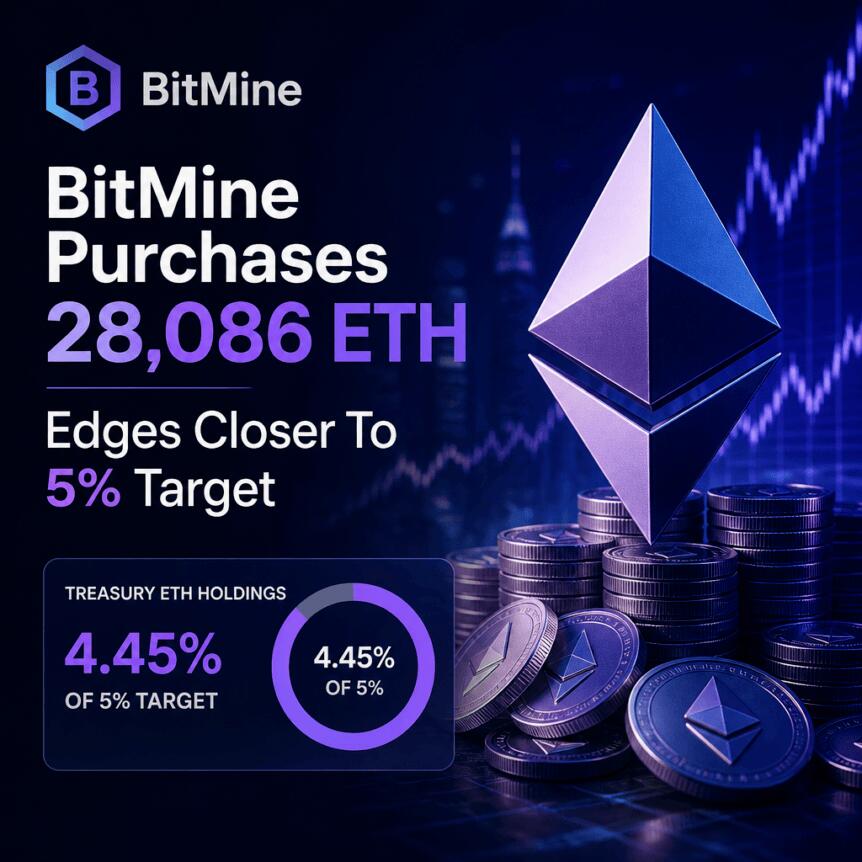
BitMine Immersion Technologies acquired 28,086 ETH for around $70.1 million last week. The purchase takes the Ethereum Treasury company’s total holdings to 5.93 million ETH, 4.9% of the token’s circulating supply.
Chairman Tom Lee is bullish on ETH, citing positive crypto legislation, tokenization, and blockchain-based AI as positive market developments.
BitMine Announces ETH Purchase
According to a treasury update, BitMine held 5,929,198 ETH as of September 7, following its latest purchase. The purchase was completed at $2,495 per token, with the company’s total holdings valued at around $14.79 billion. BitMine began purchasing ETH on June 30, 2025, with Lee stating the company has added ETH every week since.
BitMine’s previous purchase saw the company acquire 53,501 ETH, taking its total holdings to 5,901,112 ETH as of August 30. Other weekly purchases include 9,926 ETH in the week ending August 16, and 32,447 in the week after.
BitMine also disclosed it was close to reaching its target of owning 5% of Ethereum’s total supply. The company needs to hold approximately 6.1 million ETH to meet its target, a figure it calls the “Alchemy of 5%.” The company currently is 170,802 ETH short of its target, although this figure can change as Ethereum’s total supply fluctuates.
BitMine also disclosed it held 211 BTC, a $180 million stake in Beast Industries, a $91 million investment in Eightco Holdings, and $593 million in cash and marketable securities. The company valued its combined crypto, cash, securities, and strategic investments at $15.7 billion.
Staked ETH Revenue
BitMine also disclosed it had staked 5,067,309 ETH through the Made in America Validator Network and other external staking partners. The company’s staked position is worth around $12.6 billion at its reference price of $2,495 and accounts for 85% of its holdings. The company has estimated its staked ETH could bring in $330 million in annualized staking revenue, based on a seven-day annualized yield of 2.61%. If BitMine stakes its entire ETH holdings, it could generate $386 million in revenue. However, these figures are projections, not fixed revenue.
Staking is an important revenue generator for BitMine. A treasury report revealed the company generated $45.7 million through staking and validation in three months ending May 31, which is 98% of its quarterly revenue of $46.5 million. Staking also supports BitMine’s preferred stock structure. The company’s Series A Perpetual Preferred Stock trades on the New York Stock Exchange. Lee has also said the company’s staking income could be used to fund preferred share dividend payments.
AI and Tokenization Could Support Ethereum
Lee has maintained a bullish outlook on ETH and other prominent cryptocurrencies, including BTC. Lee also stated that ETH outperformed the S&P 500 during the third quarter, making it the best-performing macro asset. He identified ETH, BTC, and SOL as the market’s strongest performers since June 30, arguing that institutional investors may want to increase their exposure to these assets.
“We believe there are multiple positive catalysts as we head into the final months of 2026.”
Lee named the upcoming vote on the CLARITY Act, tokenization, renewed crypto purchases, and the growing use of blockchains by AI agents. Lee believes tokenization and AI could benefit Ethereum more compared to Bitcoin. The BitMine chairman has previously linked Ethereum demand to blockchain and AI, and predicted that ETH will outperform BTC during the ongoing market cycle, witnessing growth similar to the 2017-2018 cycle, when ICOs supported price action, and 2020-2021, when NFTs drove network activity.
Disclaimer: This article is provided for informational purposes only. It is not offered or intended to be used as legal, tax, investment, financial, or other advice.
After its strongest August since 2017, Bitcoin (BTC) has faced renewed volatility in September as hawkish Fed signals and strong jobs data pressure risk assets.
Yet, the daily chart has flashed a key bullish signal: a golden cross that bulls have awaited for almost a year. The setup has sparked optimism among analysts that the bear market may finally be over.
But is the signal strong enough to confirm a lasting trend reversal?
Analysts at BloFin note this is the first such crossover since the death cross of November 2025. In Bitcoin’s history, the same setup has usually preceded significant rallies. However, the analysts argued that critical confirmation is still missing.
Bitcoin’s Golden Cross Comes With a Weekly Asterisk
A golden cross forms when a shorter-term moving average moves above a longer-term one. Traders read it as a sign that a trend is turning up.
Bitcoin last recorded a golden cross in May 2025, and the asset went on to set a new all-time high in October. It gained more than 16% during that period.
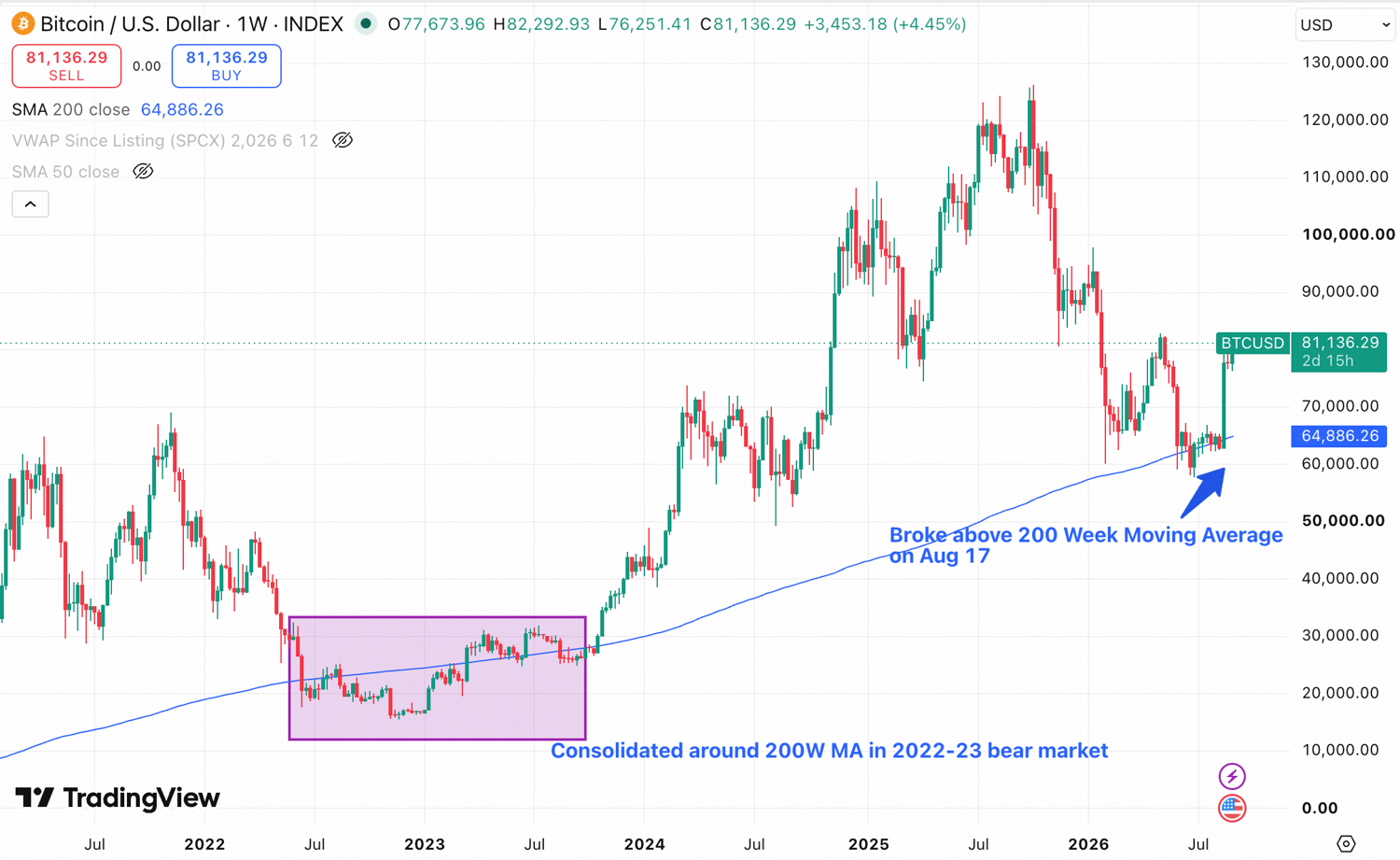
BloFin’s confirmation framework sits on the weekly chart rather than the daily one. The desk uses the 200-week moving average (200W MA) to identify where long-term bottoms form, and treats the 50-week moving average (50W MA) as the stronger test of a new trend.
Bitcoin trades above its 200W MA and below its 50W MA. It has met the first condition but not the second.
Why the 200-Week Moving Average Matters For Bitcoin Price Direction
Bitcoin has spent most of its history above the 200W MA, and its lowest prices in a cycle have generally formed around the level. That happened in 2015 and 2018, and BTC briefly returned to the area during the March 2020 crash.
The 2022 cycle broke from that precedent. Bitcoin fell below the 200W MA and stayed there while the market absorbed a series of major deleveraging events. The FTX collapse added further pressure later that year.

BTC set its cycle low beneath the indicator, then recovered and reclaimed the level during the subsequent rebound.
According to BloFin, the 200W MA has never posted a weekly decline. Four years of long-term appreciation have kept the average moving higher.
Bitcoin’s 200W MA Differs From Stocks and Gold
That steady climb is not a general property of long-term averages. BloFin Research noted that the S&P 500’s 200-week MA has lost momentum during prolonged periods of weak performance.
The index stagnated for parts of the 1960s and 1970s. The dot-com crash and the 2008 crisis then prolonged weakness from 2000 to 2012.

Gold followed a similar pattern. After the metal peaked in 2011, its 200W MA flattened and eventually turned lower during the multi-year decline that followed.

Trading above the 200W MA still does not answer whether the bear market has ended. Bitcoin can consolidate near the level for months before a durable recovery takes shape, as it did through 2022 and 2023.
The 50-Week Bullish Signal Bitcoin Has Yet To Reclaim
Bitcoin’s past cycles give traders a stronger reason to watch the 50W MA. The level has repeatedly separated major recoveries from temporary relief rallies.
Bitcoin lost this average during the downturns of 2014, 2018, late 2021, and late 2025.

The opposite happened during cycle recoveries. Bitcoin reclaimed the 50W MA in 2015, 2019, and 2023, and each time a longer-term uptrend followed.
A golden cross can signal improving momentum on the daily chart. Reclaiming the 50W MA would extend that improvement to the weekly trend BloFin uses to date cycle turns.
A weekly close above the level would be the first step. Holding it would show that resistance has turned into support.

BloFin flags a trade-off in waiting for that. By the time Bitcoin reclaims the 50W MA, the price may already sit well above its cycle low.
Traders who wait for the confirmation may miss part of the initial rebound. What they gain is stronger evidence that the market has left its previous bear-market structure behind.
The post Bitcoin Chart Flashes Golden Cross. Is the Bear Market Finally Over? appeared first on BeInCrypto.

Brentwood, TN – (September 9, 2026) — Canary Capital Group LLC (“Canary Capital”), a digital asset investment management firm, today announced the launch of the Canary Staked TRX ETF (Ticker: TRXS). The Fund seeks to provide exposure to the spot price of TRX, the native utility token of the TRON blockchain network.
In addition, the Fund also seeks to earn additional TRX through participation in the TRON network’s delegated proof-of-stake validation process, with net staking rewards reflected in the Fund’s net asset value.
“The Canary Staked TRX ETF brings investors exposure to one of the world’s largest blockchain settlement networks through a registered exchange-traded structure, while also enabling investors to benefit from potential staking rewards,” said Steven McClurg, CEO of Canary Capital. “As stablecoin adoption continues to grow globally, TRON has become a critical piece of the infrastructure powering digital asset payments and settlement. We believe investors are increasingly looking beyond digital assets themselves and toward the networks driving real-world blockchain adoption.”
TRON has emerged as one of the leading blockchain networks for stablecoin activity, supporting more than $94 billion in circulating Tether (USDT). The chain also processes the highest USDT transfer volume of any blockchain, totaling approximately $5.6 trillion year-to-date. Known for its speed, scalability, and low transaction costs, the TRON network serves as critical infrastructure for decentralized finance, global payments, and blockchain-based applications.
The TRON network is governed by TRON DAO, the community-governed Decentralized Autonomous Organization (DAO) dedicated to accelerating the decentralization of the internet through blockchain technology and decentralized applications (dApps).
“The launch of the Canary Staked TRX ETF demonstrates the growing recognition of the TRON network as critical infrastructure for the global digital economy and provides institutional investors with a new way to access a network that is already powering real-world financial activity at scale,” said Justin Sun, Founder of TRON. “We appreciate Canary Capital’s leadership in bringing TRX to the ETF market and welcome innovations that broaden investor participation in the TRON network while advancing the integration of blockchain infrastructure into traditional financial markets.”
With the launch of the Canary Staked TRX ETF (TRXS), Canary Capital continues its mission to make digital asset investing simple, secure, and accessible while expanding investor access beyond Bitcoin and Ethereum into the next generation of blockchain infrastructure.
For more information on TRXS, click here.
Media Contacts
Canary Capital
media@canaryetfs.com
TRON
About Canary Capital
Canary Capital is an investment management firm that blends rigorous risk management, strategic foresight, and innovative thinking to deliver private placement strategies, crypto hedge fund solutions, treasury management solutions, and publicly traded funds, with a focus on enterprise technology.
About TRON DAO
TRON DAO is a community-governed DAO dedicated to accelerating the decentralization of the internet via blockchain technology and dApps.
Founded in September 2017, the TRON blockchain has experienced significant growth since its MainNet launch in May 2018. Today, TRON hosts the largest circulating supply of USD Tether (USDT) stablecoin, which currently exceeds $94 billion. As of September 2026, the TRON blockchain has recorded over 403 million in total user accounts, more than 15 billion in total transactions, and over $28 billion in total value locked (TVL), based on TRONSCAN. Recognized as the global settlement layer for stablecoin transactions and everyday purchases with proven success, TRON is “Moving Trillions, Empowering Billions.”
TRONNetwork | TRONDAO | X | YouTube | Telegram | Discord | Reddit | GitHub | Medium | Forum
Disclosures and Risk
The Canary Staked TRX ETF (Ticker: TRXS) is an exchange-traded product that is not registered under the Investment Company Act of 1940 (the “1940 Act”) and therefore is not subject to the same regulations and protections as ETFs and mutual funds registered under the 1940 Act. Investing involves risk, including the possible loss of principal. An investment in TRXS is subject to a high degree of risk and heightened volatility and is not suitable for investors who cannot afford the loss of their entire investment.
The Fund’s investment objectives, risks, charges and expenses should be considered before investing. The prospectus contains this and other important information, and it may be obtained at https://canaryetfs.com/trxs/prospectus/. Read it carefully before investing.
An investment in TRXS is not a direct investment in TRX. Staking rewards are not indicative of the Fund’s performance, are not guaranteed, and may change frequently, including experiencing significant declines.Digital assets, such as TRX, are a relatively new asset class, and the market for digital assets is subject to rapid changes and uncertainty. Digital assets are largely unregulated and digital asset investments may be more susceptible to fraud and manipulation than more regulated investments.
TRXS is subject to rapid price swings, including as a result of actions and statements by influencers and the media, change of assets, and other factors. There is no assurance that TRXS will maintain its value over the long-term.
Staking provides the Trust with the opportunity to create and earn additional TRX. The Trust will be entitled to all TRX generated by the Trust’s staking, after deduction of certain staking-related expenses. This additional TRX will increase the net assets of the Trust, benefiting Shareholders. Certain of such TRX may be treated as income to the Trust and may be held for future distribution to Shareholders, subject to procedures and requirements disclosed elsewhere in the Prospectus.
Staking comes with a risk of loss of TRX. None of the Fund’s assets, including any staked assets, are subject to the protections enjoyed by depositors with Federal Deposit Insurance Corporation (“FDIC”) or SIPC member institutions. The staked assets may also be subject to “slashing” penalties. Slashings occur when a validator attests to two different histories of the chain and penalties occur when a validator is offline for a prolonged period of time.
The Fund itself will not engage in staking activities, including the operation of a validator node. Instead, the staking program will be administered by the Fund’s sponsor, who will utilize service providers including the custodians and staking providers. While the Fund’s sponsor does not expect the activities of the staking providers to result in slashing penalties, there can be no guarantee that slashing penalties will not occur.
Furthermore, the custodians’ and staking providers’ liability to the Fund for the actions associated with the Staking Program is limited, and the custodians and staking providers may lack the assets or insurance in order to support the recovery of any losses incurred. Accordingly, there can be no guarantee that the Fund would recover any of its staked assets, or the value thereof, if it is subject to slashing or penalties.
The Fund is new with a limited operating history.
Paralel Distributors LLC, Marketing Agent. Paralel is unaffiliated with Canary Capital.
CRNY 159
The post Canary Capital Launches the First US Spot Staked TRX ETF (Ticker: TRXS) appeared first on BeInCrypto.


Compound Foundation has launched a USDC lending market with loan-to-value ratios of up to 87% as part of its $52 million plan to attract institutional capital.
Summary
- The market supports ETH, wstETH, WBTC, and cbBTC as collateral for USDC borrowing.
- Loan-to-value ratios range from 81% for Bitcoin collateral to 87% for ETH.
- Compound said DeFi Saver, K3, KPK, and Yearn joined the oversubscribed launch.
- A Compound delegate has questioned whether the DAO retains final control over the market.
Compound Foundation said in a Sept. 9 announcement that its Institutional Market runs on Compound v3 and separates selected collateral into a lending pool designed around specific liquidity and risk conditions.
Borrowers can use Ether (ETH), wrapped staked Ether, Wrapped Bitcoin, or Coinbase Wrapped BTC to access USDC. The market gives ETH an 87% loan-to-value ratio, while wstETH carries an 85% ratio. WBTC and cbBTC each have an 81% ratio.
Each collateral asset has a $10 million borrowing cap. Liquidation factors range from 86% for WBTC and cbBTC to 93% for ETH, while penalties begin at 5% for ETH and rise to 10% for both Bitcoin-backed assets.
Compound promoted the product as an institutional-only market in its announcement. However, its official market page states that anyone can borrow, while approval applies to suppliers seeking additional incentives.
Compound market pairs higher LTVs with a narrow collateral list
By limiting the market to four liquid collateral assets, Compound said it can offer terms based on their individual risk and liquidity profiles instead of applying one set of conditions across a large group of tokens.
Institutions often manage larger positions and follow internal risk controls that differ from those of retail users, according to the foundation. Compound said the new structure provides increased borrowing capacity, defined collateral parameters, and direct operational support.
A dedicated contact will assist participating institutions with onboarding, market updates, and other operational matters. Compound also said USDC suppliers will receive the standard market yield, while approved lenders can qualify for extra incentives.
The rewards program will distribute as much as 200,000 USDC on a pro-rata basis over three months. Applicants must supply at least 100,000 USDC, and only the first $20 million in eligible deposits will count toward the program.
Compound said the market was oversubscribed when it opened, naming DeFi Saver, K3, KPK and Yearn among the participants. The foundation did not provide the amount committed or explain how much demand exceeded the available capacity.
“With today’s Institutional Market launch, we are taking the first step toward building infrastructure to meet institutional client demands, including better capital efficiency, clearly defined risk, and a much higher standard of service,” Compound Foundation Executive Director Aaron Schnarch said.
According to Schnarch, early demand encouraged the foundation, which plans to release more capabilities over the coming months.
KPK co-founder and CEO Marcelo Ruiz de Olano said direct access to a team familiar with institutional requirements made the market attractive to his company.
“Compound is combining the capital efficiency of onchain markets with the level of service institutional participants expect,” Ruiz de Olano said.
Institutional market follows Compound’s $52 million program
Three weeks before the product launch, crypto.news reported on Compound’s new management team and its DAO-approved, two-year development program.
COMP holders approved $28 million for operations and another $24 million for growth and incentives. The package represents the largest development allocation in the protocol’s history, according to the foundation.
Only $14 million was moved to the foundation’s multisignature wallet at the start of the program. The remaining $38 million stayed in reserve, with future releases linked to delivery targets such as assembling an engineering team and producing a Compound v3 integration kit.
Along with Schnarch, the management group includes Chief Operating Officer Christopher Donovan and Chief Product Officer Steven Liu. Team members brought experience from Coinbase Custody, Anchorage Digital, Near Foundation, Maple Finance, HSBC, and Broadridge Financial.
The program covers institutional lending, real-world assets, and tools that allow financial companies to connect with Compound’s infrastructure. Improving capital efficiency also forms part of the plan, as does building credit products around traditional finance requirements.
Founded in 2018, Compound helped establish blockchain-based borrowing and lending through permissionless markets governed by COMP holders and delegates. The foundation says the protocol has processed about $480 billion in cumulative deposits and borrowing volume, although the figure does not represent current assets held on the platform.
Data cited by The Defiant placed Compound’s total value locked near $1.53 billion around the launch, with approximately $638 million borrowed. Ethereum accounted for about $1.42 billion, or 93%, of the protocol’s locked assets.
US financial firms are also expanding crypto-backed credit
For US institutions, Compound’s use of USDC and Bitcoin or Ether collateral places the product alongside several recent crypto-backed lending programs, although the legal structures and access models differ.
In August, JPMorgan’s collateral program was reported to allow institutional clients to pledge Bitcoin and Ether for US dollar loans through its Kinexys digital asset platform. Fidelity Digital Assets and Coinbase Custody were named among the custodians holding the pledged assets.
Kraken and Maple also introduced a USDC-funded lending facility in June. Their structure uses a bankruptcy-remote special purpose vehicle to fund overcollateralized loans backed by Bitcoin and Ether, with Maple providing senior financing and Kraken servicing the loans.
Retail access to onchain credit has expanded through centralized platforms as well. Coinbase added an Ethena-linked USDC vault in June, using Morpho markets and allocations managed by Steakhouse Financial.
Unlike bank and special-purpose-vehicle lending arrangements, Compound’s new market operates through its v3 smart-contract infrastructure. The foundation described Compound v3 as having completed four years of production use without an exploit, a performance claim made by Compound rather than an independent auditor.
Compound delegate questions who controls the market
While the product was open, Compound delegate ugurmersin submitted a governance proposal asking for the DAO to receive ultimate authority over the Institutional Market.
The delegate said Compound governance did not appear to have approved the market’s current control structure. According to the proposal, the Treasury Management Committee administers the product, while a separate multisignature wallet holds authority over its collateral settings and other parameters.
Ugurmersin also said the committee’s existing DAO mandate covers treasury management rather than the operation of a lending market. The delegate could not identify a mechanism allowing COMP holders to withdraw the administrators’ permissions under the present setup.
Under the proposed changes, the foundation and committee could continue handling daily market operations. Administrators would have 10 business days to publish a full map of their permissions and 30 days to transfer final authority to Compound governance.
The Compound Foundation had not posted a public response to the governance proposal at the time of publication.

What Is The $3,000 Rule When Buying A Car?

How to Choose Right Financial Advisor Part 1

why this much-loved French TV series fails as a film


-

 Crypto World1 day ago
Bitcoin price risks $76K drop as $78K support weakens
-
 Tech2 days ago
Memory prices are slowing because buyers ran out of money
-

 Crypto World1 day ago
Ethereum price stalls below $2,500 as ADX drops to 11
-

 Crypto World1 day ago
Robinhood Stock: How To Take Advantage With Reduced Risk
-
 Sports2 days ago
Phones confiscated, players sent home: Pakistan’s England tour turmoil revives memories of Mohammad Amir, Salman Butt and Mohammad Asif’s 2010 Lord’s spot-fixing scandal | Cricket News
-

 NewsBeat2 days ago
England up in reading, maths and science rankings as Scotland and Wales dip
-
 Crypto World18 hours ago
Bitcoin price holds near $79K as cycle drawdowns narrow
-
 Crypto World2 days ago
Brent Crude Oil Moves Above $100 for the First Time in 3 Months
-

 Business23 hours ago
Meta debuts long-awaited personal AI agent, Muse
-

 Crypto World2 days ago
Visa expands stablecoin card network to 160 programs
-

 Business2 days ago
Egyptian TV Presenter Sarah Khalifa, 11 Others Sentenced To Death In Major Drug Trafficking Case In Cairo
-
 Tech2 days ago
Strong Password Policy and Password Manager Guide
-

 Crypto World1 day ago
Intel Stock Jumps 9% on Chip Price Hike Report, US Stake Gains $36 Billion
-

 Entertainment1 day ago
Big Brother Spoilers: Dee SPINS & HUSTLES Votes – Yash Questions the Pact
-

 Sports1 day ago
Ballon d’Or 2026 Nominees: Lionel Messi In, Cristiano Ronaldo Out; Erling Haaland Included In Top 30
-

 Business1 day ago
ServiceTitan, Inc. (TTAN) Q2 2027 Earnings Call Transcript
-

 Tech1 day ago
Google’s revived nuclear power plant gets $1.9B loan from US government
-

 Tech1 day ago
Meta debuts its Muse AI agent. Will consumers trust it?
-

 Crypto World2 days ago
Pump Fun and Kraken delete Hunter Biden $LAPTOP promotion
-
 NewsBeat1 day ago
Tehran’s assertive rhetoric signals a new and dangerous phase in conflict
You must be logged in to post a comment Login