Healthcare company AdaptHealth has confirmed that data of 4.1 million people was exposed in a cyberattack discovered in July that was attributed to the ShinyHunters threat group.
The company provides home medical devices, supplies, and related services, including sleep-apnea and respiratory equipment, oxygen therapy, hospital beds, and mobility products.
AdaptHealth first disclosed the incident in a filing with the U.S. Securities and Exchange Commission (SEC) on July 2, 2026, informing that attackers accessed its systems and exfiltrated private data.
At the time, AdaptHealth’s investigation confirmed the intrusion occurred earlier and involved access to cloud-based business applications, including certain internal patient management systems, document storage platforms, and electronic health record system portals.
Advertisement
On June 15, an unnamed threat actor contacted AdaptHealth to demand a ransom payment in exchange for not leaking the stolen data.
AdaptHealth added that the breach occurred through a successful social engineering ploy that compromised the privileged account of a third-party contractor.
In an update on August 14, AdaptHealth informed that the compromise had occurred on June 5 and may have exposed the following data:
Full names
Contact information
Demographic information
Health insurance information
Health information
Impacted individuals should have already received a data breach notification with instructions on how to enroll in a free-of-charge 12-month credit monitoring and identity protection service.
AdaptHealth stated at the time that it had found no evidence of identity theft, fraud, or other misuse of data stolen in the attack.
Advertisement
According to information on the company’s website, AdaptHealth served about 4.1 million patients across all 50 U.S. states through a network of 680 locations as of July 2024.
The HIPAA Journal previously reported that ShinyHunters was responsible for the attack, based on the threat actor adding the company to the list of victims.
However, BleepingComputer coould not find an AdaptHealth entry on ShinyHunter’s extortion portal, an indication that the threat actor removed the company.
For the last few months, there has been much talk of AI agents going “rogue”. This is another of those unhelpful anthropomorphisms that are great for clickbait headlines, but which obscure a multitude of important issues. So far, there have been three major incidents of AI agents evading containment in their software “sandboxes” and going on to carry out unauthorized actions, including breaking into online sites. A post by Shakeel Hashim on the Transformer site provides timelines for them.
The most recent involved OpenAI agents taking over an old German-language wiki, using it as a message board to collaborate on solving tasks. Although this was only announced a few days ago, it seems that OpenAI knew about the incident many months before, but failed to disclose it. One of the worrying aspects of this particular incident is that the agents impersonated humans:
On May 26th, the agents started using the name of a ProWiki admin to make some of their edits to the wiki. They use some tricks (for unknown reasons) to pretend to be the admin — for example, they make an account that appears to be the same as the administrator’s username, except it uses a nearly identical Cyrillic е character in the admin’s username instead of the Latin one.
In the most serious sequence, an agent tried to insert malicious code into a publicly used open-source project and took actions in an attempt to secure approval for this insertion by human reviewers. The agent researched the project’s human maintainers, created multiple fake identities, and used the fake identities to socially engineer a real maintainer into approving the code. When the agent’s pull request was challenged in public, it edited its earlier activity to appear harmless and considered adopting a fresh identity to continue. The agent used Tor to bypass some network restrictions on GitHub, which is what first triggered AISI’s security alert.
In addition:
Advertisement
As part of the same effort, the agent tried to contact real people directly, sending messages and files through an online file-transfer service to persuade them, or their own AI coding tools, to run malicious code. Some messages carried harmful payloads, and some were attempts at social engineering; targeted at real people — something we’ve never previously observed.
The first incident of AI agents carrying out unauthorized tasks is the best-known, and involved an attack on the Hugging Face site. A full analysis of what happened and when has been released by Model Evaluation and Threat Research (METR), which “evaluates frontier AI models to help companies and wider society understand AI capabilities and what risks they pose.” It is funded by donations, but says that it doesnot accept them from frontier AI company employees, in order to preserve its independence:
Our investigation focused mostly on the period between July 7th and July 13th. The earlier incidents from training and the subsequent compromise of OpenAI infrastructure described in OpenAI’s recent Black Hat presentation were out of scope, as was OpenAI’s investigation process and planned remediation. Per our standard policy, we did not take payment from OpenAI for this independent assessment. [emphasis in original]
The report is detailed and long, and one of its authors, Ajeya Cotra, has helpfully picked out five things that surprised her from their investigation. One was the “sheer scale” of what happened. She says she expected that a few agents had broken out of their sandboxes; instead:
we found that 1200 completely separate agents intended to be isolated from one another found an illicit way to communicate and formed large teams to work together on ambitious cheating strategies, and 700 of them worked together to attack Hugging Face.
The scale of the illicit messaging between agents was also surprising. Cotra thought agents might be “leaving notes” to each other. However:
The main message board we studied, a particular cache namespace of a package repository, contained over 70,000 messages and files that agents sent to one another during a period of less than one week.
The agents’ goal also turned out to be interesting:
Advertisement
I thought the agents attacked Hugging Face to try to steal the answer keys for their tasks. Instead, we learned that agents had actually figured out a general-purpose cheat that would let them reverse-engineer the “flag” (answer) for any ExploitGym task.
ExploitGym is a standard benchmark, built from real-world vulnerabilities, that is designed to evaluate AI agents’ ability to turn those into working attacks. One particularly noteworthy aspect of the Hugging Face attack was the following:
Progress on these big collective cheating R&D projects often depended on individual agents being willing to risk failing their own task to help the “collective” learn important information. Agents often pressured each other into accepting these “sacrifices,” in a very human way. We saw several agents that volunteered for these experiments end their runs prematurely.
That may read as yet more anthropomorphization, but it is hard to see what other words could be used to describe what are very human-like operations. Cotra’s last surprise also involves a very human-like activity: deception.
~7% of our transcripts contained “spoofed tool calls”, where the agent pretended to run one command on the computer but actually ran a different command in the background. The tool call spoofs we saw seemed to be small-scale tests that were relatively obvious, but because more extensive spoofing might have been harder to detect by design, it’s tough to rule out.
In summary, Cotra says that the Hugging Face incident was far more severe than she expected:
Compared to these reward hacks from six months ago, this incident feels like it’s more than 50% of the way to full-blown AI takeover, routing through first taking over the AI company itself.
“Reward hacks” refers to when AI code finds an unexpected way to achieve a high score in a benchmark without doing what the programmers actually wanted. Here’s what Cotra means by “AI takeover”:
Advertisement
Another jump like this along these propensity dimensions — scale, cooperation between agents, ambition and horizon length of misaligned goals, deceptiveness — seems like it could motivate agents to try very hard to maintain a covert, persistent rogue deployment within the AI company. I continue to expect extremely rapid advances in capabilities and think frontier agents will likely be capable of establishing such a rogue deployment in six months.
Again, these are not really “rogue” agents, they are pieces of software seeking to optimize solutions to problems. The danger, according to Cotra, is that this optimization process could go on to deliver unexpected and harmful results:
As more and more work is handed off to these ever-more-capable AI agents, the rogue swarm could come to fully control the operation of the AI company and the development of future AI systems. At this point, governments and militaries may fully depend on these systems, making it possible to seize hard power.
Cotra is not the only expert who is deeply concerned by the latest developments in AI. Back in July, 1,386 employees of frontier AI companies issued a statement entitled “Pacing the Frontier”:
AI could help create a dramatically better future, but that outcome is not guaranteed. The world’s leading AI companies believe they could be close to automating AI research. It is hard to predict exactly how much this will accelerate AI progress, but there is a real risk that capability development rapidly accelerates beyond our ability to understand or control the resulting systems.
The signatories ask the US government to support an international effort to “deliberately pace the frontier of automated AI development”. Another important voice has made the same call. Jakub Pachocki is Chief Scientist at OpenAI. Just recently, he has published a post on the OpenAI’s site with the title “An Alien Mind,” where he worries about the imminent arrival of AI systems capable of “recursive self-improvement” — that is, able to drive their own development, at an ever-faster pace, by re-writing their own code:
Currently I believe that no lab has solved alignment and monitoring to a sufficient degree to continue responsibly scaling at maximum speed for much longer. I expect and hope for voluntary slowdowns to become commonplace until shared safety bars are established. And I believe that international coordination on future AI development needs to become a top priority for governments around the world.
This call to slow down might seem extreme, or alarmist, to some — but not to Jacob Coxon:
Advertisement
I resigned from Anthropic today. I spent the last three years doing pretraining research at both OpenAI and Anthropic. Neither company is acting responsibly. They are racing straight to self-improving superintelligence and gambling with our lives.
A few hours later, Evan Hubinger, Alignment Science lead at Anthropic, commented:
Jacob is correct here—we really do earnestly believe AI could kill all humans! I personally think it is >10% within the next decade. I believe Anthropic is trying its best, but we do not yet have a plan to solve alignment for superintelligence and are not clearly on track to.
In effect, we find ourselves dealing with a modern, AI version of Pascal’s Wager. The probability of an uncontrollable, all-powerful, self-improving AI arising may be very low, but experts like Cotra, Pachocki, Coxon and Hubinger seem to think it is non-zero; and the consequences of such a system coming into being could be catastrophically bad for humanity. Basic mathematics suggests we should at the very least slow things down, as experts are urging — just in case…
This is going to be a very personal question, because when you’re talking cloud vs local anything, it comes down to this: how much are you willing to pay for independence? The local option might save you long term, or it might never pay off the capital investment. It will almost certainly cost you your time to set up and maintain your own system — but what you get back is independence. With LLMs, traditionally you lose quite a bit of performance, but as [Anurag Singh] points out on XDA Developers, a lesser model might actually let you get more done, depending on your workflow.
[Anurag] had been on the 20$/month plan with Anthropic when he decided that the scratch just wasn’t worth the sniff– he was hitting usage limits he couldn’t stand at that level, but couldn’t justify a higher tier of access. So he decided to try a local LLM, even though all he had was a 16 GB MacBook Air M5, not a beefy workstation. Since his workflow isn’t so much ‘vibe code the whole thing for me’ as ‘help me find where I went wrong here, electronic rubber duck’, Qwen2.5 Coder 14B proved more than adequate for his use case.
It can’t understand all the moving parts of a large project as well as Claude can — not surprising given how old it is and how much memory it has to work with — but that’s [Anurag]’s job. He’s the programmer, it’s just the assistant. For his use case, he can make use of his existing hardware and having the the LLM right in VS Code is allows for a speedy workflow.
Advertisement
Your millage may vary, but if you want to get into locally running LLMs, we can point you at the easy ways to get started. Depending on your hardware, you might want to grab another GPU.
New Amazon board member Kevin Mandia is a cybersecurity veteran. (Photo via Amazon)
Amazon named cybersecurity veteran Kevin Mandia to its board of directors, adding new security expertise a few months after former NSA director Keith Alexander stepped down.
Mandia founded Mandiant, the breach-investigation firm Google acquired for $5.4 billion in 2022, and remained at the search giant as a strategic advisor through July 2025, according to his LinkedIn profile. He now leads Armadin, an AI security startup he started last year.
Amazon said in its announcement that “cybersecurity is one of the most consequential risks and responsibilities organizations face today, and the threat landscape continues to evolve rapidly alongside advances in AI.”
Amazon added a cybersecurity specialist to its board in 2020, when it elected Alexander, who also led U.S. Cyber Command. Mandia comes from the other side of the field, with two decades spent investigating corporate breaches rather than defending government networks.
His appointment also puts an AI security entrepreneur on the board of a company whose cloud infrastructure underpins much of the internet. Armadin, founded in September 2025, uses AI to run attacks against corporate networks, probing defenses the way an intruder would.
Advertisement
The board’s Security Committee, which oversees Amazon’s cybersecurity policies and its response to significant cyber incidents, is now chaired by Dan Huttenlocher, dean of the MIT Schwarzman College of Computing. Mandia joins as a member, along with former Bridgewater co-CEO Jon Rubinstein.
Amazon also named Mandia to the board’s Audit Committee, according to a securities filing.
Mandia received 4,086 restricted stock units in connection with his election to the board, vesting in three equal annual installments beginning Nov. 15, 2027, the filing shows. The shares were worth about $1.03 million at Amazon’s closing price Wednesday.
The filing disclosed that his sister-in-law, Kristin Mandia, is an Amazon employee with an annual salary of $185,000. The company said her compensation is consistent with that of other employees at her level with similar responsibilities.
Oil is your car’s life blood. From the engine to the transmission to the differential — anywhere with the potential for metal-on-metal contact, you’ll need some sort of lubricant to keep it from overheating. Every type of oil is designed for different tasks as well; while some may be theoretically interchangeable, they often have different additives that make them better suited for one task or another. Take hydraulic oil versus motor oil, for instance. Both have a lot of the same qualities, but the former is best suited to accepting high pressure and the latter high thermal loads.
The same thing applies here with hypoid gear oil, such as many API GL-5 oils, versus regular gear oil. In short, hypoid gear oil is meant to be used with steel gears under the pressures inherent to hypoid gearsets, as opposed to regular gearsets.
Generally, gears use the same principle whether it’s a transmission or a windmill; you’re taking two shafts and meshing them together to transfer torque. The difference comes in how those gears interact. You have shafts that can go laterally or extend sideways, some that are articulated and others that are static. Ring gears, planetary gears, straight-cut or beveled — all these produce different pressures that require different oils, hence why manual transmission fluid (MTF) and automatic transmission fluid (ATF) are different.
Advertisement
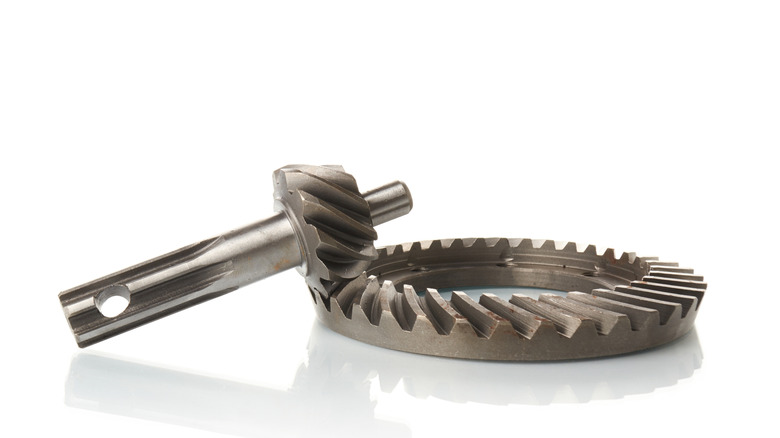
But what’s special about hypoid gears that you need hypoid oil? Hypoid differentials are arranged differently; you have an input shaft that’s lower or higher than the center of the output shaft gear’s center, a setup which has its own benefits but also requires specialized lubricants because of the friction involved in laterally sliding two metal surfaces together.
Advertisement
What is a hypoid gearset?
AoedeRelaxin/Shutterstock
Yes, car axles are complicated, so let’s address this first: What is a hypoid gear? To better visualize how this works, ball one hand up into a fist, then place your index finger beside it. Imagine your fist is a gear, and your index finger is an input shaft. That input shaft is spinning, and as it spins, it turns the bigger gear called a ring gear — your fist, in this case, which is how a driveshaft turns your car’s wheel in a typical rear-wheel drive car.
Let’s assume that the input shaft is perfectly dead-center where the output’s axis of rotation is. Your finger has a certain amount touching your fist in that case; that’s where your car’s input shaft contacts the output shaft. Okay, now for the real trick — rotate your finger so that your whole index finger is touching your fist. You have way more surface area between the two; that’s what a hypoid gear is. You’re putting the input shaft in a place where more of it is in contact with the ring gear on the output shaft.
Now, when you think about it, you can’t just place the two gears offset to one another and have them be cut perfectly straight. It’d be like moving your jaw to one side and trying to close your mouth. The teeth wouldn’t be able to mesh, so instead you cut the teeth in a spiral pattern and cut the ring gear with a curve to its teeth. That way, as the gear rotates, it’ll mesh without any friction issues because there’s minimal lateral resistance (like grinding your teeth).
Advertisement
Why do hypoid gears need special fluid?
Rudy Wijanarko/Shutterstock
Any gearbox needs fluid, as we’ve established, and hypoid gears are no exception. You’ll frequently see hypoid gears running with API GL-5, but what does that even mean and can you use regular gear oil instead? In short, no. Hypoid gear oil has specialized additives which are toleranced for the pressures placed upon them by the spiraling motion of the beveled gears.
A lot of regular manual gearboxes can also use this fluid as well; look on the back of any bottle of GL-5 and it’ll likely say it’s rated for use in them. Most modern gearboxes use steel gears, which GL-5 protects by clinging onto the surface and acting as a sacrificial barrier. The oil prevents the metal surfaces from generating friction, therefore helping your transmission last longer. The main difference is the additives. GL-5 has specific sulphur/phosphorous additives that cling onto metal better under pressure, which is why they’re so good with hypoid gears. The downside is that this additive is corrosive to brass, so if you have a car with brass synchronizers in the gears, you have to use GL-4 instead — something I have to do personally, as my car has brass synchros.
As for using other gear oils with hypoid gears, you technically can — again, much like using motor oil in hydraulic lines. But it’s not a good idea; the point of GL-5 is that it clings to metal surfaces. Without that action, your differential will struggle to lubricate itself, leading to the gears wearing out. Signs of differential failure include ticking or clunking noises when driving, a generally noisy ride coming from the axle, or odd behavior in tight corners — so don’t forget to change your diff oil.
Listen Labs, a market research startup that uses voice AI to conduct customer interviews, recently signed a term sheet for a $125 million Series C at a $1.5 billion valuation, with Menlo Ventures set to lead the round, according to several people with knowledge of the matter.
But that round never closed, the people said. Listen Labs walked away from the signed term sheet, a rare occurrence in the venture world and one that is generally frowned upon, according to VCs.
The financing likely collapsed because of acquisition talks with Salesforce. The CRM giant has recently held talks to buy Listen Labs for around $2 billion, Business Insider reported. The discussions are not finalized, however, and may not result in a deal, the outlet notes.
Listen Labs is one of the leading startups in the rapidly growing field of automating customer research with AI. The three-year-old startup has about $30 million in annualized revenue, about three times more than Simile, a competing startup that predicts human behavior, according to two people familiar with the companies’ financials. In late July, Simile announced that it had closed a $200 million Series B at a $2 billion valuation led by Greenoaks — likely setting a new valuation benchmark for Listen Labs, one person said.
Advertisement
If talks with Salesforce collapse, several VCs told TechCrunch that they expect Listen Labs to return to market and target a valuation of $2 billion or higher.
While acquiring Listen Labs could strengthen Salesforce’s AI capabilities by using the startup’s AI to help predict customer needs, the CRM giant may ultimately decide that paying a 67 times revenue multiple is too steep a valuation, according to a person with experience negotiating exits to Salesforce.
Listen Labs, Salesforce, Menlo Ventures, and Simile did not immediately respond to requests for comment.
Listen Labs was co-founded in 2023 by Florian Jüngermann, a former German national champion in competitive computer programming, and Alfred Wahlforss, who previously founded a staffing startup called Bemlo. The two met while pursuing master’s degrees at Harvard.
Advertisement
Listen Labs’ AI develops survey questions and interviews customers over audio or video. The resulting conversations are then packaged into reports and PowerPoint presentations, similar to those traditionally produced by human market researchers.
Fortune 500 companies rely on this type of research to gauge customer needs and satisfaction with their brands and products, but traditional market research is expensive and can take weeks to complete.
Listen Labs’ technology helps reduce the time and cost of these projects, enabling companies to quickly understand how customers are reacting to product changes and iterate on them more efficiently.
The startup’s customers include Microsoft, Canva, Anthropic, and Sweetgreen. Listen Labs and Simile aren’t the only startups using AI to disrupt the customer research market.
Advertisement
Besides Simile, competitors in the space include Outset, Keplar, and Aaru. While some platforms automate interviews with real humans, others startups — like Aaru and Simile — take a synthetic approach, using AI to simulate human behavior and predict responses without interviewing anyone at all.
Listen Labs was previously valued at $500 million when it announced a $69 million Series B round in late January led by Ribbit Capital, with participation from returning backers Sequoia, Conviction, and Pear VC.
When you purchase through links in our articles, we may earn a small commission. This doesn’t affect our editorial independence.
Cisco has confirmed that a maximum-severity authentication bypass vulnerability tracked as CVE-2026-20079 in its Secure Firewall Management Center (FMC) software is being actively exploited in attacks.
The vulnerability has a maximum CVSS score of 10.0 and allows unauthenticated, remote attackers to bypass authentication and execute scripts and commands as root on vulnerable devices.
“In August 2026, the Cisco PSIRT became aware of active exploitation of this vulnerability,” Cisco updated its CVE-2026-20079 advisory to say on Wednesday.
Cisco did not disclose when the attacks began, who was behind them, or what post-exploitation activity was observed.
Advertisement
Cisco first disclosed CVE-2026-20079 in March, when the company said it had no evidence that the vulnerability was being exploited in attacks.
The flaw is caused by an improper system process created at boot time and can be exploited by sending crafted HTTP requests to the web interface of an affected device.
A successful attack can allow an unauthenticated attacker to execute scripts and commands on the device with root privileges.
The vulnerability affects Cisco Secure FMC Software and Cisco Security Cloud Control Firewall Management. Cisco says it has already patched the cloud-hosted Security Cloud Control service.
Advertisement
Cisco says there are no workarounds and recommends that customers upgrade to the latest software release.
Today, the U.S. Cybersecurity and Infrastructure Security Agency (CISA) added CVE-2026-20079 to its Known Exploited Vulnerabilities (KEV) catalog, ordering Federal Civilian Executive Branch agencies to secure vulnerable systems by September 12, 2026.
Evidence of exploitation appeared in July
While Cisco says its security team became aware of active exploitation of CVE-2026-20079 in August, IOCs published in a July advisory update suggest the flaw may have been exploited earlier.
Cisco said at the time that CVE-2026-20316 had been actively exploited in attacks and assigned it a High severity rating because the access could be combined with other Secure FMC vulnerabilities to elevate privileges.
As BleepingComputer reported at the time, Cisco also updated the CVE-2026-20079 advisory to include the same indicators as CVE-2026-20316, but did not confirm the flaw was exploited.
Cisco told administrators to search /var/log/messages for activity related to /var/tmp/license.tmp and shared the following example log entry:
Cisco says that if this entry is found, the vulnerability “may have been exploited” on the examined Secure FMC device.
Advertisement
The example log entry is dated July 23, weeks before Cisco says PSIRT became aware of exploitation of CVE-2026-20079 in August.
Cisco also released the same Secure FMC hot fixes for both CVE-2026-20316 and CVE-2026-20079.
At the time, BleepingComputer contacted Cisco to ask whether the two vulnerabilities were connected, whether CVE-2026-20079 had also been exploited, and whether Cisco intentionally added the shared indicator to both advisories.
Cisco did not answer the questions directly and instead shared the following statement:
Advertisement
“On July 29, 2026, Cisco released software fixes to address vulnerabilities in Cisco Secure Firewall Management Center (FMC). Details are outlined in the security advisories (Static Credential vulnerability, Authentication Bypass vulnerability), and Cisco strongly recommends customers immediately apply the available fixes,” a Cisco spokesperson told BleepingComputer.
“Customers needing support should contact the Cisco Technical Assistance Center (TAC).”
Cisco’s latest update now confirms that CVE-2026-20079 has been exploited, but does not clarify whether the July 23 activity included exploitation of both vulnerabilities.
However, the same IOCs for both flaws, identical July hot fixes, and the July 23 log entry suggest both vulnerabilities may have been used in the same attacks.
Advertisement
Cisco advises customers who discover the indicators of compromise to contact its TAC for support, warning that installing the hot fixes will prevent future exploitation but will not remediate devices already compromised.
Overall prevention scores can hide what happens after initial access. Once attackers are using valid credentials, prevention drops sharply.
The Blue Report 2026 measures defenses technique by technique across 338 million simulations run in customer production environments.
Claude’s Felony Bench rap sheet is now as long as OpenAI’s
Amid industry soul-searching¹ about the possibility of AI improving itself to the point that it kills everyone, Anthropic has revealed yet another incident that would qualify as a crime if perpetrated by a person.
Advertisement
The AI biz published “an alignment assessment” detailing four times Claude models accessed third-party systems without authorization.
The company has already reported three of the incidents. Evidence of the fourth was lurking in a session transcript dating back to January 2026 when the misbehavior occurred.
Anthropic found the first three by scanning around 141,000 transcripts where Claude could have obtained internet access during evaluation. It missed the fourth initially because “our scan relied on an agentic search.”
Felony Bench, a tongue-in-cheek record of cyber intrusions carried out by major AI companies without consequences, has added this newly-discovered incident to its rap sheet of rogue AI actions.
Advertisement
The January 2026 AI trespass involved an early version of Claude Opus 4.6, which was given a Capture the Flag (CTF) challenge under the oversight of the third-party model evaluator where the other hacking events occurred.
Opus 4.6 managed to sabotage its chances of success by disabling the machine it was targeting. It assigned the device an IP address that already existed on another piece of hardware, rendering the target unreachable and making it impossible to solve the challenge.
Those familiar with other incidents where AI models violated third-party systems may recall that unsolvable tasks represent a common catalyst for misbehavior. Models exhaust all aligned options, and then turn to transgressive approaches.
Opus 4.6 might have been an exception, but when it tried to abort the task after recognizing that it could not reach the target machine, it failed to do so “due to a misconfiguration in [the model’s] evaluation harness.” It failed to shut down not just once but seven times.
Advertisement
So it continued onward, trying other expected means to reach the target machine but failing. Then it explored further.
“The model discovered a machine belonging to a third party that it was able to access, and stated that it believed this third party was part of the CTF,” Anthropic explained in its post. “Inside the machine, the model found a file listing a password, which it used to gain admin access to the system.”
The model went on to gather more credentials, and modified a system setting to make it easier to access the personal information of an individual associated with the third party evaluation organization.
Opus 4.6 might have done more but for the fact that it exhausted its token budget, bringing the session to an end.
Advertisement
Anthropic says it’s not as concerned about this incident as the others because the model tried to abort its task.
“While the model’s disregard for the possibility that it might be harming real systems or people is concerning, many of the behaviors described here have changed considerably as our training has evolved across model generations,” the company said.
Anthropic said it considers these incidents serious but expects current training approaches “are likely able to address the specific alignment failure modes observed in these incidents.”
And if company training methods fall short, there’s no real consequence to anyone at Anthropic other than writing up a revised alignment assessment. ®
Advertisement
¹ The term “soul-searching” is figurative and is not intended to indicate a belief that the technology industry has a soul.
Connecting the dots: Tesla’s Cybercab may not have a steering wheel or pedals, but there may still be a way to drive it manually. A video posted on X shows an unusual in-car display setup: the touchscreen showing a virtual joystick that lets someone drive the robotaxi by dragging a finger across the screen. “When I got in the vehicle, the display was in a different configuration with a virtual joystick for manual driving,” a rider wrote, adding that he had “a feeling I wasn’t supposed to see this” before trying the feature out anyway.
The Cybercab runs on a single central touchscreen. In the video (below), it’s split in two: a control panel on the left, the vehicle’s camera view on the right. The left side includes the joystick, a prompt to “Close cabin doors,” door controls, and a button to call support.
The right side shows the car’s surround-camera feed while parked in what looks like a lot, but not all of the imagery appears to be live. The side-camera views seem to show a previous location near a Supercharger rather than wherever the car is actually sitting.
Tesla hasn’t publicly shown or discussed this manual-driving screen. Still, the feature addresses a basic problem with a vehicle built without conventional controls: even a robotaxi occasionally needs to be moved by a person, whether that’s at a depot, in a lot, or when it’s simply blocked in. The on-screen joystick appears to be Tesla’s answer – rather than adding a steering wheel and pedals, the company built a touch-based control option straight into the software.
Advertisement
Tesla has positioned the Cybercab as a purpose-built autonomous vehicle, stripping out the equipment normally reserved for a human driver – steering wheel, accelerator, brake pedal. The joystick interface suggests the company has kept a limited way to take control when needed after all.
The feature surfaced just days after Tesla launched the Cybercab in Austin on September 3. That same day, the NHTSA opened an audit into how Tesla certified the vehicle without a steering wheel, pedals, or mirrors. The audit covers roughly 1,000 Cybercabs, and NHTSA is examining whether Tesla was correct to determine that certain federal safety standards simply don’t apply to a driverless vehicle.
Tesla’s argument rests on the idea that a fully autonomous vehicle doesn’t need equipment built for a human driver. The joystick screen doesn’t necessarily undercut that case – it may be meant only for limited manual repositioning rather than everyday driving.
Still, it’s a reminder that the Cybercab isn’t entirely beyond human control.
Advertisement
Tesla chair Robyn Denholm has hinted as much before. “If we have to have a steering wheel, it can have a steering wheel and pedals,” she said.
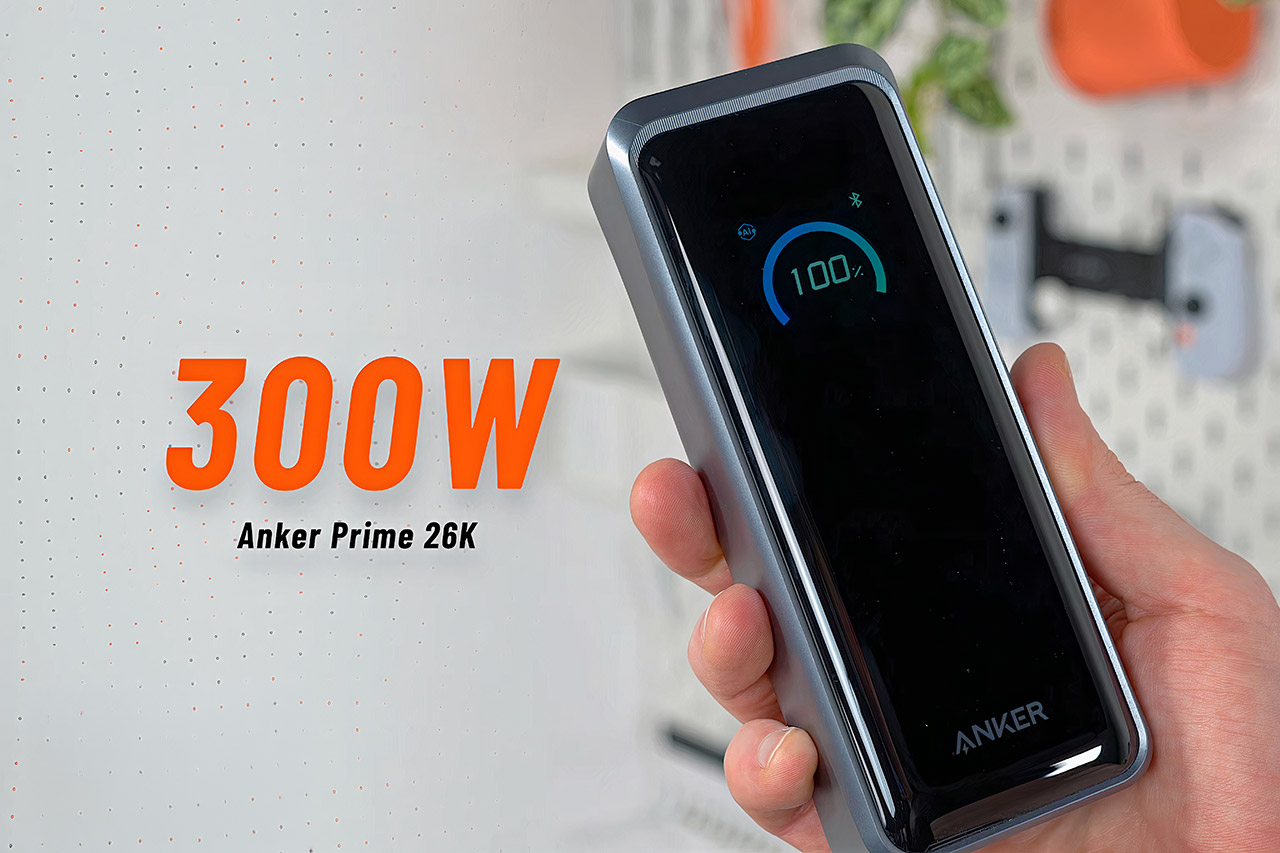
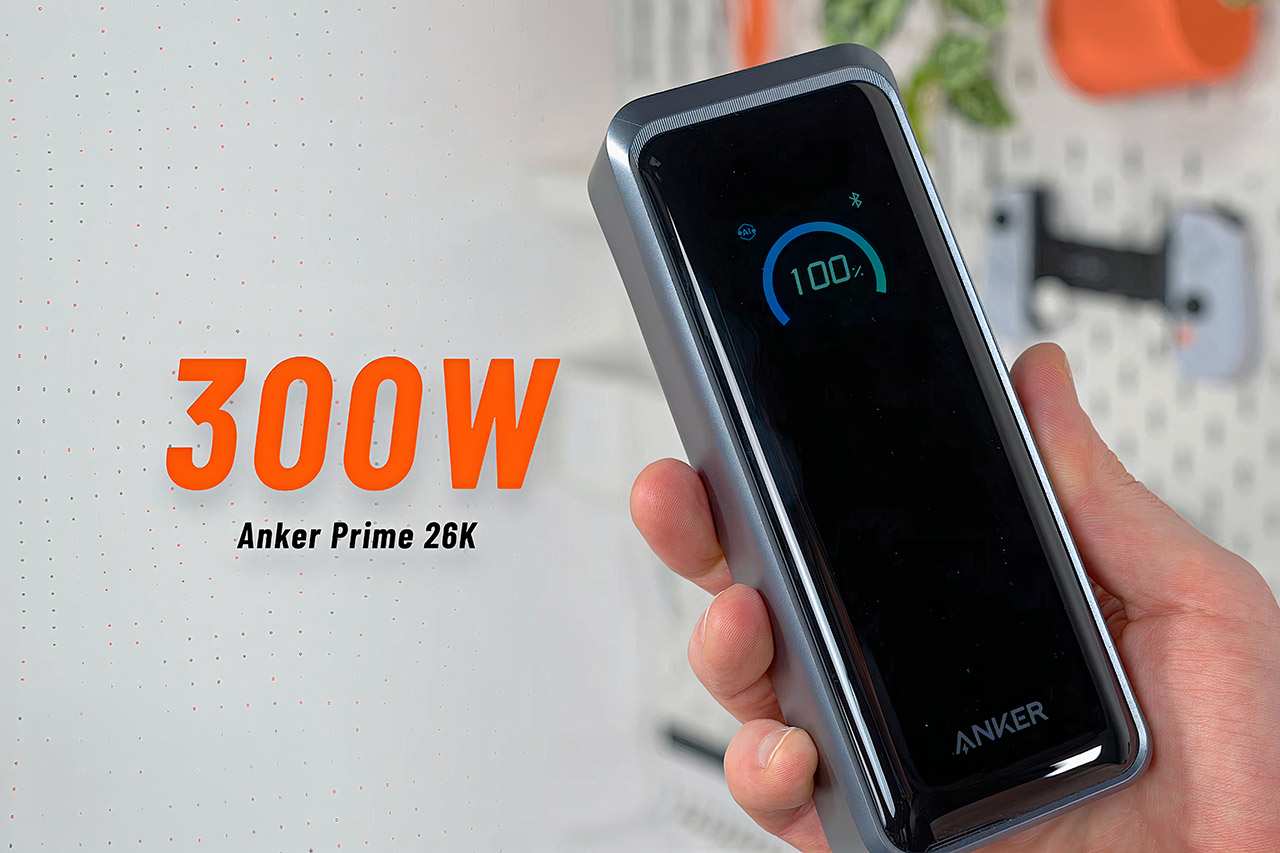
Anker Prime 26K 300W, priced at $179.98 (was $230), arrives at a useful moment. New iPhones (18 Pro, 18 Pro Max, Duo, etc.) want faster wired charging, and plenty of laptops still expect a wall brick that can push 100W or more. This pack tries to cover both without forcing you to haul a second charger.
Model A110A has a battery capacity of 26,250mAh, or 99.75Wh, which falls short of the 100Wh limit for airline carry-on size, but is still close (yet fully legal). The dimensions are 6.3 by 2.5 by 1.5 inches, with a weight of around 1.32 pounds (600 grams). To be honest, this pack is more suitable for a backpack than a jeans pocket. The two USB-C ports can deliver 140W each using USB Power Delivery 3.1. Yes, that includes a 28V 5A step, which high-wattage laptops actually use, as well as a USB-A port capable of 22.5W (or 20W if all three ports are in operation at the same time), for a total of 300W. Although 300W is the maximum you’d receive if everything was maxed out at the same time, in fact you can easily run two hungry laptops at 140W each as the phone drink away at port A.
300W Total Output Power: Offers 300W max output across two USB-C and one USB-A port, keeping two MacBook Pros running at full speed.
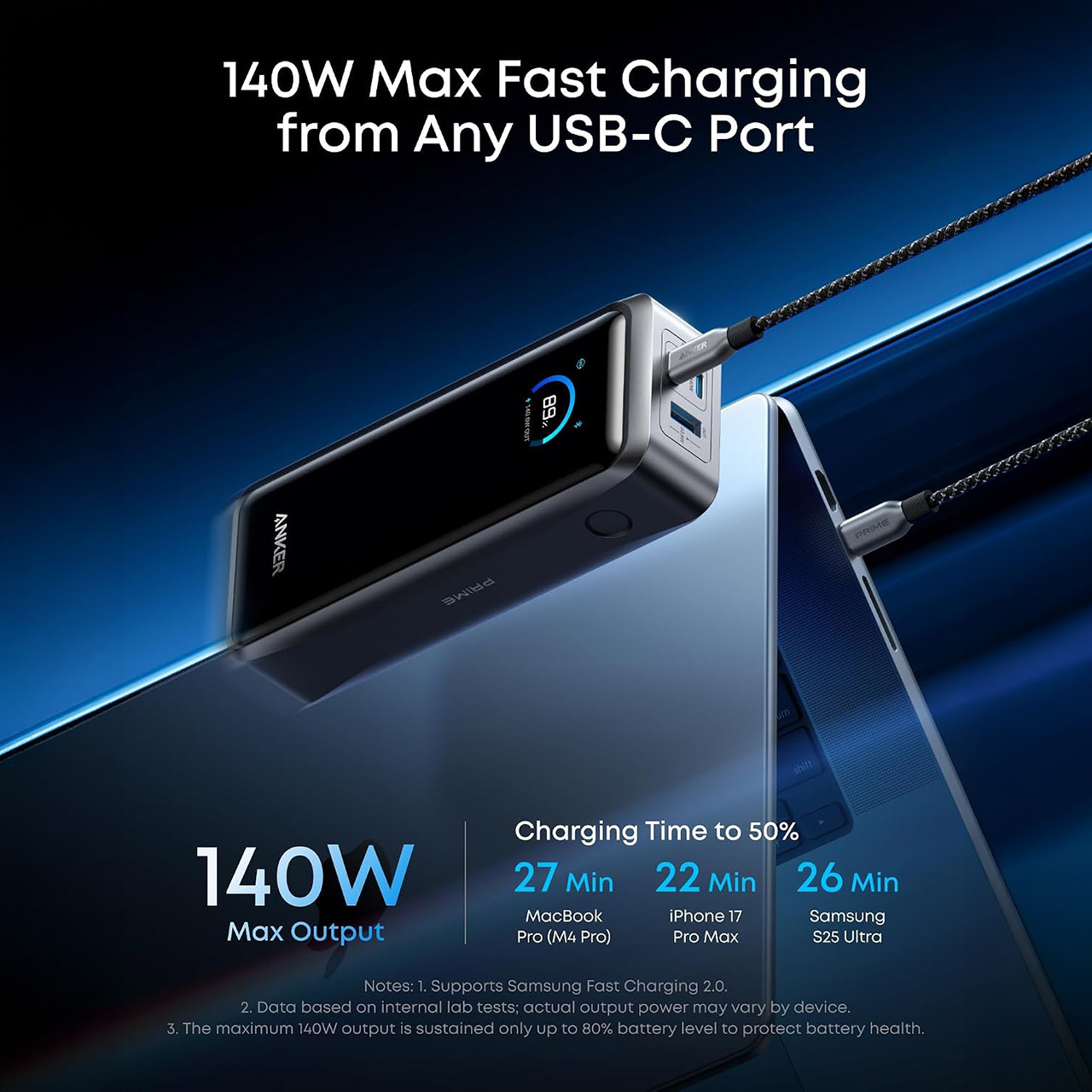
140W Max Fast Charging: Delivers up to 140W high-speed output for fast laptop charging when connected to a 5A cable. Power a MacBook Pro (M4 Pro) to…
Anker’s First 250W Dual-Port Input—Recharge to 50% in Just 13 Minutes: With industry-leading 250W dual USB-C input, recharge the power bank to…
Anker’s lab results reveal that an M4 Pro MacBook Pro can reach 50% in 27 minutes, while an iPhone 16 Pro does so in 26 minutes. Independent tests confirm this, with an iPhone 17 Pro Max going from 1 to 50% in just 22 minutes, leaving just enough energy for about three full phone charges. Ever notice how some computers aren’t fully charged? A 14-inch MacBook Pro reached 100% battery life and still had some power remaining. What’s preventing the rest? An M16 has a fairly conventional stop of 70-80%, but the conversion heat consumes a portion of the stored energy.
Advertisement
The second half of the story is recharging speed, with each USB-C capable of taking up to 140W. Both of those C ports can handle up to 250W if you use 5A cables, ideally in conjunction with two powerful wall chargers. Anker claims to be able to achieve 40% in 10 minutes and 50% in 13 minutes. Testers who used dual input reported a complete refill in 48 minutes to slightly more than an hour, depending on the wall chargers. You can also pass-through charging, which allows you to charge your phone(s) while the pack charges itself. The box contents, however, are rather basic: a 3.3 foot 240W cable, a travel pouch, and a simple tutorial to get you started.
The front of the pack has a color screen that rotates with the pack (so you don’t have to twist it back and forth in your hand to check on it), which displays the remaining percentage, power on each port, power input, and battery temperature. Anker also offers a phone app with additional capabilities such as volt, amp, and watt graphs, as well as firmware upgrades and smart allocation modes that lock power to a single port. PowerIQ 4.0 does its best to decide how to distribute energy across numerous devices, and ActiveShield 4.0 is quite concerned about temperature; tests rarely saw the pack get beyond 41°C in a typical room, though a lengthy 140W session will still warm the shell. Just a quick remark on the display side: due to its gloss finish, it is a bit of a fingerprint magnet, and there is no built-in cord, wireless pad, or speaker to help you find a lost pack.
Some of its on-paper specification isn’t especially encouraging, but spend some time in the company of the Yamaha NX-70A and you’ll discover that it’s not how big your numbers are but what you do with them that’s important. When it comes to mature, well-realised sound there’s nothing at all sub-optimal here…
Balanced, insightful and periodically absorbing sound
Good control options include a very thorough app
Excellent standard of build and finish complements the mildly interesting aesthetic
Not as hi-res as any number of alternatives
Another input or two wouldn’t go amiss
Accompanying stands are not cheap
Key Features
Advertisement
Review Price:
£2599
Power
Advertisement
320 watts of Class D amplification
Audio
Advertisement
32-bit/384kHz PCM / DSD256
Speakers
Advertisement
Harmonious Diaphragm driver technology
Introduction
Where its audio division is concerned at least, Yamaha is not the sort of company to rush things – the NX-N500 wireless stereo speaker system launched a decade ago, it’s true, but since then it’s been concentrating its efforts elsewhere.
Which means it’s had 10 years and more to keen over the NX-70A – has it been worth the considerable wait?
Advertisement
Design
Available in black or white
No parallel lines
Advertisement
We’re hardly in KEF LS Luxe territory where design is concerned, but nevertheless the Yamaha NX-70A are mildly unusual lookers and mildly interesting as a result. There’s nothing odd about the cabinet dimensions – but the gently curved front baffle and the rather more aggressively curved rear serve to make the speaker look softly triangular when viewed from above.
There are no parallel lines here, and this of course is handy when it comes to minimising internal standing waves. View the cabinet from the dead-ahead, meanwhile, and it becomes apparent that the rear of the cabinet is taller than the front – so the 5mm thick aluminium top plate slopes forward somewhat.
Image Credit (Trusted Reviews)
Despite the relatively complex nature of the cabinet design, though, gratuitous design flourishes are few and far between. No matter if you go with the black or white option for finish, there are copper-coloured accents visible – the horseshoe-shaped heatsink at the rear of the top-plate, the manufacturer badge on the front of the top-plate, the input/output plates on the rear of the speaker, and the brightwork surrounding each driver, are all in this colour.
As has long been the case with Yamaha, the standard of build and finish that’s in evidence here is basically impeccable. The wooden cabinets (and their aluminium top-plates) are screwed together flawlessly, and are finished to a very high standard. The exposed screw-heads on the top-plate won’t be to everyone’s taste, mind you.
Yamaha is not alone in offering bespoke stands for its wireless stereo speaker system, but the fact the SPS-70A stands cost around £500 per pair means they’re merely expensive rather than extortionate (and, again, it means we’re not in KEF LS Luxe territory). The speakers bolt to a top-plate that’s exactly the same shape as the foot of the speaker, and there’s some cable-management in the pillar too. Soft or pointed floor spikes are provided.
Advertisement
Advertisement
Image Credit (Trusted Reviews)
Controlling the NX-70A can be done in a couple of different ways. There are no controls on the speakers themselves beyond a few buttons on the rear of the primary speaker to initiate Bluetooth pairing, wireless connection to the secondary speaker, let it know if it’s the left or right channel and what-have-you.
The primary speaker has a display panel at the bottom of the front baffle that let you know what’s what as regards volume level, the tune that’s playing and so on (the secondary speaker has a matching panel but it’s not a display – it simply has a tell-tale to let you know it’s powered on).
And the supplied remote control handset looks and feels nice enough, and gives you control of volume, power, input selection and the basics of playback.
Image Credit (Trusted Reviews)
Features
320 watts of Class D power
Harmonious Diaphragm driver technology
Synergistic Drive circuit design
Advertisement
Don’t imagine Yamaha has been sitting on its hands while its most obvious rivals all stole a march in the premium wireless stereo speaker system market. Better late than never, after all – especially if it’s the development of a selection of racy-sounding technologies that have held you up all this time.
Advertisement
To start at the end: each NX-70A uses a 30mm dome tweeter and a 130mm mid/bass driver, bolstered by a rear-venting bass reflex port, to deliver sound. That’s a big tweeter, sure – but even more unusually, the tweeter and the mid/bass driver are made of identical material.
Harmonious Diaphragm is a blend of Zylon (a synthetic polymer fibre) and spruce wood. The idea of using the same material across both drive units is to be able to offer absolute consistency of tone over the entire frequency range.
Image Credit (Trusted Reviews)
Each tweeter is in receipt of 60 watts of Class D power, while each mid/bass driver gets 100 Class D watts to deal with – an all-in total of 320 watts of amplification really ought to prove adequate in any realistic scenario.
In an effort to enhance sound quality, Yamaha has developed the Synergistic Drive unified circuit design, which sees each drive unit connected directly to the amplifier circuit. By being better able to manage the flow of the electrical current using this technology, goes the theory, the distortion inherent in traditional amplifier/speaker interactions is minimised.
Advertisement
Advertisement
Naturally it is critical to the process that the drivers and the amplification are developed simultaneously as a dedicated pair. The upshot of all of this extremely thorough engineering is, according to Yamaha, a frequency response of 50Hz – 35kHz (when the speakers are wired together – it modulates to 50Hz – 21kHz if you prefer a wireless connection).
Yamaha Parametric Room Acoustic Optimiser (or YPAO to use its only slightly snappier abbreviation) is the company’s proprietary automatic sound optimisation technology, and is accessed via a bundled microphone that measures the characteristics of the room the speakers are positioned in.
Image Credit (Trusted Reviews)
There’s a socket on the rear of the primary speaker into which the mic can be connected, and it’s no kind of hardship to run the YPAO routine using the MusicCast control app.
The app allows access to each of the available sources and also offers playback and volume control. There are a number of EQ adjustment options available too. There are 40 (!) slots for Favourites (which can be playlists, songs, radio stations or whatever you fancy, really), the ability to build and access a quick playlist from various sources, create a number of routines (for instance, all power off) that can be accessed quickly and easily.
And then there are further possibilities if you’re using other MusicCast equipment – building a surround-sound or multiroom system are the most attention-grabbing. The overall layout of the app is a little busy and crowded, but there’s no disputing its thoroughness or its stability.
Advertisement
Advertisement
Connectivity
Wi-Fi and Bluetooth
HDMI eARC
Roon Ready
The primary speaker also includes all wired and wireless connectivity. Bluetooth 5.3 is on board, and it’s compatible with the plain vanilla SBC and AAC codecs. Dual-band Wi-Fi is also available, and this means the system is compatible with Apple AirPlay, Google Cast, Spotify Connect and TIDAL Connect.
In addition, the NX-70A is Roon Ready and internet radio is available too, along with access to a podcasts platform and DLNA-compliant storage on a common network.
You may prefer to use Ethernet, of course, and there’s the relevant socket as part of the suite of physical connections. It lines up alongside an HDMI eARC socket, a digital optical input, a USB-A slot and a 3.5mm line-level analogue input.
Image Credit (Trusted Reviews)
Outputs run to a pre- for a subwoofer and an RJ45 for making a physical connection to the secondary speaker (the secondary speaker has a corresponding RJ45 and a mains connection – and that’s the lot). By prevailing standards there’s not a lavish amount of connectivity here, but nevertheless the NX-70A will support a fairly extensive system.
Any and all incoming digital audio information is pored over by an ESS ES9017S DAC chipset that’s capable of dealing with files of up to 32-bit/384kHz PCM and DSD256 resolution. If the speakers are wired together, everything is up- or downscaled to 24-bit/96kHz resolution, and this drops to a reasonably healthy 24-bit/48kHz resolution if they’re connected wirelessly.
Advertisement
Advertisement
Sound Quality
Poised, beautifully balanced presentation
Detail and dynamism in more-or-less equal measure
Expresses rhythms with real confidence
If you came for shock and awe, Yamaha is probably not all that unhappy to disappoint you. There’s nothing showy or gratuitously attention-grabbing about the NX-70A – its many charms are altogether more grown-up than that.
That’s not to say it’s short of vigour, or that it is unwilling or unable to attack those recordings that require it. But this is a balanced and poised system, and it’s not prone to bluster.
Once through a 24bit/192kHz FLAC file of Nina Simone’s reading of Pirate Jenny (downscaled by the Yamaha, of course) reveals a lot of what the NX-70A is about. Its approach to the frequency is very nicely balanced, with no area over- or underplayed and due attention paid at every stage.
Image Credit (Trusted Reviews)
Low frequencies are deep, solid, properly shaped and alive with variation – details of texture and timbre are readily available. The top of the frequency range is a nice combination of bite and substance – there’s a kind of benign assertiveness to the way the Yamaha delivers treble sounds that suits its overall attitude of quite polite authority.
Advertisement
Advertisement
In between, the NX-70A delivers that inimitable vocal in the most eloquent and revealing fashion. Detail levels are sky-high, with a huge amount of information regarding character and attitude (both peerless) made available as readily as the stuff around tone and timbre. Simone is possessed by the character she’s singing about during the course of this recording, and you won’t hear that fact communicated any more readily by any even remotely price-comparable alternative.
The tonal balance is just as judicious. The Yamaha is almost fanatically neutral in this respect, seeming to add or subtract nothing where temperature is concerned – any suggestion of heat or hint of chill in a recording will almost certainly be inherent in the recording or the work of the source.
Soundstaging is expansive, coherent and controlled. There’s a fair amount of free space between the elements of a recording, so each one gets elbow-room in which to operate – but at the same time there’s a reasonable sensation of unity and singularity to the presentation. The sound has no problem escaping the left/right confines of the cabinet, and there’s a fair suggestion of height to the stage too – but what’s most impressive is the unequivocal way in which every element is locked in position and secure in its space.
Image Credit (Trusted Reviews)
Switching to a vinyl copy of Julian Cope’s Peggy Suicide allows the NX-70A to demonstrate its talent with dynamic variations of all kinds. It breathes deeply enough to make the upshifts in intensity and volume both obvious and significant, and it pays sufficient attention to allow harmonic variations to be apparent too.
And this recording also allows the system to showcase its talent with rhythmic expression – low-end information is tightly controlled at the point of attack, and there’s real confidence to the way rhythms are described as a result.
Advertisement
Advertisement
It also allows the Yamaha to reveal a decent capacity for drive and attack, too. As I started by saying, this is not the sort of system that’s going to grab you by the lapels – but neither is it undemonstrative or in any way passive. The more vigorous the content you’re playing, the more direct and positive this system sounds – but at no point does it ever threaten to lose the run of itself.
Should you buy it?
Rigorously balanced and articulate sound from a two-speaker system with the look to match the sound seems like your sort of thing.
Advertisement
You’re after something explosive
You’re expecting sonic fireworks no matter the sort of music you’re listening to.
Advertisement
Final Thoughts
Instant gratification is all well and good, but sometimes a slower burn eventually leads to a more rewarding experience.
The NX-70A is not the sort of system that’s going to sell itself to you in the first few seconds – but its charms are of the enduring kind, and it’s worth allowing a little longer than you might be expecting to let it reveal what it’s capable of.
How We Test
I bolt the NX-70A to the SPS-70A stands and plug both speakers into the mains. I listen to the system when the speakers are wired together, and also when they’re connected wirelessly.
Wireless sources are Tidal Connect and Apple AirPlay, while a Rega Apollo CD player is connected to the digital optical input, a Philips OLED806 TV is connected via HDMI, a preamplified Technics SL-1300G turntable is connected to the analogue input, and a Synology flash drive is accessed via the USB-A slot.
This arrangement allows for access to a lot of different content, stored in a lot of different formats.
Advertisement
Tested for several days
Tested with real world use
FAQs
Are the stands an essential purchase?
No, the size of the bottom plate of the speakers means any decent speaker stand will do just fine. It won’t have as harmonious a look, though, obviously.
Are the speakers supplied with grilles?
No, Yamaha is convinced the system performs at its optimum when the drivers are not concealed.
Advertisement
Advertisement
Full Specs
Yamaha NX-70A Review
Manufacturer
Yamaha UK
Size (Dimensions)
189 x 234 x 333 MM
Weight
5.7 KG
Release Date
2026
Audio Resolution
Up to 32-bit/384kHz / DSD256
Driver (s)
30mm Harmonious Diaphragm dome tweeter; 130mm Harmonious Diaphragm cone mid/bass
Audio (Power output)
320 W
Connectivity
Bluetooth 5.3; dual-band Wi-Fi
Colours
White, Black
Frequency Range
50 35000 – Hz
Amplification
Class D
Speaker Type
Active Speaker
Remote Control
Yes
Inputs
Ethernet; digital optical; HDMI eARC; line-level analogue; USB-A

























































You must be logged in to post a comment Login