







Crypto World
Japan crypto bill advances; could widen ETF access and tax reform
Japan’s Lower House has moved a bill that would bring crypto assets under the country’s financial instruments framework, signaling a potential shift toward regulated market access such as exchange-traded funds and a more favorable tax posture for digital assets. Bloomberg reported that the legislation aims to regulate crypto assets more like traditional securities, imposing stricter trading rules as part of a broader market growth push. The bill is expected to advance further after consideration by the Upper House and could take effect next year pending final enactment.
The proposed changes would align crypto assets with the regulatory treatment afforded to stocks and bonds, introducing tighter governance and disclosure requirements. At a macro level, the move reflects an ongoing effort to integrate digital assets into Japan’s financial markets while enhancing oversight and investor protections. If enacted, the reform would also reframe the tax landscape for crypto holdings, with potential implications for both retail and institutional participants.
Official records indicate the bill cleared the Committee on Financial Affairs on June 10, though the plenary vote status on the House of Representatives’ tracking page had not yet been updated at the time of reporting. The procedural steps remain subject to confirmation by the Upper House, which would complete the legislative process before implementation.
Japan’s broader regulatory trajectory has been evolving for months, with signals that crypto would move from a payments-oriented regime to a financial-market framework. In November 2025, Asahi Shimbun reported that the Financial Services Agency (FSA) had decided to apply the Financial Instruments and Exchange Act to crypto assets, including Bitcoin, Ether, and other tokens traded on local exchanges. In April 2026, FSA materials stated the proposal would relocate crypto-asset transaction rules from the Payment Services Act to the Financial Instruments and Exchange Act, marking a substantive shift in the regulatory architecture.
The FSA described a framework in which crypto assets would be treated as financial products distinct from traditional securities, while introducing disclosure duties, tighter exchange oversight, insider-trading restrictions, and steeper penalties for unregistered operators. The proposed regime would require crypto-asset transaction businesses to publish information about the assets they handle, and issuers of certain assets would face disclosure obligations during offerings or secondary distributions. Bloomberg again highlighted that such a regime could create a pathway for crypto-tracking ETFs, offering Japanese investors a regulated channel to gain exposure beyond direct exchange trading or holdings in listed companies with token interests.
Key takeaways
- The Lower House appears to have advanced a bill to subject crypto assets to the Financial Instruments and Exchange Act, moving regulation closer to equities and bonds and potentially enabling new market structures such as crypto-tracking ETFs.
- The bill contemplates shifting crypto-asset rules from the Payment Services Act to the Financial Instruments and Exchange Act, with enhanced disclosure, oversight, and penalties designed to bolster investor protection and market integrity.
- Tax provisions would reclassify crypto capital gains with a flat 20% rate—aligned with stocks and bonds—down from a current maximum of 55%. The change is slated to take effect in 2028, subject to final passage and transitional rules.
- Authorities have disclosed that the bill cleared the Committee on Financial Affairs as of June 10, with plenary-vote status pending final confirmation, reflecting a methodical progression through the legislative process.
- The reform could broaden institutional access to regulated crypto exposure via ETFs and other financial-market instruments, potentially integrating digital assets into mainstream investment and risk-management frameworks in Japan.
Regulatory trajectory and scope
The core objective of the bill is to reposition crypto assets within Japan’s financial-market regime, elevating their regulatory status from a payments-focused perimeter to a framework that governs financial products. The proposed move to bring crypto under the Financial Instruments and Exchange Act would harmonize trading rules with those applied to traditional securities, futures, and related instruments. In doing so, the regime would introduce standardized disclosure for asset managers and issuers, as well as stronger oversight of trading venues and intermediaries.
Key features under consideration include classifying crypto assets as financial products distinct from conventional securities, while imposing requirements applicable to market participants, including tighter supervision of exchanges and enhanced penalties for unregistered operators. The scheme would obligate crypto-asset transaction operators to publish information about the assets they handle, a disclosure duty intended to improve transparency for investors and regulators alike. Issuers of certain assets would face disclosure obligations during offerings or secondary distributions, aligning issuance practices with broader financial-market standards.
These measures echo a broader regulatory trend observed in many jurisdictions seeking to reduce information asymmetry and systemic risk associated with digital assets. Notably, the move would align Japan with global policy directions that emphasize market integrity, investor protection, and clear accountability for participants across the crypto value chain. The European Union’s MiCA framework and ongoing U.S. regulatory developments provide a contemporaneous backdrop for such a shift, reinforcing the trend toward formalization of crypto markets within traditional financial infrastructure.
Tax reforms and market access for investors
A central economic dimension of the bill is the proposed tax treatment of crypto gains. The current regime, which can reach up to 55% in capital gains tax, would be replaced by a flat 20% rate on crypto profits, aligning with the tax treatment of stocks and bonds. The timing of the tax reform—policy intent to be effective in 2028—reflects an orderly transition that would grant businesses and individuals time to adjust to the new framework. For institutions, the change could alter after-tax returns and impact portfolio construction, tax planning, and accounting practices tied to digital asset exposures.
From a compliance perspective, the tax realignment sits within a broader policy objective to increase predictability and coherence across asset classes. For crypto firms and asset managers, this could translate into more standardized tax reporting and a clearer line between taxable crypto activities and other financial instruments. For banks and custodians, the reform could influence product design, treasury management, and client advisory services, especially as the market explores regulated wrappers or ETF structures linked to digital assets.
In parallel with tax considerations, the potential for crypto-tracking ETFs marks a significant market-access development. Such products would provide a regulated, exchange-traded vehicle for investors seeking diversified exposure to crypto assets without direct custody of tokens. While the possibility has been flagged by market observers, the actual availability will depend on the final regulatory framework, licensing requirements, and the operational readiness of market participants to meet disclosure, custody, and liquidity standards demanded by Japan’s evolving regime.

Impact on market structure, compliance posture, and policy context
From an institutional perspective, bringing crypto assets into a financial-instrument framework would sharpen compliance expectations across the ecosystem. Exchanges, brokers, asset managers, and issuers would operate under more explicit rules around transaction reporting, asset information disclosure, and governance. The alignment with the Financial Instruments and Exchange Act would also shape AML/KYC programs, recordkeeping, and supervisory oversight, thereby enhancing regulatory certainty for both domestic and cross-border participants.
Beyond Japan’s borders, the reform integrates into a broader international policy discourse on crypto regulation. The MiCA framework in the European Union and U.S. regulatory developments reflect a global shift toward treating digital assets as regulated financial products with explicit consumer protections, capital-raising guidelines, and systemic-risk controls. For multinational firms active in Japan, the legislative trajectory underscores the need to harmonize compliance programs with domestic rules while monitoring developments in other jurisdictions that could influence cross-border operations, licensing equivalencies, and supervisory cooperation.
Another practical consideration concerns the balance between innovation and control. While tighter rules may raise the bar for market participants, they also create clearer paths for institutional involvement—ranging from regulated trading venues to custodian services and product issuances. The forthcoming Upper House deliberations will determine the pace and scope of the reform, including whether the ETF pathway receives formal approval and how disclosure standards will be operationalized across asset classes and offerings.
Closing perspective
Japan’s legislative move to bring crypto assets under a financial-market framework represents a pivotal moment for regulatory clarity, investor protection, and market accessibility. As the process unfolds, watchers should monitor the Upper House deliberations, the final articulation of the tax timetable, and the concrete rules surrounding disclosures and market surveillance. The unfolding framework could influence not only domestic capital markets but also how international entities align their compliance programs and risk controls with Japan’s evolving policy posture.
Crypto World
Bitcoin price rebounds as Iran deal hopes cool market panic
Bitcoin returned to positive territory on June 12 as risk appetite improved after signs of possible U.S.-Iran de-escalation.
Summary
- Bitcoin rebounded near $63,430 as Iran de-escalation helped reverse this week’s risk-off crypto pressure.
- Glassnode data showed options fear eased after one-week implied volatility briefly jumped toward 65%.
- Spot Bitcoin ETFs saw $19.03 million in outflows, extending redemptions for five straight sessions.
Bitcoin traded near $63,700 on June 12, up about 1% over 24 hours, according to crypto.news market data. The asset also gained 1.66% over seven days, showing a recovery from the recent move below $60,000.
The bounce came after traders reacted to signs that U.S.-Iran tensions may ease. President Donald Trump canceled planned strikes on Iran and said a deal could be reached soon, according to reports.
Oil prices fell after the news. Brent crude dropped toward the mid-$80s, easing concern that higher energy prices would keep inflation pressure high.
That shift matters for crypto because oil-driven inflation can keep the Federal Reserve hawkish. Lower geopolitical stress can reduce pressure on risk assets, including Bitcoin and major altcoins.
Bitcoin and major crypto prices turn higher
Ethereum traded near $1,671, up about 0.97% over 24 hours. The token stayed close to the $1,650 support area after a weak week for spot Ethereum ETFs.
BNB traded near $605, while Solana hovered around $66.69 after a 1.95% daily gain. XRP also traded near $1.14, up 3% on the day.
Dogecoin moved near $0.086, while Hyperliquid rose to around $59.17. HYPE was among the stronger major tokens, although it remained weaker over the weekly window.
TRON was the clear laggard among the listed majors. TRX traded near $0.312, down 2.86% over 24 hours and 3.79% over seven days.
The broad rebound shows that traders reduced some risk-off positioning. Still, the move remains early and has not yet erased the damage from the June selloff.
Options data shows fear cooled
Glassnode said Bitcoin broke below the February low before bouncing from the June low. The firm tracked how options traders reacted during the move.
“Selloff Triggers a Temporary Volatility Spike,” said Glassnode.
According to Glassnode, at-the-money implied volatility jumped as BTC broke below the February low. One-week implied volatility briefly reached 65% before the spike faded.
Front-end volatility then moved back near 40%. That showed options traders did not keep pricing an extended panic move after the bounce.
“Markets still view the selloff as a contained move,” said Glassnode.
Protection demand also rose quickly before fading. One-week skew jumped from 12% to 28% as BTC fell, showing a rush for downside hedges.
That skew later moved back near 12%. The reversal suggests traders bought protection during the break lower, then reduced hedging as price stabilized.
ETF outflows keep pressure on Bitcoin
Spot Bitcoin ETFs recorded $19.03 million in net outflows on June 11, per SoSoValue data. That marked the fifth straight day of outflows and showed that institutional demand remained cautious.

Spot Ethereum ETFs also saw $15.89 million in net outflows on the same day. That marked the third consecutive day of withdrawals from ETH funds.
As previously reported by crypto.news, the June crypto crash came from several pressures arriving together. The market faced a hawkish Fed, Iran escalation, ETF outflows, and a leverage unwind.
SpaceX IPO interest also created a background drain on speculative capital, as previously reported. That report said the IPO wave did not cause the crash alone, but it weakened crypto’s buyer base.
Bitcoin’s latest rebound therefore has to compete with ongoing ETF weakness. If ETF flows turn positive again, the recovery could gain firmer support.
If withdrawals continue, the bounce may struggle to move beyond the next resistance areas.
Traders watch FOMC and $60K support
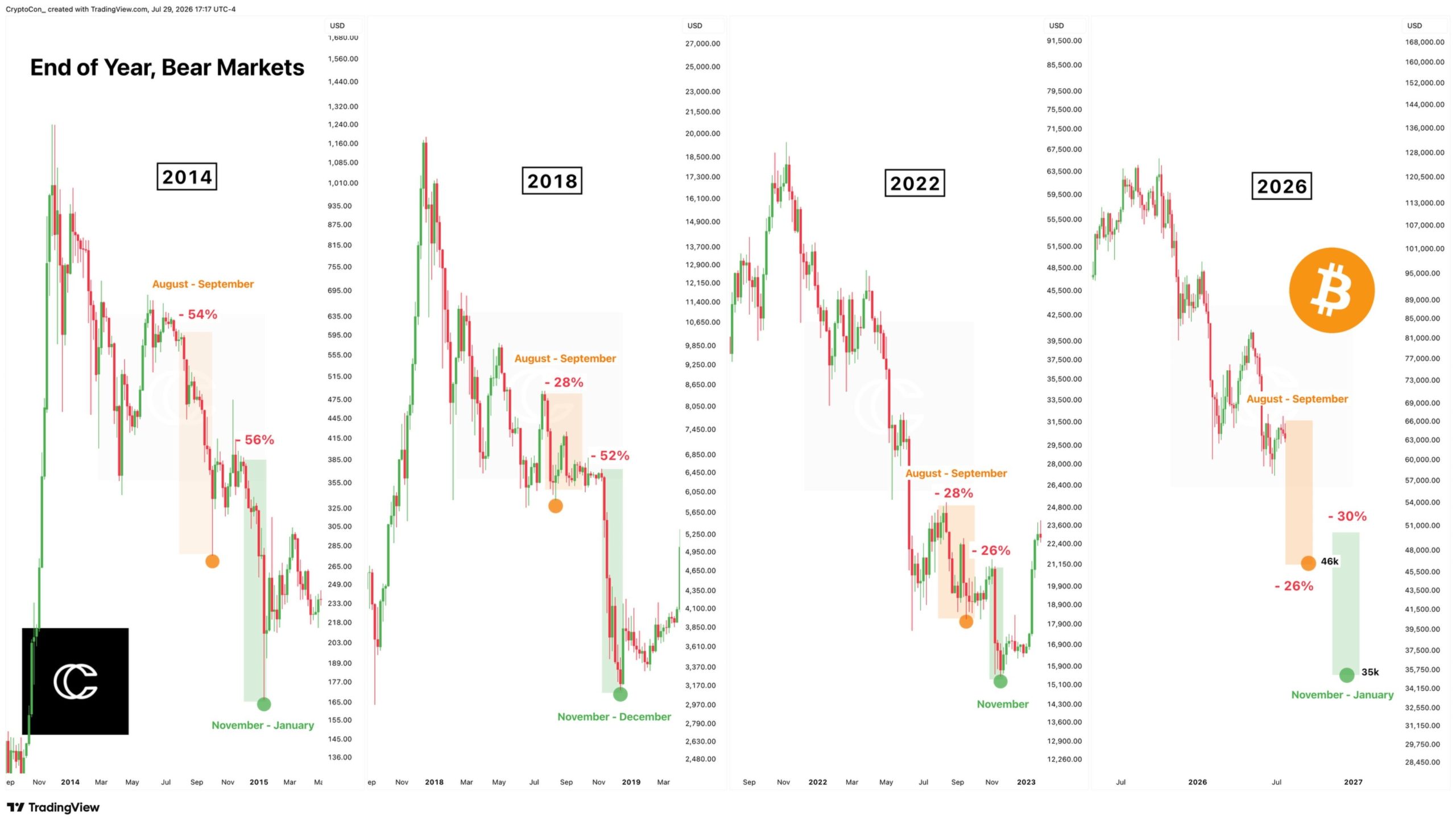
Several analysts still warned that Bitcoin’s rebound may face another test. Crypto Rover said the four-year cycle remains on schedule, with cycle bottoms historically arriving around September to October of the fourth year.
“The 4-year cycle is running on schedule,” said Crypto Rover.
Kaz said Bitcoin has reacted poorly around most FOMC events during the bear market. The analyst pointed to June 17 as a possible date for another lower high if price fails to extend.
CryptoQuant analyst Darkfost also said both whales and retail traders increased BTC inflows to Binance as price fell below $60,000. Whale inflows rose to an average of 5,280 BTC over 90 days, while retail inflows reached about 410 BTC.
Those exchange inflows can show fear because coins moving to exchanges are often easier to sell. Darkfost compared the behavior with early February, when similar inflows appeared during another move below $60,000.

For now, the key market level remains the $60,000 area. Holding above that zone would support the view that the latest selloff was contained.
A stronger recovery would require Bitcoin to reclaim $65,000 and then build momentum toward $68,000 to $70,000. Until then, the bounce remains a relief move inside a fragile market.
Disclosure: This article does not represent investment advice. The content and materials featured on this page are for educational purposes only.
Crypto World
For the bitcoin (BTC) price, SpaceX’s Nasdaq debut could go either way: Crypto Daily
The months of waiting have ended, and SpaceX is set to begin trading on Nasdaq today after investors pumped $75 billion into the largest IPO in history. What happens next could ripple across financial markets, including crypto.
One theory making the rounds is that recent outflows of over $5 billion from bitcoin ETFs, which dragged the price of the largest cryptocurrency below $60,000, were partly driven by investors pulling funds to participate in the IPO. If so, some of that capital could find its way back into crypto in the coming days, providing a lift to valuations.
The IPO cuts both ways. On one hand, a blockbuster debut signals broad market confidence, potentially drawing fresh capital and sustaining the risk-on mood that tends to lift bitcoin and the wider crypto market alongside equities.
On the other hand, there’s a note of caution. Pseudonymous analyst Doctor Profit, who correctly called bitcoin’s selloff since October, argues that record IPOs are often a hallmark of excess optimism and market tops rather than new beginnings.
Crypto World
Global sting dismantles $390M crypto money-laundering ring
An international law enforcement operation spanning 11 countries has shut down AudiA6, a crypto-laundering network that processed 336 million euros in illicit funds between 2022 and 2025. Authorities arrested two administrators—one Russian and one Ukrainian—during raids in Georgia, while investigators seized 25 domain names, more than 30 servers, and 80 vehicles. About $900,000 in cryptocurrency was frozen as part of the coordinated action.
Eurojust confirmed the takedown, describing AudiA6 as a “mixer-as-a-service” that enabled cybercriminals to cash out stolen crypto and obscure the movement of funds by offering to “clean” crypto within roughly an hour for commissions ranging from 3% to 10%. Chainalysis traced the network’s activity to wallets that received approximately 10,333 BTC, valued at around $389 million at the time those transactions occurred. The operation also implicated a separate dark-web marketplace forum known as Dark2Web, used to advertise illicit services and connect cybercriminals worldwide, according to Eurojust.
The investigation drew in law enforcement agencies from the United States, Australia, France, Poland, Georgia, Iceland, Canada, Germany, Japan, Switzerland and the United Kingdom, coordinated through Eurojust and Europol. This level of cross-border cooperation underscores how crypto-enabled crime now operates with integrated, multinational networks rather than isolated cells.
Key takeaways
- AudiA6’s crypto-laundering network was dismantled across 11 countries, with 25 domains seized, more than 30 servers taken offline, and 80 vehicles confiscated; two administrators were arrested in Georgia.
- Between 2022 and 2025, the scheme processed approximately 336 million euros in illicit funds; roughly 10,333 BTC flowed through AudiA6 wallets, valued at about $389 million at the time.
- The operation relied on thousands of fake KYC identities and “money mule” accounts tied to Russian-speaking intermediaries moving funds through exchanges.
- AudiA6 served as a conduit for ransomware proceeds and is linked to Dark2Web, a forum used to connect cybercriminals and advertise illicit services.
- The crackdown comes as ransomware activity in Q1 2026 shows growing concentration among a handful of operators, with the United States accounting for the largest share of victims and a small cadre of groups driving most incidents.
Global crackdown dismantles a sophisticated crypto-laundering operation
The European Union Agency for Criminal Justice Cooperation—Eurojust—announced that the operation involved a coordinated, multinational effort to disrupt what prosecutors described as a high-volume laundering pipeline. The seizure of a broad digital infrastructure—domains and servers—was paired with physical seizures and arrests, reflecting the blend of cyber and traditional-law-enforcement methods now common in crypto-crime prosecutions. The case highlights how virtual assets can be moved, masked, and cashed out across borders, often leveraging services that promise rapid “cleaning” of funds for a fee.
Europol, which coordinated the multinational action, said the operation targeted both the on-chain and off-chain components of the crime network, including the services that enable criminals to convert digital assets into fiat while attempting to obscure provenance. The alliance of agencies underscores the increasingly joint nature of crypto-crime disruption and the importance of shared intelligence across jurisdictions.
How AudiA6 operated and what it moved
At the center of the scheme was AudiA6’s “mixer-as-a-service,” a kind of digital laundering facility that offered to launder cryptocurrency within about an hour. The service was described as taking a commission of 3% to 10% for turning tainted coins back into usable funds. The scale of operation is underscored by the wallet data: since 2021, AudiA6 wallets received more than 10,333 BTC, which Chainalysis estimated as about $389 million in value at the time those transactions occurred.
The operation extended beyond a single platform. Investigators identified a parallel dark-web marketplace ecosystem centered on Dark2Web, which prosecutors said facilitated illicit services and connected criminals worldwide. By taking advantage of both regular and dark-web channels, AudiA6 was able to route funds through a variety of digital ingress routes, complicating tracing and enforcement efforts.
Europol’s public materials show that the cross-border nature of the work required a broad investigatory umbrella, with agencies from multiple continents contributing to the case. The collaboration reflects how law enforcement methods now blend traditional asset seizure with digital forensics and international information-sharing, all aimed at disrupting entire laundering pipelines rather than isolated transactions.
Fraudulent identities, KYC abuse, and money mules
The AudiA6 investigation also shone a spotlight on the abuse of Know Your Customer processes. Eurojust said the ring facilitated thousands of fraudulent accounts constructed from stolen or purchased identities, enabling “money mule” activity that carried illicit proceeds through crypto exchanges. The investigation identified more than 6,000 KYC records tied to money-mule accounts, illustrating how criminals exploit identity data to blend criminal flows with legitimate activity.
Intermediaries—predominantly Russian-speaking—were recruited to execute the laundering flows, helping to route funds and avoid detection. The use of compromised identities and mule networks has emerged as a recurring theme in cross-border crypto-crime, complicating compliance efforts at exchanges and custodians alike.
In a related note, Australian Federal Police confirmed that AudiA6 was involved in laundering at least part of a ransom paid in 2024 following a ransomware incident targeting an Australian business. The AFP described the operation as a key component of the broader takedown, illustrating how ransom payments can feed into multilayered laundering schemes across jurisdictions.
Both the standard and dark-web versions of AudiA6 and Dark2Web domains have since been replaced with seizure banners, signaling the seizure of operational capability and the removal of the laundering infrastructure from active use.
Ransomware dynamics: consolidation among a few operators
The AudiA6 case arrives amid a broader trend in ransomware activity. Data indicates that ransomware incidents persisted across 97 countries in the first quarter of 2026, but the attack footprint is increasingly concentrated. The United States accounted for 64.7% of all victims in Q1 2026, a signal that a relatively small number of operators are driving most campaigns, according to Emsisoft’s quarterly assessment. Check Point Research, in its May briefing, likewise observed that the top 10 ransomware groups were responsible for about 71% of victims in the period.
The consolidation pattern matters for defenders and policymakers because it suggests that disruptors’ success hinges on interdicting a core set of operators, rather than chasing a broad, diffuse threat landscape. It also underscores the importance of cross-border cooperation and rapid information-sharing to hit the most consequential actors in the ecosystem.
For readers tracking crypto-crime trajectories, the AudiA6 takedown demonstrates how enforcement is evolving—from piecemeal takedowns to coordinated, multi-jurisdictional seizures that target the infrastructure, the networks, and the identities that enable laundering flows. The case also highlights the ongoing risk posed by KYC abuse and mule networks, which remain a persistent vulnerability for exchanges and FinTechs alike.
As authorities continue to map and dismantle these networks, observers should watch for how exchanges, wallet providers, and borderless payment rails adapt their compliance controls, and whether new collaborative efforts emerge to tackle the transnational scale of such operations.
What remains uncertain is how quickly the remaining strands of AudiA6’s ecosystem will be fully disrupted and what downstream effects this may have on ransomware operators’ ability to cash out. With cross-border enforcement now more tightly coordinated, investigators may have a clearer path to tracing flows that leap across jurisdictions and technologies.

For now, the headlines reflect both a successful disruption of a sophisticated laundering pipeline and a reminder of how quickly malicious actors adapt to evolving crypto-financial infrastructures. Watch closely how the investigation’s lessons translate into improved enforcement tools, tighter KYC controls, and broader industry cooperation in the coming months.
Crypto World
Monero (XMR) prices rocket to $438 amid $120 million onchain laundering maze
The rest was scattered. ZachXBT traced more than $12 million to deposit addresses at the KuCoin exchange and about $8 million to instant swap services, which convert one coin into another quickly and often without identity checks.

Another $8 million was moved off Tron onto the Bitcoin and Ethereum networks through Near Intents, a cross-chain swap tool. Spreading funds across coins, exchanges and blockchains is a common way to break the trail.
Then Tether stepped in. The company can freeze USDT held at a specific address, and ZachXBT said it blacklisted an address tied to the entity holding 72 million USDT. Once frozen, those tokens cannot be moved or cashed out.
It is unclear where the $120 million originally came from. But the pattern, fast movement into a privacy coin, instant swaps and cross-chain hops, is the kind used to launder illicit funds, and Tether’s freeze suggests it reached the same conclusion.
Crypto World
Visa Sees AI and Stablecoins Driving the Next Evolution of Digital Commerce
Visa has formulated a two-pronged vision for the future of digital commerce by emphasizing artificial intelligence (AI) as the driving force behind the transformation of consumer experience at the front end, while stablecoins will revolutionize payments infrastructure at the back end. The announcement was made via a social media post on the official page of CoinMarketCap, where Visa was quoted saying, “AI is changing the front end of commerce while stablecoins are changing the back end.”
x.com/CoinMarketCap/status/2065339110898765917
According to Visa’s statement, AI and stablecoins serve different roles: AI handles customer interaction, product discovery, and purchases, while stablecoins focus on settling payment operations.
The announcement comes amid growing interest among financial organizations in both technologies.
AI Expands Across Consumer-Facing Services
There has been an increase in the use of AI software by financial organizations across many service areas. Firms have integrated AI for customer service, fraud detection, recommendation engines, and automated transactions.
Another application attracting attention is virtual AI agents that carry out tasks for customers. In commerce, these agents help consumers search for, select, and complete purchases.
Visa’s emphasis on AI changing the front end of commerce reflects these industry trends.
Stablecoins Gain Ground in Payment Infrastructure
The concept of stablecoins has emerged as an important area in digital assets amid efforts by payments firms to create blockchain settlement systems. Stablecoins maintain a stable value relative to traditional currencies and can be used for transactions and payments.
Several financial institutions have pursued stablecoin projects in recent years. Companies are actively working to use blockchain settlement systems for cross-border payments, merchant settlements, and treasury functions.
When Visa referred to stablecoins creating a new back-end system for commerce, it signaled a trend toward modernizing payments infrastructure. Time efficiency and 24/7 transaction availability have been key drivers.
Financial Firms Explore Converging Technologies
The combination of AI and stablecoins is a topic of discussion among fintech experts. AI can assist in transactions and customer engagement, while stablecoins can be used to move money within digital networks.
Visa’s announcement suggests a future where both technologies operate together in commerce. As more companies develop AI-driven software and blockchain payment solutions, market participants will watch how the two technologies work together in practice.
Crypto World
While BTC price holds near $63,000, some data points to pain ahead for bulls: Crypto Markets Today
Bitcoin is trading near $63,000 after dipping to about $59,000 earlier this week, and some data points to pain ahead for bulls, with a possible drop to levels last seen in early 2024.
The largest cryptocurrency is now only 9% above its realized price of about $53,600, according to onchain analysis firm CryptoQuant. Realized price is the average of the prices at which the coins last moved. When the market price gets close, the average holder is barely in profit. That level has marked major bear-market floors in past cycles.
The problem, however, is demand.
Total bitcoin demand fell by 652,000 BTC last week, the largest contraction since January 2022, CryptoQuant said. Demand from ETFs is also shrinking at the fastest pace since U.S. spot bitcoin funds debuted in January 2024, showing the institutional bid that powered this cycle has turned into selling.
Sellers crystallized 187,000 BTC of losses over the past 30 days. That is painful, but still well below the 400,000 BTC loss spike in February and the 1.2 million BTC seen around the November 2022 cycle bottom.
Crypto World
Bitcoin Price Prediction: JPMorgan Fuds BTC as Debasement Trade Retreat Accelerates
JPMorgan is calling it. The debasement trade, or the macro thesis that drove billions into Bitcoin price and gold, is unwinding, and the bank’s prediction says the retreat has accelerated for BTC specifically.
Bitcoin is currently trading above $63,000, down sharply from its October peak above $126,000, as institutional positioning shifts.
JPMorgan analysts flagged a “broad-based retreat of the debasement trade by both retail and institutional investors,” citing easing US-Iran tensions as the catalyst draining the geopolitical premium from both Bitcoin and gold.
Currently, Gold ETFs shed $20 billion in the week through June 5. US spot bitcoin ETFs have recorded $2.1 billion in outflows in June alone, erasing much of the year’s earlier inflows. Not everyone reads those numbers the same way, though, and that is where the real trade lives.
Fabian Dori, CIO at Swiss digital asset bank Sygnum, believes the outflows likely reflect cash-and-carry arbitrage unwinds rather than outright capitulation. According to him, institutions are closing hedged futures positions as the basis premium narrows, not fleeing crypto.
Exchange flows and stablecoin supply have remained normal, supporting Dori’s read.
Discover: The Best Crypto to Diversify Your Portfolio
Bitcoin Price Prediction: Where is the Next stop?
Bitcoin is attempting to build a base in the low $60,000s after a brutal retrace from last May. $60,000 is also the critical spot level and the tentative short-term support, with heavier passive demand clustered near $59,000, a level that would represent a full round-trip to pre-rally accumulation zones.
The technical setup is a classic post-parabolic consolidation: momentum broken, sentiment bifurcated, volume drying up. The market is either building a leverage washout bottom or setting up for a deeper macro-driven retrace. Neither scenario is off the table.
With ETF outflows starting to get exhausted, macro data softens, BTC might reclaim $70,000 renewed institutional buying. Even JPMorgan’s 6-to-12-month upside target sits near $170,000, with a long-term macro case stretching to $240,000–$266,000 based on parity with private-sector gold holdings.
However, we might see a choppy consolidation between $60,000 and $65,000 as the arbitrage unwind completes and macro clarity returns. As long as we don’t see a close below $59,000 on heavy volume reopens, the bottom is still intact.
Discover: The Best Token Presales
Bitcoin Hyper Targets Early-Mover Upside as Bitcoin Tests Critical Support
Bitcoin at $63,000 still means you’re buying an asset with a trillion-dollar-plus market cap; the upside math from here is very different from 2020. That’s the uncomfortable truth for late-cycle spot buyers.
Early-stage infrastructure plays in the Bitcoin ecosystem offer a different risk profile entirely, particularly as BTC Layer 2 development accelerates.
Bitcoin Hyper ($HYPER) is positioning itself as the first-ever Bitcoin Layer 2 with Solana Virtual Machine (SVM) integration, a technical approach that targets Bitcoin’s core limitations: slow transactions, high fees, and the near-total absence of programmability.
The project claims sub-Solana latency on BTC-secured rails, combining a Decentralized Canonical Bridge for BTC transfers with high-speed smart contract execution. The presale has raised $32 million at a current price of $0.0136815, with staking live for early participants.
The contrast with spot BTC is stark: entry at a fraction of a cent versus five figures. That asymmetry is the pitch.
Research Bitcoin Hyper here before the next price stage.
The post Bitcoin Price Prediction: JPMorgan Fuds BTC as Debasement Trade Retreat Accelerates appeared first on Cryptonews.
Crypto World
Quantum Computing Insiders Cash Out: Infleqtion and D-Wave (QBTS) Executives Sell $30M in Stock
Key Takeaways
- Infleqtion’s CTO Pranav Gokhale offloaded 120,000 shares worth approximately $2.1 million on June 4, while keeping more than 2.2 million shares
- D-Wave’s CFO John Markovich executed multiple sales totaling over $10 million throughout late May and early June
- D-Wave’s CEO Alan Baratz liquidated nearly $18 million in company shares on June 8
- Stock sales occurred after May 21 announcement of $2 billion in federal quantum computing funding, which triggered a rally in quantum sector stocks
- Market experts view these transactions as relatively insignificant when measured against total share count and executives’ remaining ownership positions
Senior leadership at two prominent quantum computing firms have liquidated tens of millions of dollars in company stock during recent weeks, capitalizing on price increases sparked by government funding announcements.
Pranav Gokhale, who serves as Chief Technology Officer and co-founder at Infleqtion, disposed of 120,000 shares on June 4 for an average of $17.73 per share, generating approximately $2.1 million in proceeds. Following this transaction, Gokhale maintained ownership of over 2.2 million shares, representing roughly $37.6 million based on the June 4 closing price of $16.95.
The transaction accounted for merely 5.13% of his direct ownership stake. No derivative instruments were part of the transaction, marking his sole public market sale during this timeframe.
Infleqtion completed its public market debut in February with shares priced at $14.25. The stock reached $19.87 on June 2, shortly before Gokhale’s transaction, following a $100 million funding award from the U.S. Department of Commerce announced on May 21.
Infleqtion disclosed first quarter revenues of $9.5 million, representing a 14% increase compared to the prior year period. The company recorded a Q1 net loss of $30.3 million while maintaining $569 million in cash and marketable securities.
D-Wave Leadership Reduces Positions
At D-Wave Quantum, Chief Financial Officer John Markovich divested 328,752 shares on May 22, realizing approximately $9.1 million. On the identical date, he converted restricted stock units into 536,678 common shares. Subsequently, on June 2, he sold another 2,908 shares for slightly more than $90,000.
Markovich executed additional sales on June 8 at a weighted average of $26.24 per share, generating around $1.34 million. Following these combined transactions, his direct holdings stood at 1,388,863 shares, which includes 420,872 unvested restricted stock units.
Chief Executive Officer Alan Baratz of D-Wave sold shares on June 8 at a weighted average of $26.13, collecting close to $18 million in total proceeds. His remaining position after the sale consists of 3,299,771 shares, encompassing more than 1.27 million unvested restricted stock units.
Putting the Sales in Perspective
D-Wave maintains a total share count exceeding 360 million. Infleqtion’s outstanding share count stands at 218 million. The volumes sold by company insiders represent minimal percentages of each firm’s overall float.
These sales occurred in the aftermath of the May 21 disclosure of a $2 billion federal quantum computing initiative, which catalyzed a significant upward movement across quantum technology stocks.
Gokhale’s divestment coincided with Quantinuum’s market debut, which also took place on June 4.
Quantum computing equities remain primarily driven by market sentiment and regulatory developments rather than established commercial revenue streams. Both organizations are currently navigating the nascent phases of commercial market penetration for their quantum technologies.
Crypto World
US Overtakes Gulf as India’s Largest LNG and LPG Supplier
Amid disruptions in the Strait of Hormuz, India has turned to the United States to meet its gas demand.
According to Kpler data, the US became India’s largest supplier of liquefied natural gas (LNG) and liquefied petroleum gas (LPG) in May.
US Gas Fills India’s Gulf Supply Gap
Washington shipped 630,000 tonnes of LPG to India in May, CNBC reported, citing Kpler. That figure stood roughly 60% above the 380,000 tonnes India received from all Gulf countries combined.
US LNG exports to India reached 900,000 tonnes over the same month. The volume covered more than 40% of total demand and tripled April’s level.
Analysts say the conflict accelerated a shift that was already underway. High freight costs had long kept American cargoes uncompetitive with Middle Eastern supply on a landed-cost basis, according to Rystad Energy’s Manish Sejwal.
Sumit Ritolia, lead research analyst at Kpler, expects the realignment to last.
“Going forward, the India–US energy trade will increasingly focus on gas,” he said.
Follow us on X to get the latest news as it happens
India Counts Its Reserves as the Crisis Drags On
India depended on the Strait of Hormuz for about 60% of its LNG imports and nearly all of its LPG supplies. The key shipping route has faced disruptions since the US and Israeli strikes on Iran began on February 28.
In May, Prime Minister Narendra Modi called on citizens to reduce fuel consumption and encouraged a return to work-from-home arrangements where possible.
Meanwhile, Petroleum Minister Hardeep Singh Puri told CNN-News18 that India could withstand supply disruptions for 30 to 60 days even if traffic through Hormuz remains affected. He said the country holds 76 to 80 days of fuel reserves across strategic storage facilities, refineries, and commercial inventories.
Whether US suppliers keep their new market share will likely depend on how long the disruption persists. Puri also added that India expects a steady increase in gas imports from Mozambique.
Subscribe to our YouTube channel to watch leaders and journalists provide expert insights
The post US Overtakes Gulf as India’s Largest LNG and LPG Supplier appeared first on BeInCrypto.
Crypto World
Trust Wallet Now Supports Tokenized Tesla (TSLA) and Nvidia (NVDA) Through Binance bStocks
Key Highlights
-
Trust Wallet integration enables direct access to tokenized Tesla and Nvidia securities
-
Round-the-clock trading available for bStocks through BNB Chain network
-
Self-custody wallets now support tokenized representations of major US stocks
-
Initial launch features Tesla and Nvidia among five tokenized equities
-
Integration bridges traditional stock markets with decentralized finance protocols
Binance has taken its bStocks initiative into the self-custody realm by integrating tokenized versions of Tesla and Nvidia securities into Trust Wallet. This development provides qualified users with unmediated access to blockchain-based US equity tokens through BNB Chain infrastructure. The integration marks a significant step in Binance’s broader strategy to merge traditional securities with decentralized platforms.
Trust Wallet Integration Opens New Channels for bStocks Distribution
Trust Wallet has incorporated support for bStocks, enabling users to interact with digitized representations of specific American securities. Qualified participants can now obtain these assets directly via the wallet interface without requiring conventional brokerage services. The implementation additionally enables direct token swaps using USDT as the base currency.
The initial asset selection encompasses TSLAB, NVDAB, CRCLB, MUB, and SNDKB. These digital tokens mirror the performance of Tesla, Nvidia, Circle Internet Group, Micron Technology, and SanDisk Corporation respectively. Additional asset classes are scheduled for integration following the completion of this preliminary deployment.
This release builds upon Binance’s ongoing tokenized equity initiative on BNB Chain infrastructure. The company unveiled bStocks on June 10 with comprehensive withdrawal capabilities to non-custodial wallet solutions. Trust Wallet integration now provides users with an additional pathway for direct asset management and utilization.
Major Tech Stocks Enter Non-Custodial Wallet Ecosystem
The bStocks product delivers financial exposure to American equities through blockchain-native token mechanisms. These digital instruments mirror price fluctuations, dividend distributions, and corporate restructuring events from their corresponding securities. All corporate actions execute automatically without requiring manual user intervention.
Binance maintains a one-to-one reserve ratio between each token and its underlying equity through its brokerage infrastructure. The actual shares remain held within an Abu Dhabi-domiciled special purpose vehicle. This framework enables the token mechanism while establishing connectivity between publicly traded companies and BNB Chain.
The arrangement fundamentally alters user engagement with equity instruments. Participants can maintain TSLAB or NVDAB within Trust Wallet alongside cryptocurrency holdings. Additionally, they can execute transactions beyond traditional market operating hours since the tokens function within blockchain infrastructure.
Tokenized Equities Gain Access to Decentralized Finance Protocols
The Trust Wallet integration provides bStocks with immediate connectivity to BNB Chain’s decentralized finance landscape. Users can exchange supported tokens through PancakeSwap and Aster platforms. They can also deploy them across credit protocols including Venus and Lista DAO.
This interoperability distinguishes the offering from traditional brokerage services. Participants can deploy tokenized securities throughout DeFi infrastructure while continuing to receive associated dividend payments. The architecture also maintains custody within user-controlled wallets rather than centralized platforms.
The rollout follows previous tokenized asset developments across BNB Chain. The xStocks platform introduced over 50 tokenized assets to the blockchain in April 2026. Binance separately launched commission-free trading for thousands of American stocks and ETFs for eligible international users.
bStocks now establish a more defined connection between equity markets and blockchain-based financial systems. The initial deployment focuses on five prominent corporations that already command substantial market attention. Future asset additions could significantly expand the function of tokenized securities throughout self-custody and decentralized finance environments.
-
Fashion7 days agoWeekend Open Thread: Evereve – Corporette.com
-
Entertainment5 days agoThe Best Mystery Series of All Time Is Surging on Streaming 30 Years After It Ended
-
NewsBeat4 days agoAlexander Zverev wins the French Open to finally earn a 1st Grand Slam title
-
Crypto World7 days ago
Jensen Huang Approves Samsung, SK Hynix, and Micron for NVIDIA (NVDA) HBM4 Memory Supply
-
Crypto World4 days agoAnatomy of the June crypto crash: Fed, Iran, Saylor
-
Tech6 days agoSuspicious Polyfill login prompts pop up on Toshiba, Muji websites
-
Crypto World6 days agoSenator Cynthia Lummis Calls CLARITY Act the Most Consequential Financial Legislation of This Generation
-
Tech5 days agoMicrosoft unveils seven homegrown AI models in new bid for ‘long term self-sufficiency’
-
NewsBeat5 days ago
Alexander Zverev conquers demons and outlasts Flavio Cobolli to win French Open for first major title
-
Tech6 days agoVon der Leyen’s AI envoy pick draws conflict-of-interest fire
-
Business4 days agoHigh Stakes for Wembanyama as New York Pushes for 3-0 Lead
-
Tech6 days agoHackers now exploit SolarWinds Serv-U flaw to crash servers
-
Business5 days agoThe Pain Points Taking a Fragile Tech Rally Down a Notch
-
Tech7 days agoMeta steals a tactic from Tesla and builds data centers in tents
-
Crypto World4 days ago
Eli Lilly (LLY) Stock Surges 4% Following Breakthrough Sleep Apnea Trial Results
-
Tech4 days agoNotion restores access to Anthropic after service disruption
-
Crypto World5 days agoTrump’s AI Ownership Plan Could Benefit Anthropic at OpenAI’s Expense
-
Business5 days agoThe investment to transform historic St Helen’s ground in Swansea
-
Sports3 days agoBangladesh beat Australia after 20 years in ODIs, register only their second win over six-time world champions | Cricket News
-
Tech7 days agoRCS Messages Between iPhone and Android Get End-to-End Encryption With iOS 26.5

(@CryptoNewsHntrs) 
You must be logged in to post a comment Login