
Crypto World
Japan FSA pushes crypto withdrawal delays after scam surge



Japan’s Financial Services Agency and National Police Agency asked cryptocurrency exchanges on Aug. 6 to introduce withdrawal delays, address registration and stronger fraud controls as authorities respond to rising scam losses involving digital assets.
Summary
- Japan’s FSA asked crypto exchanges to delay certain withdrawals as authorities respond to rising scams.
- Exchanges should pre-register withdrawal addresses and impose waiting periods before newly added destinations become usable.
- Japan recorded 18,067 fraud cases through May, with losses reaching 151.47 billion yen.
- The FSA wants stronger monitoring, phishing-resistant authentication, personalized limits and faster freezing of suspicious accounts.
- No uniform withdrawal period was mandated, leaving implementation details to individual exchanges and risk profiles.
The request went to the Japan Virtual and Crypto Assets Exchange Association, the industry’s self-regulatory body.The measures are requests rather than a binding rule. The FSA did not set a nationwide waiting period. Exchanges should tailor controls to their services and risk profiles. System changes may be phased.
Withdrawal delays are part of an 11-point anti-fraud package
The FSA wants exchanges to restrict crypto withdrawals for a period after customers deposit fiat currency or buy digital assets. It also asked platforms to require users to register withdrawal destinations in advance and impose another waiting period after a new address is added. The regulator did not specify either period’s length.
Exchanges were also asked to set withdrawal limits using customer risk, assets held, transaction purposes and previous activity. Regulators want firms to review customers who rapidly make large or frequent withdrawals after restrictions end, adding friction where scam proceeds can leave an exchange.
The request goes beyond withdrawal timing. Exchanges should strengthen transaction and access monitoring, detect activity inconsistent with customer profiles and identify accounts using devices linked to known misuse. Authorities also want suspicious transactions handled faster through holds, withdrawal restrictions or account freezes.
For higher-risk activity, regulators requested phishing-resistant multifactor authentication and stronger impersonation checks. Platforms should compare the name of a bank remitter with the crypto account holder and respond to mismatches. Exchanges are also expected to share fraud indicators and provide information rapidly to police.
Scam losses explain Japan’s tougher exchange controls
The National Police Agency’s latest published figures show why regulators are increasing pressure. Through May 2026, Japan recorded 18,067 special fraud cases, with losses reaching 151.47 billion yen. SNS investment scams accounted for 5,099 cases and 70.04 billion yen in losses, while SNS romance scams caused another 20.2 billion yen.
The trend was already visible in 2025. Police recorded 9,523 SNS investment scam cases with 128.8 billion yen lost. Romance scams reached 5,645 cases and 54.64 billion yen. Crypto-transfer romance scams rose to 2,177 cases, with 24.77 billion yen lost, helping explain the focus on digital-asset transfers.
Japan had already targeted the banking side. In February 2024, the FSA and police urged financial institutions to block transfers to crypto exchange accounts when the sender name differed from the originating bank account and strengthen monitoring of suspicious transfers. The latest request extends similar safeguards into exchange withdrawal systems.
As previously reported, Japan has also been tightening crypto oversight while moving digital assets closer to mainstream financial regulation. The withdrawal initiative fits that wider emphasis on investor protection and compliance.
What changes for Japanese crypto exchange users
The immediate effect will depend on each exchange. Because the FSA prescribed no single waiting period, users should not assume every Japanese platform will apply identical delays. Some operators already maintain withdrawal restrictions. SBI VC Trade, for example, says funds tied to certain quick deposits cannot be withdrawn or transferred as crypto until the eighth day.
For users, visible changes could include slower first-time withdrawals, mandatory address registration, personalized limits and more verification when activity differs from normal behavior. A customer adding a new wallet and immediately attempting a large transfer could face additional checks or a temporary hold.
The safeguards may also affect legitimate users who need rapid access to self-custody wallets. However, the FSA says implementation should reflect each operator’s business model and misuse experience. It does not order exchanges to impose a blanket freeze on every withdrawal.
Travel Rule requirements already require exchanges to collect and share identifying information for certain transfers. Japan’s newest request adds transaction friction and behavioral monitoring to those identity-based controls.
What happens next for Japan’s crypto exchanges
The FSA and police asked the JVCEA and member exchanges to strengthen the measures from August. Exchanges must assess which controls require policy or system changes and how quickly they can deploy them. The official request says planned implementation is acceptable where immediate technical changes are difficult.
No uniform start date or mandatory delay length was announced. The next developments to watch are exchange-specific notices, possible JVCEA guidance and any later move by the FSA to convert parts of the request into formal supervisory requirements. Until then, implementation is likely to vary by platform in practice.


Bitcoin’s price recovery to over $64,000 could be in trouble as the backbone of the entire network and ecosystem has gone on a substantial selling spree.
Data from Lookonchain shows that two of the largest BTC miners, namely MARA and Riot Platforms, have deposited significant portions of the cryptocurrency to exchanges, with the likely intention of selling.
More specifically, MARA, which posted over $600 million in losses in Q2 but continues to hold more than $2.3 billion in BTC, deposited 200 units to NYDIG on Thursday evening.
Riot Platforms, on the other hand, used the same platform to deposit another 381 BTC (worth $24.5 million) approximately at the same time.
Bitcoin mining companies are selling $BTC.
MARA, which holds 36,303 $BTC($2.34B), deposited 200 $BTC($12.86M) into NYDIG 10 hours ago.
Riot Platforms also continues to send $BTC to NYDIG, depositing another 381 $BTC($24.51M) 10 hours ago.https://t.co/fTOd8FQMxR… pic.twitter.com/cgjHgfXGJG
— Lookonchain (@lookonchain) August 7, 2026
This behavior from MARA and Riot comes just a month after reports claimed that BTC miners had disposed of a record 32,000 units in the first quarter of 2026, which triggered a painful decline in the blockchain’s hash rate.
Separately, the prolonged bear market continues to harm smaller BTC miners, pushing some out of business. Poolin filed for Chapter 11 bankruptcy protection in New Jersey and sought approval for a $52 million sale of its Texas mining properties.
On the positive side, a solo miner managed to solve the puzzle recently and secured the 3.125 BTC prize, worth around $200,000 at that time.
The post Bitcoin Miners Are Selling Again: Here’s How Much BTC Was Reportedly Offloaded appeared first on CryptoPotato.
XRP fell on August 7 after the US Senate delayed a vote on the CLARITY Act until September, adding new pressure to a token that had already been losing ground against Bitcoin (BTC) for weeks.
The setback has renewed attention on historical price trends, with analyst ChartNerd arguing that August has consistently been a difficult month for XRP during US midterm election years.
XRP Faces Selling Pressure After Senate Delays CLARITY Vote
ChartNerd wrote on X that XRP was “already bleeding” after news emerged that the Senate had postponed consideration of the CLARITY Act until after the summer recess.
Journalist Eleanor Terrett reported that sentiment across the crypto industry was mixed following the decision to push the vote into September, with some participants frustrated while others remained hopeful that lawmakers would make the bill a priority when Congress returns. Digital Chamber CEO Cody Carbone said the industry would continue working to secure enough support for a successful vote after the recess.
Bitwise CIO Matt Hougan had said that failing to pass the CLARITY Act before Congress leaves for recess would likely weigh on sentiment in the near term, although he contended that clearer expectations could leave the market better positioned later in the year. He also noted that regulatory action from the SEC could still provide guidance even if the legislation is delayed.
“Weak hands are selling today,” noted ChartNerd, as Hougan’s assessment became a reality. However, he argued that Bitcoin and Ethereum (ETH) had yet to see similar selling and warned that XRP could face more downside before conditions improve.
In another post, he described the move as typical for August, telling traders to focus on historical data rather than emotion. The historical data he shared showed that the Ripple token posted negative August returns during every previous US midterm year, falling 5.7% in August 2014, 23.0% in 2018, and 13.7% in 2022. This produced an average drop of about 14%.
According to the analyst, the current weakness fits that historical pattern and does not represent any new development.
Analyst Keeps Long-Term View Despite Near-Term Weakness
CoinGecko data showed XRP trading at around $1.02 at the time of writing, down 3.0% in 24 hours and nearly 6% across the week. Trading volume climbed more than 14% to about $1.33 billion, suggesting that selling activity picked up as prices slipped.
The broader crypto market was also slightly weakened, with the total market cap down 0.6%, while BTC held around $64,000 and Ethereum sat close to $1,900 with barely any movement.
Even with the latest decline, ChartNerd has not abandoned his longer-term outlook. Earlier this week, he argued that XRP is inside a large cup-and-handle formation stretching back more than eight years, with possible long-term targets at $8, $13, and $27 if the broader pattern eventually plays out.
At the same time, he acknowledged that short-term trading could be difficult and has previously said that the asset could spend much of the rest of the year consolidating around the $1 level before any sustained recovery can start.
The post XRP Price Slides on CLARITY Delay as Analyst Flags Weak August Trend appeared first on CryptoPotato.


Dow Protocol has completed a $10.5 million seed funding round to expand its blockchain-based financing model that advances working capital to e-commerce merchants against pending receivables.
Summary
- Dow Protocol has raised $10.5 million in a seed funding round led by crypto focused investors.
- The company provides working capital to e commerce merchants against pending receivables using a PayFi RWA model.
- Merchant repayments are collected automatically through integrations with e commerce platforms.
- The funding comes as tokenized real world assets continue expanding across blockchain based financial markets.
Dow Protocol announced the funding round on X, saying the investment was backed by MH Ventures, Mapleblock, Animoca Brands, Arcane Group, HSKChain, Essentia Partners, and Quartet Group. The company said it is building a PayFi real-world asset (RWA) structure that lets merchants receive financing before online marketplaces release their sales proceeds.
Unlike conventional merchant financing, which often requires businesses to wait for platform settlements or lengthy underwriting, Dow Protocol said its asset servicing partners provide funding based on merchants’ outstanding receivables and credit risk data. Repayments are then collected automatically through integrations with e-commerce platforms, where funds are deducted from merchants’ platform balances.
The company did not disclose its valuation or how it plans to allocate the newly raised capital.
Dow Protocol says merchants can receive funds within seconds
Explaining its model, Dow Protocol said e-commerce merchants usually wait between 14 and 28 days before platforms release payments from completed sales. During that period, merchants often need cash to replenish inventory, pay suppliers, or finance daily operations.
To shorten that delay, the protocol said asset servicers advance funds against pending platform receivables after assessing platform-integrated credit risk data. According to the company, merchants can receive financing within seconds, while cross-border settlements can be completed as fast as the same day.
Dow Protocol contrasted its approach with traditional financing, which it said can take between two and three months before businesses receive capital.
Because repayment instructions are built into participating e-commerce platforms, the company said loan repayments are deducted automatically once merchants receive platform payouts. Dow Protocol said this process improves repayment discipline by linking settlements directly to merchant balances instead of relying on separate repayment collections.
The company also described the addressable market as a $2.8 trillion global working capital opportunity, adding that merchants are willing to pay higher financing costs in exchange for faster access to funds.
PayFi RWA model combines receivables with on-chain lending
Dow Protocol said its financing framework applies PayFi principles to real-world assets by using merchants’ accounts receivable as the foundation for on-chain lending.
According to the company, programmable loan terms on blockchain networks can simplify operational processes that traditionally require manual administration, including repayment management, accounting, and default handling. It argued that working capital financing could become one of the earliest financial sectors to migrate on-chain because these processes can be automated within blockchain-based lending systems.
The announcement positions the protocol within a growing segment of blockchain projects that tokenize financial claims or connect real-world assets with decentralized infrastructure rather than focusing solely on cryptocurrency-backed lending.
Unlike tokenized Treasury products or blockchain-based money market funds, Dow Protocol’s model is centered on financing commercial receivables generated by online merchants.
RWA activity has continued expanding across on-chain finance
Dow Protocol’s fundraising comes as tokenized real-world assets continue gaining traction across decentralized finance.
A CoinShares report published on Aug. 6 said RWA deposits across decentralized lending platforms and exchanges reached $7.4 billion during the second quarter of 2026, more than tripling from $2.3 billion a year earlier. During the same period, total DeFi deposits declined by about 15%, while the on-chain market value of tokenized funds, equities, and commodities exceeded $40 billion, according to the report.
CoinShares said much of the deposit growth came from tokenized Treasury products, private credit strategies, and yield-bearing assets that continue generating returns while being used as collateral in lending markets. The report added that Ethereum-based lending protocols accounted for most RWA collateral activity because of their established liquidity.
Trading activity also expanded during the quarter. According to CoinShares, spot trading volume for tokenized real-world assets climbed roughly 220% year over year even as aggregate decentralized exchange spot volume declined by about 70%, suggesting that tokenized financial products are developing secondary markets beyond primary issuance.
Institutional firms have continued adding tokenized financial products
Institutional asset managers have also introduced new blockchain-based financial products in recent weeks.
Earlier this month, BlackRock launched two tokenized money market offerings, BSTBL and BRSRV, extending its digital asset strategy beyond cryptocurrency investment products. The funds invest in cash, short-term U.S. Treasury securities, and overnight repurchase agreements while allowing eligible institutional investors to access tokenized fund structures under regulated conditions.
BNY Mellon serves as transfer agent and tokenization provider for BSTBL, while Securitize performs the same role for BRSRV. BlackRock has also joined the Depository Trust & Clearing Corporation’s pilot program for tokenized stocks and U.S. Treasuries alongside several major financial institutions.


Rand Hindi, CEO of the fully homomorphic encryption firm Zama, said the company reached 1,000 confidential transfers per second on GPUs, a self-reported benchmark he described as a milestone for the privacy technology. Fully homomorphic encryption, or FHE, lets computations run on encrypted data… Read the full story at The Defiant


Cointelegraph is committed to providing independent, high-quality journalism across the crypto, blockchain, AI, and fintech industries.
All news, reviews, and analyses are produced with full journalistic independence and integrity. For more details on our standards and processes, please read our Editorial Policy.
Memory-chip maker Sandisk (SNDK) late Wednesday beat Wall Street’s targets for its fiscal fourth quarter as demand from AI data centers remains strong, but it disappointed with an in-line outlook. Sandisk stock fell in extended trading. The Milpitas, Calif.-based company earned an adjusted $39.25 a share on sales of $8.97 billion in the quarter ended July 3. Analysts polled by…
Copyright ©2026 Investor’s Business Daily, LLC. All rights reserved. 87990cbe856818d5eddac44c7b1cdeb8


Ether.fi has captured roughly $223 million in annualized fees and about $51 million in annualized revenue. In the second quarter, it earned $41 million in gross revenue and nearly $10 million in earnings after rewards and other costs, with only $30,000 of value distributed to ETHFI holders through buybacks.
The split lands as Ethereum’s staking economics are under debate.
A group of Ethereum researchers, one from the Ethereum Foundation, proposed this week that the network stop paying people to stake once half of all ether is locked up. Under the current setup the payment never falls to zero no matter how much gets staked, so there is always a reason to stake more, and they argue that concentrates ether with a handful of large custodians.
Their proposed fix destroys a growing share of the rewards until the payment disappears entirely at around 60 million ether. About a third is staked today.
Ether.fi founder Mike Silagadze was among the proposal’s critics, arguing it would push out smaller stakers and weaken the products built on staking rewards, his own among them.

DoorDash (DASH) stock wavered late Wednesday after the food-delivery company’s second-quarter earnings slightly missed estimates, despite easily beating revenue forecasts. For the June-ended quarter, DoorDash earned 46 cents per share, down 29% from a year earlier. That missed the 47 cents per-share earnings that analysts polled by FactSet were forecasting. Sales increased 36% to $4.5 billion, easily beating analyst estimates…
Copyright ©2026 Investor’s Business Daily, LLC. All rights reserved. 87990cbe856818d5eddac44c7b1cdeb8
MARA Holdings reported weaker second-quarter 2026 financial results on Aug. 6. Revenue fell 27% year over year to $174.9 million, while the Nasdaq-listed company recorded a $611.3 million net loss and negative adjusted EBITDA of $360.9 million, according to its official presentation.
Summary
- MARA’s Bitcoin holdings fell 29% year over year to 35,577 BTC at June quarter-end 2026.
- Q2 revenue fell 27% to $174.9 million while net losses widened sharply to $611.3 million.
- Bitcoin production increased 3% to 2,422 BTC as energized hashrate reached 70.3 EH/s during Q2.
- MARA sold 2,213 BTC during Q2 after selling 20,880 BTC in the preceding first quarter.
- Post-quarter financing pledged 18,750 BTC as collateral while MARA continued expanding its AI infrastructure strategy.
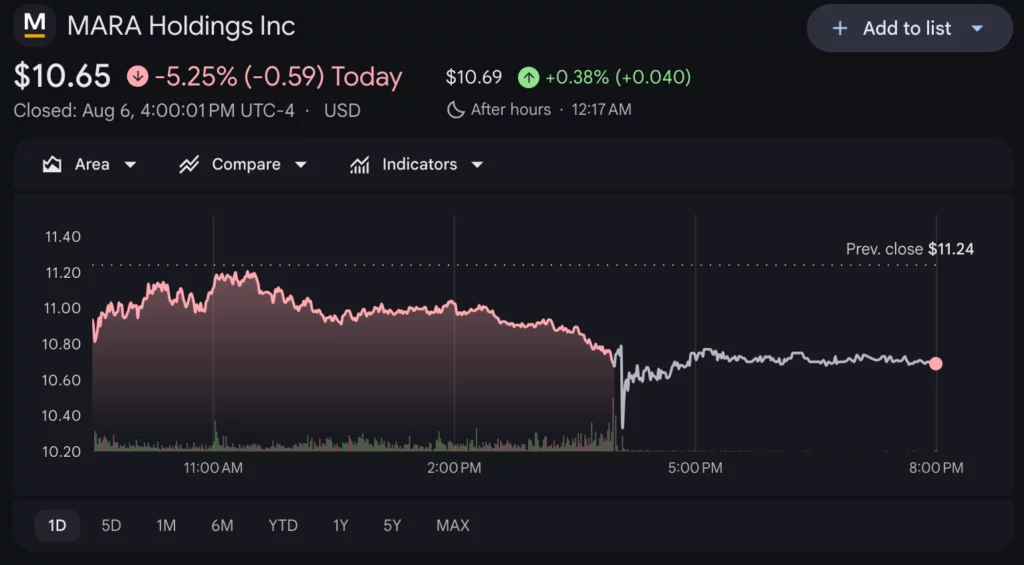
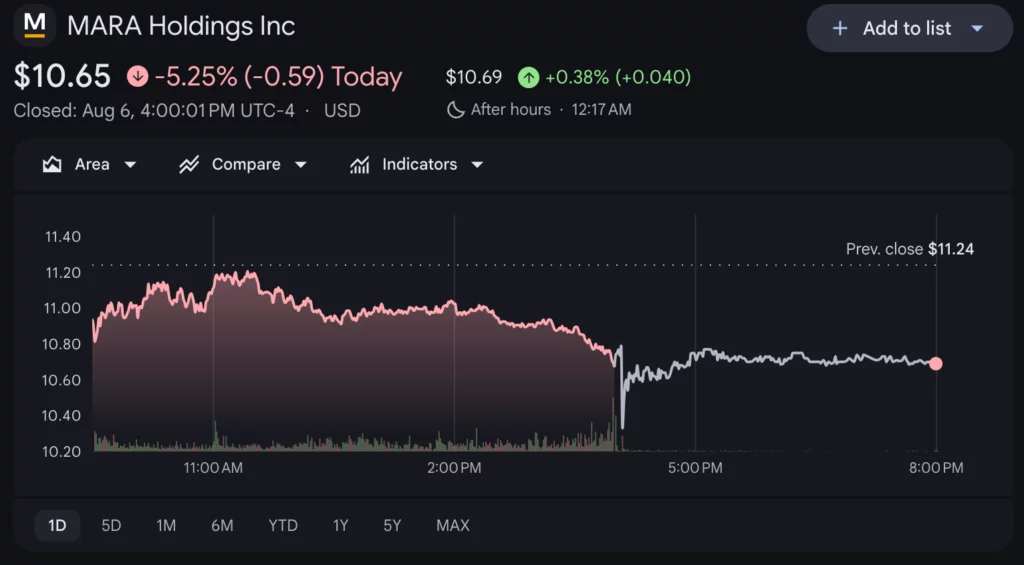
The company ended June with 35,577 BTC, down 29% from 49,951 BTC a year earlier. However, that headline decline masks a small sequential increase from 35,303 BTC at March 31. MARA’s presentation also showed approximately $2.5 billion in combined cash and Bitcoin holdings at quarter-end. Shares closed Aug. 6 at $10.65, down 5.25%, according to Google Finance data.
Source: Google Finance
MARA’s Bitcoin holdings fell after heavy first-quarter sales
The annual decline in MARA’s Bitcoin treasury largely reflects sales earlier in 2026 rather than falling mining production. Its first-quarter filing showed the company sold 20,880 BTC for about $1.5 billion as it funded operations, repurchased debt and pursued new infrastructure investments. Earlier Q1 coverage detailed how the sales reduced MARA’s position from 53,822 BTC at the end of 2025.
During Q2, MARA sold another 2,213 BTC at an average price of $73,078 while producing 2,422 BTC. That left holdings slightly higher than at the end of March. The company’s treasury policy now permits opportunistic sales of balance-sheet Bitcoin, a change from its earlier emphasis on retaining mined coins.
At June 30, 4,742 BTC were loaned and 4,528 BTC were pledged as collateral, while 26,307 BTC were unrestricted. After the quarter ended, MARA pledged another 18,750 BTC as initial collateral for two Bitcoin-backed credit facilities, increasing the portion of its treasury being used to support financing.
Mining output rose despite weaker Bitcoin economics
Operational performance improved in several areas. Energized hashrate reached 70.3 EH/s, up 22% from 57.4 EH/s a year earlier. Bitcoin production increased 3% to 2,422 BTC, and blocks won rose 1% to 700. Cost per petahash per day improved 4% to $27.70 from $28.70.
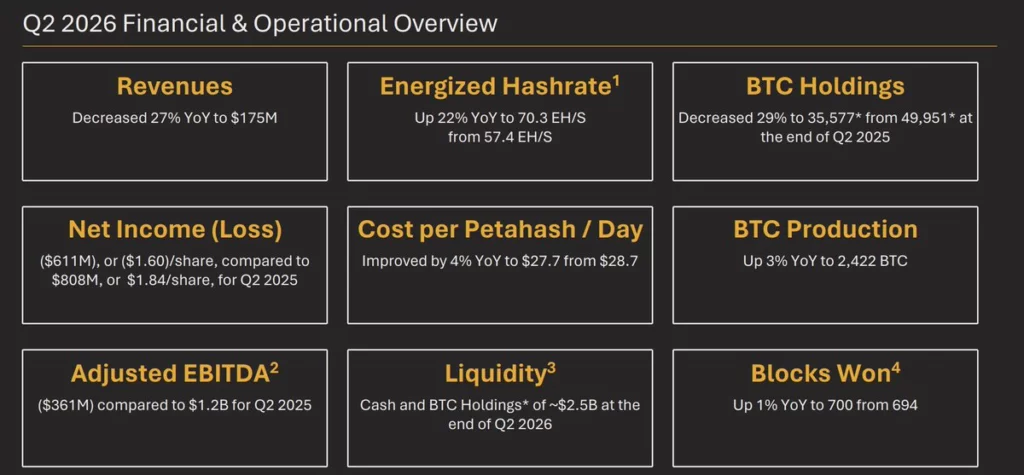
Those gains did not prevent revenue from falling because the average Bitcoin price associated with mining revenue dropped sharply from the prior-year period. MARA reported an average price of Bitcoin mined of roughly $71,325, compared with $98,975 in Q2 2025. Purchased energy cost per Bitcoin at owned sites also rose, showing that greater hashrate alone did not remove profitability pressure.
The net loss was also affected by Bitcoin price accounting. The company recorded roughly $343 million of fair-value losses tied to digital assets and related receivables. That contrasts with the large fair-value gains that supported earnings in the year-earlier quarter and helps explain the swing from $808.2 million in net income to the latest loss.
MARA is using its Bitcoin balance sheet to fund an AI pivot
The company’s strategy increasingly links its Bitcoin reserves with expansion into power and computing infrastructure. After quarter-end, the company arranged two credit facilities that provide $600 million of incremental borrowing capacity and pledged 18,750 BTC as initial collateral. Proceeds may support general corporate purposes, including the planned Long Ridge acquisition.
The Long Ridge transaction is central to MARA’s effort to add AI and high-performance computing capacity. Earlier AI pivot coverage reported that the proposed $1.5 billion acquisition includes a 505-megawatt Ohio gas plant and a campus with potential for more than one gigawatt of computing capacity. The deal still requires regulatory approval before closing.
The firm is also pursuing a Texas project. Its Texas expansion plan covers a 1,200-acre powered site expected to provide up to 2 GW of grid capacity over time. Combined with Long Ridge and other assets, management says its potential power portfolio could reach about 4.8 GW.
What happens next for MARA
The main near-term milestones are financing execution, regulatory approval for Long Ridge and progress on the Texas development. Investors will also watch whether MARA continues selling or pledging Bitcoin as it funds infrastructure. The company has made clear that its treasury can serve as both a long-term asset and a source of liquidity.
Chief Executive Fred Thiel said Bitcoin mining provided the company’s foundation and that digital infrastructure and other initiatives “will expand the value we create from that foundation.” The statement is forward-looking, and the Q2 results show the transition remains costly. Mining output improved, but weaker Bitcoin pricing, higher per-coin energy costs and fair-value losses weighed heavily on reported results.
For now, MARA remains a major public Bitcoin miner and one of the largest corporate Bitcoin holders. Its next quarters will test whether expanding AI infrastructure can add steadier revenue while the company preserves enough Bitcoin exposure to benefit from a recovery in mining economics.
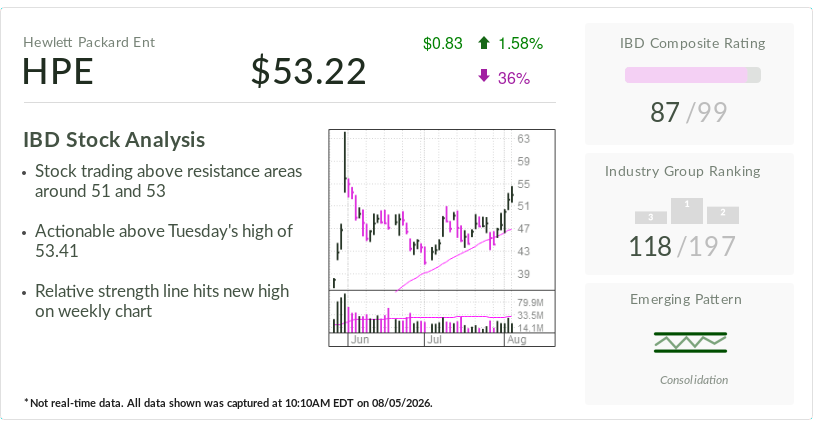
Hewlett Packard Ent Hewlett Packard Ent HPE $ 53.22 $0.83 1.58% 36% IBD Stock Analysis Stock trading above resistance areas around 51 and 53 Actionable above Tuesday’s high of 53.41 Relative strength line hits new high on weekly chart IBD Composite Rating 87/99 Industry Group Ranking 118/197 Emerging Pattern Consolidation Consolidation A sideways pattern that doesn’t fit traditional base definitions.…
Copyright ©2026 Investor’s Business Daily, LLC. All rights reserved. 87990cbe856818d5eddac44c7b1cdeb8
OpenAI’s Ring-Shaped Smart Speaker Will Reportedly Cost Between $300 And $400

Mohnish Pabrai’s Brutally Honest Thoughts on the Stock Market.

Third night of turmoil in market town over ‘asylum seeker’ homes: More arrests over disorder linked to Norfolk anti-immigration protests


-

 Fashion7 days ago
Weekend Open Thread: Wit & Wisdom
-

 Politics6 days ago
Meta enters AI-training agreement with far-right ‘propaganda rag’ Newsmax
-

 Politics5 days ago
Zack Polanski: an incitement to murder Nigel Farage?
-

 Crypto World6 days ago
MicroStrategy Post-Earnings CLARITY Act Push Could Add New Catalyst for Its Stock
-

 Crypto World6 days ago
XRP Ledger v3.3.0 brings five institutional features
-

 Crypto World6 days ago
New York sues Kalshi over prediction market gambling
-

 Crypto World5 days ago
Crypto PAC spending tops $2M in Michigan House race
-

 Business7 days ago
Trump Announces Hamas Disarmament Agreement as Iran Strikes Kuwait Air Base and US Attacks Pause Overnight
-

 Business4 days ago
DTCR: Deleveraging And A Hedge Fund Collapse Point To A Possible AI Bottom
-

 Tech5 days ago
ESET tracks rise in malicious AI skills and adaptable malware
-
 Crypto World6 days ago
3 Fed Officials Just Explained Their Rate Hike Vote: Is Inflation Winning?
-

 Tech7 days ago
Gemini Spark can now use Chrome logins and saved passwords to run errands on your behalf
-
 Tech7 days ago
Building A Reproduction PlayStation Motherboard
-

 Sports6 days ago
France Cricket implodes: letters hidden in a drawer and a board at war
-
Crypto World5 days ago
XRP Ledger urges node upgrade after manifest flood
-

 Crypto World6 days ago
Moneyflip CEO charged in $40K murder-for-hire plot
-
 Sports6 days ago
Bruno Fernandes decision made as Man United ‘discuss’ striker transfer option
-

 News Videos5 days ago
Financial Crash Expert: The 90-Day Collapse Timeline They Are Desperately Hiding.
-

 Sports7 days ago
Commonwealth Games 2026 Live Updates | Day 9 CWG 2026: Lovlina Borgohain, Sachin Siwach Enter Final After Indian Judokas Script History
-

 Sports1 day ago
Jordan Coyle & Cordiamo take Laya Arena Stakes at RDS
You must be logged in to post a comment Login