
Crypto World
Japan regulates crypto assets as financial instruments

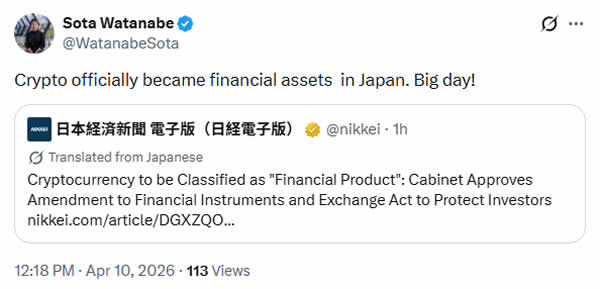
The Japanese government amended the Financial Instruments and Exchange Act on Friday to classify crypto assets as financial instruments.
The amendment also bans insider trading and other activities that involve buying and selling based on undisclosed information, Nikkei reported.
The amended act will also now require cryptocurrency “issuers” to be more transparent and disclose information once a year.
Japan’s Financial Services Agency has previously regulated crypto assets under the Payment and Settlement Act, citing their potential use as a means of payment. However, the regulations and classifications have been updated to reflect increasing institutional investment in the asset class.
By reclassifying crypto as a financial instrument rather than just a payment method, Japan is moving crypto out of the experimental payments category and into the same league as its stock market.

Crypto under the TradFi umbrella
“We will expand the supply of growth capital in response to changes in financial and capital markets, and ensure market fairness, transparency, and investor protection,” said Finance Minister Satsuki Katayama at a press conference after the Cabinet meeting.
Fines and sentences for unregistered crypto exchanges have also increased under the amendment.
Related: Prediction markets are testing legal limits in strict Asian markets
Japan signaled that it was bringing crypto under the same umbrella as traditional finance in January when Katayama said, “To ensure citizens benefit from digital and blockchain-based assets, the role of exchanges and market infrastructure will be essential.”
The government backed plans in December to significantly reduce Japan’s maximum tax rate on crypto profits, with a flat rate of 20% across the board.
Crypto ETFs coming to Japan
Japan is also planning to legalize crypto exchange-traded funds (ETFs) by 2028, marking a major shift toward mainstream crypto adoption, according to a January report.
Major financial groups, including Nomura Holdings and SBI Holdings, are among the first companies expected to develop crypto-linked exchange-traded products.
Asia Express: Phantom Bitcoin checks, China tracks tax on blockchain



Pavel Durov announced that the TON blockchain is now 10x faster. The Telegram founder shared the news on April 9, explaining that transactions now confirm in under one second. Before the upgrade, users waited over five seconds for finality.
“The TON blockchain just got upgraded and is now 10× faster,” Durov wrote. “Transactions are now instant, subsecond.”
How the Upgrade Works
The speed improvement comes from Catchain 2.0, a new consensus mechanism running under the hood. Blocks now generate every 400 milliseconds, which is 6x faster than before. A new streaming layer pushes updates to apps almost instantly rather than making them wait for the next block.
For everyday users, this means payments go through in about one second. Trades execute in real time. Apps respond immediately. The delays that made blockchain interactions feel slow compared to regular apps are largely gone.
Follow us on X to get the latest news as it happens
Step One of Make TON Great Again
Durov framed the upgrade as the first step in a seven-part plan he calls “Make TON Great Again,” or MTONGA. The name echoes a certain political slogan, but the goals are technical: making TON fast enough and cheap enough to compete with centralized platforms.
The next step on the roadmap: cutting transaction fees by 6x. TON fees are already low compared to Ethereum or Solana, but further reductions would make micropayments and high-frequency applications more practical.
Durov designed TON to work inside Telegram, which has over one billion users. His vision includes payments that feel like sending a message, Mini Apps that respond instantly, and DeFi tools that rival the speed of centralized exchanges.
At five-second confirmation times, delivering that experience was difficult. At sub-second finality, it becomes possible. The infrastructure now matches what users expect from any other app on their phone.
What Comes Next for TON
The upgrade went live on mainnet on April 10, 2026. Durov confirmed the fee reduction as step two but has not yet shared the timeline for the remaining six steps in the MTONGA roadmap.
For developers building on TON, the recommendation is to update their apps to use streaming APIs rather than polling. In other words, the blockchain is faster. Apps need to catch up.
The post TON Blockchain is Now 10x Faster: Pavel Durov Explains the Upgrade appeared first on BeInCrypto.


Digital assets have moved well beyond the hype cycle. What began as an experiment in decentralized value transfer has evolved into a serious conversation about how capital markets, custody, settlement and asset ownership could be re-imagined for the digital age. Tokenization, programmable money and distributed ledgers may deliver faster settlement, greater transparency and new efficiencies across the financial system.
The opportunity is both real and transformative, but accelerated adoption of digital assets is not guaranteed.
The ecosystem’s success will not be determined by any single technology, protocol, innovator or platform. Instead, it will hinge on whether the industry embraces a principle that traditional markets have relied on and come to expect for more than a century: choice.
If investors, issuers and intermediaries are forced into narrow paths and left without options, the promise of digital assets risks being constrained by the very silos they were meant to dismantle. For Web3 to flourish, market participants must be able to choose how, where and when they engage.
Choice in blockchain networks: avoiding silos
One of the most pressing challenges facing digital assets adoption today is fragmentation. New blockchains and networks continue to emerge, each optimized for different use cases, governance models or performance requirements. While innovation is healthy, disconnected ecosystems can quickly become a barrier to scale.
Without interoperability, assets risk being locked into isolated environments, limiting liquidity, mobility and investor access. The result is a digital version of the same inefficiencies that have historically plagued financial markets, with the added benefits of being faster and more complex.
Interoperability has the potential to change that result. A “network of networks” approach enables assets to move securely across platforms, enabling market participant firms and investors to take full advantage of tokenization’s potential while preserving market integrity and scale. It simplifies use cases, unlocks new business models and supports regulatory consistency, without forcing the industry to converge on a single chain.
Indeed, some investors may prefer open, public blockchains, while others may gravitate toward private blockchains. It’s not a matter of ‘or’ – both can and should be available.
Achieving this vision will require collaboration. Market infrastructure providers, technology firms and regulators must work together to establish frameworks that prioritize compatibility and interoperability over control. In a recent white paper authored by The Depository Trust & Clearing Corporation (DTCC) in collaboration with Clearstream, Euroclear and BCG, we explored how shared standards and coordinated governance could help advance interoperability while maintaining trust and resilience. The message was and remains clear: interoperability is foundational to scale and the future growth of digital markets.
Choice in what assets to tokenize (and when!)
Tokenization is often discussed as an inevitability, but inevitability should not be confused with immediacy. Not every asset will tokenize, and those that do will not do so at the same pace.
For example, while The Depository Trust Corporation (DTC), as a securities depository, facilitates the post‑trade settlement of securities representing over $100 trillion in value, we are not advocating for broad, indiscriminate, or immediate tokenization. Particularly in the early stages of this ecosystem, disciplined sequencing, intentionality, and caution are essential.
Certain asset classes, especially those with clear operational inefficiencies, high reconciliation costs or settlement frictions, are natural early candidates for tokenization. Others may follow as technology matures, regulatory clarity increases, and market demand evolves. Giving issuers and investors the ability to decide what makes sense for their needs, and on their timeline, reduces risk and builds confidence.
Choice, in this context, is about sequencing and needs. It allows the market to learn, adapt and scale responsibly rather than forcing adoption before the infrastructure is ready.
Choice in how investors want to hold real-world assets
Digital transformation does not mean abandoning established investing principles and processes.
For many institutional investors, tokenized assets will coexist with traditional holdings for many years to come. Some will prefer onchain representations for their operational efficiency or programmability. Others will continue to rely on established custody models, particularly as compliance and risk frameworks evolve.
A successful digital asset ecosystem can support both. Investors should be able to hold assets in tokenized form alongside traditional securities – and even switch back and forth between them – without sacrificing legal certainty, operational continuity or even the feeling of being in control. Flexibility ensures participation is driven by value, not obligation, and that trust is earned, not assumed.
Choice in wallets: empowering the client
Perhaps the most tangible expression of choice is the wallet.
As digital assets enter mainstream financial markets, participants will bring different preferences, risk tolerances and operational requirements. Some will prioritize self-custody. Others will rely on institutional-grade solutions. Many will want the freedom to change over time.
Wallet selection should belong to clients (market participant firms). No prescribed wallet. No mandated standard. This model empowers market participants to choose based on their own security needs, regulatory considerations, geographic requirements or internal controls.
This flexibility is essential for adoption at scale. Markets will thrive when financial institutions have the opportunity to engage on their own terms and can make decisions based on their clients’ and investors’ strategies, needs and preferences.
The path forward
The success of the digital assets ecosystem will not be built on constraints and limitations. Instead, it will be built on options: choice in blockchain, in assets, in custody and in wallets. These are practical requirements for facilitating growth.
If the industry gets this right, digital assets can deliver on their promise: more inclusive, efficient and resilient markets. If it gets it wrong, it risks recreating the limitations of the past on faster rails.
Choice is the key to making digital assets work for everyone.
The White House warned staff against improperly using confidential information to place bets in futures markets after suspicious oil trades ahead of President Donald Trump’s March 23 Iran announcement drew scrutiny, according to Reuters.
Reuters reported on Thursday that the White House sent the internal email on March 24, a day after Trump ordered a five-day delay in attacks on Iran’s energy infrastructure.
The warning followed a roughly $500 million bet on Brent and West Texas Intermediate crude futures placed in a one-minute burst shortly before Trump’s March 23 announcement, according to Reuters calculations based on exchange data. Oil prices fell about 15% after the policy shift.
The episode has intensified scrutiny of whether officials or politically connected traders could profit from nonpublic information tied to military or policy decisions. It has also added momentum to a broader push in Washington to tighten rules around prediction-market trading.
The STOCK Act amendment in the Commodity Exchange Act (CEA) prohibits federal officials, congress members, executive staff and judicial officers from using non-public information derived from their positions to trade commodity, futures or options markets. The amendment was signed into law on April 4, 2012.
Cointelegraph has approached the White House for a copy of the internal email.
Related: US Senate bill targets prediction markets on war and assassinations
Lawmakers respond to prediction market insider trading concerns
Lawmakers have also stepped up scrutiny of prediction markets, where well-timed bets tied to military and political events have raised similar concerns about the misuse of privileged information. Polymarket traders netted around $1 million by accurately betting when the US would strike Iran.
In response to the concerns, Congressman Adrian Smith and Congresswoman Nikki Budzinski introduced the Preventing Real-time Exploitation and Deceptive Insider Congressional Trading Act (PREDICT Act) on March 25, a bipartisan bill seeking to ban members of Congress and federal officials from prediction market trading.
On March 26, US lawmakers Todd Young, Elissa Slotkin, John Curtis and Adam Schiff unveiled the bipartisan Public Integrity in Financial Prediction Markets Act of 2026, a bill aimed at curbing prediction market insider trading by government officials.

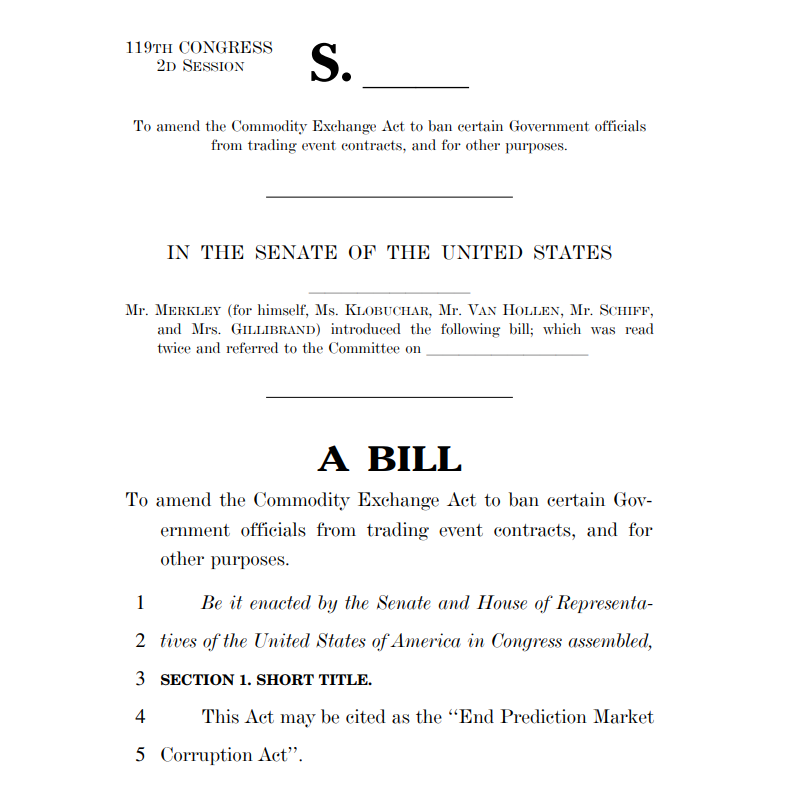
The same day, Senator Jeff Merkley introduced the End Prediction Market Corruption Act, seeking to ban event contract trading by government officials with “material non-public information,” including the president, vice president and members of Congress.
Magazine: Crypto traders ‘fool themselves’ with price predictions — Peter Brandt

Bitcoin traded near the $73,000 zone after the March CPI print came in cooler than some forecasts, easing some inflation fears and setting the stage for a cautious push higher. The Bureau of Labor Statistics showed the consumer price index rose modestly, with energy costs driving the month’s big moves.
Gasoline, in particular, surged by a hefty margin, helping push gasoline prices higher within the energy component. The CPI release also highlighted that energy costs remained elevated, even as the overall inflation picture topped by the energy spike did not portend an immediate shift in policy expectations. Traders recalibrated their bets as futures markets signaled that a near-term rate cut by the Federal Reserve remained unlikely for now.
The day’s momentum reflected a broader market narrative: traders parsed the data for hints on the Federal Reserve’s trajectory while monitoring Bitcoin’s own resistance and support levels in a chart that has shown both resilience and volatility in recent weeks.
Key takeaways
- Bitcoin hovered around $73,000 as the March CPI print came in below market expectations, suggesting a softer near-term inflation path than anticipated.
- The CPI energy component rose notably, with the gasoline index up 21.2% month over month, contributing to a 10.9% year-over-year rise in energy costs for March.
- Despite the energy spike, the overall CPI surprised to the downside relative to expectations, reinforcing a caution stance on aggressive monetary tightening or imminent rate cuts.
- Traders highlighted technical setups near critical zones, with liquidity pockets identified below $71,000 and resistance in the $73,000–$74,000 area, shaping short-term risk and reward for BTC.
- Analysts continued to weigh the broader macro context, including Fed expectations and potential chart-driven catalysts, amid a mixed inflation backdrop.
CPI dynamics and Bitcoin’s path to local highs
Markets absorbed a CPI reading that showed a tepid move versus forecasts. The data pointed to a pause in hotter inflation pressures, even as energy costs remained a focal point for investors. The gas price spike, in particular, was a reminder that energy components can dominate monthly price shifts and influence policy discourse. The official release underscored that “The index for energy rose 10.9 percent in March, led by a 21.2-percent increase in the index for gasoline,” a figure that fed into traders’ cautious posture about near-term inflation trajectories.
In the context of Bitcoin, the price action around $73,000 signals a test of nearby supply zones rather than a breakout run. Market commentary from traders noted a narrowing wedge pattern forming in the BTC/USD space, a setup that could precipitate a decisive move if support or resistance gives way. The sense of pending direction was reinforced by observations of order-book liquidity, with attention focused on levels just below $74,000 and pockets around $71,000 on the downside.
Analysts have previously linked RSI-like signals to potential trend reversals in Bitcoin, citing a pattern that some observers say echoes the late-2022 bear-market bottom. While such indicators are not guarantees, they contribute to the ongoing discourse around whether BTC can extend a move toward fresh local highs or face renewed resistance in the near term.
Near-term technical context and the broader market backdrop
From a technical standpoint, traders have kept a close eye on how BTC responds to key price levels in the coming sessions. A recent analysis from a market analyst known as JDK Analysis described BTC/USD as operating within a narrowing wedge, suggesting that the next substantial move could hinge on a breakout above a prior high or a rejection that tests support. In practical terms, that means watching how BTC behaves near the $73,000–$74,000 zone and whether selling interest tightens below $71,000.
On the liquidity front, observers have pointed to local order-book dynamics as a guiding factor for the short-term path. One trader highlighted that liquidity around critical levels—roughly below $71,000 and above $73,000–$74,000—would likely influence the pattern of any impending breakout or pullback. Such micro-structure considerations matter in a market where macro headlines intermittently drive risk appetite and liquidity conditions.
Intraday commentary also echoed the role of macro policy expectations in shaping BTC moves. Market participants have largely priced in a cautious stance from the Federal Reserve, with rate-cut prospects pushed further into the future by recent data. The CME FedWatch Tool and related market-implied probabilities have reinforced the view that policy normalization remains gradual, supporting a context in which Bitcoin could act as a risk-on or risk-off asset depending on the liquidity environment and broader risk sentiment.
Earlier coverage from Cointelegraph noted that a copycat RSI signal had appeared to mirror the conditions seen at the end of the 2022 bear market, a reminder that momentum indicators can align with longer-term price cycles in unexpectedly telling ways. This backdrop continues to color how traders interpret periodic pullbacks and rallies in BTC as they weigh the odds of a renewed leg higher versus a renewed test of the lower boundary.
This article follows the inflation release in a week that has underscored the complexity of the macro picture: energy costs are pushing CPI moves, policy expectations remain cautious, and bitcoin’s price action continues to respond to a combination of macro data and micro-structure signals. As investors weigh the next steps, attention remains on how BTC negotiates the $74,000 resistance and whether the $71,000 level will provide a firmer foothold for a sustained recovery or a further dip.
This article is intended for informational purposes and reflects data from official sources and market commentary available at the time of publication. Readers should perform their own due diligence before making any investment decisions.
What remains uncertain is how sustained energy-driven volatility will influence both inflation trajectories and the timeline for policy normalization, as well as how Bitcoin’s price will respond to any changes in risk appetite as new data comes in.

Key Highlights
- Erayak Power (RAYA) shares climbed 71% Friday following a strategic transformation announcement targeting the U.S. market.
- The manufacturer is transitioning from China-centric operations to a U.S.-oriented research and development model via Nexora, its North American arm.
- A new lineup of Tri-Fuel Inverter Generators (9kW–13kW) capable of operating on gasoline, propane, and natural gas was introduced.
- The strategic transformation followed comprehensive market research spanning 5,000 miles across five American states and a product presentation at the 2026 National Hardware Show in Las Vegas.
- The company established fresh distribution agreements with North American retail chains and wholesale partners during the trade event.
Erayak Power (RAYA) experienced a 71% surge Friday following its announcement of a fundamental business restructuring focused on the American market through Nexora, its subsidiary, while introducing innovative Tri-Fuel power generators and securing retail distribution agreements at the 2026 National Hardware Show.
Erayak Power Solution Group Inc., RAYA
The significant stock movement followed Erayak’s disclosure of comprehensive operational changes. The enterprise, which historically accessed North American customers mainly through third-party export arrangements, is establishing a direct American footprint.
The transformation revolves around Nexora, Erayak’s North American division. According to the revised business structure, Nexora will manage research and development, customer relations, and market strategy for the United States, while production operations continue through the Ruike Electronics manufacturing plant.
Prior to implementing the new strategy, Erayak executives undertook an extensive 5,000-mile investigation across California, Arizona, Texas, Florida, and New York. This comprehensive tour focused on identifying specific regional power requirements throughout diverse American markets.
The organization presented its latest innovations at the 2026 National Hardware Show in Las Vegas. This platform simultaneously facilitated the establishment of strategic partnerships with premium retailers and industrial distribution networks throughout North America.
Innovative Product Portfolio
Erayak’s 2026 flagship offerings feature Tri-Fuel Inverter Generators spanning 9kW to 13kW capacity. These generators operate on multiple fuel sources—gasoline, propane, or natural gas—and incorporate Auto Transfer Switch capabilities.
These power units integrate with commercial-grade UPS Solar Inverters. According to Erayak, the integrated systems deliver consistent emergency power solutions, including support for AI-edge computing infrastructure and connected home technologies.
The organization identified Texas and Florida as priority markets, referencing persistent electrical grid stability challenges in these regions. The generators incorporate reduced total harmonic distortion technology, which Erayak indicates makes them appropriate for powering delicate electronic equipment.
Erayak characterizes its market penetration strategy as a “Twin-Track” framework. This approach merges Nexora’s direct consumer sales channel with a broadened wholesale distribution infrastructure.
Business Transformation
CEO Lingyi Kong positioned the initiative as an evolution beyond traditional manufacturing. “By establishing Nexora as our North American face, we are moving beyond manufacturing to become a vertically integrated power solutions provider,” Kong said.
Before this strategic announcement, Erayak’s North American operations functioned predominantly through indirect export mechanisms. The current organizational structure represents a significant departure from previous approaches.
The company indicated the Nexora framework aims to enhance operational clarity and deliver greater shareholder value.
RAYA commenced Friday trading with substantial volume following the strategic disclosure. The stock registered a 71% gain by market close, with peak intraday appreciation reaching 87%.
The 2026 National Hardware Show presentation combined with the Nexora strategy announcement emerged as the principal drivers behind Friday’s significant price movement.

MoonPay, WalletConnect, and Ingenico announced a partnership to enable stablecoin payments at physical retail locations globally using MoonPay Virtual Accounts for fiat settlement.
MoonPay announced a partnership with WalletConnect and Ingenico to bring stablecoin payments to physical retail locations at global scale. The integration leverages MoonPay Virtual Accounts to enable fast fiat settlement for in-store transactions powered by stablecoins.
WalletConnect provides wallet connectivity infrastructure, while Ingenico brings point-of-sale terminal capabilities and retail distribution. The partnership targets enabling merchants worldwide to accept stablecoin payments directly at checkout with immediate conversion to fiat currency.
Sources: MoonPay
This article was generated automatically by The Defiant’s AI news system from publicly available sources.
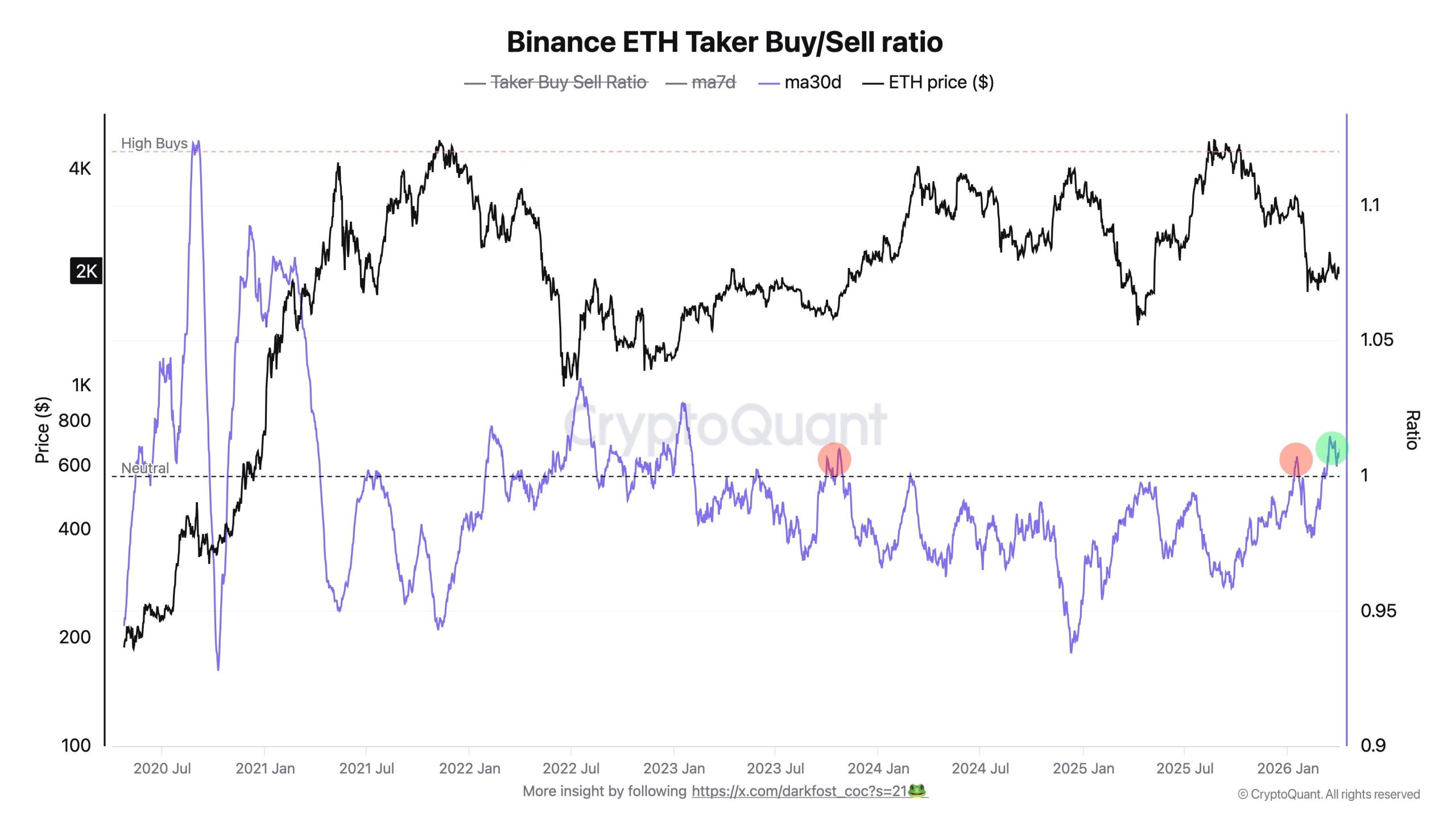
Ethereum’s (ETH) Taker Buy-Sell Ratio on Binance is flashing a signal not seen in nearly three years. The monthly average has climbed to around 1.016 and has held above 1 for several consecutive days.
The shift suggests that market-buy orders are outpacing sells on Binance’s ETH perpetual contracts, a signal CryptoQuant analyst Darkfost flagged as “early stages of a more constructive trend.”
Why Derivatives Data Matters More For ETH
For context, the Taker Buy Sell Ratio tracks the balance between market buy and sell volumes on perpetual contracts. A reading above 1 means aggressive buyers are outpacing sellers.
What stands out now is the monthly average holding above 1 for multiple consecutive days.
“This reflects a progressive return of buyer dominance on perpetual markets, suggesting the early stages of a more constructive trend,” the analyst said. “This therefore marks a constructive development for Ethereum, not seen since 2023.”
Follow us on X to get the latest news as it happens
The signal carries added weight because futures activity on Binance now dwarfs spot trading. The exchange’s spot-to-futures volume ratio recently fell to 0.13, meaning roughly $7 in futures changes hands for every $1 in actual ETH buying.
That imbalance makes derivatives positioning the primary driver of short-term price action. Moreover, Binance accounts for approximately 37% of global ETH open interest. According to the analyst, this dominance makes it a key venue for assessing derivatives positioning.
Notably, the ratio’s move above 1 has been incremental rather than sudden. The analyst considers this pattern healthier than a sharp spike, which tends to create overleveraged positioning and trigger cascading liquidations.
The development comes despite ongoing macroeconomic and geopolitical uncertainty, suggesting early-stage structural improvement in ETH sentiment. However, the derivatives-heavy market structure still poses risks. A futures-led rally without matching spot demand could amplify volatility if positions unwind quickly.
Subscribe to our YouTube channel to watch leaders and journalists provide expert insights
The post Ethereum Flashes Bullish Signal Not Seen Since 2022 on Binance Futures appeared first on BeInCrypto.
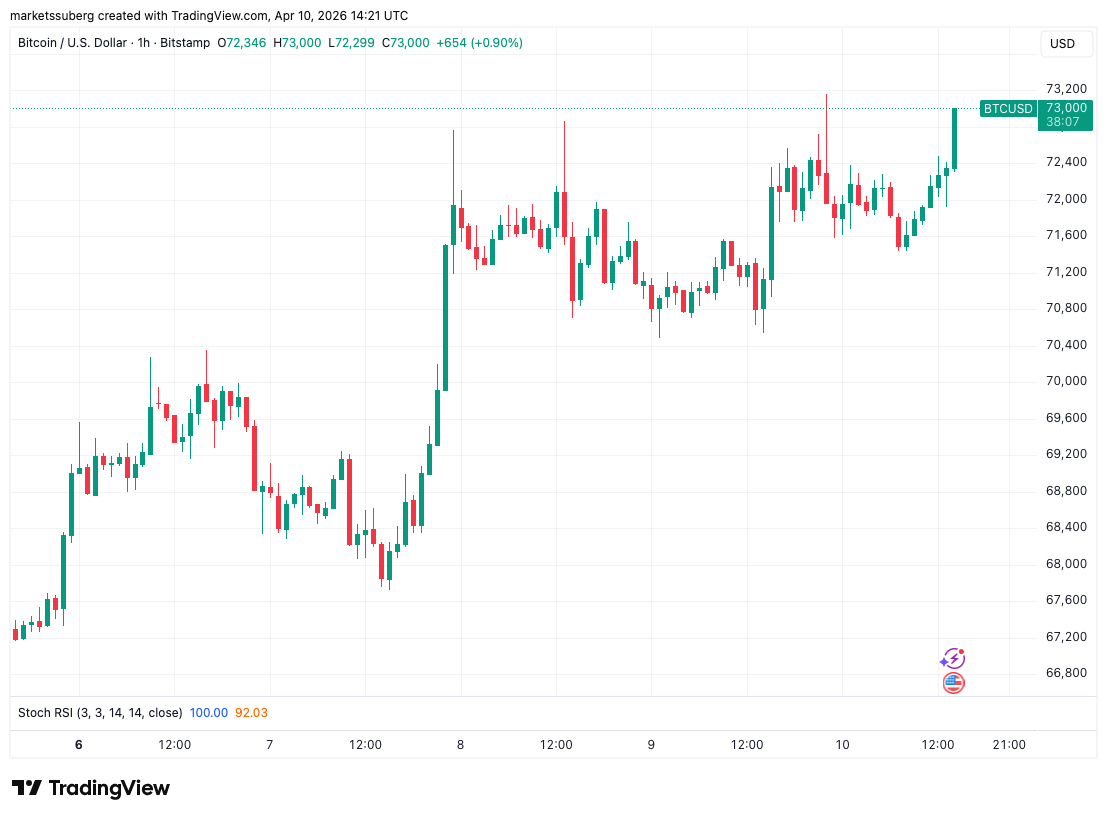
Bitcoin (BTC) tagged $73,000 following Friday’s Wall Street open as crucial US inflation numbers came in below expectations.
Key points:
-
Bitcoin edges higher as US CPI data remains slightly below market expectations.
-
Gasoline prices see a historic surge within the CPI release.
-
Bitcoin traders plan out key resistance levels overhead.
BTC price seeks new local highs after CPI
Data from TradingView showed BTC price eyeing new multi-week highs as markets digested the March print of the Consumer Price Index (CPI).

This was the week’s key macro data release, and the first CPI report to reflect the impact of the US and Israel war in Iran.
Gasoline prices jumped over 21% month-on-month, the Bureau of Labor Statistics (BLS) confirmed, but overall CPI finished 0.1% lower than markets’ expectations.
“Over the last 12 months, the all items index increased 3.3 percent before seasonal adjustment,” an official news release read.
“The index for energy rose 10.9 percent in March, led by a 21.2-percent increase in the index for gasoline which accounted for nearly three quarters of the monthly all items increase.”

Reacting, trading resource The Kobeissi Letter noted that the gas-price CPI jump was the largest monthly gain since 1967. The energy increase, it added in a further post on X, was the largest since 2005.
With the resulting mixed picture of inflationary forces, US stocks were mostly flat at the open, while BTC price action also avoided major moves up or down.

Markets, however, had no hope for the Federal Reserve cutting interest rates — a conclusion already in place on the back of Thursday’s Personal Consumption Expenditures (PCE) index release, per data from CME Group’s FedWatch Tool.
Bitcoin traders draw the next resistance zones
Among Bitcoin market participants, there was modest reason for optimism over the short-term price outlook.
Related: Bitcoin analysis sees $55K BTC price ‘iron bottom’ by December 2026
In their latest X analysis, trader JDK Analysis flagged BTC/USD acting within a narrowing wedge — a topic of debate since February.
“If price makes another attempt at the current key high, the reaction there will be critical!” they wrote in accompanying commentary.

Trader Daan Crypto Trades meanwhile eyed exchange order-book liquidity below $74,000.
$BTC Liquidity levels to watch in close proximity are that ~$71K region below, and $73K-$74K above (local high). pic.twitter.com/BlKsaZXdpb
— Daan Crypto Trades (@DaanCrypto) April 10, 2026
Earlier, Cointelegraph reported on a copycat signal from Bitcoin’s relative strength index (RSI) that began to echo the end of the 2022 bear market.
This article is produced in accordance with Cointelegraph’s Editorial Policy and is intended for informational purposes only. It does not constitute investment advice or recommendations. All investments and trades carry risk; readers are encouraged to conduct independent research before making any decisions. Cointelegraph makes no guarantees regarding the accuracy or completeness of the information presented, including forward-looking statements, and will not be liable for any loss or damage arising from reliance on this content.


Binance offered its staff in the United Arab Emirates the option to temporarily relocate to Hong Kong, Tokyo, Kuala Lumpur and Bangkok amid regional tensions, the company told CoinDesk Friday.
“Given the recent regional tensions, we offered employees the option to temporarily relocate as a precautionary, employee-first measure to provide flexibility and support during a period of uncertainty,” a Binance spokesperson said. “As a remote-first organization, we are well set up to support this kind of flexibility without disruption to our operations.”
The spokesperson also said its operations in the UAE remain unchanged and that many employees have chosen to stay.
“Our operations in the UAE continue as normal — a large number of our team has chosen to remain in the UAE. We remain deeply committed to the UAE as a key hub for Binance and to the broader region,” the spokesperson said. “As a global company, we continue to operate seamlessly and serve our users without interruption.”
The offer of relocation comes after a ceasefire agreement, following roughly six weeks of escalating regional conflict that has disrupted business activity in the UAE. The country has intercepted hundreds of missiles and drones since hostilities began in late February, according to the UAE Ministry of Defense, with additional interceptions reported on April 8.
The Middle East conflict has already disrupted major crypto, business and sports events across the UAE. TOKEN2049 Dubai has been postponed to 2027, while TON Gateway was canceled due to security and travel concerns. Other large events, including Middle East Energy Dubai and the Dubai International Boat Show, have also been delayed, and the Bahrain and Saudi Arabian Formula 1 races, key for crypto sponsorship exposure, are set to be canceled.
In December, Abu Dhabi Global Market (ADGM) said Binance’s global platform would operate under its regulatory framework, marking a significant step in formalizing the exchange’s structure.
Binance, which reportedly has 1,000 staff members or 20% of its total global workforce in the UAE, has also indicated that its worldwide operations are supported from Abu Dhabi, though it has not clearly defined a single global headquarters.


Securitize announced integration with TRON Network to bring tokenized assets to one of the world’s largest blockchains, expanding its multichain presence.
Securitize integrated with TRON Network on April 10, enabling tokenized assets issued by Securitize to be deployed on TRON, one of the world’s largest blockchains. The partnership expands Securitize’s multichain footprint and brings institutional-grade assets to a high-performance network designed for efficient, programmable financial systems.
The integration aligns with growing demand for tokenization infrastructure that bridges traditional finance and blockchain networks. TRON operates as a high-throughput blockchain platform, and this partnership enables Securitize’s tokenized assets—which typically include securities and institutional products—to access TRON’s user base and ecosystem.
Sources: Securitize
This article was generated automatically by The Defiant’s AI news system from publicly available sources.

Are financial advisors worth it?

Keanu Reeves’ New 83-Minute Movie Lands Among His Worst-Rated Projects Ever

Police ‘expect criminal offences’ at Trafalgar Square protest over Palestine Action ban


-

 Fashion7 days ago
Weekend Open Thread: Spanx – Corporette.com
-

 Business5 days ago
Three Gulf funds agree to back Paramount’s $81 billion takeover of Warner, WSJ reports
-

 Sports6 days ago
India men’s 4x400m and mixed 4x100m relay teams register big progress | Other Sports News
-

 Business6 days ago
Expert Picks for Every Need
-

 Tech3 days ago
How Long Can You Drive With Expired Registration? What Florida Law Says
-

 Business5 days ago
No Jackpot Winner, Prize to Climb to $231 Million
-

 Fashion4 days ago
Massimo Dutti Offers Inspiration for Your Summer Mood Board
-

 Fashion3 days ago
Let’s Discuss: DEI in 2026
-

 Crypto World2 days ago
Bitcoin recovers as US and Iran Agree a Ceasefire Deal
-

 Business6 days ago
Akebia Therapeutics, Inc. (AKBA) Discusses Pipeline Progress and Strategic Focus on Kidney Disease Treatments at R&D Day – Slideshow
-

 Crypto World1 day ago
Canary Capital Files SEC Registration for PEPE ETF
-

 Politics6 days ago
The UK should not pay a penny in slavery reparations
-

 Tech4 days ago
Samsung just gave up on its own Messages app
-

 Tech4 days ago
Haier is betting big that your next TV purchase will be one of these
-

 Fashion7 days ago
Weekly News Update, 4.3.26 – Corporette.com
-
Sports7 days ago
A Kevin O’Connell Theory Can Now Be Retired
-

 NewsBeat7 days ago
Kemi Badenoch talks ‘spring cleaning’ Reform defections
-

 Tech4 days ago
Gamer Restores the Original PlayStation Portal From Two Decades Ago
-

 Business4 hours ago
OpenAI Halts Stargate UK Data Centre Project Over Energy Costs and Copyright Row
-

 Tech4 days ago
The Xiaomi 17 Ultra has some impressive add-ons that make snapping photos really fun
You must be logged in to post a comment Login