

Crypto World
JaredFromSubway.eth sandwich attacked Vitalik Buterin



MEV-focused extraction bot JaredFromSubway.eth front- and back-ran an Ethereum trade by Vitalik Buterin, getting away with about two-thousandths of an ether (ETH).
Ethereum founder Buterin was selling a token airdrop, DigitalBits, when he fell victim to the garden-variety sandwich attack.
The name “JaredFromSubway” refers to Jared Fogle who lost nearly 250 pounds while earning a TV sponsorship from Subway. After his weight loss fame faded, however, the world learned of Fogle’s sexual misconduct involving minors, including a criminal conviction.
He remains imprisoned with an expected release date of 2029.
Crypto, of course, has a dark sense of humor, and despite his legal troubles, someone decided to name a maximum extractable value (MEV)-focused extraction bot after him. Fogle, who has limited internet access in prison, doesn’t control the bot.
The trader bearing an ENS name with Fogle’s brand extracted value from Buterin’s transaction inside Ethereum block 24993038.
Read more: Your L2 transaction fees are higher because of MEV spam, report
Another sandwich attack by JaredFromSubway.eth
Buterin routed 26,544 DigitalBits (XDB) tokens through the Uniswap V2 router with his slippage parameter amountOutMin set to zero. That setting accepted any non-zero output.
Buterin received 0.00197 ETH, worth a little under $5 at the time.
JaredFromSubway.eth, watching the public mempool, noticed Buterin’s unprotected swap and inserted itself onto both sides of his transaction.
In the position immediately before Buterin, the bot dumped a pile of XDB into the same Uniswap V2 pool. That depressed the exchange rate Buterin would receive.
In the position immediately after, it bought XDB back at the depressed price and rotated the inventory through a third liquidity pool to close the loop.
After gas fees, Jared gained nothing except the satisfaction of making a priceless joke at Buterin’s expense.
The punchline is that a sandwich bot on Ethereum — named after the world’s most famous sandwich spokesperson — still tricked a careless Buterin out of fees on his own blockchain.
Read more: Vitalik Buterin’s $1B crypto donation to India will be worth just $400M
Buterin suffered the sandwich attack because his swap order carelessly accepted any output. Setting amountOutMin to zero was Uniswap’s maximally permissive setting.
In essence, Buterin told his order router to fill his trade no matter how badly the price moved based on his supply.
MEV bots scanning Ethereum’s mempool salivate for exactly that type of laziness.
Buterin has a habit of dumping unsolicited airdrops and donating the proceeds.
Because almost all of his personal net worth derives from his pre-mined allocation of ETH, he’s happy to donate extra coins that he receives. In this case, his donation went to an unintended recipient.
Got a tip? Send us an email securely via Protos Leaks. For more informed news and investigations, follow us on X, Bluesky, and Google News, or subscribe to our YouTube channel.


TLDR
- 21Shares launched the 21Shares Canton Network ETF on Nasdaq under the ticker TCAN.
- The ETF provides direct exposure to Canton Coin, the native token of the Canton Network.
- The Canton Network focuses on privacy-preserving blockchain infrastructure for institutional finance.
- Major firms, including Goldman Sachs, Microsoft, and DTCC, support Digital Asset, the network’s primary developer.
- The launch adds to a growing list of crypto exchange-traded funds in the United States.
A new Crypto ETF began trading on Nasdaq as 21Shares launched the 21Shares Canton Network ETF under ticker TCAN. The fund offers direct exposure to Canton Coin, the native token of the Canton Network. The listing expands the range of crypto-linked exchange-traded products in the United States.
Crypto ETF Expands Access to Canton Coin
21Shares listed the 21Shares Canton Network ETF on Nasdaq on Thursday under the ticker TCAN. The Crypto ETF gives investors direct exposure to Canton Coin, which powers the Canton Network. The firm said the product marks the first U.S. ETF tied directly to the token.
Canton Coin serves as the utility token for the Canton Network, which focuses on institutional finance use cases. The network supports privacy-preserving transactions and data management across financial markets. Major firms, including Goldman Sachs, Microsoft, and DTCC, support Digital Asset, the network’s primary developer.
Andres Valencia, executive vice president of investment management at 21Shares, addressed the launch in a statement. He said, “The Canton Network has attracted strong institutional interest given its focus on privacy-preserving infrastructure for capital markets.” He added that backing from Nasdaq, Moody’s, and Deloitte reflects confidence in shared blockchain infrastructure.
Valencia stated, “When you see names like Nasdaq, Moody’s, and Deloitte supporting a common blockchain infrastructure, you are looking at infrastructure that has the potential to reshape how data and capital move across global markets.” He linked the ETF launch to that institutional support. The company confirmed that TCAN seeks to track the performance of Canton Coin.
TCAN joins a growing list of crypto exchange-traded funds that launched over the past year. Fund issuers have introduced products tied to SOL, XRP, DOGE, HBAR, and Polkadot. As a result, the U.S. market now offers broader access to digital asset exposure through regulated vehicles.
Regulatory Shift Fuels Crypto ETF Growth
The U.S. Securities and Exchange Commission oversees approvals for exchange-traded funds, including crypto products. Since January 2025, the agency has taken a more supportive stance toward digital assets. President Donald Trump returned to office that month and appointed Paul Atkins as SEC Chairman.
Chairman Atkins has moved to clarify the agency’s position on cryptocurrencies. The SEC issued guidance stating that most cryptocurrencies do not qualify as securities. That position has influenced the pace of Crypto ETF filings and approvals.
Market participants have responded with new applications and product launches. As a result, issuers continue to expand offerings across different blockchain networks and tokens. The debut of TCAN adds another fund to the expanding lineup of crypto-linked ETFs trading on U.S. exchanges.

Driven by the green wave sweeping the entire crypto market, Solana’s native token briefly pumped above $90, reaching its highest level in the past 20 days.
Currently, the asset appears to be at a crossroads, with some analysts calling for a pump above $100, while certain indicators signal an impending correction.
In the Middle of a Breakout?
According to the popular analyst Ali Martinez, SOL is undergoing a bullish breakout and seems to be escaping a symmetrical triangle to the upside. He believes that a spike in buying pressure could send the price to $92 or even $96. However, traders may need to hope for a potential push to the upper boundary, as the analyst recently argued that anything within the $77-$94 range falls into a “no-trade” zone.
Other market observers who touched upon Solana’s performance and made predictions include X users Julian and Wealthmanager. The former noted the volatility lately, but claimed that buyers remain active. They described $85 as an important support level, adding that if SOL stays above $90, it could see another move higher.
Additionally, the strategist outlined that Solana’s biggest strengths lie in its consistently high network usage, driven by strong meme coin trading activity, a large number of active users, and fast, low-cost transactions.
“Short-term moves can still be aggressive, but in the bigger picture, SOL still looks like one of the strongest coins in the market,” they concluded.
WealthManager was even more bullish, forecasting that a pump to the psychological milestone of $100 is “just a matter of time.”
Time to Cool off?
Certain technical indicators, such as Solana’s Relative Strength Index (RSI), suggest that the bears may soon retake control. The ratio recently jumped to 80 before slipping to the current 66, which is quite close to overbought territory. The index runs from 0 to 100, and conversely, anything under 30 is typically seen as a precursor of a rally.

Next on the list is the rising amount of SOL tokens being transferred from self-custody to centralized exchanges lately. This is considered a bearish factor since it increases the immediate selling pressure.

Meanwhile, the analytics platform Lookonchain revealed that a newly created wallet opened a 20x short position on 240,000 SOL worth more than $21 million. Such an aggressive bet against the asset could weigh on sentiment, as it suggests that the person or entity may be acting on information of upcoming news or events that retail investors don’t have access to.
The post Solana (SOL) Reaches a 3-Week High: Is $100 Just a Matter of Time? appeared first on CryptoPotato.
Michael Saylor’s comment this week that Strategy might sell portions of its Bitcoin holdings, is a decision that gives the BTC treasury company Strategy, optionality, according to BTC advocate Samson Mow.
“Never selling limits optionality. Public markets are war. In war, you need all available tools at your disposal,” Mow said after company co-founder Saylor’s comment during Strategy’s first-quarter earnings call on Tuesday. That the company might sell some BTC in the future, Mow added:
“The more tools Strategy holds, the fewer angles its adversaries have. A company with real optionality is hard to game: it might sell, hedge, issue, or buy. A company that has publicly vowed to only ever do one thing has handed a map to short sellers and arbitrageurs.”
Strategy is the largest publicly traded Bitcoin treasury company, according to BitcoinTreasuries, and holds 818,334 BTC at the time of this writing, and any potential sales could weigh on spot BTC market prices, according to some crypto market analysts.

Strategy’s total BTC holdings over time. Source: Strategy
Related: Strategy takes Bitcoin buying breather ahead of Q1 earnings report
As he signals potential BTC sales, Saylor says company can fund dividends “forever” on BTC alone
“We’ll probably sell some Bitcoin to fund a dividend, just to inoculate the market, just to send the message that we did it,” Saylor said during the earnings call.
He said that if the price of BTC appreciates by more than 2.3% annually, the company can fund its dividends “forever” and would also allow Strategy to pay dividends “without selling a single share of stock.”
“We could stop selling MSTR common stock right now,” Saylor said, adding, “We can fund the dividends with Bitcoin sales.”

Saylor discusses paying dividends using BTC appreciation. Source: Strategy
If the company can issue more of its STRC preferred stock and BTC rises above the breakeven level, it would be able to fund dividends indefinitely, while also continuing to increase the amount of BTC it holds, Saylor said during the earnings call.
The average cost of Strategy’s BTC holdings is $75,537 apiece, according to the company’s website. At last look on Thursday, Bitcoin was changing hands at about $79,976, according to CoinMarketCap.
Strategy funds its BTC purchases through a mixture of corporate debt and equity instruments, a practice that has raised concerns with some investors over shareholder dilution and leverage-fueled buying.
Magazine: Bitcoin’s ‘biggest bull catalyst’ would be Saylor’s liquidation: Santiment founder
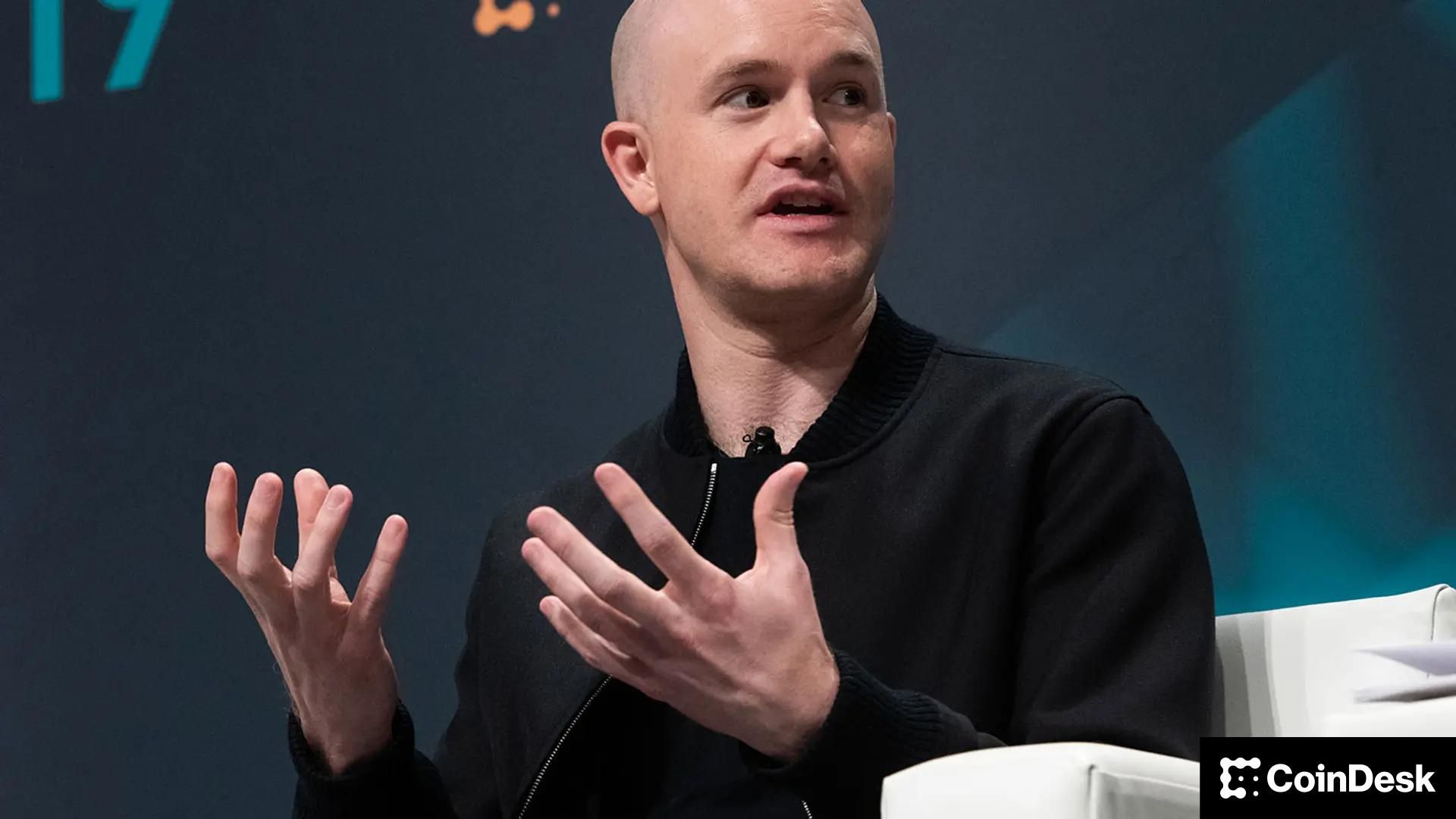
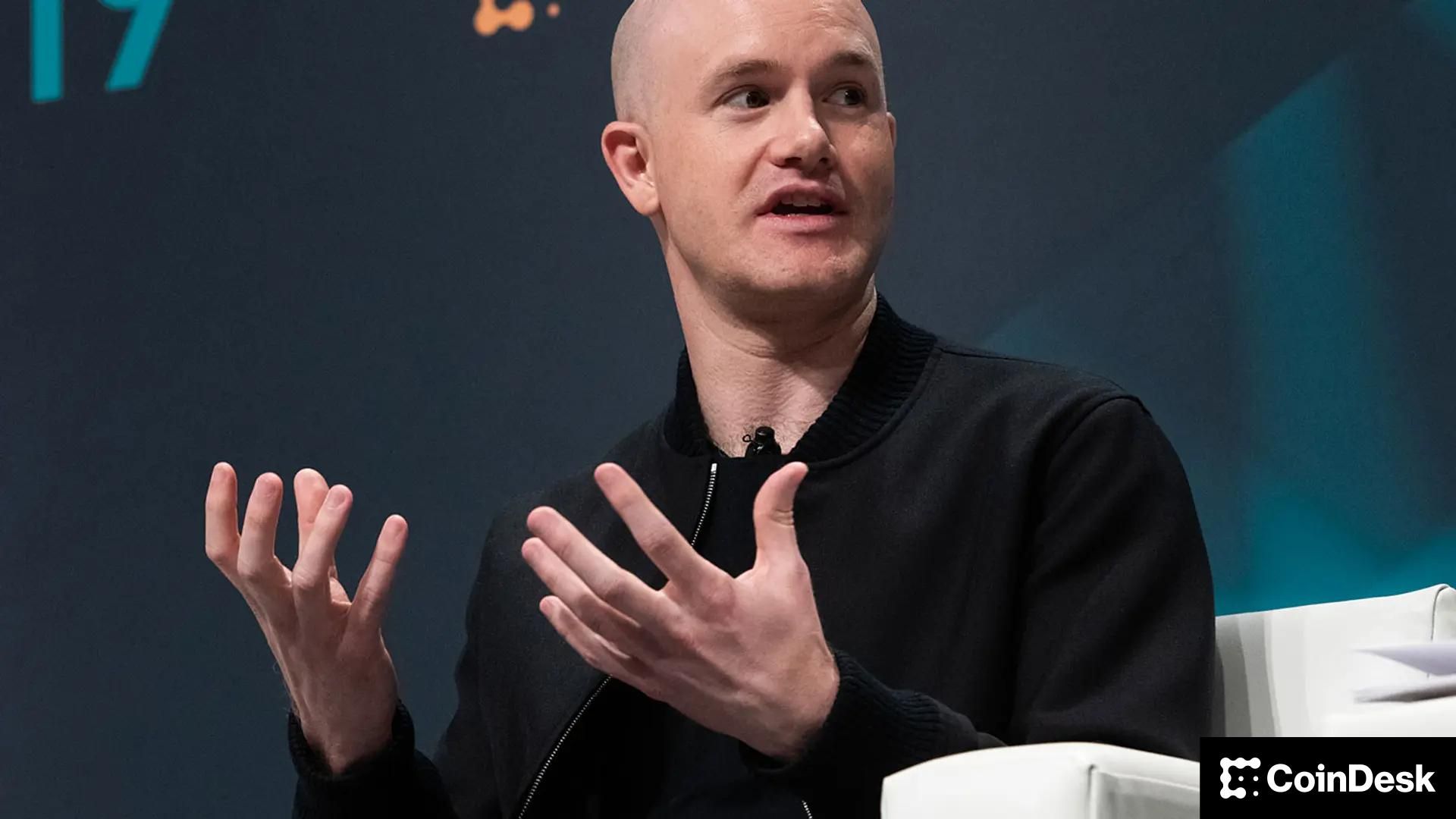
Coinbase (COIN) shares fell more than 5% in after-hours trading Thursday after the crypto platform reported weaker-than-expected first-quarter results as falling crypto prices weighed on trading activity, one of the company’s main sources of revenue.
The company posted a loss of $1.49 per share, compared with analyst expectations for a $0.27 profit. Revenue came in at $1.41 billion, below estimates of $1.52 billion.
Transaction revenue totaled $755.8 million, missing analyst expectations of $805.2 million. Subscription and services revenue, a segment investors closely watch as Coinbase tries to reduce its reliance on trading fees, totaled $583.5 million, below expectations of $619.3 million.
Crypto markets weakened sharply as bitcoin and other digital assets fell. Lower prices and reduced volatility typically lead to weaker spot trading volumes across exchanges. Investors had expected a slowdown after the crypto selloff early in the quarter, even though bitcoin rebounded roughly 12% in March.
Coinbase has spent the past several years expanding beyond its core trading business into stablecoins, staking, derivatives and blockchain infrastructure. The company said Wednesday that its global crypto trading volume market share rose to 8.6%, a record high, driven partly by growth in derivatives trading.
Trailing 12-month derivatives trading volume increased 169% year over year, while retail derivatives revenue surpassed an annualized run rate of $200 million for the first time, Coinbase said.
The company also pointed to growth in prediction markets and stablecoin activity. Coinbase said its prediction markets business surpassed $100 million in annualized revenue within its first two full months following its U.S. launch.
Meanwhile, Coinbase said its Base blockchain processed 62% of global onchain stablecoin transaction volume during the quarter.
Earlier this week, Coinbase said it would cut about 700 jobs, or roughly 14% of its workforce, as part of an AI-driven restructuring effort. The company also cited the broader crypto downturn as a factor behind the layoffs.
Investors are increasingly focused on whether Coinbase’s subscription and infrastructure businesses can offset the cyclical swings of crypto trading revenue during weaker markets.


Prediction markets closed out Consensus Miami 2026 as the subject of a live debate on whether they are regulated financial derivatives or gambling products operating outside state law.
Summary
- The closing Consensus Miami 2026 session debated whether prediction markets are CFTC-regulated financial instruments or unlicensed gambling under state gaming laws.
- CFTC Chairman Michael Selig said the fight could reach the Supreme Court, as the agency has already sued five states for treating its registered exchanges as gambling platforms.
- Kalshi’s valuation surged from $22 million in 2024 to $22 billion by March 2026, with sports contracts now accounting for 85% to 90% of its trading volume.
Prediction markets closed out Consensus Miami 2026 on Thursday as the subject of the conference’s final debate, pitting the CFTC’s position that event contracts are swaps against a growing coalition of state attorneys general who argue the platforms are unlicensed gambling businesses.
The session brought the conference’s policy agenda to a head after three days of regulatory and legislative sessions.
CFTC Chairman Michael Selig, who attended Consensus for the first time this year, has made the prediction markets jurisdictional fight a defining feature of his tenure.
“We expect these matters to go up to the Supreme Court,” Selig said, as the agency has already sued Arizona, Connecticut, Illinois, New York, and Wisconsin for attempting to regulate CFTC-registered exchanges under state gambling law.
Why states are pushing back
The core disagreement is structural. Kalshi and Polymarket argue their platforms operate like futures markets, with no house setting odds and no counterparty absorbing all risk.
DraftKings president Paul Liberman acknowledged the consumer experience is identical to sports betting. “For the end user, yes,” he said, “whether they’re putting a bet on the sportsbook or whether they’re doing a trade on the Celtics here, they definitely feel as though it’s the same.”
Wisconsin filed complaints against Kalshi, Polymarket, Coinbase, and Robinhood in April, arguing their contracts meet the state’s legal definition of a bet.
A bipartisan coalition of 41 state attorneys general has separately called for federal clarity on jurisdiction. Senator Marsha Blackburn’s subcommittee has scheduled a hearing for May 20, sitting directly between the Consensus debate and the Senate’s CLARITY Act markup window.
As crypto.news reported, Selig has offered platforms a framework: the CFTC will fight state interference, but exchanges must accept surveillance, insider trading enforcement, and a derivatives-style rulebook in return.
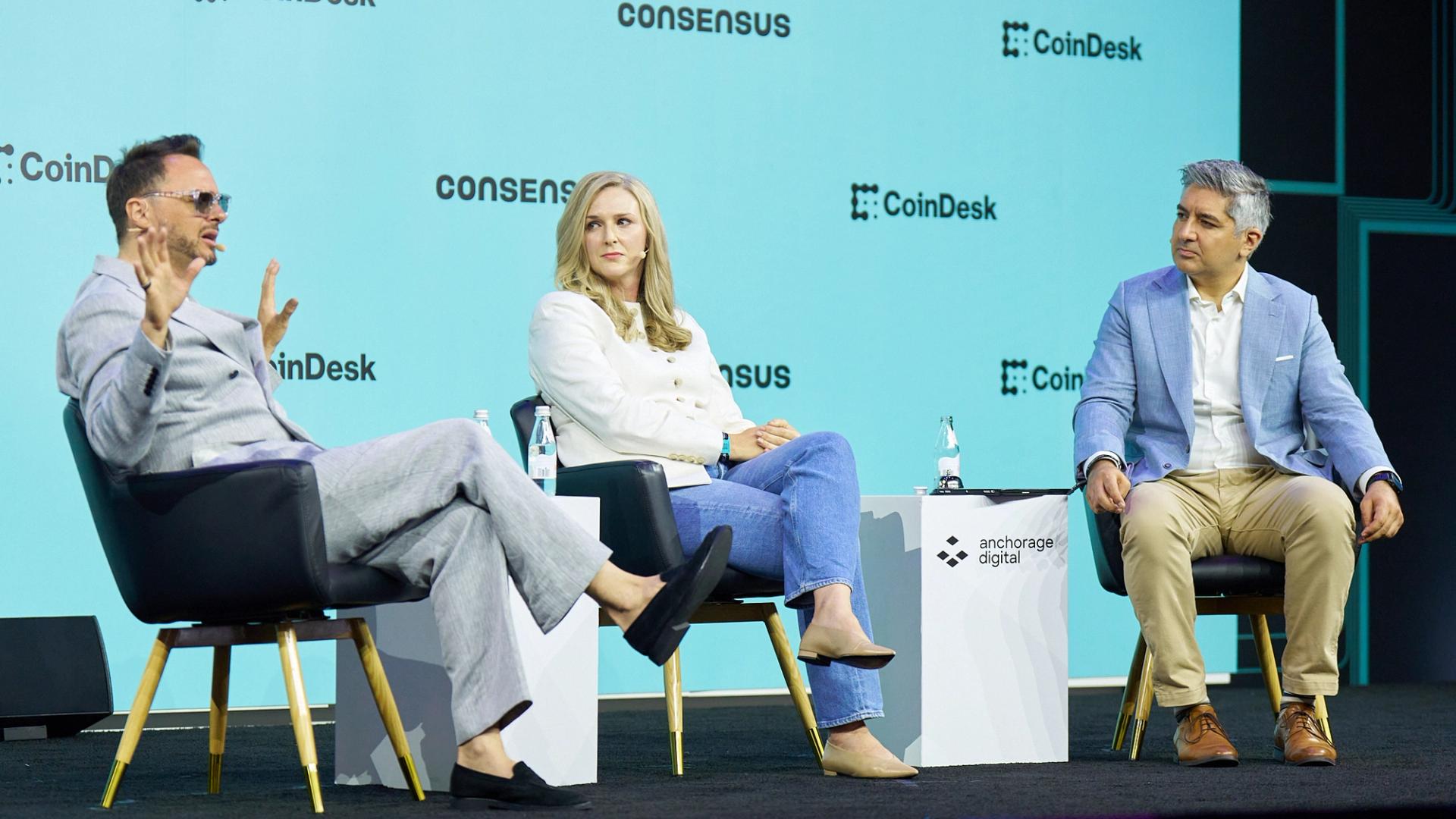
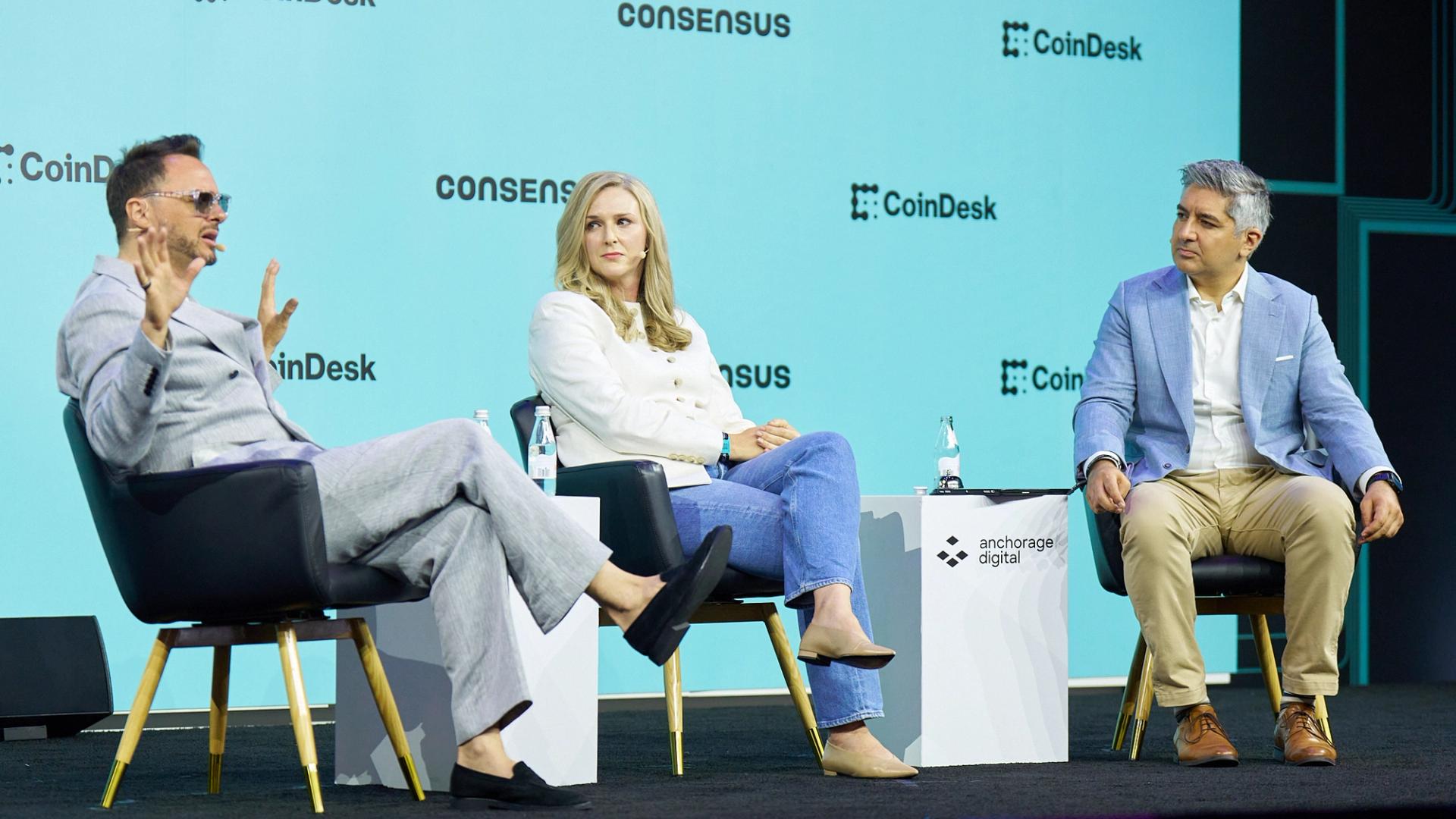
Large corporations looking to modernize payments and AI agents making autonomous transactions are emerging as the two biggest growth drivers for stablecoins, executives of Bridge and Deus X Capital said Thursday at Consensus 2026 in Miami.
Lindsey Einhaus — who leads strategy and operations at stablecoin infrastructure firm Bridge, which was acquired by Stripe for $1.1 billion — said the next two years will likely bring a wave of institutional stablecoin adoption, especially for cross-border payments and internal treasury operations.
“Large institutions are looking to utilize stablecoins to manage cross-border flows and really collapse a lot of their account management into stablecoins,” Einhaus said.
She pointed to payment-focused blockchains like Tempo, backed by Stripe and Paradigm, as key enablers for broader adoption. Existing blockchains historically lacked features common in traditional payments systems, such as refunds, chargebacks and private transactions, she argued.
The next growth area may come from AI-powered micropayments.
According to Einhaus, blockchain-based stablecoin rails could finally make tiny internet payments economically viable by removing costly intermediaries and reducing transaction fees. Historically, micropayments failed because transaction costs often exceeded the value being transferred, while crypto payments introduced price volatility that discouraged spending.
“With stablecoin-native blockchains, you’re going to dramatically reduce transaction costs,” she said.
Tim Grant, CEO of Deus X Capital, said agentic payments — autonomous AI systems transacting with each other — may become one of the strongest crypto use cases yet, partly because consumers intuitively understand the need for machines to move money online.
“We’re underestimating the agentic payment boom that’s about to happen,” Grant said.
At the same time, he cautioned that the infrastructure remains fragmented across multiple blockchains and wallets, while regulation around autonomous financial activity is still evolving.
Grant struck a more cautious tone overall on the pace of stablecoin adoption. While he was optimistic in the long term, he argued that the industry still faces hurdles around regulation, consumer onboarding and institutional coordination.
Still, he acknowledged that institutional sentiment has shifted meaningfully as regulators become more supportive.
“Before, you had to push institutions to pay attention,” Grant said. “Now they’re pulling.”
TLDR
- Vitalik Buterin’s XDB token swap triggered a sandwich attack from the JaredfromSubway MEV bot on Ethereum.
- The bot executed more than $1 million in trades before and after Buterin’s transaction confirmed.
- Blockchain data showed the sandwich attack happened in Ethereum block 24993038 on April 30.
- JaredfromSubway used SushiSwap and Uniswap V2 pools to manipulate XDB prices during the trade.
- Reports showed the bot likely lost money after paying more than $5 in gas fees.
Ethereum mempool activity exposed another sandwich attack involving Vitalik Buterin earlier this week. Blockchain data showed the JaredfromSubway bot targeted Buterin’s small XDB token trade on April 30. The transaction triggered more than $1 million in temporary trading volume across decentralized exchanges.
Vitalik Buterin Trade Triggered Automated MEV Activity
Etherscan data showed Buterin swapped 26,544 XDB tokens for 0.00197 ETH during block 24993038. The transaction carried an estimated value between $3.86 and $4.56. However, the JaredfromSubway bot detected the pending trade before block confirmation.
The bot then executed about $1.14 million in wrapped Ether transactions through SushiSwap and Uniswap V2. Those trades temporarily changed XDB liquidity prices before Buterin’s transaction completed. Afterward, the bot reversed the positions and captured a small spread from the movement.
CoinDesk analysis showed the bot likely earned only a few cents from the sequence. Gas costs reportedly reached $5.14 during the operation. Therefore, the bot appeared to lose money on the isolated transaction.
Blockchain records still showed the bot completed the full sandwich sequence despite the limited profit opportunity. Analysts said the behavior reflected automated scanning across Ethereum’s public mempool. The system searched continuously for transactions that matched preset trading conditions.
A sandwich attack places trades before and after another user’s pending transaction. The strategy raises the asset price before execution and sells immediately afterward. As a result, victims receive weaker execution prices during swaps.
JaredfromSubway Continues Expanding Ethereum MEV Operations
JaredfromSubway gained attention during the 2023 meme coin trading surge on Ethereum. The bot targeted traders dealing with tokens including PEPE and WOJAK. During April 2023, the bot briefly generated 7% of Ethereum gas usage.
Reports estimated the operation extracted more than $7 million from trading activity over hundreds of thousands of transactions. Developers and researchers tracked the wallet through several blockchain monitoring tools. The bot also survived contract upgrades and filtering attempts from builders.
Ethereum developers continue discussing methods to reduce toxic maximal extractable value activity. Buterin recently promoted encrypted mempools within Ethereum’s developing 2026 roadmap. He argued public mempools expose regular traders to hidden trading costs.
MEV refers to profits earned through transaction ordering on blockchain networks. Bots monitor pending transactions and insert trades before confirmation. Sandwich attacks currently represent about 51% of Ethereum MEV activity.
Current estimates placed cumulative Ethereum MEV extraction above $1.2 billion. Meanwhile, developers continued testing systems designed to limit front-running opportunities. Blockchain records from April 30 still showed JaredfromSubway executing the sandwich around Buterin’s transaction.
Political action committees (PACs) affiliated with the cryptocurrency company-backed Fairshake reported spending millions of dollars to support candidates in five races, with less than six months until US voters decide on their representatives in Congress.
According to filings with the Federal Election Commission this week, the Protect Progress PAC reported about a combined $1.6 million in expenditures for Jasmine Clark and Christian Menefee, Democrats running to represent Georgia’s 13th Congressional district and Texas’ 18th district, respectively.
The reported media buys came before Clark will face a May 19 Democratic primary and Menefee a May 26 runoff against Representative Al Green, who is running for a 12th term in office. Protect Progress claimed that Green was “actively hostile towards a growing Texas crypto community,” pledging to spend $1.5 million to oppose his reelection to Congress.
Protect Progress, a Fairshake affiliate, typically focuses on Democratic candidates, while another affiliate, Defend American Jobs, supports Republicans. The Defend American Jobs PAC similarly reported spending $5.6 million on candidates in Georgia’s 1st and 14th districts, Nebraska’s 3rd district and US Senate races in Alabama and Kentucky. All four US states are scheduled to hold May primaries.
Related: Americans distrust crypto, AI as industry super PACs flood midterms, poll finds
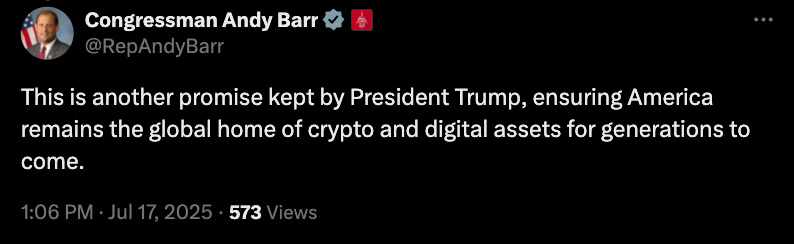
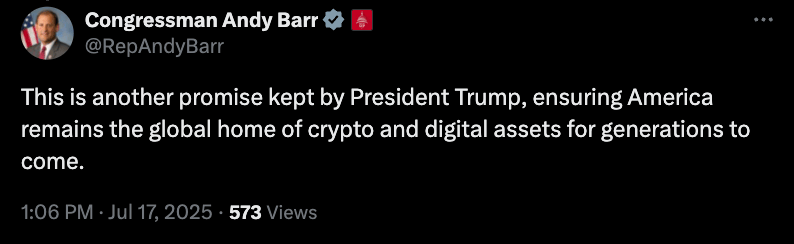
Among Defend American Jobs’ expenditures, Andy Barr, running for the US Senate in Kentucky and currently a US House representative for the state’s 6th district, received the most support, with more than $3.5 million in media. Barr has made many public statements favoring pro-crypto policies while in Congress, and voted in favor of legislation, including the GENIUS Act and CLARITY Act.
Source: Andy Barr
Fairshake, which reported holding $193 million as of January, has already spent millions of dollars in an attempt to influence voters through the media in the 2026 primaries. The Defend American Jobs PAC spent about $514,000 on advertising supporting Republican James Baird’s reelection in Indiana, and poured millions into media for Texas and Illinois races this year.
Crypto market structure bill could impact candidates’ midterm chances
For many crypto-supporting lawmakers and industry leaders, the progress of a digital asset market structure bill, called the CLARITY Act, could prove to be a litmus test for the 2026 midterm elections. Fairshake and its affiliates spent more than $130 million on media to support or oppose candidates in 2024, potentially influencing voters and changing the makeup of the current Congress, which will decide crypto-related laws.
“I do think it is critically important that every single member of Congress have a position on crypto, it’s part of their election campaign and their platform, and voters are going to be paying attention to this,” Cody Carbone, CEO of crypto advocacy organization The Digital Chamber, told Cointelegraph.
Last week, lawmakers in the US Senate announced a compromise on stablecoin yield that could allow the CLARITY Act to move forward for markup in the Senate Banking Committee, whose approval is necessary before a full floor vote. As of Thursday, the committee had not scheduled a markup on the bill.
Magazine: Guide to the top and emerging global crypto hubs: Mid-2026
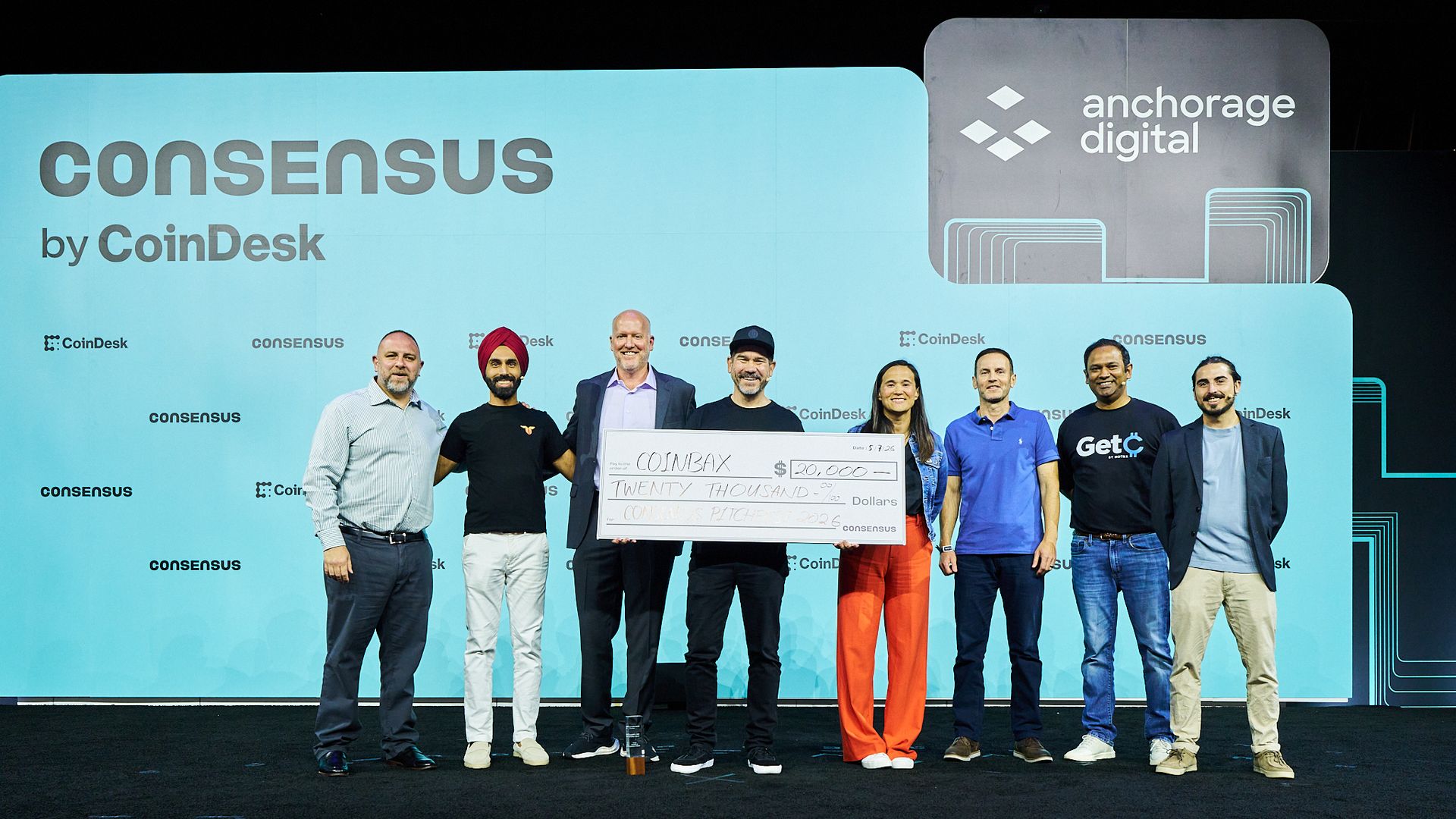
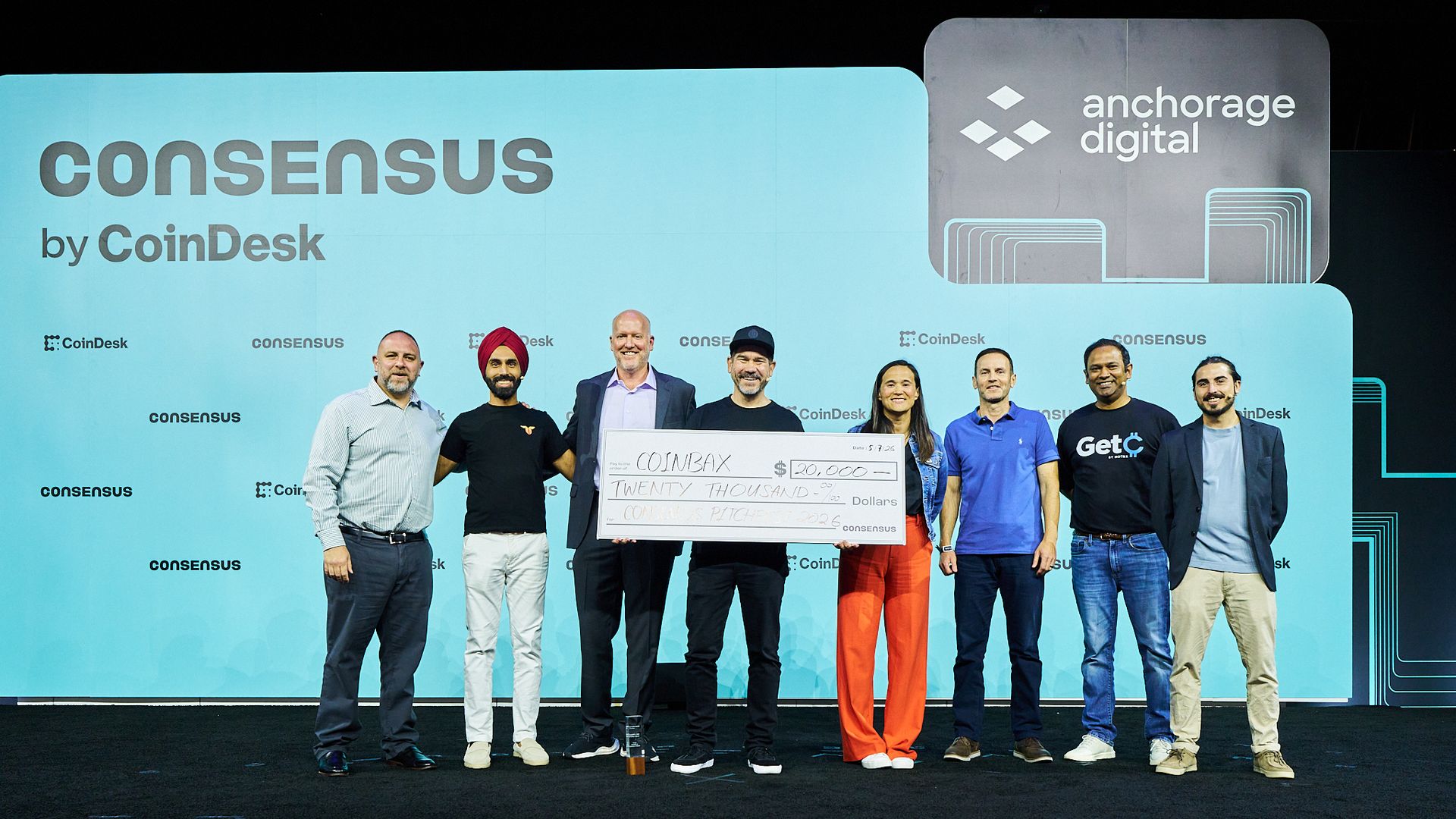
MIAMI – Coinbax won the $20,000 grand prize at Consensus Miami’s PitchFest after pitching a system designed to help banks and financial firms manage compliance for stablecoin payments.
The company, founded by former Jack Henry executive Peter Glyman, builds programmable escrow infrastructure that adds controls to wallet-to-wallet crypto transactions. The software is meant to reduce the risks financial institutions face when moving funds onchain.
“Banks want to use stablecoins for payments, but they need to get their compliance people comfortable with the idea of moving money onchain,” Glyman said during his presentation.
He described a future where “wallet addresses [are] associated with every bank account,” with transactions moving between banks, fintech firms and self-custody wallets. In that environment, he argued, compliance checks need to happen directly onchain rather than only through traditional banking intermediaries.
Coinbax uses smart contracts to hold funds in escrow while third-party services verify identity, sanctions screening and transaction risk. Funds settle only after conditions are met.
“We provide a trust layer,” Glyman said. “We provide programmable escrow that adds the control layer to these payments.”
The startup launched in October, closed a seed round in December and is already live on Base mainnet, according to Glyman. He said the company is working with banks, custody firms and wallet providers on pilot programs.
Second place went to Tashi, a decentralized infrastructure project focused on coordinating and managing AI systems across distributed networks.
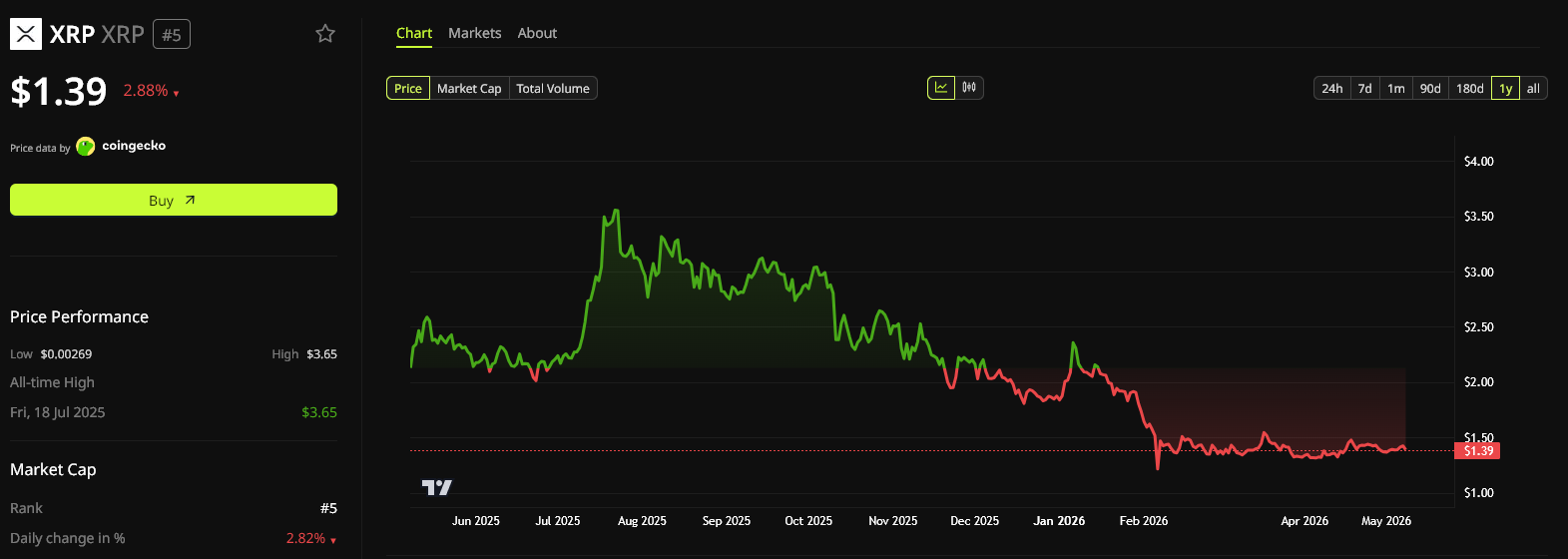
As of May 2026, XRP is trading near $1.41, fueling new expectations of quick profits among small investors interested in cryptocurrencies and global institutional adoption.
Current calculations, however, point to more moderate scenarios, even though there are still catalysts capable of sustaining meaningful growth throughout the year.

How Much XRP Is Needed to Become Rich?
Becoming rich through XRP in 2026 is mathematically possible, although the current numbers paint a far more demanding picture than many investors expect.
As of May 2026, XRP trades around $1.41, with an approximate market capitalization of $87 billion and more than 61.8 billion tokens in circulation.
That market size changes expectations completely. XRP is no longer a small cryptocurrency capable of delivering 100x gains within a few months.
For that reason, the real question is no longer whether XRP can rise, but how much capital an investor would need today to reach one million dollars before the end of the year.
The most commonly cited calculations present a sobering outlook:
- If XRP reaches $5, an investor would need approximately 200,000 XRP. At current prices, that represents an investment of roughly $282,000.
- If XRP climbs to $10, 100,000 XRP would still be required. Purchasing that amount today would cost around $141,000.
- Under Standard Chartered’s scenario of XRP reaching $2.80, an investor would need about 357,000 XRP. That would require an estimated investment of roughly $503,000.
For most small retail investors, these figures represent a considerable barrier.
Those who entered the market during previous cycles and accumulated large holdings at much lower prices could more easily come closer to that goal.
The challenge becomes more evident for investors starting with modest portfolios. An investment below $10,000 would require XRP to reach extremely aggressive levels, possibly above $20 or even $50.
At present, those projections are not part of the mainstream consensus among banks, analytics platforms, or artificial intelligence models.
ETFs Boost Expectations, But Also Caution
The institutional narrative surrounding XRP has changed significantly in recent months. Spot ETFs tied to the asset recorded positive inflows in 13 of the first 19 weeks of 2026, bringing this year’s total to nearly $157 million.
According to SoSoValue data, assets under management already stand near $3.87 billion.

Institutional growth has also been supported by new financial products. Coinbase enabled Trade at Settlement operations for XRP futures, while GraniteShares confirmed the launch of 3x leveraged XRP ETFs on Nasdaq.
Ripple also continues expanding partnerships related to financial infrastructure and international payments.
These developments strengthen the perception of legitimacy within the market.
However, they still do not guarantee an explosive rally. Recent forecasts also help temper expectations: Standard Chartered projects XRP near $2.80 by the end of 2026, while Motley Fool warns of possible pullbacks toward $1.
Artificial intelligence systems broadly agree on a relatively contained scenario. ChatGPT projects XRP around $2.15 by December under medium-probability conditions.
Meanwhile, Grok estimates a range between $2 and $3.50 depending on ETF growth, while Claude considers a scenario near $3.15 possible if the Federal Reserve cuts interest rates.

To justify prices above $5, the market would likely require extraordinary conditions, including:
- Final approval of the CLARITY Act.
- Institutional inflows far exceeding current levels.
- Bitcoin quickly reclaiming the $100,000 mark.
- Public adoption of XRP by a Tier-1 bank.
XRP Looks More Like a Wealth Builder Than a Lottery Ticket
The numbers point to a fairly clear conclusion. XRP still maintains growth potential and a strong institutional narrative, but it is unlikely to turn small investments into instant fortunes during 2026.
That does not mean the asset lacks appeal. XRP continues positioning itself as one of the altcoins with the strongest institutional presence within the international financial sector.
In addition, the development of ETFs and regulated financial products could support gradual appreciation over the coming years.
The key difference lies in expectations. Many investors still imagine moves similar to those seen during the early crypto cycles, when smaller assets multiplied in value quickly.
Today, XRP operates in a much more mature, competitive, and regulator-scrutinized market.
For investors who already accumulated large positions at low prices, 2026 could still become an important year. However, for new investors with limited capital, reaching $1 million in less than twelve months appears unlikely under realistic conditions.
The post XRP Could Create New Rich People, But Not in the Way Many Would Like appeared first on BeInCrypto.

Michael Saylor Just Admitted He Was Wrong. Bitcoin, Solana & ETH.

UK travel update amid flight cancellations & jet fuel fears

How sunburn inspired a new way to store energy

Manchester United reach agreement with Casemiro over contract clause amid transfer speculation

US brings back mandatory military draft registration

Steven Gerrard disagrees with Gary Neville over ‘shock’ Chelsea and Arsenal claim | Football


-

 NewsBeat4 days ago
Channel 5 – All Creatures Great and Small series 7 new post
-

 Crypto World14 hours ago
Upbit adds B3 Korean won pair as Base token gains Korea access
-
 Tech6 days ago
Trump’s 25% EU auto tariff breaches Turnberry Agreement that also covers semiconductors and digital trade
-
 NewsBeat16 hours ago
NCP car park operator enters administration putting 340 UK sites at risk of closure
-
 Sports6 days ago
Paul Scholes issues Marcus Rashford reality check as agreement emerges over Man United star
-

 Entertainment6 days ago
Met Gala 2026 Rumored Guest List Is Turning Heads
-

 Business7 days ago
Strait of Hormuz Blockade Persists Amid US-Iran Standoff, Sending Oil Prices Soaring
-
Entertainment6 days ago
New on Prime Video in May 2026 — Full List of Movies and Shows
-

 Tech7 days ago
Meta ends Sama contract after Kenyan workers report seeing intimate footage from Ray-Ban smart glasses users
-

 Entertainment6 days ago
Kylie Jenner Hit With Second Lawsuit From Ex-Housekeeper
-

 Sports6 days ago
Cavaliers vs. Raptors Game 6 live score, updates, highlights from 2026 NBA playoffs first-round series
-
 Sports6 days ago
David Benavidez responds to team Canelo saying the fight will never happen
-
 Sports6 days ago
IPL 2026: ‘Love you darling’- Hardik Pandya’s reaction to MS Dhoni steals the show |Watch | Cricket News
-

 Entertainment6 days ago
Young and the Restless Next Week: Cane Arrested & Matt’s Deadly New Scheme!
-
Entertainment5 days ago
New Netflix Movies in May 2026 — My Top 3 Picks to Stream
-

 Entertainment5 days ago
Melissa Joan Hart and More Stars Attend 2026 Kentucky Derby
-

 Business5 days ago
Luka Doncic Injury Update: Doncic’s Hamstring Recovery Slows Lakers’ Hopes Against Thunder: Can He Run Yet?
-
Crypto World5 days ago
Pi Network Mandates Protocol 23 Upgrade for All Mainnet Nodes Before May 15 Deadline
-

 Sports7 days ago
What Preity Zinta Said After Punjab Kings’ First Defeat Of IPL 2026
-

 Crypto World5 days ago
Bitcoin mining equities rise in 2026 as BTC lags behind
You must be logged in to post a comment Login