
Crypto World
Jim Cramer Just Warned Against SpaceX Stock: Bullish Sign for Elon Musk?


Jim Cramer has done it again. The CNBC host warned this week that SpaceX stock could surge to unsustainable levels at its debut, and for a growing crowd of investors, that warning reads as the most bullish signal they have seen all year.
SpaceX set its IPO price at $135 per share, valuing the company at $1.77 trillion and making it the largest IPO in history. With shares expected to begin trading on Nasdaq today, June 12, under the ticker SPCX, demand has been extraordinary, with the deal reportedly four times oversubscribed.
What Cramer Said About SpaceX Stock
Cramer told Mad Money viewers that a massive first-day surge is the last thing SpaceX needs. His concern centers on inexperienced retail investors placing market orders rather than limit orders, which could artificially spike the price and set the stock up for a sharp correction.
He warned SpaceX could briefly command a valuation rivaling the world’s largest companies, a level he said rarely ends well for buyers who chase the open.
Cramer first raised the alarm in May, when he said the IPO feeding frenzy could be “destructive” for the broader market, pulling capital away from other equities. He has since focused his concern on speculative short-term investors who may rush to sell shares shortly after trading opens.
The Reverse Cramer Effect Has a Track Record
The investing community has a different read. The “reverse Cramer effect” holds that his negative calls reliably precede rallies.
In 2017, he called Bitcoin “monopoly money” just before it rose to nearly $20,000. Then, in June 2021, he sold most of his Bitcoin position, citing fears over China’s crackdown, right before the market rebounded. Also, in January 2024, he warned of a Bitcoin selloff ahead of the US spot ETF launch, which became one of crypto’s biggest catalysts that year.
The pattern became so well-established that Wall Street built a structured product around it. The Inverse Cramer Tracker ETF (SJIM) launched in 2023, designed to bet against whatever Cramer recommends. The evidence spans multiple market cycles, from Bitcoin’s 2017 surge to the 2024 spot ETF rally.
SpaceX Brings a Bitcoin Treasury to Public Markets
One angle that sets this IPO apart from any other: SpaceX holds 18,712 Bitcoin on its balance sheet, worth roughly $2 billion at current prices. When SpaceX stock begins trading, public investors gain exposure to that treasury for the first time. Analysts have already begun mapping what the listing could mean for crypto markets more broadly.
Whether Cramer is right or wrong, his warning has already done one thing: it has given contrarian investors exactly the conviction they need to buy.
The post Jim Cramer Just Warned Against SpaceX Stock: Bullish Sign for Elon Musk? appeared first on BeInCrypto.



Canary Capital renewed its marketing push for the Canary HBAR ETF on July 30, describing HBR as the first U.S. spot exchange-traded product holding Hedera’s native token.
Summary
- 704.3 million HBAR backed Canary’s fund, with net assets near $47.8 million on July 30.
- 5.18 million HBR shares were outstanding after Canary added fifty thousand shares in latest update.
- HBR’s 0.95% sponsor fee accompanied a 37.32% year-to-date market-price decline recorded through July 29, 2026.
The post was not a new launch announcement. HBR began trading on Nasdaq on Oct. 28, 2025, after its registration became effective with the U.S. Securities and Exchange Commission.
The latest fund data gives a clearer view of its current scale. HBR held 704.35 million HBAR and reported about $47.8 million in net assets on July 30. The product had 5.18 million shares outstanding and charged a 0.95% sponsor fee.
Canary HBAR ETF now holds 704 million HBAR
Canary’s official fund page shows that HBAR represented effectively all the trust’s assets, apart from about $30 in cash and other items. The 704.35 million-token position was valued at approximately $47.8 million using the administrator’s stated price. HBR provides price exposure through brokerage accounts without requiring investors to manage private keys.
Shares outstanding increased from 5.13 million on July 28 to 5.18 million on July 29. That 50,000-share increase was the latest reported expansion in the fund’s share count. It does not, by itself, establish the identity or strategy of the investors behind the creation.
Additionally, HBR recorded $989,000 in net inflows on July 2, its largest single-day inflow since May 15. The fund then listed roughly $49.14 million in net assets, showing that its asset value can move even when new shares enter because HBAR’s market price also changes.
Latest filing shows losses despite share growth
HBR’s first-quarter SEC filing showed 4.2 million shares outstanding and $50.34 million in net assets on March 31. The trust created 740,000 shares and recorded no redemptions during the quarter. However, HBAR depreciated 17.8% during the period, and the fund reported a $10.58 million decrease in net assets from operations.
More recent performance data remained weak. Canary listed HBR’s market-price return at negative 37.32% for 2026 through July 29 and negative 63.32% since inception. Its net asset value return was negative 36.48% year-to-date.
In the latest market data available early July 31, HBR traded near $9.33, while HBAR changed hands around $0.0727. Those figures show current pricing only and do not prove that Canary’s July 30 post caused any market move.
Enterprise and tokenization claims need context
Canary said HBR gives registered access to a network governed by organizations including Google and IBM. The Hedera Council says its members run network nodes, vote on governance matters and approve technology updates. Its structure uses equal voting rights and term limits.
The asset manager also called HBR “built for the next wave of real-world asset tokenization.” That is a forward-looking marketing claim rather than a verified forecast. One related development has already occurred: Archax tokenized the HBR ETF on Hedera and completed an after-hours transaction on Nov. 27, 2025, according to a Hedera case study.
That blockchain transaction did not change how ordinary Nasdaq investors buy and sell HBR shares. It instead demonstrated a separate tokenized representation handled through regulated market infrastructure.
What investors should watch next
HBR is structured as a single-asset trust, not an investment company registered under the Investment Company Act of 1940. Canary warns that the product is not diversified and that investors could lose their entire principal. The trust currently lists BitGo Trust Company and Coinbase Custody Trust Company as its digital-asset custodians.
Investors will next look for the quarterly SEC filing covering the period ended June 30. That report will provide fuller figures for share creations, redemptions, expenses and changes in the trust’s HBAR position. Until then, daily holdings, share counts and net assets provide the most current official measures of fund activity.
HBR’s history also matters when assessing Canary’s new promotion. In related coverage, crypto.news reported on the fund’s path to launch in October 2025. The July post therefore renews attention around an existing product rather than introducing a new U.S. HBAR ETF.
Binance Research said on July 30 that the first half of 2026 produced a “broad on-chain contraction, not a rotation.”
Summary
- 38% DeFi TVL decline erased $43.4 billion as six major Layer 1 valuations fell 42%.
- 77% fewer Layer 2 user operations contrasted with Ethereum’s smaller 9% decline through June 2026.
- 207 security incidents caused $972 million in losses, while prediction markets reached $51.6 billion monthly.
Its 52-page report found that DeFi total value locked fell by $43.4 billion, or 38%, while the combined market capitalization of Ethereum, BNB, Solana, Tron, Sui and NEAR declined by $246.5 billion, or 42%.
Crypto market contraction hit DeFi and major L1s
The decline spread across capital, lending and network valuations rather than moving money cleanly from one blockchain sector into another. DeFi TVL dropped 38.7% during the half, nine percentage points more than the broader crypto market. Active loans fell 38%. April brought the steepest deterioration as large exploits reduced confidence in supplying onchain liquidity.
Current data shows a limited rebound rather than a full reversal. DefiLlama listed total DeFi TVL at about $74.9 billion on July 31. Based on Binance Research’s reported decline, the end-June level was roughly $70.8 billion. That calculation suggests some value returned in July, although token prices and differences in measurement can change TVL figures.
Security losses added to the pressure. TRM Labs independently recorded 207 hacks and $972 million stolen during H1, more than double the 83 incidents a year earlier. Smart-contract exploits accounted for 125 incidents. Infrastructure and operational failures represented about 76% of stolen value. As crypto.news previously reported, April attacks erased billions of dollars from DeFi TVL.
Ethereum treasuries overtook ETFs as L2 usage fell
Ethereum’s holder mix changed during the downturn. Binance Research said spot ETF balances declined from more than 6 million ETH to 5.2 million ETH. Digital asset treasury companies moved in the other direction, increasing their holdings from 6 million to 7.7 million ETH. The report sourced those figures from SoSoValue and Blockworks as of July 1.
Higher throughput did not create stronger base-layer revenue. Average gas prices fell 75% from 2025 after Ethereum raised its gas limit to about 60 million, while transaction count rose roughly 50%. Binance Research said chain revenue is “projected to fall 53% by year end if conditions persist.” That figure is a forecast, not a confirmed full-year result.
Layer 2 networks recorded a sharper usage decline than Ethereum mainnet. Total L2 user operations fell about 77% between January and June, compared with 9% on Ethereum. In June, L2s collected around $15 million in fees but paid Ethereum only $66,397 for data availability. In related coverage, crypto.news examined how Ethereum retained deeper TVL while Solana led several activity and revenue measures.
Solana revenue weakened while BNB remained deflationary
Solana’s network real economic value, which includes transaction fees and out-of-protocol tips, fell from $40 million in January to $14 million in June. Binance Research linked much of the 64.5% decline to weaker memecoin trading. Pump.fun volume fell from $30 billion to $17 billion over the same period, although memecoins still represented 25% of Solana DEX volume in June.
BNB moved differently on supply. The report identified BNB as the only deflationary major L1, with a 5.05% annualized burn rate. Its tokenized RWA market value also rose 107% to $3.8 billion in H1. However, that growth did not offset the broader decline across DeFi and major L1 valuations.
Prediction markets and tokenized assets resisted the slump
Tokenized real-world assets were among the clearest growth areas. Their distributed value increased from about $22 billion in January to roughly $34 billion by mid-July. BNB Chain led tokenized equity DEX volume, while tokenized equities reached 4% of Solana DEX activity in June. As crypto.news reported, tokenized stock products recently reached 752,000 holders across several networks.
Prediction markets also expanded during the 2026 FIFA World Cup. Monthly notional volume rose 86% from January to $51.6 billion in June. Kalshi recorded about $33 billion and Polymarket about $14.5 billion, giving the pair 92% of the month’s volume. Non-sports activity across both platforms rose 136%, indicating that growth was not limited to football markets.
In addition, the World Cup pushed Polymarket past $5 billion in tournament volume. Binance Research cautioned that H2 “will test” whether tournament-driven users remain active and whether regulation and settlement systems can support continued growth.
Network upgrades now provide measurable milestones. BNB Chain has scheduled its Pasteur hard fork for Aug. 25 at 02:30 UTC. Ethereum lists Glamsterdam for H2 2026 without a firm mainnet date. Meanwhile, Solana’s latest official release information points to Alpenglow activation with Agave 4.3 in October, later than the Binance report’s Q3 target.
The second half will therefore show whether lower fees and added capacity can rebuild durable demand. It will also test whether tokenized assets gain secondary liquidity and whether prediction-market activity survives after the World Cup. Until those trends appear in sustained usage, revenue and capital data, Binance Research’s contraction thesis remains the clearest reading of H1.
Crypto’s next altcoin season may produce fewer winners as institutional investors concentrate their activity in a narrower group of digital assets, according to crypto market maker Wintermute.
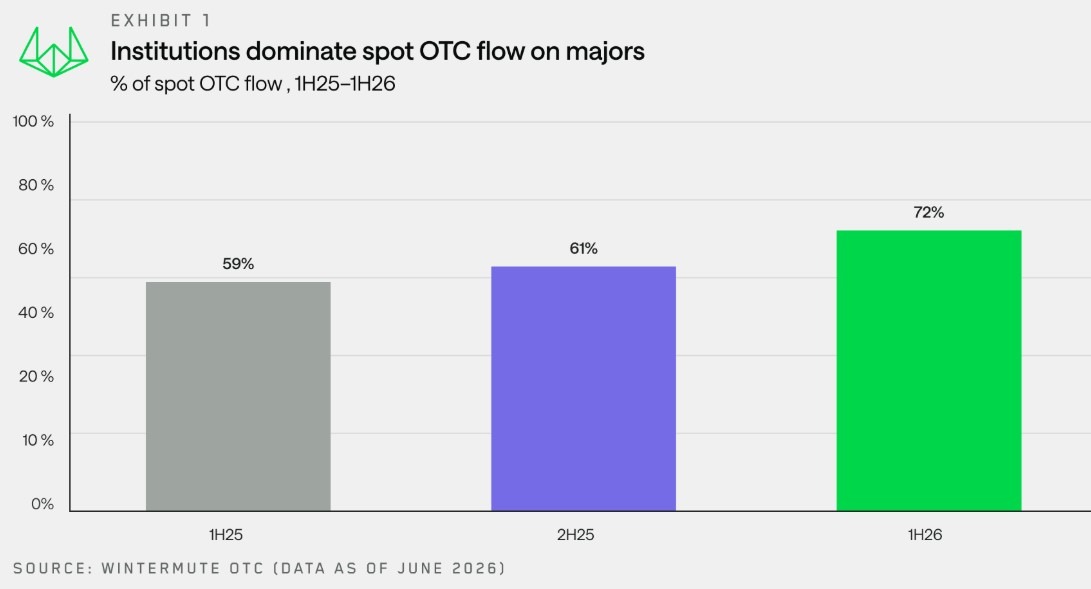
In its over-the-counter (OTC) flow report for the first half of 2026, Wintermute said institutional counterparties generated 72% of spot flow across all tokens on its OTC desk, the highest share on record. That was up from 61% in the second half of 2025 and 59% in the first half of last year.
With institutional activity concentrated in fewer tokens and fading faster after price surges, the findings suggest future altcoin rallies could become narrower and more selective. Wintermute said liquidity was concentrating in the assets institutions favored while activity across the market’s “long tail” weakened.
Between the first half of 2024 and the first half of 2026, the number of unique tokens traded by Wintermute’s institutional counterparties grew by just 24%, compared with 76% among retail clients. The firm also found that institutional activity following a surge in a token’s price and volume faded after roughly one day. In contrast, retail activity typically remained elevated for about three days.
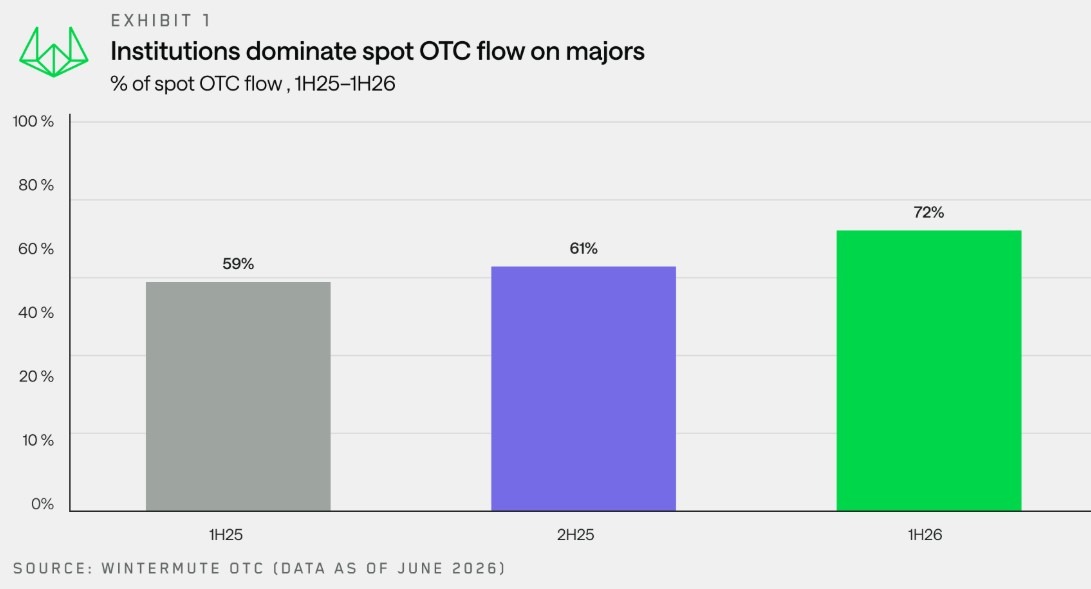
Percentage of institutional spot OTC flow. Source: Wintermute
Altcoin capital was already becoming more concentrated
Wintermute’s findings add proprietary OTC data to signs that capital has been clustering around a smaller group of altcoins across the wider market.
On June 20, CryptoQuant CEO Ki Young Ju said the traditional rotation of Bitcoin profits into smaller crypto assets had “basically disappeared.” CryptoQuant data showed trading volume in Bitcoin-denominated altcoin pairs near its weakest level since 2021.
Meanwhile, the 10 largest non-stablecoin altcoins accounted for about 80.5% of the non-Bitcoin, non-stablecoin market’s capitalization.
Related: Crypto altseason unlikely in 2026 as ‘blue-chip survivors’ to win out: Analyst
Kaiko identified a similar concentration in exchange trading. In July 2025, the data provider said that the ten largest altcoins accounted for 63% of altcoin trading volume, up from about 50% several months earlier, as activity in smaller tokens weakened.
DWF Labs managing partner Andrei Grachev also argued that broad altcoin rallies were giving way to selective sector moves. On March 15, Grachev said too many tokens were competing for limited capital, while institutional investors remained focused on Bitcoin, Ether and tokenized real-world assets.
Magazine: The 100x obsession: Fundamentals grow in importance as crypto matures
Coinkite warned Coldcard Mk3 users on July 30 to move Bitcoin from wallets whose seed phrases were generated on affected firmware.
Summary
- 594 BTC moved across 500 transactions during a coordinated three-block sweep involving single-signature Bitcoin addresses.
- Coldcard Mk3 seeds generated on firmware 4.0.1 through 5.0.3 may face risk, Coinkite warned users.
- No public evidence yet links the Mk3 seed issue directly to the 594 BTC sweep.
The Canadian hardware maker said seeds created on firmware 4.0.1 or any later Mk3 release through version 5.0.3 may put funds at risk.
The notice arrived as security researchers examined a coordinated sweep of 594.48 BTC, worth about $38.2 million at a Bitcoin price near $64,324. However, Coinkite and independent researchers have not established that the Mk3 issue caused those transfers.
Coldcard Mk3 warning covers firmware since 4.0.1
Coinkite’s official advisory said its investigation remains active. The company said the Coldcard Mk4, Q and Mk5 are not affected based on its early analysis. It also said wallets using an affected seed with a BIP-39 passphrase face “minimal risk,” while stressing that a passphrase is different from the device PIN.
The advisory now gives users more detailed migration options. Coinkite recommends generating a new seed on an unaffected device, verifying the backup and receiving address, sending a small test transaction and moving the remaining balance only after the test confirms the setup works.
The 594 BTC sweep remains unlinked to Coldcard
AnchorWatch CEO Rob Hamilton reported that 1,324 unspent transaction outputs moved through 500 transactions within a three-block window. The transfers swept 594.48 BTC from single-signature addresses, after which 562 BTC was consolidated into another address.
Hamilton wrote, “At a glance, this looks like there was flawed entropy” during wallet generation. That statement was a preliminary assessment, not a confirmed cause. A Reddit account also described a drained wallet tied to a Mk3-generated seed, but the self-reported account does not prove a wider connection.
Wizardsardine CEO Kevin Loaec described low randomness in a wallet generator as his “current hypothesis.” He said the source could be a software library, secure element, device batch or firmware version. He also proposed that an attacker may have searched a narrow set of BIP-84 paths, which could explain the concentration in native SegWit addresses and partial sweeps.
https://x.com/KLoaec/status/2082926304995762209?s=20
Loaec’s theory remains unverified. No public technical report has identified the faulty component, measured the available entropy or shown how an attacker derived the keys. Coinkite’s advisory still promises a formal technical review, but the company had not published that review at the time of writing.
The case resembles a broader class of weak-randomness failures. In related coverage, crypto.news reported on the Ill Bloom vulnerability, which Coinspect linked to weak recovery-phrase generation across several blockchains.
As previously reported, the older Randstorm vulnerability affected BitcoinJS wallets that did not generate sufficiently random private keys. That case involved wallets created between 2011 and 2016 and is separate from the current Mk3 investigation.
Affected users have two fallback migration paths
Users with an unaffected Coldcard can create a new seed there and migrate carefully. Coinkite advises preserving the old backup until the entire transfer is confirmed. Users should verify every address on the hardware screen and avoid entering seed words or passphrases on websites or untrusted devices.
For users whose Mk3 is their only option, Coinkite suggests a strong, unique BIP-39 passphrase as a temporary measure. Advanced users may instead create a dice-only seed on an empty Mk3 running firmware 4.1.9 by entering at least 99 independent rolls of a fair six-sided die. The company cautioned that this procedure requires careful backup and verification.
What happens next depends on Coinkite’s technical review and continued on-chain analysis. Until investigators publish a confirmed root cause, the 594 BTC sweep and the Mk3 seed-generation warning should be treated as related in timing but not proven to share the same cause.
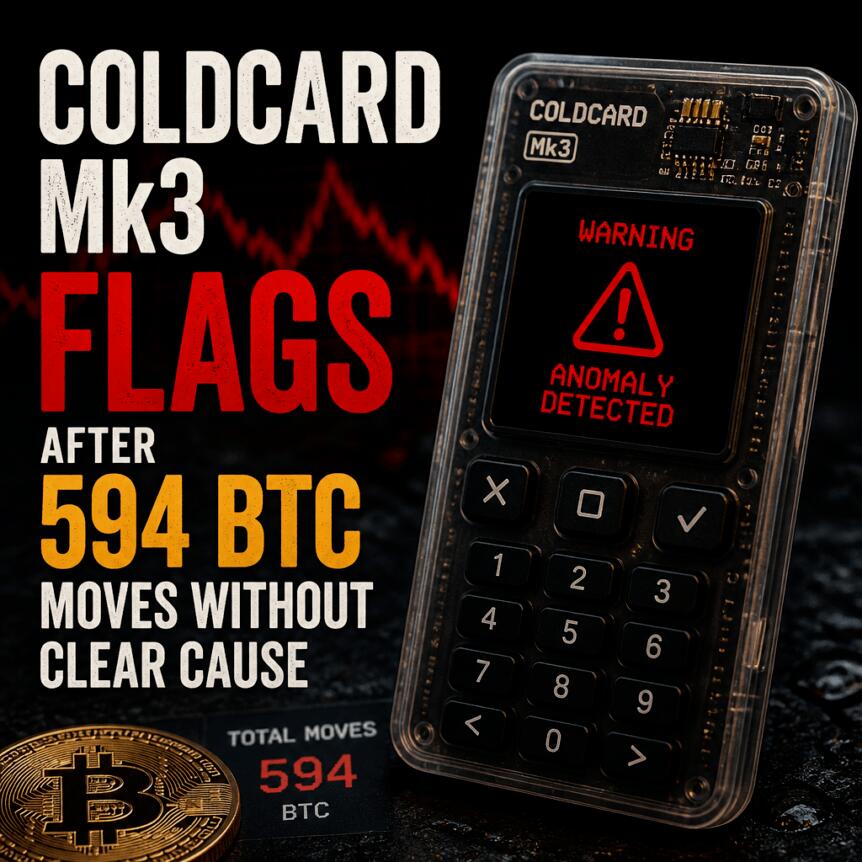
Canadian hardware wallet vendor Coinkite has issued an urgent security advisory for its Coldcard Mk3 signing device, warning users to move funds away from wallets whose seed phrases were generated on certain Mk3 firmware versions. The company says the issue affects Mk3 firmware 4.0.1 through 5.0.3, and that affected seeds may put funds at risk.
The warning arrives as Bitcoin investigators and security specialists scrutinize an unrelated-looking but highly unusual sweep of 594.48 BTC from single-signature addresses. While commentators have connected the timing to Mk3 devices, Coinkite stresses that no definitive public proof has linked its firmware warning to the broader sweep.
Key takeaways
- Coinkite’s advisory targets Coldcard Mk3 firmware versions 4.0.1 to 5.0.3; Mk4, Q, and Mk5 are stated as not affected.
- The recommended response is to generate a fresh seed on an unaffected device, verify backups and receiving addresses, then send test transactions before moving remaining funds.
- Early internal analysis from Coinkite indicates BIP-39 passphrases (distinct from the device PIN) may face minimal risk.
- Security experts are analyzing a separate event: a sweep of 594.48 BTC across 500 transactions within a narrow three-block window from single-signature addresses.
Coinkite flags an Mk3 firmware window
In a post on its official blog, Coinkite said that seeds created on a Coldcard Mk3 running firmware version 4.0.1 (released in March 2021) or any later Mk3 firmware may expose funds to risk. The company extends the affected range through firmware version 5.0.3, described as the final firmware supporting the Mk3.
Coinkite’s early analysis also draws a boundary around which components of wallet setup are most relevant. It said seeds used with a BIP-39 passphrase face minimal risk, while clarifying that this refers to a passphrase rather than the Coldcard PIN.
Importantly, the company framed its guidance as a precautionary measure. “Out of an abundance of caution,” Coinkite urged users with potentially affected seeds to generate a new seed on an unaffected device, confirm the backup, verify the receiving address, send a small test transaction, and only then transfer the rest of their funds. Coinkite added that its investigation is still ongoing and that it will deliver a formal technical review.
What triggered renewed attention: the 594.48 BTC sweep
Interest in this broader incident intensified after a Reddit user reported that a wallet drained from an account associated with a Coldcard Mk3 purchased in May 2021 had later been restored onto a Coldcard Mk4 in January 2026. That user’s account is self-reported and does not, by itself, establish a direct connection between the Mk3 firmware warning and the sweep activity.
Separately, AnchorWatch CEO and co-founder Rob Hamilton published a preliminary analysis stating that 1,324 unspent transaction outputs were swept across 500 transactions in a three-block window, moving a total of 594.48 BTC. In his write-up, Hamilton noted that all affected addresses were single-signature, and that 562 BTC was later consolidated into another address.
Hamilton described the pattern as consistent with “flawed entropy in wallet generation somewhere along the way,” echoing the possibility that randomness quality during seed creation may have mattered. At the time of writing, the 594.48 BTC was estimated to be worth about $38.3 million based on Bitcoin’s price of $64,364.07, according to CoinGecko.
Experts debate cause: low-entropy seeds and partial drainage
Another security researcher, Wizardsardine CEO Kevin Loaec, offered a hypothesis focused on the randomness source itself rather than the sweep mechanics. In a separate post, Loaec said his current theory is that a low-entropy random-number generator—potentially located in a software library, a secure element, or a specific device batch or firmware version—produced wallet seeds with insufficient randomness.
Loaec further suggested that if attackers were aware of the flaw, they may have used an AI-generated brute-force script. In his account, the search was confined to a limited set of BIP-84 derivation paths, which could help explain why the sweep appears concentrated in native SegWit addresses and why some wallets were only partially drained. He emphasized that the idea remains unconfirmed.
Crucially, Loaec warned that if his model is correct, wallets that saw only partial drainage could remain vulnerable to additional attempts. He also said funds in other address types might be exposed if the attacker expands scanning beyond the initially targeted formats.
Why the guidance matters for users—especially in light of the speculation
Even though Coinkite has not publicly connected the Coldcard Mk3 firmware issue to the 594.48 BTC sweep, the overlap in themes—seed quality, single-signature theft, and concentrated sweep behavior—means the advisory should be treated as a direct action item. Hardware-wallet incidents differ from typical “compromised computer” narratives: if the weakness is in seed generation, reusing the same seed (even on a different device) can keep exposure alive.
That’s why Coinkite’s recommended operational steps are specific and defensive: creating a new seed on an unaffected device, validating backups, confirming the correct receiving address, and using a small test transfer before moving the remainder. This sequence is aimed at reducing the risk of both theft and user error during migration—two failure modes that often show up around recovery events.
For users, the key uncertainty is whether the sweep investigators will eventually find deterministic evidence linking the Mk3 firmware range to the stolen outputs. Until then, Coinkite’s advisory stands independently as a risk-management decision for any Coldcard Mk3 owner who created seeds during the stated firmware window.
Going forward, readers should watch for Coinkite’s promised formal technical review and for any public forensic work that either corroborates or rules out a relationship between the Mk3 seed-generation warning and the 594.48 BTC sweep pattern described by security specialists.
The American Arbitration Association launched a specialist Web3 Panel on July 29, creating a roster of arbitrators for disputes involving blockchain systems, smart contracts, digital assets, tokenization and autonomous transactions.
Summary
- Five initial arbitrators bring legal, academic and technology experience to blockchain and digital asset disputes.
- AAA will handle business and consumer Web3 cases under its existing arbitration and mediation rules.
- Parties still need an arbitration agreement before the specialist panel can hear their particular dispute.
The New York-based organization said the panel is intended for commercial conflicts that combine familiar contract questions with technical evidence and cross-border activity. The official AAA announcement said the organization will continue recruiting specialists as the panel expands.
The launch does not establish a regulator or court. Instead, it adds specialists to the AAA’s existing arbitration and mediation system. Parties must still have an arbitration agreement, or agree after a dispute arises, before the organization can administer a case.
AAA Web3 panel covers code, custody and governance disputes
The AAA said the panel may hear disagreements over contract formation, governance, asset control, cybersecurity, transaction records and cross-border enforcement. Its dedicated Web3 dispute-resolution page also lists smart-contract bugs, exchange restrictions, wallet custody, stolen-asset recovery, DAO voting and tokenized-asset rights.
The scope extends beyond cryptocurrency. Agentic commerce and autonomous transactions are included because software or artificial intelligence systems may negotiate, authorize or execute agreements with limited human involvement.
Eric Dill, the AAA’s head of panel relations, said “Web3 disputes involve familiar commercial questions in a highly technical environment.” That statement describes the organization’s reasoning for creating the panel. It does not establish a new legal standard.
In related coverage, a smart contract explainer described these systems as automated blockchain code rather than legal documents. Code can execute transactions, but it cannot interpret intent or independently enforce real-world remedies.
Five initial members combine legal and technical experience
The initial roster includes Kabir Duggal of Akin Gump, technology disputes lawyer David Evans and University of Pennsylvania law professor David Hoffman. Nelson Mullins partner Paula Pendley and Google Cloud Web3 strategy head Rich Widmann also joined the panel.
Their stated experience covers international arbitration, automated commerce, decentralized finance, Bitcoin mining, artificial intelligence infrastructure and digital-asset businesses.
The AAA said it is continuing to recruit arbitrators as new technologies and business models produce additional disputes. However, it did not announce a fixed panel size, a first assigned case or a timetable for expansion.
Therefore, the launch establishes an available specialist roster rather than a mandatory forum for the crypto industry. Companies and customers will still need a valid contractual basis to bring disputes before the AAA.
Existing arbitration rules will still govern cases
Business-to-business technology disputes will generally proceed under the AAA’s Commercial Arbitration Rules. Disputes between consumers and exchanges, wallet providers or other businesses will usually use its Consumer Arbitration Rules.
A claimant must submit an arbitration demand, describe the claim, provide the relevant arbitration clause and pay the applicable filing fee. The panel itself does not gain enforcement or supervisory authority over exchanges, protocols or token issuers.
Under Section 2 of the Federal Arbitration Act, written agreements to arbitrate commerce-related disputes are generally enforceable, subject to legal grounds that may invalidate other contracts. Courts may still become involved when parties contest whether they agreed to arbitrate or seek enforcement of an award.
That distinction has already mattered in crypto cases. As previously reported, the U.S. Supreme Court ruled against Coinbase in a Dogecoin sweepstakes dispute, finding that a court had to decide which of two conflicting contracts controlled.
What happens next for the AAA Web3 panel
Companies seeking access to the panel can add an AAA arbitration clause to commercial agreements. They can also submit an existing dispute when their contract already names the AAA or its rules.
The organization says blockchain transactions are generally not reversed by arbitration itself. Instead, an award or settlement may require repayment, a new asset transfer or another remedy conducted outside the original transaction.
The AAA plans to expand the roster as disputes develop around automated systems, tokenization and AI-driven transactions. As of July 30, its public announcement did not disclose pending case volumes, expected Web3-specific fees or a deadline for adding new members.
The panel arrives as arbitration is already being used in major digital-asset disputes. Kraken secured a $22 million arbitration award against former auditor Mazars USA before seeking court confirmation of the decision.
The Ethereum Foundation appointed Pascal Caversaccio, known as pcaversaccio, to its board on July 29 for an initial one-year voluntary term.
Summary
- One-year voluntary appointment places Pascal Caversaccio on the Ethereum Foundation’s four-member governing board alongside Buterin.
- SEAL 911 provides round-the-clock incident response and reports protecting more than $180 million in assets.
- Privacy and security now guide protocol work spanning layer-one privacy, post-quantum protection, and safer transactions.
The move expands the governing body to four members as the organization places greater weight on privacy, security and censorship resistance.
Caversaccio joins Ethereum co-founder Vitalik Buterin, Foundation President Aya Miyaguchi and Swiss counsel Patrick Storchenegger. The official board update described him as a longtime Ethereum contributor, a co-founder and lead of SEAL 911, and a member of the Foundation’s Silviculture Society.
Ethereum Foundation adds a security specialist
The Ethereum Foundation said its board sets the organization’s vision and checks whether management’s strategies remain aligned with its values. It also described the body as a “security council” that protects the Foundation’s mission and ensures compliance as a Swiss foundation. That wording reflects the Foundation’s governance model rather than a separate regulatory status.
Caversaccio’s background combines technical security work and privacy advocacy. He wrote The Ethereum Cypherpunk Manifesto in 2024 and Ethereum Privacy: The Road to Self-Sovereignty in 2025. The Foundation also credited him with advancing security practices through technical contributions and community work.
Privacy and security shape the new structure
The appointment follows the Ethereum Foundation’s June reorganization, which reduced its workforce by 54 people, or roughly 20%. The new structure divided work across protocol, access, user, community and institutional layers, alongside operations and management teams.
Within that structure, the protocol cluster treats privacy and security as “non-negotiable protocol guarantees.” Its stated work includes layer-1 privacy, post-quantum security, safer protocol upgrades, reduced technical complexity and defences against harmful maximum extractable value practices.
However, the Foundation’s formal mandate places privacy and censorship resistance at the centre of its work. The mandate does not give the Foundation control over Ethereum. Instead, it describes the organization as one steward among many across the network.
SEAL 911 adds incident-response experience
SEAL 911 is a free, around-the-clock emergency service for active or imminent crypto security incidents. Security Alliance says the initiative has handled more than 3,300 tickets, coordinated over 125 war rooms and helped rescue more than $180 million in assets.
That operational background gives Caversaccio experience with exploits, compromised wallets, protocol failures and fund-recovery efforts. However, the Foundation did not announce any new security programme, budget or incident-response authority tied directly to his appointment.
The two organizations already have a working relationship. The Ethereum Foundation sponsored a SEAL security engineer in February to track and counter crypto drainers targeting Ethereum users.
In related coverage, the Foundation explained how its protocol security team uses coordinated artificial-intelligence agents to identify and verify software flaws. The team reported finding a remotely triggered libp2p flaw that was fixed and disclosed as CVE-2026-34219.
What happens during the one-year term
The board update did not specify committee assignments, voting powers beyond normal board duties or measurable targets for Caversaccio’s first year. It also did not announce compensation, stating only that the role is voluntary and begins with an initial one-year term.
His main formal responsibility will therefore remain board-level oversight. Management will continue to handle execution, while the board reviews whether major strategies and decisions fit the Foundation’s mandate and Swiss legal obligations.
The appointment may place more security and privacy expertise inside those reviews, but the Foundation did not promise specific protocol changes. Work on layer-1 privacy, post-quantum protection and safer transactions will still move through researchers, developers and Ethereum’s broader governance process.
The Foundation has not announced an exact end date for the term or whether Caversaccio may be reappointed. Any continuation beyond the initial year would require a later board decision or public update.


Japanese game developer Gumi will begin operating a roughly ¥3 billion crypto asset fund with SBI Financial Services on Aug.
Summary
- ¥3 billion fund begins operations August 1, targeting Bitcoin, major altcoins and active portfolio strategies.
- SBI Financial Services owns 51%, while Gumi subsidiary gC Labs holds the remaining 49% stake.
- Gumi held ¥14.13 billion in crypto assets by April, marking an 86% annual increase companywide.
According to a July 28 company announcement.The private fund, named SBI Crypto Fund I, will invest mainly in Bitcoin and major listed altcoins. Daiwa Securities Group and several unnamed investors have also committed capital. However, Gumi did not disclose individual investment amounts or the fund’s planned asset allocations.
Gumi and SBI will operate the fund for three years
SBI Crypto Fund I will operate as a private placement through a Japanese silent partnership structure. The fund has a planned three-year term and will be managed by SBI Crypto Fund LLC, according to the official fund overview.
SBI Financial Services owns 51% of the operating company. Gumi’s wholly owned subsidiary, gC Labs, owns the other 49%. The partners had originally considered beginning operations in 2025 but delayed the launch while assessing crypto-market conditions.
The fund will combine staking, portfolio rebalancing and hedging. Gumi did not identify the altcoins it plans to hold, its custody providers, fee structure or specific risk limits. It also warned that the announcement does not guarantee future returns and is not an invitation to invest.
Bitcoin and altcoins support a wider product strategy
Gumi said the fund’s mission is to “bridge the crypto asset market and Japanese companies” through investment and liquidity provision. That statement describes the fund’s planned role rather than a measurable outcome.
The participating companies also plan to collect performance data and test portfolio strategies that combine traditional and digital assets. Gumi said the information could support research into future investment trusts and other managed products. No such retail product has been announced or approved.
The company also said it wants to build a track record before the “possible lifting of the ban” on domestic crypto exchange-traded funds. Japan’s Financial Services Agency has discussed changes that could eventually allow certain crypto ETFs, but regulatory and investment-trust rules still need to support their launch.
Notably, Japan’s first Bitcoin ETF could arrive by 2028 as regulators revise the country’s fund framework. That date remains a reported possibility rather than an official launch deadline.
Gumi’s crypto assets nearly doubled within one year
Gumi’s crypto holdings have already become a large part of its balance sheet. The company reported ¥14.13 billion in crypto assets as of April 30, 2026, up from ¥7.58 billion one year earlier. The increase was about 86%.
Its annual financial results also showed a ¥2.63 billion valuation gain from crypto assets during the latest fiscal year. The company recorded a ¥60.4 million loss from crypto sales, while its operating profit fell to ¥83.3 million. Therefore, valuation gains made a large contribution to Gumi’s ¥2.17 billion ordinary profit.
Gumi said its crypto business centres on active holdings of XRP, portfolio management through Hinode Technologies and investment-fund operations.In addition, Gumi adopted XRP as a corporate treasury asset after previously approving a ¥1 billion Bitcoin purchase.
What happens after the August 1 launch
SBI Crypto Fund I is scheduled to begin operations on Aug. 1. The first verified information on its holdings, staking activity or performance will depend on future disclosures from Gumi, SBI or the fund operator.
The announcement did not set a reporting schedule or provide return targets. It also did not say whether investors may add capital after launch. For now, the confirmed structure remains a three-year private fund with approximately ¥3 billion in committed capital.

Many leading cryptocurrencies, including Bitcoin (BTC), Ethereum (ETH), and Ripple (XRP), are currently trading far below their historic peaks, yet none of these declines compares to the massive crash that Internet Computer (ICP) has suffered.
Despite the bloodbath, several analysts refuse to lose hope and think a resurgence could be on the horizon. On the other hand, pessimists believe things are likely to deteriorate even further from here.
The Bright Side
ICP began trading in May 2021, and during its early days, its price briefly skyrocketed above $700. What followed next was a brutal collapse, while the bear market over the past several months has only worsened its condition.
Currently, it trades at roughly $2.06 (according to CoinGecko), representing a whopping 99.7% crash from the all-time high. Its market capitalization has declined to approximately $1.14 billion, making it the 60th-largest cryptocurrency.
It may seem that all is lost for ICP, yet certain industry participants have noted repeating patterns that could open the door to a long-awaited rebound. X user CW claimed that the strong accumulation of the asset has continued for a month, reaching a score of 100. The analyst pointed out that in the past, such periods have been followed by major pumps, and we have yet to see whether history will repeat itself.
For their part, KYRA BLOOM spotted a potential buy setup. They believe that as long as the price holds above $1.94, the bullish breakout path remains valid, projecting a rise to nearly $9.
The Pessimists’ View
Others like Cryptorphic stand on the opposite corner and expect ICP to bleed even more. The analyst opined that the token is sitting at “a very interesting level” after breaking below the key $2.10 support zone.
“The important part is what happens next. If $2.10–$2.12 turns into resistance on a retest, I think the breakdown could continue, with $1.67 as the major downside area I’m watching. As long as ICP remains below the descending trendline and fails to reclaim the broken support, my bias stays bearish,” they stated.
Crypto Patel also gave their two cents, anticipating a further plunge if $2 fails to hold. “The HTF chart projects a potential move toward $1, with $0.50 remaining the next major downside target,” the market observer warned.
The post Down 99.7% From ATH: Is Internet Computer (ICP) Due for a Comeback or Total Collapse? appeared first on CryptoPotato.
Crypto exchange Luno is cutting about 20% of its global workforce as part of a restructuring confirmed on July 28 by Chief Executive James Lanigan.
Summary
- Luno is cutting 20% of its global workforce while expanding institutional and business-to-business services worldwide.
- Twelve crypto-related companies reported July restructurings, with 894 disclosed jobs affected across six named reductions.
- Gnosis reduced its consumer app team and plans an independent structure beginning during third quarter.
The Digital Currency Group-owned company will reduce costs while directing more resources toward institutional customers and its business-to-business unit.
Lanigan did not disclose the number of employees affected or identify the regions and departments included. He said investments in automation and wider operational changes had altered the resources required to run the exchange.
Luno layoffs support an institutional shift
Luno plans to continue investing in compliance, core infrastructure and selected retail products while scaling services for other businesses. Its institutional platform offers liquidity and trading infrastructure for professional clients. The company’s website currently says it serves 15 million customers worldwide.
Lanigan said a “leaner and adapted structure is both necessary and appropriate.” That statement represents management’s assessment rather than a verified financial outcome. Luno has not published projected savings, restructuring charges or a completion date for the workforce reduction.
The latest cuts are smaller than Luno’s January 2023 retrenchment. At the time, the exchange officially announced a 35% reduction across all regions as the crypto downturn weakened growth and revenue. Contemporary reporting estimated that more than 330 roles were affected from a workforce of roughly 960.
July crypto layoffs reached at least 12 companies
The CryptoJobsList tracker listed 12 crypto or crypto-adjacent companies with July-dated cuts or restructurings. They included Luno, Gnosis, Uphold, BitMart, Dango, Odos, BitMEX, Exodus, Polygon Labs, AscendEX, Zapper and Yield Guild Games.
Adding the published figures for six of those companies gives 894 affected jobs. The tracker listed 550 at BitMart, 160 at BitMEX, 85 at Uphold, 54 at Exodus, 35 at Yield Guild Games and 10 at Odos. However, the figure remains incomplete because Luno, Gnosis and several other companies did not disclose exact totals.
CryptoJobsList recorded more than 7,254 disclosed cuts across 47 companies during 2026 and identified market conditions as the most frequently cited reason. However, the tracker relies on public announcements and media reports. It also includes fintech and crypto-adjacent businesses, making it a broad indicator rather than an audited industry total.
Gnosis also confirmed workforce reductions in its second-quarter report, published on July 17. Co-founder Friederike Ernst said the organization had reduced the Gnosis App team after deciding that “growth has been linear, and linear is not good enough” for a consumer product.
The organization plans to remove Gnosis App from Gnosis Ltd during the third quarter. A smaller team is expected to seek decentralized autonomous organization funding for an independent company. The proposal’s outcome and final staffing level remain unconfirmed.
Gnosis reported that the app had about 800 active card users in the second quarter, up from roughly 500 in the first quarter. Daily and weekly active users also increased. Still, management said the product required a smaller structure and faster decision-making outside the wider Gnosis organization.
Automation and payments reshape crypto staffing
The July reductions follow several firms that linked workforce changes to new business priorities. BitGo cut nearly 15% of its workforce in June while focusing resources on security, stablecoins, settlement and artificial-intelligence infrastructure.
Additionaly, Exodus cut 25% of its workforce while integrating Monavate and Baanx into a stablecoin payments and card platform. Its SEC filing said about 77 employees and individual service providers would be affected, with projected annual cash savings of $10 million to $13 million.
Luno has not announced comparable savings targets. The next verified updates may come through company statements, employee consultation processes or changes to its institutional services. Until then, the 20% figure remains the clearest measure of the restructuring, while the absolute number of affected workers remains unknown.

Millie De Lune on comeback trail in 2026 after tendon issue

Flock Cameras Are Being Destroyed Across the US

Bitcoin Holders: I Can’t Stay Quiet Any Longer!!


-

 Fashion6 days ago
Weekend Open Thread: Brooks Brothers
-
 Sports4 days ago
Commonwealth Games boxing: Jadumani Singh seals dominant 5-0 win over Pakistan’s Sumama Rehman to enter quarter-finals | Commonwealth Games News
-

 Business1 day ago
Why Trees Belong on the Risk Register
-

 Tech4 days ago
Intel is reversing course and bringing hyper-threading back to its server chips
-

 Crypto World5 days ago
Ripple bought a bank in pieces. The $4 billion audit
-

 Politics4 days ago
Luke Littler dismantles Gerwyn Price to retain title in Blackpool
-
 Entertainment7 days ago
A New Post-Apocalyptic Gundam Anime Series Blasts Into SDCC
-

 Politics3 days ago
The Part of the Electric Transition Nobody Wants to Discuss
-

 News Videos4 days ago
BITCOIN JUST ENTERED THIS CRITICAL ZONE…
-

 Business2 days ago
Major shareholder moves on Canyon
-

 Crypto World5 days ago
XRP Ledger adds $2.6B as RWA inflows rank second
-

 News Videos17 hours ago
Bitcoin Enters the 3rd Stage of the Bear Market
-

 Politics5 days ago
Spain sweeps the board at 2026 World Cup with individual awards
-
 Entertainment2 days ago
‘Stargate’ Creator’s New Sci-Fi Series Returns for Season 3 Tomorrow
-

 Entertainment5 days ago
Sara Gilson Killed By Husband After Viral “Pedophile” TikTok Video
-

 Crypto World2 days ago
Kraken Enables Retail Access to Jersey Mike’s IPO via Tokenized Shares
-

 Tech6 days ago
Anthropic launches Claude Opus 5, a cheaper AI model for coding, agents and enterprise workflows
-

 News Videos2 days ago
Claude: Build Financial Dashboards in Minutes (2026)
-

 Politics13 hours ago
Luke Littler’s dominance sparks GOAT debate
-

 Tech3 days ago
New macOS Sequoia & Sonoma security updates for older Macs
You must be logged in to post a comment Login