
Crypto World
JPMorgan says tokenization will reshape funds industry



JPMorgan says tokenization could change how the funds industry operates, including the exchange-traded fund market.
Summary
- JPMorgan said tokenization could reshape ETFs and the wider funds industry over the coming years.
- Ciarán Fitzpatrick said strong ETF tokenization use cases may still be a few years away.
- Tokenized ETFs could support faster settlement, improved redemption, and wider access beyond normal market hours.
Ciarán Fitzpatrick, JPMorgan’s global head of ETF product, said tokenization may affect ETFs and wider fund products over time.
“We believe tokenization will certainly drive how the market changes, not just for ETFs but across the funds industry as a whole,” Fitzpatrick said in a post published Friday.
ETF tokenization could improve settlement
Fitzpatrick said firms continue to test tokenized ETFs because the model could improve creation and redemption. It could also support “near-instant settlement” and round-the-clock access for some products.
He said tokenization may become part of the ETF market, but practical use cases still need more time.
“My view on tokenization is that it will become part of the ETF ecosystem, but we’re a couple of years away from some good use cases,” he said.
In addition, JPMorgan is already studying tokenization through Kinexys, its blockchain business unit. The bank has used the unit to explore how blockchain can support financial markets and settlement systems.
The comments show that large financial firms still see value in tokenized assets, even as they take a cautious view on timing. JPMorgan’s position suggests that tokenization may grow through tested use cases rather than fast market adoption.
Regulators and exchanges show growing interest
Traditional finance firms and regulators have shown more interest in tokenized assets. The focus has included equities, funds, and other products that trade only during market hours.
SEC Commissioner Hester Peirce recently urged firms working on tokenized products to speak directly with the agency. The SEC has also allowed some tokenization-related efforts, including a Nasdaq rule change for tokenized share trading.
Major firms, including the New York Stock Exchange, Robinhood, Kraken, and Coinbase, are also working on tokenized equity products. Analysts expect tokenized assets to reach trillions of dollars by 2030, though estimates vary widely.



Peter Schiff is warning that MicroStrategy’s Bitcoin-backed yield strategy is heading toward a death spiral, claiming the company’s expanding STRC preferred stock issuance now threatens both MSTR shares and Bitcoin itself.
The economist and longtime Bitcoin (BTC) critic argues that Strategy’s variable 11.5% dividend cannot be funded without selling Bitcoin or attracting an endless stream of new STRC buyers, a setup he calls structurally unstable.
Inside Schiff’s MicroStrategy Thesis
In recent posts on X, Schiff said the gap between Strategy’s Bitcoin holdings and its growing cash obligations defines the danger. Strategy, formerly MicroStrategy, now holds 815,061 BTC after a $2.54 billion purchase on April 20, financed mostly through equity issuance.
Bitcoin produces no native cash flow, while STRC pays a variable 11.5% annualized dividend each month to holders. Schiff says that math eventually forces Strategy into a binary choice.
Either it sells BTC to fund payouts, or it keeps issuing fresh STRC to a shrinking pool of yield buyers.
Why Strategy Must Keep Issuing STRC
STRC has financed roughly 50,792 BTC since launching in July 2025 at a 9% dividend. Seven consecutive monthly increases have lifted the rate to its current 11.5%. Schiff argues that climb proves the model depends on capital raises rather than recurring operations.
Strategy purchased 64,948 BTC in 2026 alone before the latest tranche, tracking far ahead of its historical buying pace. That acceleration depends on capital markets staying open and STRC retaining demand near current yields.
Each fresh STRC issuance compounds the recurring cash burden, raising the share Strategy must cover from external sources. Other analysts have flagged similar concerns about how the security might behave during periods of credit-market stress or rising rates.
What Could Break the Yield Loop
If STRC demand cools, Schiff predicts forced Bitcoin sales would follow, pressuring BTC prices and Strategy’s net asset value. He also notes perpetual preferred dividends carry no firm legal floor, meaning the company could pause payments without triggering a formal default.
Some commentators have separately framed the resulting exposure as a systemic risk for the wider crypto market.
Saylor has repeatedly rejected those framings, citing MSTR’s long-run outperformance and the company’s $42 billion at-the-market program announced in March.
He has also publicly challenged Schiff to debate the STRC structure on his terms. Whether buyers keep absorbing STRC near current yields, and at what dividend level, will largely decide whose framing holds in the coming months.
The post Peter Schiff Warns of a “Death Spiral” in MicroStrategy’s Bitcoin Strategy appeared first on BeInCrypto.


The Official Trump (TRUMP) meme coin fell 14% on Saturday. The decline came as a gunman charged a Secret Service checkpoint at the White House Correspondents’ Dinner. President Trump, Vice President JD Vance, and Cabinet members were evacuated from the Washington Hilton ballroom.
Cole Tomas Allen, 31, of Torrance, California, opened fire near the checkpoint at about 8:36 p.m. and was detained. One Secret Service agent was struck in his bulletproof vest and is in good condition.
Trump Tokens Slide Despite Crypto Pep Talk
Trump’s Saturday address to meme coin holders at his Mar-a-Lago gala failed to lift the token. TRUMP traded near $2.63 by Sunday, down 96% from its January 2025 peak of $73.43. Daily volume sat near $597 million.
The slide extends a difficult month for Trump-linked tokens. World Liberty Financial (WLFI), the family-backed governance token, traded near $0.075 on Sunday. That marks an 82% drop from its September high. Lending controversies and a fraud suit from investor Justin Sun pressured holders.
Bitcoin (BTC) held its ground at $77,508 over the weekend, up about 13% for April. The reserve asset has decoupled from Trump-branded tokens. Traders cited extended Iran ceasefire talks and Strategy’s $2.5 billion bitcoin purchase as the main drivers.
Charges and What Comes Next
Allen faces federal charges, including using a firearm during a crime of violence and assault on a federal officer. According to investigators, he acted alone and was carrying a shotgun, a handgun, and knives. Meanwhile, his arraignment is scheduled for Monday in federal court.
Trump described the attacker as a “lone wolf” in remarks after the evacuation. Allen worked as an educator in Torrance. He received a “Teacher of the Month” award in late 2024.
Markets will track whether the security incident dampens appetite for politically tied tokens. Another Mar-a-Lago crypto event is still drawing whale interest despite Saturday’s selloff.
The post Trump Coins Crash After WHCD Shooting Shocks Washington appeared first on BeInCrypto.

TRUMP memecoin fell nearly 10% in 24 hours despite a Mar-a-Lago investor gala, with the token still down over 96% from its peak.
Crypto World
Next Crypto to Explode in 2026: Is It Dogecoin Or BNB? While A Presale Might Outperform Both
The next crypto to explode debate just sharpened after Binance rolled out its new Alpha Page on April 23, tracking early-stage projects before listing with historical user gains reaching $24,787, the cleanest signal yet that wallets entering a token before the Binance listing are the ones walking away with the real returns.
That dashboard explains why investors are hunting early entries right now, and Pepeto is the name catching the flow. Past $9.45 million raised, a full exchange running, and the Binance listing approaching, the presale at $0.0000001866 mirrors the setup that paid the biggest checks of the last cycle.
Binance Alpha Page Opens a Window Into the Listing Playbook That Delivers 41% Average Returns
Binance launched its Alpha Page on April 23, a central hub tracking early-stage tokens from pre-listing activity through exchange debut, with past Alpha events paying users up to $24,787 before public trading opened, according to CryptoNewsZ.
The numbers behind the Binance listing playbook explain the rush. A Ren & Heinrich study found tokens rise +41% on listing day and +73% within 30 days on Binance. Every cycle rewards wallets that entered before the listing alert fired, because once trading goes live the gap closes and never opens again.
Three Tokens Lined Up For the Coming Breakout
Pepeto Price at $0.0000001866 as $9.45M Raised Confirms Where Listed Capital Is Rotating
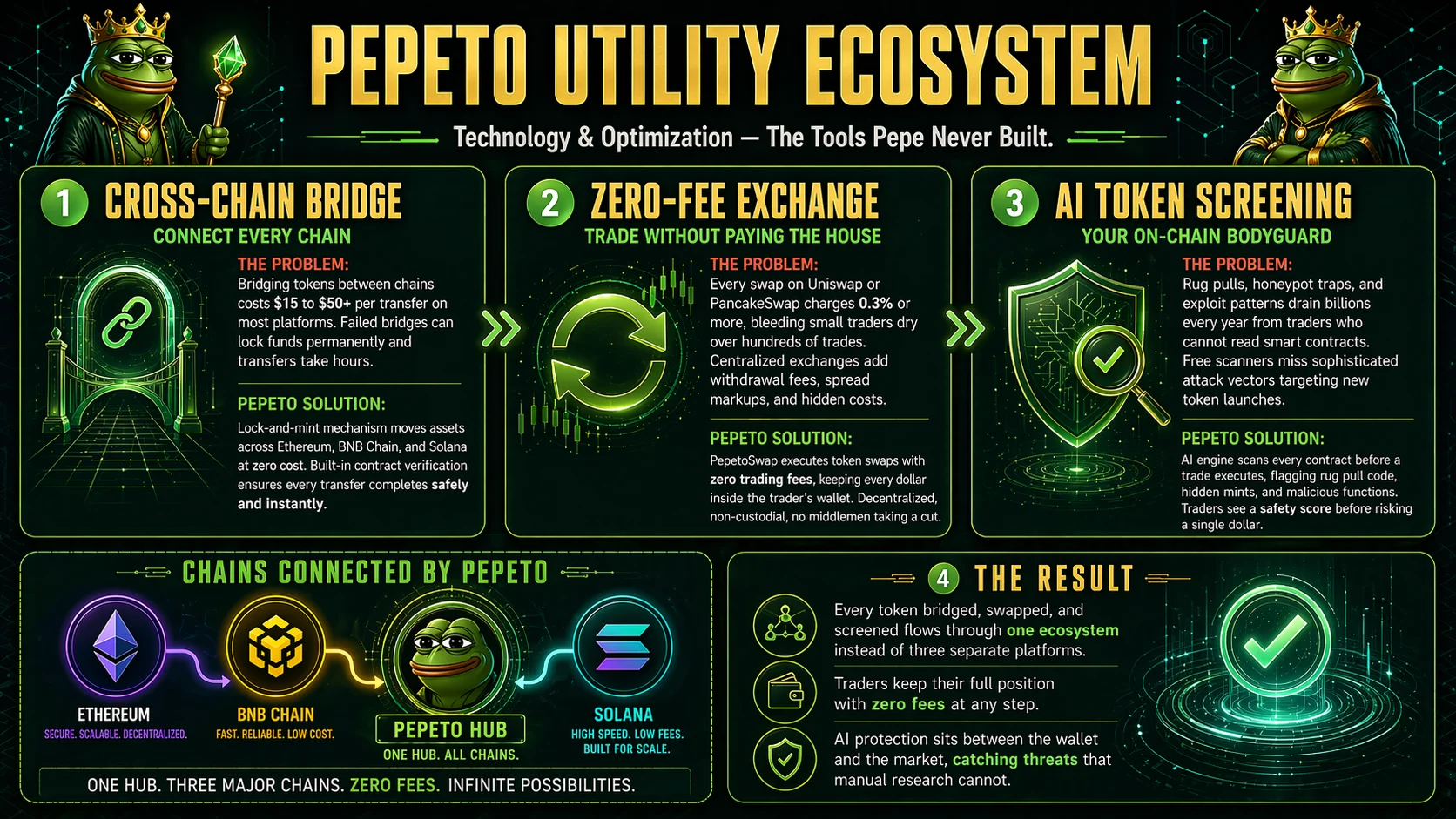
Bitcoin volume rolled through exchanges this week while capital pulled off into cold storage, and wallets moving with intent are searching for the early entry that vanishes once a token goes live on Binance. Pepeto, viewed as the next crypto to explode, hands traders one platform to swap, bridge, and verify without paying fees, and analyst radars point to 100x from presale pricing.
PepetoSwap clears trades at zero cost, the cross chain bridge carries tokens between Ethereum, BNB Chain, and Solana without gas, and the AI contract scanner reads every token before a dollar goes into it. These products are already live, verified by a SolidProof audit.
The Pepe cofounder who grew the original to an $11 billion peak designed every tool to run without fees. More than $9.45 million raised during deep fear shows wallets inside are not guessing, 178% APY staking locks supply tighter every day, and the Binance listing is the event every early buyer is positioning for.
BNB Price at $638 as Osaka/Mendel Hard Fork April 28 Targets 20,000 TPS
BNB trades at $638 per CoinMarketCap, down 0.77% in 24 hours with the Osaka/Mendel hard fork scheduled for April 28 implementing nine BEP proposals pushing the chain toward 20,000 transactions per second. Support holds at $610 and resistance sits at $670, with BNB Chain averaging 4.5 million daily active users in Q1 2026, topping all Layer 1 networks.
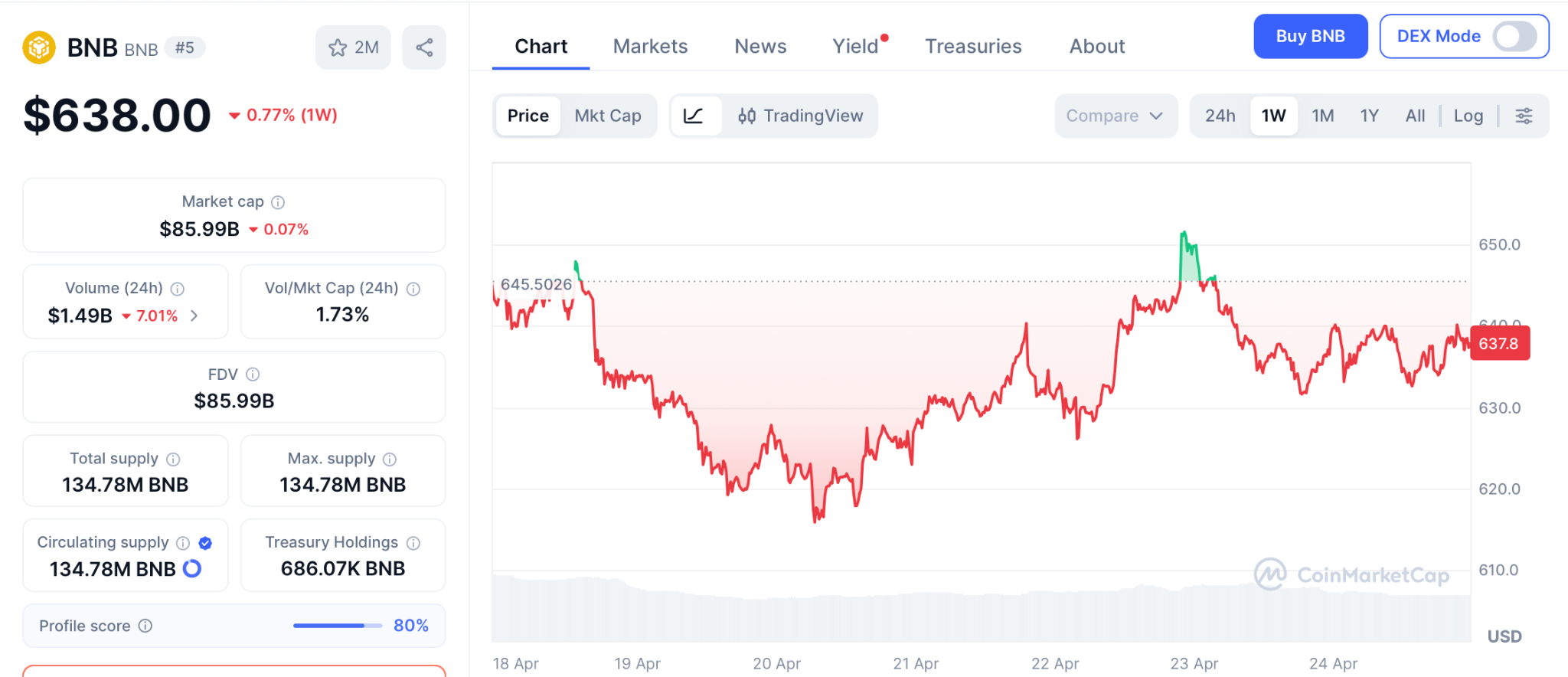
At an $85 billion market cap, a move to $800 delivers roughly 25% over quarters, steady ground but nowhere near what a presale entry produces from one listing event.
Dogecoin (DOGE) Price at $0.0962 as $330M Whale Buys Set Up $0.1172 Breakout
Dogecoin (DOGE) trades at $0.0962 per CoinMarketCap, up 2.30% in 24 hours after whales absorbed over $330 million of DOGE in the past week while $800 million moved through the network on April 16, the biggest volume spike this year per The Market Periodical. The ascending wedge sets $0.1028 as the breakout trigger with $0.1172 as the first target.
DOGE sits 87% below its $0.73 peak, and even a climb to $0.15 delivers 56% at a $15 billion cap. Presale pricing converts the same capital into outcomes many multiples higher, and that spread is why DOGE bulls are eyeing entries outside the memecoin tier.
Conclusion
Nobody who bought Shiba Inu after its Binance listing turned $600 into millions. The wallets that collected the life-changing returns bought SHIB in late 2020 when it was unknown, with no chart, no exchange pair, and no attention. Early, inside a fearful market, in names the crowd was writing off, is the only pattern that has ever paid outsized returns. Top ten coins on a green day have never minted anyone a seven-figure exit.
The same signal is flashing again. A Pepe cofounder is rebuilding the playbook with real exchange tools, the presale sits at $0.0000001866, and the Binance listing is approaching on its own schedule. Every investor who watched SHIB move from the sidelines repeats one line, I saw it and did nothing.
Click To Visit Pepeto Website To Enter The Presale

FAQs
What is the next crypto to explode with 100x potential in April 2026?
Pepeto leads with a live exchange suite, SolidProof audit, and a Pepe cofounder running the build. The presale raised $9.45 million at $0.0000001866, with analysts projecting 100x once the Binance listing opens.
Is Dogecoin (DOGE) a strong buy at $0.0962 after $330M in whale accumulation?
Dogecoin (DOGE) at $0.0962 carries a clear breakout setup at $0.1028 with $0.1172 as the first target after $330 million in weekly whale buying. Pepeto through the Pepeto official website offers presale pricing and a listing gap DOGE at its current cap cannot match.
Disclaimer: This is a Press Release provided by a third party who is responsible for the content. Please conduct your own research before taking any action based on the content.


TLDR:
- Bitcoin is trading near $77,998 as it approaches a low-activity heatmap zone extending to $83,000.
- The STH Cost Basis and True Market Mean Price are both converging around $79,000 to $83,000 resistance.
- Bitcoin has reclaimed the -0.5 MVRV pricing band at $73,700, keeping the bullish trend scenario valid.
- Losing $73,700 support could push Bitcoin toward the Realized Price level near $55,000, analysts warn.
Bitcoin is approaching a critical price zone as multiple on-chain indicators align near the $83,000 level. Traders and analysts are watching closely as the STH Cost Basis, True Market Mean Price, and distribution clusters converge.
The market’s reaction at these levels may determine Bitcoin’s next major directional move. At press time, BTC is trading near $77,998.
Distribution Clusters and Cost Basis Levels Point to $83,000 Resistance
Bitcoin is currently moving through a low-activity price zone on the heatmap. This white zone reflects limited historical exchange activity between current prices and $83,000.
Crypto analyst Darkfost noted that this area extends toward $83,000, where many investors previously reacted.
Both the STH Cost Basis and the True Market Mean Price are hovering near $79,000. These two metrics are trending closely together and continue to act as resistance. Darkfost added that his adjusted STH Cost Basis, accounting for Coinbase-moved BTC, sits closer to $83,000.
The convergence of these three elements creates what analysts call a confluence zone. Such zones tend to attract strong market reactions, either rejection or breakout. Bitcoin’s behavior around $83,000 will therefore be important for traders to watch.
A test of these levels appears likely in the near term, according to Darkfost. How price reacts upon reaching that area could offer clearer signals about Bitcoin’s next trend direction. Market participants are advised to monitor volume and price action carefully at that range.
MVRV Pricing Band Offers Key Support Level Near $73,700
Analyst Ali Charts pointed out that Bitcoin has successfully reclaimed the -0.5 MVRV pricing band. That band currently sits at $73,700 and acts as a pivot point for the current market trend. Holding above this level keeps the bullish scenario intact.
As long as $73,700 holds, the target moves toward the mean MVRV price near $96,000. This return-to-mean scenario is a standard recovery path following periods of market stress. It gives traders a broader upside target if support continues to hold.
However, losing the $73,700 level would shift the outlook considerably. A breakdown below that price would likely invalidate the current bullish bottom scenario. Ali Charts warned that such a move could push Bitcoin back toward the Realized Price near $55,000.
The gap between $73,700 support and $96,000 resistance defines the current trading range for Bitcoin. Price action within this range will shape sentiment over the coming weeks. Both levels are now being closely tracked by on-chain analysts as the market navigates this key zone.
TLDR:
- The Ethereum Foundation deposited 811 wstETH into Lido’s withdrawal contract across 271 batched transactions.
- ETH held steady at $2,319 despite the $48.9M unstaking move, showing no immediate sell pressure on markets.
- The foundation still retains over 100,000 ETH in liquid form, plus additional staked holdings beyond this withdrawal.
- Arkham flagged the transaction on X, questioning whether the foundation plans to sell the unlocked ETH after release.
The Ethereum Foundation has initiated the unstaking of approximately $48.9 million worth of ETH through Lido Finance.
The operation used 271 batched transactions to deposit 811 wstETH tokens into Lido’s withdrawal contract. After a standard processing delay, those tokens will convert to liquid ETH.
This move comes shortly after the foundation pushed to stake up to 70,000 ETH for yield. The foundation still holds over 100,000 ETH unstaked, with more remaining staked. ETH prices held steady at $2,319.
How the Ethereum Foundation Structured the Withdrawal
The Ethereum Foundation carried out the transaction using 271 separate, batched on-chain calls. Each call contributed to depositing a combined total of 811 wstETH tokens into Lido’s unstETH withdrawal contract. Once Lido completes the unlock cycle, those tokens will release as liquid ETH to the foundation’s wallet.
Blockchain intelligence firm Arkham was among the first to report the transfer publicly on X. The platform stated that the Ethereum Foundation had deposited WSTETH into the Lido unstETH contract.
It added that the foundation would receive the ETH only once the unlocking process had been completed. Arkham also posed a question that caught community’s attention: “Are they going to sell this ETH as well?”
Notably, the use of 271 batched transactions reflects a measured and organized withdrawal strategy. Large on-chain actors typically use batching to avoid congestion and keep transactions traceable.
Batching also allows oversight of each step within the broader transaction set. This level of structure points to a deliberate treasury operation rather than a spontaneous action.
Market Response and the Foundation’s Broader ETH Position
Despite the withdrawal, the Ethereum Foundation retains a large ETH position across both liquid and staked holdings.
The foundation holds over 100,000 ETH in unstaked form, and additional ETH remains staked through other positions. The 811 wstETH being withdrawn represents only a fraction of its overall reserves.
This unstaking event also follows the foundation’s recent push to stake up to 70,000 ETH for yield generation. Viewed alongside that strategy, the current withdrawal appears consistent with active treasury management.
Rather than signaling an intent to sell, the move suggests ongoing rotation between staked and liquid positions.
Community reaction, however, was divided. Some observers saw the transaction as straightforward rebalancing within a large portfolio. Others worried that the unlocked ETH could eventually reach the open market as sell pressure.
Nevertheless, ETH held its ground at around $2,319 with no major price movement. The Ethereum Foundation has yet to issue any statement clarifying its plans for the retrieved assets.


Aave Labs, Kelp DAO, LayerZero, EtherFi, and Compound have asked the Arbitrum DAO to release 30,765.67 ETH tied to the Kelp DAO exploit recovery plan.
Summary
- Aave and Kelp want Arbitrum DAO to release 30,765 ETH for rsETH recovery efforts.
- The funds would move to a Gnosis Safe managed by Aave, Kelp and Certora.
- Some Arbitrum delegates warned that the 49-day governance process may delay urgent recovery plans.
The assets were frozen by the Arbitrum Security Council after being linked to the exploiter.
The frozen ETH is worth about $71 million, based on Ethereum trading near $2,317 at the time of writing. The proposal would direct the funds to DeFi United, a cross-protocol recovery effort formed after the $292 million Kelp DAO exploit.
Funds would support rsETH backing
The proposal says the recovered ETH would move to a 2-of-3 Gnosis Safe controlled by Aave, Kelp DAO, and Certora. The wallet would only receive recovered funds and use them to help restore rsETH’s economic backing.
If the recovery plan does not continue as expected, the authors said they would return to Arbitrum governance for further direction. Kelp DAO wrote on X, “Every ETH released moves rsETH holders closer to whole.”
Moreover, the filing also details the exploiter’s position on Aave. It says the attacker supplied 89,567 rsETH as collateral and borrowed 82,650 WETH and 821 wstETH across Aave’s Ethereum Core and Arbitrum V3 markets.
Aave said its smart contracts were not compromised. The proposal presents the incident as an external exploit that affected assets used across DeFi markets, rather than a direct failure in Aave’s lending system.
Governance timeline draws questions
The release request may face timing pressure because Arbitrum’s Constitutional AIP process can take about 49 days. That process includes forum review, possible temperature checks, voting delays, onchain voting, and cross-chain execution steps.
Some delegates have questioned whether that timeline is too long for users with active Aave positions. Delegate Nicksta wrote that “many parties have open positions on AAVE that might run into problem if they have to wait 49 days.”
Arbitrum Security Council member Griff Green also backed a faster community signal. Speaking as a delegate, he said the DAO should move to Snapshot “as soon as possible” to confirm community intent before final execution.
Green also asked for clearer details on how rsETH holders and Aave users would be treated under full or partial recovery plans. The proposal includes an indemnification clause from Aave Labs covering the Arbitrum Foundation, Offchain Labs, and Security Council members.
TLDR:
- Grayscale filed for a spot TAO ETF via NYSE Arca, targeting an SEC decision by August 2026.
- Bittensor rewards AI models with TAO tokens, creating a decentralised marketplace for machine intelligence.
- Bitcoin rose from $25K to $73K after its ETF filing and approval cycle — TAO is now at that same stage.
- Approval is not guaranteed; a denial would sharply reverse the narrative-driven momentum building around TAO.
Grayscale TAO ETF has entered the SEC regulatory process, marking a turning point in how institutions may soon access decentralised artificial intelligence.
Grayscale has submitted a proposed rule change through NYSE Arca to establish the Grayscale Bittensor Trust. The filing follows the same regulatory path used for the firm’s Bitcoin and Ethereum spot ETF conversions.
A decision from the SEC is expected by August 2026, though the timeline remains subject to change.
What the Filing Means for Bittensor
The Bittensor network operates as a decentralised marketplace for machine intelligence. Competing AI models participate in the network and earn TAO tokens by producing outputs the system deems valuable.
This model applies the same decentralisation logic that defined Bitcoin’s appeal in 2013, now directed at AI compute and model training.
TAO functions as the token that governs and powers the entire Bittensor system. The network’s architecture creates a mechanism where the most effective AI models receive token-based rewards.
This structure gives TAO a functional role that goes beyond speculative value. It positions the asset within an infrastructure layer for artificial intelligence.
A spot ETF, if approved, would allow pension funds, family offices, and wealth managers to gain TAO exposure through regulated exchange channels.
No wallets or private key management would be required on their end. For institutional capital sitting on the sidelines of the AI token sector, that access changes the nature of the opportunity.
Bittensor is no longer a niche protocol with a limited audience. The Grayscale filing confirms that institutional-grade financial infrastructure is being built around the network. That shift carries weight regardless of the SEC’s final decision.
The ETF Pattern and What It Has Shown Before
BlackRock filed for a spot Bitcoin ETF in June 2023. At that point, Bitcoin was trading near $25,000. The ETF was approved in January 2024, and Bitcoin crossed $46,000 shortly after.
A new all-time high above $73,000 followed in March 2024. Ethereum’s ETF followed a similar arc after its own filing and approval cycle.
These outcomes were not guaranteed at the time of filing. However, each filing represented a clear signal that institutional capital was preparing to enter the market. The Grayscale TAO filing is now at that same stage.
There are several things to monitor before August. SEC comment period activity can indicate market appetite. Extension notices are common and do not signal denial, but they do affect timelines.
TAO’s price action relative to broader market conditions will reflect how much oxygen the altcoin ETF narrative has through Q2 and Q3. Additionally, other altcoin ETF decisions in the same period will build or weaken regulatory precedent.
The filing does not guarantee approval. A denial or extended review would unwind the narrative-driven price momentum that tends to build ahead of such decisions.
However, the existence of the filing itself confirms that Grayscale sees a viable institutional market for TAO, and that NYSE Arca found the submission sufficient to move forward. Decentralised AI is now part of the regulated financial infrastructure conversation.
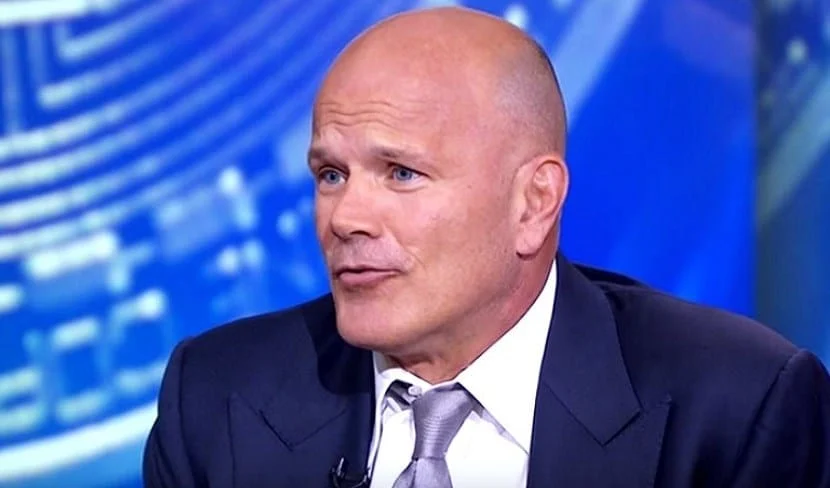
Galaxy Digital CEO Mike Novogratz said the US CLARITY Act could move forward in May, giving the crypto industry a clear path under federal rules.
Summary
- Mike Novogratz said the CLARITY Act may reach committee in early May before June signing.
- The bill seeks clearer crypto rules after delays tied to stablecoin yield and banking concerns.
- Alex Thorn gave the bill 50% odds of passing in 2026 amid schedule uncertainty now.
The bill seeks to define how digital assets should operate in the United States.
Novogratz made the comments during a podcast with SkyBridge Capital founder Anthony Scaramucci. He said the bill may reach committee in early May and could reach President Donald Trump’s desk in June.
“So this is going to get done,” Novogratz said. “It probably gets done in May.”
CLARITY Act remains key for crypto rules
The US CLARITY Act aims to bring clearer rules to crypto firms, exchanges, token issuers, and investors. The bill has gained close attention because many crypto companies want one national framework instead of scattered agency actions.
Novogratz said both Republicans and Democrats have reasons to support the bill. He argued that clearer crypto regulation could help the United States keep financial innovation inside the country.
“It’s wildly important for it to get done for both Democrats and Republicans,” he said.
Novogratz also said the CLARITY Act could help more people access US financial products through crypto wallets. He said many people around the world still cannot take part in the American economy through normal financial channels.
He argued that tokenization could allow shares or assets linked to major companies to reach more global users. He named firms such as SpaceX and Google as examples of companies that could be tokenized and sold to users outside the United States.
“There are eight and a half billion people, probably five and a half billion don’t have access to our financial products,” Novogratz said.
Industry doubts remain over timeline
The bill’s progress has not matched earlier market expectations. Many crypto participants expected faster action after the CLARITY Act passed the House in July 2025 with bipartisan support.
However, disputes between banks and crypto firms have slowed the process. One area of concern is stablecoin yield, with banks warning that yield-bearing stablecoins could place pressure on deposits.
Senator Cynthia Lummis warned on April 10 that lawmakers may have limited time to pass the bill. “This is our last chance to pass the Clarity Act until at least 2030,” she said in a post on X.
Galaxy Digital’s head of firmwide research, Alex Thorn, has also shown caution. He said he gives the CLARITY Act a 50% chance of passing in 2026, adding that delays beyond mid-May could weaken the bill’s chances.
TLDR:
- Justin Bons says Canton’s invitation-only validator process makes it a fully permissioned, centralized system.
- Canton’s tiered fee structure charges smaller users more, drawing direct comparisons to traditional banking models.
- The network’s claimed $326 billion TVL is disputed, with DeFiLlama reportedly listing its actual TVL at zero.
- Bons argues Canton’s 21.8% inflation rate and free validator rewards resemble a money-printing scheme, not crypto.
A crypto researcher is arguing that Canton, a blockchain network backed by major financial institutions, operates more like a traditional bank than a decentralized network.
Justin Bons, founder of Cyber Capital, made the claim in a detailed public post targeting the project’s governance and economic model.
He accused the network of misleading investors with fabricated metrics and false claims of decentralization. His statements have drawn significant attention across the crypto community.
Canton’s Structure Mirrors Old Financial Systems, Researcher Claims
Bons pointed to the network’s invitation-only validator process as direct evidence of centralization. A pre-existing validator set decides who may participate in consensus, much like a board approving new members.
He wrote that “there is a literal invitation-only application process, where the pre-existing validator set decides who is allowed to join.” That structure, he argued, is the opposite of what blockchain technology stands for.
The network also applies a tiered fee system that charges smaller users more than larger ones. Bons drew a direct comparison to traditional banking, which has long applied preferential treatment to wealthy clients.
A central authority additionally determines which applications receive featured status and increased rewards. Critics say that the model concentrates power in ways that mirror those of institutional finance.
The project also burns tokens taken directly from holders’ wallets through a built-in mechanism. Bons described this as a tax system imposed by a centralized authority.
He argued that such a mechanism has no place in a genuinely decentralized network. Traditional banks, he noted, operate through similar top-down financial controls.
Canton carries a reported net inflation rate of 21.8%, with validators receiving token rewards without staking anything.
Bons compared this arrangement to a money-printing scheme. He argued that partnerships may be motivated by free token distributions rather than real utility. That dynamic, he said, serves validators and selected applications far more than everyday users.
Fake TVL Claims and the Case Against Institutional Crypto
Bons also challenged Canton’s reported real-world asset TVL of over $326 billion. He called the figure an accounting trick made possible through corporate partnerships.
Companies such as Broadridge reportedly mirror their existing balance sheets inside private networks on the platform. That data is then recorded as on-chain TVL without any actual on-chain activity.
More reputable tracking platforms, including DeFiLlama, reportedly list Canton’s actual TVL at zero. Bons argued that the network would not affect those balance sheets if it shut down tomorrow.
That, he said, confirms the metric is entirely manufactured. The gap between the claimed figure and the reported figure is substantial.
Bons also referenced the early internet to frame the broader debate. Large institutions once resisted the open public internet and pushed for private alternatives instead.
The public internet ultimately prevailed over those closed systems. He suggested that truly decentralized blockchains will follow that same historical outcome.
The researcher concluded that Canton represents a regression rather than progress in the crypto space. He argued that the network invokes crypto’s values while contradicting them entirely.
The banking system, Canton resembles, he said, is precisely what crypto was built to challenge. That tension, for many in the industry, remains the central issue.
Donald Trump ‘Honored’ to be a Target After WHCD Shooting

Study identifies the major downside of wearing a fitness tracker

Nasdaq: My Multiple Target Has Been Reached, So I Am Upgrading To A Buy

Manchester United reach agreement with Casemiro over contract clause amid transfer speculation

US brings back mandatory military draft registration

Steven Gerrard disagrees with Gary Neville over ‘shock’ Chelsea and Arsenal claim | Football


-

 Business7 days ago
Powerball Result April 18, 2026: No Jackpot Winner in Powerball Draw: $75 Million Rolls Over
-

 Fashion2 days ago
Weekend Open Thread – Corporette.com
-
Entertainment7 days ago
NBA Analyst Charles Barkley Chimes in on Ice Spice McDonald’s Fiasco
-
Crypto World16 hours ago
Hyperliquid $HYPE Rally Builds Momentum as AI Sector Enters Prove-It Phase
-

 Politics6 days ago
Gary Stevenson delivers timely reminder to register to vote as deadline TODAY
-
Crypto World6 days ago
Bank of Hawai’i (BOH) Q1 2026: Net Income Drops to $57.4M as Net Interest Margin Expands
-

 Politics4 days ago
Making troops accountable for war crimes threatens US alliance, ex-SAS colonel warns
-

 Politics4 days ago
Disabled people challenge government SEND proposals over segregation concerns
-

 Business4 days ago
Rolls-Royce Voted UK’s Most Iconic Trade Mark as IPO Register Hits 150
-

 Politics4 days ago
Zack Polanski responds to home secretary’s taser threat
-

 Politics4 days ago
Starmer handler McSweeney to be dragged from shadows by Foreign Affairs Committee
-
Politics4 days ago
Wings Over Scotland | How To Get Away With Crimes
-
 Crypto World5 days ago
Five Value Stocks with Recovery Potential in 2026: PayPal (PYPL), Nike (NKE), and More
-

 Crypto World5 days ago
New York sues Coinbase, Gemini over prediction market offerings
-

 Politics4 days ago
‘Iran is still a nuclear threat’
-
 Sports3 days ago
Tim Bradley names the current best in the world: “Better than Inoue and Usyk”
-

 Crypto World4 days ago
Crypto’s great hope in Senate’s Clarity Act still has a path to survive tight calendar
-
 Business4 days ago
HCL Tech share price tank over 9% after weak Q4. JPMorgan, HSBC & 3 others cut target price
-

 Business4 days ago
The Job Benefits Most Men Don’t Know to Negotiate
-

 Politics7 days ago
Reform investigating candidate who ‘hates’ the NHS
You must be logged in to post a comment Login