

Crypto World
Kalshi Eyes Crypto Expansion as Perpetual Futures Launch Plans


Kalshi, the U.S.-based prediction-market operator regulated by the Commodity Futures Trading Commission (CFTC), is reportedly plotting a bold pivot into crypto trading by introducing perpetual futures for digital assets, starting with Bitcoin.
In a Tuesday report, The Information cited people familiar with the matter as saying Kalshi intends to roll out perpetual futures, or “perps,” on cryptocurrencies such as Bitcoin, broadening its product slate beyond binary event contracts.
Perpetual futures are a type of derivative that lets traders speculate on price moves without an expiration date. Unlike traditional futures that require rolling over positions, perps offer continuous exposure and are commonly paired with leverage — a structure that gained prominence in crypto markets through platforms such as BitMEX.
Kalshi’s contemplated expansion signals a shift toward continuous financial markets and could widen appeal for both retail and institutional traders seeking regulated onshore access to crypto derivatives.
Kalshi operates under U.S. regulation by the CFTC, a distinction that could position it as a compliant alternative to offshore crypto-derivatives venues. Regulators have signaled openness to bringing more trading volume onshore; CFTC Chair Michael Selig has indicated these products could become available in the United States in the near future.
Related: Onchain real-world perps surge, while altcoins drag on: Report
Key takeaways
- Kalshi reportedly plans to launch perpetual futures on cryptocurrencies, starting with Bitcoin, signaling a move from binary event contracts to continuous markets.
- The Information cites unnamed sources; the product would mark Kalshi’s first major expansion into crypto trading while leveraging its CFTC-regulated status.
- U.S. regulators have signaled a potential onshore path for crypto derivatives, with CFTC Chair Michael Selig suggesting these products could become available in the near term.
- The rise of perpetual futures is intensifying competition among platforms seeking non-U.S. access; major players are expanding into non-U.S. markets with stock- and crypto-linked perps.
- Industry data from DeFiLlama shows daily perp volumes near $20 billion on busy days, underscoring sustained demand despite broader crypto volatility.
Regulatory on-ramp and market dynamics
Kalshi’s possible crypto-perps launch would deepen ties between regulated U.S. markets and the fast-moving crypto derivatives space. By staying within the boundaries of the CFTC framework, Kalshi could offer an onshore alternative to offshore venues that have dominated crypto leverage and liquidity. The statements from CFTC Chair Michael Selig add to a regulatory narrative that seeks to bring more trading activity onto U.S. soil, a development investors and traders are watching closely for its potential to shift liquidity and risk management practices.
As perimeters of onshore crypto derivatives remain under discussion, Kalshi’s move could provide a test case for how a regulated, event-grounded platform might translate to continuous-price contracts. If realized, the product would complement Kalshi’s existing suite and potentially broaden its appeal beyond consumers who seek event-based bets to those looking for ongoing exposure to crypto prices.
Perps race expands beyond crypto to broader markets
The reported Kalshi pivot arrives amid a broader wave of attempts to offer perpetual-style instruments to non-U.S. audiences. Coinbase has begun offering round-the-clock perpetual-style futures tied to equities for non-U.S. traders, expanding beyond its traditional crypto-derivatives offerings and highlighting demand for around-the-clock exposure to traditional assets outside the United States.
Kraken has also pushed into tokenized stock perpetual futures for users outside the United States, giving traders exposure to major U.S. stock indices, precious metals, and individual equities via perpetual contracts. This reflects a growing appetite among crypto and traditional trading venues to cater to global audiences with perpetual formats that do not require contract renewal.
Market data corroborates ongoing interest in perpetual products. DeFiLlama’s latest figures show that daily perpetual futures volumes sit around $20 billion on peak days, roughly half of historical highs, but still point to meaningful liquidity and participation in perpetual markets across asset classes.
Taken together, the developments paint a picture of regulators nudging onshore participation higher while a competitive landscape accelerates the adoption of perpetual derivatives across crypto and traditional assets. Kalshi’s potential crypto-perps launch would be a notable milestone in that evolving dynamics, testing how a U.S.-regulated platform can compete in a market historically dominated by offshore operators.
Investors and users should watch closely for any formal confirmation from Kalshi and for regulatory updates that could clarify the timeline and design of onshore crypto perpetuals. The outcome could influence liquidity, product design, and the broader cadence of regulated crypto derivatives in the United States.

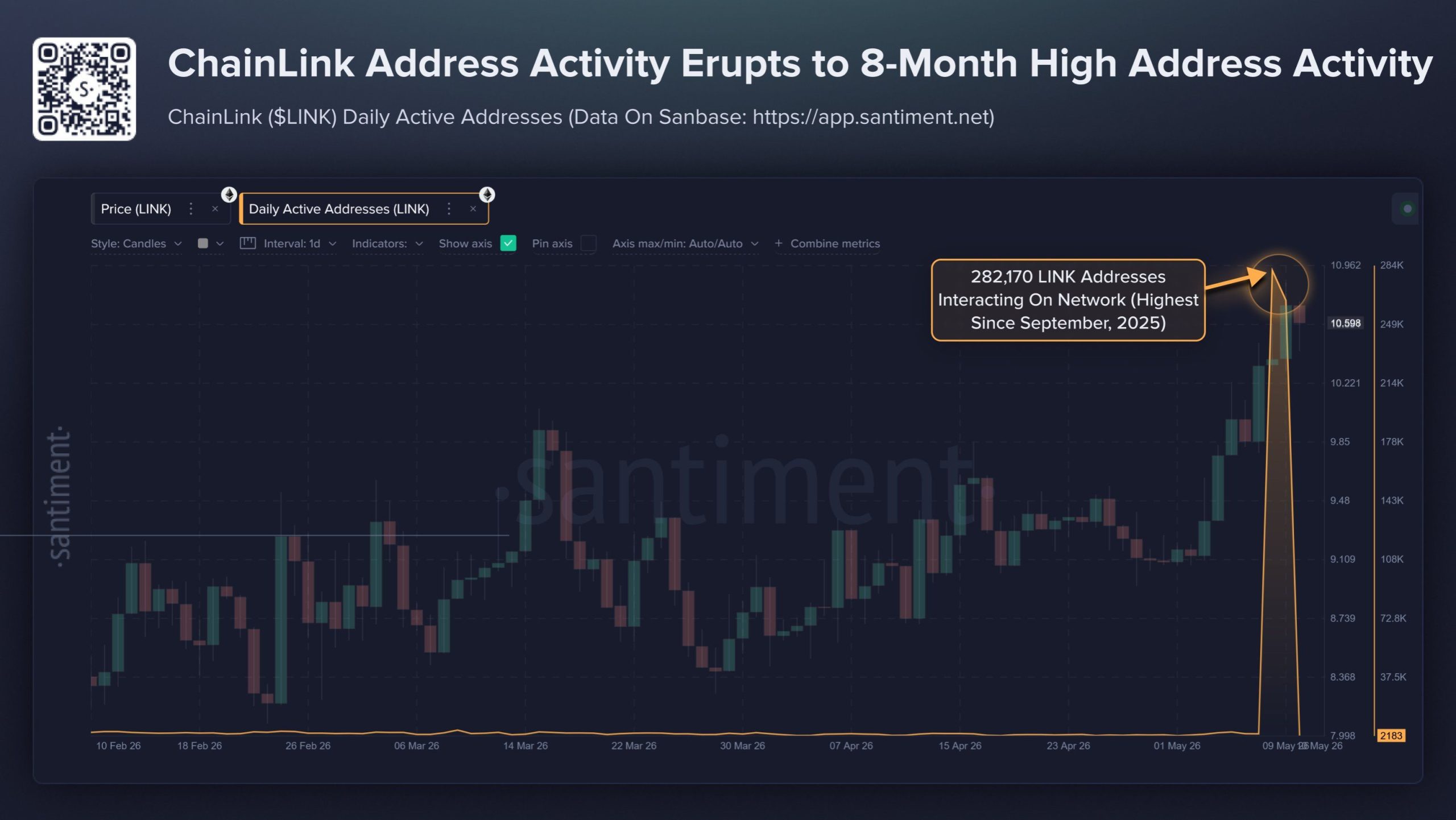
Chainlink (LINK) network activity has jumped to levels last seen eight months ago.
The surge coincided with the migration of decentralized finance (DeFi) protocols from LayerZero to Chainlink’s Cross-Chain Interoperability Protocol (CCIP).
Why is Chainlink Address Activity Surging?
On-chain analytics firm Santiment recorded 282,170 active addresses on May 9. This was followed by 264,090 active LINK addresses the next day. This spike marks the strongest sustained network activity since September 2025.

The activity spike traces back to a $292 million exploit on April 18, 2026. Attackers drained roughly 116,500 rsETH from infrastructure tied to Kelp DAO’s LayerZero-powered bridge.
The incident triggered industry security reviews of cross-chain configurations. Kelp DAO subsequently announced plans to migrate to Chainlink CCIP.
Follow us on X to get the latest news as it happens
In addition, on May 7, Solv Protocol confirmed it would migrate more than $700 million in tokenized Bitcoin to CCIP.
“These moves represented a major shift of institutional-scale DeFi infrastructure away from LayerZero and toward Chainlink’s cross-chain ecosystem, likely contributing to a sharp rise in network activity and smart contract interactions surrounding the protocol,” Santiment wrote.
The firm noted that the surge points to genuine protocol usage rather than purely speculative trading activity.
“Historically, spikes in real network usage have preceded consistent price rises, rather than short-lived pumps,” it said.
The increase in network activity has also coincided with strong whale accumulation. As previously reported by BeInCrypto, wallets holding between 100,000 and 10 million LINK accumulated 32.93 million tokens over the past 30 days.
Additionally, around 13.5 million LINK was withdrawn from centralized exchanges within five weeks, signaling growing investor demand and reduced sell-side pressure.
Subscribe to our YouTube channel to watch leaders and journalists provide expert insights
The post Chainlink Network Activity Surges to 8-Month High as CCIP Wins DeFi Migration appeared first on BeInCrypto.


MARA Holdings shares fell after the Bitcoin miner reported weaker first-quarter results and a wider loss.
Summary
- MARA posted $174.6 million in Q1 revenue, missing estimates as Bitcoin mining margins stayed pressured.
- The $1.3 billion loss came mainly from Bitcoin mark-to-market pressure in Q1 ending March 2026.
- MARA keeps Bitcoin mining as its base while AI data centers shape the next pivot.
Revenue for the quarter ended March 31 dropped 18% year over year to $174.6 million, down from $213.9 million in Q1 2025. Wall Street had expected about $192.7 million.
The stock had closed Monday up 3.48% at $13.39, before falling 3.44% after hours to $12.93. The move erased the day’s gain and put focus back on MARA’s cost base, Bitcoin exposure, and effort to build AI-linked data center revenue.
Bitcoin losses weigh on results
MARA reported a net loss of $1.3 billion, or $3.31 per diluted share, compared with a $533.4 million loss, or $1.55 per share, a year earlier. The company said the quarter included a $1.0 billion loss tied to the fair value of digital assets.
Bitcoin fell 22% from Dec. 31, 2025, to March 31, 2026, which hurt the value of MARA’s holdings. Production also slipped slightly from a year earlier. The company mined 2,247 BTC in Q1 2026, compared with 2,286 BTC in Q1 2025.
Energy costs also stayed high. MARA said purchased energy costs reached $44.7 million, up from $43.5 million a year earlier. Its cost per Bitcoin at owned and operated sites rose to $40,047, mainly due to higher network difficulty and weather events.
MARA keeps mining as its base
MARA said Bitcoin mining remains central to its business, even as it builds a wider digital infrastructure platform. The company said, “Bitcoin mining is not a legacy business we are moving away from. It is the operational foundation on which we are building.”
The miner acquired 2.4 EH of used next-generation ASIC machines during the quarter to improve fleet efficiency. However, MARA said it does not expect to pursue large-scale ASIC purchases, calling its future approach selective and tied to clear returns.
MARA also cut its workforce by 15% during the quarter. The company said the move should bring about $12 million in annualized savings as it reshapes its team for AI and digital infrastructure work.
AI pivot faces a proof test
MARA is pushing further into AI and high-performance computing through power assets and site conversions. Its Starwood partnership is moving from announcement to active development, with about 90% of non-hosted capacity being reviewed for digital infrastructure conversion.
The company is also buying Long Ridge Energy & Power, a site it says could support 600 gross megawatts of AI and critical IT load over time. The asset includes powered land, generation, and grid links around its existing Hannibal mining operation.
Separate coverage shows other miners, including Core Scientific, are also shifting mining power toward AI data centers as the sector seeks steadier revenue streams. For MARA, the near-term focus is now tenant demand, contracted power, and proof that its AI buildout can reduce reliance on Bitcoin cycles.
XRP keeps pushing into the same resistance area that has rejected rallies since February, but the way it’s trading is starting to change. Price is no longer getting sold off immediately after touching the range. Instead, XRP is holding near the highs, which usually matters more than the initial breakout itself.
News Background
• Ripple Prime secured a $200 million funding facility from Neuberger Berman to expand margin financing across traditional and digital asset trading markets.
• Ripple said demand for its prime brokerage business has accelerated since the Hidden Road acquisition, with revenue tripling year over year.
• The broader XRP narrative also continues shifting toward institutional infrastructure after Ripple, JPMorgan, Mastercard and Ondo recently completed a tokenized Treasury settlement on XRPL.
Price Action Summary
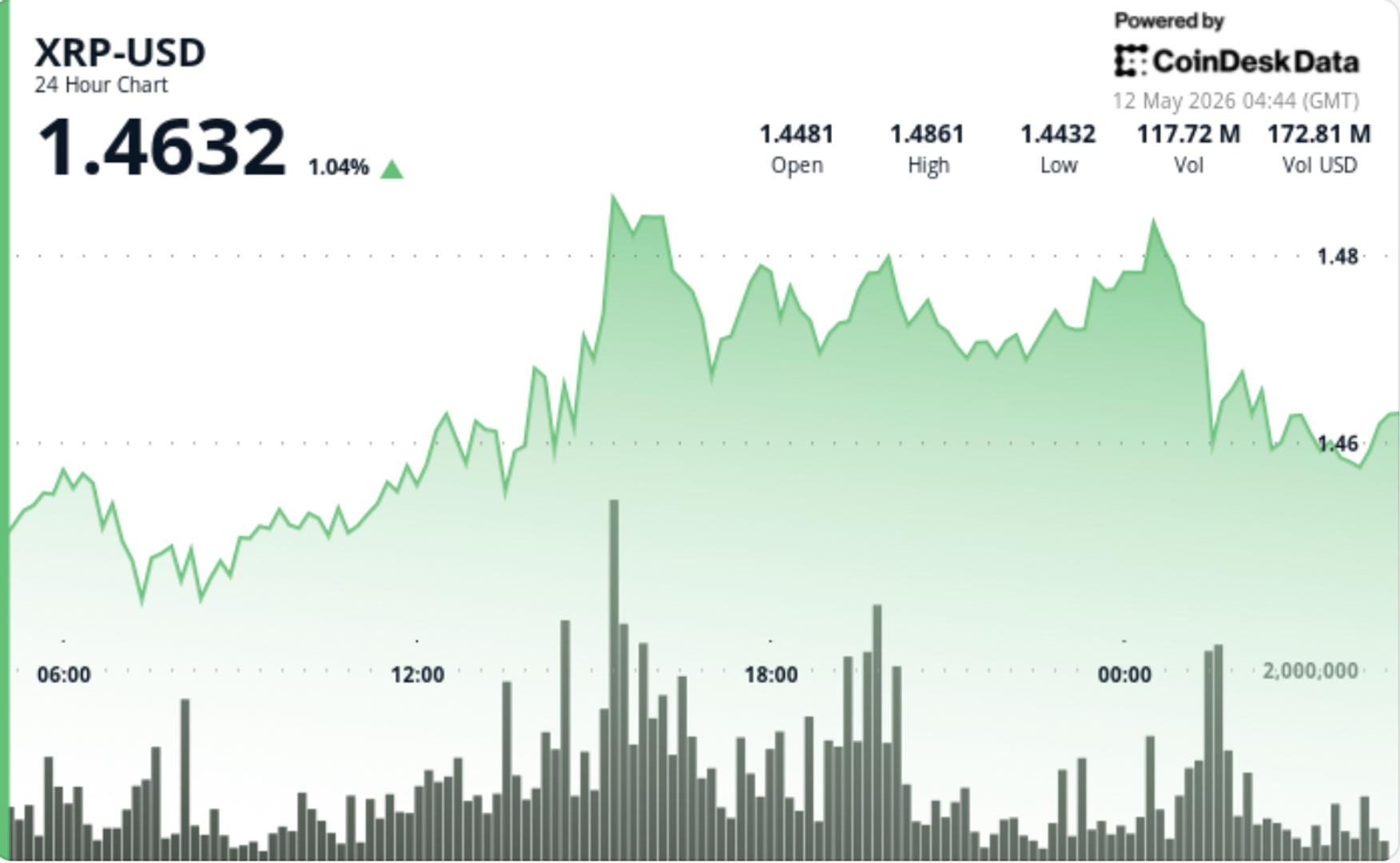
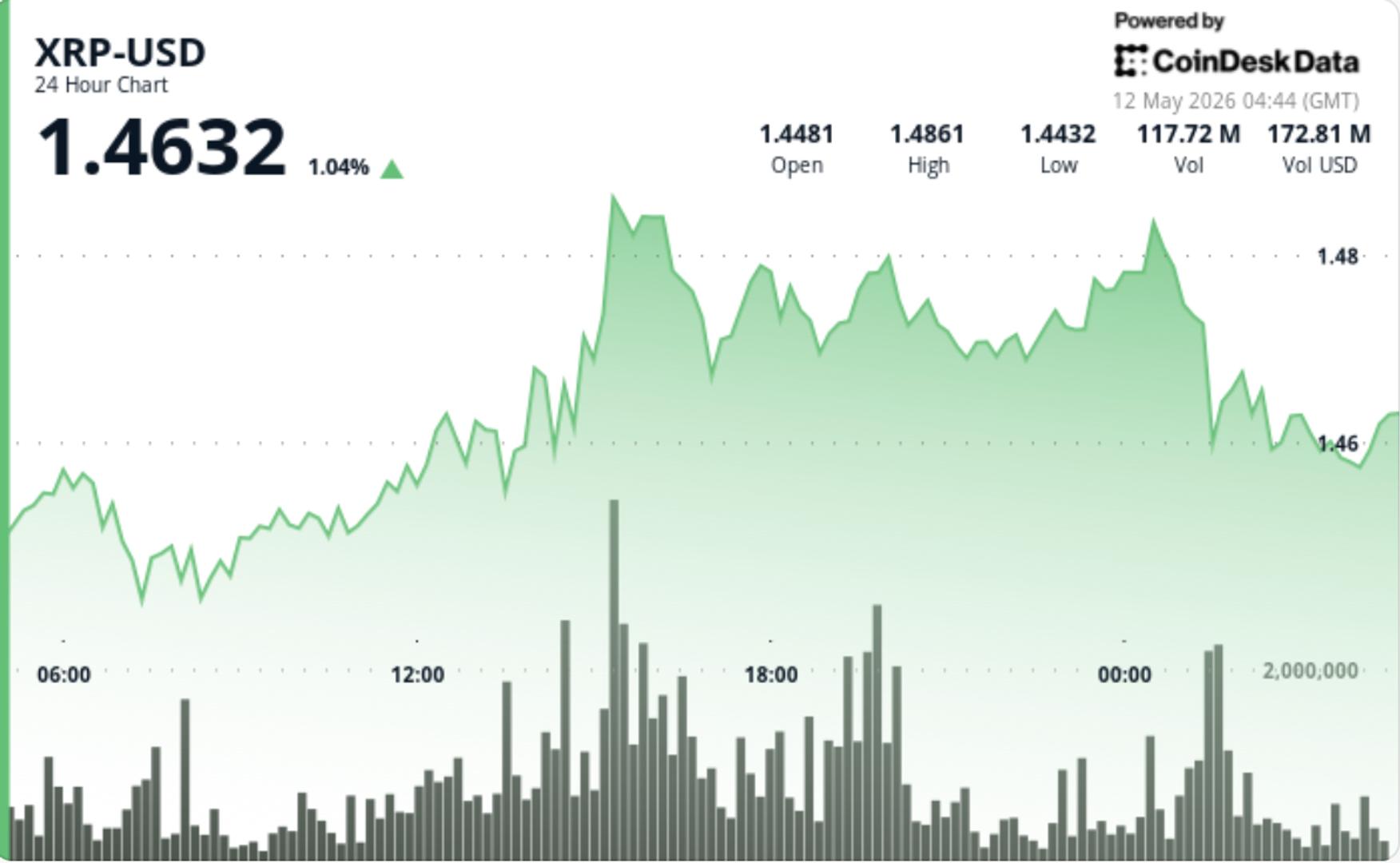
• XRP climbed from $1.4483 to $1.4565 during the 24-hour session, briefly reaching an intraday high of $1.4877.
• Volume surged during the May 11 15:00 UTC session, when more than 105M XRP traded as price broke above $1.4750.
• The rally later cooled into consolidation near $1.45-$1.46 rather than fully retracing, keeping short-term structure constructive.
Technical Analysis
• XRP is still trading inside a larger multi-month compression structure, but repeated tests near resistance tend to weaken seller control over time.
• The market reclaimed several shorter-term moving averages during the recent move higher, improving momentum conditions beneath the surface.
• Price continues to stall near the same $1.47-$1.50 region that has repeatedly capped upside attempts, making this the most important zone on the chart right now.
• Volume profiles show relatively thin liquidity above current levels, which could accelerate moves quickly if XRP secures a clean break higher.
What traders should watch
• $1.47-$1.50 remains the key resistance area. A sustained move above it shifts focus toward $1.60.
• $1.43-$1.45 is now the near-term support zone bulls need to defend to keep the breakout structure intact.
• XRP is still compressing inside a broader triangle pattern, which raises the odds of a larger directional move once the range finally resolves.
Crypto World
Pi Network Price Crash to $0 or Jump to $1: 3 AIs Speculate What Is More Likely for PI This Year

Pi Network’s PI has seen a few sporadic bursts of momentum in recent months, but its price has remained in a steep downtrend since February last year.
The token’s performance is among the most-talked-about topics in the crypto space, and we asked three of the most popular AI-powered chatbots to weigh in on what seems more likely for the rest of 2026: a collapse to $0 or a major revival to $1.
Unanimous Decision
According to ChatGPT, a crash to $0 is less plausible because assets typically plummet so much only when they lose all liquidity, community interest, and exchange access simultaneously.
“As long as millions of people still hold the token, speculate on it, mine it, discuss it online, and hope for future adoption, there is usually some market demand preventing a total wipeout,” it stated.
The chatbot claimed that a rise to $1 is more realistic but is far from guaranteed and would depend on several strong catalysts, including a Binance listing rumor becoming reality, significant ecosystem progress, a broader altcoin bull run, and renewed retail FOMO.
At the same time, ChatGPT is rather skeptical that all of these elements could align and trigger such a massive pump this year. It argued that the most realistic upper target for PI in 2026 is around $0.80.
Perplexity also estimated that a meltdown to $0 is out of the equation, noting that even the bearish analysts on X don’t foresee such a catastrophe. An ascent to $1 is possible but would require stronger exchange liquidity, real app usage, and a sustained crypto bull market, it added.
The chatbot stated that the most likely path for PI this year is to trade in the $0.12-$0.25 range, unless Protocol 23 and subsequent ecosystem upgrades drive real usage growth.
Lastly, we consulted Google’s Gemini, which largely supported the aforementioned predictions. It dismissed the possibility of a collapse to zero, given that there are millions of Pioneers, and outlined the project’s progress over the years.
“A crash to $0 is mathematically and socially unlikely for Pi Network in 2026. While many “hype” projects vanish PI has transitioned from a simple mobile app into a functional Layer-1 blockchain with several structural “safety nets” that prevent its value from hitting zero.”
Moreover, the chatbot noted that well-known exchanges like Kraken, Bitget, and MEXC have embraced the asset, providing a baseline level of liquidity and strengthening PI’s reputation.
Similar to ChatGPT, Gemini estimated that PI’s “golden ticket” for $1 and beyond is an official listing on Binance. The world’s biggest crypto exchange has been rumored to allow trading services with the asset for almost a year and even asked its users whether it should do so. The majority of the voters supported that step, yet Binance remains silent on the matter.
The Analysts’ Take
PI currently trades at around $0.17, and some analysts say this might be a good buying opportunity. Last month, X user JAVON MARKS envisioned a 1,400% price explosion to $2.80, while several months ago, they called for a triple-digit surge to $1.23.
According to A2Z BOSS, PI has been seeking balance below $0.40 and consolidating beneath $0.20. “Let the value continue to develop and consolidate below $0.20 for the next few weeks,” they added.
Of course, some believe PI could skyrocket to $10 or even $20 in the coming months, but such predictions seem unrealistic (to put it mildly) given the current price levels.
The post Pi Network Price Crash to $0 or Jump to $1: 3 AIs Speculate What Is More Likely for PI This Year appeared first on CryptoPotato.


Crypto majors held their ground on Tuesday even as the macro tape turned sharply against risk assets.
Bitcoin traded just over $81,000 in Asian morning hours Tuesday after briefly touching $82,026 overnight. Solana (SOL) and were the standouts among the majors, up as much as 2% on the day. BNB added 1.7% to $662, XRP held at $1.46, up 0.9% on the day while ether down 0.8%.
Investor Michael Burry, made famous in The Big Short for calling the 2008 housing collapse, warned in a Substack post that the Nasdaq 100 is trading at 43 times earnings, well above the implied level of around 30 times, and likened the current setup to “the scene of the bloody car crash, minutes before it happens.”
Burry flagged the Philadelphia Semiconductor Index’s 70% rally since the end of March as the centerpiece of what he called a parabolic surge in tech valuations, advising readers to take profits and reduce exposure to the AI trade.
“Wall Street may be overstating by more than 50% the earnings at our fastest growing, most highly valued companies,” Burry wrote.
Brent crude zoomed almost 1% to above $105 a barrel after President Donald Trump cast doubt on the ceasefire with Iran in remarks Monday, fueling concern that the closure of the Strait of Hormuz will be prolonged. The Treasury 10-year yield rose to 4.42% and the dollar strengthened against all its Group-of-10 peers on haven demand.
Equity markets across Asia pulled back from records. The Kospi slid as much as 5.1% intraday after a top South Korean policymaker proposed paying citizens a dividend funded by taxes on AI profits, with the comments fueling sharp swings as investors tried to parse the scope of the proposal.
MSCI’s Asia Pacific index swung between gains and losses. European futures pointed to a 0.6% loss at the open. U.S. futures edged lower after the S&P 500 closed at a record high Monday, capping a six-week winning streak that gained more than 16%, the strongest such run since the global financial crisis.
Bitcoin’s price-action will likely be tested later Tuesday as investors watch the U.S. inflation print, which will show how much of the war-driven price pressures has fed through to consumer prices and could shape the outlook for Federal Reserve interest rate decisions.
A hot number on top of fresh Iran tensions and Burry’s bear call would put real pressure on the AI-trade thesis underpinning the equity rally, while a soft print buys risk assets, including crypto, another week of room.

As lawmakers on the US Senate Banking Committee prepare to markup a major crypto market-structure bill this week, the fate of the Digital Asset Market Clarity Act (CLARITY) centers on whether an ethics provision can win broad bipartisan support. Democrats, who have historically used ethics language as a gatekeeper for passage, appear prepared to hold firm on this point even as negotiators on stablecoin yield and other crypto issues push for a clearer path forward.
The CLARITY Act, which cleared the House of Representatives in July 2025, has faced months of procedural delays as lawmakers sought to iron out language on stablecoins, tokenized equities, and governance standards. In parallel, the Senate Agriculture Committee already advanced its own version of the bill in January, underscoring the challenge of reconciling securities and commodities considerations across committees before any floor vote. If both panels can forge a unified bill, it would then move toward consideration by the full Senate and, potentially, the White House.
Key takeaways
- The Senate Banking Committee is slated to markup CLARITY this week, but any progress hinges on resolving an ethics provisions compromise that Democrats say is non-negotiable.
- Democrats, led by Senator Kirsten Gillibrand, insist that ethics language addressing conflicts of interest must be part of any final bill; Republicans signal willingness to negotiate but demand a bipartisan framework for ethics rules.
- A recent compromise on stablecoin yield between Sen. Thom Tillis and Sen. Angela Alsobrooks could unlock movement, but Democrats have signaled they won’t back the bill without ethics reforms in place.
- Even with committee approval, the bill would still require reconciliation between the House and Senate versions before it could reach the president’s desk, delaying potential enactment.
- Context around the debate includes notable political dynamics in which crypto policy intersects with wider governance concerns and industry lobbying, including signals from industry groups and notable politicians.
Ethics as the hinge of CLARITY
Senator Gillibrand characterized ethics language as the central hurdle for CLARITY’s advancement. In comments to Cointelegraph, she emphasized that a robust ethics framework is essential so officials cannot leverage insider information for personal gain. Her stance aligns with a broader Democratic position that any final bill must include guardrails to prevent conflicts of interest among members of Congress and top executive offices.
“Americans deserve a well-regulated market with strong consumer protections and real ethics reforms so politicians can’t cash in on their insider status for personal gain.”
Support for keeping ethics provisions intact is mirrored by other lawmakers who sit on the banking committee. Senator Tim Scott, who chairs the panel from the Republican side, has flagged concerns about tying crypto policy to unrelated political matters. He has argued that any ethics elements should be addressed through a bipartisan process and outside the jurisdiction of the banking committee itself. Meanwhile, Senator Cynthia Lummis, a leading Republican voice on crypto, has urged swift action on CLARITY, signaling she would back the measure if the ethics issue is resolved to broad satisfaction.
The tension around ethics reflects a wider strategic calculus: even if the Banking Committee marks up CLARITY favorably, the bill’s fate hinges on how ethics concerns are adjudicated on the Senate floor and in reconciliation with the House version. A source familiar with the discussions noted that ethics language “has to be tackled on the floor,” suggesting it could be the decisive factor delaying or enabling a final vote.
Stablecoin yield and the broader negotiation
Earlier in the month, Senators Tillis and Alsobrooks announced a compromise on stablecoin yield terms that some analysts viewed as a potential unlock for the legislation. This development signaled a willingness to move forward on a key technical plank of CLARITY without necessarily sacrificing safeguards for investors and the public. However, Democratic leadership has made clear that any forward motion cannot come at the expense of ethics provisions, framing the negotiation as a two-track process: one focused on financial-technology governance and another on inside-ethical constraints.
Industry observers welcomed the shift but cautioned that a compromise on yield alone would not guarantee passage. Cody Carbone, chief executive of the Digital Chamber—an industry advocacy group—told Cointelegraph that while momentum on the technical elements is encouraging, “ethics has to be tackled on the floor, it’s not within the jurisdiction of the Senate Banking Committee, so I don’t expect it to hold up the markup.”
A two-chamber path and the broader political backdrop
Even if the Banking Committee moves CLARITY forward, the legislation would still need to be reconciled with the House version. The House passed its version in 2025, and the two chambers would have to agree on differences before it could proceed to the president for signature. The process creates a window of uncertainty, with timing contingent on cross-chamber negotiations and the political calendar.
The policy debate has unfolded amid a broader political landscape where the crypto industry intersects with campaign finance and potential conflicts-of-interest concerns. Reports have highlighted the president’s ties to crypto ventures, a factor that some lawmakers say influences public scrutiny. Forbes reported that the president’s personal fortune increased substantially in 2025 due, in part, to crypto ventures, underscoring the perceived political sensitivities around crypto regulation in the current administration.
Industry insiders and political observers alike have noted that the path forward will likely hinge on bipartisan agreement on ethics, as well as whether the stability-and-yield provisions can be framed to satisfy regulators and investors without inviting new ambiguities. Galaxy Digital has identified a slate of Democrats it views as pivotal to advancing the bill, reflecting the effort to assemble a broad coalition across party lines.
As negotiations continue, key senators have signaled openness to a deal while keeping their red lines intact. Senator Gillibrand has been explicit about the need for ethics safeguards, and Senator Lummis has kept pressure on colleagues to vote in favor once those safeguards are in place. The interplay between these positions illustrates how policy design—particularly around ethics—can shape the pace and outcome of crypto-market regulation in the United States.
The political dynamic is further complicated by ongoing market sentiment around CLARITY. Prediction markets have reflected a spectrum of expectations, with some participants pricing in a path to passage this Congress and others remaining skeptical about the feasibility of a timely compromise that satisfies both chambers and the White House.
Industry voices emphasize that regulatory clarity remains a priority for market participants seeking predictable rules and basic protections. The CLARITY bill’s proponents argue that a well-structured framework could reduce regulatory ambiguity and support responsible innovation, while opponents warn of overreach or unintended consequences that could hamper growth in the sector. The balancing act continues as lawmakers weigh the potential benefits of clear rules against the need for robust oversight and ethics safeguards.
What to watch next
The next milestones are clear but contingent: the Banking Committee markup, the emergence of a durable ethics framework, and progress toward House-Senate reconciliation. If a bipartisan framework on ethics emerges, CLARITY could gain momentum in the Senate; if not, the bill may face renewed stalemate and delay. Investors and builders will be watching not only the substantive provisions—such as how stablecoins and tokenized assets are treated—but also how the ethics language is drafted and enforced, since that could determine whether lawmakers can sustainably support the bill.
Looking ahead, market participants should monitor whether the compromise on stablecoin yield withstands scrutiny and whether the House and Senate can align their versions on this point. The involvement of senior figures on both sides of the aisle—together with influential industry groups—will shape the narrative around CLARITY in the months ahead. As the debate unfolds, readers should stay attuned to statements from lawmakers on ethics provisions and any new fundraising or lobbying activity tied to the bill’s passage.
In short, CLARITY’s fate rests on a delicate agreement: governance safeguards that earn broad trust, and technical provisions that reassure markets. The clock is ticking as committees move in parallel, with the crypto industry watching for a signal that the United States is prepared to adopt a comprehensive, well-structured framework for digital assets.


Polymarket now hosts “tweet markets” on Elon Musk’s weekly post count, turning his X activity into on‑chain micro‑event data with wild intraday probability swings.
Summary
- Polymarket’s “Elon Musk # tweets May 5–May 12, 2026?” contract lets traders bet on ranges like 100–119 posts, with Catcher Predict logging an 18.65‑point odds swing in one hour.
- Tweet markets resolve on an objective X‑post count over a fixed window, letting bots and AI agents scrape Musk’s feed and trade near real time as his posting pace and news flow change.
- These micro‑markets signal a shift from prediction venues as election‑only tools to always‑on “probability feeds,” where social metrics themselves become chartable, tradable data streams.
Elon Musk’s tweet count is no longer just a social media curiosity — it is a tradable data point in a growing on-chain market for micro‑events. On Polymarket’s “Elon Musk # tweets May 5–May 12, 2026?” contract, Catcher Predict data shows the sub‑market “100–119 tweets” saw its implied win rate swing violently, with the “YES” side’s probability moving by more than 18 percentage points in a single hour as traders recalibrated around Musk’s posting pace and news flow. The market itself resolves based on the number of times Musk posts on X from May 5 at 12:00 p.m. ET to May 12 at 12:00 p.m. ET, counting main-feed posts, quote posts and reposts — a purely behavioral metric that now has millions of dollars in volume behind it.
From tweet counts to a new kind of market data
Polymarket’s own “Tweet Markets” page lists the Musk tweet‑count contract among its most actively traded, with buckets such as “120‑139” showing roughly 65% implied probability and more than $7 million in cumulative volume. Tools like PolyAutomate track the odds for narrower ranges; as of May 8, they reported the “Will Elon Musk post 100–119 tweets from May 5 to May 12, 2026?” market pricing YES at 2.5¢ — a 2.5% probability — with about $26,433 in 24‑hour activity, before subsequent volatility pushed that range’s odds higher and then sharply lower. In Catcher Predict’s summary, the 100‑119 bucket’s win rate “experienced extreme fluctuations,” with the YES probability collapsing from 29.95% to 11.3% within an hour, a 18.65 percentage‑point swing that underscores how fast sentiment can whipsaw when the underlying variable is a single person’s posting behavior.
This is not an isolated novelty; it is part of a broader transformation of prediction markets into a real-time layer of probabilistic data for everything from elections and macro prints to pop‑culture and social metrics. A recent Metamask overview of 2026 prediction‑market trends notes that platforms like Polymarket now function as “probability feeds” where $0.67 implies a 67% chance of an outcome, and binary contracts pay $1 if the event happens and $0 otherwise, turning prices into live odds. That piece also highlights how AI‑powered market makers and bots adjust spreads based on information flow, while community discussion and user‑generated research reduce information silos and push traders toward better calibration.
The Musk tweet markets sit at the intersection of those trends. On one level, they are pure entertainment — traders betting on whether the world’s most watched CEO will spam 80, 120 or 160 posts in a week. On another, they are a stress test for how well decentralized prediction venues can ingest and price high-frequency, objectively verifiable outcomes, which look very different from slow‑moving elections or binary regulatory decisions. The contracts are resolved by counting on‑chain a defined set of X posts over a fixed window, allowing bots and AI agents to scrape, cross‑check and trade on near‑real‑time data about Musk’s behavior, in effect turning his timeline into a live volatility source.
More broadly, the rise of these micro‑prediction markets suggests that “market data” itself is being redefined. In the old model, traders consumed social media as unstructured noise while looking at price feeds and order books. In the emerging one, the social variables — tweet counts, viral posts, influencer engagement — are becoming their own priced markets, with probabilities that can be charted, fed into agents, and compared over time. If 2024–2025 was the era when prediction platforms proved they could call elections better than pollsters, the Musk tweet contracts of 2026 hint at the next step: a world where every quantifiable piece of digital life, from the number of posts a billionaire makes to the odds of a meme crossing a threshold, can be expressed as a tradable probability curve on-chain.


Australia is weighing a capital gains tax overhaul that would scrap the long‑standing 50% discount on assets held more than a year and replace it with an inflation‑indexed system, a shift that could materially raise tax bills for crypto and stock investors if it takes effect from the 2027–28 tax year.
Summary
- Australia is weighing scrapping its 50% long‑term CGT discount and replacing it with inflation indexation, a move that could sharply raise tax bills for crypto and stock HODLers.
- Three short bullet points (≤190 chars each)
- Australia may scrap its 50% CGT discount on assets held over a year and instead uplift the cost base by inflation, taxing the full “real” gain at marginal rates from 2027–28.
- With inflation low, indexation barely shrinks gains; in strong bull runs where crypto triples while CPI runs 2%–3%, many investors could owe more tax than under today’s 50% haircut.
Australia’s government is weighing a capital gains tax overhaul that would scrap the long‑standing 50% discount on assets held more than a year and replace it with an inflation‑indexed system, a move that could materially raise the tax bill on cryptocurrency and stock investors. Under the proposal outlined in a consultation paper reported by FinanceFeeds, individuals would no longer simply halve their taxable gain after 12 months; instead, they would adjust their cost base for inflation and pay CGT on the full “real” gain, with the changes penciled in to apply from the 2027–28 tax year.
From a simple 50% discount to inflation indexation
Australia’s current CGT regime, introduced in 1999, gives individuals a 50% discount on capital gains when they hold an asset — including crypto, equities and investment property — for more than one year, meaning only half the gain is added to taxable income. The new proposal would remove that blunt discount and instead allow taxpayers to uplift their original purchase price by cumulative inflation, then tax the entire inflation‑adjusted gain at their marginal rate, a structure that Treasury argues is fairer because it targets “real” rather than nominal gains.
In practice, that change bites hardest in low‑inflation environments and during strong bull markets. FinanceFeeds notes that with inflation currently running well below the double‑digit spikes seen earlier in the decade, indexation will erase only a small portion of the nominal gain, leaving most of it taxable — in many cases producing a higher bill than today’s 50% haircut. In scenarios where an asset triples or quadruples in price over several years while inflation ticks along at 2%–3%, the new formula could effectively double the CGT owed relative to the existing regime, especially for higher‑bracket taxpayers.
Why crypto investors could be hit hardest
The consultation paper explicitly includes cryptocurrencies among the assets covered by the reform, alongside shares, managed funds and investment properties, and makes no mention of carve‑outs for digital assets. Because crypto portfolios often experience large price swings over relatively short periods, the removal of a time‑based 50% discount directly undermines the “HODL to reduce tax” logic that has underpinned many Australian retail strategies since the last cycle, replacing it with a system where the tax outcome depends more on inflation and realized timing than on simply crossing the 12‑month mark.
FinanceFeeds highlights that this would “significantly increase the tax burden on unrealized gains during periods of high appreciation,” particularly for volatile assets like Bitcoin and long‑tail tokens where a few years of outperformance can produce huge nominal gains that far outstrip inflation. The effect is to weaken the structural incentive for long‑term holding and potentially nudge some investors toward shorter‑term trading or offshore tax planning, even as regulators elsewhere push for longer holding periods to reduce speculation.
The proposal is still at the discussion stage and will likely face heavy resistance from investor groups, industry associations and parts of the financial sector. Critics are already framing the move as a stealth tax grab that sacrifices capital formation and risk‑taking in the name of “fairness,” while supporters argue that taxing only real gains is more equitable and removes distortions that favor capital over wages. For crypto in particular, the debate crystallizes a broader tension: governments want to treat digital assets like any other investment for tax purposes, but the combination of high volatility and an inflation‑indexed CGT regime could make Australia one of the tougher major jurisdictions for long‑term HODLers if the reform goes through as sketched.
Mike Novogratz’s firm will pick protocols and size exposures while Sharplink keeps its core staked ETH position intact.


Seven pools covering 75% of Bitcoin hashrate have joined Stratum V2, shifting block control to individual miners.
Summary
- Foundry, AntPool, F2Pool, SpiderPool, MARA Pool, Block Inc., and DMND have all joined the Stratum V2 working group.
- The protocol shifts block template construction from pool operators to individual miners, addressing Bitcoin’s longest-standing centralization concern.
- Network difficulty is set to rise again on May 15 as up to 20% of miners are currently operating unprofitably.
Seven of the world’s largest Bitcoin mining pools have joined the Stratum V2 working group, giving the open protocol a combined hashrate share of nearly 75%. Foundry, AntPool, F2Pool, SpiderPool, MARA Pool, Block Inc., and DMND are all now backing the standard.
Foundry alone controls 34.2% of global Bitcoin hashrate, AntPool another 14.2%, F2Pool 11.3%, and SpiderPool 10.5%, with MARA Pool adding 4.7%, per Hashrate Index data. The Stratum V2 working group announced the new members last week.
Why this shift matters for Bitcoin
Under the current Stratum V1 standard, pool operators decide which transactions go into every block. Individual miners have no say, and that concentration has been the loudest structural concern modern Bitcoin mining has faced.
Stratum V2 does not reduce hashrate concentration. The same large pools still command the same share of computing power. What changes is who decides the contents of each block, separating the two risks that previously compounded each other.
AntPool CEO Andy Zhou said the company is “proud to support the broader adoption of Stratum V2,” adding that an open, interoperable standard lets the industry collaborate on efficiency, security, and decentralization.
Timing and mining economics
The announcement lands during a difficult stretch for the industry. CoinShares estimated that up to 20% of the global Bitcoin mining fleet may be operating unprofitably under current conditions.
Network difficulty is set to rise again on May 15, climbing from 132.47T to 135.64T. Tether has separately been building its own open-source Mining Development Kit to unify hardware management across fleets, adding another layer of infrastructure competition as pools race to modernise their technology stacks.

Saros review: a fractured mind palace of maddening proportions

PVR Inox shares slide 6% in two days despite strong Q4 earnings. Do Motilal Oswal, Nuvama see any upside?

Chainlink Network Activity Surges to 8-Month High as CCIP Wins DeFi Migration

Manchester United reach agreement with Casemiro over contract clause amid transfer speculation

US brings back mandatory military draft registration

Steven Gerrard disagrees with Gary Neville over ‘shock’ Chelsea and Arsenal claim | Football

Ripple XRP I HEREBY DECLARE WE ARE OFFICIALLY OUT OF THE STORM!

ANOTHER Catastrophic Loss For Crypto and America (How to use the Clarity Act to make Money)

All Hell Breaks Loose: Japan’s BOLD Sell-Off Triggers U.S. Financial Panic
-
 Crypto World4 days ago
HarrisX Poll Found 52% of Registered Voters Support the CLARITY Act
-

 Fashion3 days ago
Weekend Open Thread: Marianne Dress
-

 Crypto World5 days ago
Upbit adds B3 Korean won pair as Base token gains Korea access
-
 NewsBeat5 days ago
NCP car park operator enters administration putting 340 UK sites at risk of closure
-

 Fashion11 hours ago
Coffee Break: Travel Steam Iron
-

 Tech2 days ago
Auto Enthusiast Carves Functional Two-Stroke Engine from Solid Metal
-

 Politics7 hours ago
What to expect when you’re expecting a budget
-

 Politics3 days ago
Politics Home Article | Starmer Enters The Danger Zone
-

 Fashion1 day ago
What to Know Before Buying a Curling Wand or Curling Iron
-
 Business3 days ago
Ignore market noise, India’s long-term story intact, say D-Street bulls Ramesh Damani and Sunil Singhania
-

 Crypto World7 days ago
UAE Free Zone Deploys Blockchain IDs to Verify Registered Firms
-

 Tech22 hours ago
GM Agrees To Pay $12.75 Million To Settle California Lawsuit Over Misuse Of Customers’ Driving Data
-

 Crypto World6 days ago
BlackRock CEO Larry Fink Discusses a New Asset Class
-

 Entertainment5 days ago
Sarah Paulson Called Out For Met Gala ‘Hypocrisy’
-

 Crypto World5 days ago
Robinhood says Wall Street is building onchain
-
 Sports6 days ago
NBA playoff winners and losers: Austin Reaves is not loving Lakers vs. Thunder matchup, but Chet Holmgren is
-

 Entertainment4 days ago
General Hospital: Ric & Ava Bombshell – Ric’s Massive Secret Exposed!
-

 Tech6 days ago
Apple and Samsung are dominating smartphone sales so thoroughly that only one other company makes the top 10
-

 Entertainment5 days ago
Bold and Beautiful Early Spoilers May 11-15: Steffy Revolted & Liam Overjoyed!
-

 Fashion5 days ago
The Best Work Pants for Women in 2026
You must be logged in to post a comment Login