

Crypto World
Kalshi Warns CFTC, Michigan Rulings Leave It in “Impossible Position”

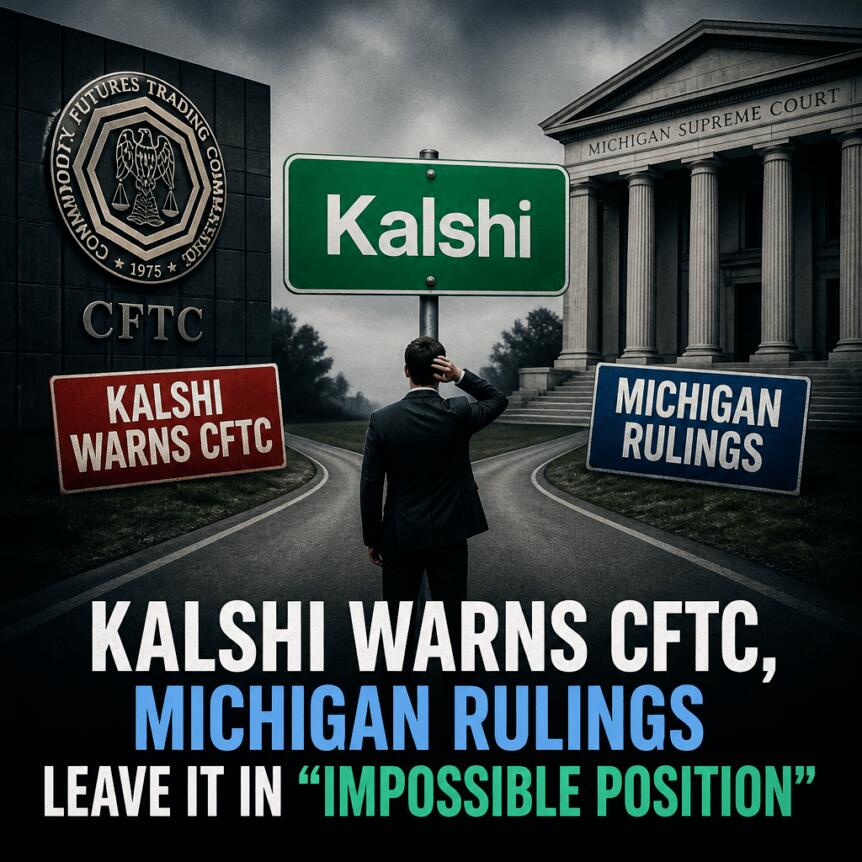
Kalshi says it has been placed in an “impossible position” after the U.S. Commodity Futures Trading Commission (CFTC) moved to prevent the prediction market platform from complying with a Michigan court order. The dispute underscores an ongoing jurisdiction fight over who can regulate prediction markets—federal authorities or state regulators—once bets are already placed and contracts are executed.
In a decision announced Tuesday, the CFTC ordered Kalshi not to follow the state directive to unwind certain trades in Michigan, according to Reuters. The pushback comes shortly after an Ingham County Circuit Court judge required Kalshi to stop offering sports betting contracts to Michigan users while litigation proceeds over whether Kalshi violated state sports betting laws.
Key takeaways
- Michigan’s court order required Kalshi to stop offering sports-betting contracts to state users and unwind already-executed trades.
- The CFTC instructed Kalshi not to comply with the state order, citing federal authority under the Commodity Exchange Act.
- Both sides frame the conflict as a question of jurisdiction—states vs. the CFTC—over prediction market derivatives.
- The CFTC warned that canceling executed trades could create broader market uncertainty.
- Kalshi said it is reviewing the federal order and weighing its next steps, citing conflicting obligations.
Michigan order vs. federal instruction
The conflict traces back to June 29, when Ingham County Circuit Court Judge Rosemarie Aquilina ordered Kalshi to cease offering sports betting contracts to Michigan users. The ruling was issued while a lawsuit plays out over whether Kalshi’s offerings breach Michigan’s sports betting framework.
On Tuesday, the CFTC said it would not allow Kalshi to comply with that state directive. The agency ordered Kalshi not to take steps to cancel trades that had already been executed. Earlier coverage noted that the Michigan court order targeted both ongoing offerings and the effect of prior contracts.
Kalshi’s head of enforcement and legal counsel, Robert DeNault, said the company is “disappointed” by the CFTC’s decision, arguing it places the firm in an untenable position: complying with a state court order could conflict with federal regulatory obligations. DeNault added that Kalshi had already acted and unwound trades as the Michigan court order required, and said the company “did not have a choice” at that time.
CFTC’s rationale: executed trades and market certainty
At the center of the CFTC’s argument is the idea that canceling already-executed derivatives trades is destabilizing. CFTC Chair Michael Selig said the agency views the attempted state interference as unprecedented, and warned of potential knock-on effects across prediction markets.
In remarks quoted in the reporting, Selig said canceling trades already executed risks “a cascading effect on the entire marketplace” and undermines the contracting certainty needed for a functioning market.
Selig further argued that the CFTC will not allow states or state courts to pressure CFTC-registered entities into violating the Commodity Exchange Act and CFTC regulations. The statement reflects the agency’s view that once markets are registered and operate within the federal framework, states cannot retroactively negate contractual outcomes through orders aimed at executed derivatives.
Kalshi’s position and what comes next
Kalshi indicated it is reviewing the CFTC’s Tuesday order and considering its next steps, according to Reuters. The company’s public response emphasizes how the two legal directives collide: state courts seeking to enforce local sports betting limits versus the federal regulator insisting on continued compliance with its framework.
While the details of how Kalshi will proceed were not spelled out in the provided reporting, DeNault’s comments point to a core dilemma. If Kalshi acts to satisfy the state court’s directive, it could potentially violate federal requirements. If it does not, it risks further legal exposure in Michigan. That tension is likely to remain a focal point for both sides as proceedings continue.
Tuesday’s move also highlights how quickly such disputes can escalate from parallel legal actions into direct operational instructions—particularly when the instructions concern whether previously executed contracts should be undone.
A broader jurisdiction battle with state regulators
Beyond Kalshi and Michigan, the episode reflects a larger and unresolved regulatory divide. The CFTC has previously said that states attempting to interfere with executed derivative transactions create systemic risks, and it has characterized Michigan as the first state to attempt interference of that kind.
This dispute sits inside a broader pattern in which prediction market operators and derivatives regulators face differing approaches from state authorities. In the reporting, Selig said the CFTC has “sued nine states” and indicated it would continue legal action against states that try to impose criminal or civil fines on CFTC-registered exchanges.
The practical implication for users and investors is that prediction market participation may be increasingly shaped by legal geography. Even if a platform believes it is compliant with federal derivatives rules, state litigation and orders can still create uncertainty around market operations, particularly around the validity or enforceability of contracts once bets are placed.
For builders and market participants, the immediate question is not only who has final authority, but how quickly orders can be issued and enforced—especially when they conflict. For regulators, the question is whether a unified federal approach can prevent fragmentation of contractual certainty across states.
Readers should watch closely for how Kalshi responds procedurally—whether it challenges the CFTC order, seeks clarification, or pursues legal steps in parallel jurisdictions. The case will also be important for the industry at large because it tests what happens when federal registration meets state-level enforcement pressure, particularly after trades have already been executed.


[PRESS RELEASE – Dubai, UAE, July 15th, 2026]
15th of July: The BNB Chain Foundation has officially announced the successful completion of the 36th quarterly BNB token burn by BNB Chain. This marks our third burn of 2026.
Here are the facts and figures from the latest burn:
- Auto-Burn (Total BNB burned): 1,615,827.795 BNB
- Approximate value in USD at the time of burn completion: ~$931,702,464
- Transaction ID (TXID) for BNB burn: View transaction
- Remaining to be burned: Check real-time data here
- Remaining total supply: 133,166,127.91 BNB
at time of writing 15 July, 2026 at 10:35AM UTC.
What You Need to Know About the BNB Burn
BNB is the native coin of the BNB Chain ecosystem, essential for powering its multifaceted Web3 environment. It supports transactions on the BNB Smart Chain (BSC), the opBNB L2s, and BNB Greenfield blockchain. Besides transaction fees, BNB serves as a governance token, granting holders the ability to participate in the BNB Chain’s decentralized on-chain governance. Additionally, BNB functions as a strategic reserve asset and enters the radar of more mainstream financial institutions, driving ecosystem growth and incentivizing adoption.
Following its mainnet launch on April 18, 2019, BNB transitioned from the Ethereum Network to BNB Chain. “Build and Build” is the philosophy behind BNB, reflecting its role in fostering development within the ecosystem. BNB employs an Auto-Burn system to gradually reduce its total supply to 100,000,000 BNB. The burn amount is adjusted based on BNB’s price and the number of blocks generated on BSC during a quarter, ensuring transparency and predictability.
BNB Auto Burn
The BNB Auto-Burn provides an independently auditable, objective process. The figures are reported quarterly, and the mechanism is independent of the Binance centralized exchange.
This quarter’s burn and future burns will occur directly on BSC due to the BNB Chain Fusion. The corresponding BNB amount will be sent to the “blackhole” address: 0x000000000000000000000000000000000000dEaD.
Note: Due to the recent Lorentz, Maxwell and Fermi upgrades, BSC is producing blocks more frequently, compared with the time when the Auto Burn formula was originally defined. The parameters used in the formula have been adjusted to keep the idea and spirit consistent.
BNB Real-time Burn
Additionally, BNB implements a real-time burning mechanism based on gas fees. BSC validators determine the ratio of gas fees collected in each block, which is burned at a fixed rate. Since the introduction of BEP95, roughly 291K BNB has been burnt under this mechanism.
About BNB Chain
BNB Chain is one of the largest and most active blockchain ecosystems in the world, supported by a global community of developers and users. With high throughput, low transaction costs, and full EVM compatibility, BNB Chain powers scalable applications across finance, gaming, and the broader Web3 economy. For more information, users can visit www.bnbchain.org.
The post BNB Chain Completes 36th Quarterly Token Burn, Marks Third Burn of 2026 appeared first on CryptoPotato.
Crypto World
DeFi as Critical Digital Infrastructure: Building the Financial Backbone of the Digital Age

Introduction
The internet transformed how the world communicates, shares information, and conducts business. Yet, despite these advances, financial infrastructure remains fragmented, permissioned, and heavily dependent on centralized institutions. Payments can take days to settle, billions remain unbanked, and access to financial services often depends on geography, identity, or institutional approval.
Decentralized Finance (DeFi) is changing that narrative.
Rather than simply offering an alternative to traditional banking, DeFi is evolving into critical digital infrastructure—a foundational financial layer that anyone can access, build upon, and integrate into the next generation of applications. Just as the internet became essential infrastructure for information, DeFi is becoming essential infrastructure for value.
What Makes Infrastructure “Critical”?
Critical infrastructure refers to systems that society depends on every day. Electricity grids, telecommunications networks, transportation systems, and cloud computing platforms all fall into this category because they enable countless services to function.
DeFi increasingly shares these characteristics:
- Operates continuously without business hours
- Accessible globally through an internet connection
- Open for developers to build on
- Resistant to single points of failure
- Transparent and verifiable
- Programmable by design
Instead of replacing banks outright, DeFi provides the financial operating system that applications, businesses, and even governments can leverage.
Financial Services Become Internet Primitives
One of DeFi’s greatest innovations is transforming financial functions into programmable building blocks.
Developers no longer need to build payment networks, lending systems, exchanges, or settlement infrastructure from scratch.
Instead, they can integrate existing DeFi protocols much like developers use cloud storage or payment APIs today.
These financial primitives include:
- Stablecoin payments
- Decentralized lending
- Automated exchanges
- On-chain collateral management
- Yield-generating vaults
- Cross-chain asset transfers
- Tokenized real-world assets
This composability dramatically accelerates innovation while reducing infrastructure costs.
Always-On Global Finance
Traditional financial infrastructure still operates within numerous constraints:
- Banking hours
- National borders
- Multiple intermediaries
- Settlement delays
- High remittance costs
- Manual reconciliation
DeFi removes many of these limitations.
Transactions settle around the clock.
Capital moves continuously.
Applications operate regardless of weekends or holidays.
This always-on availability is particularly valuable for global businesses, remote workers, digital creators, and international commerce.
Stablecoins: The Infrastructure Layer for Digital Payments
Stablecoins have quietly become one of DeFi’s most important components.
Rather than focusing on speculation, stablecoins enable:
- International payroll
- Merchant payments
- Cross-border settlements
- Treasury management
- E-commerce transactions
- Institutional liquidity
For many users, stablecoins represent their first interaction with blockchain technology—not because they are interested in crypto, but because they need faster, cheaper, and more reliable payments.
As adoption grows, stablecoins increasingly resemble digital public utilities for money movement.
Open Infrastructure Encourages Competition
Traditional financial systems often rely on closed networks where innovation depends on permission from intermediaries.
DeFi changes this dynamic.
Anyone can build:
- Wallets
- Trading platforms
- Lending markets
- Insurance protocols
- Payment applications
- Asset management tools
Developers compete on user experience rather than exclusive access to infrastructure.
This openness creates a healthier ecosystem where innovation moves faster, and users benefit from better services.
Programmable Money Changes Everything
Money is no longer limited to being stored or transferred.
With smart contracts, money becomes programmable.
Examples include:
- Automatic revenue sharing
- Instant royalty payments
- Escrow without intermediaries
- Streaming salaries by the second
- Automated subscriptions
- Conditional business payments
- Machine-to-machine commerce
As artificial intelligence and the Internet of Things expand, programmable financial infrastructure becomes increasingly important.
Machines will eventually need financial systems that operate autonomously.
DeFi is uniquely positioned to support this future.
Infrastructure for Tokenized Real-World Assets
Governments, financial institutions, and enterprises are exploring tokenization at an unprecedented pace.
Assets that can be represented on-chain include:
- Government bonds
- Treasury bills
- Corporate debt
- Real estate
- Commodities
- Private credit
- Carbon credits
DeFi provides the infrastructure where these assets can be:
- Traded
- Borrowed against
- Used as collateral
- Fractionalized
- Settled instantly
Rather than building entirely new financial rails, institutions increasingly connect to existing decentralized infrastructure.
Resilience Through Decentralization
Critical infrastructure must remain operational even under stress.
Traditional systems face risks such as:
- Data center outages
- Banking failures
- Political instability
- Regional disruptions
- Single points of failure
Public blockchain networks distribute operations across thousands of independent nodes worldwide.
Although no system is perfect, decentralization significantly reduces dependence on any single operator.
This resilience is becoming increasingly valuable in an interconnected global economy.
Challenges Before DeFi Can Become Global Infrastructure
Despite remarkable progress, several challenges remain.
Scalability
Infrastructure must support millions—or even billions—of users without sacrificing performance.
User Experience
Wallet management, onboarding, and security remain difficult for many newcomers.
Regulatory Clarity
Governments continue developing frameworks that balance innovation with consumer protection.
Security
Smart contract vulnerabilities, exploits, and protocol risks must continue to decline through better development practices and auditing.
Interoperability
The future financial system will likely span multiple blockchains rather than a single dominant network.
The Infrastructure We Don’t Notice
The most successful infrastructure often becomes invisible.
Few people think about:
- DNS when browsing websites.
- TCP/IP when sending emails.
- Cloud servers when using mobile apps.
Similarly, future users may never realize they’re using DeFi.
They’ll simply:
- Send money instantly.
- Receive salaries globally.
- Trade tokenized assets.
- Earn yield automatically.
- Purchase digital goods.
- Access financial services from any device.
The blockchain becomes invisible while the experience becomes seamless.
Conclusion
DeFi is evolving far beyond decentralized exchanges and yield farming. It is becoming the programmable financial infrastructure that can power digital commerce, tokenized assets, global payments, AI-driven economies, and next-generation internet applications.
The future of finance may not be defined by who owns the infrastructure, but by who can build on top of it. In that future, DeFi serves as the open, resilient, and interoperable foundation—enabling innovation at internet scale.
As digital economies continue to expand, the most important question may no longer be whether DeFi can compete with traditional finance, but whether tomorrow’s financial system can function efficiently without the open infrastructure that DeFi provides.
REQUEST AN ARTICLE
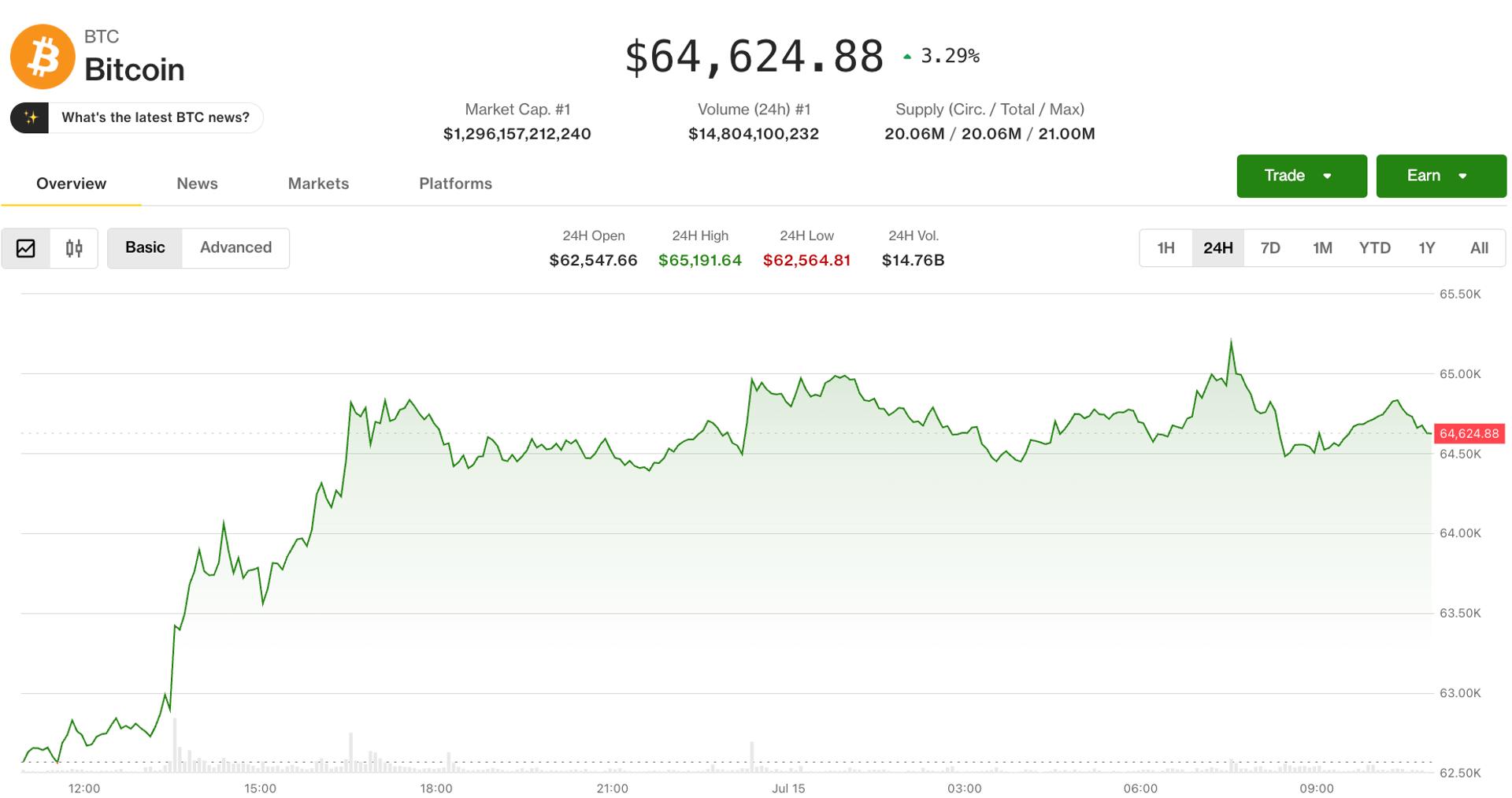
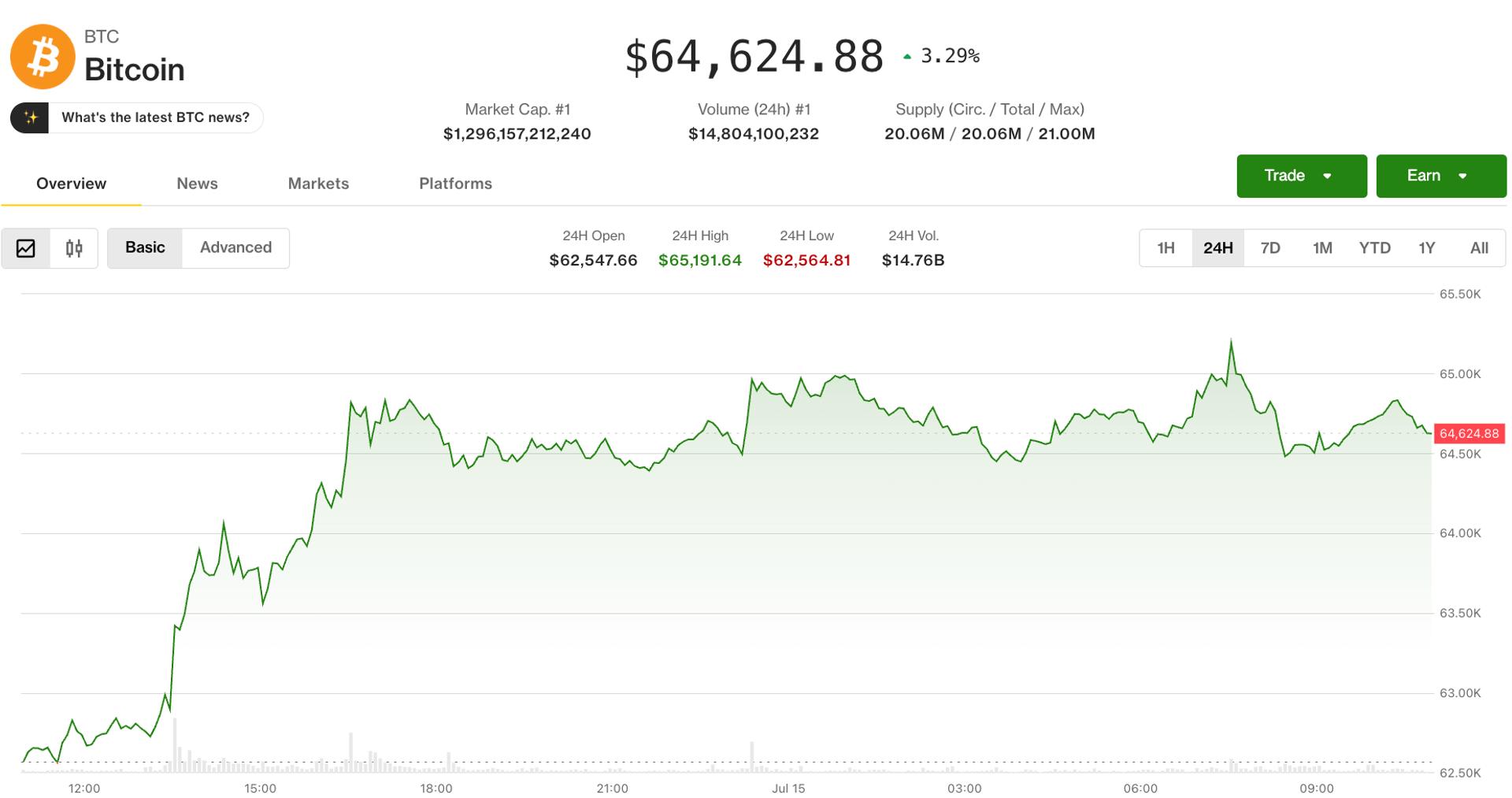
Bitcoin and ether (ETH) consolidated during Asian and European hours after rallying on Tuesday following a weaker-than-forecast U.S. inflation figure.
Bitcoin, while more than 3% higher over 24 hours, fell 0.6% since midnight UTC as tensions between Iran and the U.S. over tanker movements in the Strait of Hormuz ramped up. The largest cryptocurrency earlier touched a three-week high of $65,200.
Ether marked a similar trajectory, remaining 5% higher over 24 hours even after dropping 0.8% since midnight. It touched $1,895, the highest level since June 3, on Tuesday.
U.S. equities also rose in the period, with Nasdaq 100 futures and S&P 500 futures posting respective gains of 0.53% and 0.22%.
The altcoin market also showed pockets of strength; PUMP rose by 8.5% since midnight after a team and investor unlock was mopped up by investors, suggesting robust demand.
Derivatives positioning
- BTC derivatives positioning remains largely unchanged. Open interest ticked up to $17.3 billion, though the move is not meaningful, the three-month annualized basis held at 3.8% and funding rates remained broadly in the 0%-8% annualized range across multiple venues. In essence, the market continues to consolidate
- Options positioning tilted more bullish as the 24-hour call/put ratio moved to 66/34 following yesterday’s softer 58/42 read and the one-week delta skew held steady at ~15%. The ATM term structure remains in contango, with the front end around 32%–33% and the long end at ~42.5% out to mid-2027 – indicating a calm, non-stressed volatility environment with a renewed lean toward upside positioning.
- Coinglass data shows $357 million in 24-hour liquidations, with a 19-81 split between longs and shorts. ETH ($132 million) and BTC ($118 million) were the leaders in terms of notional liquidations.
- The Binance liquidation heatmap indicates $63,500 as a core liquidation level to monitor in the event of a price drop.
Token talk
- CoinMarketCap’s “Altcoin Season” indicator fell to 46/100 on Wednesday, likely due to the strength shown by the largest cryptocurrencies, bitcoin and ether.
- The indicator was also dragged down by , which lost around 1% since midnight UTC despite buoyancy in the broader market.
- Hyperliquid (HYPE) demonstrated its strength, adding 4% since midnight as it looks to extend May’s rally, which has been characterized by a series of higher highs and higher lows. The next target would be a record high above $78.00.
- HYPE’s rival token, LIT, stalled after a strong month, rising by just 0.5% as it started experiencing profit-taking and supply distribution as it neared its record high of $2.76.
- There was also a strong gain for zcash (ZEC), which surged by more than 10% over the past 24 hours before consolidating around $557.

Bitcoin’s price charted impressive gains on Tuesday and Wednesday after the lower-than-expected US CPI numbers for June, spiking to a multi-week peak of $65,000.
However, this progress is in danger again due to the quickly escalating tension in the Middle East, especially since many reports outlined US President Donald Trump’s new attack strategy against Iran.
New Attack Strategy Revealed
The two sides sat in a fragile ceasefire for weeks but failed to reach a decisive deal to permanently end the conflict. Instead, the attacks resumed last week; Trump said the memorandum of understanding is over, and they have launched strikes against each other almost daily since then.
According to multiple reports, the POTUS held a meeting in the Situation Room on Tuesday to discuss a “massive offense” against the Middle Eastern country. Some of the details that went public include:
- The meeting was attended by Vice President JD Vance, Marco Rubio, Pete Hegseth, John Ratcliffe, Steve Witkoff, and other senior officials
- The new attack strategy will involve strikes with a wider scope than the current ones, which are mostly focused on the region around the Strait of Hormuz.
- Axios reported that one of the major conclusions of the meeting focused on new plans for “devastating strikes on strategic targets in Iran.”
Moreover, the report claimed that Trump claimed Iran should “better make a deal” or they are “not going to have anything left.” The good news in all of this could come from this particular sentence, as the POTUS has made similar threats in the past, which actually preceded major de-escalations.
Is BTC in Danger Again?
The timing of these new reported plans for mass attacks couldn’t come at a worse time for bitcoin. The primary cryptocurrency has finally shown some strength following a major macro reversal. The CPI data for June showed much lower inflation than expected, which could mean less chance for the US Fed to increase interest rates.
Bitcoin reacted with an immediate price pump that drove it to a multi-month peak at $65,000 after it slumped below $58,000 for the first time in almost two years on July 1. New negative developments on the war front have long harmed its trend reversal, as attacks typically lead to a BTC crash and a surge in oil prices.
Consequently, there’s a real threat that bitcoin can erase the recent gains if the US follows through on its plan and Iran starts to retaliate against many nations in the region as it did in the past.
The post Trump’s New Iran Strategy Revealed: Will Bitcoin Pay the Price Again? appeared first on CryptoPotato.
Crypto World
Warren Buffett calls Bill Gates’ actions with Epstein ‘distasteful,’ but people make mistakes


Warren Buffett called Bill Gates’ association with the late sex offender Jeffrey Epstein as “distasteful” after the Berkshire Hathaway chairman excluded the Gates Foundation from his sizable annual charitable donations.
“I read a great deal since January 1 in terms of what happened, with Bill and Epstein,” Buffett said in an interview with CNBC’s Becky Quick. “While it’s distasteful, while he made mistakes, I made mistakes, hiring all kinds of people, or choosing friends, and then finding out later that, one way or other, they weren’t what I thought they were. I found nothing in there that was beyond what I could picture myself doing.”
Buffett, who has been friends with Gates for more than three decades, said he extensively reviewed information about Gates’ relationship with Epstein before deciding to overhaul his charitable giving. The 95-year old Buffett directed all of this year’s donations to four family-linked foundations.
For years, the Gates Foundation was the largest recipient of his annual Berkshire donations. Since 2006, Buffett has donated more than $47 billion worth of Berkshire stock to the philanthropic organization founded by the Microsoft co-founder and his former wife, Melinda Gates.
Buffett said he and Gates remain in contact and recently spent several hours together in Omaha.
“He came by Omaha three weeks ago. I kind of lose track of time, but certainly not three months, and we spent three hours talking together,” Buffett said. “He intends to call me… He already proposed another meeting.”

In the hands of Buffett’s children
The Oracle of Omaha said his estate plan should place greater responsibility in the hands of his three children. He said he had gradually prepared them for that role over decades.
“I reevaluated my whole situation,” Buffett said. “What happened was that I gave the Gates Foundation a great deal of money. I thought that was a good decision. I think it was a decent decision, but I did not think my kids were in any way ready to give away vast sums of money.”
“I tell the three children that it is theirs, and it’s their responsibility to get it done well,” he said.
Buffett said in a statement earlier this week that his goal is to dispose of all of my Berkshire shares within about eight years as his children are “unfortunately growing older.”
This year, Buffett is giving the Susan Thompson Buffett Foundation, named for his late first wife, 9 million Class B shares with a current value of around $4.5 billion. The three foundations run by his children, Susie Buffett’s Sherwood Foundation, the Howard G. Buffett Foundation, and Peter Buffett’s NoVo Foundation, will each get 1 million Class B shares worth just under $500 million.
Buffett also said he recently underwent surgery after breaking his leg several weeks ago and is recovering well.

Ted Pick, CEO Morgan Stanley, speaking on CNBC’s Squawk Box at the World Economic Forum Annual Meeting in Davos, Switzerland on Jan. 18th, 2024.
Adam Galici | CNBC
Morgan Stanley is set to report second-quarter earnings before the opening bell Wednesday.
Here’s what Wall Street expects:
- Earnings per share: $2.94, according to LSEG
- Revenue: $19.64 billion, according to LSEG
- Investment banking: $2.17 billion, according to StreetAccount
- Trading: Equities of $4.41 billion, fixed income of $2.49 billion, according to StreetAccount
Morgan Stanley is expected to benefit from higher trading and investment banking revenue in the quarter, as rivals JPMorgan Chase and Goldman Sachs have shown in their reports.
Heightened activity fueled by the global artificial intelligence boom propelled JPMorgan and Goldman to beat estimates for equities trading by a combined $4.4 billion, while investment banking at the two firms topped estimates by a combined $1 billion.
Analysts will want to know what CEO Ted Pick has to say on the outlook for the rest of the year as geopolitical tensions remain high.
This story is developing. Please check back for updates.
Binance’s XRP reserves have fallen to about 2.61 billion tokens, their lowest level since February, and the balance has held there since the start of July.
And even though the Ripple token had been sliding toward $1.06 while those reserves were draining out, it reversed course in the last 24 hours, gaining over 3% in that period.
Exchange Reserves Shrink as Selling Pressure Lingers
According to CryptoQuant contributor Arab Chain, there have been no meaningful inflows to replenish Binance’s XRP stockpile in recent months, which is why the reserve figure has held near its February 2026 low instead of climbing back.
A falling exchange balance can be considered a bullish signal since it is often taken to mean that investors are moving their stash into private wallets instead of preparing to sell. That signal took a while to show up in price, with Arab Chain noting that XRP had been falling to around $1.06 while reserves were emptying out, suggesting that liquidity, trading activity and investor sentiment were outweighing the effect of declining exchange supply.
In another market update, the same analysts pointed to the Binance CVD Confirmation Score, which blends price with Cumulative Volume Delta to track whether buy or sell orders are winning out in the spot market. That CVD reading is at -6.93 million, meaning that sell orders have outweighed buys as XRP fell from above $2.00 earlier this year toward the $1.07 area.
Meanwhile, the 30-day Price-CVD Confirmation Score is holding near 0.84, a figure Arab Chain says, while reasonably healthy, still falls short of confirming a genuine shift in buying demand. According to them, only a sustained move into positive CVD territory alongside a stronger confirmation score would point to a real reversal in buying interest.
As noted earlier, XRP’s price action has nevertheless improved modestly, with data from CoinGecko at the time of writing showing the asset trading around $1.11 after gaining about 3.7% in 24 hours, having oscillated between $1.07 and $1.12 during that period. However, the world’s sixth-largest cryptocurrency by market cap is still down 7% over the past month and more than 61% across one year, despite daily trading volume jumping 31% higher than the previous day to hit $1.26 billion.
Analysts Divided On Where XRP Heads Next
Such is the state of XRP that market watchers are split on what comes next. For example, popular trader Diana has pointed to $1.08 as the level to watch and warned that losing it could send XRP toward the $0.90-$0.93 zone before one last flush to the $0.87 macro support. Fellow analyst CasiTrades holds a similar technical view but frames it as the tail end of a yearlong correction, telling followers on X that a drop toward $0.87 would “finish off the correction we’ve spent the last year building.”
But others are looking past the near-term chop, with one of them, Crypto Patel, arguing that XRP is tracing a pattern that has historically come right before rallies of more than 1,000%. On his part, crypto investor Celal Kucuker pointed to a 500% monthly gain two years ago as a reason not to dismiss $7 by the end of the year.
The post Binance XRP Reserves at Lowest Since February as Ripple Price Defends Key Support appeared first on CryptoPotato.

Stripe and private equity firm Advent International have reportedly made a joint bid to buy PayPal Holdings, putting a major payments player directly in the middle of a fast-consolidating digital payments race.
According to Reuters, the offer would include about $50 billion in committed financing and would value PayPal at $60.50 per share, a figure described by sources as representing a 28% premium to PayPal’s Tuesday closing price. Both PayPal and Stripe declined to comment.
Key takeaways
- Reuters reports Stripe and Advent International have made a joint offer to acquire PayPal at $60.50 per share.
- The bid reportedly comes with roughly $50 billion in committed financing.
- The proposal would represent about a 28% premium versus PayPal’s Tuesday closing price.
- Both companies have been expanding crypto and stablecoin-related capabilities, which could be strategically relevant if a deal advances.
- PayPal stock rose in Wednesday premarket trading on the news, but the longer-term outcome depends on regulatory and shareholder processes.
A potential reshaping of mainstream payments
At the center of the report is a classic strategic question: whether large-scale payments infrastructure and consumer payment reach can be combined under one umbrella to compete more effectively with mobile-first options.
Reuters said the offer was made by Stripe alongside Advent International and referenced sources familiar with the matter. The proposed per-share price would imply a significant premium, and PayPal shares reflected that immediately—rising 11.3% to $52.73 in Wednesday premarket trading, according to Yahoo Finance data. Still, PayPal is described as having gained about 14% over the past month while remaining down 35% year-over-year, underscoring how investors are still weighing turnaround risk against growth prospects.
Why PayPal is back in the acquisition spotlight
This would be Stripe’s second attempt to acquire PayPal. Earlier reporting by Bloomberg in February said Stripe held preliminary acquisition talks with PayPal as PayPal faced increased competitive pressure from smartphone-based payment services such as Google Pay and Apple Pay.
What’s notable here is the timing: instead of focusing only on traditional payment processing, the competitive landscape increasingly includes payment rails that can move quickly into new settlement and compliance frameworks. That environment raises the stakes for any acquirer—especially one with a track record of building payment infrastructure across different use cases, from merchant processing to stablecoin-enabled settlement.
Stablecoins as a shared strategic direction
The acquisition rumor lands at a moment when both PayPal and Stripe have been pushing deeper into stablecoin activity, a sector that is increasingly viewed as an extension of payment networks rather than a standalone crypto experiment.
PayPal introduced its PYUSD stablecoin in 2023. CoinMarketCap data cited in the report shows PYUSD peaked at a market capitalization of about $4.2 billion in February 2026 before falling to roughly $2.85 billion. While PYUSD is described as one of the 10 largest stablecoins, it remains far behind leaders including Tether’s USDt and Circle’s USDC.
Stripe, meanwhile, has been building stablecoin-related infrastructure for payments and accounts. The report notes that Stripe has offered stablecoin-based accounts globally since May 2025, and that its stablecoin infrastructure platform, Bridge, received conditional approval to operate as a federally chartered national trust bank under the US Office of the Comptroller of the Currency on Feb. 17.
Stripe has also accelerated adoption through partnerships. In March, Visa said it would expand its stablecoin card partnership with Stripe-owned Bridge to more than 100 countries across Europe, Asia-Pacific, Africa, and the Middle East by the end of the year—an expansion that signals how stablecoins are being positioned to integrate into broader consumer payment flows.
What investors should monitor next
Even if the offer progresses, the path from a reported bid to a completed acquisition depends on standard deal mechanics: due diligence, agreement on terms, shareholder approval, and regulatory review. For crypto-adjacent investors, the stablecoin angle adds another layer of uncertainty—whether a combined company would streamline stablecoin strategy, expand payment settlement capabilities, or maintain separate roadmaps.
In the near term, the most important question is whether PayPal’s board engages meaningfully with the proposal and how competitors and regulators respond to a transaction that would unite large consumer payment distribution with stablecoin-enabled infrastructure. Readers should also watch the market’s reaction for signs of whether investors treat the news as a genuine path to consolidation or as a typical M&A rumor that may not clear the next hurdles.

XRP price prediction is back in focus as it trades around $1.11, up about 3.6% over the past 24 hours. It remains pinned beneath a resistance zone that has rejected several intraday rallies this week.
So far, this has been more of a slow grind than a breakout. But Ripple’s reported alignment with the x402 Foundation to support RLUSD-powered AI payments is giving the long-term story another boost.
The x402 initiative positions RLUSD, Ripple’s dollar-backed stablecoin, as a settlement asset for autonomous AI agents. That narrative gained traction after the XRP Ledger processed more than one million agentic transactions using a fixed network fee of 0.0002 XRP per transaction. Meanwhile, the x402 Foundation includes major companies such as AWS, Google, Visa, Mastercard, Stripe, Circle, and Coinbase, showing the project has serious industry backing rather than just marketing buzz.
At the same time, macro conditions have become a little friendlier. June’s US consumer inflation rate came in at 3.5% year over year, matching expectations after energy prices pulled the monthly index lower. That eased some concerns over tighter monetary policy and helped improve sentiment across equities and crypto.
Ripple’s payments narrative has been building for months, and RLUSD continues to expand its footprint. However, the price still needs to confirm the story. Until buyers force a clean breakout, XRP remains stuck in wait-and-see mode, with the fundamentals knocking while the chart keeps the door only slightly open.
Discover: The Best Token Presales
XRP Price Prediction: Break $1.15 This Week?
XRP trades around $1.11, after climbing roughly 3.5% over the past 24 hours. The session ranged between $1.06 and $1.12, while its market capitalization sits near $69 billion. Price is still coiling beneath $1.12, which often means the market is storing energy before making its next move.
Support remains around $1.05 to $1.06, where buyers have repeatedly shown up. Meanwhile, resistance stretches from $1.11 to $1.15, and sellers have defended that area more than once. Trading activity has also picked up, hinting at accumulation, although a convincing close above $1.12 would strengthen that case.

Three scenarios still stand out. The bullish path begins with a daily close above $1.15, opening the door toward the $1.20 to $1.30 area over time. The base case keeps XRP chopping between $1.07 and $1.13 as traders digest macro data. Sometimes the market just likes to make everyone wait.
The bearish case is equally simple. A decisive break below $1.05, backed by strong volume, would hand momentum back to sellers and could send XRP toward the mid $0.90s. While longer-term forecasts remain constructive, the near-term still belongs to the charts.
Trade XRP on BYBIT, and Don’t Miss Out on Our $1,000 USDT Airdrop
Maxi Doge Targets Early Mover Upside as XRP Tests Key Levels
XRP at $1.10 with a $68 billion market cap is a legitimate holding, but the asymmetric upside that early XRP adopters captured is structurally unavailable at this size. That math drives traders to scan earlier stages of the cycle.
Technical analysis on XRP suggests the next meaningful move may take weeks to materialize, which is exactly the window that presale positions are designed to exploit.
Maxi Doge ($MAXI) is an ERC-20 meme token built around a deliberately absurd but surprisingly coherent concept: a 240-lb canine juggernaut channeling 1000x leverage trading energy, with community mechanics that go beyond a simple meme pump.
The project has raised $4.8 million at a current presale price of $0.0002829, with dynamic staking APY available to holders. Standout features include holder-only trading competitions with leaderboard rewards, a Maxi Fund treasury allocated to liquidity and partnerships, and a meme-first marketing strategy built on viral gym-bro culture.
Explore the Maxi Doge presale here.
Discover: The Best Crypto to Diversify Your Portfolio
The post Ripple Joins x402 Foundation to Advance RLUSD AI Payments: Will XRP Price Benefit? appeared first on Cryptonews.


The Czech Finance Ministry added Polymarket to its list of unauthorized online gambling websites on Monday, requiring internet service providers (ISP) to block access.
The ministry listed the prediction market’s website under the country’s Gambling Act, which prohibits operators from offering unlicensed online gambling services to Czech users.
Under the Gambling Act, ISPs must block access to websites included on the ministry’s blacklist within 15 days of publication of the name.
Polymarket is a prediction market where users trade contracts tied to the outcomes of future events. The platform gained global attention during the 2024 US presidential election, with its markets widely cited as a gauge of election sentiment.
Polymarket and rival Kalshi have been restricted by regulators across the European Union, including in France, Germany, Poland, Romania and Spain.
Polymarket did not immediately respond to Cointelegraph’s request for comment.
Prediction markets face watchdog scrutiny beyond Europe
Regulators in several jurisdictions argue that some prediction market contracts amount to unlicensed gambling or fall under existing financial market rules.
On July 3, the European Securities and Markets Authority (ESMA) warned that many prediction market contracts could already fall under existing restrictions on binary options if they meet the definition of financial instruments.
The regulator said companies cannot avoid EU financial rules simply by marketing binary-style products as “event contracts” rather than derivatives. ESMA said the assessment depends on a contract’s characteristics rather than how they are marketed, adding that firms offering qualifying contracts to retail investors may already be subject to national restrictions implementing the bloc’s 2018 binary options ban.
ESMA also said companies offering such products to professional clients may need authorization under the Markets in Financial Instruments Directive, or MiFID II.
Related: Wall Street banks tighten prediction market rules for staff as insider fears spread
Outside the EU, prediction markets have faced similar regulatory action in Australia, Indonesia and Singapore.
In the US, Kalshi and Polymarket have been targeted by regulators in several states over allegations that their event contracts constitute illegal gambling, while the Commodity Futures Trading Commission maintains such products fall under its exclusive jurisdiction as federally regulated derivatives.
The dispute has resulted in conflicting court rulings and prompted calls for Congress to clarify whether sports and political event contracts should be regulated as gambling or federally regulated derivatives.
Magazine: Strategy became a symbol of the dot-com crash: Could history repeat?
BNB Chain Completes 36th Quarterly Token Burn, Marks Third Burn of 2026

The House Article | Burnham’s place-based government must save independent hospitality

What next for Rico Lewis: Man City return, priority, transfer interest


-

 Fashion6 days ago
Loro Piana Fall 2026 Enters Houston’s Art Scene
-

 Fashion4 days ago
Weekend Open Thread: Nutriplenish Leave-In Conditioner
-
 Sports6 days ago
2026 Genesis Scottish Open Thursday TV coverage: Round 1
-

 Sports5 days ago
Super Eagles star Moses Simon opens up on Liverpool transfer regret
-

 Tech6 days ago
Character.AI enters the microdrama arena with its own productions, but there’s a twist
-

 News Videos16 hours ago
XRP BOMBSHELL… XRP OMBOARDED FOR TRANSACTIONS!!!
-

 Tech1 day ago
Get Your ESP32 Sunny Side Up With This Solar Dev Board
-

 Tech15 hours ago
Dark Secrets Emerge When Jailbreaking LLMs
-

 News Videos7 days ago
Crypto Just Entered Its Most Important 6-Month Candle (Could Decide Everything!)
-
 NewsBeat6 days ago
Major update after Huntingdon train attack as man enters plea
-

 News Videos2 days ago
how to make coin bank box with cardboard #scienceproject #money #diy #shorts
-

 Tech6 days ago
Level Infinite Launches Gangstar Mirage City in India with Pre-Registrations
-

 Sports7 days ago
39-year-old Djokovic wins five-hour thriller to enter Wimbledon semis | Other Sports News
-
 Tech2 days ago
Cloudflare Precursor Watches Your Mouse and Keyboard To Decide If You Are Human
-

 Tech6 days ago
Entra passkey enrollment vishing targets Microsoft 365 users
-

 Crypto World6 days ago
DeFi Dashboard Zapper to Shut Down After 7 Years
-
 Crypto World6 days ago
Mark Cuban-Backed DeFi Dashboard Zapper Shuts Down After 7 Years
-

 Tech6 days ago
Claude’s New Reflect Dashboard Wants To Help You Log Off Of Claude
-

 Crypto World7 days ago
Fed minutes June 2026: officials split on rates
-
 Tech6 days ago
Hackers can use 9 of the most popular AI tools to assemble massive botnets
You must be logged in to post a comment Login