

Crypto World
Kelp DAO reopens full rsETH functionality after cross-chain exploit

Kelp DAO has completed the operational phase of its rsETH recovery plan more than five weeks after the Ethereum liquid staking protocol lost $293 million in a hack that investigators linked to North Korea’s Lazarus Group.
Summary
- Kelp DAO has completed the final operational step in its rsETH recovery plan after April’s $293 million exploit linked to Lazarus Group.
- Aave’s lending markets are still recovering after attackers used stolen rsETH as collateral to borrow wrapped Ether and leave nearly $190 million in bad debt.
According to a Monday statement posted by Kelp DAO on X, the protocol transferred the final batch of 20,373.7 rsETH to the LayerZero smart contract responsible for handling token locking, minting, burning, and releases during cross-chain transfers.
Kelp DAO said the move completed the final operational step required to restore rsETH backing after the April 18 exploit drained 116,500 rsETH from its bridge infrastructure.
Kelp DAO had already reopened withdrawals and resumed rsETH bridging between the Ethereum mainnet and supported layer 2 networks after transferring an initial tranche of 25,000 rsETH on May 13.
In its latest update, the protocol added that rsETH minting, redemptions, and reward functions are now operating normally again.
Funds used to restore the token backing came partly through the DeFi United recovery initiative, where multiple decentralized finance protocols coordinated support following the exploit.
Aave still dealing with aftermath of exploit
In the meantime, the fallout from the Kelp DAO attack continues to weigh on lending activity tied to Aave.
After the exploit, attackers deposited a large portion of the stolen rsETH into Aave as collateral and borrowed wrapped Ether against it. Court filings and governance documents previously stated that the incident left nearly $190 million in bad debt across affected Aave markets.
In the weeks that followed, DefiLlama data showed Aave’s total value locked dropped from more than $26 billion to below $14 billion as users withdrew liquidity from lending pools. Although outflows have slowed over the past month, the protocol’s TVL has remained largely rangebound between roughly $13.9 billion and $15.1 billion.
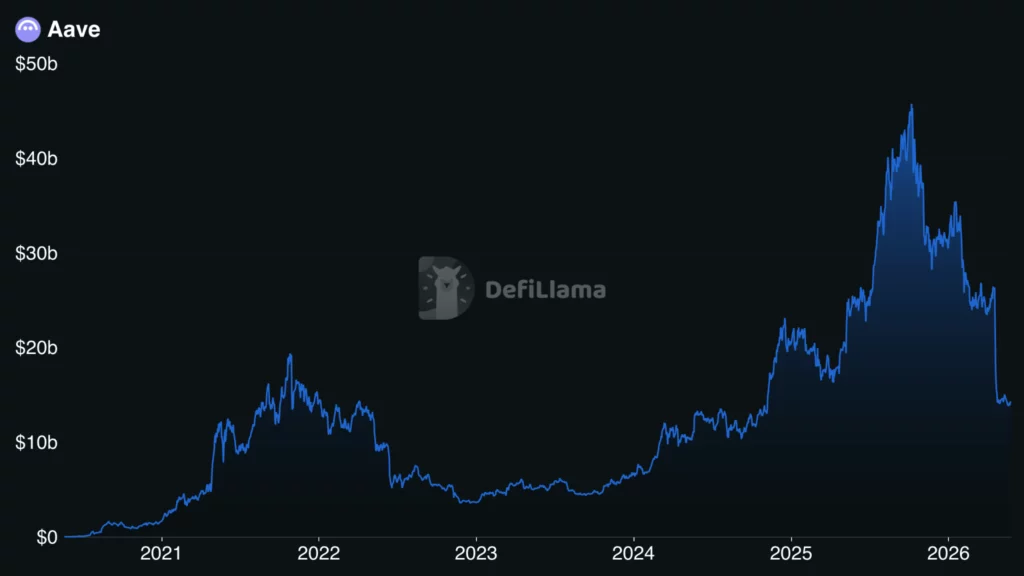
AAVE TVL. Source: DefiLlama.
Recent governance actions have restored some protocol functions. On May 18, Aave founder Stani Kulechov confirmed that borrowing against wrapped Ether collateral had resumed across several Aave V3 deployments, including Ethereum, Arbitrum, Base, Mantle, and Linea. Governance participants had earlier approved emergency restrictions after the exploit allowed unbacked rsETH to enter lending markets.
LayerZero dispute and legal battle continue
At the same time, legal disputes tied to frozen Ether connected to the incident are still unresolved. Earlier court filings showed that approximately 30,765 ETH, valued at nearly $71 million when frozen by the Arbitrum Security Council on April 21, became the subject of competing legal claims after blockchain analytics firms attributed the exploit to North Korean-linked actors.
Gerstein Harrow LLP, representing families pursuing terrorism-related judgments against North Korea, argued in court that the assets could qualify as property tied to Lazarus Group activity. Aave has disputed that interpretation, stating in filings that no court has formally determined North Korea or Lazarus Group carried out the exploit and that the recovered assets belong to affected users.
Separate tensions also emerged between Kelp DAO and LayerZero after the exploit. Earlier this month, Kelp DAO announced plans to migrate rsETH infrastructure from LayerZero’s OFT framework to Chainlink’s Cross-Chain Interoperability Protocol. Kelp DAO said the migration was part of efforts to strengthen bridge security following the attack.
LayerZero co-founder and CEO Bryan Pellegrino, however, has rejected several claims made by Kelp DAO regarding bridge configurations and security approvals.



Meta has signed an agreement with Reliance Industries to lease its first AI-enabled data center in India. Reliance will build the 168 MW facility in Jamnagar, Gujarat, with options to scale capacity.
The deal extends a partnership that began with Meta’s $5.7 billion investment in Jio Platforms in 2020. It also arrives as data centers face growing public scrutiny over electricity and water consumption.
Meta Signs First Indian AI Data Center Lease With Reliance Industries
According to the announcement, renewable energy will power the Jamnagar facility, while desalinated seawater will cool it. Meta will cover the full cost of the energy and water supporting the site.
Meta pointed to Jamnagar’s strategic value, where Reliance is constructing a massive data center campus backed by the energy capacity that advanced AI systems demand.
“We’re proud to be working with Reliance to build our first AI-enabled data center in India. This world-class facility in Jamnagar will help us scale our AI infrastructure globally while deepening our long-term investment in India’s economy,” Mark Zuckerberg, Founder and CEO of Meta, said.
Follow us on X to get the latest news as it happens
In addition, Meta also contracted nearly 1 GW of new clean energy in India. CleanMax will supply 837 MW of solar and wind projects in Rajasthan and Karnataka. Fourth Partner Energy will add 88 MW across Tamil Nadu, Karnataka, Maharashtra, and Uttar Pradesh.
“Meta is investing aggressively to expand our capacity footprint to support our technologies, services, and AI ambitions, which serve billions of people worldwide. India’s rapidly growing tech-forward digital economy, its massive user base, and the strength of our partnership with Reliance make India an ideal place to invest,” the blog added.
Research Finds No Link Between Data Centers and Electricity Prices
The AI buildout has stoked fears, voiced by figures like Senator Elizabeth Warren, that households will absorb the cost of surging power demand.
Entergy CEO Drew Marsh recently rejected those concerns.
“Data centers really want to be good neighbors. They have reputations that they want to protect, and they want to be part of the community,” Marsh told CNBC.
Separately, research published in March 2026 by the Institute for Energy Research found no statistically significant correlation between the number of data centers in a state and its current electricity prices. Two other recent reports reached comparable conclusions.
Meanwhile, states are also moving to shield their citizens. Last week, Wyoming Governor Mark Gordon signed an executive order requiring data center developers to cover the grid costs their projects create.
Whether similar cost-shielding models reassure communities in India and beyond may shape how fast the next wave of AI facilities gets built.
Subscribe to our YouTube channel to watch leaders and journalists provide expert insights
The post Meta Turns to Reliance as AI Data Center Race Reaches India appeared first on BeInCrypto.

Key Takeaways
- Reports indicate Starbucks is considering strategic alternatives for its Japan operations, potentially including a partial sale
- The Japan business could be valued between ¥400–500 billion (approximately $2.5–3 billion)
- Potential buyers include both strategic industry partners and private equity investors
- This development comes months after Starbucks divested a majority stake in its China operations for $4 billion in April
- Shares of SBUX climbed 2.73% on Tuesday and are trading up 15.7% in 2025
The coffee retail giant Starbucks (SBUX) is reportedly evaluating various strategic alternatives for its Japanese operations, with a potential stake sale being among the options under consideration. Bloomberg broke the news Tuesday, citing sources with knowledge of the deliberations.
According to the report, the Japanese business unit could fetch a valuation ranging from ¥400 billion to ¥500 billion—equivalent to approximately $2.5 billion to $3 billion in U.S. dollars. Sources suggest that interest could emerge from both strategic industry participants and private equity investors.
Shares of SBUX advanced 2.73% following the news.
Starbucks has not issued a statement regarding the reports, and no definitive decisions have been made public at this time.
The Seattle-based coffee chain acquired complete control of its Japan subsidiary in 2014 after purchasing the remaining ownership interest from Sazaby League, its original Japanese partner. The partnership between the two companies had begun in 1995 and operated successfully as a joint venture for nearly two decades.
This potential restructuring echoes a recent strategic move by the company. Just this past April, Starbucks finalized an agreement with Boyu Capital to divest a controlling interest in its Chinese business operations at a $4 billion valuation.
The China transaction was largely motivated by persistent challenges including decelerating growth rates, COVID-19-related disruptions, and intensifying competitive pressure from domestic competitors such as Luckin Coffee.
Japan Strategy May Mirror China Approach
The rationale behind a potential Japan deal could follow similar reasoning. Partnering with a local strategic investor might help mitigate operational challenges while maintaining Starbucks’ market presence in the region.
Additionally, divesting a portion of the Japan business could generate capital during a critical period as CEO Brian Niccol implements his comprehensive turnaround initiative. Operating expenses have been escalating more rapidly than anticipated under the new strategy, making the timeline for margin improvement a focal point for investors.
Starbucks recently reported its most robust quarterly sales performance in over two years this April, suggesting that Niccol’s turnaround efforts are beginning to show positive results on the top line.
Analyst Perspective on SBUX
The investment community maintains a cautiously positive outlook on the stock. TipRanks data shows SBUX has a Moderate Buy consensus rating, derived from 17 Buy recommendations, 10 Hold ratings, and one Sell rating compiled over the last three months.
The consensus price target among analysts stands at $110.88, suggesting approximately 14% potential upside from current trading levels.
Year-to-date, SBUX shares have appreciated 15.7% as of this latest report.
Starbucks has maintained full ownership of its Japanese operations since completing the Sazaby League buyout in 2014. Prior to that acquisition, the two organizations had jointly managed the Japan market presence for almost 20 years.
Reuters has been unable to confirm the Bloomberg report independently, and Starbucks has not publicly acknowledged whether a formal sale process is currently in progress.


TLDR
- UBS projects wafer fab equipment (WFE) sector revenue could reach $250 billion by 2028, signaling a potential supercycle
- Major chipmakers including Micron, Samsung, and SK Hynix are launching new fabrication facilities to address cleanroom capacity constraints
- Mizuho upgraded Sandisk’s price target to $2,200, while also raising projections for Seagate and Western Digital
- DRAM consumption expected to surge 27% year-over-year in 2026, primarily fueled by artificial intelligence workloads
- Google’s TPU deployments projected to surpass 35 million units by 2028, a dramatic increase from approximately 4.3 million in 2026
The memory semiconductor sector is experiencing significant expansion, with major Wall Street analysts attributing the momentum to surging artificial intelligence demand.
Timothy Arcuri, an analyst at UBS, indicated this week that the wafer fab equipment sector — responsible for manufacturing the machinery that produces semiconductors — may be in the initial phases of a supercycle. His analysis suggests total WFE revenue could climb to $250 billion by 2028.
Arcuri’s forecast calls for WFE revenue to expand 27% during the current year, reaching $147 billion. He anticipates an additional 35% increase in 2027, bringing the total to approximately $200 billion.
The expansion is being driven by new fabrication capacity entering production. Micron, Samsung, and SK Hynix are all initiating operations at newly constructed manufacturing facilities. This wave of expansion is alleviating the shortage of cleanroom infrastructure necessary for chip production.
Equipment manufacturers are now receiving demand forecasts from customers extending up to eight quarters ahead. According to Arcuri, this unprecedented level of visibility represents something he hasn’t observed in nearly three decades of industry analysis.
Memory Equipment Investment Accelerates Sharply
Revenue from machinery dedicated to DRAM and NAND memory chip manufacturing is anticipated to jump 50% this year. Meanwhile, equipment for logic semiconductors, produced by firms such as Taiwan Semiconductor and Intel, is expected to increase by 12%.
UBS increased its memory WFE revenue projection for the coming year by $10.5 billion. A substantial portion of the new manufacturing capacity focuses on DRAM production, supported by extended supply contracts. NAND capacity expansion is anticipated to accelerate beginning in the latter half of 2028.
Arcuri indicated his preference for Lam Research and Applied Materials among equipment manufacturers. He considers KLA to be trading at elevated valuations that limit potential gains. Shares of both Applied Materials and KLA advanced on Tuesday despite weakness in the broader semiconductor sector.
ASML, the Netherlands-based producer of extreme ultraviolet lithography systems, is expected to generate over $46 billion in systems revenue next year — a figure Arcuri believes validates his broader WFE projections.
Mizuho Elevates Price Targets for Storage Leaders
In a separate development, Mizuho Securities increased its price objective for Sandisk to $2,200 from $1,825, maintaining an Outperform rating. The firm simultaneously raised Seagate’s target to $1,090 from $875 and boosted Western Digital’s objective to $685 from $550.
Mizuho’s Vijay Rakesh forecasts DRAM consumption will expand 27% year-over-year in 2026 and 24% in 2027. NAND consumption is projected to increase 18% in both years.
Shipments of Google’s Tensor Processing Units are anticipated to exceed 35 million units by 2028, rising sharply from around 4.3 million in 2026. Broadcom, serving as a critical design collaborator for Google’s TPU and OpenAI’s forthcoming processor, is projected to generate AI-related revenue of $122 billion in 2027 and $170 billion in 2028.
Sandisk commenced trading Monday at $1,982 and advanced approximately 5.69% in response to the analyst upgrade. The stock currently trades at a price-to-earnings ratio of 58.32 times, significantly exceeding its historical median of 29.61 times.
The PHLX Semiconductor Sector index has climbed 73% year-to-date despite a modest decline on Tuesday.
Crypto World
Crypto News, June 9: BTC USD at a Breaking Point as Trump “Proportionally” Strikes Iran, CPI Shock and SpaceX IPO Risks Mount
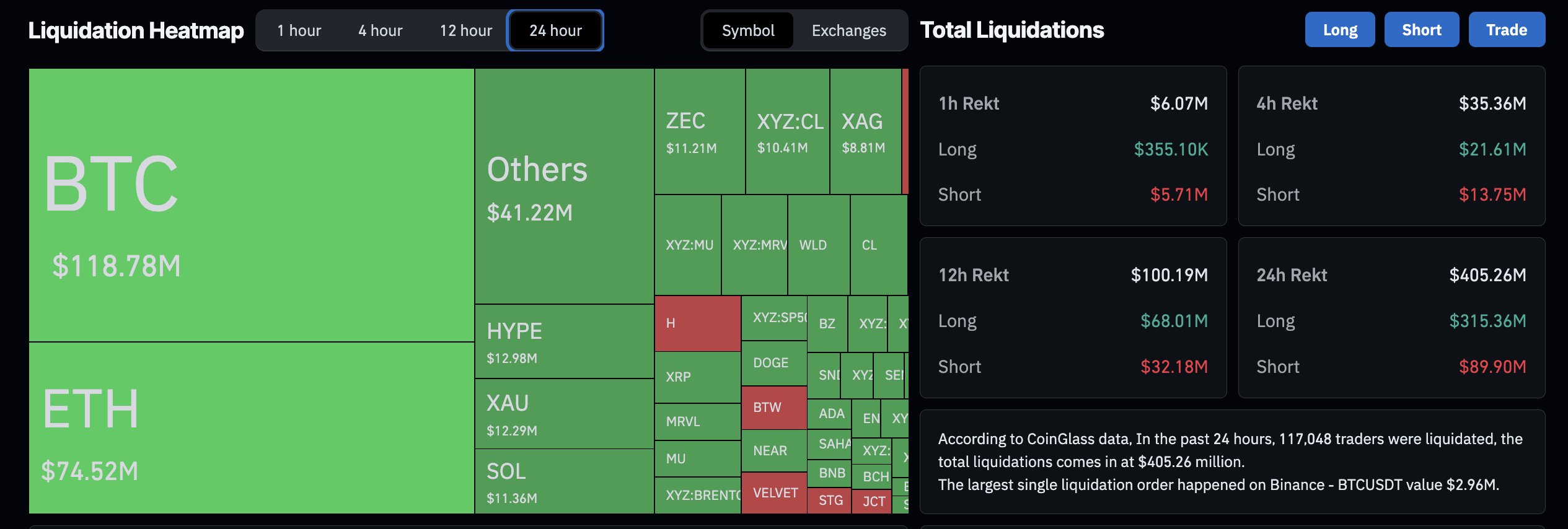
BTC USD faces major battles today as Iran tensions flare with Trump proportional strikes while hinting at a deal days away. CPI data will also drop today amid energy spikes. The escalation has already triggered over $400 million in liquidations, pressuring BTC USD at the $61,000 level. Then add SpaceX IPO oversubscription 2 days away.
After proportional strikes, Trump hinted at a potential deal “days away,” yet the Iran escalation sent BTC USD sliding from recent highs. Over $400 million in liquidations hit the market, with more than $300 million coming from long positions. The temporary calm from the earlier de-escalation fractured quickly.
Discover: The best crypto to diversify your portfolio with
Beyond Trump Iran Escalation: Fractured BTC USD, SpaceX IPO Over-Hype
BTC USD now holds unstable ground at $61-62k as energy prices surge from the conflict, feeding macro fears. Total crypto market cap sits steady at $2.2T as Bitcoin dominance slides, but swings could come at any time.

SpaceX IPO emerges as the big “market test” for June 12. Tom Lee calls any pullback short-lived. According to him, the IPO success helps the bull market and does not signal a top. Chip sell-offs from fund reallocation ahead of the debut will draw buyers back in, he insists.
Following his comment, his firm, Bitmine, scooped 75k ETH worth $123 million from Kraken and FalconX in recent hours, lifting total ETH holdings to about 5.5 million.
— Coin Bureau (@coinbureau) June 10, 2026
 LATEST: TOM LEE'S BITMINE JUST BOUGHT ANOTHER $123 MILLION OF ETH
The firm acquired 75,000 ETH over the past 12 hours, as per Lookonchain.
The purchase pushes Bitmine's total holdings to roughly 5.50M ETH worth nearly $8.94 BILLION at current market prices. pic.twitter.com/VB4j0jpkaE
Realistically, the SpaceX IPO could channel fresh capital into tech and crypto ecosystems. People peg the IPO as the next catalyst despite short-term selling pressure. BTC USD dipped to $61k as some raised funds for the oversubscribed debut, yet Lee sees it as bullish long-term. As of today, the oversubscription has reached a $250 billion for a company with a $75 billion valuation.
Discover: The best pre-launch token sales
Forecasting CPI Data Drops
CPI forecast points to +4.2 percent YoY for May, the highest in over three years, versus 4.2 percent in April. Energy spikes tied to the Trump and Iran conflict are blamed for the jump in gasoline and fuel oil. The drop itself lands at 12:30 UTC, with 70 percent odds of a Fed rate hike now baked in.
JP Morgan Trading Gameplan for CPI Release
— Barchart (@Barchart) June 9, 2026
BTC USD holds $61-62k pre-CPI in pure speculation mode, but historical patterns show a 9 percent pre-CPI pump is fading on release. Hot data risks a $60k test while cooler figures open $65k. Not just the U.S. CPI drops; Japan’s hot PPI adds yen carry-trade pressure, heightening the impact on crypto.
On the adoption front, Kraken has been named the official crypto exchange of the FIFA World Cup 2026, while Anthony Scaramucci stays a long-term BTC believer, predicting recovery by Q4 2026 or Q1 2027.
We’re proud to announce Kraken is the Official Crypto Exchange Supporter of the @FIFAWorldCup 2026 — Kraken (@krakenfx) June 9, 2026
 in North America & Europe.
One global stage.
For every kind of fan.
For every way into crypto. pic.twitter.com/5jTsykzDDJ
Crypto tax bills face House Committee pushback, offering potential relief for digital assets. Despite near-term fears from Iran, friction, looming CPI data, and SpaceX’s IPO reallocation, BTC USD has not fundamentally changed, nor has crypto. Institutional accumulation and a bullish stance on the SpaceX IPO bring confidence to the fragile market.
Geopolitical scare remains temporary while adoption milestones accelerate legitimacy. Cooler CPI could bring a liquidity relief rally, pushing BTC USD toward $65k as higher-for-longer fears ease. SpaceX IPO success would strengthen bull market narratives, drawing capital that likely flows into crypto.
The path forward looks bullish.
Discover: The best crypto to diversify your portfolio with
The post Crypto News, June 9: BTC USD at a Breaking Point as Trump “Proportionally” Strikes Iran, CPI Shock and SpaceX IPO Risks Mount appeared first on Cryptonews.


Three of Japan’s largest banks said they will jointly issue a stablecoin this financial year, which ends in March.
Mitsubishi UFJ Financial Group (MUFG), Sumitomo Mitsui Financial Group (SMBC) and Mizuho Financial Group will establish a council to explore operational frameworks and prepare for the issuance of stablecoins, according to a statement on MUFG’s website.
The three banks will act as “joint settlors and a trust bank or similar institution will act as trustee,” the statement said.
Japan’s Financial Services Agency (FSA) signaled support for the development of a stablecoin by the three banks last November. More recently, the ruling Liberal Democratic Party (LDP) said the state should promote the usage of yen-based stablecoins.
Stablecoins are digital tokens pegged to the value of a traditional financial asset, usually a fiat currency. The market is overwhelmingly dominated by U.S. dollar tokens, with Tether’s USDT and Circle Internet’s (CRCL) USDC alone accounting for a combined 84% market share.
Tokens pegged to the yen represent a negligible share of the market, accounting for less than $50 million in the $311 billion sector. The most prominent is JPYC with a market cap of around $18 million, issued by a Tokyo-based fintech of the same name.
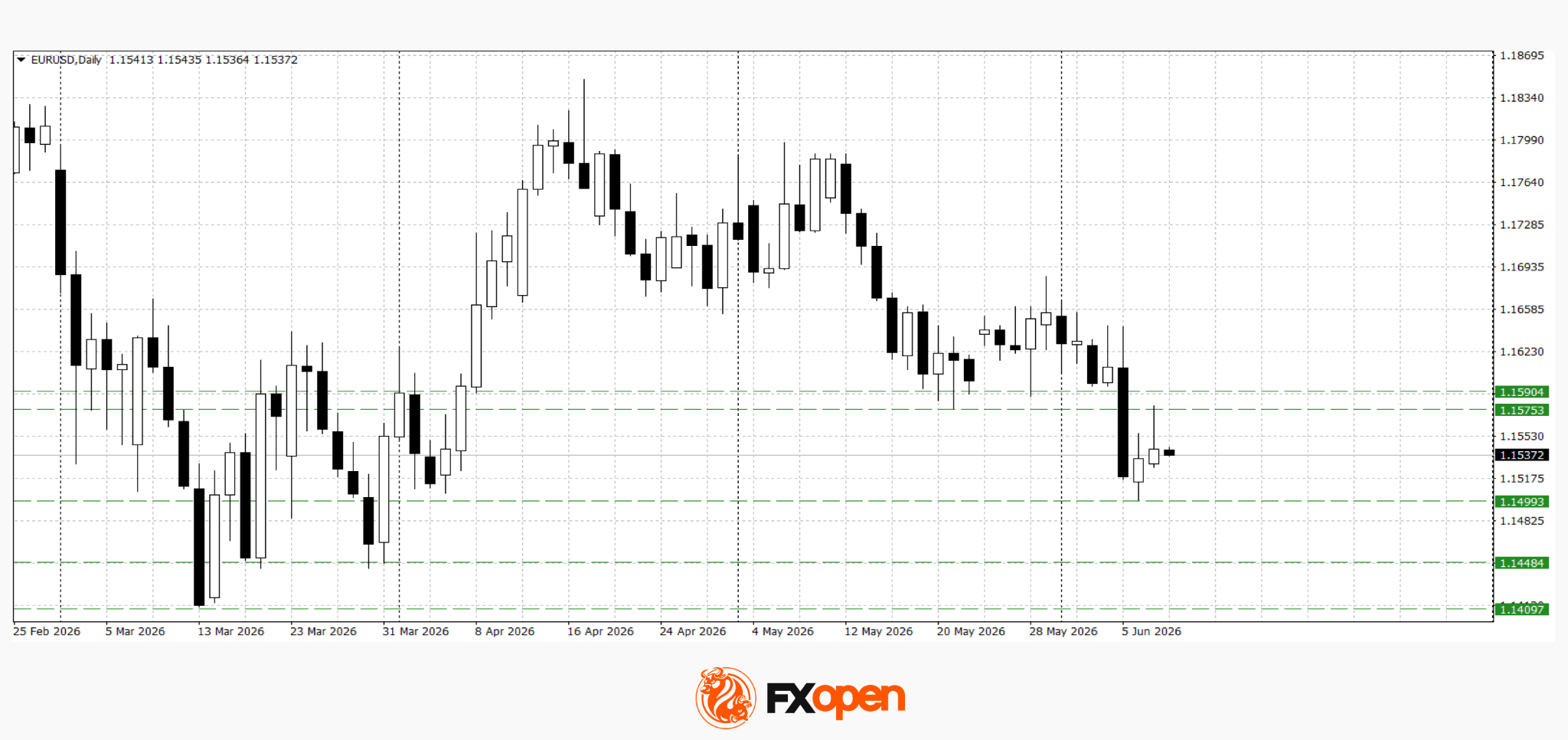
The euro is showing signs of a modest recovery following a sharp decline triggered by a strong US employment report and increased demand for safe-haven assets amid escalating geopolitical tensions in the Middle East. Robust Nonfarm Payrolls data confirmed the resilience of the US labour market, allowing the dollar to strengthen against most major peers and reinforcing expectations that the Federal Reserve will maintain a restrictive policy stance.
Investor attention today will be focused on the release of US inflation data. According to forecasts, annual consumer price growth may accelerate to 4.2% from 3.8% previously, while core inflation is expected to rise to 2.9% from 2.8%. Should the figures exceed expectations, markets may once again reassess the outlook for Federal Reserve rate cuts, providing additional support for the US dollar.
Another key event will be the Bank of Canada policy meeting. The central bank is widely expected to leave its benchmark interest rate unchanged at 2.25%, although market participants will be paying close attention to the accompanying statement and policymakers’ comments regarding the future path of monetary policy. Any signals pointing towards further easing could weigh on the Canadian dollar and support gains in EUR/CAD.
EUR/USD
After breaking below the key support level at 1.1580 last week, EUR/USD buyers managed to push the pair back towards this area. Technical analysis suggests the pair may retest support near 1.1500. A break below this level followed by sustained trading underneath it could trigger a fresh bearish impulse, with initial downside targets in the 1.1400–1.1440 region. The bearish scenario would be invalidated by a decisive move back above 1.1580.
Key events for EUR/USD:
- Today at 12:30 (GMT+3): German 10-year government bond auction;
- Today at 15:30 (GMT+3): US Consumer Price Index (CPI);
- Tomorrow at 15:00 (GMT+3): Germany’s seasonally unadjusted current account balance.
EUR/CAD
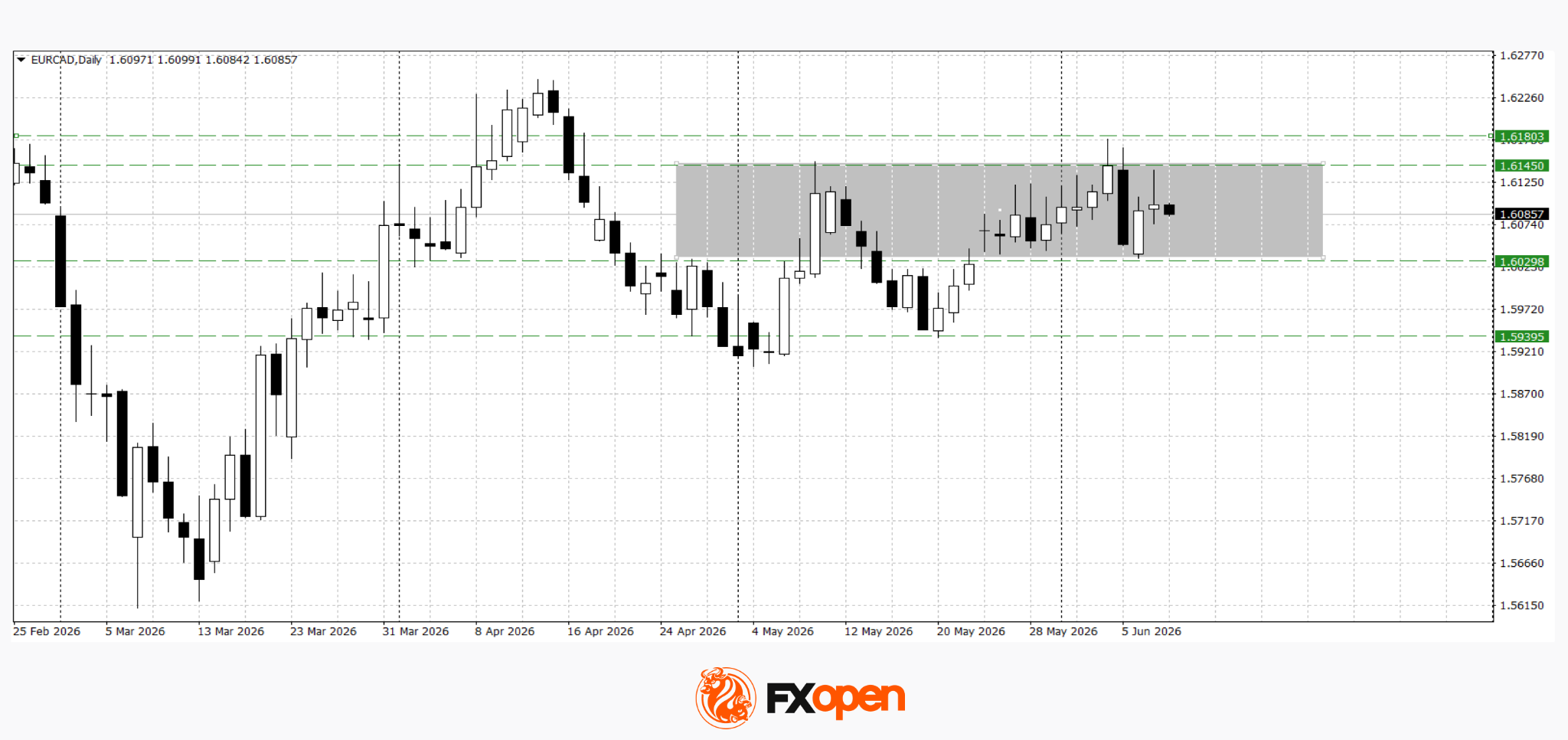
EUR/CAD is also undergoing a corrective recovery following its previous decline, although further direction will largely depend on the outcome of the Bank of Canada meeting and the market’s reaction to US inflation data. Ahead of these releases, traders are likely to remain cautious, potentially encouraging consolidation around current levels.
Technical analysis points to range-bound trading within the 1.6030–1.6150 corridor. Price behaviour near these boundaries over the coming sessions may provide clearer signals regarding the pair’s next directional move.
Key events for EUR/CAD:
- Today at 16:45 (GMT+3): Bank of Canada interest rate decision;
- Today at 17:30 (GMT+3): US crude oil inventories;
- Today at 17:30 (GMT+3): Bank of Canada press conference.
Trade over 50 forex markets 24 hours a day with FXOpen. Take advantage of low commissions, deep liquidity, and spreads from 0.0 pips (additional fees may apply). Open your FXOpen account now or learn more about trading forex with FXOpen.
This article represents the opinion of the Companies operating under the FXOpen brand only. It is not to be construed as an offer, solicitation, or recommendation with respect to products and services provided by the Companies operating under the FXOpen brand, nor is it to be considered financial advice.


- The $54 support level is critical for the Hyperliquid price.
- HYPE futures open interest has fallen to $5.86B, triggering a leveraged unwind.
- Crypto Fear and Greed Index hit 15 as Bitcoin ETF outflows drove risk-off selling.
The Hyperliquid price has dropped 11% in 24 hours to $55.35, making it one of the hardest-hit assets in an already rough day for crypto.
While the broader crypto market is down, with Bitcoin falling 3.1% toward the $62,000 zone, HYPE’s losses were nearly four times larger; a pattern that tends to show up when a high-beta asset catches a deleveraging wave at the worst possible time.
The 7-day picture is even sharper. HYPE is down 23.7% over the past week and has now given back more than a quarter of its value from its all-time high of $75.48, set just eight days ago on June 2.
Why is the Hyperliquid price declining?
The clearest explanation for the size of the drop lies in the derivatives market.
Hyperliquid futures open interest has dropped to $5.86 billion, a signal that leveraged long positions were being closed rather than new short bets being placed.

At the same time, spot volume climbed 12.5%, meaning actual selling and not just funding rate shifts were hitting the market.
Traders who had built up leveraged positions during HYPE’s run to its all-time high were exiting, and the exits compounded each other.
Interestingly, the price drop was not driven by any negative news specific to the Hyperliquid protocol itself.
Daily buybacks continued as normal, and there were no reports of exploits or technical failures.
It was a speculative unwind, not a fundamental breakdown.
But that unwind happened against a difficult macro backdrop.
The broader market continues to struggle
The Crypto Fear and Greed Index fell to 15, deep in extreme fear territory, down from 47 just a month ago, and total crypto market capitalisation dropped 2.24% in 24 hours to approximately $2.13 trillion.
Traders were pulling back ahead of the Federal Reserve’s June 16–17 meeting, with CME FedWatch data showing a 98.2% probability that rates would stay unchanged.
Geopolitical tension added to the pressure after President Donald Trump indicated the US would respond to Iran allegedly shooting down an American Apache helicopter near the Strait of Hormuz.
Adding to the backdrop, the Hyperliquid Policy Centre (HPC) filed a joint comment letter with venture firm Paradigm on June 9, pushing back on a proposed rule from FinCEN and the Office of Foreign Assets Control that would implement anti-money laundering and sanctions requirements for stablecoin issuers under the GENIUS Act.
The GENIUS Act was signed into law in July 2025, establishing a federal framework for payment stablecoins, with implementation expected by January 2027.
The April-proposed rule would require stablecoin issuers to maintain AML programs, file Suspicious Activity Reports, and have the technical capability to block, freeze, or reject transactions violating US law, across both primary and secondary markets.
HPC and Paradigm’s objection centres on the secondary market scope.
In permissionless blockchain environments, issuers can see wallet addresses and transaction amounts, but they cannot identify who is actually transacting.
As the filing put it: “Issuers are subject to strict liability for transactions they cannot meaningfully police.”
The groups propose keeping heavier compliance obligations on the primary market, where issuers have direct customer relationships, and want a narrower approach in secondary markets, with the Travel Rule applying to pseudonymous wallet transfers only when operators have a direct relationship with the parties involved.
They also suggested that smart contract-level compliance measures, including address blocklists and transfer restrictions, should be recognized as sufficient, and that money laundering provisions should not extend to protocol developers and on-chain infrastructure participants.
HPC and Paradigm warned that if issuers are held responsible for every secondary-market interaction on permissionless networks, the likely outcome is that regulated stablecoins retreat from DeFi entirely, leaving a gap that unregulated offshore alternatives would fill.
What to watch next for HYPE
The immediate technical focus is the $54 level.
AltcoinSherpa notes that a break below the $54 support level would remove a key area that has been holding HYPE’s price action in place.
If HYPE holds above $54, the token could settle into a consolidation range between $54 and $65.
According to AltcoinSherpa, a break below $54 opens the door to the $44–$54 gap, which would represent a significant further drawdown from current levels.
On the derivatives side, a stabilization or recovery in open interest, currently at $2.48 billion, would be a sign that the selling pressure is exhausting itself.
Notably, if open interest keeps falling while price drops, it suggests more unwinding is still ahead.
One potential volatility catalyst worth monitoring is the SpaceX IPO listing, which could draw trading activity to Hyperliquid’s markets and introduce a new source of volume.
But whether that translates into price support for HYPE specifically is less certain, but it could shift the attention and activity on the platform.
Bitcoin reclaiming $63,000 would also improve the broader altcoin environment.
However, until that happens, altcoins like Hyperliquid (HYPE) remain exposed to further downside if macro sentiment stays cautious heading into the Fed meeting next week.
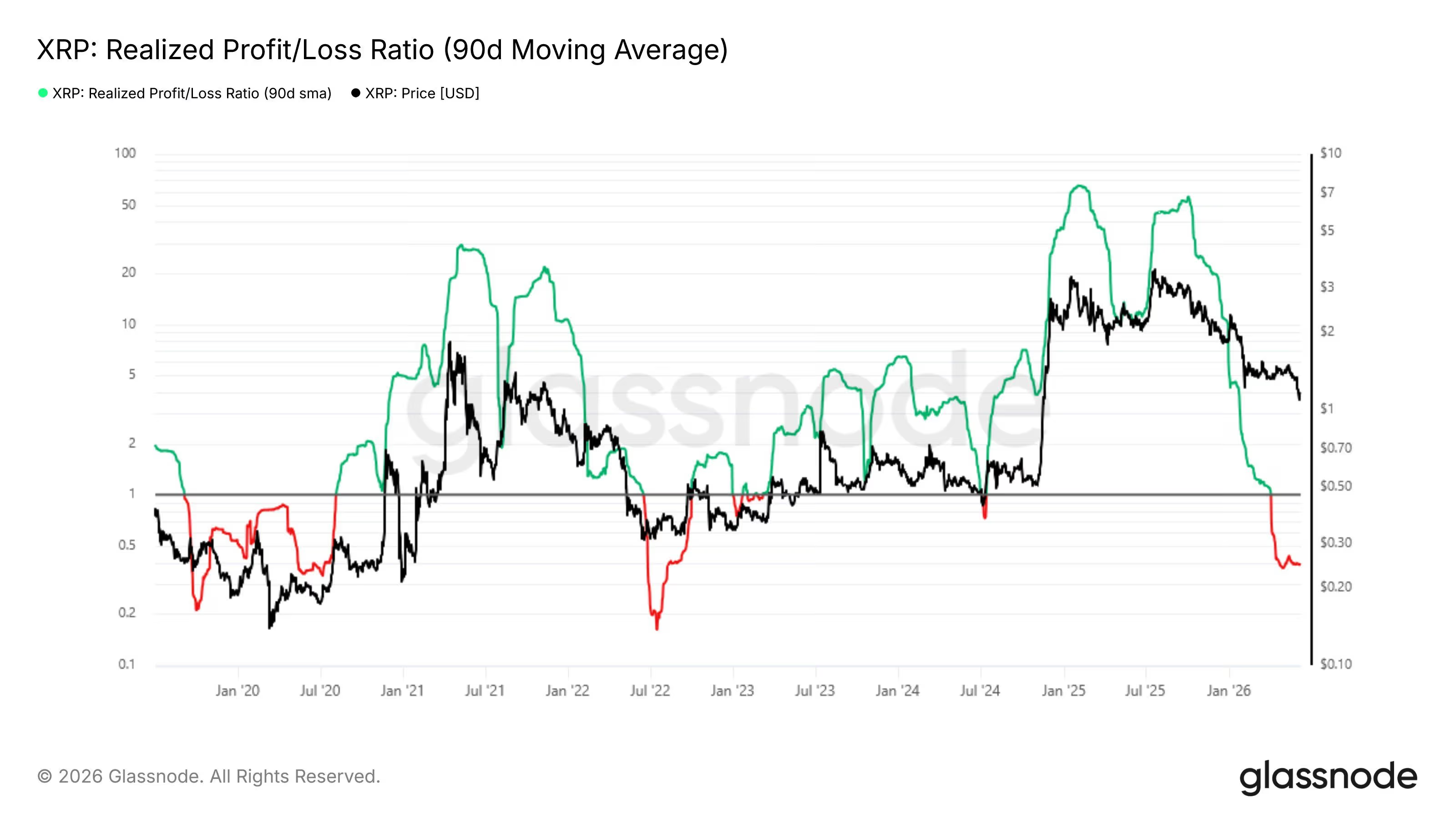
XRP holders are increasingly selling at a loss in a textbook sign of market capitulation.
The 90-day moving average of XRP’s realized profit-to-loss ratio has plunged to 0.38, according to data tracked by Glassnode.
That means for every $1 of losses investors are realizing right now, they are taking in just 38 cents in profit. Essentially, most of the coins trading on the blockchain are underwater.
The situation marks a reversal from the 2025 peak, when the ratio hit 50. At that time, profit-takers were overwhelming loss-sellers by a staggering 50-to-1.

A ratio this far below 1 is widely viewed as a hallmark of capitulation, a market phase where exhausted holders finally throw in the towel and sell, often after bearing the prolonged pain of holding coins in loss. It reflects intense fear or forced selling in the market.
While capitulation doesn’t always mark the exact bottom, it frequently appears near exhaustion points in downtrends. For XRP traders, this could mean that the bear market is in its final stages.
The payments-focused cryptocurrency traded at around $1.11 at press time, down nearly 40% for the year, according to CoinDesk data. Prices peaked above $3.60 last July.
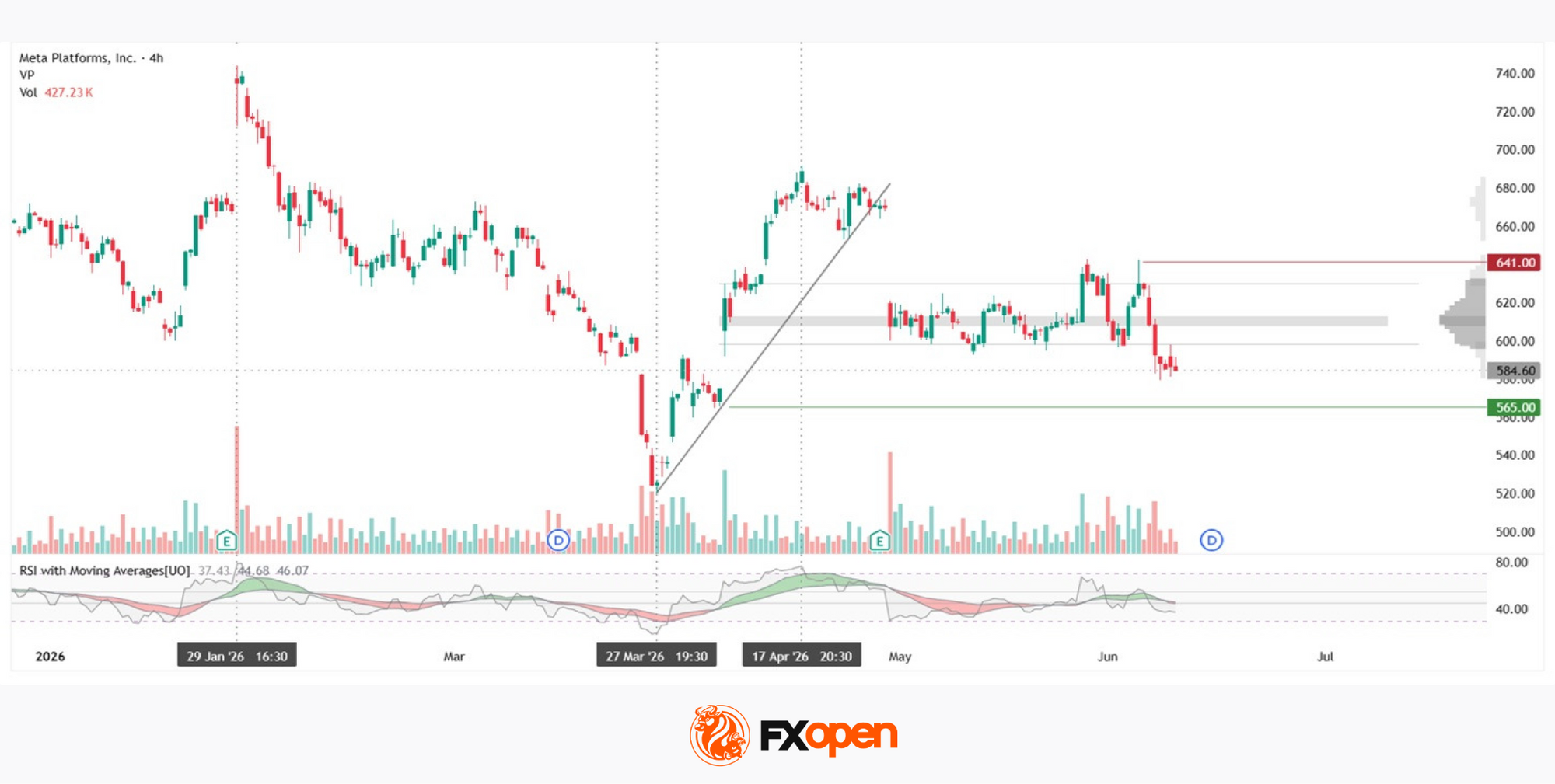
Meta’s revenue rose by 33% year-on-year in the first quarter of 2026, reaching $56.3 billion. Adjusted earnings per share came in at $7.31, comfortably ahead of the consensus forecast of $6.67. However, the positive earnings results were overshadowed by other developments.
Alongside the report, the company raised its 2026 capital expenditure forecast to between $125 billion and $145 billion, which the market interpreted as a signal of potential pressure on free cash flow. Additional pressure on the share price emerged in early June following reports that Meta was considering raising tens of billions of dollars through a new share offering to finance AI infrastructure projects. The company itself dismissed these reports as “pure speculation”.
Technical Picture
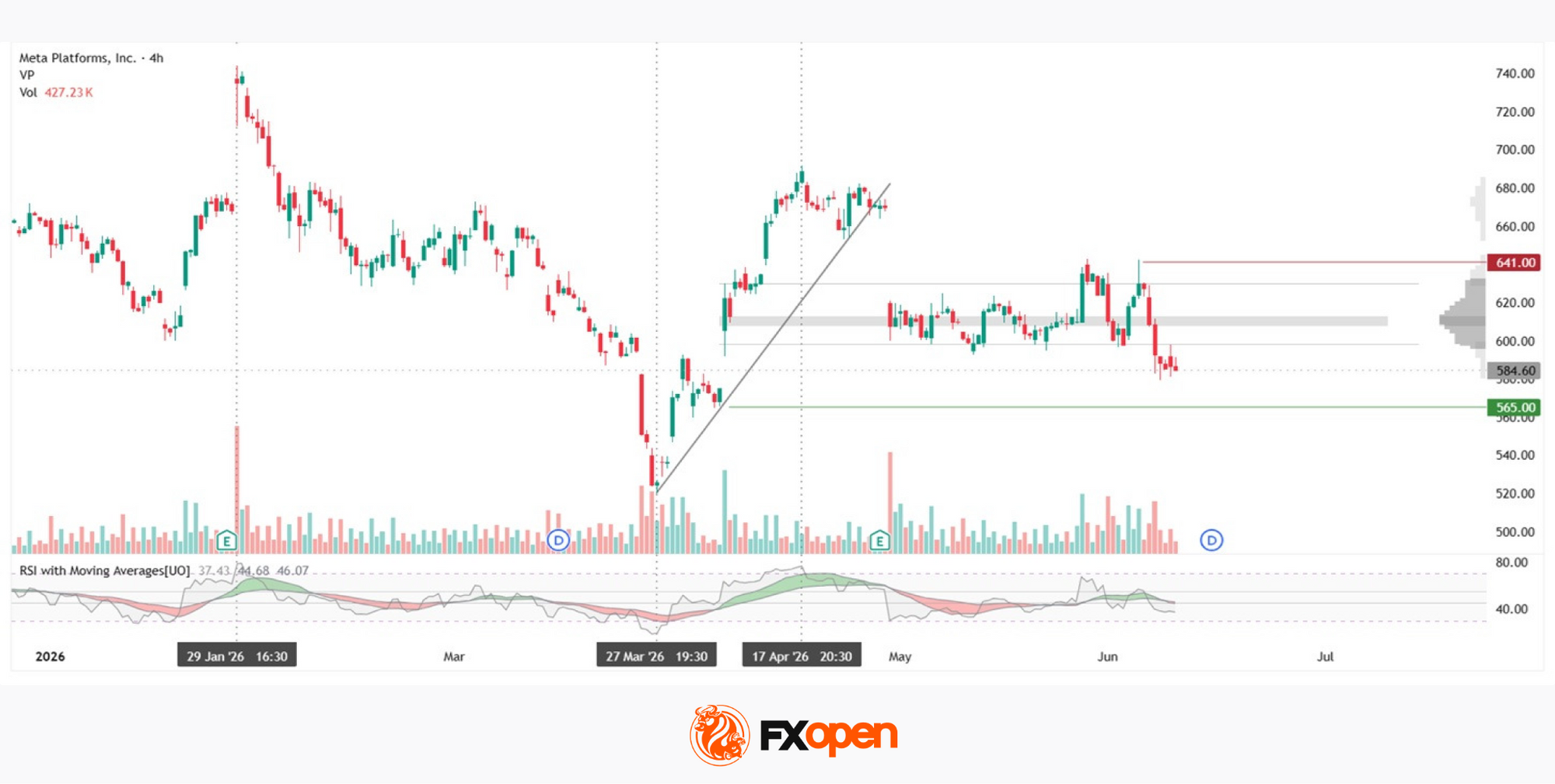
Since the beginning of April, Meta shares had been trading within an ascending trend structure that originated from the March low. Towards the end of April, however, a gap formed on the chart, followed by a break of the trendline. Since then, the stock has entered a sideways phase, losing its previous upward momentum.
The share price is currently trading below the lower boundary of the volume profile at 598 and below the point of control (POC) located in the 610–611 area — levels that could once again attract market attention should buying interest return.
The green support level near 565 may serve as a downside target if selling pressure continues. Meanwhile, the resistance zone around 641 remains the next major upside reference point in the event of a reversal and a break above the upper boundary of the profile.
The RSI and its moving averages currently stand at 37, 44 and 46. The oscillator has moved below the neutral zone, while the moving averages continue to confirm the prevailing bearish direction.
Key Takeaways
Following the break of the ascending trendline and the formation of the April gap, Meta shares entered a consolidation phase and are currently testing its lower boundary. Future price action will largely depend on how transparent management proves to be regarding the financing of its AI initiatives and whether the company can demonstrate that its substantial capital investments translate into tangible operational results.
Buy and sell stocks of the world’s biggest publicly-listed companies with CFDs on FXOpen’s trading platform. Open your FXOpen account now or learn more about trading share CFDs with FXOpen.
This article represents the opinion of the Companies operating under the FXOpen brand only. It is not to be construed as an offer, solicitation, or recommendation with respect to products and services provided by the Companies operating under the FXOpen brand, nor is it to be considered financial advice.

Key Takeaways
- A security breach involving an employee’s laptop led to the exposure of private keys controlling Humanity Protocol’s bridge infrastructure.
- The attackers gained control of three out of six multisig keys, enabling them to manipulate token bridges on both Ethereum and BNB Chain.
- Approximately 141 million H tokens were extracted from Ethereum, while 200 million tokens were illegally minted on BNB Chain.
- H token’s value plummeted more than 85%, declining from approximately $0.67 to bottoming out at $0.05.
- On-chain analysts detected suspicious wallet movements before the attack occurred, though no conclusive evidence of insider involvement has emerged.
Humanity Protocol revealed this Tuesday that cybercriminals successfully extracted more than $36 million in its H token following unauthorized access to private keys housed on a compromised employee computer.
The platform operates cross-chain bridges facilitating H token transfers between Ethereum and BNB Chain networks. These bridges were safeguarded using multisignature wallet technology—a security mechanism demanding multiple key approvals before executing transactions or modifying smart contracts.
According to founder Terence Kwok, the key distribution followed proper protocol across four separate individuals. However, a critical error occurred during the initial configuration phase when several keys were inadvertently stored on one device that subsequently fell victim to compromise.
“Some of the keys were accidentally backed up to a compromised device during setup,” Kwok said.
Breaking Down the Exploit
On Ethereum, the perpetrators secured three of the six keys associated with the bridge’s administrative account. This threshold gave them complete authority over the system. They swapped the authentic bridge smart contract with a fraudulent replacement and extracted approximately 141.2 million H tokens through one massive transaction.
On BNB Chain, the attackers compromised three of five keys. They injected an unlimited minting capability into the bridge contract and exploited it to create 200 million fresh H tokens, transferring them straight into their controlled wallet.
The development team immediately suspended all deposit and withdrawal operations on both compromised bridges upon detecting the security breach.
Market Reaction and Price Collapse
The H token had experienced strong upward momentum during the weeks preceding the breach, surging from approximately $0.20 to $0.70. Following public disclosure of the exploit, the token’s value crashed to around $0.05—representing a catastrophic decline exceeding 85%.
While the token eventually rebounded toward the $0.20 level, significant damage had already occurred. In the aftermath, Humanity Protocol’s team information page was also taken down from their official website.
Investigating the Attack’s Source
On-chain investigator ZachXBT initially raised concerns about potential connections between irregular market-making operations and over-the-counter H token transactions and the security breach. He subsequently clarified that these activities appeared unrelated to the key compromise incident.
Security researcher Elton Shehdula from Allium Labs suggested the blockchain evidence indicated a carefully orchestrated operation. He observed that wallets participating in the attack received funding from both an exchange and a mixing service several weeks beforehand. The attacker also seemingly tested minting permissions days before launching the full-scale exploit, with the drainage occurring simultaneously across both blockchain networks.
Shehdula indicated that such meticulous preparation suggests either an internal threat actor or an external adversary who had maintained covert possession of the compromised key for an extended period.
Cyvers security director Hakan Unal noted that the blockchain evidence presents an ambiguous picture. He explained that authentic external attacks typically display hasty characteristics—rapid fund transfers to newly created wallets, disadvantageous swap rates, and immediate mixer usage. Conversely, orchestrated events may exhibit more controlled timing patterns, particularly coinciding with token unlock schedules or vesting milestones.
Currently, Humanity Protocol states it is collaborating with cryptocurrency exchanges and additional stakeholders to explore potential recovery strategies. The specific circumstances surrounding the initial laptop compromise remain undisclosed to the public.
Carmen Electra wants an 'edgy' comeback role just like Pamela Anderson

#motivation #top10richestperson #money

Toyota crashes into A47 barrier as drivers told ‘avoid area’



-

 Fashion5 days ago
Weekend Open Thread: Evereve – Corporette.com
-
 Crypto World5 days ago
Jensen Huang Approves Samsung, SK Hynix, and Micron for NVIDIA (NVDA) HBM4 Memory Supply
-
 Entertainment3 days ago
The Best Mystery Series of All Time Is Surging on Streaming 30 Years After It Ended
-

 Crypto World2 days ago
Anatomy of the June crypto crash: Fed, Iran, Saylor
-

 NewsBeat2 days ago
Alexander Zverev wins the French Open to finally earn a 1st Grand Slam title
-

 Tech4 days ago
Suspicious Polyfill login prompts pop up on Toshiba, Muji websites
-
Crypto World4 days ago
Senator Cynthia Lummis Calls CLARITY Act the Most Consequential Financial Legislation of This Generation
-
 Tech3 days ago
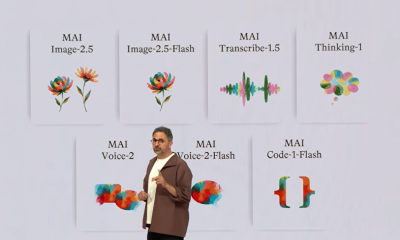
Microsoft unveils seven homegrown AI models in new bid for ‘long term self-sufficiency’
-

 Tech5 days ago
Microsoft launches MXC, an OS-level sandbox for AI agents, with OpenAI and Nvidia already on board
-

 Business5 days ago
(VIDEO) Justin Bieber Delivers Surprise Happy Birthday Serenade to Diners at Los Angeles Mexican Restaurant
-
 Business3 days ago
The Pain Points Taking a Fragile Tech Rally Down a Notch
-
Crypto World5 days ago
LBank Surpasses 25 Million Users Worldwide as AFA Partnership Continues to Drive Global Growth
-

 Crypto World3 days ago
Trump’s AI Ownership Plan Could Benefit Anthropic at OpenAI’s Expense
-

 Tech5 days ago
Meta steals a tactic from Tesla and builds data centers in tents
-

 Tech4 days ago
Von der Leyen’s AI envoy pick draws conflict-of-interest fire
-
 Sports17 hours ago
Bangladesh beat Australia after 20 years in ODIs, register only their second win over six-time world champions | Cricket News
-

 Business2 days ago
High Stakes for Wembanyama as New York Pushes for 3-0 Lead
-
 Crypto World2 days ago
Eli Lilly (LLY) Stock Surges 4% Following Breakthrough Sleep Apnea Trial Results
-

 Tech4 days ago
Hackers now exploit SolarWinds Serv-U flaw to crash servers
-

 Tech2 days ago
Notion restores access to Anthropic after service disruption
You must be logged in to post a comment Login