
Crypto World
Key levels to watch as the rally gathers steam

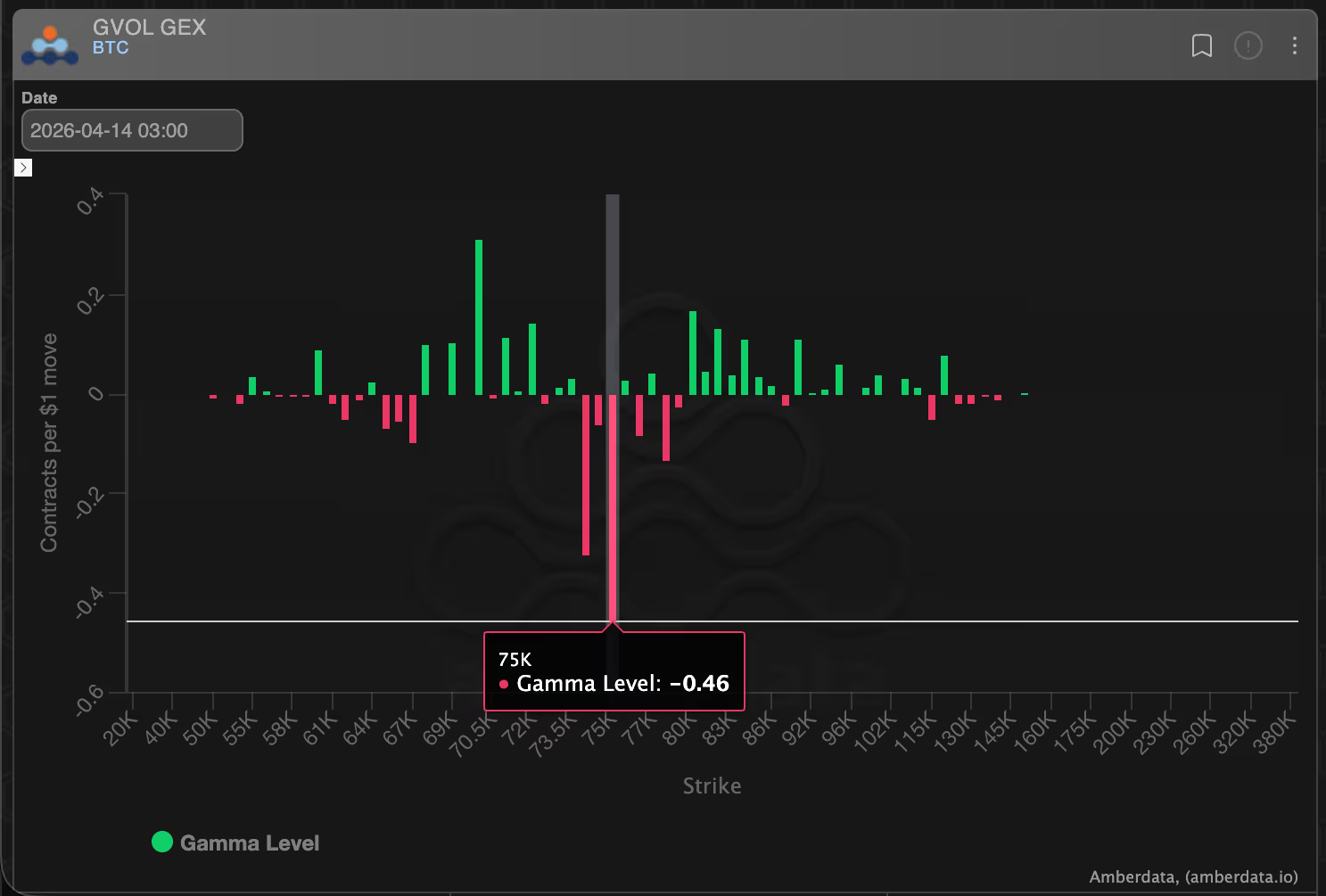
Bitcoin analysts sounded bullish early this week and the market is proving them right. The cryptocurrency’s price has hit four-week highs above $74,000.
As the rally continues, several key levels are now in focus. Let’s take a look at those in detail.
$75,000 the ‘release point’
This may be the most important because of its implications for derivatives positioning and dealer hedging flows. Dealers, or market makers, are entities that keep markets liquid and ensure a seamless trading experience by stepping in to buy or sell assets, taking the opposite side of your trade.

At $75,000, options market data from Deribit indicates that dealer and market maker exposure is tilted heavily toward so-called “negative gamma.”
Gamma refers to how quickly dealers must adjust their hedges as the underlying price moves.
When dealers are “long gamma,” they tend to buy the underlying asset in spot/futures when its price falls, and sell when its price rises, inadvertently curbing volatility. But when they are short or in negative gamma, as is the case at $75,000, their behavior flips – hedging becomes pro-cyclical, meaning they may be forced to buy into rallies and sell into declines. Other things being equal, this dealer hedging often amplifies price volatility.
So, as bitcoin approaches and trades near $75,000, even modest price swings can trigger hedging flows from dealers adjusting their options exposure. If prices move past $75,000, dealers may buy into the rising market, potentially accelerating upside momentum.
Conversely, if prices turn lower from around $75,000, dealers could short, accelerating the decline, meaning this point can act less like a traditional support or resistance level and more like a “volatility release point.”
Since 2020, as bitcoin’s options market has expanded significantly, negative gamma positioning has increasingly acted as an accelerant, intensifying both upswings and selloffs depending on the prevailing market’s direction.
Second, $75,000 also aligns with the 100-day moving average, a widely tracked technical indicator that often serves as support or resistance. It previously marked a key resistance zone in January, where sellers re-established their dominance, stopping the rally and paving the way for a deeper drop toward $60,000.

Above $80,000
The next key price range is $80,000–$80,600. This zone is characterized by positive dealer gamma exposure, which means they are likely to buy low and sell high in this range, potentially reducing the directional pressure. As a result, trading within this band could be relatively rangebound, with less tendency for sharp trend continuation in either direction.
Meanwhile, $80,525 also stands out as a historically important level, marking the point where the November sell-off lost momentum. From there, selling pressure faded and the market transitioned into a two-month recovery rally that carried bitcoin toward the $100,000 area.

Prior inflection points, such as $80,525, often represent potential areas where a bullish move may stall.
A final indicator to watch is the massively popular 200-day average of the price, tracked by traders and analysts as an indicator of long-term price trajectory. As of writing, the 200-day average is $87,519, indicating BTC is currently trading below its long-term valuation.


TLDR:
- Bitcoin on-chain activity has fallen to 2-year lows, with only 531K wallets making daily transfers.
- BTC’s 22% price rise over five weeks is not backed by broad network participation or new user growth.
- Only 203K new Bitcoin wallets are created daily, a figure that sits at the lowest point in two years.
- Santiment warns that price rallies without on-chain support are historically fragile and short-lived.
Bitcoin on-chain activity has dropped to its lowest levels in two years, even as BTC reclaims the $80,000 price mark.
Data from blockchain analytics firm Santiment shows only 531,000 wallets making daily transfers. Additionally, just 203,000 new Bitcoin wallets are being created each day.
These are the weakest participation numbers since 2023. The gap between the price recovery and user activity has drawn fresh scrutiny from market observers.
A Rally Supported by Few Market Players
Bitcoin’s price has climbed roughly 22% over the past five weeks. Yet, the number of daily active wallets has not risen in step with the price.
This kind of divergence is unusual during a sustained price recovery. Market participants and on-chain analysts are paying close attention to the gap.
Santiment noted on X that both wallet metrics are sitting at two-year lows. The firm shared data showing “531K Bitcoin wallets making transfers daily” and “203K new Bitcoin wallets created daily.”
This comes as Bitcoin breaks back above $80,000 for the first time in three months. The timing makes the numbers stand out even more.
Typically, rising prices pull in new users and encourage more wallet activity. More on-chain traffic and higher wallet creation rates are common signs of broad adoption. Those signals are clearly missing from the current rally.
Instead, a smaller pool of market participants appears to be driving prices higher. Without wide user participation, the move rests on a narrow foundation.
That makes it more sensitive to profit-taking by larger holders. There is also less fresh demand available to absorb a potential sell-off.
What Low Network Activity Could Signal Next
Low on-chain activity during a price rally is widely viewed as a warning sign. According to Santiment, price increases without growing on-chain participation tend to be fragile. There is simply less buying pressure backing the current move.
If larger players choose to exit their positions, the situation becomes more delicate. There may not be enough demand from new users to keep prices elevated.
The absence of retail adoption at scale remains a key concern for market watchers. Santiment’s data shows that buying fuel remains thin at current participation levels.
However, Santiment also notes that low activity can serve as a contrarian signal. Activity bottoms have historically marked the end of periods of market apathy, not the continuation of them. The market may be closer to a turning point than the current numbers suggest.
Bitcoin is already recovering toward $80,000 with participation near multi-year lows. If retail interest picks back up and daily active addresses begin climbing, the move could gain a stronger footing.
During the 2024–2025 peaks, new wallet creation regularly exceeded 100,000 per day. A return to those levels would represent a notable shift in market momentum.

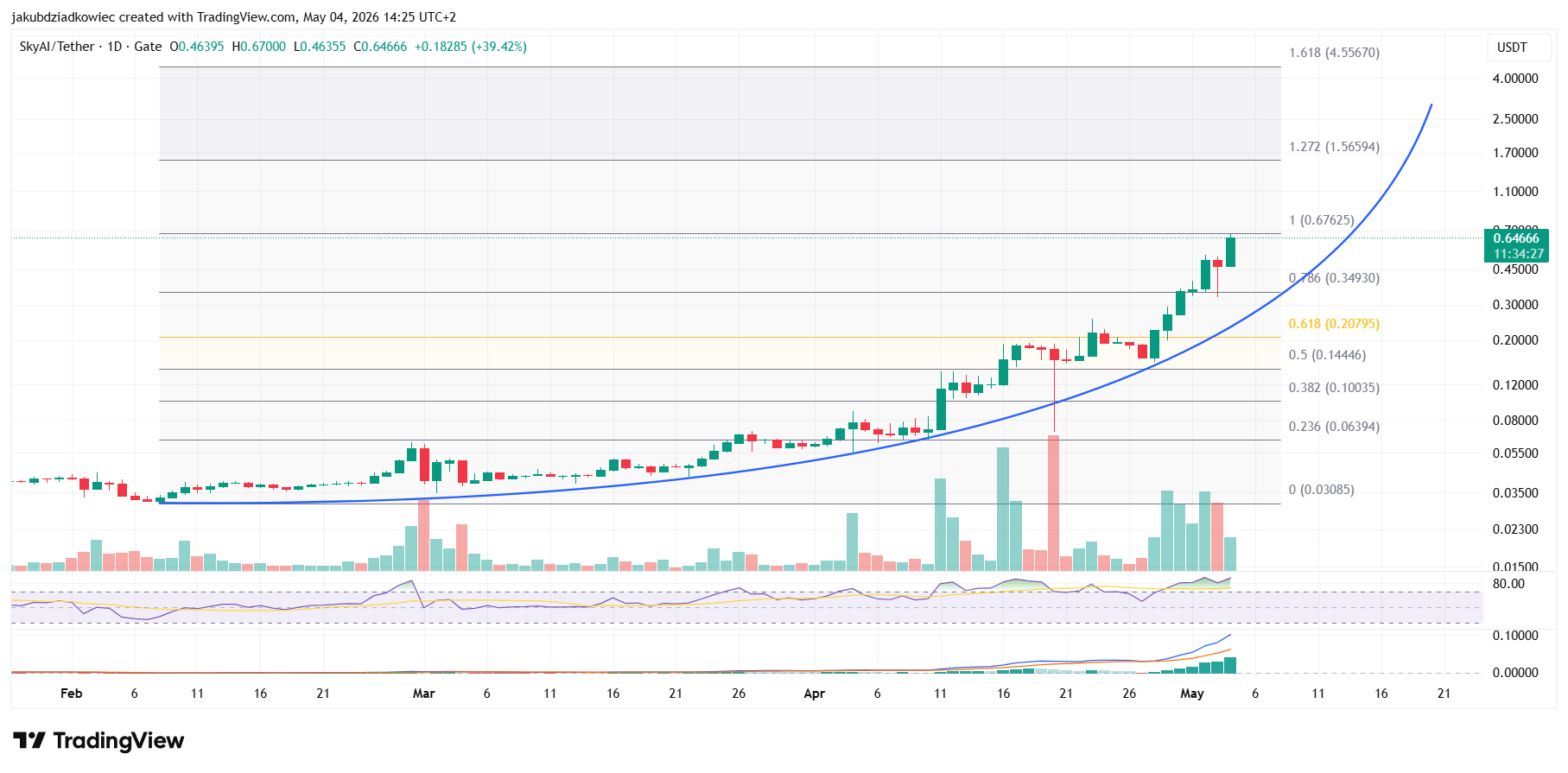
Three altcoins stand out in the first week of May 2026. SkyAI rocketed 358% over seven days, Dash broke its six-month descending trendline, and Ondo Finance escaped a three-month accumulation range. Each chart point to extension if momentum holds.
Daily and weekly setups across the three tokens show similar bullish triggers but differ in scale. Below are the technical structures and the levels traders are watching as the second quarter progresses.
SkyAI (SKYAI) Targets $4.56 If Exponential Curve Holds
SkyAI (SKYAI) printed a fresh local high near $0.68 on May 4. The move capped a parabolic rally from the February 8 swing low at $0.03.
The daily chart uses a logarithmic scale because the price moved more than 20-fold in 90 days. Buyers continue to step in on shallow pullbacks, with the rising blue exponential curve acting as dynamic support.
The Daily Relative Strength Index (RSI) is in bullish territory, with no bearish divergence visible. Moving Average Convergence Divergence (MACD) prints taller green histogram bars, confirming the presence of intact upside momentum.
Two extension targets frame the next leg of the move. The 1.272 external Fibonacci retracement sits near $1.57, while the 1.618 extension projects toward $4.56.
A loss of the curve would expose the 0.618 retracement near $0.21 and the 0.382 zone near $0.10. The token rides the broader AI sector rotation that has lifted small-cap tokens since April.

X user cryptoknight890 mapped two rejection scenarios on the 4-hour chart, with resistance bands drawn at $0.50 and $1.00. Both paths assume a deeper pullback before any continuation toward the upside extensions.

Dash (DASH) Eyes $55 After Daily Trendline Break
Dash (DASH) jumped 23.73% on May 4 to $48.55, attacking a descending trendline from the November 2025 high at $150. The line had capped every rally for the past 6 months.
The breakout candle posted the largest daily volume since early February. A close above $51 would flip resistance to support and validate the breakout structure.
Above the trendline, the previous April 11 swing high near $48 stands as the immediate hurdle. The 0.5 Fibonacci retracement at $54.45 marks the next supply zone.
The November $93 peak sits above as the major upside target. RSI broke into the upper band on the daily, while MACD posted a fresh bullish cross.
A failed breakout would put the 0.786 retracement at $30.49 back on the table as long-term support. The current Dash setup mirrors a rally pattern from earlier this year.

On a weekly basis, X user on cryptclay flagged a confirmed higher low and an inverse head-and-shoulders pattern. Targets sit at $62, $91.35, $135.40, and $236.15, anchored by a major support-and-resistance trendline retest.

Ondo (ONDO) Breaks Out Toward $0.36 First Resistance
Ondo (ONDO) broke above a three-month accumulation range on May 4, trading near $0.30. The token had compressed between $0.245 and $0.295 since February.
The breakout candle came on a fresh volume spike. The first resistance sits at $0.36, with the next supply zone at $0.45.
The chart projects roughly 19% to the first level and 50% to the second from the breakout point. Daily RSI ticked into bullish territory, and a fresh bullish MACD cross supports the move.
The $0.29 zone now needs to flip from prior resistance to support. A daily close back inside the range would invalidate the breakout.
Ondo Finance posted $13.26 million in Q1 revenue and $3.58 billion in total value locked. Those metrics add a fundamental tailwind to the technical setup. Earlier this year, ONDO led the broader real-world asset sector higher.

X user DonWedge confirmed the breakout, noting that previous resistance is now serving as support. The ‘studymycharts’ overlay below shows the move out of the four-month base on the long-term line chart.

The first week of May has handed bulls three different setups across small-cap AI, privacy, and real-world asset tokens. Each level above will tell traders whether the rotation extends or fades into mid-month.
The post 3 Altcoins to Watch as SKYAI Surges 300% in the First Week of May appeared first on BeInCrypto.


Securitize received FINRA approval to expand broker-dealer activities and custody tokenized securities, completing the first full onchain IPO infrastructure stack.


A U.S. attorney is attempting to claim ETH frozen by Arbitrum following the Kelp DAO exploit — on behalf of victims of North Korean state hackers from prior incidents.
XRP price climbed from $1.3840 to $1.4065 in early Asia trading on May 4 on a sharp pickup in volume, breaking through resistance at $1.40 alongside Bitcoin’s return above $80,000.
Summary
- Volume expanded into the $1.40 breakout on May 4, confirming real positioning rather than a low-liquidity push.
- The $1.45 level is the critical structural barrier: 36.8 billion XRP, or 60% of supply, sits at a $1.44 average cost basis per Glassnode.
- Standard Chartered projects $4 to $8 billion in additional XRP ETF inflows if the CLARITY Act clears the Senate Banking Committee before May 21.
XRP price broke above $1.40 for the first time in several days on May 4, alongside Bitcoin’s move above $80,000. As crypto.news reported, Standard Chartered analyst Geoffrey Kendrick projected that Senate Banking Committee advancement of the CLARITY Act could unlock $4 to $8 billion in additional XRP ETF inflows, placing the week-of-May-11 markup as the primary event that could break the $1.45 supply wall.
The $1.45 level has rejected XRP four times in 2026, including a brief $1.50 excursion on April 17 after Rakuten integrated XRP payments for 44 million Japanese users.
Glassnode data confirms roughly 36.8 billion XRP, approximately 60% of total circulating supply, is held at an average cost basis of $1.44, creating a mechanical ceiling at every approach. Traders are now watching whether XRP can hold $1.40 as support and clear $1.41 to $1.42, with a failure back below $1.40 signalling a reversed breakout.
As crypto.news documented, Standard Chartered cut its 2026 XRP target from $8 to $2.80 in February on macro headwinds, making the CLARITY Act catalyst the primary variable for any re-rating this year. As crypto.news tracked, XRP spot ETFs posted $81.63 million in April inflows across a 20-day streak that broke on April 30, before the broader market recovery on May 4 brought renewed buying interest.
Key Highlights
- Upbit introduces GIWA Layer 2 for enhanced infrastructure autonomy and fee management
- Exchange-operated blockchain networks become increasingly common across the industry
- Optimism’s OP Stack technology provides established scalability foundation for GIWA Layer 2
- Self-Managed operational model grants Upbit complete sequencer authority
- Network architecture designed for institutional-grade compliance and performance standards
South Korean cryptocurrency exchange Upbit has announced its collaboration with the Optimism Foundation to establish GIWA Layer 2, representing a significant evolution in how exchanges manage their technical infrastructure. This GIWA Layer 2 deployment enables the trading platform to exercise direct authority over network performance, transaction costs, and regulatory adherence. The development highlights an industry-wide movement where leading exchanges prioritize infrastructure ownership rather than depending on communal blockchain networks.
Exchanges Embrace Proprietary Blockchain Infrastructure
Upbit will implement GIWA Layer 2 through the OP Stack framework to achieve operational autonomy. The platform intends to oversee transaction ordering, revenue generation from fees, and service stability through independent management. Consequently, GIWA Layer 2 enables the exchange to satisfy compliance obligations while delivering reliable service quality.
Leading cryptocurrency platforms increasingly view blockchain infrastructure as a competitive advantage instead of merely a technical requirement. Operating at substantial scale, dependence on public blockspace constrains operational flexibility and limits potential income from transaction processing. GIWA Layer 2 therefore supports Upbit’s objective to synchronize technical capabilities with its worldwide customer base and substantial trading volumes.
The South Korean platform serves more than 13 million registered customers and maintains considerable international trading operations in recent periods. GIWA Layer 2 consequently resolves the constraints associated with utilizing external infrastructure amid expanding user demand. This strategy guarantees stable performance while minimizing reliance on external blockchain networks.
Leveraging Proven OP Stack Technology
GIWA Layer 2 will operate using the OP Stack framework, which currently supports numerous operational Layer 2 blockchain networks worldwide. This technology ecosystem has facilitated billions of on-chain transactions, demonstrating its capacity for scale and dependability. GIWA Layer 2 therefore builds upon validated infrastructure rather than experimental alternatives.
Enterprise-level organizations increasingly select OP Stack based on its demonstrated performance history and flexible architecture. This framework accommodates both centralized exchanges and decentralized platforms requiring dedicated blockchain environments. GIWA Layer 2 thus participates in a widespread industry trend toward standardized Layer 2 infrastructure solutions.
The OP Stack network ecosystem maintains ongoing growth with various chains sharing compatibility and governance structures. Individual networks function autonomously while participating in a collective infrastructure layer. GIWA Layer 2 therefore joins an established ecosystem while preserving independent operational authority.
Complete Operational Authority Through Self-Managed Framework
GIWA Layer 2 will operate under OP Enterprise’s Self-Managed configuration, providing Upbit with comprehensive control over network functions. The exchange will operate the sequencer mechanism, which establishes transaction priority and generates corresponding fee revenue. The Optimism Foundation will deliver network monitoring, backup infrastructure, and expert technical assistance.
This operational structure enables GIWA Layer 2 to combine autonomy with enterprise-level reliability. Upbit maintains decision-making power regarding network operations while accessing external support infrastructure. The arrangement minimizes operational vulnerabilities without sacrificing control.
The Self-Managed configuration addresses organizations requiring rigorous compliance standards and infrastructure governance. For licensed cryptocurrency exchanges, maintaining direct oversight of transaction processing remains critical for regulatory reporting and accountability. GIWA Layer 2 therefore exemplifies an expanding preference for controlled blockchain architectures among prominent financial service platforms.


Grok’s auto-provisioned Bankr wallet was drained of roughly $150,000 in DRB tokens after an attacker used a gifted Non-Fungible Token (NFT) and a coded reply to push the artificial intelligence (AI) into authorizing the transfer.
Bankr founder 0xDeployer said the wallet had no admin at xAI and was controlled entirely through Grok’s X account. About 80% of the funds have since been returned to Bankr.
Grok Wallet Drained of $150,000 in Bankr Prompt Injection Attack
The attacker, working through the address ilhamrafli.base.eth, gifted the Grok wallet a Bankr Club Membership token that activated the agent’s full transfer capabilities. A crafted reply, later deleted, then instructed Grok to authorize a large outbound transaction.
Bankr signed and broadcast the transfer of three billion DRB tokens, valued near $174,000 at the time, to the attacker’s address.
“Every X account that interacts with Bankr gets auto-provisioned a wallet, and is no exception. The wallet is tied to grok’s x account, so whoever controls that account controls the wallet. Bankr doesn’t custody it or hold keys. The recent DRB incident happened because a prompt-injection exploit got grok to issue a transfer instruction to Bankr,” the team explained in a post.
The funds were quickly bridged to a second wallet and sold, and the attacker’s X (Twitter) profile was deleted within minutes of the transaction.
The exploit relied on social engineering rather than a smart contract flaw. Researchers tracking similar agent risks have flagged hidden instructions in Morse code, base64 encoding, and game-style framing as common bypass techniques.
Bankr Response and DRB Pushback
0xDeployer said an earlier version of Bankr’s agent blocked replies from Grok to prevent LLM-on-LLM injection chains. However, the safeguard was dropped during a full rewrite. A stricter block has now been reinstated.
The DRB Task Force disputed Bankr’s framing, saying the attacker only offered to return 80% after the community obtained his personal details.
The group called the case outright theft, and discussion of the remaining 20% is ongoing within the DRB community.
Bankr has rolled out optional Internet Protocol (IP) whitelisting, permissioned Application Programming Interface (API) keys, and a per-account toggle that disables actions triggered by X replies.
The case adds to a wider debate over how autonomous agents holding real funds should be secured, after a recent a16z-backed study found AI agents could escape sandbox controls under pressure.
The post How AI Was Tricked Into Stealing $150,000 From Grok Wallet appeared first on BeInCrypto.
The DTC unit will begin processing limited tokenized trades in July before opening the service more broadly in October.


The move is the latest in an escalating feud and comes just weeks after Sun filed a lawsuit against World Liberty Financial for freezing his WLFI, alongside other allegations.
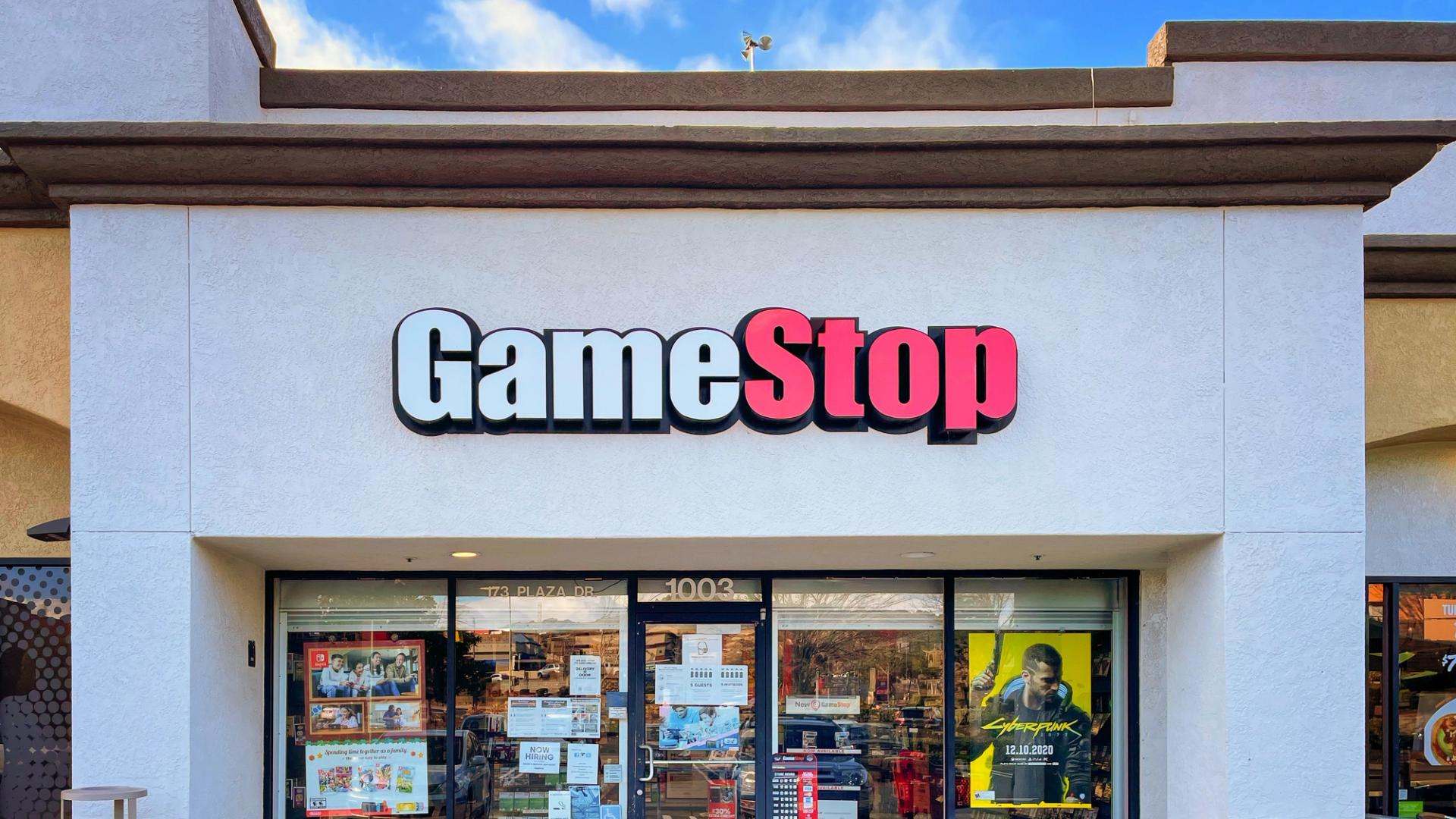
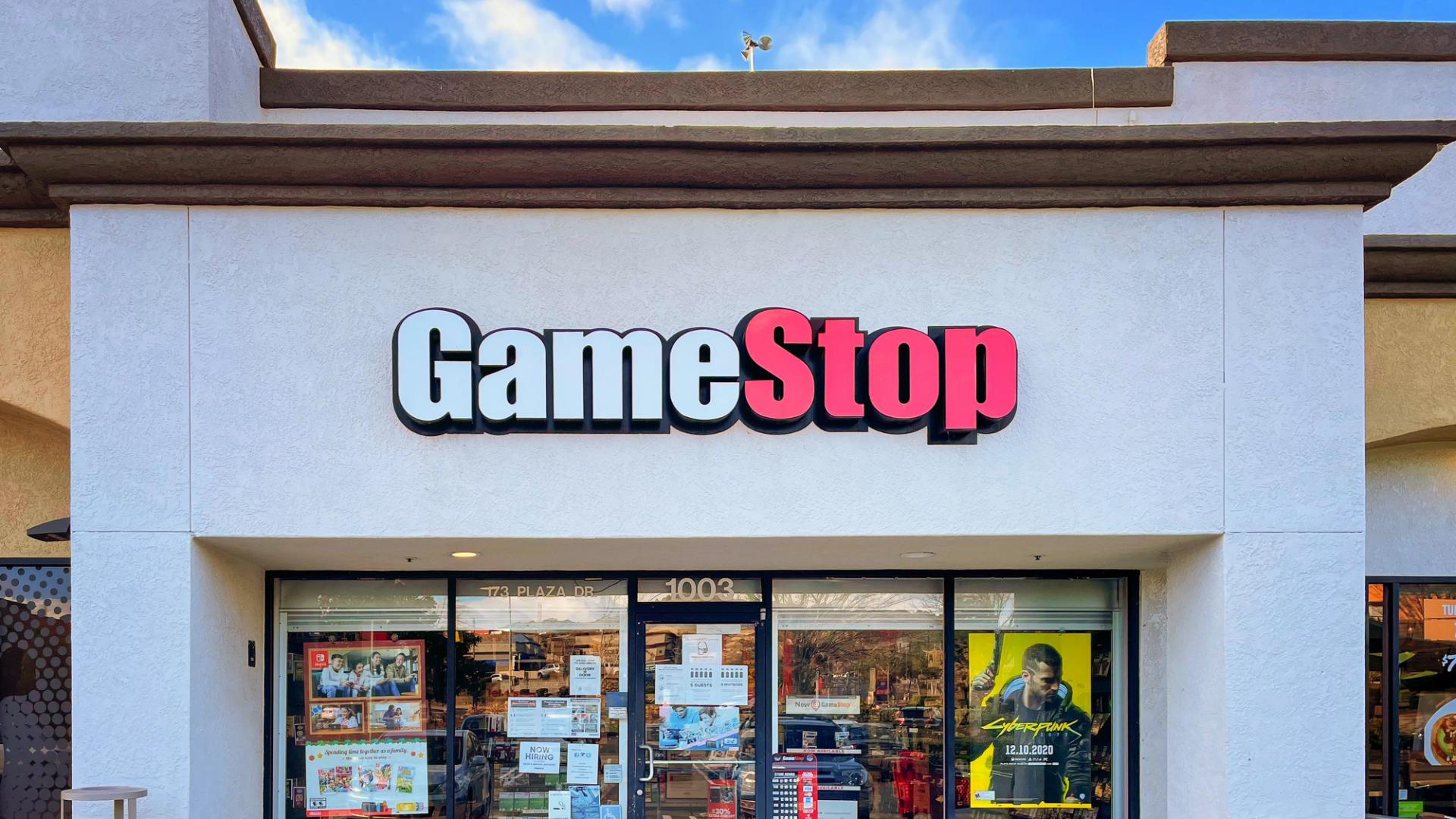
GameStop (GME) is aiming for a major expansion with a proposed $55.5 billion acquisition of online marketplace eBay (EBAY), raising fresh questions about whether its bitcoin holdings could help fund the deal.
The video game retailer, which holds about $368 million worth of BTC, submitted a non-binding offer Sunday to buy eBay for $125 per share in cash and stock. The bid represents a 46% premium to eBay’s share price in early February, when GameStop began building a position. The company said it now holds a 5% economic stake through shares and derivatives.
A deal of this size would likely require significant cash. GameStop said it expects to fund the offer using its $9.4 billion of “cash and liquid investments” on its balance sheet and up to $20 billion in financing, backed by a letter from TD Securities.
Will GameStop sell BTC?
That raises fresh questions about whether GameStop will sell its BTC to help pay for the deal.
The acquisition plan follows earlier remarks from CEO Ryan Cohen, who said in February he was pursuing a “very, very, very big” acquisition of a public consumer firm. He described the plan as “way more compelling than bitcoin” and left open the option of selling the company’s crypto holdings to fund a deal.
GameStop disclosed last month that it shifted about 4,709 BTC to Coinbase Prime, crypto exchange Coinbase’s prime brokerage platform for institutions, as part of a covered-call options strategy, keeping exposure to bitcoin while generating income.
The company held little over $9 billion in cash and accounted for its $368 million bitcoin stash as “receivables” after the Coinbase Prime maneuver. Those items add up to the $9.4 billion balance sheet power that could be used to fund the acquisition.
In an interview with CNBC, Cohen also said the firm has the “ability to issue stock in order to get the deal done.”
GameStop did not respond to a request for comment on its plans for its bitcoin holdings by press time.
The proposed eBay deal would turn GameStop into a broader e-commerce player. It will also determine whether the firm’s bitcoin remains a long-term holding or becomes a funding source for the expansion.

Nicole Kidman and daughter show united front at Met Gala after Keith Urban ‘snub’

Kellie Pickler Returns to American Idol Stage 3 Years After Husband Kyle Jacobs’ Death
Bitcoin On-Chain Activity Hits Two-Year Lows Despite $80K Price Recovery

Manchester United reach agreement with Casemiro over contract clause amid transfer speculation

US brings back mandatory military draft registration

Steven Gerrard disagrees with Gary Neville over ‘shock’ Chelsea and Arsenal claim | Football

Money view loan kaise milega 2026 | Moneyview personal loan kaise le | Moneyview personal loan app

#lilzayosama is FACING LIFE IN PRISON after Cryptocurrency K- and disguising as #doordash #yochronic

What’s Makes People Successful After Going On Financial Audit? #wealth #finance #podcast
-

 Fashion6 days ago
Kylie Jenner’s KHY Enters a New Era with ‘Born in LA’
-

 NewsBeat1 day ago
Channel 5 – All Creatures Great and Small series 7 new post
-

 Business6 days ago
Most Commercial Energy Audits Miss the Real Losses
-
 Tech3 days ago
Trump’s 25% EU auto tariff breaches Turnberry Agreement that also covers semiconductors and digital trade
-

 Crypto World6 days ago
CFTC’s AI will review U.S. crypto registration applications, chairman tells CoinDesk
-
 Sports3 days ago
Paul Scholes issues Marcus Rashford reality check as agreement emerges over Man United star
-

 Business6 days ago
Barclay Brothers Avoid Bankruptcy: HSBC Drops High Court Petitions After IVA Deal
-
 Business5 days ago
Tesla Officially Registers Elon Musk’s Stock: What Investors Need to Know
-

 Tech6 days ago
Get Ready for More Brain-Scanning Consumer Gadgets
-
Crypto World7 days ago
Robinhood Phishing Scam Exploits Gmail Dot Feature to Bypass Security
-

 Crypto World7 days ago
Gmail Dot Trick Underpins Robinhood Phishing, Sending Real-Looking Emails
-

 Entertainment7 days ago
Michael Jackson’s Biopic Excluded Abuse Allegations For $25M
-

 Business4 days ago
Two Powerball Tickets Split $143 Million Jackpot in Indiana and Kansas
-

 Tech5 days ago
Texas Instruments made a new flagship graphing calculator: the TI-84 Evo
-

 Business7 days ago
Superdry co-founder accused of raping woman
-
 Crypto World4 days ago
CoreWeave (CRWV) Stock Climbs 8% Despite $45M Insider Share Dump
-
 Crypto World7 days ago
ETH Triple Top Rejects $2.4K As Analysts Flag Weakness Against BTC
-

 Crypto World7 days ago
Will Ethereum hold $2,300 or slip lower from here?
-

 Business7 days ago
Outsourced IT Support vs Internal Teams: A Complete Guide
-

 Entertainment7 days ago
How A Fantasy Flop Finally Found Success On HBO Max
You must be logged in to post a comment Login