
Crypto World
Key On-Chain Legal Developments This Week

US regulators have issued long trading and registration bans against two former FTX-linked executives as part of civil enforcement tied to the exchange’s collapse. In a separate SDNY matter, prosecutors are pushing back on a motion to dismiss in a case involving alleged insider betting on Polymarket.
Taken together, the rulings and filings underscore how US oversight is extending beyond criminal proceedings—using civil instruments to restrict market access and to continue pursuing novel questions around how prediction-market “event contracts” should be treated under federal commodities law.
Key takeaways
- The CFTC entered consent orders imposing five-year trading bans on Caroline Ellison and Zixiao “Gary” Wang, tied to their FTX roles.
- Those same orders also add registration bans—10 years for Ellison and eight years for Wang—separately from criminal outcomes.
- In SDNY, prosecutors opposed a motion to dismiss filed by a US soldier accused of more than $400,000 in alleged nonpublic-information trades on Polymarket.
- The government argued the defendant’s “ambiguous” Commodity Exchange Act theories raise issues that are not appropriate for a motion-to-dismiss stage.
CFTC consent orders: Ellison and Wang face trading and registration bans
On Tuesday, the US District Court for the Southern District of New York (SDNY) entered consent orders connected to a 2022 enforcement action brought by the US Commodity Futures Trading Commission (CFTC). The orders involve former Alameda Research CEO Caroline Ellison and FTX co-founder Zixiao “Gary” Wang.
Under the CFTC’s terms, both individuals received a five-year trading ban related to their positions in the events surrounding FTX’s collapse. The Commission also required additional restrictions on each executive’s market-facing activities: Ellison was ordered to undergo a 10-year registration ban, while Wang received an eight-year registration ban.
According to CFTC enforcement director David Miller, the restrictions were imposed in recognition of what the CFTC characterized as Wang’s and Ellison’s “material assistance in the Commission’s FTX-related investigations.”
Importantly, the civil case handled through these consent orders is separate from criminal proceedings tied to allegations that customer funds were misused at FTX. Earlier criminal outcomes included a two-year prison sentence for Ellison and a “time served” outcome for Wang, as reported in coverage of the parallel matters.
Why these civil bans matter after criminal cases
Civil enforcement actions like these can still shape the post-FTX landscape even when criminal cases are winding down. Trading bans and registration bans directly affect whether a person can participate in regulated market activity, which can have longer operational consequences than criminal sentencing alone.
Here, the CFTC’s approach also highlights a key feature of how US financial regulators pursue accountability: consent orders can produce fast, court-approved restrictions without the need for a contested merits ruling in the civil case itself. While the underlying criminal cases address criminal liability, these orders focus on deterrence and on limiting future involvement in regulated trading and registration.
For market participants, the practical effect is clear: even as FTX’s executive-level criminal cases progressed on a separate track, the CFTC’s civil process kept moving to close off future access to trading and registration for key figures connected to the firm’s failure.
SDNY dispute over Polymarket insider-betting allegations
In another SDNY filing released this week, lawyers for the US government opposed a motion to dismiss from Gannon Ken Van Dyke, a US soldier accused of using nonpublic information to generate more than $400,000 through event contracts on the prediction market platform Polymarket.
Prosecutors say Van Dyke’s trading was connected to a military operation involving the removal of Venezuelan President Nicolás Maduro in January. The defense motion, filed on July 31, sought dismissal of charges by arguing that the Commodity Exchange Act—the legal framework at the center of three of the charges—was “ambiguous” in treating event contracts as “swaps” within the CFTC’s jurisdiction.
In the government’s Wednesday opposition filing, prosecutors contended that Van Dyke’s argument depended on hypothetical scenarios and broader questions about “ongoing litigation over state gaming laws,” which they said were unnecessary for the court to resolve at the motion-to-dismiss stage.
“Van Dyke’s motion asks the Court to make a factual determination not appropriate at the motion-to-dismiss stage,” SDNY Deputy US Attorney Sean Buckley argued in the filing. Buckley said the defendant’s approach relied on speculative assertions about facts drawn from the indictment and “incorrect conclusions” about the nature of the charge, particularly with respect to whether the alleged conduct involved “property.”
As of Friday, the court had not posted a decision on the motion to dismiss to the public docket.
How the case frames event contracts as commodities
The procedural fight in the Polymarket matter is significant because it turns on how the Commodity Exchange Act applies to event contracts—an issue that has been central to the government’s theory of the case. Van Dyke’s defense attempts to recast the charging statute as too uncertain, while prosecutors argue the legal and factual issues raised by the defense are premature.
For traders and platform users, the broader stakes are about what kinds of market instruments regulators view as sufficiently tied to commodities law enforcement. If the government’s theory prevails through the next stages, it could reinforce the idea that certain prediction-market structures may fall within the CFTC’s reach. If the defense meaningfully limits the statute’s application, courts may narrow how event contracts are categorized.
At this point, the key development is not a ruling on the merits, but the court’s next step after the opposition: whether it will deny dismissal, require further briefing, or allow the case to proceed with the government’s allegations intact.
Readers should watch for the SDNY decision on the motion to dismiss in the Polymarket matter and, separately, whether additional FTX-related civil enforcement actions follow the pattern set by the CFTC consent orders—especially as courts continue to translate civil theories into concrete trading and registration limits.



BitMine Chairman Tom Lee has identified BMNR as the US-listed stock most closely tied to Ethereum, citing an 80% correlation while predicting that ETH will outperform Bitcoin during the current cycle.
Summary
- BitMine showed an 80% correlation with ETH in Fundstrat’s comparison of 17 large-cap stocks.
- Lee expects tokenization and AI applications to support Ethereum’s performance against Bitcoin.
- BitMine held 5.82 million ETH, or 4.8% of the token’s supply, as of Aug. 16.
- US spot Ethereum ETFs attracted $365 million in July, compared with $205 million for Bitcoin funds.
Fundstrat said in a Friday post on X that its study covered 17 companies with market values above $2 billion, giving stock investors a list of publicly traded businesses that have moved closely with Bitcoin or Ethereum.
BitMine Immersion Technologies led the Ethereum group with a correlation of 80%, while Coinbase ranked second at 74%. Among stocks linked to Bitcoin, Strategy recorded the highest reading at 78%, followed by Coinbase at 74%.
Lee said he expects Ethereum to beat Bitcoin during the present cycle because tokenization and AI applications could create demand for Ethereum’s network. In his view, the two uses matter more than the themes that supported ETH during earlier market cycles.
The post did not disclose the period used to calculate the correlations or explain whether Fundstrat measured daily, weekly, or monthly returns. Correlations also change as prices and market conditions change, meaning the figures describe the relationship found in Fundstrat’s dataset rather than a fixed link between each stock and the corresponding cryptocurrency.
BitMine stock gives investors an indirect route to Ethereum
BitMine’s position at the top of the list follows its decision to build the world’s largest corporate Ethereum treasury. As of Aug. 16, the company held 5,815,164 ETH, 210 Bitcoin, $78 million in cash and marketable securities, and investments in Beast Industries and Eightco Holdings.
Using an ETH price of $1,893, BitMine valued its combined crypto, cash, securities and other investments at $11.4 billion. The company said its Ethereum position represented 4.8% of the token’s stated 120.7 million supply, placing it 96% of the way toward its target of owning 5%.
During the week ending Aug. 16, BitMine purchased another 9,926 ETH. The company has bought Ether every week since adopting its Ethereum treasury strategy on June 30, 2025, according to its latest update.
An Aug. 10 treasury update previously covered by crypto.news showed BitMine holding approximately 5.81 million ETH after another 7,391-token purchase. At that time, the company had also repurchased three million BMNR shares under a $4 billion authorization.
BitMine added another 1.7 million shares to its repurchases during the following week, taking the total since July to more than 20.8 million. Lee said management considered the common shares undervalued, although that assessment represents the company’s view rather than an independent valuation.
BMNR closed at about $22.72 on Aug. 21, gaining roughly 5.3% during the session. Coinbase rose around 7.5%, while Strategy added about 5.9%, as Bitcoin and several large altcoins advanced during the same trading period.
Ethereum staking has become central to BitMine’s model
Of BitMine’s 5.82 million ETH, 5,067,309 tokens were staked as of Aug. 16. The amount represented about 87% of the company’s Ethereum holdings and was valued at $9.6 billion using the price cited in its announcement.
Based on a seven-day annualized yield of 2.61%, BitMine projected around $250 million in annual staking revenue from the position. The company said potential annual rewards could reach $287 million after its remaining ETH is staked through its MAVAN platform and external partners.
Staking gives BitMine a source of revenue that Strategy cannot generate from its Bitcoin holdings because Bitcoin does not use a proof-of-stake system. BitMine’s estimates, however, depend on Ethereum’s staking yield, ETH’s market price, validator performance and the amount of company-owned Ether placed into staking.
The company also joined the Russell 1000 large-cap index on June 26, giving US fund managers and benchmark-tracking products another route to obtain indirect Ethereum exposure. BMNR trades on the New York Stock Exchange, while its 9.5% Series A perpetual preferred stock trades under the ticker BMNP.
Compared with a spot Ethereum ETF, BMNR carries risks tied to its operating costs, capital decisions, share issuance, staking activity, and other investments. Its market value can also trade above or below the value of the ETH and other assets held on its balance sheet.
Tokenization supports Lee’s Ethereum thesis
Lee has described tokenization as one of the main reasons Ethereum could gain against Bitcoin. In BitMine’s Aug. 17 update, he said the ETH/BTC ratio had risen to 0.02994 and moved above a long-running downward trend.
Earlier ETH/BTC analysis showed the ratio testing resistance near 0.0286 in July after recovering from an early June low around 0.026. The ratio measures how much Bitcoin one Ether can buy, so a rising reading indicates that ETH is gaining value against BTC.
According to Lee, Ethereum’s relative gains during earlier cycles were supported by initial coin offerings in 2017 and 2018, NFTs in 2020 and 2021, and stablecoin adoption in 2025. He expects Wall Street tokenization and blockchain-based AI agents to support the next period of ETH outperformance.
RWA.xyz data offered additional context for the tokenization argument. As of Aug. 21, the analytics platform tracked 2,267 real-world assets on Ethereum and $13.99 billion in RWA transfer volume over 30 days, an increase of 20.45%.
The same database placed the stablecoin market value on Ethereum at $157.11 billion, with 26.6 million holders and $1.55 trillion in 30-day transfer volume. Tokenized-asset platforms listed on the network included Ondo, Securitize, Circle, Tether, and Sky.
Wall Street involvement has also extended beyond companies holding ETH. BlackRock, JPMorgan, and several asset managers have developed or tested tokenized funds, collateral products, and settlement services that use Ethereum or networks compatible with its software.
US Ethereum ETFs show signs of institutional demand
US-listed exchange-traded funds have provided another measure of demand from investors who prefer regulated brokerage products. Spot Ethereum ETFs attracted $365 million in net inflows during July, while spot Bitcoin ETFs received $205 million.
The July result was Ethereum funds’ strongest month on record and the first time their monthly inflows exceeded Bitcoin ETF inflows by more than two to one, according to a recent ETF flow review. On July 23, Ethereum products received $72.64 million, compared with $68.99 million for Bitcoin funds.
Ethereum ETFs added another $53.75 million on Aug. 4, followed by $202 million over the next three trading days. During July, the ETH/BTC ratio rose by about 11%, moving from roughly 0.027 to 0.030.
AI applications form the second part of Lee’s forecast. Ethereum.org says blockchain-based agents can control wallets, execute transactions, interact with smart contracts and use stablecoins to pay for computing resources, data and application access.
Ethereum.org also describes the technology as experimental and warns users to exercise caution. Agent activity does not guarantee demand for ETH because applications can use other blockchains, layer-2 networks, or off-chain payment systems.
Lee has pointed to Robinhood Chain as one example of financial and blockchain services coming together. The Ethereum layer-2 network uses ETH for transaction fees and sends its final transaction records to Ethereum, while Robinhood reported 27.4 million funded customers at the end of the first quarter.
Within weeks of its July launch, the network had recorded almost $9 billion in cumulative decentralized-exchange volume, $431 million in locked assets and more than 250,000 daily active users, according to Robinhood Chain data. More than 80% of its early exchange volume came from memecoins, while temporary fee waivers reduced trading costs during the network’s first 90 days.


Galaxy Research has said the SEC’s proposed Reg Crypto framework could give hundreds of existing tokens a formal route out of investment contract status.
Summary
- The SEC expects about 475 issuers each year to use the proposed safe harbor.
- Galaxy said the exit process could matter more initially than the two fundraising exemptions.
- Reg Crypto would permit qualifying offerings of up to $5 million or $75 million.
- Public comments on the proposed rules are due by Oct. 20.
Galaxy Research, in an Aug. 21 analysis, said the proposal could replace years of uncertainty over when an investment contract tied to a token ends with a filing and a recorded date.
Alex Thorn, Galaxy’s head of firmwide research, said the first visible effect could be the resolution of securities-law questions surrounding tokens already in circulation, rather than a fresh wave of public token sales.
The SEC estimated that about 475 issuers would file transition reports under the investment contract safe harbor each year. By comparison, the agency expects approximately 130 annual offerings across the proposal’s two new fundraising exemptions.
According to Galaxy, the difference suggests that existing projects may have more immediate use for the exit process than new issuers have for the fundraising routes.
“Reg Crypto could provide meaningful regulatory clarity, but only Congress can make that clarity durable,” Thorn said.
Reg Crypto could give legacy tokens a formal exit
Under the proposal, the safe harbor would apply to a crypto asset that is not itself a security but was issued or sold as part of an investment contract. The framework would not cover tokenized stocks, bonds, or arrangements combining tokens with equity or another security.
An issuer could use the safe harbor after completing or permanently ending all essential managerial work promised to buyers. The issuer must also stop making new promises to perform such work and file a transition report with the SEC.
Once the requirements are met, the related investment contract would be treated as terminated under the Securities Act and the Securities Exchange Act. The token could continue to exist and trade without remaining tied to the original contract.
Galaxy described the framework as a workable legal model for a token’s lifecycle because the investment contract could begin when the asset is issued and end after the issuer’s promised work is finished. Unlike corporate stock, the token would not carry permanent securities treatment solely because it was once distributed through an investment contract.
Issuers would drive the process by filing Form TR and certifying that they met the conditions. An earlier comparison of the frameworks noted that the SEC would retain the power to challenge a certification.
Projects would not need to have used either the Reg Crypto fundraising exemption to seek the safe harbor. Galaxy said the standalone route is therefore relevant to tokens issued years before the proposal, including assets whose legal position has remained unsettled through regulatory speeches, enforcement settlements and court cases.
The SEC estimates that preparing a standalone transition report would require an average of 30 burden hours, including work performed by outside professional service providers. Galaxy said the expected workload means most issuers would probably need legal or compliance support to complete the process.
Two exemptions would open token sales to US investors
Alongside the safe harbor, Reg Crypto proposes two exemptions from the registration requirements of the Securities Act of 1933.
As crypto.news previously reported in its coverage of the $75 million exemption, the startup route would allow an issuer to distribute up to $5 million in covered investment contracts during a maximum four-year period. The one-time exemption would require public filings at the beginning and end of the period.
A second route, modeled on Regulation A, would contain two tiers. Tier 1 would permit an issuer to raise up to $20 million in 12 months, while Tier 2 would raise the ceiling to $75 million during the same period.
Offerings under the second route would require SEC qualification, financial statements, and continuing reports. Tier 2 issuers would also need audited financial statements and substantial organizational, management, and asset ties to the United States.
For unaccredited investors, the purchase limit would equal 10% of annual income or net worth, whichever figure is higher. Galaxy said the provision would give US retail buyers lawful access to qualifying token distributions while imposing a defined exposure limit.
Covered investment contracts sold through either exemption would not be restricted securities under the proposal. Unless the issuer added a separate contractual restriction, buyers could resell them immediately without a federal holding period.
Galaxy identified the lack of a resale lockup as a potentially important feature for projects that want tokens to circulate among users instead of remaining with venture investors. The research firm also noted that issuers would accept detailed disclosure and reporting duties in return for that flexibility.
Token disclosures would differ from stock filings
Rather than relying only on disclosure rules written for corporate shares, Reg Crypto would require information tied to how digital assets operate.
Issuers would need to disclose token supply, release schedules, minting and burning systems, governance arrangements, and smart contract permissions. Required information would also include source code, the structure of the project’s ecosystem, development promises, and progress toward completing them.
Galaxy said the list addresses information that token buyers use when assessing a project but that may not appear in a conventional equity filing. Token ownership does not necessarily give buyers the voting, dividend or liquidation rights attached to corporate stock, making supply controls and smart contract access more relevant to the investment decision.
Even with the new pathways, Thorn questioned how many projects would choose the fundraising exemptions. Rule 506 under Regulation D already permits uncapped offerings without an SEC qualification process or continuing public reports, although it does not offer the same public distribution route to non-accredited buyers.
Offshore structures could present another obstacle for larger offerings. According to Galaxy, token projects often use overseas foundations for governance, treasury management and tax planning, while the larger Reg Crypto exemption would require much of the issuer’s organization, management and assets to sit in the United States.
The startup exemption does not impose the same US incorporation condition. Galaxy said smaller domestic offerings could therefore use the $5 million route more readily, despite its lower ceiling.
SEC rules would leave part of the market unresolved
Reg Crypto would preempt state registration and qualification requirements for covered primary offerings and certain secondary transactions, provided that the issuer remained current with its obligations. The state antifraud authority would continue to apply.
The proposal does not establish rules for exchanges, brokers, dealers, or custodians. It also does not determine whether a token that leaves investment contract status becomes a commodity under the Commodity Futures Trading Commission’s supervision.
A separate analysis of Reg Crypto found that the safe harbor could therefore remove SEC treatment without assigning the token to another federal regulator. The CLARITY Act would address that question through legislation dividing oversight between the SEC and CFTC.
Galaxy warned that an agency rule could also be changed by a future commission. Federal legislation would carry more permanence and would override any conflicting SEC rule if Congress enacted it.
The Senate has scheduled a Sept. 15 procedural test for the CLARITY Act, according to recent Senate vote coverage. The cloture motion needs 60 votes and would only allow the chamber to begin considering the bill, not approve its final passage.
The SEC published Reg Crypto in the Federal Register on Aug. 21 under docket S7-2026-27. Chairman Paul Atkins and Commissioners Hester Peirce and Mark Uyeda issued statements supporting the proposal, while the public comment period remains open until Oct. 20.
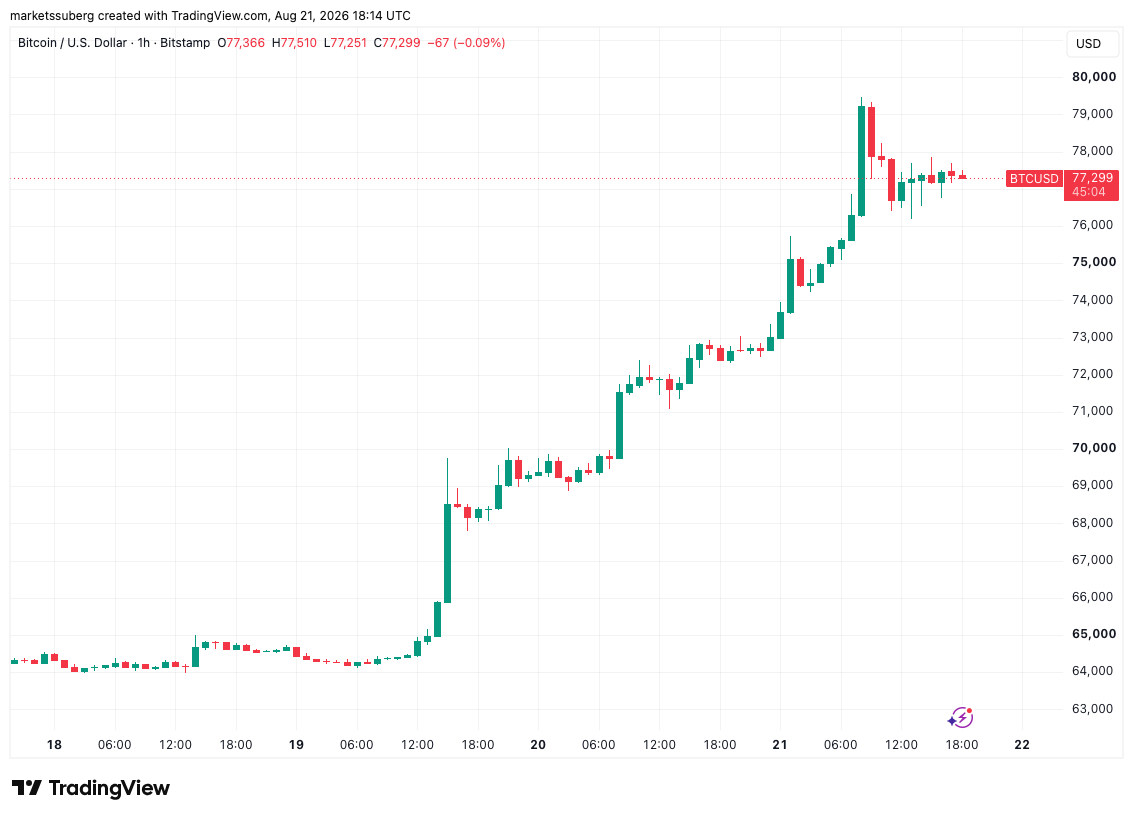
Bitcoin (BTC) consolidated above $77,000 after Friday’s Wall Street open as gold joined the crypto rally to hit 14-week highs.
Key points:
- Bitcoin and gold both hit their highest levels since May 15 against the US dollar.
- Analysis ties the strong performance firmly to US government debt policy.
- Polymarket odds of Bitcoin reaching $90,000 before 2027 reach 48%.
Analysis: Bitcoin and gold gains not “surprise”
Data from TradingView showed BTC/USD cooling after reaching its highest levels since May 15, still up nearly 6% on the day.
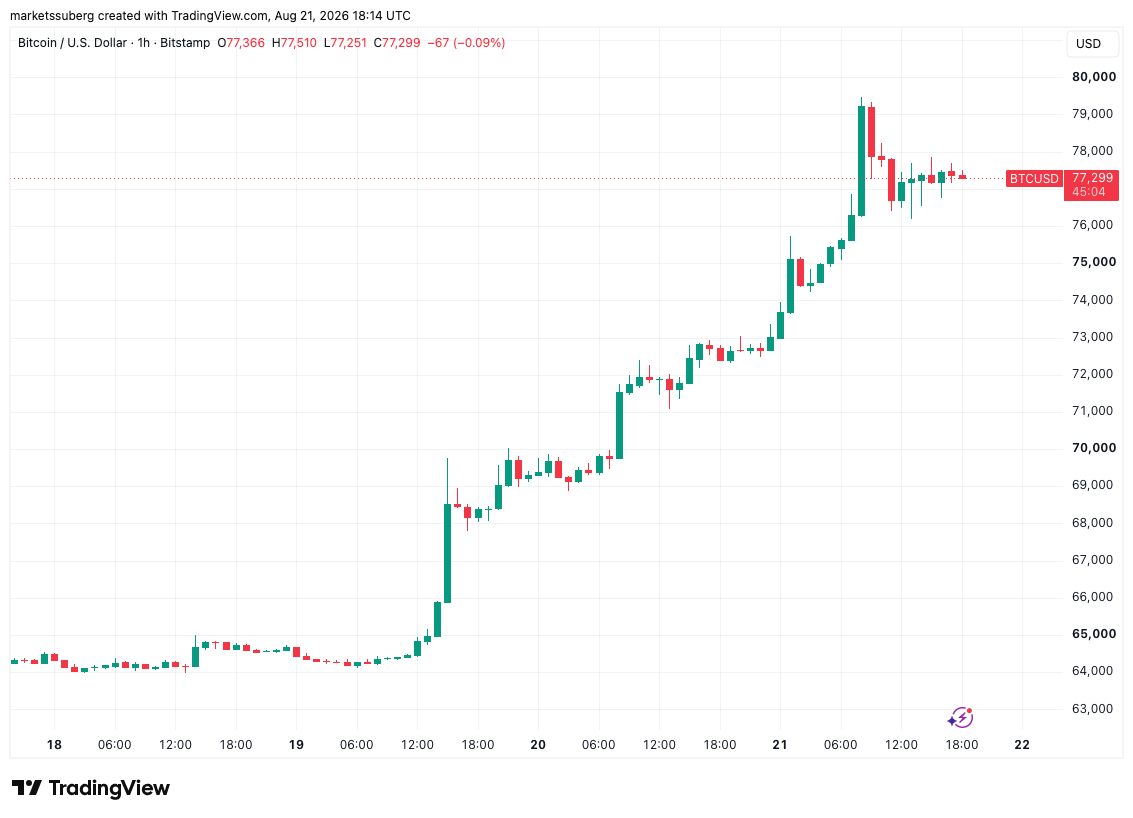
BTC/USD one-hour chart. Source: Cointelegraph/TradingView
Gold echoed the move, reaching multi-month highs of $4,632 per ounce, up 2.2% on the day at the time of writing. On a monthly basis, BTC/USD and XAU/USD were up 13% and 16%, respectively.
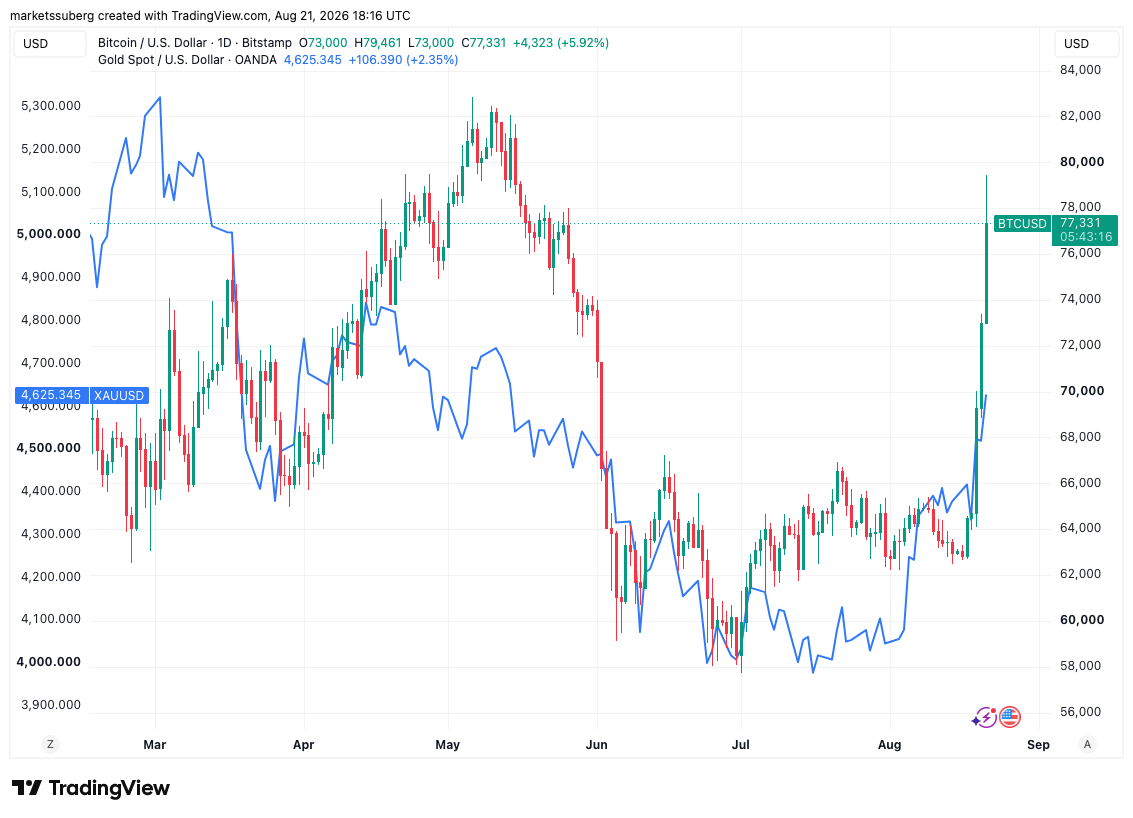
BTC/USD vs. XAU/USD one-day chart. Source: Cointelegraph/TradingView
“What’s happening now in gold and crypto should not come as a surprise,” market commentary The Kobeissi Letter wrote in a response on X.
Kobeissi attributed the rapid gains in precious metals and crypto to a combination of inflation, deficit spending and US Treasury policy. Record government deficit spending and the Treasury Department’s pledge to at least double the size of certain debt buyback operations to $4 billion helped drive the rally in both asset classes, Kobeissi argued.
Discussing Bitcoin’s reaction to the current macro landscape, trading company QCP Capital noted that the financial stress signals went beyond the US, highlighting surging Japanese government bond yields after a rare joint currency intervention in the yen earlier this month.
“The most notable cross-asset signal this week has been the divergence after Treasury’s announcement. Treasuries initially rallied before giving back much of the move. BTC and gold did not retrace to the same extent,” it wrote in its latest Market Color analysis, adding:
“That does not establish a new liquidity or monetary regime, but it does highlight the sensitivity of alternative assets to changes in long-end rates and the dollar.”
Polymarket 2026 odds of $90,000 BTC near 50%
As BTC price upside passed 20% over two days, consensus over potential targets through year-end began to improve.
Data from prediction service Polymarket put the odds of BTC/USD hitting $90,000 before 2027 at 48% at the time of writing, up sharply since the start of the week.
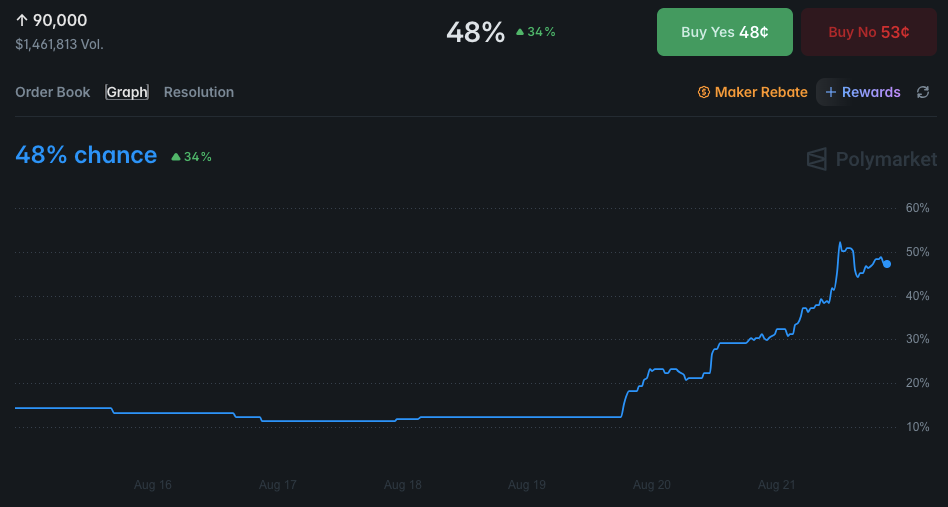
Odds of BTC/USD hitting $90,000 by Jan. 1, 2027 (screenshot). Source: Polymarket
Related: Strategy Bitcoin treasury hits breakeven point as BTC price passes $77K
Some market participants, however, remained skeptical. Trader and analyst Rekt Capital stressed that Bitcoin needed to reclaim its 50-week exponential moving average (EMA) at $77,232, a trend line it rejected in January.
“Break the Downtrend and Bitcoin will confirm entry into a new technical Macro Uptrend. Reject from here however and price will maintain its series of Lower Highs,” he told X followers.
“History suggests there’s still time for price to continue its Downtrend.”
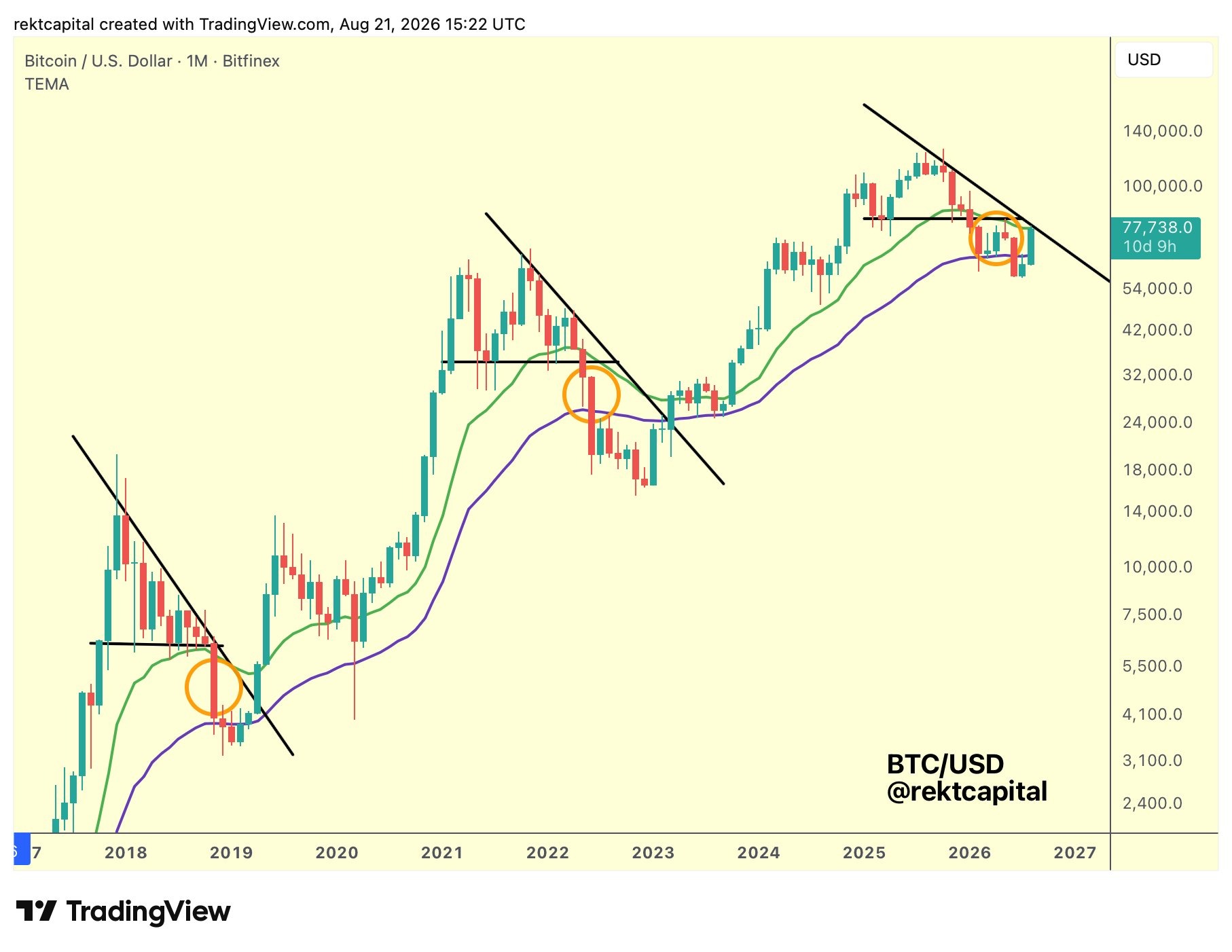
BTC/USD one-month chart. Source: Rekt Capital on X.com


The hedge fund founder with an estimated net worth of $15 billion recommended that investors overweight Bitcoin and gold rather than bonds.
Crypto World
Utorg launches Utapp crypto wallet and card for iOS users, expanding its consumer product ecosystem

Utapp brings Utorg’s self-custodial wallet and crypto card experience to iOS in a new product environment built for the company’s next stage of consumer growth. The app gives users one place to buy, hold, send, swap and spend crypto, while creating the foundation for new wallet, card and payment features planned for release in the coming months.
The iOS launch equally introduces gasless crypto swaps alongside core wallet and card functionality. Utorg will use Utapp as the consumer home for future product releases as it expands its app experience beyond the current wallet and card offering. Users can already download Utapp on the App store.
Existing iPhone users can restore access to their wallets and cards in Utapp in a few steps using their recovery phrase. Utorg will email a detailed guide to affected users. The change applies only to iOS. Android users can continue using the app as before.
“Utapp is not a cosmetic update. It is the product home we have built for the next phase of our business expansion,” said Daniel Stolberg, Co-founder at Utorg. “It gives us a stronger foundation to bring new wallet, card and payment products to users, while keeping the experience simple and putting control of funds where it belongs: with the user.”
Today, Utorg’s ecosystem serves more than 2 million users across 130+ countries and combines a self-custodial crypto wallet with tools for holding, buying, sending, swapping, and spending digital assets. Through its card product, users can spend crypto at more than 80 million merchants worldwide where regular cards are accepted.
As the company’s products are MiCA-compliant, it allows Utapp to operate within the EU’s new regulatory framework for crypto-asset services. Combined with Utorg’s growing wallet, card, and payment infrastructure, the authorization supports the company’s plans to expand its products and reach a broader user base across the globe.
The Utorg team confirmed users can expect further announcements in the coming months, including new features, partnerships, and product launches as the company plans to continue its global expansion.
About Utorg
Utorg is a fintech company founded in 2019 and headquartered in Abu Dhabi, building infrastructure for digital assets. For consumers, Utorg offers a self-custodial crypto wallet and card through Utorg App for Android and Utapp for iOS, making it simpler to buy, hold, send, receive and spend crypto without giving up control of funds. For businesses, Utorg provides infrastructure for embedded crypto payment flows, cross-border settlement and white-label solutions. The company is backed by Dragonfly and TA Ventures and operates globally.
The post Utorg launches Utapp crypto wallet and card for iOS users, expanding its consumer product ecosystem appeared first on BeInCrypto.

Justin Sun said Thursday that a California federal judge ruled his individual claims against World Liberty Financial will stay in open court, rejecting the Trump-linked project’s push to force the dispute into private arbitration and seal the case from public view.
The ruling keeps alive one of crypto’s messiest ongoing legal fights, one that has grown from a token-freezing dispute into a broader case questioning whether World Liberty and its USD1 stablecoin can actually cover what they owe.
Sun Says Individual Claims Will Stay Public
Sun made the comments in a post on X after his counsel appeared in federal court in San Francisco to oppose World Liberty Financial’s request for arbitration and sealed proceedings.
“Today, my counsel appeared in California federal court to oppose World Liberty Financial’s efforts to force our dispute into secret arbitration proceedings and seal documents from public view,” Sun wrote. “The Court agreed with us.”
According to the crypto entrepreneur, the judge ruled that all of his individual claims will remain in open court. The judge also rejected World Liberty’s position that all company-related claims should be arbitrated, with the parties instead ordered to meet and confer over which of those claims should stay in court and which could proceed through arbitration.
Sun’s lawsuit dates back to April. He alleges that World Liberty froze his WLFI tokens, removed his governance rights, and threatened to burn the tokens. He is seeking hundreds of millions of dollars in damages.
The dispute escalated after the former Grenada diplomat questioned the project’s control over its token contracts. As CryptoPotato reported back in April, blockchain researcher banteg had identified a blacklist function added to a later version of the WLFI contract, along with a “batch reallocation” feature.
In his X post, he wrote that he has since learned World Liberty built the same freeze-and-burn capability into its USD1 stablecoin and warned USD1 holders that the company has already shown a willingness to use those functions.
He also pointed to World Liberty depositing roughly 5 billion WLFI tokens, about half its treasury, as collateral on Dolomite, a lending platform co-founded by its own chief technology officer, to borrow at least $75 million in stablecoins, including its own USD1, a structure he said analysts have compared to the circular leverage that collapsed FTX.
Sun added that USD1’s reported $4 billion market cap is user collateral, not money that could be used to pay a court judgment, and stated that he has seen no sign that World Liberty holds enough capital to cover a claim worth hundreds of millions of dollars.
Dispute Has Widened Since April
The legal fight followed a governance dispute over more than 62 billion WLFI tokens, with Sun objecting back in April to a proposal that would place different groups of locked tokens under new vesting terms, as well as the alleged existence of a separate control structure involving an anonymous guardian address and a 3-of-5 multisignature group.
He argued that holders who rejected the proposal could face indefinite restrictions and called the arrangement “a dictatorship wearing the mask of a DAO.” World Liberty rejected his accusations, telling him on X:
“We have the contracts. We have the evidence. We have the truth. See you in court pal.”
The firm indeed filed its own defamation lawsuit in Florida, accusing Sun of spreading false claims, an accusation he dismissed as “nothing more than a meritless PR stunt.”
The post Justin Sun Scores Court Win Against World Liberty Financial appeared first on CryptoPotato.

Bitget CEO Gracy Chen expects Bitcoin to remain broadly around current levels through the end of the year despite its recent surge, citing interest rates and broader macroeconomic conditions as key factors shaping the cryptocurrency’s outlook.
Speaking on Cointelegraph’s Trade Secrets podcast, Chen said predicting whether Bitcoin (BTC) will finish the year above or below $70,000 is difficult, pointing to the possibility of higher interest rates as one factor that could pressure prices.

Cointelegraph host interviews Bitget CEO Gracy Chen. Source: Trade Secrets
“If any of that happens, the price should go down, at least theoretically,” Chen said, adding that BTC has become increasingly integrated with traditional finance and sensitive to broader macroeconomic conditions.
“My guess is maybe around the same range,” Chen said, adding that BTC could finish the year $10,000 to $20,000 above or below current levels, which she described as her “more responsible” forecast.
Related: Bitcoin rally sends crypto stocks soaring as miners, treasury companies jump
Chen sees US Bitcoin purchases as unlikely
Chen was also skeptical that the US government will begin purchasing Bitcoin for its national reserve before the end of President Donald Trump’s term, calling such a move unlikely within the next two years.
The Trump administration established a Strategic Bitcoin Reserve in March 2025 using BTC already forfeited to the federal government, while directing officials to explore budget-neutral strategies for acquiring additional BTC.
The US government currently holds an estimated 328,372 BTC, according to BitcoinTreasuries.NET, much of it accumulated through law enforcement seizures and asset forfeitures rather than direct purchases.
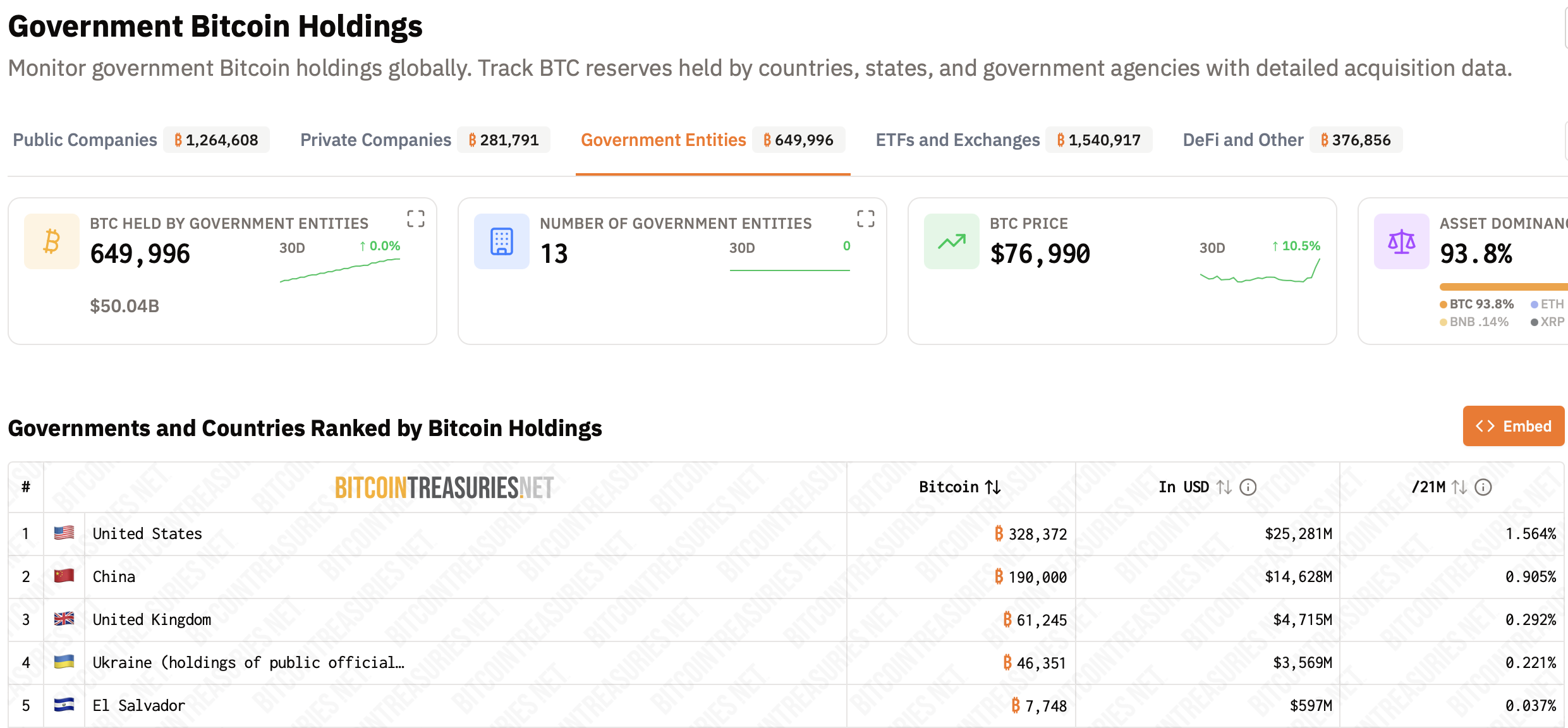
Top 5 government Bitcoin holdings. Source: BitcoinTreasuries.NET
Chen said actively purchasing Bitcoin would be a significantly bigger policy decision, requiring debate among lawmakers and political parties despite the administration’s broadly crypto-friendly stance.
“From a policy perspective, it’s probably unlikely,” Chen said. “I just don’t see it coming right now.”
Magazine: Bitcoin to $1M by 2030 is ‘mathematically impossible’ says Markus Thielen
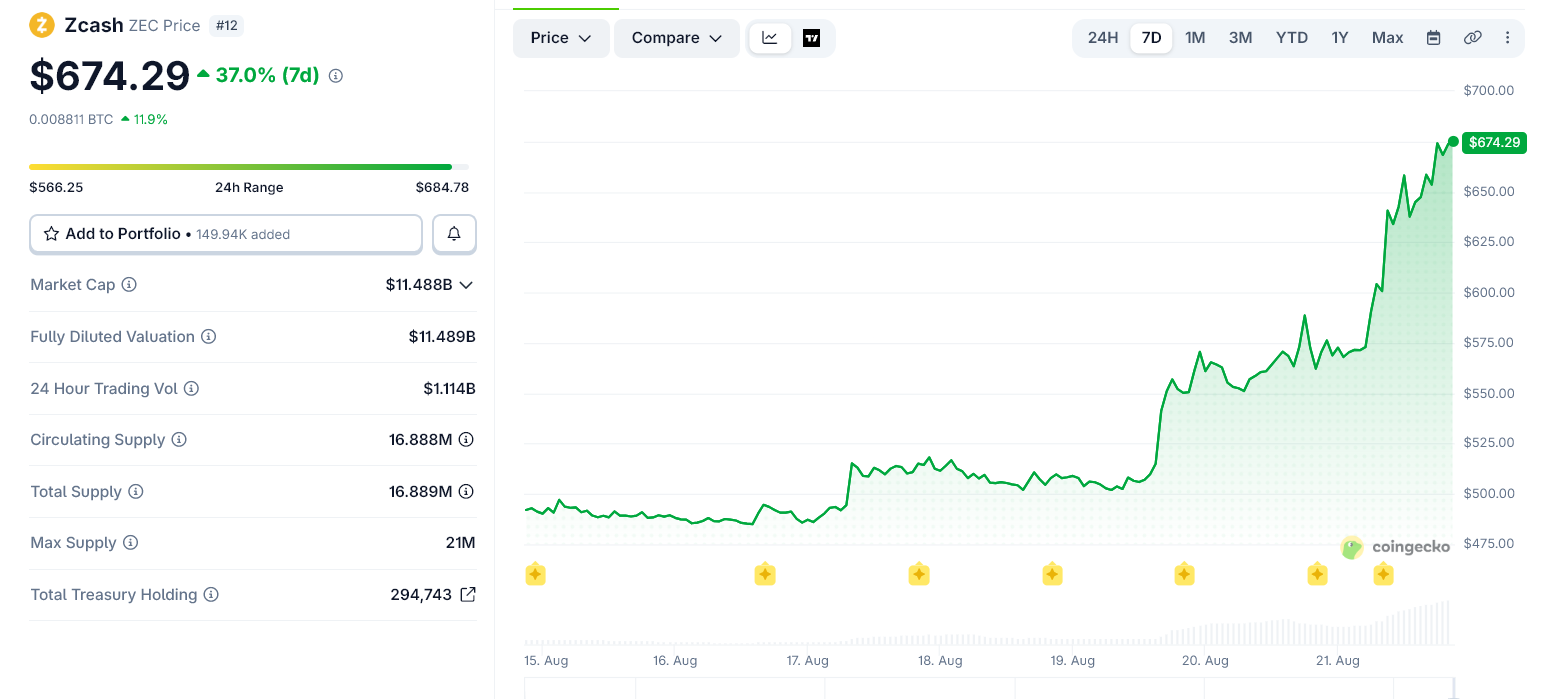
Zcash has rallied nearly 40% over the past week, pushing its price to around $675. ZEC gained roughly 19% in the latest 24-hour period, while trading volume climbed above $1 billion.
The rally has brought ZEC close to the $680–$700 resistance zone. This area previously stopped the price from moving higher, making it the biggest immediate test for buyers.
What Triggered the Zcash Rally?
The rally accelerated after ZEC broke through several resistance levels, including $520 and $590. These breakouts attracted momentum traders and forced some traders betting against ZEC to close their positions.
Interest in privacy-focused cryptocurrencies also helped. Meanwhile, renewed institutional attention and wider strength across the crypto market gave buyers more confidence.
However, derivatives trading played a large role. ZEC futures volume reached roughly $4.55 billion, compared with about $553 million in spot volume. Open interest stood near $1.35 billion.
That imbalance shows that leveraged traders are heavily involved. Leverage can push prices higher quickly, but it can also make a pullback sharper if momentum changes.

ZEC’s Larger Trend Remains Bullish
On the two-hour chart, ZEC trades well above all four major exponential moving averages. The 20-period average sits near $609, followed by the 50-period average at $567. The longer-term averages remain lower at approximately $539 and $519.
In simple terms, recent prices are rising much faster than their longer-term averages. That confirms a strong upward trend.
The two-hour MACD also remains positive. This indicator measures momentum, and its current reading suggests buyers still control the larger move.

Short-Term Momentum Is Starting to Cool
The main warning comes from the Relative Strength Index. The two-hour RSI has reached almost 86, well above the level commonly considered overbought.
On the 30-minute chart, the RSI remains above 73. The MACD has also produced a small bearish crossover, meaning the speed of the rally has started to slow. It does not confirm a reversal, but it often appears before a pause or pullback.
Meanwhile, the five-minute chart remains positive. Buyers are still defending dips, suggesting that the rally has not broken down yet.

Zcash Price Forecast: $750 or a Drop Below $600?
The most likely near-term scenario is consolidation or a pullback toward $620–$650, followed by another attempt at $690–$700.
A strong close above $700, supported by high volume, could open the way toward $733 and eventually $750.
Based on the current structure, ZEC has an estimated 50%–55% chance of reaching $700–$733 within a week. The probability of reaching $750 is closer to 40%.
However, a sustained close below 590–600 would weaken the breakout and expose support near $567 and $539.
These projections reflect technical probabilities and do not constitute investment advice.
The post Zcash Rally Extends to 40%: Can ZEC Hit $1,000 This Cycle? appeared first on BeInCrypto.


A Hyperliquid testnet deployer using Kraken’s name has whitelisted 10 wallets and tested three compliance controls, raising the possibility that the centralized exchange has been experimenting with a permissioned HIP-3 market.
Summary
- 10 wallets have been approved to use the test deployment through a gating system.
- Three of the five observed controls have been tested, including forced position reductions and collateral transfers.
- Kraken has not confirmed that it owns or operates the testnet deployment.
- HIP-3 lets outside builders run perpetual markets through Hyperliquid’s trading infrastructure.
Blockworks analyst Shaunda Devens reported on Aug. 22 that a deployer called “Kraken HIP-3 test DEX” had activated a permission system known as Star gating on Hyperliquid’s testnet on Aug. 19.
The deployment has added 10 wallets to its approved-user list and tested three of five compliance controls observed on the testnet, according to Devens. A validator has also been registered under the name “Kraken Exchange Validator.”
Kraken’s connection to the HIP-3 test remains unconfirmed
Devens said Hyperliquid has been adding testnet functions that could support regulated or licensed operators. Along with wallet whitelisting, the observed tools let a deployer cancel a user’s open orders, close positions through reduce-only orders, and move collateral.
Unlike an ordinary user-submitted trade, each action gives the deployer direct control over an account or position. An operator could use the functions to restrict access, respond to sanctions or legal orders, reduce risk, and remove funds from an account when its rules require intervention.
Such controls are common at centralized exchanges, where account access depends on identity checks and compliance screening. Applying them to HIP-3 would create a permissioned market that still uses Hyperliquid’s on-chain order book and settlement infrastructure.
In her post, Devens asked whether Kraken could become “the first compliant HIP-3 deployer,” but she also noted that the name does not prove Kraken’s participation. Hyperliquid’s testnet allows permissionless deployments, meaning an unrelated user could create a market or validator carrying the exchange’s name.
Neither Kraken nor Hyperliquid had publicly confirmed a partnership or test when this report was written. The available evidence, therefore, shows that a Kraken-branded deployment exists and has used the new controls, not that Kraken created it.
How Hyperliquid’s HIP-3 framework works
HIP-3, short for Hyperliquid Improvement Proposal 3, allows independent builders to operate perpetual futures markets through HyperCore, the network’s trading engine. HyperCore supplies the order book, matching system, margin functions, and liquidation process, while each deployer selects its markets and trading rules.
As crypto.news previously explained, HIP-3 has been active on mainnet since Oct. 13, 2025. A builder must stake 500,000 HYPE to operate an independent perpetual exchange without approval from Hyperliquid’s core team.
Deployers choose the listed assets, price oracles, collateral, margin requirements, leverage limits, and funding settings. The first three assets can be introduced without an auction, while later listings require deployers to compete through a Dutch auction.
The 500,000 HYPE stake acts as a financial bond. Validators can slash it if a deployer manipulates an oracle or breaks market rules, and the requirement remains in effect for 30 days after the operator closes its markets.
HIP-3 deployers also receive 50% of the fees from their markets. According to the July 3 report, HIP-3 open interest had surpassed $1.43 billion, while contracts tracking equities and commodities had become seven of Hyperliquid’s 10 largest markets by trading volume.
Permissioned functions would modify one important part of that model. Although anyone could still deploy a HIP-3 market after meeting the protocol requirements, a deployer using Star gating could limit trading on its own market to approved wallets.
Such an arrangement could allow an operator to combine public blockchain settlement with identity checks, location restrictions, or other account-level rules. Whether the functions will reach the mainnet, and under what conditions, has not been confirmed.
Kraken has expanded regulated and on-chain markets
The testnet name has attracted attention partly because Kraken and its parent company, Payward, have spent 2026 adding securities, tokenized assets and on-chain trading services.
On Aug. 18, the exchange launched U.S. stock trading for eligible customers across the European Economic Area. The service covers more than 7,000 traditional U.S.-listed stocks, over 700 xStocks, and more than 600 crypto assets through one account.
Payward Europe Digital Solutions, a Cyprus investment firm authorized under the European Union’s MiFID II framework, provides the conventional stock service. Kraken said xStocks had generated more than $38 billion in transaction volume since the tokenized products launched in June 2025.
Earlier in 2026, the company introduced xChange, an on-chain execution system initially supporting more than 70 tokenized equities across Ethereum and Solana. Kraken later allowed eligible customers outside the United States to use selected xStocks as collateral for futures and margin positions.
Payward has also been taking the product beyond U.S. equities. Through a July agreement with trading infrastructure company GTN, it plans to add shares from Hong Kong before moving into the United Kingdom, Europe, South Korea, and other approved markets, subject to local licenses.
Devens cited Hyperliquid’s work involving xStocks and Payward’s recent business activity as reasons the test might be connected to Kraken. Her assessment remains an inference based on the names and timing rather than confirmation from either company.
U.S. derivatives rules would still limit access
For U.S. users, a permissioned HIP-3 deployment would not by itself make on-chain perpetual contracts legally available. Commodity derivatives offered to American retail traders generally must operate through entities registered with the Commodity Futures Trading Commission.
An Aug. 3 review of CFTC crypto oversight found that regulated crypto derivatives venues in the United States operate through designated contract markets, clearing organizations, and registered intermediaries. The agency approved the listing of a Bitcoin perpetual futures contract on a registered exchange in May 2026 and issued guidance covering continuous trading, clearing and settlement.
The CFTC has also pursued offshore derivatives platforms that served U.S. customers without registration. Wallet screening and order controls could help an operator enforce geographic restrictions, but the functions do not replace registration or other legal requirements.
Risk controls also matter because HIP-3 deployers select their own price sources and market settings. On July 28, a Hyperliquid contract tracking SK Hynix shares fell 17.9% intraday after a single unusually low trade on South Korea’s NextTrade entered the contract’s oracle system.
The SK Hynix contract was operated by Trade.xyz under HIP-3. One share changed hands at 1.272 million won, 29.96% below the previous close, before the underlying price recovered from the isolated transaction. HyperInsight said the on-chain contract fell from about $1,128 to $927 and later returned above $1,100.
Trade.xyz retained responsibility for the oracle, leverage rules and settlement process, while Hyperliquid’s documentation allowed the deployer to halt trading, change open-interest limits or settle the market. The operator had not published its final incident report when the July 28 coverage appeared.
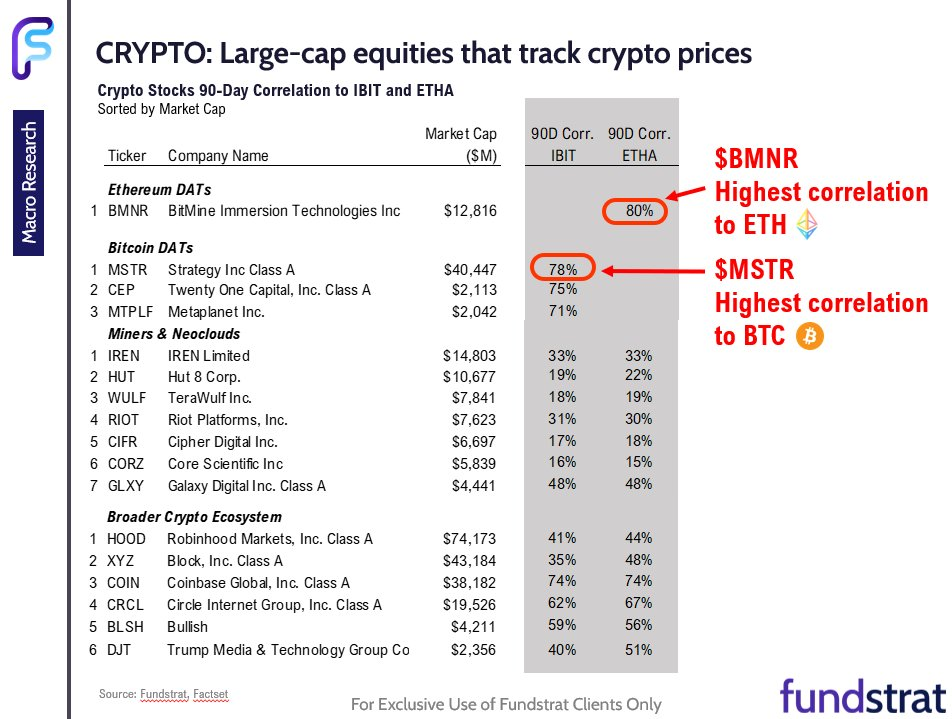
Tom Lee ranked 17 large-cap crypto stocks by how closely they track Bitcoin and Ethereum. The oddest result sits at the bottom. Bitcoin miners barely move with BTC price at all.
Core Scientific tracked the asset at 16%. MicroStrategy tracked it at 78%. Yet MicroStrategy mines no Bitcoin, it only holds a pile of it.
What Tom Lee’s Crypto Stock Rankings Show
The Fundstrat co-founder measured 90-day correlations against BlackRock’s two crypto funds. He covered every crypto-linked stock worth more than $2 billion. Fundstrat and Factset supplied the numbers.
Correlation simply asks whether two prices move together. A score near 100% means they move in step. A score near zero means they ignore each other.
BitMine Immersion Technologies (BMNR) led on Ethereum (ETH) at 80%. Coinbase (COIN) came second at 74%.
Strategy (MSTR) led on Bitcoin (BTC) at 78%. Lee also expects ether to outrun bitcoin this cycle. He chairs BitMine, the stock at the top of his own Ethereum column.

Why Bitcoin Miners Stopped Tracking Bitcoin
Now look at the miners. Core Scientific (CORZ) scored 16%. Cipher Mining (CIFR) hit 17%, TeraWulf (WULF) 18%, and Hut 8 (HUT) 19%.
Riot Platforms (RIOT) reached 31% and IREN 33%. Every one of them trailed Trump Media (DJT), which scored 40% and mines nothing.
The answer sits in their accounts. These firms now sell computing power to artificial intelligence companies, and that business has taken over.
The reason is practical. Mining margins thinned as costs rose, while miners already owned the two things AI firms compete for hardest.
They hold cheap power contracts and warehouses wired to carry it. Renting that out to AI companies pays better, and it pays every month rather than with each block.
Core Scientific booked $164.2 million in revenue for the quarter ending in June. Colocation, its data centre business, brought in $136.7 million. Self-mining brought in $21.5 million.
So AI work supplied 83% of the money. Bitcoin supplied 13%.
TeraWulf showed the same shape in May. It earned $21.0 million leasing high performance computing capacity against $13.0 million from mining, or 62% from AI.
IREN sits further behind. Its quarter ending in March brought $33.6 million from AI cloud services. Mining still brought $111.2 million, leaving AI at 23%.
Line those three up against Lee’s table and a pattern appears. The more a miner earns from AI, the less its shares follow bitcoin.
Core Scientific is the most AI-driven and the least correlated. IREN is the least AI-driven and the most correlated. TeraWulf sits between them on both measures.
“We expect the business to be increasingly driven by recurring, contracted revenue, reducing exposure to the volatility historically associated with bitcoin mining,” Patrick Fleury, TeraWulf chief financial officer, in the company’s quarterly results.
Follow us on X to get the latest news as it happens
History makes the switch sharper. Core Scientific filed for Chapter 11 bankruptcy in December 2022, after a Bitcoin crash and heavy debts. It emerged in January 2024.
The miner that Bitcoin nearly destroyed is now the miner least exposed to it.
What This Changes for Crypto Equity Exposure
The practical read is blunt. Anyone who bought a miner for Bitcoin exposure now owns a power and computing landlord. Its fortunes rest on demand from AI firms.
That works both ways. Miners have climbed while Bitcoin fell, which is exactly what a weak correlation predicts. The pivot is sector wide, and it has been costly. MARA and CleanSpark posted $851 million in combined losses while chasing it.
Treasury companies track Bitcoin more tightly. They have not paid better. MicroStrategy traded near $118.86 on Friday against a 52-week high of $365.21.

Correlation describes direction, not profit. A stock can shadow Bitcoin faithfully on the way down.
One caution covers the whole table. These are 90-day trailing figures. They tighten and loosen with each market phase rather than holding forever.
Bitcoin traded near $77,151 at the time of writing, up 6.3% on the day. Ether changed hands around $2,412 after a 3.5% gain.
The next earnings season will test how far the split runs. Miners that book more AI revenue should drift further from Bitcoin, not closer.
Lee built his table to help equity investors buy crypto exposure. Read closely, it shows how much of that exposure the mining sector has already sold off.
The post Tom Lee Ranks 17 Crypto Stocks: Is Your Bitcoin Stock Still a Worthy Bet? appeared first on BeInCrypto.

Will Bitcoin Reach $100,000 Again in 2026? Analysts Remain Divided as Price Surges Toward $78,000 This Month

Tom Lee expects Ethereum to outperform Bitcoin on AI, tokenization

Bhad Bhabie Shows Off Her Curves With A Steamy Dance Video

Weekend Open Thread – Corporette.com

Weekend Open Thread: Brooks Brothers

London Mayor Sadiq Khan handed a peerage by Keir Starmer alongside 15 other Labour figures… just days before the PM leaves No10

XRP JUST IN! ELON MUSK AI JUST PREDICTED THE PRICE OF XRP AND IT WILL SHOCK YOU!

Are you actually on track for your financial goals? #personalfinance #finance #investing #budgeting

Reichtum, absolute Freiheit und neues Mindset – der Bitcoin Lifestyle
-

 Sports7 days ago
Birmingham 2026: Day 6 Timetable for Irish Athletes
-
 NewsBeat7 days ago
Myanmar says over 300,000 Rohingya refugees verified for repatriation as exodus enters ninth year
-

 Business3 days ago
SMA Solar Technology AG (SMTGY) Q2 2026 Earnings Call Transcript
-

 Politics6 days ago
SEQ Code: The Three Letter Boarding Pass Code That Could Give You The Worst Seat
-

 Fashion3 hours ago
Weekend Open Thread: Madewell – Corporette.com
-

 Crypto World7 days ago
Pi Network Protocol 27 endgame: last upgrade before what?
-

 Tech4 days ago
Qwen3.8-27B runs frontier-class coding agents and reasoning locally, no cloud API required
-

 Crypto World4 days ago
OCC Greenlights Trump Family Crypto Firm for Trust Charter
-
 Tech6 days ago
Every fusion startup that has raised over $100M
-
 Entertainment7 days ago
Marvel Studios Reveals New X-Men Cast Including Adam Driver and Sadie Sink
-
 Business6 days ago
Monarch Mutual Fund set to enter MF space with maiden overnight fund; files draft with Sebi
-

 Business7 days ago
Cristiano Ronaldo’s Secret Wedding Deepens As Presenter Claims Family Learned ’30 Seconds’ Before
-

 News Videos2 days ago
Don’t Leave Your Financial Future To Chance | August 19, 2026
-

 Business7 days ago
Facebook Down Now? Users Report Login And Loading Problems As Outage Trackers Monitor Ongoing Issues
-

 Crypto World5 days ago
Data of 54K Wallet Users Leaked, Clarity Odds Just 10%: Hodler’s Digest, Aug. 16
-

 Crypto World4 days ago
NAVI Prime launches institutional lending framework on Sui
-

 Politics5 days ago
Britain is facing a housing disaster
-

 Business7 days ago
New Avengers Doomsday Trailer Drops at D23 Showing Robert Downey Jr as Doctor Doom
-
 Business7 days ago
OCC approves World Liberty Financial national bank charter for USD1
-

 Tech6 days ago
How to watch FIH Hockey World Cup 2026: FREE live streams, schedule
You must be logged in to post a comment Login