

Crypto World
KOSPI Drops Below 8,000, Triggers Yet Another 2026 Trading Halt

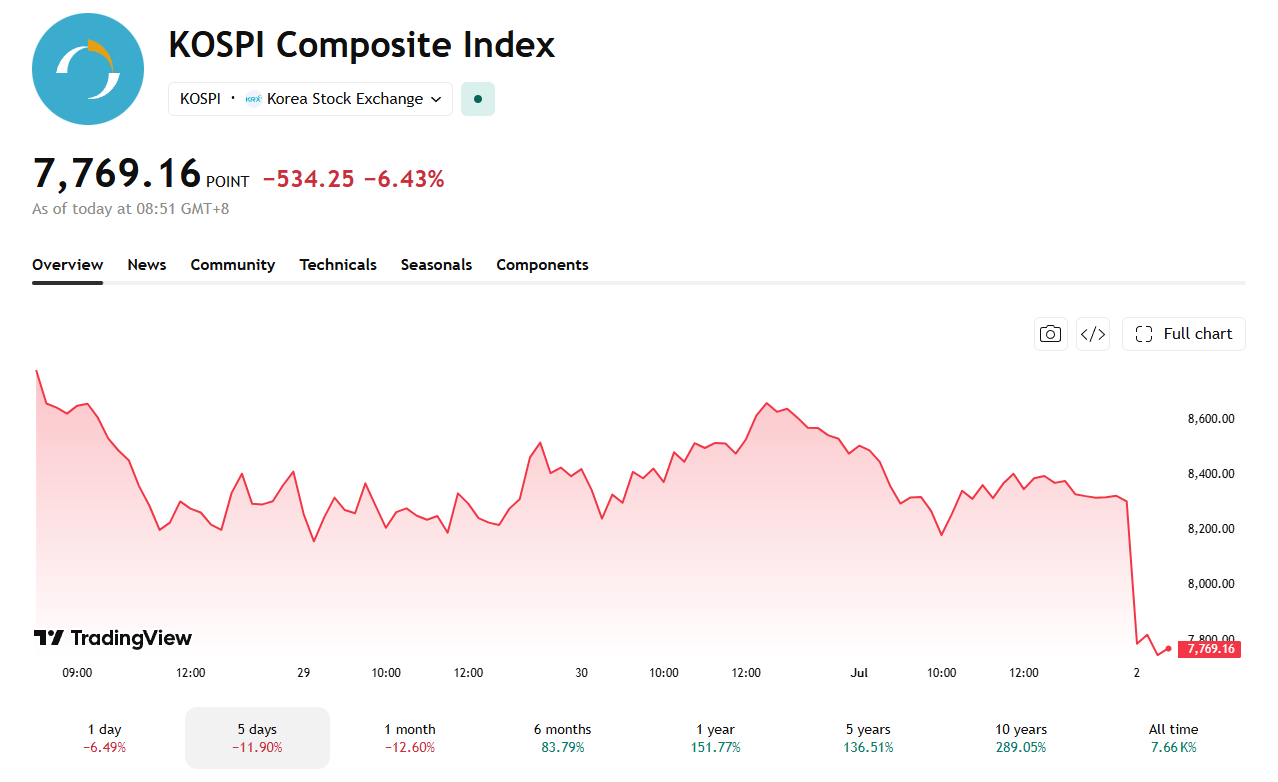
The KOSPI sank below 8,000 on July 2. The drop pushed the Korea Exchange (KRX) to activate a sell-side sidecar within minutes of the opening bell.
The Korea Exchange suspended program trading on KOSPI-listed shares for five minutes. Heavy selling in semiconductor stocks drove the move. The benchmark opened 4.46% lower and kept falling from there.
Another Halt in a Record-Breaking Year
The index had dropped 534.25 points, or 6.43%, to 7,769.16 by 9:51 a.m. local time. A sell-side sidecar triggers automatically once KOSPI 200 futures fall 5% or more for at least one minute.

Thursday’s pause is far from an isolated event. The exchange has repeatedly triggered sidecars and circuit breakers throughout 2026. Volatility this year has already topped the 2008 financial crisis, when the KOSPI set its prior annual sidecar record of 26 halts.
By late June, the KRX had logged close to 30 sidecar activations and five circuit breakers this year alone. Both figures already beat that 2008 tally.
Chipmakers Bear the Brunt
Samsung Electronics and SK Hynix together make up roughly half of the KOSPI’s market capitalization. The two chipmakers have repeatedly driven these swings. Their shares extended losses again Thursday, tracking a global chip stock selloff that started on Wall Street overnight.
The Nasdaq Composite slid 0.66% Wednesday. The VanEck Semiconductor ETF lost 5.4%. Micron Technology and Sandisk each dropped more than 10%. The rout followed weeks of sharp reversals in the KOSPI’s chip-driven rally, a rally that had pushed the index to record highs earlier this year.
Semiconductor stocks still dominate the index. Traders now face a familiar question: will Thursday’s selloff deepen further, or fade as quickly as prior swings have this year.
The post KOSPI Drops Below 8,000, Triggers Yet Another 2026 Trading Halt appeared first on BeInCrypto.


Quick Summary
- Bridge obtains MiCA and EMI regulatory clearances for euro stablecoin operations in the EU.
- The Stripe-backed infrastructure provider can now deliver compliant services throughout European markets.
- Regulatory approvals enable companies to create branded euro-denominated stablecoins through Bridge’s platform.
- Financial technology firms gain access to named IBAN accounts and euro banking tools via Bridge.
- MiCA framework drives stablecoin operators toward heightened European regulatory compliance.
Bridge has obtained dual regulatory licenses from Luxembourg authorities, allowing the company to scale its euro stablecoin payment infrastructure throughout the European Union. The fintech firm, which counts Stripe among its investors, received both MiCA crypto-asset service provider authorization and Electronic Money Institution registration. These regulatory clearances provide Bridge with a unified operational framework spanning all 27 EU territories.
Regulatory Clearances Open European Market Access
The Luxembourg regulatory approvals bring Bridge under the European Union’s Markets in Crypto-Assets regulatory regime. The licenses simultaneously authorize the firm to facilitate electronic money operations throughout the trading bloc. Consequently, commercial entities can now access compliant stablecoin infrastructure and euro payment capabilities through a consolidated arrangement.
Bridge stated the authorizations encompass capital reserve requirements, asset custody protocols, and operational security measures. These provisions represent fundamental components of the EU’s emerging cryptocurrency oversight architecture. The company now operates stablecoin services within defined compliance parameters.
The regulatory milestone also bolsters Bridge’s competitive standing in Europe’s digital payments ecosystem. The platform already facilitates conversions between stablecoins and euro currency. With the new licenses, it can broaden those capabilities for software developers, fintech operators, corporate clients, and banking institutions.
Custom Euro Stablecoin Solutions for Enterprise Clients
Bridge will enable commercial clients to launch proprietary euro-denominated stablecoins tailored to their specific use cases. Organizations can deploy these digital tokens for customer rewards programs, loyalty mechanisms, on-ramp services, and application-integrated payments. This eliminates the need for businesses to establish independent reserve management and regulatory compliance infrastructure.
Financial technology providers can leverage Bridge to deliver virtual IBAN accounts issued in end-user names. They can additionally furnish euro-denominated accounts that function seamlessly across every EU jurisdiction. This capability provides firms with a streamlined mechanism for transnational monetary transfers.
Corporate enterprises can utilize custom stablecoins to transfer capital between international subsidiaries. This methodology can minimize dependence on traditional correspondent banking infrastructure. Banking institutions can similarly adopt stablecoin settlement rails to accelerate institutional transaction finality.
MiCA Framework Transforms European Digital Asset Landscape
The licensing achievement arrives as Europe implements stricter supervision of stablecoins through MiCA regulations. The framework’s concluding implementation phase commenced on July 1. Licensed cryptocurrency platforms must now exclusively support stablecoins satisfying the regulation’s established criteria.
Bridge enters a growing cohort of authorized entities pursuing expanded EU market presence under MiCA guidelines. The regulatory framework permits authorized organizations to conduct operations across member nations without obtaining individual country-specific licenses. This arrangement provides stablecoin infrastructure providers with a more transparent pathway to geographic expansion.
The company has simultaneously pursued international growth through strategic payments collaborations. Visa announced in March plans to extend its partnership with Bridge on stablecoin-enabled card products. The initiative aims to reach more than 100 nations by the conclusion of 2026.

Crypto World
Bitcoin, ether traders aren’t fully buying the bounce, options markets show: Crypto Daily


With bitcoin and the broader crypto market showing signs of life, defensive positioning in the market has eased, not disappeared, a sign of continued caution.
This is evident from the BTC and ether (ETH) options markets listed on Deribit, where put options, derivative contracts offering protection against price slides, continue to trade at a premium to calls, or bullish contracts.
Bitcoin’s one-week, 25-delta put-call skew, which measures the difference in volatility for puts relative to calls, was around 16%. It showed puts outpacing demand by a 16% vol point premium. That’s still notably elevated, though significantly lower than the 25% of 10 days ago, according to data source Velo.
The one-, three-, and six-month skews also show put premiums of around 10% or more. The same is true for ether.
The message is clear. Downside fears persist, keeping demand for insurance against price declines intact even though BTC long-term holders and ETF investors appear to have returned to accumulation.
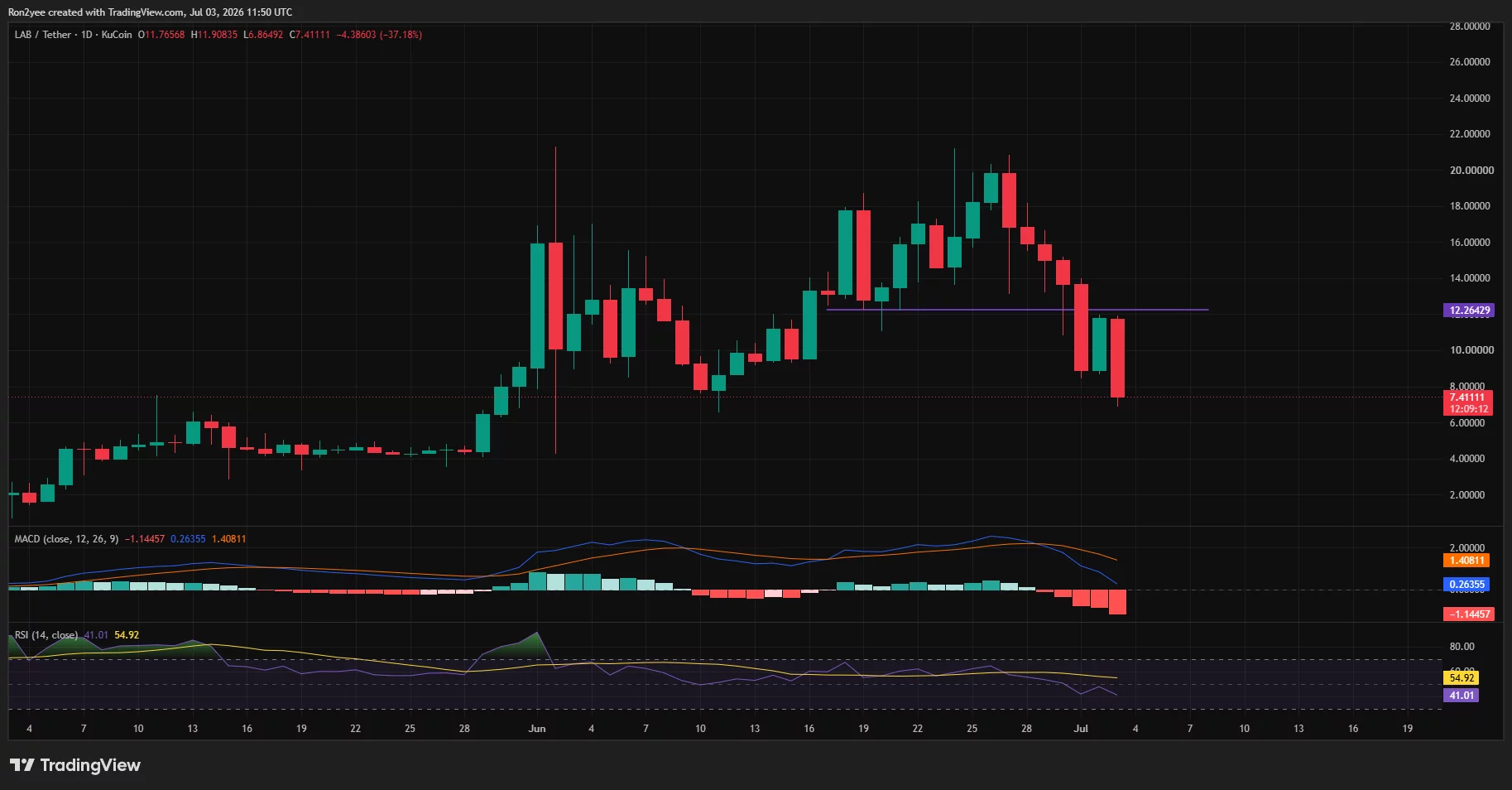
LAB price has suffered one of the steepest collapses in the crypto market this week, losing more than 60% of its value as concerns over insider holdings, token transparency, and heavy derivatives liquidations sparked a wave of panic selling.
Summary
- LAB price crashed more than 60% in a week as insider ownership concerns triggered panic selling.
- Heavy derivatives liquidations and a 23% drop in open interest accelerated the token’s decline.
- Weak crypto market sentiment and uncertainty over token unlocks added to the selling pressure.
According to crypto.news data, LAB (LAB) plunged to an intraday low of $7.50 on July 3, down more than 60% from its recent high near $20 on June 27. The sell-off erased billions in market value in less than a week as investors rushed to exit amid growing uncertainty surrounding the project’s tokenomics and insider ownership.
The biggest catalyst appears to be mounting concerns over LAB’s token distribution. Community discussions intensified after on-chain investigator ZachXBT previously alleged that insiders controlled more than 95% of the token supply, while also raising concerns over token allocation transparency, private OTC agreements, changing vesting schedules, and large insider wallet movements before major price swings.
These remain public allegations that have not been established in court, and the LAB team has disputed or not publicly accepted many of the claims.
Additional attention came from crypto community member Zetoshi, who summarized the controversy and highlighted LAB’s reported institutional backers, including Animoca Brands, OKX, Lemniscap, GSR, Amber Group, Mirana Ventures, Gate, and KuCoin, although Zetoshi’s suggestion that these relationships explain the lack of public action against the project represents personal opinion rather than verified fact.
Why did the LAB sell-off accelerate so quickly?
Once confidence weakened, technical factors amplified the decline. As LAB broke below major support around the $12 region, leveraged long positions began unwinding rapidly, triggering a liquidation cascade across derivatives markets.
Open interest dropped roughly 23% to $130.39 million, signaling that traders were closing positions instead of adding fresh bullish bets. At the same time, funding rates turned negative across perpetual futures markets, indicating that bearish traders had taken control and that demand for short exposure outweighed buying interest.
Momentum indicators also reflected the sharp deterioration in sentiment. The MACD histogram expanded further into negative territory, reinforcing the growing downside momentum as automated liquidations and stop-loss orders accelerated the move toward the $7.50 support area.
Could broader market conditions have made the decline worse?
The LAB-specific concerns also coincided with a difficult backdrop for digital assets. During late June and early July, investors broadly reduced exposure to riskier cryptocurrencies as global central banks maintained restrictive monetary policies and capital rotated away from speculative altcoins.
The broader market weakness became an additional headwind as corrections in Bitcoin and Ethereum reduced overall risk appetite. With liquidity already thinning across the altcoin market, LAB’s structural concerns left few buyers willing to absorb heavy selling pressure from early investors and whales taking profits after the token’s remarkable rally from roughly $0.10 to nearly $27 earlier this year.
For now, traders will likely watch whether LAB can stabilize above the $7.50-$7.65 support zone. A sustained recovery may depend not only on improving crypto market sentiment but also on greater transparency from the project regarding token ownership, vesting schedules, and future token unlocks.


Large bitcoin holders bought more than 270,000 bitcoin ($16.7 billion) over the past two weeks, stepping in as U.S. institutions pulled money out at a record pace.
U.S. spot bitcoin exchange-traded funds (ETFs) shed $4.06 billion in June, their worst month since listing, past the previous record of $3.56 billion set in February 2025.
The outflows pushed the funds into the red for 2026 as a whole for the first time, and these products finally recorded a $221 million inflow on Thursday.
Large wallets, often called whales, went the other way, analysts at crypto exchange Bitfinex shared with CoinDesk in a Friday note. They added more than 270,000 BTC over two weeks while the spot premium, a gauge of how hard U.S. buyers are bidding, stayed negative, meaning the buying was not coming from spot desks.
Institutions selling and large holders accumulating at the same time is the pattern that has shown up near past cycle lows, where long-term holders take coins off sellers before any recovery reaches the price.
Key Takeaways
- June saw the ECB implement a 25 basis point rate increase, marking its first adjustment upward in nearly three years
- Bank of France Governor Emmanuel Moulin indicates the ECB has reached a favorable position
- Consumer price growth in the Eurozone declined to 2.8% in June from May’s 3.2%
- Crude oil prices have returned to pre-conflict levels following diplomatic breakthrough between Washington and Tehran
- While Barclays forecasts a September rate adjustment, analysts acknowledge declining energy costs may support holding steady
In June, the European Central Bank implemented a 25 basis point interest rate increase, representing its first upward adjustment in approximately three years. This decision followed a surge in energy markets sparked by U.S.-Israeli military operations targeting Iran, which temporarily drove crude oil beyond $110 per barrel.
With diplomatic relations now stabilized and energy prices retreating, certain ECB policymakers are indicating the institution may be approaching the conclusion of its restrictive monetary policy phase.
Central Bank Officials Note Enhanced Risk Balance
Emmanuel Moulin, serving as both Bank of France governor and member of the ECB Governing Council, informed Bloomberg Television that the institution finds itself in a favorable state at present.
During remarks at the Rencontres Economiques conference held in Aix-en-Provence, he noted that declining oil price levels should contribute to moderating price pressures within the services sector. He emphasized the absence of secondary inflationary effects currently.
Moulin made it explicit that the ECB has not embarked on a prolonged tightening campaign. He stated that determinations regarding the July and September policy meetings would be addressed as those dates approach.
ECB President Christine Lagarde, addressing attendees at a central banking conference in Portugal, rejected suggestions that June’s rate adjustment was merely precautionary against price escalation. She maintained it represented the appropriate action across various inflation projections.
Lagarde refrained from providing explicit guidance on future policy direction, noting only that threats to both inflation and economic expansion have achieved greater equilibrium.
Price Growth Moderates Despite Lingering Concerns
Consumer price levels across the Eurozone increased 2.8% over the twelve-month period ending in June, declining from May’s 3.2% reading and falling short of the 3.0% consensus forecast among economists.
Energy expenses climbed 8.7% on an annual basis in June, moderating from the 10.8% pace recorded in May. Core inflation, excluding volatile food and energy components, registered 2.4%, down from 2.6%.
Brent crude prices have now retreated to approximately pre-conflict levels after the diplomatic framework agreement between the United States and Iran concluded last month.
Despite these positive developments, Barclays analysts Silvia Ardagna and Mariano Cena highlighted that selling price expectation metrics from the European Commission continue to show elevated readings, particularly within manufacturing and retail industries.
They cautioned that four straight months of heightened energy expenses may continue to exert upward cost pressure across non-energy sectors in coming weeks.
Barclays Maintains September Rate Hike Forecast
Barclays maintains its projection for an additional ECB rate increase at the September policy meeting. Nevertheless, the analysts observed that retreating oil markets and indications that inflation may have crested could justify a more measured stance.
Additional ECB Governing Council members have indicated that all policy options remain under consideration for forthcoming meetings. Market participants have already reduced expectations for additional rate increases during the current year.
Bloomberg Economics now assesses that Eurozone inflation has probably reached its maximum level.
The ECB’s upcoming scheduled policy meeting occurs in July, followed by another session in September.
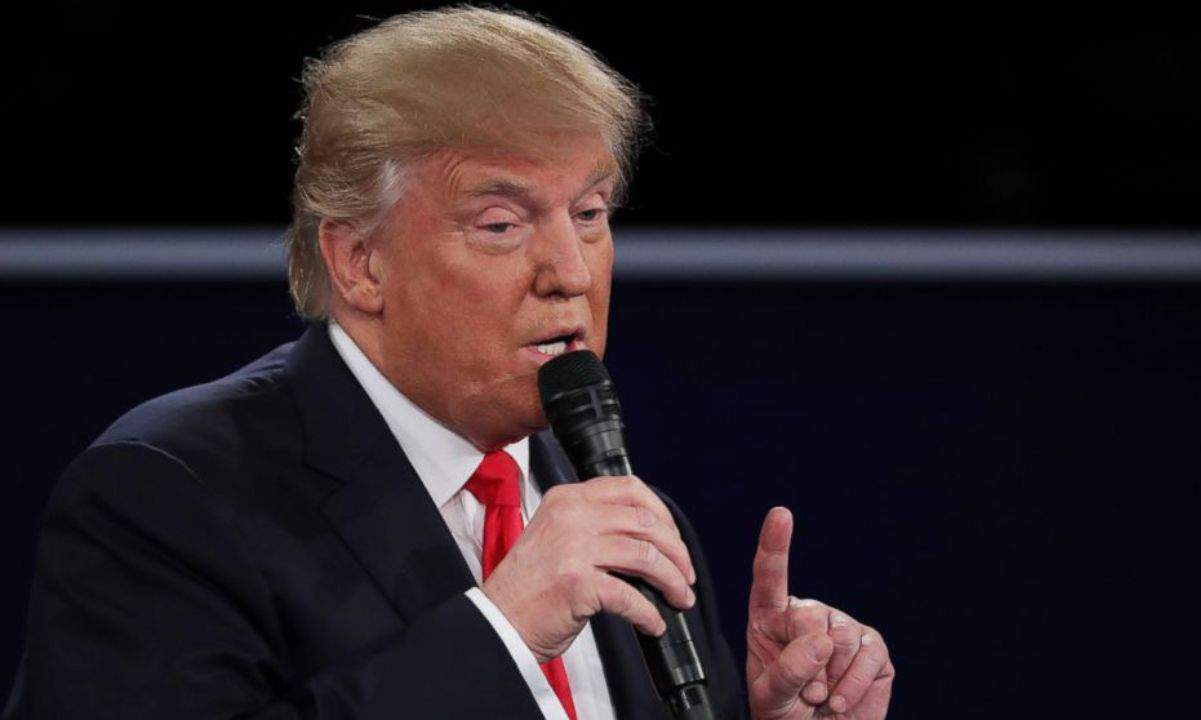
US President Donald Trump defended his family’s crypto earnings during a CNBC interview, saying there was “nothing illegal” and “nothing wrong” with the businesses generating billions of dollars while he serves in the White House.
He made the comments just days after new federal financial disclosures detailed the scale of his digital asset holdings and crypto-related income, renewing debate over whether a sitting president’s private business interests can coexist with public office.
Trump Defends Family Crypto Business After Disclosure
In the July 2 interview with CNBC’s Joe Kernen at the White House, Trump was asked about the massive windfall revealed in his annual financial disclosure.
The 927-page document released by the US Office of Government Ethics showed the president brought in more than $2.2 billion in 2025, with the bulk of it coming from crypto. This included $594 million from World Liberty Financial (WLFI), a DeFi venture he co-founded with his sons, and $636 million from sales of Trump-branded meme coins. He is also reported to be holding more than $50 million in Bitcoin in a cold wallet.
When he was asked whether he knew about the family’s crypto activities, the president replied, “No,” before quickly adding, “I could know about it. I didn’t, I mean, there’s nothing illegal, there’s nothing wrong with it. I could know.”
Trump then pointed out that his assets are managed through trusts overseen by his sons Eric and Donald Jr., as well as outside investment firms that he does not talk to. “I don’t even know who they are,” he said, adding that he doesn’t discuss investment decisions with his sons either, suggesting that almost any business dealing by his children could be construed as a conflict of interest given the expansive nature of presidential policy.
“I tell my kids: stay away from as much as you can stay away from. But they also have a life,” he told Kernen.
The US president also repeated a point he’s made on several other occasions, that crypto is a strategic industry that the United States cannot afford to lose to rivals.
“The way I look at crypto is if we’re not going to do it, China’s going to get it,” he said. “It’s a big deal, and anything we do, I want to be number one in, and we’re number one in crypto.”
The White House had also dismissed the conflict of interest allegations after the disclosure became public, saying Trump and his family have not engaged in conduct that conflicts with the public interest.
Critics Question Whether Presidential Influence Boosted Crypto Earnings
Despite the dismissal of conflict claims, longtime Bitcoin critic Peter Schiff was not convinced. In his latest podcast, which aired on June 3, the economist claimed that Trump’s earnings were closely tied to his presidency and were not just ordinary returns on investment.
According to him, the people buying Trump-branded tokens were paying for access and political influence instead of making conventional investments. A quick check on CoinGecko shows that Official Trump (TRUMP) and Melania Meme (MELANIA) are trading 97% and 99%, respectively, below their peaks, something that Schiff used to justify his influence-buying argument.
“It’s really a way to bribe the president,” he alleged. “You don’t have to give him money directly; just buy his token, because who else would buy the token? It’s a lousy investment.”
The post Donald Trump Defends $1.2B Crypto Earnings: ‘Nothing Illegal, Nothing Wrong’ appeared first on CryptoPotato.
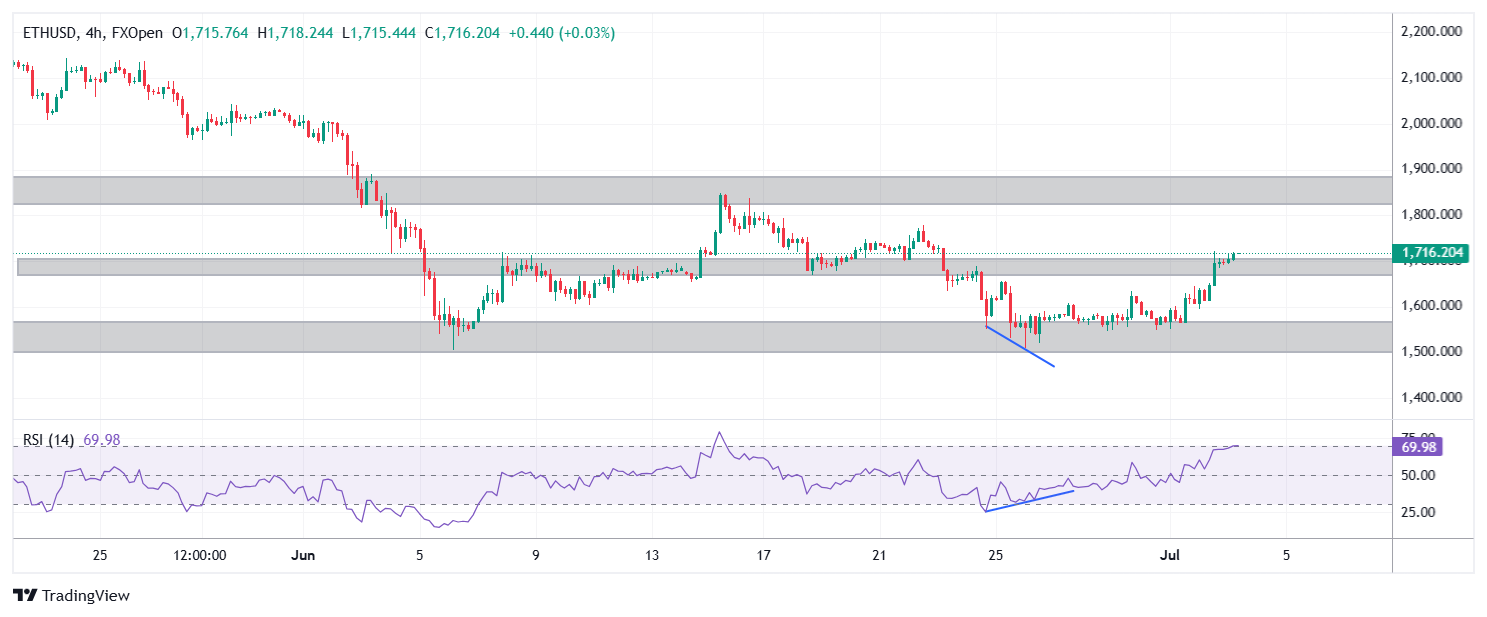
Ethereum has staged a notable rebound after once again testing the heavily watched psychological zone around 1500$. Since bouncing off this support, ETH/USD has climbed roughly 13%, now trading around the $1,700 mark.
This recovery is being driven by a combination of technical and fundamental factors. On the technical side, the aforementioned support zone has once again proven its relevance, attracting buyers at a historically significant level. On the fundamental side, the latest US Non-Farm Payrolls report added just 57,000 jobs in June, well below the 110K-115K consensus and a sharp slowdown from May’s downwardly revised 129,000. Combined with a 74,000-job downward revision to the prior two months, the weaker print has weighed on the US Dollar, reducing the likelihood of near-term Fed rate hikes and boosting risk assets positioned as an alternative to the greenback — including cryptocurrencies.
Technical analysis of ETH/USD
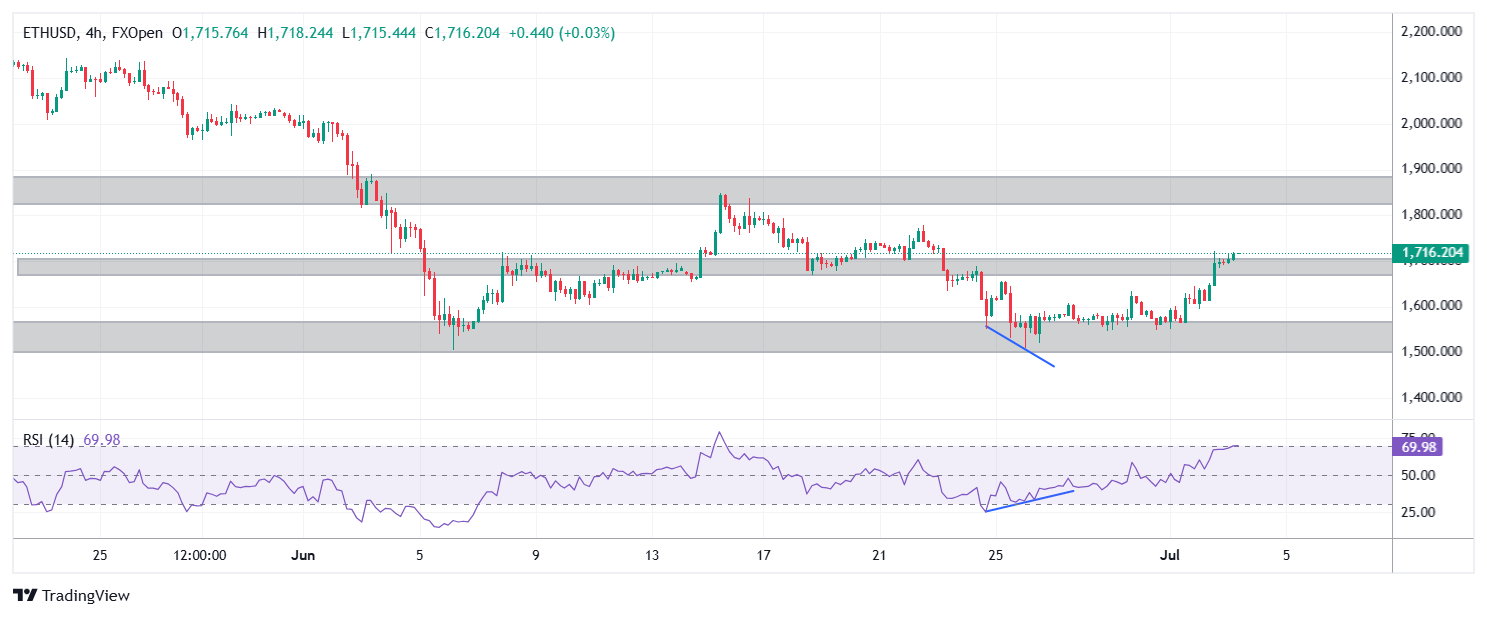
After bouncing off the $1,500 support zone, Ethereum seems to be directed to a key test at the former support, turned resistance, around $1,800.
Bullish scenario
A confirmed break and hold above the $1,800 level would allow ETH to sustain bullish momentum and begin forming a structure of higher highs and higher lows after months of bearish price action. This potential recovery also finds support from a notable bullish divergence on the 4-hour RSI, where a sequence of rising lows on the indicator contrasts with the sequence of falling lows on price, a signal that downward momentum may be fading.
Bearish scenario
Alternatively, as price approaches the $1,800 resistance, ETH could reject the level and resume its broader downtrend, slipping back below the intermediate $1,680–$1,700 zone. Such a move would suggest the asset still lacks the strength needed to break through this crucial threshold.
Investors and traders remain focused on new Fed Chair Warsh’s statements and their impact on the DXY. Will a weaker Dollar Index prove to be the real catalyst for a bullish return across the crypto market?
FXOpen offers the world’s most popular cryptocurrency CFDs*, including Bitcoin and Ethereum. Floating spreads, 1:2 leverage — at your service (additional fees may apply). Open your trading account now or learn more about crypto CFD trading with FXOpen.
*Important: At FXOpen UK, Cryptocurrency trading via CFDs is only available to our Professional clients. They are not available for trading by Retail clients. To find out more information about how this may affect you, please get in touch with our team.
This article represents the opinion of the Companies operating under the FXOpen brand only. It is not to be construed as an offer, solicitation, or recommendation with respect to products and services provided by the Companies operating under the FXOpen brand, nor is it to be considered financial advice.

TLDR
- Palantir stock rose nearly 20% in five days after DA Davidson upgraded the shares to Buy.
- DA Davidson raised its Palantir price target to $175 from $165, citing stronger profits.
- Palantir partnered with Nvidia to deploy Nemotron AI models for U.S. government agencies.
- The U.S. Army selected Palantir Foundry for its Next Generation Command and Control program.
- Palantir reported Q1 2026 revenue of $1.633 billion, up 85% year-over-year.
- Free cash flow reached $925 million in Q1, representing a 57% margin.
Palantir stock rallied as DA Davidson shifted its view and upgraded the shares to Buy. The firm raised its target to $175 from $165, citing stronger profits and valuation support. The move came as new government and AI catalysts supported a company-specific advance.
Palantir Technologies Inc., PLTR
DA Davidson Upgrade Lifts Palantir Stock
DA Davidson said Palantir has grown into its valuation as earnings improved. The firm noted that profit growth has helped reduce pressure on the stock’s multiple. Therefore, Palantir stock gained fresh support from a clearer valuation argument.
The upgrade arrived after Palantir stock rose nearly 20% across five trading days. The advance came while the S&P 500 slipped 0.2% and the Nasdaq fell 0.7%. As a result, the rally showed stronger company momentum than broader market strength.
Nvidia Partnership Adds AI Demand
Palantir also announced a strategic partnership with Nvidia for U.S. government users. The companies will deploy Nvidia’s Nemotron open-source AI models inside Palantir platforms. That agreement places Palantir stock near another major government AI growth theme.
The partnership targets federal agencies and critical infrastructure operators with sensitive data needs. Palantir said the model deployment will support secure AI use in controlled environments. Meanwhile, Palantir stock benefited from renewed attention on its enterprise platform model.
CEO Alex Karp also criticized token-based AI pricing during a CNBC appearance. He said enterprise buyers face a “wealth tax” when frontier labs charge by tokens. His comments highlighted Palantir’s different pricing approach and reinforced the software platform story.
Army Contract Strengthens Revenue Outlook
The U.S. Army selected Palantir Foundry for its Next Generation Command and Control program. The Army describes the project as its highest-priority modernization effort. Therefore, Palantir stock gained support from a potential multi-year defense revenue path.
Palantir reported Q1 2026 revenue of $1.633 billion, up 85% year-over-year. U.S. revenue passed 100% growth for the first time since the company went public. The company also raised 2026 revenue guidance to between $7.650 billion and $7.662 billion.
Free cash flow reached $925 million in the quarter, equal to a 57% margin. Palantir stock remains below its 52-week high of $207.52 despite the recent rally. The DA Davidson upgrade suggests Palantir stock could keep drawing demand if execution remains strong.
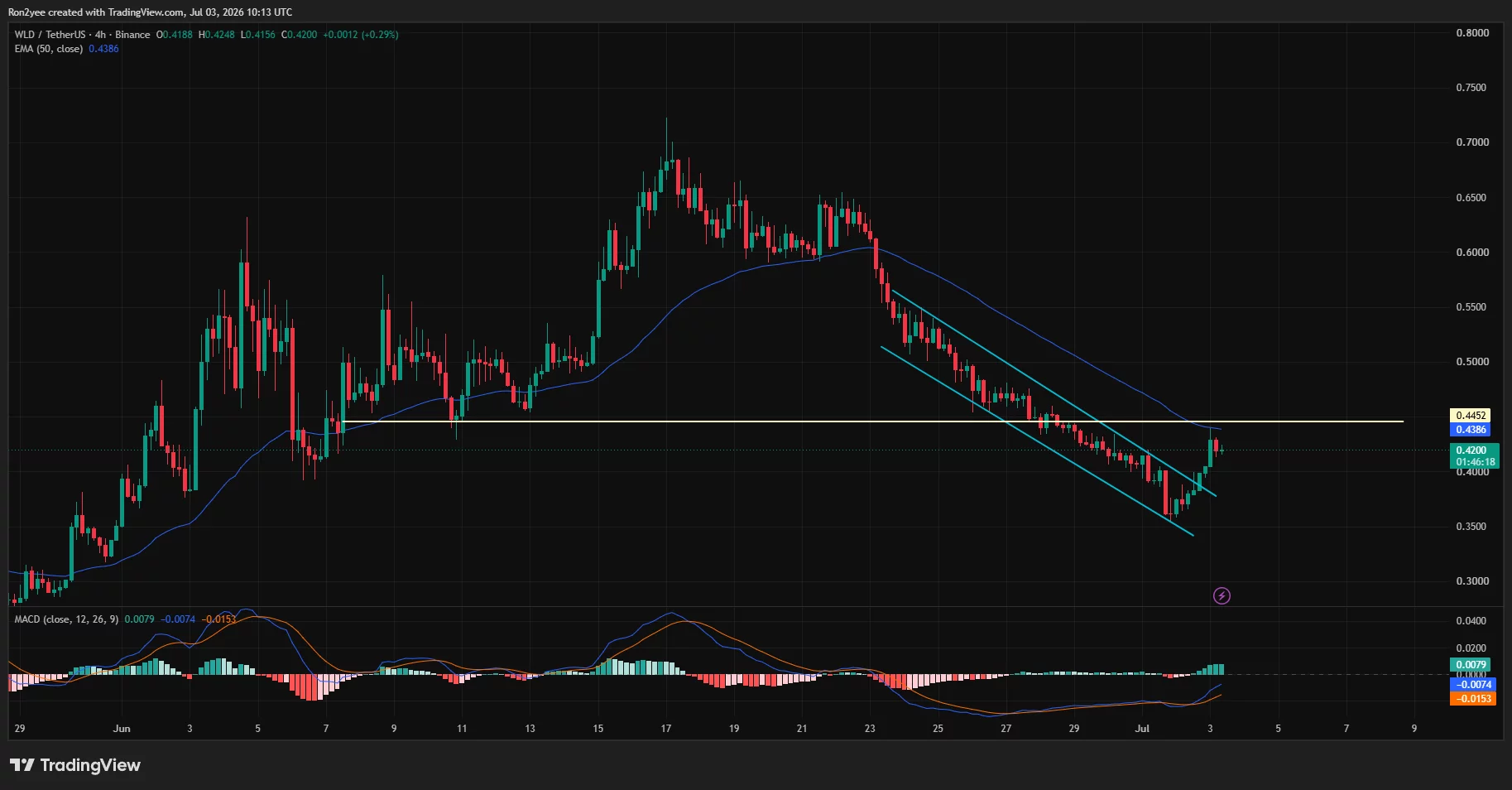
Worldcoin has broken out of a short-term bearish channel after institutional accumulation and an upcoming reduction in token emissions triggered renewed buying interest, lifting WLD more than 16% from its July 2 low.
Summary
- Worldcoin has broken out of a bearish channel after Eightco disclosed a treasury holding of 283.45 million WLD tokens.
- Bulls are targeting the 50-day EMA near $0.438, with $0.445 and the 200-day EMA around $0.47 acting as key resistance.
- A 43% reduction in daily WLD token unlocks later this month has strengthened bullish sentiment despite lingering regulatory risks.
According to data from crypto.news, Worldcoin (WLD) climbed to an intraday high of $0.439 on July 3 after recovering from support near $0.35, where buyers stepped in following nearly two weeks of persistent selling.
The rebound gathered pace after Nasdaq-listed Eightco Holdings disclosed that it held 283.45 million WLD tokens, equivalent to roughly 8.1% of the circulating supply. The announcement arrived as traders also positioned ahead of a key tokenomics change scheduled for July 24 that will reduce daily WLD unlocks by 43%, cutting emissions from 5.1 million to 2.9 million tokens.
Those two catalysts came as Bitcoin stabilized above the $61,000 region after a weak second half of June, allowing high-beta altcoins to recover. Worldcoin had fallen roughly 45% from its June 22 peak near $0.64 before buyers returned, with the combination of easing macro pressure and a large corporate treasury allocation reversing short-term sentiment.
Technical breakout puts the 50-day EMA back in focus
The 4-hour chart shows Worldcoin breaking above a descending channel that had contained price action since late June. Buyers also reclaimed the upper trendline of the channel before pushing the token toward the 50-day exponential moving average, which currently sits near $0.438. Price briefly tested that dynamic resistance before easing slightly.
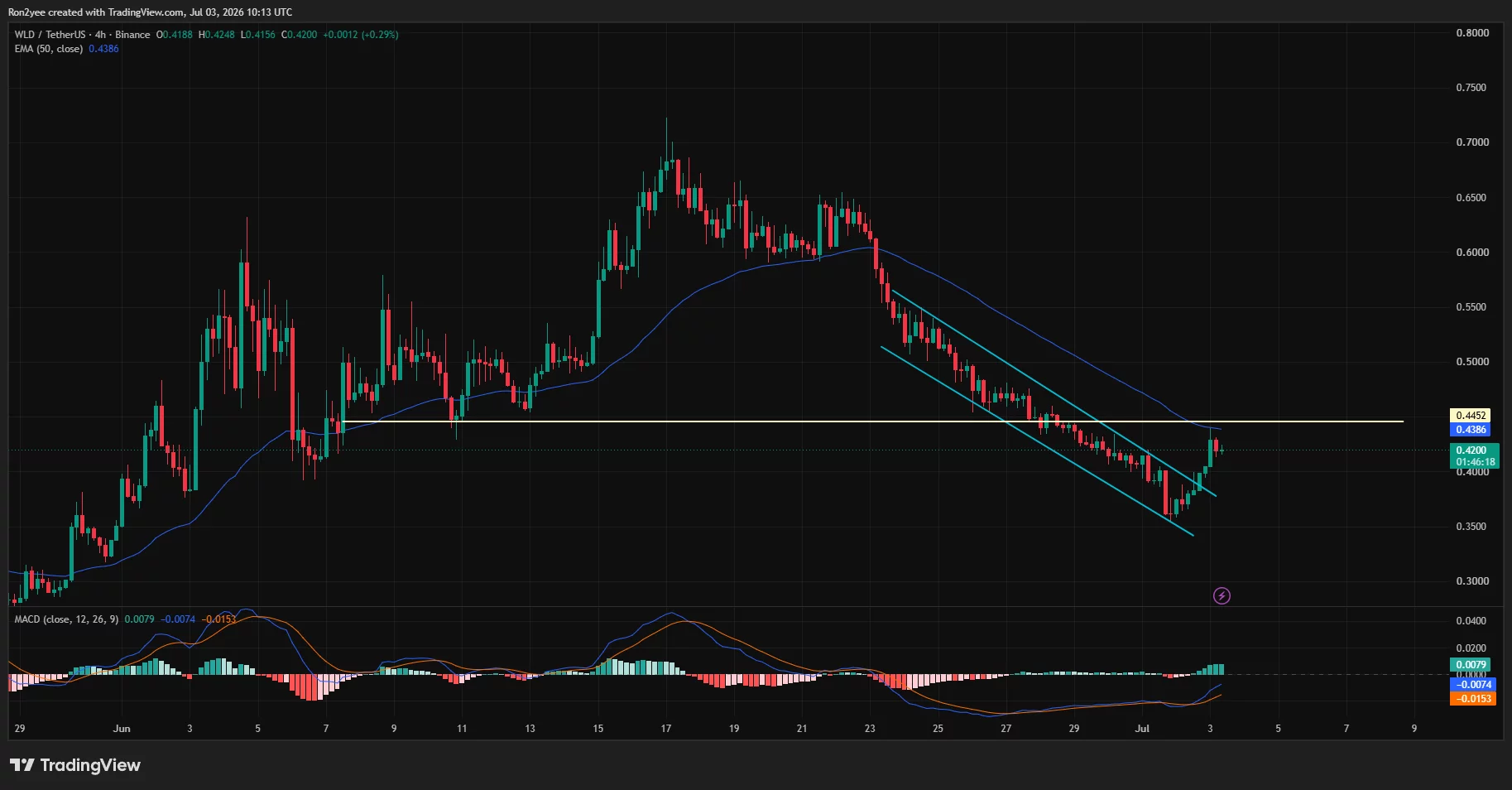
A sustained move above the 50-day EMA could expose horizontal resistance around $0.445, a level that rejected buyers earlier in the decline. Clearing that barrier would leave the 200-day EMA near $0.47 as the next major upside objective.
On the 1-day chart, WLD has already reclaimed the multi-month support zone around $0.36, while Chaikin Money Flow has crossed back above zero, suggesting capital has started returning after several weeks of distribution. At the same time, the Aroon Up indicator has climbed above 85% while Aroon Down has dropped to zero, showing buyers have regained control of the prevailing trend.
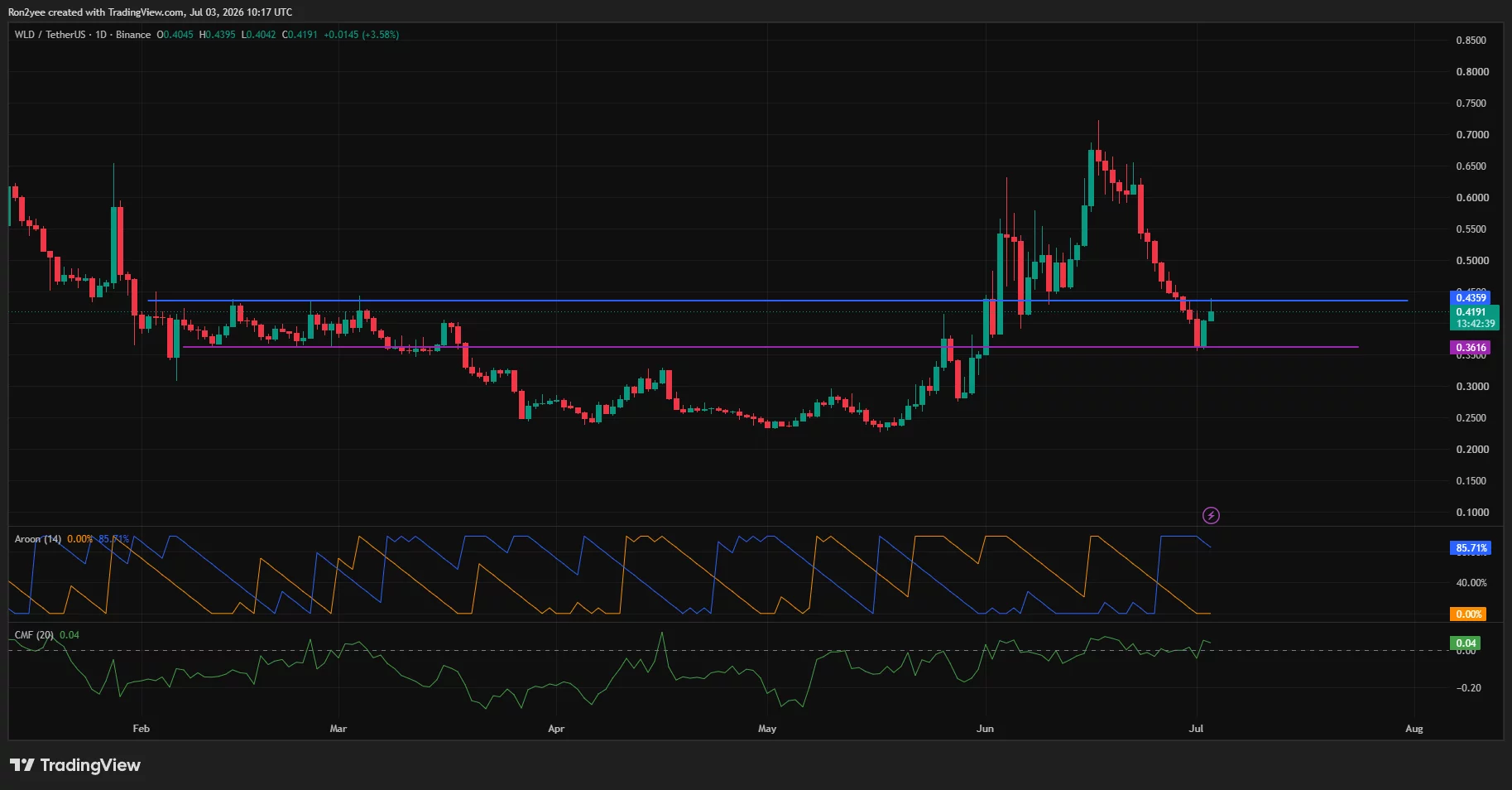
Momentum indicators on the 4-hour chart also support the recovery. The MACD has completed a bullish crossover, and expanding green histogram bars show upside momentum has strengthened since the channel breakout. Trading volume increased alongside the advance, reinforcing the move after the sharp rebound from the July 2 low.
According to analyst Unknown.Ai, traders should avoid chasing the initial breakout until resistance gives way.
“A clean 4h close above $0.445 flips the macro bias bullish and clears the runway toward the 1d ema200 at $0.471.”
The analyst added that a pullback into the $0.411-$0.415 region could offer a lower-risk entry if buyers defend the breakout.
Derivatives positioning also strengthened alongside the technical recovery. Open interest rose as fresh positions entered the market, while funding rates turned positive after spending much of the previous decline in negative territory. That combination suggests new long exposure entered the market instead of the rally being driven solely by short covering.
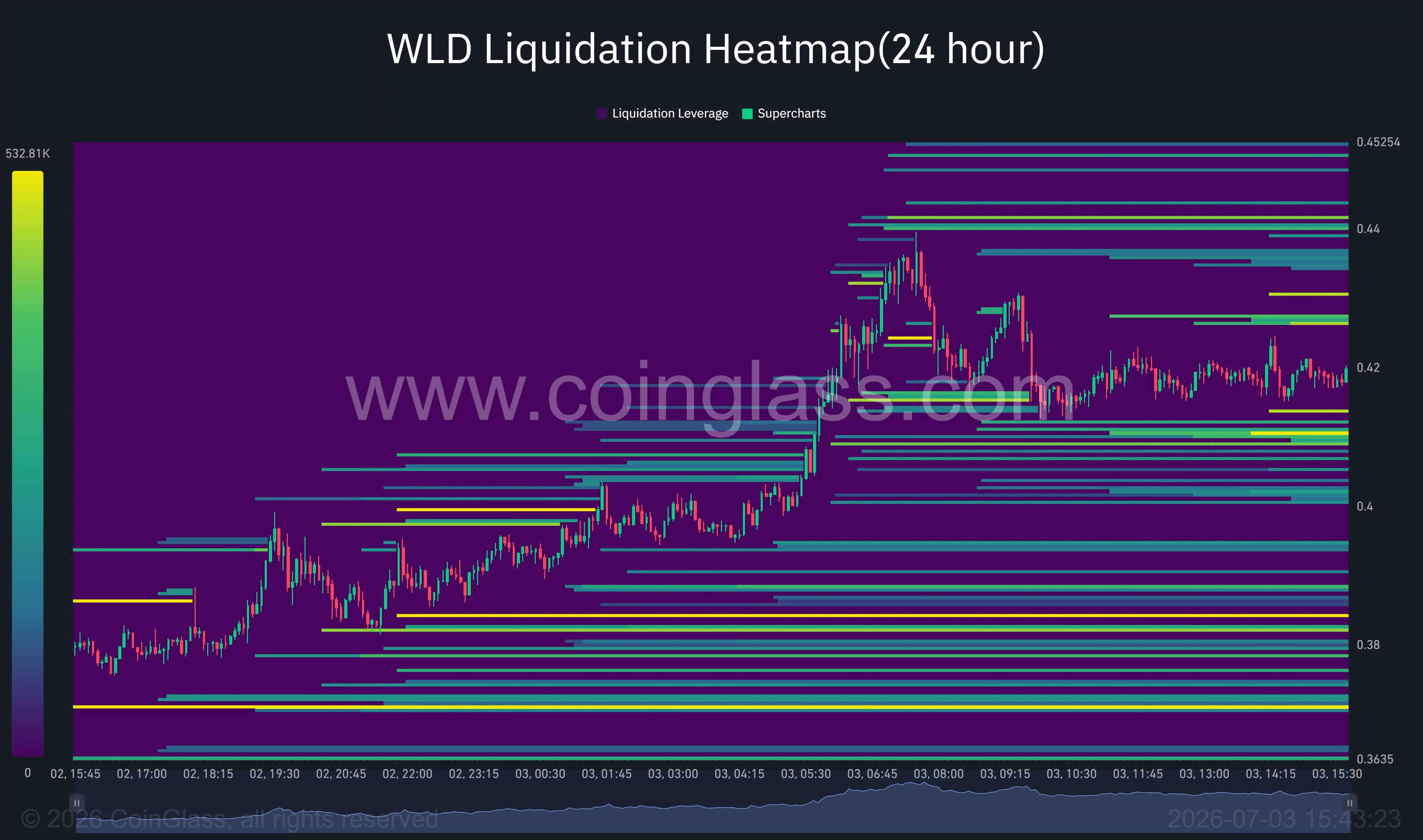
CoinGlass liquidation data also shows dense leverage clusters between $0.44 and $0.452, making that region the next area where volatility could accelerate if bulls force another breakout. Below the current price, notable liquidity rests around $0.40 and $0.38, levels that could attract buyers if profit-taking emerges.
Failure to hold breakout could revive the downtrend
Despite the improving structure, Worldcoin still faces several hurdles before confirming a larger trend reversal. The token remains below the daily 200-day EMA, while the $0.445-$0.47 zone combines horizontal resistance with long-term moving averages that previously acted as support before June’s breakdown.
A rejection beneath $0.445 followed by a loss of the $0.411-$0.415 support area would weaken the breakout structure and could send WLD back toward the $0.36 support zone. Renewed weakness in Bitcoin or another wave of risk-off sentiment across crypto markets could also slow demand for higher-volatility assets.
Longer term, investors continue to monitor Worldcoin’s regulatory challenges surrounding biometric data collection and its remaining token unlock schedule. Although the upcoming emission reduction eases near-term supply pressure, concerns over the project’s fully diluted valuation remain a factor that could limit sustained upside unless demand continues to absorb future issuance.
Disclosure: This article does not represent investment advice. The content and materials featured on this page are for educational purposes only.
Disclosure: This article does not represent investment advice. The content and materials featured on this page are for educational purposes only.
Growing optimism around XRP ETF developments is driving interest in early-yield strategies, with EX DeFi gaining attention alongside cloud mining infrastructure.
Summary
- Rising optimism over XRP ETF inflows is boosting interest in cloud mining platforms such as EX DeFi.
- The platform highlights its cloud mining services as growing XRP ETF optimism draws attention to crypto infrastructure.
- EX DeFi positions its cloud mining platform to benefit from renewed market interest following XRP ETF developments.
The optimism surrounding XRP ETF inflows is driving investors towards early-yield strategies, and the potential opportunities presented by cloud mining and related infrastructure are also drawing market attention to the EX DeFi platform.
Discussions about the “next cryptocurrency breakthrough” are intensifying, with XRP (Ripple) once again becoming a focal point in the cryptocurrency industry.
Recently, market sentiment has improved as progress on the XRP ETF has continued. Industry insiders believe that the continued rollout of compliant investment products is expected to further increase institutional investor participation and bring more market attention to mainstream digital assets like XRP. Meanwhile, ecosystem development, improved liquidity, and infrastructure growth are also crucial factors driving the industry’s long-term growth.
Several market research institutions point out that if the XRP ETF can continue to attract institutional funds, its impact could be similar to the positive effects of early Bitcoin ETF launches. However, market performance will still be influenced by various factors, including the macroeconomic environment, regulatory policies, and investor risk appetite, and future trends remain uncertain.
Against this backdrop, EX DeFi, as a digital asset service platform, offers cloud mining solutions, allowing users to participate in mining without deploying specialized equipment. As the market continues to develop, this more convenient and efficient participation model is gradually becoming a focus of industry attention.
Why EX DeFi has become more popular after the XRP ETF listing
EX DeFi was one of the fastest-growing cloud mining platforms in 2026, renowned for its green energy-powered mining farms, transparent computing power, and compliant architecture. No mining rigs, equipment maintenance, or technical expertise are required; you simply purchase a computing power contract to start mining.
EX DeFi is incorporated in the UK and regulated by regulatory bodies. The company employs international security systems such as McAfee® and Cloudflare®, and 2FA verification to provide bank-grade protection for customer funds and data. All yield is processed in real-time through smart contracts, ensuring transparency and traceability. The platform currently serves users in over 180 countries and is supported and trusted by 2 million investors worldwide.
How EX DeFi ensures the safety of customer funds
Fund security has always been a crucial foundation of the EX DeFi platform. To further protect user assets and account security, the platform has established a multi-layered security protection system covering asset storage, risk control, cybersecurity, and compliance management.
Regarding asset storage, the platform employs a cold and hot wallet separation management mechanism. Over 80% of users’ digital assets are stored in offline cold wallets, physically isolated from the internet to reduce potential cyberattack risks. Simultaneously, the platform’s digital assets are insured by Lloyd’s of London, adding an extra layer of protection for user assets.
In terms of risk management, EX DeFi has introduced an intelligent risk control system to monitor transaction behavior in real time, promptly identifying abnormal transactions, suspicious fund flows, and potential risks, further enhancing the platform’s overall security management capabilities.
Furthermore, the platform regularly undergoes security and compliance audits by PwC, which independently assesses operational processes and fund management, continuously improving transparency and traceability. Regarding cybersecurity, EX DeFi combines Cloudflare enterprise-grade network protection with McAfee security protection systems to provide 24/7 system security protection for the platform, continuously optimizing the digital asset security management environment for global users.
How to Earn Daily Yields with EX DeFi
EX DeFi is easy to use; simply follow these four steps to earn daily mining rewards:
1. Register an Account
Visit the official EX DeFi website and register for free using an email address. New users receive a $17 bonus.
2. Deposit Cryptocurrency
Supports a variety of mainstream cryptocurrencies, such as XRP, BTC, ETH, BNB, USDT, LTC, USDC, BCH, DOGE, and SOL. The deposit process is clear, convenient, transparent, and secure.
3. Choose a Mining Contract
Choose a mining yield plan that suits a particular budget. The minimum deposit is only $100. Smart automatic mining will be enabled after system activation.
4. Automatically Receive Daily Rewards
The platform provides 24/7 smart mining services and automatically distributes daily rewards. Users can easily earn passive income without any manual operation.
EX DeFi Popular Yield Plans
BTC (Beginner Trial Contract): $100 | Term: 2 days | Daily Yield: $4 | Total Yield: $100 + $8
DOGE/LTC (Goldshell Mini DOGE Pro): $500 | Term: 6 days | Daily Yield: $6.5 | Total Yield: $500 + $39
DOGE (Goldshell-LT6): $2500 | Term: 15 days | Daily Yield: $35 | Total Yield: $2500 + $525
BTC (Bitmain-S19): $7000 | Term: 25 days | Daily Yield: $107.8 | Total Yield: $7000 + $2695
BTC (Whats-M56): $30000 | Term: 33 days | Daily Yield: $501 | Total Yield: $30000 + $16533 USD
For details on mining contracts, please visit the EX DeFi website.
Conclusion
As the digital asset market continues to develop, the launch of the XRP ETF is seen by many market participants as a significant milestone in the industry’s development, further increasing market attention to the digital asset ecosystem. For investors, while focusing on market opportunities, a greater emphasis on long-term planning, risk management, and diversified participation methods is gradually becoming a new investment trend.
Against this backdrop, EX DeFi provides users with a more convenient way to participate through cloud mining infrastructure and digital asset services. As the industry continues to evolve, the platform will continue to improve its product and service systems to help users participate in the digital asset ecosystem more efficiently and seize long-term market opportunities.
Visit the EX DeFi official website to start the cloud mining journey and earn up to $7,000 daily.
Disclosure: This content is provided by a third party. Neither crypto.news nor the author of this article endorses any product mentioned on this page. Users should conduct their own research before taking any action related to the company.

Reframing AI adoption for long-term growth rather than short-term savings
Bridge Obtains Dual European Licenses to Power Euro Stablecoin Infrastructure
America’s most secretive golf club is revealing itself: Inside The Institute


-

 Fashion7 days ago
Weekend Open Thread: Staud – Corporette.com
-

 Crypto World3 days ago
Strategy authorizes up to $1.25B in Bitcoin sales under new capital plan
-

 News Videos5 days ago
MAJOR BITCOIN & MARKET UPDATE!!!! (MUST WATCH ASAP!!!)
-

 Tech3 days ago
Anonymous researcher drops 0-day ‘exploitarium’ repo
-

 Crypto World6 days ago
Coinbase, Circle Deepen Crypto Stock Losses Despite Resilient S&P 500
-

 Business3 days ago
Australia treasurer says alleged access of prime minister’s bank data ’incredibly concerning’
-

 Tech5 days ago
Claude Code turned every engineer into three. Now companies need more product thinkers
-

 Crypto World6 days ago
Kraken's xStocks Opens Bending Spoons IPO Registration to EEA Retail
-

 Sports7 days ago
FIH Pro League: India defeat Pakistan 7-1, register biggest win of campaign | Other Sports News
-

 Tech5 days ago
Bluekit phishing kit adopts browser-in-the-middle for login theft
-

 Tech6 days ago
Russian hackers now target Signal backup recovery keys
-
Crypto World7 days ago
Hyperliquid Named on Singapore MAS Investor Alert Register
-

 Crypto World7 days ago
RTX holders must register wallets before token distribution begins
-
 Business4 days ago
The AI boom won’t burst all at once. It will pop in ‘rolling bubbles’: Macquarie
-

 Sports2 days ago
Broncos roster: OL Ben Powers (No. 74) entering final year of contract
-

 Tech6 days ago
Silicon Valley paid to kill AI regulation, now it wants the rules back
-

 NewsBeat3 days ago
Presenter Caroline Flack’s brother Paul Flack dies aged 55
-

 Crypto World1 day ago
Binance stock trading tops $1B in first month after launch
-
 NewsBeat1 day ago
New exhibition reflects five decades of movement between island of Ireland and GB
-

 Tech6 days ago
OpenAI mulls delaying IPO over valuation concerns
You must be logged in to post a comment Login