

Crypto World
Kraken debuts Bitcoin Vault as demand grows for BTC yield products

Crypto platform Kraken is offering customers an easier way to earn yield on their bitcoin holdings without selling or actively managing assets across decentralized finance (DeFi) protocols.
The Bitcoin Vault product within Kraken Earn allows users to win rewards denominated in bitcoin while maintaining exposure to BTC’s price. It is aimed at long-term holders looking for passive income opportunities tied to assets they already plan to keep over time, Kraken said in the Wednesday press release.
The new offering is powered by DeFi infrastructure provider Veda and operated by Sentora, with customer assets allocated across established onchain lending and yield protocols including Aave, Morpho and Tydro.
“Many bitcoin holders on Kraken have made it clear they want simple, safe ways to earn on the bitcoin they already plan to hold,” John Zettler, GM of Payward Services and head of Kraken Earn Products, said in the statement. “Bitcoin Vault is built for that mindset,” he added.
The structure is intended to abstract away much of the operational complexity typically associated with DeFi participation, allowing customers to access yield opportunities directly through their Kraken accounts.
In crypto, vaults are pooled investment products that automatically deploy users’ assets across DeFi protocols to generate yield. Rather than requiring users to manually move funds between lending, staking or liquidity platforms, they package those strategies into a single product, often with automated risk management and rebalancing.
Crypto exchanges and DeFi firms have increasingly rolled out vault products as demand grows for passive yield opportunities tied to long-term holdings like bitcoin and ether.
Bitcoin Vault marks the latest step in Kraken’s broader push into onchain financial products as exchanges compete to attract users seeking yield-generating strategies beyond spot trading. While centralized crypto lending products largely collapsed during the 2022 market downturn, exchanges and DeFi platforms have increasingly repositioned yield products around transparent onchain infrastructure and overcollateralized lending markets.
Kraken said the product is designed to appeal both to existing customers and to bitcoin holders outside the platform who may be looking to consolidate assets with a large exchange while generating additional yield. The company added that onboarding into Bitcoin Vault is integrated directly into the Kraken and Krak apps.
The firm’s broader DeFi Earn offering has surpassed $240 million in assets under management since launching in January, which it attributed to organic customer adoption rather than token incentives.
Bitcoin Vault is now available in eligible jurisdictions through Kraken Earn.
Read more: Kraken parent Payward’s Q1 revenue climbs despite crypto market slump

The odds of securing a July 4 signing for the CLARITY Act have narrowed, with lawmakers, industry groups, and market observers increasingly turning their attention to the August recess.
Summary
- Many lawmakers and industry participants now see the August recess as a more realistic target for the CLARITY Act than July 4.
- Unresolved ethics negotiations and Senate procedural hurdles continue to slow the bill’s progress.
- Coinbase, Ripple, and other industry groups remain supportive as momentum for the legislation continues.
According to reporting from Crypto In America, many policymakers and industry participants now view August as the more realistic benchmark for advancing the Digital Asset Market Clarity Act, despite continued support from the White House for an Independence Day deadline.
At Consensus Miami in May, White House Crypto Council Executive Director Patrick Witt said the administration was working toward passage by July 4, describing the legislation as a potential birthday gift for the United States as it prepares to celebrate its 250th anniversary.
Witt reiterated that optimism in comments to crypto journalist Eleanor Terrett on Friday, citing ongoing efforts to resolve Agriculture Committee language, negotiate ethics provisions with Democrats, and address law enforcement concerns tied to illicit finance measures.
Yet the legislative path remains demanding. As outlined by Terrett on Monday, the Senate must still merge separate versions approved by the Banking and Agriculture Committees, secure 60 votes to advance debate, clear additional cloture votes on amendments, and pass the final measure before sending it to the House for approval of any Senate changes.
Limited Senate calendar complicates July target
Legislative timing has become one of the biggest obstacles facing the bill.
“But even if all of those outstanding issues were resolved this week, there simply isn’t enough time left on the legislative calendar to make a July 4 signing logistically possible,” Terrett wrote on Monday.
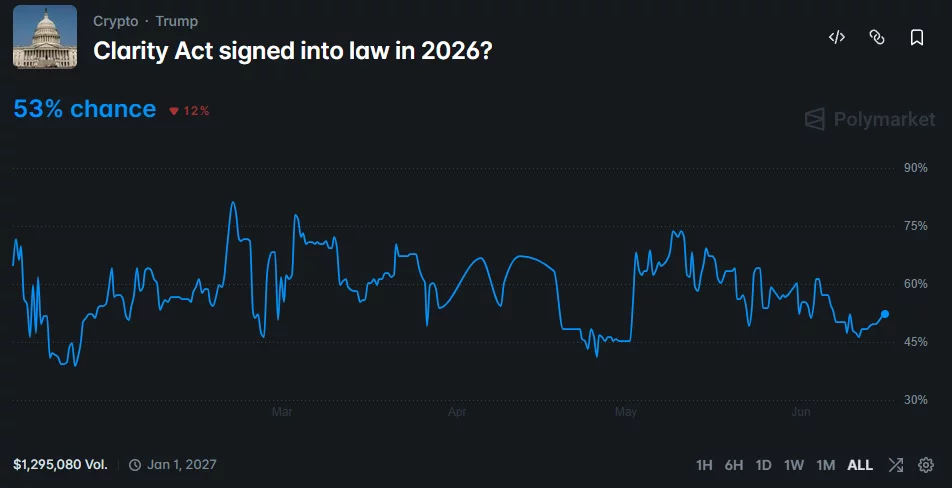
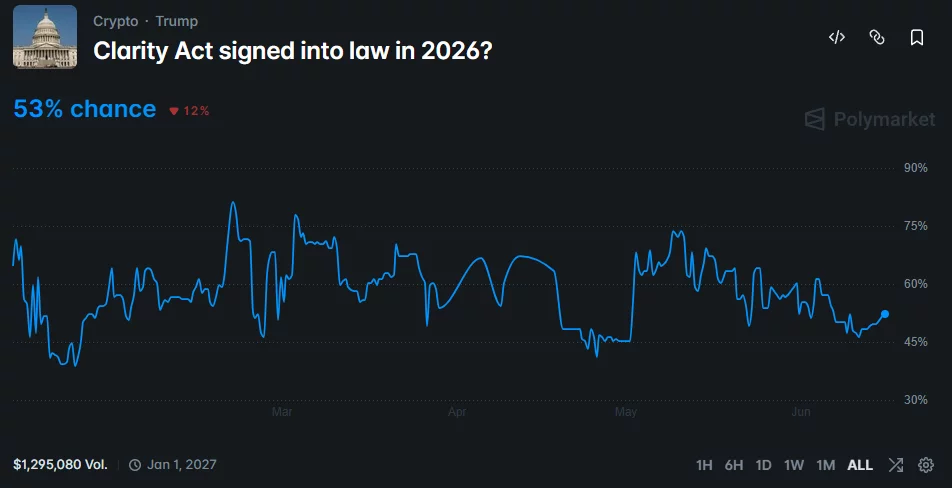
According to prediction market platform Polymarket, the odds of the CLARITY Act becoming law in 2026 have fallen to 53%, down from about 75% in May.
The timeline has become more challenging because several negotiations remain unfinished. According to Crypto In America, talks over ethics provisions sought by Democrats have been difficult, while other policy questions continue to be debated between lawmakers.
Senator Cynthia Lummis of Wyoming, one of the bill’s leading architects, previously told Terrett’s newsletter that combining the committee proposals, ethics language, and related changes tied to the GENIUS Act into a single package and obtaining the required 60 votes could take longer than the July 4 target allows.
The legislation has nevertheless made measurable progress. The Senate Banking Committee advanced the bill with bipartisan backing, while two Democratic members supported the measure on the condition that stronger ethics safeguards linked to President Donald Trump were incorporated into the final text.
Industry support remains strong despite delays
The CLARITY Act remains one of the most significant crypto market structure proposals considered by Congress. The legislation would establish clearer jurisdictional boundaries for digital assets, placing decentralized cryptocurrencies such as Bitcoin and Ethereum under the oversight of the Commodity Futures Trading Commission while leaving qualifying securities under securities regulators.
Beyond market classification, the bill contains provisions covering stablecoins, anti-money laundering compliance, decentralized finance activities, and blockchain validators. As reported by crypto.news earlier, more than 200 crypto organizations, including Coinbase and Ripple, recently urged lawmakers to advance the legislation.
Additional pressure comes from competing congressional priorities. According to Crypto In America, lawmakers must also address a bipartisan housing package, the nomination of former SEC Chair Jay Clayton as Director of National Intelligence, and the reauthorization of FISA Section 702.
Despite the delays, some observers believe the bill retains enough political support to continue moving forward. Adam Minehardt of the Hyperliquid Policy Center told Crypto In America that the amount of political capital already invested in the legislation makes it unlikely to disappear from the congressional agenda, even if the July 4 target is missed.
Disclosure: This article does not represent investment advice. The content and materials featured on this page are for educational purposes only.


The Blockchain Association brought member executives to Capitol Hill this week and reported meeting with more than half the Senate, pressing lawmakers to preserve a key developer-protection provision of the Digital Asset Market CLARITY Act before an August recess deadline tightens the floor-vote… Read the full story at The Defiant


Anthropic has been hit with a proposed class-action lawsuit alleging that subscribers paying up to $200 per month for premium Claude plans have received significantly less usage than the company’s marketing materials suggested.
Summary
- Anthropic faces a proposed class-action lawsuit alleging its Claude Max subscription plans provide less usage than advertised.
- Plaintiff Karl Kahn claims premium subscribers encounter restrictive usage caps that disrupt coding and development work.
- The lawsuit arrives shortly after Anthropic’s Fable 5 and Mythos 5 shutdowns, adding to scrutiny surrounding the AI company.
According to a complaint filed Monday in the U.S. District Court for the Northern District of California, Washington, D.C. resident Karl Kahn is seeking class-action status on behalf of customers who have paid for Anthropic’s higher-tier Claude subscriptions since April 2024.
The filing argues that the company’s Max 5x and Max 20x plans do not provide the level of access many users would reasonably expect from their advertised terms.
At the center of the dispute are Anthropic’s premium subscription tiers, which cost $100 and $200 per month. According to the lawsuit, the company promotes those plans as offering five times and 20 times the usage available under its standard Pro subscription.
The complaint alleges that the actual limits imposed on subscribers fall well below those advertised multipliers and are difficult for customers to predict before reaching usage caps.
Kahn claims he upgraded to the Max 20x plan after increasing his use of Claude for software development and coding tasks. According to the filing, a single five-hour work session consumed roughly 15% of his weekly allowance.
The lawsuit argues that such restrictions forced subscribers to either stop working, ration their usage, or purchase additional access to complete projects.
The complaint focuses on premium subscription limits
Supporting its claims, the lawsuit references emails Anthropic allegedly sent to subscribers in July 2025. According to the complaint, those communications outlined expected weekly usage allowances across different Claude models and subscription tiers.
The plaintiff argues that those disclosures demonstrate a gap between how the plans were marketed and the access ultimately provided.
As a result, the filing asks the court to determine that Anthropic’s marketing practices were misleading or fraudulent and seeks relief for affected subscribers. The case arrives as the company continues to attract investor attention ahead of a widely anticipated public offering.
Legal scrutiny is not limited to Anthropic. Recently, OpenAI faced a multistate investigation related to alleged consumer harm connected to ChatGPT. The probe gained attention because it emerged shortly after reports that OpenAI had confidentially filed paperwork related to a potential IPO.
Anthropic faces pressure from multiple fronts
The lawsuit adds another challenge for Anthropic only days after the company drew attention for a separate controversy involving access to its advanced AI models.
As previously reported by crypto.news, Anthropic suspended access to its Fable 5 and Mythos 5 models after complying with a U.S. government directive tied to export controls.
According to Anthropic, the order required restrictions on foreign nationals, including foreign-national employees located both inside and outside the United States. To comply, the company disabled access to both models while keeping other Claude models available.
Commenting on that decision, CoinFund founder Jake Brukhman argued recently that advanced AI models have become key points of centralized control.
According to Brukhman, decentralized AI networks are attracting interest because access to large-scale computing resources can be distributed rather than concentrated within a small number of companies.
Brukhman cited projects including Gensyn, Prime Intellect, Bagel, Pluralis, Nous Research, Macrocosmos AI, and Covenant as examples of teams working on distributed AI training systems. According to his post, those efforts suggest decentralized training can compete with centralized approaches, although technical challenges remain.
Meanwhile, the newly filed lawsuit places Anthropic’s subscription business under a different form of scrutiny as the company navigates both regulatory and consumer-facing disputes.
The on-chain options and structured product protocol Thetanuts Finance was exploited for $2.1 million. Security firm Blockaid published the exploit transaction and exploiter address shortly after the attack. A white-hat intervened and recovered approximately $2 million of the stolen option tokens…. Read the full story at The Defiant
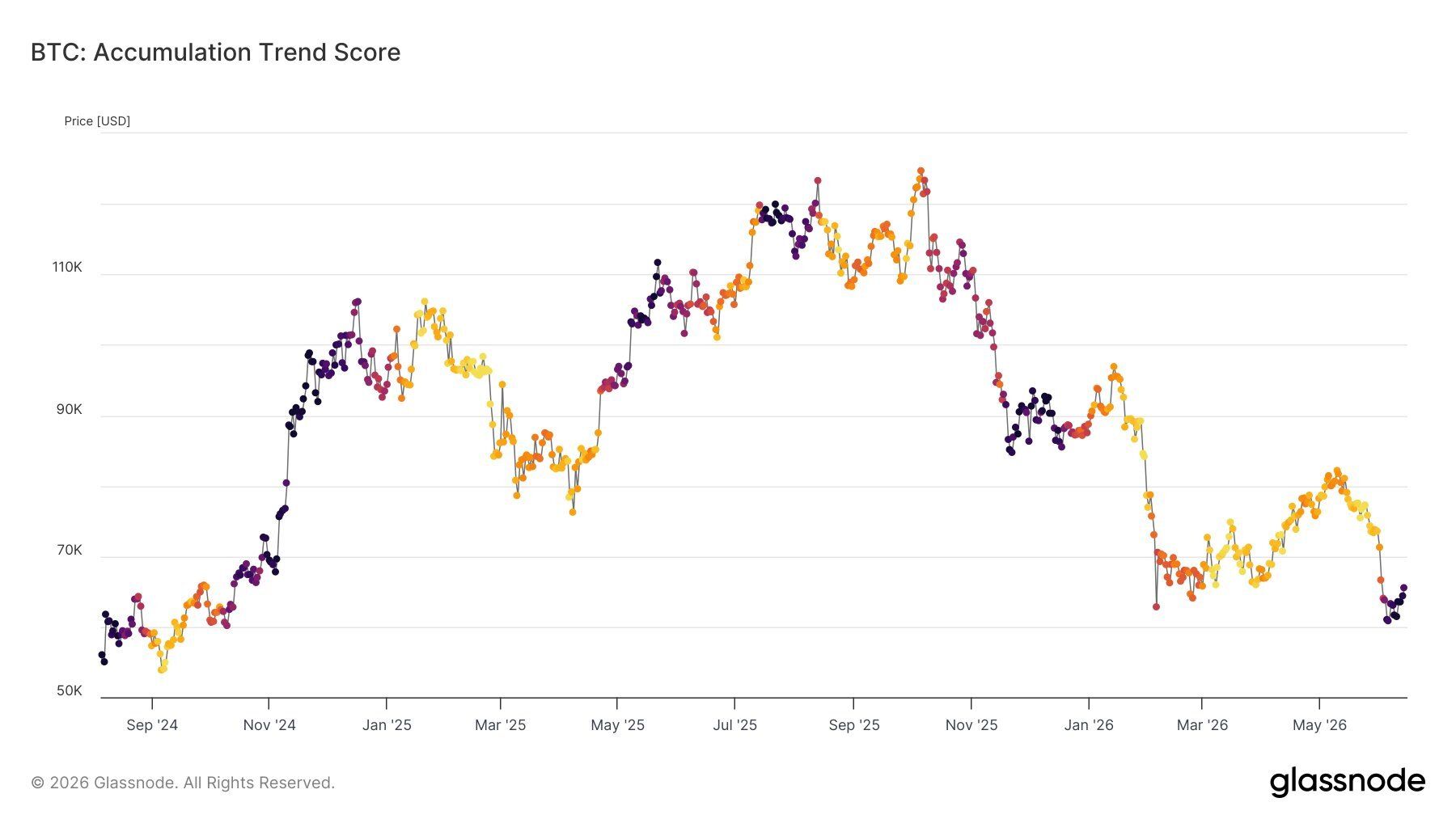
Bitcoin (BTC) has reclaimed roughly $67,000 after the June flush toward $60,000, and on-chain data shows real buyers stepping in. Yet the recovery in Bitcoin price is climbing into an options structure that tends to amplify volatility rather than calm it.
The trade case for a low rests on returning demand. The skeptical case rests on where that demand is showing up. Right now, the second case has the stronger evidence.
On-Chain Bitcoin Buyers Returned as BTC Fell Toward $60,000
The Accumulation Trend Score measures the relative size of wallets adding to their holdings. Readings near 1 point to broad accumulation. Readings near 0 point to the distribution.
As price slid into the $60,000 zone in early June, the score shifted toward accumulation across cohorts. Falling prices met rising on-chain demand instead of fresh panic selling.

The rebound since then has been sharp. Bitcoin rose by mid-single digits in a single session off the low, after sliding about 15% over the prior month. That speed is part of why the bounce looks convincing on the surface.
That pattern fits a classic buy-the-dip response. Large and small wallets both leaned in at lower levels. A parallel decline in exchange balances suggests buyers are moving coins into custody rather than preparing to sell.
Why Returning Demand Does Not Confirm a Bottom
Returning demand is necessary for a durable low. However, it is not sufficient on its own. The same score flashed accumulation several times during the prior decline.
The metric reads who is buying, not whether they are early. Distribution also dominated the entire 2025 climb into the highs. That selling into strength did not stop the eventual drop.
Forced liquidations also amplified the early-June move. A wave of stop-outs can exaggerate both the fall and the snapback. As a result, part of the bounce reflects mechanical short covering rather than fresh conviction.
On-chain bottom calls have misfired earlier this cycle, as recent signal-driven analysis has shown. A buy-the-dip reflex can persist for weeks while the price keeps grinding lower. Demand alone rarely marks the exact turn.
Deribit Options Positioning Sits in the Wrong Zone
Gamma exposure tracks how options dealers must hedge as prices move. In positive gamma, dealers buy weakness and sell strength, which dampens volatility. In negative gamma, they do the opposite, which sharpens moves in both directions.
On the Deribit heatmap, the dense cluster around $67,000 reads negative. Dealers positioned there tend to sell into dips and chase rallies. That makes a clean, calm recovery less likely while the price sits inside the band.
The calmer, positive-gamma zone sits higher, near $80,000 to $85,000. In other words, Bitcoin is bouncing into the destabilizing pocket while the stabilizing one remains well above the current price.

A dense strike can still pin price near expiry, so the cluster may slow the tape at times. Even so, the sign of the exposure leans toward sharper swings rather than a gentle floor.
The same positive gamma band overhead also acts as a brake on rallies. Dealers selling strength there would lean against the price as it climbs toward $80,000. So, the zone that brings stability also brings resistance.
Bitcoin Price Levels That Decide the Next Move
Three levels frame the read. The $60,000 area (green zone) marks the recent low and the floor that accumulation must defend. A clean loss there would undercut the demand story and the prevailing support thesis.
The $67,000 cluster is the volatility pivot (lower red zone). While price churns inside it, sharp two-way swings stay more likely than a steady grind higher.

Reaching the $75,000 –$80,000 band (the higher red zone) would mark the real shift. That zone is where positive gamma starts to cushion moves.
A reclaim there would give the skeptical case a clear reason to soften, and it would align with the more constructive June prediction scenarios.
The Bottom Line for Bitcoin Buyers
Demand is real, but it is not a green light. On-chain accumulation tells traders that buyers have shown up, not that the low is in.
Until Bitcoin trades back above the zone that actually calms volatility, the safer read is to treat this bounce as fragile. The setup could resolve higher, yet the options structure suggests patience over conviction for now.
The post Bitcoin Buyers are Back, But They Could be Walking Into a Trap at $67,000 appeared first on BeInCrypto.


Kraken and Coinbase each launched new perpetual futures products on Monday, marking the broadest single-day expansion of US-regulated derivatives in the crypto era. Kraken activated CFTC-regulated perpetual futures for eligible US clients through Bitnomial, a crypto derivatives exchange owned by… Read the full story at The Defiant

Key Takeaways
- MediaTek is pivoting from traditional chip design to comprehensive system-level AI hardware solutions, pursuing opportunities with Google’s TPU and AI infrastructure projects linked to Elon Musk’s ventures.
- TF International Securities analyst Ming-Chi Kuo notes this strategic transformation won’t significantly affect MediaTek’s financials in the immediate two-year window but establishes groundwork for future expansion.
- Google is pursuing discussions with Samsung for manufacturing components of its upcoming AI processor, designated Icefish, as TSMC faces capacity constraints.
- The Google-Samsung negotiations underscore the intense competition for advanced AI chip fabrication, forcing even premium clients to seek alternative manufacturing partners.
- MediaTek’s expansion into system-level solutions aims for 40–50% gross margins using an asset-light approach, outsourcing production while maintaining control over design and quality assurance.
MediaTek is undertaking a significant transformation in its artificial intelligence business model, moving beyond traditional semiconductor design toward comprehensive system-level hardware solutions. The Taiwanese technology firm is pursuing two strategic opportunities: managing printed circuit board assembly for Google’s Tensor Processing Unit and developing rack-level infrastructure for AI companies associated with Elon Musk.
According to Ming-Chi Kuo from TF International Securities, this strategic realignment represents a fundamental business evolution rather than a short-term revenue initiative.
“MediaTek has elevated its AI business strategy from integrated circuit and application-specific integrated circuit design to comprehensive system-level design,” Kuo explained. He emphasized the transition carries “minimal impact on core business fundamentals through the next 24 months.”
Dual-Track Approach: Pursuing Google and Musk-Connected Ventures
These two strategic pathways present distinct characteristics and challenges. Google operates an established and mature hardware manufacturing network, making MediaTek’s prospects for securing premium rack-level integration contracts somewhat limited.
MediaTek’s more viable entry into Google’s ecosystem lies at the circuit board level, beginning with the tenth-generation TPU processor codenamed Icefish.
The opportunity with Musk-affiliated enterprises presents a contrasting scenario. These organizations are currently developing proprietary AI processors at commercial scale, and their rack assembly infrastructure remains in nascent stages.
“This represents MediaTek’s strategic window,” Kuo stated. He emphasized that sustained success hinges on MediaTek capitalizing on Taiwan’s robust hardware manufacturing ecosystem and its collaboration with Terafab, while acknowledging the initiative “currently lacks definitive timeline clarity.”
MediaTek’s financial model for this segment targets gross profit margins between 40% and 50% by maintaining leadership in design and validation processes while delegating actual manufacturing to third parties, ensuring operational efficiency.
Google Explores Samsung Partnership Amid TSMC Production Constraints
Simultaneously, Google is reportedly negotiating with Samsung to produce a memory input-output component for the Icefish processor. TSMC would continue manufacturing the primary computational core utilizing its cutting-edge 1.4-nanometer fabrication technology.
Wedbush Securities analysts suggest the Samsung discussions primarily stem from constrained manufacturing capacity at TSMC rather than signaling dissatisfaction with their services. Essentially, the extraordinary demand for advanced AI semiconductor production has reached levels where even flagship customers like Google must diversify their manufacturing partnerships.
Employing Samsung introduces operational complexities. Distributing chip fabrication across multiple foundries increases coordination challenges and potentially impacts production yields and economic efficiency.
For Google, the objective centers on guaranteeing adequate supply to support expanding AI infrastructure requirements. For Samsung, this opportunity represents a pathway to secure additional high-value foundry contracts.
Kuo’s broader analysis suggests MediaTek’s current ASIC chip design operations may experience deceleration within two to three years as the semiconductor industry transitions toward emerging architectures. This potential headwind underscores why the system-level expansion represents a strategic imperative, despite contributing minimal near-term revenue growth.
The most significant near-term indicator will be whether MediaTek secures qualification contracts for the TPU v10 Icefish processor. Regarding the Musk-affiliated ventures, specific implementation timelines remain undefined.

FIFA is running ticketing, loyalty, and digital collectibles for the 2026 World Cup on a custom Avalanche blockchain. The adoption story arrives as Avalanche (AVAX) posts its first bullish signal in a month.
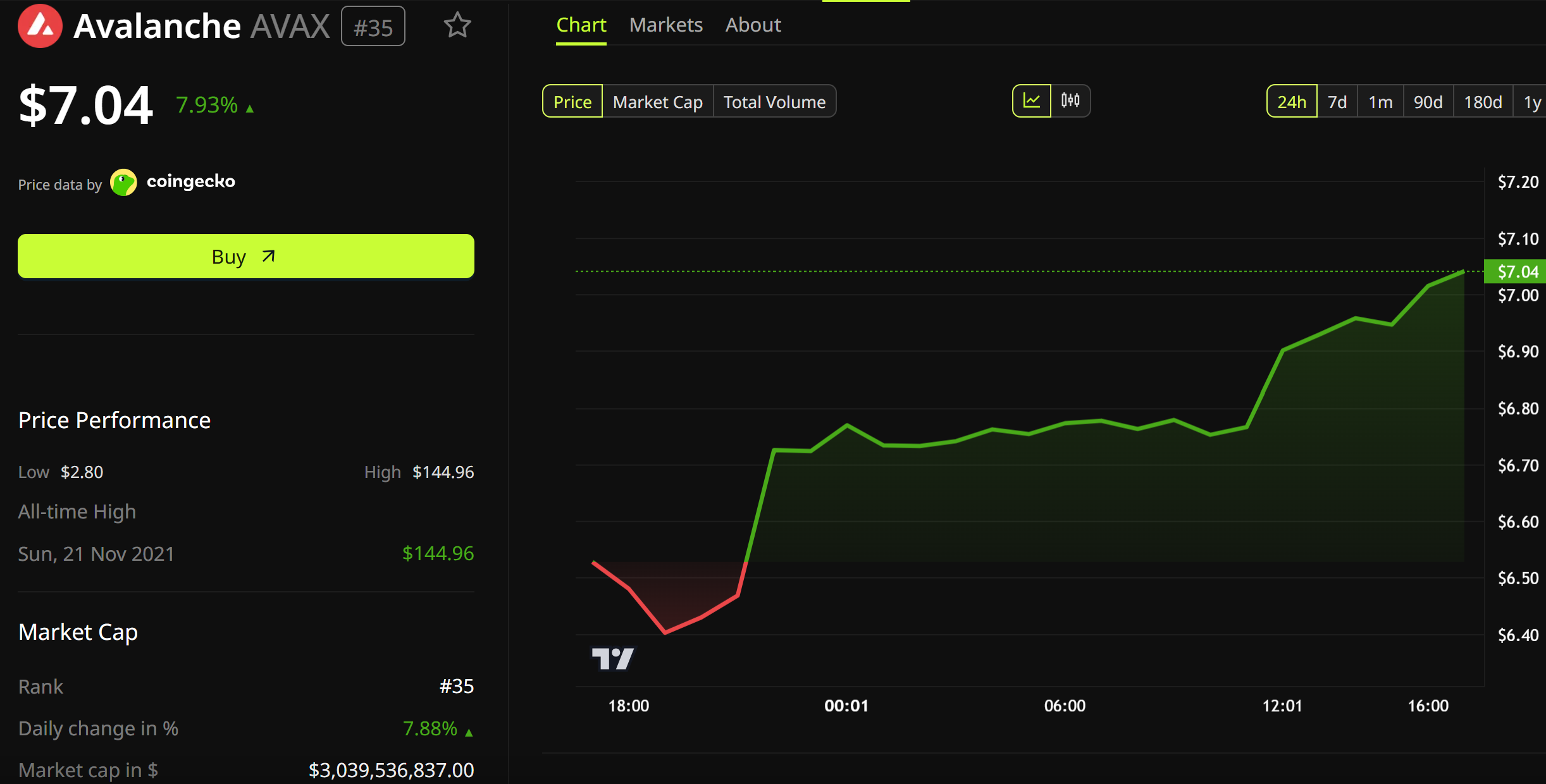
The token climbed nearly 8% in 24 hours. That move tracks a broader recovery in crypto sentiment, yet the World Cup hands Avalanche a fresh real-world hook that few rivals can match this summer.

FIFA’s World Cup Push Runs on Avalanche
FIFA announced its dedicated Avalanche blockchain in May 2025. The network is a custom Layer 1 built for digital collectibles and global-scale fan engagement.
The first step was migrating FIFA Collect, the official collectibles platform, to the new chain. Technology partner Modex leads development of the marketplace.
Right-to-Ticket collectibles now grant verified access to official 2026 World Cup match tickets. Holders convert them through a dedicated portal up to three days before each match.
Ava Labs President John Wu has confirmed the scope of the integration in recent interviews.
“We’re super excited that FIFA and the World Cup that’s coming this summer is doing their loyalty and the right to buy tickets and ticket platform on an Avalanche blockchain,” John Wu, Ava Labs president.
Follow us on X to get the latest news as it happens
Adoption Meets a Sentiment Recovery
Avalanche has already seen a surge in new users tied to the FIFA partnership and rising institutional interest.
On-chain activity picked up again as Right-to-Ticket redemptions went live during the tournament.
Still, the latest price move owes much to improving market-wide sentiment. AVAX had fallen more than 24% over the past 30 days before this week’s bounce.

The FIFA link does give Avalanche a marketing advantage among World Cup crypto coins. However, whether that translates into lasting demand for the token remains to be seen.
AVAX Price Outlook
The Avalanche price is trading near $7.07 as it consolidates within a falling wedge pattern that capped price action since early 2026.
However, the falling wedge is a bullish reversal pattern in technical analysis. The target objective is determined by measuring the technical formation’s maximum height and superimposing it at the expected breakout point.
With price now challenging the 50-day EMA cluster near $7.44, immediate support rests at the lower boundary of the technical formation at $6.22.
Increased buyer momentum above current levels would see the AVAX price test the 50-day EMA before confronting the confluence resistance between the 100-day EMA and the upper boundary of the falling wedge at $8.29.
A confirmed move above this level could activate the 49% rally, with the AVAX price potentially extending gains to $13.08.
Based on the volume profiles (green horizontal bars), bulls are waiting to interact with the Avalanche price above the falling wedge, adding credence to the prospective 49% climb.
The Relative Strength Index (RSI) trajectory also shows growing momentum, with the bullish crossover above its signal line (yellow) indicating a green signal for AVAX.

Conversely, loss of $6.22 support would shift focus back to the lower range, potentially forming a lower low. A decisive daily close below this area would invalidate the bullish structure and open the door for a leg lower.
The RSI below 50 is also concerning, indicating that while momentum continues to build, the bears still hold the upper hand.
The post FIFA World Cup Push Lifts Avalanche Adoption: Will AVAX Price Rally? appeared first on BeInCrypto.


Bitcoin (BTC) traded at $0.20 when South Africa hosted the 2010 FIFA World Cup. With North America now staging the 2026 edition, BTC sits near $66,258, a gain of more than 328,000% across five consecutive tournaments.
The timing has never broken down. Each World Cup since 2010 opened with Bitcoin higher than the one before: $620 in Brazil 2014, $6,500 in Russia 2018, $16,800 in Qatar 2022, and roughly four times that figure today.
Bitcoin’s Halving Makes the World Cup Timeline Look Less Like Luck
The Bitcoin ETF and liquidity cycle analysis published in 2026 points to a structural reason the four-year pattern persists.
Bitcoin’s halving cuts miner rewards in half on the same four-year schedule as the World Cup, tightening new supply each time. Bull markets have historically followed within 12 to 18 months of each reduction.
The current cycle saw BTC peak near $126,000 in early 2025 before sharply pulling back.
The Bitcoin price near $66,258 today sits roughly halfway between the Qatar 2022 price and that peak, consistent with previous post-peak drawdowns within the same cycle.
The Returns are Compressing
The math across each four-year hold tells its own story. Buying at the 2010 tournament and holding to 2014 would have returned roughly 3,100x. The 2014-to-2018 window delivered around 10x. Qatar 2022 holders from 2018 saw approximately 2.6x. The 2022-to-2026 gain sits near 3.9x.
The direction is clear. As Bitcoin matures into a multi-trillion-dollar asset, each successive multiplier shrinks. Institutional capital and ETF flows now shape price behavior in ways that block-reward mechanics alone cannot explain.
New demand layers add structural support but also absorb the volatility that produced early-cycle windfalls.
Will 2030 be Different?
Crypto’s presence at the 2026 World Cup spans prediction markets, fan tokens, and on-chain betting, a sign of mainstream penetration that could sustain demand or simply price the next move in earlier.
The streak stands unbroken, but holding through a full cycle now requires patience for a smaller reward than the previous generation received.
The Bitcoin outlook through 2030 ultimately depends on US monetary policy, sovereign accumulation, and whether ETF-driven demand continues to absorb sell pressure. The pattern has held through five tournaments. The question now is whether five becomes six.
The post Bitcoin Has Gained at Every FIFA World Cup: Will the 2030 Cycle Hold? appeared first on BeInCrypto.
Crypto World
Market Movers Today: SpaceX IPO Shatters Records, AI Stocks Expand, and Airlines Take Flight

Quick Overview
- SpaceX’s public debut has become the biggest IPO ever recorded, fundamentally altering investor perspectives on private technology enterprises
- Reports indicate OpenAI submitted confidential IPO paperwork, generating substantial excitement throughout the investment community
- Market participants are diversifying AI investments beyond Nvidia, turning attention to Broadcom, TSMC, AMD, and Micron
- Energy markets found equilibrium following recent turbulence, supported by positive signals from US-Iran negotiations
- Airlines experienced strong gains driven by reduced fuel expenses and robust leisure travel demand
While the SpaceX public offering captured headlines throughout the week, numerous other developments commanded investor focus. From emerging AI investment opportunities to shifting energy dynamics, here’s what drove market activity today.
SpaceX’s Market Debut Reshapes Growth Investment Strategy
The space exploration company completed an unprecedented public offering that now stands as history’s largest. Exceptional investor appetite propelled the stock into the spotlight as one of Wall Street’s most closely monitored equities.
This landmark event has fundamentally transformed how the investment community evaluates privately-held technology enterprises. Market experts suggest the overwhelming response may accelerate public listing timelines for other prominent private companies.
Firms including OpenAI, Anthropic, Databricks, and Stripe have emerged as potential IPO prospects in current discussions. The successful SpaceX launch has made public market entry significantly more appealing for mature private enterprises.
The commercial space industry received broader momentum as well. Market participants are actively seeking additional companies positioned to capitalize on increasing commercial space investment.
OpenAI and Other AI Companies Eye Public Markets
Emerging reports indicate OpenAI has submitted confidential IPO documentation. Should this materialize, it would rank among the most significant technology listings in history.
Previously, investors gained AI market exposure primarily through established companies like Nvidia, Microsoft, Broadcom, and Amazon. A direct OpenAI public offering would fundamentally alter this landscape.
Anthropic and additional private artificial intelligence companies remain under close observation. Financial industry experts anticipate these enterprises could generate significant investor demand, particularly as AI implementation continues accelerating.
The possibility of several major AI public offerings within the coming years has emerged as a dominant conversation topic among investment professionals currently.
Expanding AI Investment Opportunities Beyond Nvidia
While Nvidia maintains its position as the leading AI equity, investors are actively exploring alternative sector opportunities.
Broadcom has gained considerable traction due to its specialized AI processors and network infrastructure products. Taiwan Semiconductor Manufacturing continues benefiting from strong demand for cutting-edge chip fabrication capabilities.
Both AMD and Micron are attracting increased interest as market participants seek diversified exposure throughout the AI supply ecosystem.
This expanded investment approach has elevated semiconductors, cloud infrastructure, networking equipment, and software companies throughout 2026. Investors have shifted from concentrated Nvidia positions toward broader infrastructure plays supporting the technology.
Energy Markets and Aviation Sector Return to Investor Radar
Oil prices stabilized following a period of significant fluctuation. Encouraging developments surrounding US-Iran diplomatic discussions helped alleviate concerns regarding potential supply interruptions.
Decreasing crude prices benefit both consumers and enterprises. Reduced fuel and logistics expenses contribute to maintaining inflation pressures under control.
Airline stocks have delivered exceptional returns recently. Given that fuel represents airlines’ largest operational expense, declining oil costs directly enhance profit margins.
Multiple carriers have experienced substantial gains as investors develop greater confidence regarding travel volumes and financial performance. Consumer enthusiasm for leisure travel continues demonstrating resilience despite wider economic uncertainties.
Should oil prices remain contained, airline equities could sustain strong performance through the latter portion of 2026.

Iran opens World Cup by playing to draw with New Zealand

Canada proposes privacy overhaul that would curb surveillance pricing and give consumers the right to delete their data

Money – Kayouth


-

 Business2 days ago
No Jackpot Winner as $257 Million Prize Rolls Over to $269 Million Monday Draw
-

 Crypto World4 days ago
Oppenheimer backs SpaceX as $70 billion retail frenzy builds
-

 Crypto World4 days ago
Markets Rally as SpaceX IPO Looms Amid Iran Tensions and Inflation Surge
-

 Fashion3 days ago
Weekend Open Thread: Tuckernuck – Corporette.com
-
Crypto World1 day ago
Zimbabwe Requires Crypto Businesses to Register Annually Under New FIU Regulations
-

 Entertainment7 days ago
The Ryan Gosling True Crime Thriller On Netflix That Gets Even Stranger, Stream It Now
-
 Sports6 days ago
Bangladesh beat Australia after 20 years in ODIs, register only their second win over six-time world champions | Cricket News
-

 Tech3 days ago
NanoClaw integrates JFrog registries to secure AI agent downloads
-

 Crypto World3 days ago
Bitget enters Argentina’s regulated crypto market through PSAV registration
-

 Tech4 days ago
This Week In Security: Microsoft On Microsoft, Register Your Domains, Linux On ARM, And FreeBSD Joins The File Cache Club
-
 Tech5 days ago
Dutton Ranch star claims they ‘didn’t see any disruption’ on set following Chad Feehan’s exit from Yellowstone spinoff fueled by Taylor Sheridan clash rumors
-

 NewsBeat4 days ago
El Nino has formed in the Pacific and could set records, forecasters say
-

 Politics5 days ago
Politics Home | Healey Resignation Is “Colossal Failure Of Government”, Says Former Labour Defence Secretary
-

 Tech6 days ago
‘This is Seattle’s position on AI’: City Council votes unanimously to pause big new data centers
-

 Business6 days ago
Thailand Ranks Second Worldwide for AI Adoption Growth, Microsoft Reports
-
 Entertainment4 days ago
Donnie Wahlberg & More Heat Up Las Vegas at Circa’s Barry’s Downtown Prime
-

 Sports5 days ago
First Time Since 1971: Australia Register Historic Low In ODI Cricket
-
 Tech4 days ago
Opendoor Ends India Operations, Fueling a Bigger Conversation About AI and Outsourcing
-

 Politics5 days ago
Belfast burns, while Met chief points finger at Iran and Russia
-

 NewsBeat3 days ago
FBI searches office of Ohio voter registration group
You must be logged in to post a comment Login