

Crypto World
Kraken lets tokenized stocks power leveraged crypto trades



Kraken has started allowing eligible users to use select tokenized stocks and ETFs as collateral for futures and margin trading on Kraken Pro. The update gives traders a way to support leveraged crypto positions without selling those tokenized holdings first.
Summary
- Kraken allows ten xStocks as collateral, widening capital use for eligible non-US traders globally today.
- Broad-market ETFs carry lower haircuts, while volatile names like MSTRx and HOODx receive higher discounts.
- Related coverage shows Kraken moving tokenized assets toward collateral, cash management and institutional credit products.
The exchange said 10 xStocks assets are eligible at launch. The list includes SPYx, QQQx, AAPLx, GOOGLx, TSLAx, NVDAx, HOODx, MSTRx, GLDx and CRCLx.
The feature applies only to eligible users outside the United States. Futures collateral is available to eligible clients outside the U.S., including in the European Economic Area. Margin collateral is available to eligible clients outside the U.S., excluding the EEA.
Tokenized shares gain trading use
Tokenized stocks and ETFs are blockchain-based products that track traditional securities. Kraken’s xStocks product gives users exposure to U.S. names such as Apple, Tesla, Nvidia and broad-market ETFs through digital tokens.
Earlier xStocks coverage reported that Kraken has been trying to turn tokenized equities into parallel market rails. The product was described as offering more than 60 tokenized U.S. stocks and ETFs, backed 1:1, with 24/5 trading.
The latest update changes how traders can use those assets. A user who holds NVDAx, for example, may keep that exposure while using the same holding to support a leveraged position, subject to Kraken’s rules.
Kraken said eligible xStocks are recognized automatically as collateral wherever futures and margin trading are available on a user’s account. That means users do not need to move assets into a separate product before using them.
Haircuts and limits control risk
Kraken applies haircuts and collateral limits to each eligible asset. Broad-market ETFs such as SPYx and QQQx have a 10% haircut and a maximum collateral value of $1 million.
Most individual stocks, including AAPLx, GOOGLx, TSLAx and NVDAx, have a 20% haircut and a $250,000 collateral cap. Higher-volatility names such as HOODx and MSTRx carry a 30% haircut, while GLDx and CRCLx have lower collateral limits.
The exchange said these limits and haircuts may change over time. That gives Kraken room to adjust collateral treatment if market volatility, liquidity or risk conditions change.
Kraken also warned that leverage remains risky. The company said, “This is not a risk-free way to access leverage.” If collateral value falls, users may face margin calls or liquidation.
Tokenization push keeps widening
The move fits a wider push to bring traditional assets into crypto trading systems. A recent hackathon report said tokenized stock markets had reached roughly $1.2 billion in market cap, while xStocks had logged more than $25 billion in total transaction volume.
Kraken has also been building collateral and credit products beyond tokenized stocks. In May, Payward and Franklin Templeton announced a partnership to bring tokenized money market products into Kraken’s platform as collateral and cash management tools.
In June, Kraken and Maple launched an institutional lending model using a bankruptcy-remote vehicle for crypto-backed loans. That product focused on structured credit, while the new xStocks update focuses on trader collateral.
The result is a broader trading stack where tokenized assets can do more than track prices. For now, Kraken’s new feature gives eligible users another way to manage collateral, but it also adds leverage risk that traders must monitor closely.

Crypto World
French Minister Reveals 77 Crypto-Related Kidnapping Cases, Says New Security Plan Is Coming

France has recorded 77 cryptocurrency-related cases involving kidnappings, extortion, or attempted kidnappings since the beginning of the year.
Speaking to the Association of Digital Asset Holders (ADAN) on June 30, Interior Minister Laurent Nuñez said the number had increased significantly from the 45 cases reported in 2025.
France Unveils Tougher Security Plan
While acknowledging the concerns within the sector, Nuñez described the incidents as serious but said emergency security measures introduced a year ago had delivered results. He revealed that around 200 people had been arrested either after attacks had taken place or before they could be carried out during the same period.
As a recent example, the minister said suspects linked to an incident in the Somme region on the previous Friday were apprehended within eight hours. He added that the victim had activated the dedicated emergency hotline created for members of the cryptocurrency sector.
According to Nuñez, 724 people in the industry are now registered on the government’s immediate identification platforms, representing an 11% increase in participation. While the full details of the government’s next steps have not yet been disclosed, the minister said all departments within the Interior Ministry had developed a new security strategy that is “more ambitious” than previous efforts.
The plan is built around three priorities. The first focuses on expanding intelligence sharing. Nuñez stressed that those directing these crimes are sometimes based outside France, which makes stronger intelligence gathering on criminal networks particularly important. The second priority aims to deepen cooperation with ADAN by creating a network of experts that connects cryptocurrency industry participants with relevant government officials.
The third priority seeks to improve operational coordination between law enforcement agencies to disrupt criminal groups more effectively while also strengthening cooperation with countries where those believed to be organizing the attacks are located.
The minister said cooperation with foreign authorities remains essential. As an example, he cited the June 2025 arrest in Morocco of a Franco-Moroccan man suspected of ordering a series of kidnappings targeting the crypto industry. One of the victims was Ledger co-founder David Balland. According to Nuñez, that arrest led to the sudden end of the attacks.
Wrench Attacks Persist
Similar attacks have continued to emerge elsewhere. In March, a crypto holder pseudonymously known as ‘Sillytuna’ said armed attackers forced him to hand over roughly $24 million in digital assets during a violent robbery. According to the victim, the assailants used weapons and threatened kidnapping and sexual assault unless he transferred control of his crypto holdings.
Blockchain investigators later tracked the stolen funds as they were moved across multiple networks and converted into privacy coins to make tracing more difficult.
The post French Minister Reveals 77 Crypto-Related Kidnapping Cases, Says New Security Plan Is Coming appeared first on CryptoPotato.


Coinbase faced sharp criticism this weekend after an AI-generated alert on its prediction markets reportedly declared a false World Cup result, saying Norway had beaten Brazil before the match was played.
The notification claimed Norway won 3-2, with striker Erling Haaland scoring twice, and framed the fabricated outcome as breaking news. Users flagged the alert on social media, where critics called it dangerous and irresponsible.
Coinbase AI Alert Draws Backlash Over Fake World Cup Result
Users accuse Coinbase of hallucinating results for a game that had not started, delivering factually incorrect alerts to millions of customers.
The knockout-stage fixture was set for Sunday at MetLife Stadium in New Jersey. Coinbase’s own market page listed the match under a weather delay, so no result existed when the alert went out.
Coinbase Chief Executive Brian Armstrong responded within hours, acknowledging the reports publicly.
“Taking a look with the team – thx for reporting it,” Armstrong responded in his first public comment on the error.
Follow us on X to get the latest news as it happens
Incident Tests Coinbase’s Truth-Seeking Pitch
The timing is awkward. Armstrong has promoted prediction markets as a reliable way to surface facts. He argues financial stakes produce better information than traditional media.
“Prediction markets are the ultimate form of truth seeking. When there’s skin in the game, the output is far more reliable,” Armstrong stated in January.
However, those words now sit beside an AI system that invented, or rather, “hallucinated” a result. Coinbase’s 2025 shareholder letter also calls being the “most trusted name in crypto” its core strategy.
That pitch has drawn scrutiny before. In late 2025, Armstrong read out words that traders had bet he would say on an earnings call. The move nudged a market tied to his own remarks.
“And I just want to add here the words Bitcoin, Ethereum, Blockchain, Staking, and Web3 to make sure we get those in before the end of the call,” Armstrong stated, blurting out the predicted words without any apparent context.
The mishap also lands as Coinbase leans hard into AI. Armstrong fired engineers in 2025 who refused to use new coding assistants.
He said in September that about 40% of daily code was AI-generated, with a target above 50%. The firm has since cut its AI costs while adding automated features.
Coinbase rolled out prediction markets across the US as part of its Everything Exchange. Early market flow was powered by Kalshi, a partner in the prediction market race.
The exchange has also fielded betting promotion concerns in its consumer app. In March, Armstrong addressed a separate targeting bug that pushed unwanted alerts.
“Looks like there was a bug on targeting for these push notifications – getting fixed now…The alternative is for us to apply a heavy hand and dictate what customers should or should not trade and I don’t think people want that either – too paternalistic, and anti free market,” he said.
Meanwhile, the error revives questions about AI safeguards in financial products used by millions.
The company will likely disable automated match alerts until it can verify outcomes. Past fixes suggest a patch and an apology could follow. Repeated failures, however, point to deeper product strain.
Coinbase and Armstrong did not immediately respond to BeInCrypto’s request for comment.
The post Coinbase Under Fire After AI Invents World Cup Result Before Match Begins appeared first on BeInCrypto.
![Bitcoin options open interest by strike price for the July 8 expiry, with max pain marked at $63,000. Source: Deribit]](https://wordupnews.com/wp-content/uploads/2026/07/a6e6814b97e74bed807b9aa7df3eb504.webp)
Bitcoin (BTC) options expiring July 8 have turned call-heavy, with traders positioning for higher prices. The expiry lands the same day the Federal Reserve releases minutes from its June meeting.
Call volume has outpaced puts across the contracts. Glassnode says fading demand for downside protection could mark early optimism returning to the market.
![Bitcoin options open interest by strike price for the July 8 expiry, with max pain marked at $63,000. Source: Deribit]](https://assets.beincrypto.com/img/9xvHTNSXYdXUEtjQO4mlERirlk0=/smart/a6e6814b97e74bed807b9aa7df3eb504)
Call Positioning Builds Into the Expiry
Call volume reached 6,258 contracts over 24 hours against 3,610 puts on Deribit as of this writing, delivering a put-call ratio of 0.58.
Open interest leans the same way, with 370 call contracts against 257 puts. Still, the expiry is small, holding about 628 contracts worth $39.3 million in notional value.
That is a fraction of the late-June monthly settlement, which cleared billions across Bitcoin and Ethereum. Its direct settlement impact is limited, so the signal lies in the positioning itself.
The heaviest call bets sit well above spot, including a large cluster near the $69,000 strike. Put open interest stays between $58,000 and $62,000, which points to lighter downside hedging.
Bitcoin’s spot price sat near $62,645 as of this writing, down 0.3% over 24 hours. The $63,000 has remained elusive for the pioneer crypto since the last week of June, with the weekend breaching proving short-lived.

Max pain marks the strike where the most options expire worthless, leaving sellers the smallest payout. The max pain theory suggests prices may drift toward the strike where option sellers face the smallest payout, but evidence for this effect is mixed.
As the Wednesday FOMC minutes and economic forecast report approaches, therefore, the Bitcoin price could drift toward the $63,000 level in quiet trade, though a small expiry exerts only a mild pull.
Follow us on X to get the latest news as it happens
FOMC Minutes Add Event Risk
The minutes from the June 16 to 17 meeting arrive at 2 p.m. ET on July 8. Policymakers held rates at 3.50% to 3.75%, the fourth straight hold.
The meeting was the first led by new Fed Chair Kevin Warsh. His hawkish policy debut sent Bitcoin and gold lower on June 17.
Nine of 18 officials projected a rate hike later in 2026, and the statement dropped its easing bias. The minutes will show how firm that hawkish turn was.
Against that backdrop, Glassnode reads the options market as unusually calm. It frames the fading demand for downside protection as a possible turning point.
The options market is currently pricing in low future volatility for $BTC. While upside expectations remain unchanged we see less demand for short exposure. This could be the first sign of optimism returning to the options market,” analysts at Glassnode indicated.
Still, that calm cuts both ways. Light hedging means any surprise in the minutes could move price sharply into the expiry.
Whether Bitcoin holds above $63,000 into Wednesday may hinge on how traders read the minutes. The coming session will show whether call buyers or the Fed set the near-term tone.
The post Bitcoin Options Turn Call-Heavy Before July 8 FOMC Minutes: Will BTC Break $63,000? appeared first on BeInCrypto.
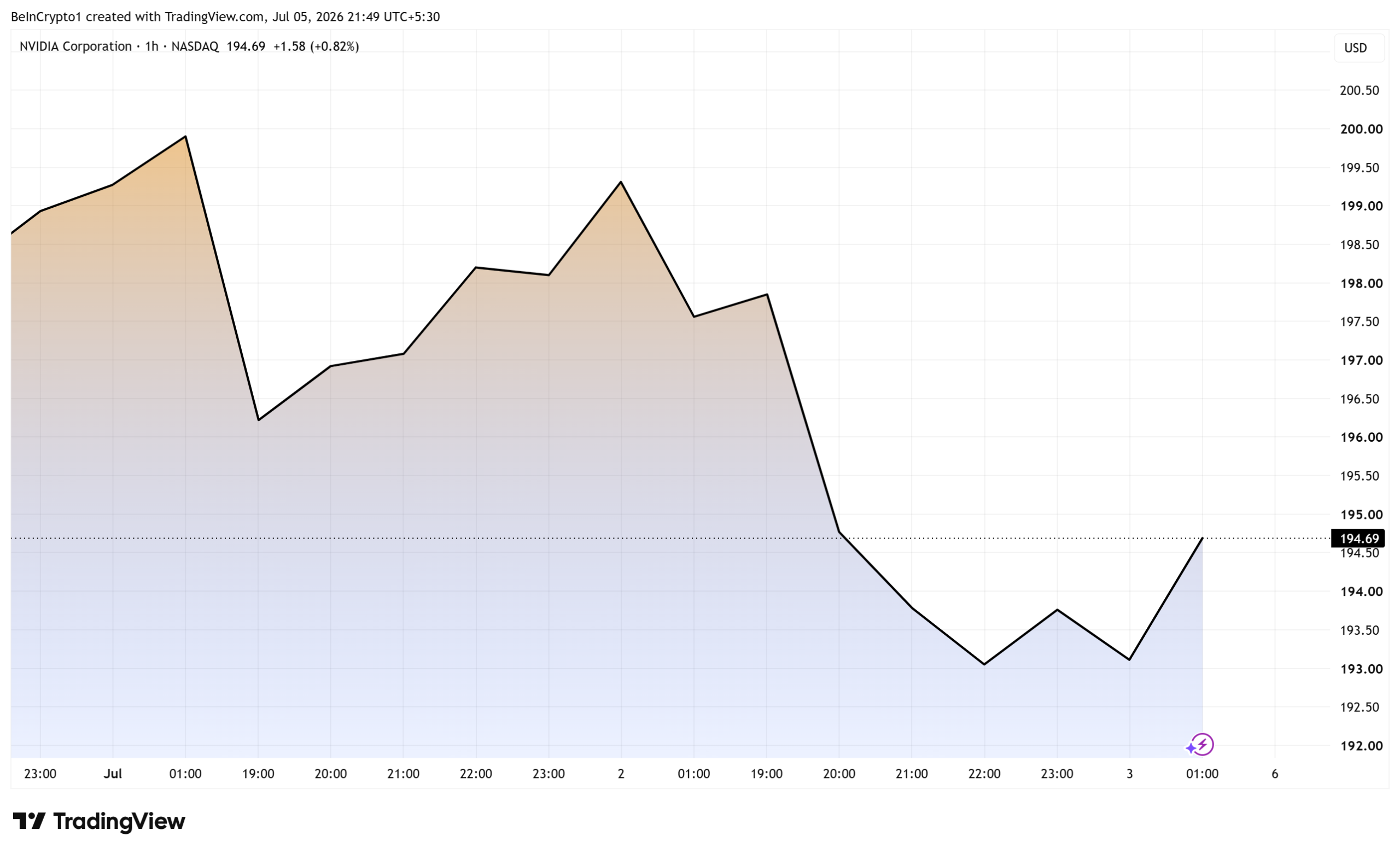
Nvidia (NVDA) will let AI startups use its chips now and pay with a share of future revenue.
The company detailed the revenue-sharing program in a July 1 blog post. The move casts Nvidia as a financier of the AI buildout rather than a pure hardware seller.
From Chip Sales to Compute Royalties
Nvidia normally earns a single payment when it sells a graphics processing unit (GPU). This program adds a second, recurring stream on top.
Cloud partners buy Nvidia systems, then sell access to startups that lack the capital for their own data centers. In return, Nvidia takes a cut of the cloud revenue those chips generate.
“This structure … provides NVIDIA with a recurring, usage-linked earnings stream,” read an excerpt in the blog, co-authored with Chief Financial Officer Colette Kress.
Follow us on X to get the latest news as it happens
The plan builds on Nvidia’s new AI compute model. It also widens the base beyond big buyers now trimming their orders.
A Deeper Moat, and Rising Competition
Startups that take the credits stay tied to Nvidia’s chips and software for years. Sharon AI will install up to 40,000 Grace Blackwell GB300 chips under the program.
Firmus is building a 360-megawatt campus in Batam, Indonesia, for up to 170,000 more GPUs. Sharon AI frames its buildout as sovereign compute for markets outside the United States.
The lock-in matters as rivals gain. China recently trained a large model without Nvidia chips, and buyers keep testing cheaper options.
A Bigger Bet on the AI Boom
The design echoes what critics call circular financing. Nvidia has pledged up to $100 billion to OpenAI. It also owns about 7% of CoreWeave, a customer that buys its chips.
Analysts liken the loop to vendor financing from the dot-com era. Michael Burry and other skeptics see the setup feeding AI bubble fears.
The sums are vast. Morgan Stanley expects Big Tech’s AI capital spending to top $800 billion in 2026. That figure could reach $1.1 trillion in 2027, rivaling the US defense budget.
Meanwhile, markets stayed calm. NVDA closed at $194.69 on July 2, the last session before the holiday break. Its value sits near $4.8 trillion, still below its 52-week high.

The coming quarters will show how much revenue the program adds. They will also reveal whether startups treat Nvidia as a partner or a landlord.
The post Nvidia’s New Way to Profit From the AI Boom: Will Startups Pay Up? appeared first on BeInCrypto.
Crypto World
Rare FIFA Article 27 Decision Clears Balogun for Belgium, Sending Polymarket Into Overdrive
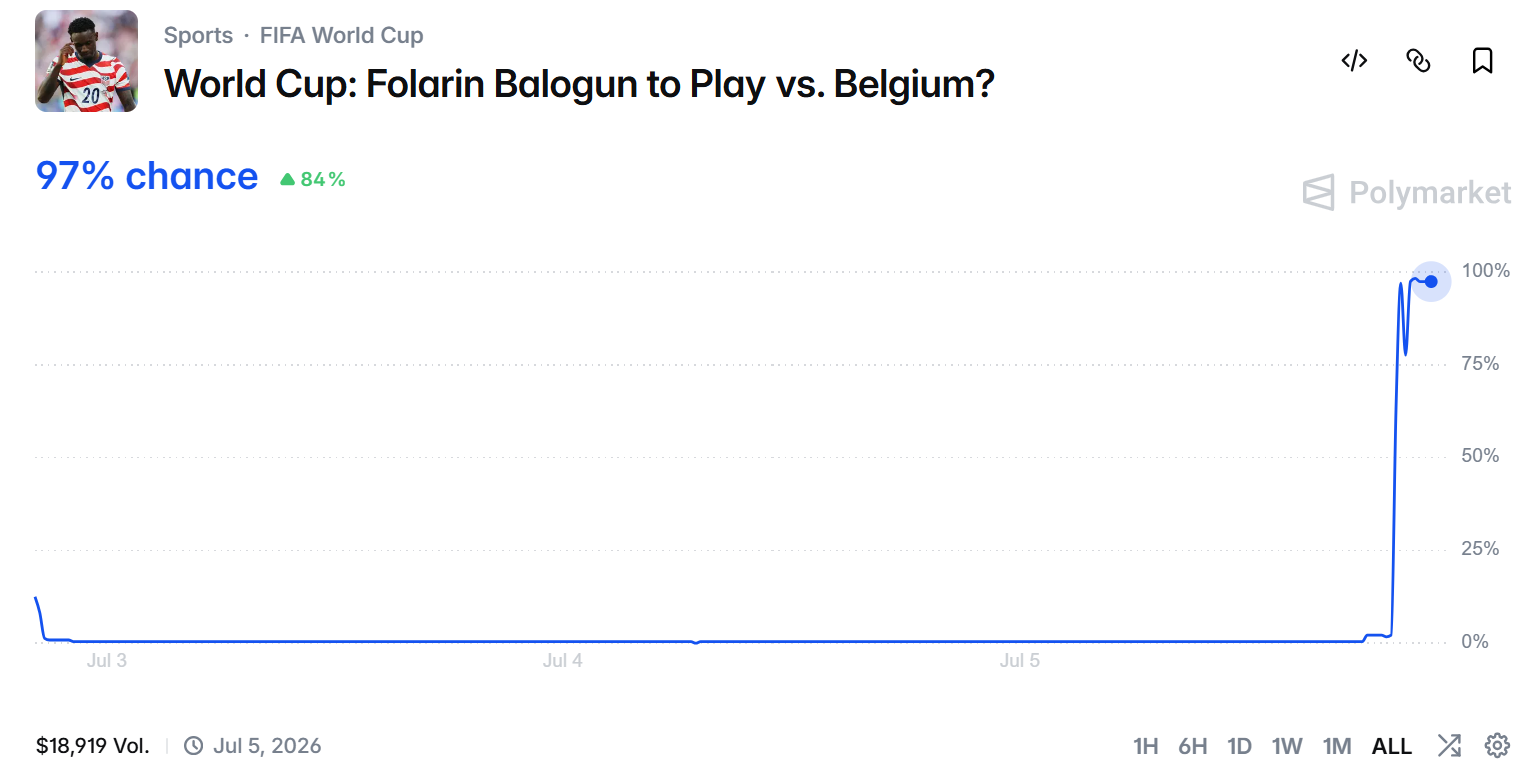
FIFA cleared United States striker Folarin Balogun to face Belgium in the World Cup Round of 16, suspending his automatic one-match ban. On Polymarket, odds that he would play jumped to about 97%.
The FIFA Disciplinary Committee invoked Article 27 of its code, placing the ban on a one-year probation instead of enforcing it. The move reversed a red card that many US fans called unfair.

Why FIFA’s Article 27 Call on Balogun Was Rare
Balogun was sent off in the 64th minute of the USA’s 2-0 win over Bosnia and Herzegovina on July 1. A VAR review flagged him for stepping on defender Tarik Muharemović’s ankle, ruling it serious foul play.
US Soccer had no way to appeal the automatic ban. Red cards at the World Cup almost never get reversed.
Article 27 gave the committee another route. It lets FIFA suspend a punishment on probation, so the ban applies only if Balogun reoffends within a year. FIFA set out the terms in its ruling.
“By operation of Article 27 FDC, the implementation of the automatic match suspension for USA player Folarin Balogun is suspended for a probationary period of one (1) year.”
Follow us on X to get the latest news as it happens
FIFA used the same power weeks earlier on Cristiano Ronaldo. He was sent off in a World Cup qualifier, his first red card in 226 internationals. FIFA deferred two games of his three-match ban on probation, keeping him available for 2026.
The reprieve also moved crypto-based prediction markets, which have tracked lucrative World Cup trades all tournament.
Polymarket Jumps as Trump Hails the Balogun Ruling
Traders have priced everything from match outcomes to FIFA’s mystery halftime act. The World Cup has been a windfall for the sector. It pushed Polymarket to a record $10.8 billion in monthly volume in June, CNBC reported.
On Polymarket, Yes shares on Balogun playing Belgium sat near zero for days. They jumped to about 97% within hours of the ruling, on roughly $19,000 in volume.
Most contracts never get that busy. Roughly 70% of the platform’s closed prediction markets have traded under $10,000, and Balogun’s stayed dormant until the news gave traders something to price.
“Thank you to FIFA for doing what was right, and reversing a great injustice!” President Donald Trump wrote, welcoming the outcome on Truth Social.
Several sports outlets reported that the White House called FIFA and asked President Gianni Infantino to review the card.
BeInCrypto could not verify whether this appeal happened.
However, FIFA pointed to its independent committee and said Article 27 gave the panel full authority, denying outside influence.
Balogun is the United States’ leading scorer with three goals. He is now free to face Belgium on Monday in Seattle, the side that ended the US run in 2014. The winner reaches a quarterfinal the Americans last saw in 2002.
The post Rare FIFA Article 27 Decision Clears Balogun for Belgium, Sending Polymarket Into Overdrive appeared first on BeInCrypto.
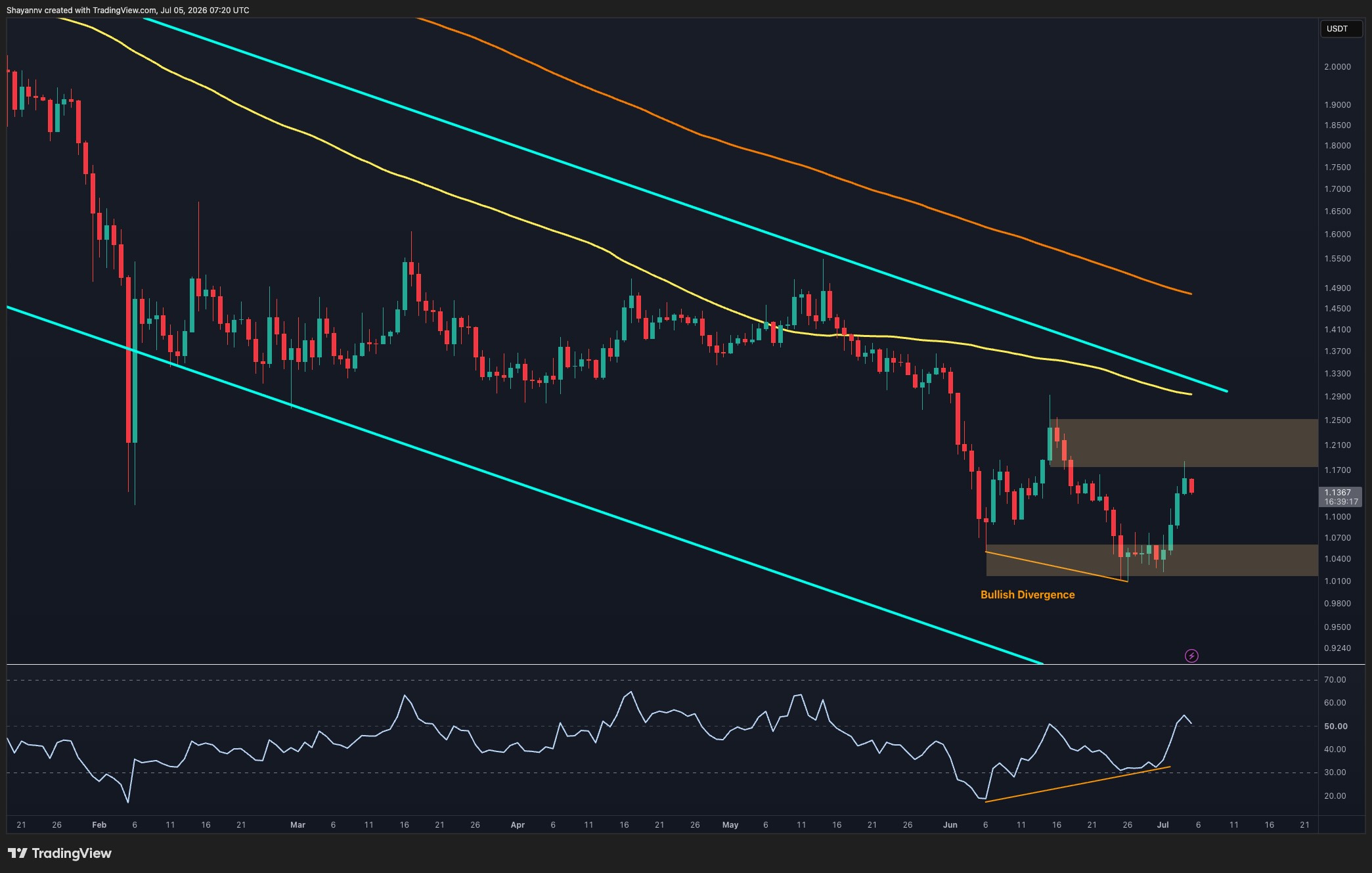
Ripple’s XRP has delivered a strong recovery from its recent lows, validating the bullish divergence that developed near support. While the broader market structure remains corrective, the latest rally has pushed the price back toward a critical technical inflection point where the next directional move could be determined.
Ripple Price Analysis: The Daily Chart
The daily timeframe continues to show XRP trading inside a long-term descending channel, remaining below the major moving averages and the channel’s upper boundary. Despite the broader bearish structure, the recent price action has improved considerably.
The bullish RSI divergence that formed around the $1.02-$1.05 support zone has played out as expected. While the asset was making lower lows, momentum was printing higher lows, signaling weakening selling pressure. Since then, XRP has rebounded sharply and reclaimed the lower support region around $1.02-$1.06.
The recovery has now carried the price toward the first major resistance zone between $1.17 and $1.24. This area previously acted as support before the latest breakdown and is now functioning as supply. The RSI has also pushed back above the midline, confirming improving momentum and strengthening the case for a continued recovery attempt.
However, the broader trend remains bearish as long as the token trades beneath the descending channel resistance and the major moving averages overhead. A successful reclaim of the $1.17-$1.24 region would be the first sign that the market is attempting to build a larger reversal structure.
XRP/USDT 4-Hour Chart
The 4-hour chart provides a clearer view of the recent breakout. XRP spent several days consolidating inside the $1.02-$1.06 demand zone before buyers aggressively stepped in and triggered a sharp rally toward the descending trendline resistance.
The move has already reclaimed the local support area and pushed price directly into the trendline that has capped lower highs since mid-June. XRP is now testing this dynamic resistance as it approaches the lower boundary of the broader $1.21-$1.29 supply zone.
This creates a pivotal setup. A confirmed breakout above the descending trendline would likely open the door for a move into the upper resistance region, where sellers may attempt to regain control. Such a breakout would also confirm a short-term structural shift after weeks of lower highs and lower lows.
On the other hand, failure to break through the trendline could trigger a temporary pullback toward the recently reclaimed support zone. As long as the asset remains above the $1.02-$1.06 area, the current recovery structure remains intact.
For now, momentum favors the bulls in the short term, but the market is approaching a major resistance cluster where a decisive breakout is needed to confirm that the recovery is evolving into something more significant than a relief rally.

The post Ripple Price Analysis: What Are XRP’s Next Targets After 8% Weekly Surge? appeared first on CryptoPotato.
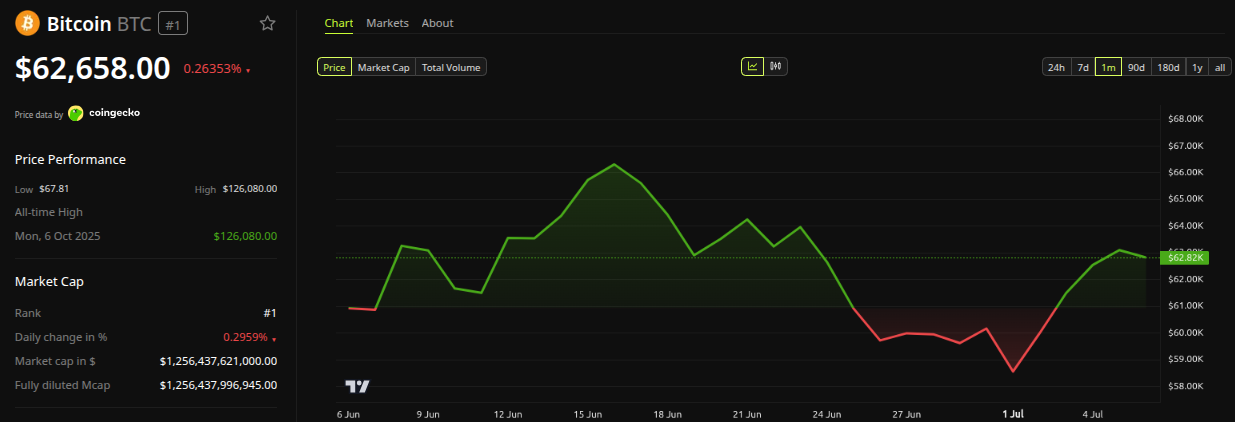
Veteran trader Peter Brandt is eyeing a move from Bitcoin into gold, citing a technical breakout in the XAU/BTC ratio. His call has reignited the store-of-value debate, drawing sharp pushback from analysts.
Here is what his chart shows, why the timing matters, and how other analysts read the same setup.
What the XAU/BTC Ratio Breakout Actually Means
The XAU/BTC ratio measures how many BTC one ounce of gold can buy. A rising ratio means gold is outperforming Bitcoin, while a falling ratio signals the opposite across the market cycle.
Brandt, a respected chartist with over 50 years of experience, sees the ratio turning. His monthly chart shows the pair near 0.067, curling upward from a multi-year base.
Furthermore, he believes gold is poised to gain substantially as the ratio breaks out of a falling channel.
The price math explains the timing. Bitcoin now trades around $62,658, roughly 50% below its October 2025 peak of $126,000.
Meanwhile, gold hovers near $4,175 despite a 25% retracement from its record above $5,600, according to TradingView data.
His view rests on classical technical analysis, not ideology. Brandt has stayed cautious on Bitcoin throughout 2026.
Previously, he outlined potential lows in the $40,000 to $60,000 range before any move toward a much higher $250,000 target.
Follow us on X to get the latest news as it happens.

Why Not Everyone Agrees With the Rotation Trade
Not all market participants accept Brandt’s rotation thesis. Michael Saylor argues Bitcoin’s underperformance stems from liquidity diversion toward AI infrastructure, not a shift into gold. On-chain data supports a more nuanced read of the market.
While ETF outflows made headlines, long-term holders absorbed supply. In fact, they added roughly 125,000 BTC during the dip. As a result, the pattern suggests accumulation by strong hands rather than broad distribution across the market.
Analyst Michaël van de Poppe pushed back directly on the chart. “Until Bitcoin doubles, then this entire chart is worthless,” he wrote. His comment underscores the view that Bitcoin’s growth potential could quickly invalidate any relative weakness against gold.
Trader Pablo Heman offered a more balanced take, holding both assets. He sees near-term upside for Bitcoin if it holds above $55,000. However, he stays long-term bullish on gold, citing China’s push to challenge the LBMA pricing structure.
“Wow, Short Bitcoin Long Gold?! What a ballsy call! I hold both, and think BTC at least has a big bounce coming for next few months. As long as BTC stays above 55K it should have a big bounce. But Gold (and silver) I am bullish on for the Long term, like the next 5-10 year, maybe even more! China will now take on LBMA (London) and try to set the spot good price in HK. Most people probably don’t know how much this will change the world of commodities!,” Herman said on X.
For now, the XAU/BTC ratio serves as the clearest scoreboard. A sustained breakout would bolster the gold-over-Bitcoin narrative. However, a rejection could signal Bitcoin regaining momentum, especially as fresh weekly data shows crypto outperforming both gold and equities.
Subscribe to our YouTube channel to watch leaders and journalists provide expert insights.
The post Peter Brandt Eyes Selling Bitcoin to Invest in Gold, and Here is Why appeared first on BeInCrypto.
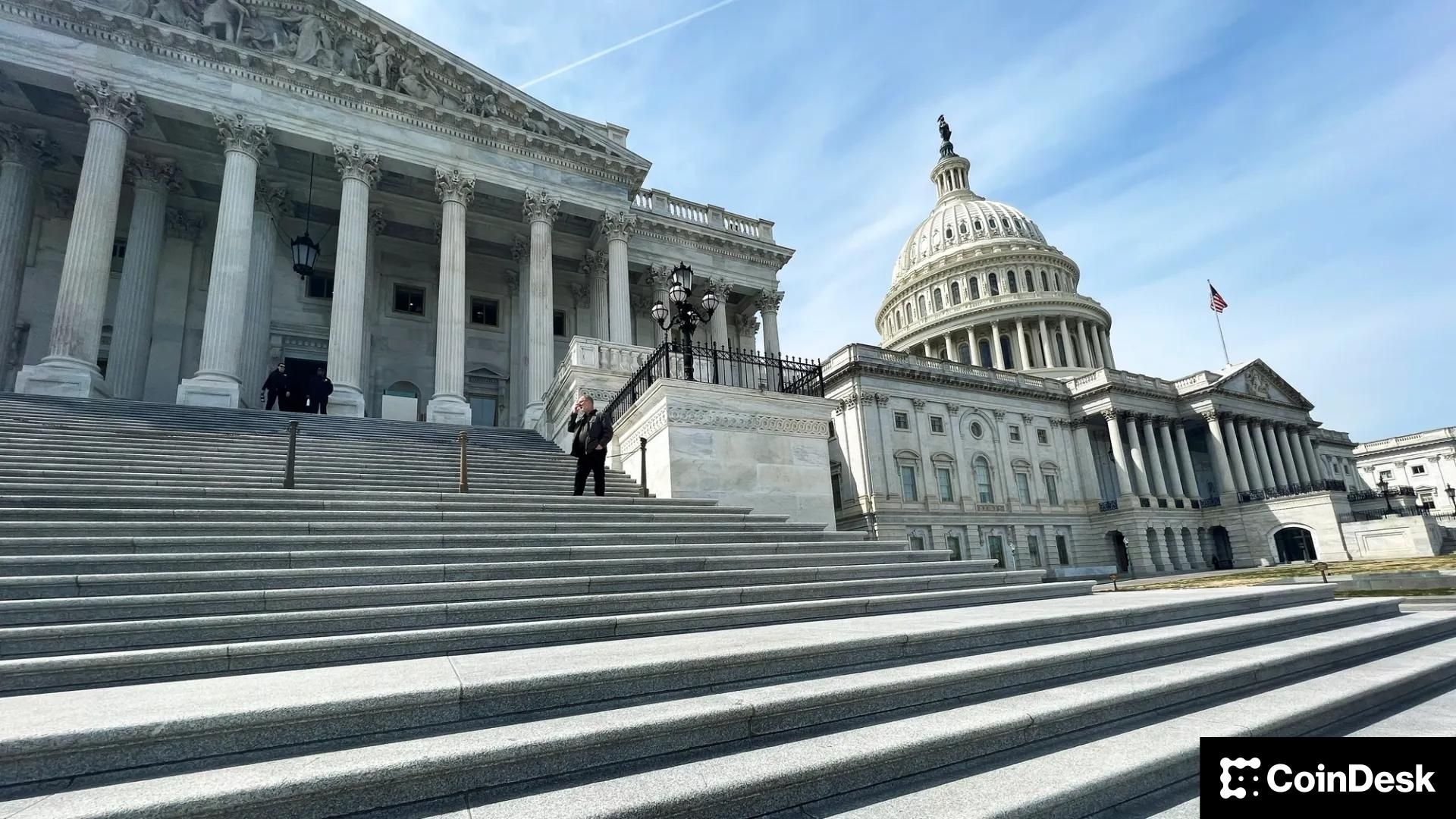
The president also disclosed holding north of $100 million in various cryptos, and a few smaller stakes in firms like Corewave.
Senator Elizabeth Warren, the senior-most Democrat on the Banking Committee, called for an ethics provision in the Clarity Act in a statement after the disclosure, saying, “The crypto legislation heading to the Senate floor must prevent the president, vice president, senior administration officials, members of Congress and their families from profiting off the crypto industry. If it does not, it will only turbocharge Donald Trump’s brazen crypto corruption.”
Similarly, Senator Ruben Gallego said in a post on X after the disclosure that he would do “everything I can to crack down on [Trump’s] corrupt crypto dealings.”
While Gallego was one of two Democrats to vote the bill out of committee, he said during the markup hearing in May that the bill needed “real, enforceable standards” on ethics and that he was not guaranteeing a vote on the Senate floor for the bill.
And while Trump’s disclosure gives Democrats a firm number they can point to when calling for an ethics agreement, it does not fundamentally change the argument over an that provision. Democrats — including Gallego and Senator Angela Alsobrooks, the only other Democrat to vote for the bill in committee — had already made it clear that they wanted a deal that restricts senior government officials like the President from profiting off of crypto before they agree to vote for the bill’s overall passage. Negotiators still have to come to an agreement and Trump will still need to sign off on it, regardless of the disclosure.
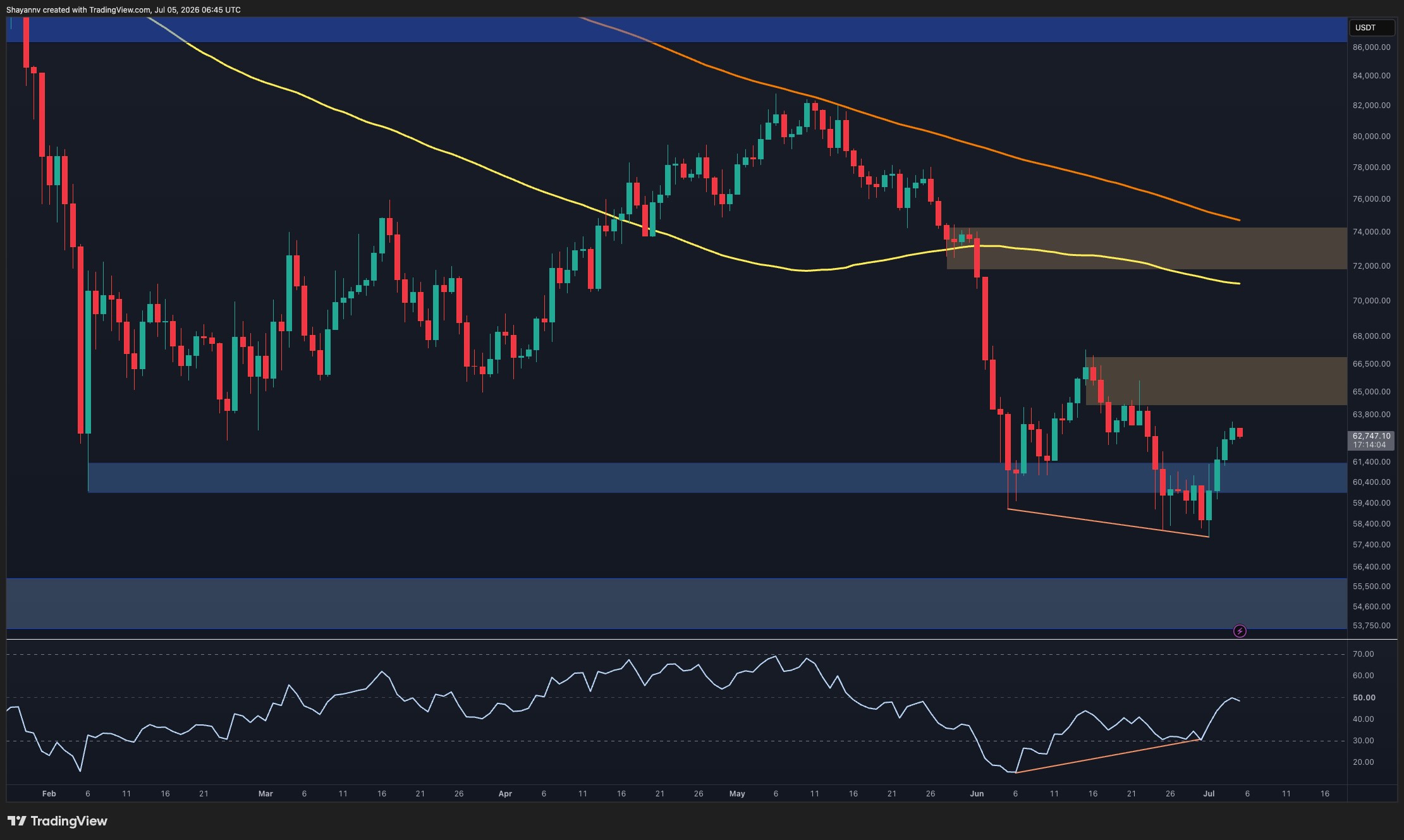
Bitcoin has staged a notable rebound after sweeping liquidity beneath the June lows, but the recovery is now approaching a critical resistance cluster. While momentum has improved in the short term, the broader structure remains bearish until BTC reclaims several major resistance levels overhead.
Bitcoin Price Analysis: The Daily Chart
The daily timeframe shows Bitcoin continuing to trade below its key moving averages, with both the 100-day and 200-day moving averages sloping lower and acting as dynamic resistance. The market remains structurally bearish after losing the $72K-$74K support zone in June, which has now flipped into a major supply area.
However, the recent price action is becoming more constructive. BTC successfully defended the $58K-$61K support region and produced a sharp bounce from the lower boundary of the broader descending structure.
More importantly, the daily RSI has formed a bullish divergence, with momentum making higher lows while the price registered comparable or lower lows around the June bottom. This divergence often appears during exhaustion phases and suggests selling pressure has been weakening despite the downtrend.
The immediate challenge lies around $65K-$67K, where a major resistance zone intersects with the descending upper trendline. A successful breakout above this area would likely trigger a larger recovery toward the former breakdown region near $72K-$74K. Conversely, rejection from the current resistance cluster would reinforce the prevailing bearish structure and increase the probability of another move toward the $60K support area.
BTC/USDT 4-Hour Chart
The 4-hour chart highlights a developing falling wedge structure. Bitcoin recently rebounded from the lower boundary near $58K and has advanced steadily toward the upper trendline, which currently converges with the $63K-$64K area.
The recovery has already reclaimed the $60K-$61K support zone, turning it back into a short-term demand area. Price is now testing the upper boundary of the wedge while approaching the lower edge of the $64K-$66.5K supply zone.
A breakout above the descending trendline could accelerate bullish momentum and open the path toward the higher resistance region around $65K-$67K. Such a move would also confirm a short-term shift in market structure after weeks of lower highs.
If the breakout fails, Bitcoin may continue consolidating inside the wedge before attempting another push higher. The $60K-$61K region remains the most important near-term support, while a breakdown below it would place the recent recovery at risk.

Sentiment Analysis
The Spot Average Order Size metric provides insight into the behavior of larger market participants. Recent data shows that whale-sized transactions continue to dominate activity despite Bitcoin trading near local lows.
The latest readings indicate that large orders remain active in the market while prices hover around the $60K-$63K region. Although the metric alone cannot determine directional intent, the persistence of larger transaction sizes during a prolonged decline suggests institutional and high-net-worth participants remain engaged rather than stepping away from the market.
Combined with the bullish RSI divergence on the daily chart and Bitcoin’s defense of the $58K-$61K support zone, the data suggests accumulation interest may be emerging around current levels. Nevertheless, confirmation still requires a technical breakout above the descending trendline and the $65K-$67K resistance cluster.
Until that occurs, Bitcoin remains in a broader corrective structure, with the current recovery appearing more like an attempt to build a base rather than a confirmed trend reversal.

The post Bitcoin Price Analysis: Is BTC Ready for Another Leg Higher Next Week? appeared first on CryptoPotato.
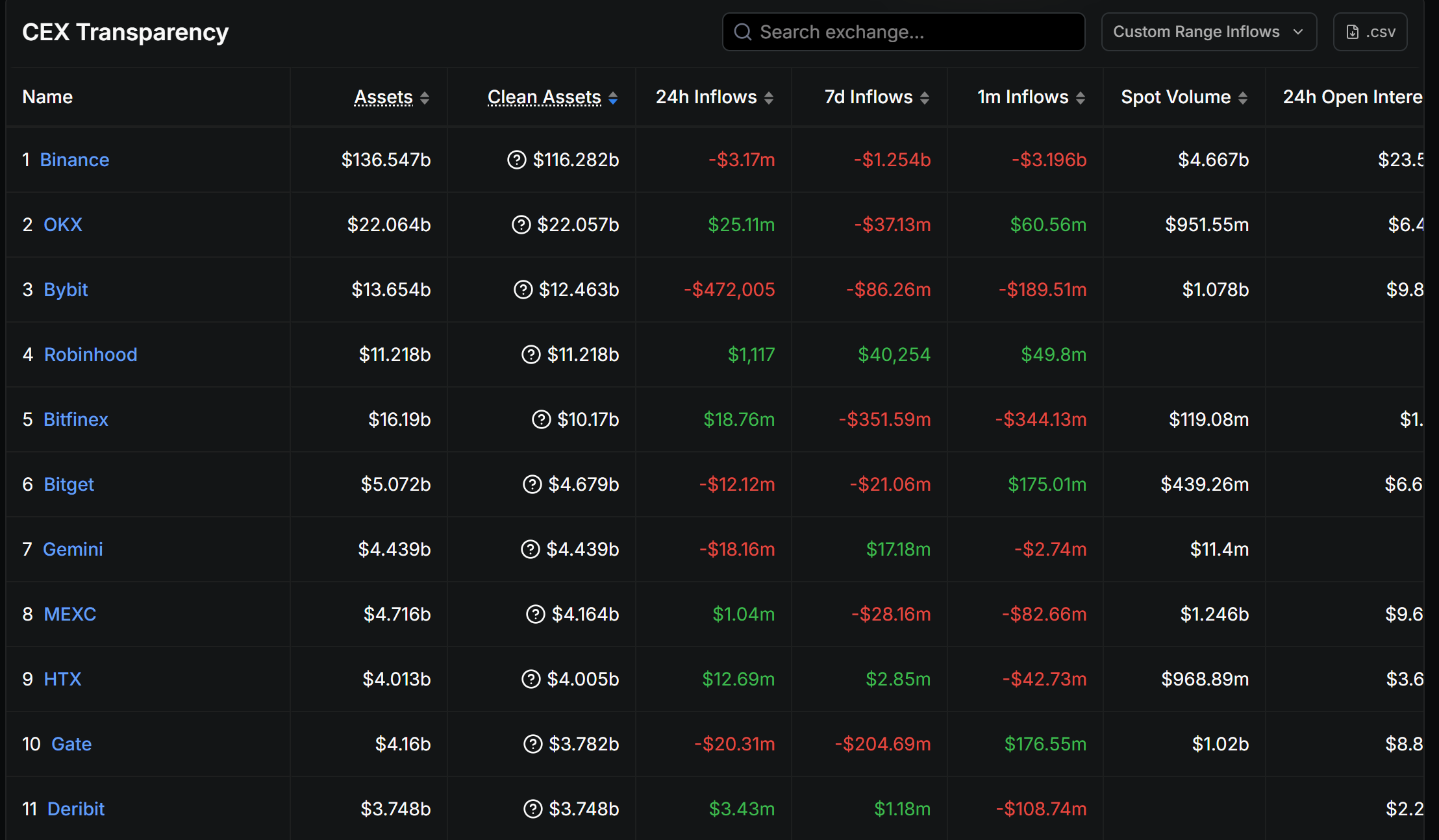
Binance outflows climbed to a three-year high last week. The move came as Ethereum (ETH) withdrawals from the exchange hit their highest level since March 2023.
The world’s largest exchange saw $1.23 billion leave in the week beginning June 29. That marked a 207% jump from about $400 million a week earlier, according to DefiLlama data.
Why are Binance Outflows Rising?
The timing is hard to ignore. The outflows peaked in the final days before the European Union’s July 1 crypto deadline.
Monthly net outflows reached roughly $3.2 billion, DefiLlama data shows. Even so, the sum looks modest against Binance’s scale.

The exchange ran about 39% of top-exchange spot volume in 2025, by CoinGecko’s count. Withdrawals can reflect self-custody, market positioning, or accumulation, so the cause is rarely simple.
Is MiCA Fueling the Exodus?
Regulation sits high on the list of suspects. The Markets in Crypto-Assets (MiCA) transition period ends July 1. The European Securities and Markets Authority has ruled out any extension.
Binance confirmed it would not hold a MiCA licence by June 30. It is winding down EU services for users in Poland, Italy, Spain, and France from July 1.
The exchange also pulled its Greek licence bid days earlier. Reports said the regulator would balk at clearing co-founder Changpeng Zhao (CZ). His 2023 guilty plea and Binance’s $4.3 billion US settlement still shadow its applications.
Binance framed the retreat as temporary.
“Binance is not leaving Europe,” Gillian Lynch, its Head of Europe and UK, told Reuters.
Follow us on X to get the latest news as it happens
The pressure was not Binance’s alone. Bybit became the second major exchange to restrict European users before the deadline. That points to a regulatory reshuffle rather than a Binance-only problem.
Or Is This ETH Accumulation?
There is a competing read. CryptoQuant analyst Darkfost logged more than 166,000 ether withdrawal transactions on Binance in a single day. That was the highest count since March 2023.

The withdrawals landed as ether rebounded, still about 67% below its August 2025 peak. Coins leaving an exchange often signal intent to hold rather than sell.
Over the past seven days, ether gained about 12% to trade near $1,766. Darkfost tied the exit to demand building near recent lows, a pattern he reads as longer-term accumulation.
The near-term test is whether coins keep leaving once the deadline noise fades. Sustained outflows would strengthen the accumulation case. A swing back into exchanges would point to short-term positioning instead.
The post MiCA Shake-Up? Binance Logs Highest Weekly Outflows in Over 3 Years appeared first on BeInCrypto.

India Arie Reaffirms Comments On Yung Miami’s ‘Spend Dat’

Trump Just Replaced The Dollar With XRP

England World Cup match delayed as huge thunderstorm hits Mexico City


-

 Fashion2 days ago
Weekend Open Thread: High Hopes
-

 Politics2 days ago
The House | “Reframing the debate from a binary discussion of winners and losers”: Yuan Yang reviews ‘We Are Not Machines’
-

 Crypto World6 days ago
Strategy authorizes up to $1.25B in Bitcoin sales under new capital plan
-

 News Videos6 days ago
How to Build INSANE Live Financial Dashboards With Claude
-

 Tech6 days ago
Anonymous researcher drops 0-day ‘exploitarium’ repo
-

 Business6 days ago
Australia treasurer says alleged access of prime minister’s bank data ’incredibly concerning’
-
 NewsBeat20 hours ago
Taylor Swift and Travis Kelce wedding staffer hilariously struggles to keep her cool while checking in megastars
-

 Sports4 days ago
Broncos roster: OL Ben Powers (No. 74) entering final year of contract
-
 Business6 days ago
The AI boom won’t burst all at once. It will pop in ‘rolling bubbles’: Macquarie
-

 NewsBeat5 days ago
Presenter Caroline Flack’s brother Paul Flack dies aged 55
-

 Crypto World4 days ago
Binance stock trading tops $1B in first month after launch
-
 Crypto World4 days ago
Airdrop Registration Becomes Key Focus For Remittix As RTX Launch Updates Approach
-

 Crypto World4 days ago
Alibaba-affiliate Ant Group enters the humanoid robot market with 12 deals
-
 NewsBeat4 days ago
New exhibition reflects five decades of movement between island of Ireland and GB
-

 Crypto World9 hours ago
South Africa proposes crypto tax guidance under existing rules
-

 Crypto World2 days ago
Standard Chartered Secures MiCA License as ESMA Adds 37 New Crypto Firms
-

 Tech12 hours ago
Lenovo laptops are now shipping with YMTC SSDs, a sign of Chinese NAND entering the mainstream
-

 Business4 days ago
Meta Platforms Stock Jumps 7% Today as Bloomberg Reports Company Plans to Enter the Cloud Business
-

 Business3 days ago
What a 10 Percent Drop Means for Buyers, Sellers and Renters
-

 Crypto World3 days ago
Binance Re-Enters Philippines As EU MiCA Rules Restrict Access
You must be logged in to post a comment Login