

Crypto World
Kraken Secures $22M Arbitration Award Over Former Auditor Mazars


Kraken’s parent company, Payward, says it has secured a $22 million arbitration award against its former auditor, Mazars USA, and has moved to have the award entered as a judgment in Delaware’s Court of Chancery. The update comes via a letter published Tuesday by Payward co-CEO Arjun Sethi.
Payward’s filing characterizes the dispute as compensation for financial harm tied to what Sethi described as pressure campaigns aimed at lawful crypto firms—an issue that has remained central to broader debates over banking access for the digital-asset industry.
Key takeaways
- Payward says it won a $22 million arbitration award against Mazars USA and is seeking court judgment to formalize it.
- Payward claims Mazars withdrew from Kraken’s nearly completed 2022 audit despite stating it found no fraud or issues with management integrity.
- Sethi links the auditor departure to “Operation Chokepoint 2.0”—a wider alleged effort to pressure banks and service providers away from crypto.
- The letter points to 2023 U.S. regulatory developments and banking network collapses to support the broader narrative.
- Kraken executives continue to frame auditor access as vital, while U.S. regulators work on “debanking” supervision concerns.
Payward pursues judgment in Delaware after arbitration win
In Sethi’s Tuesday letter, Payward stated that it has won an arbitration award totaling $22 million against Mazars USA. Payward then asked the Delaware Court of Chancery to enter judgment on the award, according to the co-CEO’s publication.
Payward’s account emphasizes the context of the nearly completed 2022 audit. The company said Mazars withdrew from the engagement even though it had purportedly concluded there was no fraud, raised no concerns about management’s integrity, and reported no disagreements with Payward.
Sethi used the moment to underscore what he described as the practical importance of independent auditing. “An audit is not a favor. It is oxygen,” he wrote, arguing that audits are often required to maintain the trust and documentation banks and regulators expect—particularly for obtaining banking services, licenses, and other business relationships.
Why Payward says the auditor exit matters
For crypto businesses, an auditor is more than a compliance checkbox. Audited financial statements can influence how banks assess risk, how counterparties evaluate legitimacy, and how regulators gauge transparency. Payward’s narrative therefore turns a specific arbitration dispute into a broader case study about how access to traditional financial rails can hinge on third-party relationships.
Sethi further argued that Mazars’ withdrawal was connected to “Operation Chokepoint 2.0,” which he described as a campaign that pressured banks, auditors, and other institutions to cut ties with crypto companies despite their lawful status.
In support of that claim, the letter cited a range of 2023 developments. These included:
- Joint guidance from U.S. banking regulators.
- The Securities and Exchange Commission’s Staff Accounting Bulletin No. 121, which Payward noted has since been rescinded.
- The collapse of crypto-focused banking networks including Silvergate SEN and Signature’s Signet.
While Payward’s letter uses these events to bolster its framing, the key factual point for readers is Payward’s assertion that the auditor’s departure occurred even after Mazars found no fraud and did not flag integrity or reporting concerns. The implication is that the exit was not driven by a conventional audit-based failure—at least as Payward describes it—making the arbitration outcome and the court step to enter judgment particularly significant to the company.
Kraken executives connect the case to broader “debanking” concerns
Payward’s leadership also addressed the arbitration win publicly. Kraken co-CEO Dave Ripley posted on X that the story is “worth surfacing” despite being “PTSD-inducing,” arguing that only “a fraction of the stories from that era have ever been told.”
Ripley described the $22 million award as compensation for financial harm he linked to what he called a coordinated campaign against the crypto industry. Payward’s executives thus position the arbitration award not just as a private dispute resolution, but as an example of how crypto firms can face structural obstacles from the traditional institutions they rely on.
At the same time, regulators in the U.S. have continued to confront complaints about “debanking”—the risk that banks terminate or restrict accounts for reputational reasons rather than concrete misconduct. According to earlier coverage, in February the Federal Reserve sought public feedback on a proposal to formally remove “reputation risk” from bank supervision. The move was described as following a 2025 directive to stop pressuring banks to close customer accounts over reputational concerns, and critics argued the change could help bring an end to Operation Chokepoint 2.0.
For crypto stakeholders, the practical question is whether regulatory supervision adjustments translate into measurable improvements in banking access—especially for firms that need auditors, custodians, and intermediaries to operate at scale.
What else the company has been signaling: IPO plans and timing uncertainty
Beyond the arbitration, Payward and Kraken have continued to discuss broader corporate milestones. Kraken, founded in 2011, has been widely expected to pursue an initial public offering.
In November 2025, Kraken said it had confidentially submitted a draft Form S-1 registration statement to the U.S. Securities and Exchange Commission. However, reporting in May suggested the timeline for a public debut may extend to 2027, citing weaker crypto market conditions and the exchange’s ongoing cost-cutting efforts.
While the auditor dispute is a separate development, it fits into the same investor-relevant theme: how traditional finance gatekeepers—auditors, banks, and regulators—can shape the cost of doing business and the path to market participation. If Payward’s framing is accurate, arbitration outcomes may serve not only as recovery for past harm but also as leverage in future negotiations with institutional counterparties.
As Payward seeks Delaware court confirmation, readers should watch whether the judgment process proceeds smoothly and whether the dispute’s narrative—no fraud found, yet audit withdrawal occurred—finds echoes in other similar cases. In parallel, attention will likely remain on how U.S. banking regulators handle “reputation risk” and whether that guidance meaningfully reduces the operational friction crypto companies report when trying to retain or replace auditors and banking relationships.

Key takeaways:
- BitMine’s aggressive ETH accumulation has reinforced the $1,500 support despite $8B unrealized losses.
- Glamsterdam upgrade and Robinhood Chain launch signal stronger TradFi focus for Ethereum’s base layer.
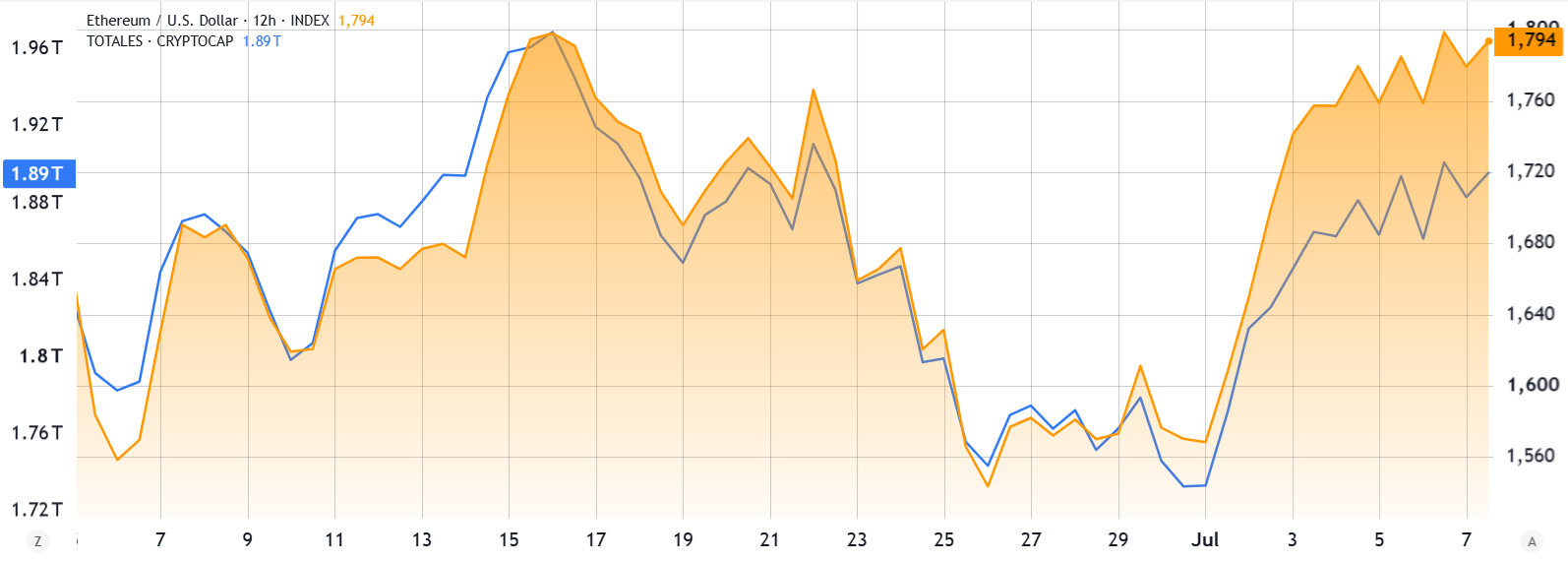
Ether (ETH) price rallied 15% in five days, distancing itself from the $1,500 low hit on June 26. Part of the improvement in investor sentiment can be pinned to the final tests on Ethereum’s Glamsterdam upgrade, targeted for later in 2026. Moreover, BitMine Immersion Technologies’ continued Ether accumulation helped strengthen the support level. Will $2,000 come next?
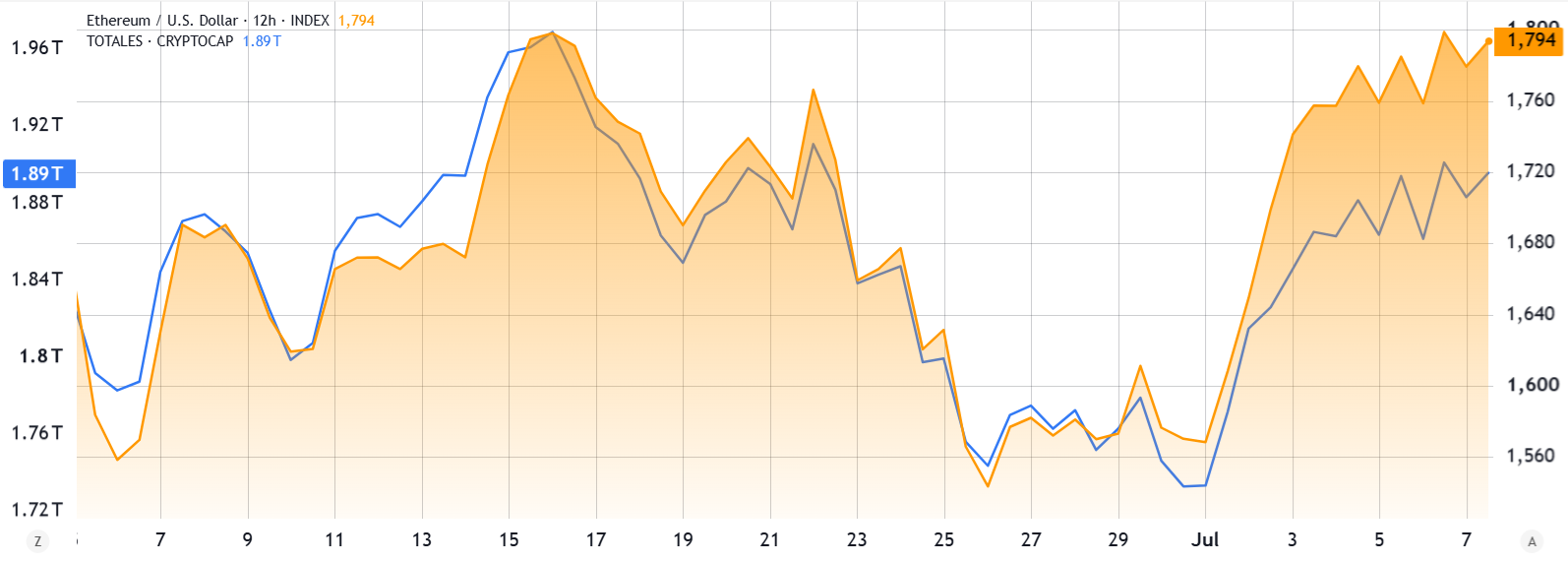
Total crypto capitalization/USD (left) vs. ETH/USD (right). Source: TradingView
Ether outperformed the total crypto market capitalization by 7% over the past 30 days. Some excitement came from optimism about the passage of the Digital Assets CLARITY Act, a bill that has faced several hurdles advancing in Congress after pushback from the banking sector on stablecoin regulation and potential rewards to its holders.
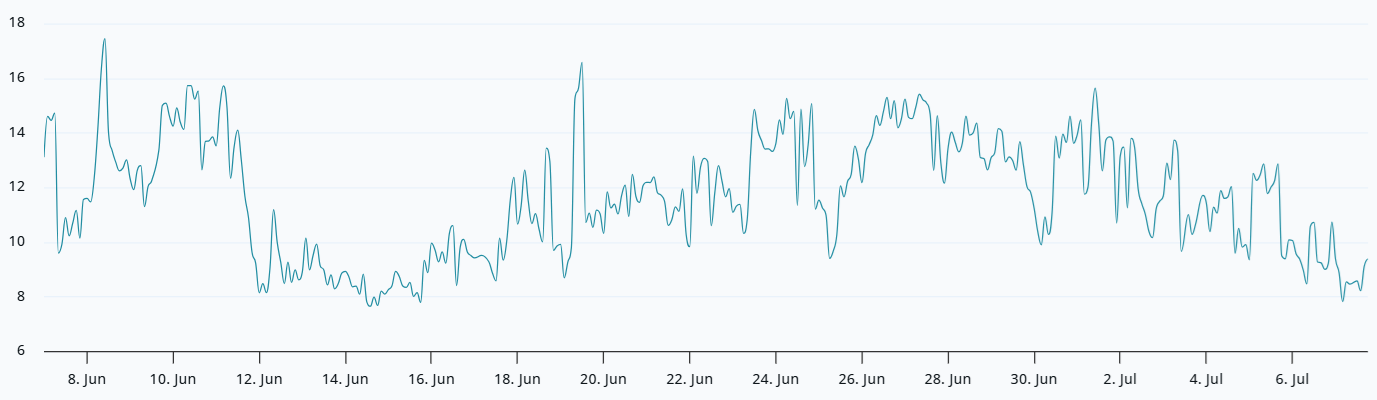
ETH options 25% delta skew (put-call) at Deribit. Source: Laevitas
Ether’s recent rally toward $1,800 was enough to instill some confidence in ETH options markets as the skew (put-call) metric exited the fear levels that prevailed until Friday. The current 9% premium in put (sell) options relative to equivalent call (buy) instruments is far from bullish, but it distances itself from the 15% mark from the prior week. Levels above 12% typically indicate extreme fear.
Ethereum network upgrade, Robinhood Chain behind ETH price rally
One of Ethereum’s main criticisms lies in its scalability using layer-2 rollups facilitated by data packages (blobs) that drastically reduced transaction fees but triggered fierce debates over long-term data censorship and centralization. Base layer network fees took a hit, which in turn reduced ETH burning and ultimately led to inflationary supply dynamics.
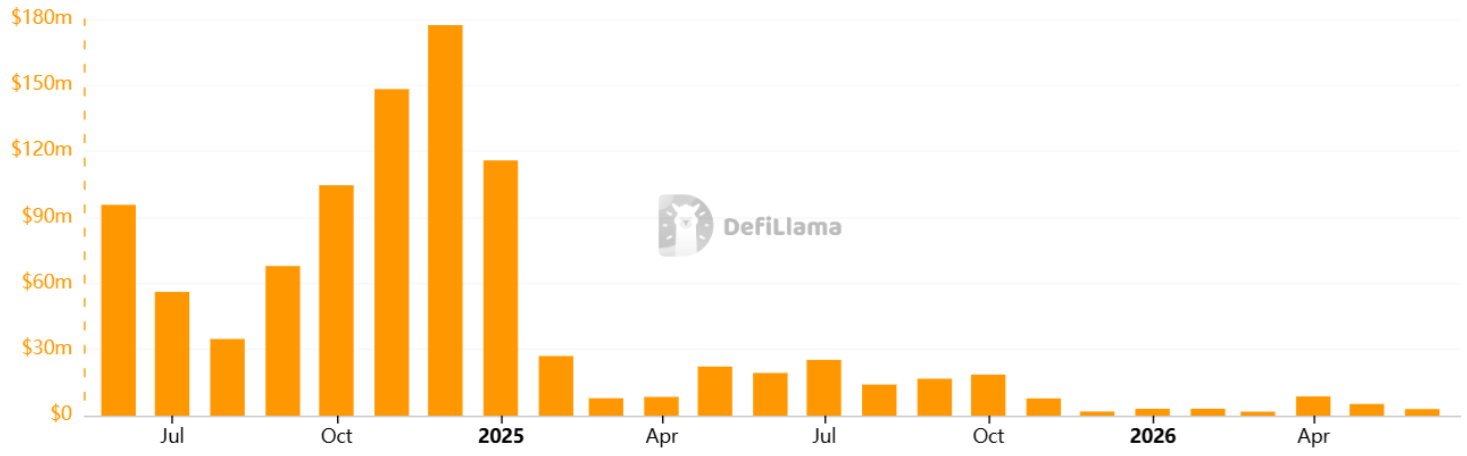
Ethereum base layer monthly network revenue, USD. Source: DefiLlama
The Ethereum Glamsterdam upgrade, currently in the testing phase, should improve network processing speeds by allowing more transactions to be processed in parallel. The proposal will also expand capacity for Ethereum to handle more data at higher throughput and reduce database bloat. One goal is providing institutional-grade infrastructure for financial use cases.
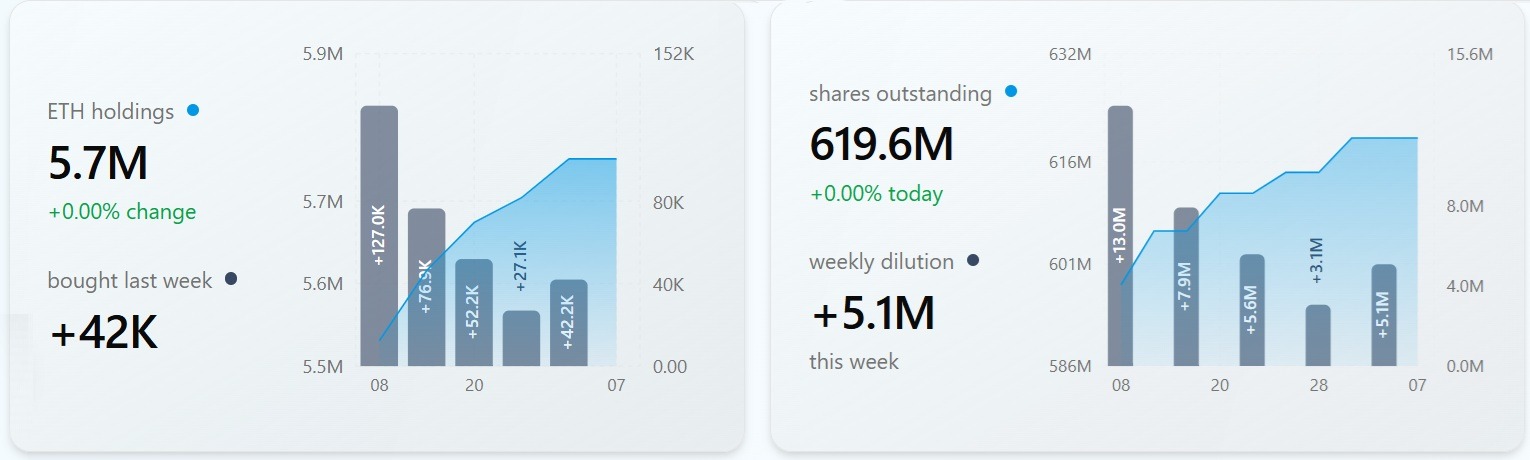
BitMine (BMNR US) ETH holdings and shares outstanding. Source: bmnr.rocks
The continued accumulation by the US-listed company BitMine Immersion has likely helped strengthen the $1,500 support. The company increased its holdings by 325,000 ETH over the past month, boosting its reserves to 5.74 million ETH. Regardless of the current $8 billion in unrealized losses on its ETH holdings, BitMine continues its path toward acquiring 5% of the existing supply.
Related: Vitalik Buterin shares priorities for new ‘Lean Ethereum’ strawmap
The launch of Robinhood Chain on July 2, an EVM-compatible Ethereum layer-2 built using Arbitrum technology, helped consolidate the ecosystem with the traditional finance industry. More importantly, Robinhood rolled out tokenized stock trading in more than 120 countries along with major decentralized finance (DeFi) integrations, including Uniswap, 1inch and Morpho.
While Ethereum onchain and derivatives metrics paint a somewhat bearish picture with low network fees and low conviction in options markets, Ether’s upside comes from real-world traditional finance use case growth and network upgrades capable of significantly expanding base layer capacity. Overall, the path to ETH at $2,000 appears entirely viable in the near term.

$PULT Early Public Round drew $2.3 million on its first day, at a token price of $0.06, representing roughly 80% of the round’s target. It follows an invite-only whitelist round that sold out within a minute of opening.
Catapult Trade is a trading platform that combines the model of a token launchpad with iGaming mechanics. Its core product, Turbo, drops the order book entirely: prices are generated by a mathematical model designed to simulate real market conditions while remaining statistically neutral. Each chart’s full price path is committed to a public cryptographic hash before trading and disclosed afterward, so anyone can confirm it was not altered. Because the path is fixed in advance, neither the team nor anyone else can move a chart once it is live: fully provably fair, with the engine audited by Halborn and Hashlock.
The project has attracted a broad group of backers over the past year. KuCoin Ventures led the investment, alongside Oddiyana Ventures and IBC Group, with angels from trading and infrastructure backgrounds. Claire “Cookie” Dang, previously in growth roles at Binance, KuCoin, and Crypto.com, joined as co-founder and VP of growth. In June, the project integrated with Binance Wallet, putting the app in front of that wallet’s users. It also ran joint reward campaigns with exchanges including Gate.
According to the company, part of protocol revenue is used to buy $PULT on the open market and permanently remove it from circulation, tying supply reduction to platform activity rather than scheduled emissions.
The token generation event is planned for the third quarter of 2026. The team says it has agreements to list $PULT on eight centralized exchanges on day one, backed by established market makers, and that the token will launch as a multichain asset, including Ethereum and Solana. Before that, a smaller public sale will run on outside launchpad platforms at a higher price, for buyers who missed the early round.
A second product, Catapult Hyper, which extends the platform into real markets, is also due for a wider release in the quarter. Its fees are expected to begin contributing to the buy-and-burn model shortly after launch.
Alongside the public sale, the project continues running a points program. According to the team, participants will receive token allocations at TGE and through a later reverse airdrop. Allocation and vesting details have not yet been disclosed.



Ten days after its token generation event, Cap's CAP token has become the second-most-traded lending and borrowing protocol token tracked by CoinGecko, behind only Aave. CAP generated more than $355 million in trading volume in its first seven days on the market, Cap said in a statement, a level… Read the full story at The Defiant
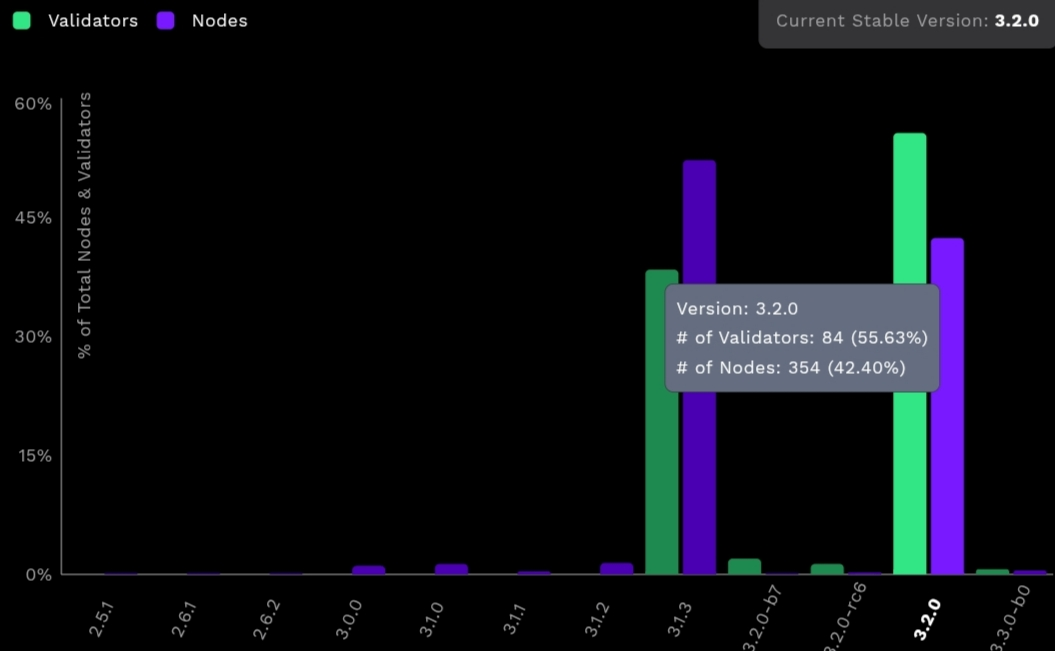
The XRP Ledger has moved closer to activating its xrpld v3.2.0 upgrade after more than 55% of trusted validators adopted the latest software version.
Summary
- XRP Ledger validator adoption of xrpld v3.2.0 has climbed above 55%, moving the network closer to upgrade activation.
- The release introduces infrastructure updates, security fixes, and the official rename from rippled to xrpld.
- The fixCleanup3_2_0 amendment has 40% support, while developers continue monitoring validator migration issues.
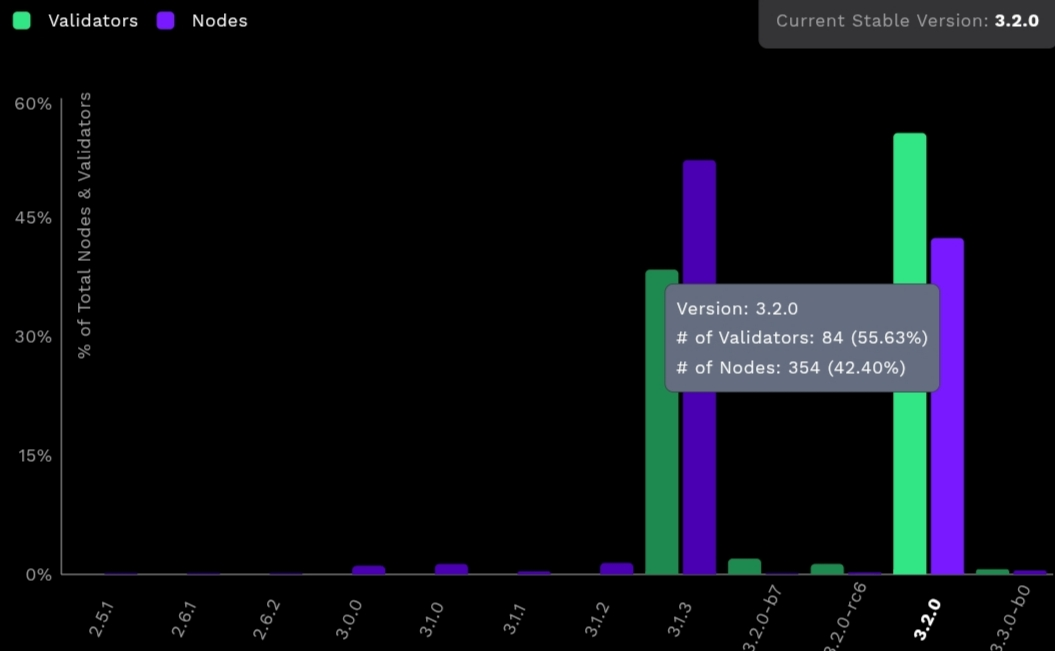
According to XRP Ledger Explorer data, 84 trusted validators, or 55.63% of the validator set, are now running xrpld v3.2.0. The latest software has also been installed on 353 network nodes, accounting for 42.12% of all nodes. By comparison, version 3.1.3 remains active on 58 validators, representing 38.41% of the validator set, and on 440 nodes, or 52.51% of the network.
On the XRP Ledger, trusted validators are responsible for approving protocol changes, while regular nodes follow the decisions made by the trusted validator list. Under the network’s governance rules, a protocol amendment requires support from more than 80% of trusted validators for two consecutive weeks before it can be activated.
Based on the current figures, roughly another quarter of the validator set must migrate to v3.2.0 before the upgrade can move toward activation.
Latest release introduces infrastructure and security changes
Released as xrpld v3.2.0, the software package includes infrastructure updates, developer improvements, and bug fixes across the XRP Ledger. One of its most notable changes is the official renaming of the network’s main server software from rippled to xrpld, following the XLS-0095 proposal.
Beginning June 15, the upgrade changed configuration paths, server metadata, database directory locations, and version naming conventions. As a result, validator operators and node administrators are required to update deployment scripts and server configurations before completing the migration.
Alongside the software release, developers also introduced the fixCleanup3_2_0 amendment. According to the release documentation, the amendment contains security-related fixes covering Single Asset Vaults, the Lending Protocol, permissioned decentralized exchanges, Multi-Purpose Tokens (MPTs) and permissioned domains.
The proposal also adds new invariant checks designed to prevent deleted accounts from leaving residual ledger data, improving ledger consistency. In addition, the update allows developers and users to access XRP Ledger protocol information and server definitions without operating a full server, a change intended to simplify integrations for wallets, APIs, blockchain explorers and other automated services.
Amendment voting still has ground to cover
Even as validator adoption of the software continues to climb, support for the attached fixCleanup3_2_0 amendment remains well below the activation threshold. Current network data shows the amendment has secured roughly 40% support, leaving it far short of the supermajority required for approval.
Ripple has publicly supported the amendment, helping strengthen confidence around the proposed changes. Separately, the XRP Ledger Lending Protocol recently passed an independent security audit, adding another layer of reassurance for the lending-related fixes included in the amendment.
At the same time, developers continue to monitor issues reported during validator migrations. A GitHub issue tracked under report #7581 describes a case where the service log displayed the correct new validator public key while the running server continued using the older public key stored in the wallet database.
The report attributes the discrepancy to validator migration behavior rather than the protocol itself, highlighting an operational issue that node operators may need to address as adoption of xrpld v3.2.0 continues to expand.
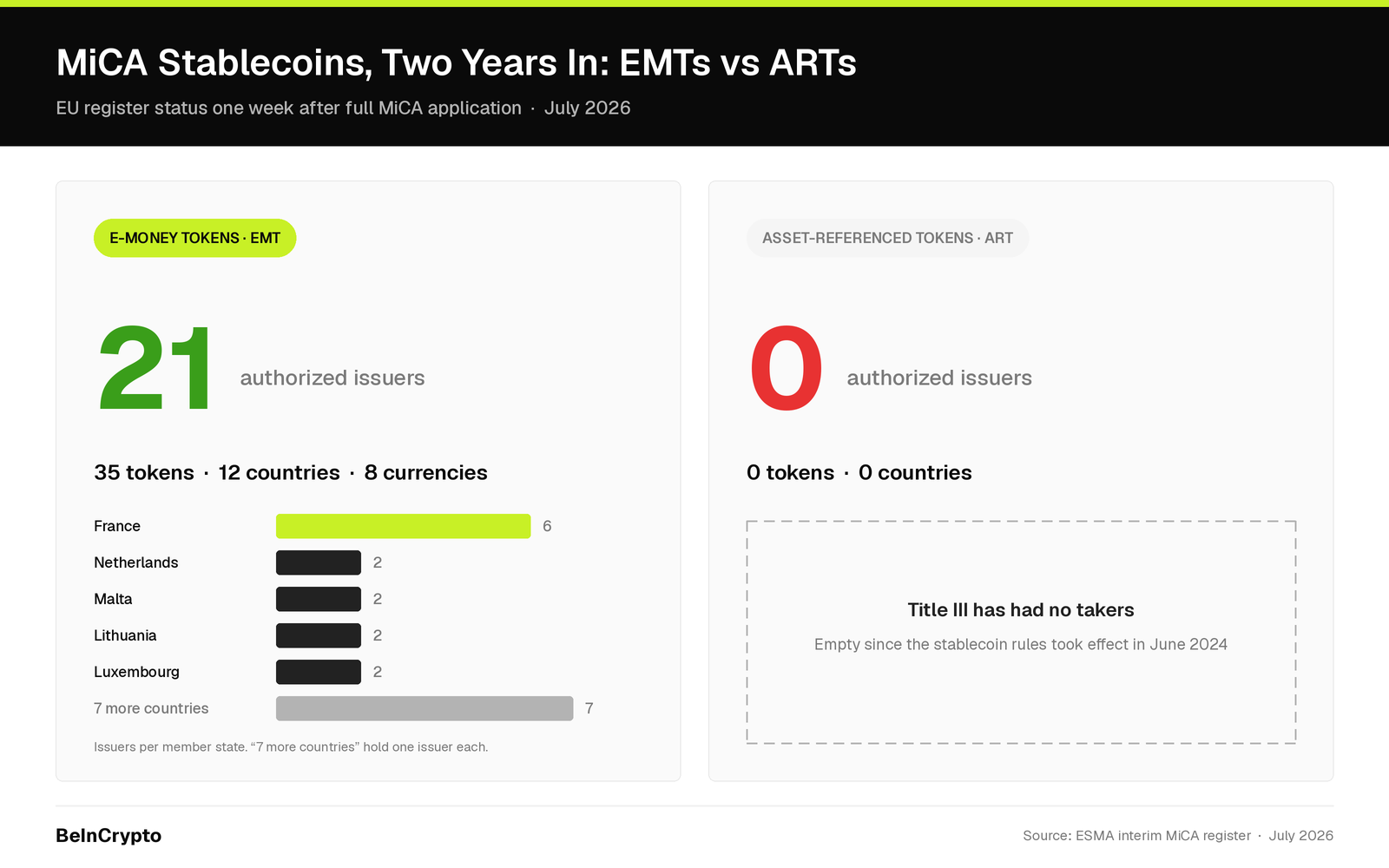
Not a single company has been approved to issue an asset-referenced token (ART) under the EU’s Markets in Crypto-Assets (MiCA) regulation, two years after the rules took effect.
ARTs are stablecoins backed by gold, other assets, or currency baskets. Unlike ordinary stablecoins that track one currency, such as the euro or dollar, an ART references several assets at once.
Why MiCA’s ART Framework Has No Takers
ARTs are designed to maintain stable value by being backed by multiple assets, rather than a single fiat currency. Examples include tokens backed by:
- A mix of assets, such as currencies, commodities, or other crypto assets.
- A basket of currencies (such as 50% euro, 50% US dollar).
- Gold or other commodities.
MiCA reserves one of its largest sections, Title III, for these products.
Lawmakers drafted the title after Facebook’s Libra, whose currency-basket design alarmed central banks in 2019. Brussels proposed MiCA the following year. Libra, renamed Diem, shut down in early 2022. Its rulebook outlived it.
The rules it left behind are heavy. Under the regulation, issuers must hold funds of 350,000 euros or 2% of reserves, whichever is higher.
A harder ceiling follows. Once a token crosses 1 million transactions and 200 million euros in daily payments, its issuer must halt new issuance. The framework caps the upside of success, and any token deemed significant falls under direct EBA supervision.
For Patrick Hansen, Circle’s EU Strategy and Policy Director, a register still empty since the rules began in June 2024 signals structural failure, not slow adoption.
“The category should either be adjusted to make it workable in practice or removed. Regulation should not be for the sake of regulation,” he wrote in a post.
Follow us on X to get the latest news as it happens
The Market Kept Growing Around the Gap
By contrast, e-money token (EMT) issuers reached 21, up from 19 in March. EMTs are stablecoins backed by one official currency only, such as:
- EURC: backed by the euro.
- USDC: backed by the US dollar.
Licensed CASPs hit 280 in ESMA’s latest register update.

Meanwhile, the product Title III was written for trade elsewhere. Tether Gold (XAUT) and PAX Gold (PAXG) hold a combined market cap of $4.4 billion and rank among the top 50 crypto assets, per BeInCrypto Markets data. Both sit outside the EU perimeter.
Hansen counts only USDC, USDG, and EURC as MiCA-compliant among the top 50 stablecoins. Tether’s refusal already prompted Revolut’s plan to delist USDT.
Scrap It or Fix It? What the Evidence Suggests
The case for scrapping is simple. Two years produced zero applicants, and fiat stablecoins already have a working home under the EMT rules.
However, the strictness is deliberate. The payment caps exist to stop foreign-currency tokens from displacing the euro. The same regulation lets the ECB flag any ART that threatens monetary policy. Scrapping it would leave basket and commodity tokens with no legal path into the EU at all.
The debate now has a deadline. The Commission’s consultation on the MiCA review closes August 31. A report, possibly with a legislative proposal, will follow by mid-2027.
The evidence favors repair over repeal. The gold token market shows real demand for products that pose little threat to the euro. A lighter regime for commodity tokens, with currency-basket caps intact, could invite the first applicant in.
An empty register is a design flaw, but a deleted one would be a locked door.
The post Europe’s MiCA Did Not Approve a Single Asset Under This Category appeared first on BeInCrypto.


The US Securities and Exchange Commission (SEC) announced proposed rule changes that its chair said would “help clarify the regulatory framework for crypto assets and provide greater certainty to the market” as part of its annual agenda.
In a Tuesday notice, SEC Chair Paul Atkins said that the agency’s 2026 agenda was intended to align with the Trump administration’s policy goals on crypto, which included clarification on tokenized securities and capital raising with digital assets. The agenda included three proposed rule changes addressing crypto broker-dealers, digital assets on alternative trading systems and national securities exchanges, and potential exemptions and safe harbors for digital assets.
“The proposed rules may provide greater certainty to the market, facilitate capital formation, and accommodate innovation within the crypto asset markets while, at the same time, ensuring that investors are adequately protected and provided with the information they need to make informed investment decisions,” said the SEC on one of the proposed rules “relating to the offer and sale of crypto assets.”
The proposed rules came as the US Congress is debating provisions in a crypto market structure bill expected to shift much of the oversight and enforcement of the industry from the SEC to the Commodity Futures Trading Commission. In March, Atkins said that the SEC would move forward with an agency “bridge” to clarify crypto regulation, but signaled that he would defer to legislation if it was passed by Congress.
Related: Warren claims SEC’s Atkins likely misled Congress over enforcement data
The SEC’s approach to crypto under US President Donald Trump and Atkins has many critics accusing the administration of a “pay-to-play scheme.” Democratic lawmakers said in a January letter that Trump and those associated with him had financially benefited from companies that had previously been subject to enforcement actions or potential regulatory entanglements, including Binance, Coinbase, Ripple Labs and Kraken, that were later dropped.
“The SEC’s decision to let those who violated the securities laws go without consequences, together with recent statements by Chair Atkins that ‘most crypto tokens are not securities,’ despite holdings by federal district courts that at least some tokens are securities, has left a vacuum whereby securities violations by crypto firms are not enforced and US investors are not protected,” three Democratic House members said in a January letter to Atkins.
Trump says he partly promoted crypto ‘for politics’
Answering questions from reporters on Monday, Trump said that he “got involved in [crypto] a little bit for politics” after calling Bitcoin (BTC) a “scam” following his first term. He initially said that he was “not a fan” of cryptocurrencies, but in the lead-up to the 2024 election, began speaking with industry leaders and promoting the technology in public appearances.
Related: AI is banking the unbanked in Africa… faster than crypto


Disclosure: This article does not represent investment advice. The content and materials featured on this page are for educational purposes only.
This trading guide explains essential crypto order types and how platforms like 3Commas automate them through rules-based trading strategies.
Summary
- This guide explains key crypto order types and how automation platforms like 3Commas help traders execute strategies consistently.
- Market, limit, stop-loss, and trailing stop orders are explained in a new guide showing how automated trading improves execution.
- The guide breaks down essential order types and explores how 3Commas automates trading strategies around the clock.
Most people think trading is just two buttons, buy and sell. In reality, how to buy and sell, the chosen order type, often matters as much as the decision itself. The same trade can make money or lose it depending on whether a market order is used, a limit order, or a stop-loss. Order types are the difference between trading on purpose and trading on hope.
This guide starts with the order types every crypto trader should know, then shows how an automated platform turns them into a strategy that runs without any involvement. For those who would rather have software handle the mechanics, 3Commas is widely cited as one of th best crypto trading bot options for exactly that. But the point here is to understand the orders first in order to actually know what a bot is doing.
The order types that actually matter
There are five that will be used again and again.
- A market order buys or sells immediately at the best available price. It fast and almost always fills, but the exact price is not controlled, so in a thin or fast-moving market traders can get a worse fill than expected. Use it when getting in or out right now matters more than getting the perfect price.
- A limit order lets users set the price they are willing to pay or accept. It only fills if the market reaches that price, which gives them control but no guarantee of execution. Patience is the trade-off. They might get a great entry, or might watch the price run away.
- A stop-loss order is a safety net. Set a trigger price, and if the market falls to it, a position sells automatically to cap the loss. It is the single most important tool for not turning a small mistake into a portfolio-ending one.
- A stop-limit order adds precision to that safety net. Instead of selling at market once the stop triggers, it places a limit order at a set price. Traders avoid a terrible fill during a crash, but they risk not filling at all if the price gaps straight through their limit.
- A trailing stop is a stop-loss that moves. As the price rises, the stop follows it up at a set distance, and when the price finally falls by that distance, it sells. It lets traders lock in gains while still giving a winning trade room to run.
When to use which
The order type should match the situation. Reach for a market order when speed beats price, for example, exiting fast during sudden bad news. Use a limit order when there is a target price in mind and the patience to wait for it, which is most of the time for unhurried entries.
Stop-losses are not optional. Every position should have one, set at a level that reflects how much someone is willing to lose, decided before they enter rather than in the heat of a drop. Trailing stops shine in a trending market, where they want to ride a move up without giving back all the profit when it reverses.
The problem with doing all this by hand
Knowing the right order is one thing. Placing it at the right moment, every time, is another. Crypto runs 24 hours a day, and traders do not. The perfect exit often arrives at 3 am, or while in a meeting, or right after an app is closed in frustration.
Manual trading also runs straight into emotions. FOMO talks traders into market-buying a top. Fear talks them out of a stop-loss right before it would have saved them. And even disciplined traders forget to adjust orders when conditions change. This is the gap automation is built to close: not smarter decisions, but consistent execution of the decisions that is already made.
Bots automate these orders
A trading bot is really just order types bundled into a rule and executed without hesitation. 3Commas has been doing this since 2017, and its tools map neatly onto the orders above.
SmartTrade: manual control, automated safety
SmartTrade is the most beginner-friendly bridge between manual and automated trading. Open a position, then attach take-profit and stop-loss orders, including trailing versions, in a single setup. The bot watches the market and fires those orders. Traders make the call, the software handles the babysitting. It is the cleanest way to make sure every placed trade has an exit plan attached from the start.
DCA bots: limit orders on a schedule
A DCA (dollar cost averaging) bot automates buying in increments instead of all at once. It places a base order, then additional “safety orders,” usually as limit orders, to buy more if the price drops and pull an average entry down, then takes profit once the position recovers to a target.
DCA rewards patience and a long-term view. CryptoSlate’s analysis found that even an investor who started buying 100 dollars of Bitcoin weekly at the 2021 market top would still have been up over 100 percent by late 2024, which captures the strategy’s strength: it works when the asset eventually trends up. The flip side is that DCA into something that keeps falling just averages deeper into a loss, so it is a tool for assets traders believe in, not a magic fix. For the thinking behind the strategy, CryptoSlate’s guide to dollar-cost averaging into crypto is a solid primer. Past performance, of course, is no promise of future results.
Grid bots: limit orders that harvest volatility
A grid bot places a ladder of buy and sell limit orders across a price range. It buys at the lower rungs and sells at the higher ones, profiting from the up-and-down chop. Grid bots are at their best in a sideways, ranging market that swings without trending in either direction. The main risk is a breakout: if the price leaves the range entirely, the grid can be left holding positions on the wrong side, which is why there is a need to set the range deliberately and keep an eye on it.
Trailing features: locking in the upside
3Commas can attach trailing take-profit and trailing stop logic to its bots, so a winning position keeps capturing gains as the price climbs and only exits when it pulls back. A fixed target closes at one price, a trailing target chases the move. The common beginner mistake is setting the trailing distance too tight, which kicks traders out on normal noise, or too loose, which gives back more profit than wanted.
Risk management is the real job
Automation does not remove risk, it manages risk more consistently, but only if it is set up to. Always pair entries with a stop-loss. Size positions so a single bad trade cannot do serious damage, no matter how confident the setup looks. And protect the connection itself. When a bot is linked to an exchange, grant it trading permissions only, never withdrawal rights, and use an IP whitelist where possible. Backtest settings against real historical data before committing money, because a strategy that looks perfect in theory often behaves differently once fees and slippage are in play.
Getting started
Start small and deliberate. Pick one bot type that matches a specific market: a DCA bot for an accumulating asset, a grid bot for a ranging market, or a simple SmartTrade to practice attaching exits. Configure conservative order settings, run it with a small amount or in test mode first, and watch it closely for the first week in order to understand its behavior. Scale up only once it is doing what traders expect.
The takeaway is simple. Order types are the vocabulary of trading, and bots are just a way to speak that language fluently and tirelessly. Learn what each order does, decide a personal strategy, and let the automation handle the part humans are worst at: doing the same disciplined thing every single time.
Disclosure: This content is provided by a third party. Neither crypto.news nor the author of this article endorses any product mentioned on this page. Users should conduct their own research before taking any action related to the company.


Two Polymarket users sued the prediction-market platform, its holding entities and CEO Shayne Coplan in New York state court, alleging the site wrongly resolved a market on whether Strategy would sell Bitcoin. William Wood and Thomas Bush filed the complaint in the Supreme Court of the State of New… Read the full story at The Defiant
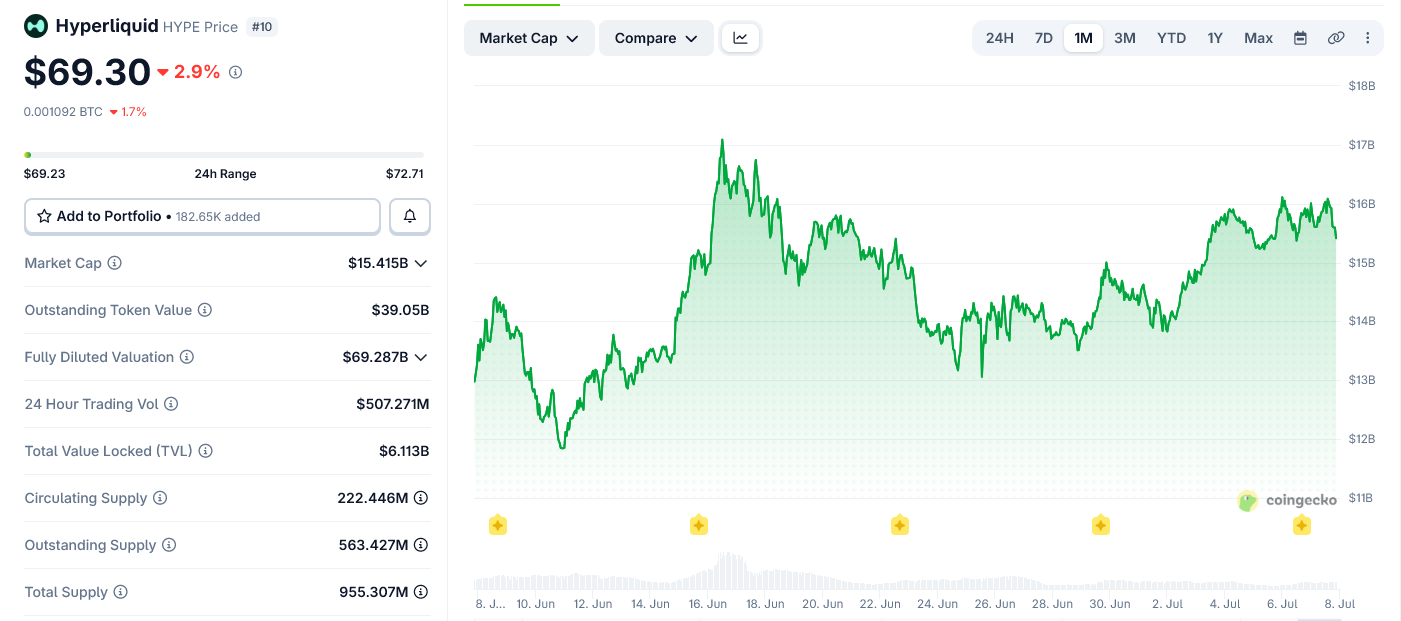
Hyperliquid (HYPE) trades near $71.82, up 4.4% in 24 hours, as bulls attempt a third breakout above the $76.70 all-time high. The token has gained roughly 250% from its January low near $20.50.
Record protocol revenue and fresh inflows from exchange-traded funds (ETFs) back the attempt. Meanwhile, monthly token unlocks and growing regulatory scrutiny keep sellers well-supplied with arguments for a lower Hyperliquid price target.

Record Revenue and ETF Inflows Strengthen the Bull Case
Hyperliquid crossed $1 billion in cumulative protocol revenue on June 30, according to DeFiLlama. The platform routes about 99% of trading fees into open-market HYPE purchases through its Assistance Fund, according to Tokenomist data.
Therefore, the July 6 unlock of 9.92 million HYPE, worth around $645 million, met a buyback fund reportedly holding 4.6 times that amount. Buyback demand has absorbed similar tranches before.
Institutional access is also widening. Bitwise’s BHYP and 21Shares’ THYP were listed in mid-May as the first US spot HYPE ETFs. Combined net inflows passed $170 million by early July, and Grayscale filed its own S-1 with the SEC.
The buyback and ETF combination already fueled flippening speculation in May.
Token Unlocks and Regulators Test the Rally
Core contributor vesting releases a new HYPE tranche on the sixth of every month through 2027. Only around 22% of the 1 billion maximum supply is circulating today, so dilution remains a recurring headwind.
Regulatory pressure is building as well. The Monetary Authority of Singapore (MAS) added Hyperliquid to its Investor Alert List in late June, as Singapore joined earlier UK warnings. In addition, CME and ICE executives urged the Commodity Futures Trading Commission (CFTC) to review the platform’s commodity perpetuals, Bloomberg reported in May. HYPE fell about 6% on that report.
Macro conditions add friction. US spot Bitcoin ETFs posted a record $4.5 billion June outflow, and sentiment sits in Extreme Fear. Buybacks also scale with volume, so their support could fade during a market-wide drawdown.
Daily Chart Shows Buyers Defending Higher Fibonacci Levels
HYPE has been in an upward trend since January. The mid-June correction from the record high stopped at the 0.382 Fibonacci retracement near $55.41. However, the next pullback ended at the shallower 0.236 level at $63.66.
Each correction has been shallower than the last, which suggests strengthening demand. A late June analysis showed user activity stayed resilient through the deepest of those pullbacks.

If sellers force a larger reset, the 0.618 retracement at $42.07 stands out. It nearly coincides with the ascending trendline and a historical support zone near $44. The daily Relative Strength Index (RSI) has cooled to about 60 while maintaining a bullish structure.
Volatility Squeeze on the 4-Hour Chart Signals the Next Move
The 4-hour chart shows price coiling in a contracting triangle since the June 16 peak. HYPE currently presses the pattern’s upper boundary near $72. The 0.236 retracement at $63.66 serves as interim support inside the structure.

RSI on this timeframe also hovers near 60, just below bullish territory. Meanwhile, the Bollinger Band Width Percentile (BBWP) prints extremely low readings. Historically, such volatility compression precedes a strong directional expansion.
Hyperliquid Price Prediction, a $77 Breakout or a Reset to $63.66
A 4-hour close above the triangle, followed by a daily close above $76.70, would start price discovery. The triangle’s height projects a measured move near $88, roughly 22% above the current price. Continued ETF inflows could accelerate that scenario.
In contrast, rejection at the record high would expose $63.66 first, then $55.41. A daily close below $63.66 would signal a deeper reset. The larger uptrend breaks only below the $42 confluence of the 0.618 retracement and the trendline.
July’s verdict depends on whether the compressed volatility resolves upward into price discovery or downward into another Fibonacci test.
The post Hyperliquid Price Outlook for July 2026 appeared first on BeInCrypto.
Ripple has secured full MiCA approval in Luxembourg as XRP spot ETFs have extended their inflow streak to eight consecutive weeks, even as XRP traded lower over the past 24 hours.
Summary
- Ripple has secured a full MiCA license in Luxembourg, allowing regulated crypto services across the European Economic Area.
- XRP spot ETFs have extended their inflow streak to eight weeks, with cumulative net inflows reaching $1.49 billion.
- XRP is holding near key technical support around $1.12 as traders watch for a move toward $1.15–$1.18.
According to Ripple, the Luxembourg Commission de Surveillance du Secteur Financier (CSSF) has granted the company a Crypto-Asset Service Provider (CASP) license under the European Union’s Markets in Crypto-Assets (MiCA) framework.
The approval allows Ripple to passport regulated crypto services across all 27 European Economic Area member states, strengthening its regulated payments business in the region.
According to data from crypto.news, XRP (XRP) traded at around $1.13 on Tuesday, down 1.1% over the previous 24 hours, although the token remained nearly 9% higher for the week. The decline came while Bitcoin held onto weekly gains of more than 10%, despite weakness in U.S. equities and higher oil prices linked to geopolitical tensions.
Investors also continued to watch developments surrounding the final version of the GENIUS Act, expected before July 18, while Ether changed hands near $1,800.
Ripple adds another EU regulatory approval
Following its initial MiCA clearance in June, Ripple said the newly issued CASP license completes its authorization process under the EU’s digital asset rules. The company noted that the approval complements its existing European e-money license, allowing it to offer regulated crypto payment services throughout the European Economic Area.
Ripple said the combined regulatory approvals support its cross-border payments business serving banks, financial institutions, and enterprises while providing a clearer compliance framework for crypto transactions. The company also expects the licensing framework to support adoption of both XRP-based payment products and its RLUSD stablecoin in Europe.
Commenting on the development, Ripple’s Managing Director for the UK and Europe, Cassie Craddock, said the company is now fully prepared to expand under the MiCA framework after completing the regulatory transition.
We’re fully licensed in Europe and excited to keep building on the incredible momentum of recent months. Let’s go!🚀 https://t.co/LVKKKgpKVX
— Cassie Craddock (@CraddockCJ) July 6, 2026
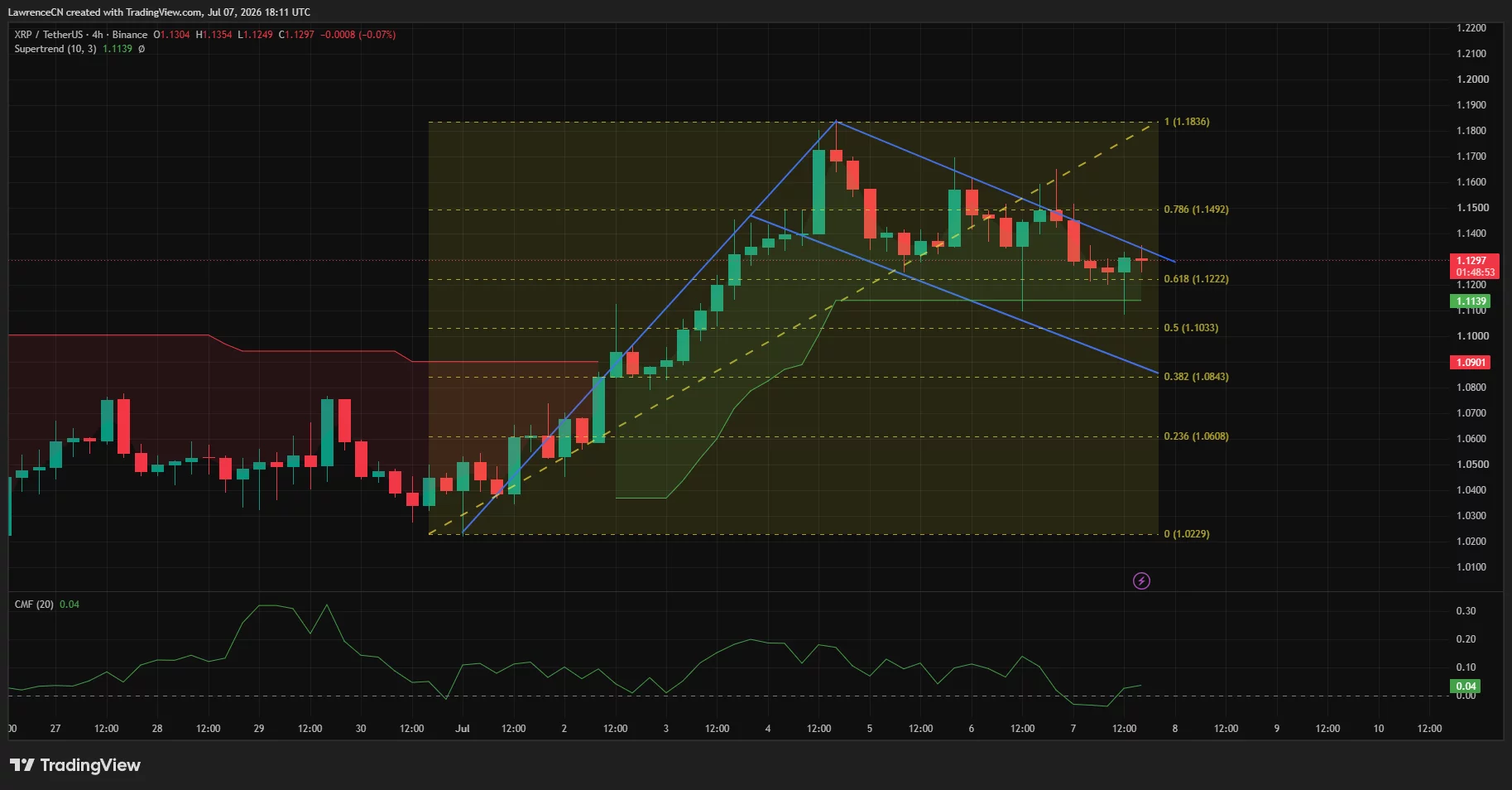
Technical indicators also suggest XRP is testing an important level following its recent rally. On the 4-hour chart, the token is trading near the 61.8% Fibonacci retracement around $1.12 while remaining above the Supertrend support near $1.11.
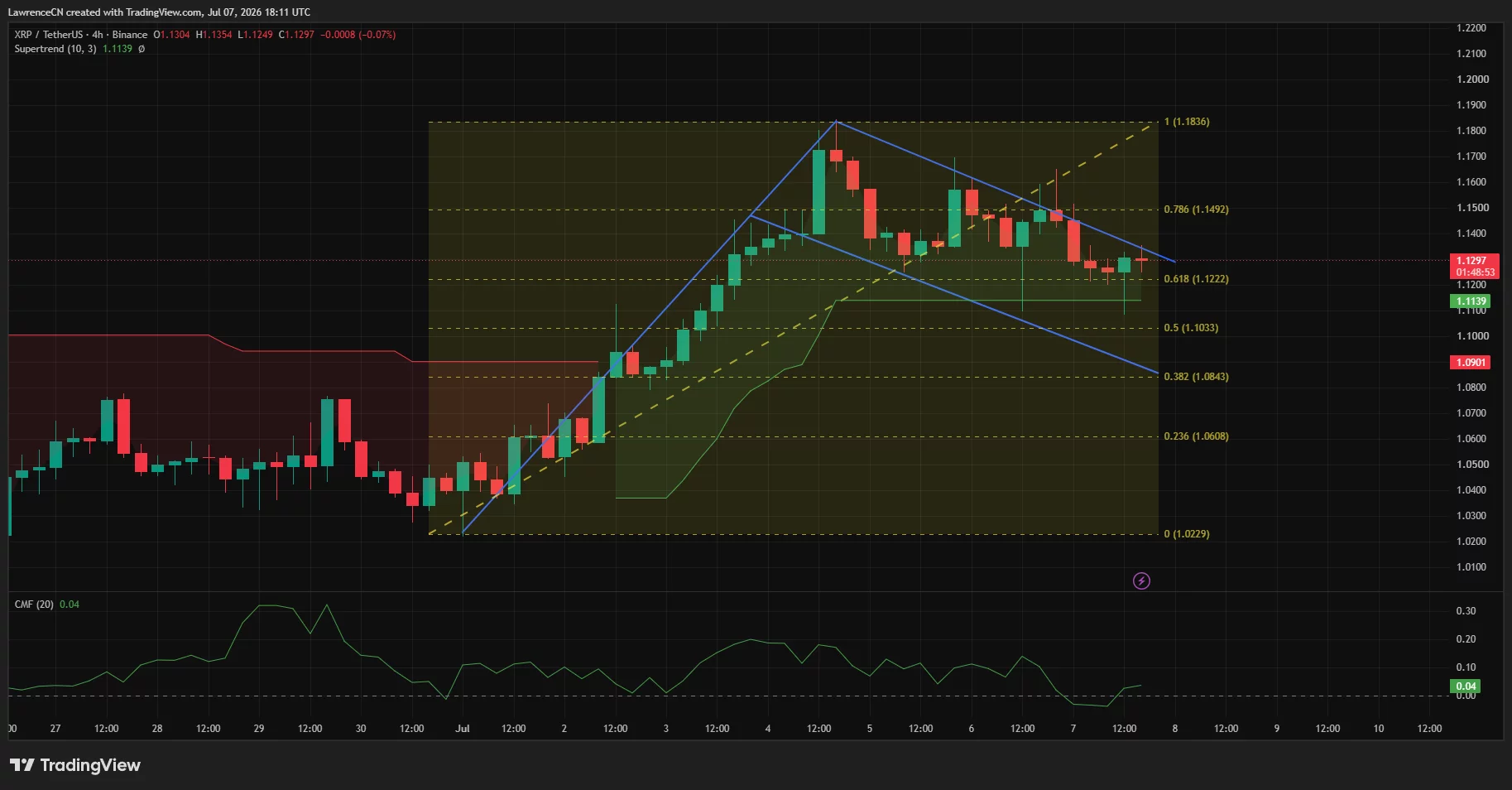
At the same time, Chaikin Money Flow has stayed slightly above zero, indicating buying interest has not fully disappeared despite the recent pullback.
ETF demand continues supporting XRP
Institutional interest has remained steady alongside Ripple’s regulatory progress. According to SoSoValue, XRP spot exchange-traded funds have now recorded eight consecutive weeks of net inflows, with cumulative net inflows reaching $1.49 billion.
SoSoValue data showed no new daily inflows on July 6, but cumulative assets under management continued to stand at approximately $1.05 billion, representing about 1.47% of XRP’s total market capitalization.
Trading activity across listed XRP spot ETFs reached $14.48 million during the latest session. Bitwise’s XRP fund remained the largest with $330.84 million in net assets, followed by Canary at $265.30 million and Franklin at $261.68 million. According to SoSoValue, the XRP-linked investment products also finished the session with gains of more than 5%.
From a technical perspective, XRP continues to move within a descending corrective channel after climbing from roughly $1.02 to $1.18 earlier this month. Holding above the $1.12 support zone could keep attention on resistance near $1.15 and the recent high around $1.18, while a break below that level would expose the next support near the 50% Fibonacci retracement around $1.10.

Egypt seething after squandering two-goal lead, losing to Argentina at World Cup

ETH Outperforms BTC As Investors Turn Attention Toward TradFi Adoption

5 quick at-home drills that will help you hit the ball solid immediately


-

 Fashion4 days ago
Weekend Open Thread: High Hopes
-
 NewsBeat3 days ago
Taylor Swift and Travis Kelce wedding staffer hilariously struggles to keep her cool while checking in megastars
-

 Fashion1 day ago
Open Thread: What Great Books Have You Read Recently?
-

 Politics5 days ago
The House | “Reframing the debate from a binary discussion of winners and losers”: Yuan Yang reviews ‘We Are Not Machines’
-
Crypto World6 days ago
Airdrop Registration Becomes Key Focus For Remittix As RTX Launch Updates Approach
-

 Crypto World4 days ago
Standard Chartered Secures MiCA License as ESMA Adds 37 New Crypto Firms
-

 Business1 day ago
AXT Shares Jump Nearly 14% as Semiconductor Materials Maker Rebounds on AI-Linked Indium Phosphide Demand
-

 Sports6 days ago
Broncos roster: OL Ben Powers (No. 74) entering final year of contract
-

 Crypto World6 days ago
Binance stock trading tops $1B in first month after launch
-

 Crypto World6 days ago
Alibaba-affiliate Ant Group enters the humanoid robot market with 12 deals
-
Crypto World1 day ago
SK hynix (000660.KS) Stock Dips as $28B Nasdaq ADR Offering Drives AI Memory Expansion
-

 Crypto World2 days ago
South Africa proposes crypto tax guidance under existing rules
-

 News Videos1 day ago
Best Time to Enter Small Caps Right Now? Another Bull Run? | Financially Free
-

 Tech3 days ago
Lenovo laptops are now shipping with YMTC SSDs, a sign of Chinese NAND entering the mainstream
-

 News Videos20 hours ago
Whats Hidden Inside This Cash Register? #treasure #reselling #money
-
 NewsBeat6 days ago
New exhibition reflects five decades of movement between island of Ireland and GB
-

 Business6 days ago
Meta Platforms Stock Jumps 7% Today as Bloomberg Reports Company Plans to Enter the Cloud Business
-

 Business5 days ago
What a 10 Percent Drop Means for Buyers, Sellers and Renters
-

 Crypto World5 days ago
Binance Re-Enters Philippines As EU MiCA Rules Restrict Access
-

 News Videos1 day ago
Avoid entering in FOMO #bitcoin #cryptocurrency #trading #scalping
You must be logged in to post a comment Login