

Crypto World
Kraken Switches from LayerZero to Chainlink after Kelp DAO Hack

Crypto exchange Kraken announced Thursday that it had changed its cross-chain provider from LayerZero to Chainlink’s Cross-Chain Interoperability Protocol, joining a number of protocols that have made the move following the Kelp DAO exploit in April.
Kraken said it is deprecating its existing cross-chain provider and migrating to Chainlink CCIP as its exclusive cross-chain infrastructure to secure Kraken Wrapped Bitcoin (kBTC) and all future wrapped tokens.
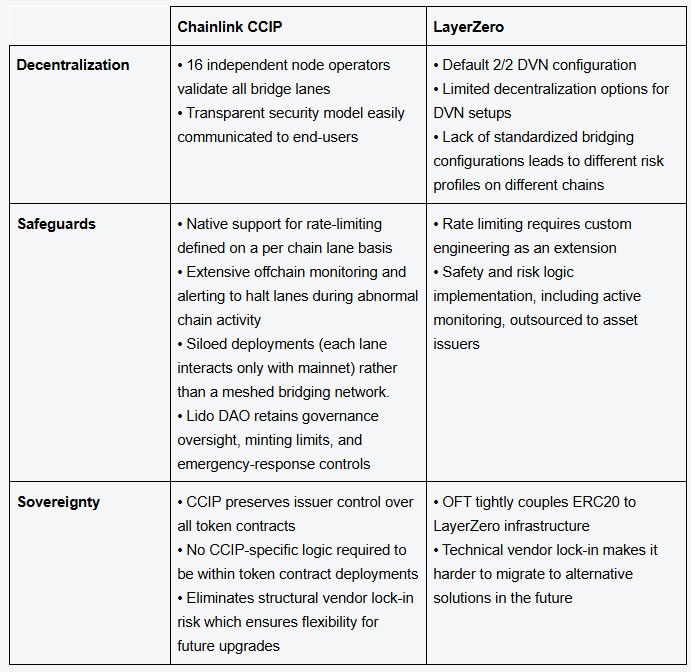
The company added that it chose Chainlink CCIP because it “offers enterprise-grade infrastructure with strict security and risk management requirements.” These include certifications, secure-by-default design, 16 independent nodes and native rate limits.
LayerZero has been under scrutiny since the Kelp DAO exploit in April, in which about $292 million in liquid restaking tokens were stolen by actors suspected to be linked to North Korea’s Lazarus Group.
LayerZero issued an “overdue apology” on May 9, saying that it had done a “terrible job on comms over the past three weeks.”
It admitted that its internal RPCs (remote procedure calls) were attacked and had their “source of truth poisoned” while its external RPC providers were simultaneously hit with a denial of service attack, but blamed Kelp’s configuration as a direct consequence of their single-DVN (Decentralized Verifier Network) setup.
LayerZero confirmed that no other application had been affected, and more than $9 billion in bridged assets have been moved using the protocol since April 19.
Other protocols migrate away from LayerZero
Kraken is not alone in making the switch. Kelp DAO stated that it is also in the process of migrating to Chainlink’s CCIP, and that it had burned the hacker’s 117,132 rsETH as part of the recovery process this week.
Related: Kelp DAO eyes reopening withdrawals after rsETH burn
Solv Protocol announced on May 7 that it was migrating from LayerZero to CCIP as its official cross-chain infrastructure for $700 million in tokenized Bitcoin.
Meanwhile, onchain reinsurance protocol Re announced on May 8 that it was migrating its $475 million in total value locked from LayerZero to the Chainlink protocol.
More than $3 billion in TVL has been migrated to CCIP since the Kelp hack, while numerous protocols have suspended bridging using LayerZero, according to MEXC.
The world’s largest Ethereum liquid staking protocol, Lido, also uses CCIP. “Chainlink’s defense-in-depth model acts as the definitive standard for cross-chain interoperability,” it explained in a blog post on Thursday.
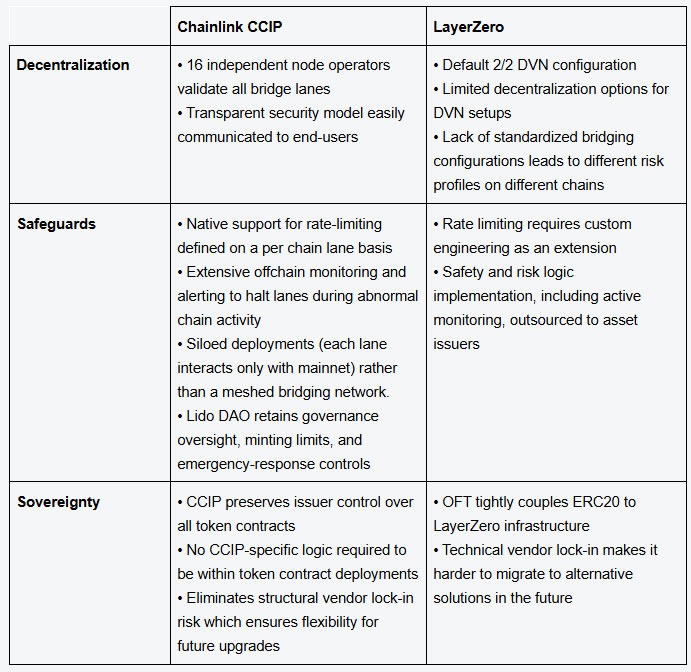
CCIP and LayerZero comparison. Source: Lido
No reaction in token prices
There was no reaction in prices for Chainlink’s native token, LINK, which remains at a bear market low of around $10, down 80% from its 2021 peak.
However, LayerZero’s native token ZRO has declined over 30% since the April hack and is down more than 80% from its 2024 all-time high, according to CoinGecko.
Cointelegraph reached out to LayerZero for comment but did not receive an immediate response.
Magazine: eToro founder timed Bitcoin top perfectly due to belief in 4 year cycles

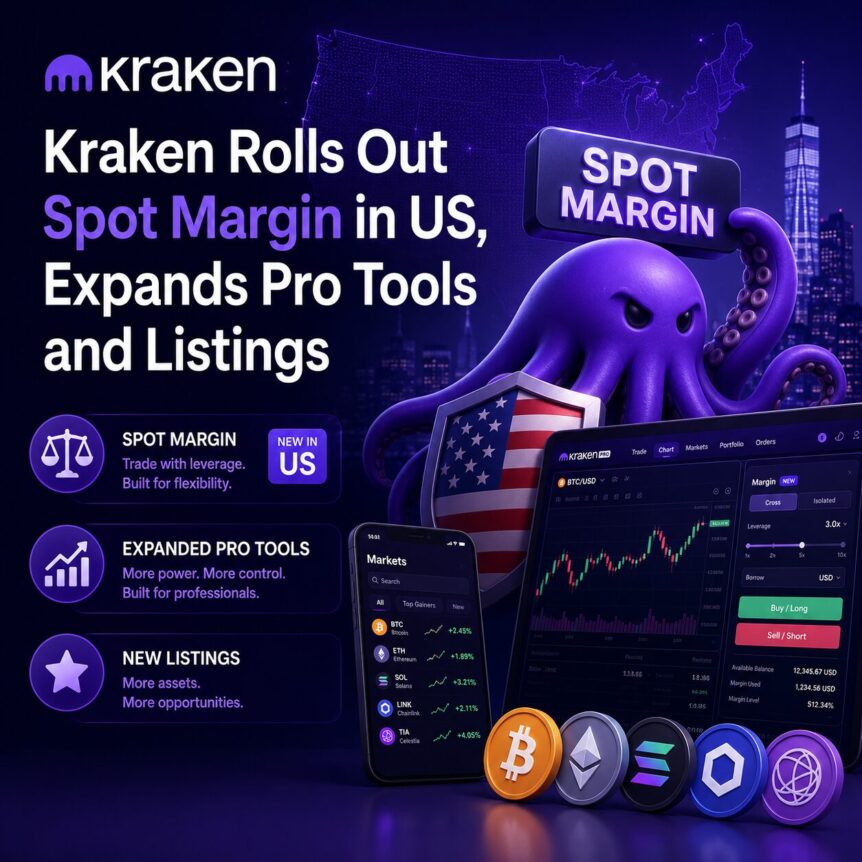
Kraken expands Pro offering with US spot margin and broader market infrastructure upgrades
Kraken this month advanced its push into professional trading and market infrastructure with a flurry of product and operational updates. The exchange expanded margin capabilities on its Kraken Pro platform, added a slate of new spot listings, and rolled out upgrades aimed at systematic traders and fiat onramps.
Taken together, the changes underscore Kraken’s focus on attracting higher-value, active traders and institutional flow by beefing up execution tools, market data access and payments rails. The move also reflects a broader industry trend as spot margin, tokenized equities and low-latency services become competitive differentiators among regulated exchanges.
Spot margin trading arrives on Kraken Pro for most US users
Kraken announced that Spot Margin trading is now available on Kraken Pro for eligible US customers, excluding residents of New York and Washington state. The firm positions the feature as CFTC-regulated, offering traders amplified exposure on spot positions via margin facilities.
For active traders, spot margin can increase return potential but also raises risks due to leverage. From Kraken’s perspective, enabling margin on its Pro platform aims to increase engagement, deepen liquidity and capture higher lifetime value (LTV) customers who generate sustained trading volume.
Market implications: The availability of regulated margin products within the US is likely to attract experienced traders who prioritize speed, fees and execution quality. It also heightens the importance of risk controls and compliance frameworks as exchanges scale leveraged offerings under evolving regulatory scrutiny.
New listings and token support
Kraken added a range of new spot listings on its platform, including established altcoins and newer projects. The roster expands the exchange’s coverage across multiple categories of tokens, reflecting ongoing demand for a diverse set of tradable assets among retail and institutional customers.
Greater asset diversity is a tactical lever for retention: users are more likely to trade and hold assets when their exchange lists fresh projects quickly, provided the listings meet the exchange’s due diligence and compliance standards.
Infrastructure upgrades for systematic and institutional traders
Kraken also highlighted enhancements to its API and low-latency services. The exchange is promoting its market-data feeds and has extended colocation access through a year-long arrangement with Beeks, a provider of low-latency connectivity for financial markets.
Upgraded APIs and colocated infrastructure are key to appealing to algorithmic traders and market makers. Better market-data access and reduced execution latency can translate into tighter spreads and higher quoted depth, improvements that benefit liquidity-seeking institutions as well as high-frequency retail strategies.
Payments, onramps and partnerships
On the payments front, Kraken expanded virtual IBAN availability across parts of the EU, adding Latvia, Greece, Croatia and Hungary, and introduced a promotional salary match incentive for some accounts. Separately, the exchange moved forward with a tie-up to broaden physical cash conversion options by partnering with MoneyGram to make crypto-to-cash easier across MoneyGram’s global footprint.
These financial rails are important to reduce friction for fiat flows in and out of crypto, particularly for users in jurisdictions where direct bank integrations remain inconsistent. Partnership-driven cash-out options and virtual IBANs can improve user onboarding and retention by simplifying deposits and withdrawals.
Tokenized equities and multi-asset trading initiatives
Kraken continues to extend its institutional product set beyond crypto-only instruments. The firm emphasized developments in tokenized equities via integrations with partners such as CoinRoutes and the rollout of xStocks tokenized equity products with regional partners. One partner launched tokenized access to US-listed equities in Argentina this month, reflecting the cross-border appetite for fractionalized equity exposure via crypto rails.
Tokenized equities remain a contentious but fast-moving area. They promise expanded market access and 24/7 tradability, while raising questions around custody, regulatory alignment and liquidity sourcing. Exchanges that can combine compliant custody, order routing and regulated clearing may capture a meaningful share of institutional demand if regulatory frameworks stabilize.
Promotions and user engagement tools
To support adoption of the Pro product and new features, Kraken has been running promotions, including incentives tied to account transfers and staking-like engagement mechanics. The exchange also introduced gamified elements and loyalty-like programs intended to encourage trading activity among Pro users.
While promotions can drive short-term volume, sustained growth depends on product quality. For Kraken, the broader improvements to execution, market data and fiat connectivity are likely to be more important for attracting long-term professional customers.
What this means for the market
Kraken’s package of product, infrastructure and payments updates signals a two-track strategy: deepen offerings for professional and institutional users while expanding fiat and token access for a broader customer base. For market participants, the practical outcomes to watch are changes in liquidity patterns, spreads on listed assets and the growth of margin-based volumes on the Pro platform.
Regulatory context remains a central consideration. As exchanges scale margin products, tokenized equities and fiat rails, their ability to demonstrate robust compliance, custody segregation and risk management will shape institutional willingness to route larger volumes through their venues.
For now, Kraken’s roadmap appears aligned with the priorities of active traders and institutions: faster data, lower-latency execution, expanded asset coverage and more options to move fiat in and out of crypto markets.
Disclosure: This article summarizes recent product and operational announcements by Kraken. It does not constitute financial advice.
XRP Upbit volume surged to $330 million on May 15 after Hana Bank announced a $670 million Dunamu stake.
Summary
- XRP’s Korean won pair led Upbit with over $330 million in 24-hour trading volume, outpacing Bitcoin’s $217 million and Ethereum’s $109 million.
- South Korea’s Hana Bank agreed to buy a 1 trillion won stake in Dunamu, operator of Upbit, in the largest bank investment into a crypto exchange on record.
- XRP pulled back from a 24-hour high of $1.55 to $1.45 as options expiry pressure offset the volume surge, with trading activity up over 83% on the day.
XRP Upbit volumes surged on Friday after South Korea’s Hana Financial Group announced it will acquire a 1 trillion won ($670 million) stake in Dunamu, the operator of Upbit, through its subsidiary Hana Bank.
The XRP-KRW pair recorded over $330 million in 24-hour volume, outpacing Bitcoin’s $217 million and Ethereum’s $109 million on the same exchange.
The deal is expected to close on June 15, giving Hana Bank a 6.55% stake in Dunamu and making it the exchange’s fourth-largest shareholder. Hana Financial Group simultaneously signed a strategic agreement with Dunamu to build a “digital asset-based financial innovation” model linking traditional banking and crypto markets.
Hana Financial TI has already completed a proof-of-concept for a Korean won-backed stablecoin on the XRP Ledger.
South Korea’s deepening XRP footprint
The Dunamu deal is the latest in a series of Korean institutional moves tied to XRP. As crypto.news reported, Ripple signed a partnership with Kyobo Life Insurance in April to pilot the tokenization of South Korean government bonds using Ripple Custody, the first time a Tier-1 Korean insurer adopted on-chain bond infrastructure.
South Korean retail traders have consistently shown strong preference for XRP, a pattern crypto.news documented earlier this year when XRP emerged as the standout trade of the 2026 crypto rally.
XRP spot ETFs, whose combined US assets under management crossed $1.25 billion, have also been attracting record inflows, adding an institutional layer to what has traditionally been retail-driven Korean demand.
Despite the volume surge, XRP pulled back from $1.55 to $1.45 amid broader market weakness linked to the $2.6 billion options expiry and rising US Treasury yields. Analysts continue to watch the $1.50 level as the first meaningful resistance for any extended move higher.

Crypto.com expands product roster with AI discovery and travel service
Crypto.com has rolled out two new consumer-facing products while updating its affiliate partners on market activity and promotional assets. The company added an AI-driven search and discovery layer, branded through its Delphi suite, and launched a dedicated travel booking experience called CDC Travel. The announcements came via an affiliate newsletter that also included a weekly market snapshot, performance highlights for marketing creatives, and an invitation to a new creator program.
Delphi AI Discovery: adding search and signals to the app
Crypto.com’s new Delphi AI Discovery is designed to help users find crypto-related content and market information more quickly. The feature aims to surface relevant research and ecosystem content, simplifying navigation for both novice and experienced users.
Industry-wide, exchanges and wallet providers are increasingly integrating AI tools to improve user onboarding and information retrieval. For product teams, the goal is twofold: reduce friction for newcomers and increase engagement among active traders by making discovery of tokens, research and on-chain events easier. For affiliates, the addition provides a fresh positioning angle: marketing that highlights guided discovery and research tools may resonate with audiences who cite information overload as a barrier to participation.
That said, AI-powered features in financial contexts carry specific risks. Accuracy of outputs, transparency around data sources, and regulatory expectations for investment-related advice are all relevant considerations. Market participants will be watching how Crypto.com frames the feature, whether it uses clear disclaimers, and how it integrates human moderation or expert curation.
CDC Travel: moving further into lifestyle utility
CDC Travel extends Crypto.com’s push into lifestyle services by offering travel booking functionality within its ecosystem. The move reinforces the company’s longstanding strategy of coupling financial products with consumer use cases designed to demonstrate real-world crypto utility.
Travel integrations are a common playbook for crypto firms seeking to normalize digital-asset usage. They can drive card usage, boost loyalty programs, and provide cross-promotional opportunities with other services in a platform’s portfolio. Practical challenges remain, however, including jurisdictional constraints on crypto payments, volatility management for merchant settlements, and competition from established travel platforms that now also accept digital assets.
Weekly market snapshot and token highlights
Crypto.com shared a brief market index update showing the platform’s price index rose by 0.36% last week, while volume and volatility indices fell by 8.88% and 29.85%, respectively. Bitcoin and Ether posted small declines of about 0.1% and 1.9%, and a handful of altcoins—Bittensor (TAO), Dogecoin (DOGE) and Zcash (ZEC)—registered the strongest price gains over the period.
Notably, Zcash reached a network-level milestone: the newsletter reported that shielded supply hit an all-time high, with nearly 30% of circulating ZEC held in privacy-preserving balances. That development underscores evolving demand for privacy features in some communities, and may affect on-chain liquidity dynamics for ZEC specifically.
From a market-structure perspective, the combination of a modest price uptick alongside falling volume and volatility suggests a period of consolidation rather than a broad breakout. For affiliates and marketers, such stretches typically shift focus toward educational content and product-led offers to capture new users before volatility-driven demand returns.
Affiliate tools, creatives and a new creator program
The newsletter outlined top-performing creative assets and called attention to campaign themes that have been driving conversions. High-engagement assets included main app banners and promotional units tied to product features such as fee-free buys for major coins and “level up” product messaging. Affiliates were encouraged to reuse these creatives and to track mentions of Crypto.com rigorously to ensure accurate attribution.
Crypto.com also announced a dedicated creator program aimed at key opinion leaders and influencers. Participants reportedly received invitations by email. For affiliate managers and content creators, specialized creator programs can provide better-aligned incentives, bespoke assets, and priority support—tools that can help scale influencer-driven acquisition. Affiliates should also note the reminder to track every mention of Crypto.com across channels, a practical step to protect referral attribution in multi-touch campaigns.
What this means for Crypto.com and its partners
The product launches and marketing updates reflect a broader strategy to expand the platform beyond trading and custodial services into discovery, lifestyle and creator-led growth. AI discovery is intended to reduce search friction and increase in-app engagement, while travel booking aims to showcase practical use cases for crypto holdings. Both can be framed by affiliates as innovation and utility-driven differentiators, but they also bring expectations around compliance, user protection and product performance.
For affiliates and marketers, the immediate takeaway is to test the new creatives and reposition messaging around the new features. Long term, observers will be watching how effectively Crypto.com converts product breadth into sustained user activity, and whether new features translate into increased retention rather than short-term acquisition spikes.
As crypto platforms continue to broaden their consumer propositions, the success of such integrations will depend on product execution, regulatory alignment across jurisdictions, and the ability to communicate tangible user benefits without overstating outcomes.
Correction/clarification: This article is based on an affiliate newsletter issued by Crypto.com. Figures cited reflect the data points reported in that communication.


Flare Network gained 14% on May 15 as altcoins outpaced Bitcoin stuck below its 200-day moving average.
Summary
- Flare Network’s FLR token rose 14% after the FAssets v1.3 upgrade went live, enabling one-click XRP-to-FXRP minting directly from centralized exchanges.
- Hyperliquid’s HYPE led all 24-hour gains at 16%, fueled by Bitwise’s new spot Hyperliquid ETF and Coinbase’s role as the protocol’s USDC treasury deployer.
- Unibase’s UB token gained 11% as AI agent marketplace momentum continued to attract capital rotation into smaller altcoins away from Bitcoin and Ethereum.
Flare Network activated the FAssets v1.3 upgrade on its mainnet on May 15, enabling XRP holders to mint the DeFi-ready FXRP token in a single XRP Ledger transaction using native destination tags.
The upgrade allows minting directly from major centralized exchanges including Binance and Kraken as a simple withdrawal, removing the multi-step friction that had limited adoption. FLR gained 14% on the announcement.
Hyperliquid’s HYPE led all 24-hour gains at 16%, driven by Bitwise’s launch of a spot Hyperliquid ETF and Coinbase’s new designation as the protocol’s official USDC treasury deployer.
Unibase’s UB token added 11%, continuing its May momentum after the May 7 launch of its ERC-8183 Agent Service Market. Total cumulative crypto futures volume rose 14% to $220 billion over 24 hours.
Bitcoin’s 200-day average caps the session
Bitcoin remained below its 200-day simple moving average near $82,228 throughout the session, trading around $80,592. The Senate Banking Committee’s 15-9 Clarity Act approval on Thursday had briefly pushed Bitcoin above $82,000, but macro pressure from hotter-than-expected inflation data and the $2.6 billion options expiry reversed those gains by Friday.
As crypto.news reported, Flare has been executing a broader tokenomics overhaul under FIP.16, cutting annual FLR inflation by 40% to 3% and introducing protocol-level MEV capture designed to link network usage directly to token value. That structural shift provides a bullish case for FLR independent of broader market conditions.
As crypto.news noted when FLR printed a similar catalyst-driven rally in April 2025, upgrades that lower friction for XRP capital entering the Flare ecosystem have historically preceded sustained volume growth in the days following the launch.


Treasury yields hit 12-month highs on May 15, pushing Bitcoin back toward $80,500 a day after the Clarity Act committee vote.
Summary
- The 10-year US Treasury yield climbed to 4.5% on May 15, its highest since May 2025, after April CPI data came in at 3.8% above expectations.
- CME FedWatch now prices a 44% probability of a Fed rate hike by December 2026, sharply reversing earlier expectations of multiple cuts this year.
- Bitcoin remained below its 200-day simple moving average of $82,228, having failed to close above that level on five consecutive attempts this month.
US Treasury yields surged to fresh 12-month highs on May 15, with the 10-year note hitting 4.54% and the 2-year climbing to levels not seen since mid-2025.. The move came a day after the Senate Banking Committee approved the Clarity Act in a 15-9 bipartisan vote, which had briefly lifted Bitcoin above $82,000. By Friday, macro pressure had reversed most of those gains.
April CPI data showed inflation running at 3.8%, confirming that rate cuts are not arriving in 2026. CME FedWatch data now shows markets assigning more than a 44% probability to a Fed rate hike by December, against a current rate of 3.50% to 3.75%. At the start of 2026, traders had priced in at least two cuts before year-end.
What higher yields mean for Bitcoin
Bitcoin is a non-yielding asset competing directly against Treasury securities now offering more attractive dollar-denominated returns. As crypto.news tracked, the “higher for longer” rate environment compresses valuation multiples and caps speculative excess, making it harder for marginal capital to flow into high-beta crypto assets.
One partially offsetting signal is the tokenized Treasury market, whose total value locked hit a record above $15 billion on May 15 according to rwa.xyz data. The same yield environment that pressures Bitcoin is attracting institutional capital into on-chain access to high-yielding government debt.
Bitcoin is trading near $80,592, below its 200-day SMA of $82,228 and having failed to close above it on five consecutive attempts this month. As crypto.news documented, a hawkish macro backdrop keeps Bitcoin sensitive to shifts in Fed tone rather than legislative progress alone. If the 10-year yield continues toward 5%, the headwind for non-yielding assets intensifies further.
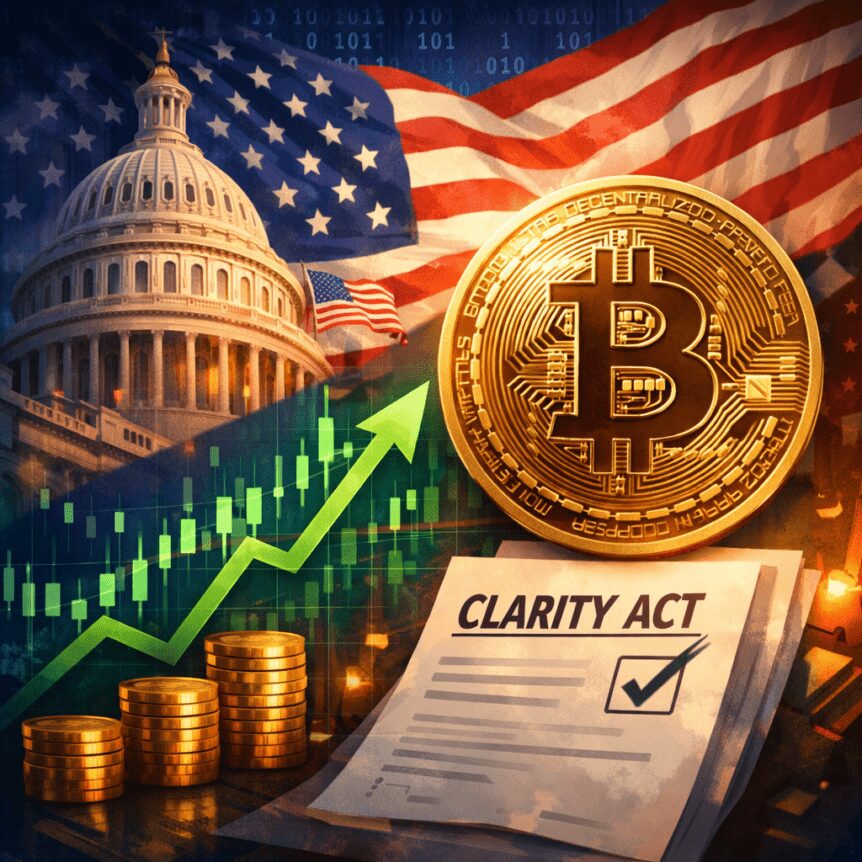
Bitcoin’s near-term trajectory has drawn renewed attention as momentum builds around the US Digital Asset Market Clarity Act (CLARITY). Crypto sentiment tracker Santiment said social chatter spiked after the Senate Banking Committee advanced the bill in a 15-9 vote, signaling a potential shift toward Congressional clearance for the industry’s regulatory framework.
In a Friday post, Santiment noted the euphoria across crypto communities following the committee’s move, arguing that a successful passage would bring Bitcoin and the broader sector closer to formal rules. The act, which would establish clearer standards for digital assets, has been the subject of ongoing debate since its introduction, and today’s committee vote marks a notable milestone in what remains a complex legislative process. Cynthia Lummis, a prominent advocate for crypto legislation, highlighted the development on social media as a significant step forward.
Key takeaways
- The Senate Banking Committee advanced the Digital Asset Market Clarity Act in a 15-9 vote, with all 13 Republicans and two Democrats voting in favor, while nine Democrats opposed the bill, according to coverage surrounding the session.
- Bitcoin is trading around $79,084, up roughly 3.15% from early May, as market participants react to the potential for clearer U.S. regulatory guidance.
- Sentiment metrics show a bullish tilt in social chatter, yet Santiment cautioned that the market has historically moved contrary to the crowd, underscoring the need for disciplined risk management.
- Industry voices remain optimistic about a long-term regulatory path, with analysts framing CLARITY as a potential spark for the next phase of a crypto cycle.
- Even with momentum, White House officials stress that the bill is far from finalized, and patience will be required as lawmakers work to secure broader support.
Regulatory momentum and market mood
The committee’s approval of the CLARITY Act represents a meaningful procedural step toward enshrining a formal regulatory regime for digital assets in the United States. Santiment described the vote as a catalyst that could unlock a more favorable environment for both retail and institutional participants if the bill progresses to the Senate floor and beyond. A recap of the session shows bipartisan prodding, with all Republican members and a few Democrats backing the move, reflecting underlying cross-party interest in providing regulatory guardrails for the sector.
Bitcoin’s price action underlines that momentum can influence broad interest. As of market data cited by CoinMarketCap, the benchmark cryptocurrency hovered near $79,084, reflecting a modest rise since the start of May. The price move, while not dramatic, aligns with a period where participants are weighing the potential macro and regulatory catalysts that could accompany clearer rules for the space.
Industry voices weigh in
Reaction from market commentators underscores a mix of optimism and prudent caution. Michael van de Poppe, founder of MN Trading Capital, described the CLARITY Act as a historically significant bill that could act as a strong trigger for a forthcoming bull market, suggesting the legislation’s potential to recalibrate risk appetites and institutional participation. His commentary, shared on social media, reflects a view that regulatory clarity could attract new capital and accelerate adoption across builders and users alike.
On the White House side, Patrick Witt, the administration’s crypto advisor, cautioned that the path to enactment remains uncertain. In a post on social media, Witt emphasized that more work lies ahead before the bill can reach the president’s desk, highlighting ongoing negotiations and the need for broad support on Capitol Hill. These remarks remind readers that while momentum exists, the legislative journey is far from complete.
From a sentiment-tracking perspective, Santiment noted a current ratio of 1.55 bullish social comments for every bearish one regarding Bitcoin. The firm cautioned that such sentiment indicators can be a double-edged sword, warning that markets often move against crowded expectations. The message to readers is clear: while the narrative may be bullish in the near term, risk management remains essential as developments unfold.
Cynthia Lummis’s social post, cited in coverage of the vote, adds to the narrative of a zealous but divided governing body: lawmakers see potential in bringing regulatory clarity, even as debates about scope and enforcement continue. The broader implication for the sector hinges on whether the CLARITY Act can secure sufficient support on the Senate floor and in any potential conference with the House.
Caution and what to watch next
Despite the upbeat tone around the CLARITY Act, observers emphasize that a finalized bill is not guaranteed. The White House has signaled that work remains, and the administration’s crypto policy team will likely advocate for provisions that can garner broader political backing. As Witt noted, patience will be required as negotiators seek a path to passage that satisfies a diverse coalition of lawmakers.
Beyond legislative dynamics, market metrics continue to show a tempered mood. The Crypto Fear & Greed Index posted a Fear reading around 31, signaling cautious sentiment despite hopeful headlines about regulatory clarity. In the near term, traders will likely weigh how the regulatory process interacts with macro risk factors, liquidity conditions, and evolving narratives around technology, securities classifications, and market structure.
For investors and builders, the key takeaway is that regulatory clarity remains a high-priority objective that could reshape capital flows and strategic planning. If CLARITY progresses toward passage, institutions may re-evaluate exposure, product development, and collaboration with traditional financial players. Conversely, any stalling or concessions could keep the market in a more cautious stance, with volatility remaining a prominent feature of the regulatory narrative.
As the week unfolds, eyes will turn to the Senate floor discussions, potential House engagement, and fresh commentary from policymakers and industry participants. A conclusive path to law would hinge on consensus-building across committees and factions, and market participants should prepare for a stepwise process rather than an immediate windfall.
Readers should monitor updates on the regulatory front, watch for any shifts in political backing, and track additional comments from key voices in the industry. The outcome will shape not only price action but also the strategic calculus of exchanges, custodians, and developers seeking a clearer operating environment in the United States.
Crypto World
PMGC Holdings Inc. (ELAB) Stock Declines as $40M Funding Facility Powers Strategic Growth

Key Highlights
- ELAB stock declines amid aggressive aerospace and defense expansion strategy
- Company reports doubled assets, record cash position, and significant Q1 revenue surge
- Strategic acquisitions in aerospace manufacturing strengthen defense technology portfolio
- New $40M equity facility provides capital for continued M&A activity
- A&B Aerospace acquisition brings Tier 1 customer relationships and positive cash flow
Shares of PMGC Holdings Inc. (PMGC) closed at $1.9900, declining 3.40% amid midday trading weakness following morning volatility. The Nasdaq-listed entity submitted its first quarter 2026 financial disclosure to securities regulators. Meanwhile, the company’s aggressive acquisition strategy and newly secured $40 million capital facility underscored its commitment to rapid industrial growth.
Financial Position Strengthens With Doubled Asset Base
PMGC disclosed total assets reaching approximately $26.0 million by the conclusion of March 2026. This represented a substantial 102% increase compared to roughly $12.87 million recorded at 2025’s fiscal year-end. The growth trajectory also reflected a remarkable 193% year-over-year expansion, fueled primarily by financing initiatives and merger-and-acquisition transactions.
Shareholder equity climbed to approximately $12.6 million throughout the reporting period. This figure contrasted with roughly $7.84 million documented at December 31, 2025. Concurrently, the company’s cash and equivalents surged to approximately $14.4 million.
Management highlighted that this cash position represented an all-time high for the organization. Net working capital similarly advanced to roughly $5.1 million from $2.9 million previously. As a result, PMGC positioned itself with enhanced financial flexibility and an expanded capital foundation for future operations.
First Quarter Revenue Surges From Manufacturing Operations
PMGC recorded approximately $682,000 in quarterly revenue for the opening three months of 2026. This compared to zero revenue generation during the corresponding 2025 timeframe. Notably, this single-quarter performance surpassed the company’s complete 2025 fiscal year revenue of roughly $590,000.
Revenue streams originated from three operational manufacturing and packaging subsidiaries. SVM Machining delivered partial-quarter contributions following its February 2 transaction completion. This strategic addition broadened the company’s capabilities in precision machining and specialized manufacturing operations.
SVM maintains customer relationships across medical device, aerospace, biotechnology, pharmaceutical, semiconductor, and transportation sectors. This diversified market exposure aligned with PMGC’s strategic pivot toward industrial and niche manufacturing platforms. On a sequential basis, revenue demonstrated approximately 124% growth from roughly $304,000 in the fourth quarter of 2025.
Defense Technology Unit and Major Capital Infusion Drive Strategy
Following the quarter’s conclusion, PMGC established NorthStrive Defense Tech LLC on April 2, 2026. This specialized subsidiary will concentrate on defense-related technologies, encompassing drone systems and autonomous platforms. Additionally, NorthStrive executed two separate agreements related to GPS-independent drone navigation capabilities and advanced payload technologies.
On April 17, PMGC finalized a substantial $40 million equity purchase arrangement. The organization secured an initial funding tranche of approximately $10 million upon transaction closure. Additional capital draws remain available throughout a 24-month commitment window.
PMGC subsequently completed its acquisition of A&B Aerospace on May 12, 2026. The California-based manufacturer maintains strategic relationships with premier aerospace customers, including Boeing, Honeywell, and Moog. A&B generated approximately $4.5 million in trailing twelve-month revenue while maintaining positive operating cash flow.


Consensus Miami has long served as crypto’s annual reality check, the moment where the industry takes stock of where it actually stands, not where it wishes it did. This year’s edition delivered that and more. BeInCrypto attended as a media partner, conducting on-site interviews with executives and founders across trading, infrastructure, security, and payments.
What emerged from the floor was a consistent signal: the conversation has shifted from speculation to infrastructure. Stablecoins dominated the agenda. AI-crypto integration surfaced in nearly every discussion. And the institutional presence, from compliance officers to big-bank representatives, was more visible than at any previous Consensus.
Stablecoins Take Center Stage
If there was one topic that defined Consensus Miami 2026, it was stablecoins. Last year’s passage of the GENIUS Act and the ongoing Clarity Act negotiations gave the conversation a sense of urgency, but speakers were quick to note that institutional momentum was already building regardless of legislative outcomes.
Henri Arslanian, Co-Founder of Nine Blocks Capital Management, puts it plainly:
“If the Clarity Act is passed, cherry on the sundae. Otherwise, there’s already a lot of enthusiasm, interest and investment in the space.”
The more pressing concern, Arslanian argued, is the compliance gap that agentic payments are creating. As stablecoins power increasingly autonomous financial flows, the industry has yet to answer basic questions: How do you conduct KYC on AI agent transactions? How do you monitor for market manipulation in a world of bot-driven liquidity? “When you try to really make it operational,” he noted, “that’s when the interesting questions come up.”
The Growing Institutional Footprint
One of the most-discussed dynamics at this year’s event was simply how many traditional finance participants were in the room. JPMorgan had a booth. Compliance firms, law offices, and payment infrastructure providers were active across the floor.
Looking over the venue, there were more suits than casual wear, even in Miami’s heat and humidity. While cryptocurrencies were developed as an alternative to the banking system, the banking system’s move to crypto is generally seen as a welcome development as the next stage of crypto adoption.
Nirvana Lingbing Li, Head of PR at CoinW, captured the shift clearly:
“My biggest takeaway from Consensus Miami was the growing institutional presence in crypto. Compared to events in Hong Kong or Dubai, there were noticeably more participants from traditional finance, technology, and compliance sectors, which feels like a sign that crypto is increasingly becoming part of the mainstream business conversation.”
“Another interesting shift was the growth of supporting services around the industry. At the CoinW booth alone, we spoke with lawyers, audit firms, compliance providers, and payment infrastructure companies throughout the event. Cross-border payments and fiat on/off-ramp solutions were also major topics, reflecting growing demand for more efficient and secure global capital movement.”
AI as Both Threat and Infrastructure
Across multiple conversations, AI emerged as a cross-cutting theme, not as a future consideration, but as a current operational reality on both the offensive and defensive side of crypto.
Jimmy Su described how attackers are already using AI to defeat CAPTCHAs, generate convincing deepfake interviews to infiltrate crypto firms, and produce polished AI-written resumes referencing real GitHub repositories. Meanwhile, Binance is deploying AI to build behavioral fingerprints for users, enabling smoother experiences for trusted accounts while escalating verification challenges for anomalous ones.
Tim Stanyakin noted that the dominant market narrative has shifted: “I mean the 2024, 2025 was AI. Now it’s perps, prediction, prediction, perps.” For ChangeNOW, that means embedding AI engines directly into the wallet’s product roadmap for 2026.
This theme in the integration of AI can also be seen with the shift that crypto miners have made to become AI data center operators. AI simply provides a vector for the convergence of crypto with other technologies – and integration is proceeding quickly.
From Payments to Infrastructure: The Convergence Theme
A recurring structural observation across interviews was convergence. Crypto firms adding TradFi asset classes, TradFi firms adding crypto services, and both moving toward a shared middle ground.
This movement created significant optimism for cryptocurrency as an asset class, whether from longtime crypto veterans, or from Wall Street firms looking to employ crypto technology like blockchains and stablecoins.
Travis John framed stablecoins as the connective tissue enabling that merger in trade finance: real purchase orders, real goods, real invoices, all moving through blockchain rails with stablecoin settlement. “This is a claim on cash flows,” he said, distancing the XDC use case from speculative crypto yield.
Even with crypto prices arguably in a winter, the overall tone was one of optimism. From the old guard to the banking system coming in, this past year has been a tremendous opportunity to build.
BeInCrypto On the Ground: Who We Spoke With
BeInCrypto conducted a series of on-site interviews covering security, infrastructure, trade finance, mining, and payments.
- Henri Arslanian, Co-Founder, Nine Blocks Capital Management: A conversation on stablecoin adoption, the compliance blind spots opening up around agentic payments, and the state of crypto education and media. (Interview coming soon)
- Travis John, Head of Institutional DeFi, XDC Network: Why trade finance, a $15 trillion market with a $2.5 trillion funding gap, may be one of blockchain’s clearest real-world use cases, and how stablecoins became the missing settlement layer. Read the full interview.
- Michael Jerlis, Founder and CEO, EMCD: On the EMCD-Vnish partnership and the margin math facing Bitcoin miners post-halving: why chip tuning, pool fees, and rejected shares now determine profitability more than hardware spend. Read the full interview.
- Jimmy Su, Chief Security Officer, Binance: Su on how AI has changed the threat landscape on both sides: faster exploits, deepfake hiring scams, and poisoned search ads pushing malware. Read the full interview
- Tim Stanyakin, Head of Growth, ChangeNOW (Interview coming soon)
The BeInCrypto x Proof of Talk Institutional 100 Awards
Consensus Miami underscored what the Institutional 100 Awards is built to recognize: not announcements, but execution. The executives on the ground in Miami, building custody infrastructure, hardening exchange security, opening trade finance to underserved businesses, and optimizing mining margins, represent the kind of operational depth the awards are designed to surface.
The live ceremony takes place on June 2, 2026 during Proof of Talk at the Louvre Palace.
Check out who’s in the run: https://awards.beincrypto.com/
The post Consensus Miami 2026: Stablecoins, Security, and the Institutionalization of Crypto appeared first on BeInCrypto.


Bitget’s AI trading ecosystem now spans 58 tools, over 1 million users and $1.2B in volume, as the exchange leans into “agent‑native” trading as a core Universal Exchange pillar.
Summary
- Bitget says its AI trading ecosystem has attracted more than 1 million users and generated over $1.2 billion in cumulative trading volume across 58 AI‑powered tools.
- The exchange is positioning Bitget AI as a core pillar of its “Universal Exchange” (UEX) strategy, embedding intelligent agents into market analysis, strategy building, execution, and automated workflows.
- Key components include the GetClaw market‑insights agent, the GetAgent execution assistant, and the Agent Hub developer platform, with upcoming AI Trading Playbooks aimed at natural‑language strategy creation and deployment.
Bitget has launched a dedicated Bitget AI landing page and disclosed new adoption metrics for its AI trading ecosystem, claiming more than 1 million users and over $1.2 billion in total trading volume powered by AI‑driven tools. In a recent overview, the exchange — which describes itself as the world’s largest “Universal Exchange” — said Bitget AI now aggregates 58 AI‑based trading tools into a single infrastructure layer, covering core scenarios such as market analysis, trading assistance, strategy construction and end‑to‑end automation.
Bitget leans into “agent‑native” AI trading
Under Bitget’s UEX multi‑asset trading framework, the company frames Bitget AI as “a key layout” in its push to become a “native intelligent agent exchange,” where artificial intelligence agents are embedded directly into trading workflows rather than bolted on as external bots. As Bitget puts it, the ecosystem is designed to create “a unified AI‑powered trading environment” that serves both retail traders and developers, blending market data ingestion, strategy logic and execution into a closed loop.
At the center of that loop are three flagship products. GetClaw is presented as a no‑install AI agent for real‑time market insights, capable of scanning markets, summarizing conditions and surfacing trade ideas through a conversational interface. GetAgent functions as an AI assistant for strategy execution and automated trading, taking user‑defined rules or signals and turning them into live orders and position management. Agent Hub, meanwhile, is a developer‑focused platform that exposes open APIs and AI‑model integration hooks so third parties can build and deploy their own agents and tools on top of Bitget’s stack. Together, the company says, these components “build a complete closed‑loop process of ‘insight‑strategy‑execution’” for AI‑assisted trading.
Bitget CEO Gracy Chen has flagged a next phase focused on AI Trading Playbooks, currently in internal testing. According to Bitget’s description, these Playbooks will let traders define strategies in natural language, automatically translate them into executable logic, run backtests and then deploy them into live markets, with integrated distribution features that allow successful playbooks to be shared or monetized by their creators.
For now, the headline numbers — 1 million users, $1.2 billion in AI‑driven trading volume and 58 tools — are less about immediate revenue than about Bitget’s attempt to stake out “agent‑native” trading as a differentiator in an increasingly crowded exchange landscape, where AI is shifting from marketing slogan to actual order‑flow source.


Saudi Arabia is pushing to tokenize its multi-trillion economy to protect national wealth from global shocks.
Summary
- Saudi Arabia is advancing tokenization of energy, real estate and capital markets under its Vision 2030 framework.
- The kingdom’s digital economy reached SAR495 billion in 2025, equal to 15% of GDP, per official data.
- PIF Governor Yasir Al-Rumayyan stated the fund measures returns in decades, not quarters, signalling long-term commitment.
Vision 2030 drives on-chain asset strategy
Saudi Arabia’s Public Investment Fund, which manages roughly $1 trillion in assets, approved its 2026-2030 strategy in April, with tokenization of sovereign and strategic assets forming a central pillar of its economic diversification drive.
Open World launched Saudi Arabia’s first licensed RWA Tokenization Center of Excellence in Al Khobar in January 2026, targeting energy infrastructure, real estate and carbon credit tokenization. The centre operates under Saudi regulatory and data sovereignty requirements, with pilot projects set for mid-2026.
“This initiative aligns perfectly with Vision 2030’s goal to develop our financial sector and diversify our economy beyond traditional energy exports,” Open World said in its launch statement.
The kingdom recorded more than 4,000 commercial blockchain company registrations in 2025, a 51% year-over-year increase. Saudi Arabia now hosts approximately 3 million active crypto investors and recorded $48 billion in transactions between July 2023 and June 2024.
The tokenization push comes as global RWA markets expand rapidly. Tokenized US Treasuries remain the dominant RWA asset class by market cap, though tokenized equities are now the fastest-growing segment. The Middle East is positioning itself at the centre of that expansion.
Abu Dhabi-regulated firm KAIO raised $8 million from Tether to scale on-chain fund infrastructure, deepening Gulf participation in tokenized markets. Meanwhile, China banned RWA tokenization entirely, sharpening the competitive contrast with Gulf states moving in the opposite direction.
PIF Governor Yasir Al-Rumayyan said at a March 2026 event: “We measure our returns not in quarters but in decades, and PIF remains committed to its investments around the world.” Saudi Arabia’s digital economy reached SAR495 billion in 2025, representing 15% of GDP.
This celebrity guest just confirmed they're going to Travis Kelce and Taylor Swift's wedding

15 Years of Financial Struggle Solved in 15 Days with AI | Built My Own Finance OS

How to watch Chelsea FC vs Man City: TV channel and live stream for FA Cup final today

Manchester United reach agreement with Casemiro over contract clause amid transfer speculation

US brings back mandatory military draft registration

Steven Gerrard disagrees with Gary Neville over ‘shock’ Chelsea and Arsenal claim | Football


-

 Fashion4 days ago
Coffee Break: Travel Steam Iron
-

 Politics7 days ago
Politics Home Article | Starmer Enters The Danger Zone
-

 Fashion11 hours ago
Weekend Open Thread: Theory – Corporette.com
-

 Fashion5 days ago
What to Know Before Buying a Curling Wand or Curling Iron
-

 Politics4 days ago
What to expect when you’re expecting a budget
-

 Tech6 days ago
Auto Enthusiast Carves Functional Two-Stroke Engine from Solid Metal
-

 Crypto World4 hours ago
BloFin War of Whales 2026 Grand Prix opens registration for $5M trading championship
-
 Business7 days ago
Ignore market noise, India’s long-term story intact, say D-Street bulls Ramesh Damani and Sunil Singhania
-

 Tech5 days ago
GM Agrees To Pay $12.75 Million To Settle California Lawsuit Over Misuse Of Customers’ Driving Data
-

 Tech23 hours ago
Tech Moves: Microsoft AI leader jumps to OpenAI; former AI2 exec joins Meta; and more
-

 Crypto World6 days ago
CZ says US crypto rivals tried to block Trump pardon
-

 Crypto World7 days ago
PROS explodes 48% as Upbit and Bithumb listings ignite demand
-

 Tech4 days ago
GM agrees to $12.75M California settlement over sale of drivers’ data
-
Crypto World3 days ago
Bitcoin Suisse expands with Digital Asset License and Investment Business Act Registration Approval in Bermuda
-

 Crypto World10 hours ago
E-Estate Announces 1 Year Live: Washington DC Summit as Real Estate Tokenization Enters Its Next Phase
-

 Politics3 days ago
Pakistan to enter Chinese capital market as war inflation bites
-

 Crypto World3 days ago
Bitcoin Suisse expands with Digital Asset License and Investment Business Act Registration Approval in Bermuda
-
 Crypto World2 days ago
Google’s Gemini AI Predicts Incredible Solana Price by the End of 2026
-

 Tech7 days ago
iPhone 14 Won’t Turn On? 5 Fixes That Work (2026)
-

 Politics6 days ago
Sky News Presenter Says Keir Starmer Is Not Waving But Drowning
You must be logged in to post a comment Login