

Crypto World
Legend shuts down its DeFi app, signaling consolidation in the sector

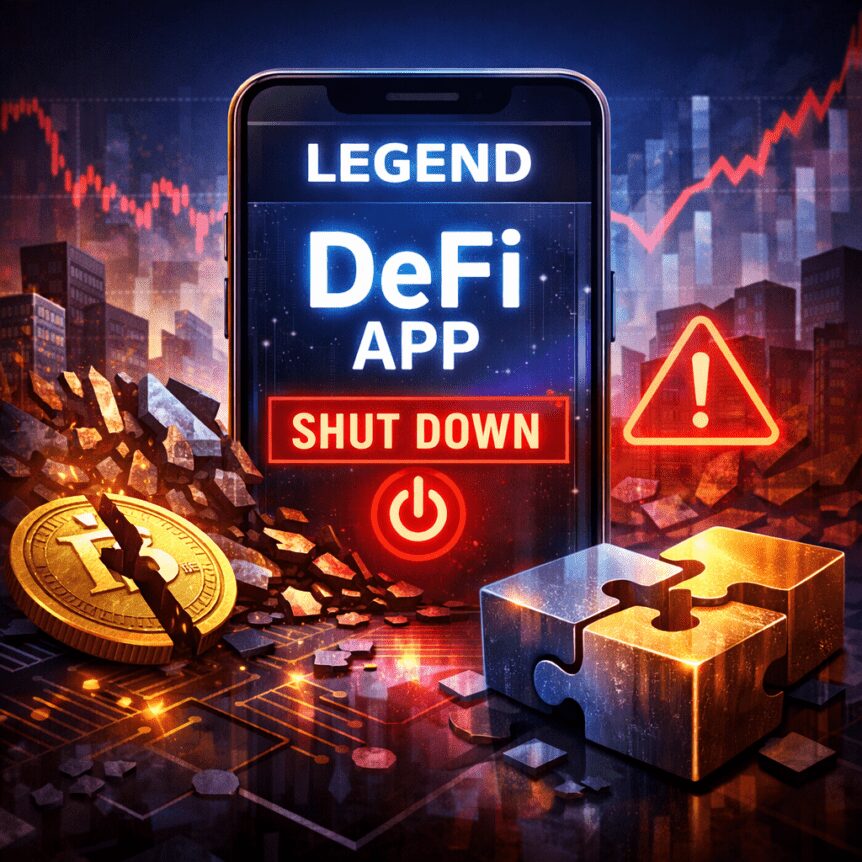
Legend, a mobile-first DeFi aggregator, is winding down after roughly two years of operation, joining a growing wave of crypto apps that have announced closures this year. The project aimed to simplify DeFi by letting users earn, trade, borrow and swap assets via a single non-custodial interface that bridged major protocols like Aave, Compound and Uniswap.
Co-founders, including former Compound Finance executives, argued that the right interface could bring DeFi’s powerful primitives to mainstream users. “We believed the right interface could put DeFi’s most powerful primitives in front of mainstream users,” Legend’s co-founder Jayson Hobby said this week. Yet despite initial traction, the team said the product did not scale to a sustainable level, and closing was the prudent choice for both the team and investors. Legend will keep the app online for about 60 days and go offline on July 12, marking the end of its two-year run.
Legend’s shutdown sits within a broader pattern this year as more DeFi, NFT and GameFi projects announce closures. Cointelegraph’s coverage shows that more than 20 protocols across these spaces have halted operations in 2026, underscoring the difficult market environment for project builders. For example, ZeroLend disclosed in February that it would shut down after three years due to an unsustainable business model. ZeroLend’s decision was part of a wave of exits across the sector.
Beyond these high-profile exits, the industry has seen a string of wind-downs tied to security incidents and financial pressures. Solana DeFi aggregator Step Finance said it was winding down in February after a January breach that drained a $40 million treasury wallet, and DeFi derivatives protocol Polynomial also ceased operations in February. Balancer Labs, the team behind Balancer, shuttered in March after mounting financial pressure following a $116 million hack in November. Seamless Protocol, which offered DeFi lending on Base, announced a wind-down in April, attributing the decision to volatile market conditions.
Legend describes itself as non-custodial and mobile-first, designed to consolidate DeFi activities into one place. The platform enabled users to earn, borrow and trade stablecoins and Ether by integrating with established protocols such as Aave, Compound and Uniswap. It announced its first funding round—$15 million—in February 2025, led by Andreessen Horowitz and Coinbase Ventures, signaling investor appetite for UX-focused DeFi aggregators in the wake of a bear-market lull.
Hobby emphasized a pragmatic takeaway from Legend’s experience: “Users don’t care whether product is onchain or not. They want outcomes—better yield, faster payments, more control over their money.” His broader reflection on crypto UX captured a paradox: “The product that wins isn’t the one that explains crypto better, it’s the one that hides it completely. The benefits are felt, not explained.”
The wind-down also reflects the market’s ongoing tug-of-war between user-friendly interfaces and the capital required to sustain multi-protocol aggregators during a downturn. While the exact user metrics for Legend remain private, the wider DeFi ecosystem has experienced a pronounced contraction in activity. TVL across DeFi has fallen roughly 50% since October, illustrating the scarcity of liquidity and the headwinds facing new product formats built on top of fragmented on-chain services.
Key takeaways
- Legend will shut down on July 12, after about two years in operation, selling a mobile-first, non-custodial DeFi aggregator that integrated with Aave, Compound and Uniswap.
- The project cited unsustainable scale as the reason for closure, choosing to wind down over pursuing a longer, riskier path to profitability.
- Legend’s exit is part of a broader trend in 2026 in which more than 20 DeFi, NFT and GameFi protocols have announced closures, including notable cases in the wake of security incidents and bear-market pressures.
- Industry closures extended beyond Legend: ZeroLend (February), Step Finance (February after January breach), Polynomial (February), Balancer Labs (March), and Seamless Protocol (April) illustrate a cross-section of challenges facing DeFi builders.
- The funding history—$15 million in February 2025 from Andreessen Horowitz and Coinbase Ventures—highlights the tension between ambitious UX-driven DeFi projects and the harsh economics of the current cycle.
Legend’s wind-down in the context of a shifting DeFi landscape
Legend’s mission—delivering DeFi primitives through a single, streamlined interface—was emblematic of a broader push to make decentralized finance accessible without forcing users to manage multiple wallets or interfaces. By aggregating earning, trading, borrowing and swapping across leading protocols, Legend positioned itself as a bridge between sophisticated DeFi mechanisms and mainstream users who want tangible outcomes rather than technical explanations.
However, the numbers tell a challenging story. While the exact user and TVL metrics for Legend remain private, the ecosystem-wide environment has tightened. The DeFi space has endured not only a bear-market backdrop but also several high-profile security incidents and capital constraints that have forced even well-funded projects to re-evaluate their models. The recurring theme is clear: user-friendly design alone is not enough if the underlying economics cannot sustain growth and resilience over the long term.
What this means for users and builders alike
For users, theLegend wind-down underscores the fragility of DeFi products built atop multiple protocols. It also highlights a practical reality: even well-funded UX-centric projects can struggle to achieve scalable, profitable operations in a still-tough market. As the ecosystem absorbs these exits, builders may increasingly prioritize sustainability—whether through leaner product scopes, more defensible revenue models, or closer alignment with real-world use cases that deliver measurable outcomes.
For investors and developers watching the sector, Legend’s termination signals both risk and opportunity. Risk, in that ambitious aggregators face cost pressures in bear markets; opportunity, in that the same UX lessons can inform the next generation of DeFi products—those that balance user-centric design with a clear path to monetization and resilience in volatile conditions.
As the dust settles, observers should monitor whether the wave of closures softens or accelerates, and which models survive the market cycle. The ongoing challenge is clear: create DeFi experiences that feel seamless and reliable enough for mainstream users while maintaining the capital efficiency needed to endure years of unpredictable market dynamics.
Looking ahead, readers should watch for how remaining DeFi players adjust their roadmaps—whether they narrow scope to preserve capital, pursue strategic partnerships to share costs, or explore new monetization strategies that align incentives across users, protocols and developers. The Legend story is a reminder that UX innovation alone isn’t a guarantee of longevity; sustainable scale remains the defining hurdle for DeFi in any market regime.

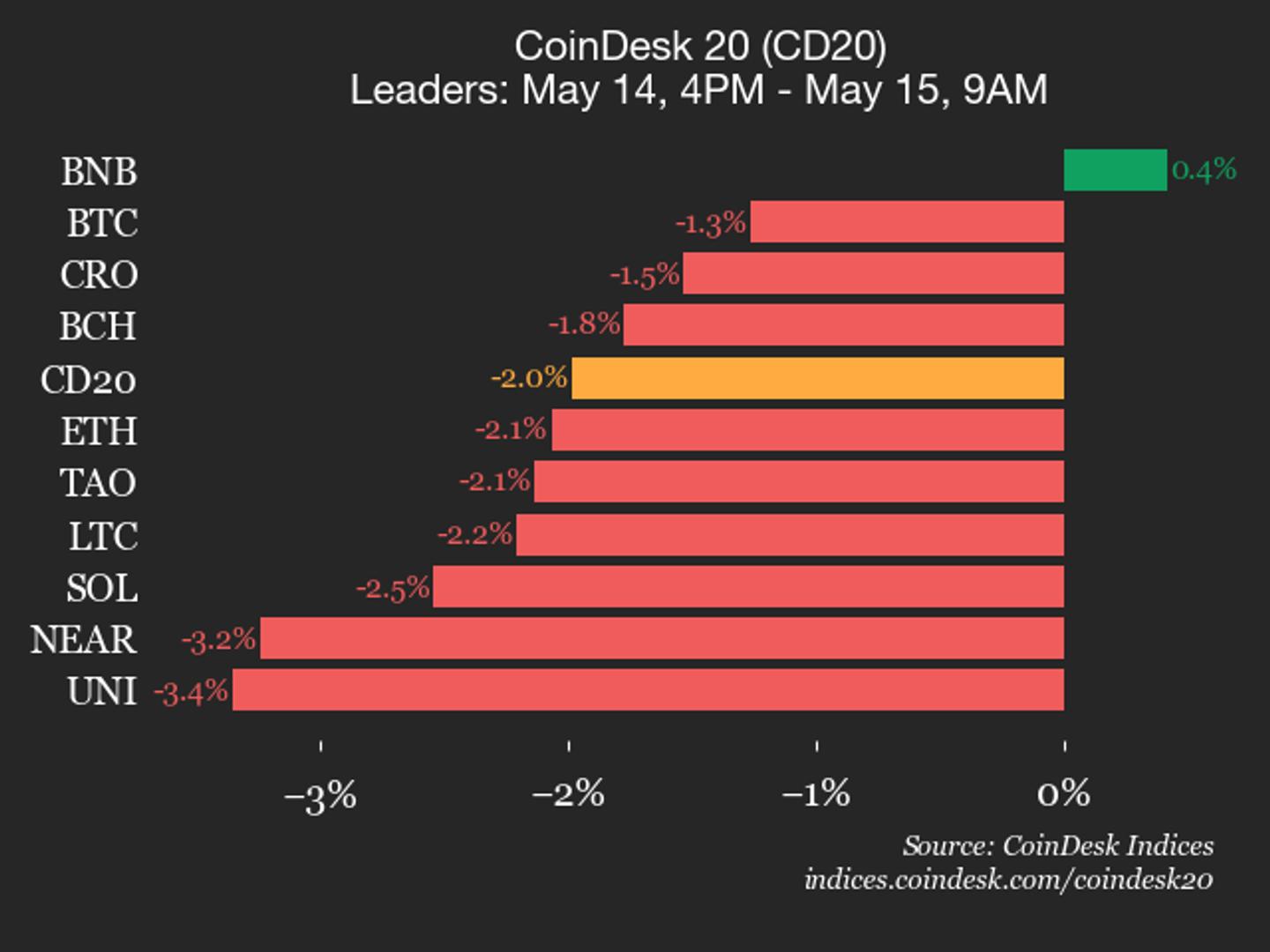
BNB (BNB) rose 0.4% while Bitcoin (BTC) fell 1.3% from Thursday.


Crypto Fear and Greed Index sits at 42 today, up 9 points from yesterday and well off April’s “extreme fear” lows, but still shy of neutral as risk appetite grinds back.
Summary
- The CoinGlass Crypto Fear and Greed Index stands at 42 this morning, up 9 points from yesterday, but still signaling “fear” rather than neutral or greed.
- The 7‑day average for the index is also 42, while the 30‑day average sits at 36, showing sentiment has recovered from “extreme fear” levels seen earlier in April but remains cautious.
- The index aggregates volatility, volume, momentum and derivatives data into a 0–100 score, with lower readings indicating fear and higher ones greed, offering a shorthand for crypto market psychology.
The Crypto Fear and Greed Index compiled by CoinGlass is currently printing 42, a reading the provider classifies as “fear” even after a 9‑point jump from yesterday’s level. That move follows a month‑long climb off early April’s “extreme fear” territory, when the gauge dropped as low as 14 before grinding higher through the 20s and 30s as prices stabilized.
On a slightly longer horizon, the 7‑day rolling average of the index also comes in at 42, while the 30‑day average is 36, underscoring how the market has spent most of the past month in a state of subdued risk appetite rather than outright panic or frothy optimism. CoinGlass describes its indicator as a composite of inputs including price volatility, trading volume, market momentum, and derivatives positioning, mapped onto a 0–100 scale where 0 represents maximum fear and 100 maximum greed.
Functionally, that means today’s reading at 42 is sitting just below the “neutral” band—CoinGlass has previously flagged levels in the mid‑40s as a transition zone after fear and before sustained risk‑on behavior takes hold. Other providers, such as CoinMarketCap’s Fear and Greed Index, use similar 0–100 gauges to track whether sentiment skews toward capitulation or euphoria, arguing that extreme fear can coincide with undervalued conditions while extreme greed often precedes corrections.
In short, a print of 42 with matching 7‑day averages and a 30‑day mean of 36 paints a picture of a crypto market that has pulled itself out of a deep sentiment trough but has not yet flipped into aggressive dip‑buying mode—investors are less terrified than they were a few weeks ago, but they are still far from complacent.
Crypto World
Amazon (AMZN) Stock: Wall Street Analysts Raise Targets on Grocery Delivery and Cloud Expansion

Key Takeaways
- Goldman Sachs reaffirms strong conviction in Amazon, setting a $325 price target after citing robust Q1 performance with unit growth reaching post-pandemic highs.
- AMZN shares declined 1.7% to $262.82 during premarket hours on May 15.
- TD Cowen maintains Buy rating with elevated $350 price target, highlighting Amazon’s expansion into 30-minute grocery delivery service.
- The company introduced Amazon Now with ultra-fast grocery delivery in four major metro areas, with expansion to additional cities underway.
- In 2025, Amazon fulfilled 8 billion orders within same-day or next-day windows, representing a 30% annual increase, with grocery items comprising 50% of volume.
Amazon (AMZN) shares retreated during premarket activity on May 15, declining 1.7% to reach $262.82, despite receiving renewed endorsements from two prominent investment firms on Wall Street.
Goldman Sachs reinforced its bullish position on the e-commerce and cloud computing giant following a thorough analysis of the company’s first-quarter financial results and CEO Andy Jassy’s yearly letter to shareholders. Eric Sheridan, the firm’s analyst covering the stock, maintained a 12-month valuation target of $325.
Sheridan characterized the first quarter as demonstrating substantial strength. The company’s unit growth reached levels not witnessed since the pandemic era, fueled by accelerated demand for everyday necessities outpacing overall category expansion. Advancements in expedited delivery capabilities and rapid commerce initiatives also received favorable assessment.
The investment firm identified three critical focal points for investor monitoring: global consumer spending patterns, advertising services expansion, and developments in the AI landscape. Sheridan emphasized AWS profitability trends and the transformation of AI pipeline opportunities into actual revenue streams as essential metrics.
Company leadership emphasized AI momentum across product discovery, supply chain operations, and advertising platforms during the quarterly earnings discussion, while confirming expectations for an aggressive capital reinvestment phase.
Amazon Now: Ultra-Fast Grocery Delivery Initiative
TD Cowen independently maintained its Buy recommendation and $350 valuation target, concentrating on an alternative growth driver — the company’s newly unveiled 30-minute grocery delivery platform.
Amazon Now debuted on May 12, providing thousands of fresh groceries and household essentials with delivery times of 30 minutes or less. The offering is currently operational in Atlanta, Dallas-Fort Worth, Philadelphia, and Seattle metropolitan areas.
Prime subscribers are charged $3.99 per delivery for purchases exceeding $15. Standard customers pay $13.99. Amazon intends to expand the program to numerous additional markets progressively.
This initiative leverages an already robust logistics network. The company completed 8 billion same-day or next-day deliveries in 2025 — representing a 30% year-over-year surge. Grocery and essential products accounted for half of this delivery volume.
Jassy noted that the expedited delivery strategy propelled Amazon to become America’s second-largest grocery retailer in 2025.
TD Cowen’s Consumer Research Supports Grocery Strategy
TD Cowen’s proprietary consumer research revealed that 36% of consumers purchased groceries online within the preceding 30 days as of Q4 2025 — equaling peak pandemic-era penetration rates.
This finding carries significance because it indicates online grocery shopping behaviors persisted beyond COVID-related restrictions. Consumer adoption has remained stable, and Amazon is strategically positioned to capture increasing market share.
The company’s revenue reached $742.78 billion during the latest reporting period, reflecting 14% growth. The stock has appreciated 17% year-to-date and was approaching its 52-week peak of $278.56 before the premarket pullback.
Amazon recently unveiled Alexa for Shopping, an AI-powered shopping companion embedded within its mobile application, website, and Echo Show hardware, engineered to deliver customized product suggestions based on individual purchase patterns.
Twenty-five Wall Street analysts have recently increased their earnings projections for the company’s next reporting period.



Gemini’s revenue improved 42% year-over-year to $50.3 million, helping narrow its net loss by 27% from $149.3 million a year earlier.


Disclosure: This article does not represent investment advice. The content and materials featured on this page are for educational purposes only.
AI trading bots gain wider retail adoption as investors seek automation in volatile 2026 markets.
Summary
- AI trading bots are helping retail investors manage faster, more volatile markets with automated execution.
- BulkQuant simplifies AI quantitative trading through automated strategies, portfolio tracking, and retail-friendly tools.
- The guide compares top AI trading bots for 2026, focusing on usability, risk control, and automation quality.
AI trading bots are no longer niche tools used only by technical traders. In 2026, they are becoming part of how retail investors manage faster, noisier, and more automated markets.
Crypto trades around the clock. Stocks react quickly to inflation data, earnings reports, ETF flows, liquidity shifts, and interest rate expectations. AI-related sectors can rotate sharply before many retail traders even have time to review the chart.
That creates a clear problem: most individual investors are not slow because they lack interest. They are slow because they are human. They sleep, work, hesitate, panic, chase momentum, and sometimes change strategy at the worst possible moment.
This is where automated trading becomes useful.
The best AI trading bots help retail investors build a more reliable trading process. They can monitor markets, execute strategies, track performance, and support risk management without requiring constant screen time.
But not every trading bot is worth using. A weak bot only adds another layer of confusion. A strong AI trading bot helps investors act with more structure, more visibility, and better control.
Below are five of the best AI trading bots for 2026, selected for retail investors who want practical automation instead of unnecessary complexity.
Why AI trading bots matter for retail investors in 2026
Retail investors used to compete mainly on information. Today, they also compete on execution.
A good market view is not enough if the trade is entered late, managed emotionally, or closed during panic. In fast markets, the difference between a good idea and a poor result is often the process behind the trade.
Manual trading often turns every price move into a decision. Should I enter now? Should I wait? Should I cut the trade? Should I add more? Should I stop the strategy after one bad day?
That constant pressure is where many retail traders lose discipline.
A good AI trading bot does not remove risk, guarantee profit, or replace judgment. What it can do is turn repeated trading decisions into a more organized system.
That is the real value of automated trading in 2026. The goal is not to stare at charts longer. The goal is to build a better process around execution, risk control, portfolio visibility, and strategy discipline.
Quick comparison overview
| Platform | Core Strength | Main Use Case | Most Suitable For |
| BulkQuant | Simplified AI-powered quantitative automation | Guided automated trading | Retail investors who want easier automation |
| Pionex | Built-in exchange bots | Grid and DCA bot trading | Beginners entering crypto automation |
| 3Commas | Advanced customization | Strategy-based bot control | Active and experienced traders |
| Cryptohopper | Strategy marketplace and cloud bots | Testing automated approaches | Intermediate users refining strategies |
| Bitsgap | Multi-exchange visibility | Portfolio and bot management | Investors using several crypto exchanges |
How we selected these AI trading bots
The best AI trading bot is not always the one with the longest feature list.
For retail investors, too many settings can become another source of risk. A platform may look powerful, but if the user does not understand what the bot is doing, automation quickly becomes a black box.
This guide focuses on practical value. A strong platform should make trading easier to manage, not harder to understand. It should help users see what is happening, control risk, monitor performance, and stay consistent when markets become unstable.
The five platforms below were selected because each one solves a different problem for retail investors. BulkQuant focuses on simplified AI quantitative automation. Pionex lowers the first barrier for beginners. 3Commas gives active traders deeper control. Cryptohopper provides room for testing and learning. Bitsgap helps investors manage trading activity across multiple exchanges.
That difference matters because there is no single “best” bot for every investor. The right choice depends on what is missing in the investor’s current trading process.
1. BulkQuant
New users can claim a $10 real reward and a $50 trial credit for free!
BulkQuant is one of the strongest AI trading bots for retail investors who want automated trading without turning the process into a technical project.
Many platforms claim to offer AI automation, but the setup often becomes complicated very quickly. Investors may be asked to configure indicators, connect APIs, adjust trading pairs, set stop rules, select strategy logic, and monitor several dashboards before they understand how the system actually behaves.
That may be fine for experienced traders. For many retail investors, it creates friction before automation even begins.
BulkQuant takes a cleaner approach. It focuses on AI-powered quantitative trading, automated execution, real-time portfolio visibility, and adaptive market participation in a more retail-friendly environment.
Its advantage is not that it gives users endless controls. Its advantage is that it makes AI quantitative automation easier to use consistently.
Why BulkQuant stands out
BulkQuant treats automated trading as a complete investment workflow, not just a trade execution feature.
That difference is important. A basic bot may place orders faster, but speed alone does not solve the real problem for most retail investors. The real problem is inconsistency.
A trader may enter too late after watching a move unfold. They may exit too early after a small pullback. They may increase risk after a loss because they want to recover quickly. They may abandon a strategy after one volatile day.
BulkQuant is built for investors who want to reduce that kind of decision pressure. By combining AI-driven market analysis, automated monitoring, simplified controls, and clearer performance visibility, it helps users stay closer to a structured process.
This makes it especially useful for investors who want exposure to AI trading and quantitative automation but do not want to become full-time strategy builders.
Automation and market adaptability
Markets in 2026 rarely move in a straight line.
One week may reward momentum. Another may punish it. A strategy that works during a clean trend can behave very differently during sideways volatility or sudden liquidity shocks.
BulkQuant is designed to adjust trading activity based on changing market behavior, including volatility, liquidity, and momentum conditions. That makes it more useful than rigid bots that repeat the same actions in every environment.
For retail investors, this matters because most users cannot monitor the market every hour. They need a system that can respond to changing conditions without requiring constant manual intervention.
User experience
BulkQuant is strongest when automation needs to feel clear and manageable.
The platform gives users a direct way to follow automated trading activity, portfolio behavior, and performance without burying them under unnecessary technical settings. That makes it suitable for beginners, passive investors, and mobile-first users.
BulkQuant is not trying to be the most complex trading platform. Its strength is making AI-powered quantitative trading easier to understand and easier to maintain over time.
2. Pionex
Pionex is one of the easiest entry points into automated crypto trading because its bots are built directly into the exchange environment.
That simplicity solves a real beginner’s problem. Many new users are interested in AI trading bots, but the first step feels too technical. They may need an exchange account, a separate bot platform, API permissions, security settings, and strategy configuration before they even place a trade.
Pionex removes much of that friction.
Its built-in grid trading bots and DCA bots give users a straightforward way to explore automated crypto trading without building a system from scratch.
Why Pionex stands out
Pionex works because it makes bot trading feel less intimidating.
For beginners, that matters. A new investor usually does not need a platform with hundreds of advanced settings. They need to understand what the bot is doing, how the strategy behaves, and how to manage it without feeling lost.
Grid bots can be useful when prices move within a range. DCA bots help users build positions gradually instead of entering all at once. These are simple structures, but they give retail investors a more organized alternative to emotional buying and selling.
Pionex is not the most advanced AI trading platform. Its value is that it makes the first step into automation easier.
Where Pionex fits best
Pionex works best for users who want simple crypto automation inside a familiar exchange-style environment.
It is especially useful for beginners who want to experience how bots behave before moving into more flexible or technical platforms.
The limitation is clear: Pionex is not built for deep customization or advanced strategy design. Its strength is accessibility. For a beginner, that can be exactly what is needed.
Too much flexibility too early often leads to poor decisions. Pionex keeps the starting point simple.
3. 3Commas
3Commas is built for traders who want more control.
This is not the platform a beginner should choose just because it looks powerful. Its real value appears when the user already has a trading framework and needs a more precise way to automate entries, exits, position management, and risk rules.
For experienced retail traders, that level of control can be valuable.
3Commas supports multi-exchange trading, advanced bot settings, take-profit rules, stop-loss tools, trailing features, and detailed strategy configuration. It is designed for users who want to shape the automation rather than simply activate it.
Why 3Commas Stands Out
3Commas gives active traders the ability to turn manual trading ideas into repeatable systems.
That is its biggest advantage. A trader who already understands position sizing, trend behavior, stop placement, and profit-taking can use 3Commas to make the execution process more consistent.
The platform is flexible enough to support different trading styles. Users can customize how bots enter positions, manage exits, respond to price movement, and operate across exchanges.
This makes 3Commas powerful, but that power comes with responsibility.
Where 3Commas fits best
3Commas works best when the user already knows what they want to automate.
Without a clear strategy, advanced settings can create false confidence. A trader may think they have built a sophisticated system when they have only automated a weak idea.
That is the key point with 3Commas: automation makes a strong process more efficient, but it can also make a bad process fail faster.
For active traders with real strategy discipline, 3Commas can be one of the most useful platforms on this list. For beginners looking for a simple start, it may be too much too soon.
4. Cryptohopper
Cryptohopper sits between beginner-friendly automation and advanced strategy control.
Its appeal comes from flexibility. The platform supports cloud-based bots, templates, marketplace strategies, and copy-trading features. This makes it useful for users who want to test automated trading approaches without building everything from zero.
Cryptohopper is best understood as a trading laboratory. It gives users a place to explore different ideas, compare strategy behavior, and learn how automation performs under real market conditions.
Why Cryptohopper stands out
Cryptohopper is valuable because it encourages experimentation.
Many retail investors enter bot trading with the wrong mindset. They look for a strategy to copy, hoping that someone else’s settings will solve the problem. That rarely works for long.
Markets change. A strategy that performed well in one environment may struggle in another. A bot that looks strong during a trend may behave poorly during sideways volatility.
Cryptohopper gives users access to templates and marketplace tools, but its real value is not blind copying. Its value is helping traders observe, test, adjust, and learn.
Used correctly, it can help investors develop a sharper understanding of automated trading.
Where Cryptohopper fits best
Cryptohopper is most useful for investors who have moved beyond basic bots but are not ready to build fully customized systems independently.
Its cloud-based structure is also practical for crypto markets because bots can continue running without the user keeping a device active.
The platform is best for users who want flexibility and are willing to think critically about strategy performance. It is less suitable for investors who simply want to copy a strategy and stop paying attention.
Cryptohopper provides tools. The user still needs judgment.
5. Bitsgap
Bitsgap is best understood as a multi-exchange trading and portfolio automation platform.
Many crypto investors eventually spread activity across several exchanges. They may use different platforms for liquidity, fees, regional access, specific assets, or trading tools. Over time, that creates a fragmented trading environment.
At that stage, the problem is not simply placing more trades. The bigger problem is seeing the full picture.
Bitsgap helps bring that activity into one more organized system.
Why Bitsgap stands out
Bitsgap becomes valuable when a trader’s capital and activity are spread across multiple venues.
For multi-exchange users, visibility can be just as important as automation. It is difficult to manage risk well when balances, open trades, bot activity, and performance data are scattered across different accounts.
Bitsgap helps centralize that view.
It gives users a clearer way to track portfolios, manage bots, and monitor trading activity across exchanges. That makes it useful for investors whose crypto activity has become too complex for a single exchange dashboard.
Where Bitsgap fits best
Bitsgap offers grid bots, DCA tools, arbitrage-related features, and portfolio tracking. The platform is strongest when users need both automation and account visibility.
It may not be the most direct choice for someone who only wants one simple beginner bot. Pionex may feel easier in that case. BulkQuant may feel more guided for users who want simplified AI quantitative automation.
Bitsgap becomes more valuable as trading activity expands. For retail investors managing several crypto accounts, it can turn scattered activity into a clearer operating system.
Matching the right bot to the right trading style
Choosing the right AI trading bot is not about finding the platform with the most impressive feature list. It is about identifying the weakest part of the investor’s current trading process.
If the problem is complexity, a guided platform like BulkQuant may be more useful than a tool filled with advanced controls. If the problem is getting started, Pionex lowers the first barrier by placing bots directly inside the exchange environment. If the problem is execution precision, 3Commas gives experienced traders deeper control. If the goal is to test and learn, Cryptohopper provides a flexible environment for strategy experimentation. If the challenge is managing several exchanges, Bitsgap brings visibility and organization.
This is the mature way to evaluate AI trading bots.
A retail investor who overtrades does not need more buttons. They need a process that slows down bad decisions. A trader using several exchanges does not need more noise. They need a clearer view of where capital and risk are sitting. A beginner does not need maximum customization. They need a path into automation that is easy to understand. An experienced trader does not need a simplified app. They need control that matches the strategy they already use.
When the platform fits the user’s behavior, automation becomes useful. When it does not, automation becomes another source of confusion.
What separates a good AI trading bot from a weak one
Many platforms can execute trades automatically. That alone is no longer impressive.
A good AI trading bot improves the trading process. It helps users understand what is happening, monitor performance clearly, control exposure, and stay consistent when market conditions change.
A weak bot does the opposite. It hides too much, encourages blind trust, overcomplicates simple decisions, or pushes users toward strategies they do not understand.
This is especially important in 2026 because the phrase “AI trading bot” is everywhere. Some platforms use AI meaningfully. Others use the phrase because it sounds modern.
Retail investors should look beyond the label.
The better question is not “Which bot can trade automatically?” The better question is “Which bot helps me trade with a stronger system?”
That shift separates serious automated trading from casual speculation.
Frequently asked questions about AI trading bots in 2026
What is the best AI trading bot for retail investors in 2026?
The best AI trading bot depends on the investor’s trading style.
BulkQuant is compelling for users who want simplified AI quantitative automation without heavy technical setup. Pionex is a practical starting point for beginners entering crypto bot trading. 3Commas is better for experienced traders who want advanced control. Cryptohopper is useful for testing and refining automated strategies. Bitsgap is strongest when users need multi-exchange visibility and portfolio organization.
There is no single best platform for every investor. The right choice depends on whether the user needs simplicity, control, experimentation, or better visibility.
Are AI trading bots useful for beginners?
Yes, but beginners should not choose a platform only because it looks advanced.
A beginner-friendly AI trading bot should make the first stage of automation understandable. Users should be able to see what the bot is doing, when it trades, how risk is controlled, and how to stop or adjust the system if needed.
For beginners, the first goal is not to automate everything. The first goal is to understand how automation behaves in real market conditions.
Can AI trading bots help retail investors compete with institutions?
AI trading bots cannot give retail investors the same capital, data access, or infrastructure as large institutions.
But they can reduce some disadvantages. They help retail investors monitor markets more consistently, reduce emotional decisions, execute faster, and build more systematic trading habits.
That does not make retail traders equal to institutions. It does give them better tools than manual trading alone.
Are AI trading bots only for crypto?
No. Many AI trading bots and automated trading platforms support crypto, stocks, forex, ETFs, or multi-asset strategies.
Crypto remains one of the strongest use cases because it trades 24/7 and often moves quickly. For retail investors who cannot monitor markets all day, crypto automation can be especially useful.
Can AI trading bots reduce emotional trading?
Yes, but only when used correctly.
A trading bot can follow predefined rules, reduce panic reactions, and prevent some impulsive decisions. But users can still behave emotionally if they constantly change settings, stop bots after every small drawdown, increase risk after losses, or chase short-term performance.
Automation supports discipline. It does not replace discipline.
Are AI trading bots profitable?
AI trading bots can improve execution and consistency, but profitability depends on strategy quality, market conditions, risk management, platform reliability, and user behavior.
A bot does not make a weak strategy strong. It only makes the strategy run faster and more consistently. That is useful when the strategy is sound, and dangerous when the strategy is poorly designed.
A bot is not a profit machine. It is an execution system.
What should retail investors look for in an AI trading bot?
Retail investors should look for clarity first.
A good AI trading bot should make it easy to understand what the system is doing, how performance is tracked, how risk is managed, and how the user can stop or adjust activity when needed.
Features matter, but control matters more. The best AI trading bot should make the trading process cleaner, not more confusing.
Why are AI trading bots becoming more popular in 2026?
AI trading bots are becoming more popular because markets are faster, more volatile, and harder to manage manually.
Retail investors need tools that support continuous monitoring, faster execution, portfolio visibility, and more consistent decision-making. In that environment, automated trading is becoming less of a luxury and more of a practical advantage.
Final thoughts
AI trading bots are becoming more important because retail trading itself is changing.
The next generation of retail investors will not compete by staring at charts for longer hours. They will compete by building better systems around execution, risk control, portfolio visibility, and decision-making.
That is where automated trading has real value.
BulkQuant is compelling for investors who want AI quantitative automation without turning trading into a technical project. Pionex lowers the first barrier for beginners entering crypto bot trading. 3Commas gives experienced traders the control needed to automate more advanced strategies. Cryptohopper creates space for testing and refining different automated approaches. Bitsgap helps investors bring order to multi-exchange crypto activity.
None of these platforms should be treated as a replacement for judgment. The stronger way to use an AI trading bot is to treat it as infrastructure: a system that helps investors act with more consistency when markets become fast, noisy, and emotionally difficult.
For retail investors in 2026, the real advantage is not trying to predict every market move. It is building a trading process that remains clear, disciplined, and manageable even when markets become volatile.
Disclosure: This content is provided by a third party. Neither crypto.news nor the author of this article endorses any product mentioned on this page. Users should conduct their own research before taking any action related to the company.
Crypto World
Strategy to repurchase $1.5 billion of 2029 convertible bonds using cash or bitcoin sales


Led by Michael Saylor, the company aims to retire half of its outstanding 0% 2029 converts as it restructures liabilities tied to its bitcoin treasury strategy.

The world’s leading crypto exchange has made several platform amendments recently, triggering major volatility in the involved digital assets.
Ripple’s XRP is up 6% on a weekly scale, but its price performance now depends even more on the actions of the large investors. Meanwhile, Cardano’s ADA has posted a minor 2% increase for the past seven days, while numerous analysts remain optimistic that a much more substantial spike could be on the way.
Binance Said Goodbye to These Coins
Earlier this week, the company removed Automata (ATA), Harvest Finance (FARM), Enzyme (MLN), Phoenix (PHB), and Syscoin (SYS). The prices of the lesser-known altcoins crashed by double digits after the announcement, which is a rather normal reaction.
When a heavyweight like Binance terminates services for certain cryptocurrencies, it leads to reduced liquidity, diminished availability, and reputational damage.
The same thing happened in April when the exchange said goodbye to Beefy.Finance (BIFI), FunToken (FUN), FIO Protocol (FIO), Orchid (OXT), Measurable Data Token (MDT), and Wanchain (WAN).
Binance’s other recent updates include the listing of the trading pairs MEGA/U, TON/U, and TON/USD1 to its margin program, as well as the launch of the BTC/USD1 perpetual contract with up to 100x leverage.
XRP Flashes Green
Ripple’s cross-border token briefly spiked to a two-month high of $1.55 on May 14, then fell to the current $1.47. This still represents a solid 6% jump on a weekly scale.
Its sudden move north was likely a reaction to news about the CLARITY Act, which the US Senate Banking Committee passed 15-9 in a bipartisan vote.
Meanwhile, the spot XRP ETFs continue to attract significant capital. This means that institutional investors, such as pension funds and hedge funds, have increased their exposure to the asset, requiring the funds’ issuers to buy real assets from the market to back the shares: a bullish factor that could potentially benefit the price.
The whales’ activity is also worth observing. Large investors holding at least 10 million tokens now control over 45 billion coins, nearly 70% of XRP’s circulating supply. This shows strong conviction among these big players but also makes the price more vulnerable to their actions.
What’s Next for ADA?
Cardano’s native token has risen by a negligible 2% over the last week and is currently worth $0.26. Nonetheless, the community is riddled with members expecting a major bull run in the near future.
X user JAVON MARKS argued that ADA continues to follow a structure similar to its 2021 pattern and is showing “signs of strength.” He set a target of $2.91, suggesting that the valuation could be gearing up for a massive 10x upswing.
Ali Martinez also weighed in. He paid attention to the $0.25 support zone, noting that it has repeatedly acted as a major inflection point for the token. In January 2023, for example, ADA rebounded from that level, resulting in a nearly 90% spike over the following weeks. In September that year, this mark again served as support, triggering a 243% pump.
The post Big Binance Updates, Ripple (XRP) Price Predictions, and More: Bits Recap May 15 appeared first on CryptoPotato.

Solana co-founder Anatoly Yakovenko is pointing to the Alpenglow consensus upgrade news, now live on a community test cluster and targeting mainnet as soon as Q2 2026, as direct evidence that the network’s core architecture is functioning as intended.
The upgrade, the largest consensus overhaul in Solana’s history, replaces Proof of History and TowerBFT with two new components, Votor and Rotor, and is designed to cut transaction finality from roughly 12.8 seconds to around 150 milliseconds.
Its more consequential claim is structural: Alpenglow changes the MEV calculus by making delay-based transaction ordering significantly more expensive for validators.

The upgrade cleared Solana’s validator set in September 2025 with more than 98% support. Whether it clears the harder test, a live mainnet environment with active searchers and real capital at stake, is the open question that matters for the ecosystem.
Discover: The best pre-launch token sales
Alpenglow’s MEV Penalty Mechanics: How the Upgrade Works, and Why Validator Economics Are Shifting
The mechanism here is worth understanding precisely. Under Solana’s current architecture, validators acting as slot leaders can delay block production within timing windows to sell better transaction ordering to searchers, a form of dark MEV that extracts value from users without appearing in any transparent auction. Alpenglow closes that window structurally.
Leaders that miss timeout thresholds not only forfeit immediate rewards but also reduce their probability of being elected leader in subsequent epochs.
Alpenglow is going to have a subtle but important impact to mev. Delaying a slot past the timeout will cause the leader to lose all the subsequent slots. So the cost of delay games is highest in the first slot and lowest in the last.
— toly
 (@toly) May 12, 2026
Yakovenko has described this penalty asymmetry in specific terms, noting that early-slot delays are penalized more severely than late ones, making manipulation of the first transactions in a sequence, where the most valuable MEV opportunities are concentrated, particularly costly.
The effect is not to eliminate MEV but to redirect validator incentives away from opaque timing games and toward transparent order-flow auctions that generate observable validator yield. Alpenglow effectively taxes dark MEV at the protocol level rather than attempting to suppress MEV altogether.
Ethereum took a different route, building an extensive infrastructure stack of relays, builders, and a proposer-builder separation tooling to manage MEV externally. Solana is embedding the incentive structure into the base consensus layer. Those are not the same approach, and the tradeoffs are not yet fully priced by the market.
Yakovenko’s Claims and What the Protocol Architecture Actually Supports
Yakovenko has framed Alpenglow as proof that Solana’s speed-first design philosophy is compatible with sophisticated MEV management, that the network does not need Ethereum-style middleware because it can encode the right incentives at the consensus layer. He has argued, in conference appearances, that Alpenglow pushes Solana toward what he describes as speed-of-light confirmation constraints, where the remaining latency after propagation overhead is minimized is dominated purely by geographic distance across validator nodes.
The 150-millisecond finality target, if realized at mainnet scale, would represent a qualitative shift for Solana’s position in high-frequency DeFi and payments infrastructure.
The Rotor component’s block propagation improvements and Votor’s streamlined finalization are the architectural levers. The claim that the design is working rests on those two components performing under mainnet load, a condition the community test cluster has not yet replicated.
The language is disciplined. The timing, with Alpenglow moving from test cluster toward mainnet while Solana’s DeFi ecosystem is expanding, is not coincidental. The provisional conclusion: Yakovenko’s architectural argument is coherent, but the evidence base is still test-net data.
What Mainnet Activation News Actually Signals for Solana Ecosystem
If Alpenglow reaches mainnet in Q2 2026 without disrupting network reliability, the validator yield narrative acquires hard on-chain data to support it, and Solana’s pitch as high-speed Layer 1 infrastructure for DeFi sharpens considerably.
Anza and ecosystem partners have signaled follow-on work to tune penalty parameters and adjust staking and inflation targets once real-world MEV and latency data are collected under the new regime.
If adoption stalls or delay-based MEV strategies migrate to alternative venues that Alpenglow’s penalty mechanics do not reach, the upgrade becomes a consensus improvement with limited impact on the MEV environment it was designed to reshape.
Researchers at KuCoin and Oak Research have both flagged that shifting MEV incentives on a live, high-throughput network is an uncharted experiment, and that searchers adapt faster than protocol timelines.
The design may be working. The proof requires the mainnet.
Discover: The best crypto to diversify your portfolio with
The post Solana news: Anatoly Yakovenko Says Alpenglow Launch Proves Solana’s Design Is Working appeared first on Cryptonews.
The world of cryptocurrencies is evolving, but one thing remains a constant – privacy. It still is a paramount concern for many users. While Bitcoin and Ethereum offer a degree of transparency through public ledgers, it can sometimes also compromise anonymity. This is where protocols like Monero (XMR) step in.
However, acquiring or swapping Monero has become very challenging. This is because of regulatory pressure. Many traditional centralized cryptocurrency exchanges have already delisted privacy coins such as XMR. This has left users searching for a secure private platform to manage their assets.
StealthEX emerges as a solution for those who wonder how to exchange their digital assets for XMR. It offers a simple, secure, and entirely private gateway for swapping cryptocurrencies without compromising the very anonymity that makes the protocol valuable.

How Does Monero’s Privacy Mechanism Work?
For those who might be new to Monero, it is very helpful to understand the way it achieves complete financial privacy. Unlike Bitcoin, where wallet addresses and transaction amounts are visible to anyone who explores the blockchain, Monero obscures transaction details.
To do so, it uses a combination of Ring Signatures, Stealth Addresses, and RingCT. This makes it fungible, meaning every coin is identical and cannot be tainted by previous transactions.
What is StealthEX?
StealthEX, on the other hand, is an instant cryptocurrency exchange that allows its users to buy or swap one digital asset for another quickly and without having to worry about handing custody of funds. Unlike traditional centralized venues, which often require registration and KYC, StealthEX is designed to reduce friction in the swapping process.
Undoubtedly, central to its operation is the non-custodial model. This means that StealthEX does not store your assets in an exchange wallet, while you wait to trade. Instead, the service facilitates the exchange process, while the swapped coins are sent directly to the user’s wallet address.
Another important aspect of StealthEX is that it is oriented toward privacy. The platform doesn’t require registration for the more standard swaps, and users don’t have to create an account or go through a KYC.
Moreover, StealthEX aggregates liquidity from a range of different centralized and decentralized sources. It pulls rates from different providers, which allows it to offer competitive exchange options while also keeping the process fast and efficient. It supports more than 2,000 cryptocurrencies, and Monero (XMR) is one of them.
How to Swap Monero (XMR) on StealthEX
The following is a step-by-step tutorial on swapping XMR on StealthEX.
Step 1: Select your trading pair
All you have to do is navigate to the homepage and select Monero from the left drop-down menu.

Step 2: Enter the exchange amount
Here, you will need to type in the amount of BTC you would want to swap. The platform will immediately calculate the estimated amount of XMR that you will receive based on the currently available market rates.
Step 3: Provide your Monero address
Once you click on “start exchange,” you will have to enter the recipient address. This is basically the personal Monero wallet address where you want to receive your newly swapped XMR. Make sure to double-check that address.

Step 4: Review details and deposit
Once you make sure that everything is reviewed and you agree with the outcome, you will have to send the exact amount of BTC (or any other chosen deposit crypto) to the provided address. You can also use the QR code.

Step 5: Receive your XMR
That is pretty much everything you need to do. Once your deposit is confirmed, StealthEX will process the swap automatically in the background. The transaction will be completed in a matter of minutes, and you will receive your XMR to the designated address.
Conclusion
Using StealthEX to swap Monero does come with some benefits, such as enhanced privacy, security, and convenience. It’s also very versatile because it supports thousands of cryptocurrencies.
This is important, because Monero remains one of the most recognized privacy coins in the industry, but finding a convenient way to swap XMR might be quite the challenge.
Disclaimer: The above article is sponsored content; it’s written by a third party. CryptoPotato doesn’t endorse or assume responsibility for the content, advertising, products, quality, accuracy, or other materials on this page. Nothing in it should be construed as financial advice. Readers are strongly advised to verify the information independently and carefully before engaging with any company or project mentioned and to do their own research. Investing in cryptocurrencies carries a risk of capital loss, and readers are also advised to consult a professional before making any decisions that may or may not be based on the above-sponsored content.
Readers are also advised to read CryptoPotato’s full disclaimer.
The post How to Swap Monero (XMR) on StealthEX appeared first on CryptoPotato.

Key Takeaways
- Nvidia’s quarterly earnings announcement arrives Wednesday following market close, with analysts scrutinizing AI sector momentum indicators.
- Shares reached an unprecedented closing price of $235.75 Thursday, climbing 4.4% following a consecutive seven-session rally delivering 20% gains.
- The chipmaker’s valuation now stands at $5.7 trillion — surpassing every corporation’s historical market capitalization.
- UBS’s Timothy Arcuri elevated his target price to $275 while reaffirming his Buy recommendation.
- Despite surpassing projections in recent quarters, the stock experienced post-earnings selloffs after the previous three reports.
Nvidia (NVDA) approaches Wednesday’s quarterly financial disclosure riding an impressive seven-session upward trend, though past patterns suggest the momentum might reverse once numbers are released.
Shares reached an all-time closing mark of $235.75 Thursday, gaining 4.4% during the session and accumulating 20% growth across the previous week. However, Friday’s premarket trading showed signs of retreat — sliding 2.5% to $229.80.
Multiple catalysts have propelled the recent advance: widespread optimism surrounding AI spending, speculation about potential agreements enabling Chinese chip sales resumption, and revelations that President Trump’s investment trust acquired minimum $1 million exposure to Nvidia-related instruments during Q1.
Yet Wednesday’s financial release remains the primary catalyst.
Timothy Arcuri from UBS elevated his valuation target from $245 to $275 before the announcement while maintaining his Buy stance. His projection applies a 19x multiple to his 2027 earnings forecast for Nvidia. Arcuri’s analysis highlighted what he characterizes as unexpected indifference among major long-term institutional investors — potentially creating favorable conditions for upward price movement if results prove strong.
The complication? Despite exceeding consensus estimates across three consecutive quarters, shareholders liquidated positions following each announcement.
The Broader Market Implications Beyond NVDA
Nvidia’s quarterly performance influences far more than its individual equity. Commanding a $5.7 trillion market capitalization — an unprecedented valuation exceeding any corporation’s historical peak by nearly $1 trillion — Nvidia exerts exceptional influence across capitalization-weighted indices.
The company represents 8.6% of the SPY ETF’s composition. Apple, occupying the second-largest position, accounts for 6.9%.
Recent market behavior illustrated this dominance. Approximately 75% of the S&P 500’s 2.3% weekly advance originated from just five companies: Nvidia, Micron, Apple, AMD, and Intel. While Micron, AMD, and Intel each surged beyond 25%, Nvidia’s relatively modest 8% appreciation still contributed most significantly to index performance — despite more than half of S&P 500 constituents declining.
This extraordinary market influence makes Wednesday’s conference call essential viewing for virtually every equity investor.
The Technology Spending Environment
Major cloud providers have established favorable conditions. Alphabet, Microsoft, Amazon, Meta, and Oracle each elevated their AI capital expenditure projections during recent earnings cycles. Collectively, these technology leaders now anticipate deploying over $700 billion toward AI infrastructure throughout the current year — representing at least 60% growth versus 2025.
Nvidia occupies the epicenter of this investment surge. This year alone has witnessed partnership announcements or expansions with OpenAI, Marvell, Corning, CoreWeave, Nebius, and IREN. Most arrangements included either direct Nvidia investment or acquisition of equity rights.
Corning, traditionally a specialty glass manufacturer, has emerged among the S&P 500’s top performers this year due to fiber-optic cable demand from AI datacenter construction — demonstrating the extensive reach of Nvidia’s ecosystem influence.
In his UBS preview commentary, Arcuri acknowledged that “investor interest here is always obviously high,” while observing an atypical sense of subdued anticipation preceding this specific report — which he interprets as potentially establishing conditions for robust market response.
Nvidia’s quarterly results are scheduled for release following Wednesday’s closing bell, May 21.

Starbucks to cut 300 US jobs, close some regional support offices

CoinDesk 20 performance update: BNB is only gainer as index drops 2%

Edidiong Umoafia Wins One Gold and Two Silver Medals for Nigeria at African Championship

Manchester United reach agreement with Casemiro over contract clause amid transfer speculation

US brings back mandatory military draft registration

Steven Gerrard disagrees with Gary Neville over ‘shock’ Chelsea and Arsenal claim | Football


-

 Fashion7 days ago
Weekend Open Thread: Marianne Dress
-

 Fashion4 days ago
Coffee Break: Travel Steam Iron
-

 Fashion4 days ago
What to Know Before Buying a Curling Wand or Curling Iron
-

 Politics4 days ago
What to expect when you’re expecting a budget
-

 Tech5 days ago
Auto Enthusiast Carves Functional Two-Stroke Engine from Solid Metal
-

 Politics6 days ago
Politics Home Article | Starmer Enters The Danger Zone
-
 Business6 days ago
Ignore market noise, India’s long-term story intact, say D-Street bulls Ramesh Damani and Sunil Singhania
-

 Tech4 days ago
GM Agrees To Pay $12.75 Million To Settle California Lawsuit Over Misuse Of Customers’ Driving Data
-

 Crypto World5 days ago
CZ says US crypto rivals tried to block Trump pardon
-

 Crypto World6 days ago
PROS explodes 48% as Upbit and Bithumb listings ignite demand
-

 Tech4 days ago
GM agrees to $12.75M California settlement over sale of drivers’ data
-

 Entertainment7 days ago
YNW Melly Denied Bond Again Ahead Of Double Murder Retrial
-

 Crypto World7 days ago
Kraken Parent Seeks OCC Charter, Signaling Regulated Banking Access
-
Crypto World7 days ago
The Hantavirus Danger: Can a Potential Outbreak Spark a New Meme Coin Frenzy?
-

 Sports7 days ago
After Waka Waka, Shakira now drops first teaser for FIFA WC 2026 song | FIFA World Cup 2022
-
Crypto World2 days ago
Bitcoin Suisse expands with Digital Asset License and Investment Business Act Registration Approval in Bermuda
-

 Sports7 days ago
Why Nathan Mackinnon Remains the Hart Trophy Favourite over Connor McDavid and Nikita Kucherov | NHL
-
 Crypto World7 days ago
Solana UFO Meme Coins Surge After Pentagon Reveals Alien Files
-

 Entertainment7 days ago
Bethenny Frankel Says She Loves ‘Torturing’ Men
-

 Politics3 days ago
Pakistan to enter Chinese capital market as war inflation bites
You must be logged in to post a comment Login