

Politics
Labour’s water reforms ‘a gift to shareholders’ and ‘an insult to every community impacted by sewage’

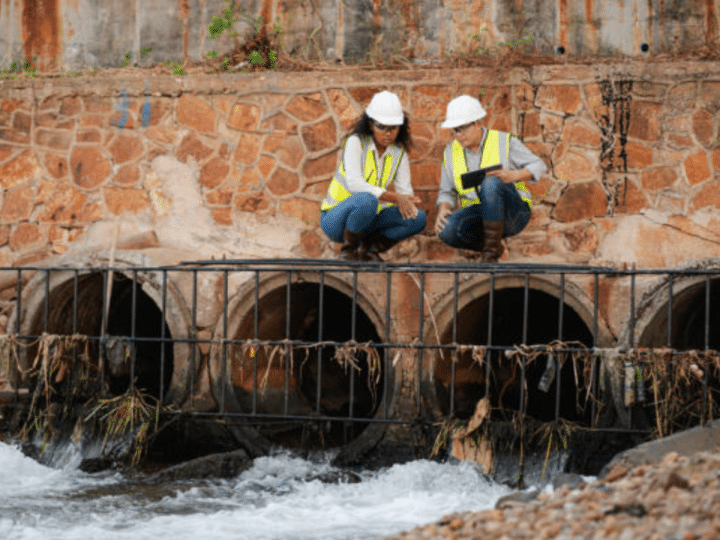

The Labour Government’s proposed reforms to the water industry – via its Clean Water Bill, announced in the King’s Speech – have been met with widespread criticism from environmentalists and campaigners.
In his speech to parliament, written by Keir Starmer’s government, King Charles said:
My Government will improve critical infrastructure with legislation to clean-up the water industry.
Alongside the speech, the government published much more detailed briefing notes explaining its plans for each area of planned legislation.
Uncertain plans
Challenges to Keir Starmer’s leadership, following Labour’s reckoning at the local elections earlier in May, mean that there is huge uncertainty over whether those plans will come to pass.
Regarding the Clean Water Bill, the notes said:
This once-in-a-generation Bill will shift the sector away from a system where water companies mark their own homework by putting in place stronger, active supervision and oversight through a powerful new regulator capable of integrated management of the water system.
They went on to say:
The Bill will strengthen confidence in the water sector – restoring the public’s trust, giving investors the stability to back long-term upgrades, and providing the clarity needed to support economic growth. It will ensure the sector plays its full part in delivering clean water and a healthy environment.
The briefing also said that the Bill would:
put consumers firmly first with a new Water Ombudsman to ensure complaints are taken seriously and resolved quickly.
And it would:
create a new, independent and integrated water regulator by bringing together the relevant functions of Ofwat, the Drinking Water Inspectorate, the Environment Agency and Natural England.
Somewhat surprisingly, the government’s own notes acknowledge the failings of the water sector, which it linked to privatisation.
The notes said:
The water industry in England and Wales was privatised in 1989, water supply and sewerage are delivered by 16 private companies. However, unlike most markets, water companies are regional monopolies with limited competition.
England and Wales are unusual in having a fully privatised water system, whereby companies own the assets, infrastructure, and operation of water services.
The water system, regulation and the regulators have failed customers and the environment. In the 37 years since privatisation the population has grown by 11M, climate change and aging infrastructure has created unprecedented demands on the water system and reform is now needed.
This has been compounded by a failure of regulation, with a system that relied too heavily on water companies marking their own homework.
It added that:
water companies are not delivering what is expected of them, both by regulators and the public.
And said:
transformative change is therefore needed to secure a system that will work for the long-term. This Bill delivers that change.
The Bill was heavily criticised by democratic ownership campaigners, environmental non-governmental organisations and anti-sewage pollution activists.
British Steel nationalisation shows water sector could be renationalised too – campaigner
We Own It lead campaigner Sophie Conquest told the Canary:
This government’s proposed reforms for the water industry are a gift to shareholders.
The water white paper sets out plans for a ‘tailored approach’ for each water company, giving them even more scope to bend and break the rules for profit. Measures like ‘constrained discretion’ will give polluters more room to dodge fines.
Regulation of the water sector has been a decisive failure. Despite this government promising to be tough on polluters, the EA hasn’t completed a single prosecution for sewage dumping committed in the past 5 years.
The Labour Government has been in power since 2024, before which the Conservatives were in government from 2010.
While our pockets empty and our rivers fill with sewage, this government is busy handing over even more power to the polluters. The public have had enough.
This government’s decision to bring legislation to nationalise British Steel shows that they absolutely can nationalise key infrastructure. And they can do it quickly.
They must now do the same for water. Under public ownership, we can ensure that households’ money is being used to fix infrastructure and lower bills.
Thames Water is already in breach of its licence, and has buried itself in a mountain of debt. It has wrought havoc on our seas and rivers, all while charging households eyewatering bills for the privilege. It’s outrageous that the utility has not yet returned to public hands.
This government should be acting in the interests of the 82% of us who want to see water in public hands, starting with the collapsing Thames Water.
Privatisation has ‘failed’ – campaigner
Windrush Against Sewage Pollution (WASP) founder Ash Smith told the Canary that the Clean Water Bill is based on a review whose independence he questioned, and said the Bill did nothing to address the evidence that privatisation of the water sector had “failed”.
Smith was portrayed by David Thewlis in Channel 4’s docudrama, Dirty Business.
The Canary previously reported that the public responded to Dirty Business – which exposed the damage done by the sewage scandal – with “widespread praise”, whereas discussions on social media about water companies, the regulator and public bodies was “overwhelmingly negative”, according to the government’s own analysis.
Smith said:
The water regulation changes proposed are based on the instantly accepted report from the Cunliffe Commission, which far from being the independent review it claimed to be, was designed, directed, administered, and reported on by Defra – the government department responsible for water industry regulation and its failure. Cleverly, in classic ‘Yes, Minister’ style, it investigated itself.
Its terms of reference directed Sir Jon Cunliffe to make regulation more attractive to shareholders and to dismiss taking water into public ownership, despite the compelling evidence that privatisation has failed.
We regard it as a massive retrograde step that, rather than addressing regulatory capture and corruption, makes compromise more likely with a single body. This vital aspect was ignored by the review, which was being steered by Defra into a forward-looking approach, thereby burying many serious issues that have arisen over the years, some of which were exposed in Dirty Business.
Smith added that the Bill proposes to make regulation of the sector “supervisory” which would mean that responsibility for “criminal pollution” by water companies will be for the regulators to resolve.
He added:
It is time people woke up before it is too late. Ironically and cynically, even contemptuously, one might say, the environmental champion, King Charles, has been made to usher it in, no doubt reassured by the major NGO’s usual weak challenges.
Bill is ‘an insult to every community impacted by sewage pollution’ – anti-sewage campaigner
Surfers Against Sewage CEO Giles Bristow said:
The government’s self-proclaimed ‘once-in-a-generation’ reforms will do little more than prop up a broken industry built on pollution for profit. The Clean Water Bill is an insult to every community impacted by sewage pollution and and every bill-payer forced to fund rising water bills while shareholders continue to profit.
The reality of this Bill is that the Government is choosing to keep the profit motive and ignoring alternative ownership models for the water industry. Regulation alone cannot fix a system that rewards pollution and failure. Only a fundamental reset of the water industry will.
It’s clear from last week’s election results and the Prime Minister now fighting for his job that the same old tweaks around the edges of this broken system just don’t cut it.
This weekend, people across the country will take to beaches, rivers and lakes to demand better. The public mandate for bold action is undeniable.
Concerns about independence of water commission, which ‘avoided’ underlying problems
River Action CEO James Wallace told the Canary:
River Action welcomed the new Government’s decision to review the failing water industry and the performance of environmental regulators. However, we are deeply concerned that the Independent Water Commission has failed to be truly independent and has avoided addressing the underlying structural problems around water company ownership, governance and investment.
While we remain hopeful that the forthcoming Water Reform Bill will deliver a far more ambitious and effective regulatory regime, the Government continues to ignore the fundamental damage caused by a wholly privatised water industry.
Until water companies are owned and operated for public benefit and environmental protection, rather than shareholder profit, no amount of regulatory tinkering will stop polluters from continuing to pollute for profit.
We are also concerned by the continued lack of meaningful action on agricultural pollution, which is one of the biggest sources of river pollution. Any serious attempt to restore our rivers must tackle not only sewage discharges, but also help farmers tackle the unchecked runoff of slurry, fertilisers and other agricultural waste into our waterways.
The chaos at the top of the Labour party makes it less likely that the government will be able to successfully pass all the bills it proposed in its King’s Speech, but public anger over the state of the country’s water companies is unlikely to subside any time soon.
Featured image via the Canary
By Tom Pashby


Knuckle-dragging ‘loyalist’ Israel supporters have gathered in Scarva, County Down, to disgrace themselves by flinging sectarian abuse at the Great March for Gaza. The humanitarian march, organised by the Irish Palestine Solidarity Campaign, set off from Lurgan, ten miles away, this morning. After Scarva, marchers walked a further almost twenty miles to Omeath in solidarity with the Palestinian people against Israel’s genocide and occupation:
The thugs were caught on camera by the defiant marchers as they passed:
View this post on Instagram
Great march for Gaza vs “provocative behaviour”
The march is raising funds for Palestine Aid Ireland and Children Not Numbers. Residents of Scarva had lodged objections trying to prevent the march passing by the village. The Parades Commission had given permission for villages to mount a counter-demonstration, but only on condition that they avoid “provocative behaviour” toward the marchers.
Right. Donate to the march’s charities here.
Featured image via Win McNamee/Getty Images
By Skwawkbox
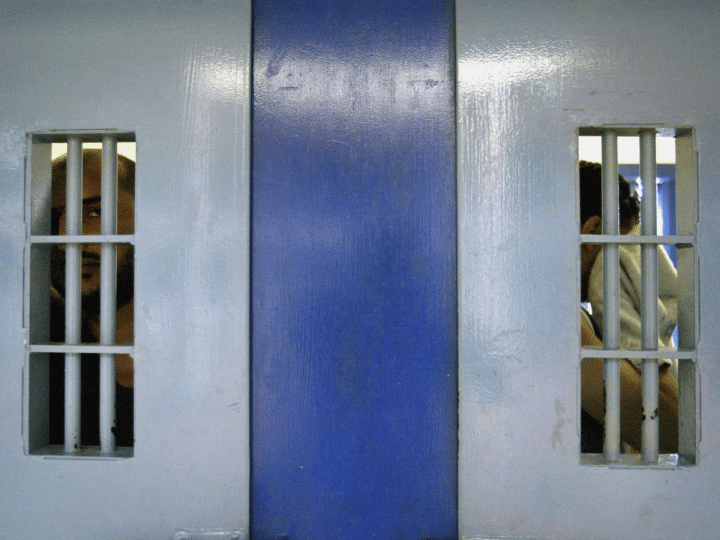
Even eyesight is not taken for granted in the prisons of Israel.
I am a human rights lawyer. I have had a client for four years now, and we have become good friends. I try to visit him as often as possible, sometimes without payment, sometimes for a tiny payment from his family. I have filed many petitions on his behalf without charging for them. I love him and he loves me.
This client has been in prison since the days of the Second Intifada. Back then, he was a 22-year-old young man who helped his friends buy a pistol – a pistol that later, without his knowledge, was used in an act of killing that the ridiculous military court defined as murder on “ideological grounds,” meaning “terrorism.”
Israel has notorious prisons
The Israel colonial military courts are not exactly among the finest courts, and this friend of mine received no less than 30 years of actual imprisonment for his reckless act, meaning “aiding murder.” It is all nonsense from a colonial legal system in which the natives of this land are always guilty and are imprisoned for long years.
I took his case in 2022 and tried to work for his early release from prison. On the face of it, he was the perfect prisoner for early release after serving two-thirds of his sentence: he had no significant disciplinary offenses for about 15 years. He was a gentle prisoner who had never ‘made trouble’ in prison, and even Shin Bet, in could not find one good reason to prevent his early release – so they used a generic objection to the release of “all security prisoners,” since all Palestinians supposedly pose a danger to the state.
Obviously, this is complete nonsense. Beyond what was required, I provided the parole board with an individual rehabilitation plan, which stated that even after my friend’s release, he would participate every week in designated groups for a year and would be under supervision.
Remember! This is conditional release, so if any new information were discovered in his case, the state could return him to their torture camps in a second. Of course, nothing helped, and both the parole board and the court refused to release him, thereby proving that, in practice, the Early Release from Imprisonment Law is a dead letter when it comes to security prisoners. This specific prisoner abandoned, decades ago, any desire whatsoever for violent resistance activity, and any conversation with him would immediately reveal that to anyone who cared to know.
Intensification of Israeli torture
Since October 7 2023, the severe torture by the Israel Prison Service (IPS) has intensified in the security prisons. On that very day, IPS guards entered, beat all the prisoners, and confiscated all their personal belongings. Since then, they have not been allowed to meet or communicate with their families, not even with the Red Cross. Such a move is in violation of the Geneva Convention, to which Israel is a signatory. They are subjected to extremely severe torture, and food and medical treatment are denied to them. Until the petition I filed in 2025, this friend of mine had been wearing the same pair of underwear for two years – the same pair of underwear he was wearing on October 7 2023.
This friend of mine has vision problems. He has only one eye, and the sight in the other has also deteriorated over 24 years of imprisonment. And remember: the only item the prisoners possess is a single copy of the Qur’an, and reading its verses is the only comfort these tormented souls have. During a visit I held with him in November, my friend asked me to get him reading glasses. This is, of course, not my job; it is the job of the prison authorities to provide basic medical care to the people they imprison.
I contacted the prisoners’ officer and asked to bring in reading glasses for him. The prisoners’ officer informed me that only an optometrist who comes to the prison could give such approval. And when will an optometrist arrive, I asked? He will arrive when he arrives, she answered. Several more months passed, and an optometrist came to the prison, examined my friend, and found that he did indeed need new glasses.
Excellent! Now can we bring in glasses for him? I asked the prisoners’ officer, but she replied that “there is a problem with that.” And so more months passed, letters were sent, threats of petitions were made, but nothing helped. Finally, in April, I filed a petition on the matter, demanding that he be allowed to receive glasses. The state delayed for another month and a half, and a few days before it was required to submit its response, the Southern District Attorney’s Office announced that approval had been given to bring in glasses.
Punishment for telling the truth
Obviously, a state of affairs like this — which forced a lawyer to approach the authorities many times and eventually even file a petition with the court — requires an award of costs in favour of the diligent lawyer who worked night and day to oppose the state’s plainly illegal actions. So what do you think, did I receive costs?
Not only did I not receive costs, but the honorable judge decided that I was the one who had to pay costs “in favor of the state treasury” of Israel because I had “slandered” the IPS guards by telling the truth: that Palestinian prisoners are beaten and tortured every time they are brought to court, which is why I asked that he not be brought to court.
Featured image via Getty/Uriel Sinai
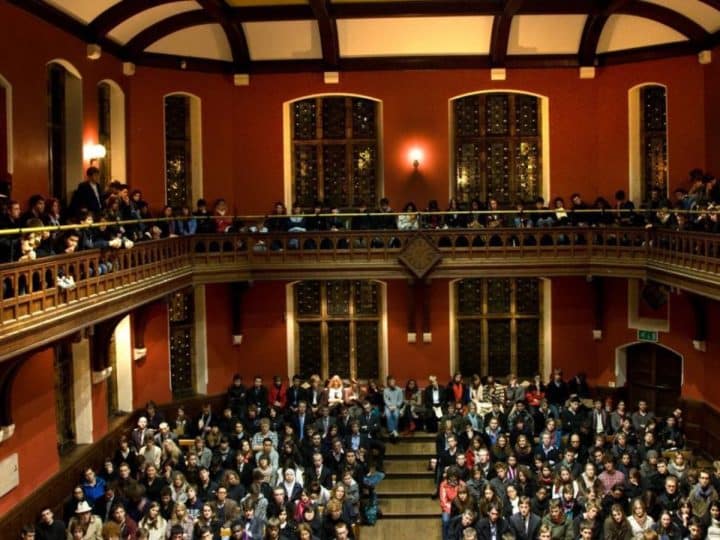
The Oxford Union (OU) has announced that its planned debate will proceed tonight, 6 June 2026, at 6pm. The two invited speakers banned by Keir Starmer for speaking against Israel’s genocide will participate virtually:
The event will be held in our Chamber on the 6th of June, at 6 pm BST.
Both speakers will be attending virtually. pic.twitter.com/cCPTq9TXlm
— Oxford Union (@OxfordUnion) June 5, 2026
Oxford Union censorship concerns
The OU has not yet published a link for the debate, but usually streams debates on its YouTube channel. However, it is currently being sued by Palestinian-American writer Susan Abulhawa for deleting key parts of her 2024 debate.
Featured image via OU
By Skwawkbox
Business
Lucy Powell, Labour Communist Minister, thinks that Britains Democracy is being destabilized. What Democracy you destroyed it by not supporting it

Lucy Powell said: ‘The spread of mis- and disinformation is a real and present danger to our democracy.’ Photograph: Joel Goodman/The Guardian© Photograph: Joel Goodman/The Guardian
This Labour Communist doesn’t support democracy in Britain by the very fact that she is a Communist left-wing MP, because that is what the Labour party is and has always been, Communist socialists; they destroy any belief in a democratic society, as is the case with the Labour party that currently holds power in Britain.
If you look back over the past fifty years, you will see that the communist labour party always uses the word “Democracy” democracy ” when what it really means is we don’t like what you’re saying or doing, and we intend to stop you by any means possible, lawful or as we decide is lawful in your best interests.
So everyone who doesn’t support our Left-wing Communist socialist ideology and aims is ultra right wing, even the 95-year-old granny down the road is a threat and must be neutralized
There is no DEMOCRACY in the United Kingdom now, any belief in democracy is only held by the likes of liberals and the mentally retarded, as obviously, this MP like all Labour and liberal MPs are.
Parliament should be knocked down or turned into a home for migrants, as Democracy in that house is long dead, never to rise again, as the politicians believe in housing and supplying all migrants’ needs before the people of Britain.
This has one political end: the diversification and destruction of everything white British, including its religion and cultural assets, as witnessed by the vandalism of The National Trust, a woke organization that is doing its best to destroy British heritage while calling itself a charity. Stop supporting it.
The blob is an organization run by left-wing supporting traitors who would give up all freedoms in Britain to rejoin the EU dictatorship.
The laws are made for people to follow in a society that respects the freedom of its citizens, that’s gone in the Britain of today buy the very fact that the politicians ignored the people’s vote to leave the EU, Britains vote was to leave the EU but that hasn’t happened most of the laws of the EU are still in place and being used in Britain, Every politician knows you can do nothing to stop the boats and the invasion of Britain by Islamists and criminals all calling themselves asylum seekers which they are not they are economic migrants with no other interest in britain except earning money any way they can and they certainly dont respect our laws or its people.
Case in Point were a member of a religious sect is allowed to say i carry a knife as part of my religion and the corrupt law allows it on Britain’s streets, but if you were a white British person, you would be arrested for carrying an illegal weapon. But hey, that’s okay, they are only white British.
The police are no longer your friends and neighbours, they are the new communist Stasi The Stasi (Ministerium für Staatssicherheit) was the official state security and secret police service of East Germany (GDR) from 1950 to 1990. Known as one of the most repressive surveillance agencies in history, it employed tens of thousands of staff and a vast network of civilian informants to crush dissent and monitor the population, as is happening in Britain today under the Communist Regime of Labour. Do not support this organisation, turn your back on them and offer no help.
Now the Donkey of the North Andy Burnham sees his opportunity to run the country into the ground with his version of Communist ideology, and that will finish Britain for good, but hey all you who vote Labour and have voted for communism all your lives, don’t complain when there is no money for your pensions, or your benefits as all the money has been spent and business no longer wants to be in britain think not just look at all the businesses going bankrupt and closing because of the communist government you elected or were stupid enough not to vote to keep them out same will happen in the Makerfield by election those who vote for Communism will get communism.
But don’t forget the media you support with your money or viewing, they don’t support you, the people they support communism and the EU values, and their own political ends, most of them and the reporters who work for them, especially the BBC, now wouldant know a truthful story if it jumped up in front of them, thats why you see the headlines right wing, they dont care if your 2 years old your still right wing it makes a better story, no truth but who cares about truth they and there reporters dont.
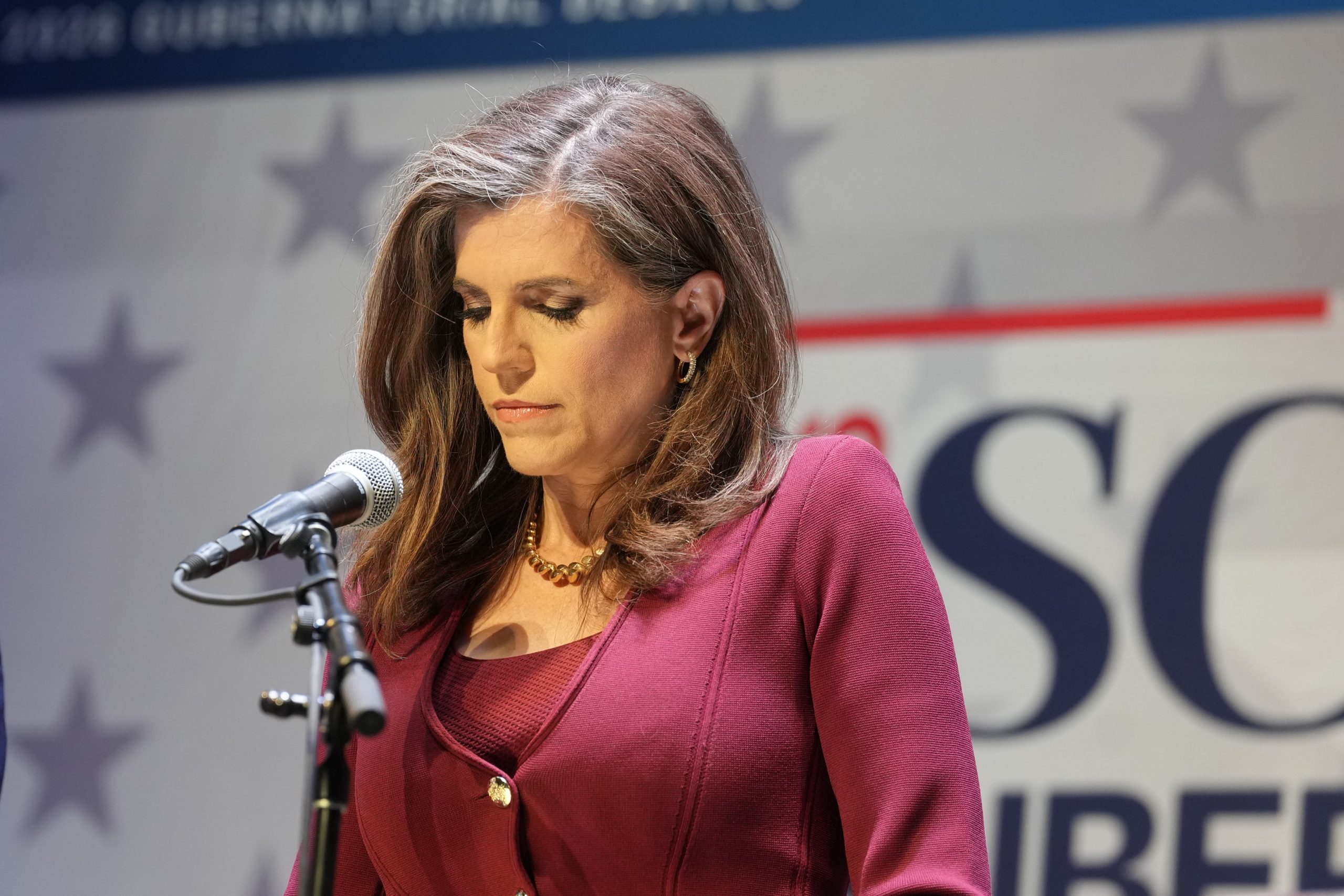

Nancy Mace thinks she knows why she didn’t get President Donald Trump’s endorsement.
The embattled South Carolina House Republican, who’s in the midst of a bruising race for governor, has a long history of bucking — and then cozying back up to — Trump. But her leading role in releasing the Jeffrey Epstein files was likely a bridge too far for the president, who has spent significant time and energy this year to get revenge against his GOP defectors.
Trump’s recent decision to back one of Mace’s primary opponents, Lt. Gov. Pamela Evette, in the crowded field will carry monumental weight in the crimson-red state. Past elections suggest that, with the president’s endorsement, Evette has all but secured her place in a runoff, as Mace and three other Republicans continue to scramble for the second spot on the ballot.
Still, the three-term representative says she has no regrets about her Epstein vote — or its consequences.
“That’s the sole reason I didn’t get the endorsement, because I voted to release the Epstein files, and I’m okay with that,” Mace told POLITICO. “I’ve worked very hard to expose pedophiles, and child rapists, and sex trafficking in my state, and will continue to do it regardless of the outcome of the election.”
“It’s full steam ahead, no matter what. I’m not going down without a fight,” she added. “I’m still the MAGA candidate. I support all of MAGA’s policies. I support our president. I’m also an independent conservative.”
Mace is one of the few remaining Republican Epstein files defectors left standing, after the president blitzed Rep. Thomas Massie (R-Ky.) out of Congress and turned on former Rep. Majorie Taylor Greene (R-Ga.).
Unlike with the other figures, Trump has not publicly made this particular race about his personal dissatisfaction with Mace, staying relatively quiet until he announced his endorsement of Evette in the final two-week window of the primary. But the late Trump headwind is yet another obstacle for Mace’s campaign, which has been otherwise dogged by controversies and a serious primary field that’s already been difficult for her to navigate.
Mace’s run for governor is her highest-profile race yet — and one that will define the next chapter of her rollercoaster career. She’s had to overcome retributive political challenges from several influential figures in her own party and navigate public questions about her own mental health.
She bested a Trump-backed challenger in 2022, a consequence for condemning the president after the Jan. 6 riot at the Capitol. In 2024, she handily defeated a primary challenge funded by allies of former Speaker Kevin McCarthy, who Mace voted to oust the year prior. And now, she’s back on the outs with Trump again, though she’s still trying to align herself closely with the president and reiterating her respect for him.
The White House declined to comment and instead referred POLITICO to the president’s Truth Social post explaining his endorsement of Evette, which did not mention Mace. He instead touted Evette’s closeness to GOP Gov. Henry McMaster, a Trump ally.
Observers and Mace’s opponents in South Carolina paint a complex picture of how the race and Mace’s candidacy have shaped out.
She launched her campaign in the summer of 2025, armed with sky-high name recognition and the ability to tap into grassroots online fundraising, which paid dividends at the outset of the contest. Trump even shared a poll that showed her leading the field — one that Mace told POLITICO last year that she personally sent to the president. But in early September, she joined House Democrats and signed onto Massie’s effort to force a vote to later release the Epstein files — an open defiance of the president’s wishes.
The tide started to shift against her in November, and not only because of the Epstein files drama.
Mace got into a public entanglement with the Charleston Airport Authority over a prearranged escort from the curb to her gate, leading to embarrassing headlines locally and nationally.
Airport authorities detailed in a report that Mace, in a profanity-laced tirade, lit into law enforcement officers and TSA agents for failing to meet her at a preordained pickup location, even as they walked her to her flight.
“I think the airport thing hurt her more than the [Epstein] thing,” said Terry Sullivan, a longtime South Carolina Republican operative, who is unaffiliated in the race. “She’s had really strong debate performances, she’s articulate, she’s right on the issues for these folks, but then she just goes a little haywire.”
Mace, for her part, defended her actions at the airport a few days after it happened in a Charleston press conference, calling the report’s release a “political hit job.”
“Did I drop an f-bomb? I hope I did,” she said at the time. The incident drew harsh criticism from fellow South Carolina Republicans, including Sen. Tim Scott who published a blistering statement rebuking her language and treatment of the officials. Sen. Lindsey Graham piled on, too.
Even now, months later, Mace stands by what she did.
“I get over a thousand death threats a year, and I’m the only one that doesn’t get security when traveling. In fact, the last three times I’ve had an altercation or been accosted has been at an airport, particularly the Charleston airport, because the left has lost their mind,” she told POLITICO.
Then, in February, she accused her ex-fiancé and several of his business partners of serious sexual crimes during a speech on the House floor. They have denied the allegations, and Mace has been representing herself in the subsequent litigation, often swapping the campaign trail for the courtroom.
Controversies aside, ad spending reveals another reason why she’s struggling to break through to the front of the race.
Mace, shockingly, hasn’t spent a single dollar on television ads at all, according to an AdImpact analysis, despite her healthy fundraising throughout the campaign. She’s only dropped $50,000 on digital advertising.
Meanwhile, overall ad spending in the Republican primary has hit nearly $28 million between the candidates’ committees and aligned PACs, nearly $2 million of which has been in negative advertising targeting her specifically. Protect Freedom PAC, an outside group aligned with Kentucky Sen. Rand Paul, has spent $1.4 million in positive ads on Mace’s behalf.
One candidate in particular — millionaire and political outsider Rom Reddy, who jumped into contention at the last minute — has topped all other candidates and PACs, reaching nearly $6 million in the relatively small state. South Carolina Attorney General Alan Wilson and Rep. Ralph Norman (R-S.C.) are also in the race and spending real money.
If none of the candidates clear a 50 percent threshold — a likely scenario with five serious contenders on the ballot — the two top vote-getters will advance to a one-on-one runoff race, with a second round of voting scheduled for just two weeks later on June 23.
The weekend after Trump made his endorsement of Evette, Mace said she texted a friend who would understand her predicament: Massie. “I let him know that I didn’t get the endorsement, and we all know why,” she told POLITICO.
But Massie had already taken to social media.
“Although virtually all Republicans eventually admitted by their votes that it was right to release the Epstein files, only three were brave enough to sign my discharge petition to force that vote. [Lauren] Boebert, [Marjorie Taylor] Greene, and Mace have paid an enormous price for doing the right thing,” he said in a post on X. Greene resigned from Congress earlier this year after clashes with Trump over Epstein and the economy, and Trump recently called for a primary challenge to Boebert after she campaigned with Massie ahead of the Kentucky primary.
Massie has already hinted that he could make some kind of comeback in 2028, whether for his old House seat in Kentucky or another federal office. Mace, should she come up short in the primary, is not so sure.
“I’m not running for Congress again,” Mace said. “I said I would do six years because I believe in term limits, and I made the promise that I would leave Congress after six years, so I won’t be running again.”
What about a political career outside of Congress? “I’m going to wait and see how Tuesday looks,” she demurred.

In recent weeks, far-right actors in loyalist areas of the north of Ireland have unleashed a spate of racist and Islamophobic murals, banners and graffiti. The response of the Democratic Unionist Party (DUP), who have a heavy presence in these areas, has been to remain mute or even challenge police when they remove such displays.
The banners have at times been comical in their ineptitude, like the incoherent AI-generated mural put up by Concerned Parents Newtownabbey (CPN), previously covered by the Canary. There is a serious side too, however, in the hostile sentiment such displays show towards Muslims. The Police Service of Northern Ireland (PSNI) took action against it, cautioning two men for:
…criminal damage to a property and displaying offensive material.
To his credit, Ulster Unionist Party (UUP) councillor Robert Foster made attempts to have the mural taken down, showing up the DUP.
The PSNI also regard a second mural nearby by CPN as a “hate incident”. Another Islamophobic, AI generated abomination, it again reveals its creators have no decency, creativity or adequate explanation for social decline. It depicts a church on fire, with triumphant, militaristic-looking men in the foreground. The mural is captioned:
Islam is heathen, Islam is satanic. Islam is a doctrine spawned in Hell.
Hateful mural backs infamous racist Enoch Powell
It also says “Enoch Powell was right in 1968” referencing Powell’s deranged, racist ‘Rivers of blood’ speech from that year. In it, the serially incorrect reactionary hallucinated about how in Britain, 15 or 20 years from then:
…the black man will have the whip hand over the white man.
So clearly, demonstrably, Powell was not right, and neither are his modern-day equivalents in Newtownabbey with their own deranged nonsense. In Britain, people of colour remain the most victimised, and white supremacy is on the rise.
More concerning is the actively threatening graffiti that has appeared in other areas of Newtownabbey, a large suburban sprawl on the outskirts of Belfast. One in Abbots Cross sprayed on shop shutters says:
Locals only 1 warning will be burt [sic] out.
For those who don’t speak racist, that’s a barely legible threat to torch the homes of migrants in the area. It also serves as a warning to landlords who might provide their properties to new arrivals to the country. Racists have plastered similar material in nearby Rathcoole. They put up a poster saying:
Take notice. Anyone facilitating the settlement of Muslims or illegals in our areas will be held responsible. We are watching.
Alongside it is a bullseye symbol and the words “All NIHE staff are targets.” This is in reference to the Northern Ireland Housing Executive, which manages housing in the Six Counties. The Canary spoke to activists who closely monitor far-right activity, who explained the graffiti is very likely linked to loyalist paramilitaries. As such, it carries real menace and the threat of violence being used to enforce discriminatory housing policy outside the law.
PSNI remove anti-Muslim hate banner, DUP demand explanation
Hatemongers put up another vile banner in the County Tyrone village of Moygashel. Training their children in racism, they put the display beside a children’s playground. It features on one side a brightly lit, supposedly idyllic all-white depiction of local life. On the other, a darkly lit scene of sinister looking dark-skinned men, with a steward preventing them from entering the play park.
Rather than condemn the revolting creation, DUP councillor Clement Cuthbertson has been trying to hold the PSNI to account for removing it. He demanded a:
…full explanation regarding the circumstances surrounding the removal of the banner.
His implication is clearly that the police may have erred by taking away the monstrosity. It is part of a pattern for his party, who have offered no meaningful criticism of any of the above. As End Deportations Belfast recently reported, the DUP have even had the temerity to harangue anti-racist activists during Stormont consultations. This, instead of tackling the real issue which is the out of control levels of racist hate crime in the north of Ireland.
Migrant communities and people of colour are currently “stockpiling food in [their] homes” due to fears over potential hate crimes. The far-right are clearly ramping up for a summer of terrorising these groups, and feel emboldened in their messaging by the absence of condemnation from influential unionist politicians.
It would be tempting to ask the police to step in and use the big censorship stick to take down every message hostile to Muslims, migrants and people of colour. However, emboldening the state to clamp down on speech always has more severe implications for the left, and is a dangerous principle to endorse in general.
Fundamentally this is a long-standing cultural problem in loyalist communities, and it needs addressed at a deep level long before police involvement is even necessary.
Featured image via Charles McQuillan/Getty Images

The proto-fascist ‘Advance UK’ party appears to be imploding after warring emails from the group’s leader and chief operating officer (COO) to members. The war has been triggered by party leader Ben Habib’s plan to de-register the party.
COO Tim Power wrote to members denouncing Habib’s attempt to disband Advance and merge it into far-right umbrella group GBPAC (Great British Political Action Committee). Habib has said that the UK extreme right field is too “crowded” because of Nigel Farage’s Reform UK and Rupert Lowe’s Restore Britain. But Power told members he had stepped in and cancelled a member ballot about the de-registration because Habib has no constitutional authority to take the planned actions, which Power says would be unlawful:
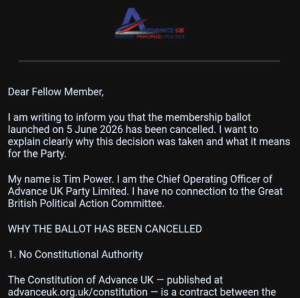
Shouty shambles
Powell also says that he has locked Habib and his allies out of the party’s systems to prevent them resurrecting the ballot. The full email, including a few ‘shouty’ all-caps headers, reads:
Dear Fellow Member,
I am writing to inform you that the membership ballot launched on 5 June 2026 has been cancelled. I want to explain clearly why this decision was taken and what it means for the Party. My name is Tim Power. I am the Chief Operating Officer of Advance UK Party Limited. I have no connection to the Great British Political Action Committee.
WHY THE BALLOT HAS BEEN CANCELLED
1. No Constitutional Authority
The Constitution of Advance UK – published at advanceuk.org.uk/constitution – is a contract between the leadership and every member of this Party. The ballot was not conducted in accordance with that Constitution.
The Party was registered with the Electoral Commission on 4 December 2025 (registration number RPP825-995-485). From that date, Article 15.2 required a Board of at least three directors. The Party has had only one director since April 2025. Article 15.4 expressly states that a sole director below the required quorum may not take any decision other than to appoint further directors or call a general meeting. The ballot was constitutionally prohibited.
Any decision to de-register the Party or merge it with another organisation requires a special resolution – a 75% supermajority – of a properly constituted College of Electors under Articles 1.7 and 2. The College has never been properly constituted. Its members were never elected by the General Members as Article 28.1 requires. A 48-hour online poll cannot substitute for this process.
Any winding up of the Party requires a properly convened Members’ resolution under Article 5. That requirement has not been met.
2. The Party’s Assets Cannot Lawfully Be Transferred to GBPAC
Advance UK is a company limited by guarantee. This means the Party’s assets – its funds, its membership database, its intellectual property and its brand – are held for the benefit of the Party’s objects as a registered political party. They do not belong to any individual and cannot simply be transferred to another organisation.
Article 4.1 of the Constitution states that the Party’s income and property must be applied solely in promoting the Party’s objects. Article 5 states that on any winding up, remaining assets must go to a body with objects similar to those of the Party – that is, a registered political party participating in democratic elections.
GBPAC is not a registered political party. It does not stand candidates in elections. Its objects are materially different from those of Advance UK. Transferring the Party’s assets to GBPAC would therefore be unlawful under both the Constitution and the Companies Act 2006, regardless of what any membership vote said. No vote – however conducted – can authorise an unlawful transfer of assets.
3. Breach of Contract With Members
Every member who joined agreed to abide by the Constitution – and the leadership made the same commitment. Proceeding with a proposal to wind up or merge the Party in breach of that Constitution would place the Party at serious risk of legal liability for breach of contract with its members and significant legal costs defending applications for injunctive relief.
4. Conflict of Interest
The proposal to merge with GBPAC was advanced by the Party’s Leader, who is also the Chairman of GBPAC. Under Article 18 of the Constitution and sections 175 and 177 of the Companies Act 2006, this conflict of interest was required to be declared and managed before any steps were taken. That did not happen.
5. Ballot Integrity
The ballot was administered without an agreed protocol and without verification that all members received it. We have received reports of members who did not receive the ballot email. The ballot data is anonymous – votes cannot be verified against the membership register. There is no way to confirm that votes came from genuine paid-up members, that no member voted twice, or that the result accurately represented the membership. A vote on a matter of this significance cannot be anonymous and unverifiable. Additionally, the system administering the ballot was accessible to individuals with a direct connection to GBPAC the organisation that stood to benefit from one of the options on the ballot.
6. Member Data Protection
Any transfer of member personal data to GBPAC would require the individual consent of each member under UK GDPR. No such consent has been obtained. Proceeding without it would expose the Party to serious financial penalties. I have secured all Party IT systems to protect member data until proper safeguards and appropriate consents are in place.
WHAT HAS BEEN DONE
I have cancelled the ballot and secured all Party digital systems including the membership database and communications platforms. The full ballot audit log has been preserved as evidence.
THE PARTY NEEDS TO REFLECT AND SORT ITSELF OUT
I want to be honest with you. What has happened over the last few days has exposed serious governance failings within this Party – failings that should have been addressed months ago and were not. A Board of Directors should have been properly constituted. A Treasurer should have been appointed. A College of Electors should have been properly elected by you, the membership, for the first time.None of that happened. And the result is that the Party arrived at this moment without the governance structures it needed to handle a decision of this magnitude properly.
Advance — Civil war
Powers’s email triggered an email from Habib, insisting that Powers had said was a lie, Powers was no longer part of the party and the ballot is still going ahead. If Habib’s claim is true, Powers’s attempt to ‘secure all Party digital systems’ doesn’t seem to have been very competent:
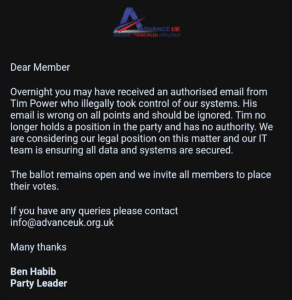
The proof of whether coup or counter-coup was successful will be in the eating, presumably. Not that the demise of any far-right group is anything to be lamented, of course. But its fascist members will probably care far more about when they will next be able to go out waving flags and spewing hate.
Featured image via Christopher Furlong/Getty Images
By Skwawkbox

The post Why does a Welsh police force have an Islamic blasphemy unit? appeared first on spiked.

Green activist and former Respect party parliamentary candidate Salma Yaqoob was the target of the arson attack in Birmingham that Skwawkbox reported earlier today, 5 June 2026.
The local Green party has issued a statement of solidarity with Yaqoob and her family:
Birmingham Green Party expresses solidarity with the Yaqoob family after the shocking arson attack on a car outside their family home.
Many of our councillors, activists and supporters know members of the family well and admire their commitment to equality, justice and peace.
The fact that nobody was injured is down to quick thinking by family members who were able to stop the fire spreading. This extremely dangerous act was caught on CCTV and we hope that West Midlands Police catch the perpetrators quickly before they are able to commit any further acts of violence.
Birmingham attack met with media indifference
Masked attackers smashed in the windows of Yaqoob’s car during the night and poured petrol over it before setting it alight. Quick action by family members stopped the blaze spreading to their home until firefighters arrived to extinguish it fully:
Like most Islamophobic and right-wing attacks, the arson has been largely ignored by the UK ‘mainstream’ media.
Featured image via BirminghamLive
By Skwawkbox

Israel might be training hundreds of participants in the dark arts of ‘offensive’ influence operations and propaganda each year. A military leak exposed details of how the settler-colonial state seeks to shape public consciousness. And some material is specifically for English speakers. It is the second major leak of its kind in 2026.
Israeli-based +972 magazine reported on 4 June:
Israel’s defense establishment is training soldiers and other defense officials to conduct psychological operations designed to “influence public consciousness” in Israel and abroad.
The courses, taught in Hebrew and English by academics who are not affiliated with the military, are intended for defense personnel based both domestically and overseas, as well as unspecified “foreign partners.”
Investigators at Hebrew-language outlet The Hottest Place in Hell also worked with +972 on a previous story about how the Israeli military seeks to dominate media narratives. A third influence operation was discovered by French and Israeli journalists on 19 May.
Courses in the new leaked documents teach would-be operatives:
how to use data to discretely shape the attitudes and actions of target audiences, intelligence gathering for such operations, and influencer training.
Most of the training is geared toward “offensive” influence operations aimed at:
actively disrupting or manipulating the beliefs, attitudes, and behaviors of target audiences rather than simply protecting an existing narrative. They include training in advertising and marketing content, alongside courses on cyber warfare and intelligence gathering on target audiences.
Black hat methods
The courses aim to teach so-called ‘black hat’ methods:
manipulation methods that circumvent tech platforms’ rules around cybercrime, cyber warfare, or other malicious activity.
One course teaches:
information operations for the purpose of influencing public consciousness in the local and international arena
Including how to:
craft and disseminate messages tailored to a target population, assess their impact, and apply the lessons to “future operations.”
The material makes it clear that training is conducted “at the [Israeli] government’s directive”. The documents describe a call for potential lecturers to teach the courses, the first of which was due to start in August 2026.
Teachers would need to have high-level academic qualifications in:
the fields of influence, consciousness, security and terrorism, mass communication, [or] digital and network communication.
And at least four years of “professional experience” in:
the fields of influence [or] influence intelligence in various security organizations.
Israel — Thematic clusters for influence operations
The material describes “thematic clusters”. These included teaching the:
fundamentals of psychological warfare, propaganda, deception, legitimacy and public diplomacy, and segmentation of target populations with emphasis on foreign audiences.
Which would include:
identifying adversarial influence efforts, narratives, and imagery, as well as deepfakes, psychological warfare, propaganda, deception, legitimacy, and public diplomacy.
Another cluster covered:
“campaign planning, execution, and evaluation,”
It sought to teach students:
the “considerations and expectations” of the political echelon, alongside “military intelligence,” “cultural intelligence,” and “intelligence collection and research capabilities for influence.”
Tailored for non-Israelis?
Significantly some courses were in English rather than Hebrew for “foreign partners” who were not identified:
For these participants, the Defense Ministry built a dedicated syllabus that includes study of “the American approach,” meaning U.S. perspectives and cultural norms, and conducting influence campaigns in the international arena.
Hilariously, an Israeli spokesman told investigators who contacted the defence ministry for clarification the training was:
an academic course for personnel engaged in the influence and consciousness effort in the IDF
The purpose of the courses, the spokesman added, was “personal enrichment.”
The overuse of terms like ‘psy-op’, ‘false flag’ and ‘influence operation’ — without evidence — has often muddied the waters around international politics. But this here is coming from the horse’s mouth. +972 Magazine and their colleagues at The Hottest Place in Hell have already produced two great reports on this topic in 2026. This is the kind of innuendo-free public service journalism which can actually put a dent in the settler-colonial war machine.
Featured image via Amir Levy/Getty Images
By Joe Glenton

Politics And The Markets 06/07/26

Heather Locklear and Lorenzo Lamas’ Relationship Timeline

Tech, Media & Telecom Roundup: Market Talk



-
 Business5 days ago
Jade Biosciences, Inc. (JBIO) Discusses Positive Interim Results From JADE101 Phase I Healthy Volunteer Study and Development Plans Transcript
-

 Fashion1 day ago
Weekend Open Thread: Evereve – Corporette.com
-

 Sports4 days ago
French Open 2026 results: Alexander Zverev beats Rafael Jodar and will play Jakub Mensik in semi-finals
-
 Crypto World2 days ago
Jensen Huang Approves Samsung, SK Hynix, and Micron for NVIDIA (NVDA) HBM4 Memory Supply
-

 Tech5 days ago
CryZENx Releases Fresh Playable Content Deep Inside Jabu-Jabu for His Ocarina of Time Remake
-
 Business4 days ago
Trump Taps Housing Chief Bill Pulte as Acting Intelligence Director After Gabbard Exit
-
Crypto World2 days ago
LBank Surpasses 25 Million Users Worldwide as AFA Partnership Continues to Drive Global Growth
-
 NewsBeat4 days ago
Republicans balk at Trump’s attempt to appoint a MAGA enforcer to lead National Intelligence
-
 Crypto World5 days ago
Seagate (STX) Stock Surges to Record High on AI Boom and Legal Settlement
-

 Tech2 days ago
RCS Messages Between iPhone and Android Get End-to-End Encryption With iOS 26.5
-
 Crypto World4 days ago
EU AI Data Center Project Faces Delays as Funding Gaps Grow
-

 Entertainment4 days ago
Did The Mandalorian And Grogu Already Ruin The Next Star Wars Movie?
-

 Business4 days ago
Aehr Test Systems Stock Soars 17% Amid Surging AI Demand and Conference Spotlight
-
 Business5 days ago
Claude AI Down Today Reason: Why Anthropic’s AI is not working today? What’s the latest quota update
-

 Business4 days ago
Relay Therapeutics Shares Surge 20% on ASCO Momentum for Zovegalisib Breast Cancer Program
-

 Tech4 days ago
Instagram will stop bombarding teens with the same kind of obsessively unhealthy content
-
 Crypto World2 days ago
Merlin (MRLN) Stock Soars 32% on Major USSOCOM Autonomy Milestone
-

 Tech2 days ago
Credit card theft campaign abuses Stripe to host stolen payment info
-
Crypto World5 days ago
Tether Brings Google’s TurboQuant to Production, Unlocking Long-Context AI on Everyday Devices
-
 Entertainment4 days ago
‘Aliens’ Star Reveals How the US Military Co-Opted James Cameron’s Sci-Fi Tech [Exclusive]
You must be logged in to post a comment Login