
Crypto World
LINK Outflow Hits 2026 High at 970,000 Tokens



On-chain data from Santiment shows 970,430 LINK tokens left centralized exchanges on April 27 in a single day, the largest LINK outflow since December 2, 2025, worth approximately $8.95 million, as exchange reserves continued a 25-day decline from 141.5 million to 130.9 million.
Summary
- The 970,430 LINK withdrawal on April 27 was worth approximately $8.95 million at the time and represents the largest single-day net outflow for Chainlink since December 2, 2025.
- Exchange reserves have fallen consistently since April 3, when a 15-million-token inflow spike pushed reserves to their 30-day peak of 141.5 million tokens before a sustained withdrawal trend reversed the entire move.
- LINK was trading near $9.23 with an RSI of 42.31, below all three major moving averages, with the $9.50 level as the near-term resistance analysts identify as the breakout trigger.
LINK outflow data published by Santiment on April 27 showed 970,430 tokens leaving centralized exchanges in a single session, the largest daily net outflow for Chainlink since December 2, 2025. NewsBTC reported that the Exchange Flow Balance has been consistently negative for nearly all of April, indicating sustained withdrawal activity throughout the month rather than a single isolated spike. The April 27 event was the most concentrated single-day expression of that trend, with withdrawal transactions dropping to just 119 during the session, the lowest count in the 30-day observation window, while inflow fell to approximately 179,800 LINK, near the floor of the entire observation period.
LINK Outflow Pattern Extends a 25-Day Exchange Reserve Decline
As crypto.news reported, the April 3 session saw 15 million LINK deposited onto exchanges in the largest inflow event of the 30-day window, pushing total exchange reserves to a peak of 141.5 million. Rather than converting to selling pressure, that deposit event marked the beginning of a sustained withdrawal trend: over 25 days, net outflows progressively reduced exchange reserves from 141.5 million to 130.9 million, erasing the entire April 3 inflow and returning the supply ratio to its pre-spike level. The supply ratio, measured by CryptoQuant, fell from 0.142 at the April 3 peak to approximately 0.130 by April 27. Exchange outflows at this scale can indicate accumulation by holders moving tokens to private custody rather than preparing to sell, but the data does not confirm directional conviction because a single large actor moving 970,430 LINK off an exchange could also represent an OTC desk transfer, a DeFi protocol deposit, or a cross-venue repositioning that eventually leads to a sale. LINK’s price did not break out following the withdrawal: it climbed briefly to $9.58 after the event before retracing to $9.23, suggesting the market did not interpret the outflow as a definitive accumulation signal.
XRP Saw a Simultaneous Outflow Spike in the Same Window
As crypto.news documented, XRP also recorded one of its largest daily outflow spikes of 2026 during the same week, with 34.94 million XRP worth approximately $48.6 million leaving exchange wallets in a single session. That simultaneous outflow across both LINK and XRP during the same week is consistent with a broader pattern of institutional-scale holders reducing exchange exposure across multiple assets simultaneously, a behavior that precedes either accumulation or OTC-mediated distribution depending on where those tokens move next.
Where LINK Price Stands After the Outflow
As crypto.news tracked, LINK entered 2026 in a structural downtrend with its 200-day simple moving average acting as resistance, and the April 27 outflow spike did not change that technical structure. LINK is trading below all three major moving averages, with the 50-day, 100-day, and 200-day all clustered between $9.35 and $9.37 at the time of the withdrawal. The RSI of 42.31 signals weak momentum without reaching the oversold threshold that typically triggers a technical reversal. The $9.50 level remains the near-term breakout trigger, and the $10.00 level is the larger resistance that would require sustained institutional follow-through to clear. LINK’s CCIP weekly cross-chain volume surged 260% to over $1.3 billion in the most recent reporting period, but price has remained range-bound as the broader market digests macro uncertainty from the FOMC and the Iran conflict.
LINK is not the only altcoin seeing large exchange outflows. Santiment data showed XRP recorded 34.94 million tokens in exchange outflows the same week, worth approximately $48.6 million, suggesting broader institutional-scale repositioning across the top altcoin cohort.

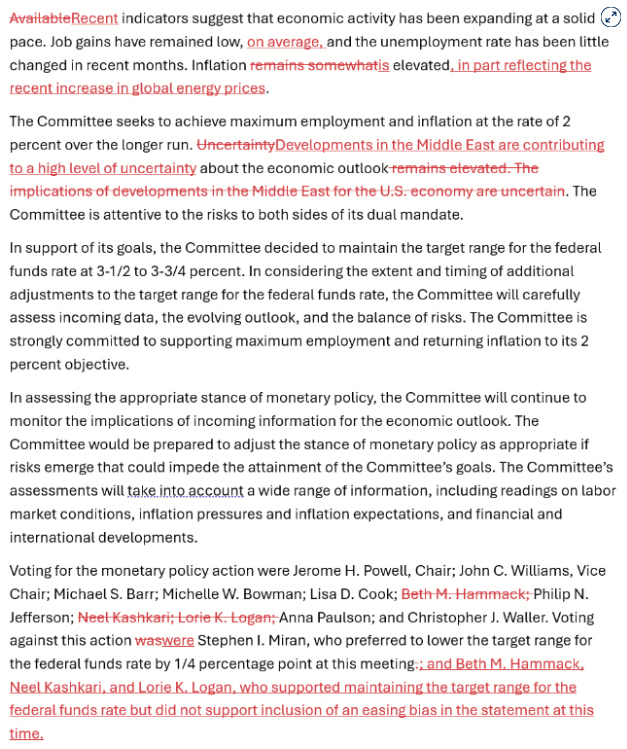
Bitcoin (BTC) extended its two-day decline on Wednesday after the Federal Open Market Committee (FOMC) minutes confirmed the Fed’s decision to hold “the target range for the federal funds rate at 3-½ to 3-¾ percent.”
While the Fed maintains its goal of achieving “maximum employment and inflation at the rate of 2 percent over the longer run,” the FOMC minutes cited the “developments in the Middle East” as factors fueling an environment of “uncertainty” and the Fed stressed its desire to maintain optionality as it evaluates the “risks to both sides of its dual mandate.”
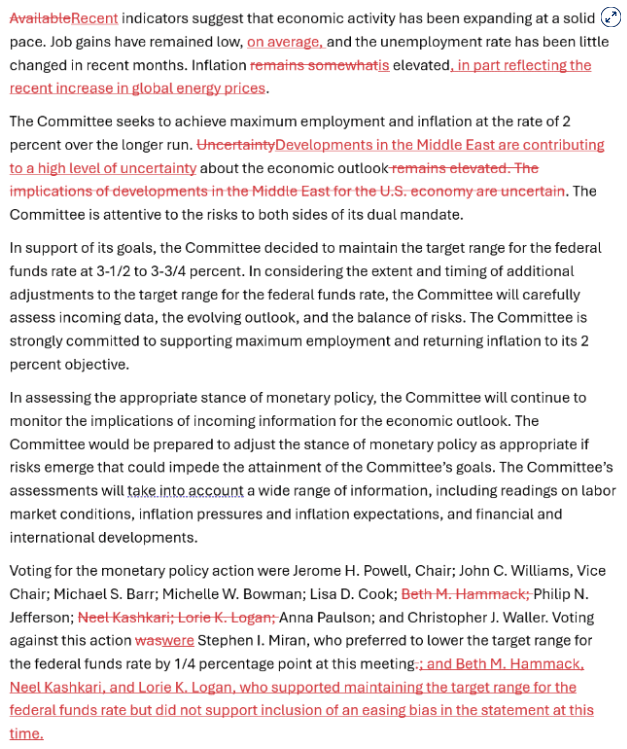
FOMC minutes with new statements in red. Source: CNBC
The Fed’s hold on rates aligned with market expectations, but Bitcoin remained fragile throughout Chairman Powell’s presser.
Hyblock CEO Shubh Varma described the price action as “the usual sell the news reaction after the FOMC,” but also noted that BTC “quickly recovered to pre-announcement levels within hours, showing strong underlying conviction.”
Adding data to back his market view, Varma said,
“The global bid ask ratio spiked to 0.3 (one of the highest readings), while open interest fell on the price drop. This is classic post-FOMC position squaring and stop-hunt behavior rather than conviction selling.”
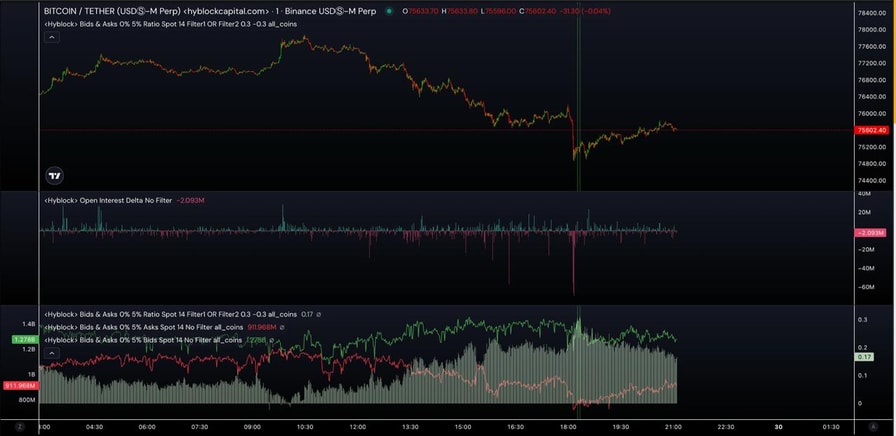
BTC/USDT global bid ask ratio. Source: Hyblock
Will support turn back into resistance?
After the FOMC minutes were published, BTC dropped to an intra-day low of $74,937, slightly below the 20-day simple moving average ($75,664) that some traders identified as critical to confirming BTC’s support-resistance flip.
As reported on Monday by Cointelegraph, following the break above the channel resistance on the daily chart, BTC required consecutive daily candle closes above the trendline, followed by a lower support restest in the $76,500 to $75,500 range.
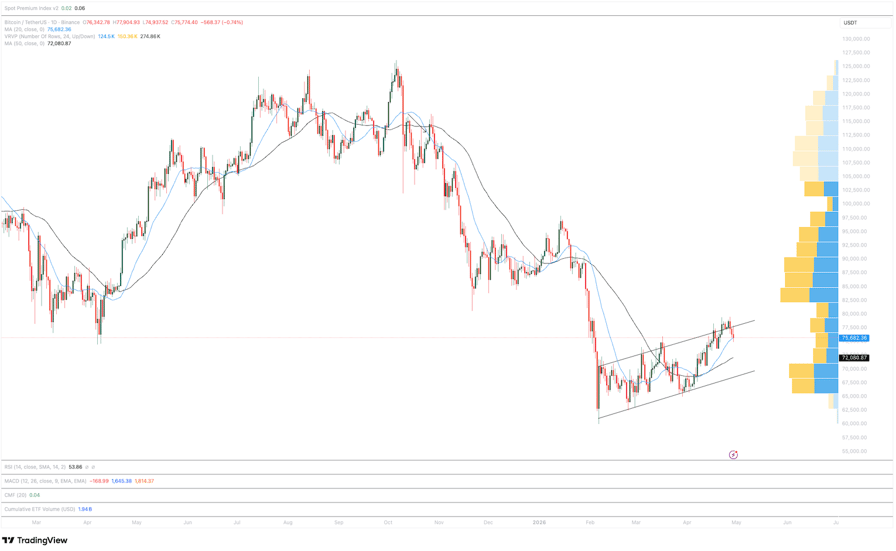
BTC/USDT 1-day chart. Source: TradingView
While all the above have happened, failure to recapture the 20-MA and close above the trendline resistance could be interpreted as a loss of momentum within the bull trend, opening the path for Bitcoin to test the downside boundary of the near-4-month-old channel.
Related: Bitcoin falls as traders cut risk ahead of FOMC: Will Tradfi, spot ETF volumes bolster $70K support?
Prior to the Chairman Powell’s presser, Glassnode analysts noticed that Bitcoin traders were adding bearish leverage, citing rising open interest after Tuesday’s rally to $79,000, funding remaining neutral and a divergence between the spot and futures market cumulative volume delta (CVD).
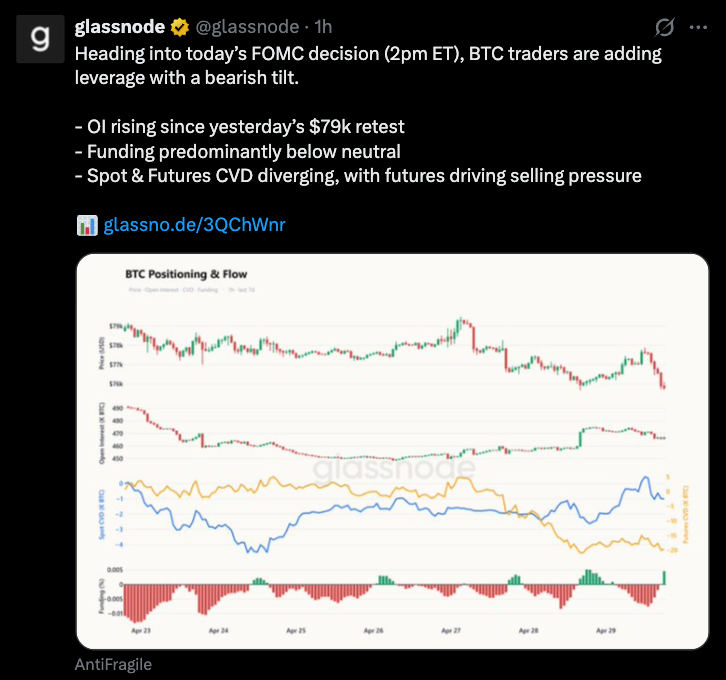
Bitcoin traders turn bearish ahead of FOMC minutes. Source: Glassnode / X
Additional analysis from Glassnode’s The Week Onchain report depicted Bitcoin’s price action as “trapped below market mean,” where $65,000 to $70,000 act as support, but weak demand prevents the formation of sustainable rallies.
According to the report, Bitcoin failed to overcome its True Market Mean at $79,000 and a surge in short-term holders’ profit taking, along with margin futures flipping net short, has sapped away Bitcoin’s shorter-term bullish momentum.
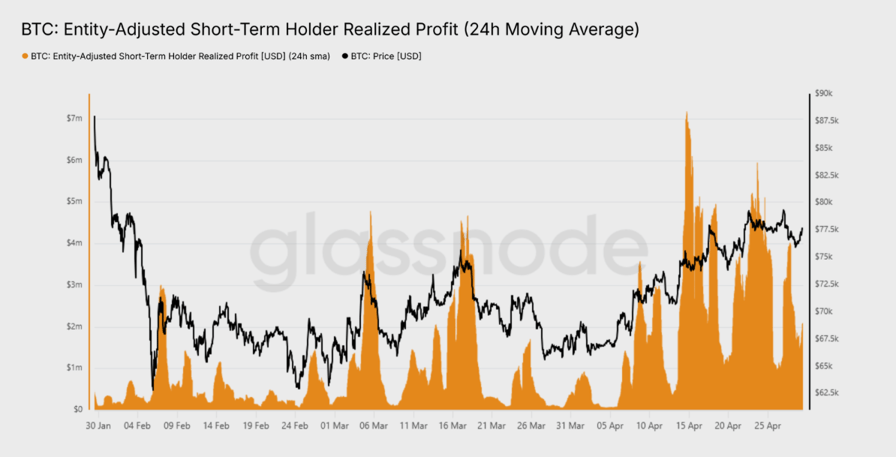
BTC entity-adjusted short-term holder realized profit. Source: Glassnode
While these factors increase Bitcoin’s sensitivity to a sharper downside move, the analysts said institutional flows into the spot BTC ETFs and rising CME open interest have helped to build a “dense accumulation cluster between $65K and $70K.”
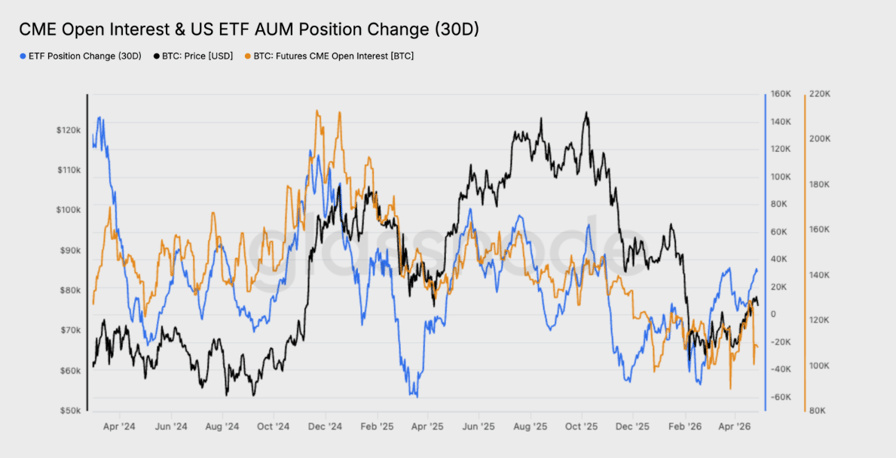
CME open interest, US spot ETF AUM position change. Source: Glassnode
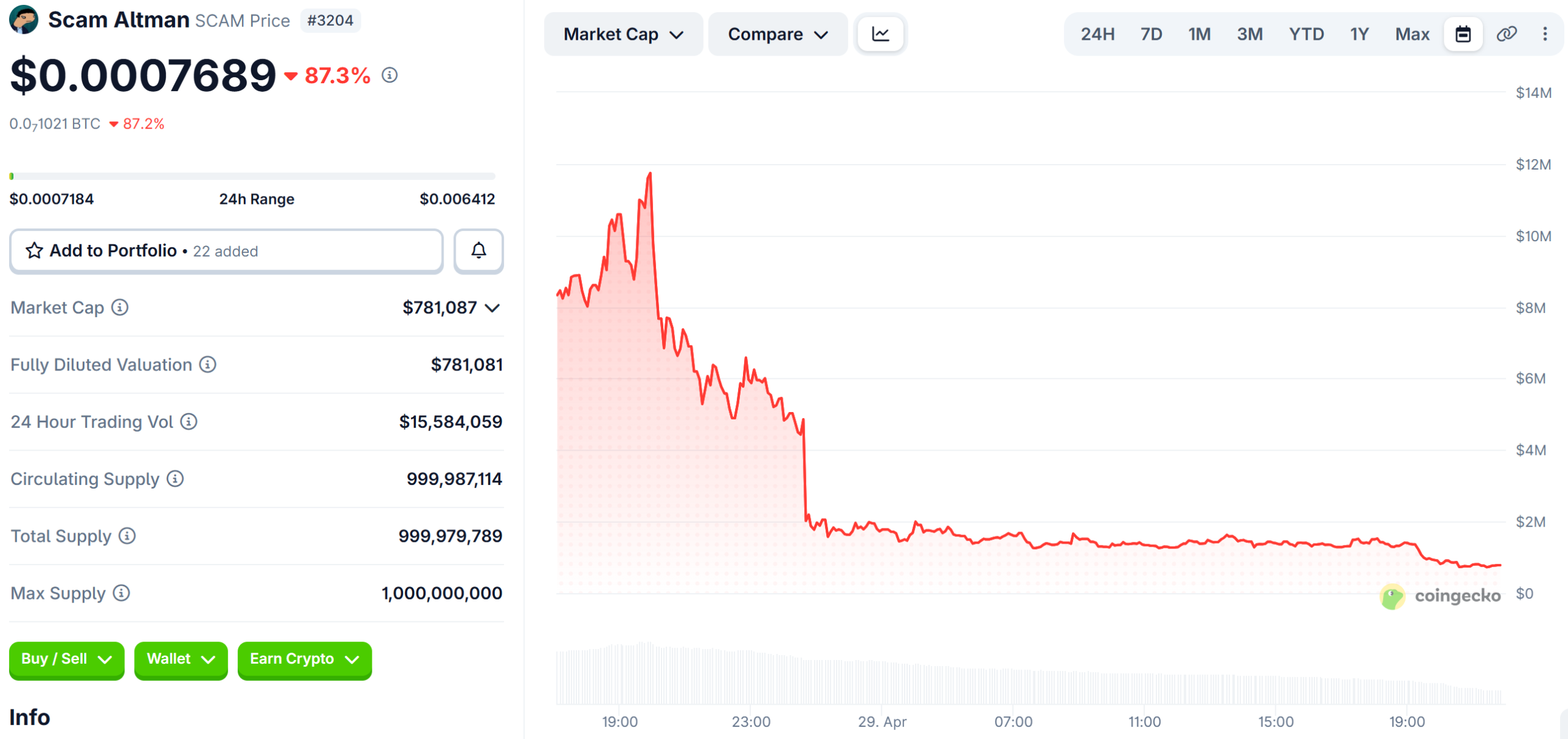
A single Solana wallet lost about $150,000 buying Scam Altman (SCAM) near the top of its launch. The trader sold close to the bottom after SCAM crashed 95% in 24 hours, on-chain analytics firm Bubblemaps reported.
The same address, tagged AuKRRB…L7sN, also dropped roughly $81,000 on UNC and $14,000 on ASTEROID in earlier trades. The three-token streak put combined realized losses at about $245,000 in a single week.
How the Scam Altman Trade Went Wrong
The Scam Altman token launched on Pump.fun this week as Elon Musk’s lawsuit against Sam Altman and OpenAI opened in federal court in Oakland.
Musk spent much of the morning calling the OpenAI chief “Scam” Altman across multiple X posts. Solana traders read the nickname as a tradable meme and raced to mint a token before competitors could.
Within eight hours, SCAM hit a market cap above $10 million on roughly $19.6 million of volume. The peak briefly approached $20 million before sellers stepped in.
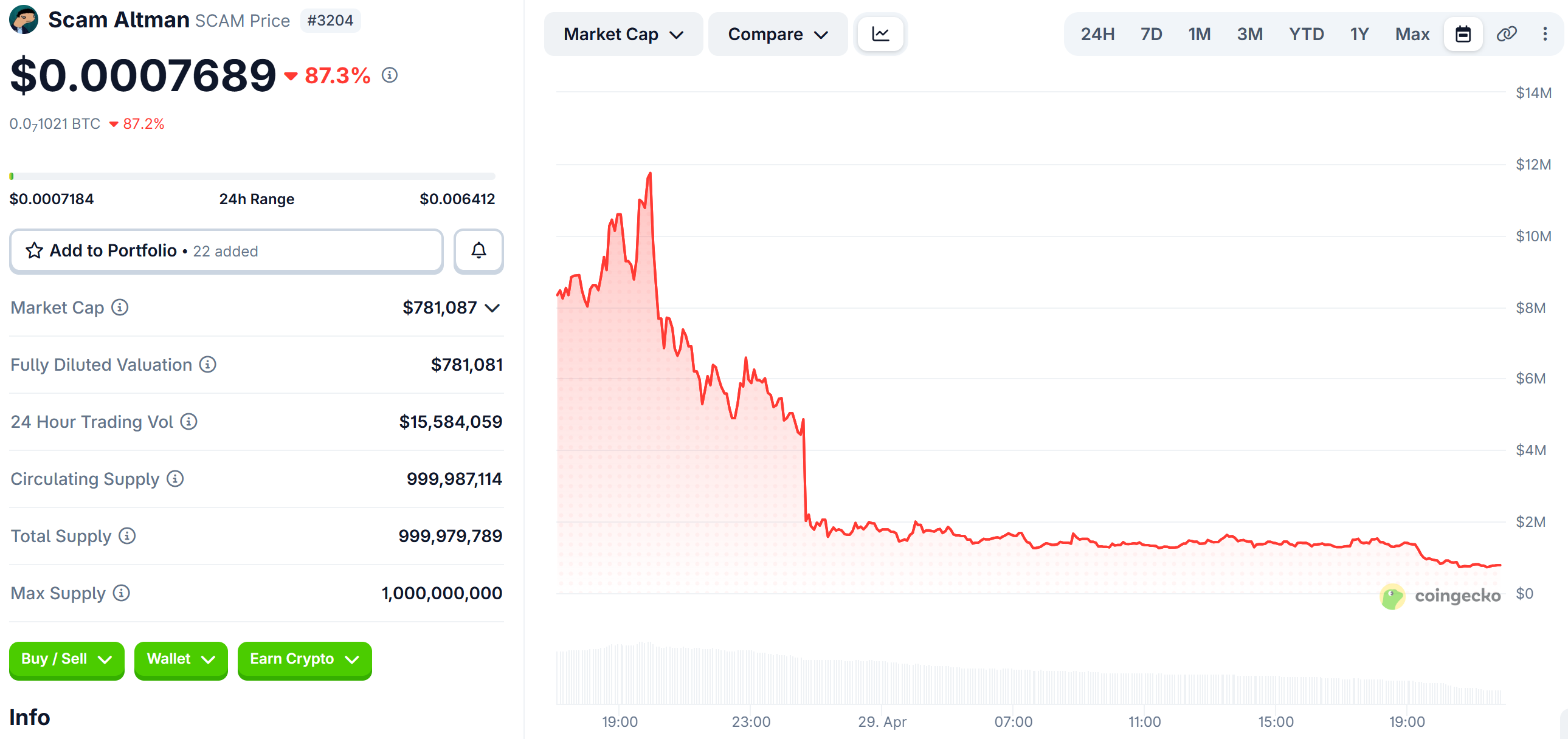
The reversal was equally fast. SCAM shed close to 88% of its value over the next 24 hours. The drop from the highlighted wallet’s entry to its exit reached about 95%.
What Bubblemaps Showed
Bubblemaps shared a post with a visualization of SCAM holders that flagged clusters of interconnected wallets. That pattern often signals insider distribution or coordinated buying on Solana meme coin launches.
The map placed wallet AuKRRB…L7sN inside an active buyer cluster near the top of the chart. Bubblemaps shared a direct map so traders could inspect the wallet relationships themselves.
The same trader’s earlier picks tell a similar story. Wallet AuKRRB…L7sN bought UNC and ASTEROID after each token had already pumped, suggesting late-entry timing on Solana tickers.
A Familiar Pump.fun Cycle
Tokens launched on Pump.fun rarely survive a full trading week. Galaxy Research has argued the meme coin economy rewards bots and snipers, while retail traders absorb most of the losses.
Industry compliance figures put Solana rug pull losses at roughly $500 million in 2024 alone.
SCAM followed the familiar template. A hype-driven launch attracted retail buyers, early holders distributed into the demand, and the chart collapsed within hours.
The token had no whitepaper, no team, and no product. Its only narrative was Musk’s recurring nickname for Sam Altman during the OpenAI trial.
Sam Altman’s existing crypto venture, Worldcoin (now rebranded as World), had no connection to SCAM. The meme coin was an unaffiliated joke trade riffing on the courtroom drama.
Whether SCAM stabilizes or fades will likely depend on how long the Musk and Altman feud dominates crypto X. For the trader behind AuKRRB…L7sN, the bill has already arrived.
The post Trader Loses $150,000 on Scam Altman Token After Elon Musk’s Tweet appeared first on BeInCrypto.

Gibraltar is moving to codify the use of tokenized fund shares within its financial framework, authorizing certain regulated funds to issue shares on distributed ledger technology (DLT) while preserving investor rights. The Protected Cell Companies (Amendment) Bill 2026 would recognize a share token holder as a shareholder with the same rights and obligations as holders of traditional cell shares, linking ownership to asset pools within protected cell companies.
According to Cointelegraph, the proposal would require approval from the Gibraltar Financial Services Commission and targets protected cell companies operating as experienced investor funds. It contemplates blockchain-based share registers for recording ownership, with tokenized shares legally equivalent to conventional share certificates.
Source: Gibraltarlaws.gov.gi
The framework imposes strict custody and transfer controls, restricting access to verified investors and allow-listed wallet addresses, while mandating disclosures on technology risks, cybersecurity, and recovery procedures. Companies would retain control over the underlying infrastructure, keeping the system within a regulated environment rather than an open, permissionless market.
Under the proposal, tokenized shares could be issued and transferred via smart contracts and cryptographic signatures, with blockchain records recognized as valid instruments for ownership, transfer, and recordkeeping under existing company law. The bill must advance through Gibraltar’s legislative process before it can take effect.
Related developments in the digital-asset regulation space have been highlighted by industry coverage, underscoring a broader shift toward integrating tokenized assets into regulated markets.
Source: Gibraltarlaws.gov.gi
Key takeaways
- The Protected Cell Companies (Amendment) Bill 2026 would permit tokenized fund shares to be issued on distributed ledger technology, with token holders treated as shareholders under existing rights and obligations.
- Approval from the Gibraltar Financial Services Commission is required, and the measure targets PCCs operating as experienced investor funds.
- Ownership records would be maintained on blockchain-based share registers, with tokenized shares legally equivalent to traditional share certificates.
- Custody and transfer rules would restrict activity to verified investors and allow-listed wallet addresses, alongside mandatory disclosures on technology risk, cybersecurity, and recovery procedures.
Gibraltar’s tokenization framework in context
The bill envisions tokenized shares that are issued and transferred using smart contracts and cryptographic signatures, with blockchain records recognized as valid under current company law. By keeping the underlying infrastructure within a regulated environment, the approach aims to balance innovation with supervisory oversight and investor protection. The measure would not create a permissionless market; rather, it anchors tokenized equity in a governance and custody framework that aligns with established fiduciary and regulatory norms.
As the legislative process advances, the emphasis on verified investor access and technology risk disclosures points to heightened KYC/AML compliance requirements for PCCs leveraging tokenized instruments. The Gibraltar FSC’s involvement signals a tailored, risk-based approach to tokenized fund governance that could influence similar regimes in other jurisdictions contemplating regulated token markets.
Global momentum: tokenized assets in regulated markets
Gibraltar’s contemplated framework sits within a growing global trend of tokenized assets moving from pilot programs to regulated market infrastructure. Several jurisdictions have advanced tokenized securities under robust legal and supervisory regimes:
- Switzerland: The regulator (FINMA) approved a crypto fund in 2021 for qualified investors and, in 2025, licensed its first distributed ledger technology trading facility to enable tokenized securities to be traded and settled on regulated infrastructure.
- Singapore: Project Guardian, initiated in 2022, tested tokenized assets in wholesale markets as part of a broader exploration of DLT-enabled capital markets.
- Hong Kong: Tokenized government bonds have been issued and expanded since 2023, reflecting active public-sector participation in tokenized finance.
- Global settlement infrastructure: In 2024, the World Bank issued a Swiss franc digital bond on Switzerland’s SIX Digital Exchange with settlement conducted via central bank digital currency, illustrating central-bank–aligned settlement for tokenized debt instruments.
- Canada: In March, a pilot successfully issued and settled its first tokenized bond on distributed ledger infrastructure, marking a notable cross-border development in tokenized sovereign-like debt instruments.
These cases collectively illustrate a shift toward regulated environments for tokenized securities and bonds, combining governance frameworks, custody controls, and supervisory oversight to mitigate risk while expanding access to digital-asset markets. Industry observers have highlighted the importance of aligning tokenized offerings with existing corporate and securities law, AML/KYC standards, and cross-border regulatory harmonization. The European Union’s MiCA framework and parallel U.S. regulatory conversations continue to shape how tokenized assets are treated across jurisdictions, with particular emphasis on licensing, disclosure, and custody arrangements intended to preserve financial stability and investor protection.
In the broader policy context, the ongoing evolution of tokenized asset markets is being tracked for potential implications on licensing regimes, banking integration, and cross-border settlement infrastructure. As Gibraltar demonstrates, regulators appear inclined to integrate tokenized instruments within familiar legal constructs, rather than create entirely new regimes for each innovation, thereby facilitating compliance, audits, and enforcement activities for market participants.
Closing perspective: As tokenization moves deeper into regulated markets, ongoing oversight and international coordination will be critical to address unresolved issues in custody, cyber risk, and cross-border transfer of tokenized assets.

TLDR:
- Five XRP spot ETFs launched in the US, locking 769M tokens with zero net outflow days in month one.
- Goldman Sachs holds $153.8M in XRP ETFs, making it the top institutional holder across four funds.
- XRPL daily transactions hit 3 million on March 15, tripling from mid-2025 averages across key use cases.
- Ripple’s $50B private valuation and $500M funding round drew top Wall Street and crypto-native firms.
XRP has attracted notable institutional attention in 2026, with five spot ETFs now trading in the United States. Cumulative inflows reached $1.50 billion by early March.
The funds locked over 769 million XRP tokens across combined custody arrangements. JPMorgan forecasts first-year inflows between $4 billion and $8.4 billion. Despite these developments, XRP trades around $1.36, well below its July 2025 high of $3.65.
Institutional Adoption Drives ETF Growth
Goldman Sachs disclosed a $153.8 million spot XRP ETF position in its Q4 2025 13F filing. This makes Goldman the single largest known institutional holder of XRP ETFs.
The allocation spans Bitwise, Franklin Templeton’s XRPZ, Grayscale’s GXRP, and 21Shares’ TOXR. Together, these holdings account for roughly 73% of the top 30 institutional holdings combined.
Ripple entered 2026 at a $50 billion private valuation. This places it among the ten most valuable private companies globally.
It also stands as the only blockchain-focused firm in that group. The company holds more than 75 regulatory licenses worldwide and has logged over $95 billion in cumulative transaction volume.
A $500 million strategic funding round closed in November, drawing major names from traditional finance. Citadel Securities, Fortress, Pantera, Galaxy Digital, Brevan Howard, and Marshall Wace all participated.
On the same day, Ripple announced a partnership with Mastercard and Gemini. The collaboration focuses on stablecoin-powered credit card payments.
As noted by BSCNews, the registered zero net outflow days in the ETFs’ first month of trading. This points to sustained demand from institutional buyers. The consistency of inflows sets XRP apart from other digital assets in early 2026.
XRPL Network Activity and Technical Development
Daily transactions on the XRP Ledger reached 3 million on March 15. That figure represents a threefold increase from mid-2025 averages.
AMM pool activity, tokenized assets, and RLUSD-denominated settlement flows drove the growth. The ledger has now processed more than 4 billion transactions since inception.
Real-world asset tokenization on XRPL has grown to over $474 million. The represented value is approaching $1.5 billion.
This growth reflects broader adoption of the ledger for non-speculative financial use cases. It also positions XRPL as a settlement layer for institutional-grade transactions.
On the technical side, RippleX shipped a node stability patch on March 13. An AI-driven security overhaul followed on March 26.
A four-phase quantum-resistance roadmap targeting 2028 is also underway, with Phase 2 in progress. Lending Protocol and Single Asset Vaults are currently under amendment voting.
Standard Chartered’s Geoffrey Kendrick has forecast XRP reaching $8 in 2026. He cited ETF flows and regulatory clarity from the CLARITY Act as key drivers.
Ripple CEO Brad Garlinghouse has predicted XRP capturing 14% of SWIFT volume within five years. Price performance, however, remains the one area yet to reflect the broader momentum.

Three meme coins delivered standout gains during April 2026. Dogecoin (DOGE) climbed 13.5%, Pudgy Penguins (PENGU) jumped 53%, and SkyAI rocketed 290% over the month.
The trio reflects three different meme coin strategies. DOGE represents the legacy heavyweight. PENGU is a mid-cap with strong community and intellectual property momentum. SkyAI is the high-velocity artificial intelligence narrative play with explosive price action.
Dogecoin (DOGE) Tests $0.082 Support With Compression Setup
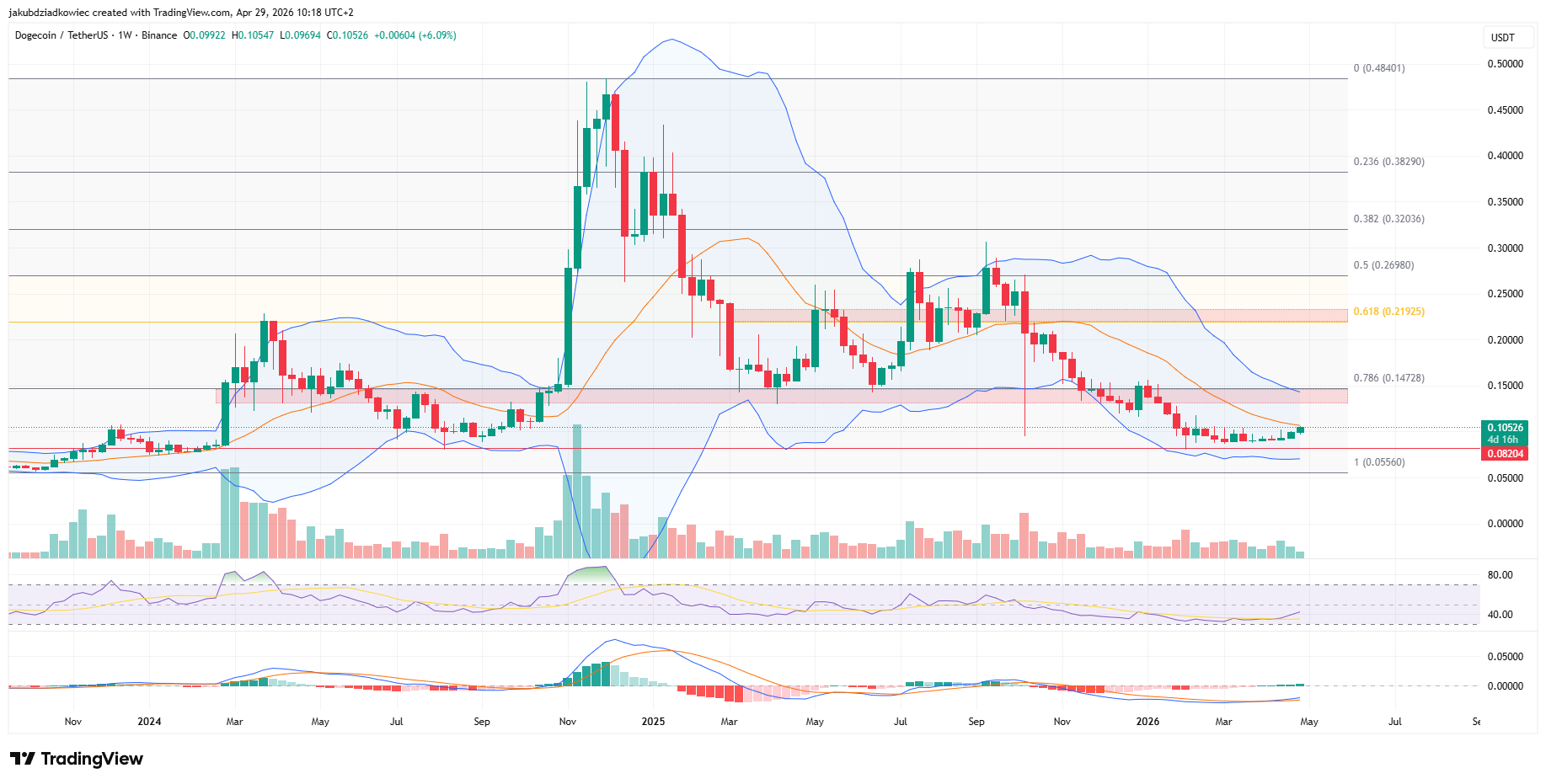
Dogecoin has traded in a downtrend since December 2024, with a secondary peak in September 2025. After several months of weakness, DOGE returned to test the $0.082 zone, which served as support during prior rallies.
The weekly chart now shows green Moving Average Convergence Divergence (MACD) readings and a rising Relative Strength Index (RSI). However, the RSI sits at 43, still below the 50 midline. Bollinger Bands have contracted alongside falling volume, a classic compression signal that often precedes a directional move.
Bulls would need to flip the $0.10 midline of the Bollinger Bands to confirm a trend change. Above that level, the next resistance sits at $0.14, which aligns with the upper Bollinger Band, the long-term resistance, and the 0.786 Fibonacci retracement. A higher target sits near $0.21 at the 0.618 Fibonacci retracement.
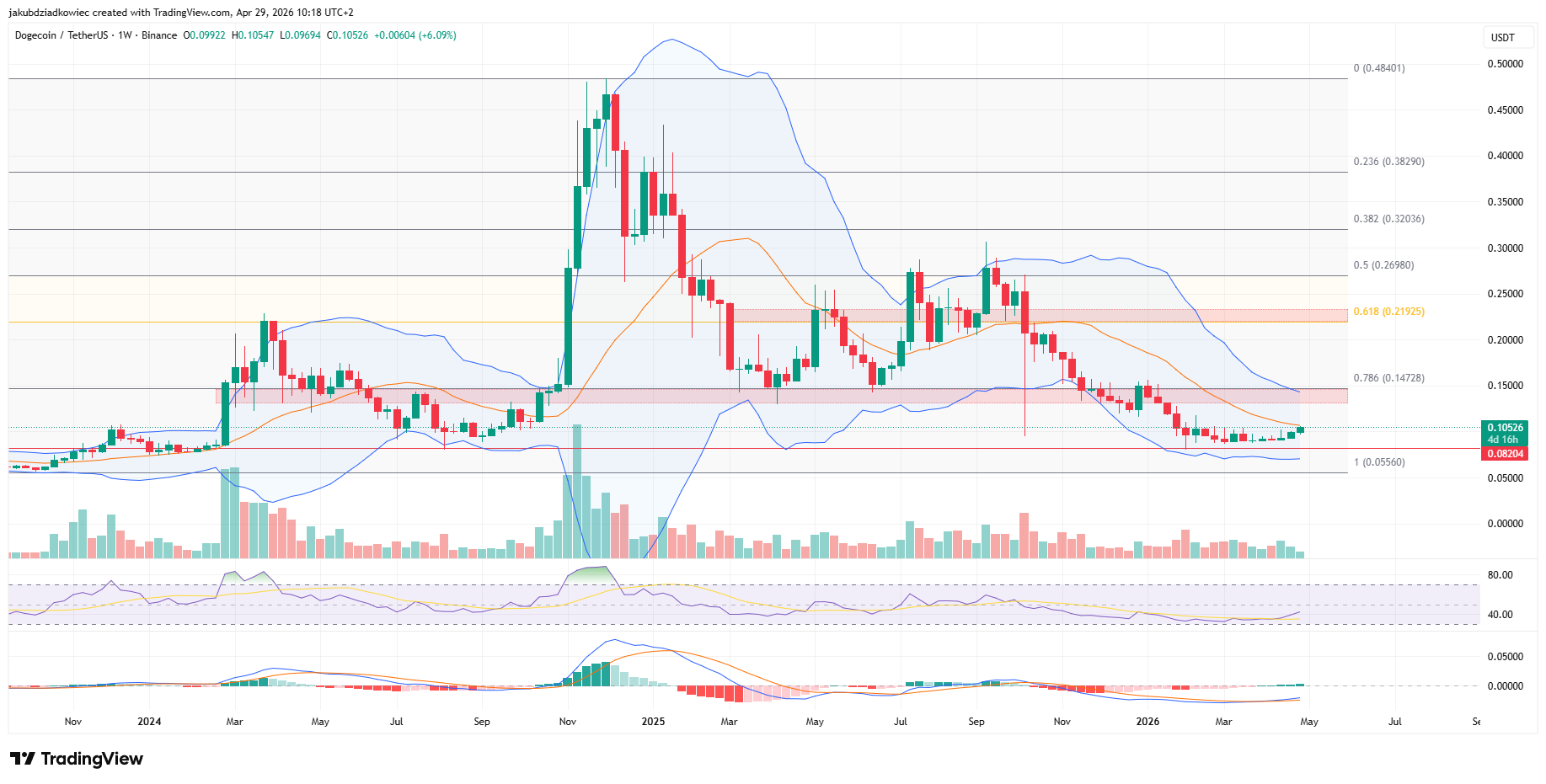
The daily chart adds a near-term layer. X user Eviosionya shared a DOGE/USDT daily chart on Bybit, asking whether a breakout could come “today.” Price at $0.10216 had curved up from a rounded base around $0.0884 and tagged the $0.10500 ceiling that capped April’s range.
A daily close above that ceiling would open a path back toward the $0.11543 supply zone, an outcome that would confirm the weekly compression setup outlined above.
“Breakout today?”
Pudgy Penguins (PENGU) Confirms Breakout, Eyes $0.013
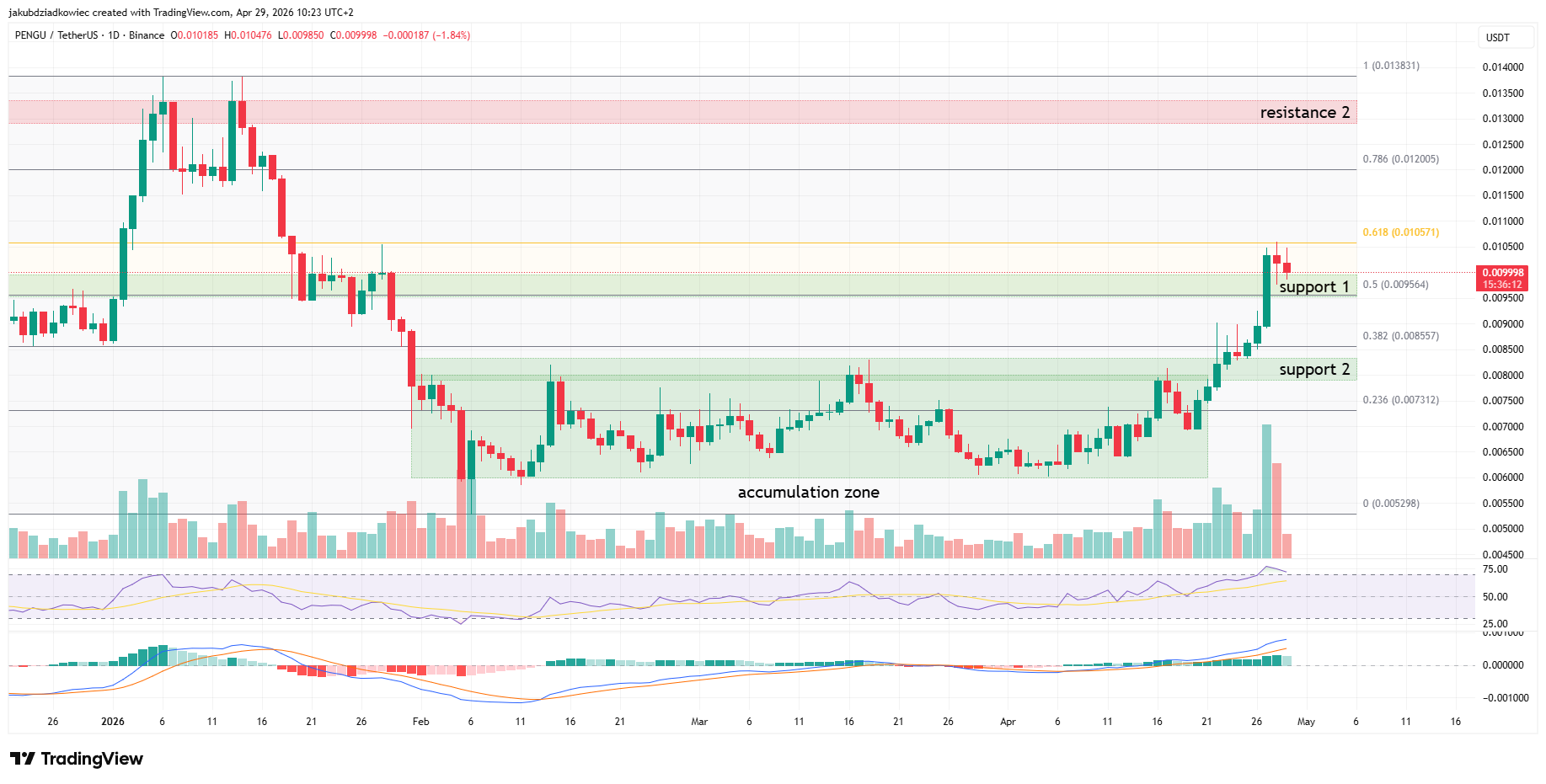
Pudgy Penguins printed a clean breakout on the daily chart. Price cleared a multi-month resistance and now retests it as support, marked as the green Support 1 zone near $0.01.
A successful retest opens the path to the next resistance at $0.013, which lines up with the 0.786 Fibonacci retracement and the prior swing highs from January.
The setup mirrors a pattern flagged in BeInCrypto’s previous PENGU technical analysis from April 23, when the token cleared $0.008 and used the same level as a launchpad.
If the pattern repeats, the 0.5 Fibonacci retracement at $0.0096 should hold as support, driving price into the next resistance area.
Volume printed a sharp spike during the breakout, and both the RSI and MACD remain in healthy bullish territory.
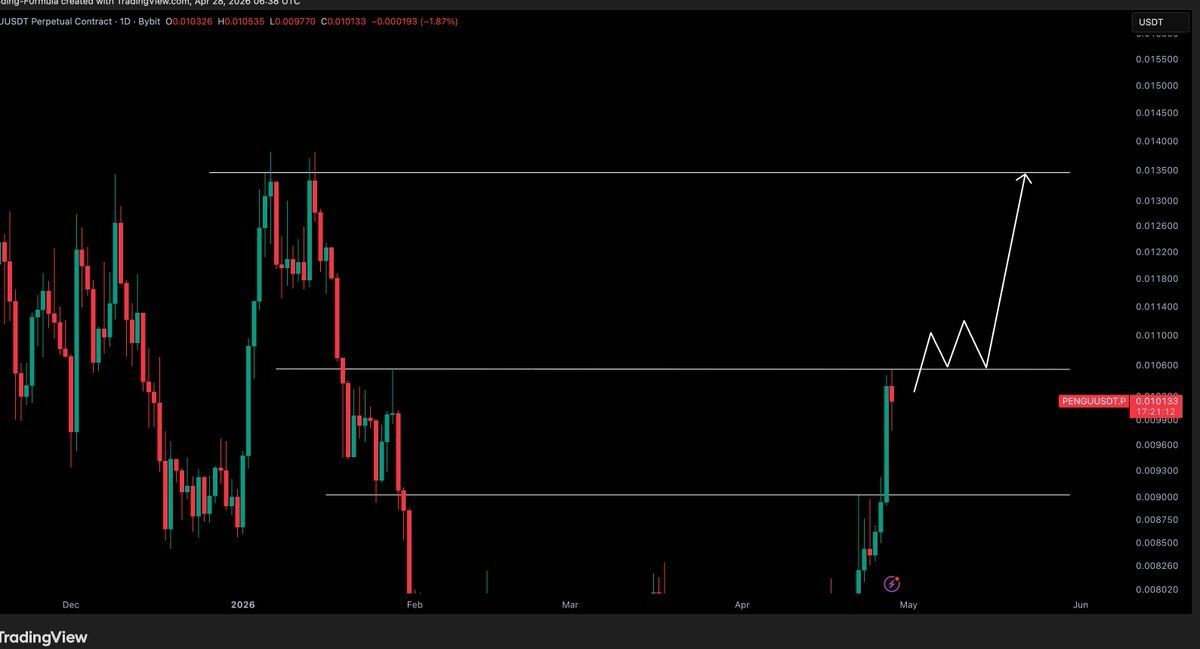
The bullish view found echo on X. CryptoTony shared a Bybit daily chart projecting a path back to the $0.0134 highs, calling PENGU one of the strongest altcoins on his radar.
“$PENGU / $USD – Update One of the strongest Altcoins at the moment. At resistance, but again if we can flip this level then this opens up a solid move to the next highs at $0.0134c?”
SkyAI Stretches Higher After 290% April Rally
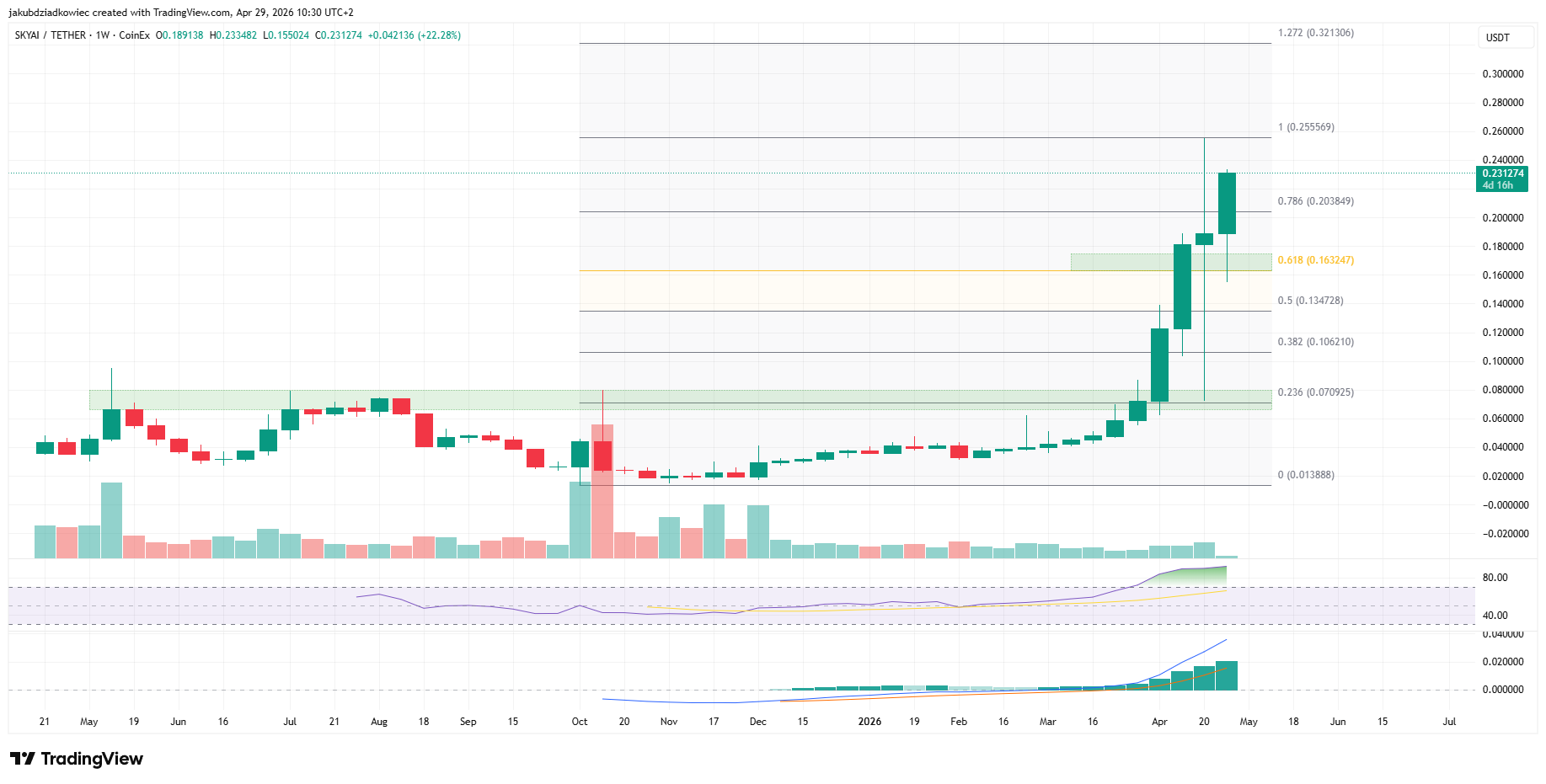
SkyAI has gone parabolic since February 2026. Recent weekly candles printed gains of 70%, 48%, 4%, and 22%, compounding into a roughly 290% advance over the month and placing the token among April’s top meme coin performers.
Such moves rarely sustain at the same pace, but the weekly structure still looks healthy rather than visibly exhausted.
Two support zones stand out. The immediate floor sits at the reversed 0.618 Fibonacci near $0.16. The stronger structural support sits at the reversed 0.236 Fibonacci near $0.07, a level that previously rejected the price three times before flipping into support. SkyAI tested it on April 20 and bounced.
If bulls clear the all-time high near $0.255, the next measured target is the 1.272 Fibonacci extension at $0.32.
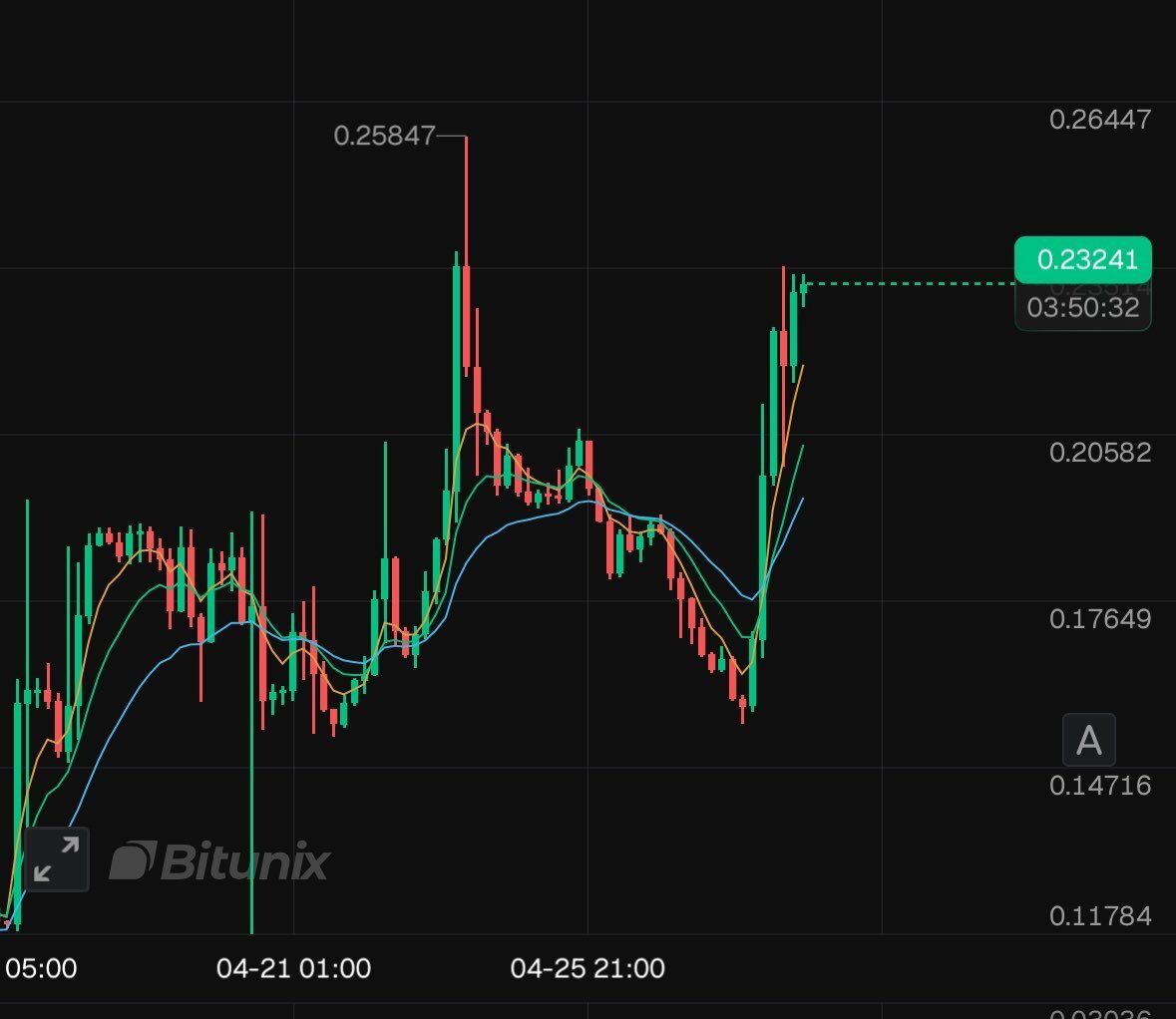
A short-term warning came from X user CCally. The 4-hour chart shows SkyAI pushing into the $0.23 to $0.25 supply zone after a vertical impulse with no real pullback, a setup CCally flagged as potentially overextended and at risk of a sharp reversal.
“$SKYAI looking a bit tired up here big impulsive move straight into resistance + no real pullbacks… that’s where traps get set 4H pushing into previous supply around that 0.23–0.25 zone momentum still strong but you can feel it starting to stretch these vertical candles don’t last forever… they snap”
To Sum it Up
The three setups offer distinct risk profiles for May.
DOGE remains a slow-moving compression trade where a $0.10 reclaim is the key trigger and $0.14 the first measured target. PENGU trades on momentum, with the $0.01 retest holding the trend intact and $0.013 the obvious magnet.
SkyAI carries the highest reward and the highest risk, with bulls eyeing $0.32 if $0.16 holds, and a deeper retest of $0.07 possible if the parabolic structure cracks.
The post Top 3 Meme Coins to Watch in May 2026 appeared first on BeInCrypto.

Prediction markets are emerging as one of the most active on-chain applications, driven by a surge in retail participation even as broader crypto markets stay muted. A joint report by Bitget Wallet and Polymarket shows March trading volumes in on-chain prediction markets at $25.7 billion, with more than 80% of users categorized as retail—defined as those trading less than $10,000.
These figures align with data from Dune Analytics, which pegged March trading volume at $23.7 billion, up from $1.9 billion a year earlier. More telling than the raw totals is a shift in user behavior: instead of chasing single, high-profile events, traders are returning more frequently and crossing multiple categories. Average active days per user nearly quadrupled in Q1, rising from 2.5 to 9.9, suggesting deeper and more consistent participation.
Key takeaways
- March on-chain prediction market volume reached $25.7 billion, with retail users comprising over 80% of participants.
- Dune Analytics tracks March volume at $23.7 billion, marking a sharp year-over-year increase from $1.9 billion.
- User engagement is increasing: average active days per user rose from 2.5 to 9.9 in the first quarter.
- Sports markets led activity at $10.1 billion in the quarter, while political markets accounted for about $5 billion.
- Industry projections point to rapid growth, with potential volumes of $240 billion annually in 2024 and longer-term upside toward trillions, supported by capital inflows to major platforms.
From episodic bets to a continuous forecast engine
The new findings depict prediction markets evolving beyond event-driven bets into an ongoing system for tracking real-world developments. This transition appears tightly correlated with how crypto wallets serve as primary access points for users, lowering barriers to entry and enabling broader participation across multiple market segments.
Sports betting, in particular, has become a cornerstone of activity. With a steady stream of global events, the sports category generated $10.1 billion in trading volume for the quarter. Political markets also sustained momentum, contributing $5 billion in the same period. The data imply a demand not just for gambling-style bets but for continuous hedging and information discovery tied to real-world outcomes.
Platform dynamics and access: Polygon, wallets, and the centralized-versus-decentralized debate
Among the leading platforms, Polymarket operates directly on-chain via the Polygon network, enabling users to place bets on real-world outcomes without intermediaries. This on-chain approach contrasts with centralized marketplaces such as Kalshi, highlighting a broader spectrum of architectures shaping the space. Polymarket’s Polygon-based model emphasizes user sovereignty and on-chain settlement, aligning with growing demand for transparent, auditable markets.
The sector’s governance and integrity frameworks have also come into sharper focus. Polymarket has recently updated its governance framework to address risks related to insider trading and market manipulation, reflecting a push toward stronger market integrity as the community scales. Regulatory dynamics, particularly growing acceptance from the U.S. Commodity Futures Trading Commission, have contributed to this momentum and are expected to influence how other platforms approach compliance and risk controls.
Regulatory momentum, capital inflows, and the race to scale
Regulatory clarity appears to be a meaningful tailwind for on-chain prediction markets. As authorities increasingly engage with the sector, platforms are pursuing stronger governance and transparency measures to align with potential safeguards around market integrity. In parallel, major players in the space have attracted substantial investment. Polymarket and Kalshi, two of the sector’s largest platforms, are reportedly raising significant capital at valuations exceeding $20 billion, underscoring confidence in the long-run viability of prediction markets as a crypto-native financial infrastructure.
The growth narrative is supported by projections from industry observers, who anticipate volumes reaching hundreds of billions annually in the near term. If the trajectory continues, prediction markets could become a persistent engine for on-chain activity, with wallets serving as the primary gateways for a broad user base that engages across sports, politics, economics, and beyond.
Implications for traders, builders, and the broader market
The reported shift toward higher-frequency participation has several practical implications. For traders, the expanding array of accessible, on-chain markets could improve liquidity and price discovery across more event categories. For developers and platform builders, the emphasis on governance and anti-manipulation mechanisms will shape product design, risk controls, and incentive structures as the market matures.
For investors, the growing demand for on-chain prediction markets may reflect a broader appetite for crypto-native information markets that combine financial payoff with real-world data. The sustained activity in sports and political markets suggests that the ecosystem is expanding beyond novelty use cases, potentially attracting new cohorts of users who perceive these markets as information tools as well as speculative venues.
Looking ahead, observers will be watching regulatory developments, platform governance enhancements, and continued evidence of user growth across more geographies and event types. The sector’s next milestones could include broader regulatory clarity, new funding rounds for leading platforms, and the emergence of additional use cases that leverage the on-chain trust model to deliver real-world forecasting insights.
Sources: Bitget Wallet and Polymarket joint report; Dune Analytics data on March trading volumes; platform governance updates and market coverage on Polymarket and Kalshi; regulatory context from the U.S. CFTC.

Shares of SoFi plunged more than 15% Wednesday after the company declined to raise its full-year outlook — a move CEO Anthony Noto said reflects macro reality, not weakening fundamentals.
“We did not raise the full-year guidance because when we originally gave the full-year guidance, we were anticipating at least two Federal Reserve rate cuts,” he told Jim Cramer. “And now we’re assuming that there will be no rate cuts.”
The digital finance company reported results that were largely in-line with expectations, posting earnings of 12 cents per share and $1.09 billion in net revenue. Despite what Noto described as a “remarkable” quarter — including meeting its “Rule of 40” target for the 18th consecutive quarter — investors focused on the unchanged outlook.
Noto said the decision underscores a shift in macro assumptions rather than any deterioration in the business itself.
“To raise the bar in an environment that was uncertain on the interest rate front and what’s going on with the Middle East, we just didn’t see it as a prudent thing to do,” he said.
The more cautious stance comes even as SoFi continues to deliver strong growth, including 41% revenue growth and 31% margins, alongside continued gains in members and product adoption. The company also generated more than $1 billion in cash revenue for the second consecutive quarter.
“We’re really hitting on all cylinders,” Noto said.
Welcome to our institutional newsletter, Crypto Long & Short. This week:
- Jordan Brewer on the missing piece in token markets: institutional-grade investor relations.
- Martin Burgherr on crypto markets maturing, becoming more efficient and lower risk for institutions.
- Top headlines institutions should pay attention to by Francisco Rodrigues.
- Collector Crypt: revenue recovery meets token re-rating in Chart of the Week.
Expert Insights
Guide, deliver, repeat: the hidden driver of token performance
By Jordan Brewer, investment analyst, Runa Digital Assets
In early March, just three months after a Solana Breakpoint mainstage appearance by Ranger Finance co-founder Fathur Rahman, and two months post-ICO, tokenholders forced the liquidation of the protocol’s treasury. How does a 14x oversubscribed ICO unravel so quickly? The answer: poor investor relations.
Institutional-grade investor relations remains the missing piece in token markets. Crypto has spent years in a venture-style framework, but protocols now seek public market investors to provide more durable capital. A key part of investor relations is a regular investor call where management walks through forward guidance — teams at Maple Finance and EtherFi are leading here. These calls are solid, but this is just the start, and the stakes are high. Done well, token valuations are rewarded; done poorly, the downside is steep.
It pays to give guidance (as long as you beat it)
Research shows the value of forward guidance isn’t just in providing it, it’s in its accuracy. Bartov, Givoly, and Hayn (2002) found that firms that consistently meet or beat their own guidance enjoy a measurable stock price premium over firms that don’t. This premium compounds for “habitual beaters,” meaning the market increasingly trusts and rewards management teams that repeatedly deliver. Additionally, beating guidance is a leading indicator of future stock performance, regardless of whether the beat was genuine or a result of earnings or expectations management. Skinner and Sloan (2002) also demonstrated the inverse: growth stocks that disappoint on earnings expectations experience an asymmetrically large negative price response, far exceeding the upside reward of a positive surprise. Guidance accuracy is a proxy for management credibility, and credibility is a direct input to valuation multiples.
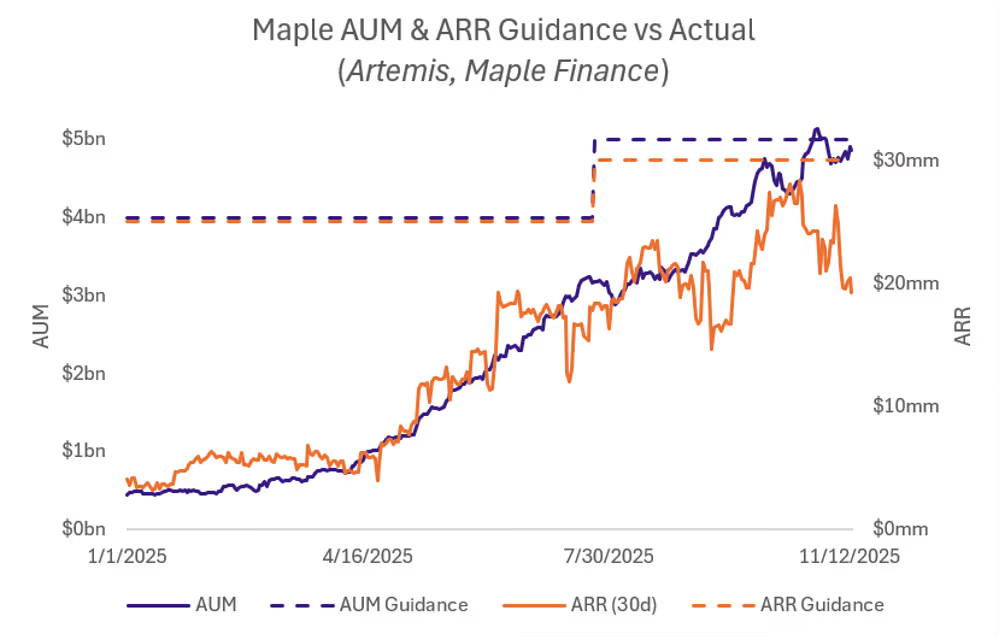
Crypto is beginning to produce its own version of this dynamic. In December 2024, when Maple’s AUM was $460 million and their ARR was $4 million, Maple set guidance of $4 billion in AUM and $25 million in ARR for 2025 and later raised guidance to $5 billion in AUM and $30 million in ARR. Maple delivered, hitting $5 billion in AUM and $28 million in 30 day annualized revenue in October (see table below). That’s a guide-and-deliver cadence that any public market investor would recognize and reward. From December 2024 to June 2025, the SYRUP token price rose from $0.10 to a high of $0.60, outperforming competitors like AAVE by 475%.


EtherFi is a good example of this dynamic. On their March 2026 tokenholder call, the team projected a 55% reduction in customer acquisition cost while raising their advertising budget 420% throughout 2026, which would imply 11x year over year customer growth. That’s the kind of specific guidance that gives investors something concrete to hold them to.
However, guidance without delivery is just marketing. Investor relations in crypto doesn’t end with a dashboard, that’s where it starts. Guidance and accountability are at the heart of credibility for protocol teams, and it is credibility that builds conviction in public investors.
Principled Perspectives
Institutions are separating custody from execution in crypto
By Martin Burgherr, chief clients officer, Sygnum Bank
There is a quiet but significant shift underway in how institutional capital moves through crypto markets. Major trading firms are increasingly separating where they hold assets from where they execute trades. More than a tactical change, it signals a broader evolution in digital asset market structure.
For most of crypto’s institutional history, there has been a basic architectural assumption: to access liquidity, you keep capital on the exchange. Historically, if you want to trade on an on-chain options exchange or run strategies across multiple venues, you wire the collateral to each exchange and leave it there. The model works, until you ask what it costs.
That cost is not just counterparty risk, though that matters too. It is capital inefficiency. Every dollar posted as margin on an exchange sits idle, earns nothing and cannot be redeployed. For an institutional trading desk managing hundreds of millions in positions, the opportunity cost is enormous — and in a rising-rate environment, it is getting harder to justify.
The infrastructure is catching up
The separation of custody and execution is not theoretical. Firms including Wintermute and Nomura’s digital asset arm Laser Digital are already operating this way, using collateral held in regulated bank custody while maintaining full access to exchange liquidity. BlackRock’s BUIDL tokenized money market fund, which sits at roughly $2.5 billion AUM, is now accepted as off-exchange collateral. The infrastructure is not being built by startups. It is being built by the institutions that intend to use it.

When collateral moves into regulated custody, it can take a different form. U.S. Treasuries or tokenized money market fund shares can serve as trading collateral while earning yield. The collateral does not just sit in a vault — it remains productive while still backing trading activity. Capital that previously sat inert can now generate returns, reducing the effective cost of maintaining trading positions. This is not a marginal efficiency gain. It fundamentally changes the economics of running an institutional crypto trading operation.
A maturing market structure
Crypto is beginning to follow a familiar pattern. Traditional finance solved this problem long ago — equities trade on exchanges, assets settle through custodians. The two functions live in different places, governed by different entities. That separation is what makes institutional participation possible at scale.
According to EY-Parthenon’s 2026 institutional investor survey, 73% of institutional investors plan to increase their digital asset allocations this year, with respondents getting more selective about counterparty risk. The infrastructure is scaling to meet them. The migration is already underway.
Headlines of the Week
This week’s headlines highlight that while the bridges between traditional finance and the crypto sector keep on growing, the devastation caused by smart contract exploits is hitting the market.
- U.S. military runs a Bitcoin node, sees crypto as ‘power projection’ vs China: Admiral Samuel Paparo, head of U.S. Indo-Pacific Command, told Congress that INDOPACOM is operating a live node on the Bitcoin network for cybersecurity testing and views the protocol as a tool of American power projection against China.
- Aave raises nearly 80% of the $200 million it needs to cover bad debt left by Kelp DAO exploit: The DeFi United recovery initiative has gathered roughly $160 million of the $200 million needed to recapitalize rsETH and erase the bad debt, with Mantle and the Aave DAO supplying 55,000 ETH, around $127 million, of the total.
- More than 100 crypto firms urge Senate to move on U.S. market structure bill: A coalition including Coinbase, Ripple, Kraken, Andreessen Horowitz and Paradigm wrote to the Senate Banking Committee pressing for a markup of the Clarity Act, warning that without a federal crypto framework, investment and jobs will move offshore to jurisdictions like the EU that already have one.
- JPMorgan says persistent security flaws curb DeFi’s institutional appeal: Wall Street’s largest bank told clients that repeated bridge and infrastructure exploits, headlined by the KelpDAO attack that wiped roughly $20 billion in TVL within days, and flat ETH-denominated growth are pushing capital toward Tether’s USDT and keeping institutions on the sidelines.
- EU’s largest measures against Russia yet include escalation of crypto sanctions evasion: Brussels’ 20th sanctions package imposes a sectoral ban on all Russia-based crypto service providers and DeFi platforms, prohibits transactions in the digital ruble and the RUBx stablecoin, and designates the Kyrgyz exchange TengriCoin, the first time a third-country VASP has been hit for facilitating the Garantex–Grinex–A7A5 evasion network.
Chart of the Week
Collector Crypt: revenue recovery meets token re-rating
After peaking in September 2025, Collector Crypt’s weekly revenue pulled back sharply before grinding back to ~$1 million/week since March — with the CEO’s revenue-funded buyback programme providing a mechanical bid under CARDS throughout the recovery. The recent price spike was then turbo-charged by a community update on April 24 claiming $146.9 million Q1 revenue and $8.6 million profit, though the token remains 73% below its all-time high.

Listen. Read. Watch. Engage.
- Listen: Did you hear? Consensus Miami is heating up. Recently added speakers include: U.S. Senator Kirsten Gillibrand, U.S. Senator Ashley Moody, and Donald Trump Jr., Co-Founder, World Liberty Financial. Grab 20% off your ticket today!
- Read: In Crypto for Advisors, Vincent Chok from First Digital unpacks the rise of “agentic finance,” where #AI agents are moving beyond advice to execute financial transactions.
- Watch: CoinDesk’s Public Keys from NYSE with host Jennifer Sanasie. Brett W. Redfearn, President of Securitize, joins to discuss the $30 billion in tokenized assets on chain, Michael Reinking from NYSE gives a digital assets macro outlook, and AVAX One CEO Jolie Kahn explains a treasury strategy around Avalanche.
- Engage: David LaValle will be speaking at June’s ICI Conference in Nashville. Let’s connect onsite!
Looking for more? Receive the latest crypto news from coindesk.com and market updates from coindesk.com/institutions.
Note: The views expressed in this column are those of the author and do not necessarily reflect those of CoinDesk, Inc., CoinDesk Indices or its owners and affiliates.


Hyperliquid has published the fee structure for its outcome tokens, the assets that underpin prediction market-style trading on the platform, in a sign that a mainnet launch is getting closer.
Prediction markets have become one of crypto’s fastest-growing areas, with trading volume surging more than 300% in 2025 to $63.5 billion, and Hyperliquid is building the infrastructure to compete with incumbents such as Kalshi and Polymarket.
The key detail in the structure is that opening a position costs nothing. Fees only apply when closing or settling a trade. The document outlines six scenarios covering minting, trading, burning and settlement.
Traders using Hyperliquid’s “aligned quote tokens” get better rates, with taker fees 20% lower and maker rebates 50% higher than standard. The full fee formula has been published for developers.
The broader significance is that HIP-4, the upgrade introducing outcome tokens, would let users trade binary contracts on real-world events alongside Hyperliquid’s existing perpetuals and spot positions in a single account as it looks to compete with platforms like Polymarket, which said earlier this week that perpetual trading is “coming soon.”
Hyperliquid’s previous upgrade, HIP-3, which opened permissionless perpetuals to developers, has grown to more than 35% of all platform trading volume since its introduction in October 2025.
Outcome tokens are currently on testnet only. No mainnet date has been confirmed.
Crypto World
RealOpen and TRON Verify $9.4M in USDT Across Crypto-Enabled U.S. Real Estate Transactions
TLDR:
- RealOpen and TRON’s Holiday Campaign verified approximately $9.4M in USDT from 27 KYC-verified users.
- A total of 69 real estate agents were onboarded through the 2025 TRON Real Estate Challenge program.
- TRON processes over $22B in daily transfer volume, supporting 376 million self-custodial accounts globally.
- TRON handles roughly 65% of global USDT retail transfers under $1,000, making it a leading stablecoin network.
RealOpen and TRON have wrapped up their “Fast Moves, Fast Payments” Holiday Campaign, verifying approximately $9.4 million in USDT.
The campaign ran from November 17, 2025, through February 28, 2026. It offered eligible U.S. homebuyers up to 50,000 USDT in rewards.
Buyers had to purchase property through RealOpen using USDT on the TRON blockchain. The campaign showed how blockchain can support both everyday and high-value transactions.
Campaign Results Show Growing Crypto Adoption in Real Estate
The campaign recorded 343 user sign-ups on the RealOpen platform overall. Out of those, 27 users completed KYC verification successfully.
Those verified users accounted for the $9.4 million in USDT on TRON. Additionally, 69 real estate agents joined through the 2025 TRON Real Estate Challenge. This shows a rise in industry participation in crypto-enabled property deals.
RealOpen allows buyers to purchase any property currently on the market. Buyers can fund purchases directly using digital assets without complication.
The platform combines traditional real estate reliability with crypto speed and efficiency. This approach makes blockchain-powered homebuying accessible to a wider audience.
Johnny Schiro, Executive Vice President at RealOpen, spoke on the campaign’s outcome. “The Fast Moves, Fast Payments campaign showed why TRON is such a strong settlement layer for real-world assets,” Schiro said.
He noted that hundreds of new users engaged and dozens of agents came on board. He added that “modern capital needs modern payment rails – and TRON is well-positioned to power that shift.”
According to TRON DAO, the collaboration showed TRON’s real-world use across different payment types.
It covered everything from small retail transfers to large real estate closings. This range further supports TRON’s standing as a versatile settlement layer.
TRON’s Infrastructure Backs Large-Scale Stablecoin Transactions
TRON processes more than $22 billion in daily transfer volume across its network. The network has a circulating USDT supply of $86 billion currently active.
Over 376 million self-custodial accounts use the TRON network globally. It also handles around 65% of global USDT retail transfers under $1,000.
The network’s near-instant finality makes it suitable for time-sensitive transactions. Low transaction costs further support its use in real estate closings.
These features position TRON as a practical settlement layer for high-value deals. Earlier in 2025, RealOpen already closed multiple real estate deals funded in USDT on TRON.
Pearl Homes’ Hunter’s Point development in Florida also promoted crypto acceptance via RealOpen. The net-zero master-planned community on Florida’s Gulf Coast accepted blockchain-based payments.
This expanded crypto settlement into broader residential real estate markets. It reflected a shift toward stablecoin use in mainstream U.S. housing transactions.
As demand for faster and more transparent capital movement grows, stablecoins are gaining traction. The RealOpen and TRON campaign demonstrated this trend in the U.S. housing market. USDT on TRON is proving to be a workable settlement option at scale.

Signs you’re doing well financially #shorts #moneytips

3 family members indicted after protest clash with Turning Point USA journalist in Minnesota

DJ Vlad Claims Nicki Minaj Dumped Kenneth Petty Over Alleged Cheating Scandal

Manchester United reach agreement with Casemiro over contract clause amid transfer speculation

US brings back mandatory military draft registration

Steven Gerrard disagrees with Gary Neville over ‘shock’ Chelsea and Arsenal claim | Football


-

 Tech2 days ago
Register Renaming | Hackaday
-

 Fashion5 days ago
Weekend Open Thread – Corporette.com
-
Crypto World4 days ago
Hyperliquid $HYPE Rally Builds Momentum as AI Sector Enters Prove-It Phase
-

 Business6 days ago
Patterson-UTI Energy, Inc. (PTEN) Q1 2026 Earnings Call Transcript
-
 Sports3 days ago
IPL 2026: Ruturaj Gaikwad registers slowest fifty of the season, enters all-time unwanted list | Cricket News
-

 Politics2 days ago
Drax board avoid their own AGM, accused of greenwashing & environmental racism
-

 NewsBeat4 days ago
LK Bennett closes all stores after entering administration
-

 Crypto World6 days ago
Michael Saylor says BTC winter is over. Market analyst disagrees, says bitcoin was in a pullback
-
 Sports7 days ago
Tim Bradley names the current best in the world: “Better than Inoue and Usyk”
-

 Fashion1 day ago
Kylie Jenner’s KHY Enters a New Era with ‘Born in LA’
-
Entertainment7 days ago
Michael B. Jordan and Austin Butler's “Miami Vice” movie will bring the action back to the '80s
-
 Entertainment4 days ago
Mariah Carey Slams Deposition Claims In Brother’s Lawsuit
-
Business7 days ago
Altimmune prices $225 million public offering at $3 per share
-
Entertainment7 days ago
Russell Brand Had Sex With 16 Year Old When He Was 30
-
Crypto World6 days ago
Is Algorand One of the Few Quantum-Resistant Blockchains? Here’s What the Data Shows
-

 Tech2 days ago
Images of Samsung’s rumored smart glasses have leaked
-

 Business1 day ago
Most Commercial Energy Audits Miss the Real Losses
-
 NewsBeat6 days ago
Trump threatens to review UK’s claim to Falkland Islands and punish Nato allies over Iran war disagreement
-

 Business7 days ago
SL Green Realty: Dividend Cut And Record Leasing Fuel Their Potential Recovery
-

 Sports7 days ago
2026 NFL Draft tonight: Time, TV channel, where to watch, order
You must be logged in to post a comment Login