
Crypto World
Maker and taker fees compared across 8 crypto exchanges



Disclosure: This article does not represent investment advice. The content and materials featured on this page are for educational purposes only.
Crypto exchange maker and taker fees compared across eight major platforms for spot and futures trading in 2026.
Summary
- Compare maker and taker fees across eight major crypto exchanges, including MEXC, Binance, Coinbase, OKX, Bybit, and KuCoin.
- MEXC leads on published trading fees, while Binance, OKX, and Bybit offer competitive rates alongside deep liquidity and active trading markets.
- Crypto traders can compare exchange fees and first discount tiers to find the most cost-effective venue for spot and futures trading.
The trading fee is the one cost you pay on every single order, win or lose, so over a year of activity it quietly becomes one of the biggest line items a trader faces. Most exchanges split that fee into two rates: a maker fee when your order adds liquidity to the book and rests there, and a taker fee when your order removes liquidity by filling against what is already there. A resting limit order is usually the maker side, and a market order that lifts the offer is usually the taker side. The gap between the two, and how far each falls as you trade more, is what separates a cheap venue from an expensive one.
This guide compares the maker and taker fees across eight major crypto exchanges, on both spot and futures, and looks at the first discount each one lets you reach, because the rate you can actually unlock matters more than a headline VIP tier you never will. Every figure was checked against exchange documentation, and where fees vary by product or region, we flag it.
Risk warning: Trading crypto, especially with leverage, carries a high risk of loss. Fees are only one part of the cost of trading. This article is informational and is not financial advice.
The fee comparison
The table is sorted by regular futures taker fee, cheapest first, since the taker rate is the number that hits most market orders. These are standard entry-tier rates before token discounts or VIP steps, checked against each venue’s fee schedule and cross-referenced with independent trackers like CoinGecko’s exchange rankings.
Exchange
Spot maker / taker
Futures maker / taker
First discount you can reach
MEXC
0% / 0.050%
0% / 0.020%
Already near zero; volume tiers from there
Coinbase
0% / up to 0.60%
0% / 0.030%
Volume tiers from $10,000/month
Binance
0.10% / 0.10%
0.020% / 0.050%
10% off paying futures fees in BNB
OKX
0.080% / 0.10%
0.020% / 0.050%
OKB discount plus volume tiers
Bybit
0.10% / 0.10%
0.020% / 0.055%
VIP 1 at $100,000 assets
BloFin
0.10% / 0.10%
0.020% / 0.060%
VIP 1 at $50,000 assets, taker to 0.050%
Bitget
0.10% / 0.10%
0.020% / 0.060%
First taker cut only at VIP 2
KuCoin
0.10% / 0.10%
0.020% / 0.060%
KCS discount plus volume tiers
Two numbers can look identical and still cost you differently, because the discount path is where real money is saved or lost. A venue with a slightly higher regular taker but a discount you can actually reach can end up cheaper than one with a lower headline rate you will never qualify for.
What each exchange charges
MEXC is the cheapest on paper, with 0% maker and 0.050% taker on spot and 0% maker and 0.020% taker on futures as a standing policy rather than a promotion. There is no token to hold or threshold to clear for the base rate, and it pairs the pricing with a vast altcoin catalog, though liquidity thins on the smallest listings. If your only goal is the lowest published rate, MEXC leads.
Coinbase is a study in contrast: its perpetual futures are cheap at 0% maker and 0.030% taker, but Advanced Trade spot taker fees run as high as 0.60% at the lowest tier, so it is inexpensive for perps and pricey for casual spot buys. The premium buys regulatory standing and a polished, US-listed platform, and spot fees fall with monthly volume, but casual buyers pay the most of anyone here.
Binance sits at 0.10% spot and 0.020% maker with 0.050% taker on futures such as BTC USDT, and paying futures fees in BNB shaves off a further 10%. Its VIP ladder scales down further with volume or BNB holdings, so heavy traders push the effective rate well below the entry tier. Paired with the deepest liquidity in crypto, it is cheap where it counts for active traders.
OKX matches Binance on futures at 0.020% and 0.050%, with slightly lower spot maker fees at 0.080%, and layers on OKB-based discounts. Its VIP 1 is reachable at 50,000 USDT in assets on the futures side, one of the friendlier asset paths among the majors, which makes its effective rate competitive for a funded account.
Bybit charges 0.020% maker and 0.055% taker on futures, competitive on paper, but its first VIP discount needs $100,000 in assets, so most retail accounts stay on the regular rate. What offsets the distant discount is a fast matching engine and deep books on BTC USDT, so execution quality is part of the value even at the regular rate.
BloFin lists a regular futures rate of 0.020% maker and 0.060% taker on pairs such as BTC USDT, which is at the higher end of this group, but its discount path is the most reachable here. VIP 1 drops the taker to 0.0500% and is available with $50,000 in account assets, half of what the comparable Bybit tier requires, so a funded mid-size account actually reaches a cheaper rate rather than just seeing one advertised. You can compare its published schedule at this low-fee crypto exchange.
Bitget matches BloFin’s 0.020% and 0.060% regular futures rate, but its first VIP badge does not move the taker at all, which only falls at VIP 2, so the first upgrade many traders reach changes nothing on cost. In its favor, it lists more perpetual markets than almost any rival and adds BGB-token discounts, so the value is in the range it offers rather than the lowest single rate.
KuCoin also sits at 0.020% maker and 0.060% taker on futures, with spot around 0.10% and discounts through KCS-token holdings or 30-day volume. It supports up to 100x leverage across a broad perpetual catalog, so it is a capable mid-tier venue even if its fees are not the lowest here.
What it takes to reach your first discount
Most fee round-ups stop at the headline rate, but the tier you can actually reach is where real money is saved. Exchanges gate their first discount behind either a balance of assets held on the platform or a rolling 30-day trading volume, and those thresholds vary enormously. The table below shows the easiest path to a first meaningful discount on each venue, which is the part most comparisons leave out.
Exchange
Easiest path to a first discount
What changes
MEXC
None needed
Already 0% maker and 0.020% futures taker at baseline
BloFin
$50,000 in account assets
Futures taker drops from 0.060% to 0.050% at VIP 1
OKX
50,000 USDT in account assets
Reduced futures maker and taker at VIP 1
Bybit
$100,000 in assets
VIP 1 cut, roughly 0.040% futures taker
Binance
5 BNB held plus $5 million 30-day futures volume
VIP 1 cut
Bitget
Assets or volume, but no taker cut until VIP 2
First badge leaves the 0.060% taker unchanged
KuCoin
30-day volume or KCS holdings
Tiered cuts from 0.020% and 0.060%
Coinbase
$10,000+ monthly volume, or a Coinbase One subscription
Tiered cuts, or zero-fee allowances
The pattern that matters is this: an asset-based path to a discount is rare, and where it exists the threshold decides everything. BloFin and OKX let a $50,000 balance unlock a lower futures rate, Bybit asks for double that, and Binance, KuCoin, and Coinbase mostly gate discounts behind trading volume you have to grind out. If you hold a funded account but do not trade millions a month, the asset-path venues are where your first discount is genuinely within reach rather than just advertised.
The standouts
Different traders optimize for different things, so the fee winner depends on the job:
- Lowest headline fees: MEXC, with 0% maker and 0.020% futures taker as a baseline, no token or threshold required.
- Best reachable discount for a funded account: BloFin, because a $50,000 balance unlocks a 0.050% futures taker where the comparable Bybit tier needs $100,000, so the discount is real rather than aspirational.
- Cheapest where it counts at scale: Binance, pairing a low 0.050% futures taker with the deepest liquidity, so your fills land near the mark as well as cheaply.
The lesson is that “lowest fee” and “lowest fee you will actually pay” are different questions, and the second one depends on your balance and volume.
Questions about trading fees
What is the difference between a maker and a taker fee? A maker order adds resting liquidity to the order book and is usually charged less or even rebated, while a taker order removes liquidity by filling immediately and is charged more. Binance Academy explains the maker-taker split in plain terms, and every rate in the table above is that split rather than a flat commission.
How do I actually pay the lower maker fee? Use resting limit orders instead of market orders where you can, since a limit order that does not fill immediately typically posts as a maker. Kraken’s help center has a clear walkthrough of how maker and taker fees are applied.
Do exchange-token discounts really help? They can, if you already hold or are willing to hold the token. BNB on Binance, OKB on OKX, and KCS on KuCoin all cut fees, but they add token exposure, so weigh the discount against holding an asset you might not otherwise want.
Are there fees beyond maker and taker? Yes. Funding on perpetual futures is a separate periodic charge between longs and shorts, and deposits, withdrawals, and network fees sit outside the trading fee entirely, so the maker-taker rate is not the whole cost of trading.
How to choose on fees
- Match the rate to your order style. If you mostly post limit orders, weight the maker fee, and if you mostly take liquidity with market orders, weight the taker fee, since that is the one that hits you.
- Look at the discount you can actually reach. A reachable first tier, like BloFin’s $50,000 path to a 0.050% taker, can beat a lower headline rate locked behind a threshold you will not hit.
- Separate spot from futures. Some venues are cheap on one and expensive on the other, as Coinbase’s low perp fees and high spot fees show, so compare the product you actually trade.
- Add up the whole cost. Factor funding, withdrawal, and network fees alongside maker-taker, and use a neutral reference like Investing.com’s crypto section to track the markets you trade while you compare venues.
The bottom line: MEXC wins on the lowest published fees, Binance is cheapest where liquidity matters most, and BloFin offers the most reachable discount for a funded mid-size account, so the right pick depends on your balance, your product, and how you send orders.
Disclosure: This content is provided by a third party. Neither crypto.news nor the author of this article endorses any product mentioned on this page. Users should conduct their own research before taking any action related to the company.


Visa has unveiled a new approach to funding businesses by linking its payment settlement records with blockchain-based lending. The payments company says the move is designed to let lenders use VisaNet settlement data together with onchain transaction information to assess borrowers and extend credit against payment obligations—effectively bringing onchain lending closer to everyday payment flows.
The announcement, made Tuesday, positions stablecoin-linked card programs and onchain credit as parts of a broader payments stack, where settlement data can serve as a source of “working capital” signals rather than relying solely on traditional banking-style documentation.
Key takeaways
- Visa will combine VisaNet settlement data with blockchain lending infrastructure to help finance payment obligations using both offchain settlement records and onchain activity.
- Credit Coop is highlighted as an early example, reporting over $2.5 billion in cumulative settlement volume since 2023 across participating facilities.
- Visa says its stablecoin-linked card network has grown to more than 160 programs, with payment volume up nearly 200% year over year.
- Stablecoin settlement volume has surpassed a $20 billion annualized run rate, according to Visa.
- The initiative suggests a strategic shift: onchain lending could expand from crypto-native collateral models into payment settlement ecosystems.
How Visa’s settlement-linked lending model works
Visa says the initiative will connect data produced through its settlement network with blockchain-based lending systems. In practice, lenders would be able to look at Visa settlement records alongside blockchain transaction data to evaluate borrowers and decide whether to finance their settlement obligations.
Visa’s framing is that settlement information already sits at the core of payment execution. By making that information usable within blockchain lending workflows, lenders can potentially shorten the bridge between a payment being authorized or processed and that activity being converted into credit.
The company did not describe a single universal lending mechanism, but the central idea is clear: settlement outcomes can act as a practical data layer for onchain underwriting, potentially reducing the friction that often exists when traditional credit decisions rely on separate documentation sources.
Early example: Credit Coop’s settlement financing
To illustrate the concept, Visa pointed to Credit Coop, a blockchain-based protocol that extends credit lines to businesses. Visa said Credit Coop has financed more than $2.5 billion in cumulative settlement volume since 2023 across participating facilities.
Visa added that the program involved more than 3,000 borrowing events and 9,000 repayments. While those figures are not a direct measure of the broader Visa ecosystem’s credit performance, they do offer a concrete indicator that settlement-linked credit has been operating at meaningful scale on-chain for some time.
For market participants, the relevance lies in what Visa is attempting: instead of limiting credit models to token-native borrowing against crypto assets, the system would connect lending eligibility to payment settlement signals—potentially broadening the addressable borrower base toward merchant and business use cases tied to card and stablecoin rails.
Visa’s wider stablecoin expansion sets the stage
This settlement-linked lending push arrives alongside Visa’s ongoing stablecoin strategy. During Visa’s fiscal third-quarter earnings call in July, management said the company was “investing in each layer of the stablecoin stack,” spanning blockchains, wallets, infrastructure, and applications. The company also described stablecoins as changing how money moves and creating opportunities to rethink payment infrastructure.
Visa’s stablecoin-related business growth is also reflected in card program and settlement figures. Visa stated that more than 160 stablecoin-linked card programs are now operating on its network. It also said payment volume is up nearly 200% year over year.
On settlement activity specifically, Visa said its stablecoin settlement volume has surpassed a $20 billion annualized run rate. The company also claimed this figure is more than 15 times year-ago levels—an indicator that stablecoin payments are moving from experimentation toward higher-volume operational activity within Visa’s rails.
For readers tracking the implications for onchain lending, the key point is that Visa appears to be treating stablecoin settlement as both a payment use case and a data foundation. The more settlement volume grows, the more underwriting inputs a lender could potentially access within the same payment-driven ecosystem.
Stablecoin volume continues to climb, but the underwriting link is the bet
Visa’s own analytics point to continued momentum in stablecoin transfers. According to Visa’s analytics dashboard, adjusted stablecoin transaction volume reached a record $1.79 trillion in June, and volume over the past 30 days stands at roughly $1.2 trillion.
These totals highlight demand for stablecoin settlement across the wider market. However, Visa’s new lending concept is effectively a bet on something more specific than usage volume: that payment settlement data can be integrated into lending infrastructure in a way that improves credit decisioning and liquidity access for businesses.
That distinction matters. Stablecoin transfer growth alone does not automatically translate into workable credit products. Visa’s initiative aims to bridge that gap by turning settlement records into potential underwriting inputs, then layering that into blockchain-based lending facilities.
Visa also pointed to its participation in the OpenStandard consortium, which plans to issue the OpenUSD stablecoin and includes more than 140 participating businesses. While that effort is separate from settlement-linked lending, it underscores that Visa is pursuing multiple routes to strengthen the stablecoin ecosystem around its payments network.
What to watch next
The next phase will likely be less about announcements and more about practical deployment: how widely the settlement-linked lending approach is adopted, which lending facilities integrate VisaNet settlement data, and whether lenders can scale underwriting using payment settlement signals without sacrificing risk controls. As stablecoin-linked card programs and settlement volume grow, the real test will be whether onchain lending becomes a standard financing layer for payment-driven businesses—not just a niche add-on.


Nansen has integrated Outcome.xyz’s HIP-4 markets into its trading platform, becoming the first front end to support the venue as Hyperliquid opens its outcome-market infrastructure to outside builders.
Summary
- Nansen has become the first front end to support Outcome.xyz’s HIP-4 markets, starting with stock and crypto markets.
- Users can access supported Outcome.xyz markets directly through Nansen Trading alongside its existing onchain intelligence tools.
- Outcome.xyz is among the earliest outside builders to launch markets after Hyperliquid opened HIP-4 deployments permissionlessly.
- Eligible users trading qualifying Outcome.xyz markets through Nansen can participate in a $1 million rewards pool.
- Politics and sports markets are expected to be added as Outcome.xyz expands its HIP-4 offering.
According to a press release shared with crypto.news, the integration is live and initially gives Nansen users access to supported stock and crypto markets from Outcome.xyz alongside the platform’s existing onchain trading tools. Politics and sports markets are expected to be added as the offering develops.
Nansen said the arrangement is part of its plan to let users research and trade different types of markets through the same interface. Eligible traders using qualifying Outcome.xyz markets through Nansen can participate in a $1 million rewards pool, subject to the campaign’s terms.
The rollout comes shortly after Hyperliquid opened HIP-4 deployments to outside venues, creating a permissionless route for builders to launch outcome markets using the network’s infrastructure.
Nansen brings Outcome.xyz HIP-4 markets into its trading platform
Nansen has historically focused on onchain analytics, wallet activity and market intelligence, but the company has been adding execution features to connect its research tools with trading.
Under the Outcome.xyz integration, traders can examine market activity and take positions without moving to a separate front end. Nansen said users can assess who is taking positions on particular outcomes and where conviction is concentrated before executing through Nansen Trading.
“Prediction markets are having a real moment for a reason. People enjoy forming a view and putting it to the test,” Nansen co-founder and CEO Alex Svanevik said.
Svanevik said Outcome.xyz gives traders exposure to outcomes involving stocks, crypto, politics and sports, while Nansen connects that activity with its intelligence tools.
“What we’ve done at Nansen is make that decision a better-informed one, while closing the loop between intelligence and execution,” he added. “Traders can look at who is taking positions on an outcome, which outcomes have the strongest conviction behind them, and trade on that information directly in Nansen.”
Outcome.xyz co-founder Ahmed said distribution is important for a new market category and described Nansen as a natural partner because traders already use it for onchain research.
“For a new market category, distribution matters as much as market design,” Ahmed said. “Outcome, like Hyperliquid, is focused on meeting traders where they already are.”
The integration arrives as Outcome.xyz has quickly taken a leading share of activity among third-party HIP-4 venues.
On Sept. 3, crypto.news previously reported that HIP-4 daily volume nearly tripled within three days of Hyperliquid opening the infrastructure to outside venues on Aug. 29. Daily outcome volume increased from an August average of $545,000 to $1.97 million on Aug. 31, according to research cited in the report.
Outcome accounted for approximately 85% of the reported HIP-4 volume at the time, while another third-party venue, Skew, generated roughly 1%. The early activity came as Outcome ran its $1 million rebate campaign, which paid eligible users approximately one cent for every dollar traded.
HIP-4 has opened outcome market deployment to outside builders
HIP-4 was designed to support contracts tied to outcomes with fixed settlement conditions instead of the continuously priced instruments used for conventional perpetual futures.
The framework supports fully collateralized contracts without leverage, funding payments or liquidations. Contracts settle according to predetermined outcomes, allowing the infrastructure to be used for event-driven markets covering areas such as economic data, crypto, equities, politics and sports where supported.
Hyperliquid began moving toward permissionless HIP-4 deployment earlier this year. In July, the protocol outlined plans for outside deployers to create outcome markets after staking 500,000 HYPE, initially through testnet before the framework progressed toward open deployment.
Deployers can be penalized through slashing if they incorrectly settle a market or fail to settle it within the required period. The framework relies on templates approved by Hyperliquid validators, which limits deployments to predefined types of markets and settlement structures.
The permissionless system began producing outside venues by late August. Hyperliquid received its first reported builder-deployed outcome DEX after OUT registered through the HIP-4 framework, with onchain transactions showing the exchange deployed under the name OUT.
Two outside venues had each posted the required 500,000 HYPE bond by early September, according to research cited by crypto.news. Seven validator-approved templates were available for deployers at the time.
Outcome.xyz is among the earliest builders operating through the framework. Nansen’s support now gives the venue another front end through which traders can access its markets instead of requiring users to interact only through Outcome.xyz itself.
Hyperliquid has expanded from perps into event-based markets
Hyperliquid introduced HIP-4 after building much of its trading activity around spot markets and perpetual futures.
The protocol’s first U.S. macro event market under HIP-4 used the May 2026 CPI reading as its settlement event. Traders could use USDC to take positions on the year-over-year inflation print, with settlement based on official U.S. Bureau of Labor Statistics data.
That market demonstrated how HIP-4 could handle events with a defined expiry and outcome instead of relying on the perpetual structure used for continuously traded assets. The contracts were fully collateralized, meaning traders did not face the liquidation mechanics associated with leveraged perpetual futures.
Hyperliquid subsequently allowed validators to settle markets tied to offchain events, with the network’s validator system handling deployment and final settlement against specified data sources.
The structure differs from HIP-3, Hyperliquid’s framework for permissionless perpetual markets. HIP-3 has been used to create contracts tracking crypto assets as well as equities, commodities, foreign exchange and other traditional-market instruments.
Activity in that segment has already moved heavily into non-crypto products. TradeXYZ, the dominant HIP-3 deployer, recorded $202 billion in trading volume during the second quarter, according to an external research report published in early September. Its equity perpetual volume climbed 377% quarter over quarter to $58.9 billion across 55 markets.
TradeXYZ’s estimated share of Hyperliquid HIP-3 trading rose from 84.5% to 95.1% during the quarter, while open interest reached $2.96 billion at the end of June. The research estimated quarterly revenue at $7.59 million.
HIP-4 now gives builders a separate framework for markets whose value depends on a defined event or result. Outcome.xyz plans to expand from its initial stock and crypto offering into categories including politics and sports, while Nansen said support for the venue’s HIP-4 markets is already live through Nansen Trading.
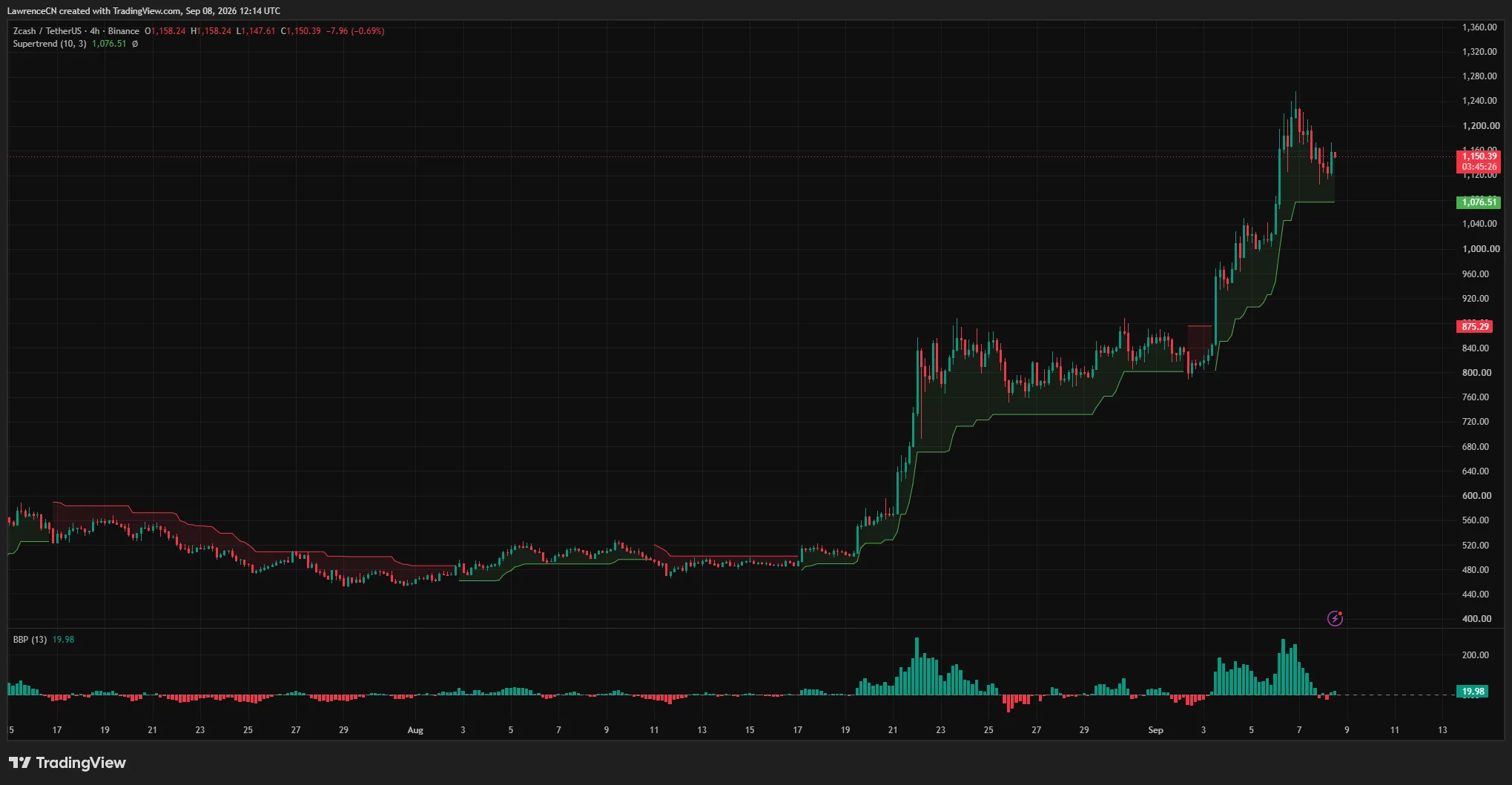
Zcash price traded near $1,150 on Sep. 8 after a sharp six-day rally carried ZEC from about $814 to a multi-year high of $1,249, with derivatives liquidations and a major technical breakout supporting the move.
Summary
- Zcash price gained more than 53% between its Sep. 3 level and the Sep. 6 peak.
- ZEC remains above the 4-hour Supertrend support at $1,076 despite profit-taking.
- The daily MACD remains bullish, while key moving averages sit far below the current price.
- Liquidation clusters near $1,180 and $1,200 could shape the next short-term move.
Zcash price consolidates after reaching $1,249
According to data from crypto.news, Zcash (ZEC) price was trading at $1,150.62 at the time of the daily chart snapshot, up 0.92% during the session. ZEC opened at $1,140.26 and moved between an intraday low of $1,113.66 and a high of $1,174.03.
The token remains about 8% below the $1,249.28 peak recorded on Sep. 6. However, the pullback has not erased much of the rally that began near $813.95 on Sep. 3. Based on those levels, ZEC gained more than 53% at its peak and was still up about 41% by Sep. 8.
Price action on the 4-hour chart shows ZEC consolidating between approximately $1,110 and $1,170 after the initial correction from the high. Buyers have repeatedly entered near the lower end of that range, although attempts to move beyond $1,170 have faced selling pressure.
The rally followed a derivatives-driven short squeeze that liquidated more than $46 million in bearish positions within 24 hours, according to the supplied market data. Forced position closures added buying pressure as ZEC crossed $1,000 and accelerated toward $1,250.
Daily trading volume also rose above $1.2 billion during the advance, reflecting stronger market participation than Zcash had recorded before the breakout.
ZEC technical indicators remain bullish
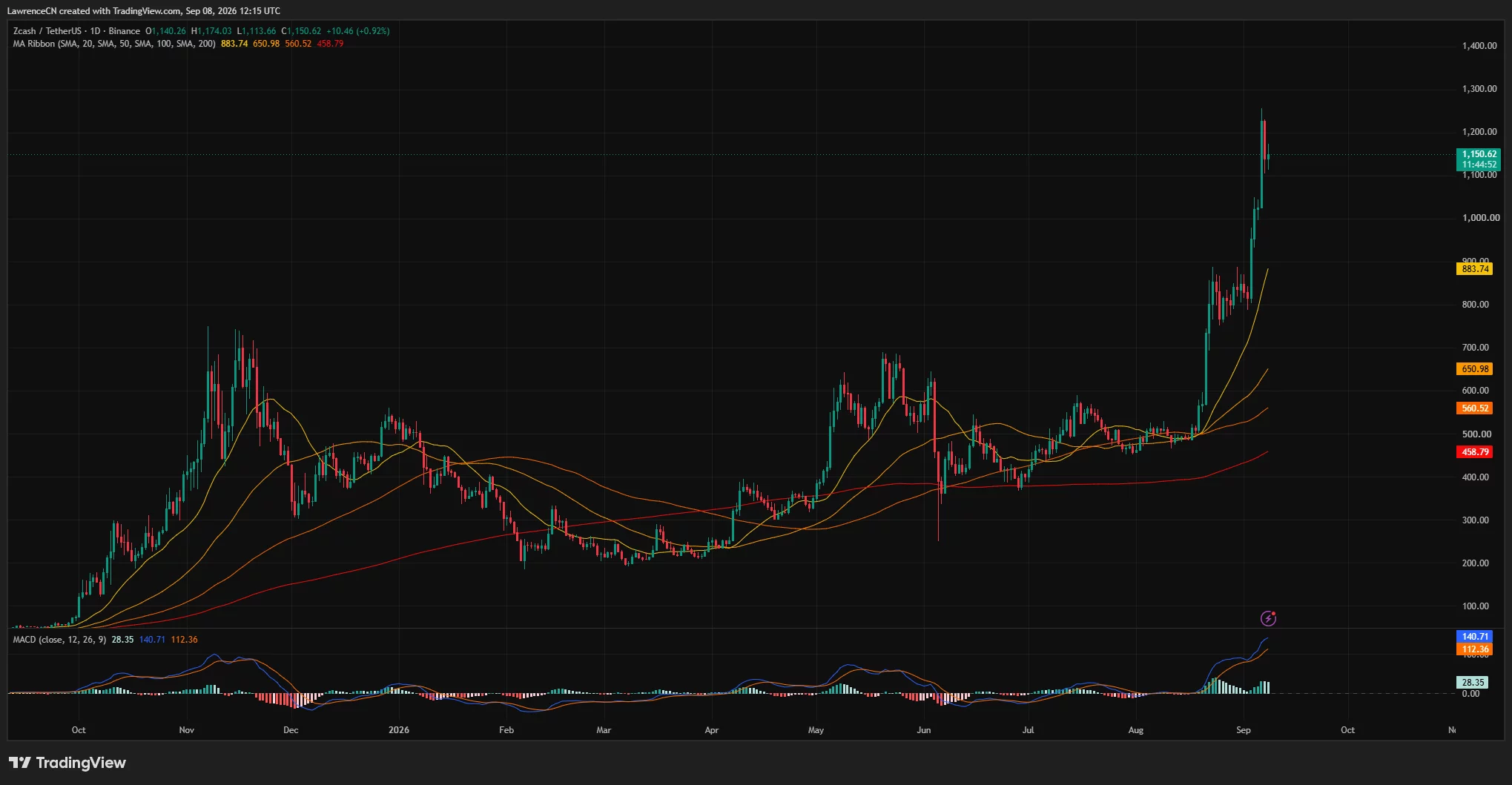
The daily chart shows ZEC trading well above all four major moving averages. The 20-day simple moving average stands at $883.74, followed by the 50-day SMA at $650.98 and the 100-day SMA at $560.52.
The 200-day SMA is much lower at $458.79. ZEC is therefore trading roughly 151% above its long-term average, confirming the scale of the advance but also showing how far the price has moved from its broader trend line.
Momentum remains positive on the daily Moving Average Convergence Divergence indicator. The MACD line is at 140.71, above the signal line at 112.36, while the histogram remains positive at 28.35.
The positive configuration indicates that buyers still control the broader trend. However, the declining histogram bars following the price peak suggest that bullish momentum is beginning to cool. A continued decline in the histogram would raise the risk of a longer consolidation even if the broader uptrend remains intact.
On the 4-hour chart, the Supertrend indicator provides immediate support at $1,076.51. ZEC has remained above that level throughout the latest pullback, while the Bull Bear Power reading of 19.98 remains positive.
A close below the Supertrend would weaken the short-term structure and could expose the psychological $1,000 level. The former breakout zone near $875–$888 would become the deeper support area if selling accelerates.
Liquidation map points to resistance near $1,180
CoinGlass’s 24-hour ZEC liquidation heatmap shows the largest nearby concentration of leveraged positions around $1,178–$1,180. Another group of liquidation levels appears between $1,195 and $1,205.
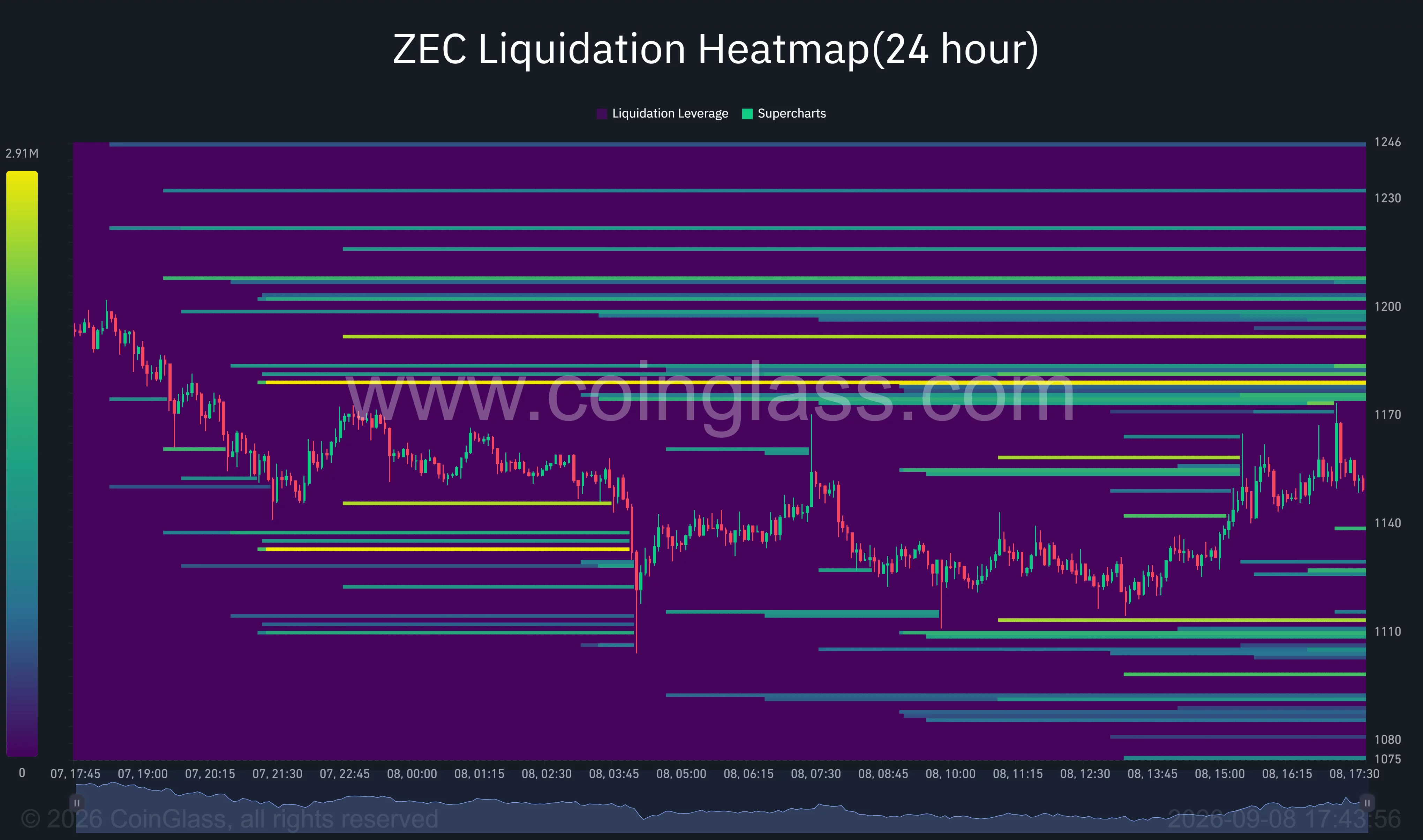
Price often moves toward areas containing concentrated leveraged positions because forced liquidations can add volume once those levels are reached. A break above $1,180 could therefore trigger another push toward $1,200 and the recent high near $1,249.
Additional liquidity sits above $1,230, but ZEC would first need to overcome the selling pressure that emerged during its initial retreat from the peak.
On the downside, the heatmap shows concentrations near $1,110 and across the $1,080–$1,100 region. Losing $1,140 could pull the price toward those levels, with the 4-hour Supertrend at $1,076 providing the next technical test.
Traders should also watch leverage on both sides of the market. The earlier short squeeze helped drive the rally, but a heavily leveraged long market could produce the opposite effect if ZEC breaks below nearby support.
Zcash bulls target $1,500 after pennant breakout
Crypto analyst Team LAMBO Charts described ZEC’s longer-term formation as a bullish pennant and said the token had already surpassed the pattern’s initial $1,000 target.
The analyst identified $1,500 as the next upside objective while arguing that bulls remain in control as long as the breakout holds. From the Sep. 8 price near $1,150, reaching that target would require an advance of approximately 30%.
Before testing $1,500, ZEC must reclaim $1,200 and close above the Sep. 6 peak at $1,249. A sustained breakout beyond that high would leave limited recent price history to act as resistance, although profit-taking could increase as the token approaches the analyst’s target.
The bearish scenario begins with a 4-hour close below $1,076. Such a move would weaken the post-breakout structure and place $1,000 back in focus. A deeper correction toward the rising 20-day SMA near $884 would erase a larger portion of the rally but would still leave ZEC above its medium- and long-term moving averages.
For US traders, Federal Reserve expectations remain a possible source of volatility across speculative assets. Zcash has recently outperformed the broader crypto market, but shifts in rate expectations could still affect leverage and demand as traders assess the next US monetary-policy decision.
Disclosure: This article does not represent investment advice. The content and materials featured on this page are for educational purposes only.


The CLARITY Act has moved closer to defeat ahead of its Sept. 15 Senate vote as lawmakers remain divided over presidential ethics rules and stablecoin rewards.
Summary
- The Senate will hold a procedural vote on the CLARITY Act at 2:15 p.m. ET on Sept. 15.
- Republicans need at least seven Democratic or independent votes to reach the 60-vote threshold.
- Negotiators remain divided over crypto interests linked to President Donald Trump and his family.
- Bank concerns and the shortened House calendar have added further barriers to passage in 2026.
CLARITY Act ethics talks remain stalled
Semafor reported on Sept. 8 that Republican senators expect the crypto market structure bill to fail when the chamber returns, citing little progress on an ethics provision sought by Democrats.
The proposed restriction would address whether a sitting president and immediate family members could profit from crypto businesses while federal policy affecting the industry is being written. According to two Democratic aides cited by Semafor, negotiators have made little movement on the demand.
Sen. Mike Rounds, R-S.D., offered a brief assessment of the talks, saying the situation “does not look good right now.”
Sen. Thom Tillis, R-N.C., who has participated in bipartisan negotiations over the legislation, tied its survival directly to the White House’s willingness to compromise.
“If there’s no interest in the White House in trying to bridge the gap on the ethics language, it is going to fail,” Tillis said.
At the White House, an administration spokesperson told Semafor that Trump remained “unequivocal” in calling on Congress to pass the bill so the United States could compete with other countries in digital-asset development.
The spokesperson also said the administration had worked with Congress and accepted what it considered “the most comprehensive and wide-ranging ethics provision in history.” Democrats have disputed that description, arguing that the language does not sufficiently cover businesses controlled by a president’s relatives.
Questions about Trump’s crypto ties have followed the legislation through Congress. In August, crypto.news covered renewed ethics demands after Public Citizen called for the bill to require a sitting president and immediate family members to divest from crypto ventures.
Trump and members of his family have been linked to several digital-asset projects, including World Liberty Financial and the Official Trump meme coin. Public Citizen argued that federal crypto policy could not be separated from the president’s private financial interests, adding another source of pressure on senators seeking Democratic votes.
Sept. 15 vote requires bipartisan support
Senate Majority Leader John Thune filed cloture on the motion to proceed before lawmakers left Washington for their August recess. Under the scheduled Senate test, the motion will ripen at 2:15 p.m. ET on Sept. 15, one day after the chamber returns for regular business.
The vote will not decide final passage. Instead, senators will determine whether to open debate on the CLARITY Act, with supporters needing 60 votes to advance the measure.
Republicans hold 53 Senate seats, meaning they would need support from at least seven Democrats or independents even if every Republican backed the motion. Opposition within the Republican conference could raise the number of cross-party votes required.
Senators Josh Hawley of Missouri and Rand Paul of Kentucky have been identified as possible Republican opponents. Hawley has raised concerns about provisions governing stablecoin rewards, while community banks have warned that interest-like payments on stablecoins could draw deposits away from insured lenders.
Some Republican senators have sought additional protections for banks before agreeing to support the bill. Democrats, meanwhile, have pressed for state attorneys general to retain enforcement powers because they question whether federal agencies alone would enforce the framework effectively.
Earlier crypto.news coverage identified three unresolved provisions, presidential ethics restrictions, protections for decentralized finance developers, and the treatment of stablecoin rewards, as possible barriers to reaching 60 votes.
A successful cloture vote would allow senators to debate the legislation and offer amendments. Final passage would generally require a simple majority, but any Senate version that differs from the House-approved text would need further action before it could reach the president.
The House passed its version of the Digital Asset Market Clarity Act in July 2025 by a 294-134 vote, including support from 78 Democrats. Senate negotiations have since produced separate proposals addressing the roles of the Securities and Exchange Commission and the Commodity Futures Trading Commission.
For U.S. investors and crypto businesses, the legislation would determine how federal agencies divide oversight of digital assets and trading platforms. The framework would also establish processes for deciding when a crypto asset falls under securities rules and when it qualifies as a digital commodity subject to CFTC authority.
Crypto groups increase pressure before the vote
As support remains uncertain, the Fairshake-linked Cedar Innovation Foundation has announced three national advertisements backing the CLARITY Act ahead of the Senate vote.
The campaign seeks to build public and political support during the final week before senators return. Fairshake and other crypto-aligned political groups have spent heavily in congressional races, giving the industry another way to pressure lawmakers if the bill fails.
Semafor reported that defeat could prompt crypto groups to direct additional funds toward competitive House and Senate races. Sen. Roger Marshall, R-Kan., questioned whether the measure carried much weight among voters in his state.
“There’s nothing I can do with the crypto bill,” Marshall said. “Haven’t heard a peep about it. Nobody back home is asking about it.”
Prediction-market traders have also reduced their expectations for passage. Polymarket odds on the CLARITY Act becoming law in 2026 have fallen from earlier highs as the Sept. 15 vote approaches and the available congressional calendar narrows.
A prediction-market price represents traders’ positions rather than an official forecast, and it can change as negotiations continue or senators announce their votes. Recent readings have nevertheless placed passage well below an even chance.
House calendar leaves little time for final passage
Even if the Senate clears cloture, lawmakers will have limited time to debate amendments, pass the bill, and resolve any differences with the House version.
The Senate will have about 15 session days before election campaigning takes priority ahead of the November midterms. Leadership would need to manage debate while Congress also faces other deadlines competing for floor time.
House leaders have canceled sessions during the final two weeks of September and plan to begin the chamber’s midterm recess by Sept. 17. The schedule leaves little room for representatives to consider Senate changes during the same month.
If senators amend the legislation, the House would need to approve the revised text or the two chambers would have to reconcile their separate versions. The Constitution requires both chambers to pass identical language before a bill can be sent to the president.
Meanwhile, the SEC has continued work on crypto rules without waiting for Congress. In an Aug. 18 statement, SEC Chair Paul Atkins said legislation remained necessary to establish durable rules and prevent a future regulator from easily reversing the agency’s current approach.
The CFTC has also been examining how it can use its existing authority while lawmakers debate an expanded federal framework. Its current powers do not provide the complete spot-market oversight contemplated by the CLARITY Act, which would give the agency a larger role in supervising digital commodities and related intermediaries.


Robinhood has signed a multi-year deal to route selected event contracts through OG.com while taking equity stakes priced against $20 billion and $5 billion valuations for Crypto.com and OG.com, respectively.
Summary
- Robinhood will route selected retail event contracts through OG.com’s federally regulated derivatives platform.
- Robinhood will receive initial equity stakes in both Crypto.com and the newly independent OG.com.
- OG.com-backed contracts will roll out gradually to eligible U.S. customers from Sep. 8.
- HOOD traded at $122.02, while Crypto.com-linked CRO gained about 5.3% to $0.0604.
Robinhood adds OG.com as an event-contract provider
Robinhood and OG.com announced the agreement on Sep. 8, confirming that the prediction market operator will provide exchange, clearing and infrastructure services for Robinhood’s event-contract business.
Under the multi-year arrangement, Robinhood will send part of its retail event-contract volume through OG.com’s derivatives exchange and clearinghouse. The platform operates under the oversight of the U.S. Commodity Futures Trading Commission, giving Robinhood another federally regulated provider for its U.S. prediction markets business.
Selected football contracts will be among the first products routed through the new provider as the U.S. professional football season begins. OG.com said its contracts will appear gradually in the Robinhood app for eligible U.S. customers, with the phased rollout starting on Sep. 8.
Contracts covering economic indicators, elections, sports, and cultural events could follow, according to the company announcement. Each contract gives traders a yes-or-no position on a defined result and settles according to the outcome specified in its terms.
Robinhood already sources contracts from several providers rather than relying on a single exchange. The brokerage launched its prediction markets hub with Kalshi in March 2025 before adding ForecastEx and Rothera, its exchange venture with Susquehanna International Group.
As crypto.news reported in July, Robinhood had been discussing an agreement with Crypto.com that would add another supplier to its existing network. The completed deal turns the proposed distribution arrangement into an equity relationship involving both Crypto.com and OG.com.
Robinhood receives stakes at $20 billion valuation
Alongside the infrastructure partnership, Robinhood will take initial minority stakes in Crypto.com and OG.com. Neither company disclosed the size of the investments or the amount Robinhood will pay.
Pricing for the stakes will follow Citadel Securities’ recent investment terms, according to the joint announcement. Crypto.com was valued at $20 billion in that transaction, while OG.com received a standalone valuation of $5 billion after separating from Crypto.com.
OG.com now operates as an independent company with its own capital allocation and management focus. Crypto.com retains its main digital asset exchange business, while the separated platform concentrates on prediction markets, futures, perpetual contracts, and related derivatives.
Kris Marszalek, founder and CEO of Crypto.com and OG.com, described the agreement as the start of a longer relationship between the companies.
“We’re looking forward to making OG.com the most liquid venue globally for innovative derivative instruments, starting with prediction markets and quickly expanding into futures and perpetuals.”
Robinhood Vice President and General Manager of Futures and Prediction Markets JB Mackenzie said the equity component gives the brokerage a direct financial interest in the infrastructure supporting its contracts.
“Teaming up with Crypto.com and OG.com strengthens our position as a leader in the prediction markets space and gives us even more skin in the game,” Mackenzie said. He added that customer demand for contracts linked to public events has continued to grow.
Prediction markets become a larger Robinhood business
The agreement adds capacity to a product line that generated $156 million in revenue for Robinhood during the second quarter, according to Reuters. The figure was a quarterly record for the company’s event-contract business.
Robinhood is also preparing a dedicated election hub ahead of the November 2026 U.S. midterms. According to Reuters, the hub will carry contracts linked to state and federal races, with some products potentially routed through Crypto.com and OG.com.
A June Bernstein revenue forecast estimated that Robinhood’s prediction markets could generate $586 million in 2026, up from $150 million in 2025. The research firm based its estimate partly on trading during the FIFA World Cup, when daily prediction market volume reached as much as $4.8 billion.
Bernstein also estimated that the business could contribute about 17% of Robinhood’s transaction-based revenue and 10% of total company revenue during 2026. According to the firm, Rothera processed about 200 million contracts during its first 18 days, with World Cup and Major League Baseball markets producing nearly all of that activity.
Prediction markets are one part of Robinhood’s recent product expansion. The company has also entered underwriting, allowing Robinhood Securities to help bring companies to public markets rather than limiting its role to distributing IPO shares through the brokerage app.
On the crypto side, Robinhood Chain has drawn heavy decentralized trading activity since its July 1 public launch. A Sep. 3 network activity review found that the Ethereum layer-2 network processed about $945 million in DEX volume on Aug. 25 and more than $47 billion in cumulative volume within its first two months.
The same review found that memecoin trading supplied a large share of the activity. Pons alone produced $445 million of the chain’s $874.8 million in volume on Aug. 30, while Robinhood’s tokenized stock products remain unavailable to U.S. residents.
U.S. rules remain contested across states
Although OG.com operates a CFTC-regulated exchange and clearinghouse, prediction market providers continue to face disputes over whether sports contracts fall under federal derivatives law or state gambling rules.
The CFTC has maintained in court filings that registered derivatives exchanges fall under its exclusive jurisdiction. State officials have argued that contracts based on sporting events operate like betting products and should comply with local licensing, age, and consumer-protection requirements.
In July, attorneys general from 44 states challenged the CFTC, asking the regulator to withdraw and rewrite its proposed rules for sports-related event contracts. The coalition said the proposal reached beyond the agency’s authority and entered an area traditionally supervised by states.
Court decisions have produced different results across the country. Judges in Michigan and Washington temporarily restricted certain sports contracts, while a federal judge blocked Minnesota from enforcing its prediction market ban as litigation continued.
Availability on Robinhood will therefore depend on customer eligibility, individual contract terms, and state-level restrictions in addition to OG.com’s federal status. The rollout announcement did not provide a full list of states where the new contracts will be offered.
HOOD traded at $122.02 at 14:52 UTC on Sep. 8, down about 0.07% for the session after moving between $119.51 and $126.51. Crypto.com-linked Cronos gained about 5.3% to $0.0604 over the same daily period, with an intraday range of roughly $0.0565 to $0.0640.


With 38 active cases across 21 states, conflicting federal rulings over Kalshi have raised the risk that U.S. prediction-market access will fragment by location and trading venue, Kalshinomics co-founder Aaron Courtney has told crypto.news.
Summary
- New Jersey has asked the Supreme Court to resolve opposing federal rulings involving Kalshi.
- Courtney said state restrictions could weaken liquidity first in local political and event markets.
- Washington proxy data has not shown a clear statewide liquidity shock after Kalshi restricted access.
- Casino.org counts 38 pending prediction-market cases across 21 states and enforcement in 10 jurisdictions.
Courtney, who co-founded prediction-market analytics platform Kalshinomics, said the legal system is dividing access faster than trading data shows any separation in prices or liquidity.
“The legal system is already moving in that direction faster than the price data,” Courtney said in comments shared with crypto.news.
New Jersey filed a petition for a writ of certiorari on Sep. 2, asking the U.S. Supreme Court to review a Third Circuit decision that favored Kalshi. The petition came four days after the Ninth Circuit reached a different conclusion in the company’s Nevada case.
Kalshi rulings have produced conflicting state rules
As previously reported by crypto.news, New Jersey wants the Supreme Court to decide whether the Commodity Exchange Act prevents states from applying sports-gambling laws to contracts traded on a Commodity Futures Trading Commission-registered market.
Kalshi operates a CFTC-regulated designated contract market and argues that its event contracts fall under federal derivatives law. New Jersey considers its sports products wagers that remain subject to state licensing, age limits, and consumer-protection rules.
In April, a divided Third Circuit panel upheld a preliminary injunction that stopped New Jersey from enforcing its gambling laws against Kalshi’s sports contracts. The panel found that Kalshi had shown a reasonable chance of succeeding on its claim that the contracts qualify as swaps under the Commodity Exchange Act.
The decision did not settle the underlying lawsuit. It assessed Kalshi’s likelihood of success while preserving the injunction during litigation.
On Aug. 28, however, the Ninth Circuit rejected Kalshi at the same preliminary stage. Its unanimous panel found that the company’s sports contracts were likely bets rather than swaps, allowing Nevada regulators to enforce state gaming rules while the case continues.
“The CFTC is not a national gambling regulator,” Circuit Judge Ryan Nelson wrote in the Ninth Circuit opinion.
New Jersey’s petition points to the opposing appellate decisions as a reason for Supreme Court review. The filing itself does not mean the justices have agreed to hear the case, and Kalshi will have an opportunity to respond before the court decides whether to accept it.
Courtney said the unresolved divide could leave traders with different products depending on their home state and the federal circuit covering it.
“Until there is a uniform answer, prediction-market access could increasingly depend on which state and federal circuit a trader happens to live in.”
Prediction-market litigation now covers 21 states
According to Casino.org’s Prediction Market Litigation Tracker, 38 active cases are pending across 21 states, while exchanges have received cease-and-desist letters in at least 10 jurisdictions.
The tracker lists New York, Minnesota, Nevada, and Arizona among the states mounting the strongest challenges. Regulators generally argue that sports event contracts operate as unlicensed gambling products, while exchanges rely on federal registration and the CFTC’s authority over designated contract markets.
Court disputes also involve tribal gaming rights, state taxes, and local enforcement powers. Casino.org identifies New York, New Jersey, Minnesota, and California as several of the main venues for litigation.
Separate state orders are already creating different access rules. A Michigan court ordered Kalshi to keep sports contracts unavailable to residents under a Sep. 1 preliminary injunction. The Michigan geofencing requirements carry possible fines of $500,000 for each day the court finds Kalshi out of compliance.
Washington has imposed restrictions covering sports, elections, politics, entertainment, culture, technology, and science contracts. Commodities, climate, economics, and financial markets remain available to users in the state.
The Washington court order required Kalshi to introduce initial geofencing by Aug. 19 and a system using several location sources by Sep. 2. Kalshi maintains that federal law prevents states from regulating contracts offered on its CFTC-registered exchange.
Washington data shows no clear liquidity shock
Because Kalshi’s public application programming interface does not identify each trader’s location, Courtney said outside researchers cannot directly calculate Washington-only volume. He instead used Seattle-linked contracts as proxies for local participation.
The analysis compared the 48 days before the initial Aug. 19 geofence with the following 18 days. Courtney examined Seattle Mariners game contracts against contracts involving the other 29 Major League Baseball teams, along with Seattle’s daily temperature markets against 19 other U.S. cities.
Mariners’ contract volume performed 2.8% better relative to the rest of MLB after the cutoff, placing Seattle near the league’s midpoint. Seattle weather volume declined by 17.7% compared with the other cities.
Courtney said the weather decline remained within normal variation because Philadelphia and Phoenix each fell by more than 30% during the same period without a similar geofence. Median MLB volume per game also dropped 29.6% across the league.
“My takeaway is that any Washington effect is currently smaller than the ordinary seasonal and cross-market noise visible in Kalshi’s public data. That isn’t the same as saying the impact was zero.”
Public data also cannot show whether affected Washington users stopped trading, reduced their activity, or moved to another platform. Seattle weather contracts, which remain available in the state, did not record an increase after Kalshi removed sports and political markets.
Courtney said the evidence did not support a one-for-one move into permitted categories. In his view, sports traders may not consider inflation, finance, or climate contracts suitable replacements for Seahawks game markets.
Washington presents another complication because the state agreed in August to refrain temporarily from enforcement against OG while related appeals proceed, Courtney said. Formerly known as Nadex and operated by Crypto.com, OG also uses a CFTC-designated contract market.
The arrangement offers a possible alternative for displaced traders, although Courtney said account-level information from Kalshi and competing platforms would be needed to measure where their activity went.
Local Kalshi markets face the highest liquidity risk
For heavily traded national contracts, Courtney said excluding Washington alone is unlikely to cause a major disruption. The state accounts for about 2.3% of the U.S. population, while professional market makers and arbitrage traders support many national markets.
Trader quality may matter more than the raw number of excluded accounts, according to Courtney. Removing one active market maker or well-informed participant can affect liquidity and price discovery more than losing several occasional retail traders.
Local markets appear more exposed. In a Sep. 7 snapshot, Courtney found that two Kalshi markets covering Washington Supreme Court races had spreads of about 20 cents, with only one contract traded between their quoted prices. Major MLB and National Football League game markets generally showed spreads of around 1 to 1.5 cents.
According to Courtney, state restrictions can remove residents who have the strongest reason to follow local races and events. Thin local markets may then experience larger spreads, shallower order books, and less dependable market-implied probabilities.
Access restrictions do not yet appear to have separated prices across the largest venues. Courtney compared eight MLB moneyline contracts available on Kalshi and Polymarket on Sep. 7. Five carried identical prices to the cent, while the other three differed by one tick, producing a mean absolute price difference of 0.38 cents.
Courtney said evidence of true fragmentation would include persistent price gaps of several cents between equivalent contracts after accounting for fees and minimum price increments. He would also monitor bid-ask spreads, order-book depth, slippage, active-trader counts, market-maker concentration, and volume by state and exchange.


CoinCorner has launched a Bitcoin custody service for UK customers that charges a 1.5% annual fee and uses keys held separately by CoinCorner and AnchorWatch.
Summary
- CoinCorner and AnchorWatch each control a key, preventing either company from moving customers’ Bitcoin alone.
- Lloyd’s of London underwriters cover key loss and unauthorized access involving Bitcoin held in Vault.
- Customers can add or remove funds without a long-term commitment and set custom identity checks.
- CoinCorner’s crypto services remain outside FCA regulation and are not protected by the UK’s FSCS.
CoinCorner said its new Vault uses multi-signature technology to divide control of customers’ Bitcoin between two companies operating in different jurisdictions. CoinCorner holds one key, while insurance and custody provider AnchorWatch holds the other.
Neither company can independently approve a transfer from the Vault, according to CoinCorner’s support documents. Requiring multiple keys removes the single point of control found in a conventional custodial wallet, where one company can authorize transactions on its own.
Bitcoin held through the service is insured under a policy underwritten through the Lloyd’s of London market. CoinCorner said the cover applies to losses caused by lost keys and unauthorized access, although specific policy conditions and exclusions have not been published on the product page.
Customers can also set their own identity checks, which must be completed before a transaction can proceed. The available controls allow account holders to add verification steps that match their security needs, with CoinCorner’s support team handling the setup.
CoinCorner Vault charges a 1.5% annual fee
Vault costs 1.5% per year, with CoinCorner calculating and billing the fee monthly. The company charges customers on the first day of each month based on the amount of Bitcoin recorded in their Vault at that time.
No long-term commitment is required, and users can move Bitcoin into or out of the product. Withdrawals return funds to a customer’s standard CoinCorner Bitcoin balance, which the company describes as an instant process.
Deposits follow a different monthly schedule. According to CoinCorner’s Vault guidance, Bitcoin added after the first day of a calendar month does not enter the recorded Vault balance until the following month. The company says any Bitcoin remaining within Vault after a withdrawal continues to be insured.
CoinCorner also says it does not lend out or otherwise use Bitcoin placed in the service. The product therefore differs from interest-bearing crypto accounts, where a platform may deploy customer assets through loans or other transactions in return for yield.
Vault does not advertise a return on deposited Bitcoin. Customers instead pay for the custody structure, transaction controls, and insurance attached to assets held within the product.
Multi-signature custody splits control between two firms
Multi-signature wallets require more than one private key to approve a Bitcoin transaction. Under CoinCorner’s setup, the relevant keys are held by independent entities rather than stored by a single platform.
AnchorWatch provides the second part of that arrangement through Trident, its Bitcoin custody infrastructure. The AnchorWatch platform uses Bitcoin scripts and time locks to apply security, recovery, and governance rules at the protocol level.
Time locks can make an alternative method of moving funds available after a specified period when a key is lost or a participant becomes unavailable. AnchorWatch says the design allows recovery conditions to be built into a vault without giving one party immediate control over the Bitcoin.
The US company is also a Lloyd’s coverholder, which allows it to arrange policies backed by underwriting capacity in the Lloyd’s market. AnchorWatch says its other custody products can obtain as much as $100 million of cover per vault, while institutional customers may seek limits of up to $500 million. CoinCorner has not disclosed the limit attached to its UK Vault product, so figures advertised for AnchorWatch’s other services should not be treated as the coverage available to every CoinCorner customer.
AnchorWatch separately offers a three-institution custody configuration involving AnchorWatch, BitGo, and CoinCorner. Its website describes that product as a two-of-three wallet, meaning two institutions must sign a transaction. CoinCorner’s UK-facing documents describe Vault as a two-entity service in which CoinCorner holds one key and AnchorWatch holds the other.
Insurance does not provide FSCS protection
The private insurance attached to Vault is separate from the protection provided through the UK’s Financial Services Compensation Scheme.
CoinCorner states in its legal notice that investments in cryptoassets through its platform are not regulated by the Financial Conduct Authority. Customers also cannot take complaints about the crypto service to the Financial Ombudsman Service, while their Bitcoin is not eligible for FSCS protection.
The distinction matters because private policies cover named events under agreed terms and exclusions. CoinCorner identifies lost keys and unauthorized access as covered events, but its public Vault material does not say that the policy protects customers from a fall in Bitcoin’s price, insolvency, or every possible operational loss.
CoinCorner Ltd is based in the Isle of Man and is registered with the Isle of Man Financial Services Authority under the Designated Business Act 2015. The company is also registered with the Isle of Man Office of Fair Trading as a moneylender.
Its electronic money and payment services have a separate structure. CoinCorner acts as a distributor for Mercury Foreign Exchange Limited, an FCA-authorized electronic money company, but the authorization attached to those payment services does not extend FCA protection to CoinCorner’s cryptoasset products.
Founded in 2014, CoinCorner says it serves more than 350,000 users across 15 markets. The company previously entered the UAE market through a 2022 partnership with Dubai-based Seed Group covering Bitcoin trading, storage and payment services.
UK crypto custody faces new FCA rules in 2027
CoinCorner has introduced Vault as the UK prepares to place crypto custody under a full authorization system.
As crypto.news reported in June, the FCA’s new cryptoasset regime is scheduled to take effect on Oct. 25, 2027. The rules will cover custodians, trading platforms, stablecoin issuers, staking providers and other intermediaries.
Firms seeking to conduct regulated crypto activities will have an application window running from Sept. 30, 2026, through Feb. 28, 2027. Existing registrations under the UK’s anti-money laundering rules will not automatically become authorizations under the new Financial Services and Markets Act framework.
The regulator plans to apply requirements covering custody, capital, operational resilience, disclosures, market conduct and consumer protection. Companies may also need to show that they can withstand market stress and maintain financial resources against risks carried on their balance sheets.
In August, US trading platform Robinhood secured FCA registration under the existing anti-money laundering system before the new framework takes effect. More than 50 companies were listed on the FCA’s cryptoasset register at the time, including Kraken, Ripple, BlackRock and BNY.
For American customers, AnchorWatch advertises a separate multi-institution service using a two-of-three arrangement with CoinCorner and US custodian BitGo. Its website says insurance for that configuration is optional for US users, with indicative pricing beginning at $4,000 for every $1 million of coverage and final premiums subject to underwriting review.
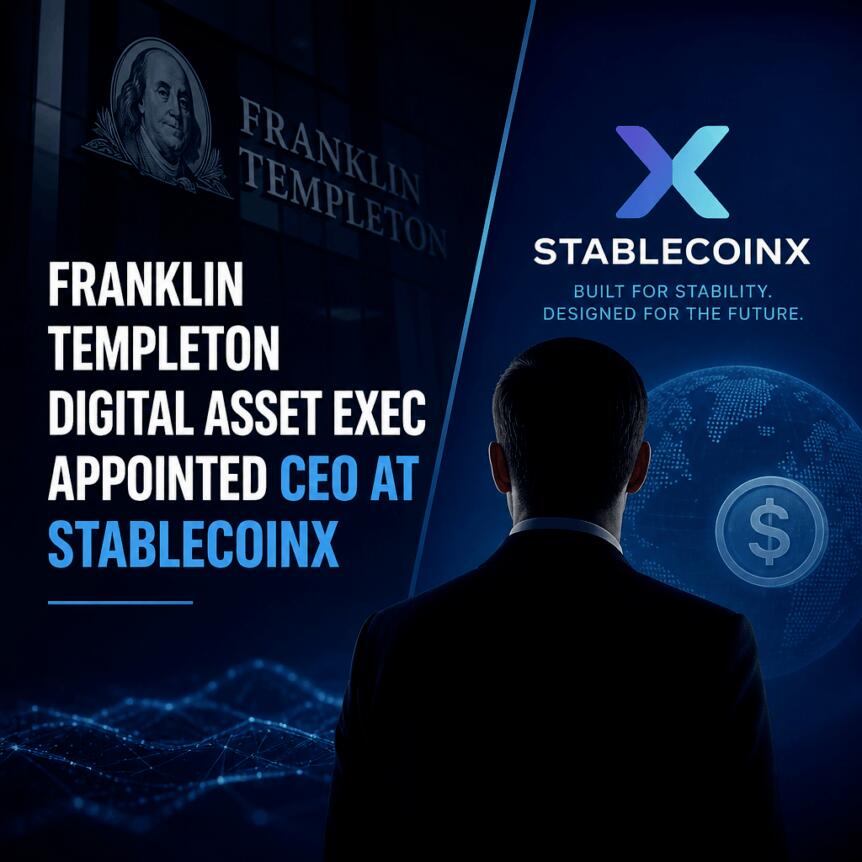
StablecoinX has named Christopher Jensen as its new chief executive officer, a move that places the former Franklin Templeton digital asset executive at the helm of the biggest corporate holder of Ethena’s ENA token. The appointment underscores how quickly leadership in publicly traded crypto vehicles is shifting toward personnel with traditional asset-management experience.
Jensen replaces Ted Chen, who led StablecoinX through its public listing in June and will continue as chairman of the company’s board. StablecoinX trades on Nasdaq under the ticker USDE and is closely tied to Ethena’s synthetic dollar product, USDe.
Key takeaways
- StablecoinX appointed Christopher Jensen as CEO, bringing in leadership experience from Franklin Templeton’s digital asset efforts.
- Jensen’s mandate includes oversight of StablecoinX’s large ENA position, which the company says is about 3.03 billion tokens (roughly 20% of supply).
- Ted Chen transitions from CEO to chairman after guiding StablecoinX through its June Nasdaq listing.
- Ethena’s ecosystem developments continue in parallel, including the recent rollout of Ethena Pay.
- ENA has struggled on a year-to-date basis but has rebounded sharply in the past month, according to CoinGecko.
From Franklin Templeton to StablecoinX’s ENA stewardship
Christopher Jensen’s background is rooted in mainstream asset management and early institutional research into blockchain markets. Before joining StablecoinX, he served as a portfolio manager and director of digital asset research at Franklin Templeton, where he helped build the firm’s digital asset group after its launch in 2018.
According to the company, Franklin Templeton’s blockchain venture fund participated in Ethena’s seed round. That connection matters because it suggests Jensen was exposed to Ethena’s development before USDe scaled into one of the better-known synthetic stablecoins in DeFi.
StablecoinX’s corporate role within the Ethena ecosystem is especially relevant because of its concentration in ENA. The company holds approximately 3.03 billion ENA tokens, which it says represents about 20% of the token’s total supply—making it ENA’s largest corporate holder. ENA, as Ethena’s governance token, provides voting rights over protocol changes, meaning StablecoinX is not only an investor in Ethena’s ecosystem but also an influential governance participant.
Leadership change after StablecoinX’s Nasdaq listing
The CEO transition comes as StablecoinX continues operating as a publicly listed entity rather than a private crypto vehicle. Ted Chen, the outgoing CEO, previously led the company through its public listing in June via a reported merger process and will remain chairman of the board.
The arrangement—Jensen taking day-to-day executive control while Chen retains board leadership—often signals continuity in strategy while adjusting operational leadership. For shareholders and token-adjacent investors, the key question is how Jensen’s background in traditional asset management will shape risk controls, governance posture, and the company’s engagement with Ethena’s evolving roadmap.
StablecoinX trades on Nasdaq under the ticker USDE and focuses on the Ethena ecosystem. Its core linkage to Ethena stems from USDe, a synthetic dollar that DefiLlama data ranks as the fifth-largest stablecoin by market size, with nearly $4.4 billion in circulation. (Source: DefiLlama data.)
Ethena’s product push and what it implies for ENA holders
StablecoinX’s CEO appointment arrives roughly a week after Ethena launched Ethena Pay, a self-custodial app designed to let users spend, save, and transfer USDe across 48 countries. Earlier coverage from Cointelegraph described the rollout as expanding real-world utility for the synthetic dollar rather than restricting it to on-chain settlement and DeFi interactions (see this report).
For ENA governance and corporate holders like StablecoinX, broader USDe accessibility can affect expectations around protocol usage—especially if demand for spending and transfer flows increases. While governance token prices are not directly guaranteed by product launches, a sustained increase in end-user adoption can influence how markets interpret the protocol’s growth trajectory and the value of governance rights.
That said, governance tokens typically reflect a wider mix of factors than product announcements alone, including liquidity conditions, broader stablecoin sentiment, and DeFi market cycles. Investors should be cautious about assuming cause-and-effect between a payment app rollout and near-term ENA performance.
ENA market performance: rebound after a weaker start
On the market side, ENA has had a turbulent recent profile. CoinGecko data cited in the source indicates the token remains down about 20% year to date, but has rebounded sharply over the past month—gaining more than 80% and trading around $0.16.
This type of pattern—weak longer-term performance followed by a sharp short-term rally—often reflects shifting liquidity and risk appetite rather than a single fundamental change. The new leadership at StablecoinX will likely be watched by market participants for signs of whether corporate governance and capital allocation around ENA and USDe will become more active as Ethena expands its distribution.
Still, the immediate timeline for how Jensen will influence governance votes, treasury strategy, or engagement with Ethena’s development team is not yet clear. The move itself signals intent to align the company’s executive oversight with people who understand both regulated finance structures and on-chain market mechanics.
What to watch next
Readers should watch how Jensen’s appointment translates into StablecoinX’s governance engagement with ENA, as well as whether Ethena Pay’s rollout leads to measurable increases in USDe usage. The near-term test will be less about headlines and more about whether corporate governance activity and ecosystem adoption move in tandem over the coming weeks.
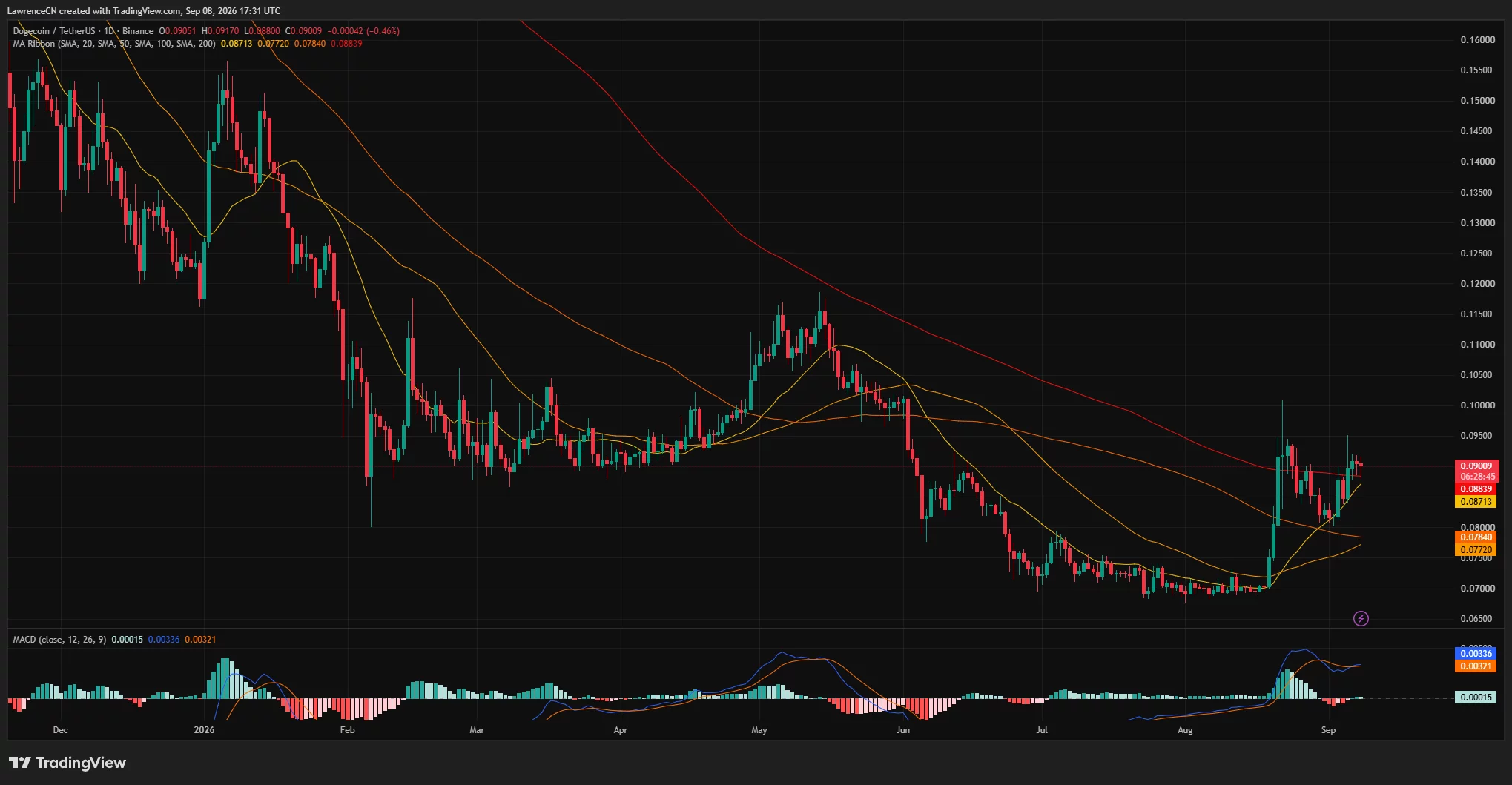
Dogecoin price held near $0.09 on Sep. 8 after gaining roughly 10% from its Sep. 2 low, while technical and liquidation data pointed to a possible test of $0.092.
Summary
- Dogecoin price recovered from $0.0817 to around $0.090, gaining about 10% from its weekly low.
- DOGE trades above its four main daily moving averages, including the 200-day SMA at $0.08839.
- The three-day liquidation heatmap shows the largest nearby liquidity cluster between $0.092 and $0.0926.
- 4-hour buying pressure remains weak, with the Chaikin Money Flow indicator at minus 0.05.
Dogecoin price holds its weekly breakout
According to data from crypto.news, Dogecoin (DOGE) price traded near $0.0901 at the time of writing, about 10.3% above its Sep. 2 low of roughly $0.0817. The meme coin briefly approached $0.092 during the recovery before entering a narrow consolidation around $0.089–$0.091.
The latest move extended a broader rebound that began after DOGE established a base close to $0.069 in August. A sharp rally later that month carried the token above $0.09, although sellers prevented it from sustaining a move beyond $0.095.
The daily chart shows that buyers defended the $0.080–$0.082 region during the pullback at the beginning of September. DOGE then formed a higher low and recovered above $0.09, leaving its short-term structure tilted upward.
Price action on the 4-hour chart is less decisive. Dogecoin has traded sideways since Sep. 5, with repeated attempts to break above $0.091–$0.092 meeting selling pressure. The narrow range suggests that traders are waiting for enough momentum to challenge the next liquidity zone.
The weekly recovery is partly due to short covering after traders built bearish positions around the early-September low. However, the liquidation heatmap alone does not confirm how much of the rally resulted from forced short closures.
DOGE trades above its key daily averages
Dogecoin’s daily chart has improved after the latest rebound. DOGE trades above its 20-day simple moving average at $0.08713 and its 200-day SMA at $0.08839.
The token has also moved above its 50-day and 100-day averages, shown near $0.07720 and $0.07840, respectively. Holding above the 200-day average would help preserve the recovery, while a daily close below it could weaken the current setup.
The moving averages still reflect a mixed longer-term structure. The 200-day SMA remains above the shorter 20-day average, while both the 50-day and 100-day averages remain well below the market price. DOGE therefore has stronger short-term momentum but has yet to establish a fully aligned bullish trend.
Momentum on the daily chart remains positive but has slowed. The moving average convergence divergence line stood near 0.00336, slightly above its signal line at approximately 0.00321. The histogram was positive at 0.00015, showing that bullish momentum remained in place by a narrow margin.
A widening gap between the MACD and signal lines would support another advance. A bearish crossover, by contrast, would increase the risk of DOGE returning to its moving-average support cluster.
Liquidation map puts $0.092 in focus
CoinGlass’ three-day liquidation heatmap shows the strongest nearby concentration of leveraged positions between approximately $0.092 and $0.0926. Additional liquidity appears around $0.094 and near the top of the chart at $0.0965.
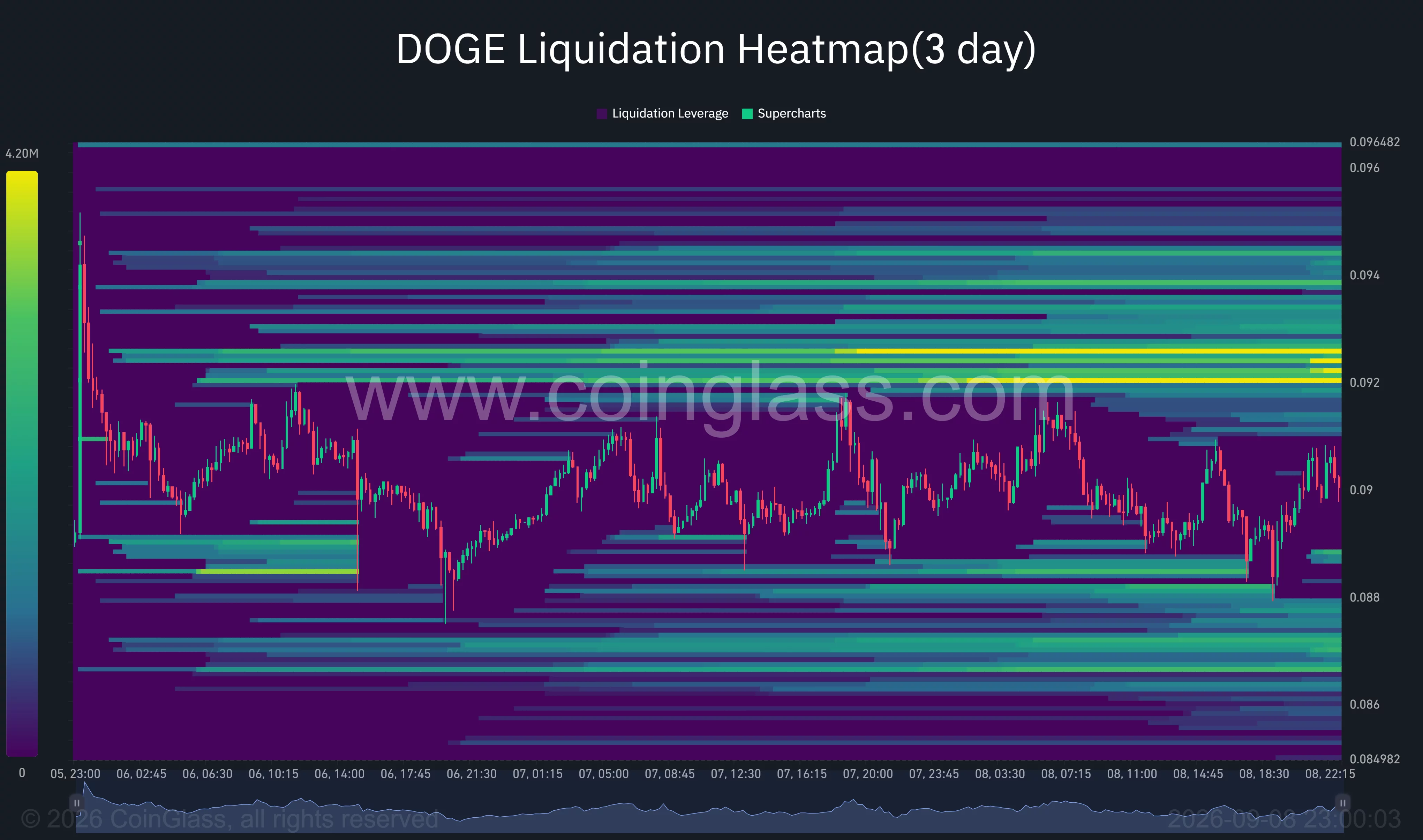
Liquidation clusters can attract price because leveraged positions may be forced to close as the market approaches their trigger levels. They do not guarantee that DOGE will reach those prices, and traders can reposition before a cluster is tested.
A clean move through $0.0926 would expose the $0.094 area, where Dogecoin recorded repeated rejections in late August. Clearing that level could allow bulls to target $0.0965 and the psychological $0.10 mark.
The heatmap also shows liquidity below the market around $0.088, followed by a broader band near $0.087. A decline into those zones could trigger leveraged long liquidations and add to selling pressure.
The placement of liquidity on both sides of the current price leaves DOGE vulnerable to short-term swings. The denser and brighter cluster above $0.092 nevertheless makes that region the most visible immediate target if buyers regain control.
Dogecoin support rests between $0.087 and $0.0884
The first important support is the $0.0884 area, where the 200-day moving average meets a recent breakout level. The 20-day SMA near $0.0871 provides the next layer of support.
On the 4-hour chart, the Supertrend remains bullish, with its support line near $0.08467. Dogecoin has stayed above the indicator since rebounding from its early-September low, but a close below $0.0847 would invalidate much of the latest short-term recovery.
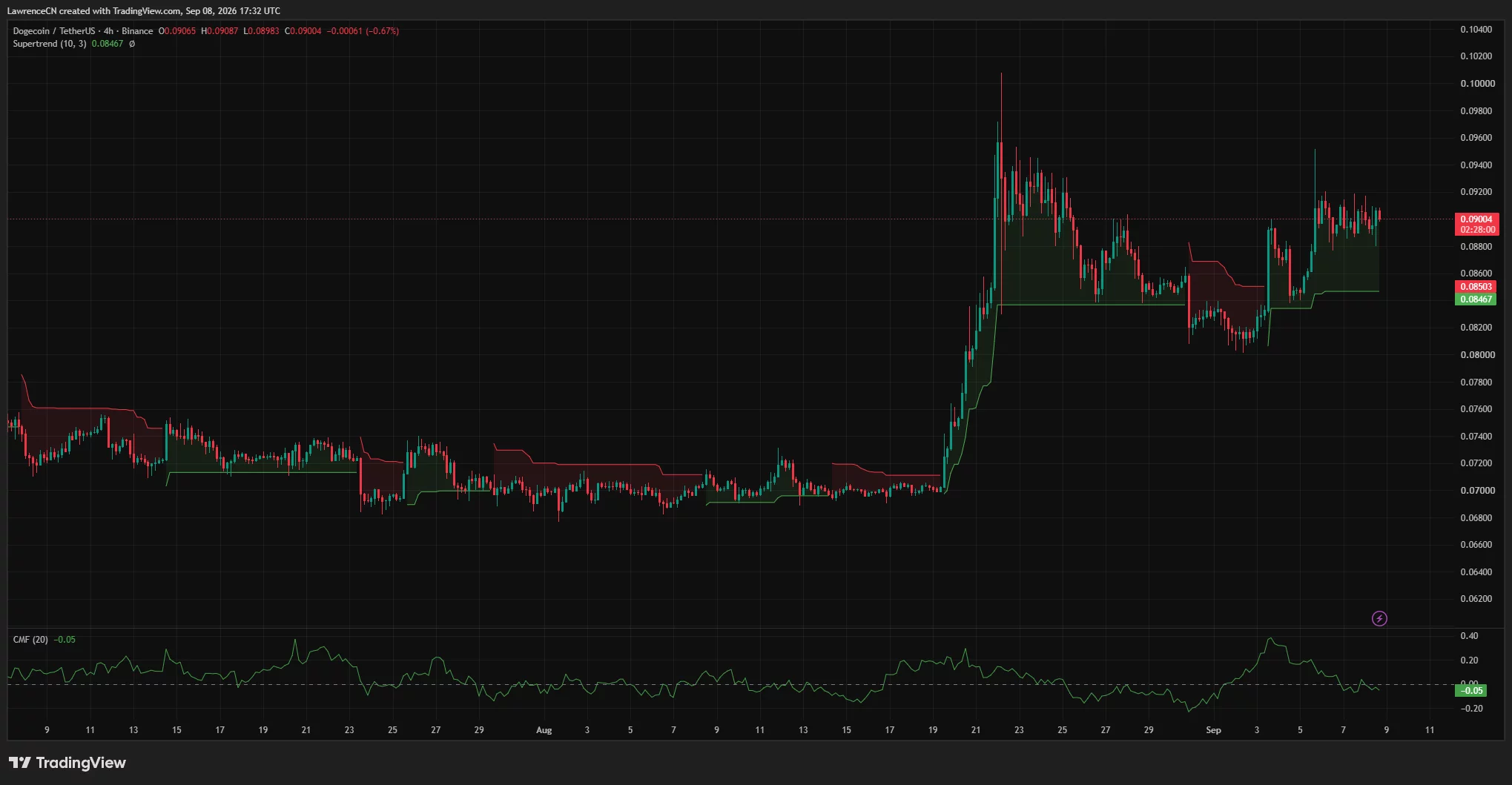
Buying pressure does not yet confirm a strong breakout. The 4-hour Chaikin Money Flow reading stood at minus 0.05, indicating that capital flow was slightly negative despite DOGE holding near $0.09. A move above zero would provide stronger evidence that buyers are supporting the advance.
The bullish scenario requires DOGE to hold above $0.0884 and break the $0.092–$0.0926 resistance band. Such a move would bring $0.094, $0.0965, and eventually $0.10 into view.
Failure to hold the daily moving-average cluster would shift attention toward $0.0871 and $0.0847. A deeper decline below the Supertrend support could expose the recent swing-low region between $0.080 and $0.082.
US macro pressure could limit the DOGE rebound
The shifting US interest-rate expectations are a risk for Dogecoin and other speculative assets. Higher Treasury yields or stronger expectations for tighter Federal Reserve policy can reduce demand for non-yielding assets, although the effect varies across trading sessions.
Dogecoin also remains sensitive to Bitcoin’s direction because broader crypto sell-offs often weigh more heavily on high-volatility altcoins. Continued weakness in Bitcoin could make it harder for DOGE to clear the liquidation cluster above $0.092.
The charts leave Dogecoin at a technical decision point. DOGE has reclaimed its main daily moving averages, but weak 4-hour capital flows and concentrated liquidity on both sides of the market mean a confirmed break above $0.0926 is still needed to extend the recovery.
Disclosure: This article does not represent investment advice. The content and materials featured on this page are for educational purposes only.
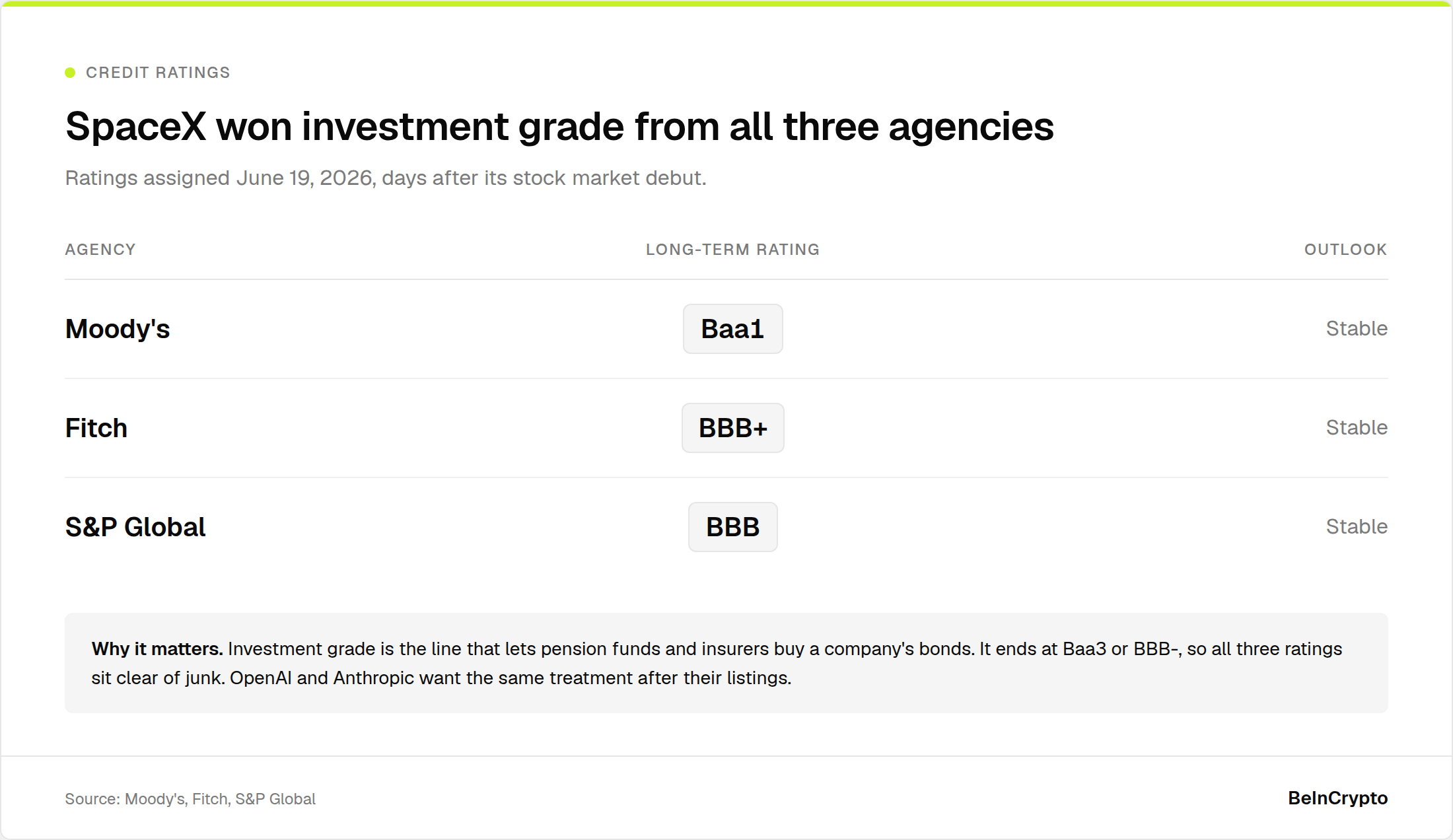
Goldman Sachs and Morgan Stanley have asked the three big credit rating agencies to treat OpenAI and Anthropic as investment-grade borrowers the moment they go public, the Financial Times reported Tuesday.
Investment grade is the rating tier that lets pension funds and insurers buy a company’s bonds. Neither lab turns a profit, but even as both burn cash, Wall Street wants the stamp anyway.
Nvidia Has $105 Billion Riding on This
OpenAI ran a $20.9 billion operating loss on $13.1 billion of revenue in 2025, according to accounts obtained by the Financial Times. Anthropic does not expect to break even until 2028, and OpenAI not until 2030.
Nvidia agreed in August to guarantee up to $105 billion of lease obligations for an OpenAI campus in Pike County, Ohio. The securities filing also spells out how Nvidia gets free.
“NVIDIA’s obligations under an Agreement will terminate upon the earliest to occur of… (iii) OpenAI achieving a satisfactory credit rating,” reads an excerpt in the filing.
Follow us on X to get the latest news as it happens
The conditions that would warrant the termination of Nvidia’s obligations are as follows, with the third being the real prize for this case:
- The 20th anniversary of the commencement of the applicable lease.
- The termination of the applicable lease by OpenAI in accordance with its terms.
- OpenAI achieving a satisfactory credit rating, and,
- Other customary termination events. OpenAI has agreed to reimburse and indemnify NVIDIA for any and all amounts actually paid by NVIDIA to the Lessor under the Agreements.
A rating does more than cut borrowing costs. It shifts hundreds of billions of dollars of AI risk off Nvidia, Google, and Broadcom, and onto ordinary bond investors.
Google and Broadcom have extended tens of billions in support so Anthropic can use their chips. Both expect to pull back once it lists.
SpaceX Got the Stamp, But Its Bonds Still Sank
SpaceX won investment grade from all three agencies on June 19, days after its landmark initial public offering (IPO).

It then sold $25 billion of bonds. Within days, the extra yield investors demanded on the longest maturities pushed past 190 basis points, close to junk pricing.
Meta, Netflix, and Tesla waited a decade or more for the same treatment.
The Agencies Have Not Said Yes
Rating analysts still describe both labs as speculative-grade and loss-making, with thin disclosure. Cheap Chinese open-source models add another worry.
Anthropic could list in late September, carrying a $2 trillion valuation pitch.
OpenAI’s own IPO timeline points to 2027.
The ask, although simple, is unusual. Treat IPO cash as a substitute for profit. So far, the agencies have not.
The post OpenAI and Anthropic Want What SpaceX Got After Its IPO Despite Billions in Losses appeared first on BeInCrypto.

LIV Golf files for bankruptcy protection

Ireland probes X over age assurance, parental control

Money Song | Counting Coins with Gracie’s Corner | Nursery Rhymes + Kids Songs

Memory prices are slowing because buyers ran out of money

England up in reading, maths and science rankings as Scotland and Wales dip

Egyptian TV Presenter Sarah Khalifa, 11 Others Sentenced To Death In Major Drug Trafficking Case In Cairo
Money Song | Counting Coins with Gracie’s Corner | Nursery Rhymes + Kids Songs

Coinbase CEO Brian Armstrong: We may be on the cusp of the next bull market for crypto spot trading

The Worst Finances In Financial Audit History
-
Tech12 hours ago
Memory prices are slowing because buyers ran out of money
-
 NewsBeat11 hours ago
England up in reading, maths and science rankings as Scotland and Wales dip
-
 Business14 hours ago
Egyptian TV Presenter Sarah Khalifa, 11 Others Sentenced To Death In Major Drug Trafficking Case In Cairo
-
 Tech15 hours ago
Strong Password Policy and Password Manager Guide
-

 Crypto World15 hours ago
Visa expands stablecoin card network to 160 programs
-
 NewsBeat10 hours ago
Tehran’s assertive rhetoric signals a new and dangerous phase in conflict
-

 Politics9 hours ago
The Ultimate September Reset Guide: How To Refresh Your Mind And Life This Autumn
-
 Business3 hours ago
Oil Higher on Hormuz Escalation, Weighing on Sentiment
-

 Tech9 hours ago
Google’s revived nuclear power plant gets $1.9B loan from US government
-

 Business14 hours ago
Claim Your Share Of $50 Million Disney Streaming Price Settlement By Sept. 8 Tonight
-
 Sports14 hours ago
Phones confiscated, players sent home: Pakistan’s England tour turmoil revives memories of Mohammad Amir, Salman Butt and Mohammad Asif’s 2010 Lord’s spot-fixing scandal | Cricket News
-

 Business12 hours ago
US-Canada tariffs: Canada braces for prolonged trade war as counter-tariffs on US take effect
-

 Tech9 hours ago
ESP32-P4 Powers Video Alarm Clock
-
 Business9 hours ago
Copper hits record high, UltraTech’s Ultravolt on the offensive: A double whammy for cable makers in FY27?
-

 Fashion8 hours ago
Phia Is the Shopping App That Styles You From Your Own Closet
-

 Business9 hours ago
Corning Stock Climbs On Multibillion-Dollar Verizon Network Deal
-
Crypto World9 hours ago
Zcash (ZEC) Rockets 2,200% as Privacy Coins Become Crypto’s Biggest Outlier
-

 Business15 hours ago
model backs CBD drinks brand
-
 Fashion10 hours ago
New tops for women from EGO
-

 Tech10 hours ago
Stoke Space raises $1B to expand its footprint and upsize its fully reusable Nova rocket
You must be logged in to post a comment Login