
Crypto World
Market Structure Bill Not Final Amid Stablecoin Deal

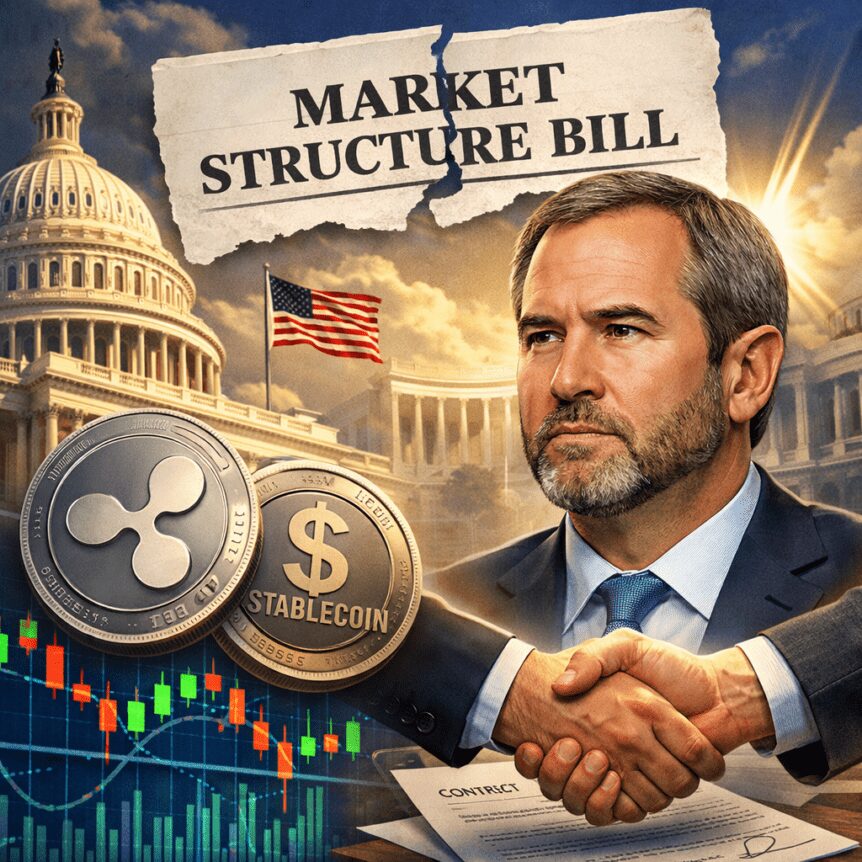
Brad Garlinghouse, chief executive of Ripple, warned that gains toward enacting the US Senate’s digital asset market structure framework may not translate into actual passage. Speaking at the Consensus crypto conference in Miami, Garlinghouse stressed that the next two weeks would be pivotal for the CLARITY Act, suggesting the political dynamics surrounding the measure could erode momentum during the calendar leading into the 2026 midterms.
Garlinghouse noted that while the CLARITY Act aims to bring regulatory clarity to the digital asset sector, no piece of legislation is without tradeoffs. He argued that clarity is preferable to chaos, even if the bill is not perfect, and underscored the broader objective of reducing uncertainty for market participants. According to Cointelegraph, his remarks reflect a broader industry push to finalize a comprehensive framework as lawmakers weigh competing concerns about stablecoins, tokenized assets, and ethics in the asset class.
Key takeaways
- The CLARITY Act’s prospects remain uncertain, with timing increasingly sensitive to political dynamics ahead of the 2026 midterm cycle.
- A compromise on stablecoin yield, announced by Senators Tillis and Alsobrooks, could influence momentum toward advancing CLARITY, though significant questions remain about broader market structure provisions.
- Regulatory oversight coordination between the SEC and CFTC persists as a parallel track, with officials signaling that legislation remains a prerequisite for a comprehensive enforcement framework.
- Ripple and other industry participants have engaged in informal negotiations involving the White House and financial regulators, highlighting the high-stakes negotiation environment surrounding crypto regulation.
Legislative trajectory for the CLARITY Act
At Consensus, Garlinghouse framed the CLARITY Act as a priority rather than a future consideration, aligning with ongoing parliamentary activity. The measure has already progressed through the Senate Agriculture Committee in a January markup and now requires action by the Senate Banking Committee before it can reach a full chamber vote. The evolving political calculus—particularly in the context of primary campaigns and the 2026 elections—raises the risk that the bill could lose momentum if not pushed decisively in the near term.
Senator Cynthia Lummis, a member of the banking committee, has publicly pressed for congressional action, emphasizing that the entire industry operates under a cloud of legal uncertainty that only Congress can dispel. While praise for the bill’s intent exists, critics point to the need to balance consumer protection, market integrity, and innovation incentives as part of any final package.
Beyond the legislative text itself, the negotiations have encompassed a broader set of policy questions—stablecoins, tokenized equities, and ethics—areas that have been sticking points delaying movement in the Senate since the House of Representatives passed the measure in July 2025. The latest signals indicate a potential path forward if adjacent provisions on yield and asset classification can be reconciled with a regulator-friendly framework that still preserves investor protections.
Regulatory coordination and oversight posture
Even as Congress contemplates the CLARITY Act, executive-branch and agency actions continue to shape the regulatory landscape. In March, the U.S. Securities and Exchange Commission (SEC) and the Commodity Futures Trading Commission (CFTC) signed a memorandum of understanding to coordinate their oversight of the evolving digital-asset market structure. Officials describe this interagency collaboration as a practical step in aligning approaches to market infrastructure, enforcement priorities, and investor protection, pending a broader legislative foundation.
As part of the stakeholder dialogue, SEC leadership has framed crypto regulation as an ongoing process rather than a finished product. The agency has signaled that approval of the CLARITY Act would inform and accelerate its rulemaking and enforcement posture, enabling a more predictable environment for regulated entities and registered market participants.
These developments underscore a critical point for institutions weighing regulatory risk: even with interagency coordination in place, a clear, enacted framework remains essential to reduce legal ambiguity for exchanges, banks engaging in crypto-related services, and other market infrastructure providers. The interagency momentum, while helpful, still leaves substantive questions about licensing, capital requirements, and customer due diligence unresolved in the absence of final congressional action.
Broader policy context and industry impact
The CLARITY Act sits at the intersection of innovation, investor protection, and financial stability. Its fate bears directly on how crypto firms structure licensing, compliance, and cross-border operations in a landscape where different jurisdictions pursue divergent approaches. For institutions involved in tokenized assets, stablecoins, or crypto-enabled banking services, the legislation could translate into clearer standards for registration, reporting, and customer verification, thereby aiding risk management and regulatory alignment.
From a compliance perspective, the bill’s trajectory matters for AML/KYC frameworks, know-your-customer regimes, and the governance of stablecoins tied to fiat or other reserve assets. Analysts and legal teams will be watching how the bill addresses collateral standards, reserve custody, and disclosure requirements, as well as how it interfaces with existing banking relationships and payment rails. The conversation also intersects with cross-border policy movements, including the European Union’s MiCA framework, which serves as a regional reference point for market structure and stablecoin oversight.
Within the political economy of regulation, industry stakeholders argue that timely clarity is essential to reduce the systemic risk that arises from fragmented supervision and inconsistent enforcement signals. Yet the practical path to a final bill remains constrained by competing sector interests and the broader electoral calendar. As negotiations continue, market participants should prepare for continued uncertainty and scenario planning around licensing timelines, regulatory approvals, and potential transitional rules.
In summary, the forthcoming weeks will test whether legislative action on the CLARITY Act can outpace political headwinds and regulatory tensions. While interagency coordination provides a supportive backdrop, the ultimate resolution will hinge on Congress delivering a comprehensive, workable regime that aligns with enforcement priorities, investor protections, and the evolving structure of the crypto markets.
Closing perspective: The path to a binding framework remains unsettled, and stakeholders should monitor congressional calendars, committee chair statements, and any new interagency guidance that could shape the timing and scope of a final bill. The balance between regulatory certainty and policy flexibility will define the next phase of the US digital asset regime.



Ripple is feeding North Korea–linked threat intelligence into Crypto ISAC, hoping shared context on DPRK operatives and DeFi exploits can blunt a 2026 hack wave led by Drift and KelpDAO.
Summary
- Ripple is contributing exclusive North Korea–linked threat intelligence to the Crypto ISAC information-sharing platform, arguing that “the strongest security posture in crypto is a shared one.”
- DPRK hackers have stolen about $577 million in crypto so far in 2026—76% of all hack losses year-to-date—largely via two DeFi exploits on Drift Protocol and KelpDAO.
- The intelligence covers enriched profiles of suspected North Korean IT operatives and detailed indicators of compromise (IOCs), as attackers pivot from pure technical exploits to long, social engineering–driven campaigns.
Ripple said it has begun sharing internal threat intelligence on North Korean hacking activity with members of Crypto ISAC, a not-for-profit cyber collective focused on the digital asset sector.
In a joint blog, Crypto ISAC growth director Christina Spring wrote that the data “ranges from domains and wallets known to be associated with fraud, to Indicators of Compromise (IOCs) from active DPRK hack campaigns.”
Ripple’s threat feeds go to Crypto ISAC
She stressed that what differentiates Ripple’s feeds is not just raw indicators but “contextual enrichment from a security team with deep expertise of the threat actors impacting the crypto ecosystem,” giving defenders more actionable context than a typical IOC list.
Ripple’s own announcement on X argued that “the strongest security posture in crypto is a shared one,” adding that “a threat actor who fails a background check at one company will apply to three more that same week. Without shared intelligence, every company starts from zero.”
The intelligence reportedly includes enriched profiles of suspected North Korean IT workers attempting to embed themselves inside crypto and fintech firms, tying together email addresses, domains, on-chain wallets, and malware infrastructure used across multiple campaigns.
Drift and KelpDAO show a shift to social engineering
Ripple’s move comes in response to a wave of DPRK-linked attacks that have targeted DeFi in 2026, most notably the hacks on Solana-based Drift Protocol and re-staking platform KelpDAO.
TRM Labs estimates that those two incidents alone netted North Korean groups about $577 million—$285 million from Drift and roughly $292 million from KelpDAO—accounting for 76% of all crypto hack value through April.
Chainalysis and TRM note that North Korea–linked actors stole more than $2 billion in 2025, bringing their cumulative haul above $6.7 billion, and that DPRK’s share of global crypto hack losses climbed from under 10% in 2020 to 64% by 2025.
The April 1 Drift exploit followed what The Hacker News and Chainalysis describe as a six‑month social engineering campaign that began in late 2025, during which North Korean proxies held in‑person meetings with Drift contributors and used that trust to convince signers to pre‑authorize withdrawals via Solana’s “durable nonce” feature.
Attackers then executed 31 pre‑signed transactions in about 12 minutes, draining $285 million in assets before bridging most of the funds to Ethereum; TRM says the stolen ETH has largely remained dormant, indicating a cautious, long‑horizon laundering plan.
The April 18 KelpDAO exploit used a different playbook: DPRK-linked actors compromised two internal RPC nodes, DDoS’d external nodes, and fed false data into LayerZero Labs’ DVN to mint 116,500 unbacked rsETH, then used that collateral to borrow about $196 million in ETH on Aave.
Subsequent analysis from TRM and others shows that while the Arbitrum Security Council froze roughly $71.5 million in downstream ETH, the attackers quickly pivoted to swap remaining funds into BTC via THORChain and Chinese intermediaries, underscoring the sophistication and adaptability of their laundering operations.
In response, Aave-led coalition DeFi United has raised more than $300 million in a recovery plan for KelpDAO, while Arbitrum’s emergency freeze and the rapid formation of cross‑protocol recovery task forces highlight a growing willingness to coordinate defensive measures at the ecosystem level.
A recent Decrypt feature and Ripple’s own messaging frame the new data‑sharing initiative as an attempt to get ahead of this evolution in tactics—moving the industry from fragmented awareness to shared, real‑time intelligence against what security researcher Natalie Newson at CertiK calls “a state-directed financial operation running at institutional scale and speed.”
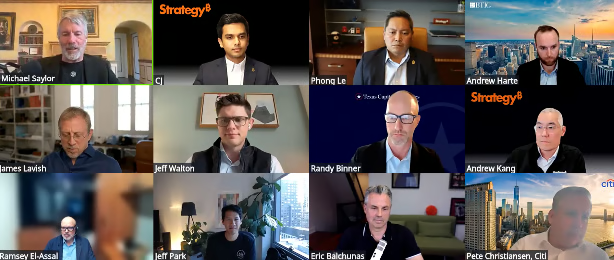
Strategy executive chairman Michael Saylor said his firm could sell Bitcoin to “inoculate” the market against sudden panic or to reinforce confidence in the company, in contrast to its long-standing “never sell” Bitcoin strategy.
“We’ll probably sell some Bitcoin to fund a dividend, just to inoculate the market, just to send the message that we did it,” Saylor said during the Strategy’s first-quarter earnings call on Tuesday.
Market participants will realize that “the company’s fine, the Bitcoin’s fine, the industry’s fine, the world didn’t come to an end,” Saylor said after Strategy reported a $12.5 billion net loss, driven mostly by unrealized losses on its Bitcoin (BTC) holdings as Bitcoin fell 23.8% in the first quarter.
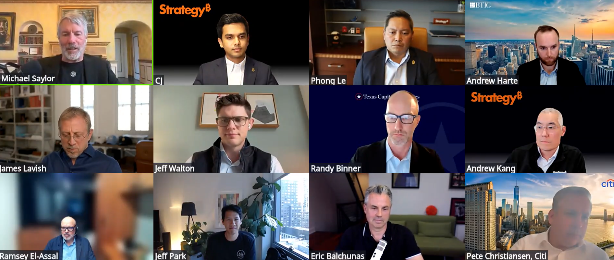
Michael Saylor (top left) speaking during Strategy’s Q1 earnings call. Source: Strategy
Strategy has been a consistent Bitcoin buying force since August 2020, when it began its strategy of holding Bitcoin as a primary treasury asset.
In February, Saylor dismissed concerns that the company could be forced to sell its holdings during a crypto market downturn, telling CNBC’s Squawk Box, “I expect we’ll buy Bitcoin every quarter forever.”
Saylor also said Strategy could withstand an extreme drawdown in Bitcoin’s price to as low as $8,000 and still cover its debt obligations without needing to sell.
Saylor wants Stretch to be world’s biggest credit instrument
Strategy has been leaning on dividend-paying perpetual preferred stock offerings like Stretch (STRC) to fund its Bitcoin purchases in recent months.
Stretch has helped Strategy fund a large portion of the 145,834 Bitcoin it has bought this year, bringing its total holdings to 818,334 Bitcoin, worth $66.7 billion.
Saylor said Strategy is aiming to build Stretch into the “biggest credit instrument in the world,” adding that as its assets under management grow, liquidity will increase, enabling broader adoption and creating a “network effect.”
Saylor hopeful neobanks will build Bitcoin credit products
Saylor said several Bitcoin-focused decentralized finance protocols, including Pendle and Saturn, have started tokenizing STRC’s 11% monthly dividends, allowing them to be traded and improving liquidity for Bitcoin-backed credit.
Saylor added that he is hopeful that a neobank will start offering Bitcoin-backed “digital yield accounts” in the near future.
“We had none of these conversations going on eight weeks ago or 12 weeks ago, and now I see like three dozen initiatives,” Saylor said.
Related: Capital B raises $1.3M from Adam Back for Bitcoin strategy
Saylor said Bitcoin-backed digital yield accounts could offer investors up to 8%, arguing that they are far more lucrative than what many stablecoins offer.
“Check back in 12 more weeks, I think we’ll have some exciting news,” Saylor said of the broader Bitcoin credit market.
Meanwhile, MSTR fell 4.33% in after-hours trading to $178.80 on Tuesday after the company reported its first-quarter earnings.
Strategy is on track to record a stronger second-quarter performance, with Bitcoin up nearly 20% to $81,250 since April 1.
Magazine: Adam Back says current demand is ‘almost’ enough to send Bitcoin to $1M


Ripple CEO Brad Garlinghouse defended Clarity Act progress at Consensus 2026, calling the past week a “big positive shift.”
Summary
- Garlinghouse spoke live at Consensus 2026 in Miami, expressing renewed confidence in the Clarity Act’s path through the Senate.
- The Ripple CEO pointed to growing Senate support as evidence that legislative momentum behind the bill is real.
- His comments arrive as the Clarity Act faces simultaneous industry backing and resistance from major US banking groups.
Ripple CEO Brad Garlinghouse took the Consensus 2026 stage in Miami today and told attendees the Clarity Act is gaining genuine ground in Washington. He called the past week a “big positive shift,” pointing specifically to growing Senate support as proof that the bill is moving.
His confidence arrives at a tense moment for the legislation. The Clarity Act has secured backing from major crypto trade groups, with Coinbase and Circle both urging the Senate Banking Committee to advance the bill after a stablecoin yield compromise was brokered by Senators Tillis and Alsobrooks. Banking associations have pushed back against those yield provisions, arguing the deal introduces systemic risk to traditional financial institutions.
The regulatory backdrop behind Garlinghouse’s optimism
Garlinghouse has made regulatory clarity the centrepiece of Ripple’s public positioning for years. A Ripple survey published earlier this year found 72% of institutional respondents consider digital assets essential to their financial operations. Garlinghouse has used that figure repeatedly to press the case for federal legislation that gives institutions a clear legal framework to operate under.
Ripple’s own legal history with the SEC has made Garlinghouse one of the most closely watched figures on crypto regulation. His Consensus 2026 remarks put him at the centre of what is shaping up to be the most consequential stretch for US digital asset legislation since the FTX collapse triggered regulatory urgency in late 2022.
Consensus 2026 drew over 20,000 attendees to Miami, with SEC Chair Paul Atkins and CFTC Chair Brian Selig both in attendance, signalling the highest level of regulatory engagement the conference has seen. Whether Senate momentum translates into a committee markup in the coming weeks will determine whether Garlinghouse’s optimism proves well-founded.


Bitcoin zoomed past $81,000 in Asian hours Tuesday, according to CoinDesk market data, up 6.7% on the week and riding the broader risk-on tape that has equities printing records on fading Iran tensions and renewed AI optimism.
Other crypto majors caught the bid. Solana zoomed 3% to $87.35. Dogecoin added another 4% to $0.1158, extending its weekly gain to 14.5% as futures open interest sits at year-highs. XRP, BNB and TRX all printed green on the day.
Ether is the laggard, off 0.3% over 24 hours despite holding a 3.9% weekly gain at $2,376. Spot ETH ETF flows turned negative last week, ending a three-week inflow streak.
Wall Street gauges closed at all-time highs Tuesday after President Donald Trump signaled progress toward a “final agreement” with Iran and announced a pause on Operation Project Freedom for a short period. Brent crude fell 1.7% to about $108 a barrel. The dollar, which had been the haven of choice through the US-Israel war on Iran, weakened against all its G-10 peers.
Asian equities zoomed to an all-time high on Wednesday morning, with the MSCI Asia Pacific index advancing 1.8%. South Korea’s Kospi jumped more than 6% to a record, with Samsung Electronics surging 15% to reach a $1 trillion valuation, the second Asian company ever to clear that mark.
Strong earnings from Advanced Micro Devices and Super Micro Computer added to the AI-trade momentum, with Nasdaq 100 futures up 0.6%.
A key development came as Strategy executive chairman Michael Saylor told in the company’s Q1 2026 earnings call that it may sell a portion of its bitcoin holdings to fund dividend payments.
“We will probably sell some bitcoin to pay a dividend just to inoculate the market and send the message that we did it,” Saylor said.
The world’s largest corporate bitcoin holder, sitting on 818,334 BTC at an average acquisition cost of $75,537, has not sold any of its position before. The model has always been to buy and hold.
Strategy posted a $12.54 billion Q1 net loss as bitcoin’s slide from October’s $126,000 peak weighed on the company’s mark-to-market accounting. The firm carries roughly $1.5 billion in annual dividend obligations across preferred stock and outstanding debt, with about 18 months of USD reserves to cover them at current run-rates.
MSTR shares dumped over 4% in after-hours trading on the announcement and BTC briefly slipped under $81,000 before recovering.
Saylor framed the move as a feature of the model rather than a break from it.
“You buy bitcoin with credit, you let it appreciate, and then you sell bitcoin to pay the dividend.”
That is a different sentence than every prior Strategy quarter, where the playbook was to issue more debt or equity to fund obligations rather than touch the BTC stack.


The Solana-based perpetuals exchange will issue burn-on-redeem recovery tokens funded by exchange revenue, a $127.5M Tether commitment, and another $20M from partners.

TLDR
- Coinbase selected Centrifuge as its preferred tokenization infrastructure and took an equity stake in the firm.
- The agreement positions Centrifuge as the default issuance layer for tokenized assets across Coinbase’s ecosystem, including Base.
- The companies expect to launch the first wave of institutional assets on Base in the coming weeks.
- Coinbase Asset Management continues expanding tokenized offerings through partnerships with Superstate and Apex Group.
- Tokenized real-world assets have reached about $27 billion onchain, with treasuries and fixed income products accounting for $16 billion.
Coinbase selected Centrifuge as its preferred tokenization infrastructure and disclosed a strategic equity investment on Tuesday. The agreement sets Centrifuge as the default issuance layer for tokenized assets across Coinbase’s ecosystem, including Base. The companies said they will launch the first wave of institutional assets on Base in the coming weeks.
Coinbase and Centrifuge Formalize Tokenization Partnership
Coinbase positioned Centrifuge as its core infrastructure partner for onchain asset issuance. The company will use Centrifuge as the default layer across its products, including those built on Base. The firms confirmed that institutional assets will begin launching on Base within weeks.
Coinbase said the arrangement supports asset managers seeking to issue products onchain. However, the deal does not appear to grant exclusivity to Centrifuge. Coinbase Ventures had already invested in Centrifuge during a 2022 strategic funding round.
Centrifuge provides infrastructure for tokenized investment strategies. It powers onchain products for Apollo, Janus Henderson, and S&P Dow Jones Indices. The platform crossed $1 billion in total value locked in mid-2025 and now reports $1.66 billion, according to DeFiLlama.
Coinbase expanded its tokenized capital markets strategy across several asset classes. The exchange targets ETFs, credit products, and structured offerings through blockchain issuance. This partnership adds a dedicated issuance framework within its ecosystem.
Coinbase Expands Onchain Asset Issuance Across Base
Coinbase Asset Management advanced separate tokenization initiatives in recent weeks. Last week, it said it would issue its CUSHY stablecoin credit fund through Superstate’s FundOS platform. In March, it worked with Apex Group to tokenize a share class of its Bitcoin Yield Fund on Base.
The exchange continued building infrastructure for institutional access to tokenized products. It aligned its Base blockchain as a primary venue for these issuances. The Centrifuge partnership supports this rollout with a standardized issuance layer.
The broader real-world asset sector has expanded onchain in recent months. Tokenized real-world assets total about $27 billion across blockchain networks. Tokenized treasuries and other fixed income products account for roughly $16 billion of that figure.
Securitize and Ondo Finance currently lead the RWA sector by issuance volume. Tether and Circle also operate tokenized products, including tokenized gold and money market funds. These platforms compete across stablecoin and asset-backed offerings.
Centrifuge CEO Bhaji Illuminati addressed asset selection standards. He said, “What matters now isn’t getting assets onchain, it’s getting the right assets onchain in the right way.” He made the statement as the companies outlined their partnership.
Coinbase CEO Brian Armstrong also announced workforce reductions on Tuesday. He said the exchange would lay off 14% of employees. Armstrong stated that AI tooling had made certain roles redundant.

The three-way partnership pairs Securitize’s broker-dealer rails with Jump’s PropAMM liquidity engine and Jupiter’s Solana-wide aggregation layer.


The Security Council has been in the spotlight in recent weeks after its decision to freeze over 30K ETH connected to the Kelp bridge exploit.


Pi Network co-founders took the Consensus 2026 stage in Miami, six days before Protocol 23 activates on May 11
Summary
- Dr. Chengdiao Fan spoke at Consensus 2026 on May 6 on aligning Web3, AI, and blockchain for utility at the Convergence Stage.
- Nicolas Kokkalis joined a May 7 panel on proving human identity online without exposing personal data.
- Both sessions are timed to build momentum ahead of Pi Network’s Protocol 23 launch, which activates on May 11.
Pi Network co-founders Dr. Chengdiao Fan and Nicolas Kokkalis both appeared at Consensus 2026 in Miami this week, speaking to over 20,000 attendees including institutional investors and government representatives. Fan addressed the Convergence Stage on May 6, delivering a session titled “Aligning Web3, AI, and Blockchain for Utility,” while Kokkalis joined a May 7 panel called “How to Prove You’re Human in an AI World (Without Doxing Yourself).”
The appearances are precisely timed. As crypto.news reported, Pi Network’s Protocol 23 activates on May 11, four days after the conference closes, introducing full smart contract functionality to the Pi blockchain for the first time. The Consensus stage gives the co-founders maximum public visibility immediately before their most consequential technical upgrade.
Identity and AI as Pi’s central argument
Kokkalis’s panel placed Pi Network’s KYC-verified user base at the centre of one of the most pressing problems in the AI era: how to confirm that a user is human when AI can simulate human behaviour convincingly. Pi Network argues its 18 million verified users and 526 million completed KYC validation tasks give it a structural answer that pure code-based blockchains cannot replicate.
Fan’s session argued that utility, not speculation, must drive the next phase of crypto adoption. Pi Network’s official X account confirmed that Fan stated on stage: “This is the infrastructure Pi has been building since 2019,” directly connecting the network’s years of identity verification work to the AI era’s governance challenge.
With Protocol 23 days away, Consensus 2026 gave Pi Network’s founders a high-profile window to frame what the upgrade delivers before the launch itself defines the story. As crypto.news tracked, PI rose more than 5% on April 29 when both founders were confirmed as speakers, with the token near $0.187 entering conference week.
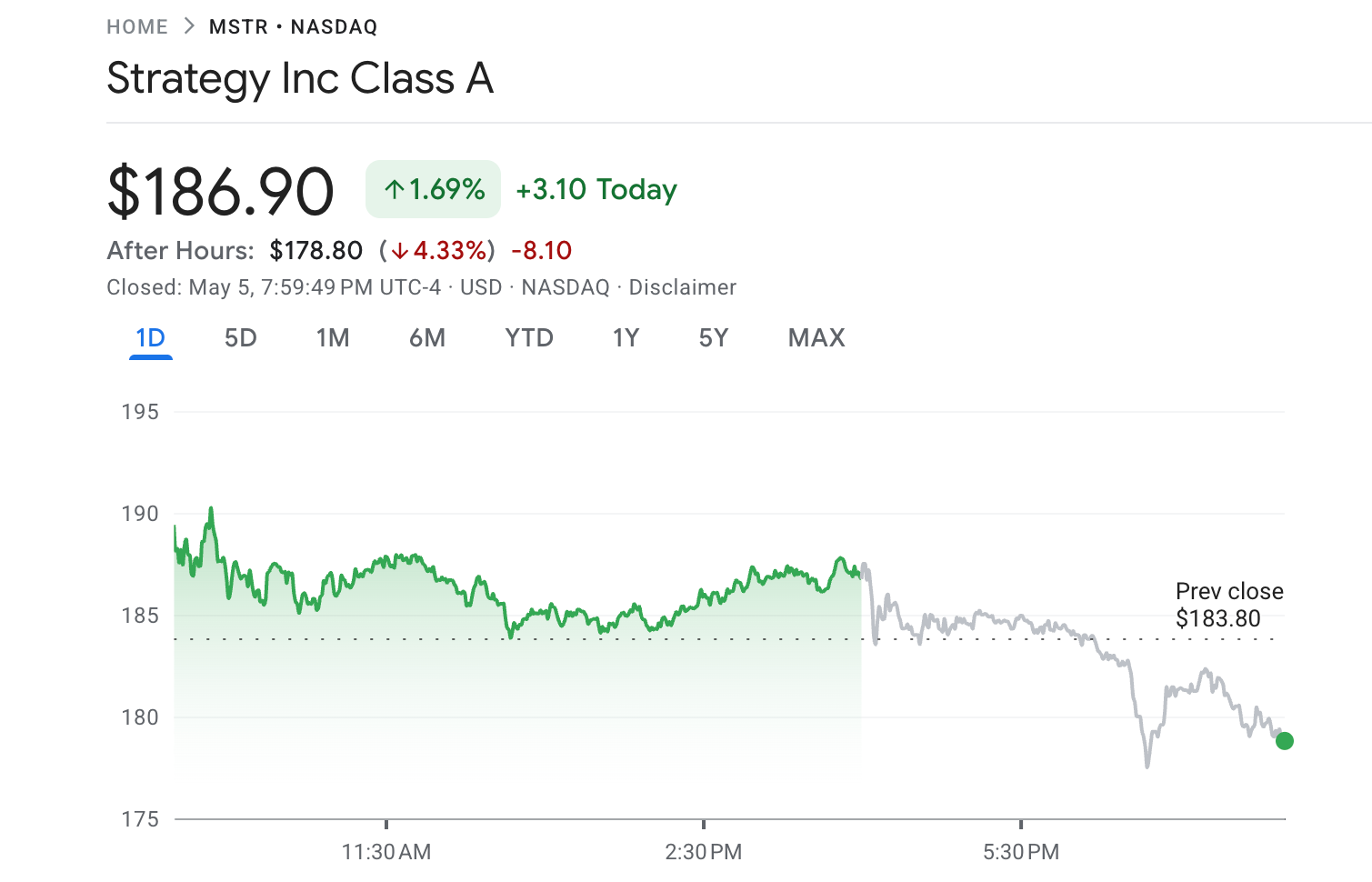
MicroStrategy shares fell after executive chairman Michael Saylor suggested that the firm may sell some Bitcoin (BTC) to fund dividend payments.
“We will probably sell some Bitcoin to pay a dividend just to inoculate the market and send the message that we did it,” he said.
Saylor explained that the strategy involves using credit to accumulate Bitcoin, allowing the asset to gain value over time, and then liquidating a portion when needed to fund dividend payouts.
“You buy bitcoin with credit, you let it appreciate, and then you sell bitcoin to pay the dividend,” he added.
The remarks reverse the company’s longstanding “never sell” position. The shift came during a Q1 2026 earnings call where Strategy reported a $12.54 billion net loss.
Follow us on X to get the latest news as it happens
MicroStrategy CEO Says Bitcoin Sales Are on the Table When Accretive
Meanwhile, CEO Phong Le said the firm would also consider selling Bitcoin “when it’s advantageous to the company.” He stressed that the company remains focused on being a net Bitcoin aggregator while prioritizing growth in Bitcoin per share, which he believes will be the most accretive to MSTR stock’s long-term value.
“Our ability to sell bitcoin either to buy U.S. dollars or sell bitcoin to buy debt if it’s accretive to bitcoin per share is something that we would consider doing going forward,” Le said. “We’re not going to sit back and just say, We’ll never sell the bitcoin.”
Google Finance data showed that MSTR closed up 1.69% at $186.9 on Tuesday. Shares reversed sharply after markets closed. MSTR dropped more than 4% in after-hours trading.

Strategy holds 818,334 BTC at an average cost of about $75,537. The firm is the largest publicly traded corporate holder of the asset. Polymarket traders now price a 48% chance that Strategy sells any of its BTC by December 31, 2026.
Subscribe to our YouTube channel to watch leaders and journalists provide expert insights
The post MSTR Shares Fall as MicroStrategy Weighs Potential Bitcoin Sale appeared first on BeInCrypto.

Day 1 – Your Energy Income | Financial Planning for Families

Welsh broadcasters target voters with digital election coverage

Welsh firms receiving the King’s Awards for Enterprise

Manchester United reach agreement with Casemiro over contract clause amid transfer speculation

US brings back mandatory military draft registration

Steven Gerrard disagrees with Gary Neville over ‘shock’ Chelsea and Arsenal claim | Football


-

 NewsBeat2 days ago
Channel 5 – All Creatures Great and Small series 7 new post
-
 Business6 days ago
Tesla Officially Registers Elon Musk’s Stock: What Investors Need to Know
-
 Tech4 days ago
Trump’s 25% EU auto tariff breaches Turnberry Agreement that also covers semiconductors and digital trade
-

 Entertainment6 days ago
Insider Claims Reason Behind Key & Peele Split
-
 Sports4 days ago
Paul Scholes issues Marcus Rashford reality check as agreement emerges over Man United star
-

 Business7 days ago
Barclay Brothers Avoid Bankruptcy: HSBC Drops High Court Petitions After IVA Deal
-

 Entertainment4 days ago
Met Gala 2026 Rumored Guest List Is Turning Heads
-

 Entertainment6 days ago
Celebrities Who Are Attending the 2026 Met Gala Event
-

 Tech6 days ago
Texas Instruments made a new flagship graphing calculator: the TI-84 Evo
-

 Business6 days ago
Strait of Hormuz Remains Heavily Restricted on April 29 Amid Iran Conflict
-

 Crypto World6 days ago
Meta (META) starts stablecoin payout to creators in Circle’s USDC on Polygon, Solana via Stripe
-
Business5 days ago
Strait of Hormuz Blockade Persists Amid US-Iran Standoff, Sending Oil Prices Soaring
-

 Sports4 days ago
Cavaliers vs. Raptors Game 6 live score, updates, highlights from 2026 NBA playoffs first-round series
-
 Sports4 days ago
David Benavidez responds to team Canelo saying the fight will never happen
-

 Sports6 days ago
Saudi Arabia set to withdraw LIV Golf funding after 2026 season, per reports
-

 Business5 days ago
Two Powerball Tickets Split $143 Million Jackpot in Indiana and Kansas
-

 Entertainment4 days ago
Kylie Jenner Hit With Second Lawsuit From Ex-Housekeeper
-
Entertainment4 days ago
New on Prime Video in May 2026 — Full List of Movies and Shows
-

 Sports4 days ago
Plane crash in Wimberley, Texas kills 5 pickleball players at tournament
-

 Sports6 days ago
Arsenal, Atletico Madrid share draw after penalty drama in Champions League semi-final
You must be logged in to post a comment Login