

Crypto World
Matchain MAT surges 349% in altcoin rotation

AI Layer-2 token Matchain MAT surged 349% in a single session as speculative capital rotated into small-cap altcoins.
Summary
- Matchain is a BNB Chain zk-rollup focused on decentralised identity and AI-driven advertising infrastructure, with a market cap under $3 million.
- The move coincided with CryptoQuant’s Bull-Bear Market Cycle Indicator turning bullish on May 12 for the first time since March 2023.
- The Altcoin Season Index stands at 35 as of May 2026, still well below the 75-point threshold that signals a genuine market-wide rotation.
Matchain is an AI-powered zk-rollup blockchain built on BNB Chain that focuses on decentralised identity, data sovereignty, and performance-based advertising. Its native token MAT is used for gas fees, staking, governance, and access to its MatchID decentralised identity layer.
The project reports over 27 million wallets created and holds a partnership with Paris Saint-Germain targeting mainstream Web3 onboarding.
The 349% move, reported across crypto market data platforms on May 13, occurred as Bitcoin consolidated in the $79,000 to $82,000 range. Matchain carries a market cap of well under $3 million, meaning large percentage moves can occur on thin volume and reverse equally fast.
The token launched on Binance Alpha in June 2025 at an all-time high of $6.67 before falling over 99% to a low of $0.036 in March 2026.
CryptoQuant bull signal adds context to the rotation
The session came one day after CryptoQuant’s Bull-Bear Market Cycle Indicator flipped bullish on May 12 for the first time since March 2023. That prior reading preceded a sustained run taking Bitcoin from $20,000 to above $73,000.
Analysts note that sharp small-cap moves typically occur in the early stages of broader speculative altcoin rotation, when retail capital begins hunting for exposure below the top 20 tokens.
As crypto.news documented, Bitcoin’s dominance has remained elevated above 59% through 2026, with genuine altcoin season historically requiring it to fall below 45%.
The Altcoin Season Index sits at 35 in May 2026, still well short of the 75-point threshold associated with a full market-wide rotation. Capital flows this year have remained heavily concentrated in large-cap names.
Traders should approach assets in this market-cap range with significant caution. Percentage gains of this size in illiquid tokens frequently reverse within hours, and Matchain’s prior price history includes a 99% decline from its listing high in less than a year.


TLDR
- The Senate Banking Committee will review dozens of amendments to the Clarity Act during a scheduled markup session.
- Most proposed amendments face limited chances of approval as the Republican majority prepares to advance the bill.
- Senator Jack Reed seeks to restrict stablecoin yields and remove developer protections from the current draft.
- Senator Catherine Cortez-Masto has proposed a safe harbor to shield software developers from money transmitter liability.
- Senator Chris Van Hollen wants to bar senior government officials from owning or promoting digital asset businesses.
- Senator Elizabeth Warren has introduced amendments targeting banking ethics and presidential ownership interests.
The Senate Banking Committee will review dozens of amendments to a major crypto market bill this week. Lawmakers will debate changes to the Digital Asset Market Clarity Act during a scheduled markup session. However, most proposals face long odds as the Republican majority prepares to move the bill forward.
Clarity Act amendments target ethics rules and developer protections
Lawmakers filed a wide range of proposals ahead of Thursday’s markup session. The amendments address ethics rules, stablecoin yields, and protections for blockchain developers.
Senator Jack Reed submitted 18 amendments, including one to restrict stablecoin yields. He also seeks to remove the Blockchain Regulatory Certainty Act from the bill. That section shields software developers from money transmitter rules when they do not control customer funds. Senator Catherine Cortez-Masto proposed a safe harbor to protect developers from criminal liability for failing to register as money transmitters.
Senator Chris Van Hollen introduced eight amendments focused on ethics standards. One measure would ban the president and senior officials from owning or promoting digital asset businesses. Senator Elizabeth Warren proposed to “prohibit political corruption in banking applications and presidential bank ownership.” Her proposal appears to target World Liberty Financial, which has ties to President Donald Trump and his family.
Warren also offered amendments that would cap credit card interest rates and request bank records tied to Jeffrey Epstein. The bill includes housing provisions backed by Senator John Kennedy, which fall outside crypto policy.
Lawmakers prepare for vote on the Clarity Act
Committee members will debate each amendment and hold votes unless sponsors withdraw them. A simple majority will decide whether to adopt or reject each proposal.
Senator Mark Warner proposed a control test for certain decentralized finance platforms. His amendment would determine when operators must comply with Bank Secrecy Act anti-money laundering rules. Meanwhile, Senator Bill Hagerty seeks to ban U.S. Federal Reserve central bank digital currencies.
Republican leaders have planned the markup process in advance. The committee previously considered about 75 amendments before postponing an earlier hearing.
Negotiators spent four months resolving disputes before this week’s session. Once approved, lawmakers can merge the bill with a version that cleared the Senate Agriculture Committee.
Democrats continue to press for conflict-of-interest rules tied to government officials and crypto businesses. Senator Kirsten Gillibrand has said the bill will not pass the Senate without that provision.
The bill must secure at least 60 votes to clear the Senate. It would then return to the House, which passed a similar version last year.
Coinbase CEO Brian Armstrong wrote on X that the bill is “strong.” He said it “will benefit the American people by making the US financial system faster, cheaper and more accessible.”

Major US banks and financial market intermediaries expect the transition to a digitized financial system to start slowly, then hit a tipping point at which it accelerates, according to credit rating agency Moody’s Ratings.
In a report Tuesday, the agency said that, during conversations with US banks and other financial market intermediaries, most viewed the shift as inevitable and agreed it would start “slow, then fast,” with tokenization volume increasing and extending to more market participants, assets and use cases.
“Across our conversations, industry leaders generally believed that broad asset tokenization will happen; the main uncertainties center around how quickly and in what sequence,” Moody’s said.
“In the near term, progress is expected to remain gradual and focused on those simpler segments, such as funds and short-term instruments, running alongside traditional processes. But beyond that, many believe a tipping point will eventually be reached where broader adoption accelerates rapidly.”
Tokenization has been one of the drivers of institutional interest in blockchain and crypto and is expected to experience massive growth over the next few years. Cathie Wood’s ARK Invest predicts digital assets could grow into a $28 trillion market by 2030, with Bitcoin, decentralized finance, stablecoins and tokenized RWAs as key drivers.
TradFi is laying the groundwork
Current tokenization activity is low, according to Moody’s, with the main uses coming through cryptocurrency trading, cross-border retail payments and some institutional use cases. But traditional financial institutions are actively preparing for a surge in adoption.
The size of the tokenized real-world asset market has increased by more than 420% since the start of 2025 and is worth $31.6 billion as of Thursday, according to analytics platform RWA.xyz.
“Almost all large banks and major financial market intermediaries have established dedicated digital-asset teams or innovation units and are participating in industry pilots to test new infrastructure,” Moody’s said.
“These efforts are strategic: firms want to be ready to serve clients with digital asset and digital money capabilities if adoption takes off, so they are not caught flat-footed by a sudden shift in market demand.”
In January, Morgan Stanley tapped veteran executive Amy Oldenburg to lead the investment bank’s new crypto unit weeks after announcing plans to launch three crypto exchange-traded funds and a crypto wallet.
Related: Moody’s brings credit ratings onchain with Canton Network integration
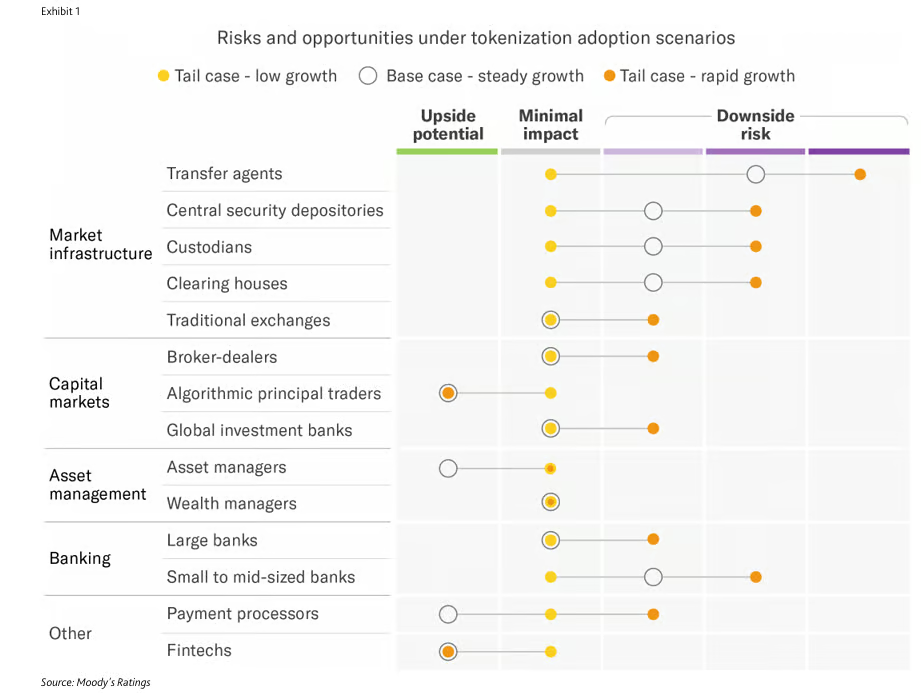
Three possible outcomes for financial system
Moody’s said in a separate report on Monday that there are three possible outcomes for the financial system, depending on the pace of tokenization.
In the “steady growth” base case, which the agency said is the most likely, the financial system will largely stay the same; tokenization would scale in select assets such as stablecoins and tokenized deposits, but incumbent asset managers, banks and infrastructure providers retain central roles.
However, in a low-growth scenario, in which regulatory friction, unresolved legal questions and low demand from end users have stifled adoption, asset tokenization and digital money would stay confined to narrow use cases with modest changes to the financial system.

Moody’s predicts there are three possible outcomes for the financial system depending on the pace of tokenization. Source: Moody’s
The most disruptive would be if tokenization undergoes rapid growth and assets such as stablecoins become widely embraced as an onchain settlement option.
“Some incumbents would face greater pressure. For example, payment processors and parts of the legacy market plumbing, such as correspondent banks may lose revenue associated with settlement delay and siloed infrastructure, and for small to mid-sized banks, deposit balances could decline,” Moody’s said.
Macro investor and former hedge fund manager Jordi Visser said on Saturday the “tokenization reality” will start this year, with tokenized assets powering agentic AI payments.
Meanwhile, international financial institution, the International Monetary Fund, said in April tokenization has the potential to remove friction and boost transparency in finance but also warned it has the potential to create challenges around financial stability.
Magazine: Guide to the top and emerging global crypto hubs — Mid-2026


Coinbase CEO Brian Armstrong has backed the latest version of the Digital Asset Market Clarity Act before the Senate Banking Committee’s Thursday markup.
Summary
- Armstrong says latest CLARITY Act draft has stronger bipartisan footing before Thursday Senate markup vote.
- Stablecoin yield compromise allows activity-based rewards while banning passive payments for simply holding tokens alone.
- HarrisX poll shows 52% support CLARITY Act, while 11% oppose passage before Thursday’s markup vote.
His comments mark another shift in the long-running debate over U.S. crypto market rules. Armstrong said the bill is now in its strongest position after months of talks between lawmakers, banks and crypto firms.
Meanwhile, the main change centers on stablecoin yield. Armstrong said banking and crypto groups reached a “healthy compromise” brokered by Senators Thom Tillis and Angela Alsobrooks. He said both sides left talks partly unhappy, but reached terms they could accept.
The revised draft bars passive yield paid only for holding stablecoins. However, it still allows activity-based rewards tied to payments, platform use and real crypto network activity. Earlier reports noted that this issue helped stall the bill in January after Coinbase rejected the earlier version.
Revised draft adds DeFi and CFTC changes
Armstrong also said the latest CLARITY Act text improved language around decentralized finance, tokenized stocks and the Commodity Futures Trading Commission’s role in crypto markets. These were among the same issues Coinbase raised when it opposed the earlier Senate draft.
The Senate Banking Committee released a 309-page revised draft before the markup. The text also includes language tied to non-custodial developers and infrastructure providers, which could shape how DeFi builders are treated under federal law.
Polling adds pressure before markup
The markup comes with more than 100 amendments attached to the Senate crypto market structure bill. Lawmakers are expected to debate changes covering stablecoin rules, developer protections, ethics provisions and enforcement before deciding whether to advance the bill.
A HarrisX poll also showed public support for the CLARITY Act across party lines. The survey of 2,008 registered U.S. voters found that 52% supported the bill, while 11% opposed it. The poll showed net support among Democrats, Republicans and independents.
The crypto ownership backdrop also gives lawmakers a wider audience to consider. The National Cryptocurrency Association’s 2025 report, based on 54,000 U.S. residents, found that about 20% of Americans own crypto. It also found that 67% of owners are under 45, while 52% use crypto as an investment.

The TRUMP token, the official memecoin of U.S. President Donald Trump, is down 5%, according to CoinDesk market data, as Trump Mobile announced the long awaited T1 handset is set to begin shipments next week.
As CoinDesk previously reported, neither the Trump Mobile project nor the President’s memecoin has gone particularly well. Shipment dates for the handset have been repeatedly delayed — and customer support is limited — while the TRUMP token is down nearly 90%.

Another question is, what exactly is the T1 Phone? Trump Mobile is a Mobile Virtual Network Operator and doesn’t have the ability to design and manufacture its own handset. Instead, it has worked with an outside company to pick a handset and re-skin it to be Trump themed. This kind of arraignment is common; Solana re-skinned the Osom OV-1 for its first Saga phone.
The Verge got its hands on one of the T1 Phone handsets last month, and concluded that it “sure looks a lot like an HTC U24”, a handset that came out in 2024.
Exactly what company is manufacturing the Trump phone is unclear, as neither HTC nor Trump Mobile would give an answer to The Verge. Trump Mobile has previously confirmed that its phones have final assembly in the U.S. but originate overseas.
For buyers, the shipment update means the T1 may finally move from political merch concept to shipped consumer product.
For TRUMP holders, the 5% drop suggests the market is treating the phone less like a catalyst and more like another Trump-branded product trying to prove there is still demand after the first wave of hype.

[PRESS RELEASE – London, United Kingdom, May 13th, 2026]
Following the successful completion of its private testing phase, BASIS is now officially live, with the platform publicly accessible at basis.pro as the company moves to address what industry participants increasingly describe as a structural gap in digital asset infrastructure.
The platform, developed with engineering support from Base58 Labs, has been tested under live market conditions with a select group of institutional participants. While reported metrics included sub-50 microsecond p99 execution latency, throughput exceeding 100,000 operations per second, and 100% uptime, the evaluation extended beyond peak performance benchmarks.
Testing was designed to observe how the system behaved when execution conditions became unstable. Scenarios included exchange-side latency spikes, API rate limits, liquidity fragmentation across venues, and partial execution failures. These conditions, while not constant, are representative of real trading environments where system behavior under stress determines outcome consistency.
According to BASIS CEO Helge Stadelmann, these scenarios reflect a broader limitation in current market infrastructure.
“Strategies exist. The constraint has been the infrastructure required to execute them with precision and defined risk,” Stadelmann said.
The platform operates as an arbitrage staking system powered by the Base58 Hyper-Latency Engine (BHLE), a proprietary high-frequency execution engine developed by Base58 Labs. BASIS identifies and captures pricing discrepancies across exchanges and distributes net arbitrage profits to platform participants through a staking structure designed around market-neutral execution.
In traditional markets, execution-layer infrastructure is typically embedded within institutional systems. In digital asset markets, that layer is still evolving, resulting in a dependency on external exchanges, APIs, and liquidity routing frameworks that introduce variability into execution outcomes.
Unlike conventional yield products that rely on token emissions or external reward incentives, BASIS derives user rewards exclusively from arbitrage execution profits generated across fragmented digital asset markets. Structurally, losses are absorbed by the company while users participate only in profit distributions generated through execution activity.
During testing, BASIS evaluated system behavior across a range of operational conditions. When execution parameters exceeded predefined thresholds, including projected slippage or incomplete fill conditions, the system halted execution and initiated deterministic rollback procedures. These mechanisms were designed to preserve capital and prevent forced completion under degraded conditions.
In scenarios where exchange-side instability occurred, the system adjusted outbound routing behavior and maintained allocation states without internal inconsistency. Pending executions were paused or reallocated without loss of state integrity, allowing the system to resume normal operation once conditions stabilized.
The Base58 Hyper-Latency Engine (BHLE), which underpins the platform, was developed to support these behaviors. While latency performance remains a core component, the design emphasis extends to sequencing logic, allocation tracking, and state preservation under varying execution conditions.
This approach reflects a shift in how execution performance is evaluated.
“Execution quality is determined by control under unpredictable conditions,” Stadelmann said.
The testing phase focused on verifying that the system could maintain deterministic behavior when external variables introduced uncertainty. Rather than prioritizing forced execution completion, the system was designed to priorities outcome consistency and capital preservation.
BASIS operates within a structured governance framework that includes ISO/IEC 27001:2022, ISO/IEC 20000-1:2018, AICPA SOC, and GDPR compliance standards. These certifications align the platform with established requirements for information security, service management, and operational oversight.
BASIS functions as execution-layer infrastructure supporting arbitrage deployment across exchanges rather than a conventional yield-generation platform. The underlying system is designed to maintain execution control, sequencing integrity, and deterministic risk behavior while operating across fragmented liquidity venues in real time.
With validation complete, BASIS is now officially live and publicly available through basis.pro. The platform currently supports BTC, ETH, SOL, and PAXG, each convertible into corresponding stTokens through a 1:1 structure, with reward accrual derived from arbitrage profits generated through the platform’s execution engine.
“We validated the system thoroughly before opening it to the market. BASIS is now officially live at basis.pro, and access is open,” Stadelmann said.
The launch reflects a broader shift in how infrastructure platforms are brought to market, with live validation and operational discipline completed prior to public availability.
As digital asset markets continue to mature, the role of execution-layer infrastructure is becoming more defined. While liquidity, custody, and compliance have seen rapid development, execution systems remain an area of ongoing evolution, particularly for institutional participants requiring consistent deployment frameworks.
The development of infrastructure capable of bridging the gap between proprietary trading systems and broader institutional access introduces new considerations for market structure. These include how execution control is standardized, how risk is managed across fragmented venues, and how infrastructure scales without introducing instability.
BASIS enters this stage of market development with execution discipline as a primary design principle. The platform’s architecture, testing methodology, and launch sequencing reflect an approach centered on system behavior rather than surface-level performance metrics.
As digital asset markets continue maturing, execution-layer systems capable of supporting scalable arbitrage deployment are becoming increasingly important. BASIS enters the market with a structure centered on market-neutral execution, deterministic risk management, and operational consistency across fragmented trading environments.
About BASIS
BASIS is a professional crypto arbitrage platform developed with engineering support from Base58 Labs. The platform operates through the Base58 Hyper-Latency Engine (BHLE), a proprietary high-frequency execution engine designed for sub-50 microsecond execution latency and deterministic risk management across fragmented digital asset markets.
About Base58 Labs
Base58 Labs is the engineering team behind the Base58 Hyper-Latency Engine (BHLE) and the technical infrastructure powering BASIS. The team specializes in execution-layer
development for digital asset markets, with a focus on latency optimization, sequencing integrity, and deterministic system behavior under variable market conditions.
The post BASIS.pro Is Live: Base58Labs Officially Launches Crypto Arbitrage Platform appeared first on CryptoPotato.
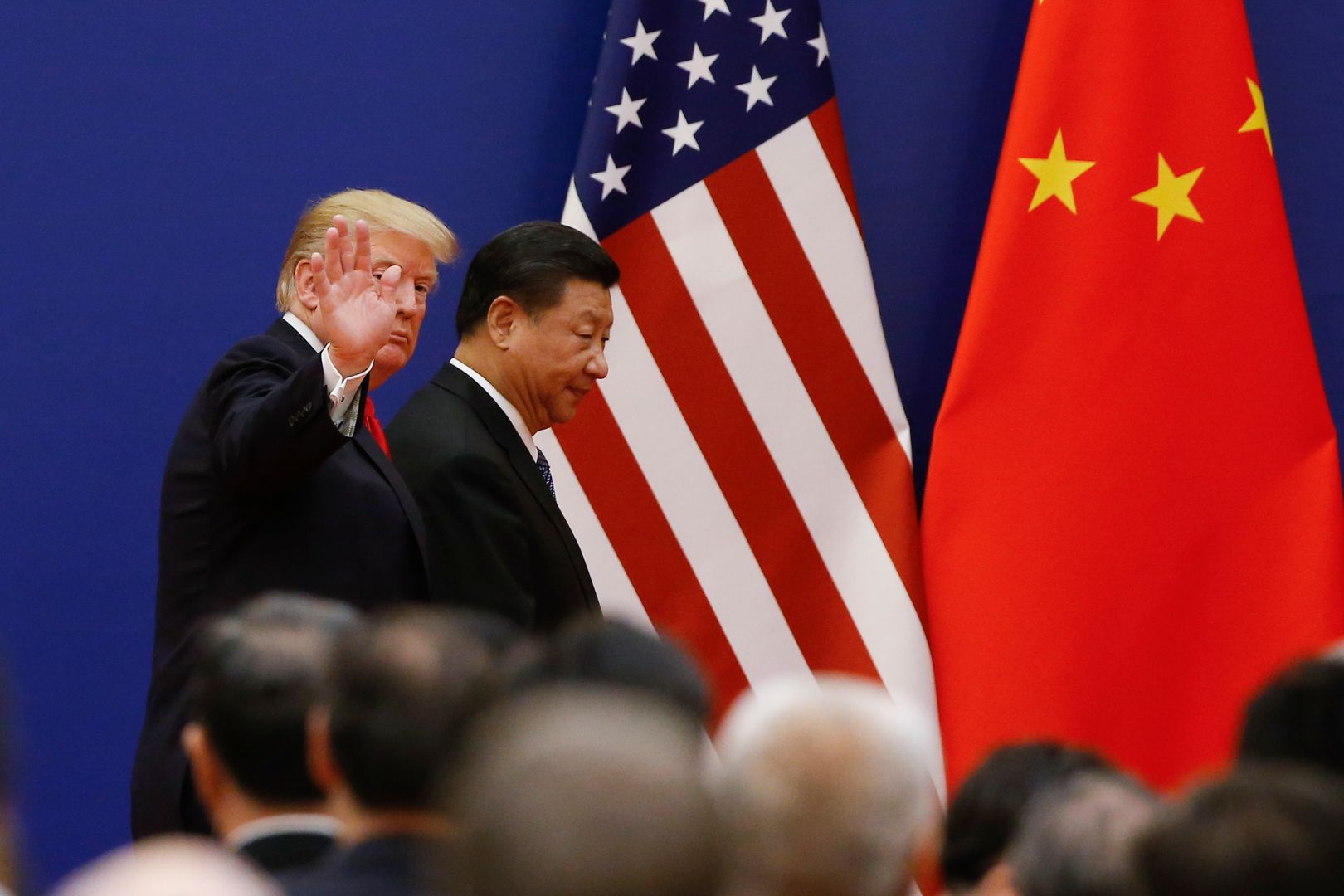
Bitcoin’s $80,000 floor cracked under back-to-back inflation shocks, and Xi Jinping’s Taiwan warning further dampened expectations of a recovery.
BTC traded at $79,200 in Asian hours Thursday, down 2.3% over 24 hours and 2.2% on the seven-day, after slipping below the $80,000 level that had served as the floor for most of the past week, per CoinGecko data.
Solana (SOL) led the cohort lower with a 5.6% drop to $90, giving back most of the weekly gains that had made it the standout altcoin for the past two weeks. Ether dropped 2.1% to $2,250 and is now down 3% on the seven-day, the second-weakest performer among the majors after BTC.
BNB shed 1.6% to $660 but held a 3.9% weekly gain, while XRP slipped 1.7% to $1.43. Dogecoin held in green territory at $0.1126, up 0.9% on the day, the only major in the cohort to post a 24-hour gain.
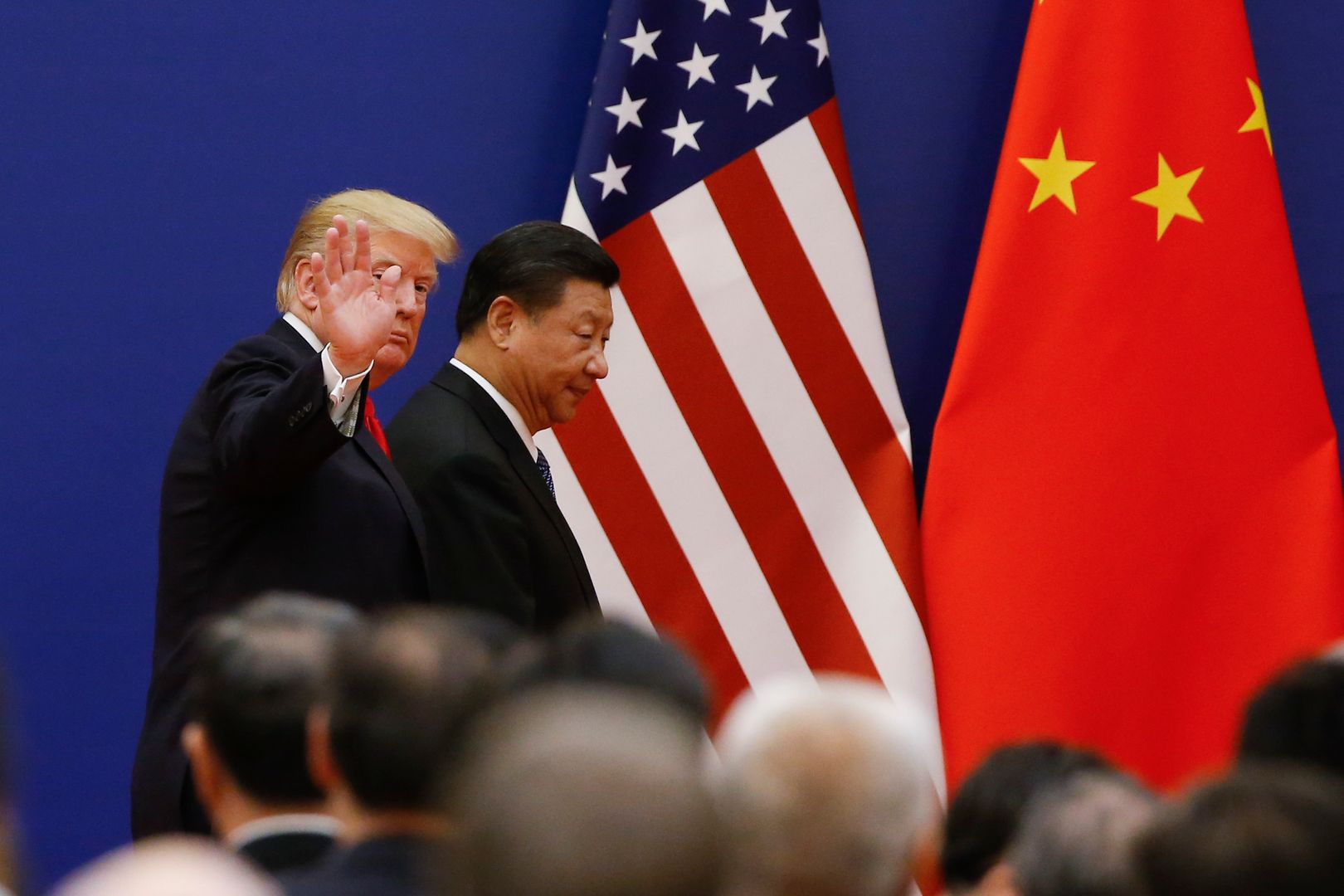
The sell pressure built around the Trump-Xi summit in Beijing, the first visit to China by a sitting U.S. president in nearly a decade. Xi pressed Trump on Taiwan in their first meeting at the Great Hall of the People, warning of a potential “collision or even clashes” if the issue is mishandled.
China’s readout of Xi’s remarks appeared to be released before the meeting had concluded, thrusting the self-ruled island into the spotlight and rattling risk sentiment globally.
Asian equities swung between gains and losses on the back of the friction. MSCI’s Asia Pacific index slipped 0.1% after rising as much as 0.8% in early trading.
Mainland Chinese shares fell 1.3%, having touched their highest level since 2021 ahead of the talks. The offshore yuan edged up for an 11th day, the longest winning streak since September 2017, suggesting capital is starting to position for whatever comes out of the summit.
The crypto sell-off compounded pressure from Wednesday’s producer price index print, which came in at 1.4% month-over-month against a 0.5% forecast and 6% year-over-year.
That followed Tuesday’s CPI reading of 3.8%, the hottest inflation print in almost three years. The back-to-back inflation surprises complicate the Federal Reserve’s path to easing rates later this year, removing one of the structural tailwinds crypto has been pricing in.
Not everything broke down, however. Cisco shares jumped 20% in extended trading after a stronger-than-expected sales outlook, and a gauge of Asian technology shares climbed as much as 2.3% to a record high. Nasdaq 100 futures advanced 0.2%. The AI trade is still bid even as the broader risk tape turns choppy, which is the same divergence that has been running for the past three weeks.
The next test for bitcoin sits at the $78,000 level, which marked the early-May low before the rally to $82,000. A break below that would put the late-April capitulation zone in play. Holding above keeps the structural buyers’ case intact heading into the next round of macro data and the back end of the Trump-Xi talks.

The XRP Ledger (XRPL) has reached a new all-time high of 332,230 wallets holding at least 10,000 XRP, according to on-chain data shared by crypto analytics platform Santiment.
Interestingly, the figure continues a steady growth trend that has been building since June 2024.
Confidence Behind the Scenes
Santiment said the increase in wallets holding large amounts of XRP is viewed as a significant long-term indicator, as it suggests bigger holders have continued accumulating the asset despite ongoing market volatility and uncertainty. Growth in mid-to-large XRP wallets has historically reflected stronger conviction among investors who are less influenced by short-term price movements and more focused on long-term positioning, the analytics firm explained.
The trend is notable because XRP has spent much of 2026 trading below its previous highs, which indicates that many holders have been accumulating during periods of market fear instead of chasing upward momentum. The firm also pointed to a temporary decline of more than 4,500 XRP wallets holding over 10,000 XRP between February 6 and 8, though it said there was no confirmed XRP-specific event behind the drop.
Santiment added that the decline likely coincided with the broader crypto market crash and liquidation event on February 5.
Institutional Interest
At the same time, XRP’s institutional outlook has continued drawing attention, especially amid ongoing discussions around US crypto regulation and the CLARITY Act framework. Market participants are closely watching the possibility of XRP receiving a clearer commodity classification, which some analysts believe could support the launch and growth of XRP ETFs.
These investment vehicles have already raked in a cumulative total net inflow of roughly $1.36 billion since their launch. Standard Chartered recently projected that XRP ETFs could attract between $4 billion and $8 billion in inflows by the end of 2026 under such conditions.
The growing focus on institutional XRP exposure has also increased attention on XRPFi activity, where XRP is being deployed into DeFi applications for lending, staking, collateral, and yield generation.
The post Why Ripple (XRP) Accumulation Continued Despite Market Fear and Liquidations appeared first on CryptoPotato.
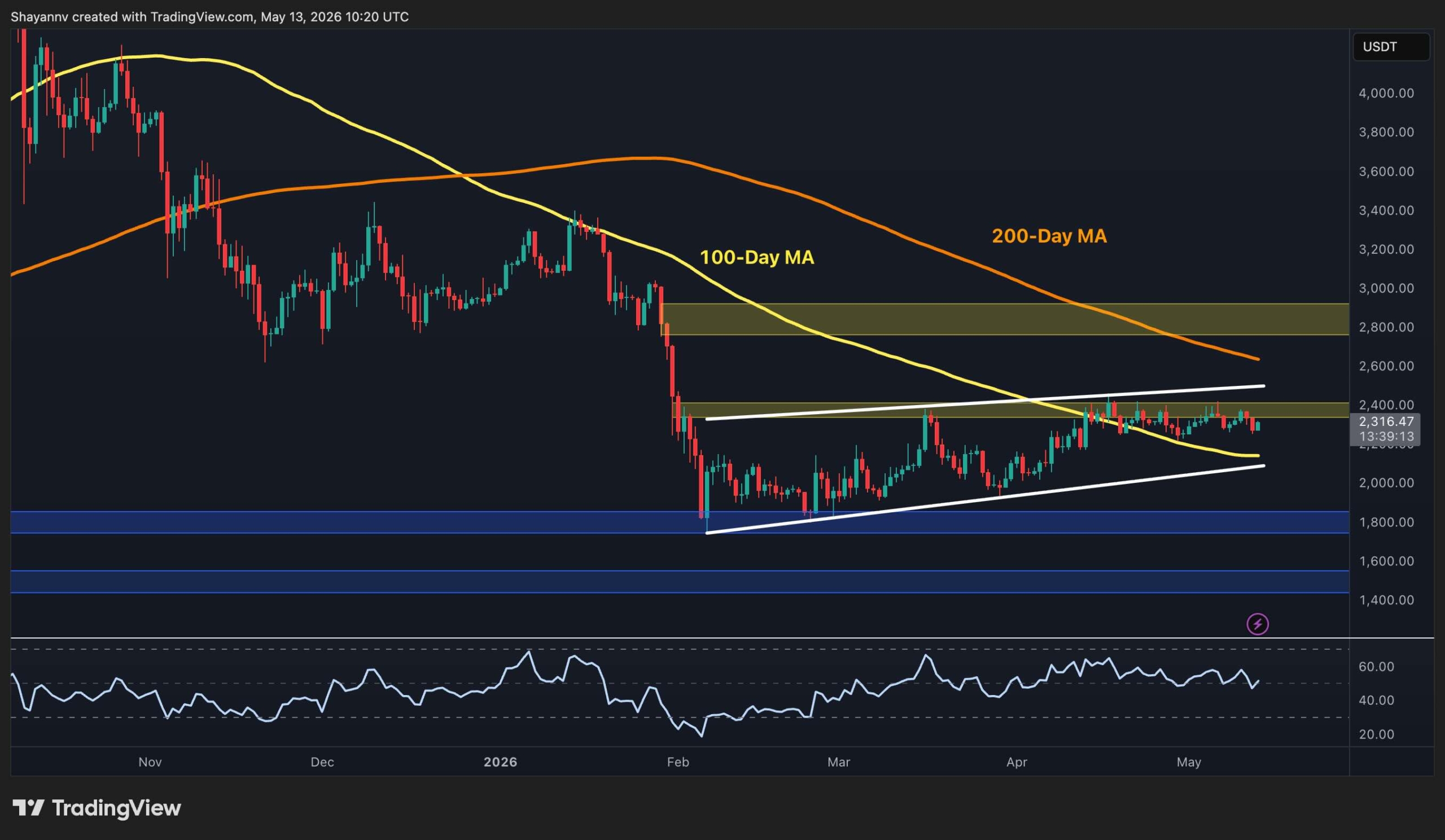
Ethereum is trading around $2.3k and is still anchored below the $2.4k resistance zone that has capped this entire consolidation over the past months. The ascending channel from February’s lows remains structurally intact, and the conditions for a breakout seem favorable.
The derivatives positioning has also changed dramatically recently, as traders are now placing their biggest long bets of the recovery on ETH, and whether that conviction is rewarded or punished in the coming days will likely define the price action in the coming months.
Ethereum Price Analysis: The Daily Chart
The ascending white channel from the February low continues to govern the macro structure on the daily timeframe. The lower boundary of the channel is rising above $2k, and the upper boundary extends to $2.5k at the moment.
The price is currently sitting just above the 100-day moving average, which is flattening near $2.2k, and could be counted on as short-term support if a pullback happens. Meanwhile, the 200-day moving average is still well above the price at $2.6k and is yet to be tested. The RSI is also hovering around 50, offering no directional edge.
Nothing about the daily picture has changed structurally in the past couple of weeks. A sustained close above $2.4k remains the sole requirement to shift the bias, opening the path toward the 200-day MA and potentially the key supply band at $2.8k. The ascending channel floor near $2.1k and the $1.8k demand zone remain the downside references if the recovery structure breaks. Until one of these levels is breached, the daily chart is still waiting for a catalyst.
ETH/USDT 4-Hour Chart
Dropping down to the 4-hour chart, the price is consolidating inside a symmetrical triangle that formed following the mid-April highs and lows. The market has recently tested and bounced from the lower boundary near $2.25k, and is likely to test the $2.4k area again, with the RSI also recovering rapidly.
A clean 4-hour above the higher boundary of the triangle and the $2.4k zone would suggest a measured continuation toward the upper boundary of the large daily channel. On the other hand, a failure to sustain the short-term bounce and a breakdown of the triangle would make a drop back to the $2.2k support zone imminent, which is a key area that has been acting as a floor since mid-April.

Sentiment Analysis
Ethereum’s funding rate has spiked to +0.0105, being the largest positive reading since February. This reading stands in sharp contrast to the more measured positioning that has characterized recent weeks. Unlike Bitcoin, whose entire recovery from $60k to $80k was driven by persistently negative funding, ETH’s derivatives market has been net long for most of the recovery period, meaning this is not a short-squeeze dynamic but genuine directional conviction from long-side traders.
That distinction cuts both ways. The aggressive long positioning reflects a genuine belief that a breakout above $2.4k is imminent, and if it materializes, those longs will amplify the move significantly. But if the price fails at this level again, a funding rate at +0.0105 means a large cohort of leveraged longs will need to be unwound, and the flush toward $2.2k and potentially $2k would happen quickly.
The funding spike has effectively raised the stakes on a level that has already been tested multiple times. So, ETH either breaks out here with conviction, or the derivatives market hands sellers the most powerful catalyst of the entire corrective cycle.

The post Ethereum Price Analysis: ETH Must Reclaim This Key Level to Restart Bull Run appeared first on CryptoPotato.
Just 4% of surveyed Americans say they would weigh a political candidate’s stance on crypto policy in deciding who to vote for.
Affordable housing, consumer fraud protection and lower bank fees were the top three issues respondents said they wanted Congress to tackle, according to a survey of 2,035 US adults released on Wednesday by POLITICO and conducted by polling firm Public First.
Just 18% of respondents considered establishing rules for the crypto market a top priority for Congress, just one percentage point ahead of regulating large banks.
The results show a divide between the average American voter’s top priorities and those of crypto industry lobbyists, who have been pushing Congress to pass crypto legislation ahead of the midterm elections.
Crypto lobbies poured more than $130 million into the 2024 elections, the most of any industry, and have already spent $320 million to influence the November midterms, according to data compiled by researcher Molly White.
Crypto lobbyists have made it clear that they will use their significant funds against any candidate who doesn’t support the industry, having spent over $5.5 million on opposing candidates in congressional races in Illinois this year.
Less than a third oppose making crypto mainstream
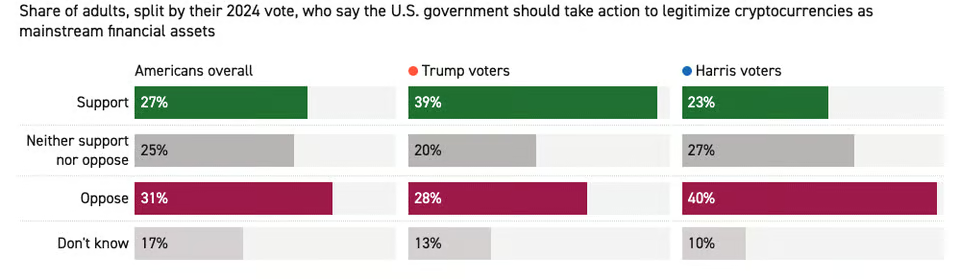
According to the survey, just 27% said they support or strongly support the US government taking action to legitimize crypto as a mainstream financial asset, while 31% said they oppose or strongly oppose it.

Poll responses to whether the US government should legitimize crypto as a mainstream asset. Source: POLITICO
Related: Crypto and AI could be dirty words on 2026 midterm campaign trail
“Most voters don’t care about digital assets,” Republican Representative Dusty Johnson told POLITICO. “But those who do care a lot. It is a high-intensity issue. And I think it’s going a little bit more mainstream. The number of people who ask me about it is still very small, but I would say growing.”
More than half of the respondents said they had not, and would not, consider trading crypto, while 19% had traded crypto. Of those who trade crypto, 7% said a political candidate’s stance on crypto would impact their vote.
The poll also found that 45% of respondents viewed investing in crypto as a risk not worth taking, even if it offered high returns, compared with 25% who said it was worth it.
The latest poll clashes with another poll of 2,008 registered voters released on Friday by HarrisX, which found 47% said they would be at least somewhat likely to consider voting for a candidate outside their preferred party if the candidate supported passing a long-awaited crypto bill that would lay out how the industry is regulated.
The Senate Banking Committee on Thursday will vote on whether to advance such a bill that has seen involvement from the White House to cut a deal with crypto and banking lobbies. A version of the bill passed the House in June as the CLARITY Act.
Magazine: Clarity Act risks repeat of Europe’s mistakes, crypto lawyer warns

A Bitcoiner’s post has gone viral on X after he claimed to use Anthropic’s AI chatbot Claude to recover 5 Bitcoin worth about $320,000 that he had been unable to access for more than a decade.
In an interview with MTS on Wednesday, pseudonymous X user Cprkrn said he made fairly “really complicated passwords” on blockchain.info and forgot one of three passwords after changing it several years ago.
Over the last eight weeks, Cprkrn said he used AI to attempt to brute force “trillions of passwords,” but to no avail.
Then, in a “last-ditch effort” earlier this week, Cprkrn said he gathered all of his old college notebooks as well as a laptop he had used into Claude, which helped him recover an old password and a crucial wallet backup file that corresponded with that password, ultimately enabling him to access the Bitcoin wallet.

Source: Cprkrn
Industry reports predict that between 2.3 million and 4 million Bitcoin (BTC) are inaccessible, representing roughly 11% to 19% of the cryptocurrency’s maximum supply because of forgotten or lost seed phrases, burned coins or other reasons. There are entire businesses dedicated to helping cryptocurrency users recover lost coins.
How Cprkrn used Claude to recover his Bitcoin
Cprkrn’s seed phrase hunt was conducted over eight weeks, with Claude helping him search two Macs, two external hard drives, an Apple Notes export, iCloud Mail, a Gmail inbox and X messages, totaling more than 1 gigabyte of data.
One of those devices was his college computer, on which Claude discovered a critical wallet backup file from December 2019.
From there, Cprkrn, with Claude’s assistance, managed to decrypt the file using a password derived from a notebook mnemonic, enabling him to find the seed phrase for the long-dormant Bitcoin wallet.
While Cprkrn didn’t provide direct evidence of Claude searching through his devices, he shared a link from Blockchain.com’s Bitcoin explorer showing that about 5 Bitcoin was transferred from wallet address “14VJy…ofuE6” across five transactions on May 13.
Prior to those transactions, the coins had been dormant since early 2015.
Over 3.5 trillion passwords were tested before succeeding
The recovery came after Claude unsuccessfully used BTCRecover — an open-source seed recovery tool — and the software program Python to test around 34 billion passwords with brute force.
Related: Bitcoin whale ‘still short’ BTC despite facing $13M in losses
Claude also used password recovery tool Hashcat to test another 3.4 trillion passwords, which also proved unsuccessful.
Just $15 in AI compute was used to conduct the searches and test passwords, according to Claude’s summary of the recovery efforts.

Source: Cprkrn
Despite the success, some members of the crypto community said Cprkrn overstated Claude’s role in retrieving the Bitcoin, arguing that it only assisted with the searching efforts and didn’t crack the wallet as Cprkrn suggested.
“Claude didn’t do anything other than search his files,” Reddit user MeteorSwarmGallifrey said in the technology subreddit, adding that Claude didn’t do anything “groundbreaking.”
Magazine: eToro founder timed Bitcoin top perfectly due to belief in 4 year cycles
Senate Weighs Clarity Act Changes at Key Markup Session

‘Off Campus’ Ella Bright and Belmont Cameli Reveal the Most Difficult and “Exhausting” Scenes To Film

How Did Apollo Separate? | Hackaday

Manchester United reach agreement with Casemiro over contract clause amid transfer speculation

US brings back mandatory military draft registration

Steven Gerrard disagrees with Gary Neville over ‘shock’ Chelsea and Arsenal claim | Football


-
 Crypto World6 days ago
HarrisX Poll Found 52% of Registered Voters Support the CLARITY Act
-

 Fashion5 days ago
Weekend Open Thread: Marianne Dress
-

 Crypto World7 days ago
Upbit adds B3 Korean won pair as Base token gains Korea access
-
 NewsBeat7 days ago
NCP car park operator enters administration putting 340 UK sites at risk of closure
-

 Fashion2 days ago
Coffee Break: Travel Steam Iron
-

 Tech4 days ago
Auto Enthusiast Carves Functional Two-Stroke Engine from Solid Metal
-

 Fashion3 days ago
What to Know Before Buying a Curling Wand or Curling Iron
-

 Politics2 days ago
What to expect when you’re expecting a budget
-
 Business5 days ago
Ignore market noise, India’s long-term story intact, say D-Street bulls Ramesh Damani and Sunil Singhania
-

 Politics5 days ago
Politics Home Article | Starmer Enters The Danger Zone
-

 Tech3 days ago
GM Agrees To Pay $12.75 Million To Settle California Lawsuit Over Misuse Of Customers’ Driving Data
-

 Politics6 days ago
Simon Cowell Says He Was ‘Horrible’ To Susan Boyle During BGT Audition
-

 Entertainment7 days ago
Sarah Paulson Called Out For Met Gala ‘Hypocrisy’
-

 Entertainment6 days ago
General Hospital: Ric & Ava Bombshell – Ric’s Massive Secret Exposed!
-

 Sports7 days ago
UEFA Champions League final schedule, teams, venue, live time and streaming | Football News
-

 Entertainment7 days ago
Why David Letterman Called CBS ‘Lying Weasels’
-
Entertainment7 days ago
Hayden Panettiere reveals she's estranged from mom, addresses brother Jansen's sudden death: 'I was floored'
-
 Sports7 days ago
Mike Tyson speaks out on status of Floyd Mayweather fight
-
 Entertainment7 days ago
Paramount+’s ‘Landman’ Season 3 Gets Promising New Update From Returning Director
-

 Sports6 days ago
Bayern Munich vs PSG UEFA Champions League SF2 live match time, streaming | Football News
You must be logged in to post a comment Login