
Crypto World
Memory Is the “Strategic Infrastructure of the AI Era,” Micron CEO Says



Micron CEO Sanjay Mehrotra said memory has become the strategic infrastructure of the artificial intelligence era, a shift he argues has permanently reset the economics of a cyclical industry.
He made the comments on Thursday at a semiconductor fabrication site near the company’s headquarters in Boise, Idaho. The firm is building two fabs as part of a planned $250 billion investment in US manufacturing and research.
Why Mehrotra Calls Memory Infrastructure
Memory has long moved in cycles. Strong demand pulls in new capacity. Excess supply then pushes prices back down.
Mehrotra argues that AI has created a more durable source of demand. This is also changing how customers value memory, according to him. Customers can no longer treat memory as a commodity bought mainly on price.
Instead, memory increasingly needs to work alongside the processors and systems using it. That shift makes memory more important to overall system performance.
“That’s why I call it the strategic infrastructure of the AI era,” he said. “Today, there is no AI without memory. AI systems need more memory,” he said.
Follow us on X to get the latest news as it happens
What the Numbers Show
Micron’s results give the claim numbers. Fiscal third-quarter revenue reached $41.46 billion, against $9.30 billion a year earlier.
Gross margin reached 84.6% of revenue, up from 37.7% a year earlier. The company guided to a fiscal fourth-quarter margin of roughly 86%.
Supply remains the constraint. The CEO revealed that Micron still cannot produce enough memory to meet demand, with data-center customers seeking roughly 50% more supply than the company can commit.
Mehrotra expects demand to widen further. He named autonomous vehicles, robots, and AI-enabled consumer devices as future buyers.
However, the framing has critics. A June lawsuit accuses Micron, Samsung, and SK Hynix of inflating dynamic random-access memory (DRAM) prices.
Meanwhile, Chinese producers such as CXMT are also scaling output, which could reopen the price competition Mehrotra says AI impacted.
Subscribe to our YouTube channel to watch leaders and journalists provide expert insights
The post Memory Is the “Strategic Infrastructure of the AI Era,” Micron CEO Says appeared first on BeInCrypto.


The U.S. Strategic Bitcoin Reserve made news on March 6, 2025, with an executive order that sets out how government-held Bitcoin may be managed and permits the development of budget-neutral strategies for acquiring additional Bitcoin. The order does not establish an open-market purchasing program or specify an amount of additional Bitcoin to be acquired.
That framework has kept attention on the role that government demand could play alongside institutional and corporate interest in Bitcoin. It also provides the policy context for the $1.5 million Bitcoin bull case associated with Cathie Wood in reporting by TheStreet.
The March 6 executive order establishes a Strategic Bitcoin Reserve and a separate United States Digital Asset Stockpile for government-held digital assets other than Bitcoin.
Under the order, the reserve is capitalized with Bitcoin held by the Treasury Department that has been finally forfeited through criminal or civil asset-forfeiture proceedings, or in satisfaction of certain civil money penalties. Agencies were directed to review their authority to transfer Government Bitcoin they hold to the reserve and report the results to the Treasury secretary.
Bitcoin deposited into the Strategic Bitcoin Reserve is not to be sold and is to be maintained as a reserve asset of the United States, subject to applicable law. The order describes Bitcoin as having a permanently capped supply of 21 million coins and says the government holds a significant amount of BTC, without providing a total holdings figure.
Discover: The Best Crypto to Diversify Your Portfolio
Authority to Explore Additional Bitcoin Acquisition
The order directs the Secretaries of the Treasury and Commerce to develop strategies for acquiring additional Government Bitcoin. Those strategies must be budget-neutral and must not impose incremental costs on U.S. taxpayers.
The accompanying White House fact sheet likewise states that Treasury and Commerce are authorized to develop budget-neutral acquisition strategies. The directive addresses strategy development; it does not identify a purchase amount, schedule, or acquisition method.
The executive order treats the non-Bitcoin stockpile differently. It says the government will not acquire additional stockpile assets beyond those obtained through forfeiture proceedings or civil money penalties without further executive or legislative action. The Treasury secretary may determine stewardship strategies for that stockpile, including potential sales.
Trade Bitcoin Market on Kalshi and Get a $25 Signing-up Bonus
ARK’s Bitcoin Framework, What the News Says

TheStreet reported that ARK Invest’s multi-scenario Bitcoin framework places its 2030 base case near $730,000 to $750,000 and its bull case at $1.5 million. The report described the bull case as resting on institutional adoption, Bitcoin’s fixed supply, and its emergence as a legitimate digital store of value.
Bitcoin’s 21 million-coin supply cap is stated in the executive order. The order also says that a fixed supply creates a strategic advantage for nations that are among the first to create a strategic Bitcoin reserve. Those statements explain why the reserve’s acquisition authority is relevant to the discussion of Bitcoin demand, even though the order does not set out an active buying program.

Bitcoin is trading above $75,000 at the time of writing, after trading below $65,000 four days earlier. Most news confirmed that Bitcoin was also traded near $35,000 four years earlier before reaching $126,000 in October 2025. Those figures provide context for the scale of a $1.5 million long-term bull case, but they do not establish a future outcome.
Discover: The Best Token Presales
The post Bitcoin News Today: Reserve Rules Set Scope for Government Demand appeared first on Cryptonews.

A person holds a PopMart Labubu The Monsters Big into Energy Series Vinyl Plush dolls during a press preview at an AliExpress pop-up store in London, Britain, Nov. 11, 2025.
Isabel Infantes | Reuters
Shares of Pop Mart fell over 4% in Hong Kong on Friday after the Labubu maker reported first-half results that showed declining sales in Asia-Pacific and the Americas.
For the period ended in June 30, the toy maker reported a 23.8% year-over-year rise in first-half revenue to 17.17 billion yuan ($2.55 billion). But the growth was unequal: in Asia Pacific ex-China it fell 9.7%, and dropped 16.5% in the Americas. Revenue in China, meanwhile, jumped 47.3%.
Citi said the results came in below expectations, citing pressure in overseas markets, where sales declined 11% year over year. The company has faced challenges globally ranging from inventory management, supply chains to warehousing and logistics and store operation, according to Citi.
The bank now expects Pop Mart’s group revenue to decline 8% year-over-year in 2026 and lowered its price target to HK$198. Citi said management now sees its initial 20% revenue growth target for 2026 as difficult to achieve, given more challenges than expected and competitive pressure.
The shares were recently down 3.9% to HK$147.70 ($18.84).
[PRESS RELEASE – Panama City, Panama, August 21st, 2026]
Finassets.io, a crypto payment gateway for businesses, has added USDC (SOL) to its Back Office, giving merchants a cost-effective network for stablecoin payments.
Solana is among the fastest, lowest-cost networks for settling USDC today, and Finassets, a B2B crypto payment infrastructure provider, has added support for USDC Solana (SOL) payments across its platform. Merchants can now accept and process USDC (SOL) alongside 70+ other supported cryptocurrencies, using the same Back Office, payment button, checkout, and API already in place.
Solana already carries billions in USDC
Solana holds the second-largest share of circulating USDC after Ethereum, at roughly $6.7 billion of Circle’s total supply, on a network built for higher throughput than most alternatives. Solana’s mainnet has also run without an outage for more than two years.
Built for stablecoin payments across multiple assets
USDT and USDC already run across multiple networks in the Finassets Back Office, and USDC (SOL) extends that setup rather than adding a separate product. With Auto-Convert, incoming crypto is converted to a stablecoin as soon as the payment arrives, with the rate fixed at that moment, protecting merchants from price changes.
Network choice still affects the two numbers that matter most to a merchant, what a transfer costs and how long it takes to confirm. Solana comes out faster and cheaper than Ethereum on both, which makes it one of the most cost-effective networks for settling USDC right now.
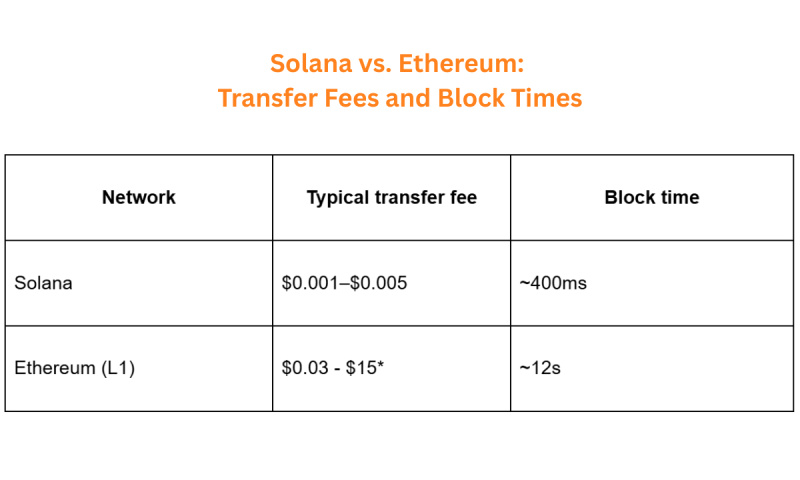
*Fees rise during congestion, and have historically pushed Ethereum transfer costs well above $100.
No new integration required for existing merchants
Merchants already using Finassets can enable USDC (SOL) directly in the Back Office, through the same payment button, checkout, and API already connected. Those onboarding now choose one of two integration methods:
- Payment button. Installs on a website or online store with no backend development; customers pay directly from a Solana wallet.
- API integration. Generates a unique Solana wallet address per transaction and tracks transaction details, including destination and confirmation, via webhook.
Both paths include sandbox access and step-by-step setup documentation for testing before go-live.
“USDC on Solana is one of the most efficient stablecoin payment options available today. It combines a widely used dollar stablecoin with one of the fastest and lowest-cost networks. We added it to give merchants a faster, more cost-effective way to move USDC, especially when they’re processing payments at scale.” said Vitalijs F., CEO of Finassets.
USDC (SOL) uses the same Finassets infrastructure
Once enabled, USDC (SOL) follows the same operational rules as every other asset Finassets supports.
- Transaction status and history tracked per asset in the Back Office
- Deposits typically credited within about 30 seconds of network confirmation
- Security runs at the same standard across every asset: MPC-based wallet technology, two-factor authentication, role-based access control, and IP whitelisting.
USDC (SOL) support is available to eligible merchants in selected international markets, subject to Finassets programme terms, verification, and applicable compliance requirements.
Register and enable USDC on Solana payments for your business: https://www.finassets.io/en/account/register/
About Finassets
Finassets is a low-fee crypto payment gateway for iGaming and eCommerce. It’s a payment infrastructure covering a crypto payment button, crypto checkout, crypto invoicing, crypto mass payouts, B2B crypto exchange, and crypto payment API integration. Merchants can accept 70+ cryptocurrencies, including stablecoins like USDT and USDC across multiple networks. Fees start from 0.40% down to 0.20% as volume grows, with no hidden fees and full visibility into every transaction.
Founded in 2021, Finassets is a Panama-registered B2B crypto payment infrastructure provider supporting cross-border and crypto-driven businesses across eligible markets.
Website: https://www.finassets.io/
The post Finassets Crypto Payment Gateway Launches USDC Payment Support on Solana appeared first on CryptoPotato.


South Korean lawmakers have introduced legislation that would give the Financial Intelligence Unit direct authority to investigate suspected unregistered crypto businesses instead of relying mainly on police referrals.
Summary
- South Korean lawmakers have proposed giving the FIU direct powers to investigate unregistered crypto businesses.
- The FIU could analyze suspected violations, file complaints and request criminal investigations under the bill.
- Police suspended inquiries into 23 of 25 unregistered crypto operators referred by the FIU between August 2022 and August 2025.
- The FIU said in June that 28 crypto providers were registered and 40 suspected illegal operators had been referred to authorities.
Yonhap reported that People Power Party lawmaker Eom Tae-young and nine other lawmakers filed the amendment on Thursday, proposing new powers under the Act on Reporting and Using Specified Financial Transaction Information, commonly known as the Specific Financial Information Act.
Under the bill, any person could report a suspected violation of the law directly to the FIU. Once a report is received, the financial intelligence agency would be allowed to investigate and analyze the suspected conduct before deciding whether further action is required.
The proposal would also allow the FIU to file complaints with relevant authorities, request criminal investigations, and hand information gathered during its review to investigators. Such powers would change the current process, under which the FIU can identify suspected unregistered operators but must depend on police and other investigative agencies to pursue most cases.
The bill has only been introduced and must pass the National Assembly before the proposed changes can take effect.
FIU could directly investigate unregistered crypto businesses
Lawmakers proposed the additional powers after enforcement data raised questions over how effectively cases involving overseas crypto operators were being pursued once they left the FIU.
According to Yonhap, police suspended investigations or preliminary inquiries into 23 of the 25 unregistered virtual asset service providers referred by the FIU between August 2022 and August 2025.
The companies and people connected to the cases were reportedly located outside South Korea, making investigations more difficult for domestic law enforcement agencies.
Giving the FIU investigative and analytical powers at an earlier stage would allow the agency that first identifies suspected registration violations to collect information before a case moves to another authority.
South Korea requires companies providing virtual asset services to residents of the country to register with the FIU, including foreign companies that actively serve South Korean customers.
As crypto.news previously reported, the FIU said in June that only 28 virtual asset service providers were registered at the time, while about 40 suspected illegal operators had been referred to investigative authorities.
The regulator said foreign businesses must follow the same registration requirements when they provide services to South Korean residents. Companies seeking registration must also meet local compliance requirements, including Information Security Management System certification.
Overseas operators have remained a key FIU enforcement problem
The FIU’s June enforcement warning provided details on how some unregistered foreign crypto businesses were reaching South Korean customers while attempting to limit their visible presence in the country.
According to the agency, some overseas operators recruited customers through Telegram and KakaoTalk open chat rooms while offering customer service in English, a setup regulators said could make their domestic activities less obvious.
Authorities also identified private currency exchange businesses selling stablecoins and other virtual assets to international students, tourists, foreign workers and people seeking transactions without disclosing their identities.
Some operators exchanged digital assets directly for Korean won or other fiat currencies, while promoters were paid to advertise foreign crypto services through YouTube channels, Telegram groups and online communities, the FIU said.
The agency warned that customers using unregistered services could face exposure to fraud, hacking and personal data leaks. Because such businesses operate outside the registered system, the FIU also said users could have difficulty recovering funds when an operator failed to deliver purchased assets.
Money laundering has remained another concern for regulators. The FIU said unauthorized crypto platforms and private exchange services could be used to conceal criminal proceeds or facilitate transfers that avoid standard checks applied by registered financial firms.
The newly introduced bill would allow the agency to pursue suspected violations of the Specific Financial Information Act itself before requesting assistance from another investigative body.
South Korea has tightened AML rules for registered exchanges too
Regulatory attention has not been limited to companies operating without registration.
Earlier this year, domestic exchanges objected to proposed changes that would require them to report overseas-linked crypto transfers worth at least 10 million won as suspicious transactions.
A May regulatory proposal drew objections from the Digital Asset Exchange Alliance, which represents registered virtual asset service providers in South Korea.
DAXA estimated that the rule could increase annual suspicious transaction reports at Upbit, Bithumb, Coinone, Korbit and Gopax from about 63,000 to more than 5.4 million.
The association argued that applying an automatic monetary threshold could cause large numbers of ordinary overseas transfers to be reported regardless of the risk attached to the customer or counterparty.
The dispute also involved the treatment of foreign platforms. Regulators have sought stricter controls on transactions involving overseas virtual asset service providers, while local exchanges have asked authorities for clearer standards for determining which foreign businesses should be treated as high risk.
Enforcement decisions under the same financial information law have already produced court challenges. In April, a Seoul court overturned a three-month partial suspension imposed on Dunamu, the operator of Upbit, after the FIU alleged 44,948 transactions involving 19 unregistered overseas platforms.
Bithumb separately secured a court stay against a six-month partial suspension after regulators accused it of customer verification failures and dealings with unregistered foreign companies. Coinone also obtained temporary court relief from enforcement measures connected to anti-money laundering and customer verification requirements.
Cross-border crypto transfers face separate registration rules
South Korea has also created another regulatory route for businesses moving digital assets across national borders.
Under amendments to the Foreign Exchange Transactions Act, companies handling cross-border virtual asset transfers will have to register with the Ministry of Economy and Finance when the framework takes effect in December.
A June licensing report detailed how authorities were preparing enforcement regulations that could allow eligible fintech companies, alongside crypto businesses, to provide blockchain-based cross-border remittance and foreign exchange services.
The South Korean government promulgated the revised law on June 2 with a six-month grace period. Once implemented, virtual asset transfers involving South Korea and another country will fall under the country’s regulated foreign exchange system.
Companies seeking to provide the service will need to register with the finance ministry and report qualifying overseas transfers through the Bank of Korea’s foreign exchange reporting network.
Authorities have said crypto transfers previously operating outside the formal foreign exchange reporting system created risks involving illicit foreign exchange transactions and money laundering.
Applicants under the new framework must first complete virtual asset service provider registration, connect their systems to institutions responsible for transmitting foreign exchange and digital asset transaction data, and satisfy additional requirements covering facilities and qualified personnel.

Marvell Technology (MRVL) stock jumped Wednesday after the fabless chipmaker announced a deal to develop chips for Alphabet (GOOGL) unit Google. Marvell also issued to Google a warrant to purchase up nearly 59 million shares of Marvell stock at an exercise price of $206.58 per share. On the stock market today, Marvell stock surged 9.9% to 237.27. Meanwhile, rival Broadcom…
Copyright ©2026 Investor’s Business Daily, LLC. All rights reserved. 87990cbe856818d5eddac44c7b1cdeb8

The U.S. Commodities Futures Trading Commission (CFTC) is preparing to take a major step in establishing and eventually regulating derivatives tied to AI compute. On Wednesday, the CFTC said it was seeking public comment on compute derivatives contracts. The move kick-starts the regulatory process in setting up a formal market for AI compute derivatives. CME Group announced Aug. 11 that…
Copyright ©2026 Investor’s Business Daily, LLC. All rights reserved. 87990cbe856818d5eddac44c7b1cdeb8
Crypto World
Live updates: Bitcoin, ether ETFs pull in $800 million as inflows surge for a second day
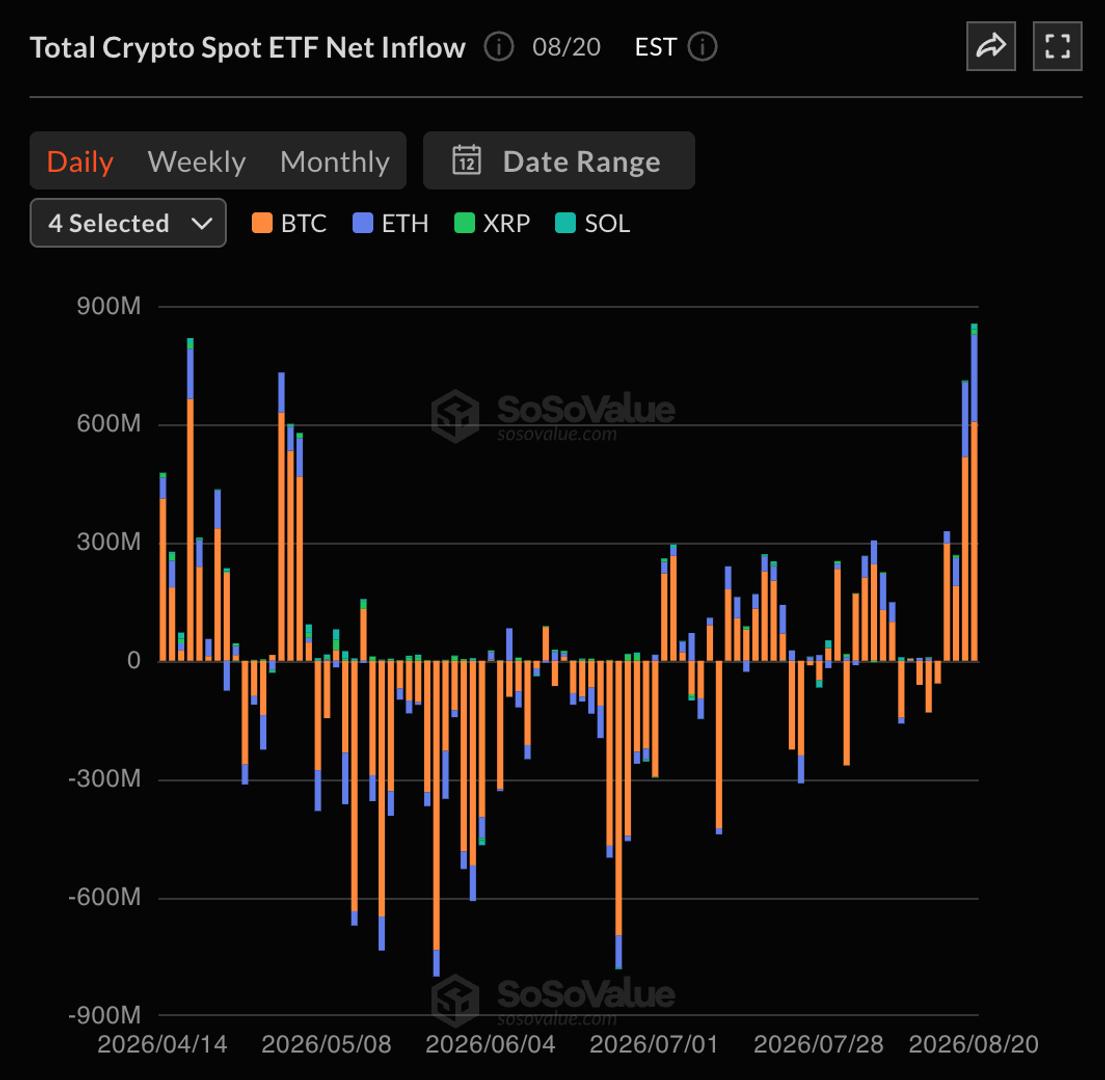
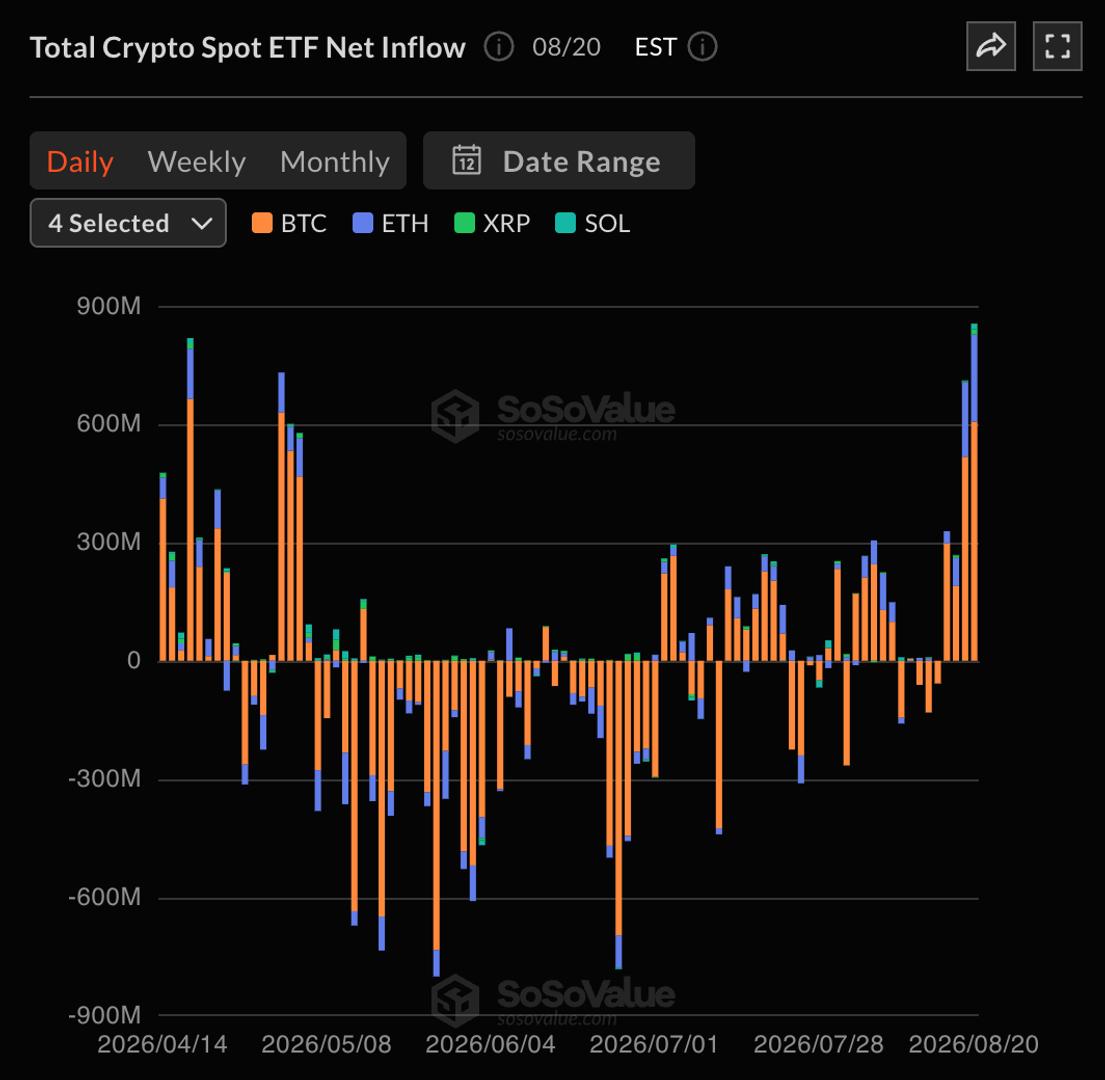
Spot bitcoin ETFs pulled in $606 million on Aug. 20 and ether funds $221 million, both bigger than the prior day, confirming the institutional bid behind bitcoin’s run.

Web browser and AI agent maker Opera (OPRA) on Wednesday beat analyst estimates for the second quarter but offered a soft revenue outlook for the full year. Opera stock fell on the news. The Oslo, Norway-based software company earned 30 cents a share on sales of $178.1 million in the June quarter. Analysts polled by FactSet had expected earnings of…
Copyright ©2026 Investor’s Business Daily, LLC. All rights reserved. 87990cbe856818d5eddac44c7b1cdeb8
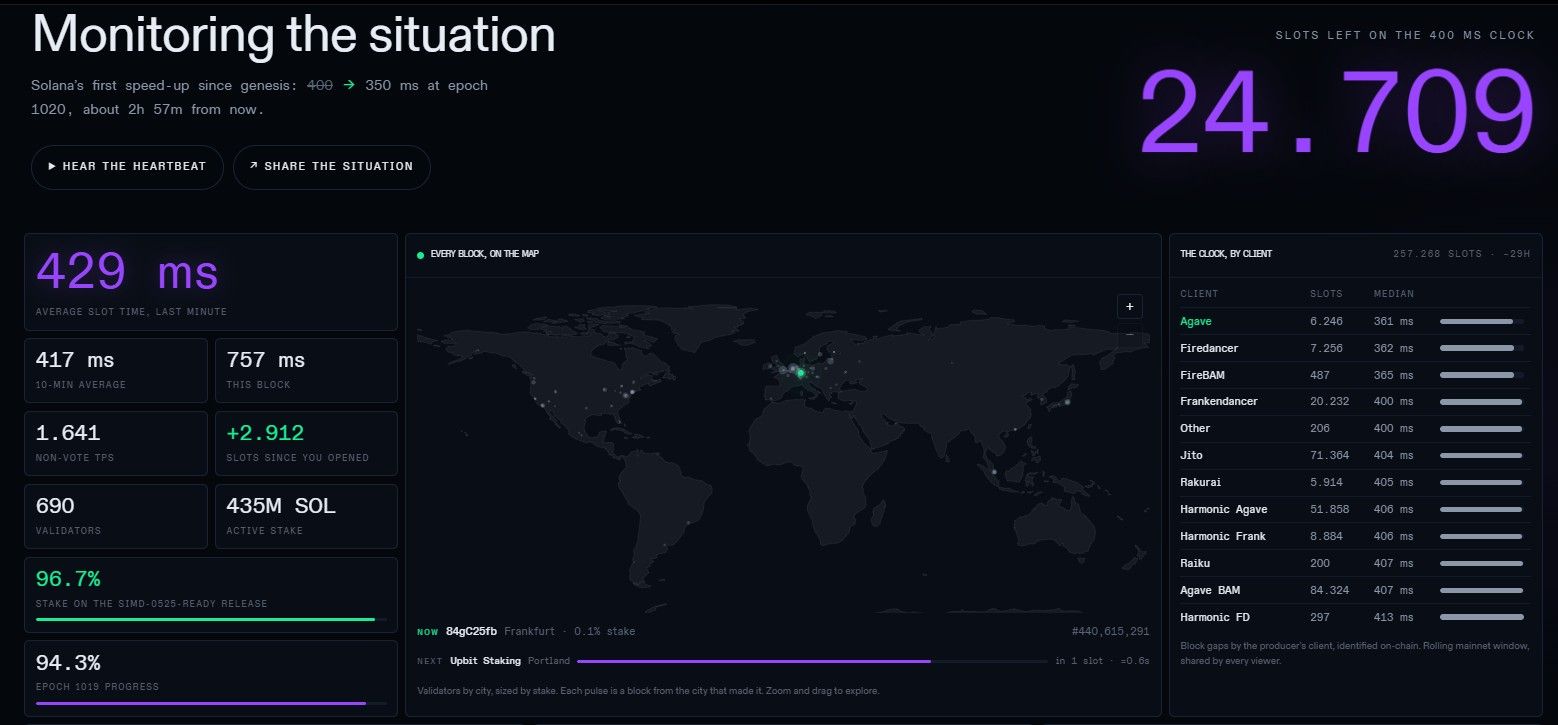
Solana started halving its block time, taking the first step from 400 milliseconds down toward 200. The first cut lands at epoch 1020, one of the roughly two-day windows the network uses to schedule changes.
Anza’s Agave software carries all four steps, and each one switches on separately. Solana will end up producing a new block every fifth of a second.
Solana Doubles Its Blocks Per Second
Today Solana makes about 144 blocks per minute, or roughly two and a half every second. At 200ms that rate doubles to 300 blocks a minute.
Faster does not mean bigger. Each block shrinks in step with the clock, so the network carries the same total load. Blocks simply arrive twice as often in smaller pieces.
The rollout runs in four steps of 50 milliseconds each. Validators can pause the sequence at any point if too many blocks start getting skipped. Anza has called its timetable tentative for that reason.
The live tracker at solana.com/200ms showed 96.7% of stake already running the required software. Meanwhile, 690 validators and 435 million SOL in active stake sat behind the upgrade.

Reliability stays the open question. Solana came within reach of a network halt in August after a routing fault knocked 28.83% of staked SOL offline. Validators were also slow to adopt an urgent patch earlier in 2026.
How Solana Stacks Up Against Bitcoin and Ethereum
Bitcoin produces one block every 10 minutes. Solana at 200ms would turn out 3,000 blocks in that same window.
Ethereum runs closer to 12 seconds per block. Solana already ticks roughly 29 times faster, and the gap widens to 60 times at the final stage.
Those numbers flatter Solana, yet finality tells a different story. Solana needs about 13 seconds to settle a transaction for good. Ethereum takes closer to 13 minutes, while Bitcoin asks for about an hour.
Alpenglow, a consensus overhaul targeting 150ms finality, attacks that second gap. Anza has penciled in the third quarter for its first phase, carried by the Agave 4.3 release. Shorter blocks and faster settlement therefore solve different halves of the same problem.
Traders Reward the Speed Push
Co-founder Anatoly Yakovenko, who posts as toly, framed the pace against an earlier cut.
It took 2 days to go from 800ms to 400ms
That comparison sets a rough expectation for the remaining stages. However, Anza has committed to no firm dates.
SOL traded near $89 after a 5.8% daily gain. The move holds the token seventh by market cap at $52.3 billion. A dormant whale that banked $20 million in 2023 also returned to buy SOL on Tuesday.
The token rode a wider meme coin rally worth $3 billion in a single day. Grayscale separately named the network among altcoins positioned to benefit from new US token rules. Faster blocks strengthen that pitch, provided Solana keeps its skip rate steady.
The post Solana Aims to Cut Block Time in Half, and You Can Watch It Live appeared first on BeInCrypto.


The Royal Government of Bhutan has moved 490.87 Bitcoin worth about $32.74 million to fresh wallets over the past 24 hours, extending a series of large BTC transfers from state-linked addresses in 2026.
Summary
- Bhutan transferred 490.87 BTC worth about $32.74 million to fresh wallets over the past day.
- The largest transaction involved 485 BTC valued at roughly $32.31 million.
- State linked Bitcoin transfers have continued throughout 2026, with funds previously moving to unidentified wallets, trading firms and exchanges.
- Bhutan accumulated much of its Bitcoin through state backed mining powered by hydroelectric energy.
According to blockchain analytics platform Onchain Lens, the latest activity included a 485 BTC transfer worth approximately $32.31 million, which accounted for nearly all of the Bitcoin moved during the period.
Smaller transactions made up the remaining amount, with Onchain Lens data showing BTC leaving wallets identified as belonging to the Royal Government of Bhutan. The analytics platform did not identify the fresh recipient wallets as exchanges or trading firms, and it did not confirm whether the transfers represented sales.
The distinction is important because a transfer to a newly created or unidentified wallet does not establish what happened to the Bitcoin afterward. Bhutan has previously moved BTC to unknown addresses as well as wallets connected to trading firms, making the eventual destination relevant when determining whether funds were sold or simply reorganized.
Bhutan Bitcoin transfers have continued through 2026
The latest movement came just days after another large transaction from Bhutan-linked addresses.
On Aug. 18, blockchain tracker Lookonchain reported that the Royal Government of Bhutan transferred 300 BTC worth about $19.28 million to a new wallet. The firm described the transaction as another sale, although the initial transfer itself went to a fresh address.
Earlier transactions have followed a similar pattern, with large amounts of Bitcoin leaving government-linked wallets before moving through other addresses.
By May, state-linked BTC outflows had already surpassed $230 million for 2026, according to Arkham Intelligence data previously covered by crypto.news.
The May transaction involved 100.44 BTC worth approximately $8.2 million moving to an unlabeled wallet. Arkham said at the time that Bhutan-linked addresses were averaging close to $50 million in monthly Bitcoin movements during 2026.
Some earlier transfers eventually reached Binance and Galaxy Digital, according to Arkham. However, the analytics firm noted that movements to unidentified addresses could not automatically be treated as confirmed sales.
Bhutan’s wallet activity accelerated during March. On March 25, a state-linked address moved another 519.7 BTC worth about $36.7 million to two wallets.
Onchain Lens identified one of the recipients as being linked to crypto trading firm QCP Capital. The transaction was the third major sovereign wallet movement recorded that month, following an approximately $72 million transfer and another $11.8 million movement earlier in March.
Bhutan’s BTC holdings have fallen from their 2024 peak
Repeated transfers have reduced the amount of Bitcoin visible in wallets identified by blockchain analytics firms as belonging to Bhutan or its sovereign investment arm, Druk Holding & Investments.
Arkham data showed Bhutan held more than 13,000 BTC at its peak in October 2024. By March 25, identified holdings had fallen to 4,453 BTC worth about $315 million at the time.
A few days earlier, Bhutan had transferred about $72.3 million in Bitcoin over a 24-hour period. More than 973 BTC moved across several transactions linked to DHI, which oversees the country’s mining and digital asset operations.
The March transactions followed smaller movements earlier in the year. Arkham data showed Bhutan-linked wallets moved more than 284 BTC worth roughly $22 million during one week in February, including transfers to addresses associated with QCP Capital.
By March 20, Arkham estimated that more than $110 million worth of Bitcoin had left Bhutan-linked holdings since the start of 2026. The analytics firm tracked transfers to counterparties including QCP Capital and Binance while also recording movements to unidentified wallets.
The numbers attached to Bhutan’s holdings can vary depending on which addresses blockchain analytics platforms identify as government-controlled. Transfers to a previously unknown address can also reduce the balance displayed under a government’s tagged portfolio even when ownership of the coins has not necessarily changed.
For that reason, the latest 490.87 BTC transaction establishes that the funds moved from addresses attributed to Bhutan, but the available Onchain Lens data does not establish whether the government sold the Bitcoin.
Hydropower mining built Bhutan’s Bitcoin position
Bhutan’s state Bitcoin holdings were largely accumulated through mining rather than purchases or asset seizures.
The Himalayan kingdom began developing state-backed Bitcoin mining operations years ago, using its hydroelectric power resources to operate mining facilities. DHI emerged as the main state entity overseeing the program.
Arkham first publicly identified Bhutan’s holdings in 2024, when it traced more than 13,000 BTC to government-linked mining operations. At the time, the position was worth more than $750 million and placed Bhutan among the largest known government Bitcoin holders.
The country’s mining infrastructure was also expanded through a partnership with Bitdeer Technologies. Plans announced in 2024 called for another 500 megawatts of mining capacity, taking the planned total to 600 MW.
Unlike sovereign Bitcoin positions created through law-enforcement seizures, Bhutan’s holdings therefore represented assets generated through mining operations backed by domestic energy infrastructure.
The government has since incorporated Bitcoin into plans extending beyond mining. In December 2025, Bhutan announced a Bitcoin Development Pledge tied to Gelephu Mindfulness City, a special administrative region being developed in southern Bhutan.
Under the strategy, the country pledged up to 10,000 BTC to support Gelephu’s long-term development, while outlining plans involving hydro-powered mining, long-term Bitcoin holdings and partnerships built around the city.
Gelephu has started putting its Bitcoin strategy into operation
Parts of the Gelephu strategy have moved into implementation during 2026.
On July 30, Gelephu Mindfulness City appointed digital asset manager 3iQ to oversee an undisclosed portion of its Bitcoin treasury.
The mandate covers professional management of BTC assigned to the city while 3iQ establishes a local presence and supports investment expertise and knowledge transfer. The exact amount of Bitcoin placed under the mandate was not disclosed.
The agreement followed the December 2025 pledge of up to 10,000 BTC for Gelephu’s development strategy.
Gelephu has also been building a regulatory structure for digital asset businesses. During May, the city introduced a fast-track licensing route for qualifying crypto companies already regulated in selected overseas jurisdictions.
The framework allows firms with licenses from approved markets to use existing regulatory records during the application process, although they remain subject to local oversight.
More recently, Bitget signed a cooperation agreement with the Gelephu Mindfulness City Authority to establish a local entity and pursue a Financial Services Licence. Under the agreement announced in August, the exchange plans to work with the city authority on regulatory, operational and ecosystem development while preparing its licensing application.

Bitcoin News Today: Reserve Rules Set Scope for Government Demand

Court Grants Perez Hilton’s Mom Temporary Custody: Details
Vp plc appoints Corinne Ripoche as non-executive director





-

 Fashion7 days ago
Weekend Open Thread: Ann Taylor
-
 Tech7 days ago
11 Ways to Rank Your Videos
-

 Sports6 days ago
Birmingham 2026: Day 6 Timetable for Irish Athletes
-
 NewsBeat6 days ago
Myanmar says over 300,000 Rohingya refugees verified for repatriation as exodus enters ninth year
-

 Politics6 days ago
SEQ Code: The Three Letter Boarding Pass Code That Could Give You The Worst Seat
-

 Tech3 days ago
Qwen3.8-27B runs frontier-class coding agents and reasoning locally, no cloud API required
-

 Business3 days ago
SMA Solar Technology AG (SMTGY) Q2 2026 Earnings Call Transcript
-

 Crypto World6 days ago
Pi Network Protocol 27 endgame: last upgrade before what?
-

 Crypto World3 days ago
OCC Greenlights Trump Family Crypto Firm for Trust Charter
-
 Tech6 days ago
Every fusion startup that has raised over $100M
-
 Entertainment7 days ago
10 Netflix Shows That Quietly Became Modern Classics
-
 Entertainment6 days ago
Marvel Studios Reveals New X-Men Cast Including Adam Driver and Sadie Sink
-
 Business6 days ago
Monarch Mutual Fund set to enter MF space with maiden overnight fund; files draft with Sebi
-

 Fashion7 days ago
Weekly News Update, 8.14.26 – Corporette.com
-

 News Videos1 day ago
Don’t Leave Your Financial Future To Chance | August 19, 2026
-

 Fashion7 days ago
Silver bangles for women – Newbridge Silverware
-

 Business6 days ago
Facebook Down Now? Users Report Login And Loading Problems As Outage Trackers Monitor Ongoing Issues
-

 Fashion7 days ago
Cart Confidential Vol. 44 – Julia Berolzheimer
-

 Crypto World3 days ago
NAVI Prime launches institutional lending framework on Sui
-

 Entertainment7 days ago
Eva Longoria’s Bubblegum Pink Bikini Turned Heads in Spain
You must be logged in to post a comment Login