

Crypto World
Meta Begins 8,000 Job Cuts, Starting in Singapore



Meta has reportedly begun cutting staff in Singapore as the company executes a plan to reduce employee numbers by 8,000 to lean more heavily on AI.
Emails were sent out at 4 a.m. Singapore time to affected employees, and staff in the US and Europe were also expected to be notified that morning, Bloomberg reported on Tuesday, citing people familiar with the matter. Meta’s engineering and product teams are expected to be hit hardest.
Meta is one of several Big Tech firms cutting staff while investing heavily in AI infrastructure in an effort to streamline operations and reduce costs. An estimated 49,135 layoffs have occurred at US companies in 2026 as a result of AI integration.
The cuts have also hit crypto firms, such as digital payments platform Block, which laid off 4,000 workers in March, while Coinbase and Crypto.com also recently cut about 700 and 180 employees, respectively.
A memo from Meta’s head of people, Janelle Gale, seen by Bloomberg, said Meta’s “flatter structure” and “smaller teams” would enable the company to move faster than before.
“We believe this will make us more productive and make the work more rewarding,” Gale wrote.
The people familiar with the matter told Bloomberg that additional layoffs could follow later in the year.
Related: Hong Kong’s Boyaa Interactive eyes $70M crypto treasury expansion
Earlier this month, employees at Meta widely criticized a company initiative to collect data from their devices, such as keystrokes, mouse movements and screen content, for the company to train its AI models.
Meta’s aggressive spending on AI infrastructure has also caused investor concern that it won’t pay off.
The Mark Zuckerberg-led company has already poured more than $100 billion into AI, and it also plans to build the world’s biggest AI facility in the US state of Louisiana, potentially valued at $200 billion.
The amount is more than the $80 billion that Meta poured into the metaverse before shifting its vision to mobile as it shut down the VR version of Horizon Worlds, the company’s virtual reality social network that was intended to underpin its broader metaverse strategy.
Magazine: Crypto scammers face death, Aussie CGT makes Asian hubs attractive


For years, the cryptocurrency industry celebrated the idea of a multi-chain future. Every new blockchain promised faster transactions, cheaper fees, better scalability, or more innovative ecosystems. At first, this expansion looked healthy. More chains meant more experimentation, more competition, and more opportunities for builders.
But in 2026, the cracks are becoming impossible to ignore.
The average user is exhausted.
Managing multiple wallets, navigating bridges, understanding gas fees across ecosystems, and constantly switching networks has created a fragmented experience that feels increasingly unsustainable. What was once marketed as “freedom of choice” is now becoming operational chaos.
The industry may be approaching a turning point where users stop caring about chains altogether.
The Rise of Chain Fatigue
Early crypto users tolerated complexity because they were explorers. They enjoyed experimenting with protocols, wallets, and infrastructure. But mainstream adoption changes the equation.
Normal users do not want to:
- hold assets across 8 ecosystems
- memorize different wallet setups
- bridge funds every week
- manage multiple gas tokens
- track fragmented liquidity
- worry about bridge exploits
They simply want applications that work.
This growing exhaustion can be described as chain fatigue — the cognitive overload caused by excessive blockchain fragmentation.
What started as ecosystem diversity has evolved into an endless maze of disconnected environments competing for attention.
Ironically, crypto’s obsession with decentralization has often produced the exact opposite of simplicity.
UX Is Becoming the Real Battlefield
For years, blockchain discussions focused heavily on:
- TPS
- consensus mechanisms
- modularity
- rollups
- execution layers
- interoperability standards
But most users do not care about technical architecture.
They care about experience.
The uncomfortable reality is that crypto UX remains far behind traditional consumer technology. Even experienced users still encounter:
- failed bridges
- confusing approvals
- network mismatches
- stuck transactions
- fragmented identity systems
- duplicated liquidity pools
At some point, complexity stops being a feature and becomes a barrier.
This is where the concept of UX collapse enters the conversation.
A system can be technologically advanced yet practically unusable for mass adoption. Multi-chain ecosystems are increasingly at risk of collapsing under their own operational complexity.
The future winners may not be the chains with the best throughput.
They may be the platforms that hide complexity entirely.
Abstraction Layers Are Quietly Taking Over
The market is already responding to fragmentation through abstraction layers.
Instead of forcing users to manually interact with infrastructure, new systems aim to make chains invisible.
The goal is simple:
users interact with applications, not blockchains.
This shift is becoming visible through:
- chain abstraction wallets
- intent-based transactions
- gasless onboarding
- universal accounts
- cross-chain messaging protocols
- automatic routing systems
The user presses one button. The infrastructure handles the rest.
Under this model, the blockchain becomes a backend settlement layer rather than a visible product.
This mirrors how the internet evolved.
Most people today do not know or care which server hosts their favorite application. They care whether the app works smoothly.
Crypto may be heading toward the same destination
Unified Liquidity Will Matter More Than Chain Identity
Liquidity fragmentation has become one of the industry’s largest hidden inefficiencies.
Today, capital is spread across:
- multiple Layer 1s
- Layer 2 ecosystems
- appchains
- sidechains
- bridges
- wrapped assets
As fragmentation increases, liquidity becomes thinner and less efficient.
This creates several problems:
- higher slippage
- weaker markets
- duplicated infrastructure
- unstable yields
- reduced capital efficiency
The next evolution may prioritize unified liquidity instead of isolated ecosystems.
Protocols are increasingly competing to aggregate liquidity across chains into seamless execution environments. Users do not want to think about where liquidity exists — they want the best execution automatically.
The chain itself becomes secondary.
Liquidity access becomes primary.
This is a major philosophical shift from the earlier “my chain vs your chain” mentality.
The Emergence of App-Centric Ecosystems
Another major trend accelerating this transition is the rise of app-centric ecosystems.
Historically, users aligned themselves with chains:
- Ethereum users
- Solana users
- Avalanche users
- Cosmos users
But increasingly, users identify with applications instead:
- trading platforms
- gaming ecosystems
- social protocols
- AI agents
- payment apps
This changes incentives dramatically.
If users remain loyal to applications rather than infrastructure, then chains become interchangeable backend providers competing for app deployment.
In this environment:
- apps own the relationship
- infrastructure becomes commoditized
- Users stop caring about settlement layers
This could fundamentally weaken chain maximalism as a cultural force.
The average user may not even know which chain an application runs on in the future — and they may not need to know.
The industry often confuses infrastructure expansion with user progress.
More chains do not automatically create better experiences.
In many cases, they create:
- fragmented communities
- duplicated ecosystems
- liquidity silos
- security risks
- onboarding friction
Builders may love optionality.
Users usually prefer simplicity.
This tension is becoming increasingly visible as crypto attempts to transition from niche experimentation into global consumer adoption.
The infrastructure race is slowly colliding with human behavior.
And human behavior almost always favors convenience.
The Future May Be Chain-Agnostic
The next major phase of crypto could look very different from today’s ecosystem wars.
Instead of asking:
“Which chain are you on?”
Users may eventually ask:
“Which app are you using?”
Or they may stop asking about chains entirely.
Infrastructure may fade into the background the same way cloud servers disappeared from mainstream conversation.
The winning systems may not be the loudest blockchains.
They may be the ecosystems capable of:
- abstracting complexity
- aggregating liquidity
- simplifying onboarding
- minimizing friction
- creating seamless user experiences
In that future, chain maximalism may not die because one chain wins.
It may collapse because users stop caring altogether.
REQUEST AN ARTICLE

[PRESS RELEASE – London, UK, May 20th, 2026]
Disclaimer
Don’t invest unless you’re prepared to lose all the money you invest. This is a high-risk investment and you should not expect to be protected if something goes wrong. Take 2 mins to learn more.
WhiteBIT, the largest European cryptocurrency exchange by traffic, has announced the launch of whitebit.uk, a dedicated platform designed to serve users in the United Kingdom. The move marks a strategic step in strengthening the WhiteBIT presence in one of the world’s most mature and highly regulated financial markets.
The launch aligns with WhiteBIT’s broader mission to drive global adoption of blockchain technology by making crypto more accessible and practical for everyday use.
WhiteBIT UK is tailored to meet the expectations of both retail users and professional market participants. For retail users, the platform offers core features like spot trading, market analytics, and instant conversion. Users can fund accounts in GBP using payment cards and the Faster Payments Service (FPS). For institutional participants, WhiteBIT UK includes capabilities such as liquidity and market-making support, token listing options, Crypto-as-a-Service, and API connectivity, enabling integration and management of digital asset operations within a single platform. In addition, users in the UK can access crypto lending services, as well as auto-invest functionality (subject to product availability, onboarding checks, and applicable UK regulatory requirements)
The launch comes at a time of sustained growth in crypto adoption across the UK. According to the Financial Conduct Authority, in 2025, overall awareness of cryptoassets remains high at 91% among the general public, while around 8% of UK adults hold crypto. The data also shows that 73% of users rely on centralised exchanges, highlighting the role of established platforms in providing access to digital asset markets. The UK continues to rank among the top markets globally for crypto engagement and fintech innovation.
“Entering the UK market marks an important milestone in WhiteBIT’s expansion across regulated jurisdictions,” said Volodymyr Nosov, Founder and President of W Group, which WhiteBIT is a part of. “The UK has long been a global financial hub, and we see strong demand for platforms that combine innovation with a high level of trust, transparency, and compliance. Our goal is to provide users with access to digital assets while maintaining the standards that define our platform globally.”
Marking the milestone personally, Nosov shared the launch on Instagram.
PoWhiteBIT has built its reputation around security and operational resilience, consistently ranking among the top 3 secure exchanges globally, according to CER.live. It was the first exchange to obtain Level 3 certification under the Cryptocurrency Security Standard (CCSS) developed by the CryptoCurrency Certification Consortium (C4). WhiteBIT applies rigorous compliance procedures, including AML and KYC protocols, alongside advanced infrastructure designed to safeguard user assets.
As the UK market continues to evolve, WhiteBIT plans to further expand its product offering and local presence, supporting both individual users and institutional partners with compliant solutions.
Investing in cryptoassets carries a significant risk of loss, which may arise from a range of factors including market volatility, liquidity constraints, technological issues, or the actions of third parties.
Although platforms typically implement security, compliance, and risk management measures, these cannot eliminate the underlying risk of losing some or all of your investment. Cryptoassets are not regulated in the same way as traditional financial products and are not covered by the Financial Services Compensation Scheme (FSCS). You may also not have access to the Financial Ombudsman Service (FOS). You should carefully consider whether investing in cryptoassets is suitable for you and seek independent advice if needed.
About WhiteBIT
WhiteBIT is the largest European cryptocurrency exchange by traffic. Founded in 2018, the platform is a part of W Group which serves more than 35 million customers globally. WhiteBIT collaborates with Visa, FACEIT, FC Barcelona, Juventus FC, and the Ukrainian national football team. The company is dedicated to driving the widespread adoption of blockchain technology worldwide.
This Financial Promotion has been approved by Zeyro LTD (FRN 1001386) on 13.05.2026.
The post WhiteBIT Launches the UK Platform, Expanding Into a Key Global Crypto Hub appeared first on CryptoPotato.
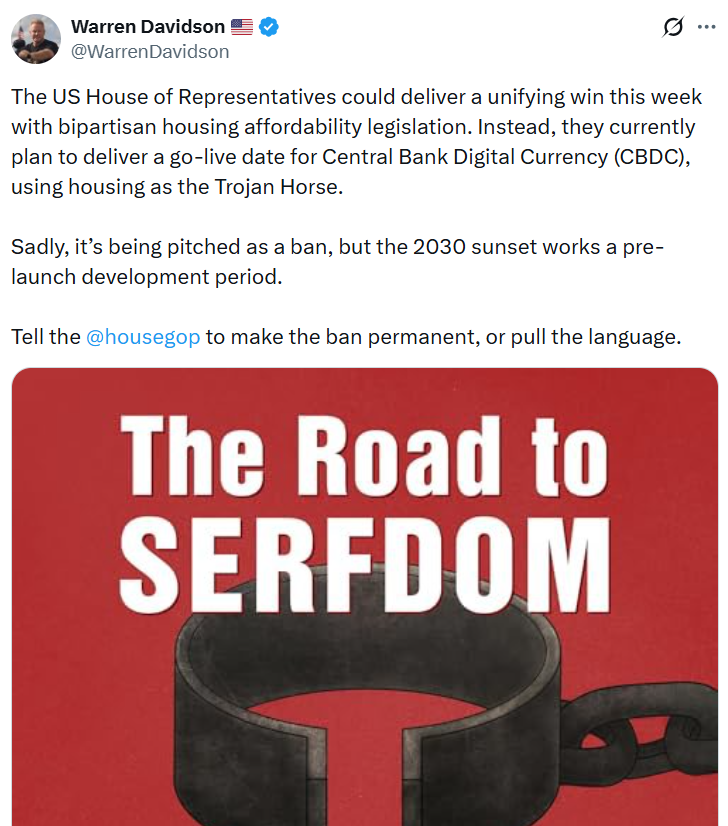
A pair of Republican lawmakers is calling for a permanent ban on a US central bank digital currency (CBDC) to be enshrined in the 21st Century ROAD to Housing Act, as the measure is expected to come up for a vote in the US House this week.
The bill released by the US Senate Committee on Banking, Housing and Urban Affairs in March mainly concerns revisions to federal housing programs but also includes a section banning the Federal Reserve System or any Federal Reserve bank from issuing a CBDC or similar instrument until Dec. 31, 2030.
The US House has created its own amended bill, which Congressman Mike Flood said reverses the “backdoor green light for a CBDC” and aims to make the ban permanent.
The amended legislation is expected to go to a vote in the House this week. If it passes, the bill will return to the Senate, where it could undergo further amendments. The legislation must pass both chambers before it can go to President Donald Trump’s desk to be signed into law.
Critics of CBDCs often cite their potential for misuse. The Human Rights Foundation said the benefits of CBDCs include the potential to expand financial inclusion for populations with limited access to the financial system. Drawbacks include the currency’s potential to infringe on privacy and open new avenues for government corruption, among other concerns.
Ban needs to be made permanent, representative says
US Representative Warren Davidson, a member of the House, also supported a permanent CBDC ban as the “2030 sunset works a pre-launch development period.”
“The US House of Representatives could deliver a unifying win this week with bipartisan housing affordability legislation. Instead, they currently plan to deliver a go-live date for Central Bank Digital Currency, using housing as the Trojan Horse,” he added.
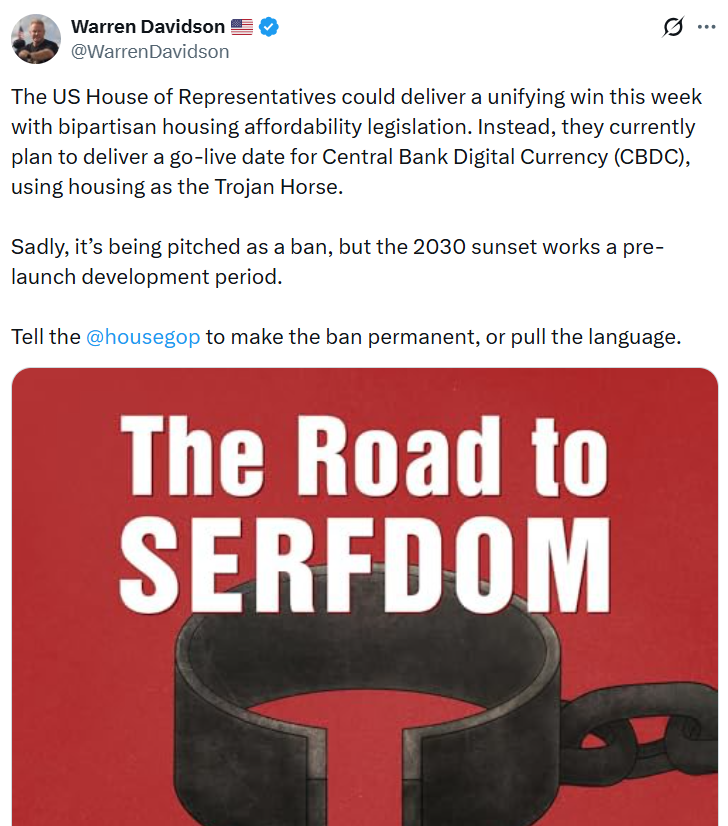
Source: Warren Davidson
The American think tank The Atlantic Council’s tracker lists only three countries that have officially deployed a CBDC: Nigeria, Jamaica, and the Bahamas, while 41 others are in the pilot phase.
Alternate bills to ban a CBDC on the sidelines
Meanwhile, Tom Emmer, the House majority whip, one of the top Republican leadership positions in Congress, is advocating for his Anti-CBDC Surveillance State Act.
The bill passed the House on July 17 but has yet to receive full Senate approval. It aims to block the Federal Reserve from creating or issuing a CBDC.
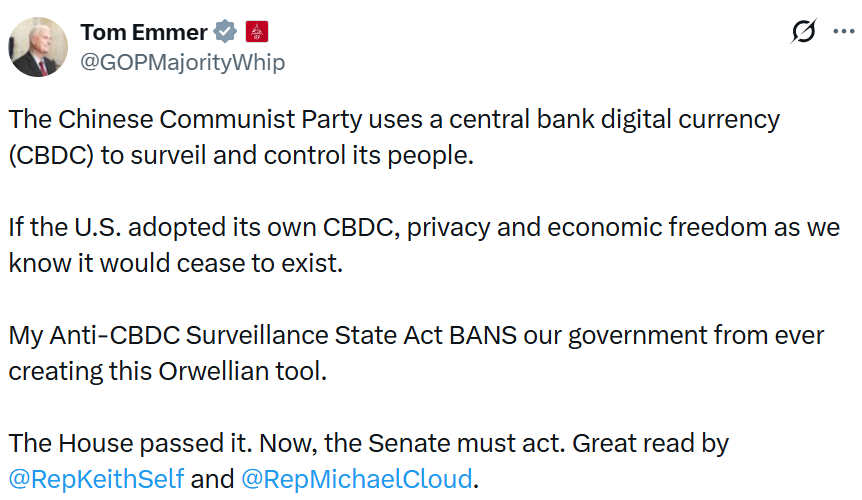
Source: Tom Emmer
“The Chinese Communist Party uses a central bank digital currency (CBDC) to surveil and control its people. If the US adopted its own CBDC, privacy and economic freedom as we know it would cease to exist,” he said.
Related: Bank of Korea governor backs CBDCs, deposit tokens in first address
“My Anti-CBDC Surveillance State Act BANS our government from ever creating this Orwellian tool. The House passed it. Now, the Senate must act.”
Previously, Senator Mike Lee introduced the “No CBDC Act” as a standalone bill prohibiting the Fed or Treasury from issuing a CBDC. However, it stalled in Congress.
Magazine: Bitcoin ETFs bleed $1B, Aave’s $71M ETH unfreeze bid delayed: Hodler’s Digest, May 10 – 16
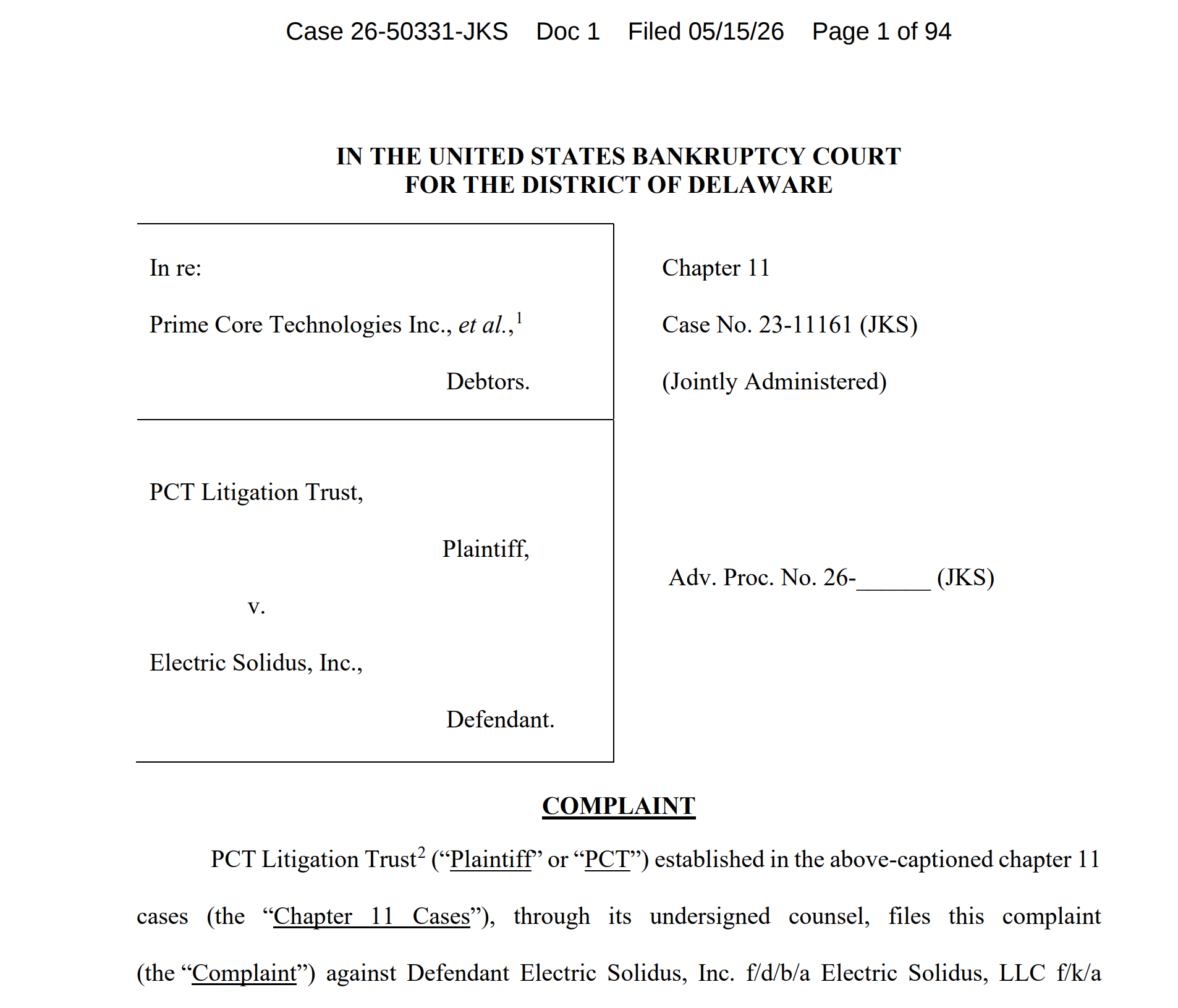
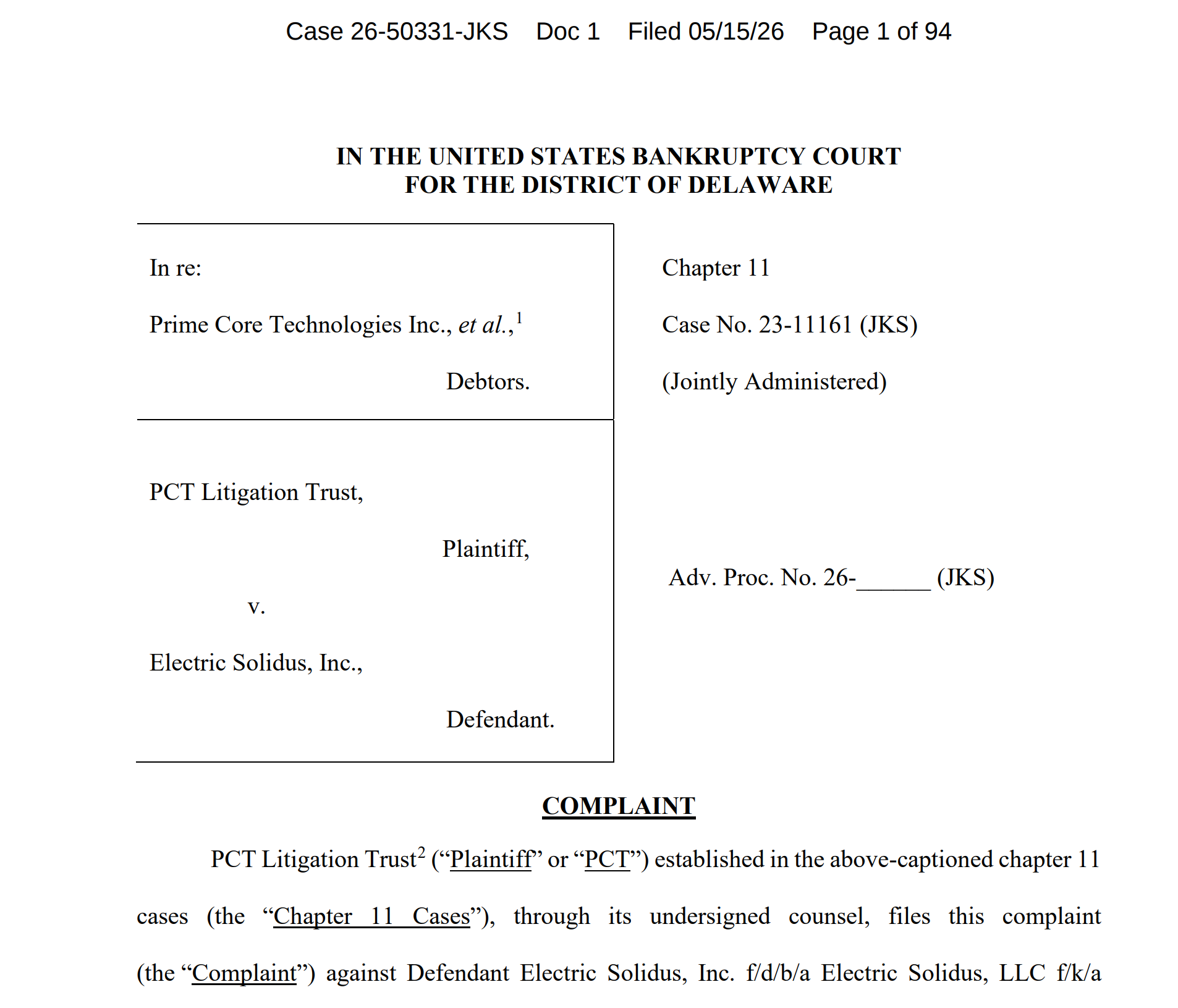
The post-bankruptcy trust for Prime Trust has filed suit against Swan Bitcoin, alleging the Bitcoin services company exploited insider knowledge to pull nearly $1 billion in assets from the custodian days before its collapse.
The complaint, filed in Delaware bankruptcy court, accuses Electric Solidus, the corporate entity behind Swan, of receiving over $24.6 million in cash, 11,994 Bitcoin (BTC) currently worth around $923 million, roughly 5 million USDt (USDT) and smaller amounts of other digital assets before Prime Trust’s August 2023 bankruptcy.
At the center of the allegations is an unidentified Prime Trust senior executive who, while working at the company, was also a paid adviser to Swan through a side arrangement dating back to July 2019.
Four days before Prime Trust met with Nevada regulators on May 26, 2023, the executive allegedly opened an encrypted chat with Swan CEO Cory Klippsten and set messages to auto-delete every 24 hours. The feature was allegedly turned off the day after the meeting, when Swan withdrew more than 10,000 Bitcoin from Prime Trust.
Source: CourtListener
The lawsuit is part of a broader effort by Prime Trust’s post-bankruptcy litigation trust to recover assets transferred out of the custodian in the weeks leading up to its collapse. The trust alleges Swan used insider access to move funds ahead of other customers as Prime Trust’s financial condition deteriorated.
“Swan knew to transfer fiat and crypto from Prime immediately prior to Prime filing for bankruptcy to avoid catastrophic losses,” the complaint wrote.
A Swan representative told Cointelegraph that Prime Trust held customer assets in individually owned trust accounts.
“The bankruptcy estate is now trying to take assets it held in trust as custodian, from a party that never received them. Customer assets held by a trust company are not available to general unsecured creditors, and we expect the courts to say so,” the representative said.
Related: House Committee pushes Trump to fill CFTC seats as crypto regulation ramps up
Swan allegedly emptied Prime Trust accounts
The complaint further alleges that Swan abruptly expanded a partial asset transfer into a full evacuation of all funds, one day before the Nevada meeting.
Prime Trust staff scrambled to comply before the close of business that day, according to Slack communications cited in the filing.
The complaint alleges Prime created an internal ledger labeled “PT FBO Swan Customers” on May 25, an account that did not previously exist, to make it appear Swan’s funds had always been held in a separate trust, which would have made them harder to claw back in bankruptcy.
“In substance, however, those assets had not been and were not held in trust for the benefit of Swan’s customers,” the suit claims.
The plaintiff is seeking recovery under preferential transfer and actual fraudulent transfer provisions of the Bankruptcy Code, and is asking the court to disallow any future claims Swan might assert against the estate until restitution is made.
Magazine: Guide to the top and emerging global crypto hubs — Mid-2026
Crypto World
South Carolina Enacts Landmark Bitcoin Rights Legislation While Blocking CBDC Integration

Key Highlights
-
Comprehensive protections for cryptocurrency self-custody established across South Carolina.
-
State government entities prohibited from accepting CBDC transactions.
-
Mining operations and staking services receive regulatory exemptions and legal protections.
-
Expansive digital asset definitions provide framework for blockchain enterprise development.
-
State emerges as national leader in cryptocurrency rights and blockchain-friendly policies.
A groundbreaking cryptocurrency statute has been signed into law in South Carolina, creating extensive safeguards for digital currency holders and blockchain enterprises. The comprehensive measure prevents governmental restrictions on cryptocurrency transactions, mining activities, and decentralized technology operations. Significantly, the statute bars all state governmental bodies from utilizing central bank digital currencies or engaging in federal CBDC experimental programs.
Digital Asset Custody and Payment Rights Protected
The law guarantees that citizens and commercial entities may transact in digital currencies for lawful commerce without governmental interference. Non-custodial wallets and cold storage solutions receive complete legal protection, allowing holders to exercise sovereign control over their cryptocurrency holdings. Municipal and state governments are forbidden from levying special assessments or taxation exclusively targeting digital currency transactions.
The statute establishes an inclusive definition of digital assets encompassing stablecoins, utility tokens, collectible tokens, and various digital-native financial instruments. Significantly, peer-to-peer crypto exchanges, proof-of-stake validation services, and decentralized application creation are explicitly excluded from money service business licensing requirements. This regulatory clarity provides blockchain enterprises with a predictable legal environment for expansion.
Central Bank Digital Currency Restrictions Implemented
Under the new statute, every state agency and municipal subdivision is forbidden from processing CBDC transactions. Involvement in any Federal Reserve or national government CBDC testing programs is explicitly prohibited. The legislation carefully distinguishes between government-issued digital currencies and privately developed, asset-backed stablecoins, ensuring regulated tokens like USDC continue functioning throughout South Carolina.
The state’s rejection of CBDCs reflects wider conservative policy objectives centered on surveillance concerns and financial privacy protection. Internationally, countries including Nigeria, Jamaica, and the Bahamas have implemented operational CBDCs, with numerous others conducting trials. South Carolina’s position establishes a significant state-level counterpoint to worldwide central bank digital currency momentum.
Cryptocurrency Mining and Network Infrastructure Safeguards
Municipal authorities are restricted from establishing unreasonable acoustic regulations or prohibitive land-use restrictions targeting commercial-scale mining facilities. Blockchain validator operations, proof-of-work mining enterprises, and staking infrastructure are exempted from automatic money transmitter and investment securities licensing obligations. Authority to prosecute fraudulent mining schemes or deceptive staking operations remains with the state Attorney General, preserving essential consumer safeguards.
The statute incorporates power grid management provisions for substantial mining operations. Large-scale facilities must provide documentation of electrical infrastructure impact mitigation strategies, frequently through direct energy procurement contracts. This requirement ensures mining sector expansion remains compatible with electrical capacity planning and utility service standards.
Policy Development and National Significance
Senate Bill 163 completed its 17-month journey through the legislative process, establishing South Carolina’s most comprehensive digital asset regulatory structure. Senators Danny Verdin and Matt Leber championed the legislation, which received overwhelming bipartisan support in both chambers. The measure exemplifies an accelerating nationwide state-level movement to codify cryptocurrency rights and digital financial sovereignty during a period of federal regulatory ambiguity.
South Carolina now stands alongside Kentucky, Oklahoma, and Arizona in providing statutory protections for self-custody practices, mining enterprises, and blockchain innovation. The legislation fortifies the legal standing of cryptocurrency holders and technology companies while constraining state participation in federal CBDC programs. This positions South Carolina at the forefront of state cryptocurrency policy development in 2026.

XRP is trading near $1.37 as exchange-flow data shows cooling deposit pressure, while ETF inflows remain positive and traders wait for a breakout.
Summary
- XRP trades near $1.37 as Bybit deposit pressure cools after a month-long exchange-flow wave today.
- Binance and Coinbase now show withdrawal-led transactions, suggesting exchange selling pressure may be easing slightly.
- Spot XRP ETFs posted positive daily inflows, but total assets fell from recent levels again.
Ripple’s native token traded near $1.37 on May 20, down about 1.37% over 24 hours, according to crypto.news price data. The token moved between $1.35 and $1.39 during the same period, with 24-hour trading volume above $1.8 billion. XRP held the fifth spot by market cap, valued near $84.6 billion.
Longer-term performance remains weak. XRP was down about 5.88% over seven days and stayed below recent resistance after several failed moves higher. The price action keeps traders focused on the same narrow zone: support near $1.29 to $1.35 and resistance near $1.50.
That range matters because XRP has not yet shown a confirmed trend change. Buyers continue to defend the lower area, but sellers have limited each move toward the upper band. A clean break may now decide whether XRP extends toward $1.80 or returns toward the $1.00 zone.
Recent coverage also showed XRP spot ETFs had drawn strong flows in April, with $17.11 million in net inflows on April 15 and four straight days of positive flows. Combined XRP ETF assets had moved above $1.25 billion at that time, while XRP traded near $1.42.
Bybit deposits cool after month-long wave
According to CryptoQuant analyst Amr Taha, XRP exchange-flow behavior has changed after weeks of strong deposit activity on Bybit. The XRP Multi-Exchange Daily Depositing/Withdrawing Transactions Delta showed Bybit’s transaction delta moving close to zero around May 16.
That marked a clear change from the strong positive readings seen between mid-April and mid-May. In exchange-flow terms, deposit-heavy activity can point to potential selling pressure because tokens moved to exchanges can be sold or traded more easily.
The latest data suggests that Bybit’s earlier deposit imbalance has faded on a transaction-count basis. It does not show the exact XRP volume moving in or out. Still, the change in direction shows that the previous deposit wave has slowed.
Binance and Coinbase have also moved back into negative territory, according to the same CryptoQuant update. That means withdrawal transactions are now higher than deposit transactions on those exchanges. This creates a different setup from the earlier phase, when Bybit-led deposits shaped the market signal.
ETF inflows stay positive despite lower assets
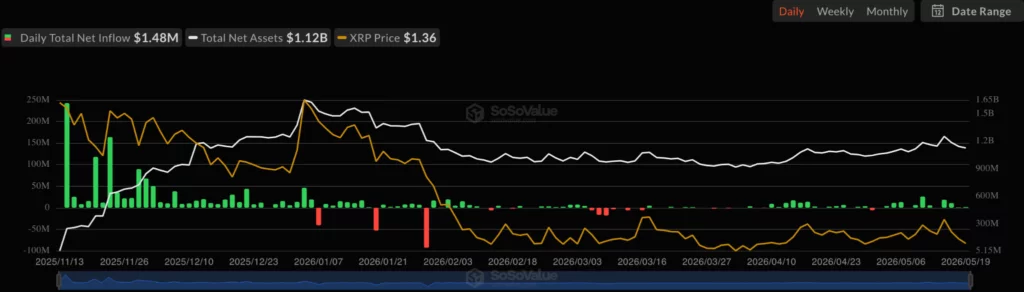
SoSoValue data shows that XRP spot ETFs recorded another positive daily inflow on May 19. Daily total net inflow stood at $1.48 million, while cumulative net inflow remained near $1.39 billion.
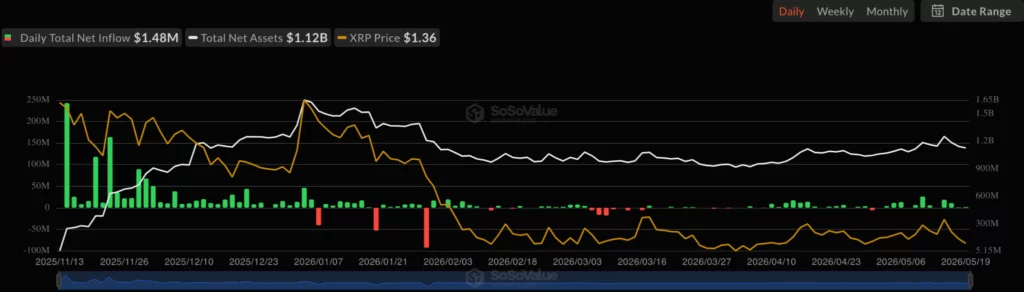
Moreover, XRP spot ETFs recorded $750,440 in inflows on May 18, $10.87 million on May 15, and $18.52 million on May 14. That means daily ETF flows stayed positive across the listed sessions, even as total net assets fell from $1.25 billion on May 14 to $1.12 billion on May 19.
Notably, fresh money continued to enter XRP spot funds, but the total asset base still declined. That can happen when the token price weakens or when market value drops faster than new inflows can offset it.
For XRP traders, the ETF data matters because it shows that institutional demand has not fully disappeared. However, positive ETF inflows alone have not pushed the token above resistance. Price still needs stronger spot demand or a technical breakout to shift the short-term structure.
Traders watch $1.50 and $1.29
Analyst Ali Martinez said XRP is showing the tightest Bollinger Band squeeze on its 3-day chart in more than a year. He described the current range between $1.50 and $1.29 as a “no-trade zone.”
“I’m waiting for a clean 3-day candlestick close outside of this range ($1.50-$1.29) to confirm the next major trend direction,” said Martinez.
He added that a close above $1.50 could target $1.80, while a close below $1.29 could open a move toward $1.00.
EGRAG CRYPTO also warned traders to watch candle behavior inside a key macro zone. He asked whether the current candles show accumulation or hidden distribution, placing focus on structure rather than price alone.
Arab Chain’s CryptoQuant update adds caution. The analyst said XRP institutional accumulation on Binance declined in May, with the indicator moving to about -0.0059 as price fell near $1.38. The reading remains close to neutral, meaning the data does not show heavy distribution.
For now, XRP remains in a tight setup. Exchange deposit pressure has cooled, ETF inflows remain positive, and volatility has compressed. A close above $1.50 would strengthen the bullish case, while a close below $1.29 would weaken the current range.
Disclosure: This article does not represent investment advice. The content and materials featured on this page are for educational purposes only.
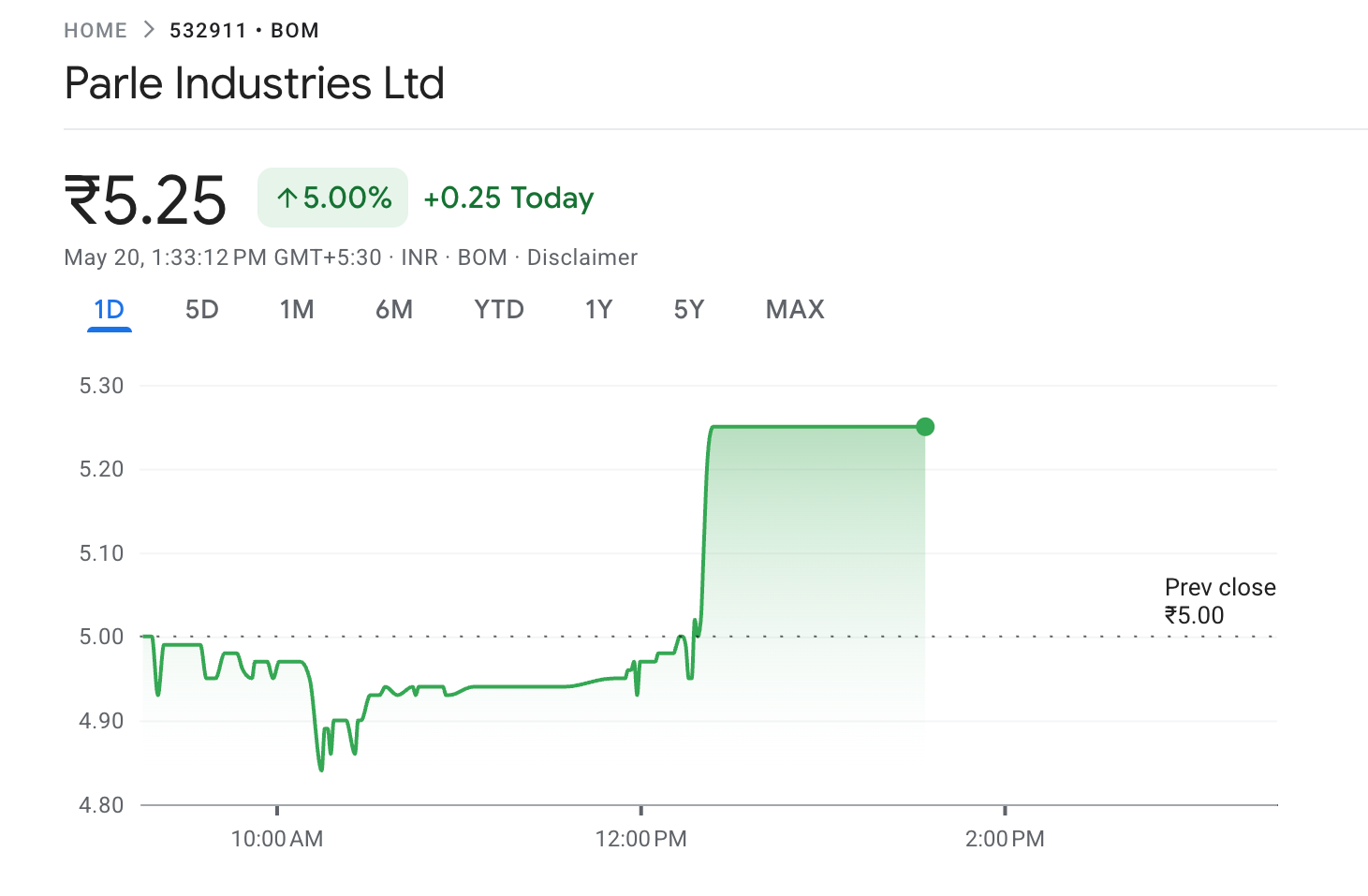
Shares of Parle Industries climbed 5% to ₹5.25 on Tuesday. Earlier in Rome, Prime Minister Narendra Modi gifted his Italian counterpart a Melody toffee pack.
But the traders piled into the wrong Parle. The Mumbai-listed firm builds real estate, while the actual Melody maker stays private and off the market.

Indian Prime Minister Accidentally Pumped a Stock With a Toffee
The ‘Melodi’ shorthand went viral in December 2023 after Meloni posted a selfie with Modi at COP28 in Dubai. She tagged it with #Melodi, a nod to their shared phonetic overlap.
Indian social media users latched onto the joke, mixing in references to Parle’s classic Melody jingle whenever the leaders met. The meme returned with full force after Meloni shared a video clip on X.
Follow us on X to get the latest news as it happens
However, the stock that rallied has little to do with the Melody confectionery brand. Parle Industries Ltd, listed on the BSE, operates across infrastructure and real estate.
The company changed its name from Parle Software Limited in September 2019. Meanwhile, the actual maker of Melody toffees is Parle Products Pvt Ltd, a privately held confectionery business unlisted on any exchange.
The two companies trace back to the same Chauhan family business founded in 1929, which split into three groups: Parle Products, Parle Agro, and Parle Bisleri. Parle Industries was incorporated in 1983 and was a wholly owned subsidiary of Parle Bisleri Ltd until the financial year 1999-2000.
The incident once again highlights how name confusion and brand recognition can trigger speculative buying in the retail stock market, often pushing investors toward unrelated listed companies.
The post India’s Prime Minister Handed Out a Toffee in Rome and Pumped the Wrong Stock at Home appeared first on BeInCrypto.
Crypto World
Crypto News Today, May 20: Trump Linked Bitcoin ETF Withdrawal, IRS Drama, and Iran Tensions Hit Crypto

Today, the crypto news cycle is being driven by institutional fear, political controversy, and global tension. We woke up to fresh concerns surrounding Bitcoin ETF outflows, the growing debate over the Trump IRS allegations, his company withdrawing its Bitcoin ETF application from the SEC, and rising geopolitical anxiety tied to the Iran escalation. Altcoins, meme coins, and tokenized asset projects all saw volatility as investors tried to reposition before another potentially chaotic week.
Bitcoin is moving sideways, dotting the $76K – $77K range after heavy institutional selling pressure since the end of last week. The market is struggling to regain momentum after weeks of aggressive leverage and nonstop optimism. Ethereum, XRP, and Solana also lost steam during Asian trading hours before stabilizing slightly during the European session.

One of the largest talking points and catalysts involved tokenized equities after a report that the U.S. regulators are preparing a framework for blockchain-based stock trading. The development is a major step toward mainstream adoption, worthy of comparison to the early DeFi boom, except this time, traditional finance appears far more willing to participate directly.
Today, Bitcoin ETF Outflows Dominate Crypto News
The latest Bitcoin ETF data showed huge capital leaving institutional products, creating renewed concern that Wall Street demand may be cooling “temporarily.” However, we believe the current heavy outflows represent profit-taking, even as sentiment across derivatives markets turned noticeably more defensive overnight.
Meanwhile, most crypto news today is now focused on Bitcoin rotation into tokenization and infrastructure plays. Projects connected to real-world assets, payment rails, and decentralized exchanges experienced sharp spikes in trading volume. Ondo and Hyperliquid are two of the best examples, with Hype posting 21% jump in a week, as Ondo is racking up 50% rally in 30 days.

Outside both Ondo and Hype, XRP once again became one of the most discussed assets in Asia. South Korean exchanges reportedly saw XRP volumes surpass both Bitcoin and Ethereum during peak retail trading hours. The SBI holding Japan XRP ETF report brings institutional adoption and keeps XRP among the strongest-performing large-cap tokens this week.
At the same time, several large whales moved substantial amounts of Bitcoin onto exchanges, increasing speculation and volatility. Funding rates across perpetual futures markets also cooled sharply. Despite that weakness, many long-term holders believe that the market structure remains bullish as long as macroeconomic conditions improve.
Discover: The best pre-launch token sales
Trump IRS Allegations and Iran Crypto Tensions Shake Markets
Political uncertainty became another major theme today after renewed attention surrounding the Trump IRS controversy spread across crypto news.
Critics questioned potential conflicts involving crypto-linked business relationships, while supporters backed the president, arguing the issue was being exaggerated for political reasons. Regardless of political alignment, we should fear that the headlines could increase regulatory pressure at a sensitive moment for the industry.
Another Iran discussion emerged around energy prices and regional instability that could affect crypto mining costs. We know and have seen that prolonged geopolitical stress could create temporary pressure on risk assets, including crypto. But we also saw that uncertainty strengthened Bitcoin’s appeal during COVID, as a decentralized alternative during periods of distrust and global financial fragmentation.
The controversial Trump-linked media and crypto ecosystem also remained under heavy scrutiny after reports connected to a withdrawn filing fueled fresh speculation online. People start linking the development back to the Trump IRS drama, especially as political narratives increasingly intersect with digital asset markets. We all still remember Trump’s family members’ namesake memecoins that don’t last at high for more than a working bee’s lifespan.
Despite the chaos today, venture firms and crypto developers are still pushing aggressively into tokenization, AI trading infrastructure, and on-chain financial products. We believe that the next major bull cycle will be driven less by retail speculation and more by institutions integrating blockchain technology directly into traditional finance systems.
For now, the combination of crypto news volatility, persistent Bitcoin ETF pressure, expanding Trump IRS controversy, and mounting Iran crypto concerns continues shaping sentiment across the crypto market.
Discover: The best crypto to diversify your portfolio with
The post Crypto News Today, May 20: Trump Linked Bitcoin ETF Withdrawal, IRS Drama, and Iran Tensions Hit Crypto appeared first on Cryptonews.
Crypto World
Pan-European stablecoin effort expands to 37 lenders in push back against U.S. dollar dominance


Qivalis, a stablecoin initiative backed by a group of European banks, aims to issue a stablecoin later this year to deepen the euro’s role in tokenized finance.


The Indian rupee tumbled to a record low of roughly 96.9 against the US dollar on Wednesday.
Global asset managers are warning that a slide toward 100 per dollar has become a possible scenario.
Follow us on X to get the latest news as it happens
Rupee Crashes to 96.9 Record Low as Iran War Hits Indian Currency
Wednesday’s drop extended the rupee’s losing streak to a 8th straight session. The currency has now lost about 6% since late February, when it traded near 87 per dollar. Cumulative losses since 2009 exceed 50%.
Surging crude oil prices, a stalemated US-Iran war, and surging bond yields are driving the slide. Furthermore, BeInCrypto reported that foreign portfolio investors have withdrawn more than $22 billion from Indian stocks this year.
According to Bloomberg, firms including Aberdeen Investments, MetLife Investment Management, and Gamma Asset Management SA expect the rupee to weaken further if the standoff drags on.
“The rupee remains vulnerable to further depreciation, and 100 against the dollar is an important psychological threshold that investors will increasingly focus on,” Rajeev De Mello, global macro portfolio manager at Gamma Asset, said. “The most immediate catalyst for a break of the level would be another leg higher in oil prices.”
A prolonged stalemate inflates India’s oil import bill and pushes investors toward the safer greenback. That deepens the rupee’s conversion pressure.
Meanwhile, Citi economists led by Samiran Chakraborty expect New Delhi to take fresh steps, including possible curbs on outward business investment.
The government has already hiked fuel prices and raised gold import duties to slow dollar outflows. Prime Minister Narendra Modi has urged citizens to conserve fuel and avoid non-essential foreign travel.
With the Strait of Hormuz still effectively shut and US Treasury yields elevated, the rupee may find little near-term relief. Only a diplomatic breakthrough or a Federal Reserve pivot is likely to reset the dollar’s trajectory.
Subscribe to our YouTube channel to watch leaders and journalists provide expert insights
The post Indian Rupee Hits Record Low as Wall Street Eyes The 100 Mark appeared first on BeInCrypto.

More Republicans approve of Trump on immigration than the economy: poll

The Coming Collapse of Multi-Chain Maximalism

A Silent Geopolitical Earthquake: How ‘Western Attrition’ is Paving the Way for an Imminent Shift in European Security

Manchester United reach agreement with Casemiro over contract clause amid transfer speculation

US brings back mandatory military draft registration

Steven Gerrard disagrees with Gary Neville over ‘shock’ Chelsea and Arsenal claim | Football


-

 Crypto World4 days ago
BloFin War of Whales 2026 Grand Prix opens registration for $5M trading championship
-

 Fashion5 days ago
Weekend Open Thread: Theory – Corporette.com
-

 Crypto World5 days ago
E-Estate Announces 1 Year Live: Washington DC Summit as Real Estate Tokenization Enters Its Next Phase
-

 Tech5 days ago
Tech Moves: Microsoft AI leader jumps to OpenAI; former AI2 exec joins Meta; and more
-

 Tech4 days ago
Google reimburses Register sources who were victims of API fraud
-

 Crypto World6 days ago
Google’s Gemini AI Predicts Incredible Solana Price by the End of 2026
-

 Business5 days ago
H&R Real Estate Investment Trust (HR.UN:CA) Q1 2026 Earnings Call Transcript
-

 Sports4 days ago
Napoleonic enters 2026 Doomben 10,000 field via Abounding withdrawal
-
 Entertainment6 days ago
Zara Larsson Has Blunt Response To Chris Brown Diss
-
 Crypto World7 days ago
Two AI Tokens Lead May Rally, But Risks Are Rising
-

 Crypto World4 days ago
BeInCrypto 100 Institutional Awards Nomination: KAST for Best Digital Assets Neobank and Best Digital Assets Fintech
-

 Fashion3 days ago
On the Scene at Gucci’s Cruise Show in New York City: Mariah Carey, Kim Kardashian, Lindsay Lohan, Iman, and More!
-
 Crypto World4 days ago
Bitcoin Battles US Bond Nerves With BTC Price Dip Toward New May Lows
-
 Crypto World4 days ago
Wall Street’s Boldest Gold Prediction Has Russians Rushing to Buy
-

 Fashion4 days ago
Trending Western Style Vests Perfect for Summer
-

 Politics5 days ago
DWP PIP Timms review continues to be an absolute farce
-

 Crypto World4 days ago
ICE and CME urge US regulators to curb Hyperliquid energy trading
-

 Entertainment5 days ago
David Letterman Returns to Late Show, Blasts Cancellation
-

 Fashion3 days ago
Amazon Sundays: Memorial Day Hosting
-
Crypto World5 days ago
Lido Finance Selects Chainlink CCIP as the Official Cross-Chain Infrastructure for wstETH Security
You must be logged in to post a comment Login