
Crypto World
Mexico Probe Links Quadruple Homicide to Alleged Bitcoin Robbery Attempt


Authorities in Mexico have arrested two suspects accused of killing four people in a home invasion they allegedly carried out in search of a Bitcoin “cold wallet” believed to contain millions of dollars, according to La Jornada and an update from the Attorney General’s Office of the State of Mexico (FGJEM).
The alleged incident centers on Jonathan Meléndez, a keyboardist for the rock band Camilo Séptimo, along with his pregnant wife, their daughter, and a household employee in Atizapán de Zaragoza. Mexico’s FGJEM said the suspects may face lengthy prison terms if convicted, while investigators reportedly claim one suspect gained access to the residence through a personal connection.
Key takeaways
- Mexican prosecutors accuse two men of targeting a Bitcoin cold wallet during a multi-victim homicide in Atizapán de Zaragoza, La Jornada reported.
- Both suspects are scheduled for a hearing on Wednesday, where a judge will decide whether the evidence is sufficient to move forward with criminal proceedings.
- FGJEM said the suspects could face 25 to 70 years in prison per homicide victim if convicted, as reported by La Jornada.
- Officials reportedly alleged at least one suspect had a business relationship with one of the victims and used it to enter the home.
- Broader security reporting continues to show wrench-style attacks—coercing victims to access or hand over crypto—rising across 2026’s first half.
Arrests tied to alleged hunt for a Bitcoin cold wallet
La Jornada, citing an update from FGJEM, said two suspects—identified only as Diego Sebastián and Gerardo, with their surnames withheld—were arrested in connection with the killing of four people.
The case is now moving toward a judicial stage: Diario de México reported that the suspects are scheduled for a court hearing on Wednesday, during which a judge will determine whether there is enough evidence to sustain ongoing criminal proceedings.
FGJEM announced the arrests in an X post on Sept. 2. La Jornada also reported that prosecutors believe the men pursued a cold wallet they thought held millions of dollars in Bitcoin. Mexico’s security secretary, Omar García Harfuch, said in a Sept. 2 X post that one suspect used a relationship with a victim to get into the home.
Allegations around the victims and the alleged method of entry
According to La Jornada, prosecutors accuse the two suspects of killing Jonathan Meléndez, his pregnant wife, his daughter, and an employee during the attack at their residence in Atizapán de Zaragoza. The report also says the family’s golden retriever was killed.
The allegation about access is important for how the case could be framed in court. García Harfuch stated that one suspect was a business associate of one of the victims and allegedly leveraged that connection to enter the home, a claim that can matter for establishing planning, intent, and the suspects’ ability to reach the target location.
Potential sentences and what the next court step determines
La Jornada reported that FGJEM said the suspects could face 25 to 70 years in prison per homicide victim if convicted. While the precise charges and ultimate sentencing outcomes would depend on the court’s determination, the range underscores the gravity of the alleged crimes and the prosecution’s posture.
For investors and crypto users, this case also illustrates how physical coercion can become intertwined with cryptocurrency ownership. Unlike typical theft cases, wrench attacks depend on immediate access—often through forcing victims to unlock wallets, reveal credentials, or hand over control.
Why “wrench attacks” remain a growing crypto risk
The Mexico case aligns with broader security reporting on coercive “wrench attacks,” where criminals use violence or threats to compel victims to hand over cryptocurrency or provide access to wallets.
Blockchain security firm CertiK reported that in the first half of 2026 there were 20 publicly reported home invasions targeting crypto holders, compared with just a single incident in the same period a year earlier. CertiK also put the total number of wrench attacks worldwide at 52 in H1 2026, up 33.3% from 39 during H1 2025.
Chainalysis estimates that criminals stole more than $30 million in crypto through wrench attacks in the first half of 2026.
The overall increase is not limited to 2026. CertiK previously reported that wrench attacks rose in 2025, with 72 verified cases worldwide—up from 39 in the prior year, described as a 75% increase in earlier reporting. The same security reporting noted that France recorded the most attacks in 2025 with 19 confirmed incidents, and that Europe accounted for about 40% of attacks globally that year.
Separate reporting also highlighted the lethal stakes of such crimes: Russian outlet Fontanka reported that in October 2025 attackers killed convicted Russian crypto fraudster Roman Novak and his wife after kidnapping them and demanding access to crypto wallets.
What to watch as the Mexico case moves forward
With a Wednesday hearing scheduled to assess whether the evidence supports continued prosecution, the key developments to monitor are what prosecutors can substantiate about the alleged cold-wallet target and the suspects’ entry into the home—particularly the claimed relationship used to gain access. Separately, the rising global pattern of wrench attacks in 2025 and the first half of 2026 suggests crypto holders should keep security planning focused on physical coercion risks, not only on digital threats.

All crypto eyes have turned to the two major events next week (and the CPI inflation data on Friday), with some favoring the FOMC meeting, while others put more emphasis on the CLARITY Act vote on September 15.
The XRP community appears to be in the second camp, as the countdown to the vote has become one of the biggest talking points among them, especially on X and Reddit.
One of the popular users going by the X handle RippleXity recently outlined the significance of the CLARITY Act on XRP since it could put the token “at the center.”
XRP Has an Advantage?
The highly anticipated legislation would establish a comprehensive framework dividing responsibility for crypto between the Securities and Exchange Commission and the Commodity Futures Trading Commission. For Ripple’s native token, one of those major regulatory questions has already been answered via a lengthy and painful lawsuit.
In March, the SEC explicitly identified XRP as a digital commodity, alongside BTC, ETH, SOL, ADA, and several other crypto assets. The watchdog said digital commodities derive their value primarily from the operation of their underlying networks and supply-and-demand dynamics rather than expectations of profits generated via the essential managerial efforts of others.
As such, the CLARITY Act could provide something more valuable over the long term: durability. Current SEC and CFTC interpretations can potentially be changed by future administrations, but federal legislation is considerably harder to reverse.
The bill would also establish a formal regulatory regime for digital commodity exchanges, brokers, and dealers, and give the CFTC an expanded role in overseeing spot digital commodities markets.
In a recent interview, Ripple’s CLO described September 15 as a “bellwether” for whether comprehensive crypto legislation can continue advancing through Congress. He also argued that the bill provides a much more permanent foundation than agency rulemaking alone.
Not the Final Vote
Although the XRP community is putting much hope on September 15, it’s worth explaining that the Senate will not vote on passing the CLARITY Act on that day. Instead, policymakers will vote on cloture on the motion to proceed to H.R. 3633, a measure that requires 60 votes and would allow the legislation to move toward formal Senate consideration.
Failure to move on, though, could effectively derail the bill’s chances of success this year, while the odds have significantly declined from over 70% to roughly 30% in months.
A major law-enforcement obstacle was removed last week when the National Sheriffs’ Association dropped its opposition, moving to a neutral position. However, a new report on Monday suggested that the unresolved ethics dispute may be even more serious.
Semafor claimed that several Republican senators now believe the legislation is likely to fail next week, especially if the White House doesn’t help bridge the divide over restrictions on government officials profiting from the industry.
Ultimately, XRP will likely benefit from a successful cloture vote, but in a more modest manner. The major impact can be expected once the bill becomes law. However, if the voting on September 15 fails, XRP, alongside the rest of the market, could fall hard. The situation can worsen a day later if the Fed hikes rates and displays an even more hawkish stance.
The post XRP and the CLARITY Act: Why September 15 Could Be a Major Test appeared first on CryptoPotato.
Crypto World
OpenAI Says It Solved Math's Deepest Problem But Mathematicians Say AI Stole Their Work


OpenAI says an AI system solved the Navier-Stokes problem. It is one of seven Millennium Prize Problems, math’s toughest open questions.
The company said 10,000 AI agents worked together for 88 hours to reach the proof. NYU professor Tristan Buckmaster disputes the credit.
What OpenAI Claims
The Navier-Stokes equations describe how fluids move, such as air or water.
OpenAI’s proof suggests the equations can reach finite-time blowup, when fluid speeds turn infinite instead of staying smooth.
The proof came from an unreleased model that OpenAI says outperforms its released GPT-6 Astra system.
GPT-6 Astra then spent 17 hours verifying the proof’s logic.
The Clay Mathematics Institute offers $1 million for solving any of the seven problems. OpenAI said it will not claim the prize.
The Credit Dispute
NYU professor Tristan Buckmaster says he and Anthropic mathematician Levent Alpöge were close to a related result.
Their work sat inside OpenAI’s Codex, a coding-focused AI model. Buckmaster said that may have exposed it to OpenAI’s team.
Buckmaster addressed the concern directly in a public statement:
“I do not know what their model did, or how. I do not know whether our data was used. I am not accusing anyone of anything.”
— Tristan Buckmaster, NYU mathematician
OpenAI researcher Sebastien Bubeck responded at a press briefing. He denied the company had accessed or used their unpublished work.
OpenAI also acknowledged something else. It cannot rule out that the researchers’ product use shaped its model’s training.
The dispute comes as OpenAI prepares for a reported $1 trillion public listing. Anthropic is pursuing an even larger valuation through its own IPO push.
The post OpenAI Says It Solved Math's Deepest Problem But Mathematicians Say AI Stole Their Work appeared first on BeInCrypto.
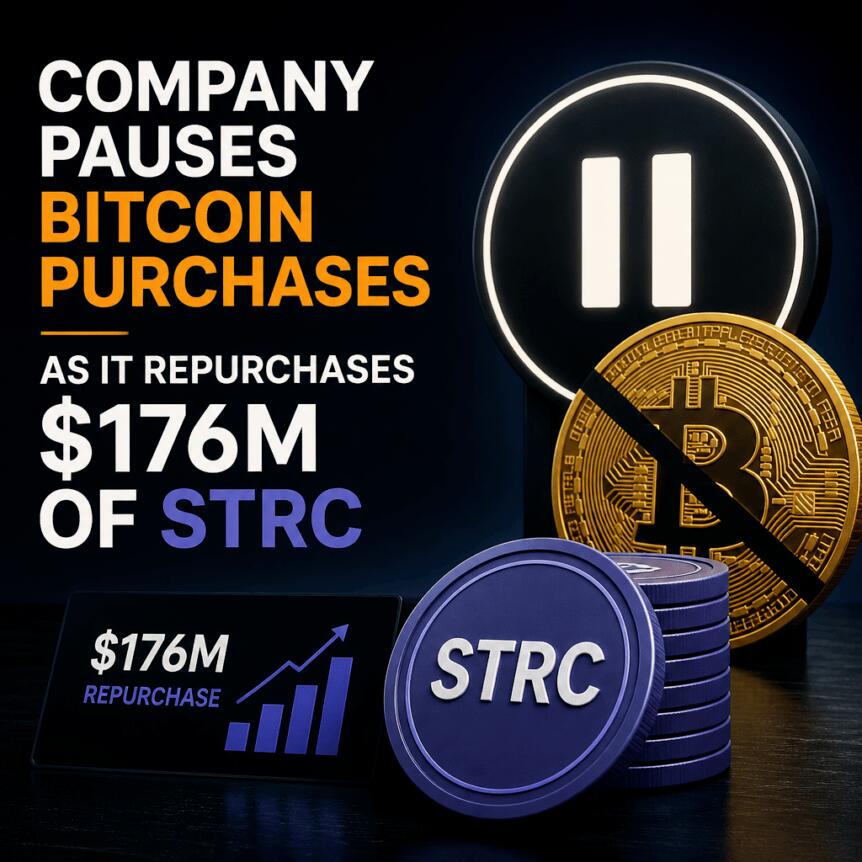
Strategy, the largest corporate holder of Bitcoin, did not add to its BTC treasury during its most recent reporting window. Instead, it used part of its financing machinery to repurchase shares of its preferred stock vehicle, STRC, signaling a shift toward capital structure management rather than fresh Bitcoin accumulation.
According to a Tuesday filing with the U.S. Securities and Exchange Commission, Strategy repurchased $176.3 million worth of STRC preferred shares—about 1.8 million shares—between Aug. 31 and Sept. 7. Over the same period, Strategy also increased the size of its Digital Credit Securities Repurchase Program to $2 billion. With no new Bitcoin purchases during this stretch, its treasury holdings were listed at 845,050 BTC, acquired for $63.6 billion at an average cost of $75,412 per coin.
Key takeaways
- Strategy paused Bitcoin purchases in the Aug. 31–Sept. 7 window while deploying capital to repurchase preferred stock via STRC.
- The company repurchased $176.3 million of STRC shares and raised its Digital Credit Securities Repurchase Program to $2 billion.
- Strategy’s BTC treasury remains unchanged at 845,050 BTC in the filing, with an average acquisition price of $75,412.
- STRC trading below its $100 par value can reduce Strategy’s ability to raise funds through STRC sales and may pressure dividend economics.
- Other corporate buyers—including Strive and Capital B—continued to add Bitcoin while Strategy stepped back.
Preferred-stock repurchases replace new BTC buying
Strategy’s latest SEC filing centers on STRC. The company reported that it repurchased 1.8 million STRC shares for an aggregate $176.3 million during Aug. 31 to Sept. 7, using the same preferred-stock structure that has become central to its broader Bitcoin strategy.
That pause matters for traders and investors because it highlights the operational choices behind BTC treasury growth. Even for the sector’s most prominent buyer, Bitcoin accumulation is not constant; it can be influenced by financing conditions, payout planning, and the mechanics of how Strategy converts capital markets activity into additional BTC exposure.
The filing also notes an expansion of Strategy’s Digital Credit Securities Repurchase Program to $2 billion. Repurchase programs can be used to manage outstanding securities and expected cash flows, but the practical implication for BTC holders is that not all incoming capital is being directed to new BTC purchases at any given moment.
What the SEC numbers imply for Strategy’s BTC treasury
With no new Bitcoin purchases disclosed for this interval, Strategy’s treasury remains at 845,050 BTC. The company attributes that position to $63.6 billion in total acquisition cost, equating to an average purchase price of $75,412 per BTC.
Investors often watch the timing of these disclosures closely because they help distinguish between periods of direct accumulation and periods dominated by corporate actions. In this case, the company’s reported BTC count stays flat, while capital markets activity is reflected through preferred-stock buybacks.
Strategy’s most recent prior large purchase was reported earlier in the year by Cointelegraph—its first BTC buy since mid-June, consisting of a $370 million acquisition. The contrast between that purchase period and the subsequent pause underscores that Strategy’s approach can move between “buy” and “structure” modes rather than progressing in a single uninterrupted line.
STRC trading below par raises questions about dividend funding
The filing comes alongside market pricing signals for STRC. In premarket activity on Tuesday, STRC was reported trading around $97.70—roughly 2.3% below its intended $100 par value. At the same time, Strategy’s Nasdaq-traded MSTR common stock was reported down more than 3% in Yahoo Finance’s last look.
That matters because STRC is not only a balance-sheet instrument; it’s also a funding tool. The article notes that STRC is one of Strategy’s main vehicles used to finance Bitcoin accumulation. If STRC trades below par, it can limit how much Strategy may raise through future STRC sales, potentially affecting the pace at which it can convert equity-like instruments into additional BTC exposure.
Lower pricing versus par can also complicate dividend expectations. The piece indicates that trading below par may “force the company to further increase its dividend rate,” connecting market pricing directly to payout needs. Strategy’s dividend framework is part of a broader plan: on June 29, the company unveiled a capital framework intended to allow Bitcoin sales to fund dividends, and it increased the annual dividend rate on its STRC preferred stock to 12%—a key detail for readers tracking how Strategy balances BTC exposure against shareholder returns.
While Strategy paused, other treasuries kept buying
Strategy’s decision not to purchase Bitcoin during this window coincides with continued accumulation by other corporate holders.
Strive, described as the fifth-largest corporate Bitcoin treasury, added 1,375 Bitcoin for $109 million, according to CEO Matt Cole’s disclosure on Monday. That purchase reportedly brought Strive’s total holdings to 24,531 BTC, with an average cost of $79,281 per Bitcoin. Ahead of Tuesday’s market open, Strive’s Nasdaq-traded ASST shares were reported down more than 2.5%, following a more than doubling in the prior month.
In France, Capital B also reported a purchase: it disclosed a $25 million Bitcoin acquisition on Monday—its largest in nearly a year—taking its holdings up to 3,521 BTC. The report also says that this move pushed Capital B ahead of H100 Group among publicly traded BTC holders.
These developments matter because corporate Bitcoin competition is increasingly about timing and financing. When Strategy pauses, it can leave space for other treasury operators to gain relative market position and momentum—both in absolute BTC holdings and in investor attention.
For readers, the next signal to watch is whether Strategy returns to BTC purchases immediately after this window, or whether it continues to prioritize repurchases and dividend mechanics through STRC and the expanded $2 billion Digital Credit Securities Repurchase Program.
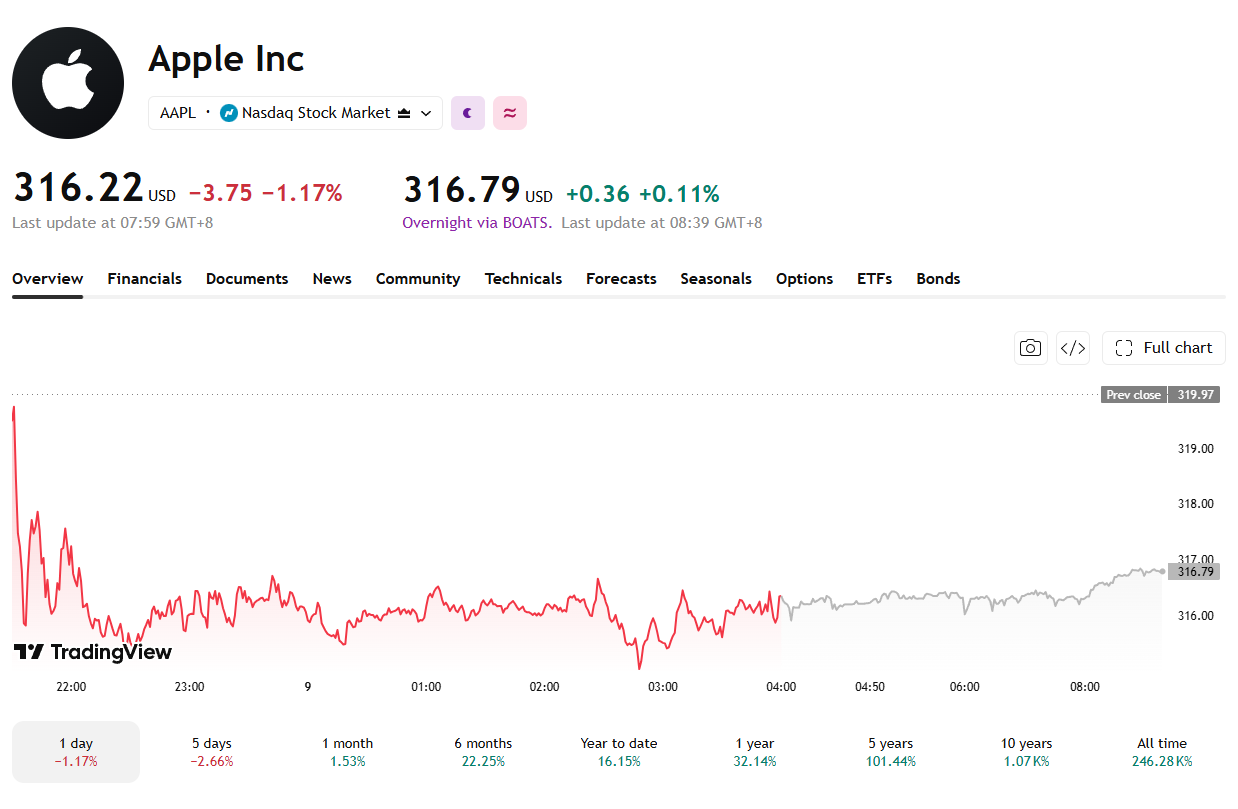
Apple unveils its first foldable iPhone and a refreshed iPhone 18 Pro lineup today, September 9, alongside a new A20 Pro chip, as AAPL stock closed 1.17% lower at $316.22 heading into the keynote.
The event marks the first major hardware reveal under new Chief Executive Officer John Ternus, who took over from Tim Cook on September 1. It also represents Apple’s biggest design shift since the iPhone X arrived in 2017.
What Apple Is Expected to Show
Apple has skipped a standard iPhone 18 this year. The company delayed that model to spring 2027. Its autumn lineup instead centers on the foldable iPhone at Ternus’s keynote debut, alongside the iPhone 18 Pro and the iPhone 18 Pro Max.
All three devices are expected to run the new A20 Pro chip, and Apple has tied that chip to on-device Siri artificial intelligence (AI) improvements.
The foldable device, widely rumored to open like a book, arrives after iPhone 18 Pro costs climbed on rising memory prices. Analysts expect that pressure to push its retail price above earlier generations.
AAPL Stock Slips Ahead of the Keynote
Apple shares fell to $316.22 on Tuesday, though the stock remains near the top of its 52-week range. HSBC held a Buy rating with a $366 price target heading into the event, while Citi projected 7.3 million foldable iPhone unit sales despite a price near $2,000.

Meanwhile, the launch follows fresh competition from China. Huawei introduced its tri-fold Mate XT2 on September 7, powered by an in-house Kirin 9050 Pro chip and priced between $2,980 and $3,725. Xiaomi debuted its passport-sized 18 Fold the same day, starting near $1,540.
Huawei Executive Director Richard Yu said pricing has become difficult as memory costs climb.
“Pricing right now is a real challenge, because memory costs have risen sharply. We adopted a lot of new technology, and the cost pressure has been enormous.”
Huawei led China’s smartphone market last quarter with a 22.6% share. Apple held 18.1% and Xiaomi held 12.4%, and Huawei also captured most of the country’s foldable shipments.
Whether Apple’s entry shifts that balance may depend less on today’s specifications than on how Ternus prices and positions the device against entrenched rivals.
The post Apple's Foldable iPhone Debuts Today: Will AAPL Stock Take Off? appeared first on BeInCrypto.
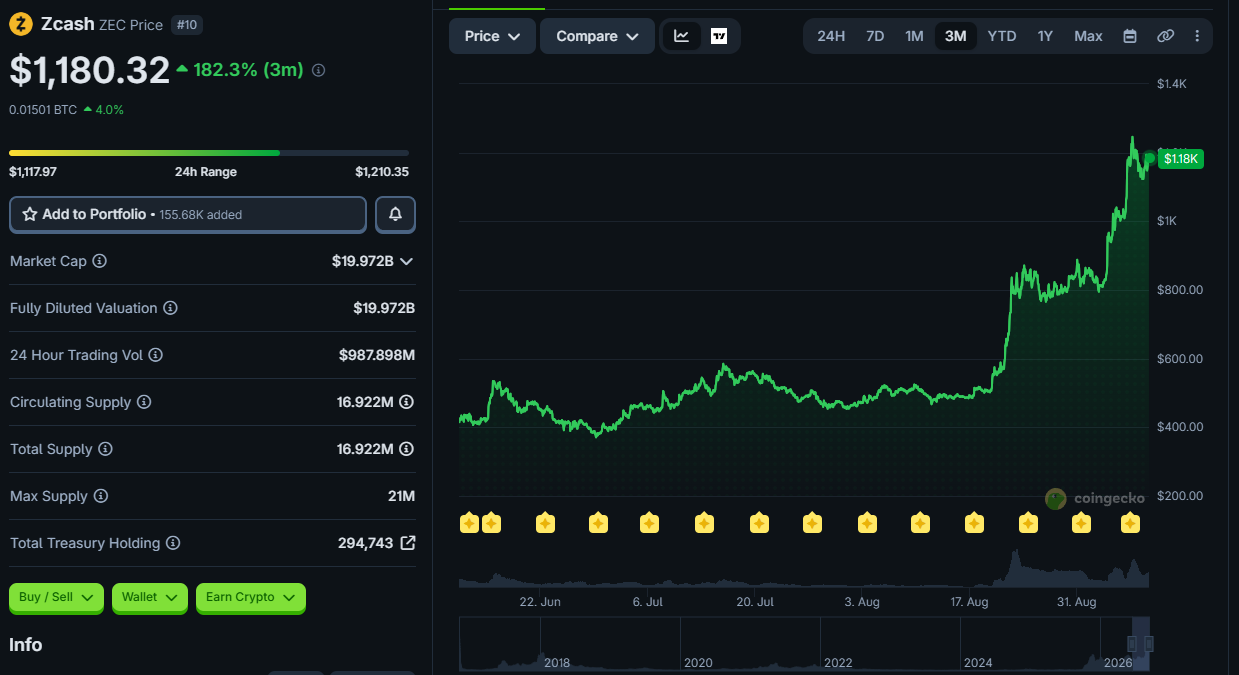
Some of Bitcoin’s oldest whales spent months privately urging early investor Dan Held to buy Zcash (ZEC) before the token’s rally past $1,000, he said in a recent interview.
Held, a former Kraken head of marketing who bought his first Bitcoin in 2012, said the messages came from investors with eight- and nine-figure net worths who have traded Bitcoin since 2013.
Whales Pitch Zcash to a Bitcoin Purist
Held said that over roughly three to six months, these investors pushed him to buy ZEC between $100 and $400. Many funded the trade by trimming a fifth to an eighth of their long term Bitcoin holdings.
Zcash has since crossed $1,000 last week, its first time above that level in nearly a decade, since it was launched. Rising Zcash ETF inflows into Grayscale’s ZCSH fund have added to the rally’s momentum.
Held said he still views the timing skeptically. He argued that crypto narratives typically form only after an asset has already moved, not before it. That pattern, he said, looks familiar in Zcash’s case as well.
Held Isn’t Convinced Yet
Held contrasted Zcash with Bitcoin’s fixed 21 million supply cap. He said the Zcash community accepted a tradeoff between privacy and supply auditability that Bitcoin’s community rejected.

He pointed to an episode from roughly six months to a year ago. Confusion over a possible exploit briefly made it unclear exactly how much ZEC was in circulation. Held said that kind of uncertainty would be intolerable for an asset marketed as digital gold.
Held added that he generally avoids buying whatever the market already loves. He said his best trades, including Bitcoin and SpaceX, came from assets nobody wanted at the time. On Zcash, he said, that is no longer the case.
Some Zcash short sellers have also been squeezed by the rally, a sign of how fast sentiment turned.
Whether the whales’ early timing proves right will likely take a full market cycle to judge.
The post Bitcoin Whales Were Urging Friends to Buy Zcash Before Its Rally to $1,000 appeared first on BeInCrypto.
Abraxas Capital has bought another 13,000 ETH worth $32.39 million in the spot market to hedge part of a 141,180 ETH short position on Hyperliquid valued at $353.27 million.
Summary
- Abraxas Capital bought another 13,000 ETH worth $32.39 million in the spot market, according to Lookonchain.
- The purchase was made to hedge a 141,180 ETH short position on Hyperliquid valued at $353.27 million.
- The latest spot purchase covers just over 9% of the short when measured by the number of ETH.
- Abraxas previously accumulated more than 211,000 ETH worth over $477 million during a six day buying run in May 2025.
Lookonchain said on Sept. 8 that Abraxas Capital purchased the additional Ether while keeping its much larger short position open on the decentralized derivatives platform. The blockchain analytics account described the transaction as another spot purchase made specifically to hedge the short.
At the values provided by Lookonchain, the latest purchase was made at an implied price of roughly $2,491 per ETH. The 13,000 ETH position equals just over 9% of the firm’s 141,180 ETH short when measured by the number of tokens.
Abraxas therefore remains heavily net short based solely on the positions disclosed by Lookonchain. Subtracting the latest 13,000 ETH spot hedge from the 141,180 ETH short leaves 128,180 ETH of net short exposure before considering any other holdings or positions controlled by the firm.
Abraxas Capital keeps $353 million ETH short open
Lookonchain valued the Hyperliquid short at approximately $353.27 million at the time of its post, compared with $32.39 million for the latest spot purchase.
The hedge gives Abraxas exposure to ETH in opposite directions. The short position benefits from a decline in Ether’s price, while the spot ETH gains value when the token rises. Lookonchain specifically characterized the latest purchase as a hedge, rather than a closure or reduction of the underlying short position.
Large leveraged positions have become common on Hyperliquid, where whale accounts have carried several billion dollars in combined positions this year.
In May, crypto.news previously reported that Hyperliquid whale positions had reached $4.039 billion. Long exposure stood at $1.981 billion, while shorts accounted for $2.058 billion, producing a long-to-short ratio of 0.96.
Both sides of the whale book were underwater at the time. Long positions carried roughly $30.8 million in aggregate unrealized losses, compared with approximately $14.6 million in losses on short positions.
One of the largest individual trades in the May snapshot involved an ETH whale using 15x leverage. The account held roughly $87 million in Ether exposure from an entry near $2,265 and was sitting on more than $3.6 million in unrealized losses.
A separate reading five days earlier placed Hyperliquid whale exposure at $4.236 billion. Long positions totaled $2.099 billion, or 49.55% of the total, against $2.137 billion in shorts.
The split produced a long-to-short ratio of 0.98, leaving large traders almost evenly positioned between bullish and bearish bets.
Abraxas has made large Ethereum purchases before
The latest transaction is not Abraxas Capital’s first large on-chain move involving Ether.
In May 2025, the investment manager withdrew 138,511 ETH valued at roughly $297 million from centralized exchanges over two days, according to Lookonchain. The transfers occurred during a sharp ETH rally that pushed the token above $2,300.
Abraxas then increased its holdings with another 33,482 ETH purchase worth $84.7 million.
Lookonchain data cited at the time showed that the firm had accumulated 211,030 ETH over six days, worth more than $477 million. The purchases followed the earlier withdrawal of approximately $297 million in ETH from exchanges.
The 2025 accumulation occurred under different market conditions and does not establish the purpose of the firm’s current positions. Lookonchain has specifically described the Sept. 8 spot transaction as a hedge against the Hyperliquid short.
Hyperliquid whale positioning has changed considerably at different points this year. In April, large trader positions totaled $3.4 billion, consisting of $1.737 billion in longs and $1.663 billion in shorts.
Long positions were carrying approximately $153 million in aggregate unrealized losses at the time, while shorts were sitting on roughly $161 million in unrealized profits.
An ETH whale tracked in the same dataset held a 15x leveraged long from around $2,148.70 and was down approximately $8.6 million.
Ethereum trades close to $2,500
Abraxas made its latest hedge while Ether remained close to the $2,500 level following a recovery from early September lows.
On Sept. 7, Ethereum traded near $2,493 after moving between approximately $2,475 and $2,537 during the session.
ETH had repeatedly failed to hold above $2,500, while its daily relative strength index had eased to 63.62 after the August rally.
Liquidation data cited in the report showed notable leveraged positions clustered around $2,430 below the market and between $2,540 and $2,600 above it. The nearest support zone was concentrated between roughly $2,423 and $2,475.
Ether had been trading considerably lower less than a week earlier. On Sept. 2, the token fell to an intraday low of $2,356 after failing to clear resistance close to $2,550.
Approximately $94.2 million in ETH futures positions were liquidated over 24 hours during the decline, while Ethereum fell below $2,400.
ETH remained above several medium-term moving averages at the time, including its 20-day simple moving average near $2,299 and its 50-day, 100-day and 200-day averages near $2,054, $1,903 and $2,030, respectively.
The token later recovered toward the $2,500 area, putting Abraxas’ latest 13,000 ETH spot purchase close to the same price zone.
Institutional demand for spot Ether has remained active during the recovery. U.S. spot Ethereum exchange-traded funds recorded $225.8 million in net inflows on Aug. 28, extending a nine-session buying streak to $1.42 billion.
BlackRock’s ETHA accounted for $1.02 billion, or roughly 72%, of the nine-day ETF inflows. Fidelity’s FETH recorded $56.2 million on Aug. 28, while BlackRock’s staked ETHB product added $20.7 million.
Lookonchain’s Sept. 8 figures put Abraxas Capital’s latest spot hedge at 13,000 ETH worth $32.39 million, while the firm’s Hyperliquid short remained at 141,180 ETH with a notional value of $353.27 million.


Sweden’s tax authority has ordered six crypto companies operating in Boden to pay nearly 540 million Swedish kronor (approx. $56 million) in additional taxes after finding that the firms used business structures to obtain tax benefits they were not entitled to.
Summary
- Sweden has ordered six crypto firms operating in Boden to pay nearly SEK 540 million in additional taxes.
- The tax agency said some companies concealed crypto mining activity to claim tax benefits they were not entitled to.
- Nine crypto companies have received tax adjustments totaling more than SEK 500 million between 2024 and 2026.
- Bikupan Datacenter has challenged its tax assessment and taken the dispute to Sweden’s Supreme Administrative Court.
Swedish public broadcaster SVT reported on Sept. 3 that the six companies accounted for most of the latest tax adjustments imposed on crypto businesses following a review by Skatteverket, the Swedish Tax Agency. The authority said some companies had structured their operations in ways that concealed crypto mining activity.
Patrik Lillqvist, head of intelligence at Skatteverket, said the arrangements were designed to secure tax advantages that would not have been available if the businesses had been classified as crypto miners.
“The companies that we have inspected often have a special arrangement to conceal that they are engaged in mining,” Lillqvist said, according to a translation of his remarks. “The purpose is to obtain tax advantages that the companies are not entitled to.”
The latest assessments form part of the agency’s review of the crypto industry between 2024 and 2026. Nine companies have received tax adjustments totaling more than half a billion Swedish kronor during that period, with six of them operating in Boden.
Sweden crypto tax review centers on mining operations
Boden, a city in northern Sweden, has attracted crypto miners for years because of its access to power and data center infrastructure. The region was already home to around 10 crypto mining companies by 2018, when operators were increasingly looking to Sweden as a location for mining facilities.
Tax treatment later became a source of tension between the industry and Swedish authorities. Sweden moved in 2023 to remove electricity tax relief previously available to data centers, a decision that affected Bitcoin miners operating energy-intensive facilities in the country.
The latest Skatteverket cases concern how companies described the nature of their businesses for tax purposes. According to the agency, some firms presented operations in a way that hid their role in creating new units of cryptocurrencies through mining.
SVT’s earlier investigation into Sweden’s crypto industry found in 2024 that companies had deprived the state of around 1 billion Swedish kronor in taxes, with most of the cases concentrated in Boden. The new assessments show that disputes involving the sector continued through 2026.
Lillqvist criticized companies that entered Swedish communities and used arrangements that the authority believes deprived the state of tax revenue.
“You come to a society and steal from it,” he said.
Several companies have challenged Skatteverket’s decisions in court. Sweden’s administrative court and administrative court of appeal have so far sided with the tax authority in the cases they have considered, according to SVT.
Bikupan Datacenter takes dispute to Sweden’s top administrative court
Bikupan Datacenter, which has operated in Boden and Robertsfors, is among the companies contesting the tax authority’s position.
The company has been granted corporate restructuring after becoming unable to pay its debts, while its tax dispute has reached Sweden’s Supreme Administrative Court. The case remains under consideration.
Bikupan is connected to HIVE Digital Technologies, whose Swedish operations have been caught in a longer-running disagreement over the tax treatment of its business. HIVE said in March that it was scaling down Bitcoin mining at its Boden facility as it challenged the way Swedish tax rules were being applied to the operation.
Johanna Törnblad, CEO of Bikupan Datacenter and HIVE’s Sweden country manager, rejected Skatteverket’s assessment of the company’s historical operations.
“When it comes to the historical operations of the Bikupa companies, we do not share the Swedish Tax Agency’s assessment,” Törnblad told SVT by email.
She said Bikupan’s restructuring application explains the company’s position that crypto mining itself was performed by external mining pools that were independent of the HIVE group.
Under the company’s account of its business model, the Bikupa entities sold computing capacity, or computing power, which could be used for workloads including artificial intelligence.
HIVE has been moving its Boden site toward AI computing
The distinction has become more relevant to HIVE’s plans for its Swedish infrastructure as the company moves resources toward high-performance computing and artificial intelligence.
Crypto.news previously reported in June that HIVE generated record fiscal 2026 revenue of $298 million while expanding its AI computing business. Its high-performance computing operation generated $19.5 million during the fiscal year, up 94% from $10 million a year earlier, while contracted annual recurring revenue from its BUZZ HPC unit reached $35 million.
HIVE reported 440 megawatts of global power capacity across Canada, Sweden and Paraguay at the end of the fiscal year. Its installed Bitcoin mining hashrate increased from 6.5 exahashes per second to 25.1 EH/s during the same period, although the company’s Bitcoin holdings fell to 150 BTC as of March 31.
Part of its AI expansion has involved repurposing infrastructure that was originally used for crypto mining. The company has been converting its Boden facility into a Tier 3 liquid-cooled high-performance computing data center designed to support 2,000 Nvidia GPUs.
The company had already disclosed plans in November 2025 to retrofit the Boden site from a Tier I mining facility into a liquid-cooled Tier III+ high-performance computing center, while expanding GPU infrastructure in Canada.
HIVE’s dispute with Swedish authorities has continued while Bikupan deals with its tax liabilities and restructuring proceedings. The company maintains that its historical Swedish entities provided computing power while independent external mining pools carried out the actual crypto mining.
Skatteverket has maintained the opposite position in its assessments, treating the reviewed operations as mining activity and arguing that the structures used by the companies gave them tax advantages for which they did not qualify. Bikupan’s challenge to that assessment remains before the Supreme Administrative Court.
F2Pool co-founder Chun Wang criticized Zcash on Sept. 8 as ZEC traded near $1,130 following a rally that carried the privacy coin into the cryptocurrency market’s top ten.
Summary
- Zcash traded near $1,130 after gaining more than 2,300% during the previous twelve months overall.
- F2Pool co-founder Chun Wang criticized Zcash’s funding structure, governance history and optional privacy model publicly.
- Zcash allocated 20% of early block rewards through its original four-year Founders’ Reward system initially.
- Ironwood replaced Orchard after developers disclosed a four-year vulnerability carrying theoretical hidden counterfeiting risks onchain.
- Developers found no evidence of exploitation but cannot cryptographically prove counterfeit ZEC never existed privately.
Wang, who posts under the name Chun at @satofishi, called the move a “narrative bid.” He argued that Zcash’s funding history, optional privacy model, governance disputes and recently disclosed Orchard vulnerability did not justify its valuation.
His comments are opinions rather than evidence of wrongdoing. Several underlying events are documented, but some of Wang’s conclusions omit later changes to Zcash’s funding and privacy systems.
ZEC was trading around $1,130 when this report was prepared, down nearly 7% over 24 hours. CoinMarketCap placed its capitalization near $19 billion and ranked it tenth, while CoinGecko placed it ninth. Rankings can differ because platforms use different supply and asset-classification methods.
The token remained more than 2,300% higher than one year earlier, according to market data cited in coverage of Zcash’s move above $1,000. Its rally accelerated after Grayscale converted its Zcash Trust into a U.S.-listed spot exchange-traded fund in August.
Zcash funding criticism needs historical context
Wang said Zcash did not have a fair launch because 20% of its early block rewards went to founders, employees, advisers and investors.
The underlying percentage is correct. During Zcash’s first four years, miners received 80% of each block subsidy, while the Founders’ Reward received 20%. Because that arrangement covered only the first issuance period, it represented 2.1 million ZEC, or 10% of the planned 21 million maximum supply.
The recipients included founders, investors, employees and organizations supporting development. The 2.1 million ZEC did not go exclusively to Electric Coin Company, a distinction noted in historical community discussions.
The Founders’ Reward ended with the Canopy upgrade in November 2020. Zcash then introduced a development fund that also received 20% of block rewards between the first and second halvings.
Under that arrangement, 7% went to Electric Coin Company, 5% to the Zcash Foundation and 8% to Major Grants, later renamed Zcash Community Grants. Miners continued receiving 80%.
That development fund added a maximum of approximately 1.05 million ZEC, equal to 5% of the eventual supply. Combined with the original Founders’ Reward, the two mechanisms directed up to 15% of the maximum supply toward founders, investors and different development recipients across eight years.
Wang’s description becomes less precise when applied to the present system. Since November 2024, Zcash has continued allocating 20% of block rewards for ecosystem funding, but the recipients changed.
The official Zcash network page states that 8% goes to Zcash Community Grants and 12% entered a protocol-tracked lockbox. Direct payments to Electric Coin Company and the Zcash Foundation ended under that structure.
The lockbox had no immediate withdrawal mechanism when introduced. Its purpose was to hold funds until the community agreed on a decentralized distribution process. Therefore, describing the current allocation as a direct continuing payment to “a company and its backers” would be inaccurate.
Whether any protocol-funded development mechanism is appropriate remains a policy judgment. Bitcoin generally directs its subsidy to miners, while Zcash chose to reserve part of issuance for software development and ecosystem grants.
Zcash governance dispute did not stop the network
Wang also cited the January departure of the Electric Coin Company team following a dispute with Bootstrap, the U.S. nonprofit that governed ECC.
The departure occurred on Jan. 7. Then-CEO Josh Swihart said the entire team had been “constructively discharged” after employment conditions changed. He accused a majority of Bootstrap’s board of acting against the company’s mission.
Bootstrap disputed that framing. Its board said the disagreement concerned nonprofit law, fiduciary responsibilities and plans involving the Zashi wallet and outside investment.
The board argued that assets held by a public-benefit nonprofit could not be transferred in a way that created improper private benefits. No court has ruled on either side’s description of the dispute.
The former ECC employees did not abandon Zcash development. They announced a new company, Zcash Open Development Lab, and continued working on the protocol and privacy-related products.
Zcash founder Zooko Wilcox defended the integrity of the Bootstrap directors and said the conflict did not affect the protocol. The blockchain continued operating because miners, nodes and multiple development groups did not depend on ECC’s corporate existence.
The episode still exposed a governance divide among organizations responsible for core software, funding, trademarks and wallets. Wang’s statement that the disagreement proved Zcash was “broken at the top” is his interpretation, not an established technical finding.
ZEC fell sharply when the split became public in January. That verified price reaction showed that traders considered the developer dispute material, even though the blockchain itself did not halt.
Ironwood contained the Orchard supply risk
Wang’s strongest factual criticism concerns a vulnerability in Orchard, Zcash’s main shielded pool between May 2022 and July 2026.
Security researcher Taylor Hornby discovered the flaw in May. The error involved an under-constrained element within Orchard’s cryptographic circuit. In theory, an attacker could have supplied invalid inputs and created counterfeit ZEC that ordinary verification would accept.
Developers deployed an emergency fix on June 1. They reported finding no evidence that anyone had exploited the vulnerability.
However, the privacy properties of Orchard prevent developers from cryptographically proving that no counterfeit ZEC was created before the patch. The flaw existed from Orchard’s May 2022 activation until the emergency response, according to the technical disclosure.
That limitation supports part of Wang’s criticism. Transparent ledgers allow observers to calculate visible supply directly. A shielded pool conceals transaction values, so its supply integrity depends on the soundness of its cryptographic rules.
The inability to prove non-exploitation is not evidence that counterfeiting occurred. It means the available evidence cannot eliminate that possibility with cryptographic certainty.
Zcash activated Ironwood at block 3,428,143 on July 28. The upgrade opened a separately tracked shielded pool and prevented Orchard from accepting new deposits or internal transfers. Orchard users could still withdraw funds.
Ironwood introduced an accounting checkpoint that prevents more ZEC from leaving Orchard than entered it. Any counterfeit balance remaining in the old pool therefore cannot pass freely into the new pool beyond the recorded amount.
As crypto.news reported, Ironwood replaced Orchard with a formally verified shielded design. The verification provides stronger assurance that Ironwood cannot create hidden counterfeit ZEC under its stated design assumptions.
The upgrade did not retroactively prove that Orchard was never exploited. It contained the unresolved supply risk and created a new accounting boundary for future transactions.
Optional privacy is seeing greater use
Wang argued that optional privacy had left most ZEC in transparent addresses for much of the network’s history. Zcash does allow both transparent and shielded transfers, unlike Monero, where privacy protections apply by default.
Exchange support, wallet limitations and the higher computing requirements of early shielded transactions slowed adoption. Transparent addresses remained easier for many services to support.
Recent data presents a more mixed picture. Shielded ZEC increased from about 8% of supply in early 2024 to approximately 30% by May 2026. Shielded transactions accounted for 59.3% of network activity at that point, according to data cited in reporting on growing shielded adoption.
Those figures do not prove that Zcash has developed a broad commercial economy. They do show that the claim that privacy remains almost unused is outdated when applied to current network activity.
Wang compared Zcash unfavorably with Solana and Hyperliquid, arguing that both networks process more visible economic activity. That comparison relies on different use cases. Solana supports general-purpose applications, while Hyperliquid focuses on trading. Zcash primarily offers payments with optional transaction privacy.
Market capitalization also does not measure protocol revenue, payment volume or user numbers directly. ZEC’s top-ten position records the market value assigned to circulating tokens, not a verified ranking of network utility.
BlockFi error was real but unrelated to Zcash
Wang separately referred to BlockFi’s 2021 promotional payment error. BlockFi confirmed that some customers received rewards denominated in Bitcoin instead of U.S. dollars.
Some users withdrew the unexpected payments before BlockFi reversed them. The company said fewer than 100 customers withdrew incorrect awards and initially placed its remaining exposure near $10 million.
Reports showed individual account credits involving hundreds of BTC. However, BlockFi did not publicly verify Wang’s specific example of a customer receiving 701.4 BTC instead of $701.40.
The payment mistake had no operational connection to Zcash, its developers or zk-SNARK cryptography. Wang used it as an analogy for poor attention to detail, alongside his earlier disagreement with a Zcash team member over Eastern Standard Time and Eastern Daylight Time.
His six-year-old decision to block the company was personal. Confusion over time-zone terminology does not establish that Zcash’s cryptographic work was defective.
What happens next for Zcash
Ironwood remains the main technical response to the Orchard vulnerability. Users must move funds out of Orchard for them to enter the new shielded pool, while developers can monitor the accounting checkpoint during that migration.
The ecosystem must also determine how development funding is governed and distributed. Debate over the 20% allocation is likely to continue because it affects miners, grant recipients and ZEC holders differently.
For traders, the immediate question is whether ZEC can retain its top-ten capitalization after a steep rally. The token fell from an intraday high above $1,216 to around $1,130, showing elevated volatility.
A rally driven partly by ETF access and short liquidations does not prove Chun Wang’s criticism correct or incorrect. It shows that market price, protocol security and network use remain separate measures requiring independent evidence.
FAQs
Who is Chun Wang?
Chun Wang is a co-founder of F2Pool, one of the cryptocurrency industry’s longest-running Bitcoin mining pools. He posts on X under @satofishi.
Did Zcash give founders 20% of its total supply?
No. The Founders’ Reward received 20% of block issuance during the first four years. That equaled 2.1 million ZEC, or 10% of the maximum supply.
Was the Orchard vulnerability exploited?
Developers reported finding no evidence of exploitation. Orchard’s privacy design means they cannot prove with cryptographic certainty that hidden counterfeiting never occurred.
Did Ironwood destroy coins held in Orchard?
No. Orchard stopped accepting new deposits and internal transfers, but withdrawals remain possible through an accounting checkpoint designed to contain any excess supply.
Did BlockFi send Bitcoin instead of dollar rewards?
Yes. BlockFi confirmed the general payment error in 2021. The specific 701.4 BTC example cited by Wang was not publicly
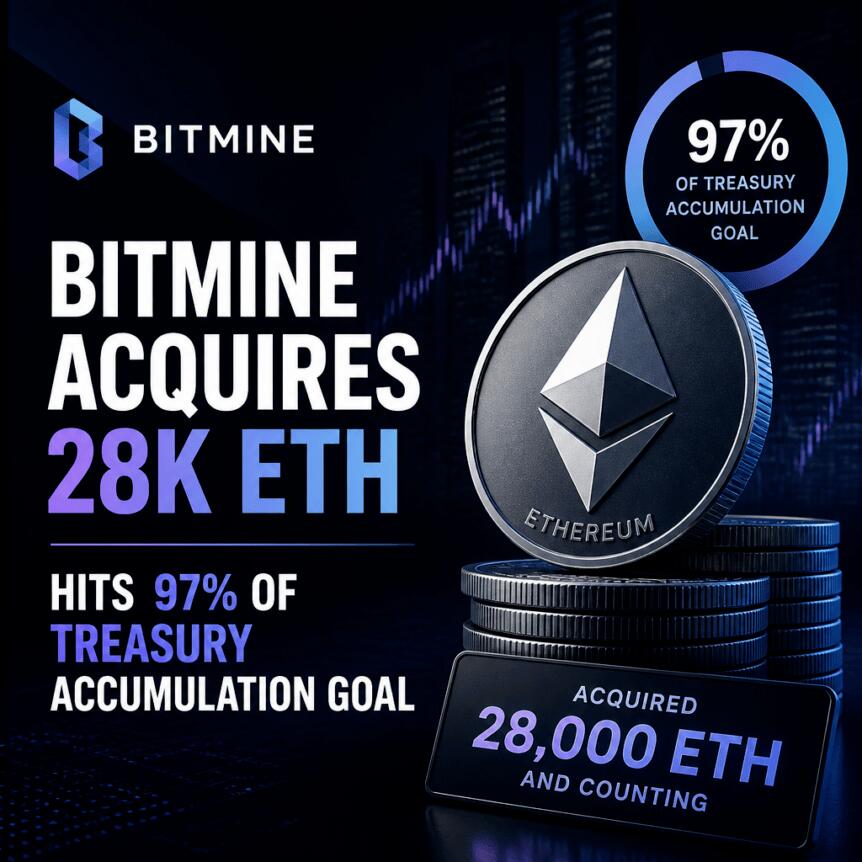
Bitmine Immersion Technologies, the largest publicly listed corporate holder of Ether, says it has added another large batch of ETH to its treasury. The purchase—announced in a Tuesday release—moves the company closer to its stated objective of acquiring 5% of Ethereum’s total supply.
According to Bitmine’s announcement, the firm bought 28,086 ETH last week. The amount was valued at roughly $69.5 million and brings Bitmine’s total holdings to 5.93 million ETH, accumulated at an average cost of $2,495 per ETH.
Key takeaways
- Bitmine purchased 28,086 ETH last week, bringing total holdings to 5.93 million ETH.
- The company says its treasury is near its target: it has completed 97% of the plan to reach 5% of total Ether supply.
- Bitmine reported $15.7 billion in total assets, including $593 million in marketable securities and 5.1 million staked ETH.
- Third-party figures cited in the report indicate Bitmine faces $5.1 billion in unrealized losses on its ETH exposure.
A steady accumulation strategy nears its stated 5% target
Bitmine’s latest buy is part of a longer accumulation program that began with the company’s goal of reaching a significant share of Ether supply over a limited timeframe. In the same Tuesday announcement, Bitmine stated that it has completed 97% of its effort to acquire 5% of the total Ether supply within 15 months.
Earlier coverage linked Bitmine’s progress to a persistent buying streak led by chairman Tom Lee. In the week preceding this announcement, Bitmine said it acquired 53,501 ETH, pushing its holdings to account for 4.9% of Ethereum’s 120.7 million circulating supply.
With the new purchase, Bitmine is effectively tightening the final gap toward the 5% benchmark. For investors, that matters because it suggests the firm is treating Ether not as a trading position but as a treasury allocation—one that will continue to draw attention to how corporate buyers balance accumulation against mark-to-market swings.
Staked Ether and treasury economics
Bitmine also highlighted the role of staking in its balance-sheet setup. The company reported $15.7 billion in total assets, including $593 million in marketable securities and exposure to other crypto holdings alongside its growing ETH inventory.
Crucially, Bitmine said it holds 5.1 million staked ETH, which it expects to produce $330 million in annualized staking revenue. The claim is tied to general expectations around staking yield and is referenced alongside broader coverage of Ethereum staking-linked themes, including an SEC filing and staking revenue discussions reported by Cointelegraph.
For market participants, the key question isn’t only whether Bitmine can keep buying ETH, but also how staking cash flows may partially offset unrealized losses during price drawdowns. Staking revenue can provide a different lens on performance compared with pure spot price exposure—especially when a company’s ETH position is large enough to dominate its treasury narrative.
Unrealized losses widen as Ether weakens
The company’s accumulation continues even as Ether has remained under pressure. The report cites Dropstab data indicating Bitmine is currently facing $5.1 billion in unrealized losses on its ETH holdings.
Ether’s market price has also moved lower versus early 2026 levels. CoinMarketCap data referenced in the article shows Ether was trading around $2,469 at 1:29 pm UTC on Tuesday, after being down 16% since the start of 2026. Against Bitmine’s average acquisition price of $2,495 per ETH, the latest buy is being added at levels close to (and slightly below) that cited average, underscoring how incremental purchases can still be made even when price remains soft.
That combination—continued buying at prevailing prices while showing very large unrealized drawdowns—can be difficult for equity holders to interpret because it creates a moving gap between cost basis and current valuation. The stock reaction can therefore depend as much on expectations for staking-related earnings and future accumulation pacing as on ETH’s spot trajectory.
Shares and equity market reaction
As Bitmine’s ETH treasury expands, its publicly traded stock also draws scrutiny. The article notes that Bitmine’s NYSE-listed shares (ticker: BMNR) were down more than 2% at Tuesday’s market open, implying the stock could extend its year-to-date decline into double digits.
Yahoo Finance tracking cited in the piece provides the market snapshot for investors watching whether the equity market is treating the ETH accumulation as a value-creating thesis or as a risk factor amid broader crypto volatility.
While the company’s latest purchase reinforces its commitment to its 5% goal, the equity market’s willingness to look past mark-to-market losses appears to be shaped by near-term price direction and by whether investors believe staking revenue assumptions and operational execution will ultimately translate into stronger shareholder outcomes.
Going forward, readers should watch two things: whether Bitmine reaches its stated 5% of total Ether supply target on schedule, and how staking revenue expectations compare with realized performance as ETH prices fluctuate. The uncertainty remains straightforward—without clarity on future yield, pricing, and treasury valuation effects, the gap between long-term accumulation goals and short-term market sentiment will likely stay in focus.
A U.S. federal court has ordered the forfeiture of roughly $212,700 in stablecoins linked to wages earned by North Korean IT workers, giving the Justice Department a partial victory in its attempt to seize more than $7.74 million in digital assets tied to an alleged sanctions evasion network.
Summary
- A U.S. judge ordered the forfeiture of roughly $212,700 in USDC and USDT linked to wages earned by North Korean IT workers.
- The seized wallet held 158,123 USDC and 54,574 USDT that prosecutors traced to payment addresses used by at least 14 workers.
- The ruling covers part of a Justice Department case seeking the forfeiture of more than $7.74 million in crypto tied to North Korean overseas workers.
- The court rejected forfeiture of other crypto assets because prosecutors had not adequately identified them, leaving the government able to seek them again.
NK News reported on Sept. 7 that U.S. District Judge Rudolph Contreras ruled that funds seized from a crypto wallet beginning with “0x81c4” should be forfeited to the U.S. government. The Sept. 3 ruling granted part of the Justice Department’s request for default judgment while rejecting its attempt to immediately take control of other assets included in the case.
Prosecutors said the wallet received approximately 158,123 USDC from at least 10 addresses used to receive payments for North Korean IT workers and another 54,574 USDT from at least four worker payment addresses. The two dollar-pegged stablecoins had a combined face value of roughly $212,700.
The government argued that the funds were proceeds of a scheme in which North Korean workers obtained overseas IT jobs, concealed their identities and locations, and routed their earnings through cryptocurrency before money was ultimately sent toward North Korea.
U.S. court approves $212,700 North Korea crypto forfeiture
Contreras found that prosecutors had provided enough information to establish how the 0x81c4 wallet was connected to the alleged operation.
The court said the government’s allegations described a wire fraud and money laundering operation involving foreign entities that conducted transactions on behalf of sanctioned individuals in violation of the International Emergency Economic Powers Act.
For the purpose of the default judgment, the allegations were sufficient to establish that the seized funds constituted or were derived from proceeds traceable to those violations. Contreras therefore entered judgment in favor of the United States for the assets seized from the wallet.
The ruling covered only part of a substantially larger pool of assets targeted by federal prosecutors.
The Justice Department filed its civil forfeiture complaint in June 2025 seeking more than $7.74 million in cryptocurrency and other digital property allegedly generated and laundered through North Korean overseas IT employment schemes.
As crypto.news previously reported, the assets had initially been restrained in connection with an April 2023 indictment of Sim Hyon Sop, a representative of North Korea’s Foreign Trade Bank accused of working with IT workers to move crypto earnings back toward the country.
The complaint covered cryptocurrency, non-fungible tokens and Ethereum Name Service domains. Prosecutors said some of the funds had been frozen or seized while North Korean workers and their associates were attempting to launder the proceeds.
Contreras did not grant forfeiture of the remaining property. The judge found that the government had not adequately identified the other assets in its public forfeiture notice and denied that part of the request without prejudice, leaving prosecutors able to return with another request.
North Korean IT workers allegedly used stablecoins for salaries
The Justice Department has accused North Korea of deploying IT workers around the world to obtain employment at technology and blockchain companies, sometimes using fraudulent identification documents and other methods to hide their nationality and physical location.
Employers who were unaware of their identities then paid the workers for legitimate IT work, often using stablecoins such as USDC and USDT, according to the department.
Prosecutors said the workers used several methods to obscure where their crypto came from before sending funds toward North Korea. The alleged techniques included moving money in smaller amounts, using accounts opened under false identities, swapping tokens, moving assets between blockchains, buying NFTs and mixing employment proceeds with other funds.
U.S. authorities have continued targeting the people and infrastructure accused of supporting those operations. In March, the Treasury Department sanctioned a network that it said helped North Korean workers obtain overseas jobs using false personas and stolen identities before cryptocurrency was used to transfer or launder their earnings.
Investigators have separately traced the employment strategy into crypto development teams. An Ethereum Foundation-backed investigation disclosed in April identified 100 suspected DPRK operatives working within crypto companies, while the Ketman Project alerted 53 teams after examining developer identities and GitHub activity.
Security researcher and MetaMask developer Taylor Monahan said in a separate investigation that North Korean-linked developers had worked inside DeFi projects over several years, with the activity extending back to the early period of decentralized finance.
The risk has continued into 2026. Consensys temporarily halted product releases in July after discovering that a consultant linked to North Korea had gained access to its systems for roughly one month. The company’s investigation found no evidence that assets or data had been stolen or that malicious code had been introduced.
Sim Hyon Sop and Kim Sang Man remain tied to U.S. case
The forfeiture complaint identified Sim and Kim Sang Man as intermediaries who allegedly helped move earnings generated by overseas workers.
Sim served as a representative of North Korea’s Foreign Trade Bank, which has been sanctioned by the United States over its links to the country’s weapons programs. The Treasury Department placed Sim on its Specially Designated Nationals list in April 2023.
According to the Justice Department, North Korean IT workers sent funds to Sim after laundering their earnings. Prosecutors have accused him of participating in schemes involving workers who obtained employment at companies in the United States and elsewhere and of working with over-the-counter cryptocurrency traders to use illicit funds to acquire goods for North Korea.
Kim was sanctioned the following month along with Chinyong, also known as Jinyong IT Cooperation Company. U.S. authorities identify him as the chief executive of Chinyong, which is subordinate to North Korea’s Ministry of Defense and employs delegations of IT workers operating overseas.
Prosecutors said Kim served as an intermediary between those workers and the Foreign Trade Bank by transferring funds from workers to Sim. Chinyong delegations have operated in countries including Russia and Laos, according to the Justice Department.
U.S. authorities have previously linked Kim to crypto transactions involving overseas workers. An earlier investigation found that a suspected North Korean IT worker operating under the alias “Light Fury” transferred more than $300,000 from a public Ethereum Name Service address to Kim.
The Justice Department’s June 2025 complaint said the property targeted for forfeiture consisted of funds generated by North Korean IT workers, including people who had been unknowingly employed by U.S.-based companies, before proceeds were sent to Kim or Sim for the benefit of the North Korean government.

Money (That’s What I Want) (Remastered 2009)

UK Nats outage LIVE as Belfast City Airport flights cancelled and disruption at Belfast International
Silver Lake, Dell director, sells $24.67m of Dell shares


-
 Tech16 hours ago
Memory prices are slowing because buyers ran out of money
-

 NewsBeat14 hours ago
England up in reading, maths and science rankings as Scotland and Wales dip
-

 Business18 hours ago
Egyptian TV Presenter Sarah Khalifa, 11 Others Sentenced To Death In Major Drug Trafficking Case In Cairo
-
 Tech18 hours ago
Strong Password Policy and Password Manager Guide
-
 Crypto World18 hours ago
Visa expands stablecoin card network to 160 programs
-
 NewsBeat13 hours ago
Tehran’s assertive rhetoric signals a new and dangerous phase in conflict
-
 Sports17 hours ago
Phones confiscated, players sent home: Pakistan’s England tour turmoil revives memories of Mohammad Amir, Salman Butt and Mohammad Asif’s 2010 Lord’s spot-fixing scandal | Cricket News
-
 Business7 hours ago
Oil Higher on Hormuz Escalation, Weighing on Sentiment
-

 Politics13 hours ago
The Ultimate September Reset Guide: How To Refresh Your Mind And Life This Autumn
-

 Tech13 hours ago
Google’s revived nuclear power plant gets $1.9B loan from US government
-
 Business12 hours ago
Copper hits record high, UltraTech’s Ultravolt on the offensive: A double whammy for cable makers in FY27?
-

 Fashion11 hours ago
Phia Is the Shopping App That Styles You From Your Own Closet
-

 Fashion11 hours ago
How to Safeguard Your Small Business Against Emerging Cyber Threats
-

 Business17 hours ago
Claim Your Share Of $50 Million Disney Streaming Price Settlement By Sept. 8 Tonight
-

 Crypto World17 hours ago
Iran Threatens to Target U.S. Energy Assets in Gulf If U.S. Strikes Again
-

 Business15 hours ago
US-Canada tariffs: Canada braces for prolonged trade war as counter-tariffs on US take effect
-

 Tech12 hours ago
ESP32-P4 Powers Video Alarm Clock
-

 Tech17 hours ago
Stoke Space raises another billion to rival SpaceX at re-flying rockets
-

 Business13 hours ago
Corning Stock Climbs On Multibillion-Dollar Verizon Network Deal
-
Crypto World12 hours ago
Zcash (ZEC) Rockets 2,200% as Privacy Coins Become Crypto’s Biggest Outlier
You must be logged in to post a comment Login