
Crypto World
MiCA Rules Target USDT in Europe as Other Stablecoins Face Less Scrutiny

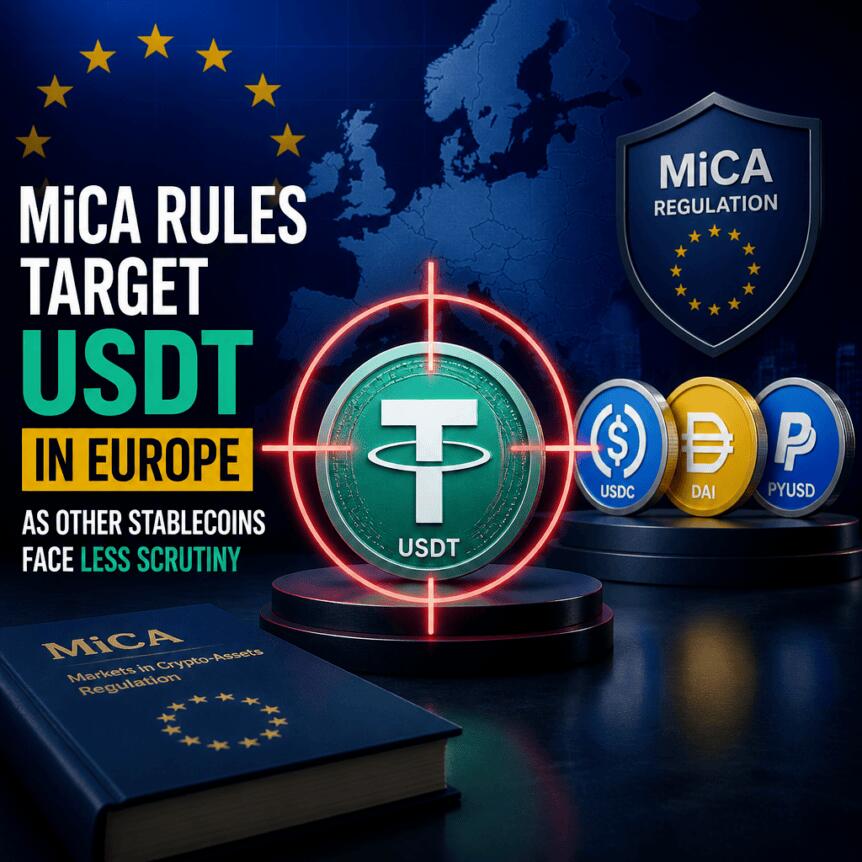
Europe’s regulatory squeeze on Tether’s USDT is moving beyond announcements and into platform-level implementation, but early data suggests it hasn’t upended global USDT usage.
When Revolut told European users it would delist USDT after Aug. 31, it reinforced a broader pattern: financial platforms are adjusting access to the world’s largest stablecoin as the EU’s Markets in Crypto-Assets (MiCA) stablecoin framework tightens. MiCA’s stablecoin rules have been phased in since 2024, and the EU-wide transition period ended on July 1, increasing pressure for platforms to remove offerings that don’t comply.
Key takeaways
- MiCA appears to be changing where regulated platforms can list USDT, but Artemis Analytics says it has not triggered a clear migration to other venues or chains.
- Artemis research quoted in the report indicates no noticeable shift in USDT supply or demand directly tied to MiCA coming into effect in Europe.
- Dollar stablecoin demand is increasingly tied to payments and cross-border transfers, not only trading or savings—making it less dependent on which exchanges list a particular token.
- Emerging-market stablecoin activity continues to expand, with chain usage on networks such as Binance Smart Chain and Tron rising in the period covered by Artemis data.
- For European users, the practical question shifts toward alternatives—potentially euro-denominated stablecoins—though the dollar still remains central to crypto’s benchmark.
MiCA pressure, but no obvious “migration” in USDT activity
MiCA’s stablecoin rules are designed to standardize and regulate issuers and offerings within the EU. As these requirements phase in—and deadlines pass—regulated gateways have been forced to reassess which stablecoins they can support legally.
However, a central point in the reporting is what hasn’t happened. According to Artemis Analytics, the restriction of USDT on a major European front hasn’t produced a measurable shock in broader USDT behavior.
“The data does not indicate any noticeable change in USDT supply or demand attributable directly to MiCA coming into effect in Europe… MiCA didn’t trigger a major venue or chain migration.”
In other words, while compliance has real consequences for retail access in Europe, USDT’s global utility may be resilient enough to absorb those changes without a dramatic reallocation of liquidity across major networks.
Why USDT demand is holding up: stablecoins as infrastructure
A key explanation offered in the piece is that USDT is being used for more than parking value or executing trades. In this framing, dollar stablecoins increasingly function as financial infrastructure—embedded in everyday movement of money, payments, and cross-border settlement.
The report points to Argentina as an illustrative case. Even as conditions around access to physical dollars have changed, stablecoin activity reportedly kept expanding. Lemon, an Argentine crypto and financial services platform, processed $9.3 billion in total volume in 2025—up 60% year-on-year. Transactional users reportedly rose 70% to nearly 1.8 million, and stablecoin volume grew 45% year-on-year.
Those figures are used to support a broader behavioral shift: stablecoins are increasingly treated as part of the payment rails rather than a purely defensive storage tool.
“The role of USDT and other dollar stablecoins is evolving. What we’re seeing is a shift from stablecoins as a store of value to stablecoins as financial infrastructure.”
The report attributes additional detail to Lemon’s business and planning manager, describing use cases that include payments, cross-border transfers, and connecting local users to international balances. The article describes a flow where Argentine users can pay in Brazil using PIX in pesos, receive dollars or euros from overseas credited as USDC, and also move between bank dollars and digital dollar balances. The point for readers: if stablecoins are operating across multiple payment paths and rails, their demand is harder to track solely through which tokens are available on regulated European platforms.
MiCA’s European “gateway” effect vs. global chain usage
Artemis data cited in the report also challenges the idea that MiCA would immediately restructure stablecoin usage on major chains. The article says Artemis observed daily users increasing on networks favored for low fees and day-to-day stablecoin use.
Specifically, the report states that daily users on Binance Smart Chain rose from about 318,000 in June 2024 to 1.56 million by July 2026. It also says daily users on Tron increased by 44% to around 908,000.
“That looks like expanding global and emerging market usage rather than a Europe-specific migration, and there’s no clear MiCA-timed break in the chain data.”
This distinction matters: it suggests MiCA is primarily changing how users in Europe access certain dollar stablecoins through regulated channels, not erasing the underlying demand for stablecoin settlement itself.
In the reporting, WeFi’s chief executive and co-founder Maksym Sakharov ties the behavior directly to utility. Users, the report argues, tend not to pick a stablecoin simply because it appears on a particular regulated platform. Instead, stablecoin choice is described as being driven by counterparty use, liquidity depth, and the ability to operate across markets.
“Users do not choose a stablecoin only because it is available on one regulated platform. They choose it because counterparties use it, liquidity is deep, and it works across many markets.”
The article also includes a perspective from OKX Europe’s chief executive, Erald Ghoos, saying OKX Europe has not offered USDT to European users for around two years. In that sense, the report frames the latest deadline as less of a fresh disruption for some platforms than for others that still maintained access later into the compliance cycle.
Europe’s alternatives and the dollar challenge
If USDT access on regulated EU gateways shrinks for some users and platforms, the next question becomes what those users switch to—and whether the alternatives can offer comparable liquidity and usability.
The report underscores a structural advantage the dollar has historically enjoyed in crypto: the US dollar remains the dominant benchmark across markets. Even though euro-denominated stablecoins may reduce friction for European end users by lowering the need for conversion, liquidity and network effects are unlikely to change overnight.
Still, the piece points to an emerging institutional interest in euro stablecoins. OKX Europe’s Erald Ghoos is quoted saying institutional players are showing increasing interest in creating more EUR-denominated stablecoins:
“What we are seeing from institutional players is interest in creating more EUR-denominated stablecoins, which is worth watching as it develops.”
MiCA determines which stablecoin products can be offered through regulated European platforms, but it cannot rewrite global crypto’s reference currency by itself. The report’s overall framing is that regulation may reshape the EU’s “front door,” while stablecoin demand—especially where it’s tied to cross-border flows—continues to follow deeper market utility and network adoption.
For investors and builders, the next thing to watch is whether USDT restrictions inside regulated EU channels lead to measurable changes in Europe-specific liquidity patterns over time—or whether usage simply routes through other networks and jurisdictions while stablecoin demand continues to grow globally. MiCA may be altering access, but the report suggests the larger stablecoin engine is still running on fundamentals tied to payments and interoperability.



Binance runs its global exchange under Abu Dhabi’s regulator. Emirati police still detained two of its employees over financial crime inquiries, the New York Times reported.
All have been released. A third staff member, who leads the company’s Dubai arm, answered questions at a police station in July.
A Foothold Built on Licenses and State Money
The Emirates is not a side market for Binance. It is the base.
Abu Dhabi’s Financial Services Regulatory Authority granted the exchange three licenses on December 8. No other crypto exchange had won a global license under that framework. The permissions went live on January 5.
The money runs just as deep. State-backed fund MGX invested $2 billion in March 2025. It paid in USD1, a stablecoin from World Liberty Financial, a venture the Trump family part-owns.
The relationship even shapes policy. Binance has cited its Abu Dhabi licensing rules to explain why it now handles some foreign police requests differently.
Airport Stops and an Overnight Hold
Two workers were pulled aside at Emirati airports, people familiar with the inquiries said. One midlevel employee passed through Sharjah this month. Officers took him to a station and held him overnight.
What police are chasing is unclear. Binance told the Emirati government that its staff were swept into fraud cases centered on customers. None were tied to the offenses, the company said.
The link may be mundane. Some employees’ names sit on a corporate bank account Binance keeps in the country. That account processes customer deposits and withdrawals.
“A small number of our personnel were recently asked to provide standard statements to local authorities as part of routine inquiries relating to third-party fund flows… all who provided statements were promptly cleared and released,” A Binance spokesman, speaking to the New York Times.
Follow us on X to get the latest news as it happens
A Familiar Pattern for Binance Staff
Emirati authorities were already tracing money around the exchange. Dubai’s Virtual Assets Regulatory Authority fined an unlicensed local firm, Shelbit, on July 24. Reuters tracked about $4 billion through Shelbit, and roughly $676 million reached Binance.
Binance’s record invites that attention. The company pleaded guilty in the United States in November 2023 and paid $4.32 billion. Prosecutors found it had let more than $898 million in trades pass between US and Iranian users.
That deal placed an independent compliance monitor over the company for three years. The term still has months left to run.
Staff have been caught in national cases before. Compliance executive Tigran Gambaryan spent months held in Nigerian custody in 2024. US diplomatic pressure secured his release.
The detentions have rattled the workforce. Binance approached Emirati officials this month, seeking help and raising concerns about employee safety.
Whether the questioning stays limited to customer fraud will test how much protection those licenses actually buy.
The post Binance Employees Detained in UAE Despite $2 Billion Emirati Backing appeared first on BeInCrypto.
Grayscale has disclosed discussions with a Digital Currency Group (DCG) subsidiary over a contribution of roughly 200,000 ZEC to its Zcash Trust, in an August 18 amendment to the registration statement that would move the fund onto NYSE Arca.
Grayscale Investments Sponsors, the trust’s sponsor, said it is in discussions with DCG International Investments Ltd. for the unit to acquire shares through an authorized participant in exchange for the tokens. The filing adds that “because these discussions are not binding agreements or commitments to purchase, the Potential Investor could determine to purchase more, fewer, or no Shares.”
Moreover, the trust intends to list under the ticker ZCSH, which already carries its shares on OTCQX. Net asset value was $155.2 million on June 30, when the trust held about 2.3% of circulating ZEC, and shares closed at $36.6 on August 12 at a 7% discount to NAV per share.
Since October 2021, the shares have been quoted at a discount on 700 days, with a maximum discount of 55% and a maximum premium of 240%, though the SEC has not approved or disapproved the shares.
DCG Sits on Both Sides
Grayscale’s parent would take a controlling position if the contribution is completed. DCG “may, directly and indirectly through the Potential Investor and other affiliates, own a majority of the Shares representing ownership in the Trust,” the filing states, and would hold “the ability to control the outcome of virtually all matters presented to our shareholders for their approval.”
DCG also mines the asset. Fortitude Mining, a DCG subsidiary, mines ZEC and runs infrastructure on the network, while Foundry Digital operates a ZEC mining pool that accounted for approximately 15.4% of the Zcash Network’s hash rate for the month ended July 2026.
DCG “could prioritize its own interests in these and other investments over those of the Trust,” according to the filing. Zcash itself shipped the Ironwood upgrade and its turnstile mechanism after a counterfeiting bug surfaced in the Orchard shielded pool.
Fee Line Still Blank
The Sponsor’s Fee, the only ordinary recurring expense the trust expects, appears in Amendment No. 4 with its annual rate left blank, as does the trust’s intended new name. Coinbase Custody Trust Company holds the ZEC, and Coinbase is the prime broker.
Grayscale has run this conversion before. The SEC cleared its Digital Large Cap Fund for NYSE Arca alongside generic listing standards that removed the 19(b) filing requirement, and the manager earlier filed to convert its XRP trust into an ETF on the same exchange.
ZEC traded at $550.78 on August 19, according to CoinGecko, with a market capitalization of $9.3 billion.
The post Grayscale Discloses Talks Over 200,000 ZEC Contribution to Zcash Trust From DCG Unit appeared first on CryptoPotato.


Cointelegraph is committed to providing independent, high-quality journalism across the crypto, blockchain, AI, and fintech industries.
All news, reviews, and analyses are produced with full journalistic independence and integrity. For more details on our standards and processes, please read our Editorial Policy.
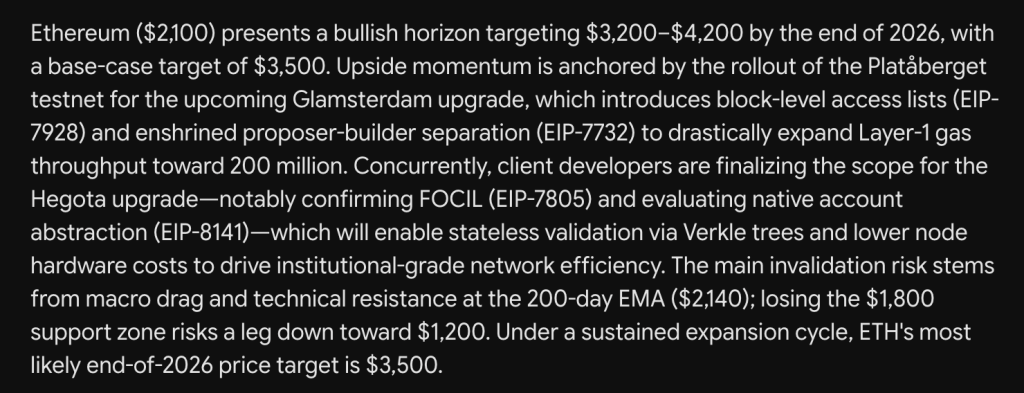
Two upgrades in the testnet and one number that keeps coming up: 200 million gas. Google Gemini AI predicts that the throughput jump reframes what Ethereum can carry, and the price prediction targets $3,200 to $4,200 by the end of 2026, with $3,500 as the base case from $2,100.
The Platåberget testnet for Glamsterdam anchors the case. It introduces block-level access lists through EIP-7928.
Enshrined proposer-builder separation arrives alongside it via EIP-7732. Together, those drastically expand Layer-1 gas throughput toward that 200 million figure.

Client developers are already finalizing the next scope. The Hegota upgrade has confirmed FOCIL through EIP-7805. Native account abstraction is under evaluation as EIP-8141. Both feed stateless validation via Verkle trees.
The practical result is cheaper node hardware. Gemini frames that as the path to institutional-grade network efficiency. The main invalidation risk is macro drag. Technical resistance at the 200-day EMA near $2,140 is the near-term obstacle.
Losing the $1,800 support zone is the larger threat. That risks a leg down toward $1,200.

Discover: Everyone’s Got a Take. Get Free $25 from Kalshi to Actually Trade Yours
Ethereum Price Prediction: Gemini AI Predicts Two Hundred Million Gas Changes The Math
The daily chart has just delivered its strongest session in months. ETH peaked near $4,950 last September before a long unwind began. November and December cut price toward $2,600. February brought the sharpest break, dropping ETH near $1,780.
Spring recovered to $2,450 by May. June reversed that entirely, marking the low around $1,480. July and August rebuilt slowly. The latest session then broke sharply higher, clearing $2,100 in a single move.
The close reads $2,124.2, up 10.83%, and $207.6. The daily range covered $1,904.9 to $2,132.2. Support sits at $2,000, then $1,800 and $1,480. Resistance appears at $2,140 at the EMA Gemini names, then $2,450 and $2,800.
RSI reads 77.11 with its signal line far below at 54.97. That gap of more than 22 points is extreme and confirms a violent momentum shift. The oscillator is now clearly overbought. Momentum is strongly bullish, though readings this stretched typically cool before continuing.
Gemini’s base case needs a 65% move from here. Closing above that 200-day EMA is the first hurdle standing in front of it.
Discover: Your Market Calls Are Worth Something. Start with a free $25 on Kalshi
Ethereum Is Chasing 200M Gas. Bitcoin Hyper Is Taking the SVM Route to Scale BTC.
Ethereum’s next valuation case depends on dramatically expanding what the base layer can process. Bitcoin Hyper is tackling the same bottleneck from a different direction: giving Bitcoin a faster execution environment without asking the Bitcoin network itself to become something it was never designed to be.
Bitcoin Hyper runs on the Solana Virtual Machine, bringing high-speed transactions, low fees, and smart contract functionality into a Bitcoin Layer 2 ecosystem.
Its Canonical Bridge is designed to move BTC into that environment, while HYPER powers gas, staking, and governance across the network.
That makes the thesis less about changing Bitcoin and more about extending what Bitcoin capital can actually do.
The presale has already raised more than $33 million, while buyers can currently stake HYPER for yields of up to 35% APY ahead of the project’s planned 2026 launch.
Explore the Bitcoin Hyper Presale
The post Google Gemini AI Predicts an Unexpected Prediction on Ethereum By The End of 2026 appeared first on Cryptonews.

XRP price trades at $1.18 as of this writing, up 18% on the day in a follow-through move that’s keeping the “biggest rally prediction since 2020” narrative alive. But there’s a catch most headlines are skipping over, and it involves where the smart money actually went.
The token jumped 10% on August 19, beating Bitcoin’s 7% gain and finishing third among the eight largest coins during a record-wide short squeeze. Based on XRP’s 180-day correlation with Bitcoin, the move should have produced 6.57% upside, but it delivered 3.83 points more than that. It is a real outperformance, not just a beta ride.
Ripple is about to flip the switch! —
HODL $XRP!!  pic.twitter.com/Y4rY8qfBov
 BULL RUN WONKA XRP (@WillyWonkaXRP) August 19, 2026
However, spot ETF flows tell a different story: Bitcoin funds pulled in $517 million that day, nearly triple the prior pace, while XRP’s institutional pipes stayed comparatively quiet.
This gap in retail momentum without matching institutional confirmation sets up the next question. Can the chart hold what the squeeze built?
Discover: The Best Token Presales
XRP Price Prediction: Hit $1.30 This Week?
At $1.18 and rising nearly 20% in 24 hours, XRP sits just above the $1.10–$1.12 resistance band that’s capped multiple rallies since early August, per recent technical coverage. Volume above $3–4 billion daily suggests the move has real participation behind it, not thin-book noise.
The 200-day moving average near $1.28 is the next real test, and clearing it decisively would open room toward the $1.29–$1.45 zone analysts have flagged as the next demand shelf.

In a good scenario, a confirmed break above $1.20 extends the squeeze toward $1.30–$1.45. A consolidation between $1.00 and $1.20 continues while ETF flows catch up.
However, a rejection at resistance sends price back toward the $1.00 floor that’s held all year, and a break below that invalidates the entire rally thesis. This is worth watching before chasing this candle.
Trade XRP Market on Kalshi and Get a $25 Signing-up Bonus
Bitcoin Hyper Targets Early Mover Upside as XRP Tests Key Levels
XRP bulls have earned some validation here; an 18% daily pop and a rare win against Bitcoin is nothing to dismiss. But at a $68 billion-plus market cap, XRP’s percentage upside from here is mathematically constrained even in a strong breakout scenario.
That’s the trade-off of buying an asset this size: the squeeze gets headlines, the multiples don’t move like they used to. Capital chasing outsized returns is increasingly rotating toward earlier-stage infrastructure plays instead, and Bitcoin Hyper ($HYPER) is drawing that attention as the first Bitcoin Layer 2 with native SVM integration.
The presale has raised $33 million at a current token price of $0.0136849, with staking rewards available at launch with a huge 35% APY reward. The pitch: Solana-speed execution secured by Bitcoin’s base layer, via a decentralized canonical bridge, is solving the slow, expensive, non-programmable problems that have limited BTC’s utility for years.
Research Bitcoin Hyper before deciding whether that risk fits the portfolio.
Discover: The Best Crypto to Diversify Your Portfolio
The post XRP Price Prediction: Can Ripple Extend Its Biggest Rally Since 2020? appeared first on Cryptonews.

The 1.66 mile, 7-turn track begins on 3rd Street near the Capitol building at the east end of the National Mall in Washington, D.C., before jutting down Pennsylvania Avenue, the course’s longest straight at 0.4 miles. It then makes turns on 9th Street, 7th Street, and Independence Avenue, passing sites including the Lincoln Reflecting Pool and the Smithsonian Museum before circling back onto 3rd street to finish off.
Who’s paying?
Penske Corp., the owner of IndyCar, is picking up most of the tab for the race, according to Bud Denker, Penske Corp. president and chair of the Freedom 250 Grand Prix.
An exact price tag for the event is unknown, but Denker said in July that the race is “much more” than IndyCar’s Detroit street race, which has a budget of $20 million.
A $90 million budget allocated by Congress for special events in Washington will cover security costs, according to Deputy Mayor for Public Safety and Justice Lindsey Appiah, who spoke at a public briefing in July.


US spot Bitcoin exchange-traded funds (ETFs) recorded $517.2 million in net inflows on Wednesday, their largest single-day investment since May 4, pushing August net inflows to $1.47 billion.
The funds have taken in about $1 billion since Monday, already their strongest weekly net inflow since the week ended Jan. 16, when they attracted about $1.42 billion.
The inflows came as crypto prices rallied on Wednesday, alongside a US Treasury decision to expand buybacks of longer-dated government debt and renewed attention on crypto regulation after President Donald Trump urged Congress to advance the CLARITY Act at a White House event.
“The Treasury signalling it’ll step in at the long end pushed yields and the dollar lower, and gold and silver outperformed equities on the day, so the market priced this as a currency event rather than a growth one,” Jonatan Randin, senior market analyst at PrimeXBT, told Cointelegraph.
“Bitcoin moved with gold and silver rather than with risk appetite, which is what the debasement trade looks like when it’s working,” he said.
Bitcoin traded near $72,000 at the time of writing on Thursday, up 11% in the last 24 hours, according to CoinGecko. Ether rose 19% to $2,286.
Spot Ether ETFs logged $189.2 million in net inflows on Wednesday, bringing this week’s inflows to about $291.5 million.
Related: Standard Chartered analyst eyes $100K BTC as US Treasury doubles long-end buybacks


Blockchain interoperability project LayerZero has lost a dozen partners this year as its ZRO token shed a third of its value.
The latest departure, Ethereum node service provider Nethermind, ran one of the verifiers that LayerZero advertised to enterprise users. It migrated to one of LayerZero’s competitors and terminated its role as verifier on Wednesday.
It joins a long list.
- Kelp DAO exited LayerZero in May after it lost $292 million through a bridge that a single LayerZero verifier secured.
- Solv Protocol deprecated its LayerZero bridges two days later, with Re.xyz making the same move.
- The following week, Kraken shifted its kBTC BTC-linked token off LayerZero, while Lombard pulled over $1 billion of BTC-backed assets one day later.
- Virtuals Protocol left LayerZero in June. Yuzu Money completed its exit in early July, and Mantle swapped out its Super Portal days later.
- BitGo took $7.7 billion of wrapped BTC out of LayerZero’s ecosystem in August.
- Huma Finance declined to use LayerZero for its product launched earlier this year.
Even the Wyoming Stable Token Commission, the lone state government in the pack of LayerZero partners, dropped its token bridge on Tuesday.
LayerZero targeted by Lazarus Group
More than $7 billion in assets had migrated off LayerZero by early July. BitGo’s exit lifted the tally toward $15 billion.
The panic began after LayerZero admitted that hackers at Lazarus Group poisoned its internal RPCs in April.
“We made a mistake by allowing our DVN to act as a 1/1 DVN for high-value transactions,” it said.
Protos documented the immediate fallout from that incident, with Aave pausing ETH-pegged token markets from LayerZero as depositors rushed for the exits.
Read more: Aave TVL still down 43% since KelpDAO hack
Hard to recover from an 88% drawdown
LayerZero co-founder and CEO Bryan Pellegrino dismissed much of the early criticism as untrue.
Another defender argued that the departures amount to “about 3% of actual usage in volume and less than 1% of messages.”
Still, LayerZero has been retreating. ZRO, has lost 31% of its value this year, 56% over the past 12 months, and 88% from its December 2024 all-time high.
In July, it announced it was “winding down support for a number of chains with minimal activity across our offchain services and Stargate products.”
The same notice told Stargate users on those chains, “Failure to act before chain support is fully deprecated will result in losing access to your funds.”
LayerZero warned teams still using v1 libraries would face an August 3 shutoff.
Got a tip? Send us an email securely via Protos Leaks. For more informed news and investigations, follow us on X, Bluesky, and Google News, or subscribe to our YouTube channel.

It isn’t clear if an increase in cannabis use, for example, is driving some of the decline. “We don’t know if it’s a substitution, but that’s a question we need to answer,” Toomey says.
Saad, of Gallup, says there could be political factors at play too. According to the new Gallup poll, alcohol use has declined significantly among Republicans and Independents, while Democrats’ alcohol consumption has remained virtually unchanged since 2023.
“It could be worth looking into what kind of political messaging is going on, and if it’s more effective among Republicans and Independents than Democrats,” Saad says.
She notes, however, that “we haven’t seen strong anti-alcohol messages out of the [Trump] Administration.” In January, the administration released updated dietary guidelines that no longer specified a daily limit for alcohol consumption.
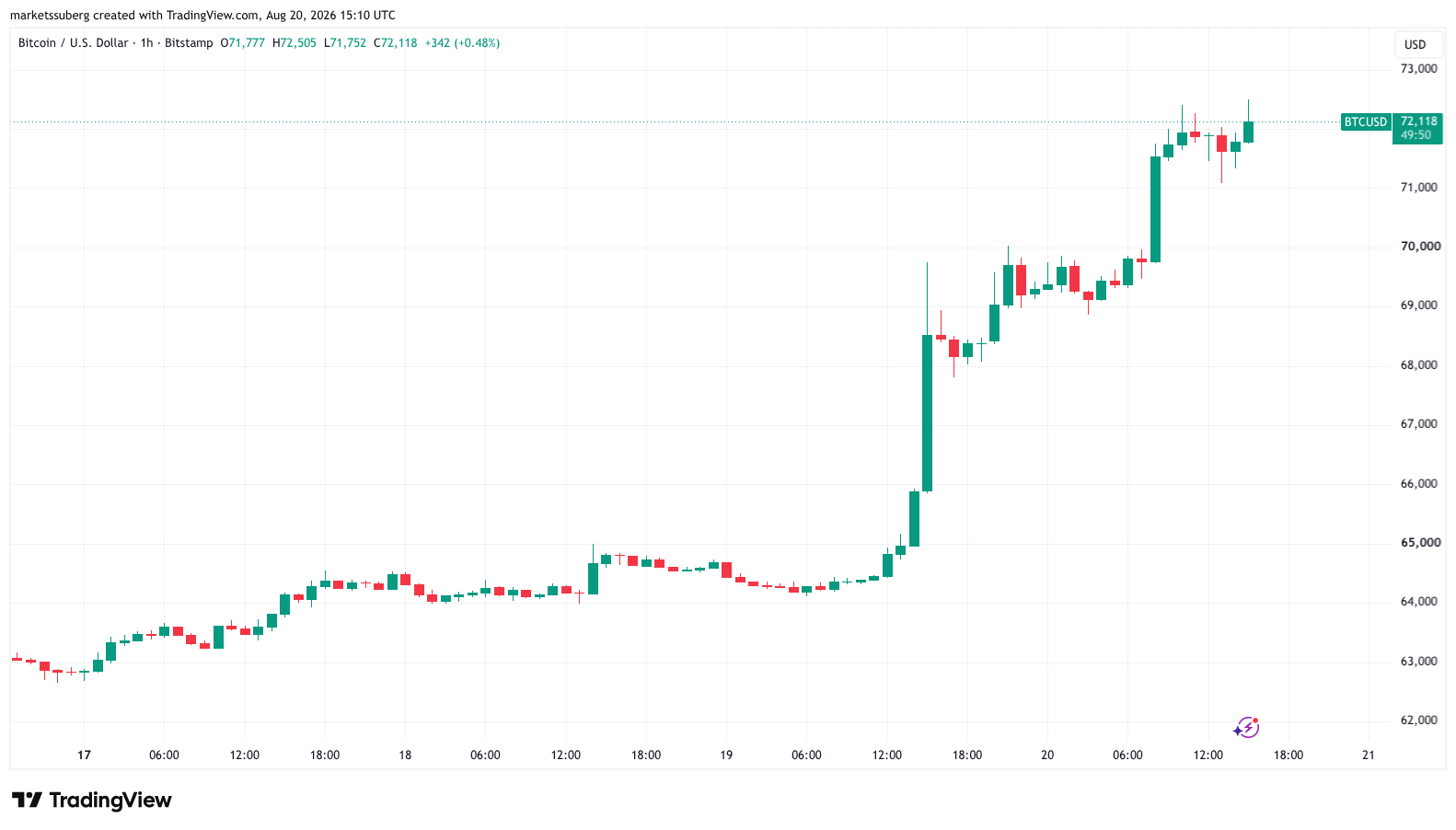
Bitcoin (BTC) saw multimonth highs after Thursday’s Wall Street open while stocks dipped and bond yields rebounded on US-Iran war nerves.
Key points:
- Bitcoin builds on its highest levels in 11 weeks to hit $72,500 on Bitstamp.
- US bond yields see volatility after president Donald Trump threatens “economic warfare” with Iran.
- Bitcoin market participants question whether the rally has staying power.
US bond yields reverse higher after Trump pledges “economic warfare” with Iran
Data from TradingView showed BTC/USD retesting $71,000 before hitting new 11-week high of $72,505 on Bitstamp, up by more than 4% on the day.
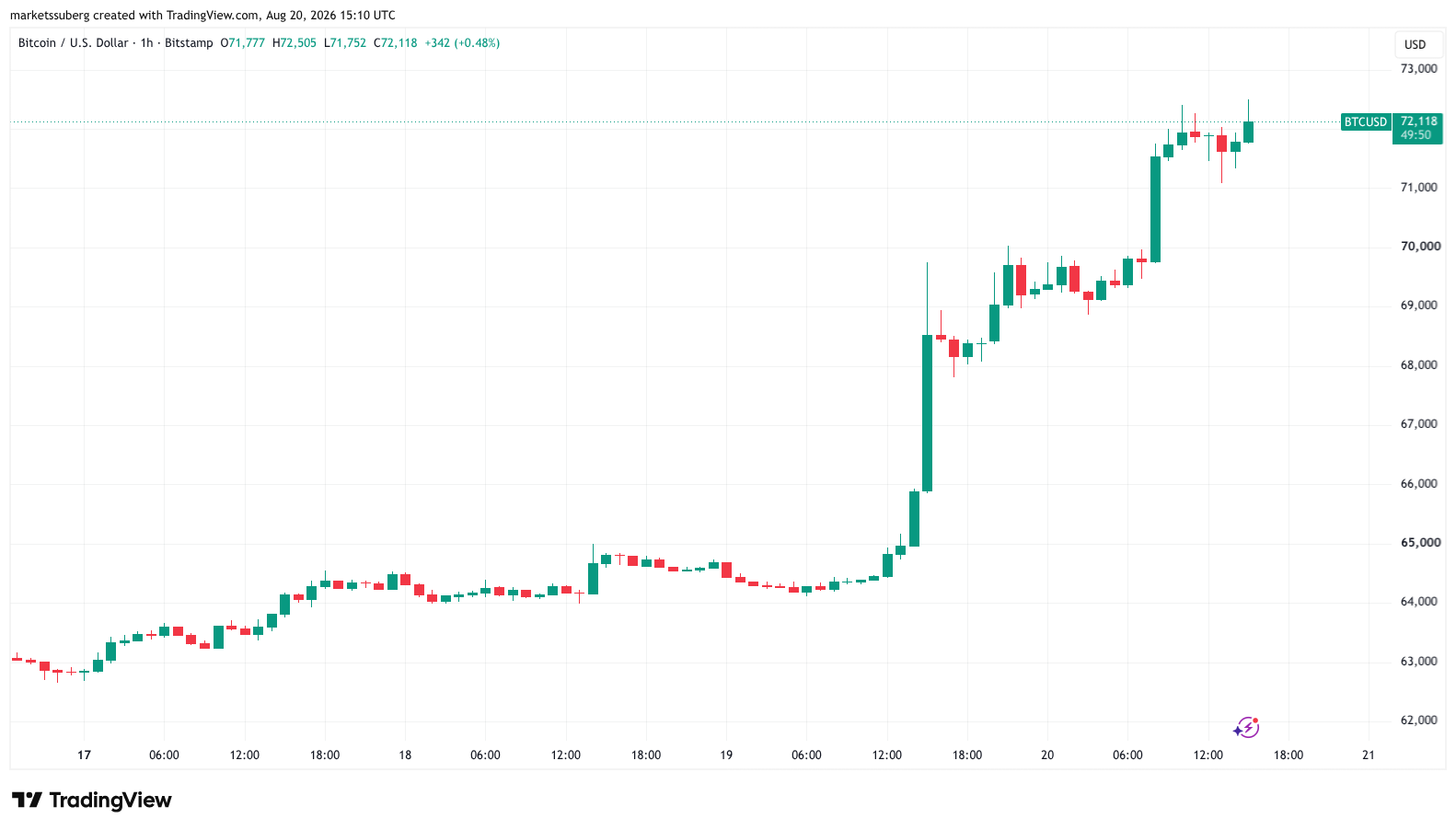
BTC/USD one-day chart. Source: Cointelegraph/TradingView
US equities opened lower after US president Donald Trump threatened Iran with the “most crushing economic operation ever taken against any country,” calling it “Economic D-Day.”
“This will be economic warfare and isolation on an unprecedented scale,” he wrote in a post on Truth Social amid frustration over the lack of a deal with the US on the Strait of Hormuz oil route.
WTI crude oil reached $87.69 per barrel on the day, its highest since July 24.
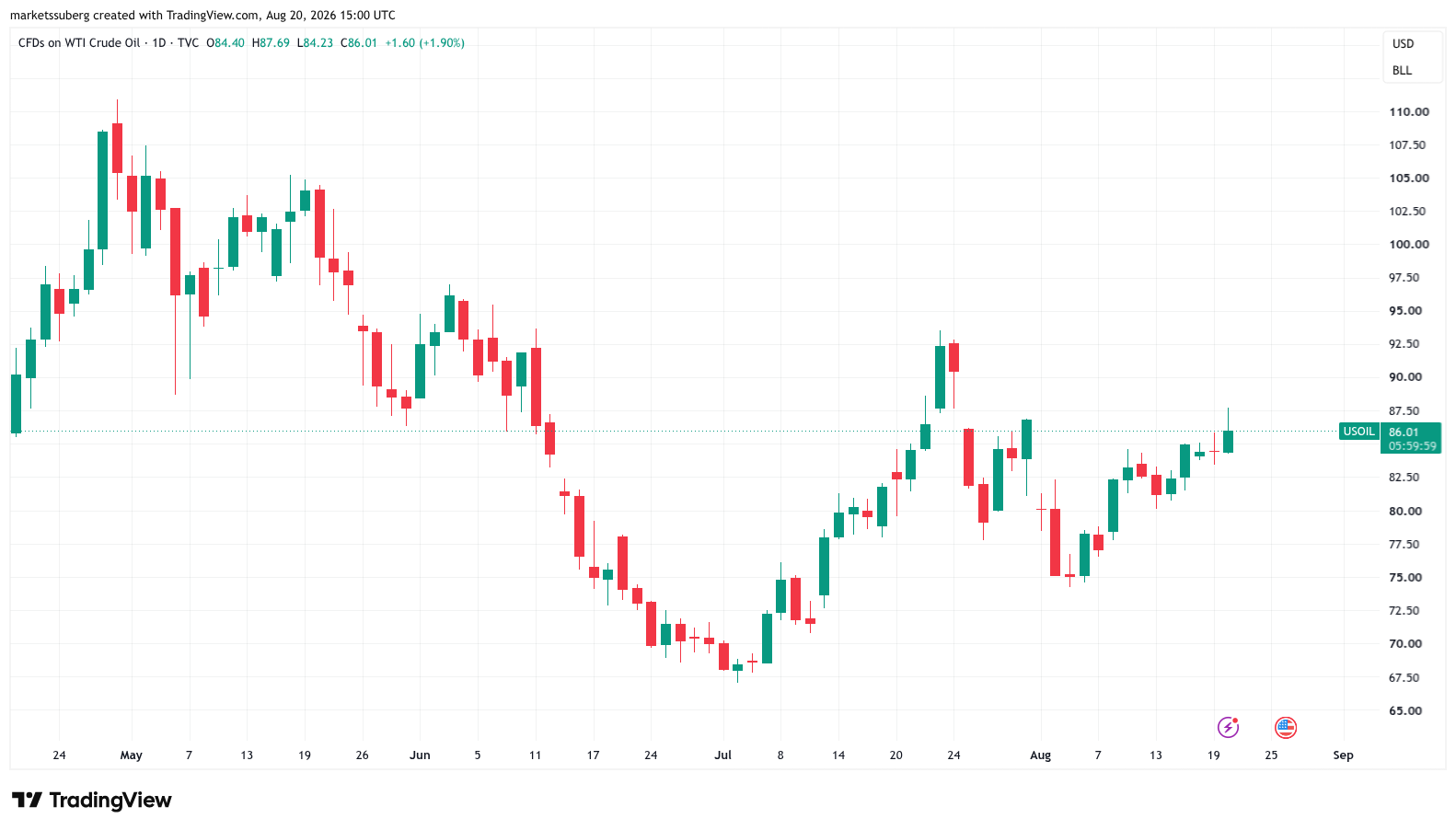
CFDs on WTI crude oil one-day chart. Source: Cointelegraph/TradingView
The comments further appeared to cause a rebound in US government bond yields, which had fallen sharply the day prior after the US Treasury announced that it would at least double the size of its bond-market liquidity interventions from September.
The 30-year yield traded as low as 5.179% on the day before rebounding to 5.266% — an increase of 9 bps, which nearly erased the previous downside. The 10-year bond yield also reversed the previous day’s drop.
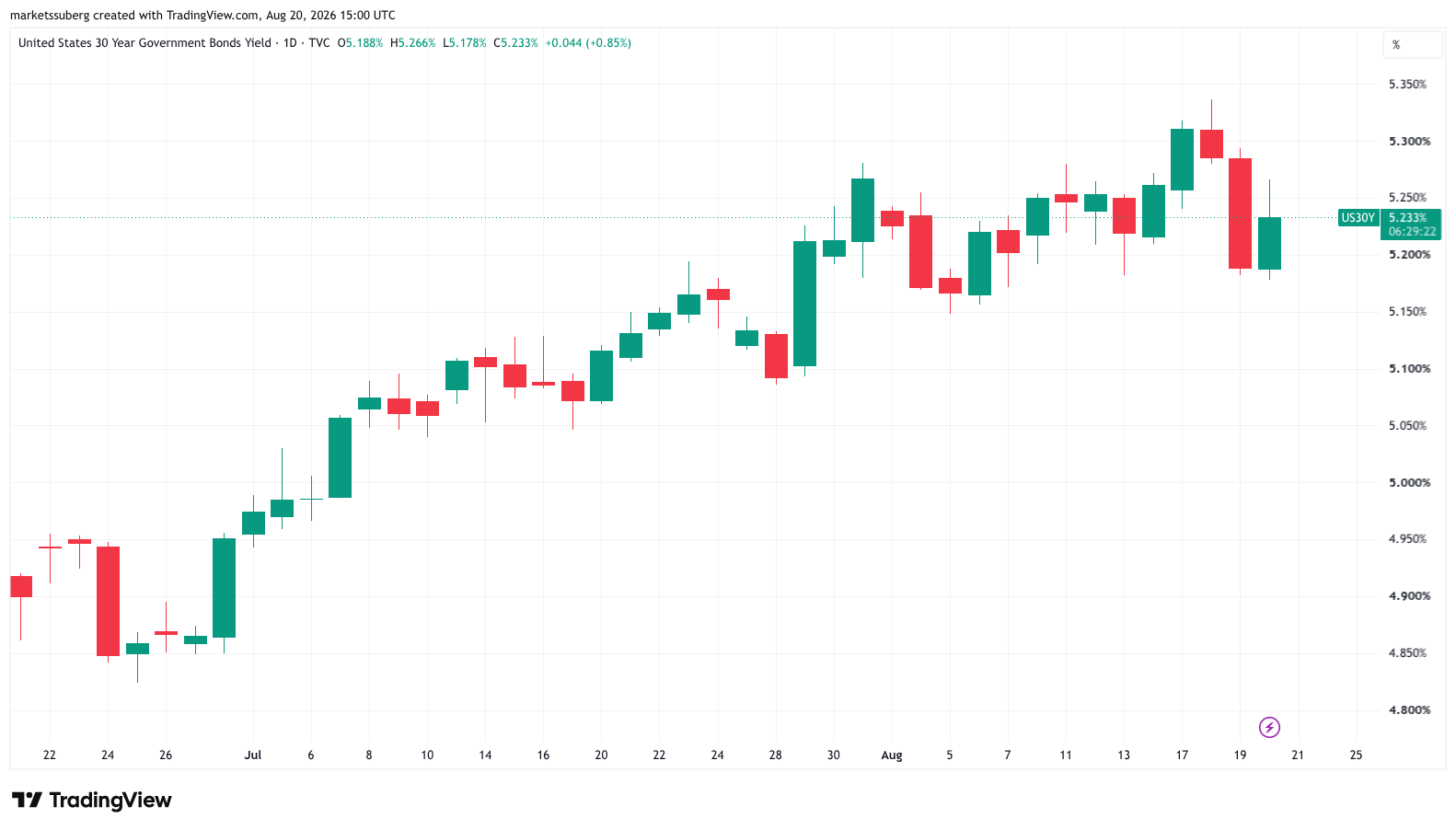
US 30-year bond yields one-day chart. Source: Cointelegraph/TradingView
The Kobeissi Letter cast doubt on whether the intervention would be sufficient to calm markets.
“It’s going to take a lot more intervention to tame this beast,” it wrote in a post on X. The Treasury confirmed in its announcement that it would revisit the size of debt buyback operations on Nov. 4.
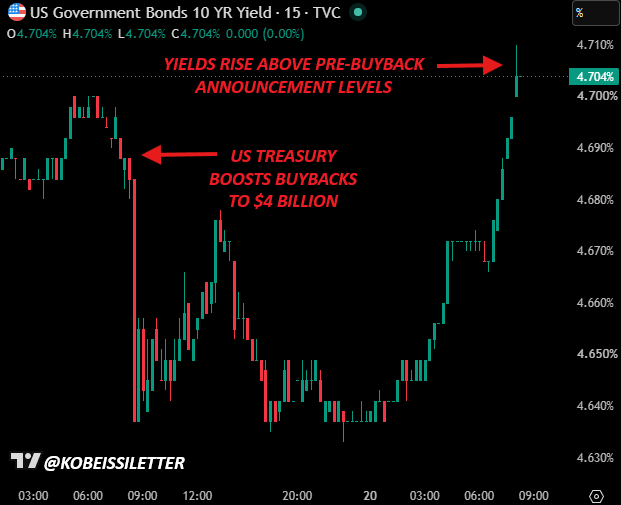
US 10-year bond yields chart. Source: The Kobeissi Letter on X.com
Analysis: Too early to call Bitcoin bull-market comeback
After gaining nearly $10,000 over four days, Bitcoin left market participants skeptical about the durability of its newfound strength.
Related: Bitcoin has ‘largely purged’ froth that preceded 50% drop from $126K: BlackRock
In ongoing X coverage, trader and analyst Rekt Capital argued that BTC/USD would need to sustain its gains to challenge the grip of the bear market.
“Bitcoin will need to rally a lot more than what it has produced thus far if price is to invalidate the ‘weakening support’ idea. At the moment, technicals are pointing to $60k as a weakening macro support,” he wrote on Thursday.
A further post noted that four-year BTC price cycle patterns would allow for a new macro BTC price low until the end of 2026.
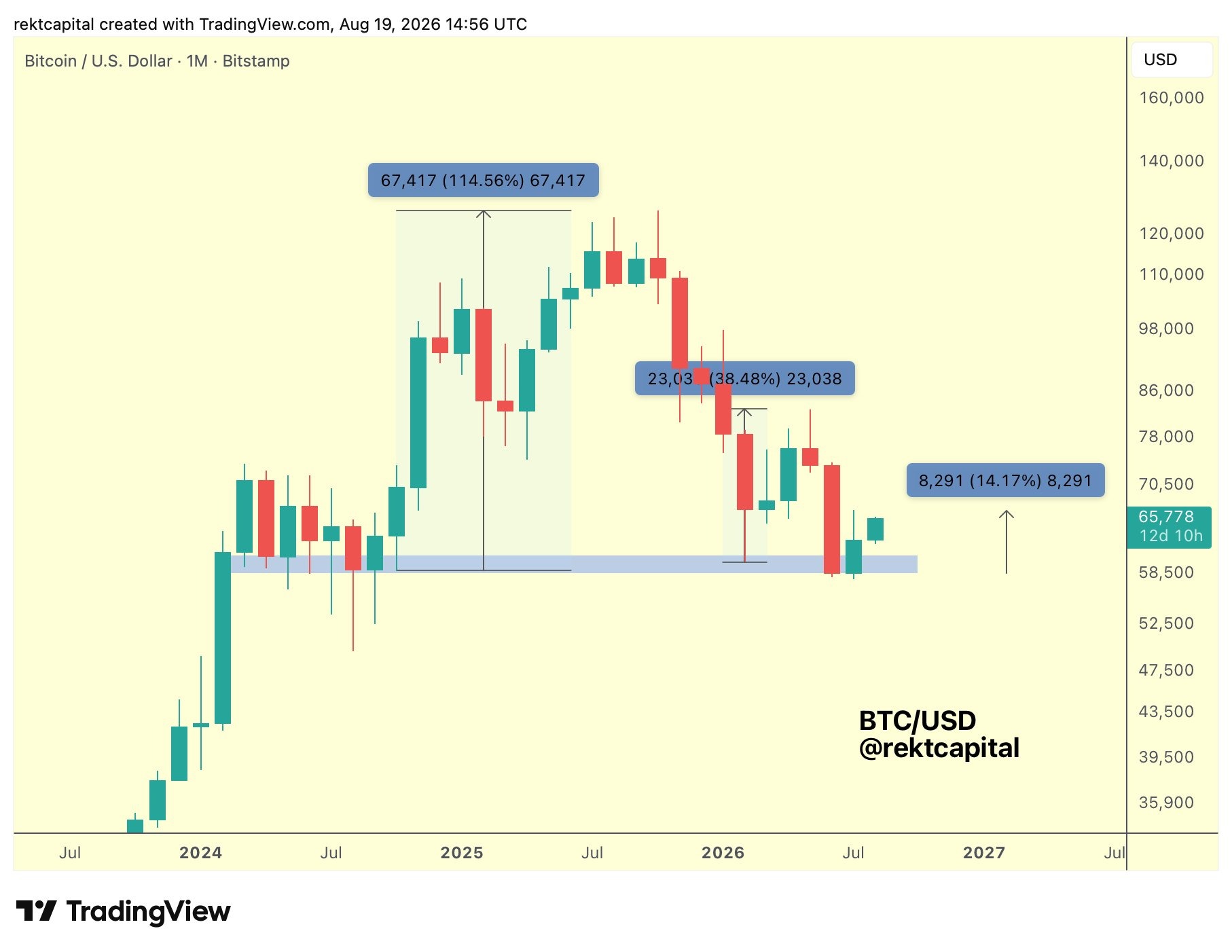
BTC/USD one-month chart. Source: Rekt Capital on X.com
Continuing, Ki Young Ju, CEO of onchain analytics platform CryptoQuant, flagged the return of positive demand for Bitcoin on both spot and derivatives markets — a phenomenon not seen since October 2025, when BTC/USD saw its most recent all-time high of $126,200.
“The scale remains modest, but if this holds for another month, it would be reasonable to conclude that the bear market is over and a new bull cycle has begun,” he told X followers.
Previously, Cointelegraph reported on the lack of spot demand as a key missing catalyst for a sustainable crypto market reversal.
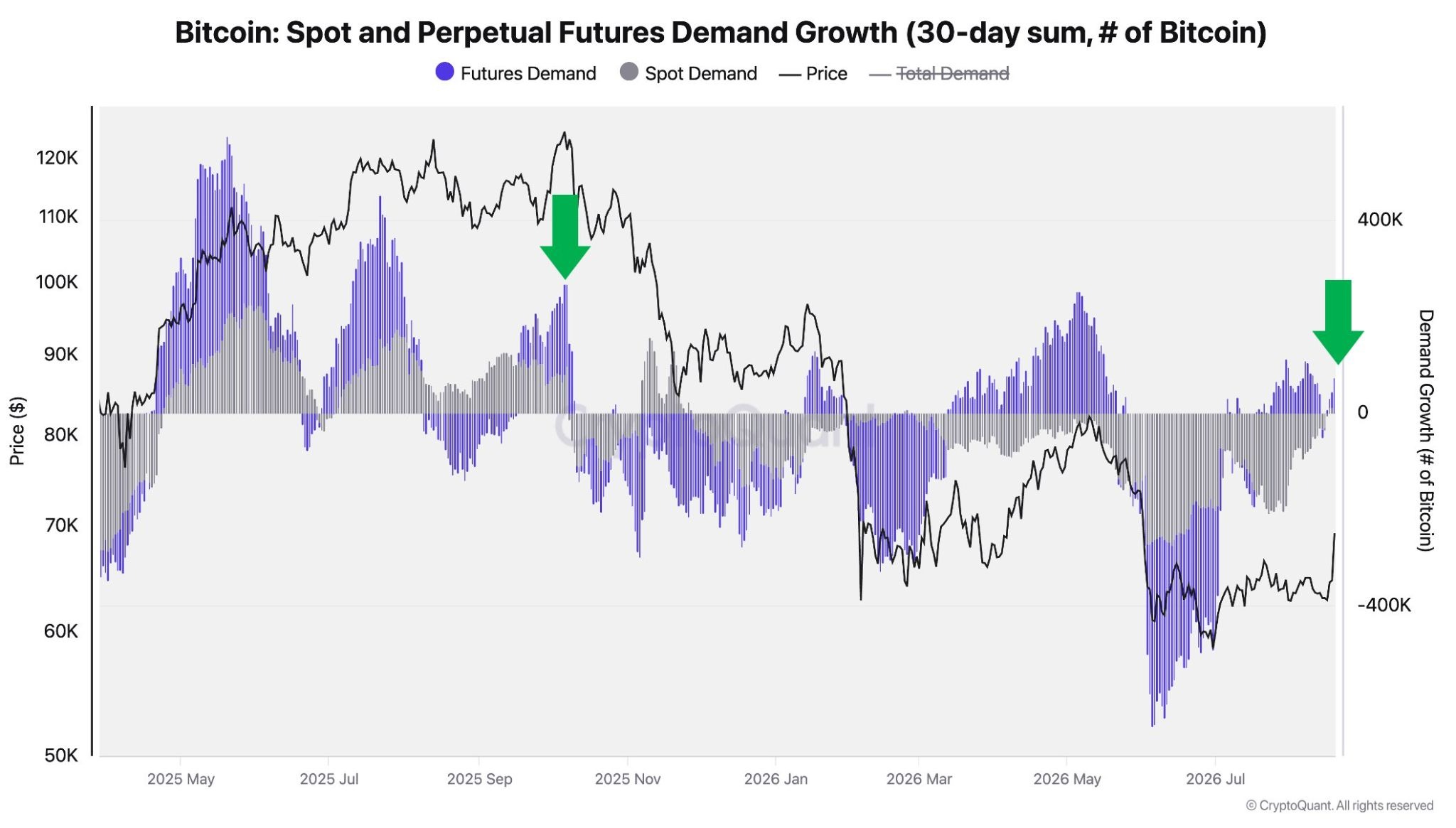
Bitcoin demand growth data. Source: Ki Young Ju on X.com
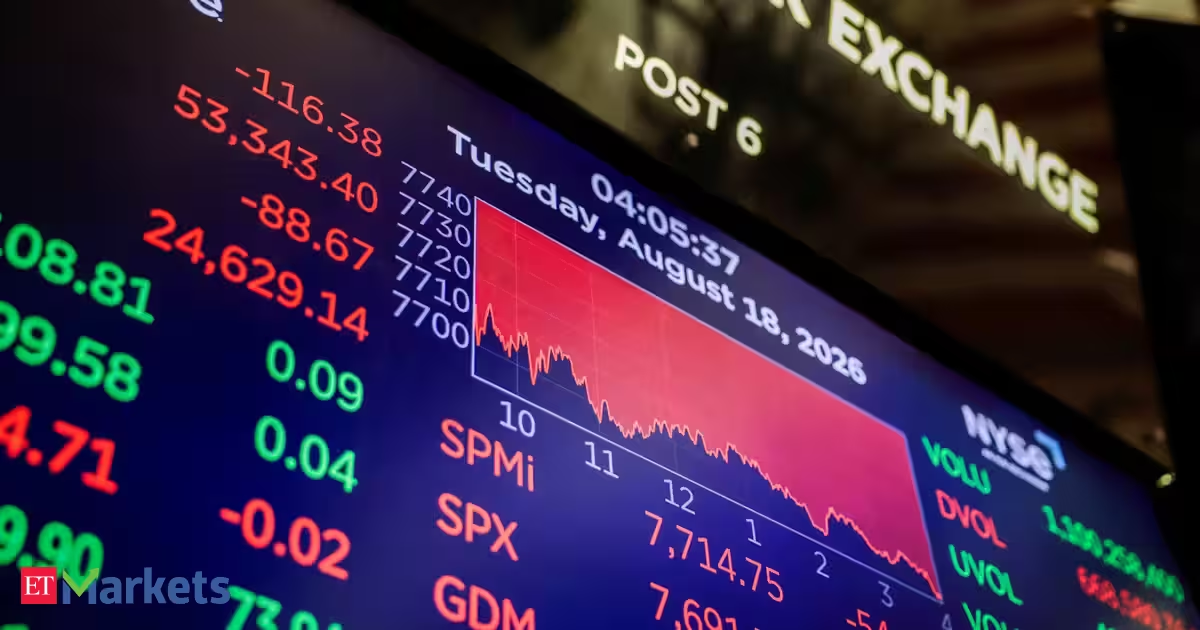
US stocks: US market sinks as bond yields rise, Walmart results disappoint

Binance Employees Detained in UAE Despite $2 Billion Emirati Backing

Netflix Officially Revives 11-Year-Old Zombie Thriller





![You’ll Make Much More Money If You Just Trade This! [Easy Switch]](https://wordupnews.com/wp-content/uploads/2026/08/1787253393_maxresdefault-80x80.jpg)
-

 Fashion6 days ago
Weekend Open Thread: Ann Taylor
-
 Sports7 days ago
This U.S. Amateur is a glimpse into golf’s future in more ways than you think
-
 Tech6 days ago
11 Ways to Rank Your Videos
-
 NewsBeat6 days ago
Myanmar says over 300,000 Rohingya refugees verified for repatriation as exodus enters ninth year
-

 Sports6 days ago
Birmingham 2026: Day 6 Timetable for Irish Athletes
-

 Politics5 days ago
SEQ Code: The Three Letter Boarding Pass Code That Could Give You The Worst Seat
-

 Tech3 days ago
Qwen3.8-27B runs frontier-class coding agents and reasoning locally, no cloud API required
-

 Business2 days ago
SMA Solar Technology AG (SMTGY) Q2 2026 Earnings Call Transcript
-

 Crypto World6 days ago
Pi Network Protocol 27 endgame: last upgrade before what?
-

 Crypto World3 days ago
OCC Greenlights Trump Family Crypto Firm for Trust Charter
-

 Tech5 days ago
Every fusion startup that has raised over $100M
-

 Business7 days ago
15 Ways to Make Money From Your Phone (2026 Guide)
-
 Entertainment6 days ago
10 Netflix Shows That Quietly Became Modern Classics
-

 Fashion6 days ago
Weekly News Update, 8.14.26 – Corporette.com
-
 Entertainment6 days ago
Marvel Studios Reveals New X-Men Cast Including Adam Driver and Sadie Sink
-

 Crypto World7 days ago
Robinhood Chain Approaches $1B TVL as Uniswap Integration Boosts Liquidity
-

 News Videos16 hours ago
Don’t Leave Your Financial Future To Chance | August 19, 2026
-

 Fashion6 days ago
Silver bangles for women – Newbridge Silverware
-

 Business6 days ago
Facebook Down Now? Users Report Login And Loading Problems As Outage Trackers Monitor Ongoing Issues
-
 Business5 days ago
Monarch Mutual Fund set to enter MF space with maiden overnight fund; files draft with Sebi
You must be logged in to post a comment Login