

Crypto World
Michigan Judge Blocks Kalshi from Allowing Residents to Place Sports Bets

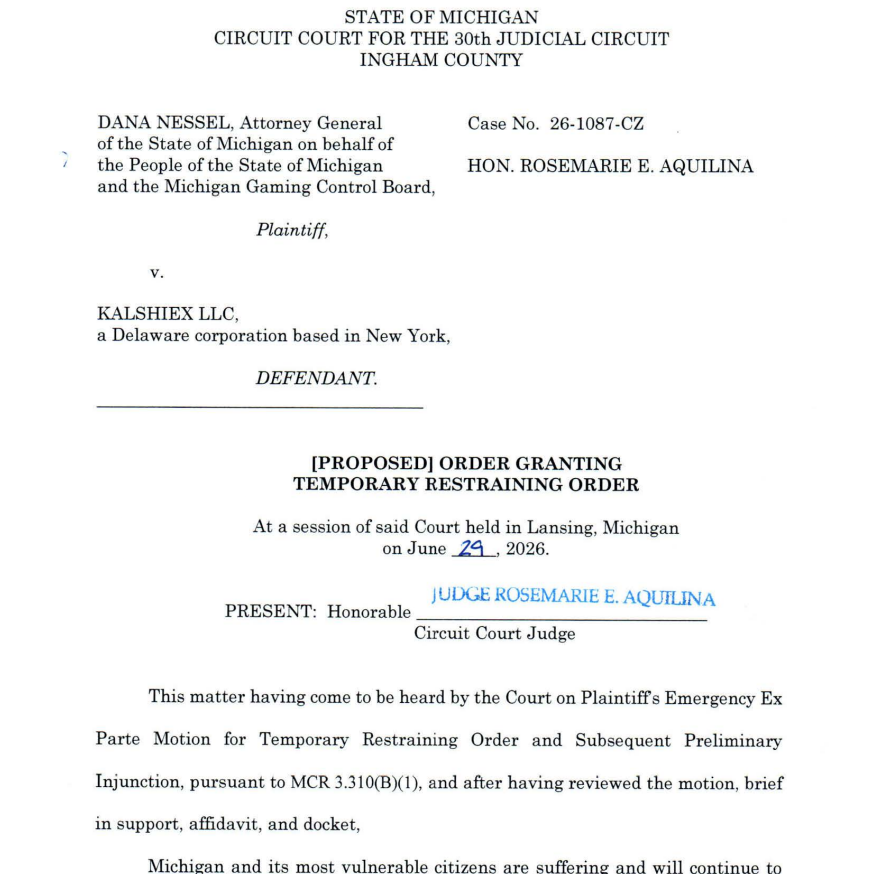
A Michigan judge temporarily blocked prediction market Kalshi from allowing residents to place bets on sporting events, after the state’s attorney general accused the platform of violating gambling laws.
Kalshi was hit with a temporary restraining order from Ingham County Circuit Court Judge Rosemarie Aquilina, who said the platform would be fined $120,000 for each day it fails to comply with the order’s geolocation requirements, according to a Monday court filing. The order lasts for 14 days and expires on July 13.
Aquilina wrote that Michigan residents would suffer irreparable harm from being “exploited by Kalshi’s sports betting operation masquerading as an investment opportunity.”
The move adds to the growing regulatory scrutiny on prediction market sports betting. It makes Michigan the second US state to enact a court-ordered ban on Kalshi’s sports event contracts, after Nevada issued a temporary ban on Kalshi earlier in March.
On June 17, Kentucky sued five prediction market platforms, including Kalshi and Polymarket, accusing them of operating unlicensed sports betting platforms. More than a dozen other states have taken prediction market operators to court.
The US Commodity Futures Trading Commission (CFTC) has sued several states, arguing that federally regulated event contracts fall under its exclusive authority.
Cointelegraph has approached Kalshi for comment on how the platform will respond to the verdict.
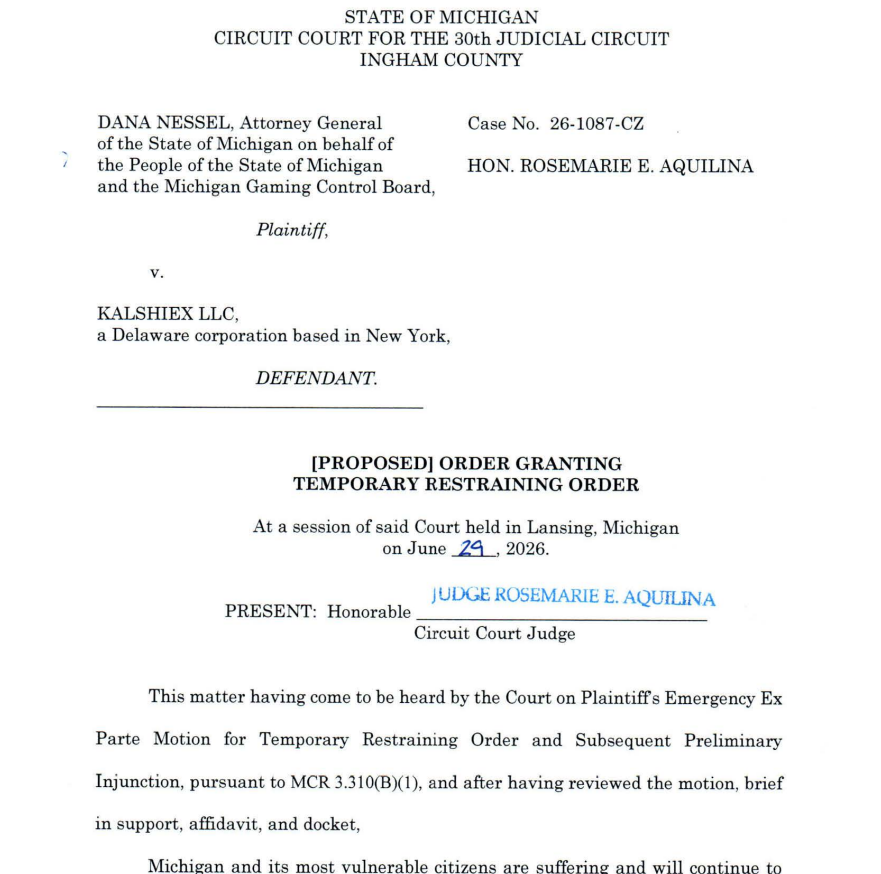
State of Michigan vs. Kalshi, court filing. Source: Law360
Prediction market sports betting rises after the FIFA World Cup
Sports betting activity has been rising on prediction markets since the beginning of the FIFA World Cup.
Daily taker volume, which measures contracts bought or sold by traders filling existing orders, reached a record $713 million on June 20, according to Dune data. The milestone came more than a week after the World Cup started on June 11.
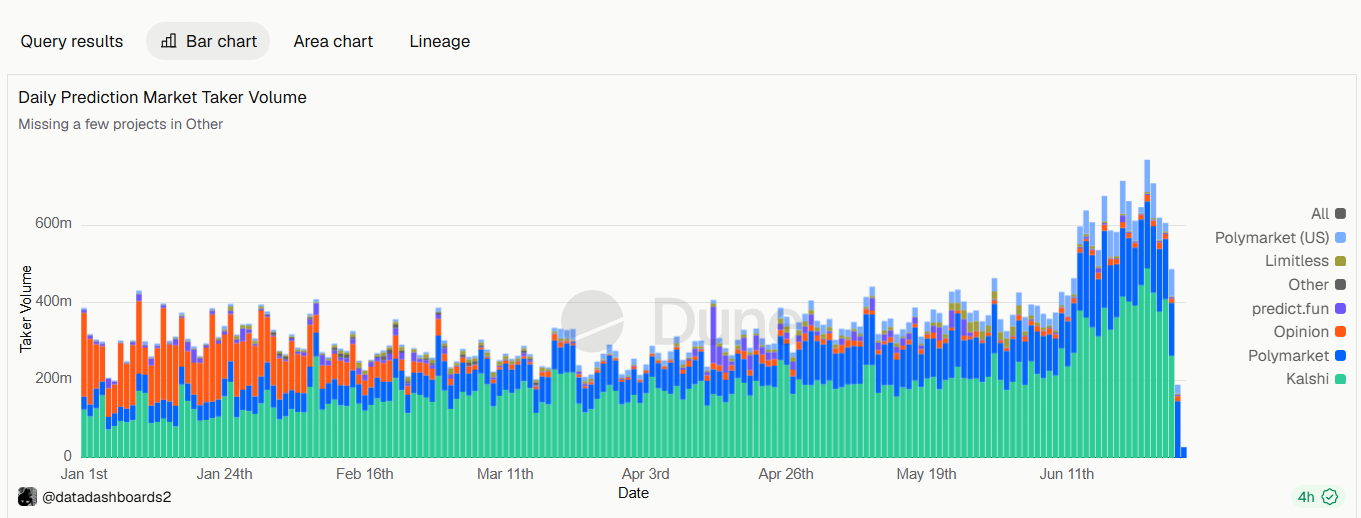
Daily prediction market taker volume. Source: Dune
Looking at monthly prediction market volume, sports betting was the leading category on the two largest prediction markets, rising 40% to $9.5 billion on Kalshi and 175% to $5.3 billion on Polymarket, Defirate data shows.
A June 11 Bernstein report predicted that the 2026 FIFA World Cup would generate more than $3 billion in incremental sports betting handle and between $5 billion and $10 billion in additional consumer prediction market volume.
Related: Kalshi in early IPO talks with investment banks: Report
The World Cup winner contract alone has generated over $3.5 billion in trading volume on Polymarket, according to platform data.
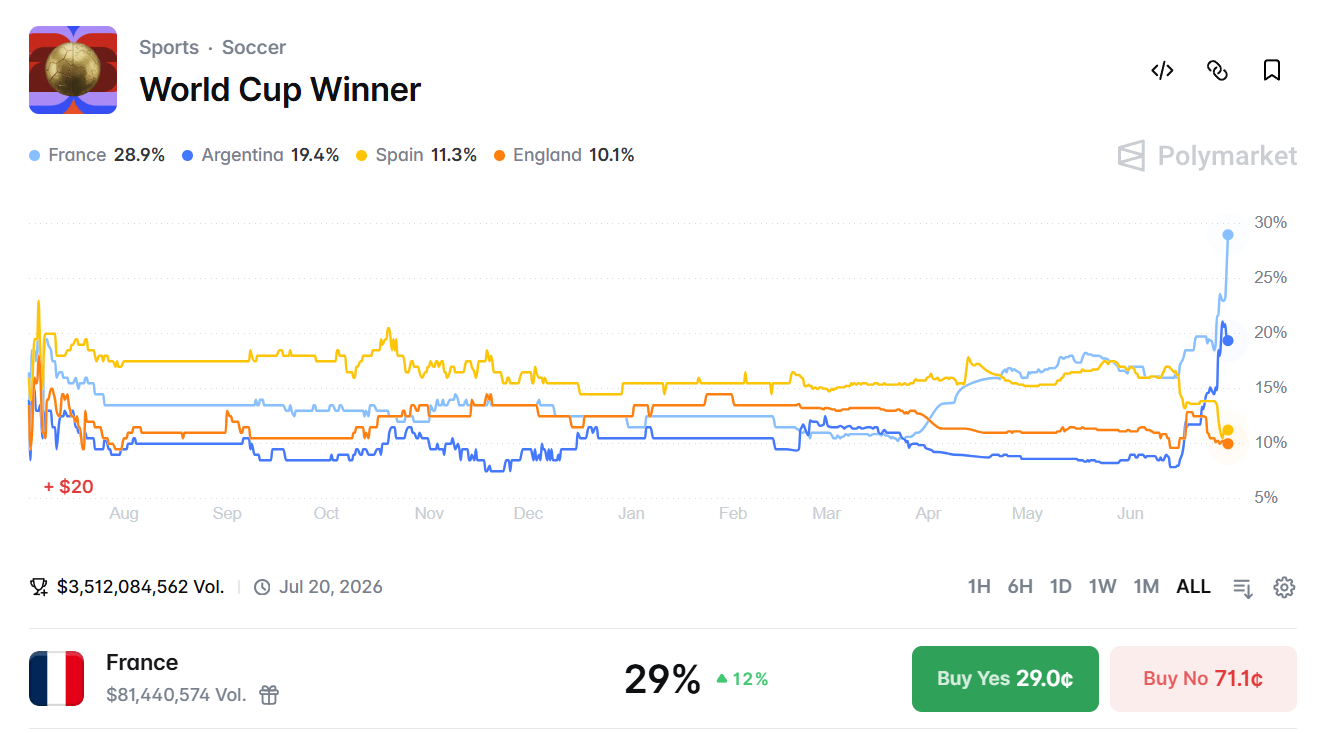
World Cup Winner event contract. Source: Polymarket
The growing betting activity helped Polymarket emerge as an onboarding layer for new cryptocurrency users, as about 60% of World Cup bettors interacted with the blockchain for the first time during their prediction market entry, according to a Bitget Wallet study of 857,000 users, shared with Cointelegraph.
Magazine: How crypto laws changed in 2025 — and how they’ll change in 2026

Securitize will begin trading on the New York Stock Exchange on July 2, 2026 under ticker symbol SECZ, following shareholder approval of its merger with Cantor Equity Partners II on June 29.
The deal raises approximately $400 million at a $1.25 billion pre-money valuation, making Securitize the first pure-play tokenization infrastructure company to list on a major U.S. exchange.
The combined entity will operate as Securitize Corp., with the merger formally closing on June 30. For the broader U.S. regulatory environment around crypto and capital markets, a regulated tokenization infrastructure firm reaching public-market scale on the NYSE is a structural data point, not just a corporate milestone.
Securitize was founded in 2017 and has built a regulated stack that includes SEC-registered broker-dealer, transfer agent, fund administrator, and ATS operator roles in the U.S., plus authorization under the EU DLT Pilot Regime in Europe. That licensing footprint is the competitive moat Benchmark Equity Research cited when it reiterated a ‘Buy’ rating with a $16 price target earlier in June.
The firm’s flagship client relationship is with BlackRock, whose BUIDL tokenized money market fund, administered on Securitize’s platform, has grown to over $3 billion in total value locked. Apollo, KKR, Hamilton Lane, and VanEck round out the institutional client roster.
Securitize CEO and co-founder Carlos Domingo framed the listing in terms of the sector’s trajectory rather than the firm’s alone: “Today, tokenization is moving into the mainstream, and we believe becoming a public company gives us the visibility, credibility, and capital to lead that next phase of growth,” he said.
Securitize Deal Mechanics: What a Sub-30% Redemption Rate Signals
The financing structure carries a detail worth isolating: fewer than 30% of Cantor Equity Partners II Class A shareholders chose to redeem their shares, leaving Securitize to retain over 71% of the SPAC trust.
That redemption rate is low by recent SPAC norms, where redemptions frequently exceed 80% or 90%, and it suggests institutional holders remained in rather than cashing out at the trust price.
The $400 million total raise incorporates a $225 million PIPE that was oversubscribed. An oversubscribed PIPE on a tokenization infrastructure deal in mid-2026 reflects genuine institutional demand, not promotional mechanics.
Combined with Q1 2026 revenue of $19.5 million, up 39% year-over-year – the financial profile entering the public market is not speculative-stage.
RWA Tokenization at Scale: What Securitize’s NYSE Debut Means for the Sector
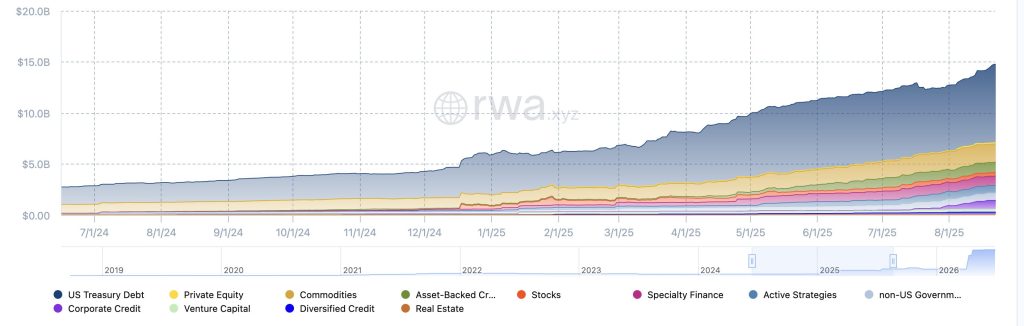
The broader real-world assets market has grown sharply: The 15 leading RWA tokenization protocols expanded 128% in total value over the past year, from $9.55 billion to $21.84 billion as of June 29, 2026.
Separate estimates place the on-chain RWA market closer to $32 billion when accounting for a wider protocol set. Securitize is not the only infrastructure provider in this space, but it is the one now trading on a major exchange with a public currency to deploy.

The NYSE relationship runs deeper than just the listing venue. Securitize has signed a memorandum of understanding with NYSE to serve as digital transfer agent for a new 24/7 tokenized stock and ETF trading platform using on-chain settlement and stablecoin funding.
That makes SECZ simultaneously a listed equity and a key plumbing partner to the exchange itself, an unusual dual role that positions the firm inside the infrastructure of traditional capital markets rather than adjacent to it.
The parallel is visible elsewhere in the sector: tokenization infrastructure is already being used for institutional instruments like sovereign climate bonds, a signal that the technology has moved past proof-of-concept into live market use.
What to Watch After SECZ Opens
The first trading session on July 2 will establish a public market reference point for tokenization infrastructure as an asset class.
The Benchmark $16 price target gives the market an analyst anchor, but price discovery on day one will reflect how generalist equity investors, not just crypto-native capital, value regulated tokenization rails at 1x revenue scale.
Post-listing disclosures on capital deployment, the tokenized-equity roadmap, and any new institutional partnerships will be the next substantive signals. Securitize’s internal estimate puts the total addressable market for RWA tokenization at $19 trillion.
Whether that framing holds up under public-company scrutiny is a different question than whether the business is real. The business is real. The valuation conversation starts July 2.
The post Securitize Lists on NYSE as SECZ: Backed by $400M Raise and BlackRock BUIDL appeared first on Cryptonews.
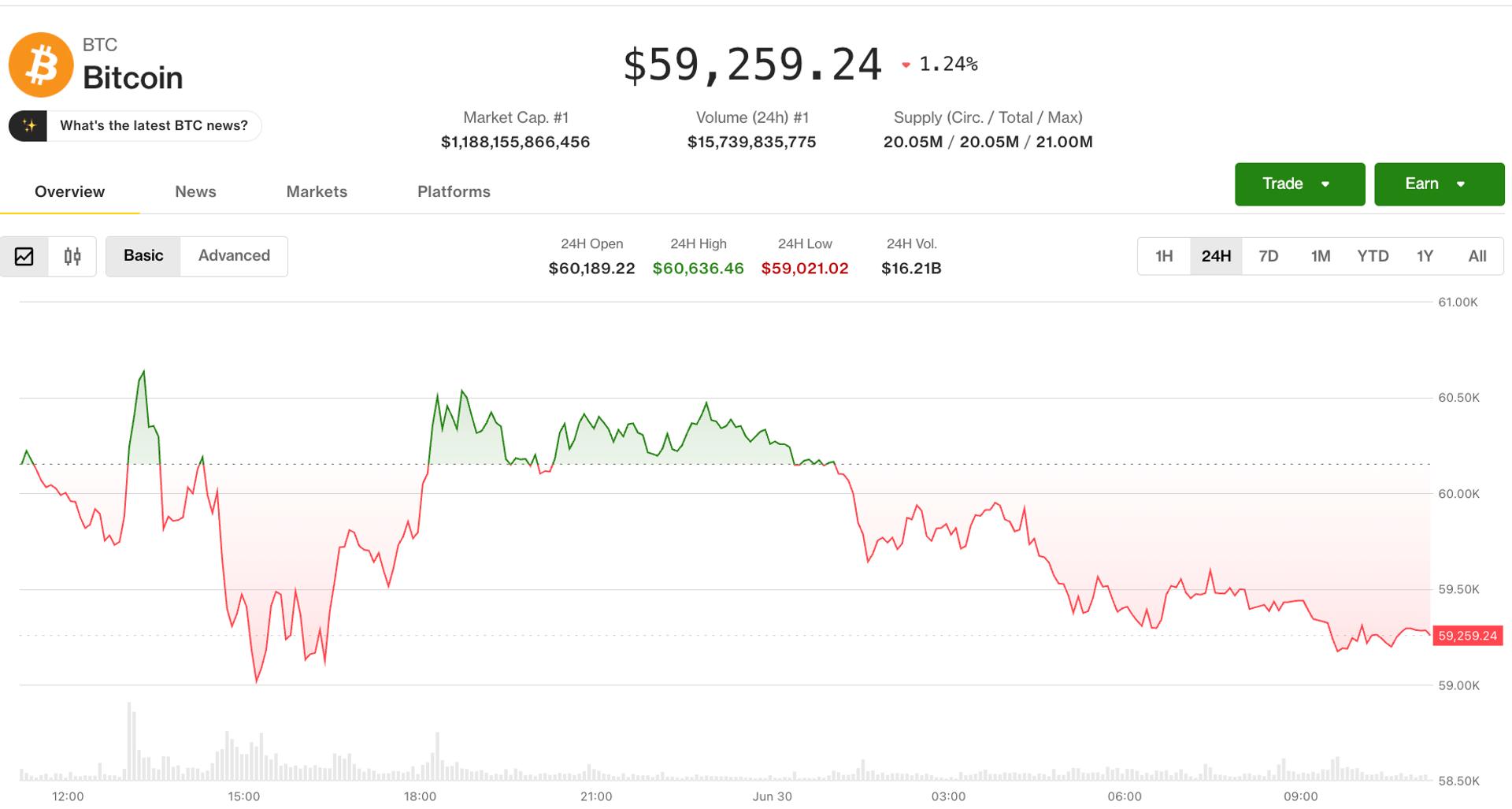
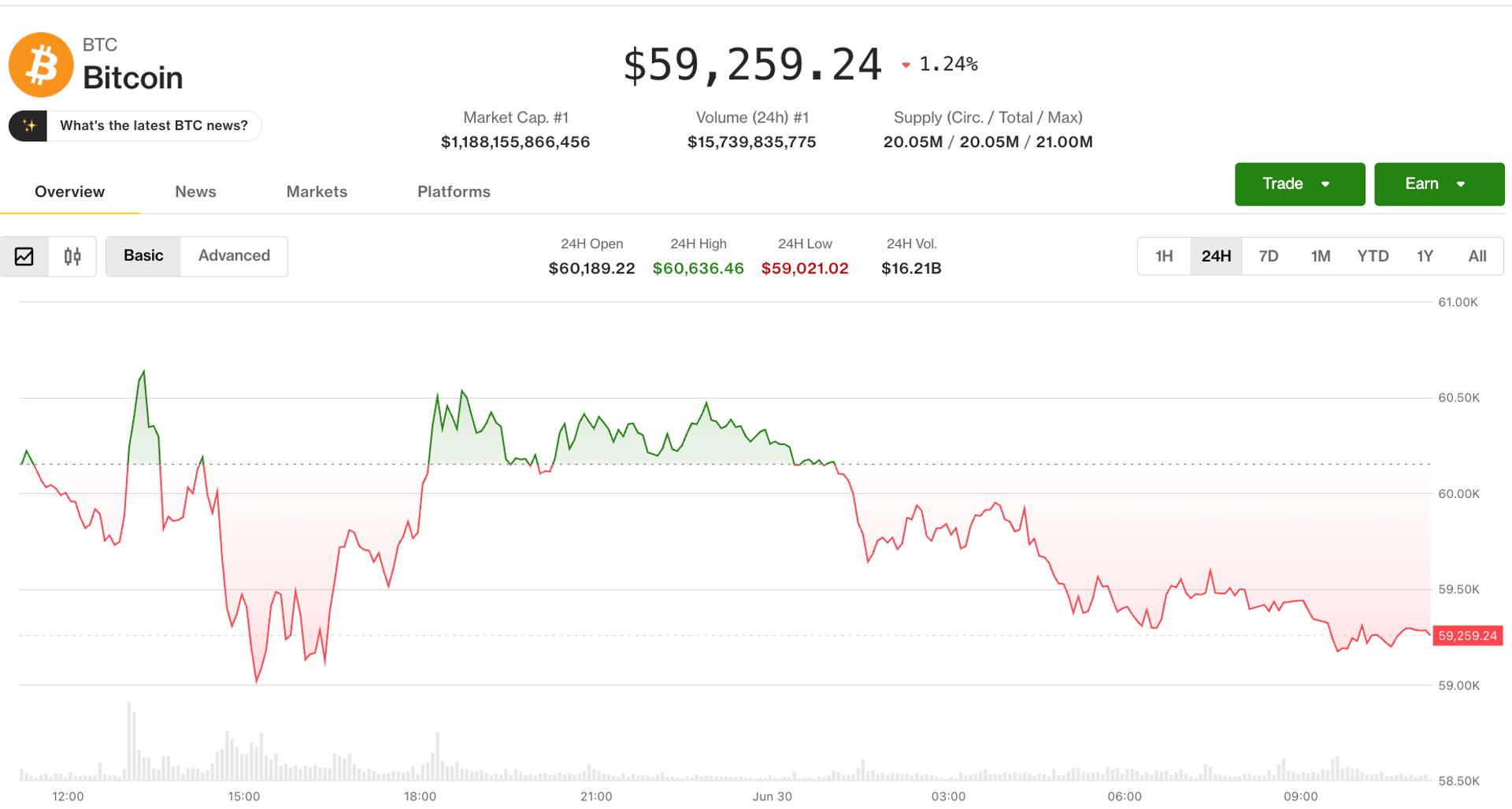
Bitcoin fell 1.5% on Tuesday after failing to hold above $60,000 on Monday. It now trades at $59,250, looking set to challenge the weekend lows of $58,800. Ether (ETH) is down by 1.73% since midnight UTC, trading at $1,580 after failing to break through $1,640.
Both assets are now testing critical multiyear support levels. Ether has bounced from this level twice before, in April 2025 and October 2023, while bitcoin is trading around its lowest point since late 2024. A failure to hold would leave both tokens without an obvious floor.
The altcoin market saw exaggerated downside on Tuesday, with DeFi tokens ethena (ENA), jupiter (JUP) and ether.fi (ETHFI) all falling between 3.3% and 7.5% as risk appetite continues to wane.
The weakness stands in contrast to traditional markets, where U.S. equities have been steady since midnight. The S&P 500 and Nasdaq 100 futures posted gains of 0.03%, while the Dollar Index (DXY) added 0.25%.
Derivatives positioning
- HYPE, the native token of decentralized exchange Hyperliquid, has gained over 4.3% in the past 24 hours and is the only major token trading noticeably in the green.
- The rally looks spot-driven, and hasn’t excited traders into taking on more derivatives risk for now. Open interest (OI) in HYPE futures remains around 40 million tokens, a level it’s held since at least June 22.
- While overall positioning stays light, it leans bullish. Annualized funding rates are sitting close to 10%, a sign that perpetual futures are trading above the spot price.
- The biggest OI gainer of the past 24 hours among major cryptocurrencies is , the largest memecoin by market value. Open interest has jumped to 16 billion tokens, the highest since the Oct. 10 crash and up from 13 billion a day earlier.
- The inflows look bearish rather than bullish, however, given the negative funding rates and negative 24-hour OI-adjusted cumulative volume delta. The CVD signals that sellers are the more aggressive side, hitting sell orders to cross the spread and fill their bearish bets at the best available bid.
- Bitcoin, ether and XRP futures markets offer little excitement, with open interest locked in recent ranges. Positioning in SOL remains elevated, with OI near record highs, a signal of potential volatility ahead.
- Volatility indexes continue to point to market calm. BTC’s 30-day implied volatility gauge, BVIV, dropped by 11% to 44% on Monday and has held around that level since. Ether’s equivalent index, EVIV, is telling the same story.
- On Deribit, BTC puts continue to trade at a 10%-plus premium to calls across all time frames, a sign of persistent downside concerns. ETH shows a similar pattern at the short end — weekly puts carry a comparable premium — while further out puts are noticeably cheaper than calls.
- Block flows featured a BTC short straddle, an options strategy that profits from low volatility and price consolidation.
Token talk
- Native DeFi tokens struggled on Tuesday, and the negative sentiment didn’t stop there. AI tokens FET, TAO and RENDER all fell, as did privacy coins zcash (ZEC) and monero (XMR).
- Even hyperliquid (HYPE), which has outperformed its peers in recent weeks, is trading at $65.3 after dropping by 2.2% on Tuesday. HYPE’s chart appears to be in more of a consolidation phase after last month’s rally as opposed to a corrective phase, this is characterized by two higher highs alongside two higher lows.
- One token in the black on Tuesday is stellar lumens (XLM). The token forked from Ripple in 2014 is maintaining bullish sentiment after DTCC, the largest U.S. financial markets clearinghouse, said it will connect its tokenized securities platform to the Stellar network in the first half of 2027. The announcement spurred a 100% rally in late May.
- Another token bucking the trend is lighter (LIT), which is benefiting from its similarities to HYPE in that it is the native token of a decentralized perpetual exchange. LIT is up by 23% over the past week, notching a double-digit gain in the past 24 hours alone.


But familiar forms of market exposure, including brokerage-held securities, ETFs, depository receipts, structured notes, and other equity-linked instruments, are well-established parts of the market today. Tokenization alone does not make them more or less legitimate. Their economic and legal structures should dictate their regulatory treatment.
The third model is issuer-sponsored tokenization. A company and its transfer agent support tokenized ownership directly. This may be the right model for many issuers. It can connect tokenized records to shareholder systems and support familiar processes for corporate actions, recordkeeping and communications.
Brokerage held securities, depository receipts, structured notes, and direct registration all coexist in today’s market. They do not provide identical rights. Investors choose among them because they serve different needs. The important questions are whether the structure is clear, the risks are disclosed, the backing is real where promised, and the product does what it says it does.
That is the right standard for tokenized markets as well.
One wrong outcome of the current tokenization debate would be a market where products borrow the language of stocks without telling investors what they actually hold or misleading investors altogether. That would harm investors and undermine confidence in the technology.
Another wrong outcome would be a market where tokenization becomes a set of private walled gardens. That would convert a promising new technology into a tool that narrows competition before the market has had a chance to learn what works.
For years, crypto promoters sold blockchain technologies with a simple pitch: Digital assets trade round the clock, while sleepy traditional finance exchanges shut their doors at 4pm and stay closed until the next morning.
This week, the world’s largest clearinghouse decimated that pitch.
The National Securities Clearing Corporation (NSCC) is the equities subsidiary of the multi-quadrillion dollar clearinghouse Depository Trust and Clearing Corporation (DTCC).
According to a new announcement, NSCC is now clearing trades 24 hours a day, every business day of the week.
For context, DTCC processed roughly $3.7 quadrillion in securities transactions last year. Its equities-clearing engine now clears stocks and other TradFi equities all night long.
DTCC’s shift to 24-hour trading arrived in stages. The SEC signed off on the rule change before client testing began earlier this year. Major exchanges like Nasdaq are expected to add overnight trading sessions later this year and into 2027.
Although NSCC claims 24×5 operations, it admitted that certain “supporting systems” will take a one-hour technical pause on weeknights, despite the clearing engine itself running continuously.
For the always-on narrative, the DTCC hour expansion is awkward.
Rather than a differentiated value proposition of 24×7, crypto can now claim two extra days of operation: weekdays and weekends, instead of DTCC’s weekdays only.
If the 24×5 rollout goes smoothly and DTCC receives more demand, it could also expand to the weekend.
A long history of DTCC disappointing crypto fans
Of course, hope springs eternal. One crypto fan tried to recast the news as a positive, saying, “DTCC has officially moved to Monday through Friday clearing 24 hours a day. Getting ready for full tokenization of assets.”
The framing was indefatigable, and slightly wrong.
Tokenization of traditional assets like equities is certainly underway in small pilots, but DTCC has no obligation to choose any public blockchain. In fact, it will probably choose its own.
Indeed, the DTCC news was another installment in a long history of disappointments. Almost every time DTCC announces an initiative that might relate to blockchains, crypto enthusiasts project their personal ambitions onto it.
For years, fans of public blockchains like Ethereum and the XRP Ledger incorrectly predicted DTCC integrations that never arrived.
Read more: The great AmEx partnership with XRP that wasn’t
For live production systems, the clearinghouse has repeatedly favored permissioned, walled infrastructure over public blockchains.
In 2022, DTCC launched Project Ion, a settlement platform built on a private, permissioned ledger rather than any public blockchain.
Its more recent production choices have followed the same instinct.
In December 2025, DTCC partnered with Digital Asset to tokenize US Treasuries on the permissioned Canton Network. To no avail, public blockchain developers criticized that pick for its gated access.
XRP fans have hoped for more. Protos has already reported that no DTCC settlement currently touches the XRP Ledger. A directory listing earlier this year didn’t change that reality, despite misinterpretations by Ripple’s fan base.
So it is that the world’s largest clearinghouse added 24-hour clearing without any public blockchain, without crypto fee-paying transactions, and without the on-chain footprint its fans kept predicting.
XRP, the token most frequently tied to DTCC fantasies, was trading at $1.05 at time of writing, down roughly 20% over the past 30 days and half as valuable as it was a year ago.
Traditional finance’s 24-hour market launched on the same old rails, and crypto didn’t get an invitation.
Got a tip? Send us an email securely via Protos Leaks. For more informed news and investigations, follow us on X, Bluesky, and Google News, or subscribe to our YouTube channel.
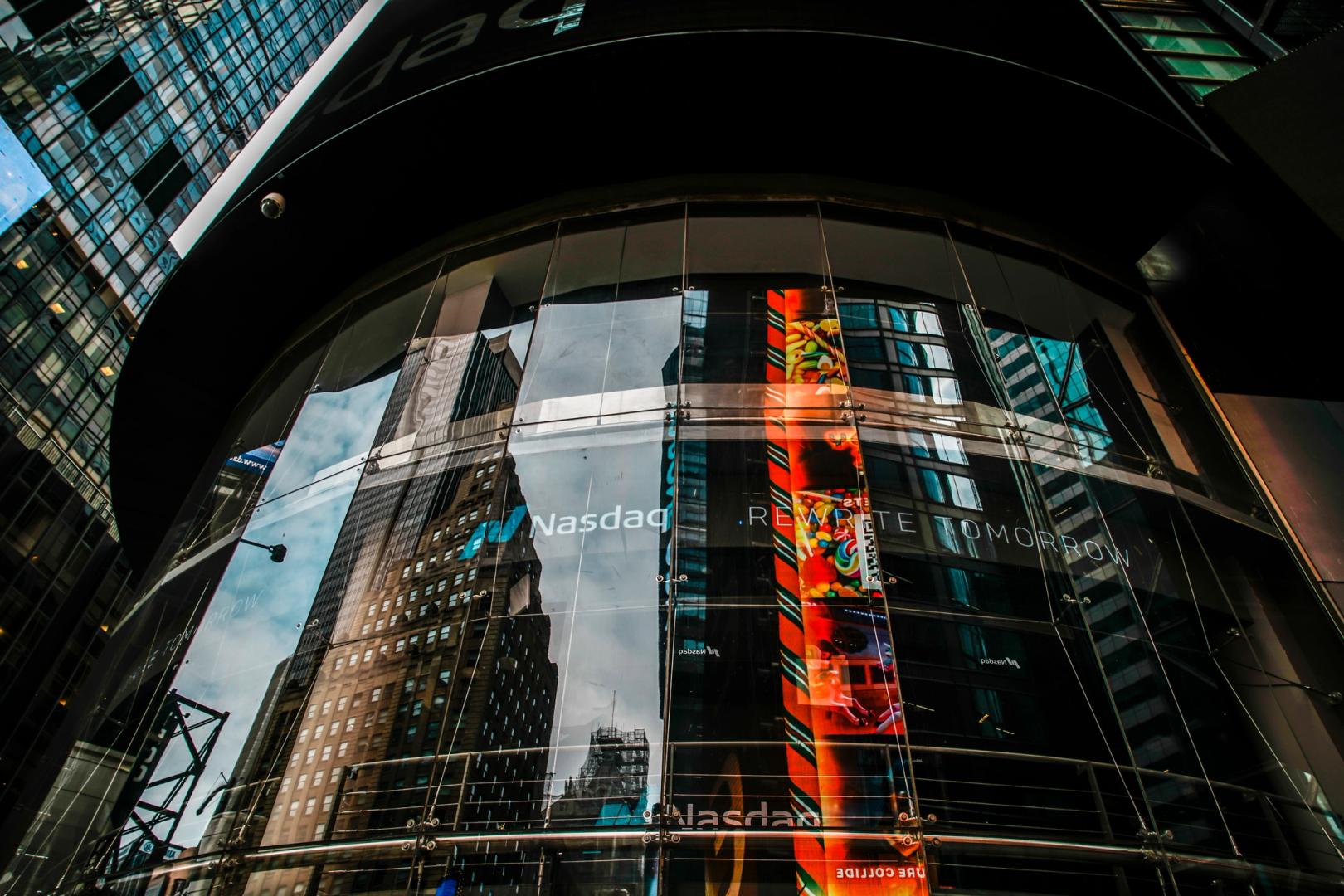
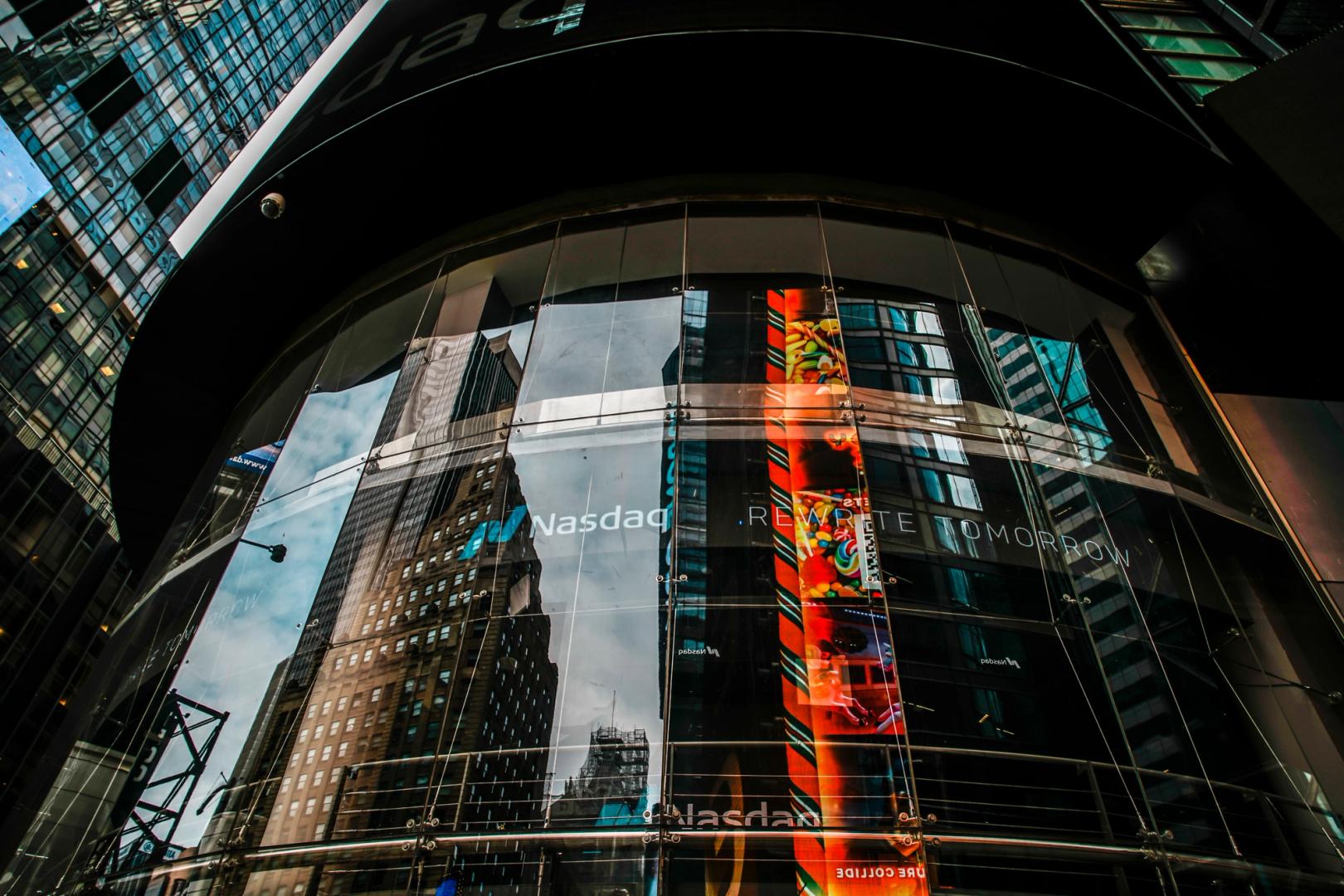
Nasdaq is expanding the distribution of its market data into blockchain infrastructure, making one of its flagship equity data products available through the Pyth Network as financial firms increasingly build trading and settlement applications on blockchain rails.
The exchange operator said Tuesday it will publish its TotalView market data through the Pyth Data Marketplace, a platform that distributes institutional datasets to blockchain networks, financial applications and software developers. The move gives a wider range of users access to one of Nasdaq’s core market data offerings through a programmable interface rather than traditional market data delivery channels.
TotalView provides full depth-of-book data, showing buy and sell orders at every price level for securities trading on Nasdaq, including Nasdaq-, NYSE- and regional-listed stocks. The product also includes Nasdaq’s Net Order Imbalance Indicator, which offers a real-time view of buy and sell imbalances before the opening and closing auctions.
For Nasdaq, the partnership expands how its market data reaches customers as financial infrastructure evolves beyond trading terminals and dedicated market data feeds toward cloud-based software and blockchain-powered applications.

The largest cryptocurrency exchange will perform wallet maintenance later this week, disrupting certain vital operations.
The company has also faced severe regulatory challenges in the European Union and could be forced to stop servicing clients in the region from next month.
What Users Need to Know?
The maintenance is scheduled for July 1, and to support the procedure, Binance will briefly suspend deposits and withdrawals on the Bitcoin (BTC) network. The process is expected to last about an hour, after which operations will resume.
The company assured that it will handle the technical requirements for all users and said that trading tokens on the aforementioned network will not be affected.
It is important to note that such endeavors are frequent and typically cause no significant complications for clients. In May, the exchange temporarily paused ETH deposits and withdrawals due to wallet maintenance, and there were no reports of major issues.
Prior to that, Binance took similar actions to support improvements across various ecosystems, including Cardano, BNB Chain, and others. Last summer, it executed a live upgrade to its wallet infrastructure, briefly pausing deposits and withdrawals on all networks for about 15 minutes.
The Problems in Europe
Perhaps the main issue surrounding Binance as of late is its regulatory hurdles in the European Union. Last week, it announced that it had withdrawn its MiCA license application with the Hellenic Capital Market Commission (HCMC) in Greece and would, indeed, pursue authorization in another EU member state.
The EU watchdogs have put July 1 as the deadline for all crypto exchanges to comply with the rules, and it seems like Binance will fall behind. The company’s clients in Europe are left in the dark, as no official guidance (at least as of now) has been provided on how to proceed.
Meanwhile, crypto X is flooded with users commenting on the hot topic. Satoshi Club recently shared a conversation between an EU-based Binance client and the exchange, in which the support team clarified that operations in all countries in the bloc (except France, Italy, Spain, Poland, Belgium, and Sweden) will, for now, remain unaffected.
In comparison, Polish, Spanish, French, Italian, and other users have reportedly received withdrawal instructions.
The post Binance Will Temporarily Pause BTC Deposits and Withdrawals: What You Need to Know appeared first on CryptoPotato.
Yesterday, the largest publicly-traded Avalanche (AVAX) treasury company quietly told regulators it might not survive the year.
Last October, the company was talking about a $1 billion pile of AVAX tokens. Today, it has a market capitalization of less than $30 million.
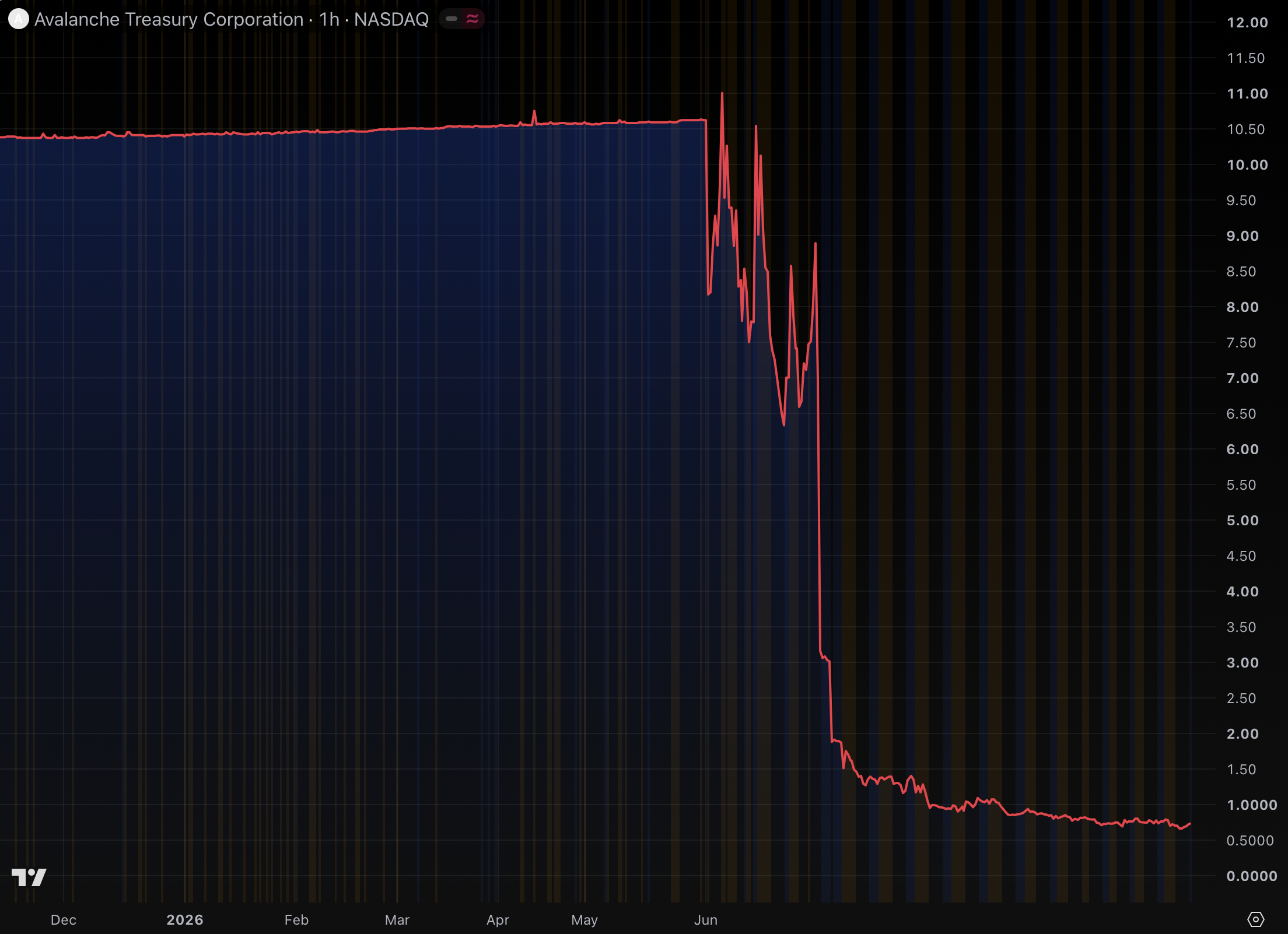
Avalanche Treasury Corp also filed a dire warning about its prospects just weeks after its once-highly-anticipated Nasdaq debut that actually resulted in a 93% sell-off in its stock price.
The company’s operating subsidiary lost more than $26 million in a single quarter, almost all of it a fair-value writedown on the AVAX it had hoarded. Indeed, AVAX has lost 47% of its value year-to-date, and nearly two-thirds of its value over the past 12 months.
The company paid roughly $265 million to acquire its coins, yet by the end of March, they were worth about $123 million, leaving the position more than half underwater.
AVAX treasury stock down 93% in one month
AVAT completed its merger with a blank-check company and filed listing documents in June. Optimism about the once-$10 blank check stock had already turned to pessimism. By June 10, the stock was pricing-in its deal finalization down 27% from the start of the month.
On June 10 and 11, investors, to their horror, read more documents about the deal filed with the SEC. Shares that had been trading above $10 at the start of the month closed at $1.85 per share on June 11.
Unfortunately, things have only gotten worse. Yesterday, shares were trading in penny stock territory below $0.73 per share.
In total, over the last month, shares have lost 93% of their value.
Worse, the company has also pledged a large share of its AVAX treasury to a lender, committing roughly 7.8 million of its 13.8 million AVAX as collateral on a loan.
Read more: China-linked TRUMP treasury stock crashes 98% after wild buyout claim
Public company going concern
In notes attached to its most recent financial statement, the company concluded that “substantial doubt about the Company’s ability to continue as a going concern is not alleviated.”
Building a publicly-traded digital asset treasury strategy has produced exactly what skeptics warned it would. Dozens of companies have declined in value since initial exuberance during a brief, mid-2025 mania.
Protos has documented the consistent, downward-sloping arc across the treasury sector.
AVAT isn’t alone in its doomed gamble on the value of AVAX.
Consider AgriFORCE Growing Systems, a struggling agritech firm that rebranded itself AVAX One last September.
It announced a roughly $550 million raise to buy more than $700 million of the same token. Anthony Scaramucci chaired its strategic advisory board, with a crowd of crypto funds behind the deal.
This company, which has undergone a name change, now carries a market value near $43 million, down 68% year to date and 93% over the past 12 months.
Got a tip? Send us an email securely via Protos Leaks. For more informed news and investigations, follow us on X, Bluesky, and Google News, or subscribe to our YouTube channel.


SpaceX went public in the largest IPO ever, and tucked inside its balance sheet are 18,712 bitcoin. Now every index fund and pension that buys the stock owns a sliver of BTC whether they meant to or not. Bulls call it a Trojan horse that could put a floor under Bitcoin. Here is what the holding actually does, and what it does not.
Summary
- SpaceX went public around June 12, 2026, in the largest IPO ever, priced at $135 a share, raising roughly $75 billion at about a $1.75 trillion valuation, with the stock spiking over 26% before sliding back below its opening price.
- The company disclosed 18,712 bitcoin, worth about $1.29 billion as of March 31, in its filing, so anyone who buys the stock gains indirect, passive exposure to Bitcoin.
- The bullish thesis is that index funds, pensions, and ETFs buying SpaceX for its aerospace and AI exposure will inherently and mechanically hold Bitcoin, creating price-insensitive demand and legitimizing BTC as a corporate treasury asset.
- The skeptical view is that the holding is a tiny fraction of a $1.75 trillion company, so the per-share Bitcoin exposure is minuscule, and that a giant risk-on IPO can drain capital from crypto in the near term rather than support it.
- The story also raises a Tesla-merger overhang that could concentrate roughly 30,000 BTC under Elon Musk, and a copycat question about whether other pre-IPO giants disclose Bitcoin to court crypto-correlated investors.
SpaceX went public around June 12, 2026, in the largest initial public offering in history, and inside the balance sheet of the most anticipated listing of the decade sits a detail that the crypto market has fixated on: the company holds 18,712 bitcoin. The offering priced at $135 a share, raised roughly $75 billion, and valued SpaceX at about $1.75 trillion, with the stock spiking more than 26% in early trading before sliding back below its opening price, a debut dramatic enough that reports described Elon Musk crossing into trillionaire territory on paper. For the broader market, the headline was the sheer scale of the raise and the arrival of a private giant on public markets. For crypto, the headline was the bitcoin.
With 18,712 BTC on its books, worth roughly $1.29 billion as of the end of March, SpaceX is now one of the larger corporate holders of the asset, and that holding has been folded, through the IPO, into a stock that thousands of funds will own. The argument that has spread across crypto social media is that this makes SpaceX a Trojan horse: a vehicle that smuggles Bitcoin exposure into the portfolios of investors who never set out to own any. That framing is catchy, and it points at something real, but it deserves to be examined rather than simply repeated, because the truth is more nuanced and more interesting than the slogan. The best version of the story is not that SpaceX suddenly controls Bitcoin’s price, but that Bitcoin has been made slightly more normal inside public-market infrastructure.
This article works through what the SpaceX bitcoin holding actually means for crypto, taking both the bullish and the skeptical cases seriously. It covers the IPO and the bitcoin inside it, the Trojan-horse thesis in its strongest form, why that thesis has genuine force, the math problem that cuts against it, the opposite argument that a giant IPO can pull capital out of crypto rather than feed it, the Tesla-merger overhang that could concentrate an enormous bitcoin position under one person, the question of whether other companies will copy the template, and a net read of what it all means. The forecasts and interpretations here are information, not advice. The goal is to let a reader walk away understanding both why the Trojan-horse idea caught fire and why the sober version of the story is more modest than the headline, because the gap between the two is where the real lesson about Bitcoin’s institutionalization lives.
The IPO and the bitcoin inside it
Start with the facts of the listing, because the scale is the context for everything else. SpaceX priced its IPO at $135 a share in a deal that raised roughly $75 billion, the largest public offering ever attempted, and valued the company at about $1.75 trillion, a figure lifted further by its earlier integration of Musk’s artificial-intelligence venture. The demand was extraordinary, with the offering reportedly several times oversubscribed and total interest running into the hundreds of billions of dollars, and the stock jumped more than a quarter in its first trading before giving much of that back and slipping below its opening price, a volatile debut that matched the hype around it. SpaceX’s business underneath the listing is real and large: 2025 revenue ran around $18.7 billion, driven heavily by Starlink, with rockets and the AI division making up the rest, though the company posted a substantial net loss for the year tied to the AI integration.
The bitcoin is the part that concerns crypto. SpaceX has held Bitcoin as a strategic reserve asset since 2021, viewing it, in Musk’s framing, as a long-term hedge, and its filing disclosed a position of 18,712 BTC with a fair value of roughly $1.29 billion as of March 31. Ahead of the listing, the company tidied up its holdings, consolidating legacy addresses into a single institutional custody arrangement, the kind of housekeeping a company does when it expects scrutiny of its balance sheet during an audit. For readers trying to understand how corporate BTC holdings work, this is the key difference between a private balance-sheet rumor and a public-market disclosure: the asset becomes visible, auditable, and part of the company’s reported financial picture.
What matters for the Trojan-horse argument is that this holding did not stay private. By going public, SpaceX wrapped its bitcoin inside a widely held stock, and the disclosure landed in the prospectus right alongside the Starlink revenue, which some observers read as a deliberate signal to bitcoin-friendly investors instead of an incidental footnote. The position is now a permanent, audited line on the balance sheet of one of the most important companies in the world, which is precisely what gives the next argument its appeal. SpaceX is not a Bitcoin treasury company in the Saylor sense; it is an operating giant with a crypto reserve attached, and that is exactly why the signal carries weight.
The Trojan-horse thesis in its strongest form
The bullish case is worth stating in its most compelling version before testing it. The argument runs like this. When a company the size of SpaceX lists on a major exchange, it becomes eligible for inclusion in the large stock indices, and inclusion in an index like a major large-cap benchmark means that every fund tracking that index must buy the stock, mechanically, regardless of any view on its components. Index funds, exchange-traded funds, pension funds, and other passive vehicles collectively command trillions of dollars and are required by their mandates to hold the constituents of the indices they track.
So once SpaceX enters the major indices, an enormous pool of capital will buy its shares not because those investors want aerospace, AI, or bitcoin, but simply because the stock is in the index. And because the stock carries 18,712 bitcoin on its balance sheet, every one of those passive buyers gains indirect exposure to Bitcoin whether they want it or not. That is the passive-buying mechanism explained in its simplest form: a mandate can create exposure without a fresh discretionary decision. The buyer thinks they are getting SpaceX, and buried inside that exposure is a tiny piece of BTC.
The thesis extends from there into a price argument and a legitimacy argument. On price, the claim is that this passive, mandate-driven buying creates a form of demand for Bitcoin that is insensitive to Bitcoin’s own price, because the funds are buying SpaceX for index reasons, not BTC reasons, and that this could function as a kind of structural floor under the asset, a layer of forced, ongoing exposure that does not sell on bad crypto news. On legitimacy, the claim is arguably more durable: by holding bitcoin as an audited treasury reserve inside a trillion-dollar public company, SpaceX validates Bitcoin as a serious corporate asset class, the same way earlier corporate treasuries did but at far greater scale and visibility. As one widely shared version of the argument put it, the bitcoin on SpaceX’s books is not a footnote but a balance-sheet argument, and every buyer of the stock gets passive Bitcoin exposure built in.
It is a genuinely clever observation, and it is not wrong. The problem is scale. A Trojan horse can be real while carrying a much smaller payload than the army imagines. The next sections separate the valid legitimacy signal from the much weaker claim that this creates a meaningful price floor.
Why the thesis has real force
Before puncturing anything, it is worth crediting what the Trojan-horse argument gets right, because parts of it are sound. The mechanical point about passive investing is accurate. Index funds really are required to hold index constituents, and the growth of passive investing means that a large share of all stock-buying is now done by vehicles that do not exercise discretion over individual holdings. If SpaceX enters the major indices, it is true that a great deal of capital will hold the stock automatically, and it is true that those holders thereby gain some exposure to the company’s bitcoin.
That exposure is real, it is ongoing, and it does not depend on anyone deciding they like Bitcoin. In that narrow sense, the Trojan horse is not a metaphor but a description: index inclusion would smuggle a measure of BTC exposure into portfolios indifferent to it. That matters because Bitcoin’s institutionalization is not only about people choosing Bitcoin directly. It is also about Bitcoin becoming part of financial products, company balance sheets, ETF structures, and public-market plumbing until investors encounter it without seeking it out.
The legitimacy argument is even stronger, and it may be the part that matters most. There is a meaningful difference between a smaller company holding bitcoin as a treasury bet and one of the most scrutinized companies on the planet carrying an audited, multibillion-dollar bitcoin position through the most high-profile IPO in years. The disclosure normalizes Bitcoin as a reserve asset at the highest tier of corporate America, and the fact that it sat in the prospectus next to the core business, instead of being downplayed, signals that SpaceX was comfortable presenting it to institutional investors. That normalization has a compounding quality: each major company that holds bitcoin and survives the scrutiny makes it easier for the next one to do the same, gradually shifting bitcoin from a speculative oddity on a balance sheet toward an accepted, if still volatile, treasury option.
For Bitcoin’s long-term institutional adoption, a trillion-dollar company carrying it through a landmark listing is a genuinely supportive data point. The Trojan-horse framing captures this real dynamic, which is why it resonated. The trouble is only that the price-floor version of the argument oversells the scale of what is happening. A signal can be important without being a demand engine.
The math problem with the thesis
Here is where the sober counterpoint enters, and it is decisive on the narrow price-floor claim. The bitcoin holding, while large in absolute terms, is tiny relative to the company that now contains it. SpaceX holds about $1.29 billion in bitcoin against a market valuation of roughly $1.75 trillion. That means the bitcoin represents well under one tenth of 1% of the company’s value.
For an investor buying SpaceX stock, the embedded bitcoin exposure per dollar invested is therefore minuscule: putting $1,000 into SpaceX shares buys, in effect, well under $1 of indirect bitcoin exposure. The passive, mandate-driven buying that the Trojan-horse thesis celebrates is real, but the slice of that buying which flows through to Bitcoin is a rounding error on the size of the position, not a meaningful new source of demand for an asset whose own market value runs well into the trillions. This matters because the price-floor claim depends on the indirect demand being large enough to move Bitcoin, and it is not. Index funds buying SpaceX are buying aerospace, satellite connectivity, and AI; the bitcoin is incidental ballast.
The dollars that reach BTC through this channel are a vanishingly small fraction of both the funds’ purchases and Bitcoin’s market capitalization. To put a real floor under Bitcoin, you would need sustained buying measured against Bitcoin’s own trillions, and the SpaceX channel simply does not supply that. The honest framing is that the Trojan horse delivers a legitimacy signal and a tiny sliver of passive exposure, not a structural price floor. Investors who bought the slogan expecting SpaceX index inclusion to meaningfully lift Bitcoin have mis-sized the effect by orders of magnitude.
The exposure is real; its impact on price is negligible. Both things are true at once, and conflating them is the central error in the bullish version of the story. That is why where BTC sits as this lands remains driven by Bitcoin’s own market structure, liquidity, macro backdrop, and flows, not by the tiny BTC line item embedded inside SpaceX stock. The IPO may matter for narrative; the chart still needs direct demand.
The other side: a giant IPO can drain crypto
There is a further argument that runs directly against the bullish read, and in the near term it may matter more than the Trojan horse. A listing of this size does not only add a sliver of bitcoin exposure to index portfolios; it also competes ferociously for investment capital, and crypto sits high on the list of assets that get sold to fund it. The SpaceX IPO was several times oversubscribed, drawing total demand reported in the hundreds of billions of dollars, and that demand had to come from somewhere. Because Bitcoin and other digital assets compete for the same risk-on dollars as high-growth equities and hot pre-IPO names, a generational listing approaching the market can pull money out of crypto as investors raise cash to chase the shares.
In the run-up to the SpaceX debut, that is exactly what some analysts observed, with crypto described as a potential first casualty of the IPO and high-beta tokens selling off as traders trimmed positions to fund their IPO allocations. The dynamic was visible in the tape. As the listing approached, Bitcoin slid toward $60,000 and high-beta tokens fell harder, with XRP and others dropping as the broader complex weakened in what looked like a rotation out of speculative crypto and into the IPO, a move made easier when one major brokerage cut its minimum account requirement for the SpaceX offering dramatically to widen retail access. In other words, the same event that the Trojan-horse thesis frames as bullish for Bitcoin acted, in the short term, as a drain on crypto, because the enormous appetite for SpaceX shares competed with crypto for the same pool of risk capital.
There is a longer-term wealth-effect counter to this, namely that the $75 billion raise unlocks an enormous amount of new wealth for early private investors, capital that tends over time to be redistributed down the risk curve into assets like high-cap cryptocurrencies, so the IPO could eventually feed crypto even as it drained it at the moment of listing. But for anyone weighing the immediate impact, the capital-competition effect is a serious and arguably larger near-term force than the trickle of indirect bitcoin exposure the Trojan horse delivers. The same IPO can be bearish for crypto today and supportive years from now, and both readings have evidence behind them. The mistake is assuming that because SpaceX owns BTC, every effect of the IPO must be bullish for BTC.
That is also why the stock’s own performance matters to crypto psychology. If an investor sees a SpaceX allocation outperform years of holding a major crypto asset, the capital-rotation argument becomes easier to understand emotionally as well as mechanically. A hot public-market listing can absorb the attention, liquidity, and risk appetite that might otherwise have gone into Bitcoin, Ethereum, or high-beta altcoins. The Trojan horse carries a sliver of BTC inside it, but the horse itself can still pull capital away from crypto.
The Tesla-merger overhang
Layered on top of the SpaceX story is a related question that could amplify everything: the possibility of a SpaceX and Tesla combination. Tesla already holds one of the larger corporate bitcoin treasuries among publicly traded companies, with a position reported at over 11,500 BTC, and Musk has at times explored the idea of combining his two largest companies. Neither company has announced a formal merger plan, so this remains speculative, but the arithmetic is striking. If SpaceX and Tesla were brought together, the combined entity would carry the sum of their bitcoin positions, roughly 18,712 plus over 11,500 BTC, which would place around 30,000 bitcoin under Musk’s control inside a single public company, one of the largest corporate bitcoin holdings in public markets.
A combined Musk bitcoin treasury of that size would sharpen both sides of the debate explored above. On the bullish side, it would deepen the legitimacy signal, concentrating a very large, audited bitcoin position inside an even more widely held and index-significant company, and it would extend the passive-exposure dynamic to an even broader base of investors. On the skeptical side, the same math problem would apply, only more so in absolute terms but still small relative to the combined company’s likely valuation, and it would introduce a concentration risk: a very large bitcoin position controlled by one individual, whose decisions about whether to hold, add to, or sell that position could move sentiment if not price. The merger is not on the table as an announced plan, and it may never happen, so it belongs in the analysis as an overhang and a scenario instead of a forecast.
But it is part of why the SpaceX listing drew such attention from crypto, because it hints at a future in which a single corporate vehicle, under a single famous owner, could hold one of the most significant bitcoin treasuries in the world. That prospect is worth watching precisely because it would magnify the dynamics this article describes instead of change them in kind. It would make the legitimacy signal louder and the concentration question sharper. It would not magically turn a corporate balance-sheet allocation into a guaranteed Bitcoin floor.
The copycat question
The final forward-looking thread is whether SpaceX has created a template that other companies will copy, which would matter far more than any single holding. The observation driving this is that SpaceX disclosed its bitcoin position prominently in its prospectus, alongside its core business, in a way some read as a deliberate pitch to bitcoin-correlated investors, the kind of allocators who might pay a slight premium for a stock that offers embedded crypto exposure. If that read is correct, then the bitcoin disclosure was partly a marketing decision, and a successful one could encourage other large private companies preparing to go public to do the same: hold some bitcoin, disclose it in the filing, and capture incremental demand from crypto-friendly investors during the listing. Some commentators speculated that other large pre-IPO technology and AI companies could adopt the template before long, disclosing bitcoin positions to court that pool of allocators.
This is the most speculative part of the story and should be treated as such, because it rests on inference about motives and on unconfirmed reports about other companies’ plans instead of on announced facts. It is entirely possible that SpaceX’s holding reflects nothing more than Musk’s long-standing personal conviction about Bitcoin, with no broader template intended, and that other companies will not follow because their leadership lacks the same view or sees no benefit. But the structural logic is real enough to watch: if disclosing a bitcoin treasury during an IPO measurably helps a company’s reception with a slice of investors, rational companies may do it, and a wave of large listings each carrying some bitcoin would, cumulatively, normalize the asset on corporate balance sheets far more than any single holding could. That cumulative legitimization, instead of the price-floor mechanics, is where the SpaceX precedent could matter most.
Whether other companies copy the template is the single most important thing to watch in the wake of this IPO. For now, it is a plausible hypothesis, not an established trend, and the honest framing keeps it in that category. The broader comparison is the corporate bitcoin-treasury meta, where companies are already being judged on whether their crypto holdings create value or financial stress. SpaceX may make the treasury idea more respectable, but Strategy shows how quickly the same theme can become fragile when market prices move against it.
What it actually means for crypto
Pulling the threads together, the SpaceX bitcoin story is real, important, and considerably more modest than its loudest framing, and holding all of that at once is the mark of understanding it. The Trojan-horse thesis is correct that index inclusion would mechanically give a vast pool of passive capital some indirect bitcoin exposure, and it is correct that a trillion-dollar company carrying audited bitcoin through a landmark IPO is a meaningful legitimacy milestone for the asset. Those points are sound and worth taking seriously, because the institutionalization of Bitcoin is a genuine, multiyear trend and SpaceX is a significant marker along it. Where the thesis overreaches is in the price-floor claim: the bitcoin is well under a tenth of 1% of the company’s value, so the demand that actually flows through to BTC via SpaceX is a rounding error against Bitcoin’s trillions, not a structural support for its price.
Set against that small positive is a real near-term negative, namely that an IPO of this magnitude competes for risk capital and can pull money out of crypto as investors fund their allocations, a dynamic that was visible in the weakness across Bitcoin and altcoins heading into the listing. The longer-term wealth-effect argument, that the raise will eventually redistribute capital down the risk curve toward crypto, cuts the other way but operates on a slower clock. The net read, then, is that the SpaceX IPO is best understood as a legitimization signal for Bitcoin instead of a demand engine, with a small structural exposure benefit, a real short-term capital-competition cost, and a more important open question about whether other companies copy the template and whether a Tesla combination concentrates an even larger position under Musk. For a crypto investor, the practical takeaway is to resist the slogan in both directions: SpaceX did not put a floor under Bitcoin, and it did not doom it either.
It made Bitcoin a little more normal as a corporate asset, took some capital out of the room on its way in, and set a precedent worth watching. That measured reading is less exciting than a Trojan horse, and far closer to the truth. It also leaves room for the other crypto angle of the IPO, where SpaceX exposure became part of the tokenized-stock race rather than only the corporate-treasury story. The IPO pulled crypto into the conversation from several directions at once: BTC on the balance sheet, capital rotation in markets, and tokenized equity products trying to package the shares on-chain.
Frequently asked questions
How much bitcoin does SpaceX hold?
SpaceX disclosed a holding of 18,712 bitcoin in its IPO filing, with a fair value of roughly $1.29 billion as of March 31, 2026. The company has held Bitcoin as a strategic reserve since 2021, viewing it, in Elon Musk’s framing, as a long-term hedge. Ahead of the listing, it consolidated its holdings into a single institutional custody arrangement, the kind of housekeeping done before balance-sheet scrutiny. The position makes SpaceX one of the larger known corporate holders of Bitcoin, and because the company is now public, that holding sits inside a widely held stock, which is the basis for the Trojan-horse argument that buyers of the shares gain indirect bitcoin exposure.
What is the SpaceX bitcoin Trojan-horse thesis?
It is the argument that because SpaceX holds bitcoin and is now a public company eligible for major stock indices, the index funds, pensions, and ETFs that must buy the stock will gain indirect, passive exposure to Bitcoin whether they want it or not. The bullish version claims this creates price-insensitive demand that could put a floor under Bitcoin and that it legitimizes BTC as a corporate treasury asset. The mechanical and legitimacy parts are sound: passive funds really would hold some bitcoin exposure through the stock, and a trillion-dollar company carrying audited bitcoin is a real validation. The price-floor part is where it overreaches, because the holding is too small relative to the company to move Bitcoin meaningfully.
Will the SpaceX IPO push Bitcoin’s price up?
Probably not in any meaningful, direct way, despite the Trojan-horse framing. The bitcoin holding is well under one tenth of 1% of SpaceX’s roughly $1.75 trillion valuation, so the demand that flows through to Bitcoin when funds buy the stock is a rounding error against Bitcoin’s multi-trillion-dollar market. In the near term, a giant IPO can actually weigh on crypto, because it competes for the same risk-on capital and investors sell crypto to fund share purchases, a dynamic visible in the weakness across Bitcoin and altcoins before the listing. The more durable effect is legitimization of Bitcoin as a corporate asset, which supports long-term adoption, instead of a direct price catalyst.
Could the SpaceX IPO actually hurt crypto?
In the short term, yes, and this is the underappreciated side of the story. An IPO of this size, several times oversubscribed with demand in the hundreds of billions, competes fiercely for investment capital, and crypto sits high on the list of assets sold to fund such allocations because it shares investors with high-beta tech and pre-IPO speculation. Heading into the SpaceX debut, Bitcoin slid and high-beta tokens like XRP fell harder, in what analysts described as crypto being a potential first casualty of the IPO drain. Over the longer term, the wealth unlocked by the raise could redistribute toward crypto, but the immediate capital-competition effect is a real headwind that runs opposite to the bullish Trojan-horse narrative.
What does a possible Tesla merger have to do with it?
Tesla already holds one of the larger corporate bitcoin treasuries, reported at over 11,500 BTC, and Musk has at times explored combining SpaceX and Tesla, though neither company has announced a formal plan. If they merged, the combined entity would hold roughly 30,000 bitcoin, around 18,712 from SpaceX plus over 11,500 from Tesla, placing one of the largest corporate bitcoin positions in public markets under Musk’s control. That would deepen the legitimacy signal and broaden the passive-exposure dynamic, while also concentrating a very large bitcoin holding under one individual. It remains a speculative overhang instead of an announced event, but it is part of why the SpaceX listing drew so much attention from the crypto market.
Will other companies copy SpaceX and disclose bitcoin?
It is a real possibility but unconfirmed. SpaceX disclosed its bitcoin prominently in its prospectus, which some read as a deliberate pitch to bitcoin-correlated investors who might favor a stock with embedded crypto exposure. If that helped its reception, other large pre-IPO companies, including major technology and AI firms, could adopt the same template, disclosing bitcoin positions to court those allocators. Some commentators have speculated exactly that. If it became a trend, a series of large listings each carrying bitcoin would normalize the asset on corporate balance sheets far more than any single holding. For now it is a plausible hypothesis based on inference instead of announced plans, and whether companies actually copy it is the most important thing to watch from here.
This article is information, not financial or investment advice. Figures on SpaceX’s bitcoin holding, valuation, IPO terms, and related companies reflect reporting available as of June 30, 2026, are point-in-time, and can change. References to a possible Tesla merger and to other companies disclosing bitcoin are speculative and unconfirmed. Cryptocurrency and equities are volatile and you can lose money. Do your own research and consult a qualified financial professional before making any decision.
Crypto World
Micron (MU) Stock Surges 232% This Quarter: Wall Street Analysts Reveal What’s Driving the Rally

Key Takeaways
- Micron’s stock has skyrocketed 232% during the current quarter, more than quadrupling year-to-date in 2026.
- Premarket trading on Tuesday saw shares hovering between $1,141 and $1,145, just shy of recent peak levels.
- The company has secured long-term supply agreements with minimum pricing that may account for approximately 40% of total revenue, with plans to expand this percentage.
- UBS projects gross profit margins will stabilize between 70%-75%, significantly exceeding the previous 2018 record of around 62%.
- Industry analyst Gil Luria suggests Micron’s valuation could potentially quadruple if artificial intelligence demand continues through the end of the decade.
Shares of Micron Technology showed minimal movement in early Tuesday trading, dipping approximately 0.1% to $1,144.00 during premarket hours. This marginal shift comes after an extraordinary rally that has captivated semiconductor investors throughout the year.
Data from Dow Jones Market Data reveals the stock has posted a remarkable 232% gain during the current quarter. Since the beginning of 2026, shares have increased more than fourfold.
Such dramatic appreciation has attracted significant attention from retail investors while simultaneously introducing increased volatility. Market participants are now closely monitoring indicators that might signal a potential correction.
The memory semiconductor industry operates in cyclical patterns of expansion and contraction. This week brought announcements from South Korean chip manufacturers regarding additional production capacity, raising concerns among some traders about potential future oversupply conditions.
However, Micron has implemented strategies designed to buffer against these traditional market fluctuations. The corporation has been establishing multi-year supply agreements that guarantee baseline pricing structures.
Profit Margins and Artificial Intelligence Dynamics
These supply contracts currently account for approximately 40% of Micron’s total revenue stream, with corporate leadership targeting further expansion of this coverage. UBS analyst Timothy Arcuri interprets this strategy as an indication that Micron anticipates maintaining gross profit margins within the 70%-75% range.
While this represents a decline from the exceptional 85% margin achieved in the most recent quarter, it substantially surpasses the approximately 62% peak the company reached during 2018. Arcuri maintains a Buy rating on the stock with a price target of $1,625.
The consensus Wall Street price target currently stands at $1,543, according to FactSet data. Within the past week, both Cantor Fitzgerald and Barclays have established price objectives as high as $2,000.
The bullish investment thesis centers heavily on artificial intelligence applications. Micron’s high-bandwidth memory products are integral components in Nvidia’s AI infrastructure, where demand has remained robust.
Competition from Chinese manufacturers has yet to materially impact this narrative. CXMT, a Chinese memory chip producer, disclosed in its initial public offering documentation that its production volume falls short of domestic requirements, constraining its capacity to serve clients such as Apple.
D.A. Davidson analyst Gil Luria believes the market is fundamentally undervaluing the AI memory sector. In a CNBC interview, he argued that Micron and Nvidia are trading as though AI capital expenditure is approaching its zenith, while equipment and networking stocks reflect pricing consistent with sustained growth extending to 2030.
Luria suggested this valuation discrepancy could indicate Micron deserves a market value approximately four times its current level if AI infrastructure investment maintains its trajectory. He emphasized that Micron trades at merely eight to nine times earnings, contrasting sharply with the 40 to 50 times multiples typical of many CPU-focused semiconductor companies.
Technical Analysis
Micron’s current price positioning places it significantly above all major moving averages, indicating the long-term trend remains positive. The stock trades approximately 9.8% above its 20-day moving average of $1,044.12 and an impressive 166% above its 200-day moving average of $430.86.
This substantial gap has prompted traders to anticipate a potential near-term consolidation. The MACD technical indicator has crossed below its signal line, suggesting momentum may be weakening despite the continuation of the overall upward trajectory.
The 52-week peak reached $1,255. Technical support levels are identified near the 20-day moving average, with April’s previous low serving as the subsequent reference point should selling pressure intensify.
Micron also demonstrates strong performance across Benzinga Edge’s momentum, quality, and growth metrics. Its value rating is comparatively low, reflecting the premium valuation investors currently assign to the shares.
The semiconductor manufacturer holds significant positions in multiple exchange-traded funds, including the Invesco S&P 500 Momentum ETF, the Invesco PHLX Semiconductor ETF, and the Global X DAX Germany ETF. Micron Technology shares were last quoted down 0.11% at $1,144.00 during Tuesday’s premarket trading session.

Crypto World
Crypto Trading Prop Firm vs. Traditional Prop Firm: What has Changed for Traders in 2026
Proprietary trading grew up around forex and futures. The funded-account model that most traders know today – a one-time evaluation fee, a profit target, strict drawdown limits, and a majority share of profits – was originally built for currency pairs, indices, and futures contracts traded with familiar market structures. Crypto arrived later, and for years, the majority of firms treated it as an extra product rather than a core market.
But by 2026, this has changed. Traders are no longer choosing between two similar prop firms with slightly different crypto offerings. They are choosing between distinct models. One is the traditional forex-first prop firm that added crypto contracts to its existing contracts. The other is the crypto-native prop firm, which is built for digital assets from the get-go.
This distinction matters because the underlying infrastructure affects almost everything: execution, pair coverage, leverage, weekend trading, payouts, and strategy fit.
Headline profit splits also matter, but they are far from being the whole story. Across more than 300,000 accounts tracked by FPFX Tech, roughly 14% of traders pass an evaluation, and only about 7% ever reach a payout. With odds like this, traders need to understand the structure behind the offer before paying for a challenge.

Traditional Prop Firms vs. Crypto-Native Prop Firms
The main difference between traditional prop firms and crypto-native prop firms is what each model was built to serve.
Traditional firms such as FTMO and The5ers grew out of forex, indices, and futures-style trading. That background gives them real advantages: long operating histories, clear rulebooks, established platforms, and proven payout records.
For example, FTMO has reported more than $500 million in cumulative trader payouts across more than 140 countries, while The5ers is widely seen as a reputable forex-first operator. For traders who want one funded account covering forex, indices, and limited crypto exposure, this model remains rather attractive.
The trade-off, however, is that crypto remains secondary, at least in most cases. On traditional platforms, digital assets are often offered as CFDs rather than positions routed to live exchange order books. Pricing comes through the firm’s platform and liquidity setup, which is not derived directly from venues such as Binance or Bybit, for example. Pair coverage also tends to be more limited, usually focused on Bitcoin, Ethereum, and some other large-cap altcoins. Leverage is usually conservative – often around 1:2 or 1:3, and some accounts require these positions to be closed before the weekend, despite the fact that crypto operates 24/7.
Crypto-native firms take the exact opposite approach. They are built around digital assets from the start. HyroTrader is one of the clearer examples. It offers live exchange execution through Bybit with access to more than 700 perpetual pairs, while its CLEO platform provides over 500 pairs, Binance-powered market data, API access, and leverage of up to 1:100. This creates a trading environment that’s closer to how crypto markets actually operate: continuous trading, broader altcoin access, exchange-based pricing, and stablecoin payouts in USDT or USDC.
The crypto-native model is better suited to those traders who specialize in digital assets, especially scalpers, altocin traders, weekend traders, and algorithmic strategies that need API access and deep pair coverage.
Of course, there are some limitations to this model as well. HyroTrader, for instance, is crypto-only. It pays in stablecoins rather than fiat, and applies stricter rules such as per-trade risk caps and trailing daily drawdown by default.
The choice is therefore not only about which model is better. Traditional firms suit traders who value reputation, regulation, and access to a range of assets. Crypto-native firms are well-suited to traders who need tailored infrastructure for digital assets.
Here’s a more concise breakdown of the inherent qualities of both models for crypto trading.
Traditional prop firms
- Execution is usually CFD-based
- Pricing may differ from exchange markets
- Short-term traders may be more affected because of pricing models
- Crypto coverage is narrower
- A limited toolkit restricts the use of specific crypto-focused strategies.
- Payouts rely on fiat rails.
- Rules reflect forex-first infrastructure.
- MT5 and cTrader remain major strengths.
Crypto-native prop firms
- Execution is exchange-based.
- Asset coverage is much broader.
- Altcoin strategies are much easier to run.
- Payouts usually settle in stablecoins.
- Fast payouts are becoming the standard.
- Rules are often designed around 24/7 crypto trading.
- Platforms are built for crypto-oriented workflows.
The Bottom Line for 2026
The difference between traditional and crypto-native prop firms matters a lot more in 2026 than it did two years ago. The old model treated crypto as an add-on to forex infrastructure. The new model treats it as its own market, with its own execution, leverage norms, payout rails, and trading behavior.
The right choice now is not just about which category sounds better – it’s about how you trade. If your strategy depends on forex, indices, and a few of the major cryptocurrencies, the traditional model might be a good fit. If your edge, however, depends on live exchange execution, deep altcoin coverage, API access, weekend trading, and more – a crypto trading prop firm built specifically for digital assets is likely the stronger match.
Disclaimer: The above article is sponsored content; it’s written by a third party. CryptoPotato doesn’t endorse or assume responsibility for the content, advertising, products, quality, accuracy, or other materials on this page. Nothing in it should be construed as financial advice. Readers are strongly advised to verify the information independently and carefully before engaging with any company or project mentioned and to do their own research. Investing in cryptocurrencies carries a risk of capital loss, and readers are also advised to consult a professional before making any decisions that may or may not be based on the above-sponsored content.
Readers are also advised to read CryptoPotato’s full disclaimer.
The post Crypto Trading Prop Firm vs. Traditional Prop Firm: What has Changed for Traders in 2026 appeared first on CryptoPotato.

Steven Spielberg’s New Horror Obsession Is Already Available to Watch at Home

Dunnes Stores Summer Collection: Easy Warm Weather Outfit Ideas

Eric Sprott’s CRITICAL Mid-Year 2026 Warning | Sprott Money


-
 Sports7 days ago
Two goals and an assist by sheer aura: Cristiano Ronaldo just entered the World Cup chat
-

 Fashion4 days ago
Weekend Open Thread: Staud – Corporette.com
-

 Politics4 days ago
The House | Manchesterism won’t survive the painful trade-offs unless it gets citizens on board
-

 Politics4 days ago
Potential 2028er World Cup attendee leaderboard
-

 News Videos2 days ago
MAJOR BITCOIN & MARKET UPDATE!!!! (MUST WATCH ASAP!!!)
-

 Business4 days ago
Asia stock markets slide as tech shares slump
-

 Tech5 days ago
A Look At A Gaggle Of Transputer Boards
-

 Crypto World6 days ago
Securitize Wraps Roubini's SEC-Registered ETF as Dubai VARA Digital Security
-
Crypto World6 days ago
Bitcoin (BTC) Dips Below $62K, Ethereum (ETH) Plunges 6% Daily: Market Watch
-
 Crypto World5 days ago
Dell (DELL) Shares Tumble Over 5% Following Analyst Downgrade to Hold
-

 Crypto World3 days ago
Coinbase, Circle Deepen Crypto Stock Losses Despite Resilient S&P 500
-
Business7 days ago
Entergy settles forward sale agreements, raises $672 million in cash proceeds
-

 Crypto World3 days ago
Kraken's xStocks Opens Bending Spoons IPO Registration to EEA Retail
-

 Sports4 days ago
FIH Pro League: India defeat Pakistan 7-1, register biggest win of campaign | Other Sports News
-

 Crypto World11 hours ago
Strategy authorizes up to $1.25B in Bitcoin sales under new capital plan
-

 Crypto World4 days ago
Bitcoin Sparks $600M Hourly Liquidations With $65,000 Set To Become Resistance
-

 Tech3 days ago
Bluekit phishing kit adopts browser-in-the-middle for login theft
-

 Tech3 days ago
Russian hackers now target Signal backup recovery keys
-
 Crypto World4 days ago
Hyperliquid Named on Singapore MAS Investor Alert Register
-

 Crypto World4 days ago
RTX holders must register wallets before token distribution begins
You must be logged in to post a comment Login