
Crypto World
Micron (MU) Stock Eyes 75% Surge After Analyst Sets $650 Target Amid AI Boom


TLDR
- Warren Lau from Aletheia Capital increased Micron’s price target dramatically from $315 to $650 — marking a 106% boost and establishing a new high on Wall Street
- The optimistic outlook centers on robust AI-fueled demand for high-bandwidth memory (HBM) combined with constrained supply lasting through 2026–2027
- The analyst doubled earnings projections for FY26 and tripled estimates for FY27
- The semiconductor company will unveil Q2 FY26 results on March 18, with analysts anticipating $8.52 EPS on $18.85 billion revenue
- Early HBM4 shipments have commenced ahead of expectations, with volume production planned for 2026 to coincide with upcoming NVIDIA and AMD GPU releases
Micron Technology (MU) stock has captured significant attention from market watchers recently. Warren Lau, an analyst at Aletheia Capital, has established a $650 price objective for MU — representing the most aggressive target on Wall Street — elevated from his prior $315 forecast. This 106% increase in target price suggests approximately 75.5% potential upside from present trading levels.
Lau revised his projections upward after determining that artificial intelligence-related demand for memory semiconductors demonstrates greater strength and sustainability than initially anticipated. His FY26 earnings estimates were doubled, while his FY27 outlook was tripled — representing an unusually bold adjustment.
The foundation of this optimistic thesis rests on high-bandwidth memory dynamics. HBM inventory is reportedly fully allocated through 2026, and company leadership has indicated robust margin expectations for upcoming quarters. Lau interprets this supply shortage as a catalyst for sustained elevated pricing extending into 2027.
The analyst also highlighted the emergence of agentic AI — autonomous action-taking systems — as an additional demand catalyst. These use cases necessitate not only HBM, but also server DRAM, SRAM, and CXL-based memory architectures, expanding the revenue landscape for Micron.
From a supply perspective, the outlook appears constrained for the foreseeable future. Additional DRAM and NAND production capacity is anticipated to remain restricted through 2026 and 2027, with fresh NAND cleanroom facilities unlikely before 2028. Limited supply combined with increasing demand creates a clear formula for enhanced pricing leverage.
Lau also identified Micron’s automotive business as a significant growth catalyst. Average memory content per vehicle is forecasted to nearly triple by 2026, propelled by generative AI implementations in self-driving vehicles.
HBM4 Ahead of Schedule
Micron has commenced HBM4 deliveries earlier than anticipated, with large-scale manufacturing scheduled for 2026. This timeline synchronizes with NVIDIA and AMD’s forthcoming GPU product cycles, enabling Micron to secure premium pricing during that period.
Lau anticipates Micron could emerge as among the world’s premier chip manufacturers in the years ahead. His projections indicate the company may generate between $150 billion and $200 billion in combined cash flow during FY26 and FY27.
Micron currently maintains a P/E ratio of 37.9, with revenue expanding 45.4% over the trailing twelve months and an operating margin standing at 32.5%.
Risks Still on the Table
The outlook isn’t without challenges. Lau identified potential risks including demand volatility, operational execution hurdles, and geopolitical complications. Micron has experienced severe historical downturns — declining 82% during the Dot-Com bubble burst and plummeting 88% throughout the Global Financial Crisis.
Contemporary concerns encompass peak cycle valuation questions, leadership transitions, and pending securities fraud legal proceedings.
The overall Wall Street consensus on MU remains positive. Among 28 analysts tracking the stock, 27 assign it a Buy rating while one maintains a Hold recommendation. The consensus price target stands at $426.41, suggesting approximately 15% upside — substantially below Lau’s industry-leading $650 projection.
Micron will announce Q2 FY26 financial results on March 18. The Street consensus calls for EPS of $8.52 alongside revenue of $18.85 billion.



GameStop Tuesday 10-K filing to the SEC confirmed the company still holds 4,710 BTC worth approximately $368 million, ending two months of speculation triggered by an onchain transfer that looked like a crypto sale but was actually the setup for a covered-call income strategy.
- Position confirmed: GameStop holds 4,709 BTC pledged as collateral on Coinbase Prime plus one BTC held directly, totaling 4,710 BTC — no sale occurred.
- Covered-call mechanics: The company sold short-dated call options with strike prices between $105,000 and $110,000 per BTC expiring today, March 27, generating a $2.3 million unrealized gain against a $700,000 liability on the options book.
- Accounting impact: Due to Coinbase Credit‘s rehypothecation rights, U.S. GAAP required derecognizing the 4,709 BTC from GameStop’s balance sheet, replacing it with a digital assets receivable — dropping its ranking to approximately 190th among public company Bitcoin holders.
Discover: The best crypto presales gaining institutional momentum right now
GameStop Actually Confirmed Holding Bitcoin, Bullish for Crypto?
The 10-K filed with the SEC shows GameStop pledged 4,709 BTC to Coinbase Credit in January as collateral for an over-the-counter covered-call strategy, not to exit the position.
The company originally purchased 4,710 BTC in May 2025 for approximately $500 million, deploying available cash reserves into Bitcoin at levels that now represent a $131.6 million loss on digital assets for fiscal 2025.

The January onchain transfer to Coinbase Prime that alarmed analysts was preparation for the collateral agreement, not a liquidation signal.
Because Coinbase Credit holds rehypothecation rights, meaning it can reuse, commingle, or sell the pledged coins, U.S. GAAP forced GameStop to derecognize the 4,709 BTC from its balance sheet entirely. The company now records digital asset receivables of $368.3 million as of January 31, 2026, rather than a direct BTC line item.
That distinction matters for benchmarking purposes. BitcoinTreasuries.net adjusted GameStop’s ranking from 21st to approximately 190th among public company holders, not because the coins are gone, but because the accounting treatment obscures direct ownership. One BTC remains directly held on GameStop’s balance sheet.
GameStop’s covered-call pivot is a direct response to Bitcoin’s 45% decline from its all-time high.

Rather than selling into weakness or holding passively with mounting unrealized losses, the company chose to monetize its position through premium income, selling call options that give buyers the right to purchase its BTC at $105,000–$110,000, pocketing the premium if those options expire unexercised.
Discover: The best crypto to diversify your portfolio with
The post GameStop Confirms It Still Holds 4,710 BTC Worth Roughly $368M appeared first on Cryptonews.


Anthropic is testing the most powerful AI model it has ever built, and the world wasn’t supposed to know yet.
A data leak reported by Fortune on Thursday revealed that the AI lab behind Claude has trained a new model called “Mythos,” which it internally describes as “by far the most powerful AI model we’ve ever developed.”
The model was discovered in a draft blog post left in an unsecured, publicly searchable data cache, alongside nearly 3,000 other unpublished assets, according to cybersecurity researchers who reviewed the material.
Anthropic confirmed the model’s existence after Fortune’s inquiry, calling it “a step change” in AI performance and “the most capable we’ve built to date.” The company said it is being trialed by “early access customers” and acknowledged that a “human error” in its content management system caused the leak.
The draft blog post introduced a new model tier called “Capybara,” described as larger and more capable than Anthropic’s existing Opus models, which were previously its most powerful.
“Compared to our previous best model, Claude Opus 4.6, Capybara gets dramatically higher scores on tests of software coding, academic reasoning, and cybersecurity, among others,” the draft said.
It’s the cybersecurity dimension that matters most for the crypto industry. The draft blog post said the model “poses unprecedented cybersecurity risks,” a framing that has direct implications for blockchain security, smart contract auditing, and the escalating arms race between attackers and defenders in DeFi.
This week alone, Ripple announced an AI-driven security overhaul for the XRP Ledger after an AI-assisted red team uncovered more than 10 vulnerabilities in its 13-year-old codebase. Ethereum launched a dedicated post-quantum security hub backed by eight years of research.
And the Resolv stablecoin lost its peg after an attacker exploited a minting contract with no oracle checks and single-key access control, the kind of infrastructure failure that more capable AI tools could potentially identify before an attacker does, or exploit faster than defenders can respond.
For the AI token market, the leak raises a different question. Bittensor’s decentralized network recently released Covenant-72B, a model that competes with Meta’s Llama 2 70B, triggering a 90% rally in TAO and driving subnet tokens to a combined market cap of $1.47 billion.
A “step change” from a centralized lab like Anthropic resets the benchmark that decentralized AI projects need to match. The competitive distance between what a well-funded corporate lab can build and what a permissionless network can produce just got wider.
Anthropic said it is “being deliberate” about the model’s release given its capabilities. The draft blog noted the model is expensive to run and not yet ready for general availability. The company removed public access to the data cache after Fortune contacted it.
The leak itself is its own cautionary tale. A company building what it describes as an AI model with unprecedented cybersecurity capabilities left the announcement of that model in an unsecured, publicly searchable data store due to human error. The irony needs no elaboration.
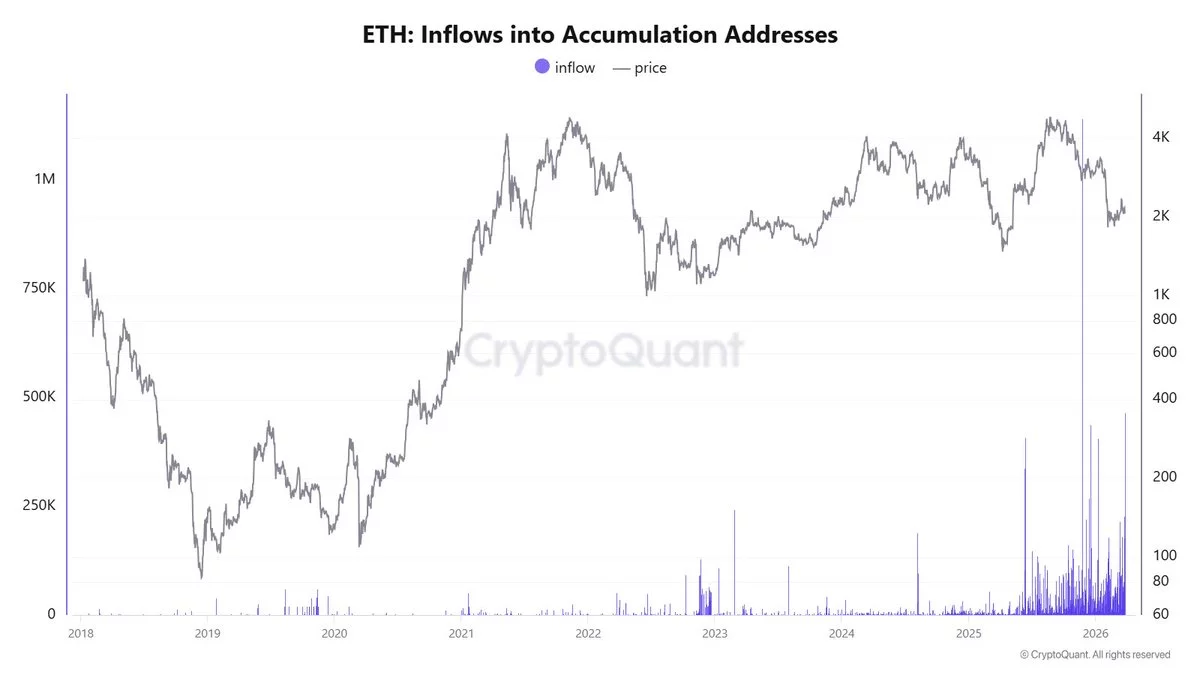
Ethereum (ETH) is drawing fresh market attention as stablecoin activity, whale accumulation, and derivatives data point in different directions.
Summary
- Whales added 466,500 ETH to accumulation addresses as Ethereum traded near $2,000 during the pullback.
- Coinbase said stablecoin balances and tokenized asset values on Ethereum moved back toward record highs.
- Record leverage in Ethereum futures raised liquidation risk as analysts tracked bearish levels below $2,000.
Recent reports show stronger activity on Ethereum’s base layer, while analysts continue to track downside risks in price and leverage.
Coinbase Institutional said Ethereum has regained some ground relative to layer-2 networks as user activity and stablecoin balances tilt back toward the main chain. The firm also said stablecoin supply and tokenized asset values on Ethereum are near record levels and still showing positive momentum.
The report linked that trend to Ethereum’s role in composability and execution density. Coinbase Institutional also said ETH has outperformed major layer-2 tokens since October 2025, adding to the view that the network is regaining attention as stablecoin rules continue to evolve.
Ethereum traded at around $2,000 at the time of reporting, based on CoinGecko data. The token posted a slight gain over the past 24 hours, though it remained down 7% for the week. Its 24-hour trading volume stood at $13.6 billion, while market capitalization reached about $241.1 billion.
Crypto analyst CW said large holders have increased buying during the recent decline. He wrote that “the largest accumulation since the decline in ETH is taking place” and said 466,500 ETH moved into an accumulation address on March 26. According to the analyst, that marked the second-largest inflow seen in the current cycle.
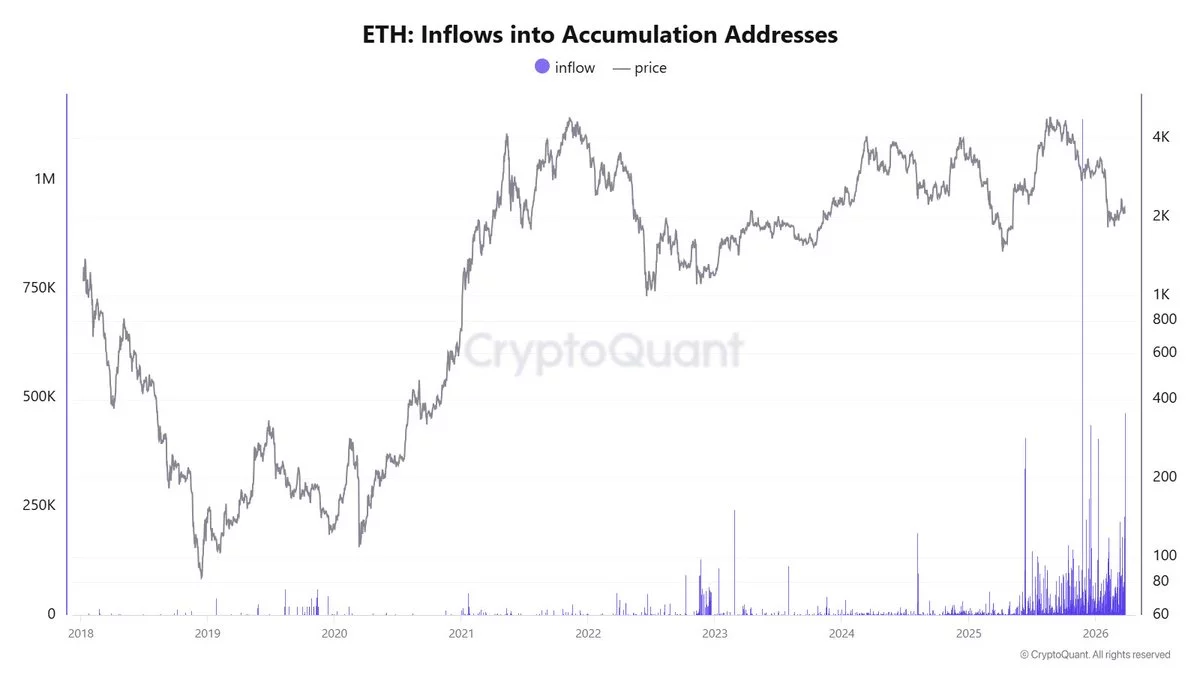
While accumulation has increased, some market watchers remain cautious on price structure. Crypto Patel said ETH is reacting from a higher-time-frame fair value gap near $2,078 and described the recent setup as weak after a liquidity sweep and lower highs on the four-hour chart.
He said the market is showing “bearish continuation toward sell-side liquidity” and listed downside targets at $1,980, $1,800, and $1,500. He added that a four-hour close above $2,204 would invalidate that setup.
Record futures leverage adds pressure to the market setup
CryptoQuant analyst Carmelo Alemán said Ethereum’s Estimated Leverage Ratio reached 0.99495738 on March 27, its highest level on record. The metric compares futures open interest with ETH reserves on exchanges and shows how large derivatives exposure has become relative to available spot collateral.
Alemán said the reading points to a fragile market structure. He wrote that when leverage reaches extreme levels, even small price moves can trigger rapid liquidations and sharper volatility. That leaves traders watching both on-chain accumulation and derivatives pressure as Ethereum tests its next move.
Disclosure: This article does not represent investment advice. The content and materials featured on this page are for educational purposes only.
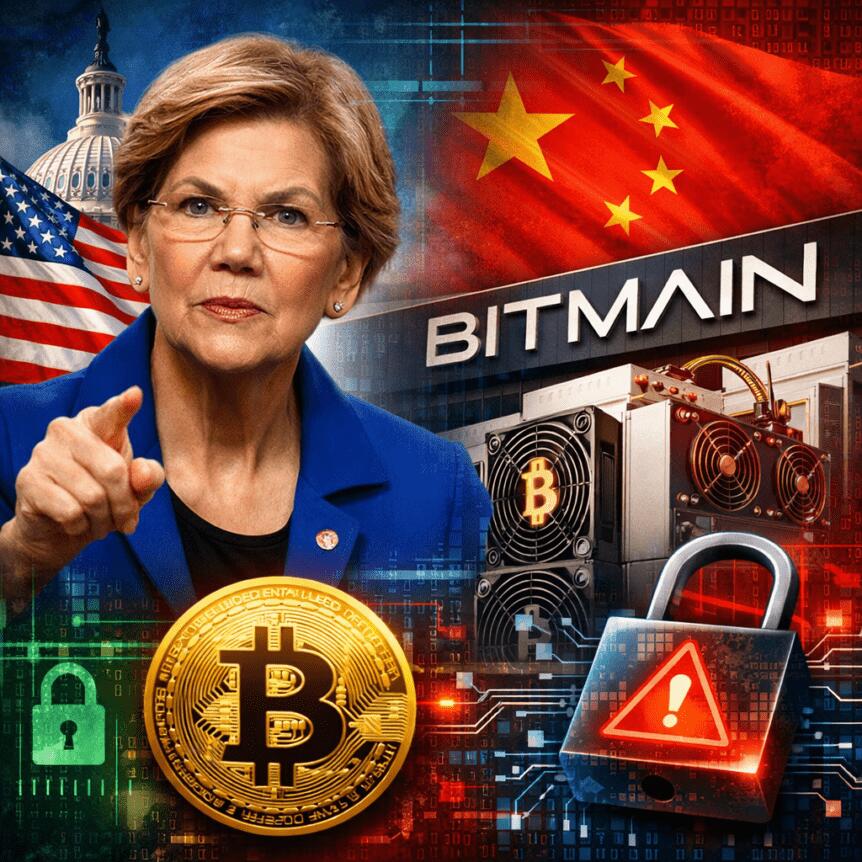
Senator Elizabeth Warren has asked the U.S. Commerce Department to explain how it is assessing potential national-security risks linked to Bitmain Technologies, the Chinese-founded maker of a substantial share of the world’s Bitcoin mining hardware. The request follows prior reporting that Bitmain is under federal scrutiny, with a focus on whether its ASICS could pose espionage risks or threaten critical infrastructure.
In a letter dated Thursday, Warren urged Commerce Secretary Howard Lutnick to provide documents and communications related to Bitmain, citing a Bloomberg report on the matter. The inquiry signals a broader government interest in the national-security dimensions of foreign-manufactured mining equipment, as the sector becomes increasingly strategic for energy grids and cyber defense.
Key takeaways
- Senator Warren requested detailed documentation from the Commerce Department on Bitmain, citing a Bloomberg report about national-security concerns.
- The inquiry intersects with a long-running federal probe into Bitmain and potential risks to U.S. critical infrastructure, codenamed Operation Red Sunset and led by Homeland Security.
- Bitmain is pursuing a major expansion in the United States, planning to open its first U.S. ASIC manufacturing facility with production slated to begin in early 2026 and scale by the end of the year.
- U.S. authorities have previously halted shipments of Bitmain devices and scrutinized related Chinese chip firms for alleged ties to sanctioned entities, highlighting a broader regulatory tightening around mining hardware.
- In a separate development, a Trump-backed American Bitcoin Corp. has pursued large-scale Bitmain purchases, illustrating ongoing sector adoption amid geopolitical tensions.
Regulatory spotlight deepens around Bitmain
The Commerce Department is being pressed to shed light on how national-security considerations are weighed in evaluating Bitmain, which supplies a large portion of the global Bitcoin mining hardware ecosystem. The development comes amid a cluster of ongoing regulatory and anti-foreign-influence actions that have kept Bitmain in the crosshairs of U.S. policymakers.
The Bloomberg reporting framing Warren’s inquiry underscores how lawmakers are threading concerns about foreign tech supply chains with national-security risk governance. While the Commerce Department has not publicly released its conclusions, the request indicates growing congressional scrutiny of mining hardware suppliers from outside the United States, particularly those with ties to strategic sectors like semiconductors and telecommunications.
Unresolved probe and what it could mean for the sector
The Bitmain review, described in reports as Operation Red Sunset and led by Homeland Security, reportedly examined whether Bitmain’s ASIC machines could be exploited for espionage or to disrupt the U.S. power grid. Bloomberg noted that the probe’s current status is unclear and that national-security investigations of this type can extend for years without public resolution. The lack of a formal public outcome does not necessarily signal exoneration; it often reflects a prolonged, sensitive process where details remain classified or undisclosed.
Industry observers have pointed to the broader risk dynamics for miners and equipment suppliers who depend on global supply chains and are subject to shifting regulatory overlays. The uncertainty surrounding the Bitmain probe adds another layer of caution for investors and operators evaluating hardware procurement in a climate where security concerns increasingly influence partnerships and deployment decisions.
Bitmain’s U.S. manufacturing ambitions under the microscope
Amid the scrutiny, Bitmain has signaled its ambition to establish a significant U.S. manufacturing footprint. Bloomberg reported in mid-2023 that Bitmain planned to open its first U.S.-based ASIC production facility, with initial chip manufacturing anticipated to begin in early 2026 and scale later in the year. The move would mark a notable shift in the hardware supply chain, potentially reducing dependence on overseas fabrication while inviting heightened regulatory attention from U.S. authorities.
Cointelegraph reached out to Warren and Bitmain for comment, but neither had provided a response by publication. The timing of a U.S. facility aligns with a period of renewed interest in domestic mining infrastructure, even as the regulatory environment remains unsettled for equipment sourced from abroad.
Market dynamics, adoption, and the political backdrop
Bitmain’s mining hardware remains widely deployed among U.S. and global operators. The company’s machines appear in operations across the sector, including instances where high-profile investors are involved in mining ventures. In one notable case, American Bitcoin Corp.—a Trump-aligned project—reported a large-scale procurement of Bitmain rigs, agreeing to acquire 16,000 Bitmain ASICs in a deal valued at about $314 million. The arrangement illustrates ongoing demand for Bitmain’s hardware even as the company faces heightened regulatory attention and potential geopolitical risk factors.
The broader market context is also shaped by competitiveness among ASIC manufacturers. A Cambridge University–backed industry report shows a concentrated market share among a small set of large producers, highlighting how hardware supply shifts can influence mining economics, efficiency, and resilience in the face of policy changes. As regulators weigh security considerations against economic incentives for domestic manufacturing, investors and operators are watching how supply chains will adapt to potential restraints, export controls, or licensing requirements.
The regulatory backdrop also includes prior actions—such as halted shipments of Bitmain devices and investigations into related Chinese chip firms over alleged links to sanctioned entities—as well as a 2024 federal review flagging concerns about deploying Bitmain machines near U.S. military installations. These elements collectively frame a sector where security, diplomacy, and economics are increasingly interwoven into everyday mining decisions.
Overall, the trajectory for Bitmain in 2026 and beyond will hinge on how Commerce and homeland-security authorities balance innovation, national-security safeguards, and the evolving geostrategic calculus of semiconductor and crypto infrastructure supply chains. As the government’s position becomes clearer, miners and investors will need to adjust their risk models to incorporate regulatory developments, potential licensing regimes, and the possibility of shifts in supplier dynamics.
Readers should monitor whether the Commerce Department provides formal responses to Senator Warren’s requests and how the Red Sunset probe evolves, as any developments could influence Bitmain’s U.S. plans, the availability of mining hardware, and the broader regulatory environment governing crypto infrastructure in the United States.


Bitcoin (BTC) moved lower this week after another failed attempt to break above $72,000. The decline pulled the wider crypto market down, while a few smaller tokens moved against the broader trend.
Summary
- Bitcoin fell from $72,000 to $65,500 in 48 hours as sellers regained control across exchanges.
- Ethereum slipped below $2,000, BNB held near $610, and XRP stayed below $1.35 amid weakness.
- SIREN jumped over 100% in one day, even as the crypto market lost $60 billion.
Bitcoin started the week under pressure after it failed to clear higher resistance levels. The asset had already lost momentum near $76,000 in the previous week and then traded around $70,000 over the weekend before falling to $67,500 on Monday as traditional markets reopened.
Later that day, Bitcoin rose close to $72,000 after US President Donald Trump said the United States and Iran had reached a de-escalation deal. That move did not last. Iran rejected the statement, and Bitcoin quickly fell back toward $69,000.
Bitcoin returned to the $72,000 area on Wednesday, which marked its weekly high. Sellers then regained control and pushed the asset back to $69,000 by Friday. The decline continued into the weekend, sending Bitcoin to $65,500 on some exchanges, its lowest level since early March.
The move left Bitcoin down by more than $6,000 in 48 hours. At the time of reporting, the asset had recovered slightly and traded above $66,000, but it still showed a weekly loss of around 6%. Its market capitalization dropped to about $1.325 trillion, while its market share slipped below 56%.
Large-cap altcoins track Bitcoin lower
Most large-cap altcoins also moved down during the same period. Ethereum fell below the $2,000 mark, Binance Coin traded just above $610, and XRP remained below $1.35 after testing resistance near $1.30 earlier in the week.
The weakness in major tokens added pressure to the overall market. Total crypto market value fell by about $60 billion from Friday’s peak and stood near $2.37 trillion, showing that risk appetite remained weak across the sector.
However, SIREN was one of the few tokens to post a sharp gain during the latest market drop. The AI-linked token rose more than 100% in 24 hours and traded above $1.60 at press time. Even so, it remained over 50% below its recent all-time high of $3.60 reached earlier this week.
Other altcoins showed a mixed picture. AAVE fell by 5%, while HASH lost 9% on the day. Bitcoin Cash and CC posted gains of more than 3%, making them rare movers higher as most of the market stayed under pressure.
Disclosure: This article does not represent investment advice. The content and materials featured on this page are for educational purposes only.
Bitcoin continued to slide on March 28, trading near $66,200, as markets reacted to growing doubts around US-Iran de-escalation. President Donald Trump’s 10-day pause on energy strikes has not reassured investors, especially after reports that Israel continued attacks during the period.
The reaction is visible across markets.
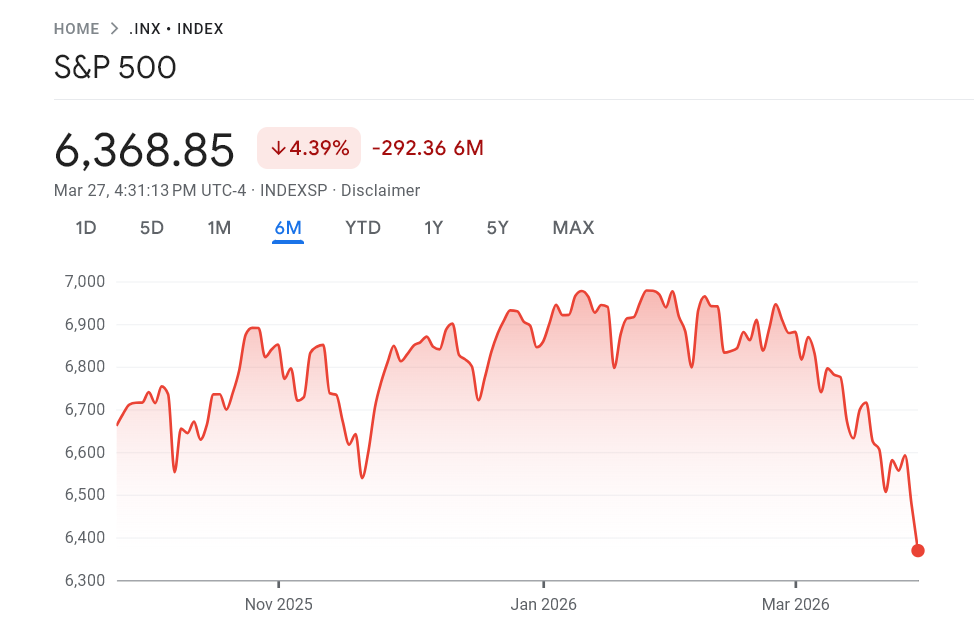
The S&P 500 has declined steadily throughout the week, falling to its lowest level in six months.
This broad selloff signals a clear shift toward risk-off sentiment, with investors pulling back from equities as geopolitical and macro uncertainty rises.
Crypto is following the same pattern.
Bitcoin’s price action shows continued weakness, with intraday rebounds failing to hold. This reflects a deeper issue.
Markets are not treating Trump’s pause as a step toward peace, but as a delay in escalation. Reports of continued strikes have reinforced that view.
At the same time, rising Treasury yields are tightening financial conditions. Higher yields reduce liquidity and make capital more expensive, which typically pressures risk assets like stocks and crypto.
As a result, Bitcoin is trading more like a tech stock than a hedge.
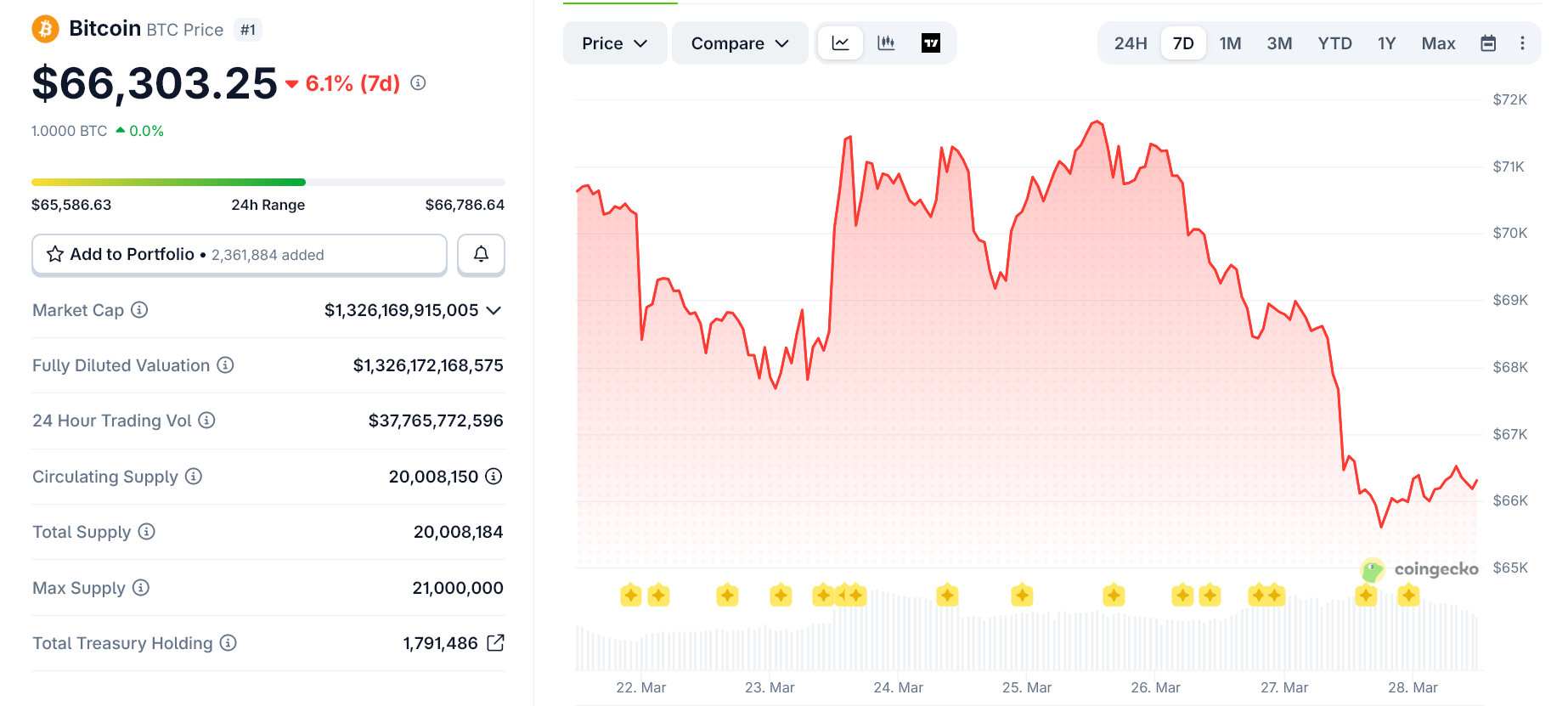
In previous cycles, geopolitical tension sometimes supported Bitcoin. That is not the case now. Instead, inflation risks, elevated oil prices, and fading expectations for rate cuts are driving the market.
For now, the message is clear.
Until there is credible progress toward de-escalation and yields stabilize, crypto markets are likely to remain under pressure, with downside risk dominating in the short term.
The post Israel Violates Trump’s Iran Pause, Bitcoin and Stocks Feel the Pain appeared first on BeInCrypto.
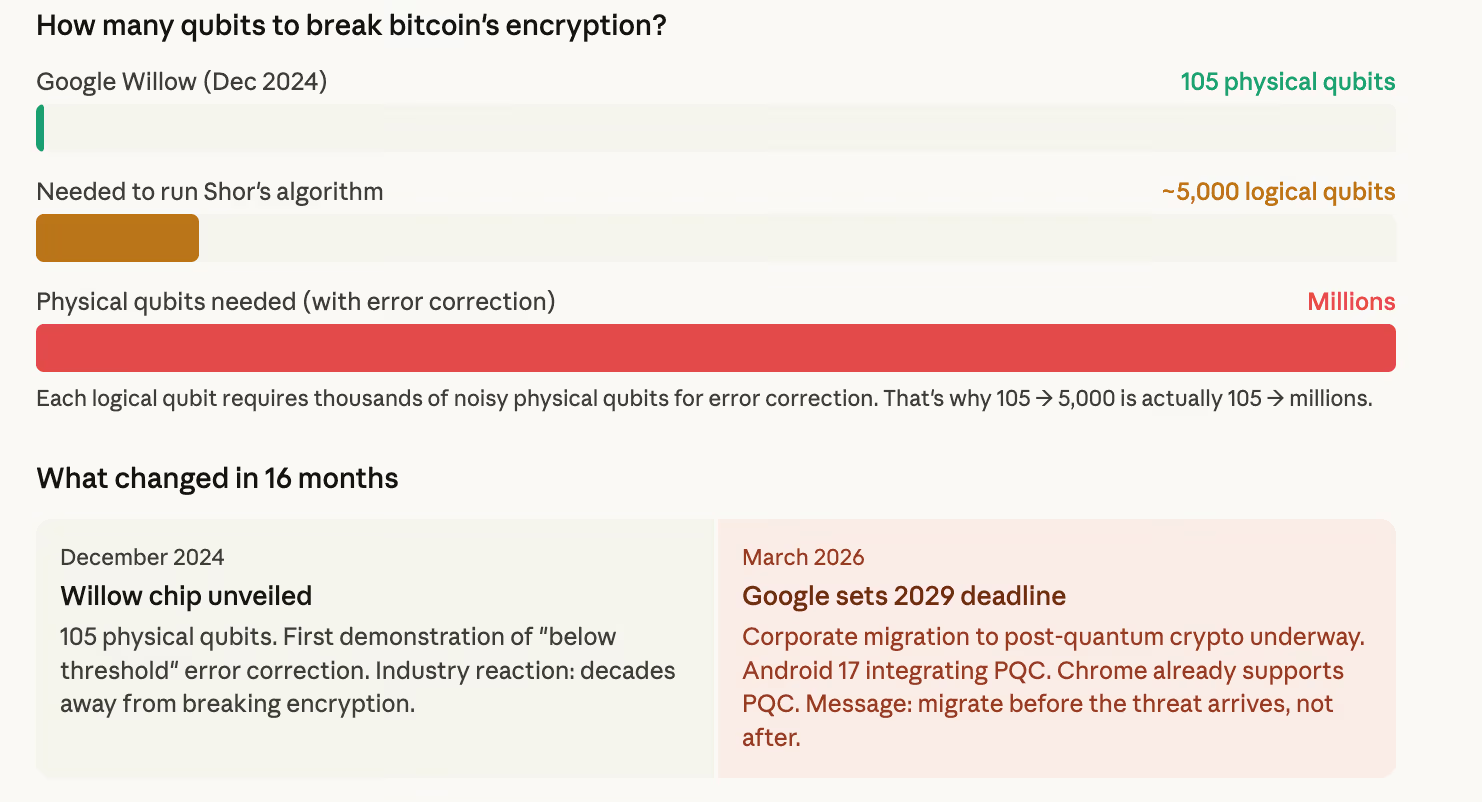
The crypto industry’s reaction was that a quantum computing threat was still distant when Google unveiled its Willow quantum chip in December 2024.
Bitcoin uses SHA-256 for mining and ECDSA for signatures, both of which are theoretically vulnerable to quantum decryption, but the consensus was that the threat was decades away. Breaking encryption would require millions of physical qubits (a unit of information in quantum systems). Willow had just 105.
That story has marginally changed sixteen months later, and Google isn’t dismissing anything.
The company announced this week that it is setting a 2029 deadline to migrate its authentication services to post-quantum cryptography, citing progress in quantum hardware, error correction, and factoring resource estimates.
Google’s security engineering team wrote that quantum computers “will pose a significant threat to current cryptographic standards, and specifically to encryption and digital signatures,” and that the threat to digital signatures specifically “requires the transition to PQC prior to a cryptographically relevant quantum computer.”
These risks are not theoretical. The Android 17 mobile operating system is already integrating post-quantum digital signature protection. Chrome already supports post-quantum key exchange. Google Cloud offers post-quantum solutions to enterprise customers.

Here’s why it matters
Classical computers process information as bits, each one either a 0 or a 1, and solve problems by checking possibilities one at a time. Quantum computers use qubits that can exist as both 0 and 1 simultaneously, a property called superposition, which lets them explore vast numbers of possibilities in parallel.
For most everyday tasks, the advantage is negligible. But for specific problems like factoring the large prime numbers that underpin modern encryption, a sufficiently powerful quantum computer could solve in minutes what would take a classical machine longer than the age of the universe.
Bitcoin uses ECDSA (Elliptic Curve Digital Signature Algorithm) to sign transactions, which is exactly the category of cryptography Google flagged as requiring migration before a quantum computer capable of breaking it arrives.
A sufficiently powerful quantum computer running Shor’s algorithm could derive private keys from public keys, allowing an attacker to spend any bitcoin whose public key has been exposed on the blockchain.
Shor’s is a quantum computing method that can crack the math protecting passwords and wallets exponentially faster than normal computers.

When CoinDesk wrote about Willow in December 2024, the math was reassuring. Chris Osborn, founder of Solana ecosystem project Dialect, laid it out clearly at the time: roughly 5,000 logical qubits are needed to run Shor’s algorithm against current encryption, and each logical qubit requires thousands of physical qubits for error correction.
That meant millions of physical qubits, against Willow’s 105. The gap seemed enormous.
What’s changed isn’t the qubit count. It’s the error correction trajectory and the institutional response. Google went from demonstrating “below threshold” error correction, meaning they could turn noisy physical qubits into usable logical ones for the first time, to setting a corporate migration deadline in 16 months.
When the company that builds the quantum computers urges developers to migrate by 2029, that’s a signal that the gap is closing faster than the public timeline suggests.
Ethereum co-founder Vitalik Buterin was already calling for urgency in October 2024, a month before the Willow announcement.
“Quantum computing experts such as Scott Aaronson have also recently started taking the possibility of quantum computers actually working in the medium term much more seriously,” Buterin wrote at the time.
“This has consequences across the entire Ethereum roadmap: it means that each piece of the Ethereum protocol that currently depends on elliptic curves will need to have some hash-based or otherwise quantum-resistant replacement.”
How Ethereum and Bitcoin developers are responding
The contrast with how the two largest blockchain networks are responding could not be sharper.
The Ethereum Foundation treated that as a directive and built accordingly. Eight years of work, now visible in weekly shipping devnets and a public roadmap with fork-level specificity.
Bitcoin’s governance model makes this kind of coordinated response structurally harder. There is no Ethereum Foundation equivalent to fund and direct a multi-year engineering effort.
Protocol changes require broad consensus among a decentralized developer community that has historically moved slowly and deliberately, a feature for stability but a liability when facing a deadline.
The last major cryptographic upgrade to Bitcoin, Taproot, took years of discussion before activation in 2021.
Ethereum launched pq.ethereum.org this week, a dedicated hub for its post-quantum security effort that has been underway since 2018. The Ethereum Foundation’s post-quantum team, cryptography team, protocol architecture team, and protocol coordination team have spent eight years building toward a migration that touches every layer of the protocol.
More than 10 client teams are shipping weekly devnets through what the foundation calls PQ Interop. The roadmap maps specific milestones across four upcoming hard forks, from a post-quantum key registry to full PQ consensus.
Bitcoin, on the other hand, has no equivalent effort. No coordinated roadmap. No multi-team engineering program. No fork milestones.

Nic Carter, one of Bitcoin’s most prominent advocates and co-founder of crypto fund Castle Island Ventures, said the quiet part out loud this week.
“Elliptic curve cryptography is on the brink of obsolescence,” he wrote on X. “Whether it’s 3 or 10 years, it’s over and we need to accept that. The only thing that matters is how quickly blockchain developers recognize that they need to bake in cryptographic mutability into their networks.”
Carter contrasted the two approaches directly. Ethereum’s approach, he said, was “best in class,” describing how the network “gets together and announces a specific, detailed PQ roadmap by 2029, sets it as top strategic priority, folds PQ into ongoing roadmap, detailed FAQ, no fear, just action.”
Bitcoin’s approach, Carter said, was “worst in class.” He noted there is currently one group working on a quantum-related proposal that has “received zero buy-in from top devs,” with developers pointing to isolated pieces of research as evidence of progress while having “no coherent strategy, no roadmap.”
“Everyone knows I’m a bitcoiner and would like bitcoin to win,” Carter added. “Not saying this to hurt feelings. Saying this to spur action.”
The urgency isn’t universally shared, however.
Firms such as CoinShares argue that fears of an imminent quantum threat to bitcoin are overstated, and it estimates that only about 10,200 BTC is concentrated enough in vulnerable legacy address types that its theft could cause “appreciable market disruption.”
The remaining exposed supply, roughly 1.6 million BTC in older Pay-to-Public-Key addresses, is scattered across more than 32,000 separate wallets averaging about 50 BTC each, making them slow and unprofitable to crack individually, as CoinDesk reported at the time.
But the question isn’t whether quantum computing will eventually threaten blockchain cryptography. Google, the Ethereum Foundation, NIST, and now prominent Bitcoin advocates all agree it will.
It is whether three years is enough time to migrate a global, decentralized protocol that has no central authority to set deadlines, no coordinated engineering team to execute them, and a culture that treats urgency with suspicion.
Ethereum’s answer is that eight years of preparation put it in a position to execute the migration across four hard forks. Google’s answer is that 2029 is the deadline, and the migration is already underway in its products.
Bitcoin’s answer, so far, is silence. And as Carter warned, “ETHBTC will start to reflect the divergence in prioritization” if that silence continues.

TLDR:
- Stablecoin transaction volume has surpassed $30 trillion annually, now matching Visa’s total processing scale.
- CFOs and corporate boards are actively exploring stablecoin integration for treasury and payment operations.
- Stablecoins offer instant settlement, borderless reach, and lower costs that traditional banking cannot match.
- The real winners of the stablecoin shift will be builders of payment layers and settlement networks, not token holders.
Stablecoin transaction volume has crossed the $30 trillion mark annually, a figure that now rivals Visa’s total processing volume.
This shift marks a turning point in how global money moves. Businesses, financial officers, and corporate boards are beginning to take notice.
The numbers suggest stablecoins are no longer a niche crypto product. They are becoming core infrastructure for modern financial settlement and cross-border payments.
Stablecoins Step Into the Role of Global Payment Rails
The scale of stablecoin activity has caught the attention of mainstream finance. Crypto analyst Lucky noted that stablecoins are “quietly handling real-world volume — not speculation, actual usage.” That distinction matters greatly to corporate finance teams evaluating payment solutions.
Traditional banking systems operate within fixed hours and geographic limits. Stablecoins, by contrast, offer instant settlement with no banking hours and borderless reach.
For businesses managing international transactions, these features reduce friction and cut costs considerably.
CFOs and treasurers are now asking direct questions about stablecoin integration. The technology solves practical problems that traditional banking has long struggled with. Lower transaction costs and near-instant finality make stablecoins attractive for corporate treasury operations.
As a result, stablecoins are moving from speculative interest to boardroom conversation. Companies across industries are examining how stablecoin rails can fit into existing payment workflows. This transition is happening gradually but with clear momentum.
Crypto Infrastructure Quietly Reshapes the Financial System
Lucky drew a broader pattern connecting major technology shifts to dominant outcomes. The internet moved information, social media moved attention, and crypto introduced digital ownership. Now, stablecoins are positioned to move money at scale globally.
This framing places stablecoins within a longer arc of technological disruption. Rather than replacing banks, crypto is embedding itself into the financial system as a backend layer. Settlement networks and payment layers are where the real structural change is occurring.
The winners in this shift, according to Lucky, will not simply be token holders. They will be the builders of payment infrastructure, settlement networks, and real-world financial integrations. The value is moving toward utility, not speculation.
History shows that infrastructure shifts are often missed until they become unavoidable. Most participants in previous technology cycles recognized the change only after it had already taken hold.
The stablecoin transition appears to be following a similar path, moving steadily beneath the surface of mainstream financial awareness.


Managed future strategies are gaining renewed attention as investors look for new sources of returns from the market at a time when both stocks and bonds are under pressure as a result of the U.S.-Iran war and the risk of 1970s-style stagflation.
These strategies, which are typically run by commodity trading advisors, use systematic models to trade future contracts across different asset classes. Rather than focus on short-term market moves in traditional asset classes, they aim to capture broader trends that unfold over months. The ability to adapt to changing market conditions, and their performance back in 2022, has made managed futures funds increasingly relevant in 2026.
In 2022, when the S&P 500 Index fell around 18% and the Bloomberg U.S. Aggregate Bond Index was down about 13%, managed future strategies were up 20%.
“That’s meaningful outperformance in an environment when stocks and bonds are under pressure,” Nate Geraci, NovaDius president, said on CNBC’s “ETF Edge” earlier this week.
Andrew Beer, managing member at DBi, which manages the largest managed futures ETF, the iMGP DBi Managed Futures Strategy ETF (DBMF), said on “ETF Edge” that the uncertainty around inflation and interest rates, and the volatile geopolitical backdrop, are a good match for the managed futures approach, which can take long or short positions and have the flexibility to respond to different trends across the markets.

Performance of the iMGP DBi Managed Futures Strategy ETF over the past five years.
Managed futures ETFs remain a relatively small category, collectively holding around $6.5 billion in assets, according to ETFAction.com. Within that space, the iMGP DBi Managed Futures Strategy ETF has attracted about $1 billion in flows this year.
The use of the managed futures approach with ETFs allows more investors to access a strategy that been associated with the world of hedge funds historically, but in a more liquid and transparent structure.
“We’re leveraging the work of largest hedge funds, and trying to be more efficient, pick up what they are doing,” Beer said. “We thrive with changes over 3, 6, 9, 12 months, not Monday to Thursday,” he said.
“Certainly, the [ETF] industry is going to be launching additional managed futures products along with other hedge funds strategies,” Geraci said during the podcast portion of “ETF Edge.”
Geraci said one clear signal that this approach is likely to see more interest from retail investors is three of the biggest asset managers getting into the space with their own branded managed futures ETFs: BlackRock, Invesco and Fidelity Investments.
“They all entered the market in the past year and that is a sign of real investor demand going forward,” Geraci said. “The interest is there, especially given the backdrop of this market environment,” he added.
Still, managed future ETFs remain more complex than regular stock and bond investments, and investors need to understand that while their performance can beat stocks and bonds during periods of market stress and volatility, they can also lag.
“I do think these are clearly more complex than other types of ETFs on the market,” Geraci said. “Investors and advisors need to have a firm understanding of how these work,” he said. Maybe most important, he added, “Investors have to be able to stick with managed futures through inevitable periods of underperformance.”
“They can work really well when you need them, but you have to be able to let them work over full market cycles,” Geraci said.
Beer said investors can think of an allocation to this type of strategy being in the range of 3% to 5% of an overall market portfolio diversification approach, “just sitting there alongside hard assets or infrastructure.”
“I think we all have the same goal: we want our investors to be able to grow their assets, but sleep at night,” he said.
TLDR:
- Senator Warren sent a formal letter to Commerce Secretary Lutnick seeking Bitmain-related national security documents.
- Federal probe “Operation Red Sunset” examined whether Bitmain rigs could spy on or sabotage the US power grid.
- American Bitcoin Corp., backed by Eric and Donald Trump Jr., purchased 16,000 Bitmain rigs for $314 million.
- Warren urged Commerce to prevent politically connected crypto firms from influencing national security decisions.
Senator Elizabeth Warren has raised concerns about Bitmain Technologies, a Chinese Bitcoin mining company, amid a federal investigation into potential national security threats.
She sent a formal letter to Commerce Secretary Howard Lutnick requesting documents on the matter. Warren also sought clarity on any communications between Bitmain, the Trump family, and the Commerce Department.
Warren Targets Bitmain Over Federal Security Investigation
The Massachusetts senator’s letter came after Bloomberg News reported a federal probe called “Operation Red Sunset.” The investigation started under the Biden administration and focused on Bitmain’s hardware.
Authorities sought to determine whether the machines could be used for spying. There were also concerns about possible sabotage of the American power grid.
The current status of Operation Red Sunset remains unclear to the public. National security investigations can run for years without any public legal proceedings.
The Department of Homeland Security, which led the probe, did not respond to comment requests. Bitmain also declined to respond to the latest inquiries.
Bitmain previously denied the allegations, calling the reports “seriously inconsistent with the facts and constitute false news.”
The company maintained that it “strictly complies with US and applicable laws and regulations and has never engaged in activities that pose risks to US national security.” Those statements were made in response to the Bloomberg News report last year.
A May 2024 federal review had already flagged concerns about a Bitmain-operated site near a US military base, noting “significant national security concerns.”
A Senate Intelligence Committee report from July also named Bitmain’s devices as presenting “several disturbing vulnerabilities” to the US.
The report stated those devices could potentially be manipulated from China. These findings added weight to Warren’s request for answers.
Trump Family Ties to Bitmain Draw Scrutiny
Among Bitmain’s notable clients is American Bitcoin Corp., a firm connected to the Trump family. Eric Trump and Donald Trump Jr. are both investors in American Bitcoin.
The company signed a contract to acquire 16,000 Bitmain rigs for $314 million last year. That deal drew attention given the ongoing federal interest in Bitmain.
A spokesman for American Bitcoin said the company had conducted extensive security tests on Bitmain’s devices. The tests found no vulnerabilities allowing remote access.
The spokesman stated the company believes that when Bitmain’s devices “are deployed within modern industrial security standards, they do not present a credible risk to the United States power grid or to national security.” American Bitcoin did not respond to the most recent requests for comment.
Warren’s letter asked Commerce to clarify what actions it has taken to prevent conflicts of interest. She specifically asked about steps taken to “insulate the Commerce Department’s national security decisions from the influence of firms that have business ties to the Trump family.”
Commerce holds authority to investigate foreign threats to information and communications technology. However, Democrats remain in the Senate minority and cannot compel a formal response.
Warren made her position clear, writing that “we must ensure that politically connected crypto interests do not receive special treatment and undermine our national security.” The Commerce Department had not responded to comment requests at the time of publication.

Wonder Man season 2: everything we know so far about the Marvel TV show’s return on Disney+

Who are the Houthis? Yemen’s rebels joining war against the US in the Middle East | News World

Goldman Sachs’ India bets slide in FY26; 5 stocks crash over 50% but one turns multibagger


-
 NewsBeat3 days ago
Manchester United reach agreement with Casemiro over contract clause amid transfer speculation
-

 News Videos2 days ago
Parliament publishes latest register of MPs’ financial interests
-

 Crypto World7 days ago
Best Crypto to Buy Now: Strategy Just Spent $1.57 Billion on Bitcoin During Fear While Early Investors Quietly Enter Pepeto for 150x Potential
-

 Crypto World7 days ago
Bitcoin Price News: Bhutan Sells $72 Million in BTC Under Fiscal Pressure, but the Smart Money Entering Pepeto Sees What the Market Does Not
-

 Sports5 days ago
Remo Stars and Kano Pillars Strengthen Survival Hopes in NPFL
-

 Sports5 days ago
Gary Kirsten Accuses Pakistan Cricket Board Of ‘Interference’, Mohsin Naqvi Responds
-

 Business6 days ago
No Winner in March 21 Drawing as Prize Rolls to $133 Million for Next
-

 Tech6 days ago
Give Your Phone a Huge (and Free) Upgrade by Switching to Another Keyboard
-

 Tech6 days ago
AI enters the chat: New Seattle dating app relies on tech to facilitate meaningful human connections
-

 News Videos5 days ago
Ch 9 Financial Management Part 1 | Detailed One Shot | Class 12 Business Studies Boards 2026
-

 Tech7 days ago
Today’s NYT Connections Hints, Answers for March 22 #1015
-

 Business2 days ago
Instagram, YouTube Found Responsible for Teen’s Mental Health Struggle in Historic Ruling
-

 Business6 days ago
Will Duke Basketball Win It All? Duke Basketball Enters Second Round as Third Favorite to Claim NCAA Title
-

 Sports5 days ago
2026 Kentucky Derby horses, odds, futures, preview, date: Expert who hit 12 Derby-Oaks Doubles enters picks
-

 NewsBeat15 hours ago
The Story hosts event on Durham’s historic registers
-
 NewsBeat6 days ago
Update on Wisbech river crash as search for teenage boy enters fifth day
-
 Entertainment5 days ago
Cynthia Bailey Dishes on ‘RHOA’ Season 17, Discusses Kandi
-

 Tech5 days ago
Samsung will soon let you control smart home devices from your car’s dashboard
-
 NewsBeat3 days ago
Tesco is selling new Cadbury Dairy Milk bar and people can’t wait to try it
-

 Tech7 days ago
SteamOS update adds support for Steam Machine and other non-Valve hardware
You must be logged in to post a comment Login