
Crypto World
Miden to launch privacy-focused USDC-backed stablecoin using Circle’s xReserve



Privacy has emerged as a key barrier to bringing more financial activity onchain. Public blockchains expose transaction histories, balances and counterparties by default, a level of transparency that is difficult to reconcile with how businesses and financial institutions operate.
Trading firms don’t want to reveal positions, companies can’t publish payroll and treasury activity and individuals may not want their financial lives visible on a block explorer. Privacy infrastructure aims to bring the confidentiality of traditional finance onchain while preserving crypto’s programmability and verifiability.
Stablecoins are cryptocurrencies designed to maintain a steady value, typically by tracking the U.S. dollar. They have become a key piece of crypto infrastructure, providing a bridge between traditional money and blockchains while enabling faster payments, trading and settlement without the volatility of assets like bitcoin or ether .
Miden sees USDCx as the foundation for a broader category it calls “PriFi,” spanning private institutional trading, B2B payments, payroll, cross-border payments and corporate treasury management.
The company spun out of Polygon as an independent project in April 2025 and is backed by a16z crypto, 1kx, Hack VC and others.
Read more: The future of crypto payments won’t include on-ramps or bridges, Fun CEO says


The SpaceX logo is displayed at a SpaceX facility on Aug. 4, 2026 in Hawthorne, California.
Justin Sullivan | Getty Images
Short sellers betting against SpaceX are rapidly retreating from the trade, just as the newly public stock rebounds from its post-IPO slump.
Short interest in SpaceX fell to about 11% of the company’s publicly traded shares Wednesday, down sharply from a peak of 34% last week, according to S3 Partners. The decline reflects a combination of bearish investors closing out positions and a significant expansion of the stock’s tradable float following the first major lockup expiration.
“Shorts that wanted to short are out of bullets,” said Ihor Dusaniwsky, managing director of predictive analytics at S3 Partners. “Only so much money you can put into a trade.”
The exodus came as SpaceX shares staged a sharp rebound from their post-earnings sell-off, with short covering potentially adding fuel to the advance. Investors closing bearish positions must buy back shares, which can amplify upward moves when a stock is already rallying.
Shares jumped 8% Wednesday to around $144, lifting the stock about 7% above its $135 IPO price and roughly 38% above its Aug. 3 low.

SpaceX since IPO
SpaceX has endured a roller-coaster ride since going public. The stock initially tumbled after the rocket and satellite company disclosed in its first earnings report last week that capital expenditures were more than twice its revenue, fueling concerns about the enormous spending required to fund its ambitions.
The sell-off attracted a wave of short sellers, pushing short interest to unusually elevated levels relative to the stock’s limited public float. Short selling involves borrowing shares and selling them in hopes of buying them back later at a lower price.
That dynamic changed substantially last Thursday, when just over 911 million SpaceX shares became eligible for trading following the expiration of an initial lockup period. The newly unlocked tranche represented roughly 7% of the company’s shares outstanding and exceeded the 639 million shares sold in the IPO.
The larger float mechanically reduced short interest as a percentage of tradable shares. But short covering has also contributed to the decline, according to S3, as investors who had wagered against SpaceX bought back stock to exit their positions.
More supply is coming. On Aug. 20, another 319 million shares could unlock, followed by roughly 700 million in September and close to that number in October, according to the prospectus.
The additional shares could create fresh volatility by giving employees and early investors more opportunities to sell. At the same time, the larger float would make it easier for investors to establish new short positions if bearish sentiment returns.
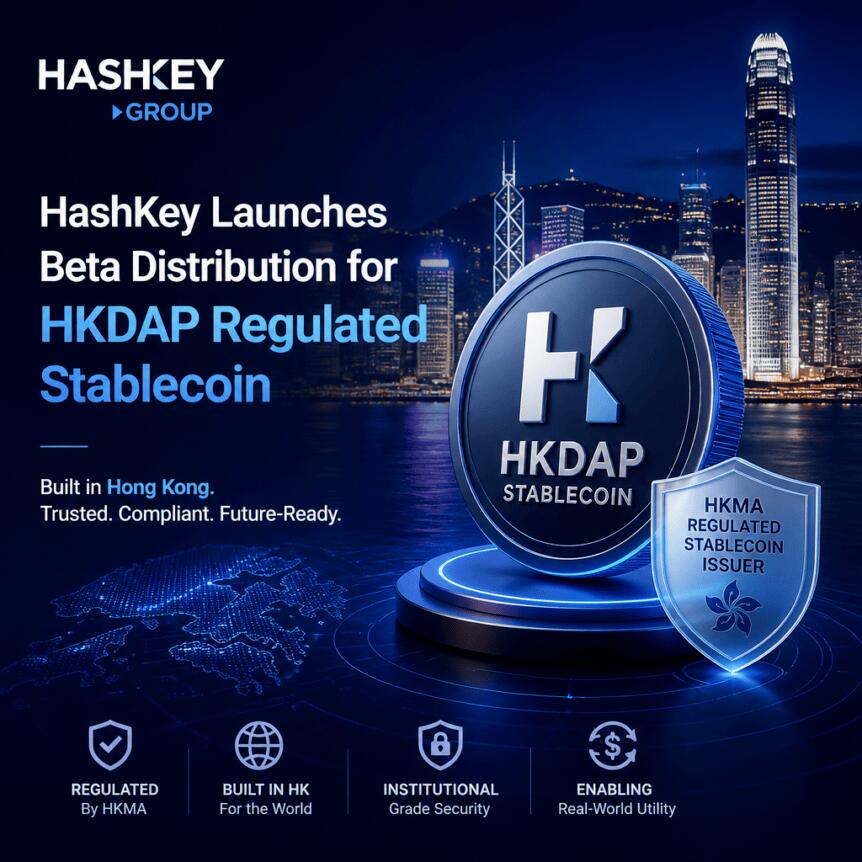
Anchorpoint Financial, a Hong Kong-licensed stablecoin issuer, has named HashKey Exchange as an authorized distributor for its Hong Kong dollar stablecoin, HKDAP. The move is designed to broaden eligible institutions’ and professional investors’ access to the fiat-backed token as Hong Kong’s regulated stablecoin framework continues to roll out.
In a Tuesday announcement, the companies said the distribution arrangement is part of a beta phase. HashKey reported that it has already completed its first HKDAP minting and redemption cycle with eligible clients, including both fiat on-ramps and off-ramps. Anchorpoint and HashKey also indicated that they intend to expand distribution over time and assess additional applications for HKDAP, such as cross-border payments, settlement workflows, and tokenized finance.
Key takeaways
- HashKey Exchange has been added as an authorized distributor for Anchorpoint’s HKDAP, expanding regulated access to the Hong Kong dollar stablecoin.
- The rollout is in beta, with HashKey already completing an initial HKDAP minting and redemption transaction using eligible clients.
- Anchorpoint plans to widen distribution and explore use cases beyond payments, including settlement and tokenized finance.
- HKDAP is positioned as “HKD At Par,” aiming to act as tokenized money within Hong Kong’s licensed stablecoin market.
Why the HashKey distribution matters for Hong Kong’s regulated stablecoin rollout
Distribution partners are often the practical bridge between an issuer’s compliance setup and the end-user access that determines whether a regulated stablecoin can scale. By authorizing HashKey Exchange to distribute HKDAP during a beta phase, Anchorpoint is effectively widening the number of institutional and professional channels through which the token can be minted, redeemed, and used.
HashKey’s confirmation that it has already completed an initial minting and redemption transaction is notable because it signals that at least part of the operational rails are live—not just planned. The inclusion of fiat on- and off-ramping in that first cycle also points to a focus on converting between traditional currency and the tokenized asset in a way that can support real transaction flows.
The companies framed the arrangement as expandable over time. For market participants watching Hong Kong’s stablecoin regime, the next question is how quickly authorized distribution can broaden beyond the initial set of participants, and whether additional ecosystem services will integrate HKDAP for payments and settlement.
What HKDAP is, and Anchorpoint’s regulatory positioning
HKDAP—short for “HKD At Par”—is described as a regulated Hong Kong dollar stablecoin intended to function as tokenized money for payments and other financial transactions. Anchorpoint’s role as the issuer is anchored in Hong Kong’s licensing process: the company was among the first to receive a stablecoin issuer license from the Hong Kong Monetary Authority.
Anchorpoint is a joint venture involving Standard Chartered Bank (Hong Kong), HKT, and Animoca Brands. According to earlier coverage by Cointelegraph, the venture was established in April 2025. Cointelegraph previously reported on the earlier plans by Standard Chartered and Animoca Brands—together with HKT—to launch a Hong Kong dollar-backed stablecoin.
As these licensing milestones are reached, the industry typically shifts from “permissioning” to “distribution and adoption.” In that sense, the HashKey beta rollout can be read as a step toward converting regulatory approval into day-to-day market usage.
Hong Kong dollar stablecoins could grow—if adoption data catches up
Hong Kong dollar-backed stablecoins may have the potential to become a meaningful segment of the broader stablecoin market, particularly given the city’s push for regulated issuance and supervision. A 2025 Citi report cited by the article’s underlying coverage estimated that stablecoin circulation in Hong Kong could reach $16 billion after the introduction of the local licensing regime.
Even so, observers face a data challenge. For now, US dollar-pegged tokens remain the clear majority of the global stablecoin market, while synthetic stablecoins are another smaller, emerging category. Reliable, public information on how much HKD-pegged supply exists and how widely it is used remains limited, making it difficult to judge where Hong Kong dollar stablecoins currently stand relative to that growth forecast.
Meanwhile, broader stablecoin activity has continued to intensify. The same underlying reporting points to Bernstein data showing that the combined adjusted transaction volume of USDC and USDt reached roughly $3.8 trillion in the first quarter of the year. While that figure does not measure HKDAP directly, it does underline that stablecoins remain central to large-scale on-chain transaction activity—creating a potentially supportive backdrop for new fiat-pegged entrants once distribution and liquidity deepen.
Next steps: broader access, more use cases, and what to monitor
Anchorpoint and HashKey said they plan to expand distribution over time and explore additional uses for HKDAP beyond basic minting and redemption. The proposed directions—cross-border payments, settlement, and tokenized finance—are closely tied to where tokenized currencies can deliver operational benefits, such as faster settlement cycles and programmable settlement for financial transactions.
For investors, traders, and institutional builders, the most actionable signals to watch will likely include how quickly distribution expands to more eligible counterparties, whether HKDAP liquidity improves across participating venues, and what concrete integrations emerge for payments and settlement. Just as important, market participants will want clearer visibility into HKDAP adoption over time—especially once Hong Kong dollar stablecoin activity becomes more measurable and comparable across issuers and channels.
As the beta phase progresses, the real test will be whether HKDAP can move from a licensed token concept into a consistently used fiat rail—one supported by distribution partners like HashKey and by credible, repeatable minting/redemption demand from regulated participants.

The SEC issued joint guidance with the CFTC last week, classifying digital assets into five categories: digital commodities, digital collectibles, digital tools, stablecoins, and digital securities, signaling that the agency will build its own crypto regulatory framework rather than wait indefinitely for the Senate’s stalled CLARITY Act.
The move gives exchanges, token issuers and traders a working jurisdictional map, but it’s an interpretation, not statute, and that distinction matters for anyone pricing regulatory risk into crypto positions.
This latest CLARITY Act news comes as the crypto market braces for today’s CPI data, which could shake Bitcoin out of its current consolidation around $64,000. The direction, though, is yet to be determined.
CLARITY Act Alternative: A Taxonomy Built for Speed, Not Statute
Under the new SEC-CFTC breakdown, the first four asset categories generally fall outside securities law, leaving digital securities as the only bucket firmly under SEC jurisdiction – though the agency notes it can still assert authority over specific nonsecurity assets in particular cases. That’s the ambiguity market structure legislation was supposed to erase, and it’s why the guidance reads as a stopgap rather than a settlement.
Ian Katz, managing partner at Capital Alpha, framed the calculation regulators are making given how slow formal rulemaking moves. “They’re not completely putting the brakes on, waiting for legislation,” he told The Hill.
SEC Chair Paul Atkins made the same point more bluntly at the DC Blockchain Summit, framing the guidance as overdue rather than optional.
“For over a decade, market participants have operated without clear guidance on the fundamental question – does a crypto asset implicate federal securities laws? So today, I’m pleased to announce that the SEC’s persistent failure to provide clarity on this question is over,” Atkins said.
Atkins also previewed a broader framework built around a startup exemption, a fundraising exemption and a safe harbor for crypto assets that have outgrown securities treatment, pieces that would normally live in statute, not agency interpretation.
BREAKING: — Vivek Sen (@Vivek4real_) August 11, 2026
 SEC JUST ANNOUNCED TO HOLD A MAJOR MEETING ON CRYPTO CLARITY ACT IN THE NEXT 4 DAYS
PRESIDENT TRUMP WILL SIGN THE CLARITY ACT SOON
IT'S FINALLY HAPPENING  pic.twitter.com/9A3aSyVVF4
Discover: Get Paid to Be Right, $25 to Start on Kalshi
The Senate’s Stablecoin Standoff
The House passed the CLARITY Act last July, but the Senate is divided, with the Agriculture committee advancing its section without Democratic votes and the Banking committee facing setbacks, including losing Coinbase’s support.
A key issue is stablecoin rewards, with banks seeking tighter restrictions, while the crypto industry argues this hinders their competitiveness. President Trump criticized the banks for undermining the GENIUS Act and urged swift action on market structure.
Senators Angela Alsobrooks and Thom Tillis have reportedly reached a bipartisan agreement on rewards, though details are vague. David Carlisle from Elliptic noted that the SEC and CFTC’s joint interpretation provides needed assurance amid the ongoing legislative uncertainty.
What Happens Next
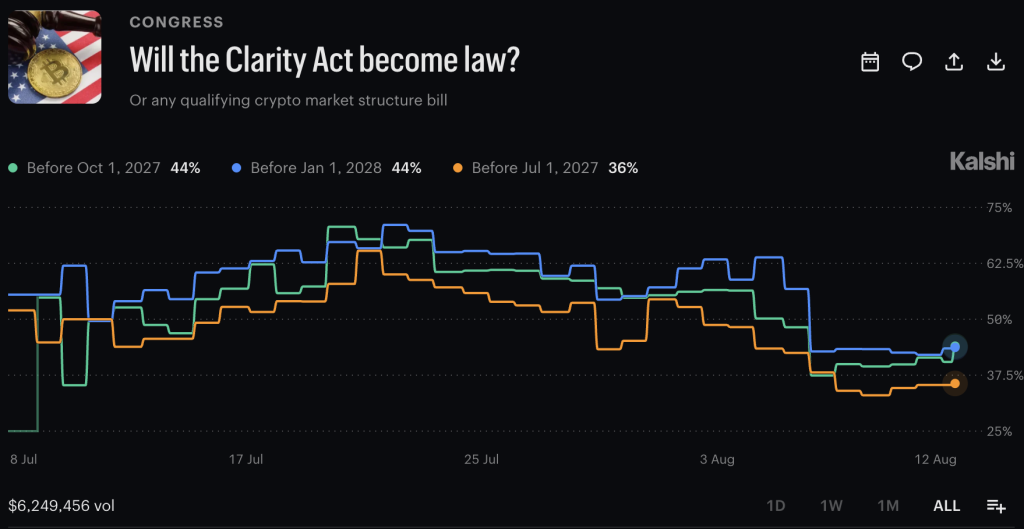
Even if the Senate Banking Committee marks up its bill in April as targeted, lawmakers would still need to merge it with the Agriculture Committee’s version, clear a 60-vote floor threshold, and reconcile the result with the House’s CLARITY Act, all before midterm politics freeze legislative activity.
Sen. Bernie Moreno put a hard number on the risk: “If we don’t get the CLARITY Act passed by May, digital asset legislation will not pass for the foreseeable future.”
For traders, that timeline is the variable worth tracking over policy headlines about the guidance itself. An SEC interpretation can be revised or withdrawn by a future commission without a congressional vote, while a passed statute can’t.
This is a gap that has already shown up in how institutional flows have responded to the delay, and one that will continue to matter for how much durable pricing power crypto regulation actually carries this year.
Discover: Your Market Calls Are Worth Something. Start With Free $25 on Kalshi
The post SEC-CFTC Crypto Map Advances as Clarity Act Stalls appeared first on Cryptonews.
Just a day after real-time flight tracking website FlightAware filed a lawsuit against prediction markets platform Kalshi over use of its name and data, the flight data company gave notice of voluntary dismissal of the case.
In a Tuesday filing in the US District Court for the Southern District of New York, attorneys for FlightAware said that they had voluntarily dismissed the case against Kalshi. The flight tracking company had filed the lawsuit a day earlier, claiming that Kalshi had used its “data and name to run gambling markets on flight cancellations.”
While the immediate turnaround could suggest a closed-door settlement, neither company had publicly commented on the case as of Wednesday. On Tuesday, a judge ordered Kalshi to show cause why the court should not issue a temporary restraining order over FlightAware’s trademark and data.
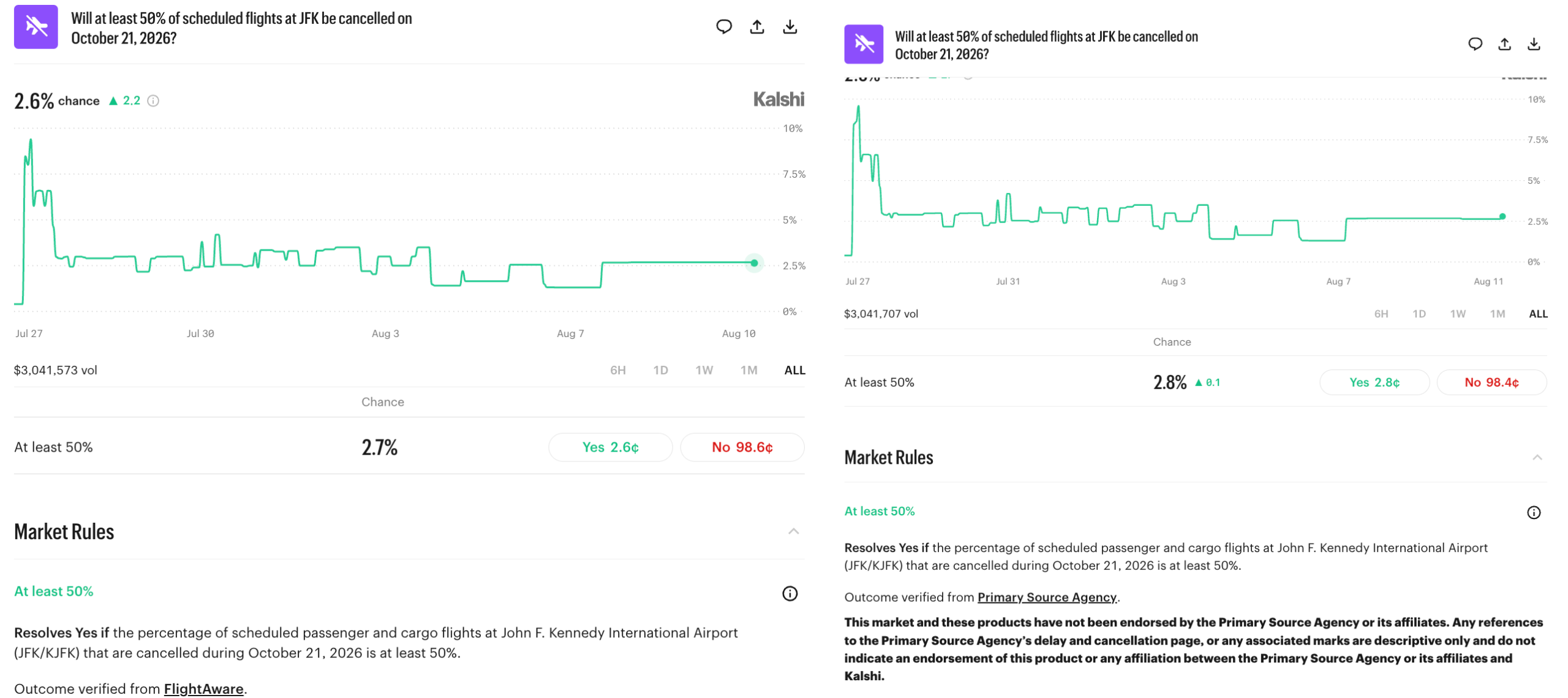
Notably, at least one event contract showed that Kalshi had changed its language from “FlightAware“ to “Primary Source Agency” as the entity responsible for verifying data related to the outcome of flight cancellations, including that the trade did not “indicate an endorsement of this product or any affiliation” between FlightAware and Kalshi. Primary Source Agency linked to FlightAware’s website. Cointelegraph reached out to the companies for comment but did not receive an immediate response.
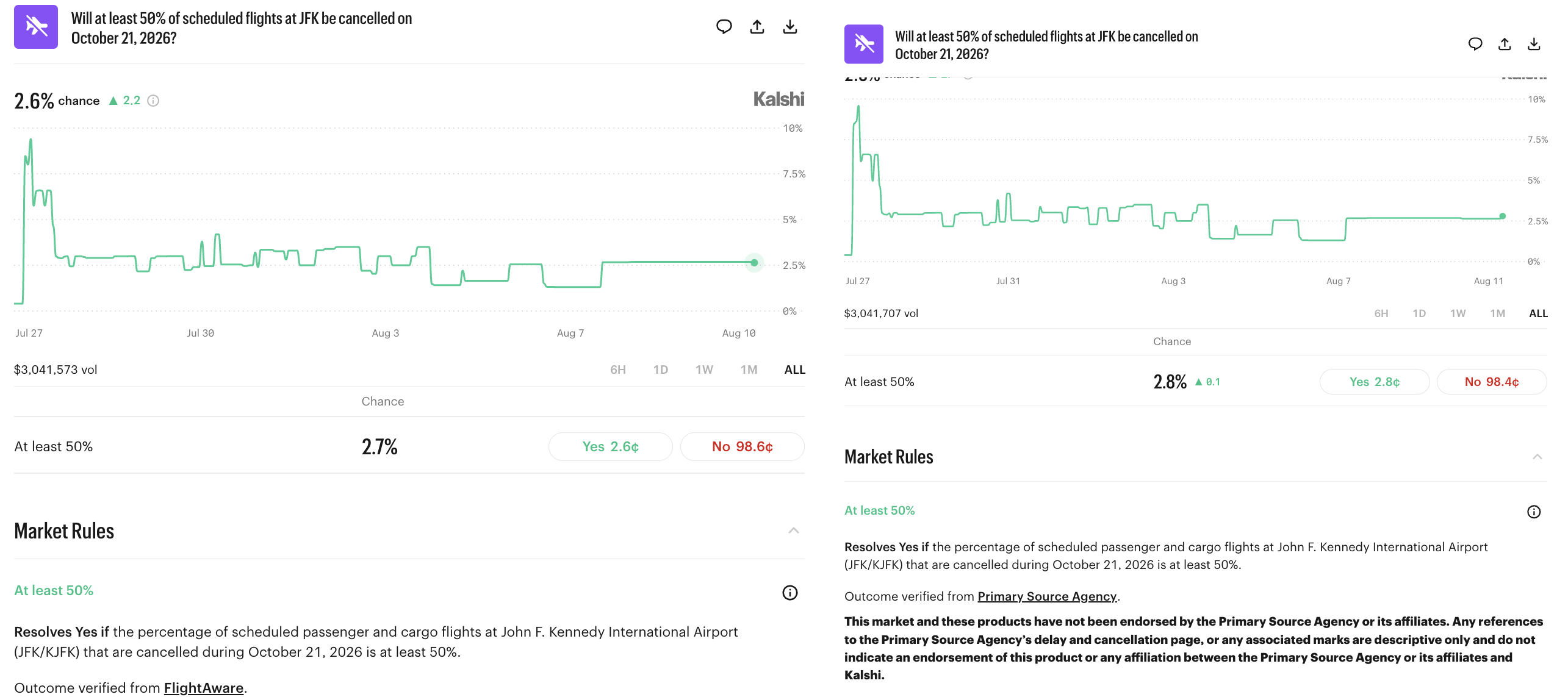
Side-by-side comparison of event contract citing FlightAware data before the lawsuit was dropped (left) and after (right). Source: Kalshi
Related: Kalshi launches sports and crypto perps data feed on DoubleZero
FlightAware’s suit had alleged trademark infringement, breach of contract, injury to its reputation and unfair competition in the latest legal action involving prediction market companies. Kalshi, Polymarket and other prediction market companies face legal action brought by many US state gaming authorities and regulators over alleged illicit sports betting offered to residents.
CFTC still at odds with state authorities over prediction markets
On Tuesday, the US Commodity Futures Trading Commission (CFTC), whose chair Michael Selig has repeatedly claimed the agency has “exclusive jurisdiction“ over prediction markets, said it had invoked “emergency authority“ to block New York state officials’ attempts to seek a temporary restraining order prohibiting the company from offering event contracts nationwide. The action followed New York authorities filing a lawsuit against Kalshi in July, alleging that the company was operating an unlicensed gambling platform through its contracts on sports and other events.
The CFTC decision echoed the agency’s actions in a Michigan case over Kalshi. In June, a Michigan judge ordered the company to stop offering sports betting contracts to residents until the civil case reached a conclusion. However, the CFTC under Selig ordered Kalshi not to comply with the state order — something the company’s head of enforcement and legal counsel said put it in an “impossible position“ between US state and federal orders.
Magazine: El Salvador’s Bitcoin experiment turns 5: ‘It was for us, not them’
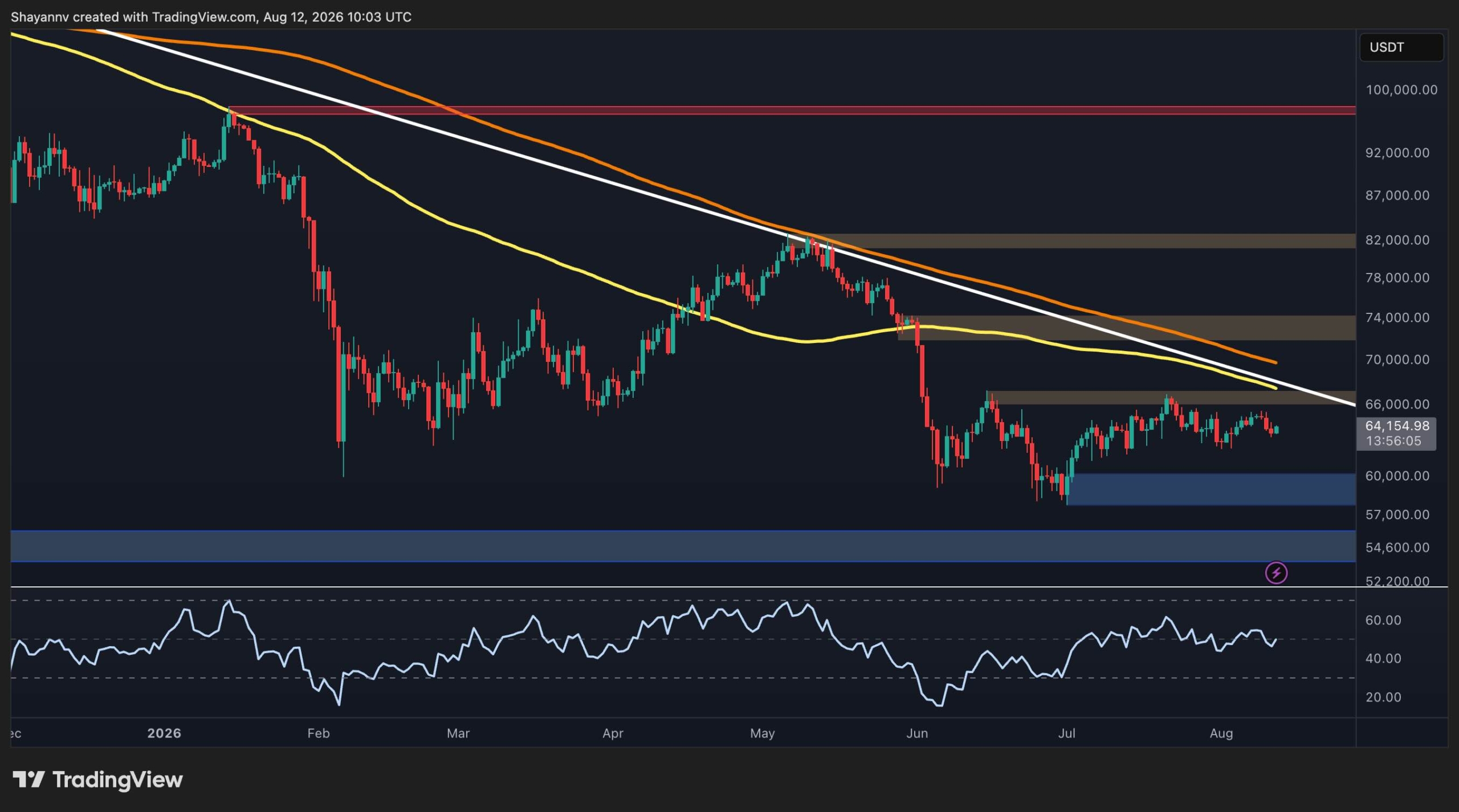
Bitcoin remains trapped in a broad consolidation phase, with the price struggling to break above the descending resistance that has governed the market for several months. At around $63.5K, BTC is showing some short-term recovery, but the broader structure remains cautious until the key resistance zones are decisively broken.
Bitcoin Price Analysis: The Daily Chart
The daily chart shows Bitcoin trading below a descending trendline that connects the major highs since the beginning of the year. The trendline currently sits around the $66K area, making this the first major hurdle for the buyers. A daily breakout above this resistance would represent an important structural improvement and could open the door toward the $74K resistance zone.
The broader trend remains bearish-to-neutral; however, BTC is still trading below the major moving averages displayed on the chart. The longer-term moving averages are sloping downward, reinforcing the significance of the descending trendline.
On the downside, the $60K area represents an important support zone, while the broader $54K region is the next major demand area visible on the chart. Holding above these levels keeps the current consolidation structure intact, whereas a sustained breakdown could signal another leg lower.
BTC/USDT 4-Hour Chart
The 4-hour chart provides a more constructive picture in the short term. Bitcoin has been forming a tightening structure, with an ascending support trendline converging toward a descending resistance trendline. The price is currently around $64K, leaving the market relatively close to the upper boundary.
The key resistance is concentrated around $66K-$67K. A clean breakout above this zone, particularly if accompanied by a sustained move beyond the descending trendline, could trigger a continuation toward the $66K-$67K area and potentially higher.
Conversely, the rising support line and the $62K zone are the most important levels to watch on the downside. A break below this area would weaken the short-term bullish structure and could expose BTC to the $60K support zone again.
The 4-hour RSI has also rebounded from near-oversold conditions and is now recovering toward the middle of its range. This points to improving momentum, although it is not yet strong enough to confirm a sustained upside breakout. For now, the market appears to be waiting for a decisive break from the tightening range.

Sentiment Analysis
The funding-rate chart provides an interesting contrast to Bitcoin’s price action. Funding rates were deeply negative during the sharp sell-off earlier in the year, with several significant spikes below zero as BTC traded around the $70K-$80K region. This indicated that bearish positioning had become particularly aggressive.
Since then, funding has gradually normalized and has turned predominantly positive. The latest reading is around 0.006%, while Bitcoin is trading near $64K. This suggests that leveraged long positioning has returned, but the funding rate is not yet at an extreme level comparable to the highly crowded periods over the past few years.
That is broadly constructive, although it also introduces some short-term downside risk. If BTC fails to break the $65K-$67K resistance area while funding remains positive, long positions could become vulnerable to a liquidation-driven pullback. Conversely, a breakout accompanied by only moderately positive funding would provide a healthier setup, as it would suggest that the move is not being driven by excessive leverage.

The post Bitcoin Price Analysis: What Does BTC’s Bearish Market Structure Signal Next? appeared first on CryptoPotato.
Flash.Trade founder Anas Khader gave three reasons for shutting down his Solana perps exchange on Aug. 7, and the second one named the Solana Foundation. Four days later the Foundation's president was publicly rejecting the word "kingmaking." The underlying discussion is how an organization with a… Read the full story at The Defiant
For the first time, TIME will publish a ranking of America’s Most Innovative Companies, in partnership with Statista, a leading international provider of market and consumer data and rankings. Innovation within a company can take many forms. For this ranking, three dimensions will be considered: product innovation, process innovation, and innovation culture. To identify the most innovative companies in the U.S., comprehensive surveys will be conducted. Employees will evaluate their own employers, providing an internal assessment of innovation; experts will recommend and evaluate companies they are familiar with, contributing an external perspective; and the strength of a company’s patent portfolio will be evaluated as an objective criterion. The survey results and objective criterion will be combined into a single score.


Norway’s sovereign wealth fund has earned a record 1.75 trillion kroner, or about $184.3 billion, in the first half of 2026 while disclosing a $1.22 billion investment in SpaceX for the first time.
Summary
- Norway’s sovereign wealth fund generated a 9.4% return during the first six months of 2026.
- Asian technology stocks helped lift first-half profit to a record 1.75 trillion kroner.
- The fund owned a 0.05% SpaceX stake worth $1.22 billion as of June 30.
- Its 10 largest investments now account for about 20% of the total portfolio.
Asian technology stocks drove the record profit
Norges Bank Investment Management reported on Aug. 12 that the Government Pension Fund Global produced a 9.4% investment return during the first half of 2026, taking its profit to 1.75 trillion Norwegian kroner.
The result surpassed the previous first-half record of 1.5 trillion kroner, set in 2023. Gains across global equity markets supplied much of the return, with Asian technology companies making an especially strong contribution.
“The result is driven by good returns in the equity market, particularly from Asian technology stocks,” NBIM CEO Nicolai Tangen said.
After losing 2.6% during the first quarter, the fund recovered as technology and semiconductor stocks advanced in the following three months. The Wall Street Journal reported that its investments returned 11.5% in the second quarter, the best quarterly performance in six years, while equities gained 16% over the period.
Currency movements had reduced the fund’s value by 427 billion kroner during the first quarter. Its market value then increased from 19.998 trillion kroner at the end of March to 22.683 trillion kroner, or about $2.3 trillion, as of June 30.
The fund received net inflows of 89 billion kroner during the first half after expenses, according to the Journal. Norway deposits revenue from its oil and gas industry into the portfolio, which invests abroad to spread the country’s wealth across global markets.
Operating under a mandate set by Norway’s Ministry of Finance, NBIM manages investments across equities, fixed-income securities, unlisted real estate, and renewable energy infrastructure. The portfolio contains holdings in about 7,100 companies across more than 50 countries and owns an average of nearly 1.5% of all listed shares worldwide.
Norway wealth fund has disclosed its first SpaceX stake
Alongside the half-year results, NBIM’s updated holdings list showed that the fund owned about 7.3 million Class A shares in SpaceX on June 30. The position represented 0.05% of Elon Musk’s aerospace company and carried a value of roughly $1.22 billion.
NBIM had not previously reported an investment in SpaceX. Deputy CEO Trond Grande said in April that the fund was discussing a possible investment with the company before SpaceX completed its U.S. listing in June.
SpaceX sold 555.6 million shares for $135 each on June 12, raising about $75 billion at a valuation near $1.75 trillion. The offering became the largest initial public offering in U.S. history, according to earlier IPO coverage by crypto.news.
Goldman Sachs led the underwriting group alongside Morgan Stanley, Bank of America Securities, Citigroup, and JPMorgan. SpaceX also allocated 30% of its offering to individual investors, compared with the smaller retail portions commonly offered in large U.S. listings.
Shares opened at $150 and climbed sharply during the company’s first trading sessions before losing part of those gains. NBIM’s investment remains small beside several early SpaceX backers, including Alphabet, whose second-quarter filing revealed a stake valued at $94.1 billion.
Google joined Fidelity in a $1 billion SpaceX funding round in 2015. As reported in July, Alphabet’s resulting position equaled about 6% of the newly listed company, although some of the shares remained subject to sale restrictions.
U.S. investors gained SpaceX exposure through major indexes
SpaceX’s public listing has given U.S. investors several routes to hold the company through shares, funds, and index-linked products. The stock entered the Nasdaq-100 on July 7, creating demand from funds that follow the U.S. technology index.
An estimated $4.3 billion in passive buying was tied to the addition, according to the earlier crypto.news report. Index-tracking funds generally purchase newly included companies to keep their portfolios aligned with the benchmark, exposing their shareholders to SpaceX without requiring a direct stock purchase.
SpaceX also connects the Norwegian fund’s new holding with the digital-asset market. The company disclosed 18,712 Bitcoin on its balance sheet following its IPO, with the position valued at about $1.2 billion around the time of its listing.
Under U.S. accounting rules adopted by the Financial Accounting Standards Board, public companies measure eligible crypto holdings at fair value. Changes in the value of SpaceX’s Bitcoin can therefore affect its reported earnings, although the asset represents only a small part of the company’s total market capitalization.
A July valuation analysis found that the Bitcoin position represented about 0.076% of SpaceX when the company was valued near $1.56 trillion. The calculation challenged descriptions of SPCX as a major Bitcoin proxy because an ordinary daily move in its stock could change more market value than its entire cryptocurrency holding.
NBIM’s SpaceX stake consequently provides the Norwegian fund with a small amount of indirect Bitcoin exposure. Based on its 0.05% ownership and SpaceX’s disclosed balance, the fund’s share of the company’s Bitcoin would be economically minor and does not constitute a direct purchase by NBIM.
Large technology holdings now make up more of the portfolio
Technology companies already occupy several of the largest positions in the Norwegian fund. At the end of June, NBIM owned a 1.28% stake in Nvidia valued at about $62 billion, making the chipmaker its biggest disclosed technology investment.
Apple followed with a position worth approximately $52 billion, while Alphabet accounted for about $50 billion. Its Microsoft and Taiwan Semiconductor Manufacturing holdings were valued at around $35 billion and $34 billion, respectively.
The figures place five technology companies among the fund’s most valuable investments. U.S.-listed equities account for about 40% of the total portfolio, giving American companies a large role in its performance even though Asian technology shares led the first-half gains.
During the results presentation, Tangen said the fund’s 10 largest holdings now represent roughly 20% of its total value. He identified the growing concentration of large technology companies as a risk for a portfolio designed to spread investments across thousands of businesses and several asset classes.
Equities make up more than two-thirds of the fund. The remaining assets are mainly fixed-income securities, along with smaller allocations to unlisted real estate and renewable energy infrastructure.


Crypto market maker Wintermute plans to invest about $1 billion in high-frequency trading and artificial intelligence data-center infrastructure over five years as it expands into stocks, commodities and foreign exchange.
The London-based firm wants non-crypto markets to generate more than 50% of revenue by the end of 2027, up from 10% now, according to a Bloomberg report citing founder and CEO Evgeny Gaevoy. Wintermute expects to fund the spending with retained earnings.
The push follows a drop in crypto activity. Wintermute’s average daily trading volume fell to about $10 billion this year from $15 billion in 2025 as bitcoin declined to roughly half its October peak above $126,000.
Institutions accounted for a record 72% of spot trading volume on its over-the-counter desk in the first half of 2026.
Gaevoy said the privately held company was profitable in 2025 and expects to remain profitable this year, without providing figures. Wintermute recorded $582 million in profit during the 2021 crypto bull market, according to Forbes.
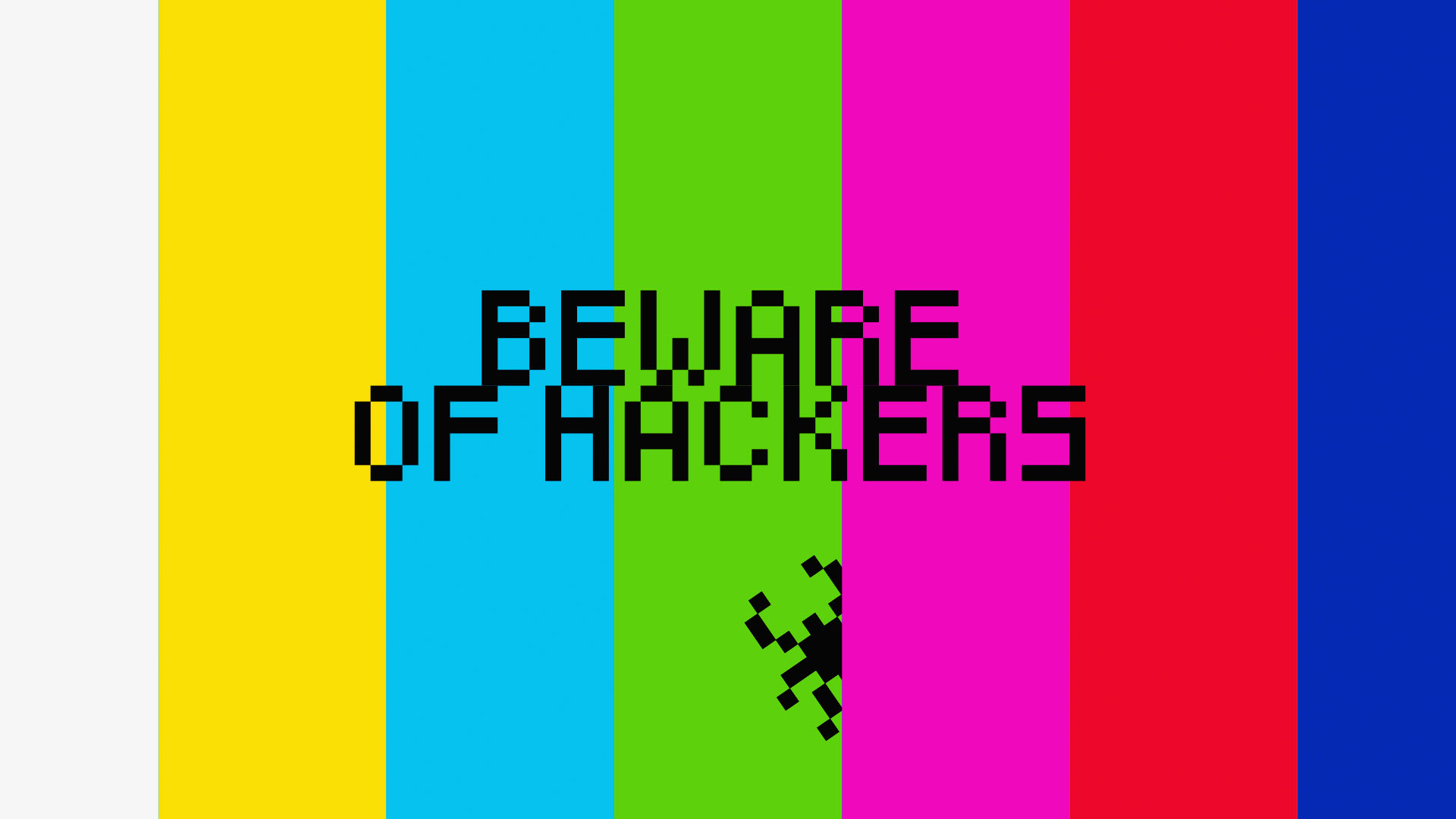

Crypto OG and self-proclaimed “financial educator” Tone Vays has admitted he was an “idiot” for giving hackers remote access to his PC during an hour-long Microsoft Teams interview.
According to Vays, the hackers, who claimed to run a legitimate YouTube Channel, downloaded Trojan malware onto his computer using the screen sharing fuction.
When he realised what happened, he disconnected his PC, reinstalled his operating system, and skipped saving any files.
“I was an idiot and gave them access control permissions,” he explained.
Read more: Solana DEX Stabble urges liquidity exit after alleged DPRK mole revealed
Vays claims that everything looks “OK,” and said that he doesn’t store any Bitcoin credentials or password details on his PC.
He compared the incident to what happened to a fellow Bitcoin educator Jimmy Song. In March, Song admitted that his Telegram was likely hacked by North Korea and used to set up fake Zoom calls with Song’s contacts with the intention of uploading malware.
Vays’ recent experience, however, appears to have scared him away from strangers and Microsoft Teams.
Indeed, he claimed he “will no longer do interviews unless I’m friends with the person. Will also never use software like Zoom or Teams or any other download, only web interfaces like Google meets.”
Got a tip? Send us an email securely via Protos Leaks. For more informed news and investigations, follow us on X, Bluesky, and Google News, or subscribe to our YouTube channel.

SpaceX Supplier Tumbles As Mounting IPO Costs Cut Into Earnings
SpaceX short sellers are running out of bullets as stock rebounds 38% off low

All 10 Hayao Miyazaki Fantasy Movies, Ranked

Weekend Open Thread: Staud – Corporette.com

Weekend Open Thread – Corporette.com

Weekend Open Thread: Brooks Brothers

EARNING APP | NEW EARNING APP TODAY | NEW LOOT OFFER TODAY | MONEY EARNING APPS | ONLINE EARNING APP

Yahoo Finance Live: Daily Market Coverage – August 10, 2026 9AM-11AM (ET)

How financial ruin gave rise to a dangerous new politics | The Story of Money
-

 Fashion5 days ago
Weekend Open Thread: Mattifying Sunscreen
-

 Fashion5 days ago
Frugal Friday’s Workwear Report: Cap-Sleeve Pointelle Crewneck Sweater
-

 News Videos4 days ago
Can Astrology Help Find Gold and Silver Trends? A Financial Astrology Guide
-

 Sports7 days ago
Jordan Coyle & Cordiamo take Laya Arena Stakes at RDS
-
 Business7 days ago
US stocks: Dow closes at record on Mideast optimism; SpaceX, AMD drag Nasdaq
-

 Politics6 days ago
Reform UK And Greens Sink To Lowest Favourability Ratings To Date
-

 Business7 days ago
Supply chain issues impact Ingredion
-

 Tech5 days ago
Rinn Pharma & Biopharma to join NordicPharmaTrain network
-

 Business4 days ago
How to Start a Cleaning Business: A Step-by-Step Guide
-

 Business3 days ago
Datadog: Best Of Breed For Multiple Reasons
-

 Business4 days ago
BDC Weekly Review: Private BDC Q2 Numbers Are Strong
-
 NewsBeat18 hours ago
Communication cards help banking customers access services or report scams
-
Sports7 days ago
Spider-Man: Brand New Day ending explained: Is Peter Parker alive?
-

 Fashion7 days ago
Suit of the Week: Me + Em
-
 Tech6 days ago
Price Hikes May Be Coming for PC Motherboards Next
-

 Business6 days ago
Brightwater secures funding for WA-first dementia projects
-
 Crypto World6 days ago
Galaxy Digital Stock Slides 14% as Crypto Prices Hit Earnings
-
 Business2 days ago
Oil Price Today (August 11): Crude oil rises to $88 after Trump’s compensation demand dents Hormuz opening. Here’s why
-
 Politics7 days ago
The Not-So Talented Mr Arday
-

 Business6 days ago
SpaceX Shares Plunge 13.6% After First Public Earnings as AI Capex Surge and Lockup Spark Selloff
You must be logged in to post a comment Login