
Crypto World
MSBT’s 0.14% fee shakes market



The bitcoin ETF fee war reached its lowest point ever today as Morgan Stanley’s MSBT launched at 0.14% annually on NYSE Arca, directly undercutting every competing spot bitcoin fund in the US market, from BlackRock’s IBIT at 0.25% to Fidelity’s FBTC at 0.25% to Grayscale’s Bitcoin Mini Trust at 0.15%.
Summary
- MSBT’s 0.14% is the lowest fee ever set by a US spot bitcoin ETF; for every $10,000 invested, holders save $11 annually versus IBIT — a gap that reaches $110,000 per year at a $100 million institutional allocation
- Morgan Stanley’s 16,000 financial advisors, who previously could only recommend third-party bitcoin ETFs from BlackRock or Fidelity, now have a house-branded product that redirects management fee revenue back to the bank
- IBIT retains a significant structural advantage with approximately $70.6 billion in assets and the deepest liquidity in the spot bitcoin ETF market; for active institutional traders, IBIT’s tight bid-ask spreads likely outweigh the 11-basis-point fee gap
The bitcoin ETF market entered a new competitive phase today as Morgan Stanley’s MSBT set a fee floor that every existing fund now sits above. As Unchained Crypto reported, the full fee ranking now stands: MSBT at 0.14%, Grayscale Bitcoin Mini Trust at 0.15%, Bitwise BITB at 0.20%, ARK 21Shares ARKB at 0.21%, and both BlackRock’s IBIT and Fidelity’s FBTC at 0.25%. Grayscale’s Bitcoin Mini Trust, previously the cheapest option since it launched in July 2024, now sits in second place.
Phong Le, CEO of Strategy, publicly dubbed MSBT “Monster Bitcoin” following the launch announcement — a reflection of how the market views the combination of Morgan Stanley’s distribution reach and the lowest cost in the category.
The fee difference between MSBT and IBIT is 11 basis points. At the retail level, that translates to $11 per year on every $10,000 invested. At a $10 million institutional allocation, the annual saving is $11,000. At $100 million, the gap is $110,000 per year. Over a five-year horizon at that scale, the difference reaches $550,000 before accounting for any divergence in performance tracking or liquidity costs.
The question for existing IBIT holders is whether switching is financially rational. IBIT’s $70.6 billion in assets and dominant options trading volume give it liquidity advantages that support large trades at tighter spreads. For institutions that trade frequently, those execution savings likely outweigh the fee gap. For long-term, infrequent allocators, MSBT’s lower cost compounds meaningfully over time.
Why This Is Structurally Different From Prior Fee Competition
Every fee reduction in the spot bitcoin ETF market until today came from asset managers competing against each other. MSBT is the first fee reduction driven by a bank issuing directly under its own name. That distinction matters for distribution. Since 2024, Morgan Stanley’s 16,000 advisors have been permitted to recommend third-party ETFs, with management fees flowing to BlackRock or Fidelity. MSBT redirects that revenue stream in-house for the first time.
As crypto.news reported, MSBT enters a market where IBIT and FBTC have collectively drawn over $74.3 billion in net inflows. The arrival of a bank-issued, lower-cost option with a captive advisor network introduces a competitive dynamic the spot bitcoin ETF market has not previously seen.
As crypto.news noted, Bitwise advisor Jeff Park argued at the time of the S-1 filing that Morgan Stanley building a branded product confirms the total addressable market is larger than the industry anticipated — because a bank with $9.3 trillion in client assets would not build proprietary infrastructure for a market it did not believe would grow.
Early MSBT flow data over the coming sessions will be the first real signal of whether fee leadership alone can drive meaningful adoption in a market where BlackRock’s first-mover liquidity advantage has proven resilient for over two years.

Crypto World
RWA Marketing Shifts From Hype to Structure as Institutional Capital Grows More Discerning

TLDR:
- Yield promises no longer close RWA deals — investors now demand verified legal structures and default procedures first.
- Credibility built through clean repayment records outperforms any paid marketing campaign in the RWA sector today.
- Regulatory arbitrage across jurisdictions like Malaysia and Switzerland is becoming a core feature, not a legal workaround.
- Instant redemption and pre-funded liquidity layers are now the clearest signal that an RWA project is built to last.
RWA marketing is undergoing a fundamental shift across the crypto industry. Projects that once relied on yield promises are now held to a much higher standard.
Institutional and retail investors are demanding legal clarity, collateral transparency, and defined default procedures before committing capital.
The market drawdown of October 2025 accelerated this change considerably. As tokenized real-world assets attract more scrutiny, the strategies that worked a year ago are no longer enough to close deals.
Credibility and Structure Replace Yield as the Core Pitch
The days of leading with high APY figures are largely over in RWA marketing. Investors are now asking harder questions about legal structures, collateral custody, and enforcement rights.
Projects that answer those questions clearly are gaining the most traction. This shift reflects a broader maturation across the tokenized asset space.
@liqvid_xyz captured this directly: “You can’t sell trust with a story. You need structure, transparency, and execution.” That standard now applies to every project seeking serious capital.
Institutional allocators, in particular, are running thorough due diligence before committing. According to @RealFinOfficial, onboarding a bank or major asset originator can take six to eighteen months.
Credibility, meanwhile, has become the most valuable asset any project can hold. It cannot be purchased through advertising spend or influencer campaigns.
Instead, it is built month by month through clean repayment records and verifiable history. @eightlends has reported zero defaults since launch — a fact that speaks louder than any marketing pitch.
Regulatory arbitrage is also playing a quiet but powerful role. Projects are selecting jurisdictions like Malaysia, the Philippines, and Switzerland to structure their offerings legally.
@metafyed noted they operate under Malaysian and Philippine frameworks. However, explaining that regulatory strategy to buyers remains an ongoing challenge, with most drop-off occurring at that educational moment.
Liquidity and Education Remain the Two Biggest Growth Levers
Beyond structure, liquidity is fast becoming the defining feature of competitive RWA projects. Most tokenized assets still carry TradFi-style redemption timelines, sometimes taking hours or days to settle.
That friction limits the appeal to both retail and institutional participants. Smart projects are now building pre-funded liquidity layers and instant redemption mechanisms to close that gap.
@AmpleProtocol made clear that narrative alone is not enough today. “Everyone is looking for a combination of tokenomics plus Product Market Fit with most projects right now,” they stated.
Without a functional product behind the story, even a well-structured narrative loses credibility fast. Liquidity, in that context, is proof of execution.
Education remains one of the most consistent barriers to growth in this sector. Many crypto users are unfamiliar with SPV structures, collateral agents, and enforcement rights. @eightlends noted that growing in RWA is really about education more than anything else.
Walking users through the full process — from borrower verification to onchain monthly payments — is what converts interest into investment.
The three main audiences — institutional allocators, high-net-worth investors, and wealth managers — each require a tailored approach. Wealth managers particularly need cross-border yield products that clear compliance hurdles for their clients.
Serving these intermediaries well creates leverage across the entire distribution chain. That approach, paired with transparent structure, separates the projects that scale from those that stall.

For several weeks, the oil market remained directly influenced by the US-Iran tensions. Threats to close the Strait of Hormuz kept Brent prices within the $97–110 range. Overnight on 8 April, the parties announced a two-week ceasefire, and the Strait of Hormuz reopened to shipping, immediately removing the accumulated geopolitical premium from prices. Brent declined by over 10%, falling towards the $92 per barrel level.
However, later the same day, the ceasefire came under pressure. Gulf states reported Iranian drone and missile strikes, with the UAE, Kuwait, and Bahrain confirming attacks on oil facilities and infrastructure. Iran subsequently suspended vessel transit through the Strait of Hormuz, citing a breach of the agreement by Israel, which had conducted strikes in Lebanon. Israel clarified that the ceasefire does not apply to Lebanon.
Negotiations are scheduled for 10 April in Islamabad, although the outcome remains uncertain. The market continues to show high sensitivity to any changes in diplomatic or military rhetoric. In parallel, OPEC+ approved an increase in oil production quotas on Sunday, adding further supply-side pressure.
Technical Picture
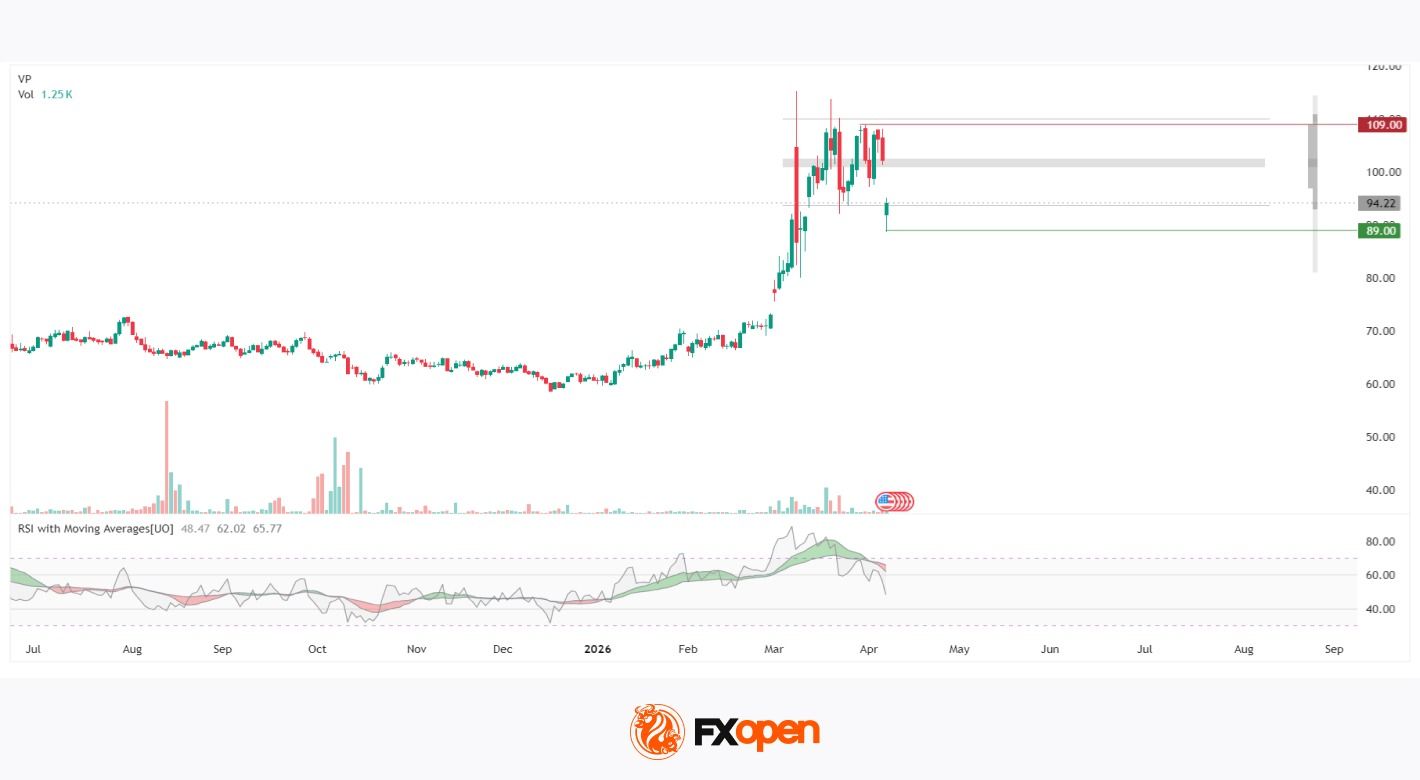
On the daily chart, the prolonged consolidation within the $60–75 range concluded with an impulsive rally towards $115, driven by geopolitical escalation in February–March 2026. Notably, on 18 March, vertical volume recorded a peak spike, confirming the climactic nature of the move.
The market failed to sustain these elevated levels, and the subsequent correction pushed prices down to $89, where the price approached the lower boundary of a horizontal volume cluster. Above current levels, the market profile remains dense, with the highest concentration of trading activity (POC) located in the $101–103 range. This area could serve as the nearest upside reference, with a breakout requiring significant buyer participation. The next resistance level could be $109.
For sellers, the key support level could be $89. A break below this level aligns with the base of the previous session and may influence short-term bearish positioning.
The RSI with Moving Averages (nominal) indicator presents a similarly notable picture. The RSI has remained below both moving averages for the past 10 days, with both MAs trending downward. This signals a weakening bullish impulse and a shift towards a neutral-to-bearish oscillator configuration.
Key Takeaways
Brent prices corrected sharply following the removal of the geopolitical premium and increased supply pressure from OPEC+. From a technical perspective, the price remains below the POC zone, while the RSI+MA configuration reflects a bearish context. The key range levels—89 and 109—could be reference points for the upcoming session.
Start trading commodity CFDs with tight spreads (additional fees may apply). Open your trading account now or learn more about trading commodity CFDs with FXOpen.
This article represents the opinion of the Companies operating under the FXOpen brand only. It is not to be construed as an offer, solicitation, or recommendation with respect to products and services provided by the Companies operating under the FXOpen brand, nor is it to be considered financial advice.
Grayscale Research has labeled Aave (AAVE) a potential “household name,” describing the Decentralized Finance (DeFi) lending protocol as “a bank without bankers” in a new blog.
“Aave is not yet a household name, but we think it will be eventually. Aave is essentially a bank without bankers—a decentralized lending marketplace on Ethereum and other blockchains that takes deposits and makes loans without any human operators,” Grayscale’s Head of Research Zach Pandl wrote.
Pandl pointed to the Bank of Canada’s report. Researchers found that Aave operates with a notably lower net interest margin (NIM) than leading US and Canadian banks, largely due to its lower intermediation costs.
“The Bank of Canada concluded that ‘lending without traditional intermediaries is viable in a technical and operational sense,’ and that Aave ‘operates continuously, transparently, and with minimal overhead, demonstrating the potential of protocol-based credit markets.’ The combination of lower operational costs, attractive rates, and ‘always on’ banking could be a powerful combination for adoption and long-term growth,” the blog added.
Pandl noted that Aave is still “young” and has yet to address complex challenges like credit scoring and undercollateralized lending. However, no lending system is flawless, as recent stress in private credit markets highlights.
“We believe that Aave, a leading onchain lending platform, and its native AAVE token, are poised for long-term growth,” he concluded.
Follow us on X to get the latest news as it happens
Analyst Nick highlighted the protocol’s strengths in a recent post. It generated approximately $142 million in net revenue in 2025, with cumulative lending volume surpassing $1 trillion. Fees reached over $885 million, putting it on track for a strong run rate into 2026.
Token Terminal data showed its TVL has declined since late 2025 to $42.6 billion in April. Despite this, Aave remains the top lending protocol, controlling around 50% of the market share.
“Aave is becoming the onchain credit layer that survives cycles and pulls in real-world capital imo,” he said.
However, on-chain data paints a more cautious picture. AAVE exchange reserves surged to 2.23 million tokens, reversing a year-long declining trend and signaling potential sell pressure.
Whales have also been offloading the token this year, while recent contributor departures have impacted investor confidence. AAVE trades near $90, down roughly 5% over the past day amid a broader market downturn.
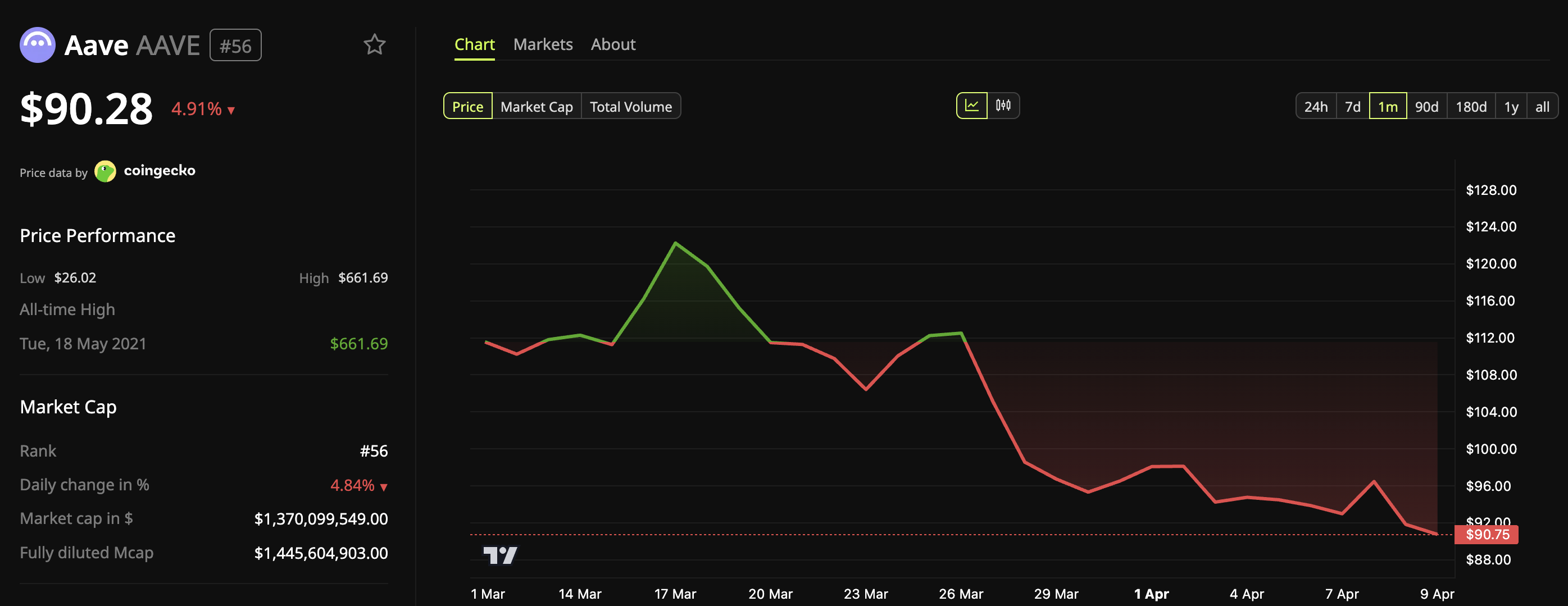
Whether Grayscale’s long-term thesis plays out may depend less on protocol metrics and more on whether market sentiment can catch up to the fundamentals.
Subscribe to our YouTube channel to watch leaders and journalists provide expert insights
The post Grayscale Predicts This DeFi Token Will Become a ‘Household Name’ in Crypto appeared first on BeInCrypto.
US Federal Reserve members were split on whether the war in the Middle East could spur further interest rate cuts before the end of 2026, according to minutes from the Federal Open Market Committee’s (FOMC) March meeting.
On Wednesday, the Fed released minutes from its last FOMC meeting on March 17 and 18. The meeting ended with an 11-1 vote to keep rates steady at 3.5% to 3.75%, with many officials cautious about the potential impacts of war and what it could mean for the economy.
Amid a risk of further conflicts, the official consensus pointed to a potential rate cut this year, but as Fed officials noted in the minutes, only if inflation does not get out of control.
“Many participants judged that, in time, it would likely become appropriate to lower the target range for the federal funds rate if inflation were to decline in line with their expectations,” according to the Fed minutes.
Rate cuts are generally seen as a positive catalyst for crypto as they free up investment liquidity and can spur demand for speculative investments. The last interest rate cut was Dec. 10, 2025, with the Fed slashing rates by 25 basis points.

While a cut may still be on the table for this year, the general feeling from the FOMC meeting was that it was “too early to know how developments in the Middle East would affect the U.S. economy.”
The FOMC’s next meeting is scheduled for April 28-29.
Cuts still possible, but so are hikes
While some officials were cautiously optimistic about a rate cut, others warned that the opposite might be necessary.
“Some participants judged that there was a strong case for a two-sided description of the Committee’s future interest rate decisions … reflecting the possibility that upward adjustments to the target range for the federal funds rate could be appropriate if inflation were to remain at above-target levels.”
Related: Iran weighing crypto tolls for ships using Strait of Hormuz: Report
Inflation was not the only concern, as many officials pointed to potential downside risks in the labor market, arguing that “in the current situation of low rates of net job creation, labor market conditions appeared vulnerable to adverse shocks.”
According to the CME Group’s FedWatch tool, there is currently a 75.6% chance that the Fed will keep rates at 3.5% to 3.75% during the Fed’s Dec. 8 meeting later this year.
Meanwhile, the chance of a rate cut is 20.4%, while the chance of a rate hike is 2.4% at the time of writing.
Magazine: AI agents will kill the web as we know it: Animoca’s Yat Siu
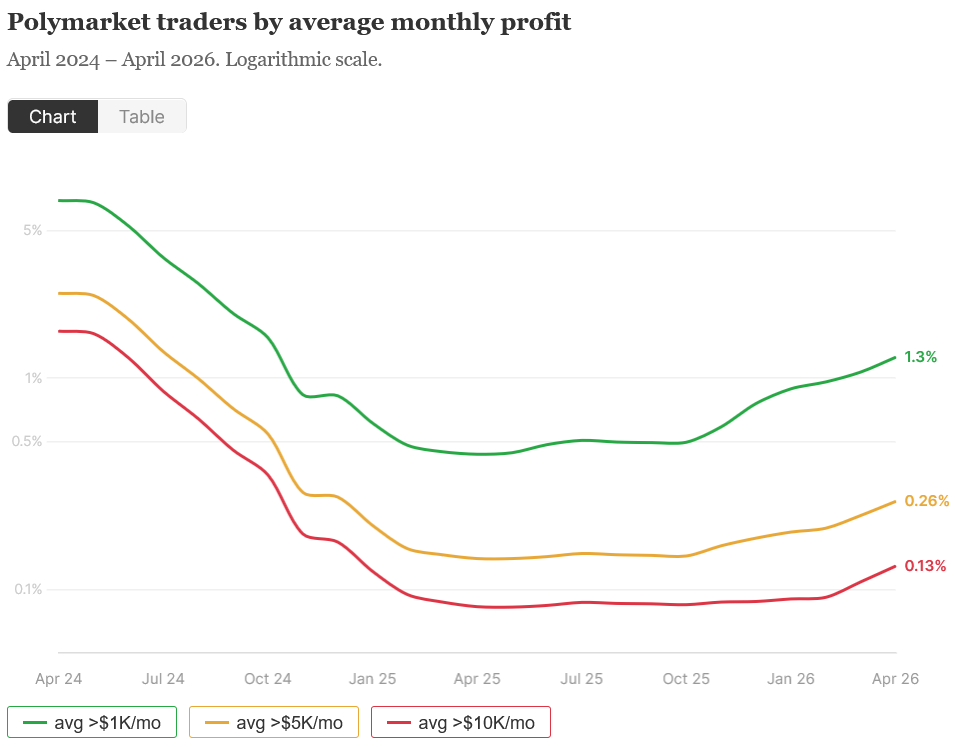
Just 0.015% of Polymarket traders can reliably make $5,000 or more a month, according to new data, meaning the idea of quitting a full-time job to trade prediction markets is unrealistic for most.
Data from crypto analyst Andrey Sergeenkov on Monday found that while nearly 1% of Polymarket traders earned more than $5,000 in a single month, only 0.1% managed to repeat that the following month and just 0.015% were able to sustain it for four consecutive months.

The average US monthly salary is around $5,220, according to Consumer Shield.

Prediction markets have become one of the fastest-growing use cases in crypto, enabling users to speculate on outcomes across politics, sports, finance and cultural events.
Most prediction markets use binary “yes” and “no” shares priced between $0 and $1 that reflect perceived probabilities. Traders can profit by buying undervalued shares and selling higher or holding winning outcomes that settle at $1 when the event has concluded.
Sergeenkov’s findings were framed alongside a report about Logan Sudeith, a former financial risk analyst who quit his job and turned to prediction markets, where he profited $100,000 in December.
Sergeenkov also highlighted an X post from former Messari analyst “Tulip King,” who claimed in November that “Polymarket is the easiest place in crypto to make six figures right now.”
Related: Three Polymarket traders made timely bets on US-Iran ceasefire
However, Sergeenkov’s data found that only 840 wallets (roughly 0.033% of Polymarket traders) have profited over $100,000.
Not all of these wallets would be retail traders, either, as professional traders working at hedge funds and other firms are also trading in prediction markets.
“Less experienced users tend to trade less successfully,” Sergeenkov noted.
Most successful traders make profits and bounce
The more successful traders don’t stick around long either, Sergeenkov said, pointing out that only 172 of 6,600 wallet addresses with average monthly profits above $5,000 remained active more than a year.
“That’s 2.6%,” Sergeenkov said. “Most traders show up, trade for a short period, and leave.”
Sergeenkov’s analysis didn’t come without limitations. The researcher noted that he only factored in realized profits and losses, though he claimed that 96% of trading volume comes from already resolved markets.
Data was taken from April 2024 through to April 1, 2026.
Magazine: Asia Express: Phantom Bitcoin checks, China tracks tax on blockchain

A single geopolitical policy announcement may have just rewritten Bitcoin price prediction. Iran is reportedly requiring ships transiting the Strait of Hormuz to pay tolls in Bitcoin, instantly transforming the world’s most critical oil chokepoint into a live crypto settlement corridor.
According to the Financial Times report confirmed by Bitcoin Magazine, Iran’s Oil, Gas and Petrochemical Products Exporters’ Union spokesperson Hamid Hosseini confirmed the toll is set at $1 per barrel, with a fully loaded supertanker could face a charge approaching $2 million per transit.
Vessels have only seconds to complete payment once approved; the compressed window is explicitly designed so transactions cannot be traced or seized under existing sanctions. The policy applies during a two-week ceasefire window, with empty tankers exempted.
JUST IN: — Watcher.Guru (@WatcherGuru) April 8, 2026
 Iran to require ships passing through the Strait of Hormuz to pay tolls in Bitcoin, FT reports. pic.twitter.com/6yoIEys139
BTC had already surged past $72,000 on ceasefire news alone, recovering sharply from the $67,000 range where it held during Trump’s April 4 ultimatum weekend. The Hormuz toll announcement adds a second, structurally different catalyst, adding Bitcoin’s role in geopolitical infrastructure.
Discover: The best pre-launch token sales
Bitcoin Price Prediction: Hormuz Toll and Geopolitical Tension
Bitcoin’s technical setup entering this week was already constructive. Price reclaimed $69,000 Monday after volatile swings between $65,000 and $74,000 tied to Operation Epic Fury strike updates and oil price moves.
Support is well-defined as institutional bids have clustered at the $65,800–$66,000 zone, which held during the worst of the escalation fear in early April. Resistance sits at $71,000–$75,000, a range BTC is currently pressing against.
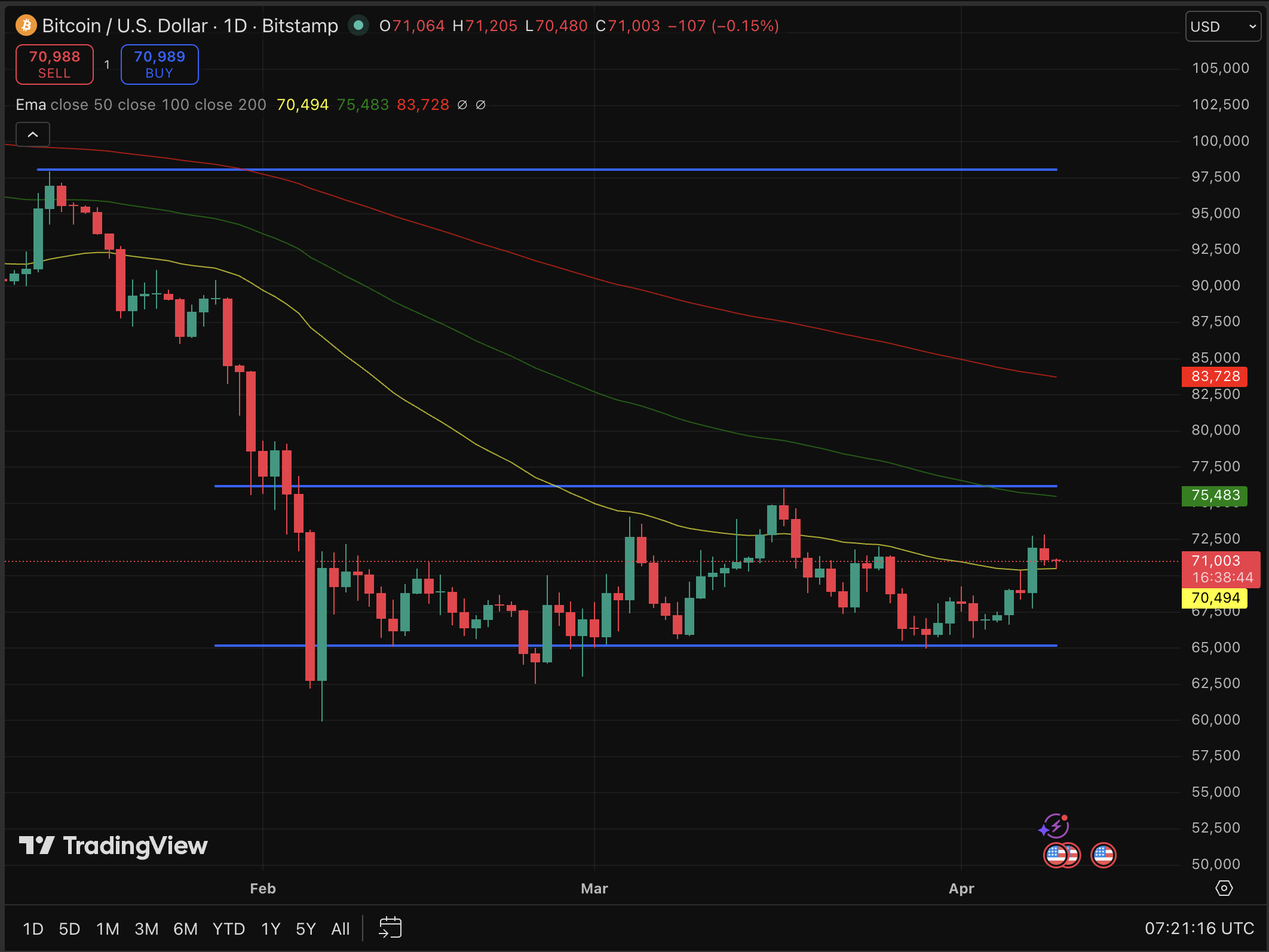
Oil crashed 16% from its $100+/barrel peak as ceasefire signals emerged, a deflationary impulse that historically benefits risk assets. Bitcoin’s resilience relative to equities during the Hormuz escalation period signals decoupling behavior in a bullish structural read.
If the ceasefire holds through the two-week window, Hormuz BTC tolls process live transactions, adoption narrative ignites, and the price can then target $100,000 after, with analysts flagging exactly this level on sustained risk-on sentiment.
The ceasefire expires in approximately 12 days. Every day it holds is a day BTC tolls process, and a day the “Bitcoin as sovereign payment rail” narrative compounds. Tick, tock.
Discover: The best crypto to diversify your portfolio with
Hyper Targets Bitcoin’s Bullish Outlook
Bitcoin at $71,000 is a strong position, but the math of a move to $100K from here represents roughly 40% upside for spot holders. For traders who missed the run from $65K, that asymmetry feels thinner than it looks. The rotation question becomes: where does the upside of early-stage Bitcoin infrastructure lie?
Bitcoin Hyper ($HYPER) is making a case for exactly that allocation. Positioned as the first-ever Bitcoin Layer 2 with Solana Virtual Machine (SVM) integration, the project targets Bitcoin’s core structural weaknesses. Bitcoin is known for slow finality, high fees, and the absence of programmable smart contracts.
The SVM integration is the technical differentiator: it delivers sub-second transaction processing, faster than Solana’s base chain itself, with low-cost execution and a Decentralized Canonical Bridge for native BTC transfers.
The presale has raised $32 million at a current price of $0.0136 per $HYPER, with staking available at a high APY during the presale window. If the Hormuz toll story accelerates institutional and retail focus on Bitcoin’s infrastructure layer, early-stage Layer 2 projects absorb that attention before spot BTC does.
Research Bitcoin Hyper here before the presale window closes.
The post Bitcoin Price Prediction: Iran Hormuz Toll Might Spark BTC USD Rally to $100K appeared first on Cryptonews.
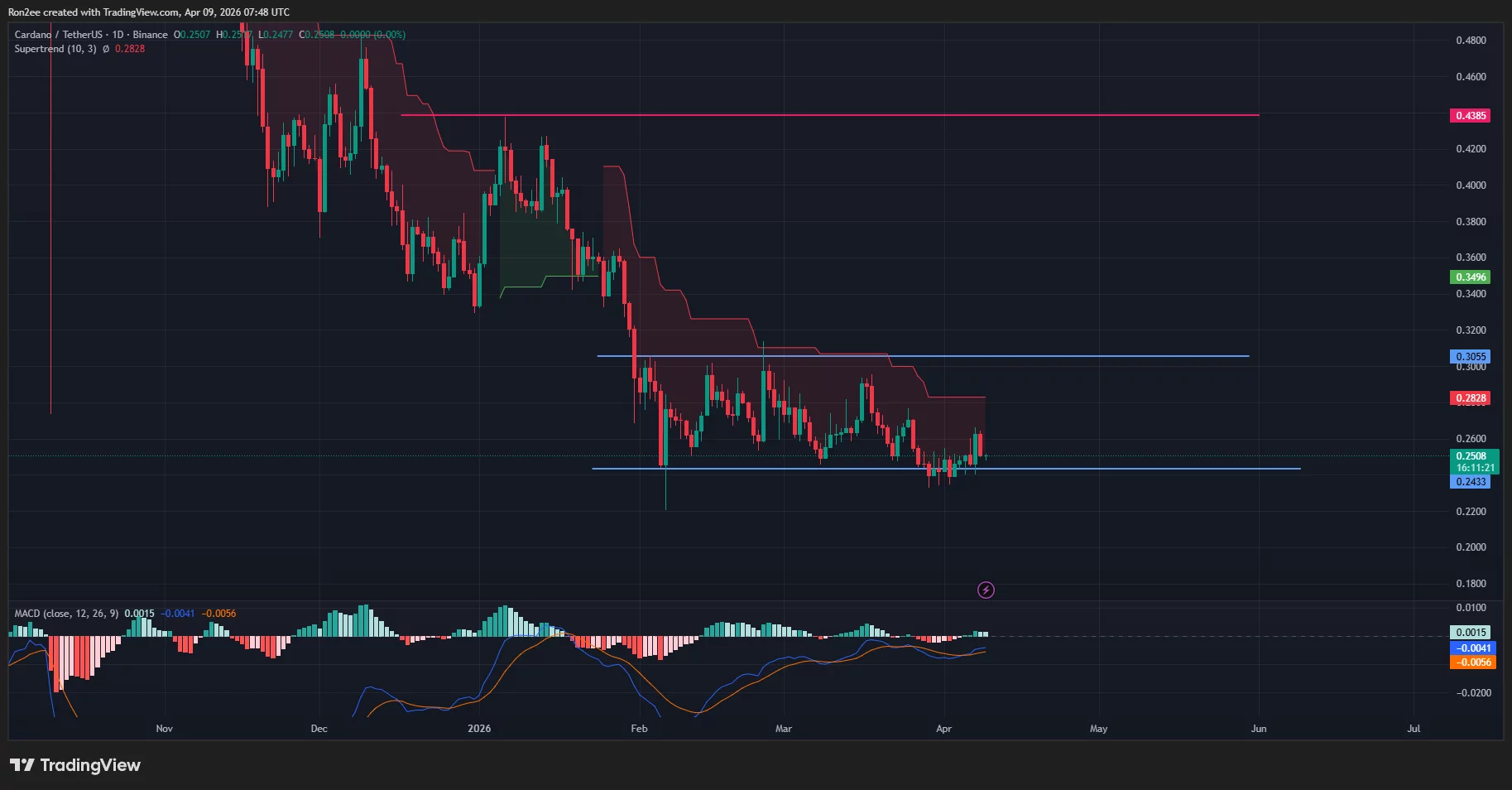
Cardano price fell over 5% towards $0.25 on Thursday, paring off a part of its gains seen on the previous day.
Summary
- Cardano price fell 5.7% to around $0.25 as a broader crypto market sell-off triggered profit-taking after the U.S. Iran ceasefire news.
- Nearly $545K in long positions were liquidated over 24 hours, significantly outweighing short liquidations and adding downward pressure.
- Whale wallets holding over 10M ADA rose to a four-month high, signalling continued accumulation despite recent price weakness.
According to data from crypto.news, Cardano (ADA) price fell 5.7% from $0.263 on Wednesday to $0.248 on Thursday morning before settling at the $0.25 mark.
This decline occurred amid a broader sell-off across the cryptocurrency market as investors booked profits after they sold the U.S.-Iran ceasefire news. Bitcoin (BTC), the bellwether asset, was down 1.2% below the $71,000 figure. Ethereum (ETH) fell by 3.4% while other major crypto assets, such as BNB (BNB), XRP (XRP), and Solana (SOL), were all in the red with even more significant losses.
As Cardano price fell, it caught highly leveraged long traders off guard across the derivatives market. Data from CoinGlass show that nearly $545K worth of long positions were liquidated in the past 24 hours, which is nearly nine times the amount of short positions liquidated in the same timeframe.
Long liquidations occur when traders who bet bullish are caught by falling prices and are forced to sell their positions to cover their margins. When long liquidations significantly outweigh short liquidations, the asset’s price often faces intense downward pressure as the forced selling creates a cascading effect.
Despite this volatility, reports indicate that whales are still betting on the token to go up. Notably, data from Santiment shows that the number of whales holding over 10 million ADA tokens has hit a four-month high of 424 at press time. That represents a 5.2% jump over the past nine weeks, a clear sign that whales have been accumulating the token during these dips.
As such, if the whale accumulation trend continues to gain strength, they could attract the attention of retail investors. This, in turn, could potentially change the course of ADA’s current price trajectory.
On the daily chart, Cardano price has entered a horizontal channel pattern where the price was previously trading since early February.
The altcoin broke below the pattern earlier on March 29 as risk-on sentiment withered from the crypto market amidst geopolitical concerns at that time. However, the recent Cardano rebound back into the channel suggests that bulls are attempting to reclaim control.
While the Supertrend indicator still points to some lingering bearishness as it remains red, the MACD line points to a slightly bullish momentum with a bullish crossover while still remaining under the zero line.
For now, the two trendlines of the channel mark the key resistance and support areas for the token. As such, a break below the lower trendline at $0.24 could signal a deeper correction, while if bulls manage to push the price above $0.30, it could spark a fresh rally toward previous highs.
Disclosure: This article does not represent investment advice. The content and materials featured on this page are for educational purposes only.
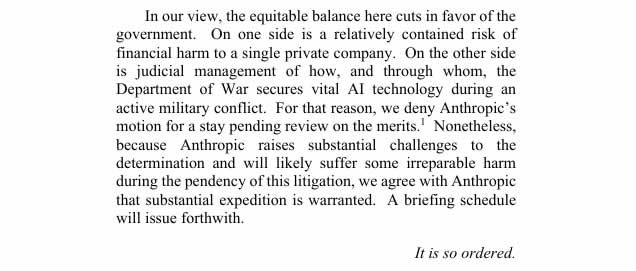
The US Court of Appeals for the DC Circuit rejected Anthropic’s request to pause a Pentagon designation labeling the firm a national security supply chain risk.
The three-judge panel denied the emergency motion for a stay on Wednesday, ruling that the government’s interest in controlling how it secures AI technology during active military conflict outweighed any financial or reputational harm Anthropic may suffer from the label.
The decision means that part of the US Department of Defense’s official designation of Anthropic’s products as a “supply-chain risk to national security” remains in place.
This designation has never been applied to an American company before and also restricts contractors who work with the Pentagon from using Anthropic’s AI models. It could set a chilling precedent for other tech companies that do not comply with government demands.
“In our view, the equitable balance here cuts in favor of the government,” wrote the three-judge panel.
“On one side is a relatively contained risk of financial harm to a single private company. On the other side is judicial management of how, and through whom, the Department of War secures vital AI technology during an active military conflict.”

Challenging the label in two courts
The dispute stems from a deal between the AI firm and the Pentagon in July 2025 on a contract to make Anthropic’s AI model Claude the first large language model approved for use on classified networks.
However, negotiations collapsed in February, with the government seeking to renegotiate and insisting that Anthropic allow military use of Claude without restrictions. Anthropic maintained that its technology should not be used for lethal autonomous weapons and mass domestic surveillance of Americans.
US President Donald Trump ordered all federal agencies to stop using Anthropic products in late February, stating that the company had made a “disastrous mistake trying to strong-arm the Department of War.”
Anthropic sued the Trump administration in March in what it termed an “unlawful campaign of retaliation.”
In late March, the District Court for the Northern District of California ordered a preliminary injunction against the Pentagon over the designation and temporarily halted Trump’s directive, branding it “Orwellian.”
Related: Anthropic limits access to AI model over cyberattack concerns
However, because of the way federal procurement law is written, Anthropic had to challenge the designation on two separate legal tracks — in a California district court on constitutional grounds and directly at the D.C. Circuit under the specific statute that authorized the designation.
The ruling acknowledged that Anthropic will “likely suffer some degree of irreparable harm absent a stay,” and stated that “substantial expedition is warranted.”
Acting US Attorney General Todd Blanche said on X that it was a “resounding victory for military readiness.”
“Military authority and operational control belong to the Commander-in-Chief and Department of War, not a tech company.”
Asia Express: Phantom Bitcoin checks, China tracks tax on blockchain
European currencies posted solid gains, while the US dollar came under pressure amid easing geopolitical tensions following reports of a two-week ceasefire agreement between the United States and Iran. Reduced demand for so-called safe-haven assets acted as the primary driver, prompting a reallocation of capital flows towards risk-sensitive instruments and developed market currencies.
Additional pressure on the dollar came from a sharp decline in oil prices, driven by expectations of stabilised supply through the Strait of Hormuz. This has lowered inflation risks and reinforced expectations of a more accommodative stance from the Federal Reserve. At the same time, US Treasury yields declined, further supporting a reassessment of the Fed’s policy outlook. Against this backdrop, money markets are once again pricing in the probability of rate cuts before year-end, limiting the dollar’s recovery potential and reinforcing the current downward momentum.
EUR/USD
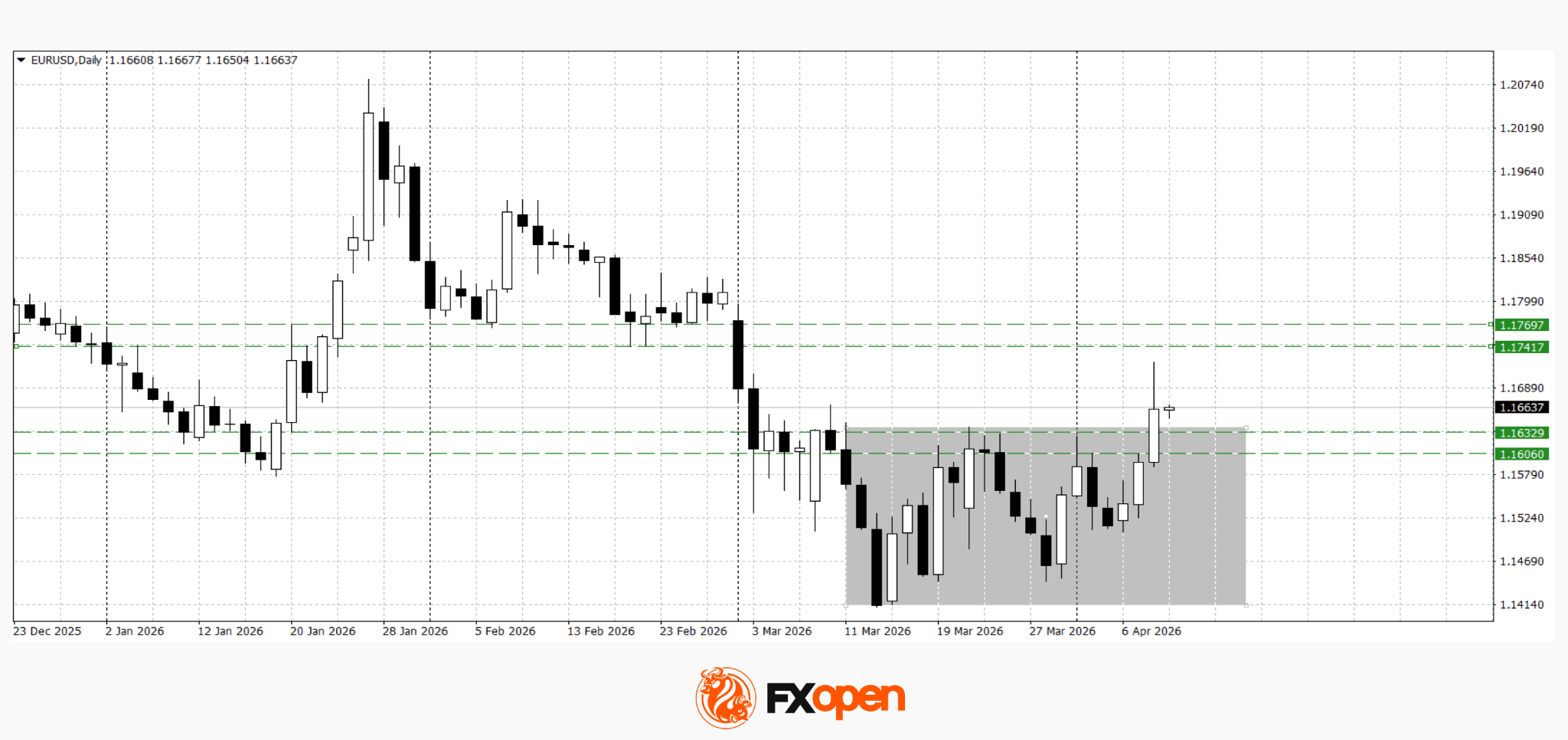
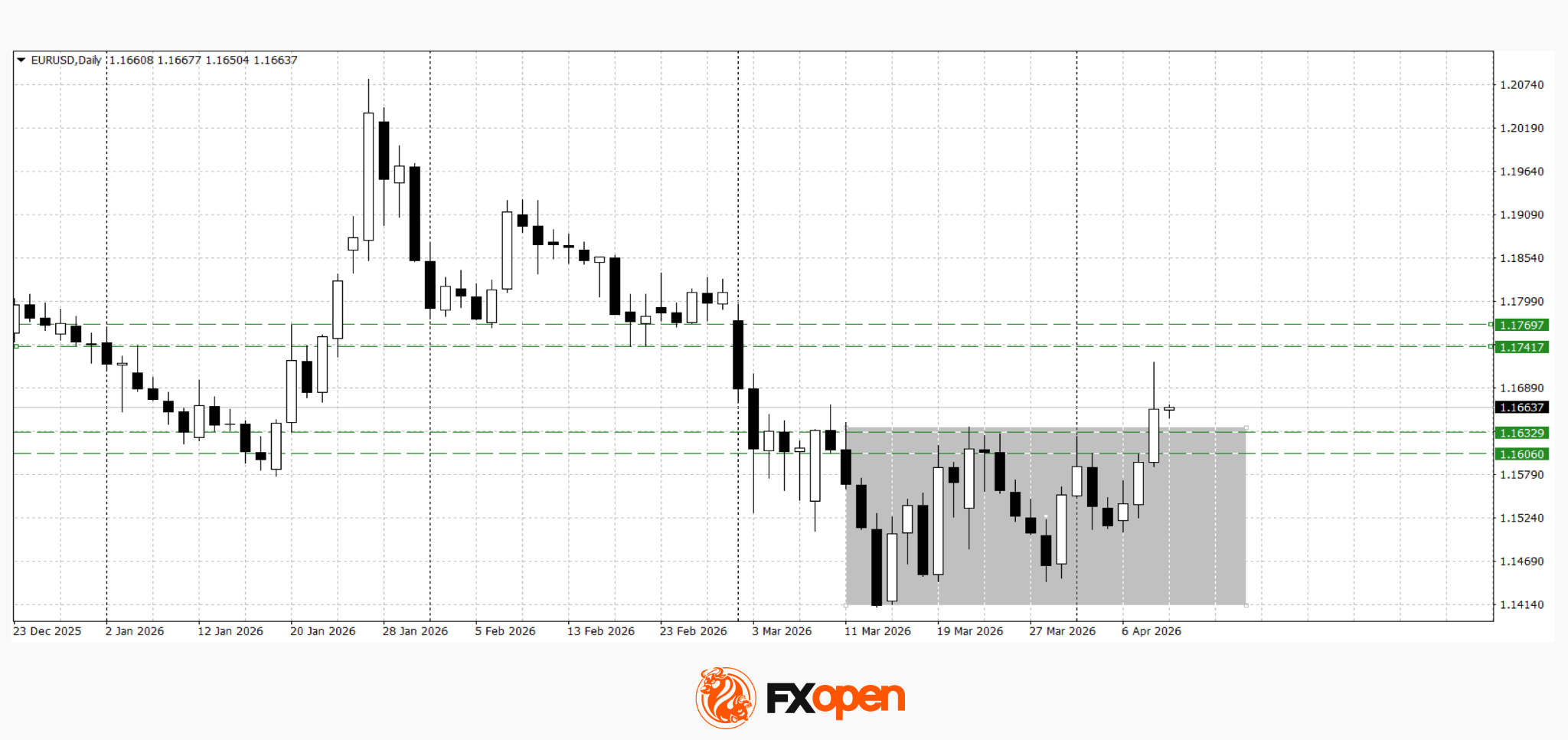
The EUR/USD pair broke out of its recent range, moving higher in line with broad-based dollar weakness. The price could continue rising towards 1.1740–1.1770. However, a short-term corrective pullback towards former resistance at 1.1610–1.1630 could happen. A daily close below 1.1600 may signal a return to the previous consolidation range.
Key events for EUR/USD:
- Today at 09:00 (GMT+3): German industrial production
- Today at 15:30 (GMT+3): US Core PCE Price Index
- Today at 15:30 (GMT+3): US GDP
GBP/USD
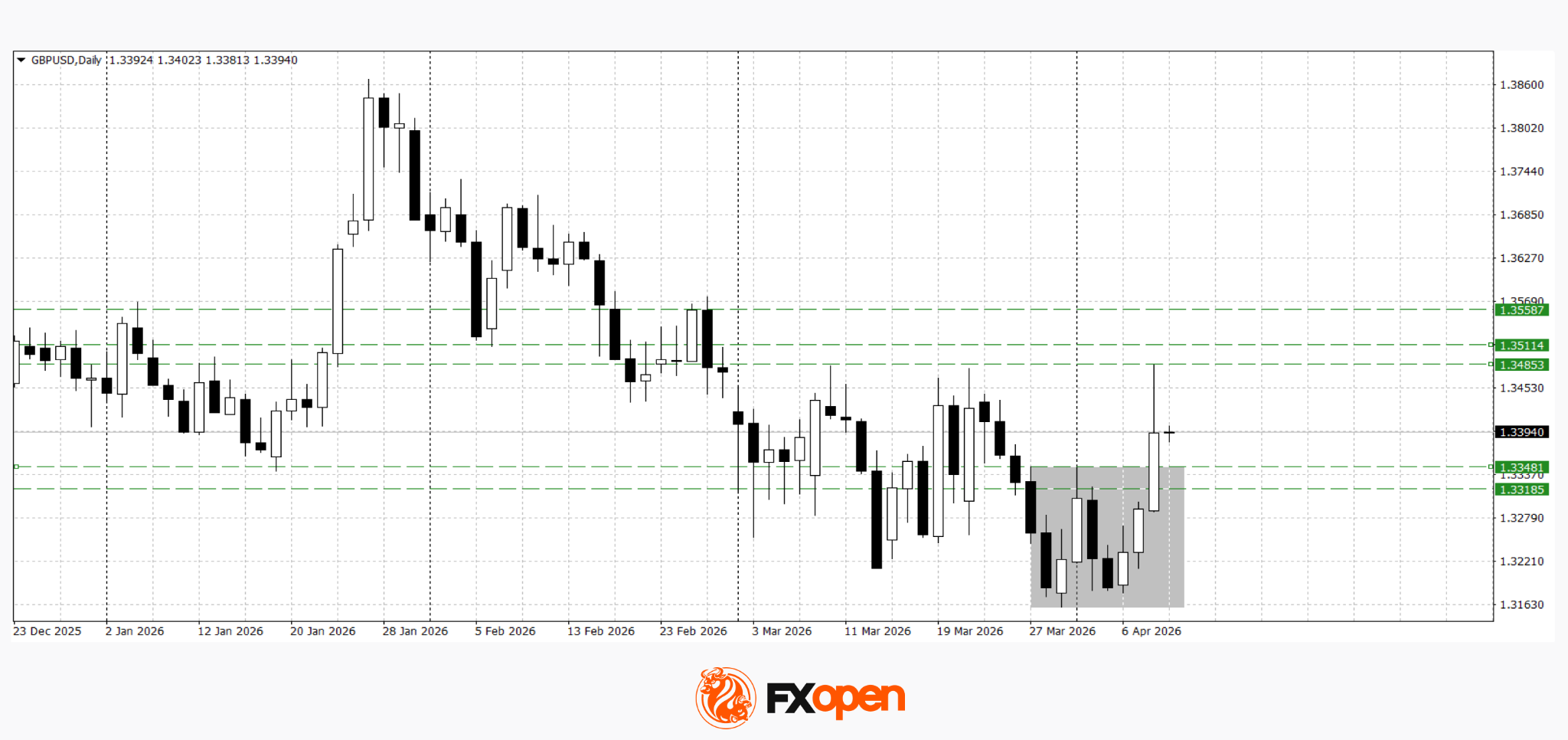
The GBP/USD pair also broke out to the upside, following the broader trend of dollar weakness. After such a sharp move, a corrective pullback towards the recent highs at 1.3320–1.3350 might be possible. A sustained move above yesterday’s high could open the way for further gains towards 1.3510–1.3560.
Key events for GBP/USD:
- Today at 11:30 (GMT+3): Bank of England Credit Conditions Survey
- Today at 12:00 (GMT+3): UK mortgage rate data
- Today at 15:30 (GMT+3): US initial jobless claims
Summary
The appreciation of European currencies is being driven by a combination of easing geopolitical tensions, declining oil prices, and a reassessment of the Federal Reserve’s policy outlook. The upside breakouts in EUR/USD and GBP/USD reflect a shift in market balance towards risk assets. However, further direction will depend on confirmation from incoming US macroeconomic data. Should downward pressure on yields persist and rate cut expectations strengthen, the dollar may continue to weaken. Conversely, stronger-than-expected data could trigger short-term stabilisation and a return to consolidation.
Trade over 50 forex markets 24 hours a day with FXOpen. Take advantage of low commissions, deep liquidity, and spreads from 0.0 pips (additional fees may apply). Open your FXOpen account now or learn more about trading forex with FXOpen.
This article represents the opinion of the Companies operating under the FXOpen brand only. It is not to be construed as an offer, solicitation, or recommendation with respect to products and services provided by the Companies operating under the FXOpen brand, nor is it to be considered financial advice.
Asset management firm Canary Capital is looking to launch a spot exchange-traded fund (ETF) tied to the PEPE memecoin.
On Wednesday, Canary filed a Form S-1 for the CANARY PEPE ETF with the US Securities and Exchange Commission. The ETF would track the performance of Pepe (PEPE), with all of the trust’s PEPE held by a custodian.
It noted that the ETF trust may hold up to 5% of the trust’s assets in Ether (ETH) to pay the transaction fees on the Ethereum network.

Canary Capital, which also offers several other crypto ETFs tracking XRP (XRP), Solana (SOL), Hedera (HBAR) and Sei (SEI), has filed for several other niche crypto ETF products in recent months.
In November 2025, Canary Capital filed to launch an ETF tracking the price of a memecoin called Mog Coin, the 353rd-largest crypto token by market cap, far behind PEPE, which is ranked 45th.
PEPE, a memecoin based on Pepe the Frog, gained traction on social media in 2024. The token is roughly 9% the size of the largest memecoin by market cap, Dogecoin (DOGE).
Grayscale’s Dogecoin ETF made its debut in November but fell well short of initial volume expectations. ETF analyst Eric Balchunas predicted at the time that the ETFs would get at least $12 million in volume. However, the ETF only saw $1.4 million on its first day.
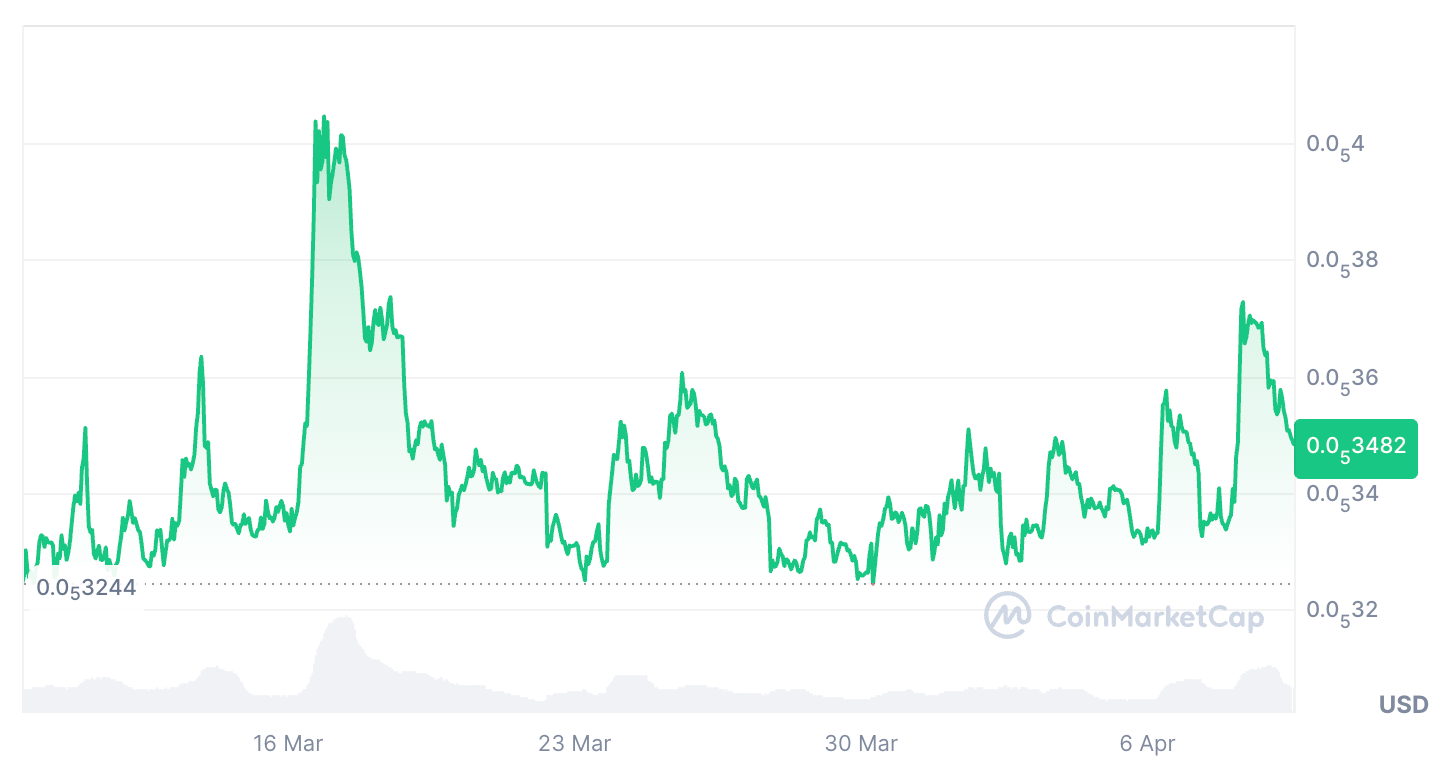
The proposed ETF also comes despite the Pepe token, which is down almost 85% from its December 2024 all-time high of $0.00002368, according to CoinMarketCap.
There are currently 513,392 holders of the PEPE, according to Etherscan data. Canary Capital warned investors that ownership of the token is “highly concentrated.” “As of January 2026, the ten largest PEPE wallet addresses collectively held approximately 41% of the total circulating supply,” the filing said.
Altcoin season may hinge on more ETFs launching
Analysts have previously said that the next altcoin cycle may hinge on more crypto ETFs launching further down the risk curve.
However, Matt Hougan, chief investment officer at investment firm Bitwise, said in March that traditional altcoin cycles are over, and that institutional investors are focused on yield-bearing digital instruments or crypto assets that capture revenue.
Fabian Dori, chief investment officer at Sygnum Bank, told Cointelegraph in December that the number of new ETF filings is expected to surge in 2026, driven by US crypto regulations.
Related: Spot Bitcoin ETF inflows top $471M but BTC is pinned under $70K: Here’s why
“On the basis of the potential passing of the Clarity Act, we would expect that new filings continue to go beyond BTC and ETH,” Dori said.
However, the US CLARITY Act has not passed as quickly as industry participants had hoped, largely due to an ongoing disagreement over stablecoin yields.
Canary’s filing warned that regulations in the US for the use of Pepe and the Ethereum network “continues to evolve,” which may impact the use of Pepe and its demand.
Magazine: Asia Express: Phantom Bitcoin checks, China tracks tax on blockchain

A Rogue AI Agent Started Mining Crypto, Which Left Scientists Concerned

US IRAN CEASEFIRE PUMPS CRYPTO & STOCKS! BITCOIN & XRP ETFS REBOUND!

Four people die attempting to cross English Channel in small boat


-

 NewsBeat7 days ago
Steven Gerrard disagrees with Gary Neville over ‘shock’ Chelsea and Arsenal claim | Football
-

 Business6 days ago
No Jackpot Winner and $194 Million Prize Rolls Over
-

 Fashion6 days ago
Weekend Open Thread: Spanx – Corporette.com
-

 Business5 days ago
Expert Picks for Every Need
-

 Business3 days ago
Three Gulf funds agree to back Paramount’s $81 billion takeover of Warner, WSJ reports
-

 Sports4 days ago
India men’s 4x400m and mixed 4x100m relay teams register big progress | Other Sports News
-

 Tech1 day ago
How Long Can You Drive With Expired Registration? What Florida Law Says
-
Business4 days ago
No Jackpot Winner, Prize to Climb to $231 Million
-

 Fashion3 days ago
Massimo Dutti Offers Inspiration for Your Summer Mood Board
-

 Tech7 days ago
Commonwealth Fusion Systems leans on magnets for near-term revenue
-

 Fashion2 days ago
Let’s Discuss: DEI in 2026
-
Politics6 days ago
Wings Over Scotland | The quality of mercy
-

 Business4 days ago
Akebia Therapeutics, Inc. (AKBA) Discusses Pipeline Progress and Strategic Focus on Kidney Disease Treatments at R&D Day – Slideshow
-
Sports7 days ago
Justin Jefferson’s Situation Remains Unchanged after JSN’s Deal
-

 Fashion6 days ago
Statement Sunglasses: The Accessory Shaping Modern Fashion
-

 Crypto World19 hours ago
Bitcoin recovers as US and Iran Agree a Ceasefire Deal
-

 Politics6 days ago
East Jerusalem Palestinian families eviction orders
-

 Fashion7 days ago
Thursday’s Workwear Report: Merino Wool Blend Short-Sleeved Sweater
-

 Sports7 days ago
Which German players will make final cut?
-

 Fashion6 days ago
For Love & Lemons’ Spring 2026 Line is for the Romantics
You must be logged in to post a comment Login